
Where is Hyperliquid restricted?
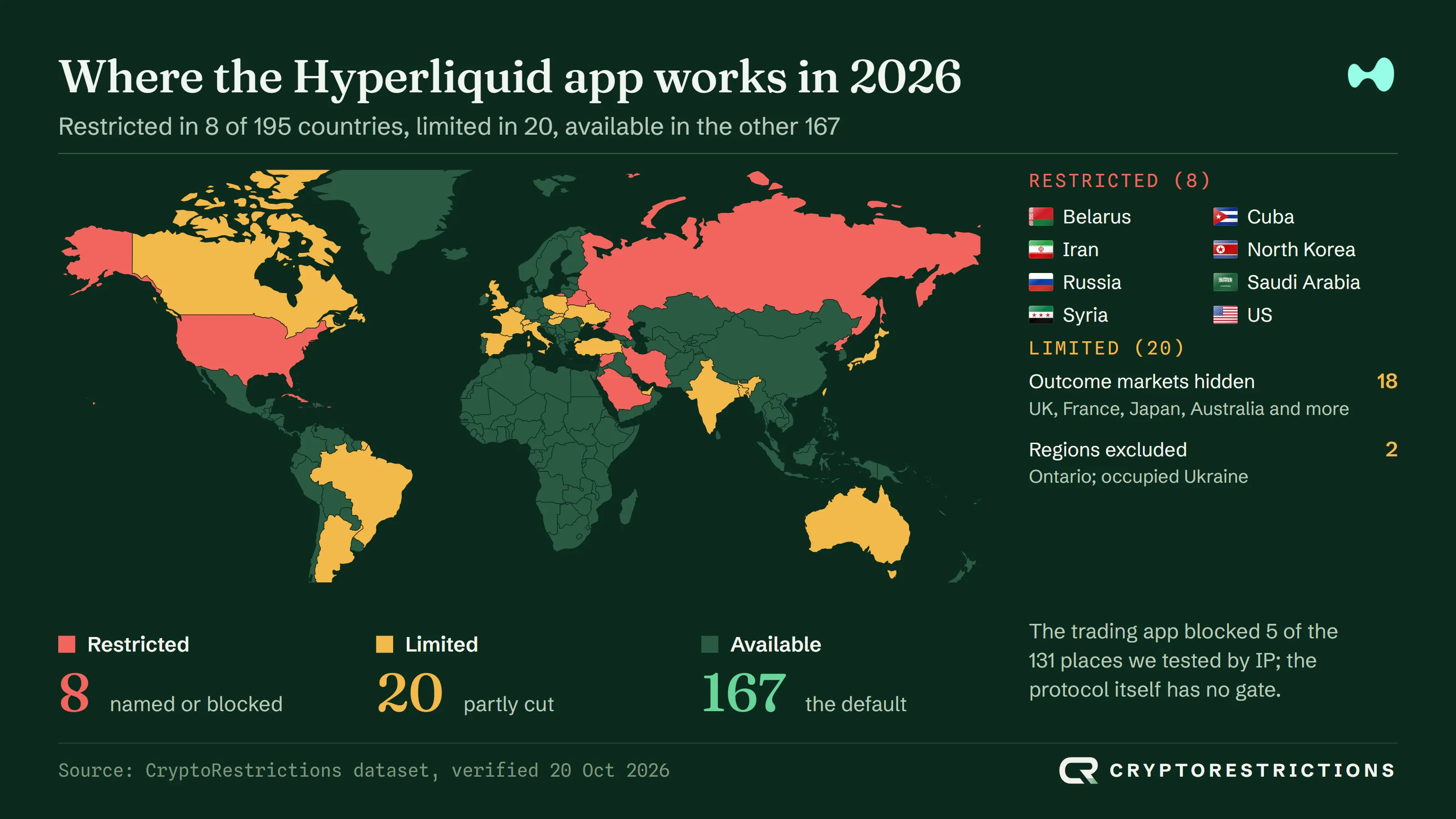
Hyperliquid is restricted in 8 of the 195 countries we cover: the  United States,
 Cuba,
 Iran,
 North Korea,
 Russia,
 Belarus,
 Syria and
 Saudi Arabia.
The rules come from the terms of use (last updated 15 June 2026) of the web app at app.hyperliquid.xyz, which Hyperliquid Corp. runs. They shut out “Restricted Persons”: anyone who lives in, is located in or is incorporated in the United States or Ontario, anyone in a place under sanctions or export controls, and citizens of those places wherever they live. Only the US and Ontario are named. We apply the sanctions limb to the countries under broad sanctions, Cuba, Iran, North Korea, Russia and Belarus, and to Syria, which the app blocks although the US lifted most of its Syria sanctions in 2025.
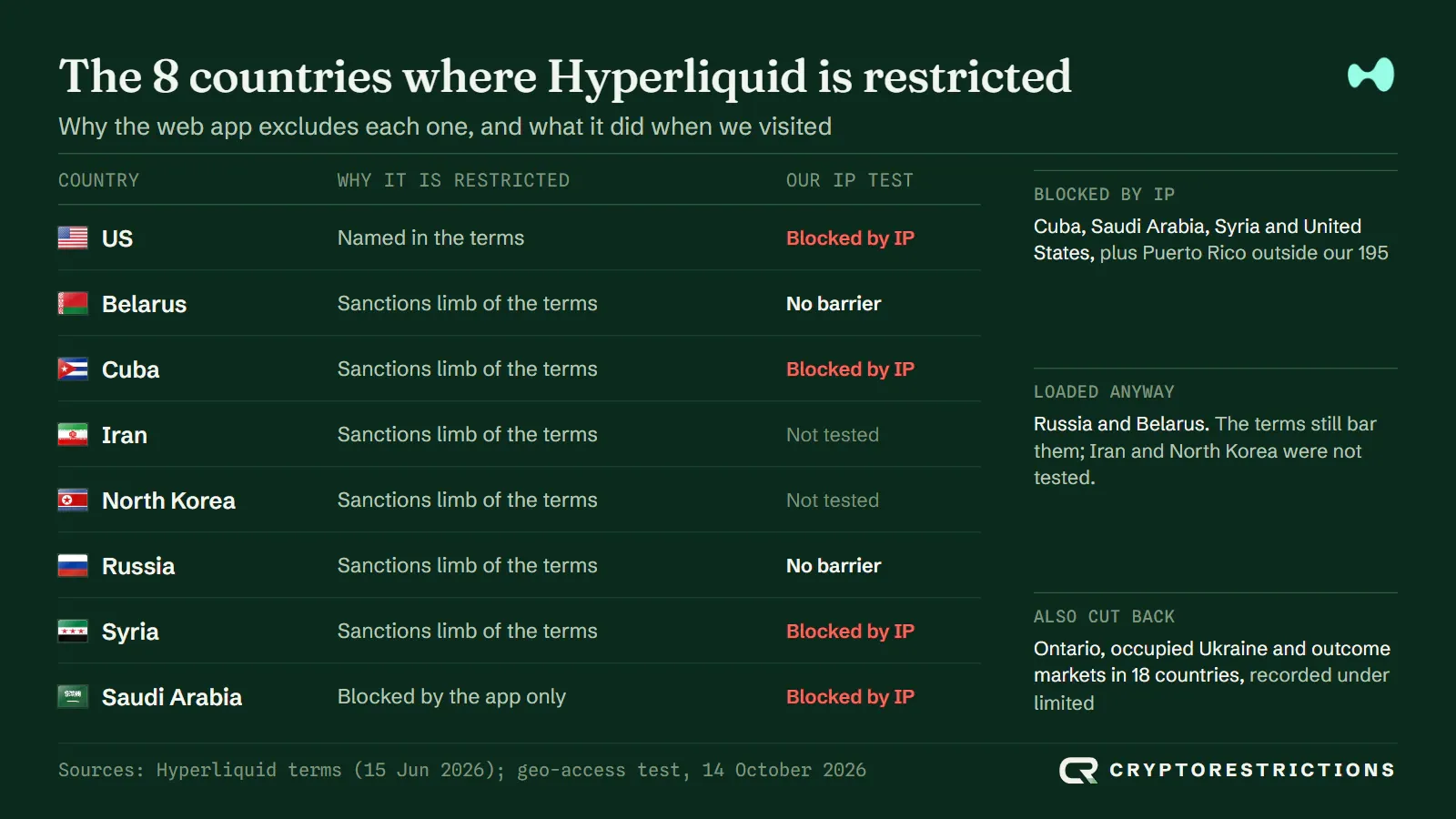
Saudi Arabia is the one we added from our own test: the terms never name it, but the trading app refused a Saudi IP address with the same banner it shows in the US, which says Hyperliquid does not allow access from sanctioned places “and other jurisdictions where our services are ineligible for use”. Puerto Rico, a US territory outside our 195, was blocked too. The full list is below: pick a country to see the cause, what applies and what our test saw.
Where is Hyperliquid limited?
Hyperliquid is limited in 20 countries: 18 where the trading app hides its outcome markets, among them the  United Kingdom,
 France,
 Japan,
 Australia,
 Singapore and
 Brazil, plus
 Canada, where Ontario is excluded, and
 Ukraine, where Crimea and the occupied Donetsk and Luhansk regions are.
Outcome markets are Hyperliquid’s prediction markets. The June 2026 terms added a second category, “Excluded Persons”, for them: people in jurisdictions Hyperliquid designates “from time to time”, and the right to block the outcome markets tab there. Hyperliquid has not published that list, so we read it from the app. In our test the Outcomes tab was missing from the menu and the positions panel in 20 places, while perpetuals and spot loaded as usual. Under our product-cut rule each of those countries is limited, with outcome markets restricted and perpetuals available. Two of the 20 are not in this group: Russia is restricted outright and Taiwan is outside our 195.
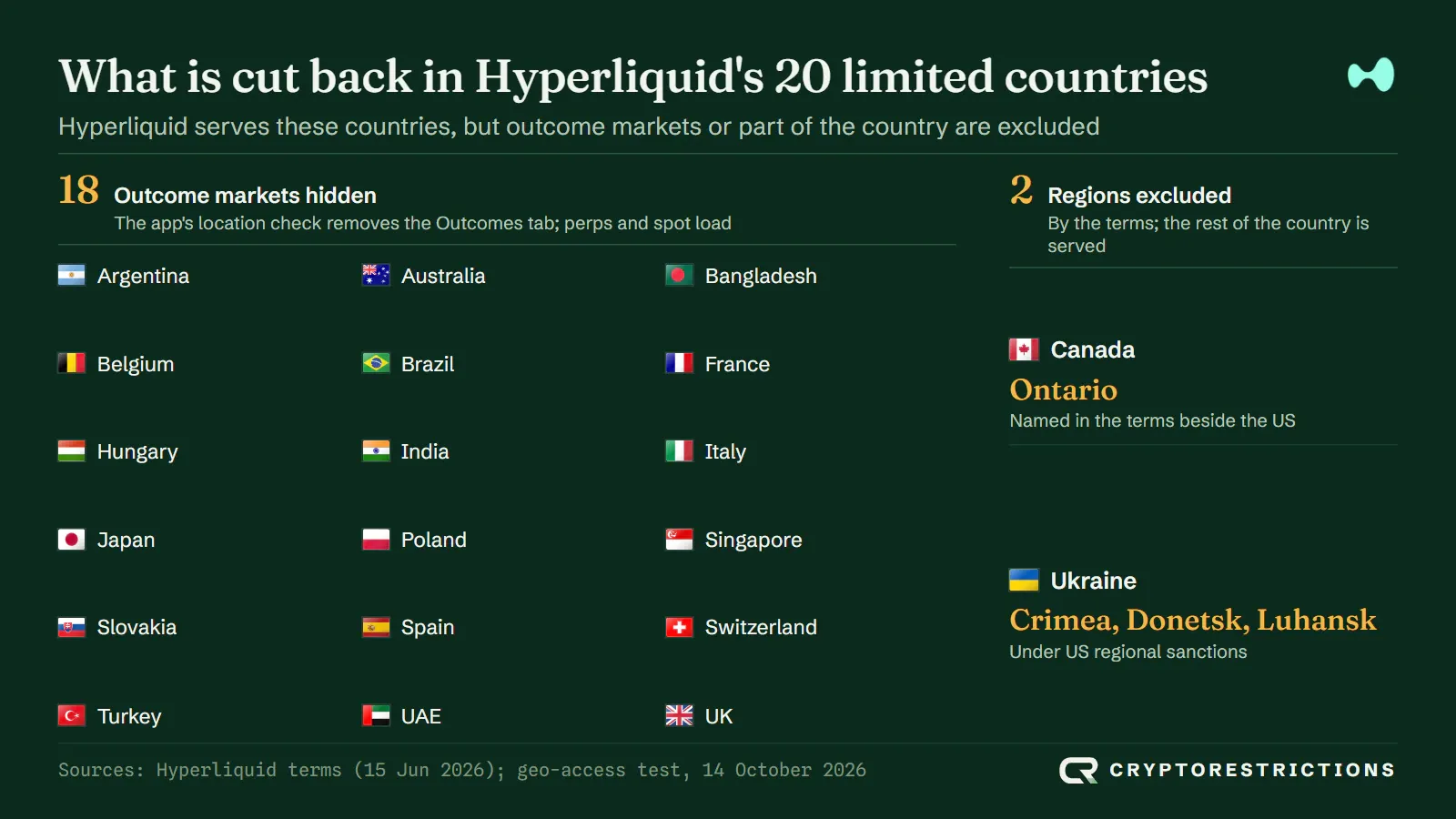
Hyperliquid gives no reason for any country, and places we could not test, such as Germany and the Netherlands, may be on its list too. The groups are below.
Where is Hyperliquid available?
Hyperliquid is available in the other 167 of the 195 countries we cover, from  Germany and the
 Netherlands to
 South Korea,
 Nigeria and
 Mexico.
None of them rests on a licence, because Hyperliquid holds none. In 102 the terms do not exclude the country and our test loaded the full trading app, Outcomes tab included; the other 65 are available under our coverage rule, since no document restricts them and we could not test them. We found no regulator that blocks Hyperliquid in any of the 167.
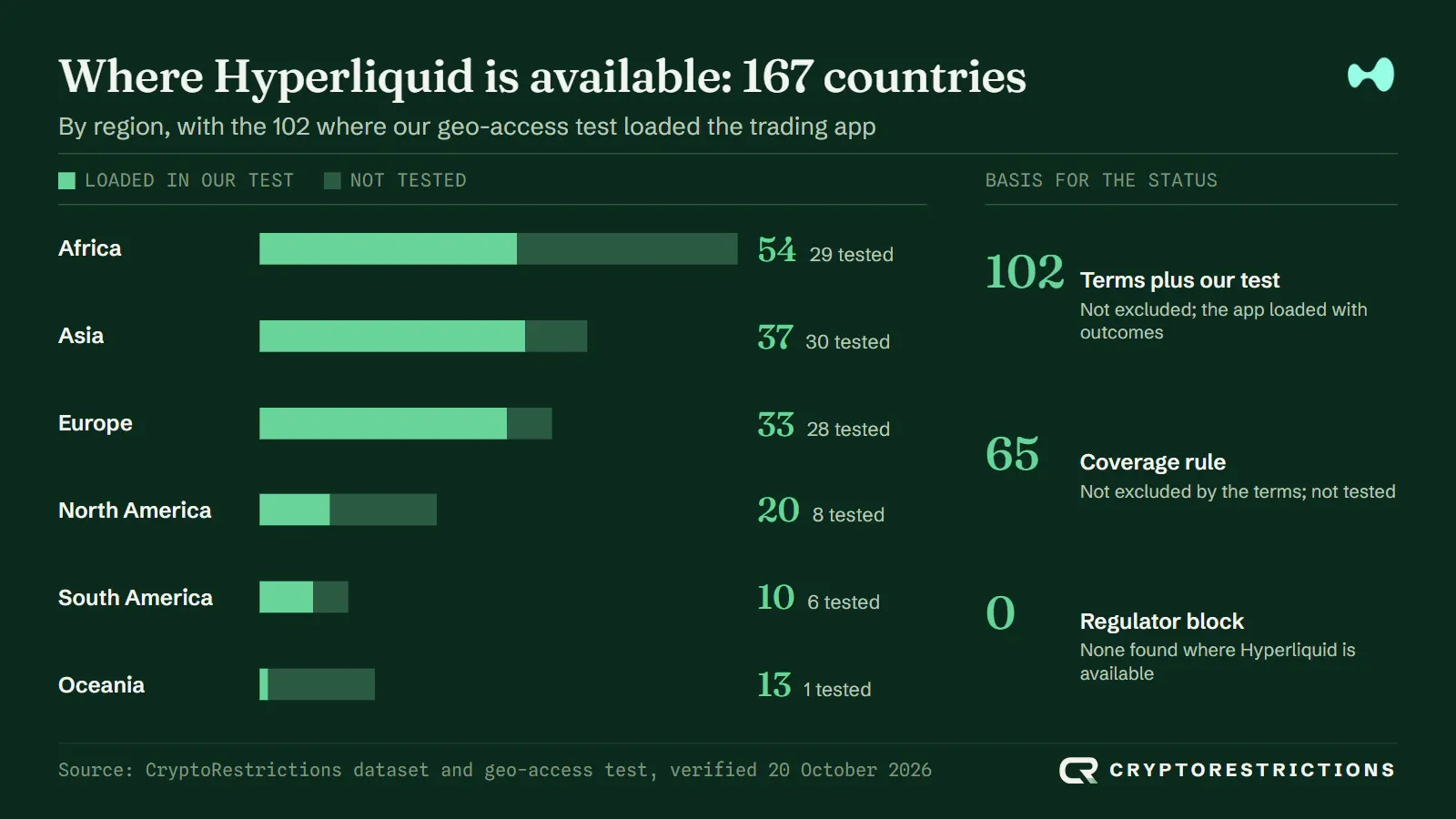
Available means the Hyperliquid app serves the country, not that local law allows leveraged crypto trading. Most of the EEA is here: Hyperliquid has no MiCA licence, but its app serves every EEA state we tested except the seven where it hides outcome markets.
Where do Hyperliquid’s visitors come from?
The United States, where the app is blocked, is the largest source of visits to hyperliquid.xyz in both estimators we checked, though they disagree on how large.
Similarweb puts the US at 25.6% of visits in September 2026, followed by Singapore, South Korea, the UK and Hong Kong. Semrush counts 6.04 million visits in the same month, 17% fewer than in August, with the US at only 7.77% and  Bangladesh,
 Turkey, Germany and Brazil close behind.
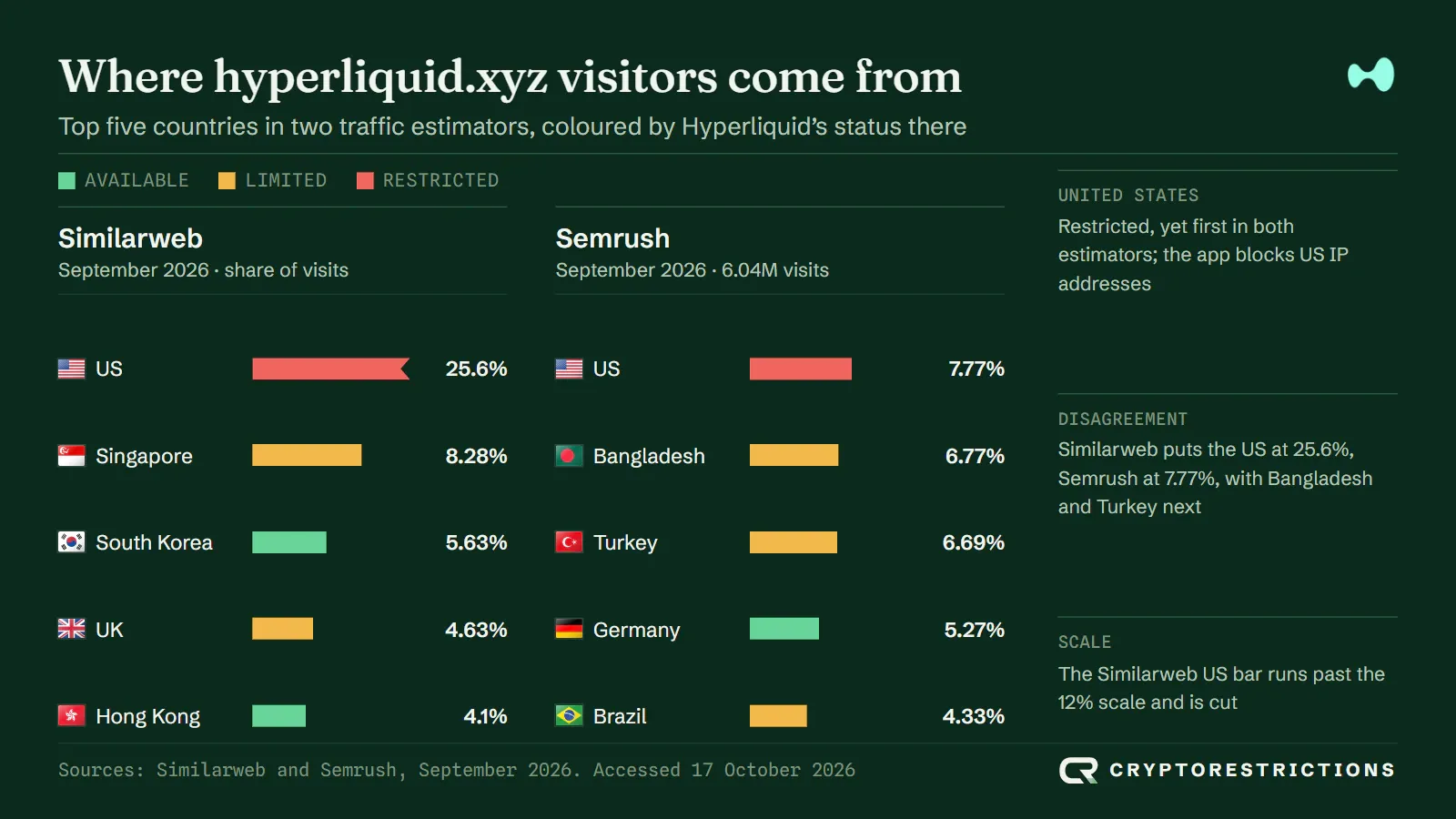
The US lead need not mean Americans trade there. The block sits in the trading app, while the home page at hyperliquid.xyz, which both estimators measure, loads everywhere. A visit to a home page is not an account, so treat any single country share as an estimate.
Hyperliquid geo-access test: what we saw from 131 places
The trading app blocked 5 of the 131 places we tested by IP address: the United States, Puerto Rico, Cuba, Syria and Saudi Arabia. It also hid its outcome markets in 20 others.
We ran the test ourselves on 14 October 2026. A browser with a VPN connected to one place at a time and loaded the hyperliquid.xyz home page and the trading app at app.hyperliquid.xyz, each time in a fresh private window with no cookies and no wallet connected. Banners were never accepted and bot checks never solved, and every run saved the page text and a screenshot.
Of the 131 places, 127 are among our 195 countries and four are territories: Hong Kong, Macau, Puerto Rico and Taiwan. 58 runs used servers in the country and 73 used virtual locations, IP addresses registered to a country but hosted elsewhere. The app places visitors by where their IP address is registered, not where the server stands: a US address was blocked, a Venezuelan one hosted in Miami was not, so the virtual runs test the app’s own location check.
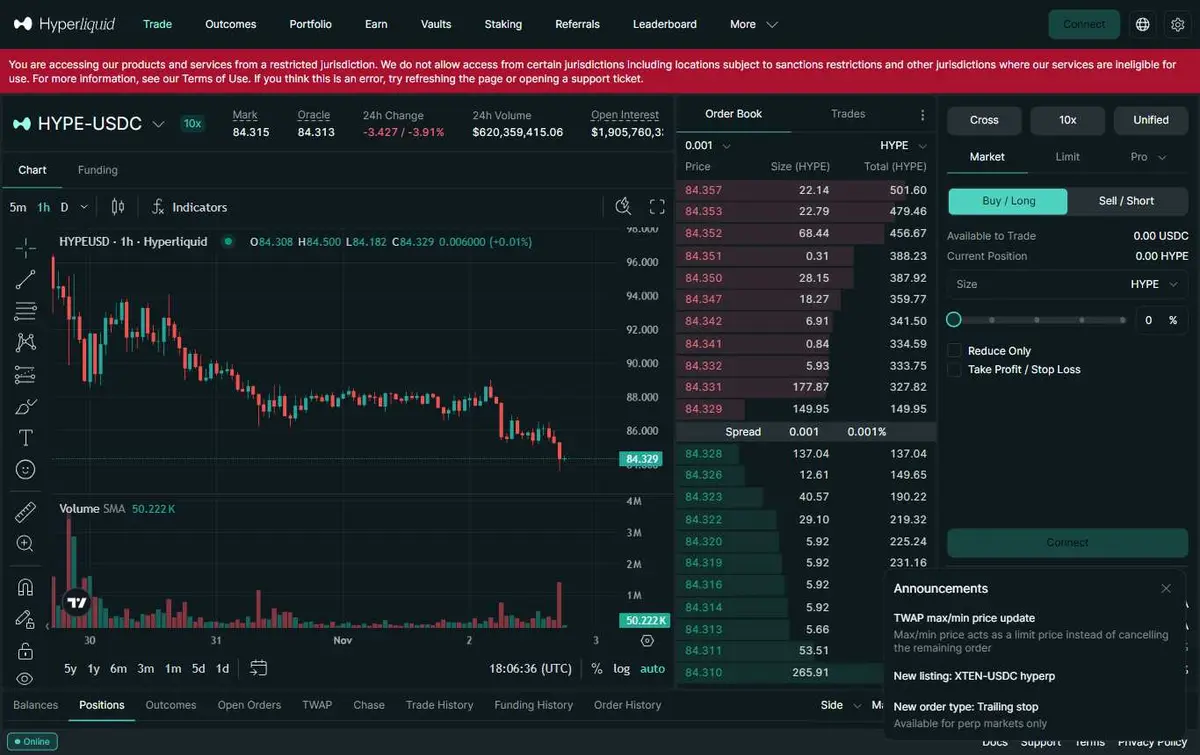
BlockedUnited States · Trading app
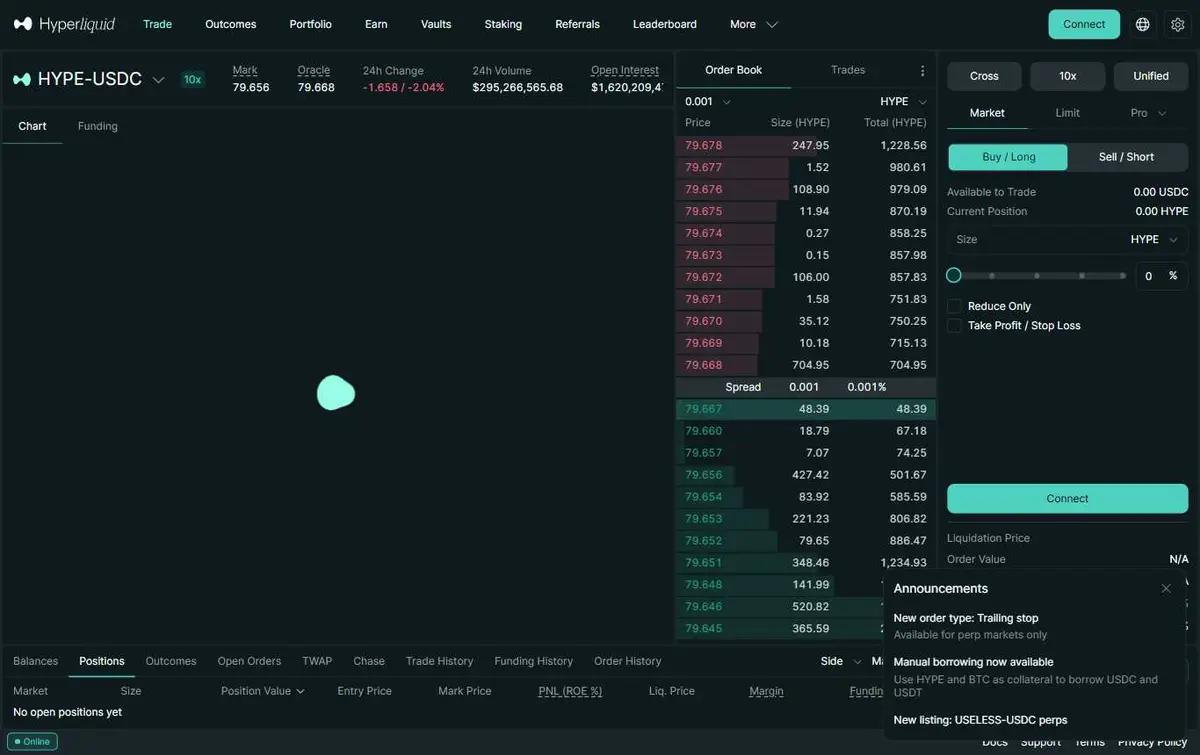
A US address: the trading app loads behind a restricted-jurisdiction banner
“You are accessing our products and services from a restricted jurisdiction.”
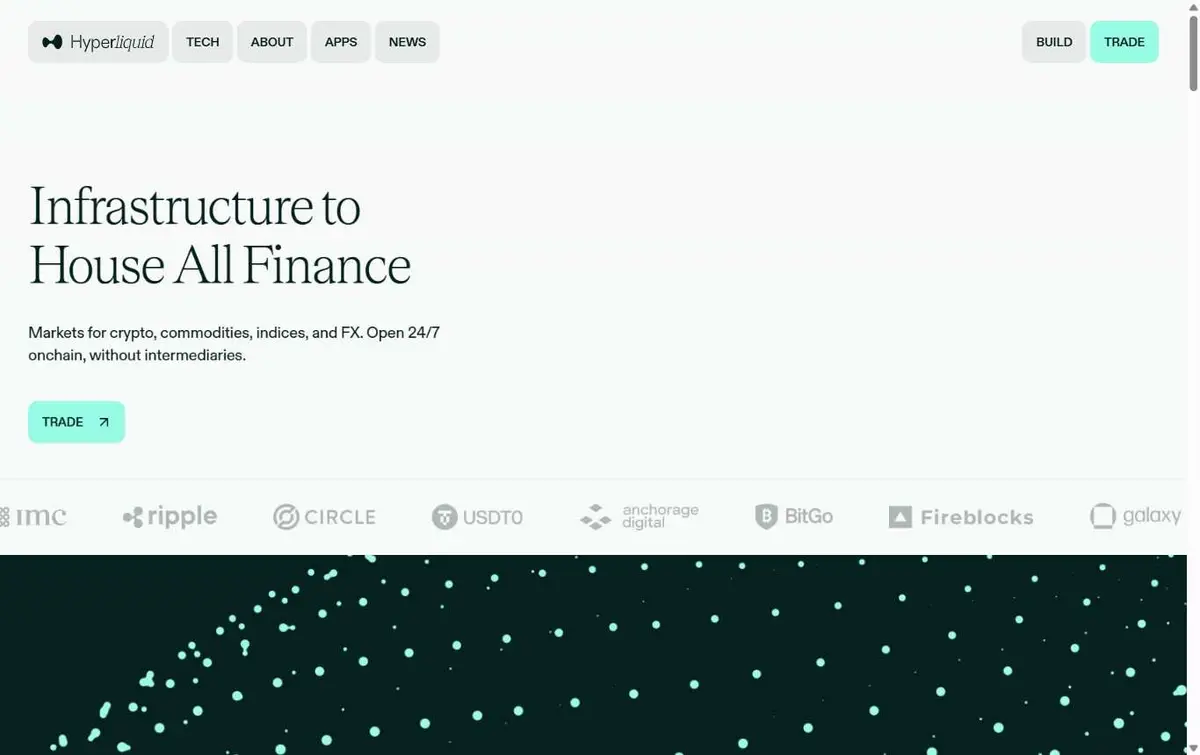
No barrierUnited States · Home page
The hyperliquid.xyz home page has no gate, even from the US
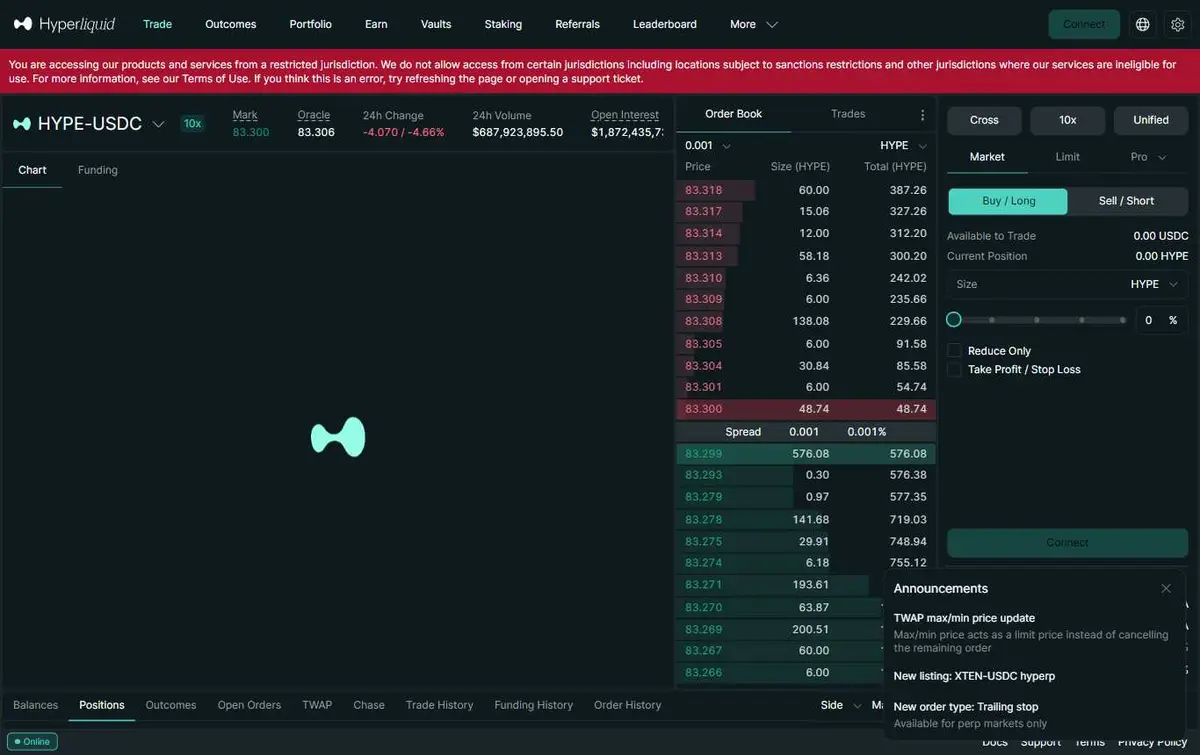
BlockedSaudi Arabia · Trading app
Saudi Arabia is not named in the terms, yet the app shows the same block
“You are accessing our products and services from a restricted jurisdiction.”
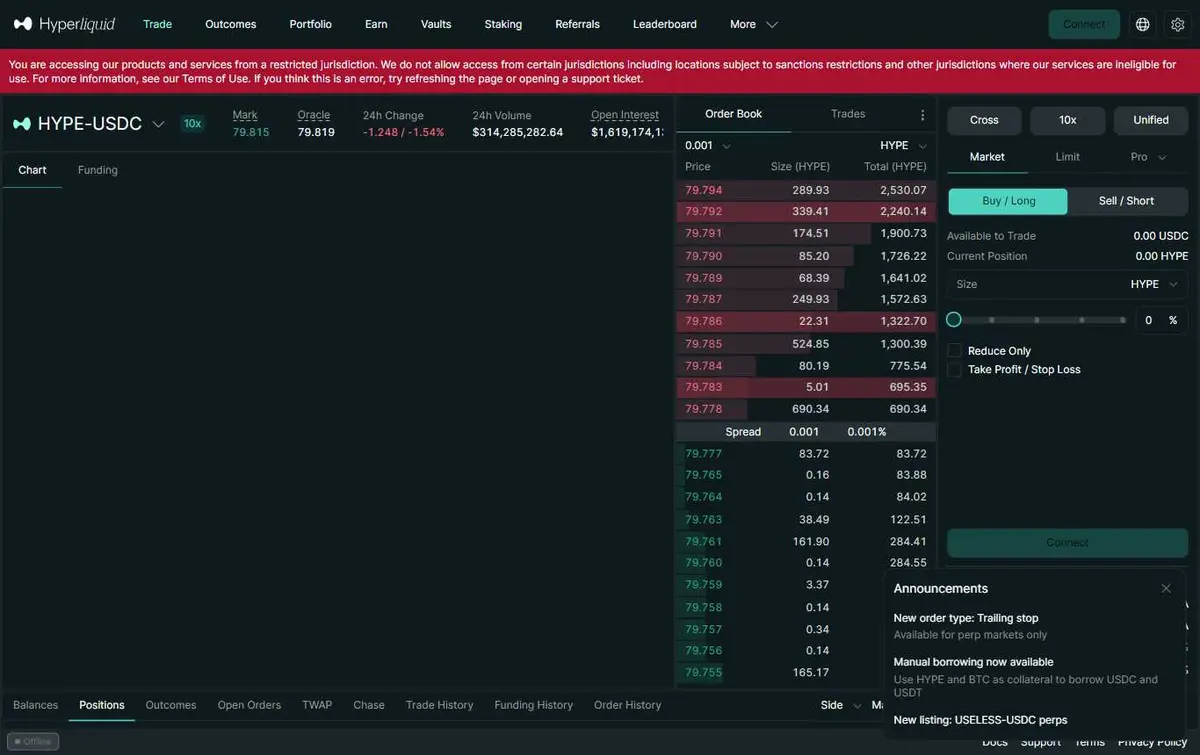
BlockedCuba · Trading app
Cuba, under US sanctions: blocked by IP
“You are accessing our products and services from a restricted jurisdiction.”
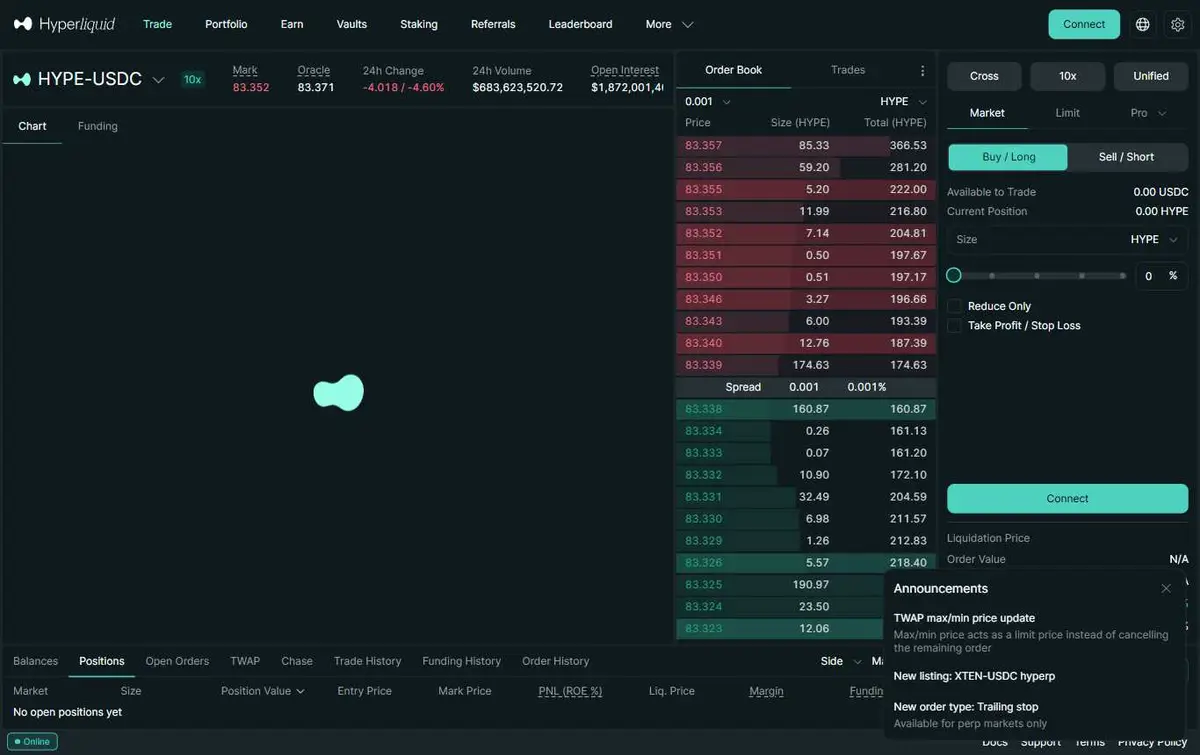
No barrierRussia · Trading app
Russia loads with no banner, though the terms' sanctions clause bars it; the Outcomes tab is gone
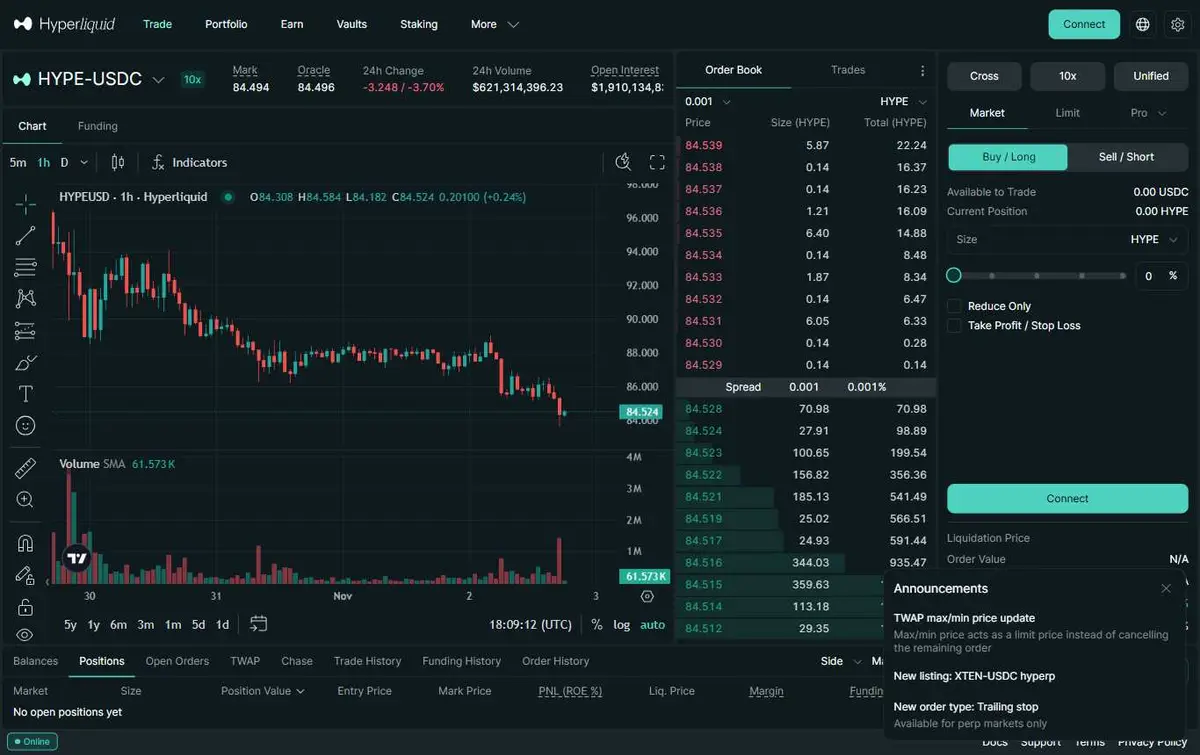
No barrierUnited Kingdom · Trading app
The UK, where the FCA warned in May 2026: perps load, the Outcomes tab is hidden
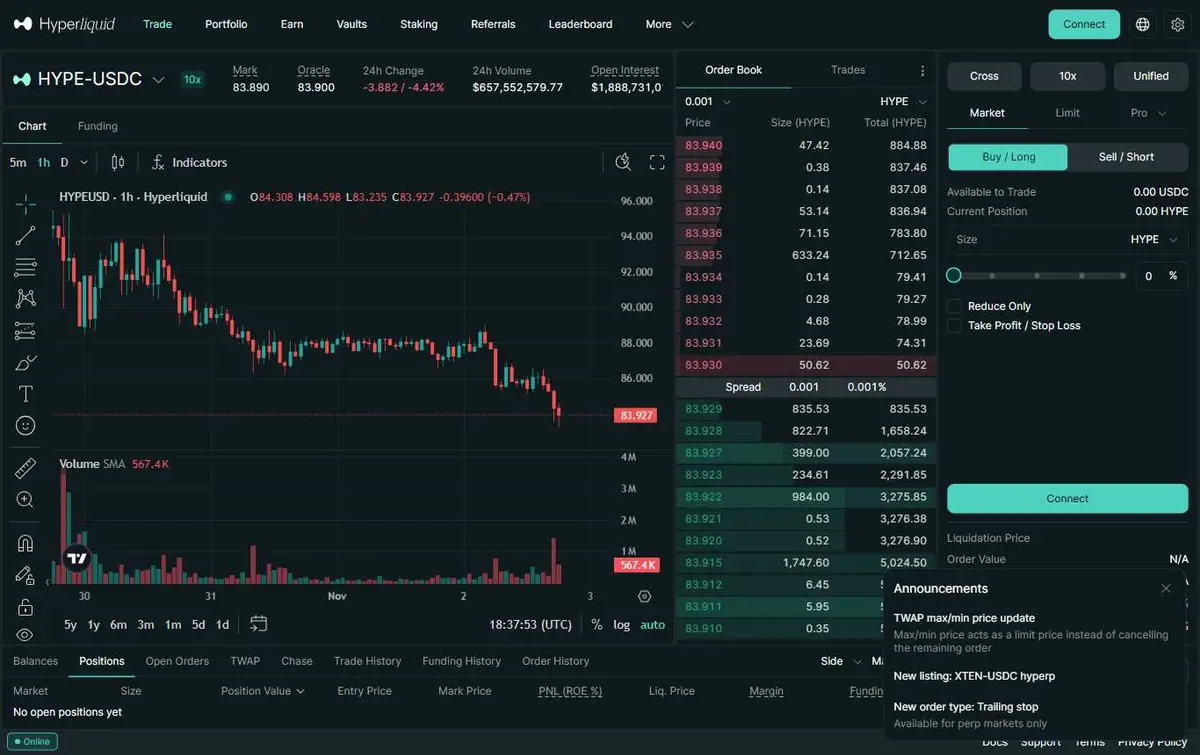
No barrierFrance · Trading app
France: perps load without the Outcomes tab
No barrierSingapore · Trading app
Singapore, second in Similarweb's traffic list: no Outcomes tab
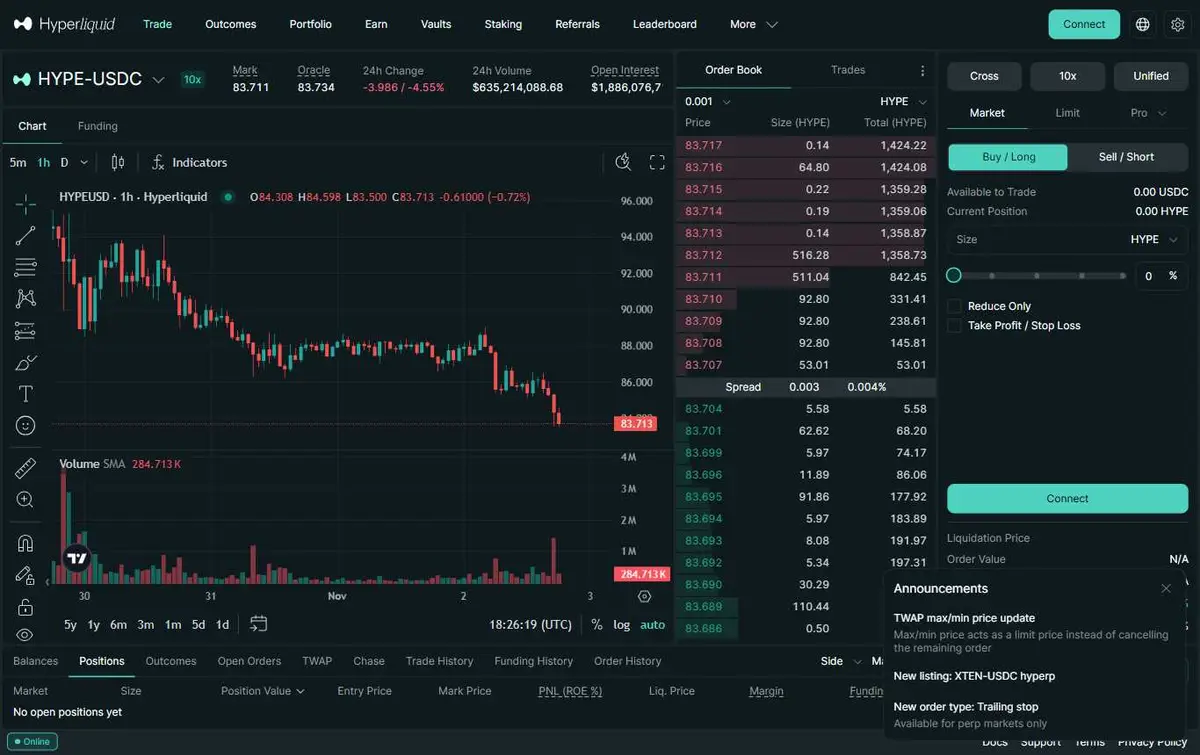
No barrierSouth Korea · Trading app
South Korea gets the full app, Outcomes tab included
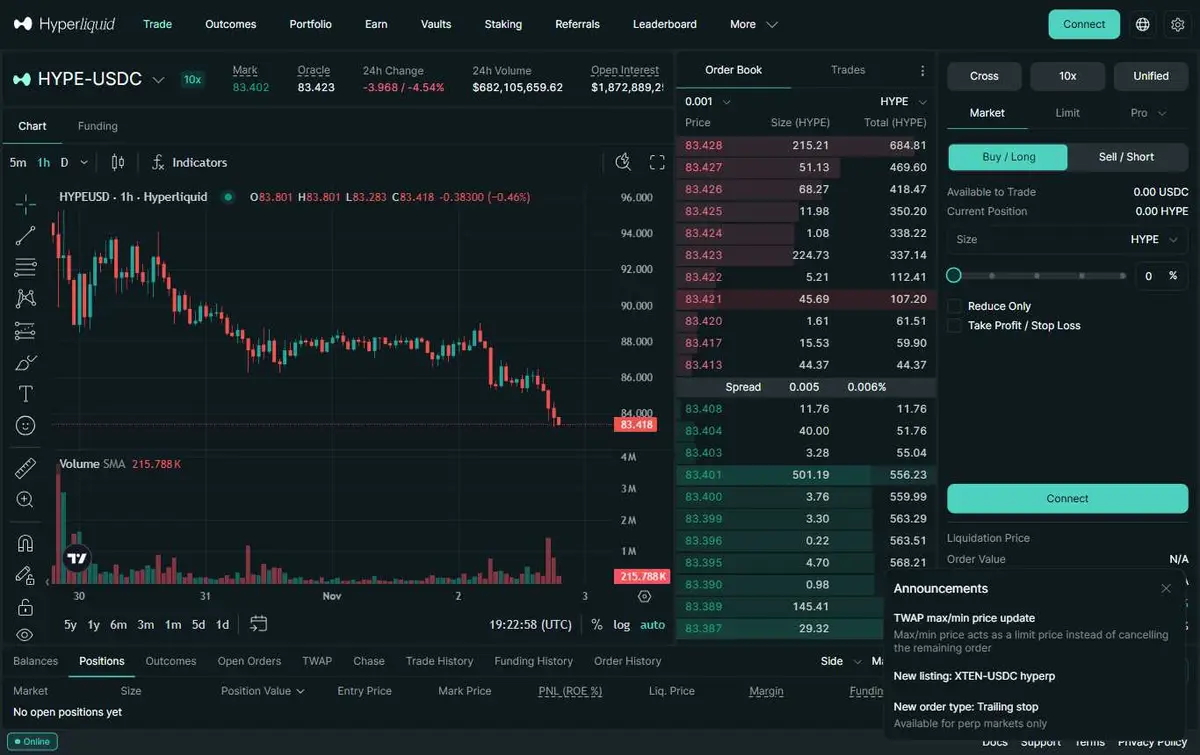
No barrierUkraine · Trading app
Ukraine loads in full; only Crimea, Donetsk and Luhansk are excluded by the terms
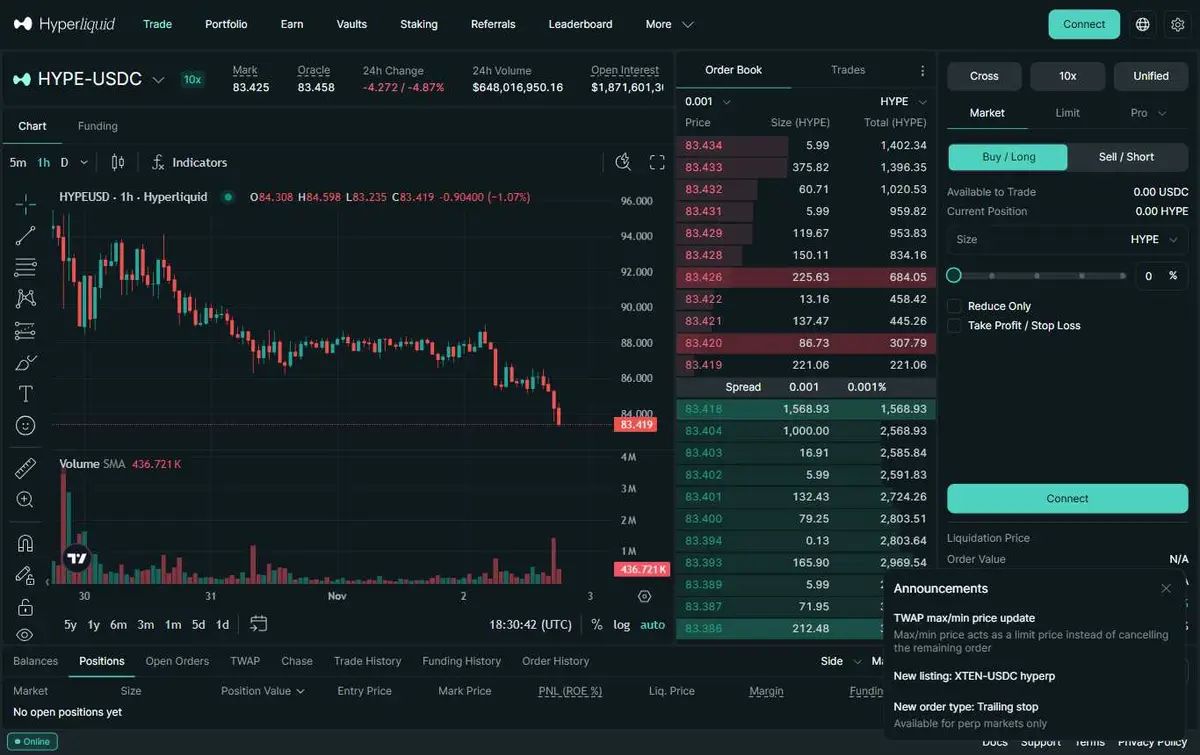
No barrierTurkey · Trading app
Turkey: the trading app loads, with its outcome markets tab hidden
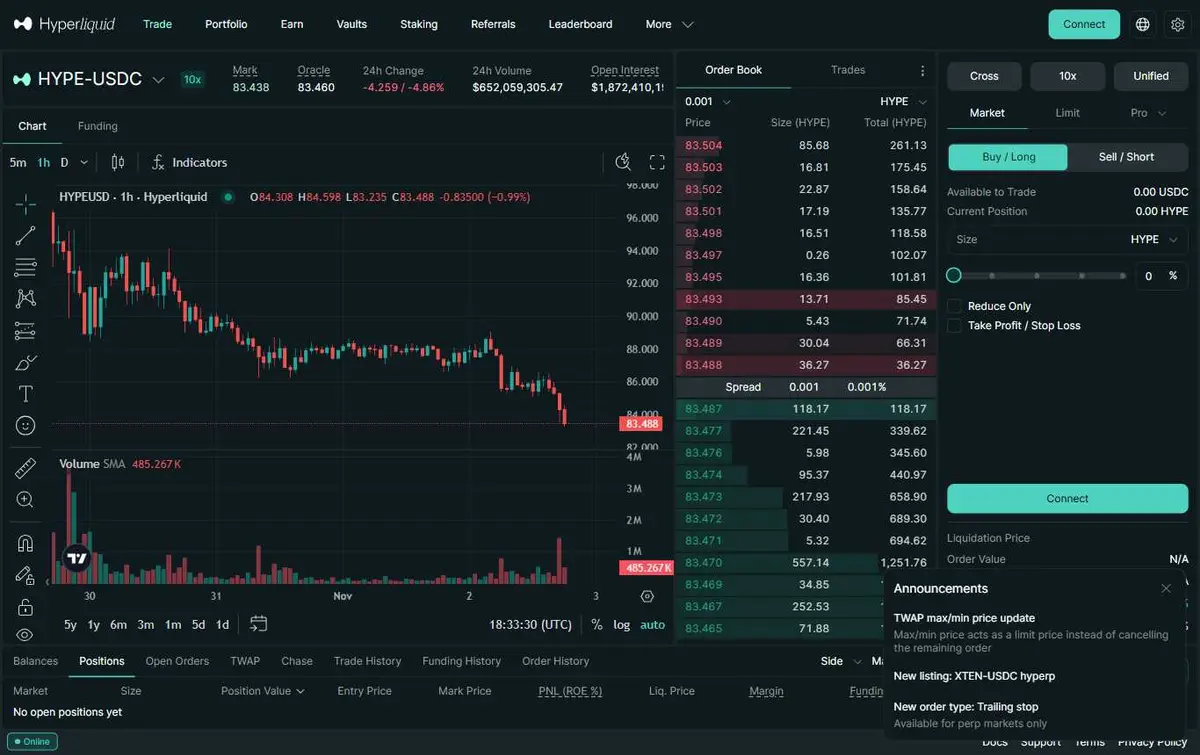
No barrierBrazil · Trading app
The trading app loads from Brazil, with its Outcomes tab hidden
No barrier Philippines · Home page
The trading app loaded with no barrier
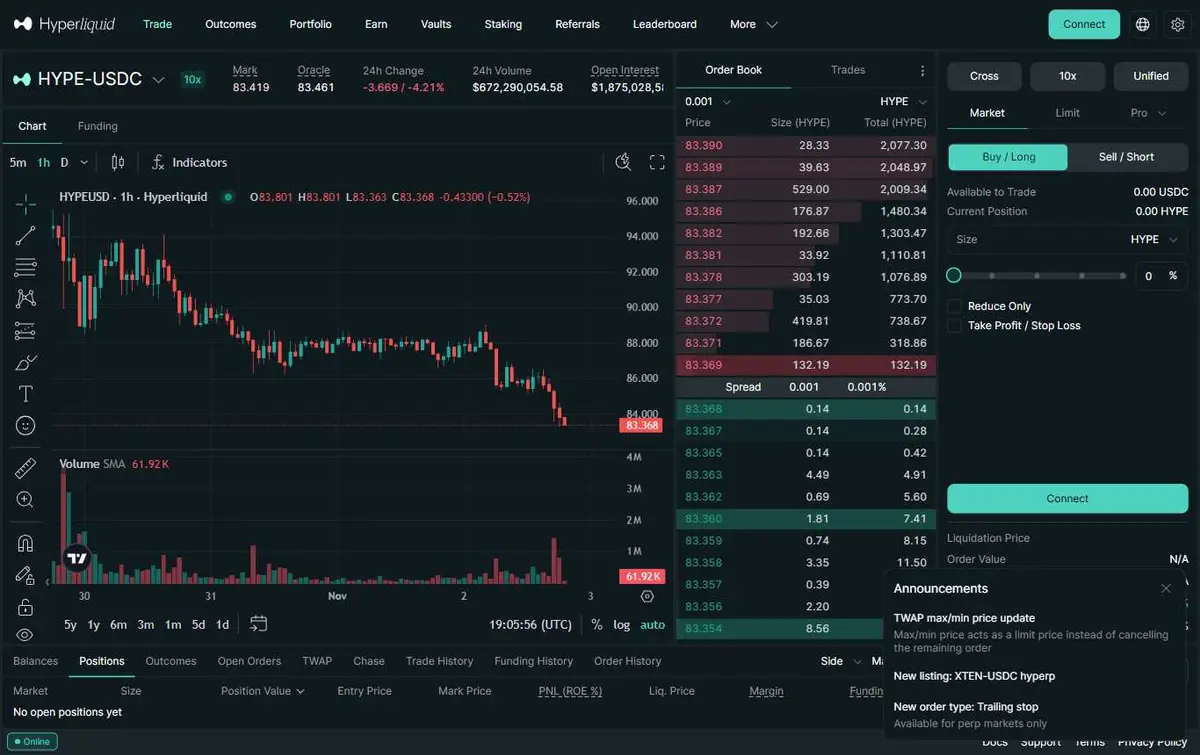
No barrierMexico · Trading app
Mexico: the trading app loads with no barrier
“Connect”
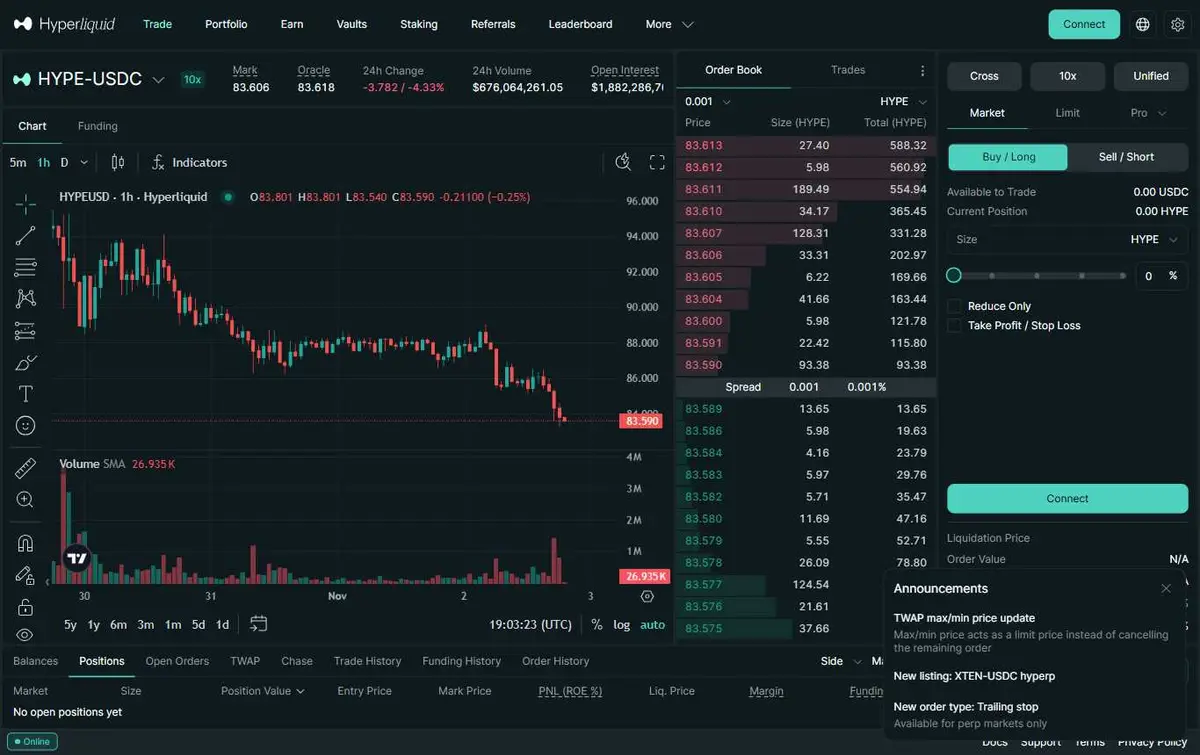
No barrier Argentina · Trading app
Argentina: perpetuals load, but the trading app shows no outcome markets tab
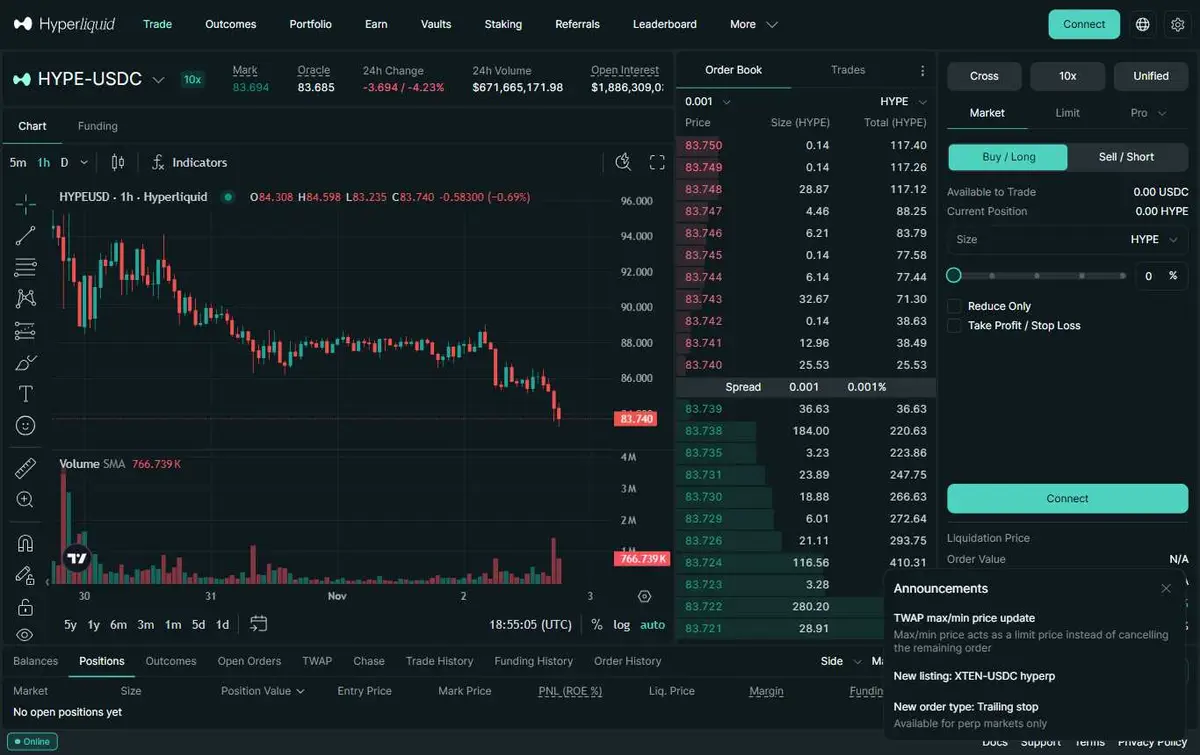
No barrier Ireland · Trading app
Ireland: the trading app loads with no notice
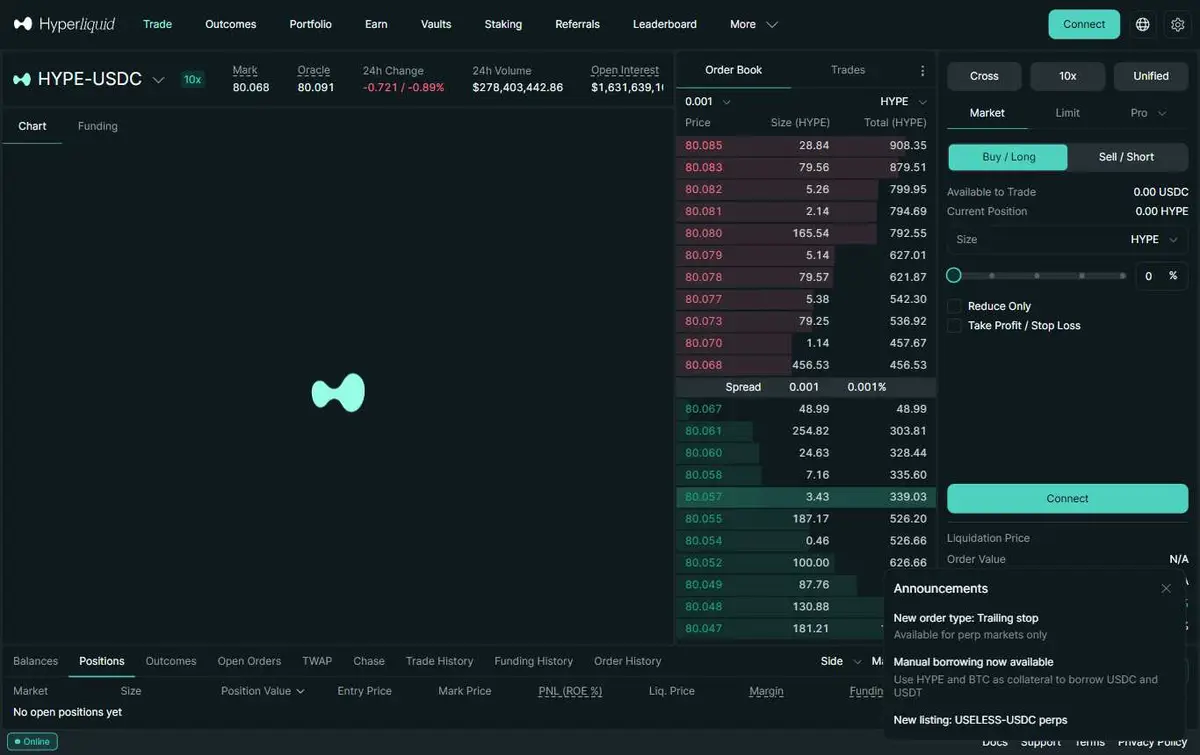
No barrier Israel · Trading app
The trading app loads from an Israeli address with no barrier
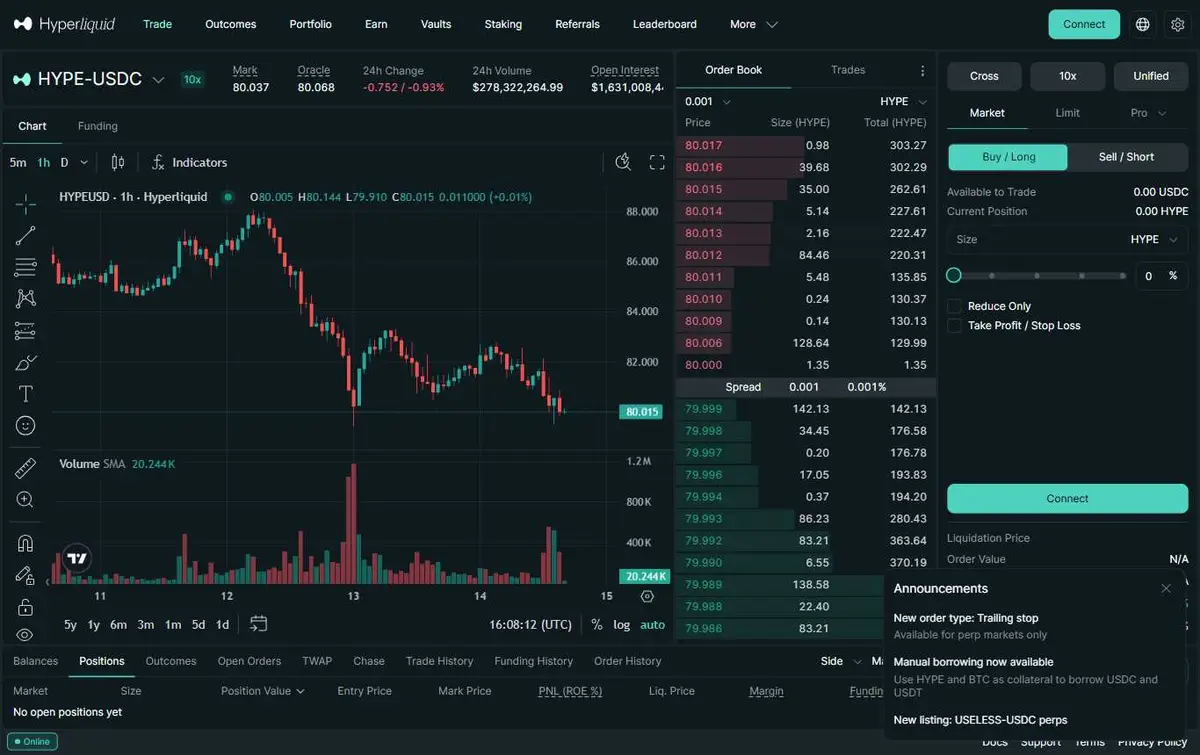
No barrier New Zealand · Trading app
New Zealand: the trading app loads with no notice
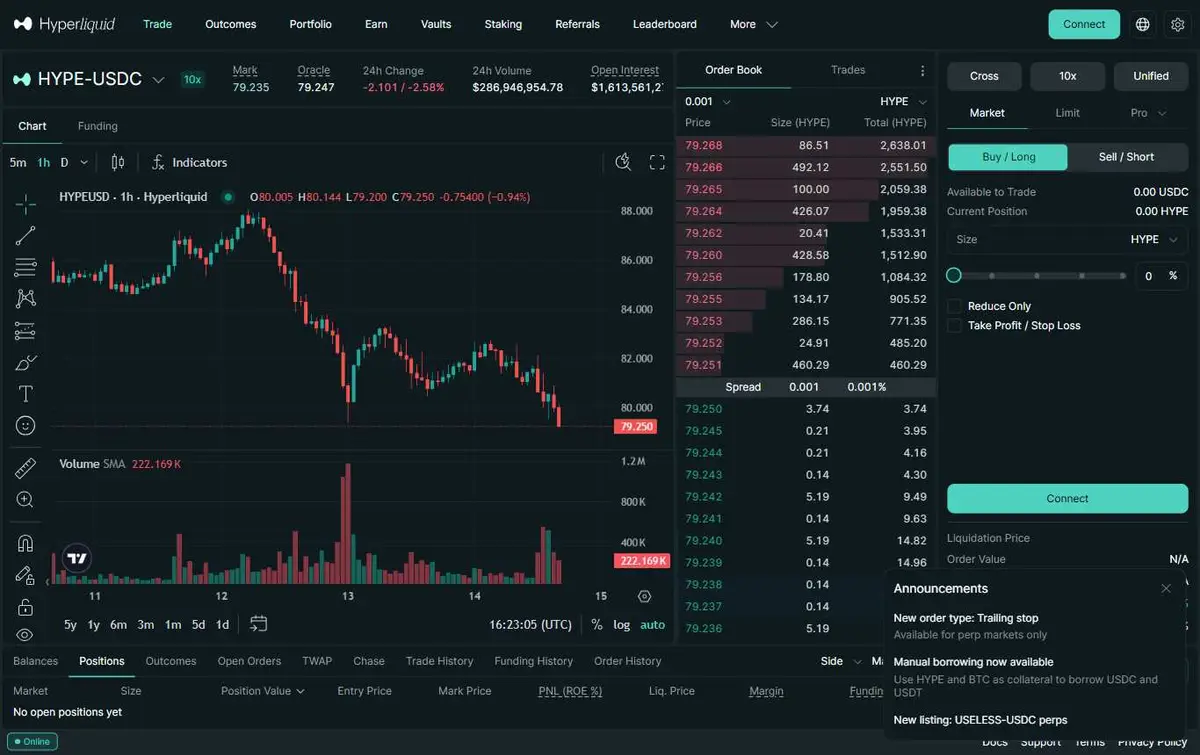
No barrier Norway · Trading app
Norway: the trading app loads with no notice
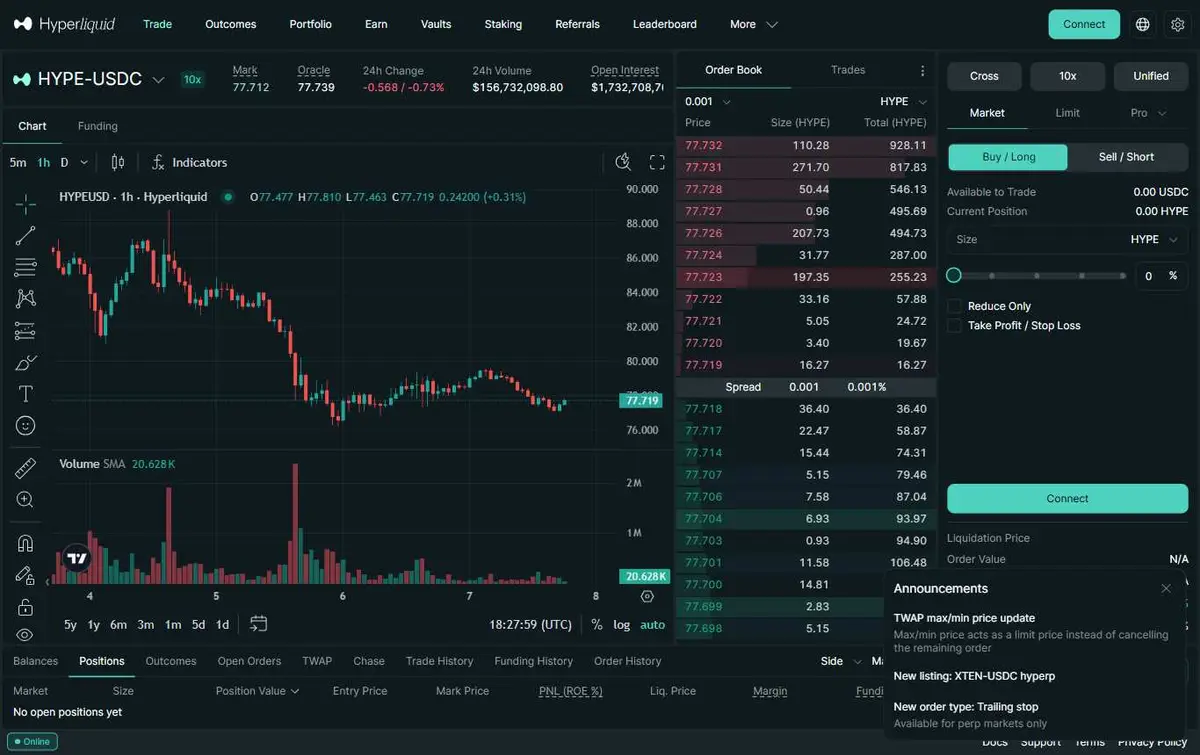
No barrier Finland · Trading app
Finland: the trading app loads with no notice
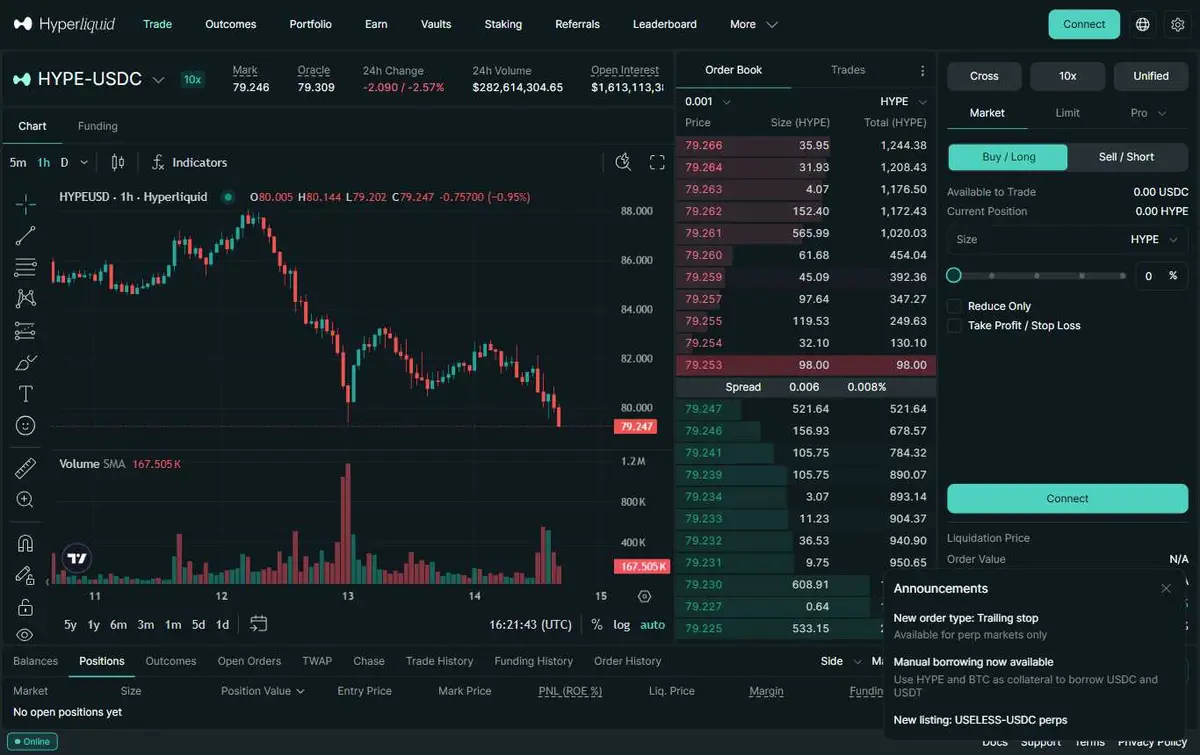
No barrier Greece · Trading app
Greece: the trading app loads with no notice
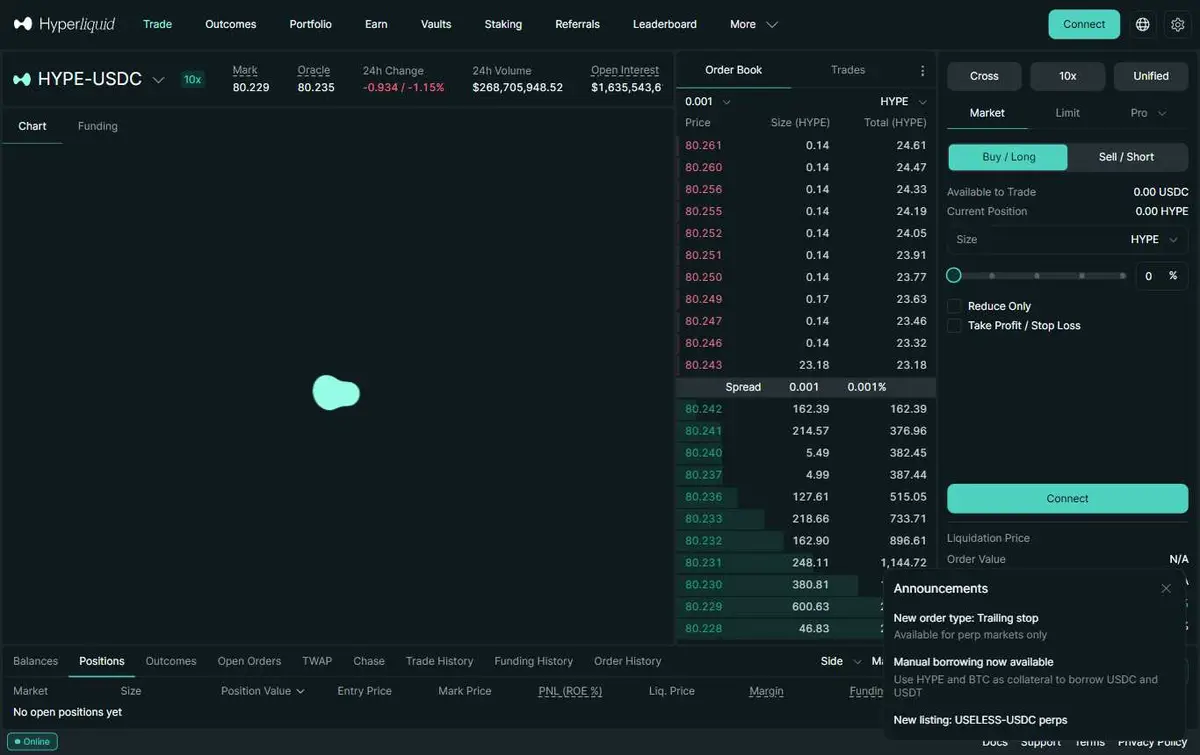
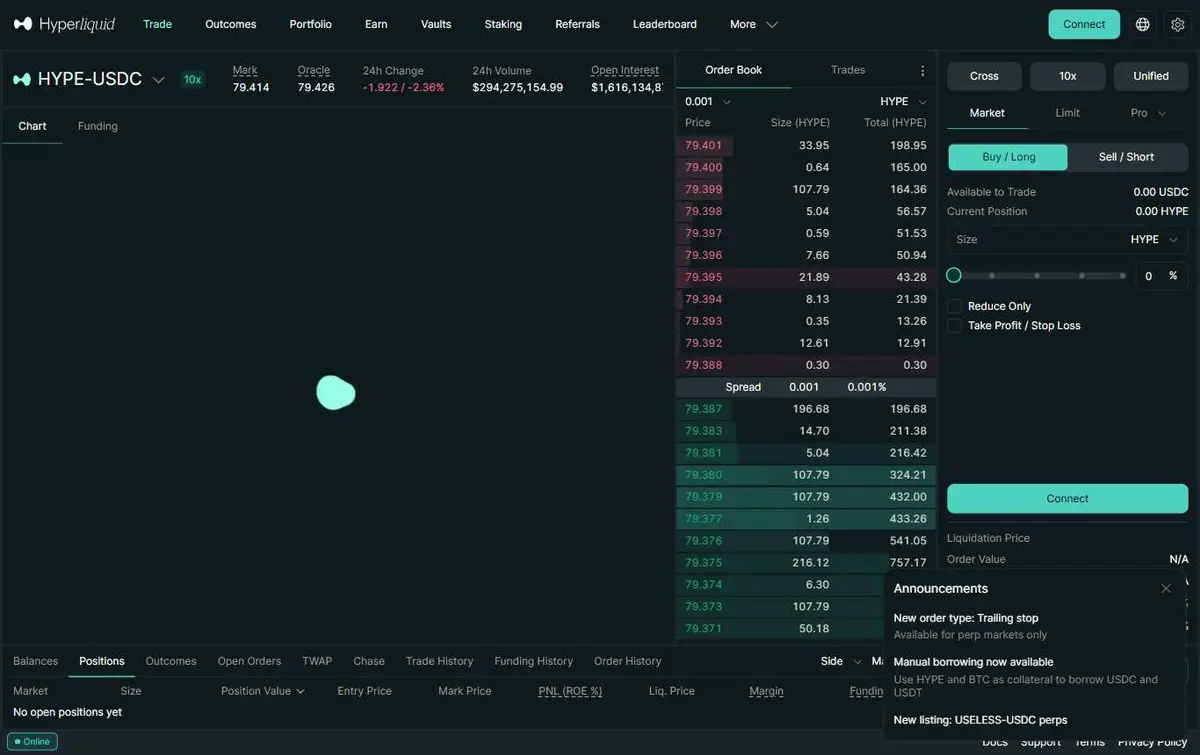
No barrier Bulgaria · Trading app
Bulgaria: the trading app loads with no notice
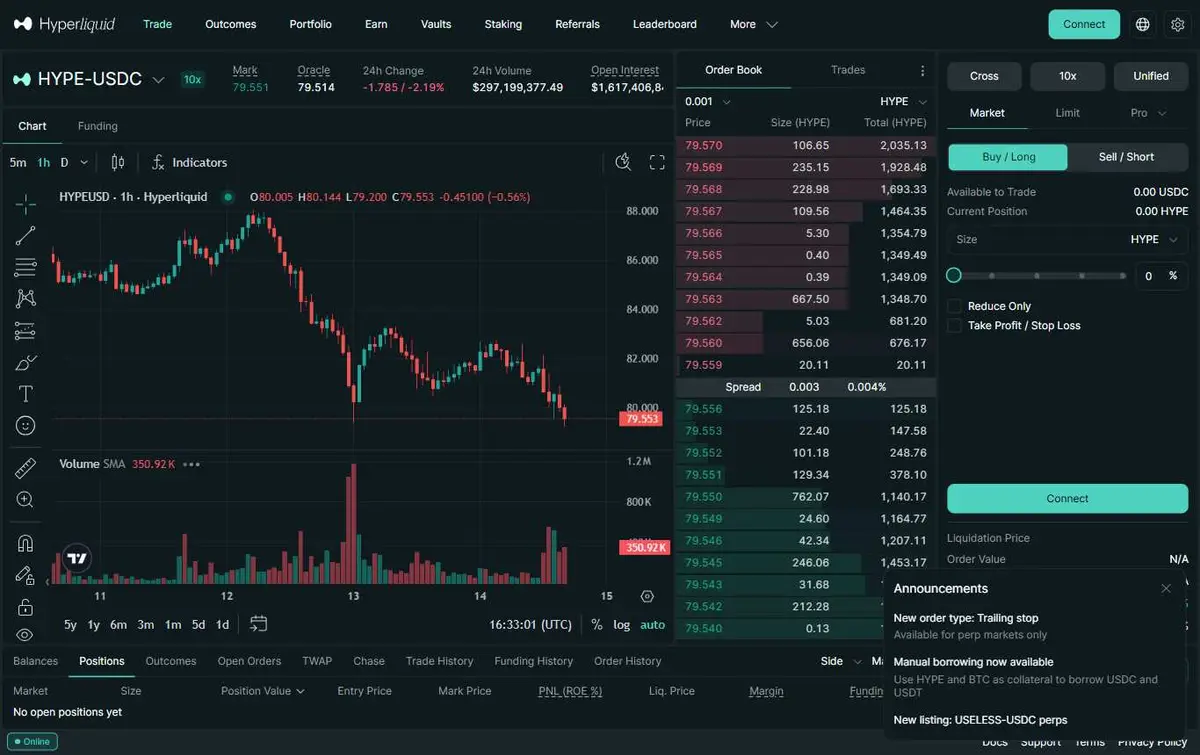
No barrier Croatia · Trading app
Croatia: the trading app loads with no notice
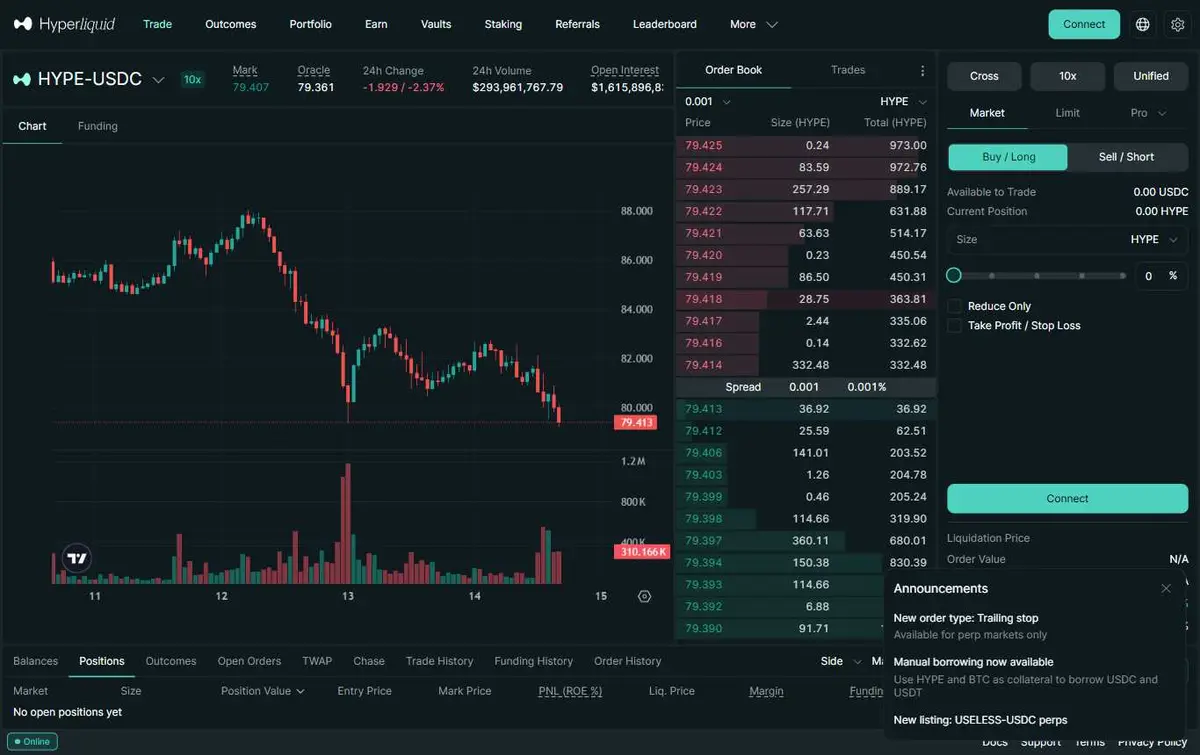
No barrier Latvia · Trading app
Latvia: the trading app loads with no notice
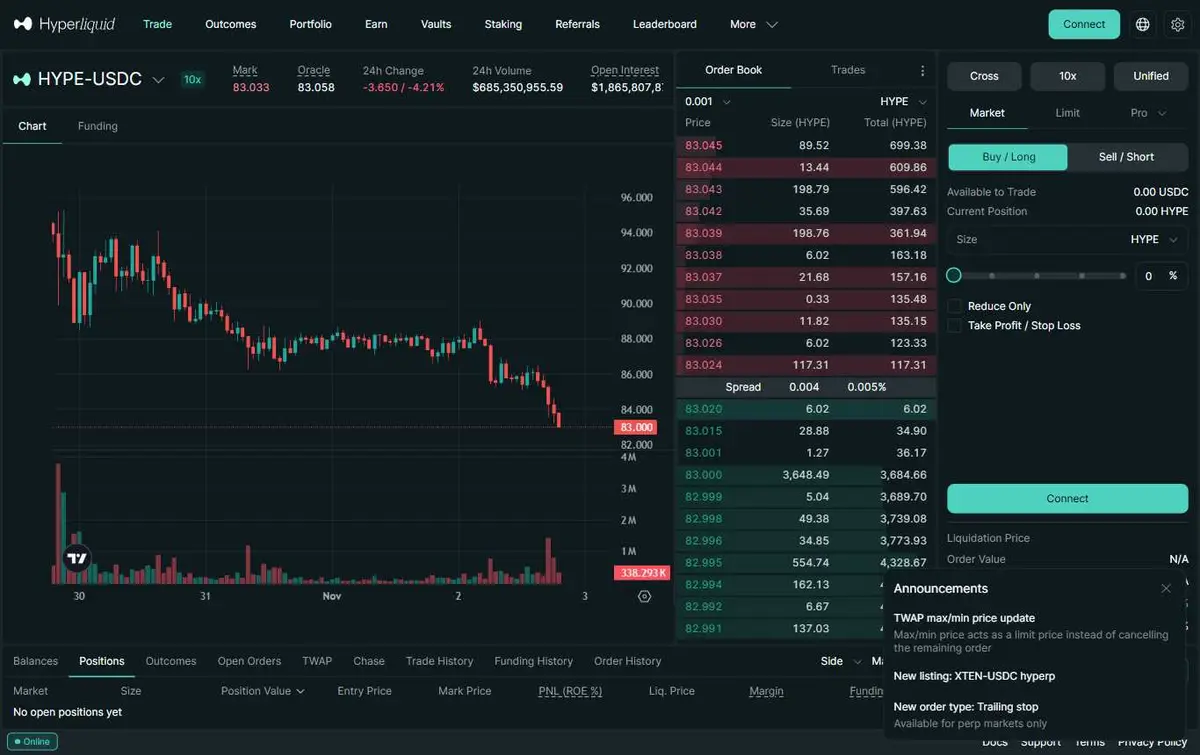
No barrier Estonia · Trading app
Estonia: the trading app loads with no notice
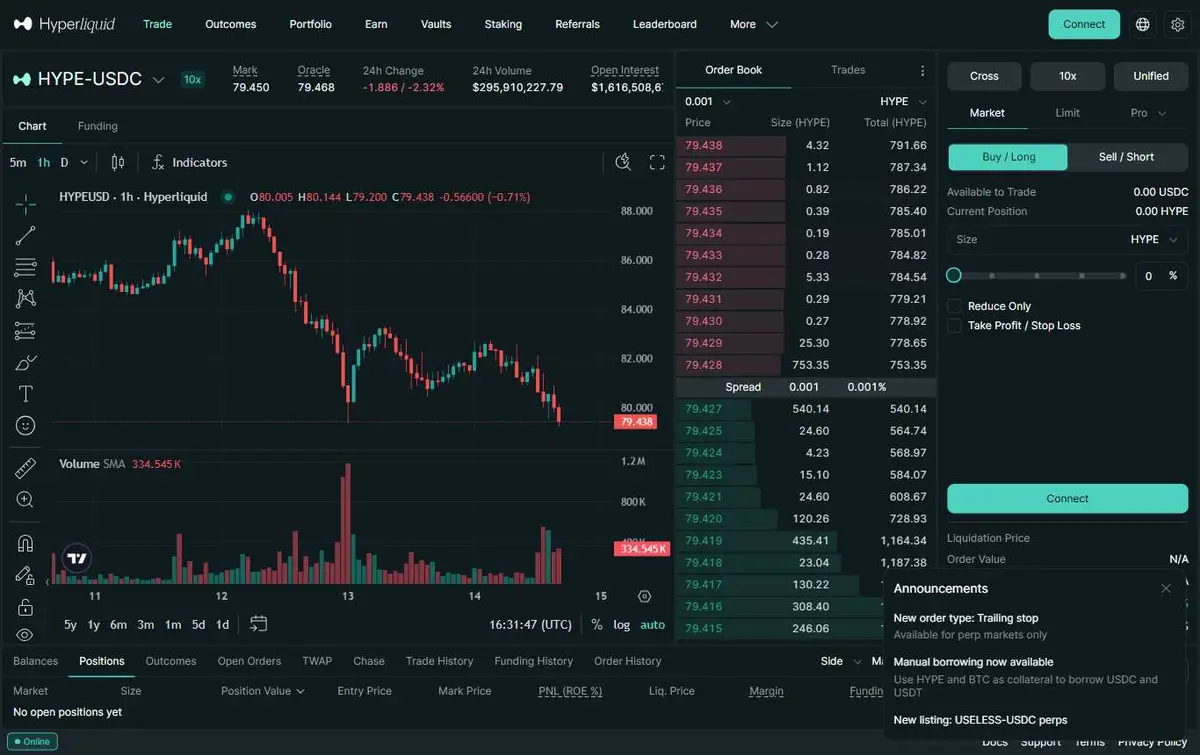
No barrier Egypt · Trading app
Egypt: the trading app loads with no restricted-jurisdiction banner
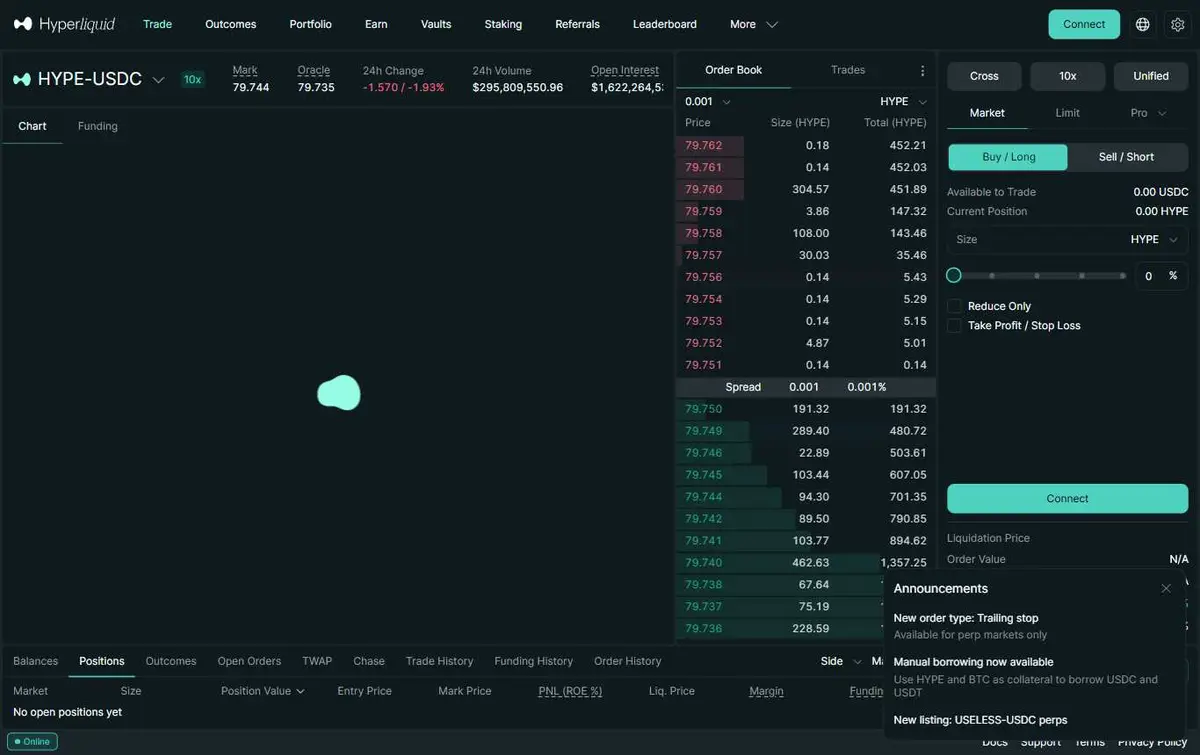
No barrier Lithuania · Trading app
Lithuania: the trading app loads with no notice
No barrier Slovenia · Trading app
Slovenia: the trading app loads with no notice
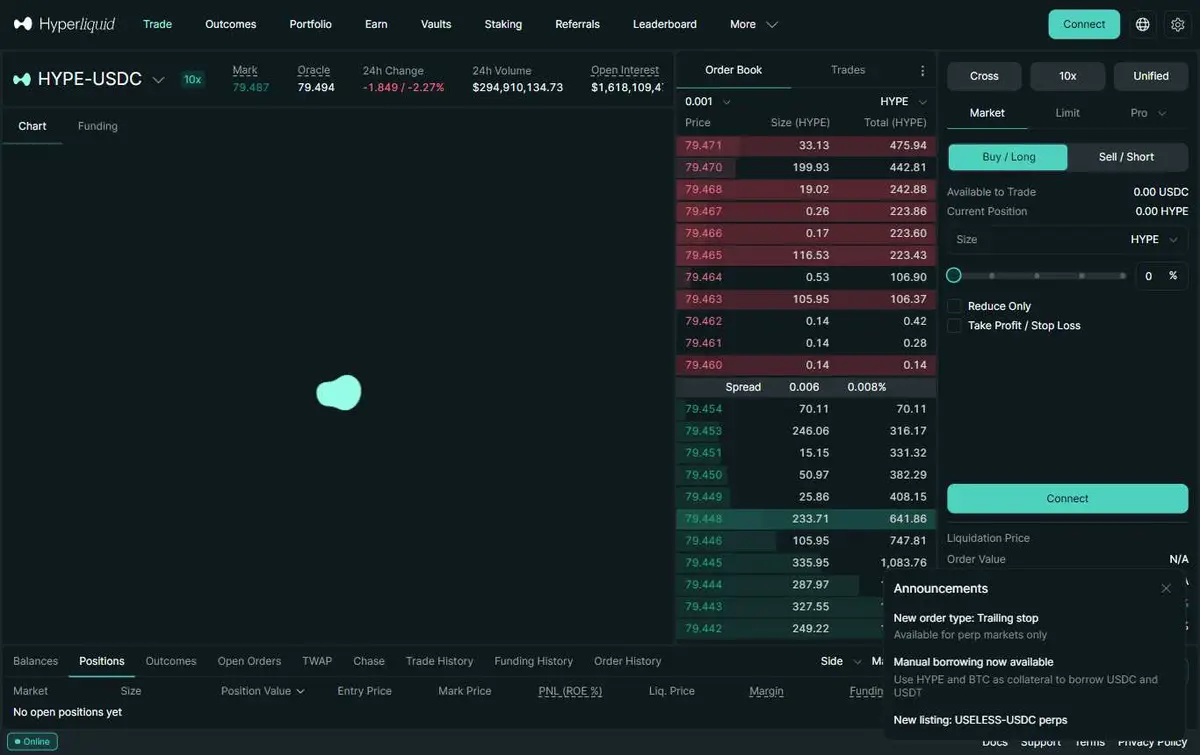
No barrier Iceland · Trading app
Iceland: the trading app loads with no notice
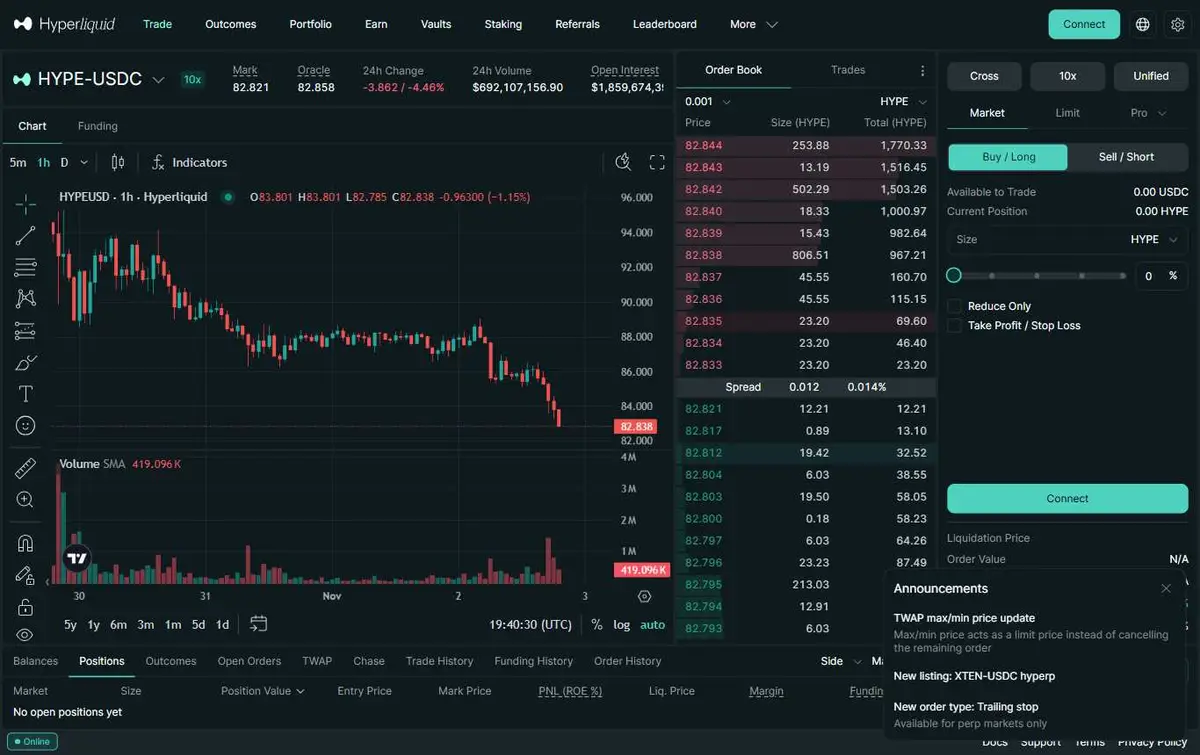
No barrier Pakistan · Trading app
Pakistan: the trading app loads with no notice
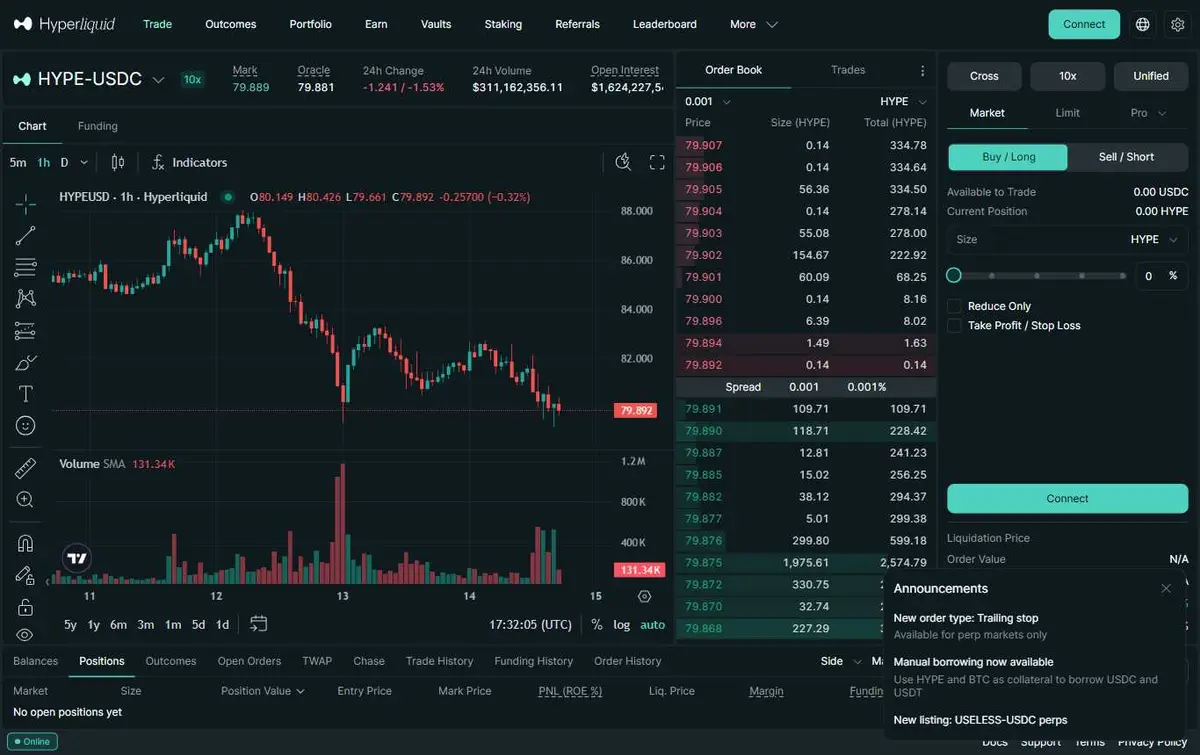
No barrier Georgia · Trading app
Georgia: the trading app loads with no notice
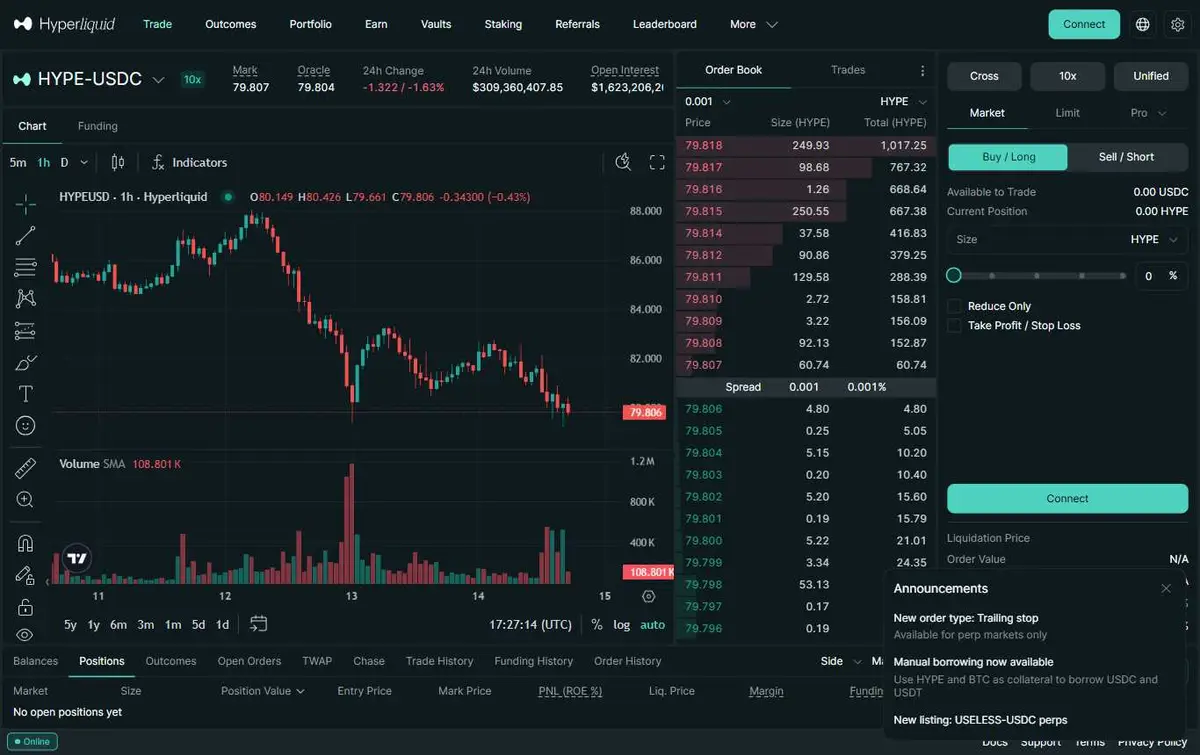
No barrier Venezuela · Trading app
Venezuela: the trading app loads with no notice
No barrier Serbia · Trading app
Serbia: the trading app loads with no barrier
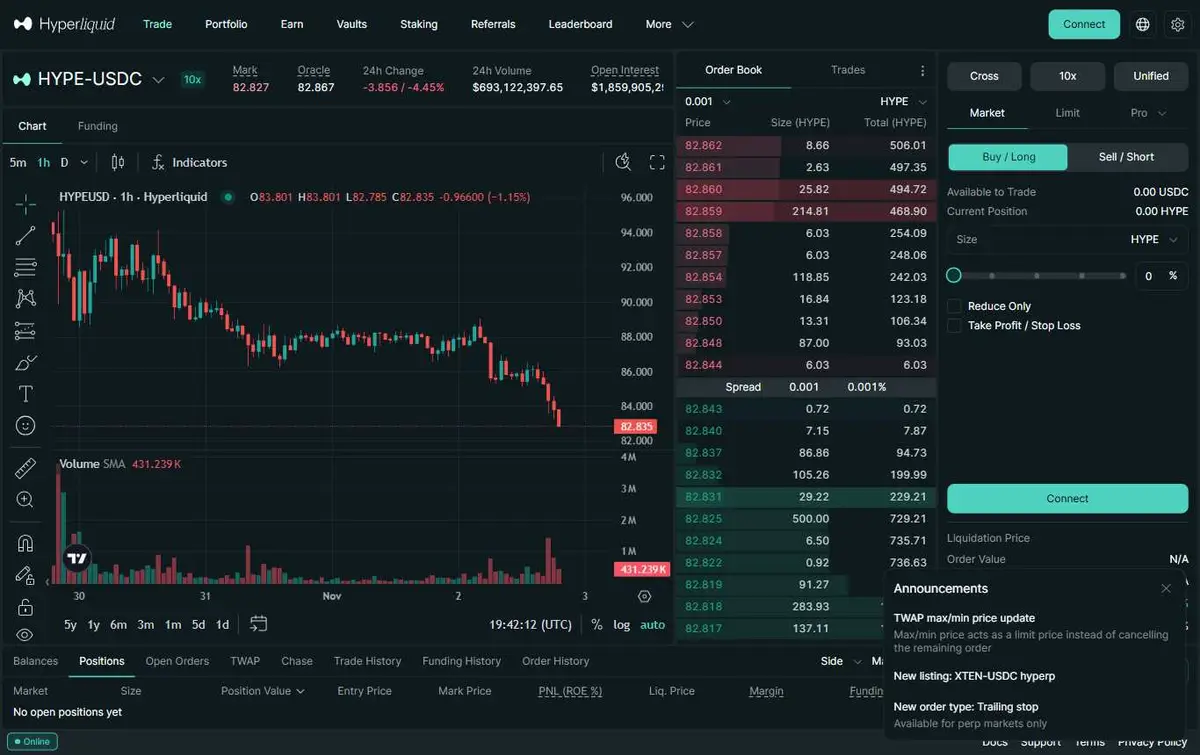
No barrierBangladesh · Trading app
Bangladesh: the trading app loads with perps and spot; the Outcomes tab is hidden
 CRYPTORESTRICTIONS
The check is Hyperliquid’s own. The app asks Hyperliquid’s API for a legal check on every visit, and the answer sets one of several states: no restriction, a full block, or hidden outcome markets. A blocked visitor still sees prices and the order book, but a red banner says access is not allowed and the balances panel says deposits and withdrawals are not allowed.
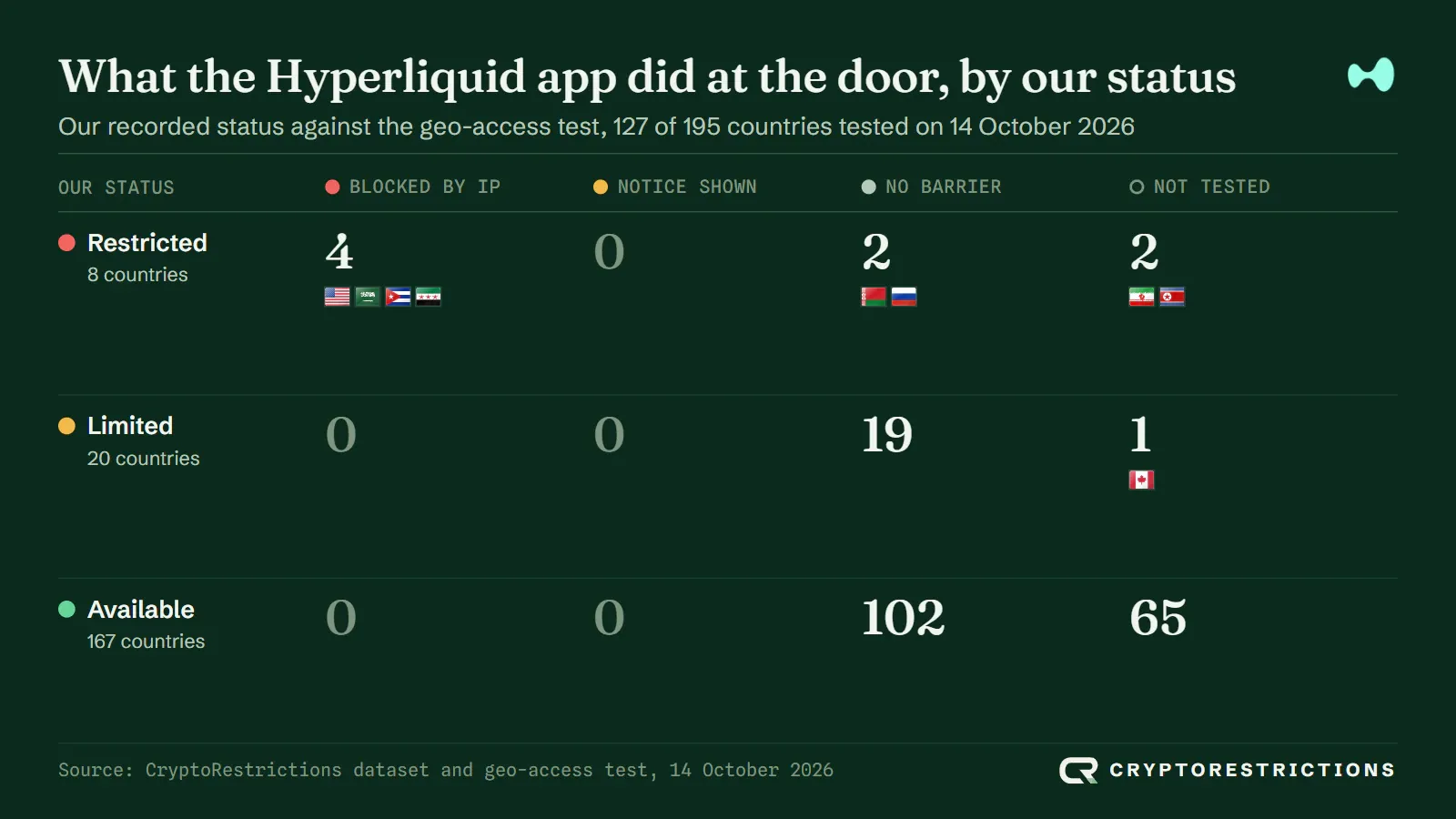
Two patterns stand out. The written list and the block do not match: Saudi Arabia is blocked without being named, while Russia and Belarus, which the sanctions limb covers, loaded with no banner, so for them the terms are the only control. And with no accounts to verify, the app can only enforce at the door. The “no barrier” counts include the 19 countries where the app loaded without its Outcomes tab. The full result for every place is below.
All 131 test results, country by country
Hyperliquid licences and registrations
Hyperliquid holds no licence or registration anywhere that we could find, and its terms say so: neither the app nor the Hyperliquid blockchain is “licensed, approved, authorized” by any government authority.
The app is made available by Hyperliquid Corp., which the terms say does not own or control the blockchain, and which states that the app “is not the exclusive means of accessing Hyperliquid”. The blockchain runs on its own validators, and anyone can trade through its public API or through other front ends. Many of those earn a fee through Hyperliquid’s builder codes, and they set their own country rules: MetaMask Perps, which runs on Hyperliquid, is closed to the USA, the UK, Ontario, Belgium and countries on the US sanctions list. Our statuses describe Hyperliquid’s own app, not every front end built on it.
Two regulators have warned about Hyperliquid, neither with a ban. The UK FCA warned on 21 May 2026 that it may be providing or promoting financial services without permission, naming hyperfoundation.org and the app. Singapore’s MAS added the Hyperliquid and Hyper Foundation sites to its Investor Alert List on 26 June 2026, which Hyperliquid said is not a ban or a finding of wrongdoing. We found Hyperliquid on no other national warning or block list we searched, including those of Ontario, Quebec, France, Italy, Spain, Belgium, Japan, the Philippines, Thailand and Malaysia, and it was not among the 27 overseas exchange sites South Korea ordered blocked in October 2026.
Hyperliquid and MiCA in the EU
Hyperliquid has no MiCA authorisation: no Hyperliquid entity appears in ESMA’s register of crypto-asset service providers, which we checked on 17 October 2026.
Whether it needs one is the open question for every decentralised exchange. MiCA says in recital 22 that crypto-asset services “provided in a fully decentralised manner without any intermediary” should fall outside the regulation. Hyperliquid’s app is run by a company, but the trades settle on a blockchain the company says it does not control, and no EU regulator has taken action against it that we found. That is why we record the EEA as available here, unlike the centralised exchanges that closed new EEA accounts at the MiCA deadline.
The app does not treat the EEA as one market. It hides outcome markets in seven EEA states,  Belgium, France,
 Hungary,
 Italy,
 Poland,
 Slovakia and
 Spain, and serves them in the rest of the EEA we tested, from Austria and Ireland to the Nordic states.
Is Hyperliquid available in the US?
No. Anyone who lives in, is located in or is incorporated in the United States is a Restricted Person, and the app blocked our US and Puerto Rican IP addresses. We found no US registration for Hyperliquid, and the block covers every state.
Hyperliquid availability by US state
The block is old. The same banner text was already in the app’s code in an archived copy from 31 May 2024. A US company does not change that for other front ends either: Lighter is run by a Florida company and still excludes US persons.

Hyperliquid regulators and incidents
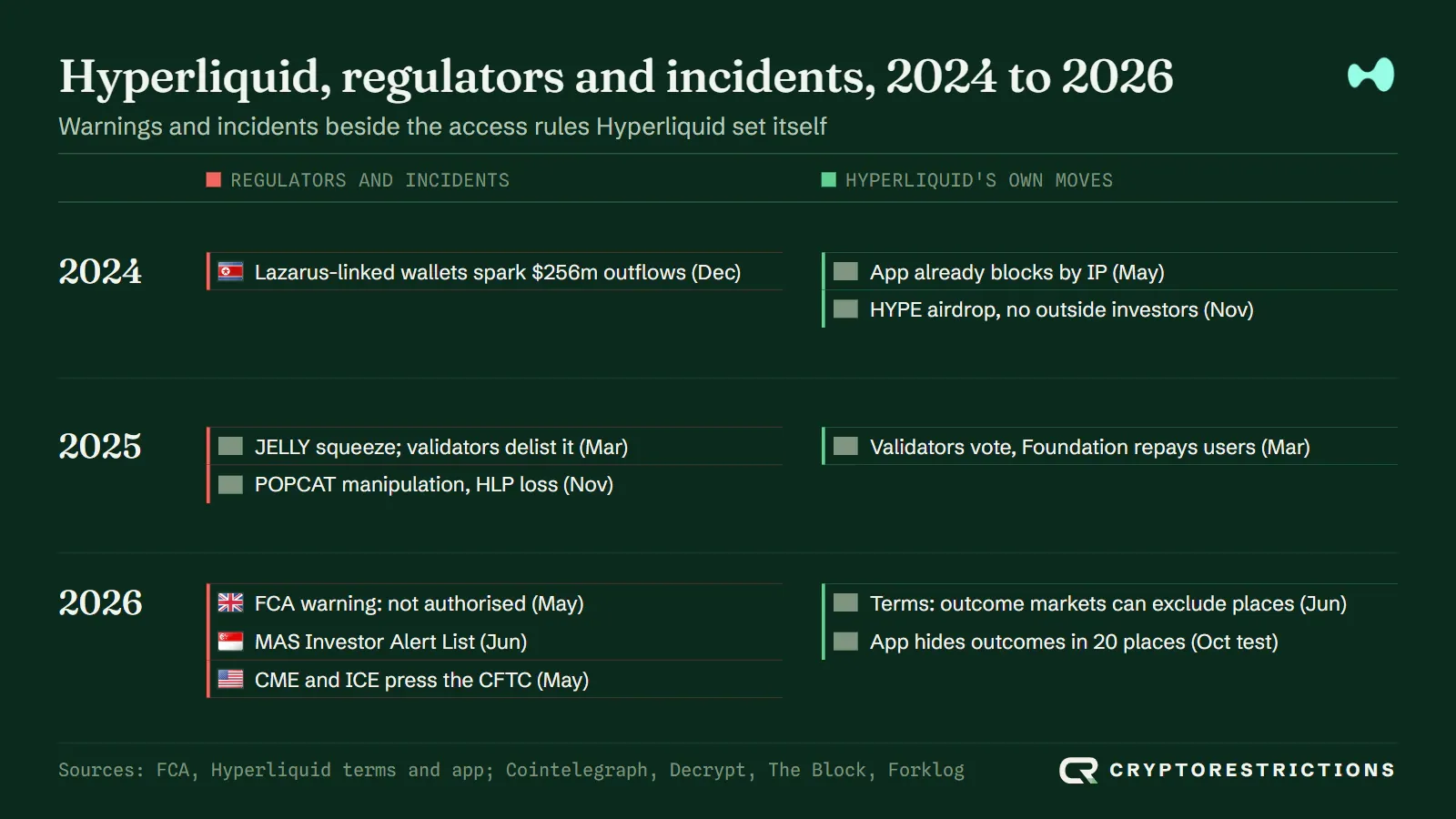
We found no CFTC, SEC, Justice Department or OFAC action against Hyperliquid. The pressure has come from markets and from rivals. In December 2024, reports that wallets linked to North Korea’s Lazarus group were trading on Hyperliquid set off more than $256 million in net outflows; Hyperliquid said there had been no exploit. In March 2025 a squeeze on the JELLY token led validators to vote to delist its perpetual, and in November 2025 a POPCAT trading scheme left a loss in the HLP vault and paused deposits and withdrawals there. In May 2026 the owners of CME and the New York Stock Exchange reportedly urged US regulators to act on Hyperliquid, and in September The Block reported that the platform was still not available to US traders while routes into the US market were discussed.
Hyperliquid KYC and identity verification
Hyperliquid asks for no identity documents at all: you connect a self-custody wallet, or sign in with an email address that creates one, and sign the terms.
The onboarding guide has two steps, connect a wallet or enter an email and a six-digit code, and then deposit at least 5 USDC. By signing the terms you state that you are not a Restricted or Excluded Person, and the terms add that you may not use a VPN, a proxy or a false statement about where you live or your citizenship to get around them.
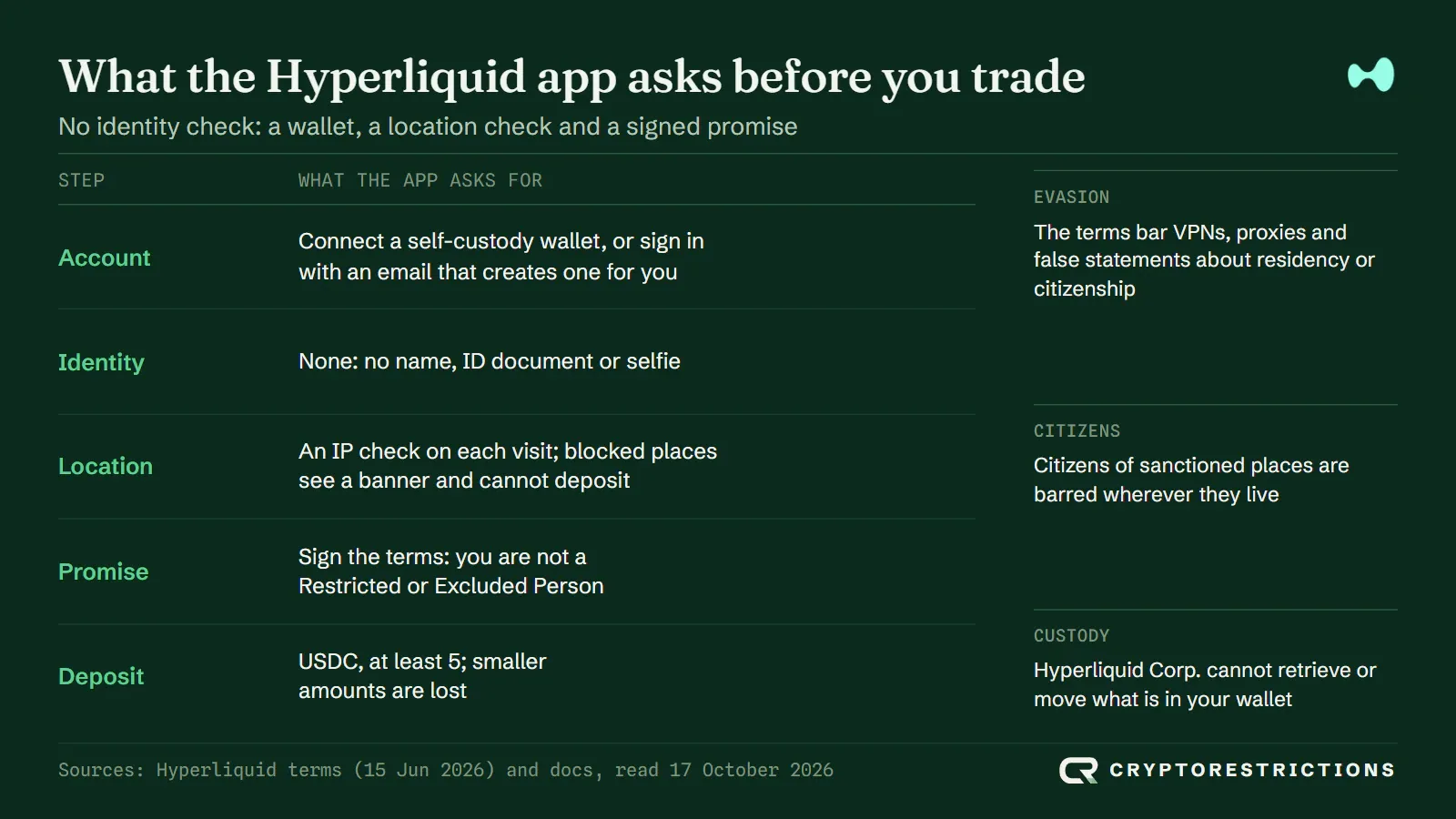
So the only control the app applies is the location check, plus your promise. A wallet carries no name, which is why the citizenship rule in the terms cannot be checked at the door.
Hyperliquid verification history
We found no record that Hyperliquid has ever asked for identity documents, and no announced plan to start. What has changed is the location layer: the IP block was in the app by May 2024, and the June 2026 terms added the Excluded Persons list for outcome markets, which the app enforces by hiding the tab.
What if Hyperliquid is restricted where you live?
It depends on the country: of the 21 other platforms we track, 20 are available in Saudi Arabia, but only one in Cuba, Iran and North Korea.
Using the app from a restricted country is not an option under the terms, which bar VPNs, proxies and false statements about residency or citizenship, and bar citizens of sanctioned places even when they live elsewhere. Other front ends set their own rules, often stricter ones. What is left is a platform allowed to serve you where you live.
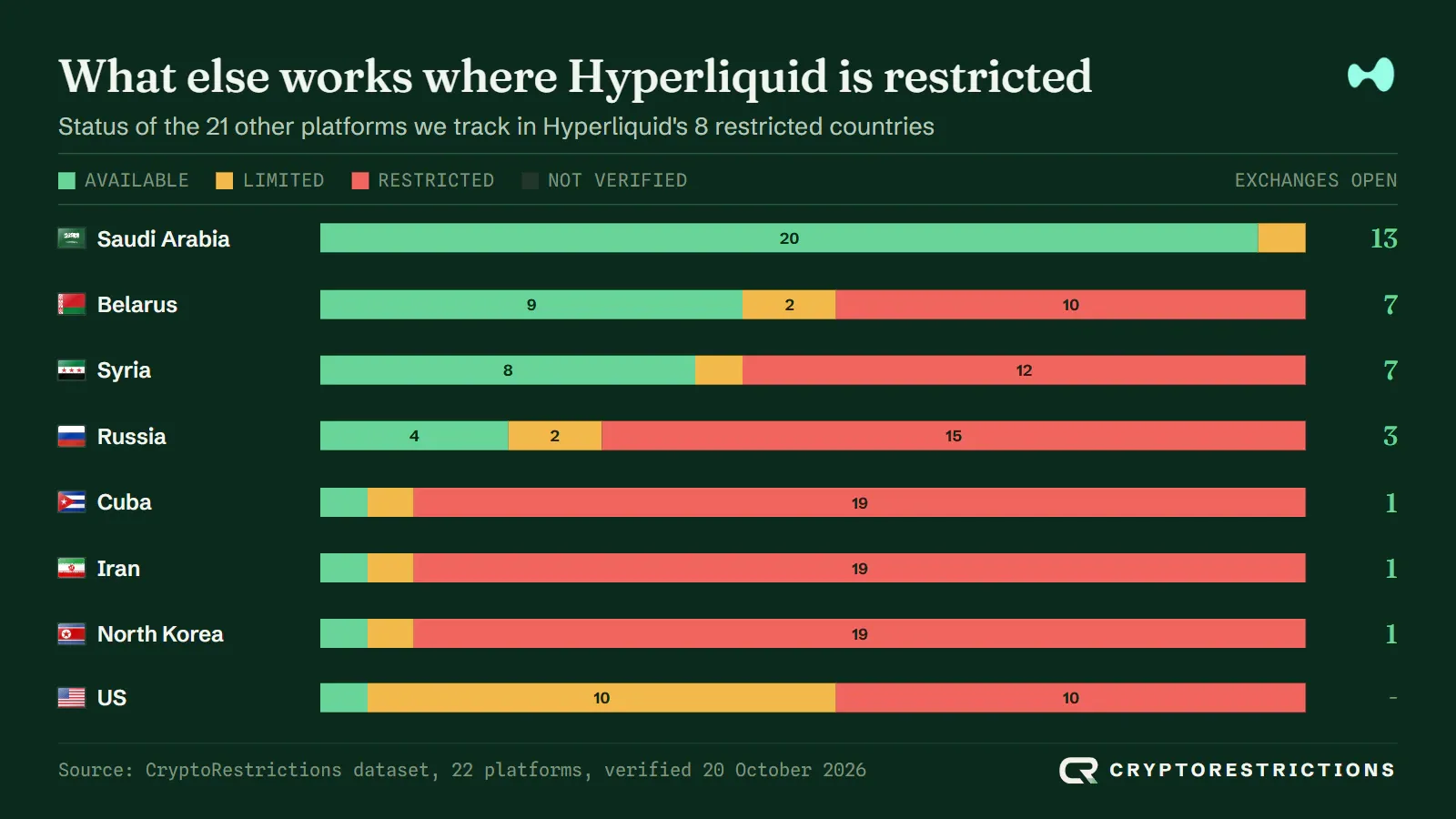
Saudi Arabia, blocked only by the app, keeps most tracked platforms open, 13 of them centralised exchanges. In the United States the field narrows to one, Uniswap, with ten more limited, and in Cuba, Iran and North Korea only one exchange is recorded as available.
For a country-by-country comparison of exchanges, with residency rules and licences side by side, see our guide to exchange alternatives by country.