
 United States · WA
Is crypto legal in Washington?
Yes. Owning and trading crypto is legal in Washington, but a firm that sends, holds or exchanges crypto for Washingtonians needs a money transmitter licence from the Department of Financial Institutions (DFI). There is no BitLicense-style crypto-only licence.
Washington has regulated crypto under its existing money services law since 23 July 2017, when SSB 5031 added virtual currency to the Uniform Money Services Act, chapter 19.230 RCW. DFI says exchanges, kiosk operators and custodial wallet providers may need that licence. Its May 2026 newsletter counted 242 main money transmitter licensees, all kinds of transmitter together, not crypto alone.
Federal rules from the SEC, CFTC, Treasury and IRS apply on top, and offshore exchanges that refuse US users refuse Washingtonians too. Both are covered in our United States guide. Washington has a tax on long-term crypto gains but no tax on other income yet, covered in the tax section below.
Which crypto licences does Washington require?
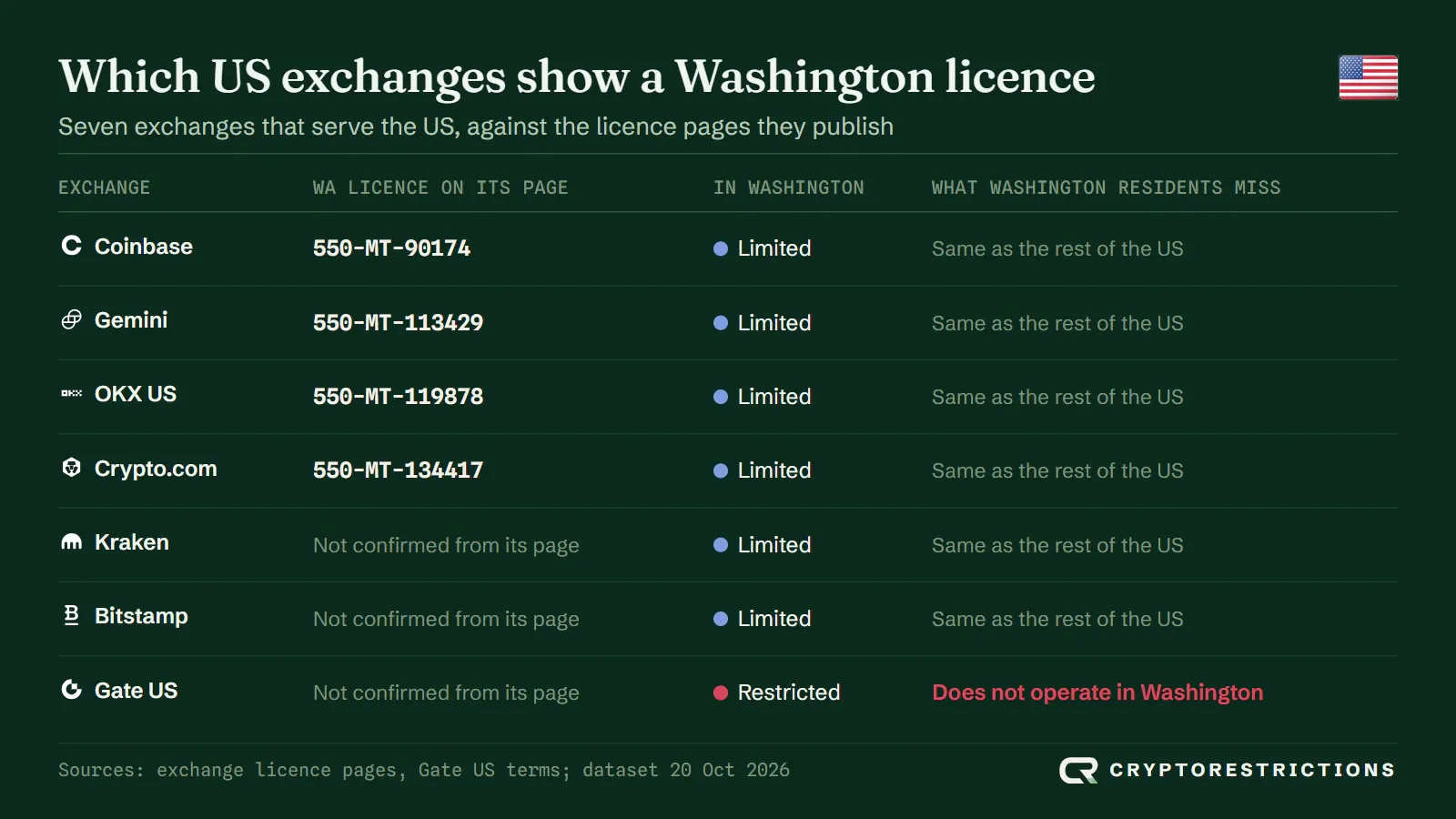
A money transmitter licence from DFI. Four of the seven US exchanges we track print a Washington licence number on their own pages: Coinbase, Gemini, OKX US and Crypto.com.
The rule is one licence for every transmitter, with a surety bond of $10,000 to $550,000 under RCW 19.230.050 and extra disclosure rules for crypto. We could not confirm a Washington licence number for Kraken or Bitstamp from their own pages, and Gate US says it does not operate in Washington, so it needs none.
A licence does not open every product. Coinbase’s staking program drew a DFI statement of charges in June 2023, and Coinbase says Washington residents can still stake. See the regulators section for the dated actions.
Best crypto platforms for Washington residents
By our access score inside Washington, Gemini (8.4 out of 10), Kraken (8.3) and Coinbase (7.9) are the most open exchanges, Kalshi (7.3) the most open prediction market and Uniswap (8.0) the most open DeFi platform.
The score rates how fully a Washington resident can use each platform, not its fees or safety. It is the US score with Washington’s own limits applied: access status (4 points), the share of the platform’s products open in the state (3), the licences we hold on file (2) and what our geo-access test saw from a US address (1). Platforms that refuse Washingtonians are not scored. The method is on our methodology page.
Exchanges

Gemini
Best for Spot trading with a Washington licence
8.4/10- Access
- 3.5/4
- Products
- 1.9/3
- Licences
- 2/2
- Our test
- 1/1
Read our Gemini reportPros
- Washington licence 550-MT-113429 on its Washington page
- Spot trading open in Washington
Cons
- Washington residents must opt in to staking (Asset Rewards)
- Gemini Derivatives excludes US persons

Kraken
Best for Regulated futures for US residents
8.3/10- Access
- 3/4
- Products
- 2.3/3
- Licences
- 2/2
- Our test
- 1/1
Read our Kraken reportPros
- Excludes only Maine and New York on its US licensing page
- US futures through a CFTC-registered futures commission merchant
Cons
- No Washington licence number on its licensing page
- Staking only in select states, none named for Washington

Coinbase
Best for The widest product range, licensed in Washington
7.9/10- Access
- 3.5/4
- Products
- 2.4/3
- Licences
- 1/2
- Our test
- 1/1
Read our Coinbase reportPros
- Washington money transmitter licence 550-MT-90174 on its licence page
- Loans and in-app DEX trading exclude only New York
- Staking still open to Washington residents
Cons
- DFI charged its staking program in June 2023
- No resolution of the staking charges found in DFI records

Crypto.com
Best for Event contracts beside a crypto app
7.5/10- Access
- 3/4
- Products
- 1.5/3
- Licences
- 2/2
- Our test
- 1/1
Read our Crypto.com reportPros
- Washington licence 550-MT-134417 for Foris DAX
- App available in Washington
Cons
- Its prediction exchange is suing Washington in federal court
- No derivatives for US residents on the Exchange

OKX
Best for Spot and conversions from a global brand
6.0/10- Access
- 3/4
- Products
- 1.5/3
- Licences
- 1/2
- Our test
- 0.5/1
Read our OKX reportPros
- Washington licence 550-MT-119878, page updated 15 September 2026
- Excludes only New York and four territories
Cons
- Spot and OTC conversions only: no derivatives
Prediction markets

Kalshi
Best for The broadest event contracts outside sports and politics
7.3/10- Access
- 3/4
- Products
- 2.3/3
- Licences
- 1/2
- Our test
- 1/1
Read our Kalshi reportPros
- CFTC-designated contract market
- Markets outside the barred types stay open
Cons
- Barred in Washington from sports, elections, politics, entertainment, culture, tech, science and mentions
- A court order since August 2026, and the state suit continues
DeFi

Uniswap
Best for Swapping tokens from your own wallet
8.0/10- Access
- 4/4
- Products
- 3/3
- Licences
- 0/2
- Our test
- 1/1
Read our Uniswap reportPros
- Terms do not name Washington
- A New York company with no US-user exclusion
Cons
- Leveraged products for US retail are barred

PancakeSwap
Best for BNB Chain swaps and pools
6.3/10- Access
- 3.5/4
- Products
- 1.8/3
- Licences
- 0/2
- Our test
- 1/1
Read our PancakeSwap reportPros
- Swaps, pools and staking are not excluded
Cons
- PCS Perps bars US users
- No US licence on file
Which platforms block or limit Washington residents?
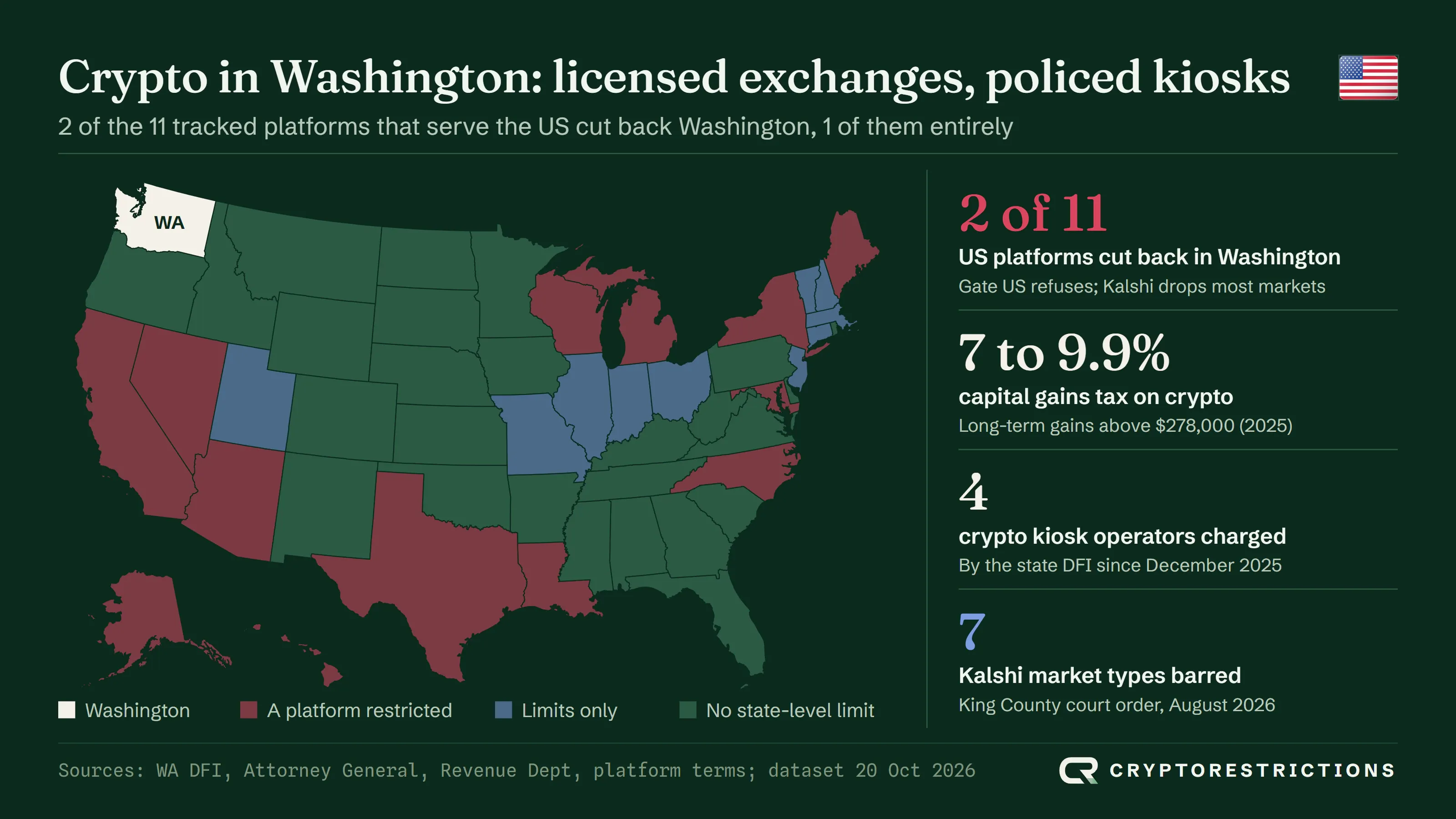
One exchange that serves the rest of the US refuses Washington: Gate US. Kalshi has most of its markets closed here by a court order. No other platform we track names Washington as excluded.
Coinbase’s prediction markets are not named in the Washington order and its help page excludes only Nevada and Michigan, so we log no Washington row for it. Our United States guide covers the platforms that bar every US user.
Who regulates crypto in Washington?
DFI licenses and polices crypto firms, the Attorney General has so far gone after a prediction market rather than an exchange, and the Gambling Commission treats event contracts as unauthorized. A kiosk limits bill has passed the Senate twice but never the House.
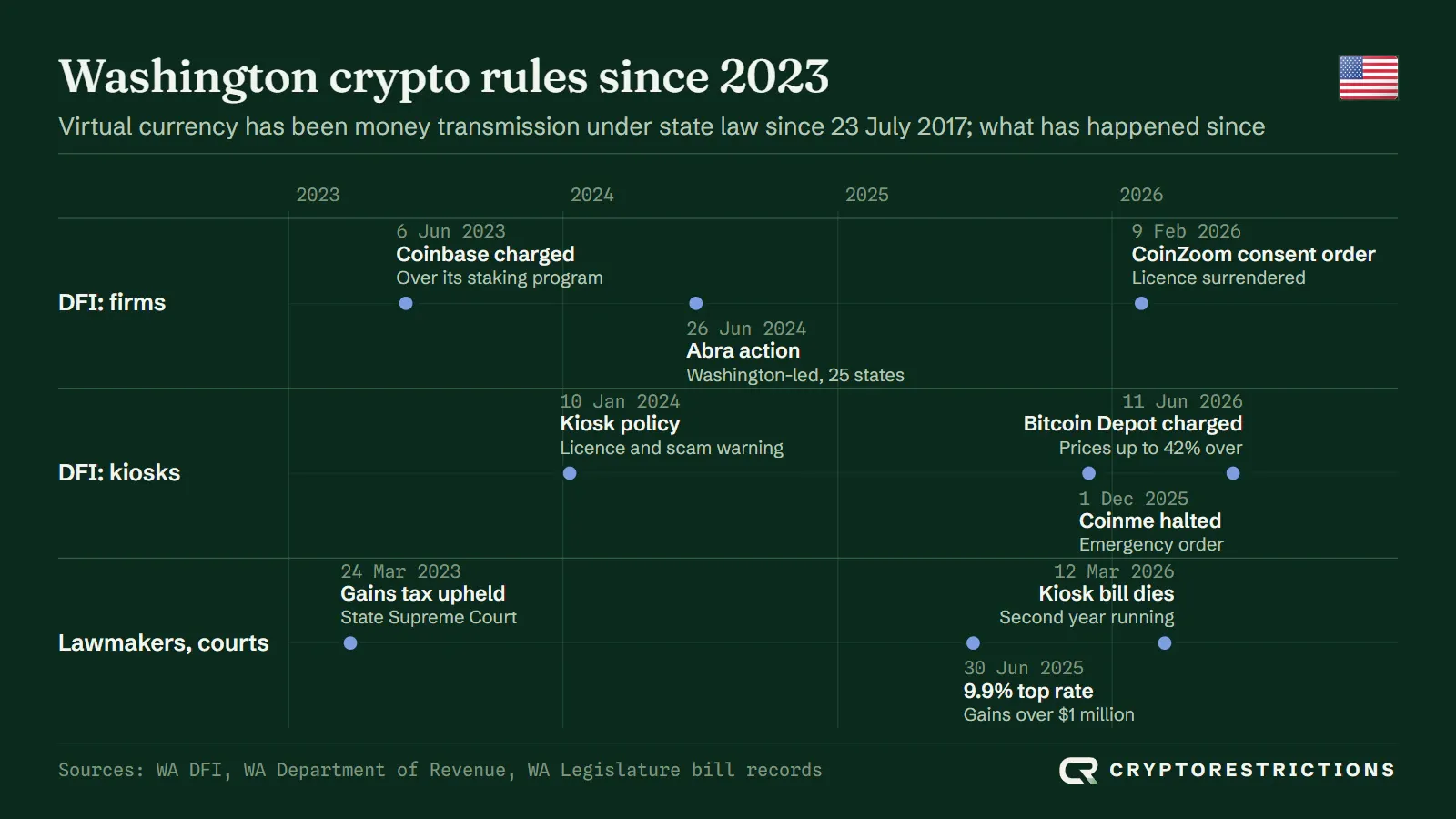
- DFI, firms. On 6 June 2023 it charged Coinbase over its staking program, and on 26 June 2024 it led a 25-state action against Abra that stopped its US trading.
- DFI, kiosks. Its policy statement of 10 January 2024 requires a licence, a report of every kiosk location and a scam warning on the machine, from 1 May 2024. It then halted Coinme on 1 December 2025, charged Bitcoin Depot on 11 June 2026 and CoinFlip on 3 September, and on 8 October joined 34 regulators in a $2.5 million consent order under which Coinme shuts its kiosks by the end of the year. On 19 October it charged Digital Access over markups of up to 31% and seeks a $1,006,175 fine. Charges are allegations until a hearing decides them.
- Legislature. SB 5280, the kiosk bill DFI requested, passed the Senate 29 to 17 in 2025 with a $1,000 daily cap per customer, and again 37 to 12 in 2026, but the House took no vote and it returned to Senate Rules on 12 March 2026. No daily limit or fee cap is in force.
Are prediction markets legal in Washington?
Not for sports and most other event contracts. The Gambling Commission says they are not authorized, and a King County court has ordered Kalshi to stop offering them in the state.
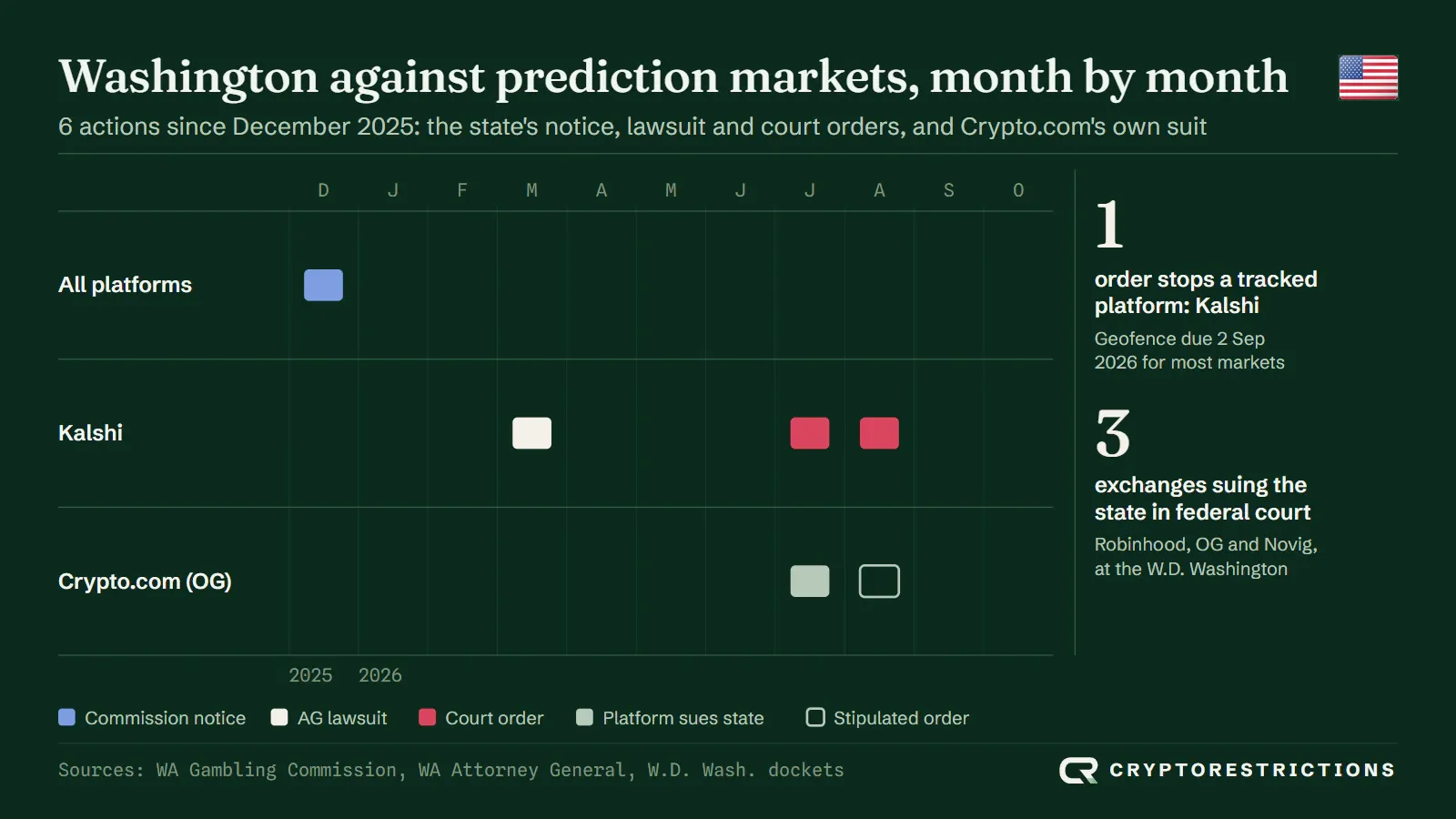
The Gambling Commission’s notice of 9 December 2025 says offering or taking part in event contracts is not authorized in Washington. The Attorney General sued Kalshi on 27 March 2026, and on 20 July a judge granted a preliminary injunction, finding it likely broke the Gambling Act and the Consumer Protection Act. The amended order of 13 August bars sports, elections, politics, entertainment, culture, tech, science and mentions wagers and their advertising, with an IP and residency geofence due by 19 August and a multi-source one by 2 September. The Court of Appeals denied Kalshi a stay. Our United States guide covers the national court split.
Other platforms went to federal court instead of waiting. Robinhood’s derivatives arm filed No. 3:26-cv-05311 on 30 March, the OG exchange, which Crypto.com runs, filed No. 2:26-cv-02579 on 22 July, and Novig filed No. 3:26-cv-05888 on 6 August. The OG docket shows a stipulated order on enforcement actions signed on 27 August; we have not read its terms. We found no Washington action against Polymarket US, Coinbase or Gemini.
How is crypto taxed in Washington?
Washington has no tax on short-term crypto gains today, but a 7% capital gains tax applies to long-term gains over a $278,000 deduction (2025), rising to 9.9% above $1 million of taxable gains. A 9.9% income tax on income over $1 million is set to start in 2028.
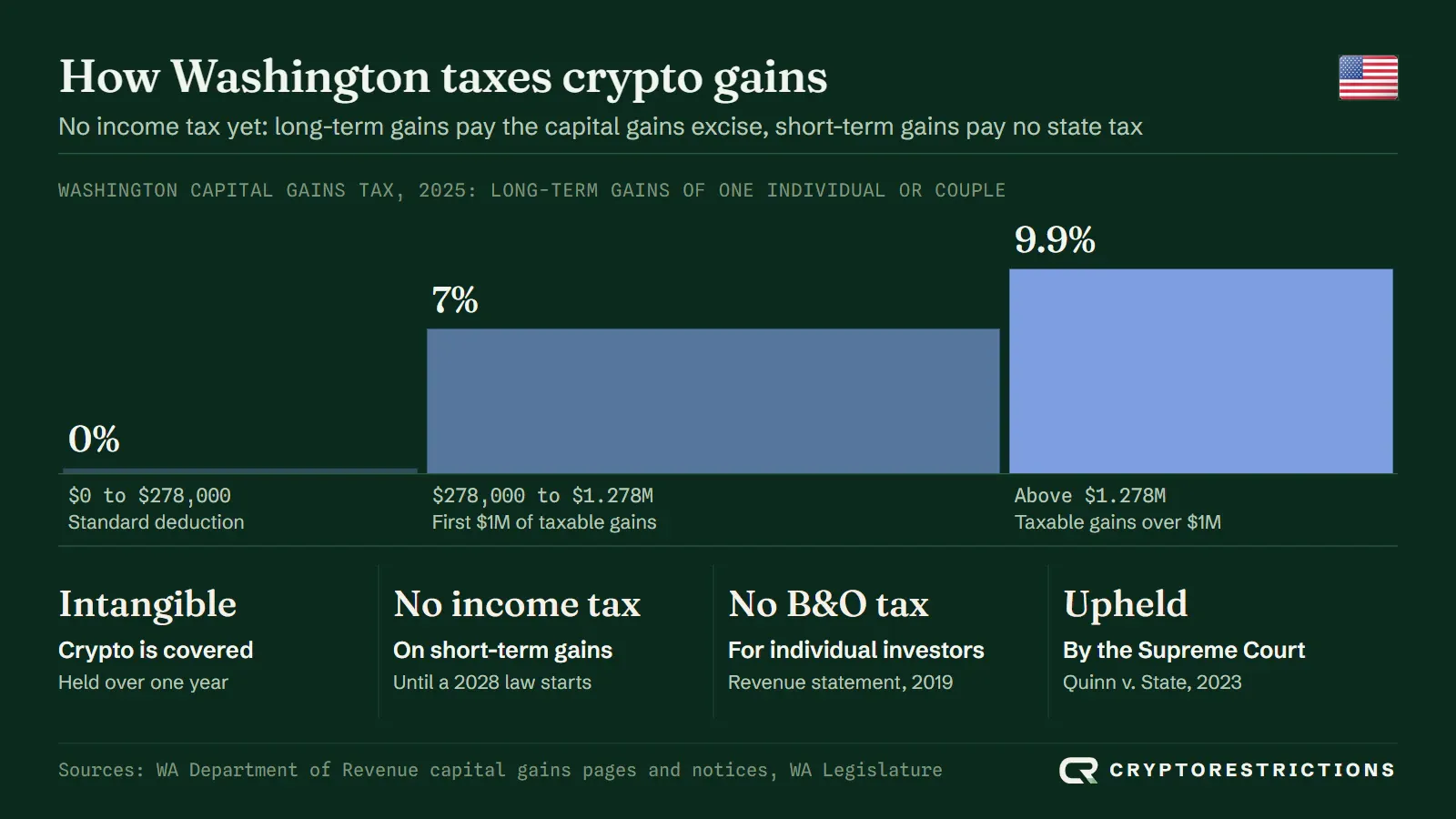
The Department of Revenue treats crypto as intangible property, so you generally owe the tax on a sale of crypto held more than a year if you lived in Washington when you sold. The 2025 standard deduction is $278,000. The 9.9% tier came with the June 2025 law and first applied to 2025 returns. The state Supreme Court upheld the tax on 24 March 2023.
Two Revenue Department rules from August 2019 matter for everyday use: paying for goods in crypto is taxable consideration valued in dollars, and individuals who invest in crypto generally owe no business and occupation tax on their gains. Mining rewards count as service income for that tax.
SB 6346, signed on 30 March 2026, creates a 9.9% tax on income over a $1 million deduction from 1 January 2028, with a credit for capital gains tax paid, according to the Washington Research Council. Voters will decide on 3 November 2026 whether to repeal it through Initiative 645.