Where is Kraken restricted?
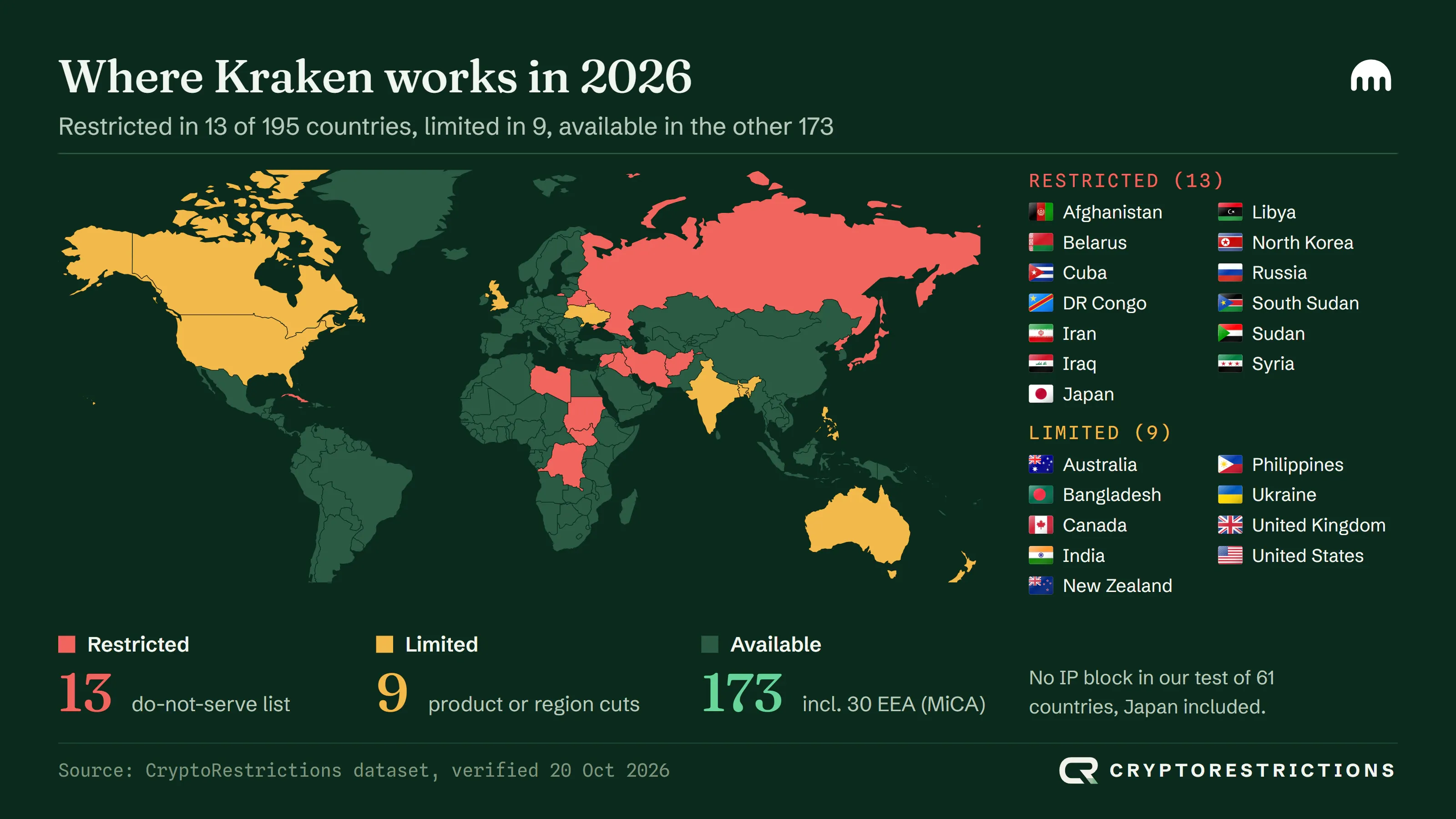
Kraken is restricted in 13 of the 195 countries we cover:  Afghanistan,
 Belarus,
 Cuba, the
 DR Congo,
 Iran,
 Iraq,
 Japan,
 Libya,
 North Korea,
 Russia,
 South Sudan,
 Sudan and
 Syria.
All 13 come from one list. Kraken’s support page on where it is licensed (updated 30 September 2026) names the regions where it does not serve clients or permit cash and crypto deposits, and it adds the Crimea, Donetsk and Luhansk regions of Ukraine. Six of the countries are named again in the sanctions clause of Kraken’s global terms (updated 6 October 2026): Belarus, Cuba, Iran, North Korea, Russia and Syria. Cuba, Iran and North Korea are also under comprehensive US sanctions (OFAC programmes for Cuba, Iran and North Korea).
Japan is the one market exit. Kraken announced in December 2022 that it would close its Japanese business, and its Japanese notice set deregistration with the Financial Services Agency for 31 January 2023. Kraken is not on the FSA’s current register of crypto exchanges.
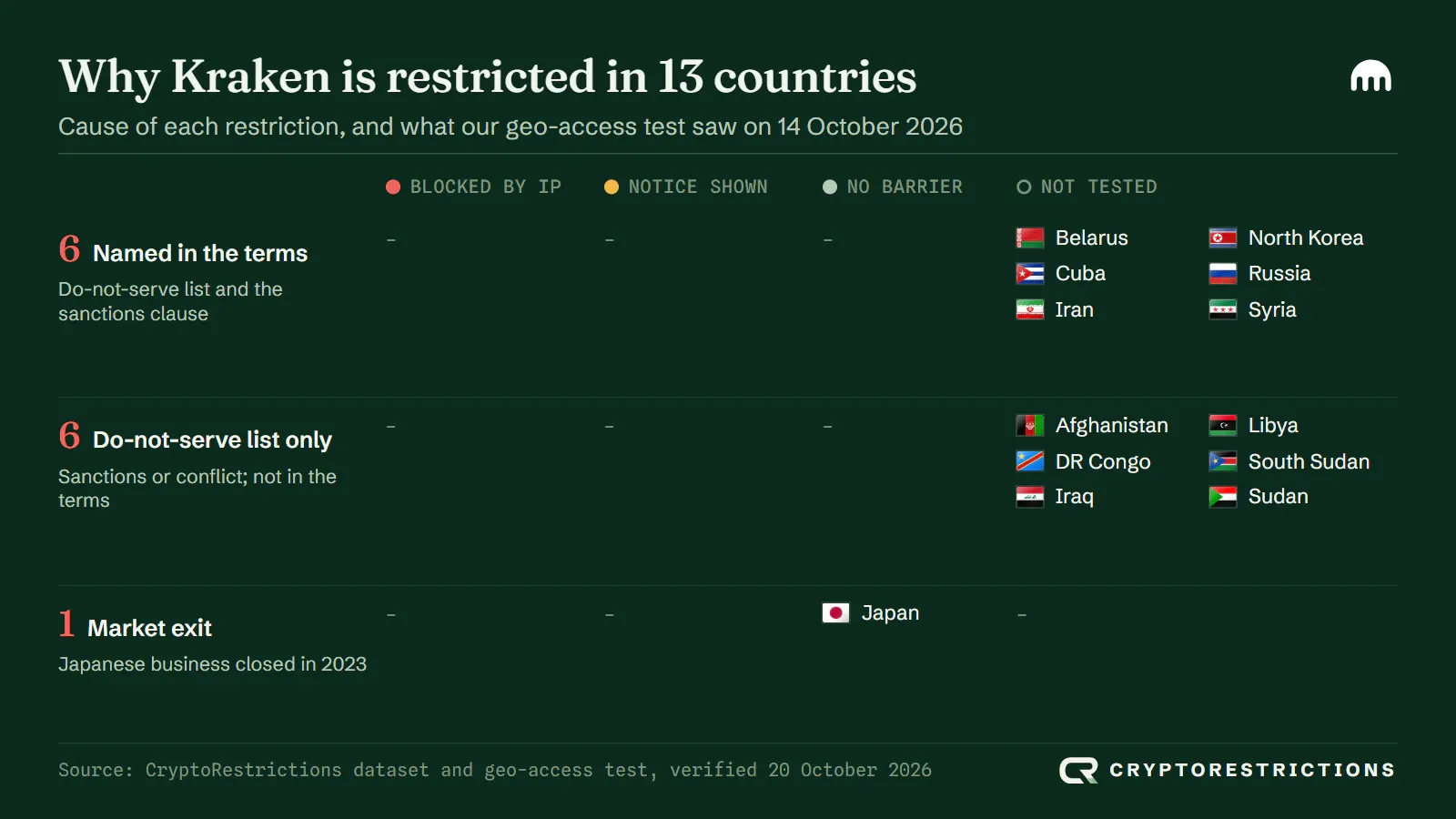
The list is short and almost entirely about sanctions or conflict, and Kraken does not enforce it at the door: Japan, the only restricted country our VPN could reach, loaded both pages. The full list is below: pick a country to see the cause, what applies, when it started and what our test saw.
Where is Kraken limited?
Kraken is limited in 9 countries:  Australia,
 Bangladesh,
 Canada,
 India,
 New Zealand, the
 Philippines,
 Ukraine, the
 United Kingdom and the
 United States.
Six of them come from Kraken’s own pages. Its derivatives eligibility page (updated 28 July 2026) excludes Bangladesh, Canada and New Zealand from Kraken Derivatives, opens it in the UK only to professional clients and in Australia only to wholesale clients. The licensing page adds that Canadian clients cannot trade on margin, that retail clients in the UK cannot trade derivatives and get no Opt-in Rewards, and that Kraken does not serve residents of Maine or New York. Ukraine is limited because Crimea, Donetsk and Luhansk are excluded.
The other two come from regulators that named Kraken as unregistered. India’s Financial Intelligence Unit sent show cause notices to nine offshore exchanges, Kraken’s operator Payward Trading among them, and asked the IT ministry to block their URLs, according to the government’s release of 28 December 2023; the sites were reported blocked in January 2024, and we found no FIU registration for Kraken since. The Philippine SEC named Kraken among ten unregistered exchanges in August 2025, as BitPinas reported, after which the main internet providers restricted access. Kraken excludes neither country, so both stay limited rather than restricted.
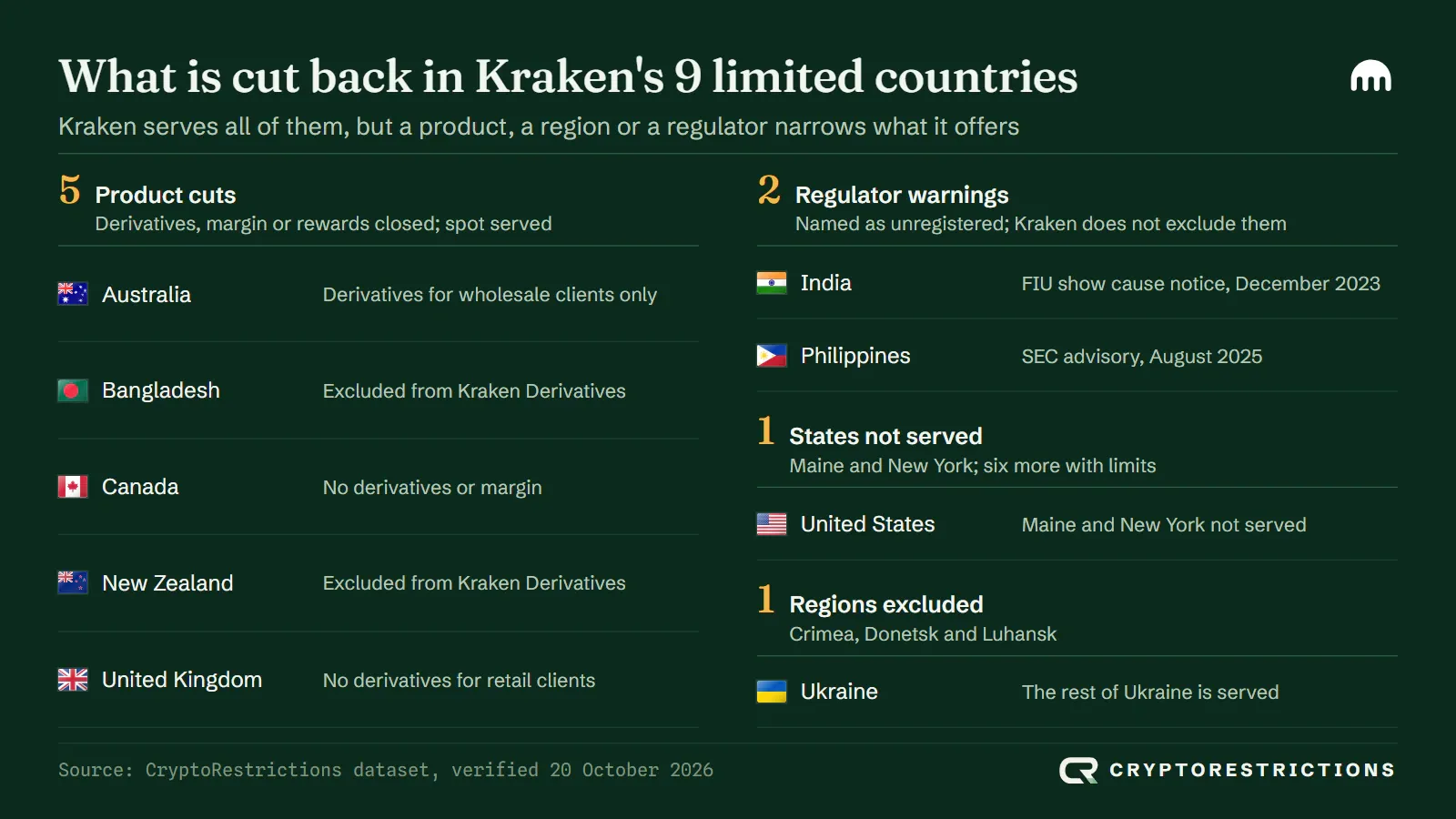
Limited means Kraken still serves the country, but something is cut back or a regulator stands in the way. The list is below: pick a country to see what is closed, what still works and when it changed.
Where is Kraken available?
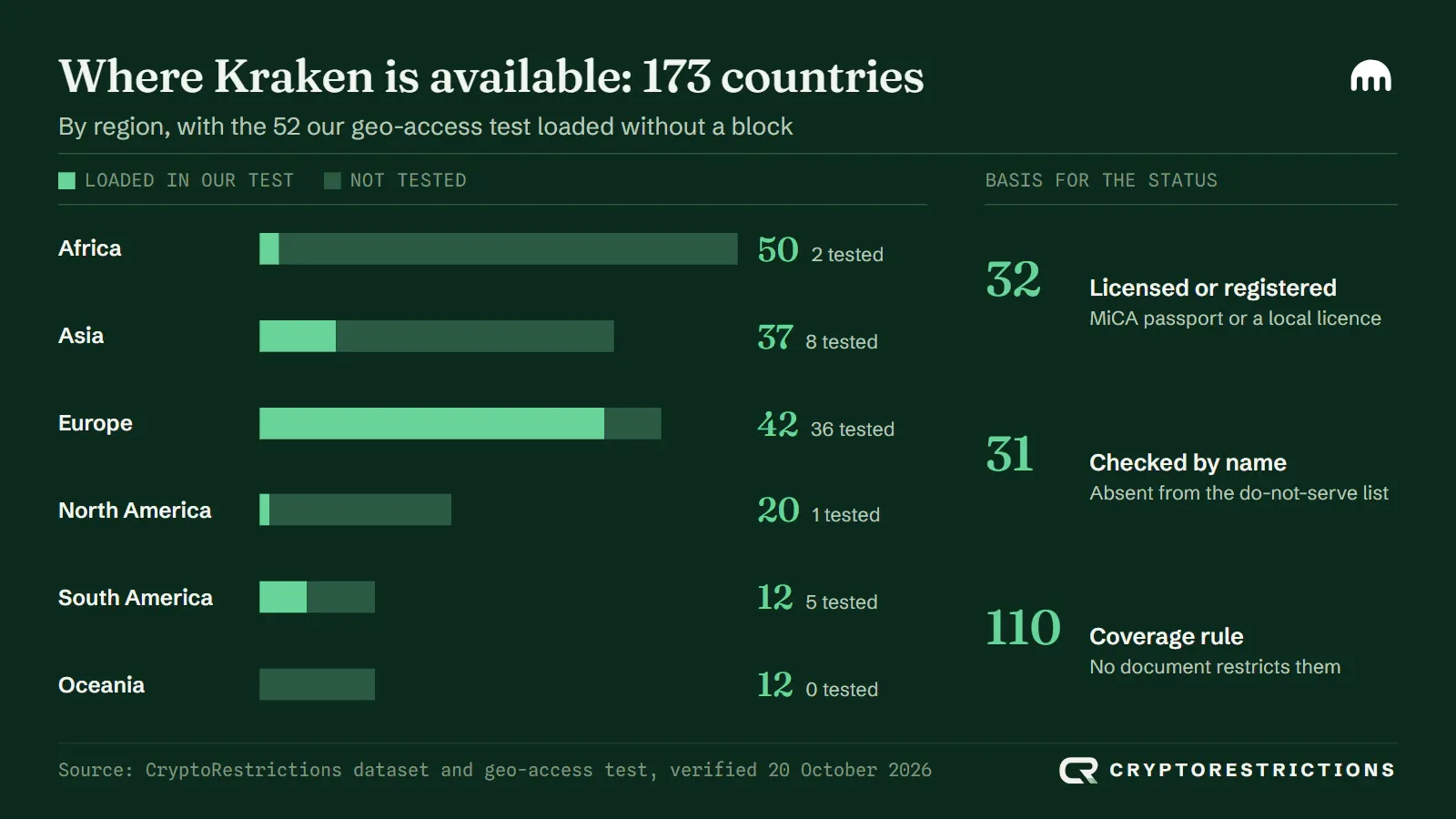
Kraken is available in the other 173 of the 195 countries we cover, from all 30 EEA countries and  Switzerland to
 Brazil,
 Nigeria and
 Singapore.
Thirty-two of them host a Kraken licence or registration: the 30 EEA countries under its Irish MiCA passport,  Argentina and the
 United Arab Emirates (listed in the licences section below). For 31 more we checked the country by name against the do-not-serve list and found it absent, among them
 South Korea,
 Turkey and
 Myanmar, which carries a FATF call for action but is not in Kraken’s list or its sanctions clause. Singapore is served although Kraken says it holds no licence there.
The remaining 110 are available under our coverage rule: no official document from Kraken or a regulator restricts them, so we record them as available rather than unknown. Our geo-access test backs this up where it reached: both pages loaded in 52 of the 173, and only Belgium showed a message, a risk warning Belgian law requires.
Available means Kraken serves the country, not that local law allows crypto trading, and products still vary: DeFi Earn, for example, is not offered in Argentina or Singapore.
Where do Kraken’s visitors come from?
In both traffic estimators kraken.com’s top visitors come from the United States, the United Kingdom, France and Germany, and no restricted country appears in either top five.
Semrush counts 9.32 million visits in September 2026, 27.68% of them from the United States and 7.33% from the UK, with Bangladesh third at 5.52%. Similarweb’s own page was over its free search limit when we checked on 17 October, so we used the monthly reports built on its data: Cryip’s June 2026 report puts the United States at 33.06% and the UK at 10.53%, and BitRSS’s May 2026 report at 35.07% and 11.36%, both with Canada third.
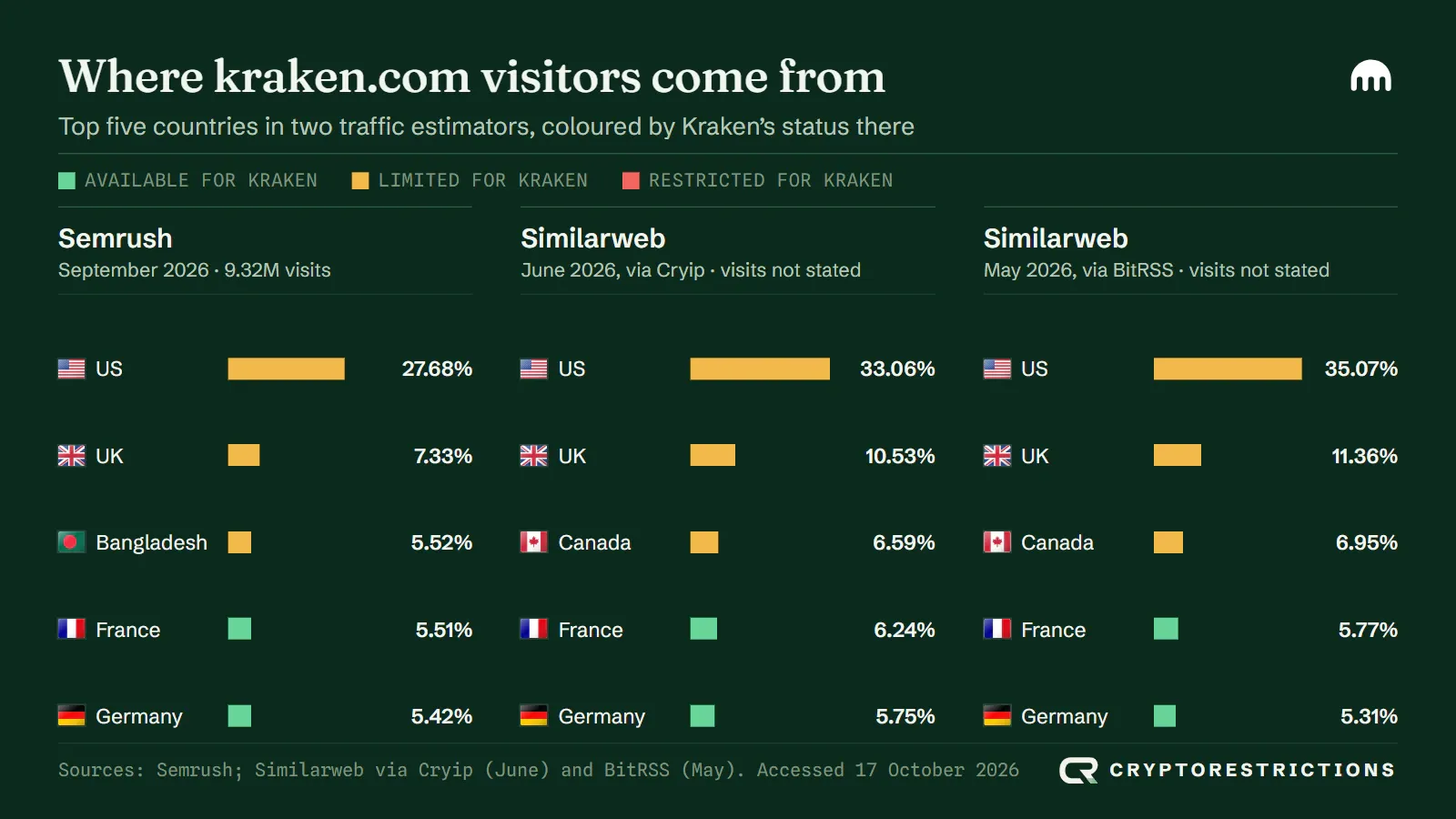
Most of Kraken’s traffic comes from countries where it is limited rather than restricted: the United States, the UK, Canada and Bangladesh are all limited for product or state cuts, not closed. Bangladesh shows up only in Semrush, where 97.99% of its visits are from desktops, and not in either Similarweb report; estimators model traffic from panels and samples, so treat a single country’s share as an estimate.
Kraken geo-access test: what we saw from 61 places
In our test Kraken refused visitors by IP address in none of the 61 places we reached, Japan included; the only messages were risk warnings in the UK and Belgium.
We ran the test ourselves on 14 October 2026. A browser with a VPN connected to one country at a time and loaded Kraken’s home page and its sign-up page, each time in a fresh private window with no cookies. Cookie banners were hidden but never accepted, and bot checks were waited out, never solved. Every run saved the page text and a screenshot.
All 61 places, 59 of our 195 countries plus Hong Kong and Taiwan, were reached through VPN servers located in the country. Kraken’s location check follows the physical server rather than the address’s registered country, so we did not use the VPN’s virtual locations for Kraken; that leaves out most of Africa, the Middle East and every restricted country except Japan.
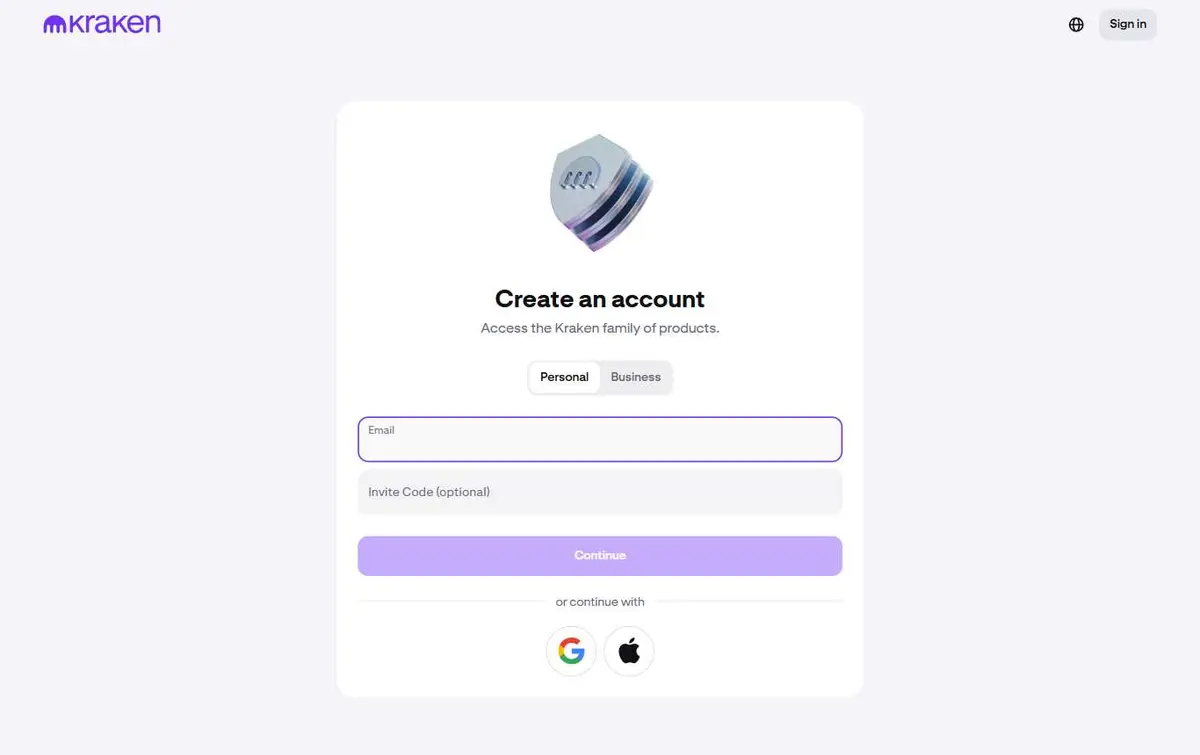
No barrierJapan · Sign-up page
Japan is on Kraken's do-not-serve list, yet the sign-up form loads
“Create an account”
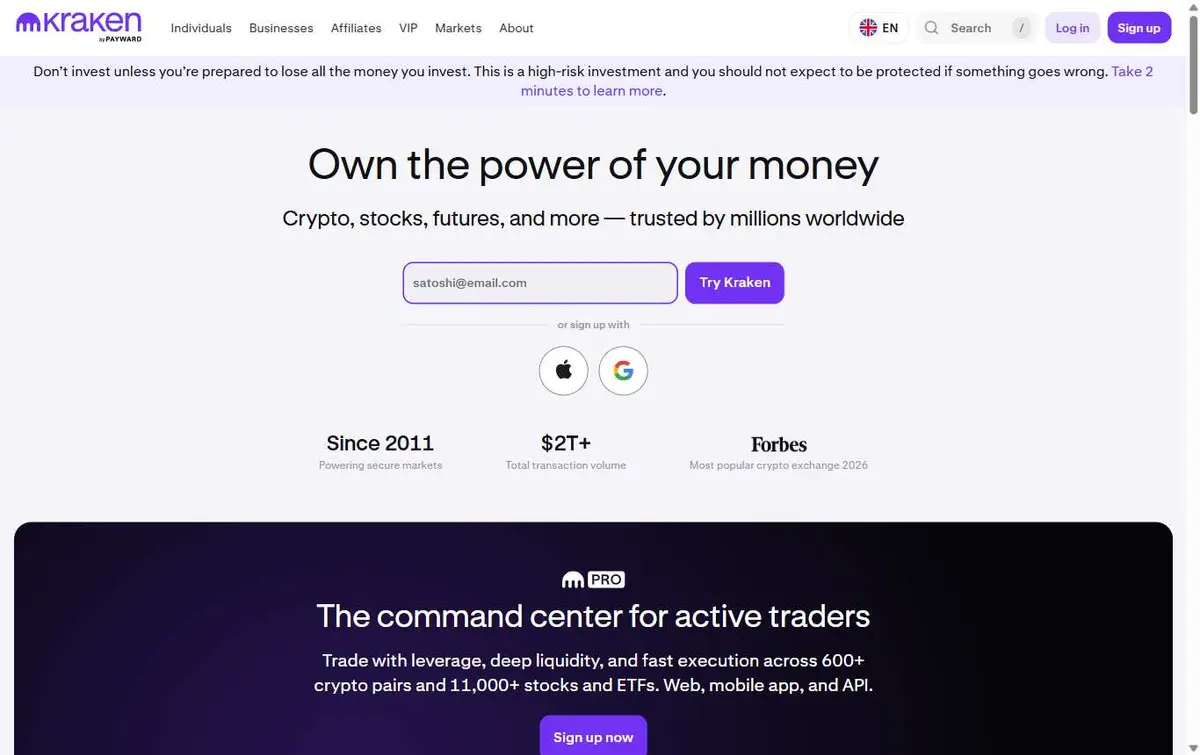
Notice shownUnited Kingdom · Home page
The UK risk warning required by the FCA, over an open page
“Don’t invest unless you’re prepared to lose all the money you invest.”
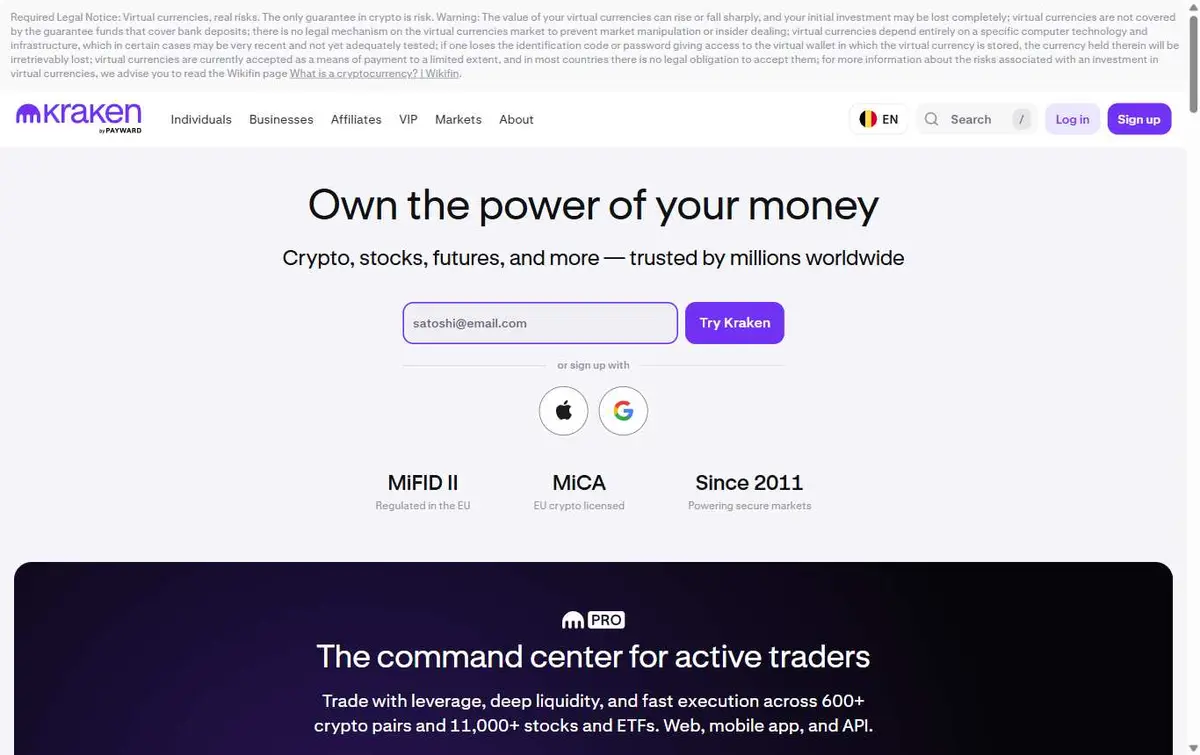
Notice shown Belgium · Home page
Belgium's legally required risk notice, the only other message we saw
“Required Legal Notice: Virtual currencies, real risks.”
No barrierUnited States · Sign-up page
From the US, the global sign-up form: Maine and New York are refused later
“Create an account”
No barrierCanada · Sign-up page
Canada: sign-up open, but no margin or derivatives for Canadian clients
“Create an account”
No barrierUkraine · Sign-up page
Ukraine is served outside Crimea, Donetsk and Luhansk
“Create an account”
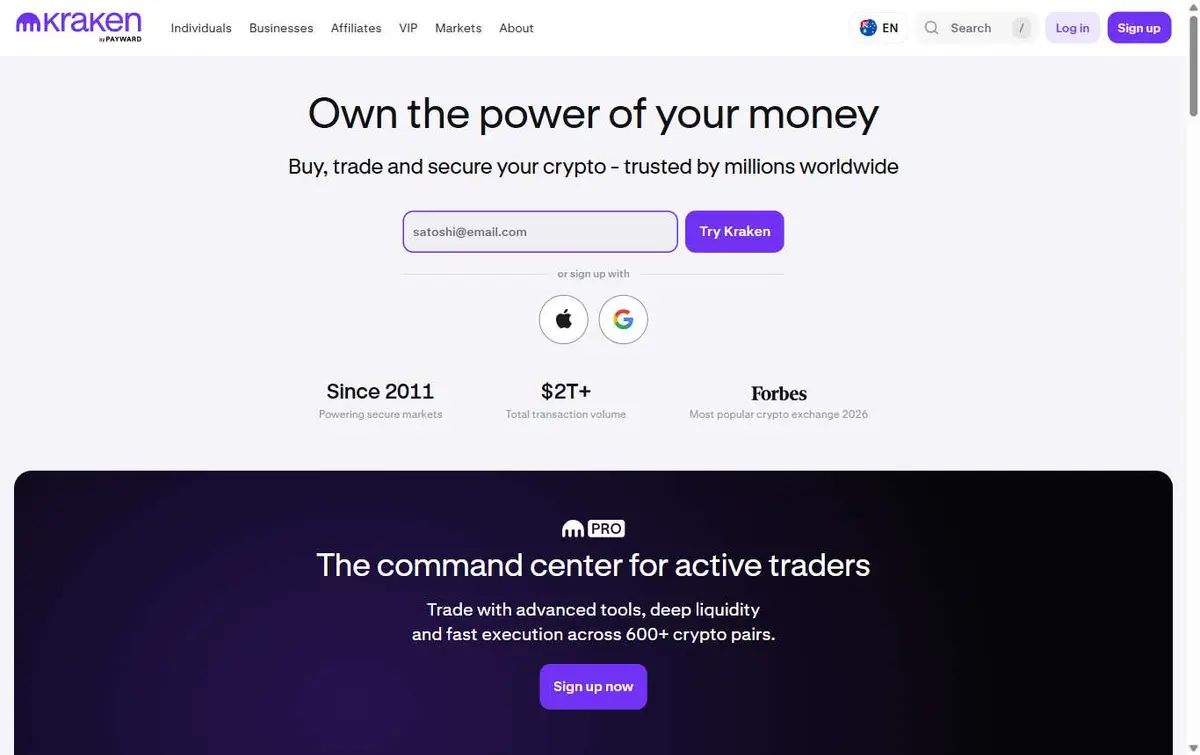
No barrierAustralia · Home page
Australia: derivatives only for wholesale clients
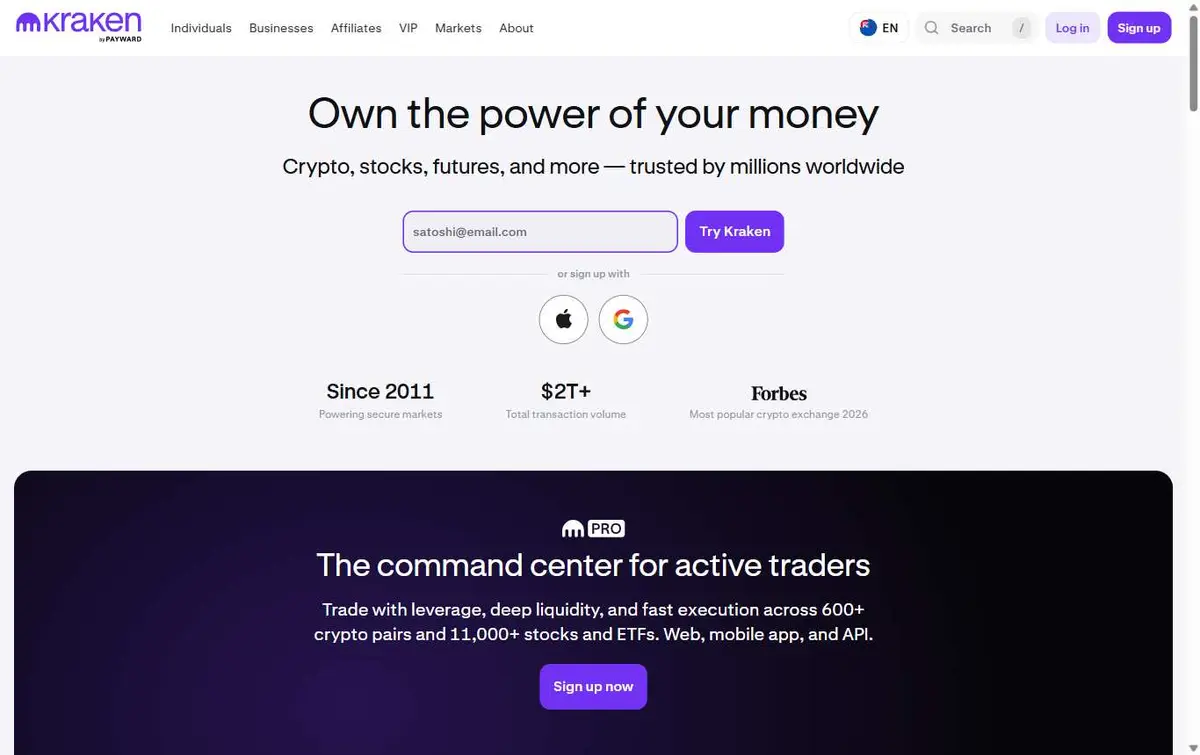
No barrierNew Zealand · Home page
New Zealand loads normally; only Kraken Derivatives excludes it
No barrierSingapore · Sign-up page
Singapore, where Kraken says it holds no licence, is still served
“Create an account”
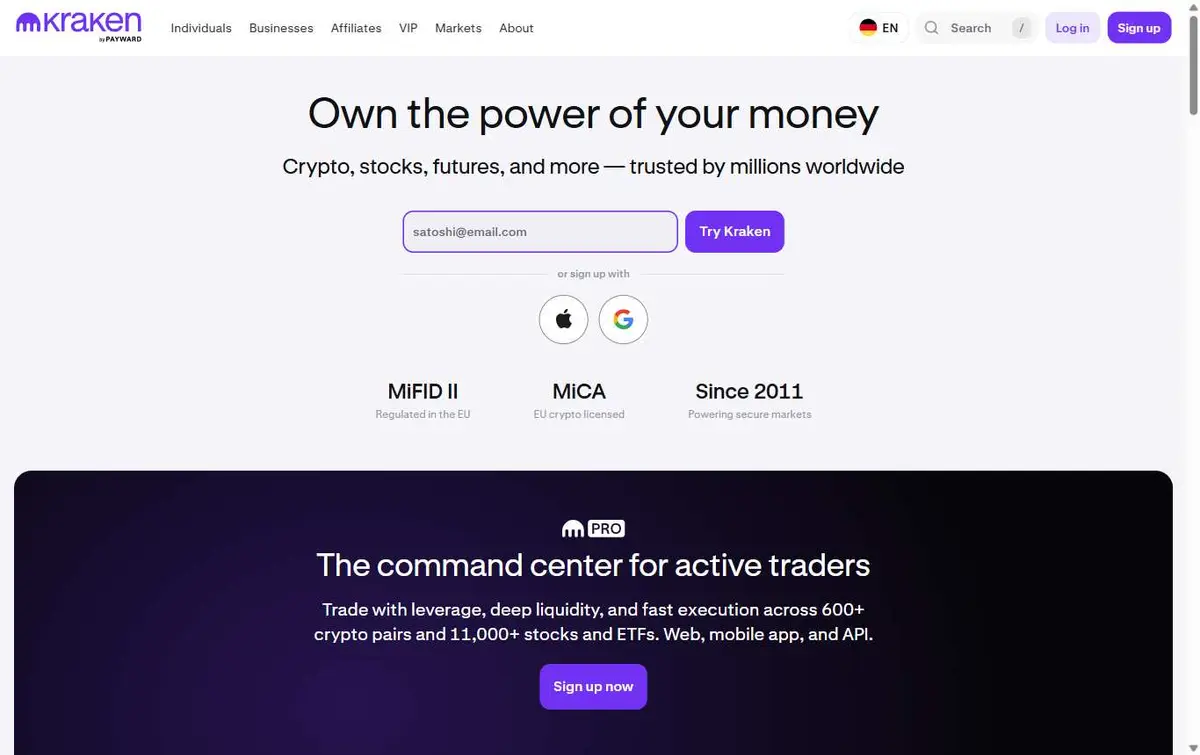
No barrier Germany · Home page
Germany, one of 30 EEA countries under Kraken's Irish MiCA licence
No barrier Netherlands · Sign-up page
The Netherlands, one of 30 EEA countries under Kraken's Irish MiCA licence: sign-up loads
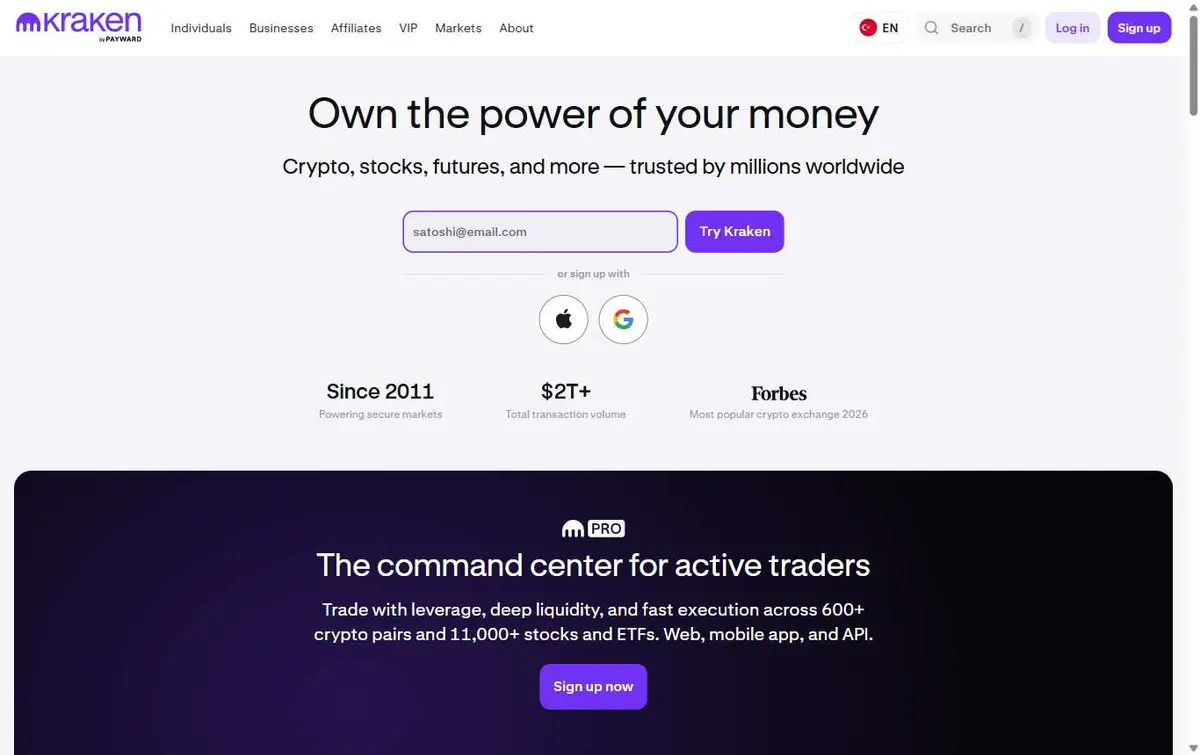
No barrierTurkey · Home page
Turkey: the home page loads with no notice
No barrier Mexico · Sign-up page
Mexico: the sign-up form loads with no barrier
“Create an account”
No barrierArgentina · Sign-up page
Argentina: the sign-up form loads; Kraken is registered with the CNV
“Create an account”
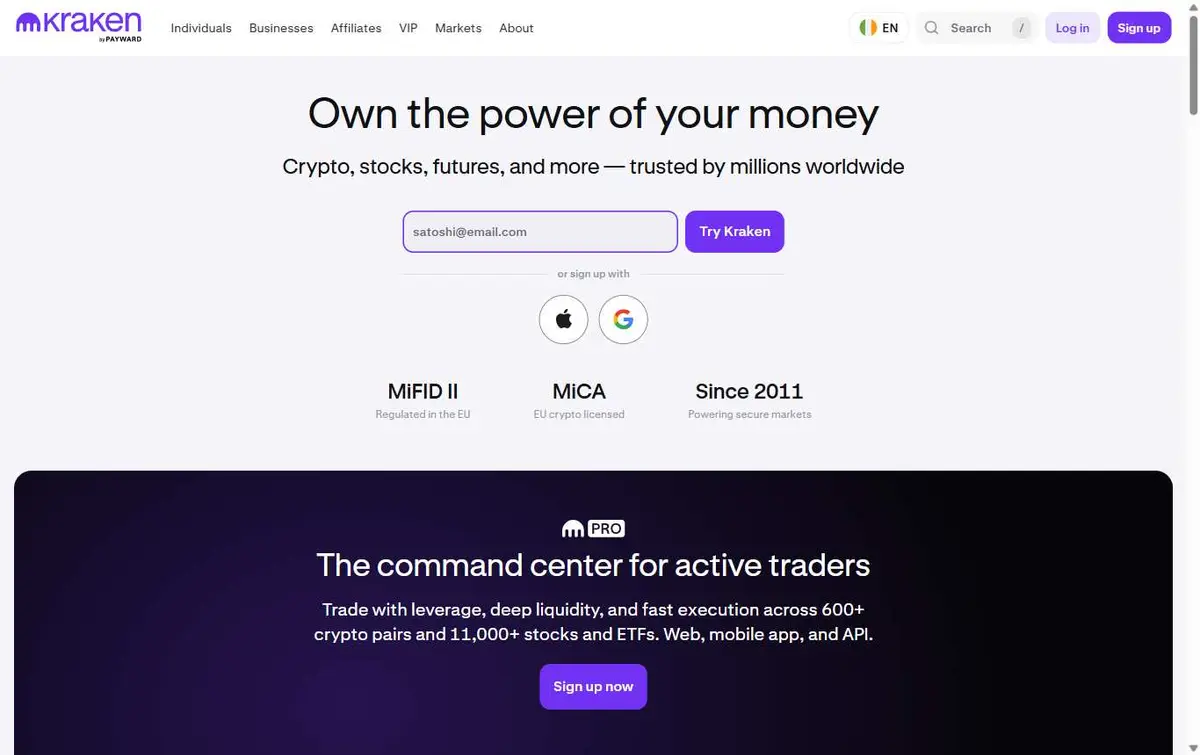
No barrier Ireland · Home page
Ireland, the home of Kraken's MiCA licence: the home page loads with no notice
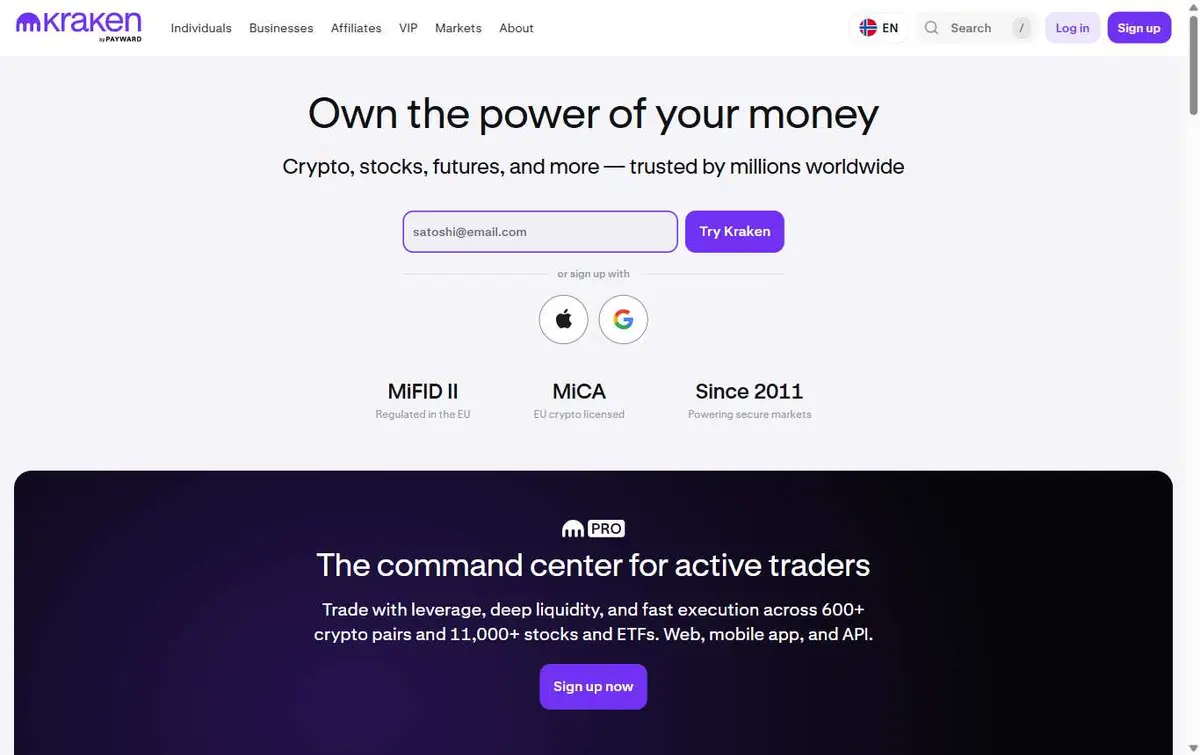
No barrier Norway · Home page
Norway: the home page loads with no notice
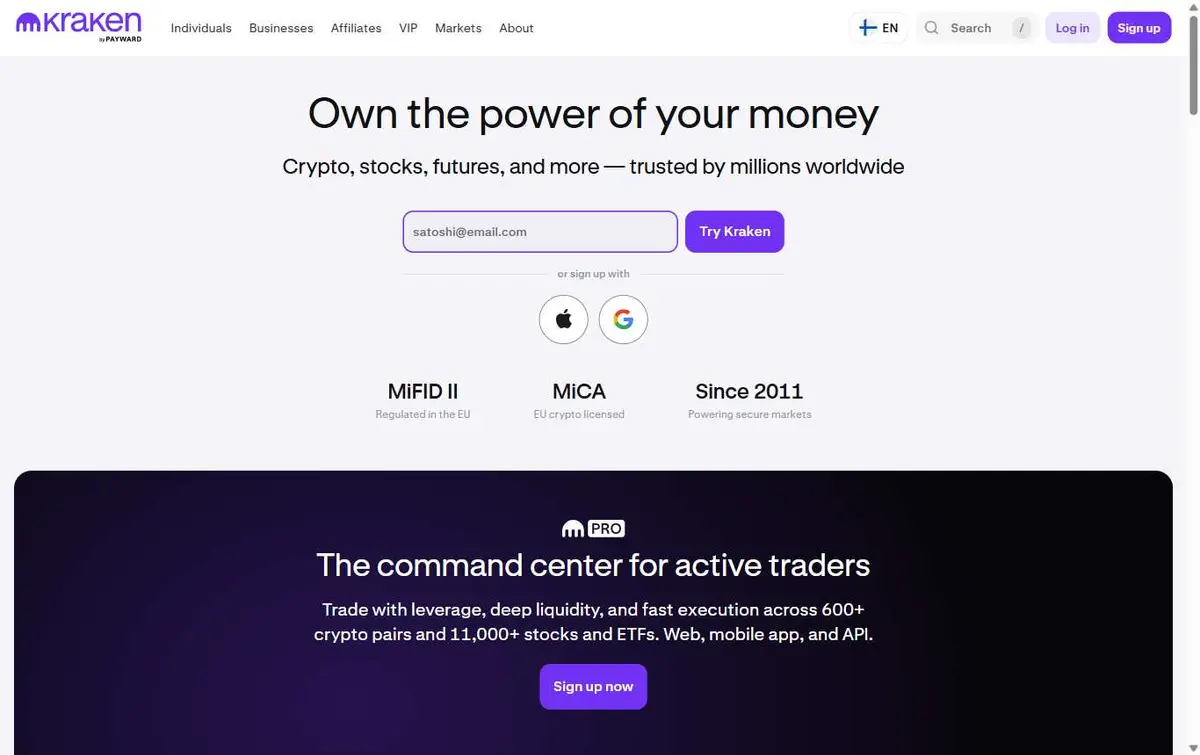
No barrier Finland · Home page
Finland: the home page loads with no notice
No barrier Greece · Home page
Greece: the home page loads with no notice
No barrier Bulgaria · Home page
Bulgaria: the home page loads with no notice
No barrier Croatia · Home page
Croatia: the home page loads with no notice
No barrier Latvia · Home page
Latvia: the home page loads with no notice
No barrier Estonia · Home page
Estonia: the home page loads with no notice
No barrier Lithuania · Home page
Lithuania: the home page loads with no notice
No barrier Slovenia · Home page
Slovenia: the home page loads with no notice
No barrier Iceland · Home page
Iceland: the home page loads with no notice
No barrier Serbia · Sign-up page
Serbia: sign-up loads with no barrier
 CRYPTORESTRICTIONS
The test does not decide a country’s status on its own: official documents come first, and a page that loads is not permission to use Kraken. What it shows is how Kraken enforces its rules at the door.
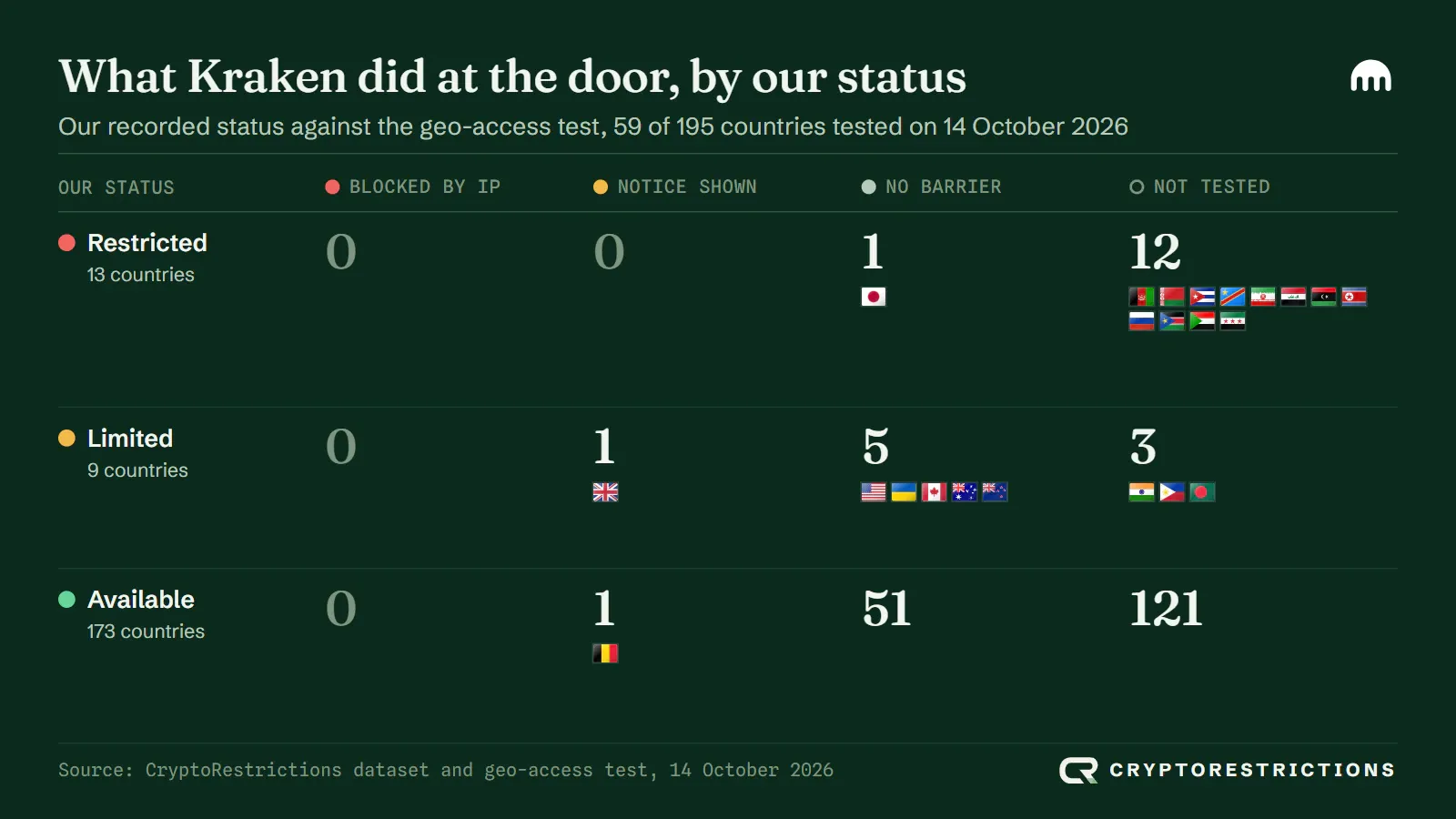
The pattern is simple: Kraken does not geo-block. Japan, restricted since 2023, showed the same sign-up form as the United States, and so did Canada, Australia and New Zealand, where products are cut. That puts Kraken at the opposite end from Bitget, whose IP check flagged 13 of the countries in its own test. Kraken applies its rules at verification instead, when you give your country of residence and an ID. The two messages we saw are legal requirements, not blocks: the FCA’s risk warning in the UK and Belgium’s notice on the risks of virtual currencies.

The full result for every place we tested is below.
All 61 test results, country by country
Kraken licences and registrations
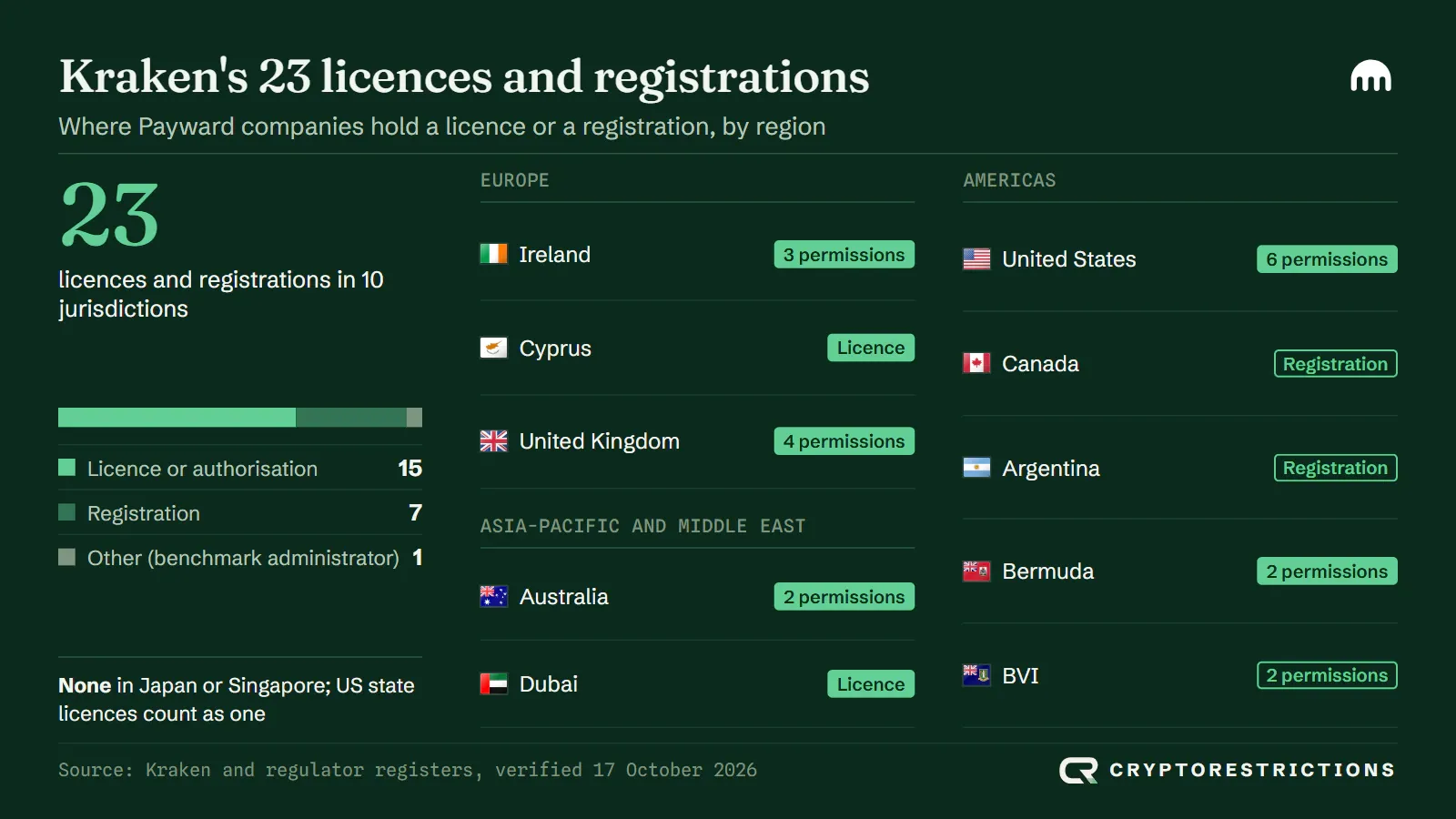
Kraken holds 23 licences and registrations in 10 jurisdictions, from a MiCA authorisation in Ireland to state money transmitter licences in the US, and none in Japan or Singapore.
The list starts from Kraken’s legal disclosures (updated 11 August 2026) and its regulation page, which counts more than 100 active licences when each US state licence is counted separately. We checked each entry against the regulator’s own register where it could be read. Fifteen are licences or authorisations, seven are registrations, mostly for anti-money-laundering supervision, and one is a benchmark administrator authorisation for CF Benchmarks.
Europe
- Ireland (EEA passport): Payward Europe Solutions Limited (C468360) is authorised as a crypto-asset service provider under MiCA by the Central Bank of Ireland, and ESMA’s register shows the authorisation of 25 June 2025 passported to all 30 EEA countries. A second Irish company, Payward Global Solutions Limited (C559106), is authorised to operate the trading platform, passported to Cyprus, and Payward Ireland Limited (C453020) is an e-money institution, all three on the Central Bank’s register.
- Cyprus: Payward Europe Digital Solutions (CY) Limited holds MiFID investment firm licence 342/17 from CySEC, which serves EEA clients derivatives through eu.kraken.com.
- United Kingdom: Payward Ltd (FRN 928768) has been registered with the FCA for cryptoasset activities since 23 November 2021. Crypto Facilities Ltd (FRN 757895), the derivatives platform, has been FCA authorised since 2017; Payward Services Ltd is an e-money institution and CF Benchmarks Ltd a benchmark administrator.
Americas
- United States: Payward Interactive holds money transmitter licences in 46 US jurisdictions, with its California application under the state’s new crypto law still pending. Kraken Financial is a Wyoming special purpose depository institution with a Federal Reserve master account, NinjaTrader Clearing (Kraken Derivatives US) a CFTC futures commission merchant, Bitnomial a CFTC-licensed exchange and clearing house, and Kraken Securities and Kraken Adviser are SEC-registered.
- Canada: Payward Canada and Payward, Inc. are registered as a restricted dealer in every province and territory, with the Ontario Securities Commission as principal regulator, according to the OSC’s list (decision of 1 April 2025, amended in 2026).
- Argentina: Payward Trading Limited’s Argentine branch is registered with the CNV as a virtual asset service provider, according to Kraken; we could not reach the CNV register.
- Bermuda and the British Virgin Islands: Payward Digital Solutions Ltd and Payward Commercial Treasury Limited hold Class F digital asset business licences on the BMA register, the second one not listed by Kraken itself. In the BVI, Payward Oceanic Ltd. joined the FSC register as a virtual assets exchange on 1 October 2026.
Asia-Pacific and the Middle East
- Australia: Bit Trade Pty Ltd is registered with AUSTRAC as a digital currency exchange, and derivatives reach wholesale clients through Beaufort Fiduciaries, which holds an Australian financial services licence.
- Dubai: Payward FZCO holds VASP licence VL/26/10/002 for broker-dealer and investment management services, issued on 6 October 2026, on the VARA register; Kraken says UAE clients go live in the coming weeks.
Kraken and MiCA in the EU
Kraken holds a MiCA licence from the Central Bank of Ireland, granted on 25 June 2025, and serves all 30 EEA countries under it.
MiCA is the EU’s crypto rulebook, and from 30 December 2024 it required exchanges serving EU clients to hold an authorisation from one member state that can then be passported across the EEA (our MiCA article covers the rules). Firms without one had to stop by 1 July 2026 at the latest, ESMA said in its statement of 17 April 2026. Kraken announced its Irish licence a year before that deadline, and on 12 August 2025 said it was live in all 30 EEA countries under it.
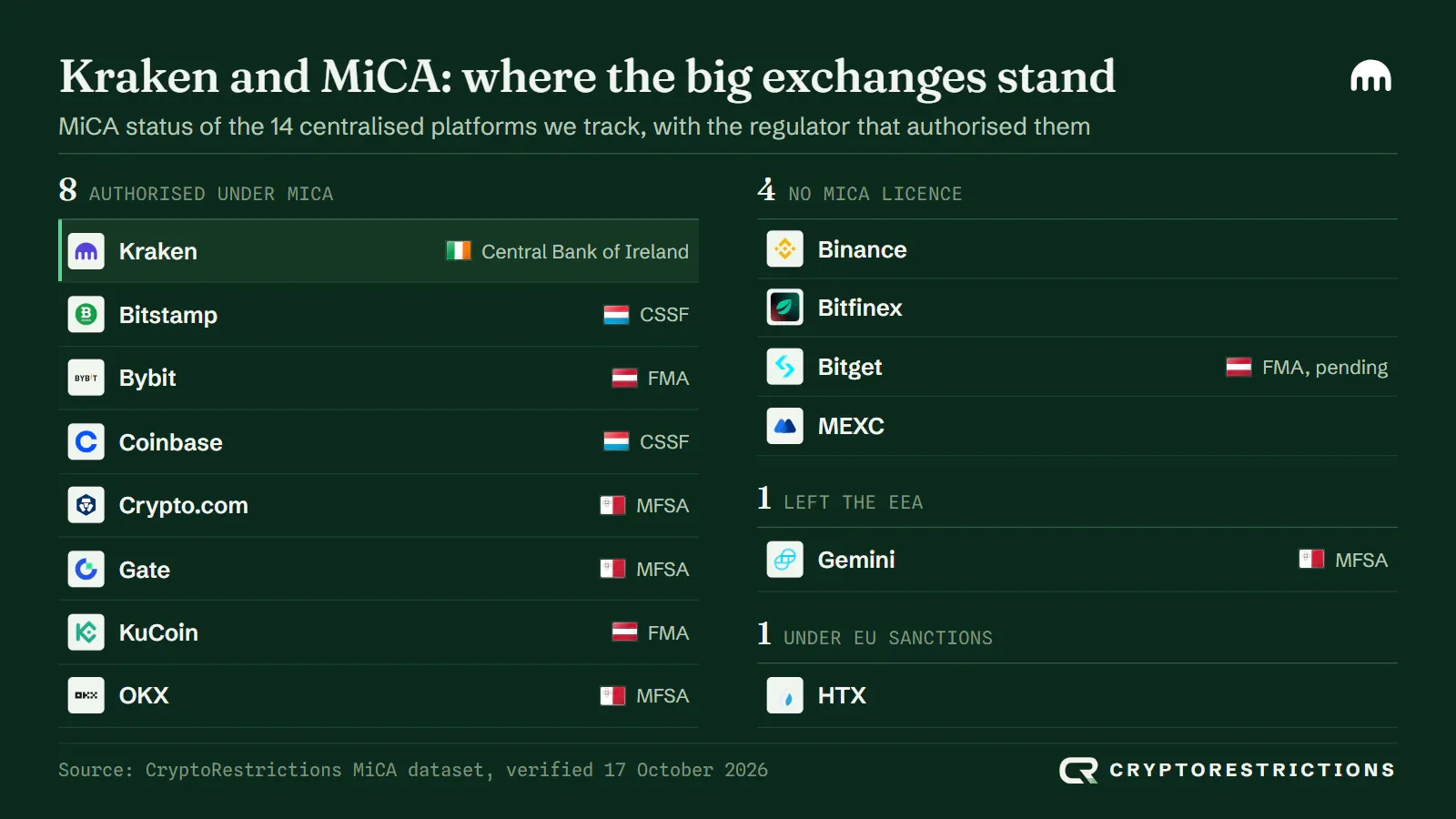
Kraken is one of eight authorised platforms among the 14 centralised exchanges in our MiCA dataset, and the only one licensed in Ireland; the others went to Luxembourg, Malta and Austria. Unlike MEXC, which has no MiCA licence and appears on ESMA’s list of non-compliant firms, Kraken can serve the whole EEA from one passport.

The EEA offer is still narrower than the global one. Kraken’s licensing page says Opt-in Rewards in the EEA cover only Bitcoin, USDG Rewards and Babylon Bitcoin staking are not offered, and a list of tokens including USDT, DAI and PYUSD cannot be deposited or traded. New EEA terms took effect on 14 October 2026, the day Kraken’s parent agreed to buy Saldo Bank, a Lithuanian bank, a deal expected to close in 2027.
Kraken MiCA timeline
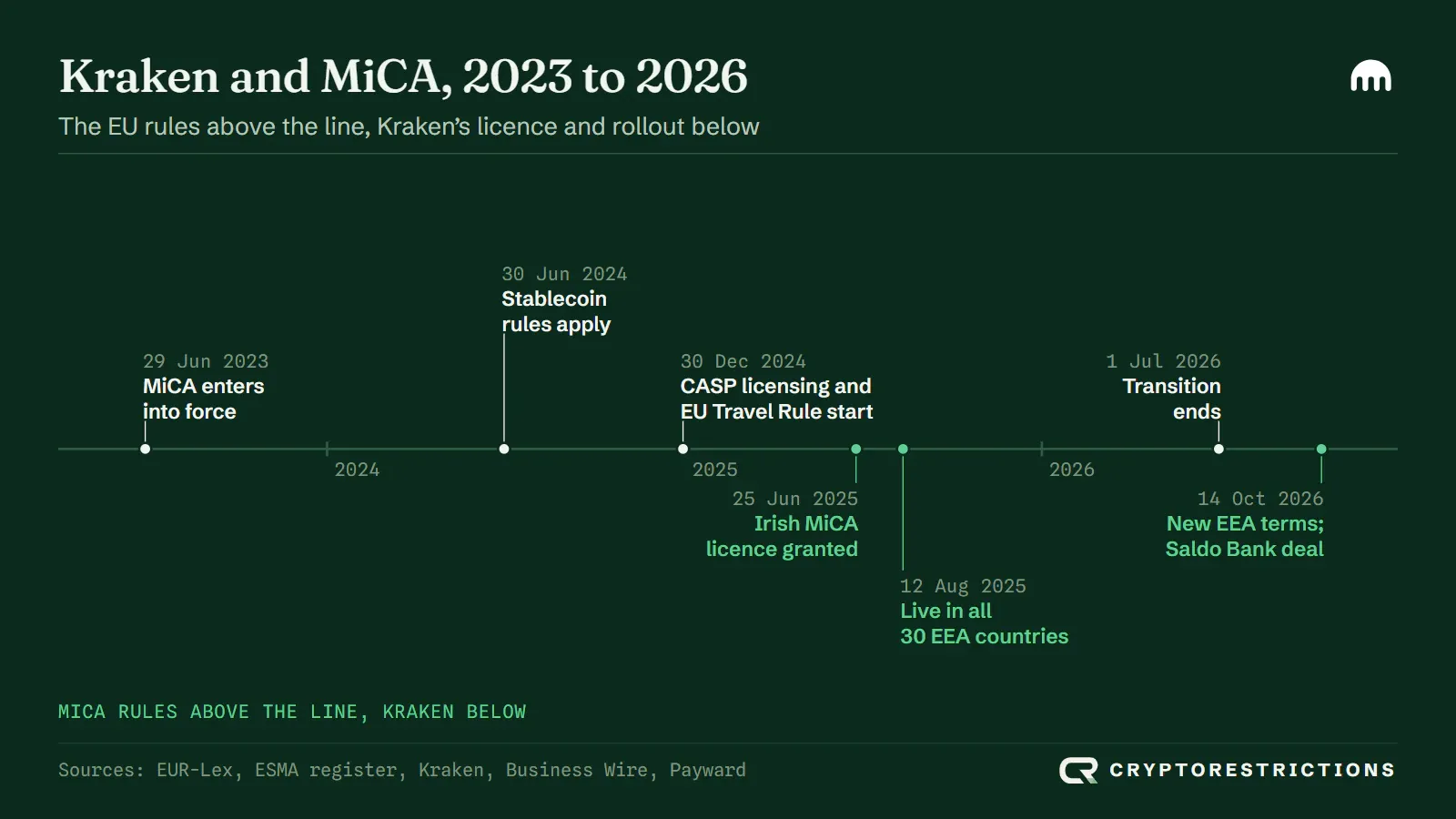
MiCA entered into force on 29 June 2023 and applied in steps: the stablecoin rules on 30 June 2024, and licensing for exchanges, together with the EU’s crypto Travel Rule, on 30 December 2024. Kraken was authorised in the middle of the transition, so the deadline of 1 July 2026 that closed EEA sign-ups at unlicensed platforms changed nothing for its EEA clients.
Is Kraken available in the US?
Yes, in 48 states and Washington DC: Kraken’s US company, Payward Interactive, serves every state except Maine and New York.
Kraken’s licensing page says it does not offer services to residents of Maine or New York. It left New York in 2015 rather than apply for a BitLicense, Bitcoin Magazine reported, and its notice to US clients says it stopped serving Maine from 1 June 2024, with final withdrawals by 12 April 2025. From a US address, kraken.com loaded the normal sign-up form in our test; the state check comes at verification. Coinbase takes the other route in New York: it holds a BitLicense there.

Where does Kraken work in the US?
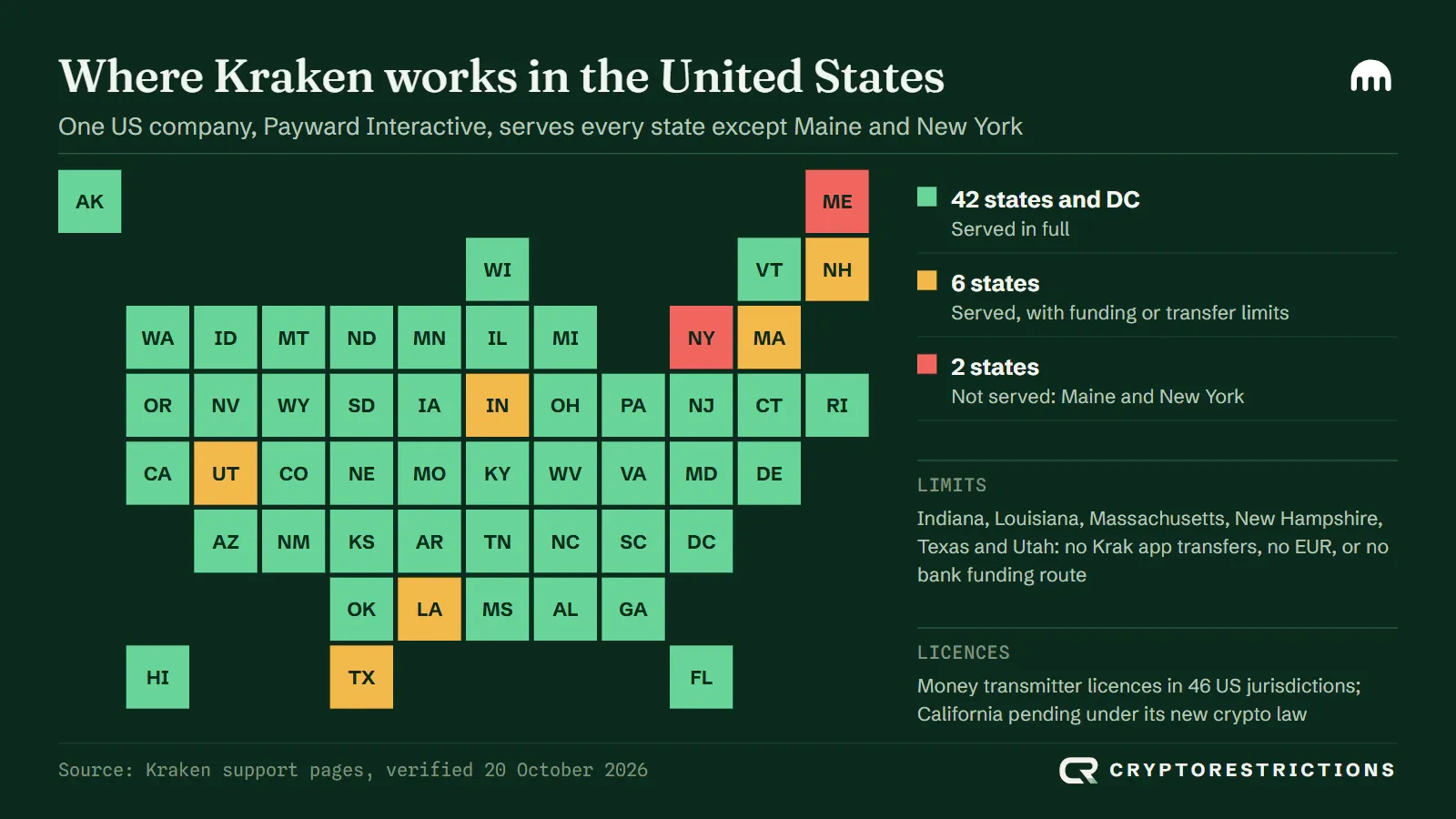
Kraken names two states it does not serve and six where some services are missing:
- Not served: Maine and New York.
- Krak app transfers: no crypto or fiat transfers in Indiana, and no fiat transfers in Louisiana, Massachusetts and Utah.
- EUR and funding: residents of Texas and New Hampshire cannot deposit or hold EUR or trade EUR pairs, and Kraken’s US funding page lists Texas among the states without its FedWire and ACH bank funding.
US clients also get a different product set: futures through Kraken Derivatives US, margin for eligible clients, Opt-in Rewards only for accredited investors, and no xStocks.
Kraken’s US fines and settlements
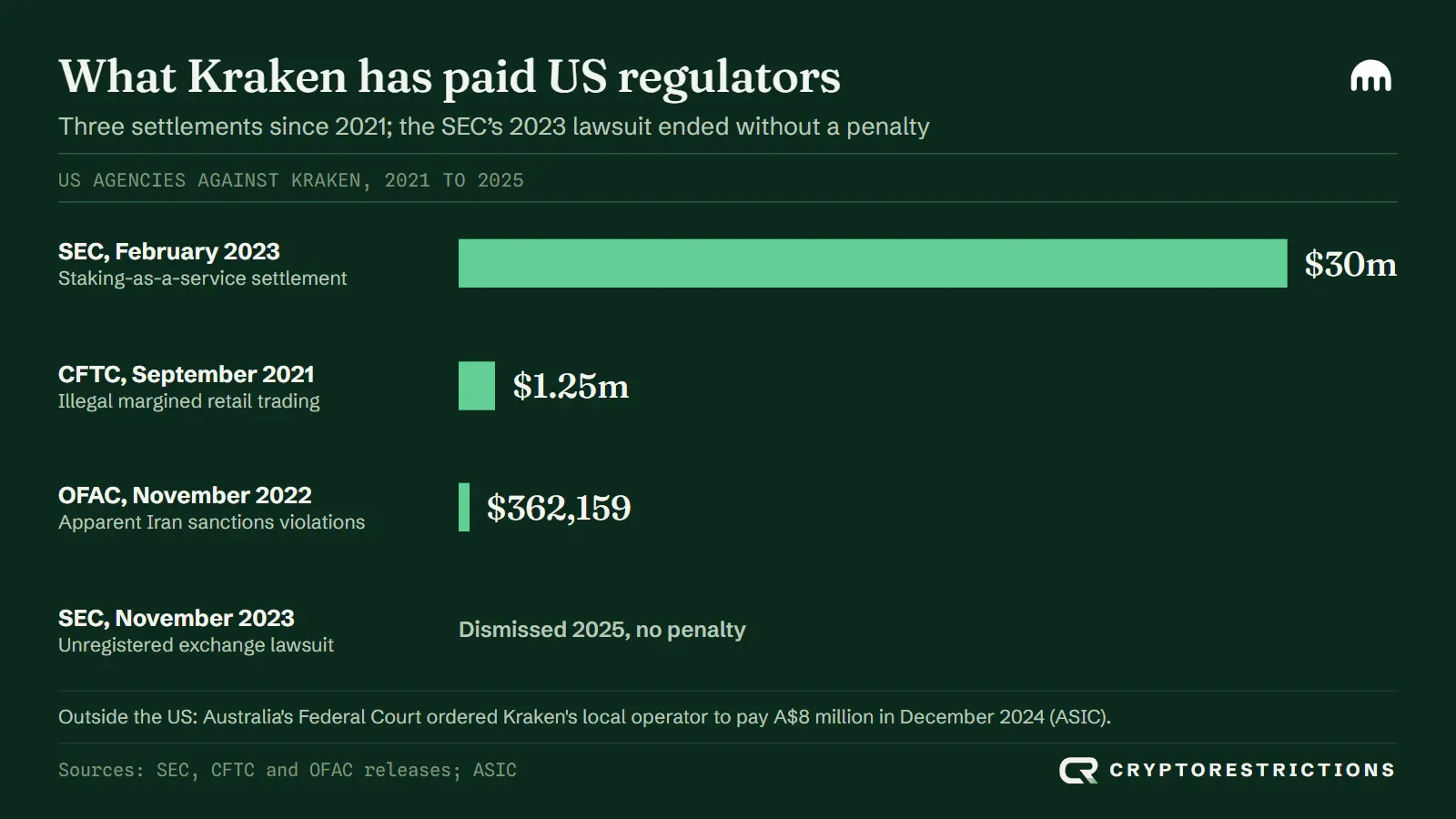
Kraken has settled three times with US agencies. The CFTC fined it $1.25 million in September 2021 for offering margined retail trading without registering, and OFAC settled for $362,158.70 in November 2022 over apparent Iran sanctions violations, after Kraken failed to block Iranian IP addresses. In February 2023 Kraken agreed to end its US staking service and pay $30 million to the SEC.
The SEC then sued Kraken in November 2023, alleging it ran an unregistered exchange, broker, dealer and clearing agency. That case ended on 27 March 2025, when both sides agreed to dismiss it with prejudice. Outside the US, Australia’s Federal Court ordered Bit Trade, Kraken’s Australian operator, to pay A$8 million in a case brought by ASIC over a margin product offered without a target market determination.
Kraken in the US: timeline
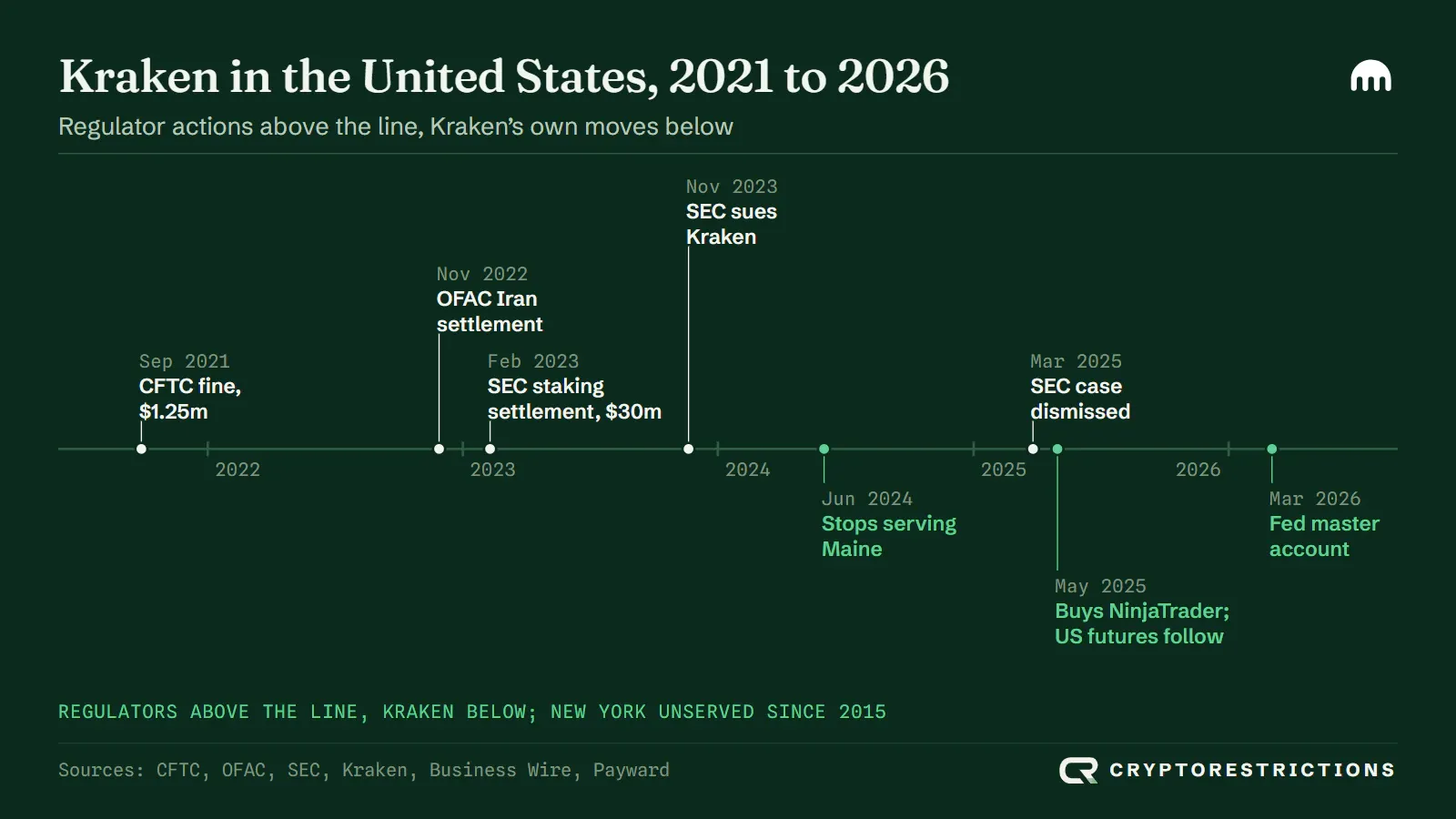
After the dismissal Kraken expanded its US licences rather than its footprint. It completed the NinjaTrader acquisition on 1 May 2025, which brought the futures commission merchant now trading as Kraken Derivatives US, and Kraken Financial got a Federal Reserve master account on 4 March 2026. Payward also agreed to buy the derivatives exchange Bitnomial in April 2026.
Kraken KYC and identity verification
Kraken verifies personal accounts at two levels, Verified and Higher limits, and an unverified account cannot deposit or trade; the only limits it publishes are for cash.
Kraken’s verification requirements (updated 1 October 2026) ask both levels for an email, full name, date of birth, phone, physical address, occupation and a valid ID, plus a Social Security Number or tax ID for US clients. Where an address cannot be confirmed automatically, some countries are asked for a face photo instead of a proof of address. Its document requirements (19 August 2026) add that a face photo is required for US and South African residents and that a proof of address must be less than three months old.
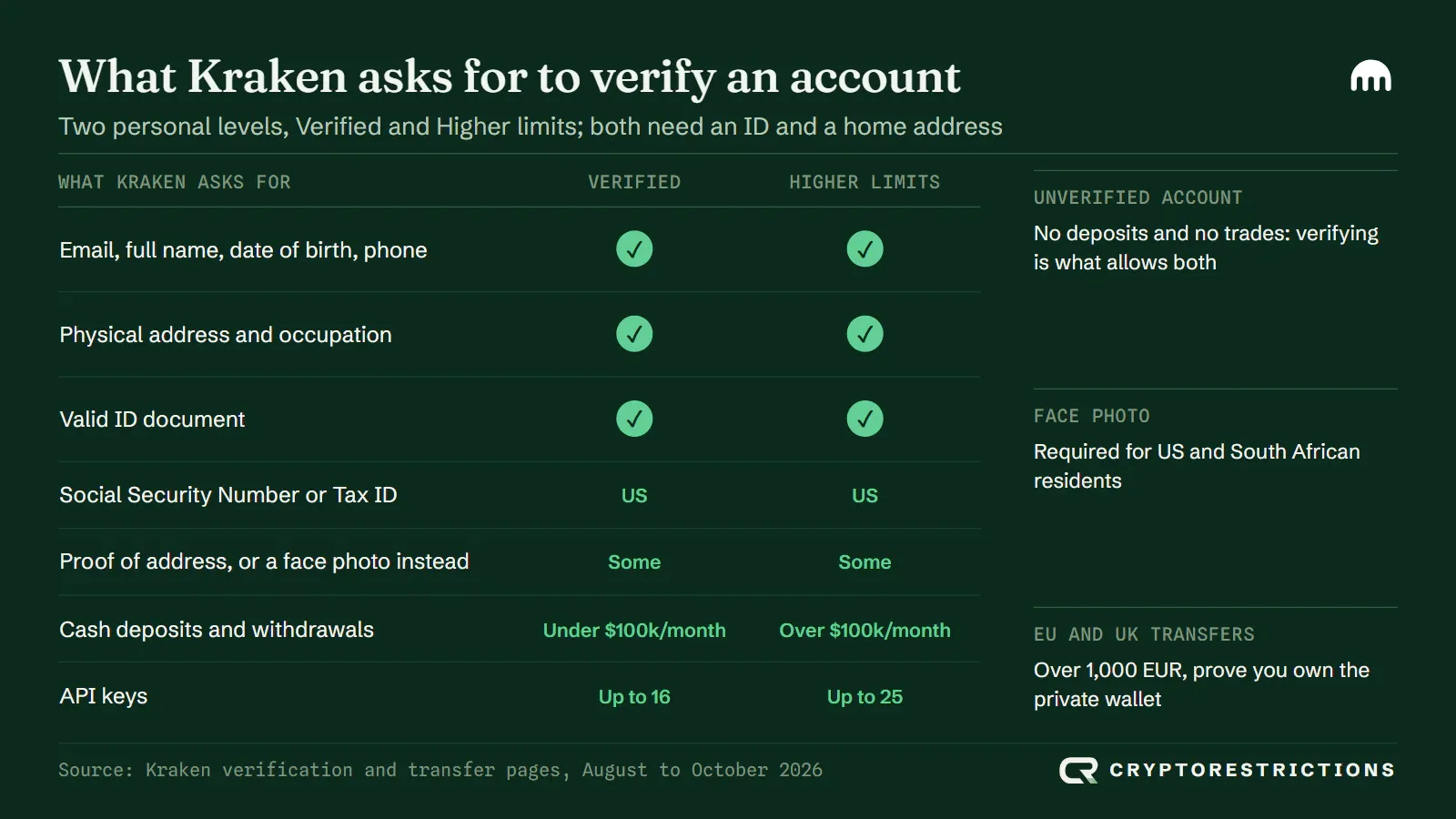
The difference between the levels is the limit. Kraken’s page on its verification levels (6 October 2026) gives Verified accounts cash deposits and withdrawals of under $100,000 a month and Higher limits accounts more, with 16 and 25 API keys. Transfers in the EU and the UK carry one more check: for crypto deposits and withdrawals above 1,000 EUR, Kraken’s transfer rules ask you to prove you own the private wallet.
Kraken verification history
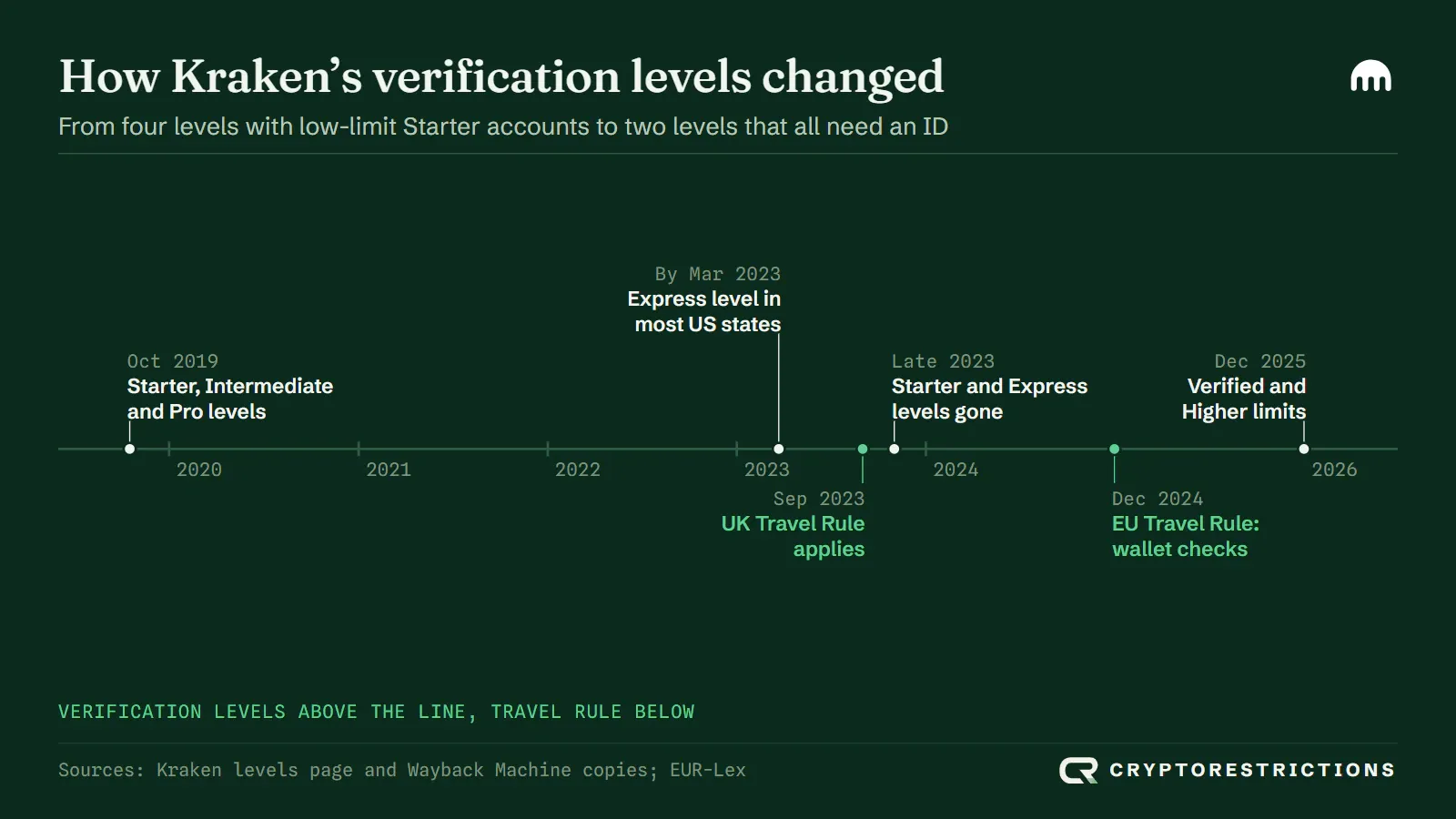
Kraken used to let accounts start with less. An archived copy of its levels page from October 2019 shows three levels, Starter, Intermediate and Pro, and by March 2023 a fourth, Express, for US clients outside New York, Texas and Washington. Starter was gone from the page by September 2023 and Express by January 2024, leaving Intermediate and Pro, which were renamed Verified and Higher limits by the end of 2025. For how Kraken’s checks compare with Binance and Coinbase, see our guide to crypto exchange KYC.
What if Kraken is restricted where you live?
It depends on the country: of the 21 other platforms we track, 15 are available in Afghanistan, 14 in DR Congo and 9 in Belarus, but only one in Cuba, Iran and North Korea.
The restrictions above are applied at verification, where Kraken asks for your country of residence and an ID, so a VPN does not open an account, and Kraken’s terms forbid trying to reach services that are unavailable where you are. What is left is a platform that is allowed to serve you where you live.
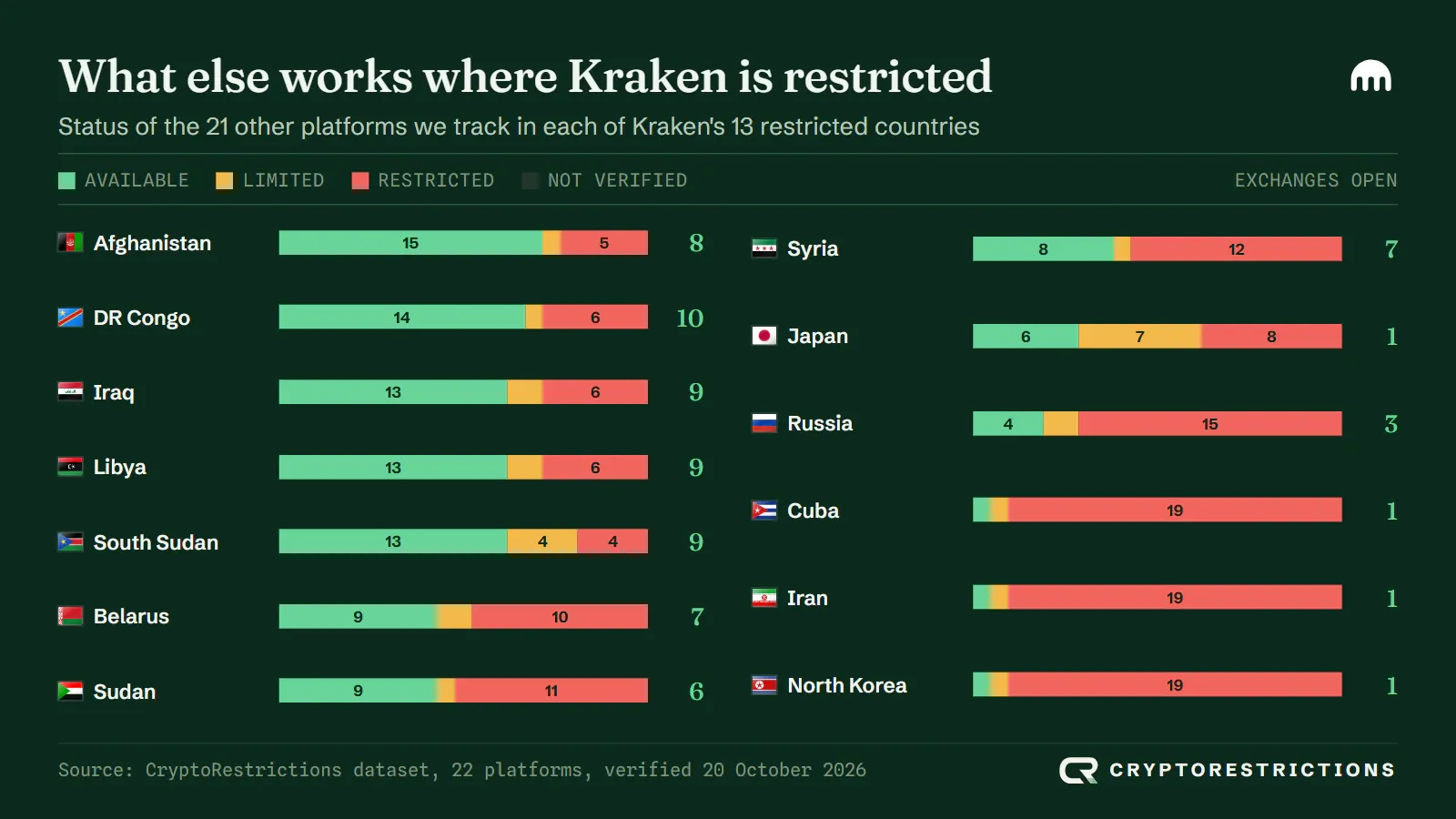
The chart shows how much choice each restricted country has. Afghanistan and DR Congo have the most, and Belarus, Iraq and Libya still have seven to nine exchanges open, against one in Japan. In Cuba, Iran and North Korea the one platform we record as available is a default under our coverage rule, not a platform that says it serves them.
For a country-by-country comparison of what to use instead, with residency rules, licences and products side by side, see our guide to Binance alternatives by country.