

Is crypto legal in Chile?
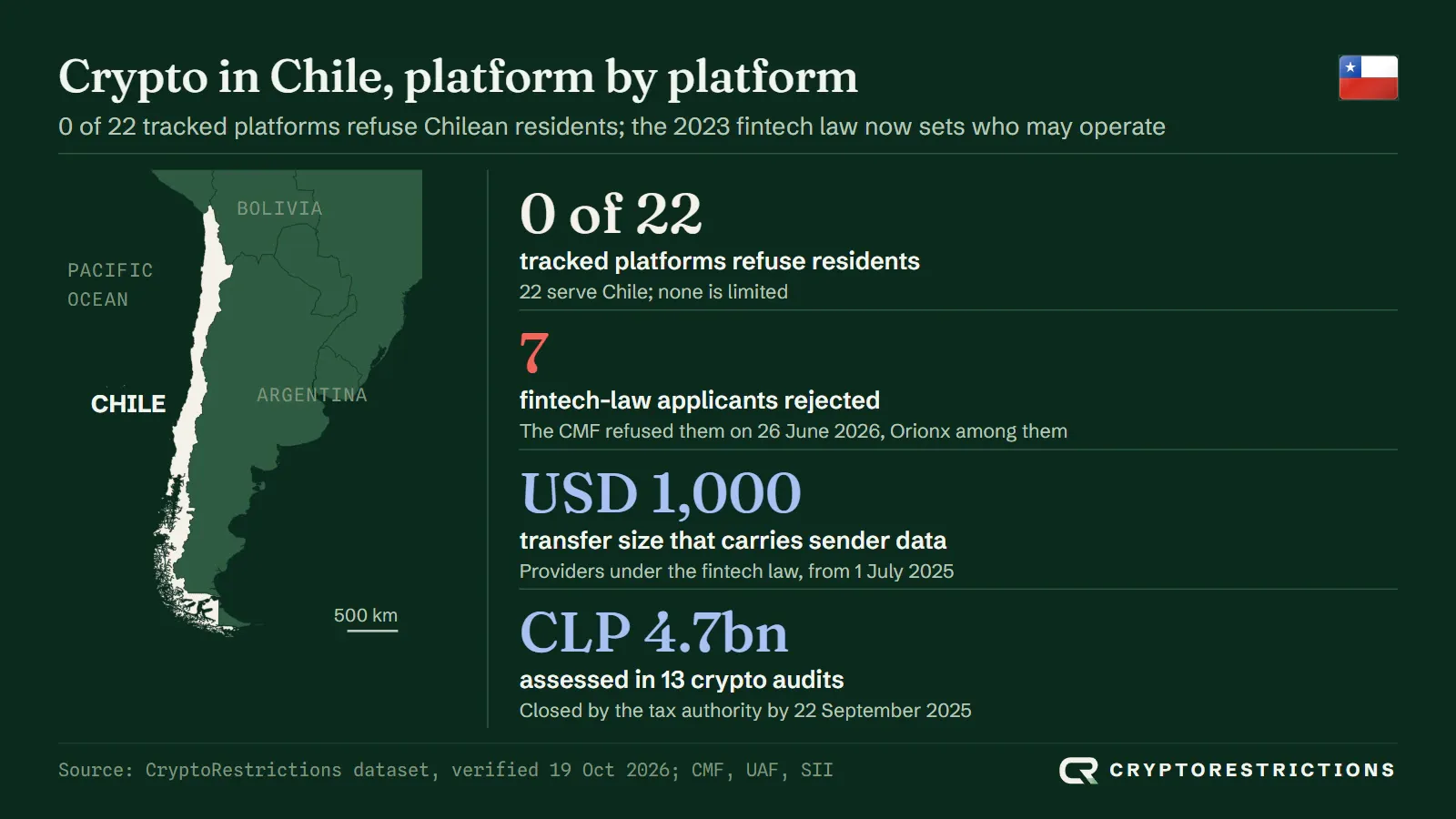
Yes: no Chilean law bans holding or trading crypto, and since 2023 the fintech law requires firms that trade, broker or custody it to register with the financial regulator CMF and seek its authorisation. The register is thin so far, and the tax authority treats gains as taxable income.
Law 21.521, the Ley Fintec, was promulgated on 22 December 2022 and published on 4 January 2023. Article 3 defines a crypto asset as a digital representation of units of value, goods or services, other than money, that can be transferred, stored or exchanged digitally,, and its definition of a financial instrument includes a virtual financial asset. Article 5 says only entities in the CMF’s Registro de Prestadores de Servicios Financieros may professionally run a crowdfunding platform, an alternative trading system, intermediation, order routing, credit or investment advice, or custody of financial instruments. Article 7 requires the CMF’s authorisation before such a service starts.
The tax authority adds that Chile does not treat crypto as legal tender, foreign currency or foreign exchange, per its news release of 22 September 2025.
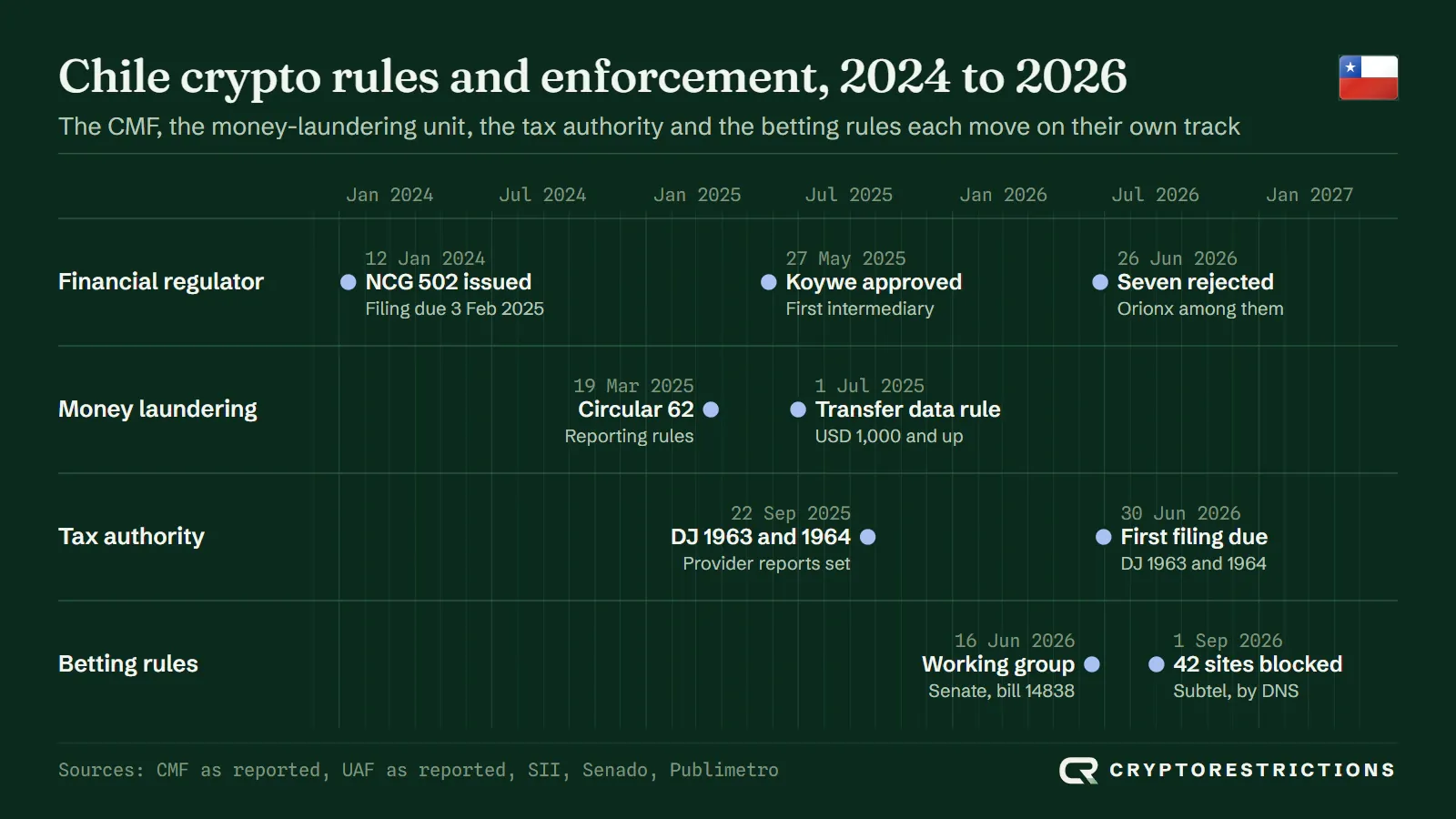
The deadline for firms already operating was set by the CMF’s rule NCG 502, issued on 12 January 2024: Garrigues reports that every service other than investment advice had to file before 3 February 2025, and that registration and authorisation can be requested together. Firms that filed kept operating on a transitional footing until the CMF decided.
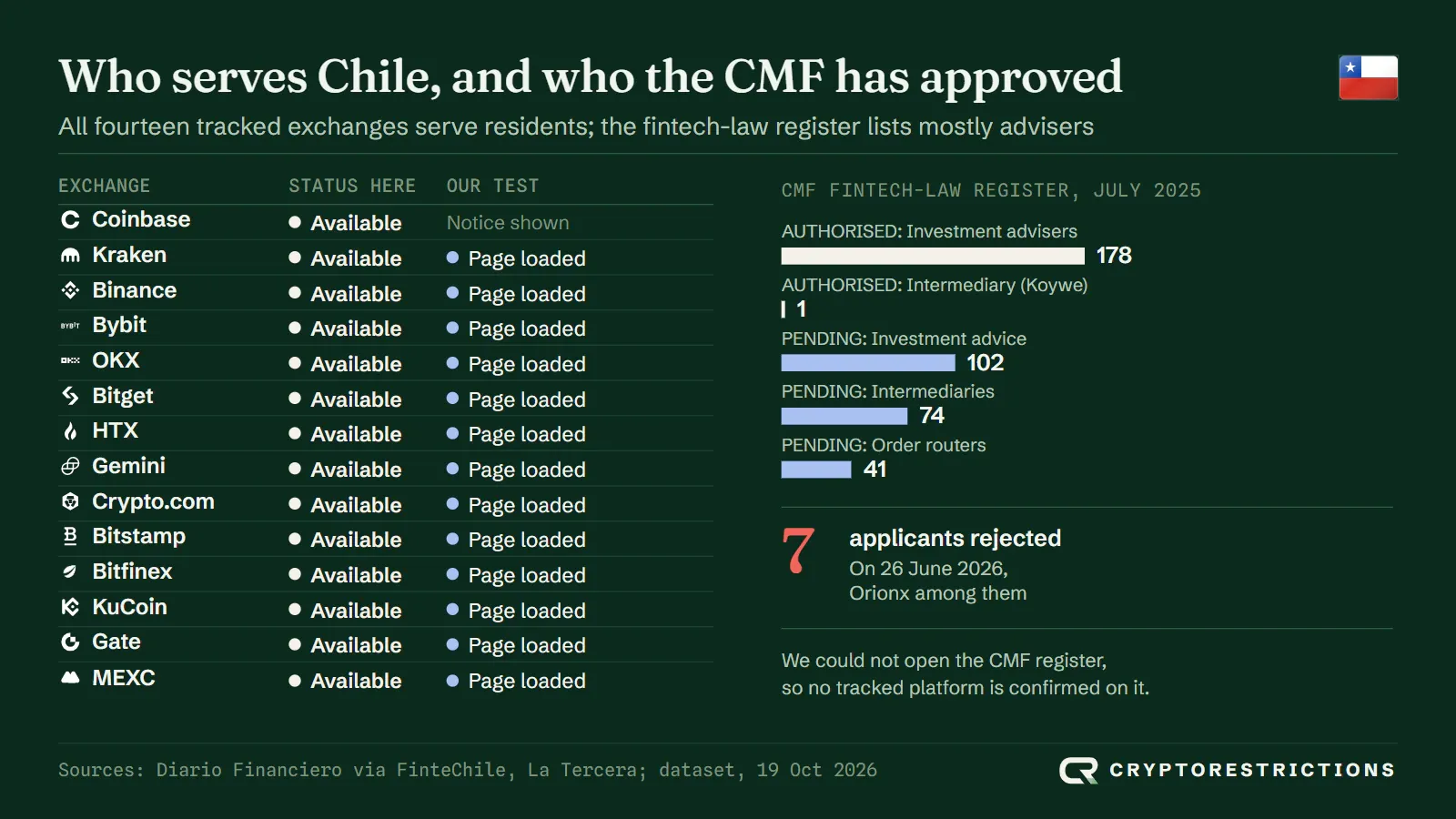
We could not open the CMF’s register or its own pages from our network, so the counts come from the press. Diario Financiero, as republished by FinteChile on 7 July 2025, gave the CMF’s figures: 179 entities authorised, 178 of them investment advisers and one an intermediary, Koywe, approved on 27 May 2025, with more than 300 applications pending. We found no later count that we could confirm.
The CMF has started to refuse applicants. La Tercera reported on 26 June 2026 that it rejected seven, among them the crypto platform Orionx, for unanswered observations, missing audited statements and no proof of the customer-protection guarantee. They lost their transitional cover and must stop taking new clients. On 3 September 2026 Orionx announced its closure, saying transactions had moved assets worth more than USD 7 million to wallets it did not control. El Mostrador quotes the CMF as saying Orionx and its activities “no son fiscalizadas” by it, and that the CMF will not oversee the closure.
Which crypto exchanges work in Chile?
All 14 exchanges we track serve Chilean residents. Chile does have a licensing register, but we could not open it, so we cannot say which, if any, of them is on it; the only crypto-linked authorisation we found is Koywe’s.
Statuses below come from each platform’s own country lists and our geo-access test, not from the CMF register. The register panel repeats the counts reported in July 2025 and the seven rejections of June 2026 described above.
Local exchanges such as Buda and CryptoMarket are not among the platforms we track, and we could not confirm where their applications stand.
Best crypto platforms for Chilean residents
By our access score all 22 platforms get the same 8.0 out of 10, because we hold no Chilean licence or register entry on file for any of them, which leaves the two licence points unearned. The picks below differ by what we found.
The score rates how fully a Chilean resident can use each platform, not its fees or safety. It is computed from our data and moves when a row changes: access status (4 points), the share of the platform’s products open here (3), the licences we hold on file for Chile (2) and what our geo-access test saw from a Chilean address (1). The full method is on our methodology page.
Exchanges

Binance
Best for The widest range of markets
8.0/10- Access
- 4/4
- Products
- 3/3
- Licences
- 0/2
- Our test
- 1/1
Read our Binance reportPros
- Chile is not on its prohibited-countries list
- Its pages loaded in our test
Cons
- Peso funding not confirmed on its own pages
- No CMF register entry confirmed

Bitfinex
Best for Spot and margin for experienced traders
8.0/10- Access
- 4/4
- Products
- 3/3
- Licences
- 0/2
- Our test
- 1/1
Read our Bitfinex reportPros
- Chile is not a prohibited jurisdiction under its terms
- Its pages loaded in our test
Cons
- No CMF register entry confirmed

Bitget
Best for Spot and derivatives in one account
8.0/10- Access
- 4/4
- Products
- 3/3
- Licences
- 0/2
- Our test
- 1/1
Read our Bitget reportPros
- Chile is not on its prohibited-countries list (updated 16 October 2026)
- Its pages loaded in our test
Cons
- Its list is non-exhaustive, so absence is not a guarantee

Bitstamp
Best for Plain spot trading
8.0/10- Access
- 4/4
- Products
- 3/3
- Licences
- 0/2
- Our test
- 1/1
Read our Bitstamp reportPros
- No Bitstamp document excludes Chile
- Its home page loaded in our test
Cons
- No CMF register entry confirmed

Bybit
Best for Spot and derivatives in one account
8.0/10- Access
- 4/4
- Products
- 3/3
- Licences
- 0/2
- Our test
- 1/1
Read our Bybit reportPros
- Chile is not on its excluded-jurisdictions list
- Its pages loaded in our test
Cons
- No CMF register entry confirmed

Crypto.com
Best for Trading in an app
8.0/10- Access
- 4/4
- Products
- 3/3
- Licences
- 0/2
- Our test
- 1/1
Read our Crypto.com reportPros
- Chile is not on its app or spot geo-restriction lists
- Its home page loaded in our test
Cons
- No CMF register entry confirmed

Gate
Best for A wide range of listed tokens
8.0/10- Access
- 4/4
- Products
- 3/3
- Licences
- 0/2
- Our test
- 1/1
Read our Gate reportPros
- Chile is not named in its restricted-locations clause (updated 22 July 2026)
- Its pages loaded in our test
Cons
- Its list is non-exhaustive, so absence is not a guarantee

Gemini
Best for A regulated US exchange with perpetuals
8.0/10- Access
- 4/4
- Products
- 3/3
- Licences
- 0/2
- Our test
- 1/1
Read our Gemini reportPros
- Chile is on its main list and its perpetuals list
Cons
- No CMF register entry confirmed

HTX
Best for Spot and derivatives in one account
8.0/10- Access
- 4/4
- Products
- 3/3
- Licences
- 0/2
- Our test
- 1/1
Read our HTX reportPros
- Chile is not on the restricted lists in its user agreement
- Its pages loaded in our test
Cons
- Peso funding not confirmed on its own pages

Kraken
Best for Plain spot trading
8.0/10- Access
- 4/4
- Products
- 3/3
- Licences
- 0/2
- Our test
- 1/1
Read our Kraken reportPros
- Chile is not on its do-not-serve list
- Its pages loaded in our test
Cons
- Peso funding not confirmed on its own pages
- No CMF register entry confirmed

KuCoin
Best for A wide range of listed tokens
8.0/10- Access
- 4/4
- Products
- 3/3
- Licences
- 0/2
- Our test
- 1/1
Read our KuCoin reportPros
- Chile is not on its restricted-locations list (updated 29 September 2026)
- Its pages loaded in our test
Cons
- The list may be updated at any time, so absence is not a guarantee

MEXC
Best for A wide range of listed tokens
8.0/10- Access
- 4/4
- Products
- 3/3
- Licences
- 0/2
- Our test
- 1/1
Read our MEXC reportPros
- Chile is not on its prohibited-jurisdictions list (updated 13 October 2026)
- Its pages loaded in our test
Cons
- Its list is non-exclusive, so absence is not a guarantee

OKX
Best for A global brand with a wide product range
8.0/10- Access
- 4/4
- Products
- 3/3
- Licences
- 0/2
- Our test
- 1/1
Read our OKX reportPros
- Chile is not on its restricted-locations list (updated 8 July 2026)
- Its pages loaded in our test
Cons
- No CMF register entry confirmed

Coinbase
Best for A familiar US exchange for spot buying
7.5/10- Access
- 4/4
- Products
- 3/3
- Licences
- 0/2
- Our test
- 0.5/1
Read our Coinbase reportPros
- Chile is a listed sign-up country in its identity-verification guide
Cons
- Its home page told us stocks and prediction markets are not available here
- Peso funding not confirmed on its own pages
Prediction markets

Kalshi
Best for Regulated event contracts
8.0/10- Access
- 4/4
- Products
- 3/3
- Licences
- 0/2
- Our test
- 1/1
Read our Kalshi reportPros
- Chile is not on its restricted-jurisdictions list
- Its home page loaded in our test
Cons
- No Chilean rule covers prediction markets

Polymarket
Best for The largest prediction market
8.0/10- Access
- 4/4
- Products
- 3/3
- Licences
- 0/2
- Our test
- 1/1
Read our Polymarket reportPros
- Chile is not on its own blocked-countries list
- Its home page loaded in our test
Cons
- No Chilean rule covers prediction markets
DeFi

Aster
Best for Perpetuals from your own wallet
8.0/10- Access
- 4/4
- Products
- 3/3
- Licences
- 0/2
- Our test
- 1/1
Read our Aster reportPros
- Chile is not on its prohibited-jurisdictions list
- Its trading app loaded in our test
Cons
- No peso funding: you need crypto from another source

Hyperliquid
Best for Perpetuals and spot on its own chain
8.0/10- Access
- 4/4
- Products
- 3/3
- Licences
- 0/2
- Our test
- 1/1
Read our Hyperliquid reportPros
- Not excluded by its terms
- Its trading app loaded in our test
Cons
- No peso funding: you need crypto from another source

Jupiter
Best for Solana swaps
8.0/10- Access
- 4/4
- Products
- 3/3
- Licences
- 0/2
- Our test
- 1/1
Read our Jupiter reportPros
- Chile is not named in its terms
- Its app loaded in our test
Cons
- No peso funding: you need crypto from another source

Lighter
Best for Perpetuals from your own wallet
8.0/10- Access
- 4/4
- Products
- 3/3
- Licences
- 0/2
- Our test
- 1/1
Read our Lighter reportPros
- Chile is not named in its terms
- Its trading app loaded in our test
Cons
- No peso funding: you need crypto from another source

PancakeSwap
Best for BNB Chain swaps and pools
8.0/10- Access
- 4/4
- Products
- 3/3
- Licences
- 0/2
- Our test
- 1/1
Read our PancakeSwap reportPros
- Not excluded by its terms
- The swap page loaded in our test
Cons
- No peso funding: you need crypto from another source

Uniswap
Best for Swapping tokens from your own wallet
8.0/10- Access
- 4/4
- Products
- 3/3
- Licences
- 0/2
- Our test
- 1/1
Read our Uniswap reportPros
- Its terms bar only places under comprehensive US sanctions
- Our test loaded the swap app from a Chilean address
Cons
- No peso funding: you need crypto from another source
Which platforms block Chilean users?
None of the 22 platforms we track refuses Chilean residents, and none is limited. Only a few carry a caveat worth knowing.
Chilean law gives a platform no reason to close the country: individuals may hold and trade crypto, and the licensing duty falls on firms that offer the regulated services. Several exclusion lists are non-exhaustive, so an absence is not a guarantee, and most platforms enforce at identity verification, not at the page.
What our geo-access test saw from Chile
From a Chilean address on 14 and 16 October 2026 we loaded all 22 platforms we track: none refused us, 1 showed a notice and 21 loaded with no barrier.
An open page is not permission, and the test cannot see identity checks or blocks by internet providers. The notice was Coinbase’s, which said stocks and prediction markets are not available in our jurisdiction. Our test saw no screen that named Chile as unsupported on any platform.
Who regulates crypto in Chile?
The CMF runs the register and authorises crypto providers, the UAF supervises their anti-money-laundering duties, the tax authority SII collects their user reports, and betting sites are handled by the casino superintendency and the telecoms regulator.
- CMF. The Comisión para el Mercado Financiero keeps the Registro de Prestadores de Servicios Financieros and grants the authorisations described in the legal section above.
- UAF. Law 21.521 makes registered providers of the regulated services reporting entities of the financial intelligence unit, under article 36 of the law. Its Circular 62 of 19 March 2025 took effect on 1 June 2025, and its chapter on electronic transfers took effect on 1 July 2025 for providers of services regulated by Law 21.521: they must carry accurate originator and beneficiary data on any transfer of USD 1,000 or more. We read that on a law firm’s summary, not on the UAF’s own text.
- SII. The tax authority’s Resolutions 113 and 114 create two annual sworn declarations for crypto providers; they are covered in the tax section.
- Casino superintendency and Subtel. The Superintendencia de Casinos de Juego supplies the list of sites, and Subtel instructs internet providers to block them; both are covered in the prediction markets section.
- Congress. The online betting bill sits in the Senate; the same section covers it.
We found no CMF or UAF rule written for prediction markets, and no Chilean regulator statement on the foreign exchanges we track.
Are prediction markets legal in Chile?
No Chilean rule names them. The online betting bill that could reach them is not law, and Subtel’s block orders named none; Polymarket and Kalshi are open and drew no Chilean action that we found.
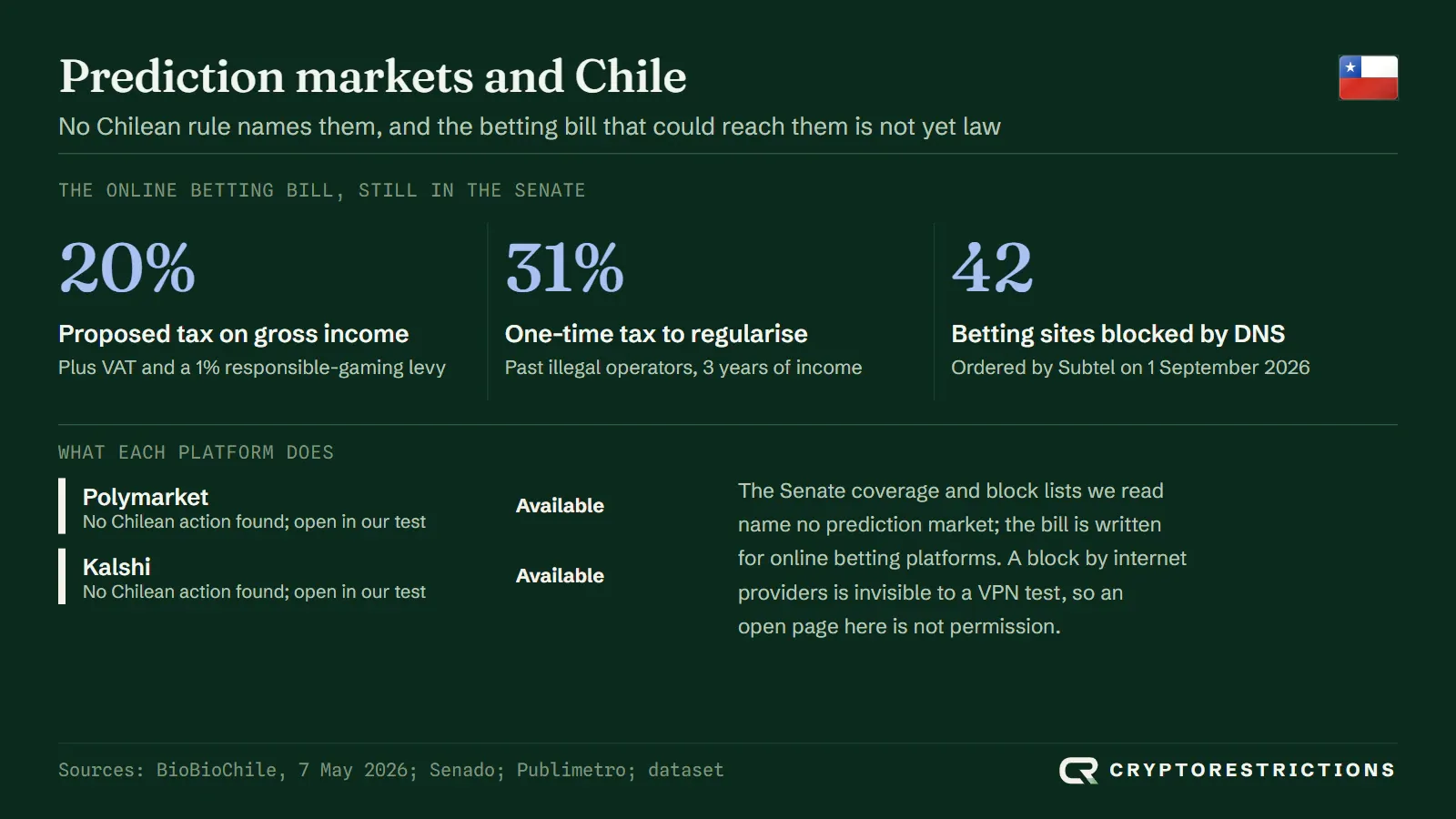
The bill, boletín 14838-03, was filed in March 2022 and is in its second stage in the Senate. BioBioChile reported that the government gave it “suma urgencia” on 6 May 2026. As described there, operators would need a general licence and be Chilean closed corporations; the Superintendencia de Casinos de Juego would become the Superintendencia de Casinos, Apuestas y Juegos de Azar; platforms would pay a 20% tax on gross income plus VAT and a 1% responsible-gaming levy; banks would have to block transfers to unlicensed sites; and operators that worked illegally in the previous 12 months could not apply but could regularise by paying a one-time 31% tax on three years of income. The report does not mention crypto or prediction markets.
The Senate Economy Committee agreed on 16 June 2026 to set up a technical working group with the Executive and to set a new deadline for amendments afterwards. A Senate report of 8 September 2026 says the committee was still analysing the bill and lists what senators asked for, among them stronger powers for the casino superintendency, the CMF, the SII and the UAF, technological blocking and financial tracing. It does not mention crypto or prediction markets either.
Blocking already happens under court rulings. Publimetro reported on 1 September 2026 that Subtel told Entel, Movistar, Claro, GTD, WOM and VTR to block 42 sites by DNS, from a list supplied by the casino superintendency, following a protection action by the Lotería de Concepción and rulings of the Supreme Court and the Santiago Court of Appeals. The report names no prediction market. A block by internet providers is invisible to our VPN test, so we cannot rule one out.
How is crypto taxed in Chile?
The tax authority SII says gains from selling crypto are taxable income, with no VAT on the sale. For an individual that means the Global Complementary Tax, which runs from 0% to 40% by band of yearly income.
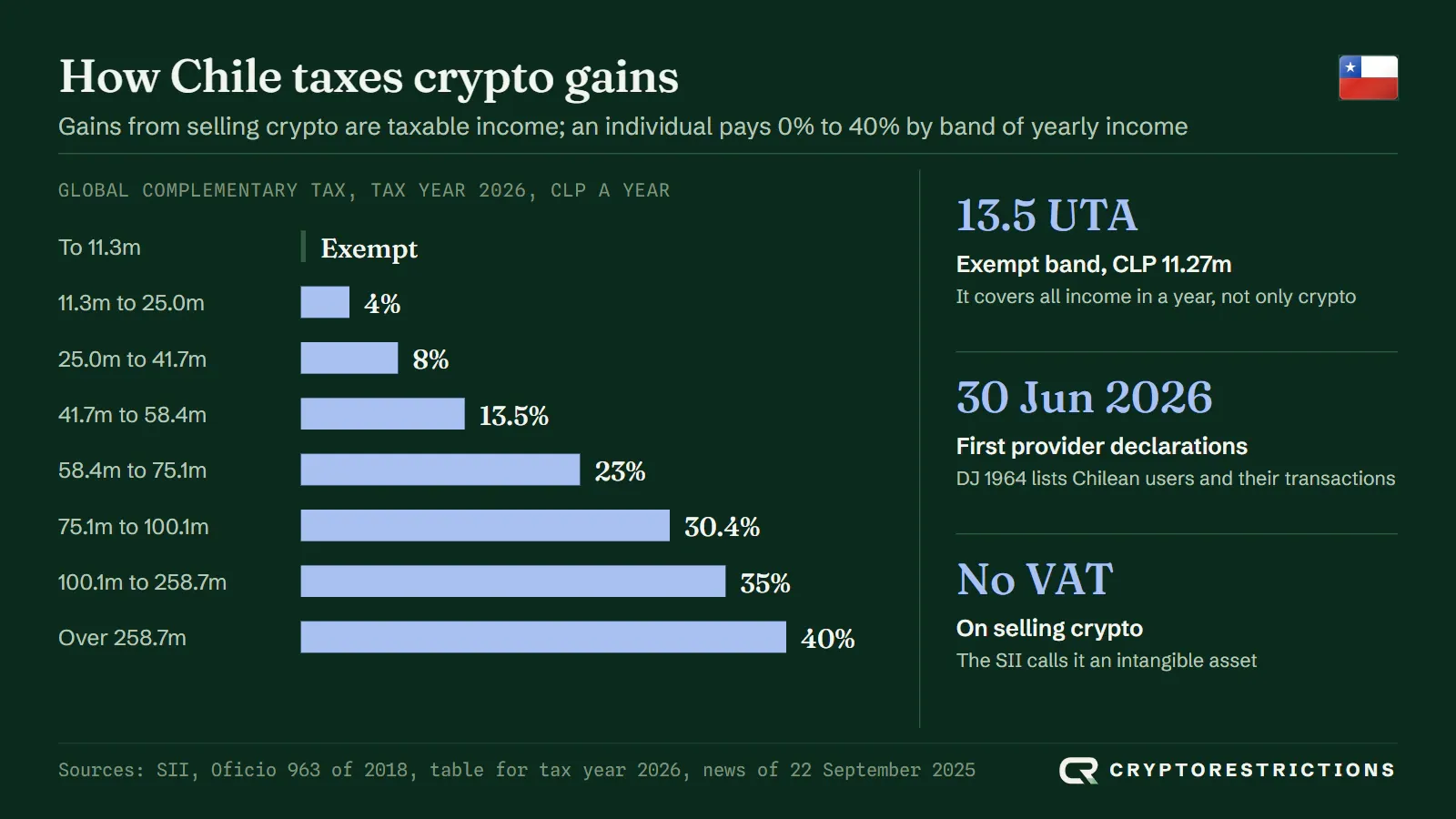
Oficio 963 of 14 May 2018 says income from buying and selling virtual assets falls under article 20, number 5 of the income tax law and bears the general taxes, and that the sale is not subject to VAT because the asset is intangible. The purchase cost can be deducted under article 30 and shown with electronic transfer receipts. The ruling covers direct trading, not intermediation, and was written for a company that must report on Form 22.
The SII’s news release of 22 September 2025 spells out who pays what: individuals pay the Global Complementary Tax, or the Additional Tax if they do not reside in Chile; a business held through a company pays First Category Tax, plus the owner’s tax when the crypto is withdrawn. It also reports 13 closed crypto audits that assessed CLP 4,702,255,765, aimed at unpaid income from services paid in crypto, unproven costs, miners, unlicensed exchanges and influencers, and says the leads came from provider filings, mining-equipment imports and tax returns.
The same release created the reporting duties. Resolution 113 sets sworn declaration 1963, in which providers report users who are not Chilean tax residents so the data can be exchanged under the OECD’s crypto-asset reporting framework; Resolution 114 sets declaration 1964, in which providers report Chilean-resident users, who controls each account, the transactions and wallet addresses. The first filing for both was due on 30 June 2026.
The SII’s table for tax year 2026, which covers income earned in 2025, exempts the first CLP 11,265,804 of yearly income, which is 13.5 tax units (UTA) of December 2025 at CLP 834,504 each, then taxes bands at 4%, 8%, 13.5%, 23%, 30.4%, 35% and 40% above CLP 258,696,240. The exempt band is for all income, not only crypto.
We found no SII text on holding periods, mining, staking, airdrops or crypto kept on foreign platforms, and blog claims that individuals are taxed on a separate capital-gain basis could not be verified on an SII or Congress page, so they are left out.
 Peru
 Uruguay
 Colombia
 Argentina
 Brazil
 Venezuela
 Ecuador
 Paraguay
 Bolivia
 Guyana
 Suriname