Where is Uniswap restricted?
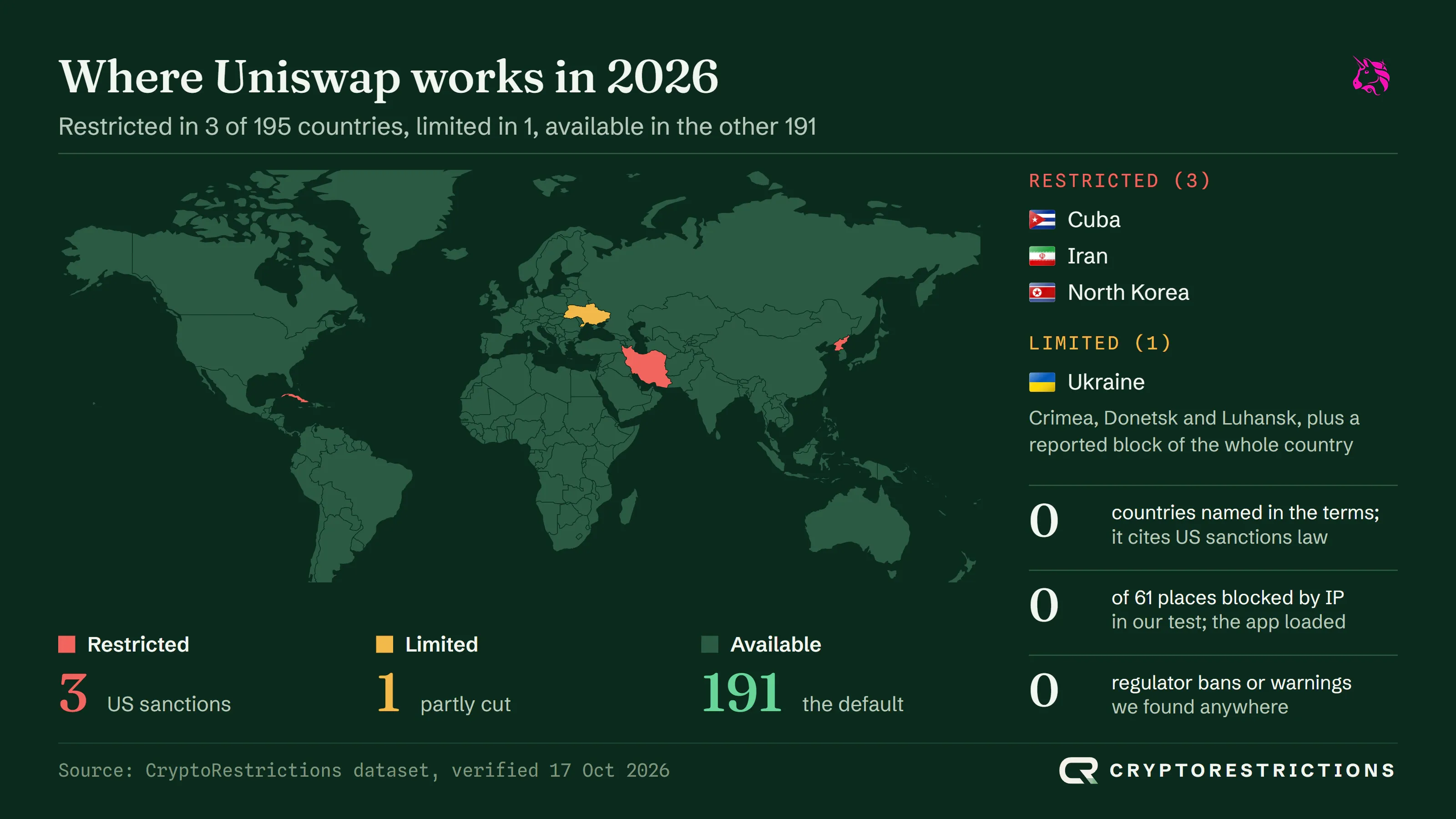
Uniswap is restricted in 3 of the 195 countries we cover:  Cuba,
 Iran and
 North Korea.
The rule comes from the Uniswap Labs terms of service (last modified 28 July 2026), which cover the web app at app.uniswap.org and the Uniswap Wallet. You promise that you are not a “citizen, resident, or organized in a jurisdiction or territory” under comprehensive country-wide, territory-wide or regional US sanctions. No country is named. We apply the clause to the three countries under US embargoes, and the address screening applies everywhere: the address screening guide says Uniswap Labs blocks wallets linked to sanctions, terrorism financing, stolen funds and similar crime, whatever country the owner is in.
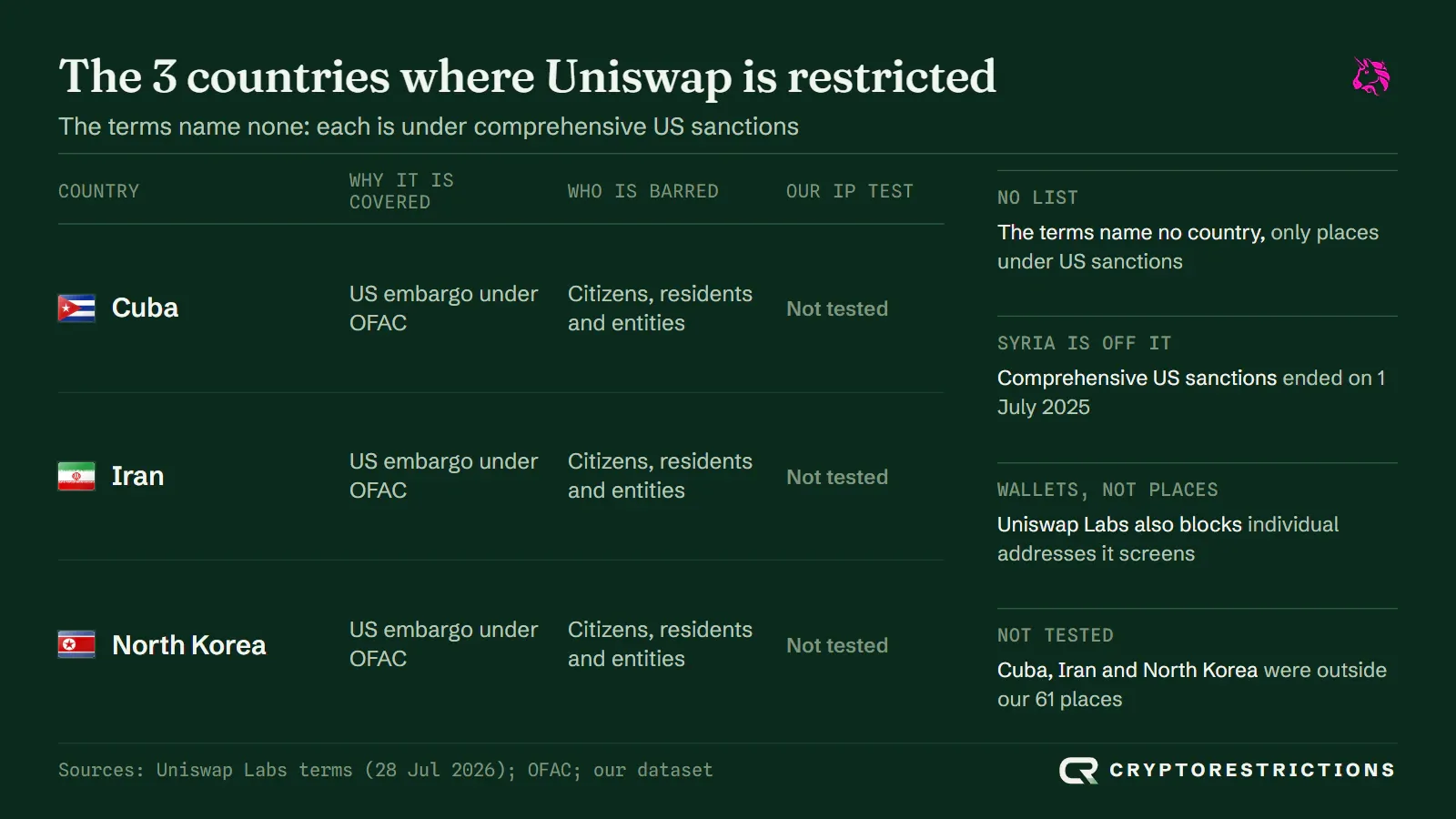
 Syria is not on the list any more. The US ended its comprehensive sanctions on Syria on 1 July 2025 (OFAC), so the clause no longer reaches it, and we found no Syrian block. We could not test Cuba, Iran, North Korea or Syria, because they were outside the 61 places in our run. Sanctions are the one lever Uniswap Labs uses. Jupiter, a spot DEX front end, names 19 places in its terms, among them the US, China and Singapore, and forbids VPNs; Uniswap Labs names no country and does not mention VPNs.

The list is below: pick a country to see what applies.
Where is Uniswap limited?
Uniswap is limited in one country,  Ukraine, where the terms bar the occupied regions and developers say the app blocks more than that.
The terms’ sanctions clause reaches “regional” US sanctions, which is why Crimea and the occupied Donetsk and Luhansk regions are out. In October 2025 Ukrainian developers told Blockworks that the Uniswap Labs interface stays blocked for the whole country, with an error when a user picks a token, and that Uniswap Labs support had pointed to Ukraine’s presence on the OFAC list. Uniswap Labs has said nothing publicly that we found, in either direction.
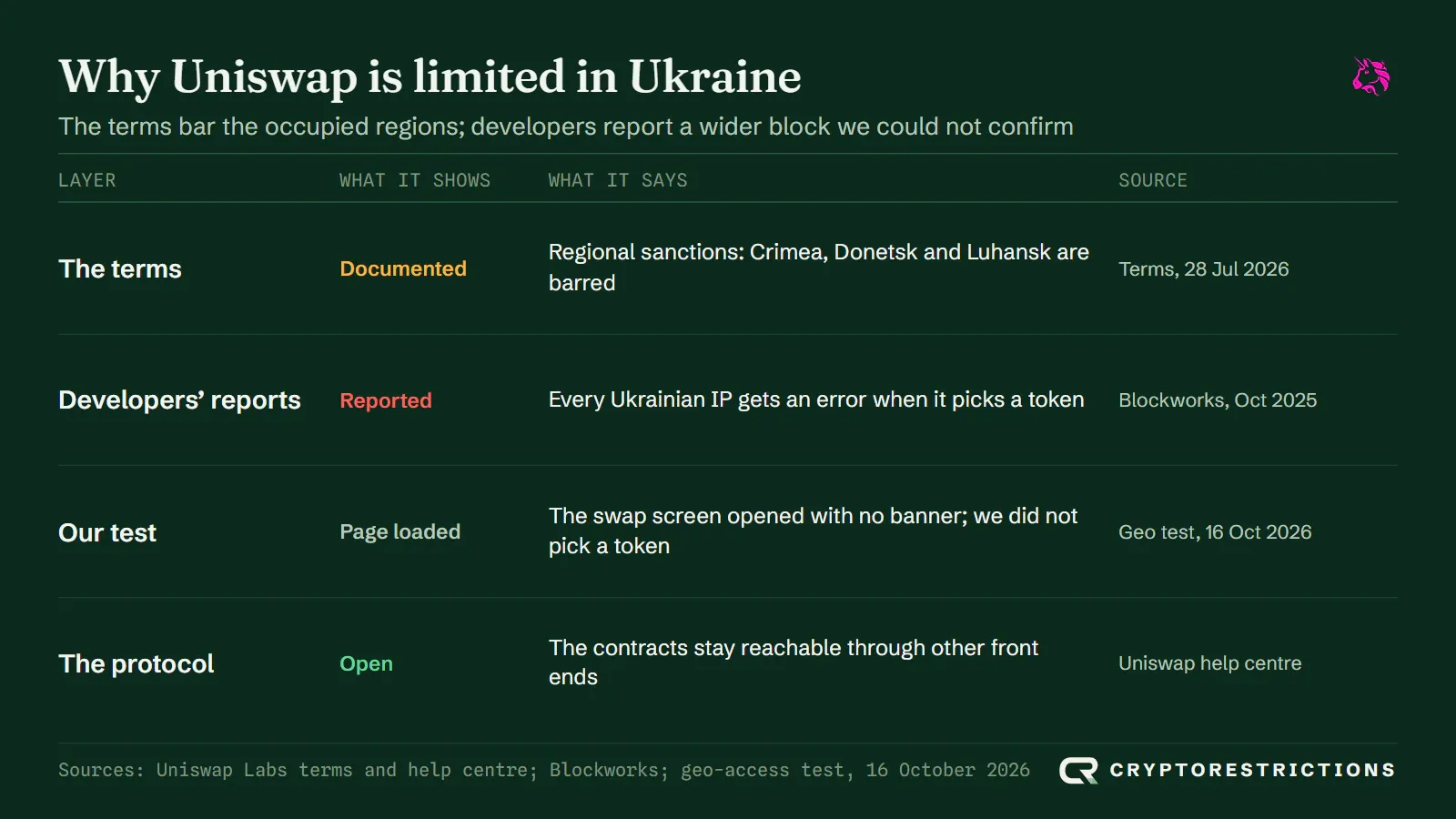
Our own test does not settle it. The swap screen opened from Ukraine with no banner, but we only loaded the page and did not pick a token, which is where the developers say the error appears. We therefore record Ukraine as limited, at medium confidence, on the strength of the terms plus a secondary report, and we would move it to restricted if a test shows the error. The protocol itself is not blocked: Uniswap Labs says in its asset blocking policy that its interface is “one of many ways to interact with the Protocol”.
Where is Uniswap available?
Uniswap is available in the other 191 of the 195 countries we cover, from  Germany and the
 United States to
 China,
 Russia and
 Nigeria.
None of them rests on a licence, because Uniswap Labs holds none. In 58 the terms do not bar the country and our test loaded the swap app; the other 133 are available under our coverage rule, since no document restricts them and we could not test them. We found no regulator that blocks Uniswap in any of the 191.
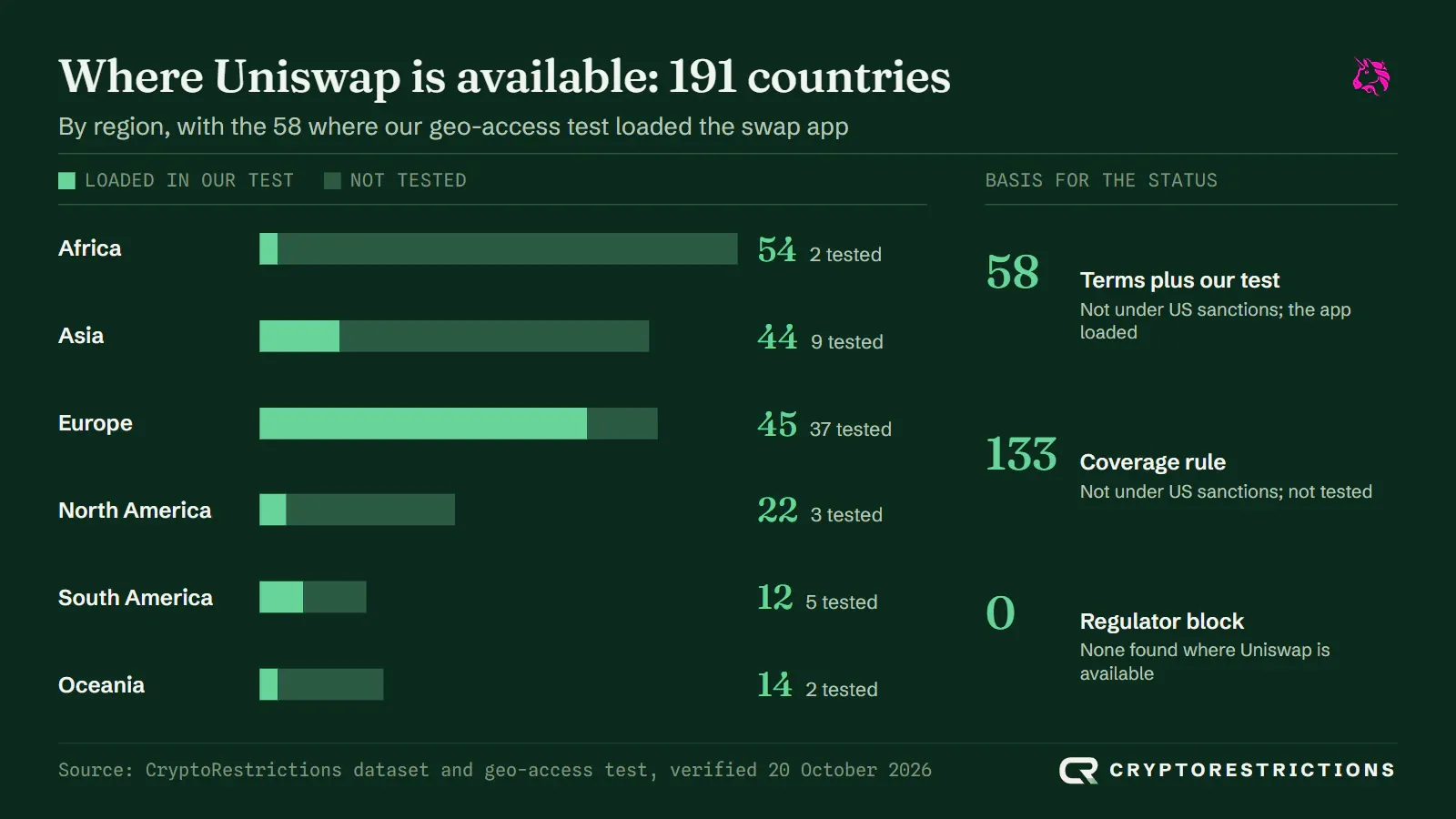
Available means the Uniswap Labs interface serves the country, not that local law allows trading crypto: China bans it, and the app still loaded there. Tokens add their own limits. Issuers of tokenised stocks and similar assets can restrict where their tokens are held, and the help centre says a transaction that breaks an issuer’s restriction “may be blocked”.
Where do Uniswap’s visitors come from?
Bangladesh leads the visits to uniswap.org in the one estimator we could read, ahead of the United States, and every country in its top five is one where Uniswap is available.
Semrush counts 5.04 million visits in September 2026, 44% more than in August, with Bangladesh at 40.0% (2.01 million visits), the US at 7.46%,  Brazil at 5.07%,
 Indonesia at 4.76% and Russia at 3.3%. Similarweb refused our requests with an error page, so Semrush is the only estimator here, and it has no page for app.uniswap.org, where the swapping happens.
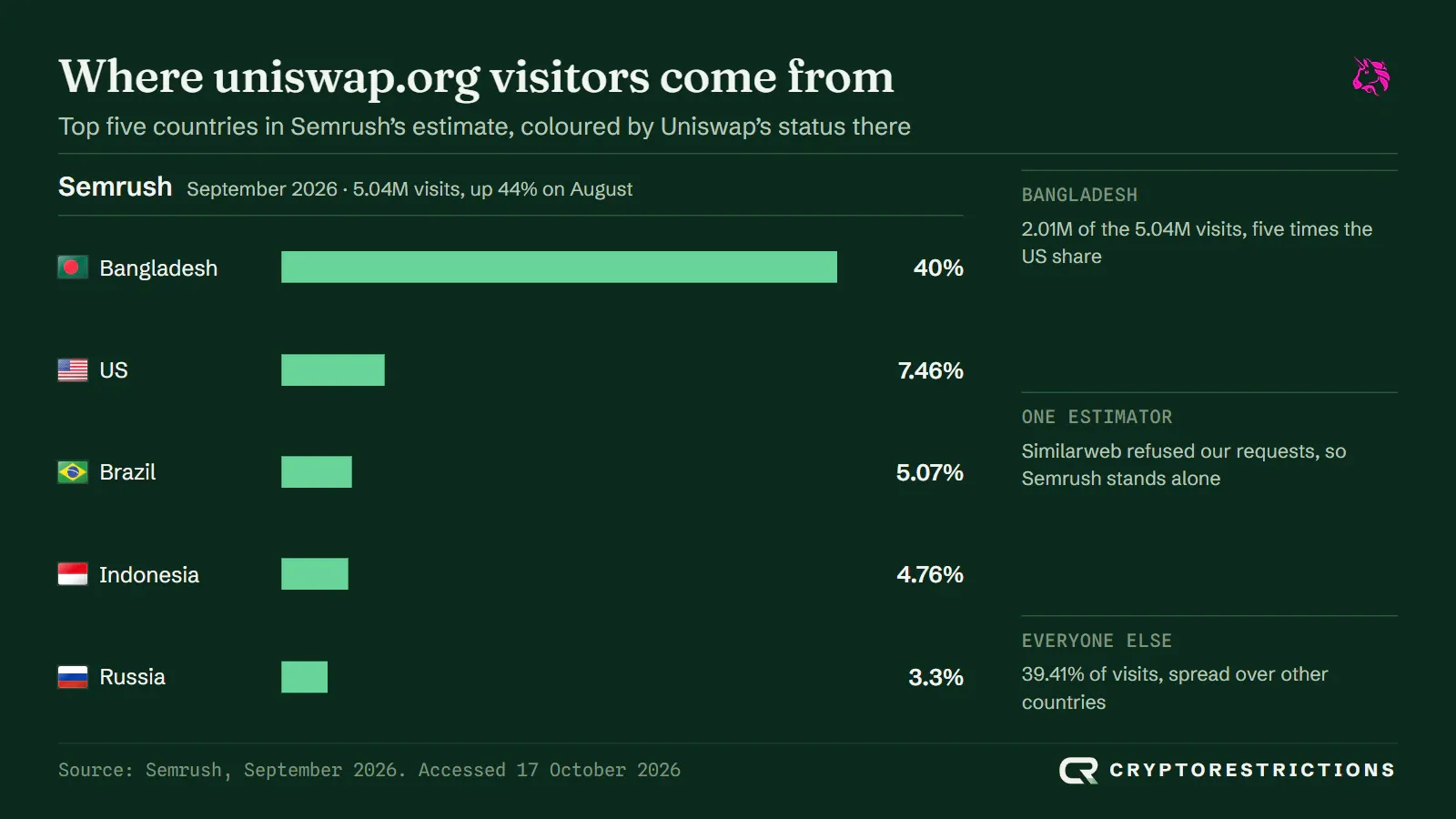
Read the Bangladesh figure as an estimate and not as a count of traders. The block sits in the app and in wallet screening, while the home page at uniswap.org that Semrush measures loads everywhere, and a visit to a home page is not a swap.
Uniswap geo-access test: what we saw from 61 places
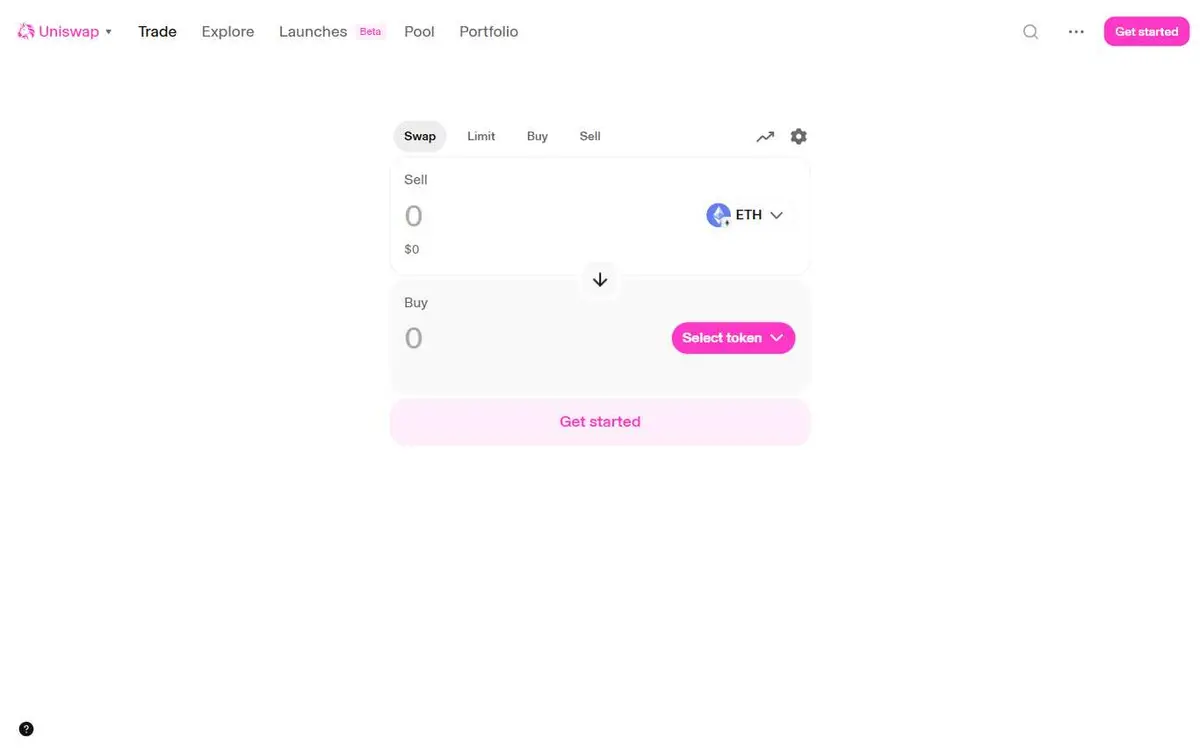
The swap app loaded in all 61 places we tested, 59 countries plus Hong Kong and Taiwan, with no block, banner or notice.
We ran the test ourselves on 16 October 2026. A browser with a VPN connected to servers inside one place at a time and opened app.uniswap.org/swap in a fresh private window, with no cookies and no wallet connected. Banners were never accepted and bot checks never solved, and every run saved the page text and a screenshot. All 61 runs used servers in the country.
No barrierUkraine · Trading app
Ukraine, where developers report an error at token selection: the swap page itself loads normally
No barrierUnited States · Trading app
The US: the swap screen loads with no banner, though leveraged products for US retail are barred
No barrier United Kingdom · Trading app
The UK: the same screen, no notice or gate
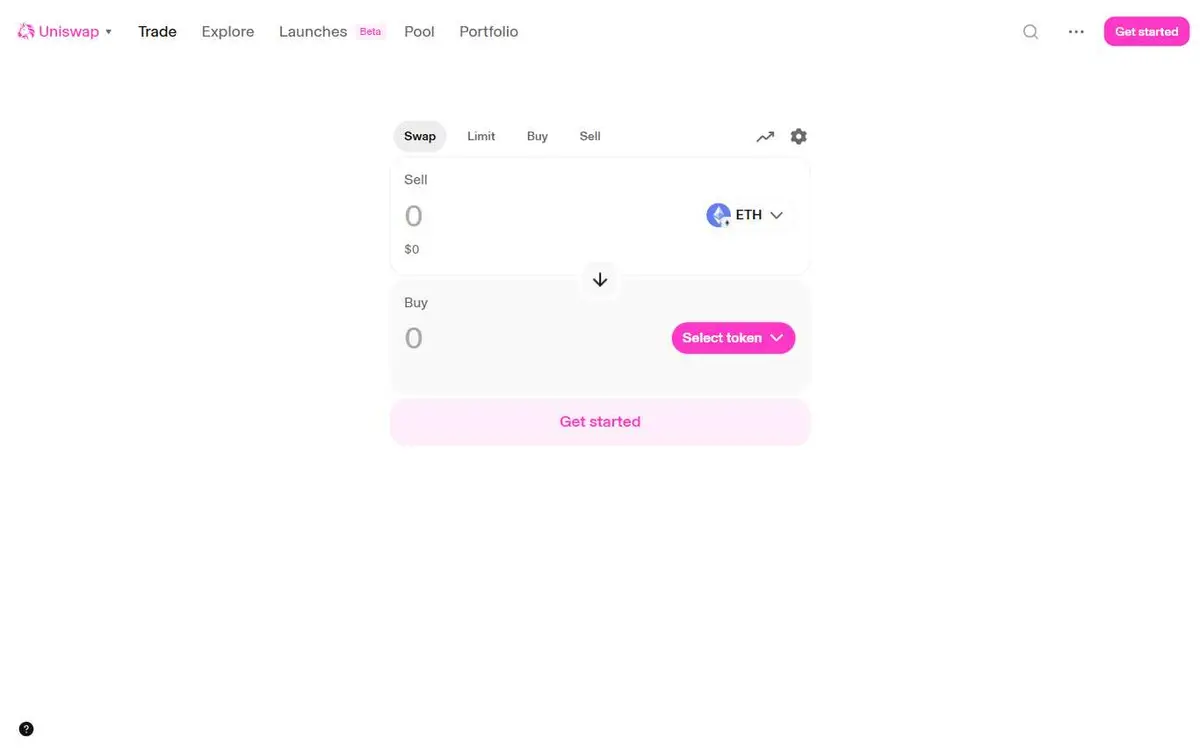
No barrierChina · Trading app
China, where crypto trading is banned locally: the app still loads
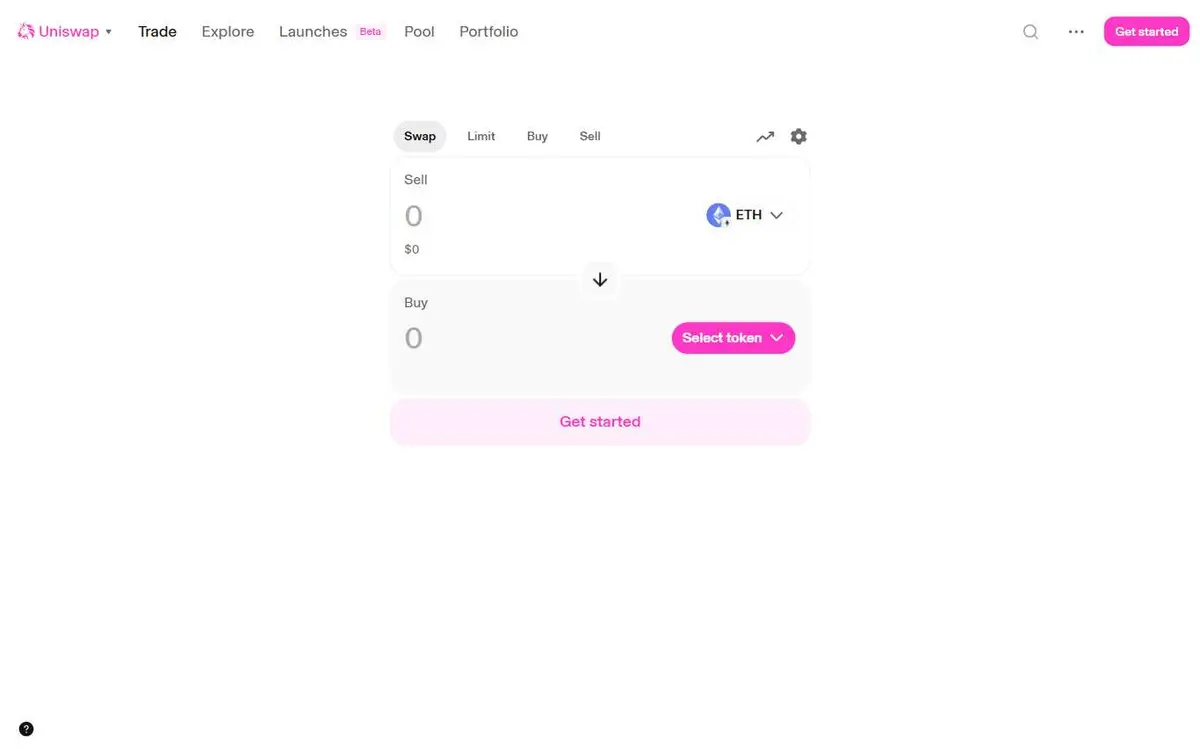
No barrier Turkey · Trading app
Turkey, where the regulator blocked PancakeSwap in 2025: Uniswap loads
No barrier United Arab Emirates · Trading app
The United Arab Emirates: no notice
No barrier Singapore · Trading app
Singapore, where Jupiter's terms bar users: Uniswap loads
No barrierGermany · Trading app
Germany, inside the EEA: Uniswap Labs holds no MiCA authorisation and the app loads
No barrier Netherlands · Trading app
The Netherlands, inside the EEA: the app loads
No barrier Mexico · Trading app
Mexico: the swap app loads with no barrier
“Buy, sell & trade”
No barrier Ireland · Trading app
Ireland: the swap app loads with no notice
No barrier New Zealand · Trading app
New Zealand: the swap app loads with no notice
No barrier Norway · Trading app
Norway: the swap app loads with no notice
No barrier Finland · Trading app
Finland: the swap app loads with no notice
No barrier Greece · Trading app
Greece: the swap app loads with no notice
No barrier Bulgaria · Trading app
Bulgaria: the swap app loads with no notice
No barrier Croatia · Trading app
Croatia: the swap app loads with no notice
No barrier Latvia · Trading app
Latvia: the swap app loads with no notice
No barrier Estonia · Trading app
Estonia: the swap app loads with no notice
No barrier Lithuania · Trading app
Lithuania: the swap app loads with no notice
No barrier Slovenia · Trading app
Slovenia: the swap app loads with no notice
No barrier Iceland · Trading app
Iceland: the swap app loads with no notice
No barrier Serbia · Trading app
Serbia: the swap app loads with no barrier
 CRYPTORESTRICTIONS
That is a weaker signal than it sounds. Uniswap Labs says it blocks individual addresses, not visitors’ locations, so a connected wallet and a swap are what trigger the screening, and we did none of that. Cuba, Iran, North Korea and Syria were not in the run, and the Ukrainian token-selection error described above would sit beyond a page load. What the test does show is that, unlike Hyperliquid, whose trading app refused 5 of the 131 places we tested by IP address, Uniswap’s app has no IP gate on the swap screen.

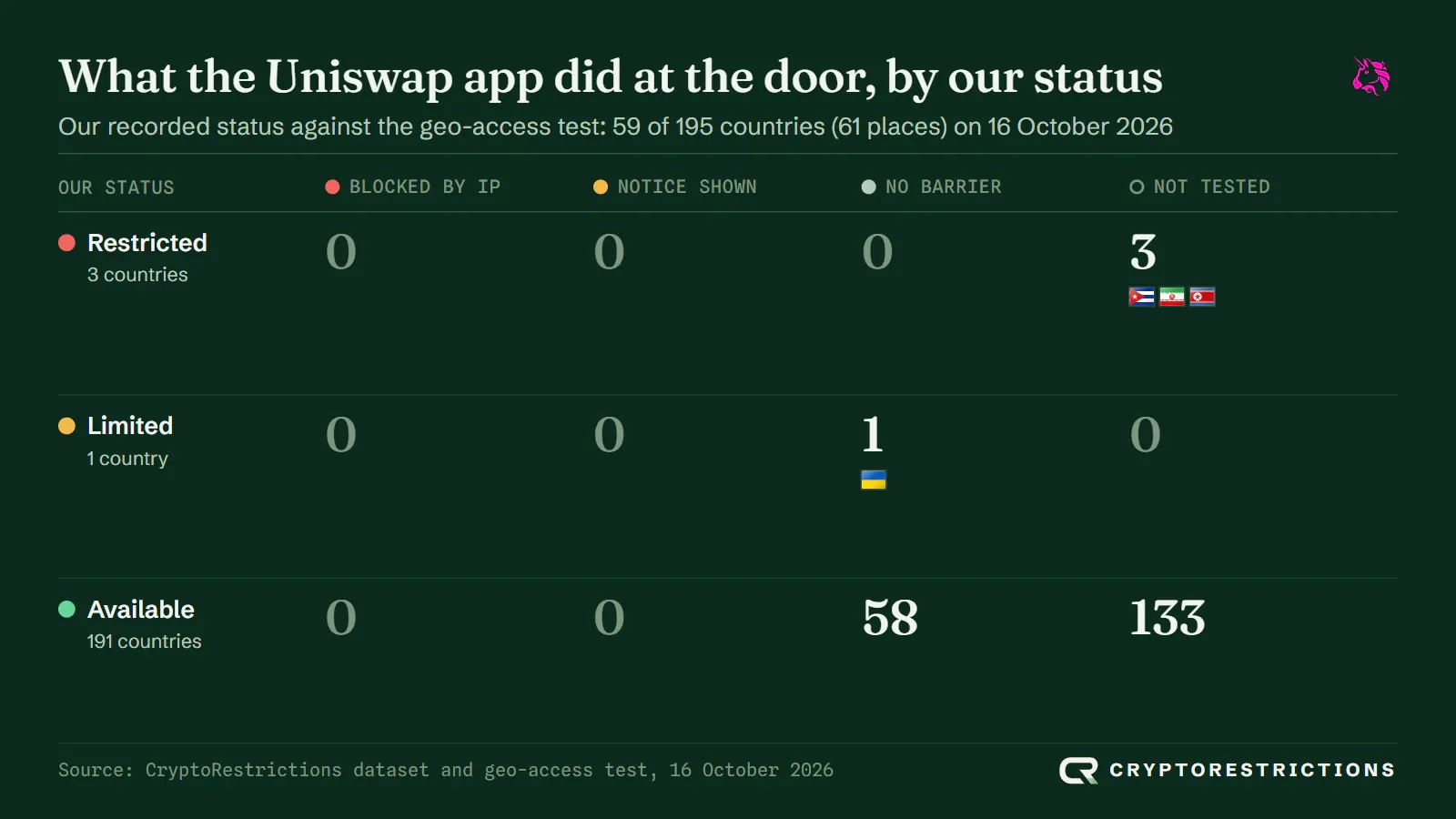
Two patterns stand out. The restricted countries are the ones we could not reach, so the written clause is the only control there. And the one limited country, Ukraine, loaded as an open page, which is why the status rests on the terms and a developers’ report and not on our run. The full result for every place is below.
All 61 test results, country by country
Uniswap against other spot DEX front ends
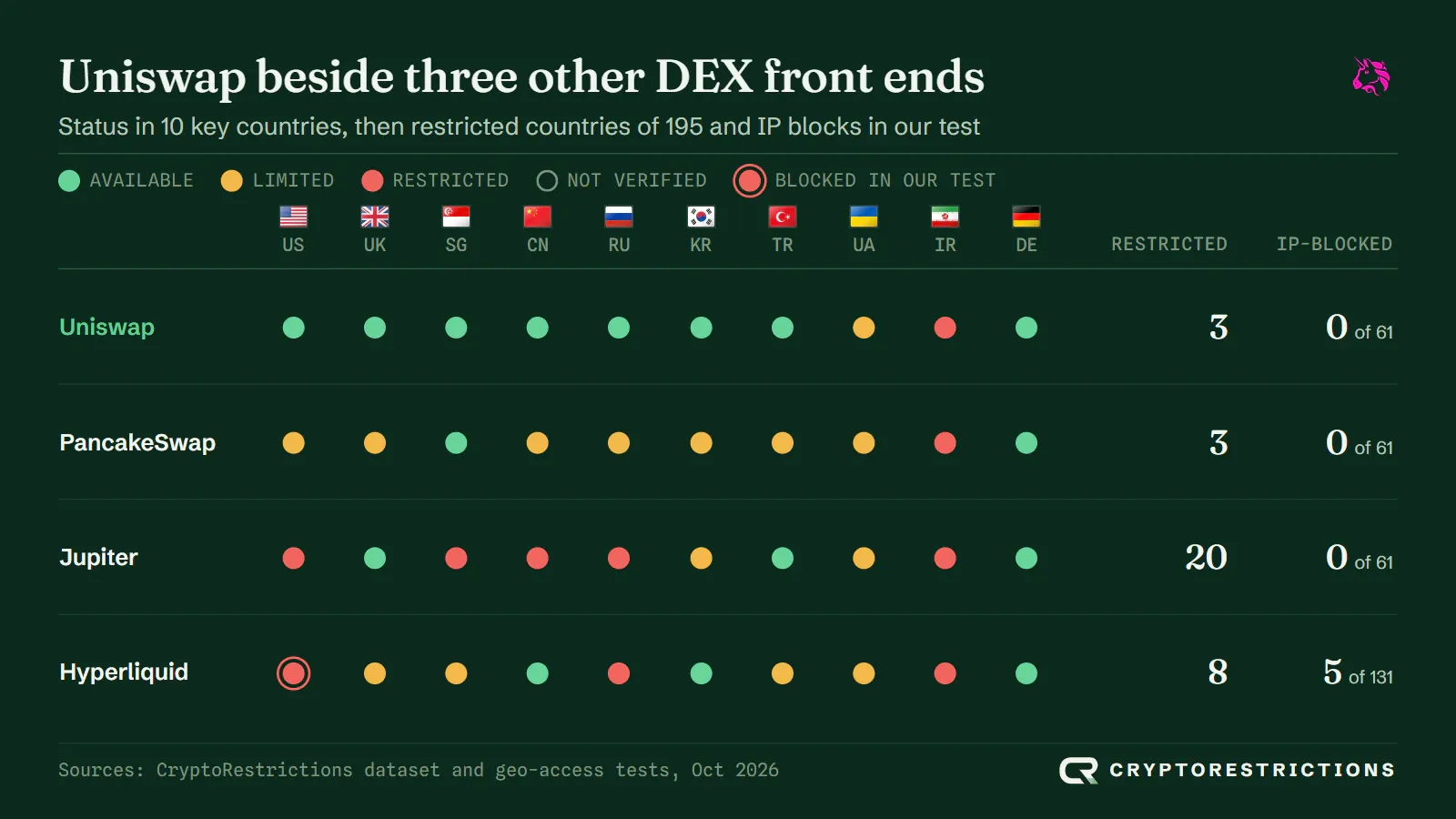
Uniswap has the lightest rules of the four DEX front ends we compare: 3 restricted countries and no IP block, against 20 restricted for Jupiter, which blocked nothing by IP in our test either, and 8 restricted with 5 IP blocks for Hyperliquid. PancakeSwap also has 3 restricted, but limits 10 more, mostly by barring its perpetuals.
The chart reads each platform’s status from our dataset in ten countries where they differ. In it Jupiter is restricted in the US, Singapore, China, Russia and Iran; Hyperliquid is restricted in the US, Russia and Iran and limited in the UK, Singapore and Turkey, where it hides its outcome markets. PancakeSwap is restricted in Iran and limited in seven of the ten, in six of them because its perpetuals are barred there. Turkey’s Capital Markets Board ordered access to PancakeSwap’s website blocked in July 2025, a regulator step we found nothing like for Uniswap.
Uniswap licences and registrations
Uniswap Labs holds no licence or registration that we could find, and its terms describe a company that runs an interface, not an exchange.
The app and wallet are provided by Universal Navigation Inc., trading as Uniswap Labs, which the CFTC describes as a Delaware company based in New York. The terms say the Uniswap Protocol is made of smart contracts that Uniswap Labs “does not control or operate”, that it is a non-custodial application and that it operates no liquidity pools. We found no FinCEN registration, state money transmitter licence, BitLicense or MiCA authorisation in any public source we searched, though we did not query the FinCEN register itself, and Uniswap Labs has no subsidiaries that we could find.
Several of its products carry third-party limits that our country statuses do not. Earn deposits sit in vaults run by Morpho, tokenised stocks are issued by third parties, and token launch auctions are run by the projects. The same Uniswap Labs terms cover every product, so the three restricted countries are barred from all of them.
Uniswap and MiCA in the EU
Uniswap Labs has no MiCA authorisation: neither Uniswap Labs nor Universal Navigation appears in ESMA’s register of crypto-asset service providers, which we checked on 17 October 2026, or in its list of non-compliant entities.
Whether it needs one is the open question for every decentralised exchange. MiCA says in recital 22 that crypto-asset services “provided in a fully decentralised manner without any intermediary” should fall outside the regulation. Uniswap Labs runs an interface, not the protocol, and no EU regulator has taken action against it that we found. ESMA is moving on the question: in its response to the European Commission’s review of MiCA it asks for clearer criteria for what counts as “genuinely decentralised” and a new regulated service for firms that give users access to DeFi protocols, which would reach front ends like Uniswap Labs’. Until that changes we record the EEA as available, and our test loaded the app in 28 of the 30 EEA countries.
Is Uniswap available in the US?
Yes. Uniswap Labs is a New York company, its terms do not exclude US users in any state, and the swap screen loaded from a US address. The one carve-out is leverage: the terms bar offering “leveraged and margined commodity products to retail customers in the United States”.
Uniswap availability by US state
That clause follows the CFTC’s order of 4 September 2024, which found that Uniswap Labs let US retail users trade leveraged tokens through its interface without being a registered contract market. The order carried a $175,000 civil penalty, reduced for cooperation, and a cease and desist order, and two commissioners dissented. The SEC took a different route. Uniswap Labs said in April 2024 that it had received a Wells notice, a warning that the staff may recommend action. On 25 February 2025 the SEC closed its investigation with no action, ten months later.
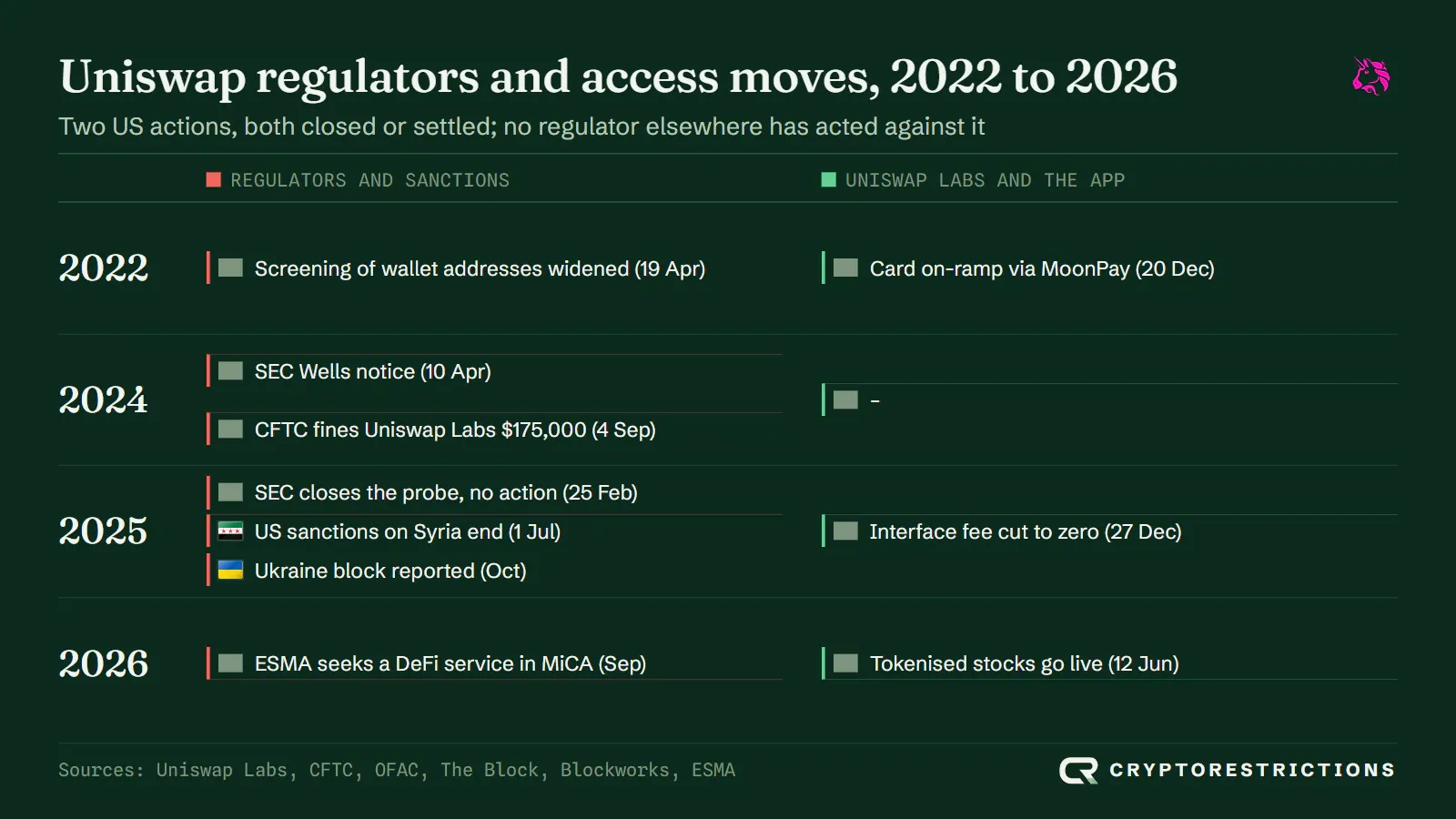
We found no other regulator that has acted against Uniswap by name: no action or warning from authorities in the UK, Singapore, Hong Kong, Japan, South Korea, Thailand, the Philippines, India, Russia, China or Brazil turned up, and no US state action. That is the result of searches, not an exhaustive check. The closest peer case is PancakeSwap, whose website Turkey’s regulator ordered blocked in 2025.

Uniswap KYC and identity verification
Uniswap asks for no identity documents: you connect a non-custodial wallet and accept the terms, and Uniswap Labs never holds your assets.
The terms say you must use “non-custodial wallet software” and give no step that collects a name, a document or a selfie. By using the products you state that you are of age, not sanctioned and not in a place under US sanctions. The one check is on your wallet: Uniswap Labs screens it through third-party blockchain analytics, and a flagged address cannot make any transaction. When you buy crypto with a card or bank transfer through a payment partner, the partner’s own identity rules apply, and Uniswap Labs said at launch that “you do not need to verify your identity to use the Uniswap Protocol” and that the partner does not share customer data with it.
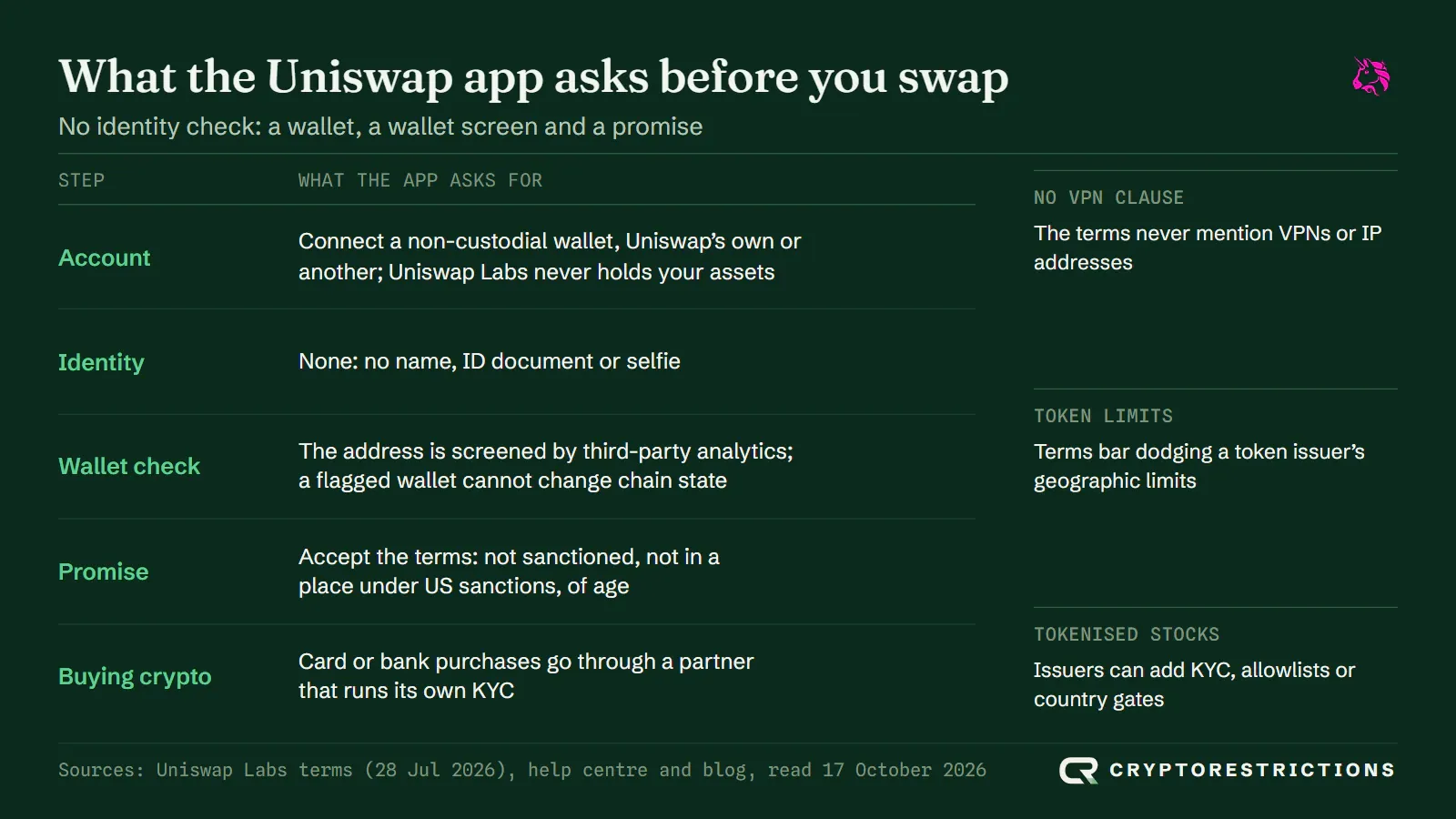
Newer products add limits of their own. The 12 June 2026 announcement of tokenised stocks warns that they may carry issuer-imposed eligibility, KYC, allowlists or country limits, which Uniswap’s v4 pools can enforce at the pool level.
Uniswap verification history
Wallet screening has been a Uniswap Labs control for years. A 19 April 2022 post says the app had long blocked addresses on the OFAC sanctions list and began, with TRM Labs, to block addresses tied to stolen funds and ransomware too. The card on-ramp followed on 20 December 2022 through MoonPay, which is where identity checks entered the picture. We found no record that Uniswap Labs has ever asked swappers for identity documents.
What if Uniswap is restricted where you live?
It depends on the country: of the 21 other platforms we track, one exchange is available in Cuba, Iran and North Korea, and none of the three DEX peers we compare is.
Uniswap Labs’ terms bar anyone under US sanctions, and its screening blocks wallets, so changing your location does not change the answer if the wallet is flagged. The terms have no VPN clause, but they make you promise you are not in a sanctioned place and say you are responsible for complying with your own laws. What is left is a platform allowed to serve you where you live.
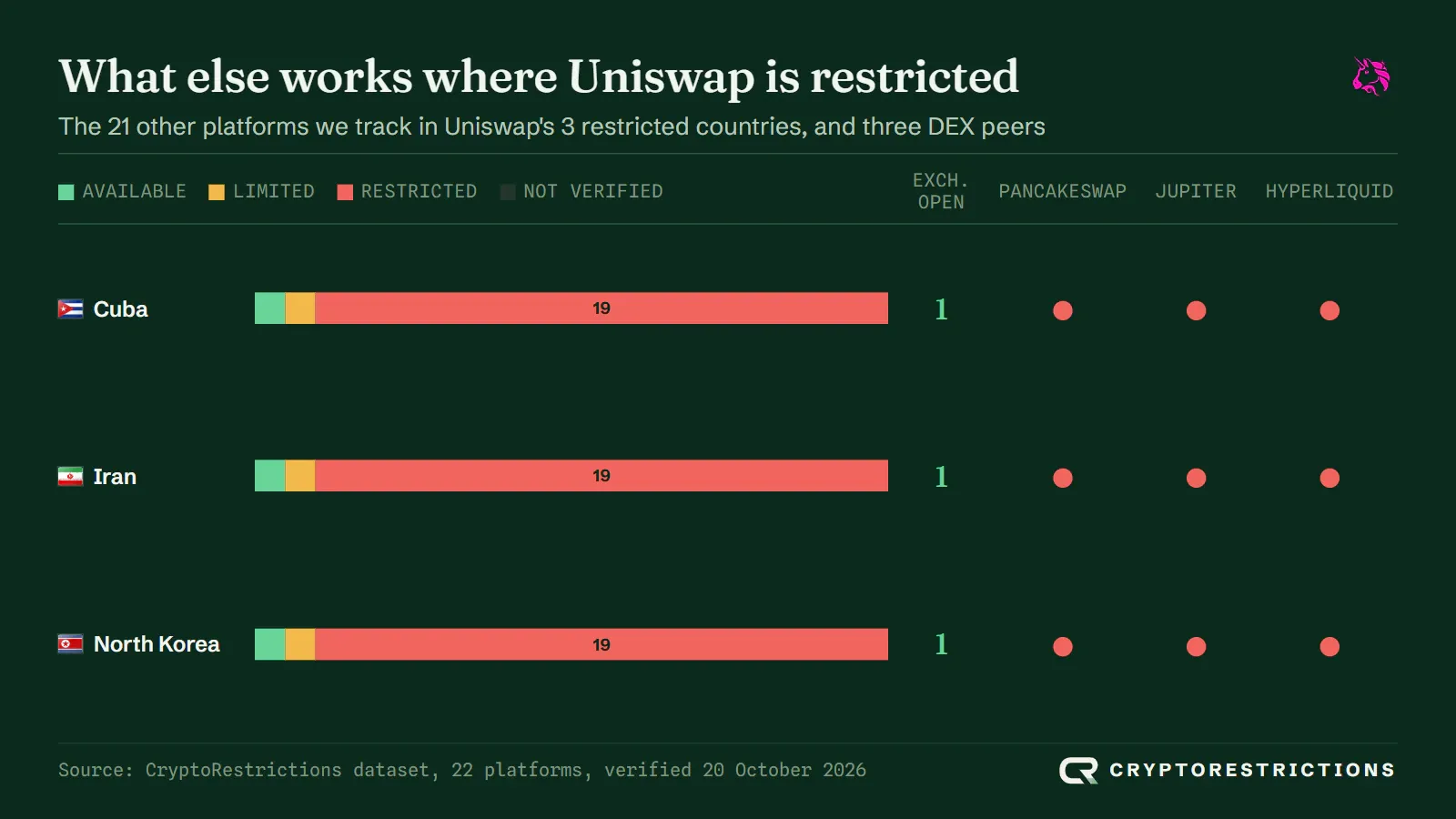
In all three countries only two of the 21 other platforms are recorded as available, both centralised exchanges, and PancakeSwap, Jupiter and Hyperliquid are restricted in each. For a country-by-country comparison of exchanges, with residency rules and licences side by side, see our guide to exchange alternatives by country.