
 United States · SD
Is crypto legal in South Dakota?
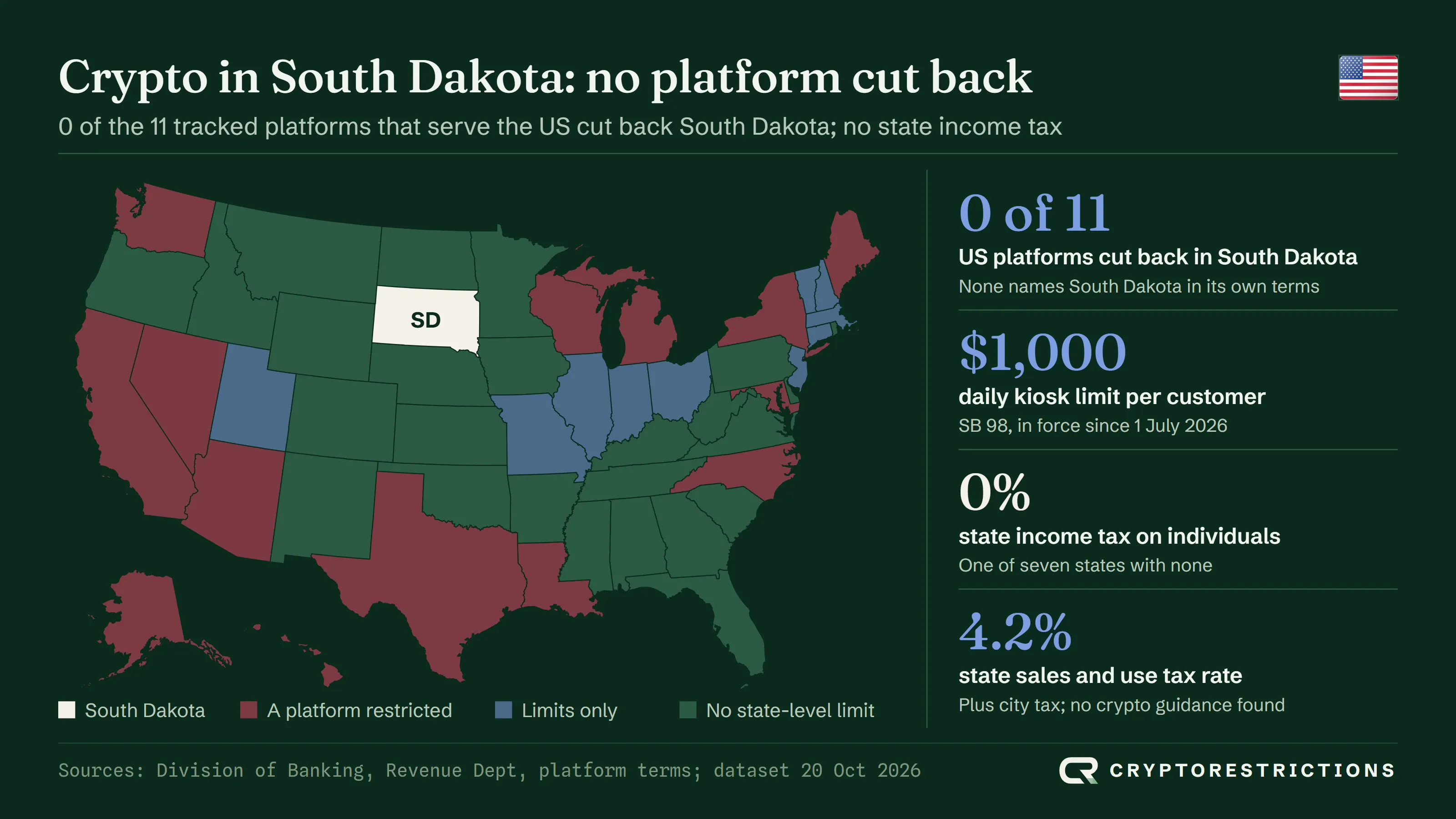
Yes. South Dakota has no crypto-specific licence: a company that moves customers’ money, crypto included, needs a money transmitter licence from the Division of Banking, and crypto kiosks have their own licensing law. The state levies no individual income tax.
Money transmission is licensed under SDCL chapter 51A-17, with applications and renewals through NMLS, and kiosks under chapter 51A-18. We found no exemption for crypto exchanges and no BitLicense-style regime. The Division has treated virtual currency as “monetary value” since a 2019 memo, according to a law firm summary (we could not read the memo itself).
Federal rules from the SEC, CFTC, Treasury and IRS apply on top, as in every state, and offshore exchanges that refuse US users refuse South Dakotans too. Both are covered in our United States guide.
Which crypto licences does South Dakota require?
A money transmitter licence from the Division of Banking, issued through NMLS. Of the seven US exchanges we track, only Gemini states its South Dakota licence numbers: 1518126.MT and 2403509.MT.
Gemini’s South Dakota page names the Division of Banking as licensor and lists those two money transmitter licences, held by Gemini Trust Company and Gemini Moonbase. The Division sends licensee lookups to NMLS Consumer Access, which returned an access error when we checked, so we could not confirm or rule out a South Dakota licence for Coinbase, Kraken, OKX, Crypto.com, Bitstamp or Gate.

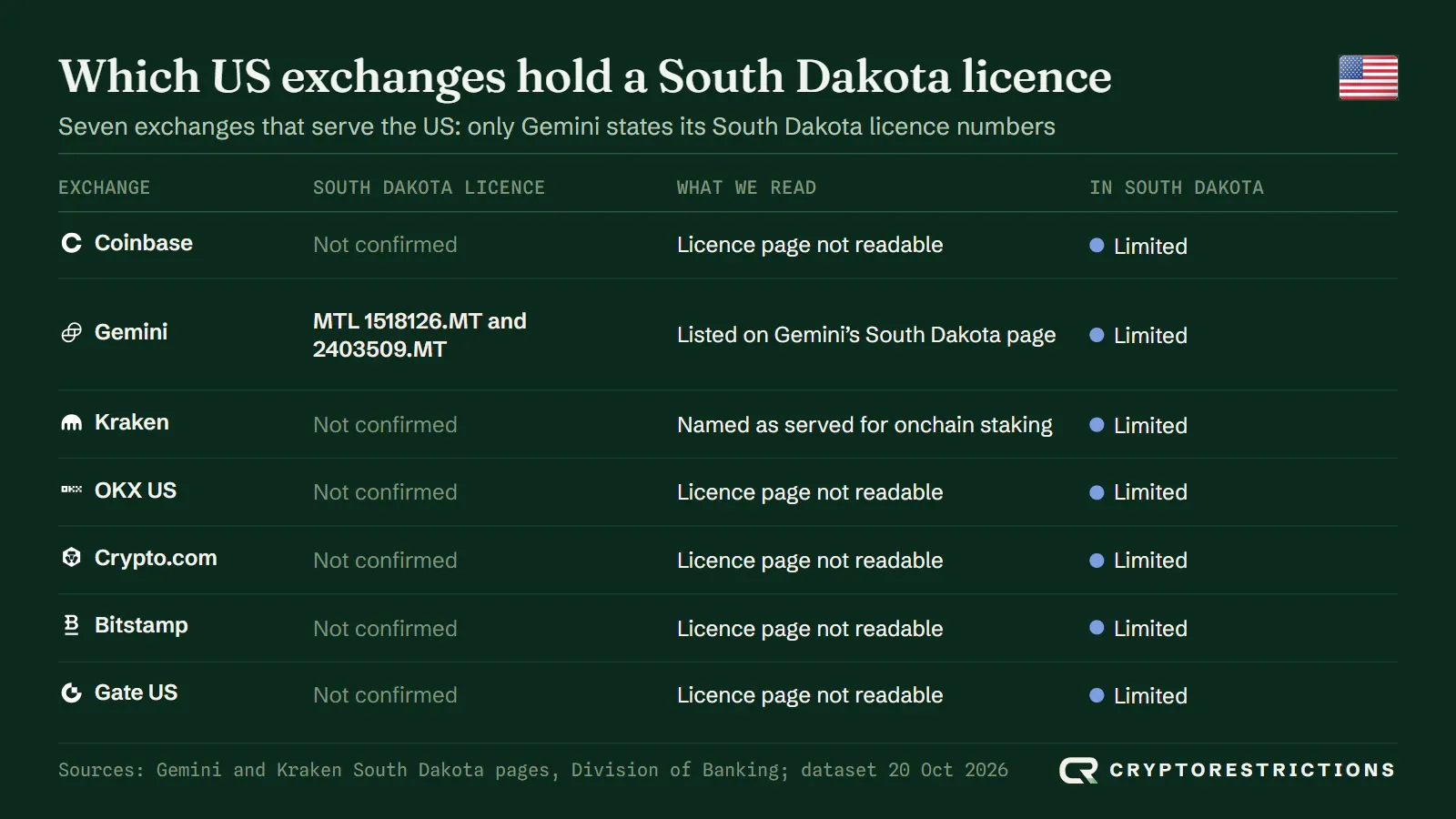
An unconfirmed licence is not a ban: none of the seven names South Dakota as excluded in the pages we could read.
Best crypto platforms for South Dakota residents
By our access score inside South Dakota, Gemini (8.4 out of 10), Kraken (8.3) and Coinbase (7.9) are the most open exchanges, Kalshi (7.3) the most open prediction market and Uniswap (8.0) the most open DeFi platform.
The score rates how fully a South Dakota resident can use each platform, not its fees or safety. It is the US score with South Dakota’s own limits applied: access status (4 points), the share of the platform’s products open in the state (3), the licences we hold on file (2) and what our geo-access test saw from a US address (1). No tracked platform has a South Dakota-specific cut, so the scores track the US ones. The method is on our methodology page.
Exchanges

Gemini
Best for Plain spot trading under named licences
8.4/10- Access
- 3.5/4
- Products
- 1.9/3
- Licences
- 2/2
- Our test
- 1/1
Read our Gemini reportPros
- Gemini lists South Dakota as available
- Holds South Dakota money transmitter licences 1518126.MT and 2403509.MT
Cons
- Fiat deposits are USD only
- Gemini Derivatives excludes US persons

Kraken
Best for A wide coin list, with onchain staking open
8.3/10- Access
- 3/4
- Products
- 2.3/3
- Licences
- 2/2
- Our test
- 1/1
Read our Kraken reportPros
- Its restricted list names only New York and Maine
- South Dakota is on its onchain staking list
Cons
- Federal limits on US customers still apply
- Its South Dakota licence is not confirmed

Coinbase
Best for Spot trading plus staking and loans
7.9/10- Access
- 3.5/4
- Products
- 2.4/3
- Licences
- 1/2
- Our test
- 1/1
Read our Coinbase reportPros
- Serves the US with no South Dakota carve-out we could find
- Staking is not restricted here: its help page excludes only CA, MD, NJ and WI
Cons
- Its licence page would not load, so its South Dakota licence is unconfirmed
- Its prediction markets run through Kalshi

Crypto.com
Best for The App for spot trading
7.5/10- Access
- 3/4
- Products
- 1.5/3
- Licences
- 2/2
- Our test
- 1/1
Read our Crypto.com reportPros
- Staking exclusions name NY, CA, MD, NJ and WI, not South Dakota
Cons
- The Exchange does not offer US residents derivatives
- Its South Dakota licence is not confirmed

Bitstamp
Best for Plain spot trading
6.6/10- Access
- 3/4
- Products
- 0.6/3
- Licences
- 2/2
- Our test
- 1/1
Read our Bitstamp reportPros
- No South Dakota carve-out in its US terms
Cons
- No staking or lending in the US
- No derivatives for US customers

OKX
Best for Spot trading under a US entity
6.0/10- Access
- 3/4
- Products
- 1.5/3
- Licences
- 1/2
- Our test
- 0.5/1
Read our OKX reportPros
- Its US licences page excludes only New York and the territories
Cons
- Spot and convert only, no derivatives for US customers
- Its South Dakota licence is not confirmed
Prediction markets

Kalshi
Best for The broadest CFTC-regulated event contracts
7.3/10- Access
- 3/4
- Products
- 2.3/3
- Licences
- 1/2
- Our test
- 1/1
Read our Kalshi reportPros
- CFTC-designated contract market
- No South Dakota letter, lawsuit or order found
Cons
- South Dakota's attorney general backs Massachusetts against Kalshi
- Sports betting is illegal outside Deadwood under state law

Polymarket
Best for Polymarket markets on a US exchange
6.3/10- Access
- 3/4
- Products
- 2.3/3
- Licences
- 1/2
- Our test
- 0/1
Read our Polymarket reportPros
- Polymarket US is a CFTC-designated exchange
- No South Dakota letter, lawsuit or order found
Cons
- polymarket.com itself blocks US users
- No state list is published, so South Dakota status rests on silence
DeFi

Uniswap
Best for Swapping tokens from your own wallet
8.0/10- Access
- 4/4
- Products
- 3/3
- Licences
- 0/2
- Our test
- 1/1
Read our Uniswap reportPros
- Terms do not exclude South Dakota
Cons
- Leveraged products for US retail are barred

PancakeSwap
Best for BNB Chain swaps and pools
6.3/10- Access
- 3.5/4
- Products
- 1.8/3
- Licences
- 0/2
- Our test
- 1/1
Read our PancakeSwap reportPros
- Swaps, pools and staking are not excluded
Cons
- PCS Perps bars US users
- No US licence on file
Which platforms block or limit South Dakota residents?
None of the platforms we track. We found no tracked exchange, prediction market or DeFi protocol that names South Dakota as excluded or limited in its own terms, licence page or help centre, so South Dakota residents get the same product list as the rest of the US.
The exclusions we did find name other states. Kraken serves every state except New York and Maine, and lists South Dakota for onchain staking. Crypto.com bars staking in New York, California, Maryland, New Jersey and Wisconsin. Gate does not operate in Alaska, Texas, Louisiana, New York, Washington and North Carolina, and OKX excludes New York and the territories. Several platform pages would not load when we checked, so a silent page is not proof: we re-check the rows when a platform publishes a state list.
Kiosks are rules on machines, not on platforms: South Dakotans can still buy and trade crypto online.
Who regulates crypto in South Dakota?
The Division of Banking licenses money transmitters and, since 1 July 2026, kiosk operators. The Legislature writes the rules, and the Attorney General warns the public about crypto scams and backs other states’ fights over prediction markets.
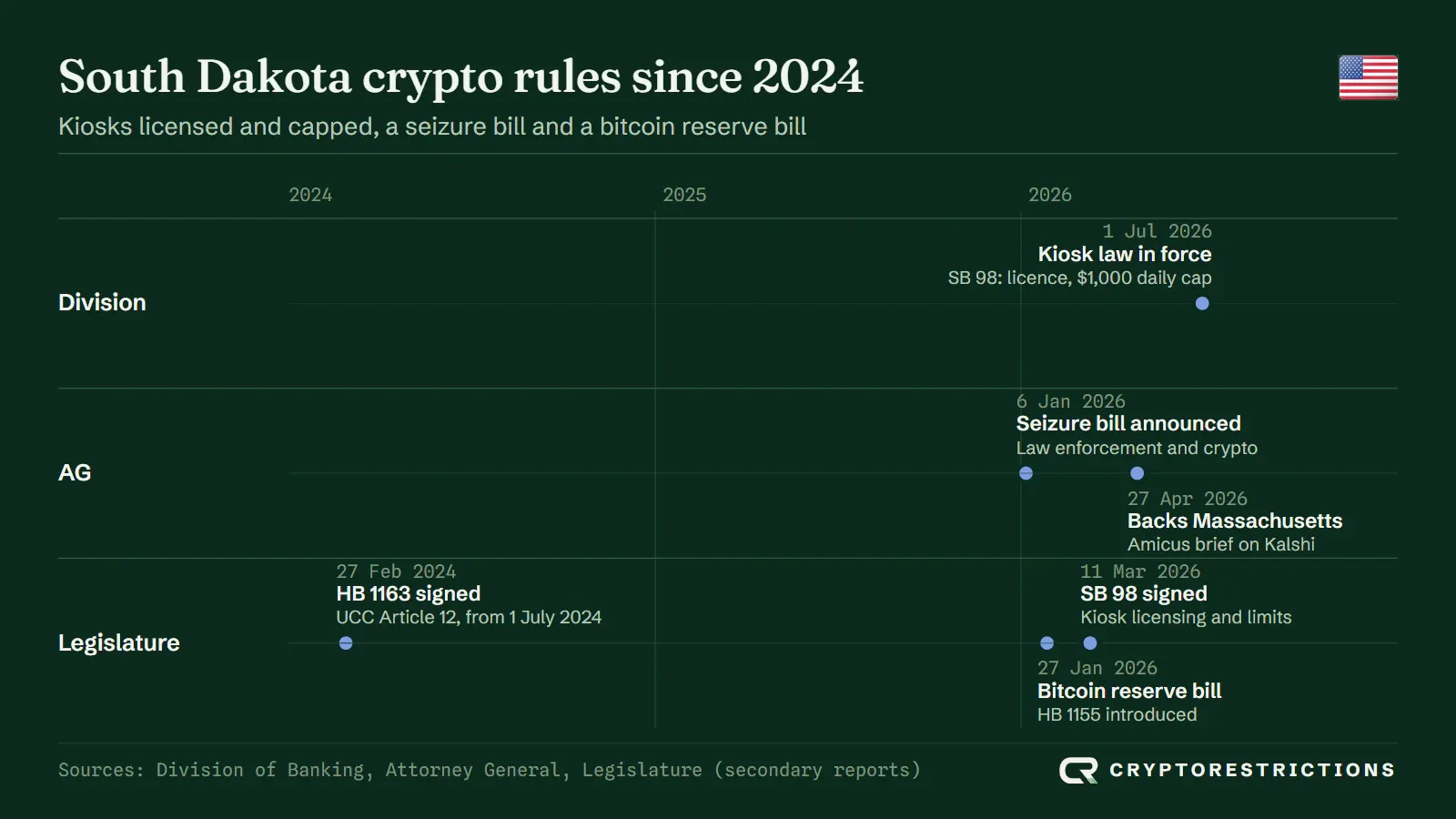
- Division of Banking. Operators of crypto kiosks must hold a money transmitter licence from 1 July 2026, according to a law firm summary of Senate Bill 98.
- Legislature. Senate Bill 98, signed by Governor Larry Rhoden on 11 March 2026, caps what each customer can send at $1,000 a day and $10,000 over 30 days, caps fees at 3%, requires refunds to fraud victims within 72 hours once reporting conditions are met, and requires live support, ID checks and blockchain analytics to block high-risk wallets. House Bill 1163, signed on 27 February 2024, adopted the UCC article on controllable electronic records with South Dakota changes (a single secondary source). A 2026 bitcoin reserve bill, House Bill 1155, was introduced on 27 January 2026; we found no sign that it passed, and a 2025 bill, House Bill 1202, was deferred in committee.
- Attorney General. Marty Jackley announced on 6 January 2026 a bill to let law enforcement seize crypto accounts, saying crypto “has become a haven for scammers, drug traffickers, and human traffickers”. We found no enforcement action by his office against an exchange or kiosk operator.
We could not load the Legislature’s bill pages, so the legislative facts above rest on news and law firm reports, not the bill texts.
Are prediction markets legal in South Dakota?
Unsettled. We found no cease-and-desist letter, lawsuit or court order from South Dakota officials against Kalshi, Polymarket or any other event-contract platform as of 20 October 2026, but sports betting is illegal outside Deadwood under state law and the Attorney General has joined other states against Kalshi.
South Dakota was one of 38 states that signed an amicus brief on 27 April 2026 supporting Massachusetts in its suit against Kalshi, according to the Arizona Capitol Times. That is support for another state, not an action against a platform in South Dakota. South Dakota Public Broadcasting reported on 24 July 2026 that betting on sports outside Deadwood is illegal, and that a Sioux Falls user can still buy a contract on a South Dakota college team because platforms treat it as trading. Those two reports are secondary, and we found no South Dakota bill aimed at prediction markets.
Other states have acted, and a federal appeals court has already ruled on a state’s gambling law against Kalshi. Those actions and the federal side are in our United States guide. If South Dakota regulators act, the change will show in the rail beside this page.
How is crypto taxed in South Dakota?
South Dakota has no state income tax on individuals, so a crypto gain is taxed by the IRS only. Buying goods with crypto falls under the state sales and use tax of 4.2% plus any city tax, and we found no Department of Revenue guidance written for crypto.
The Department of Revenue says South Dakota is one of seven states that does not impose a state income tax. Its sales and use tax page gives a state rate of 4.2%, adds a municipal tax that varies by city, and says the tax covers “any product transferred electronically”. We read nothing on that page that treats a crypto purchase differently. Federal capital gains rules, which decide what counts as a gain, are in our United States guide.







