
 United States · MA
Is crypto legal in Massachusetts?
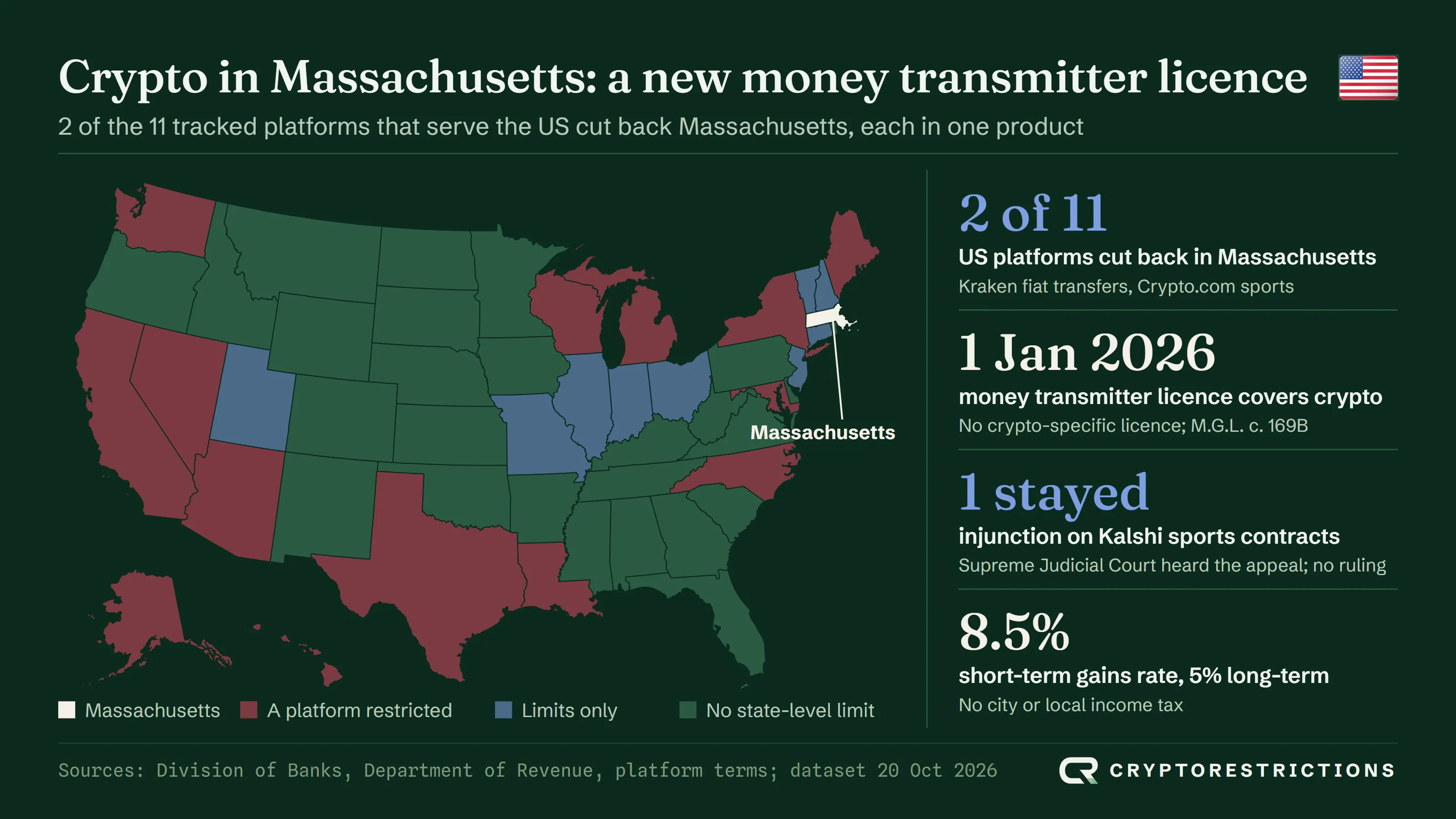
Yes. Owning and trading crypto is legal in Massachusetts and there is no crypto-specific licence, but since 1 January 2026 a firm that transmits crypto for residents generally needs a money transmitter licence from the Division of Banks.
The licence comes from Chapter 312 of the Acts of 2024, signed on 1 January 2025 and now M.G.L. c. 169B. The old law, c. 169, covered only transfers abroad, and in Opinion 23-003 of 29 November 2023 the Division found that a US-only crypto app needed no licence. Its FAQ now says licensing is “Generally, yes” for virtual currency transmission, treats Bitcoin and USDC as monetary value, and tells firms not to rely on the old opinions. The law covers transmissions for personal, family or household purposes.
Firms had until 1 July 2026 to apply and may keep operating while an application is pending. On 31 July 2026 the Division told firms that did not apply to stop all licensable activity at once. People who only hold crypto need no licence.
Federal rules from the SEC, CFTC, Treasury and IRS apply on top, as in every state, and offshore exchanges that refuse US users refuse Massachusetts residents too. Both are covered in our United States guide.
Which crypto licences does Massachusetts require?
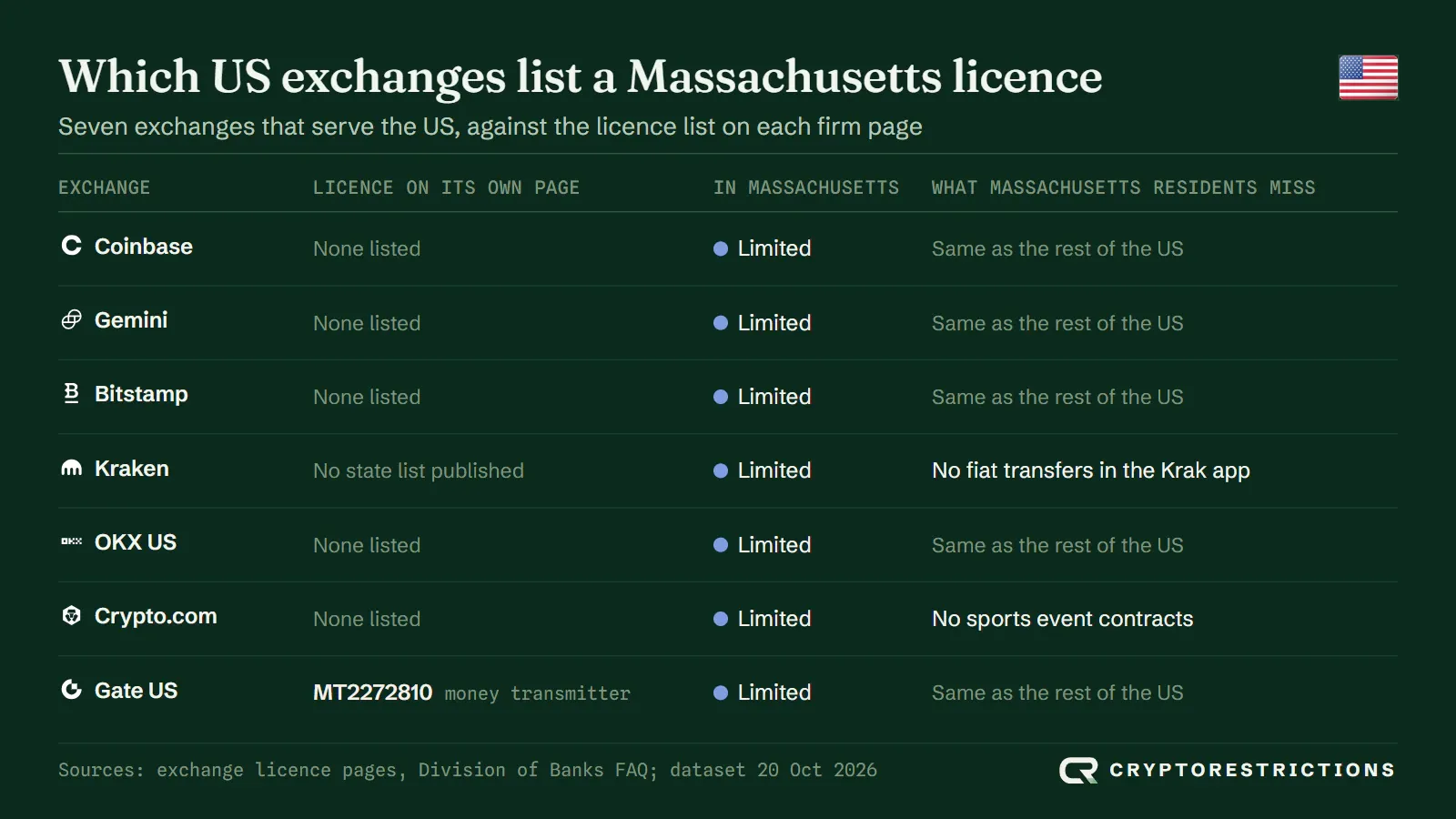
A money transmitter licence under M.G.L. c. 169B from the Division of Banks; there is no BitLicense-style crypto licence. Of the seven US exchanges we track, only Gate US lists a Massachusetts licence on its own page.
The Division’s licence lookup sits behind a CAPTCHA, so we read each exchange’s own licence page on 19 October 2026. Coinbase, Gemini, Bitstamp, OKX and Crypto.com list no Massachusetts licence, and Kraken publishes no state-by-state list. That is not proof they are unlicensed: a firm that filed by 1 July 2026 may operate while its application is pending. Gate lists money transmitter licence MT2272810 from the Division of Banks on its US licences page.


Best crypto platforms for Massachusetts residents
By our access score inside Massachusetts, Gemini (8.4 out of 10) and Kraken (8.3) are the most open exchanges, Kalshi (7.3) the most open prediction market and Uniswap (8.0) the most open DeFi platform.
The score rates how fully a Massachusetts resident can use each platform, not its fees or safety. It is the US score with Massachusetts’ own limits applied: access status (4 points), the share of the platform’s products open in the state (3), the licences we hold on file (2) and what our geo-access test saw from a US address (1). The method is on our methodology page.
Exchanges

Gemini
Best for Spot trading with staking by opt-in
8.4/10- Access
- 3.5/4
- Products
- 1.9/3
- Licences
- 2/2
- Our test
- 1/1
Read our Gemini reportPros
- Massachusetts is on its list of areas of availability
- Asset Rewards staking is open to Massachusetts residents
Cons
- Residents must opt in to staking
- No Massachusetts licence on its trust centre list

Kraken
Best for Staking and crypto transfers, no state carve-out
8.3/10- Access
- 3/4
- Products
- 2.3/3
- Licences
- 2/2
- Our test
- 1/1
Read our Kraken reportPros
- Massachusetts is not on its list of states it does not serve
- Onchain staking is open in Massachusetts
Cons
- Fiat transfers in the Krak app are not available
- Publishes no state licence list

Coinbase
Best for The widest product range, no state carve-out
7.9/10- Access
- 3.5/4
- Products
- 2.4/3
- Licences
- 1/2
- Our test
- 1/1
Read our Coinbase reportPros
- No Massachusetts exclusion on its staking, loan or DEX help pages
- Prediction markets open: only Nevada and Michigan are excluded
Cons
- No Massachusetts licence on its licences page
- Its prediction markets run through Kalshi, whose appeal is pending

Crypto.com
Best for The app, minus sports contracts
7.5/10- Access
- 3/4
- Products
- 1.5/3
- Licences
- 2/2
- Our test
- 1/1
Read our Crypto.com reportPros
- The App is offered in 49 states, Massachusetts included
- CFTC-registered exchange and clearing house
Cons
- No sports event contracts in Massachusetts
- No Massachusetts licence in its licence document
Prediction markets

Kalshi
Best for The broadest CFTC-regulated event contracts
7.3/10- Access
- 3/4
- Products
- 2.3/3
- Licences
- 1/2
- Our test
- 1/1
Read our Kalshi reportPros
- CFTC-designated contract market
- The injunction against its sports contracts is stayed during the appeal
Cons
- Sued by the Attorney General on 12 September 2025
- A ruling for the state could end sports contracts here

Polymarket
Best for Polymarket markets on a US exchange
6.3/10- Access
- 3/4
- Products
- 2.3/3
- Licences
- 1/2
- Our test
- 0/1
Read our Polymarket reportPros
- Polymarket US is a CFTC-designated exchange
- No Attorney General action against it found
Cons
- Filed its own suit against the state in February 2026
- polymarket.com itself blocks US users
DeFi

Uniswap
Best for Swapping tokens from your own wallet
8.0/10- Access
- 4/4
- Products
- 3/3
- Licences
- 0/2
- Our test
- 1/1
Read our Uniswap reportPros
- Terms do not exclude Massachusetts
- Open in our geo-access test from a US address
Cons
- Leveraged products for US retail are barred

PancakeSwap
Best for BNB Chain swaps and pools
6.3/10- Access
- 3.5/4
- Products
- 1.8/3
- Licences
- 0/2
- Our test
- 1/1
Read our PancakeSwap reportPros
- Swaps, pools and staking are not excluded
Cons
- PCS Perps bars US users
- No US licence on file
Which platforms block or limit Massachusetts residents?
None of the platforms we track refuses Massachusetts outright. Two drop one product: Kraken its fiat transfers in the Krak app, and Crypto.com its sports event contracts.
Massachusetts is not on the short list of states Kraken does not serve (Maine and New York). Kalshi is not cut back: the court order against its sports contracts is paused, as the prediction markets section below explains.
Who regulates crypto in Massachusetts?
The Division of Banks licenses money transmitters, the Securities Division polices crypto offerings, the Attorney General sues over scams and gambling, and the Gaming Commission polices sports betting. Beyond the 2025 money transmission law, no crypto bill has become law; a kiosk ban passed the Senate in July 2026 but is not law.
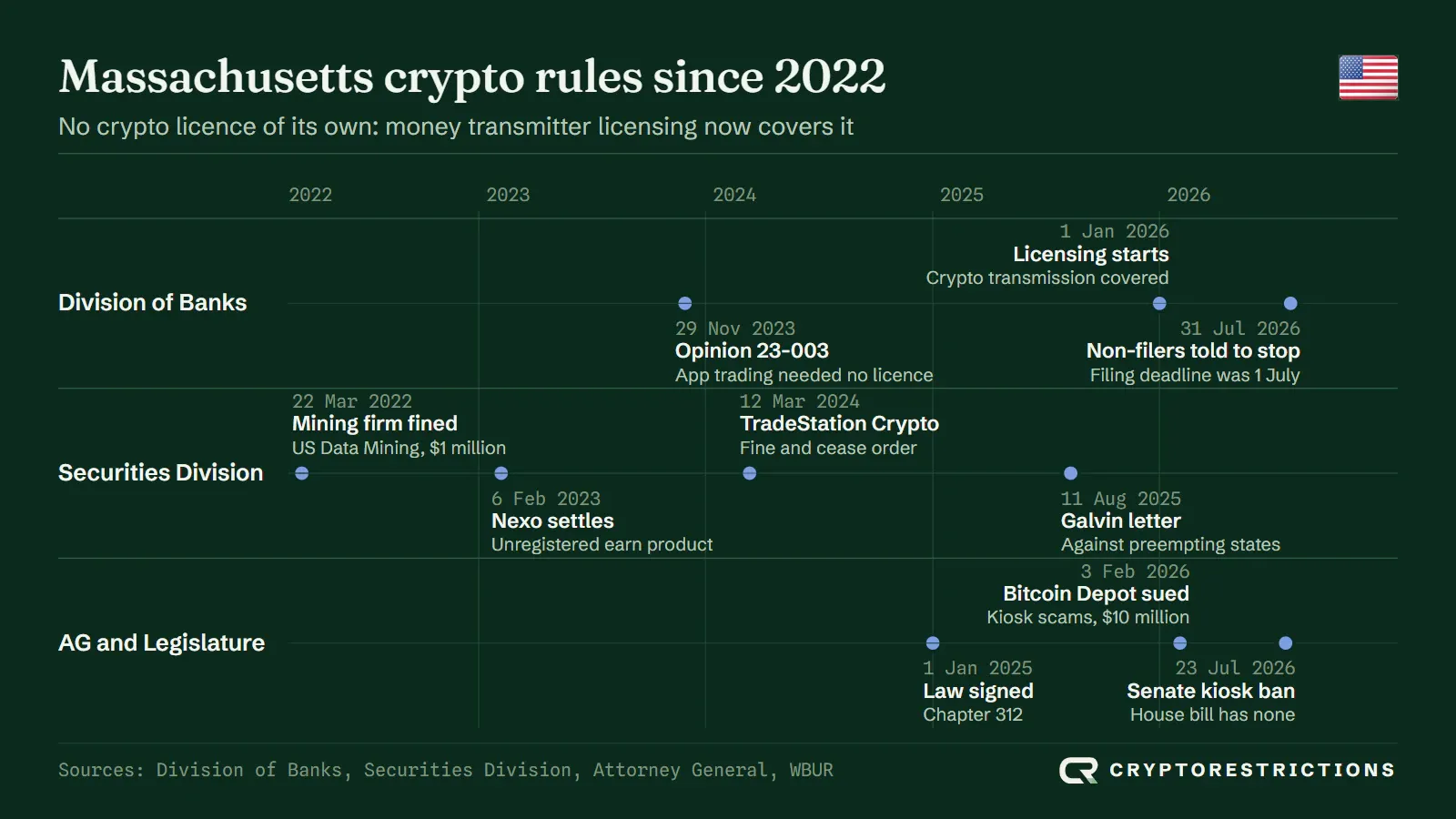
- Securities Division. Secretary William Galvin’s office fined mining firm US Data Mining Group $1 million on 22 March 2022, settled with Nexo over its unregistered interest product on 6 February 2023 and, on 12 March 2024, ordered TradeStation Crypto to pay a fine and stop offering unregistered securities. We found no crypto enforcement entry for 2025 or 2026. On 11 August 2025 Galvin wrote to the Senate against federal bills that would preempt state regulators.
- Attorney General. Andrea Campbell sued kiosk operator Bitcoin Depot on 3 February 2026, saying its machines helped scammers take more than $10 million from residents.
- Legislature. The Senate added a kiosk ban to its economic development bill on 23 July 2026, as WBUR reported. The House bill had no ban, so the two chambers went to conference, and we found no final text as of 19 October 2026.
Are prediction markets legal in Massachusetts?
Not settled. Massachusetts treats sports event contracts as unlicensed sports wagering and won an injunction against Kalshi, but an appeals judge paused it and the Supreme Judicial Court has not ruled.
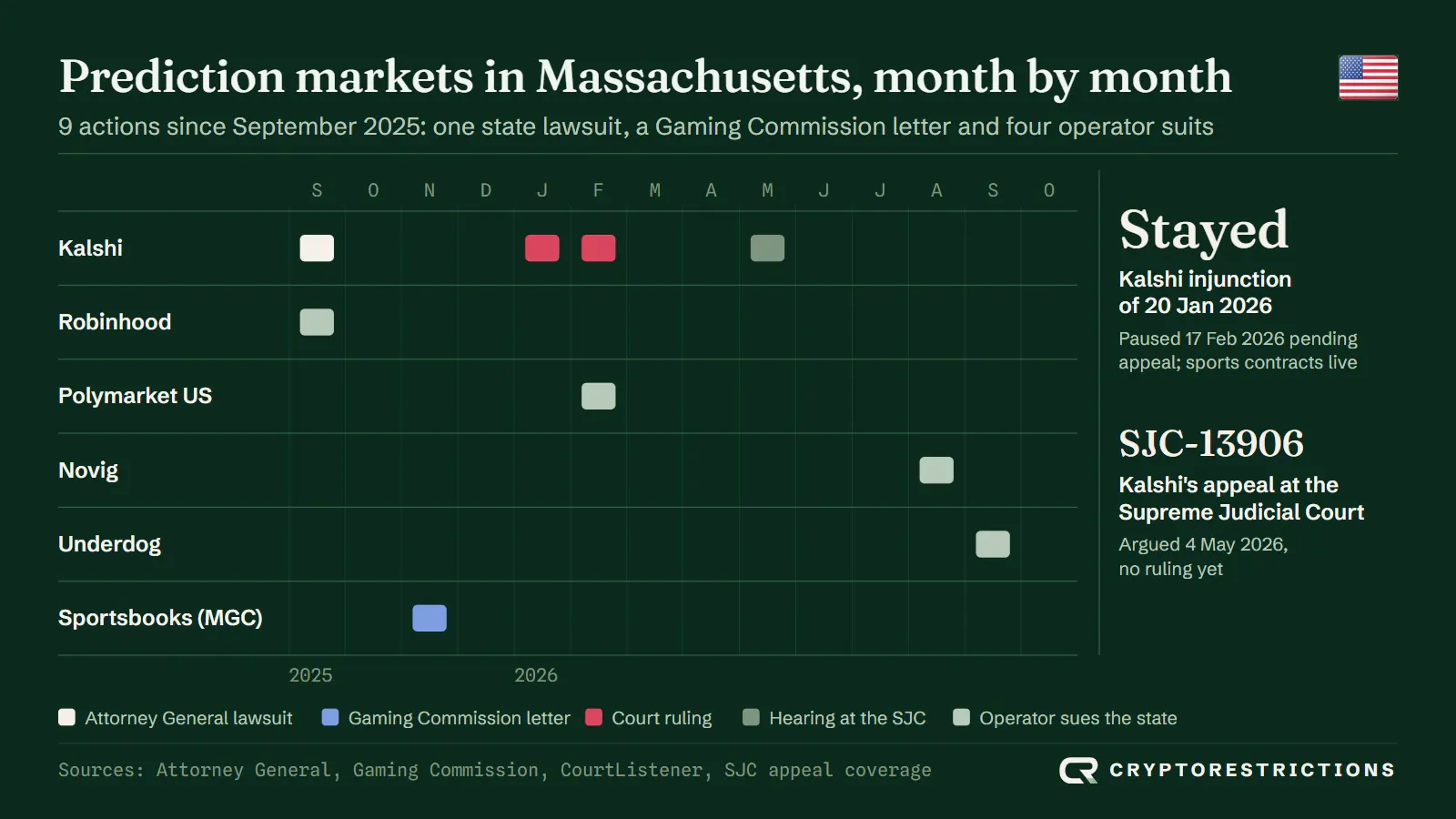
The Attorney General sued Kalshi on 12 September 2025, the first state lawsuit against a prediction market, saying its sports contracts are sports wagering without a Gaming Commission licence. Kalshi moved the case to federal court, and a judge sent it back on 28 October 2025. On 13 November 2025 the Gaming Commission told its licensed sportsbooks they may not offer sports event contracts in Massachusetts.
On 20 January 2026 a Suffolk Superior Court judge granted the injunction. On 17 February an Appeals Court judge paused it and sped up the appeal, which moved to the Supreme Judicial Court as No. SJC-13906. The CFTC filed a brief for Kalshi on 24 April, and the court heard argument on 4 May 2026, in a session Insurance Journal reported. We found no decision as of 19 October 2026, and the court’s own docket was behind a bot check, so the case could be decided at any time.
Operators have sued the state instead of waiting. Robinhood filed on 15 September 2025 and was dismissed on 13 March 2026, with an appeal pending. Polymarket US filed on 9 February 2026, Novig on 6 August and Underdog on 8 September. We found no state action against Coinbase, Gemini or Crypto.com, and no prediction market bill in the legislature, though the legislature’s site was unreachable when we checked.
How is crypto taxed in Massachusetts?
We found no Massachusetts crypto tax rule, so a gain follows the general rates: 8.5% on short-term gains and 5% on long-term gains for 2025, plus a 4% surtax on income over $1,083,150. There is no local income tax.
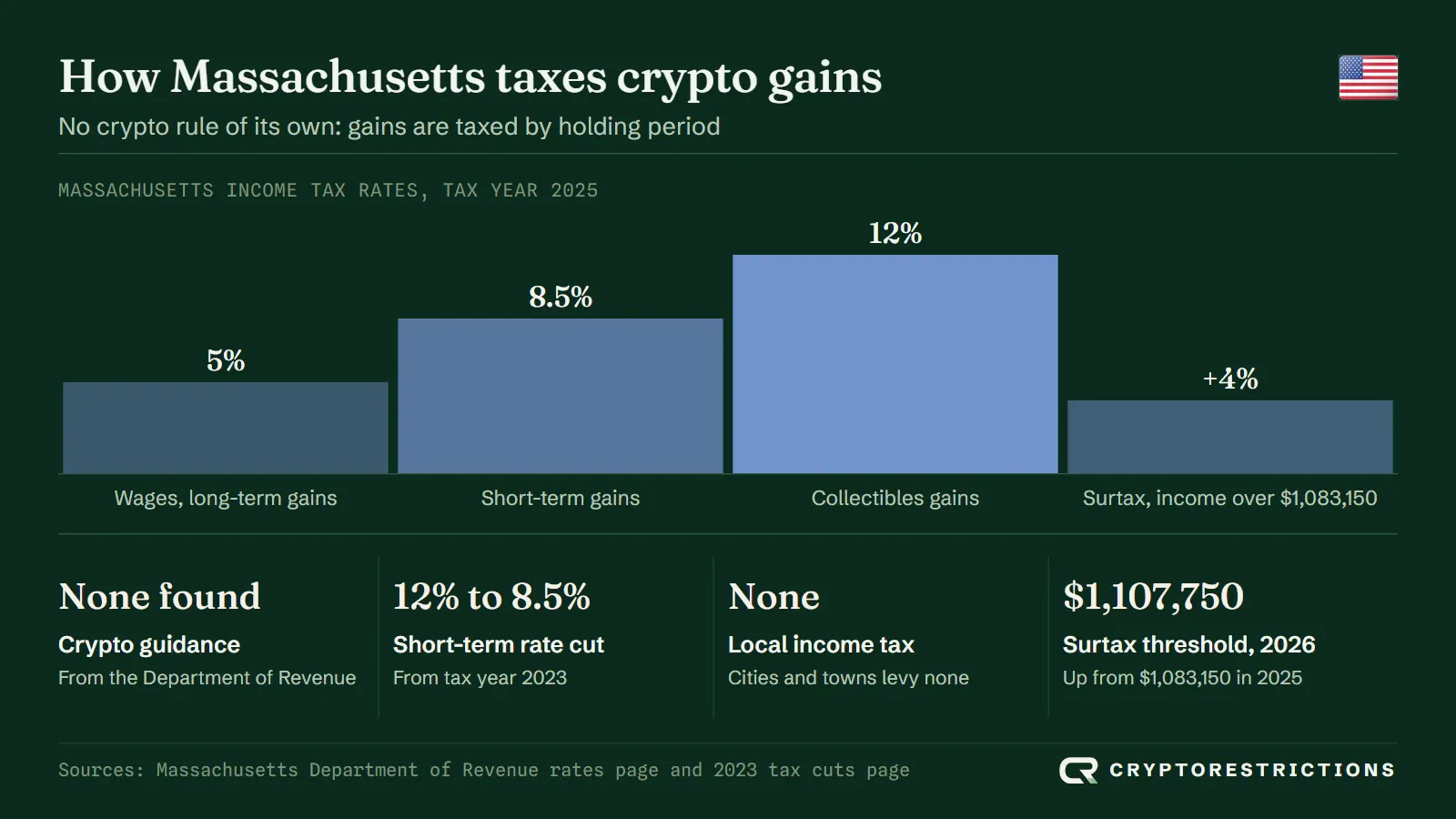
The Department of Revenue’s rates page sets 5% on wages and long-term gains, 8.5% on short-term gains and 12% on collectibles gains. The short-term rate was cut from 12% to 8.5% from tax year 2023. The 4% surtax applies on top, above $1,083,150 for 2025 and $1,107,750 for 2026.
We found no Department of Revenue guidance on virtual currency. The 6.25% sales tax on the rates page covers tangible property, and we found no statement on whether it reaches crypto purchases. Federal tax treatment is in our United States guide.