 United States · KY
Is crypto legal in Kentucky?
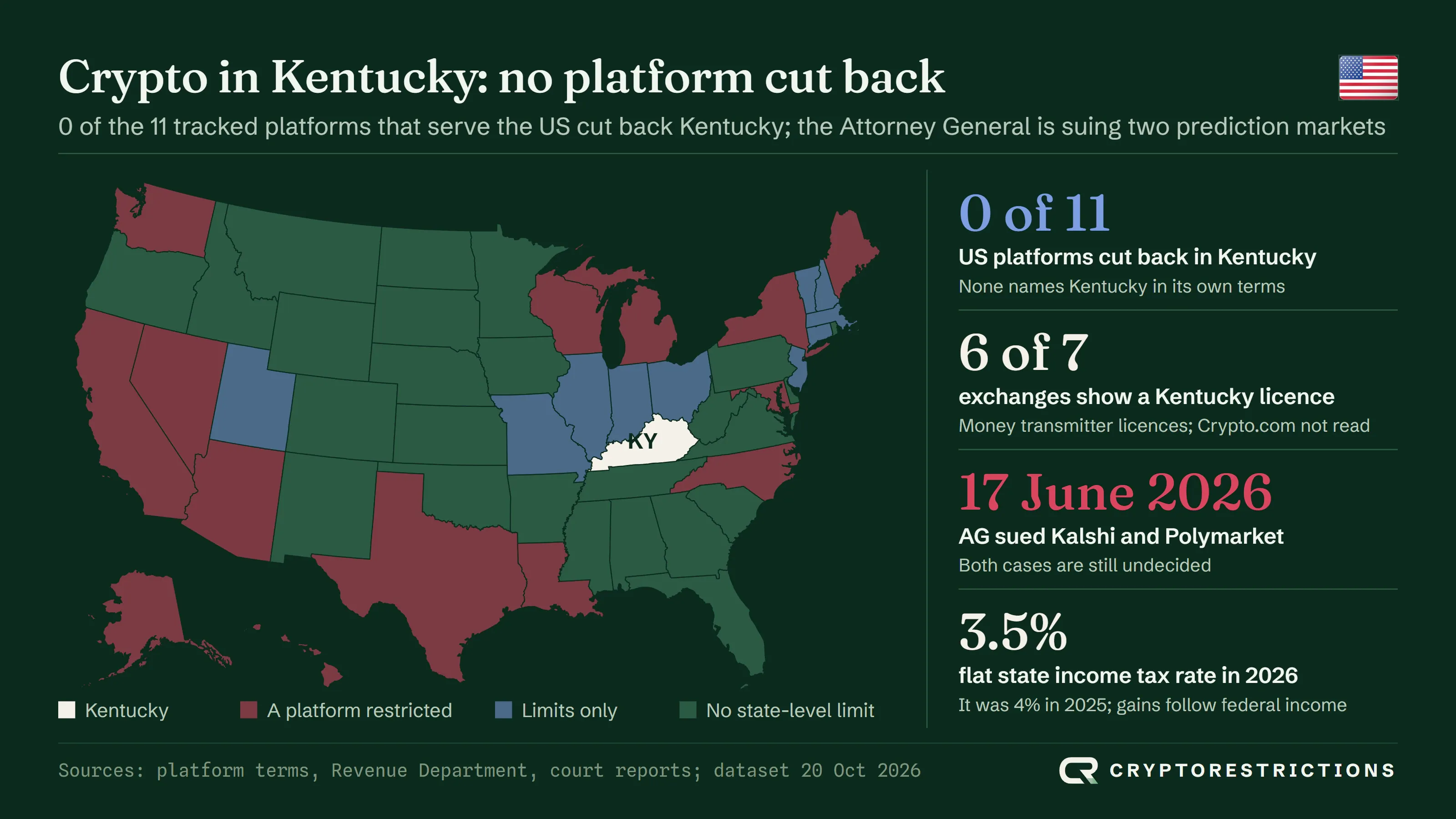
Yes. Owning and trading crypto is legal in Kentucky, and a 2025 law protects self-custody, running a node and mining. The state has no crypto licence of its own: exchanges are licensed as money transmitters, and crypto kiosks will need their own licence from April 2027.
The Department of Financial Institutions (DFI) has said its Money Transmitter Act applies to virtual currency. In guidance dated 20 September 2022 it set out the business models it treats as money transmission. As summarised by the law firm Frost Brown Todd, a business that takes monetary value from a customer and sends it to a third party can need a licence whether the value is dollars or crypto.
HB 701, signed on 24 March 2025, is the other half. Reported by Cointelegraph, it protects the right to self-custody, to run a node and to use digital assets, bars zoning that singles out mining, and exempts mining, node operation and staking from money transmission.
Kentucky taxes crypto gains at its flat income tax rate (see the tax section below). Federal rules from the SEC, CFTC, Treasury and IRS apply on top, as in every state, and offshore exchanges that refuse US users refuse Kentuckians too. Both are covered in our United States guide.
Which crypto licences does Kentucky require?
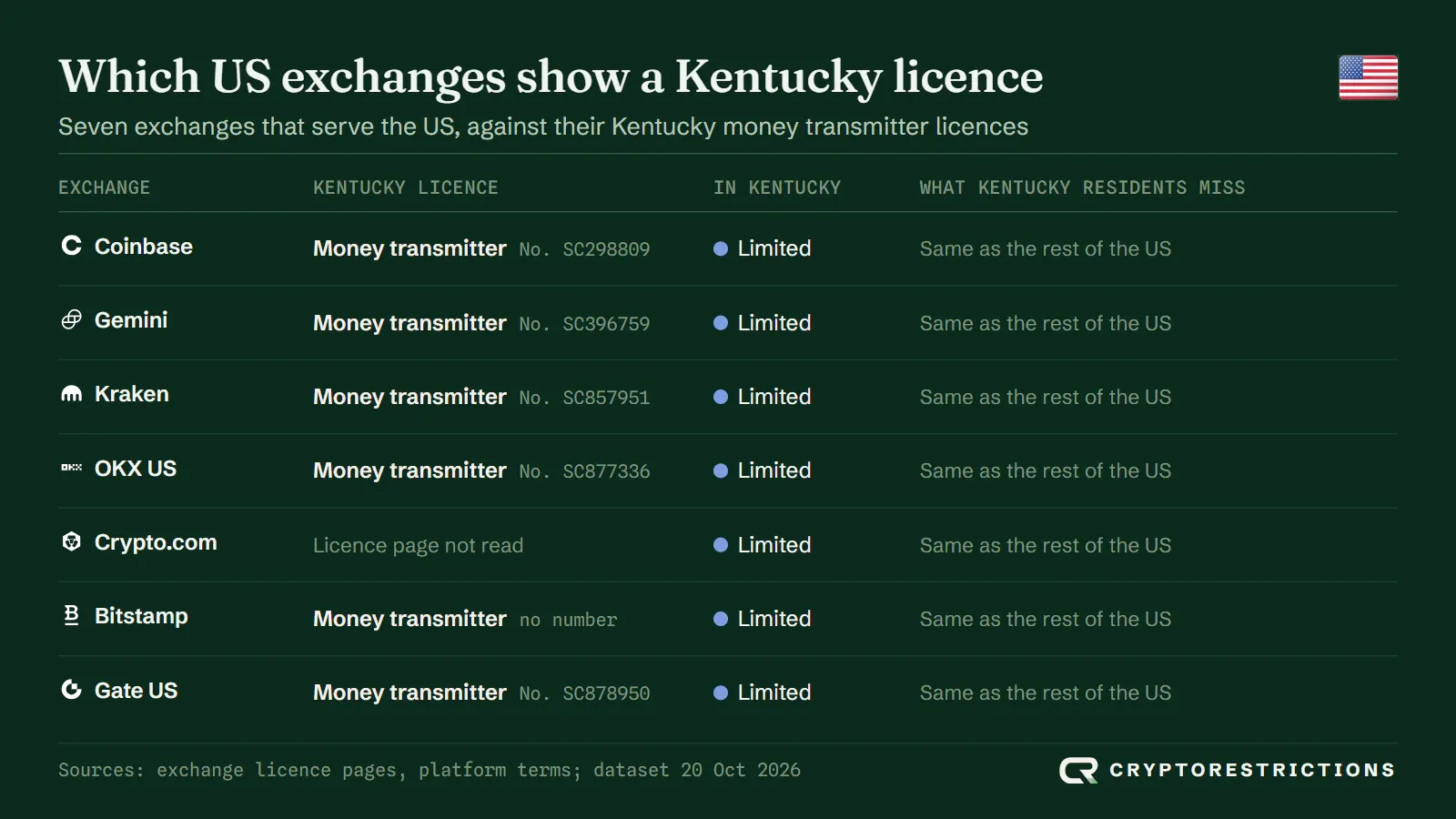
A money transmitter licence from DFI for any firm that sends customers’ money or crypto to others, and from 30 April 2027 a separate DFI licence for crypto kiosk operators. Six of the seven US exchanges we track show a Kentucky licence on their own pages: Coinbase, Gemini, Kraken, OKX US, Bitstamp and Gate US.
Kentucky has no BitLicense-style regime and no list of approved coins. DFI publishes no list of crypto licensees either; licences run through the NMLS system, so the exchanges’ own licence pages are the evidence. Coinbase, Gemini, Kraken, OKX US and Gate US each print a Kentucky licence number there, and Bitstamp lists Kentucky among its states without one. Crypto.com lists the App as available in Kentucky, but we did not read a Kentucky licence on its pages.
Kiosks are the one new licence. Senate Bill 189, signed by Governor Andy Beshear on 13 April 2026, creates a DFI licence for virtual currency kiosk operators from 30 April 2027, according to Orrick. Operators must meet a $500,000 net worth, post a surety bond, verify identity and refund reported fraud. Each user is limited to $2,000 a day, and fees are capped at the greater of $5 or 18% of the transaction. The JD Supra summary lists the same terms. Kentucky chose licensing and limits where Tennessee chose a ban.
Best crypto platforms for Kentucky residents
By our access score inside Kentucky, Coinbase (8.9 out of 10), Gemini (8.4) and Kraken (8.3) are the most open exchanges, Kalshi (7.3) the most open prediction market and Uniswap (8.0) the most open DeFi platform.
The score rates how fully a Kentucky resident can use each platform, not its fees or safety. It is the US score with Kentucky’s own limits applied: access status (4 points), the share of the platform’s products open in the state (3), the licences we hold on file (2) and what our geo-access test saw from a US address (1). No tracked platform has a Kentucky-specific cut, so the scores track the US ones. The method is on our methodology page.
Exchanges

Coinbase
Best for Spot trading plus staking and loans
8.9/10- Access
- 3.5/4
- Products
- 2.4/3
- Licences
- 2/2
- Our test
- 1/1
Read our Coinbase reportPros
- Kentucky money transmitter licence SC298809
- Staking is open in Kentucky: its help page names only CA, MD, NJ, WA and WI
Cons
- Named with Kalshi in the Attorney General's June 2026 suit over sports contracts

Gemini
Best for Plain spot trading under one licence
8.4/10- Access
- 3.5/4
- Products
- 1.9/3
- Licences
- 2/2
- Our test
- 1/1
Read our Gemini reportPros
- Kentucky money transmitter licence SC396759
- Gemini lists Kentucky as available
Cons
- Fiat deposits are USD only
- Gemini Derivatives excludes US persons

Kraken
Best for A wide coin list, with EUR still open
8.3/10- Access
- 3/4
- Products
- 2.3/3
- Licences
- 2/2
- Our test
- 1/1
Read our Kraken reportPros
- Kentucky money transmitter licence SC857951
- Its EUR and bank funding exclusions name other states, not Kentucky
Cons
- Federal limits on US customers still apply

Crypto.com
Best for The App for spot trading
7.5/10- Access
- 3/4
- Products
- 1.5/3
- Licences
- 2/2
- Our test
- 1/1
Read our Crypto.com reportPros
- The App is available in 49 states, Kentucky included
- Staking exclusions name NY, CA, MD, NJ and WI, not Kentucky
Cons
- The Exchange does not offer US residents derivatives
- We did not read a Kentucky licence on its pages

Bitstamp
Best for Plain spot trading
6.6/10- Access
- 3/4
- Products
- 0.6/3
- Licences
- 2/2
- Our test
- 1/1
Read our Bitstamp reportPros
- Lists Kentucky among its money transmitter licences
- No Kentucky carve-out in its US terms
Cons
- No staking or lending in the US
- No derivatives for US customers

OKX
Best for Spot trading under a US entity
6.0/10- Access
- 3/4
- Products
- 1.5/3
- Licences
- 1/2
- Our test
- 0.5/1
Read our OKX reportPros
- Kentucky licence SC877336 from DFI
- Its US licences page excludes only New York and the territories
Cons
- Spot and convert only, no derivatives for US customers
Prediction markets

Kalshi
Best for The broadest CFTC-regulated event contracts
7.3/10- Access
- 3/4
- Products
- 2.3/3
- Licences
- 1/2
- Our test
- 1/1
Read our Kalshi reportPros
- CFTC-designated contract market
- We found no court order stopping it in Kentucky
Cons
- Sued by the Attorney General on 17 June 2026
- Kentucky is in the Sixth Circuit, which sided with Tennessee against Kalshi

Polymarket
Best for Polymarket markets on a US exchange
6.3/10- Access
- 3/4
- Products
- 2.3/3
- Licences
- 1/2
- Our test
- 0/1
Read our Polymarket reportPros
- Polymarket US is a CFTC-designated exchange
- We found no court order stopping it in Kentucky
Cons
- Sued by the Attorney General on 17 June 2026
- polymarket.com itself blocks US users
DeFi

Uniswap
Best for Swapping tokens from your own wallet
8.0/10- Access
- 4/4
- Products
- 3/3
- Licences
- 0/2
- Our test
- 1/1
Read our Uniswap reportPros
- Terms do not exclude Kentucky
- No US state is named in its terms
Cons
- Leveraged products for US retail are barred

PancakeSwap
Best for BNB Chain swaps and pools
6.3/10- Access
- 3.5/4
- Products
- 1.8/3
- Licences
- 0/2
- Our test
- 1/1
Read our PancakeSwap reportPros
- Swaps, pools and staking are not excluded
Cons
- PCS Perps bars US users
- No US licence on file
Which platforms block or limit Kentucky residents?
None of the platforms we track. We found no tracked exchange, prediction market or DeFi protocol that names Kentucky as excluded or limited in its own terms, licence page or help centre, so Kentucky residents get the same product list as the rest of the US.
The exclusions we did find name other states. Kraken bars EUR in Texas and New Hampshire and bank funding in Texas, New York and Maine. Crypto.com bars staking in New York, California, Maryland, New Jersey and Wisconsin. Gate does not operate in Alaska, Texas, Louisiana, New York, Washington and North Carolina, and OKX excludes New York and the territories.

The one live Kentucky question is prediction markets, where the Attorney General is in court with Kalshi and Polymarket but no platform has changed its Kentucky access that we could confirm. It is covered below. In 2025 DFI also ended its own staking case: it had joined the 2023 multistate suits against Coinbase over staking and, per Cointelegraph, dismissed it at the end of March 2025, days after HB 701 became law.
Who regulates crypto in Kentucky?
DFI licenses money transmission and, from 2027, crypto kiosks. The Attorney General sues the SEC on the industry’s side and prediction markets on the state’s, and the Horse Racing and Gaming Corporation is the gambling regulator the Attorney General points to. The General Assembly has passed a Bitcoin rights law and a kiosk law.
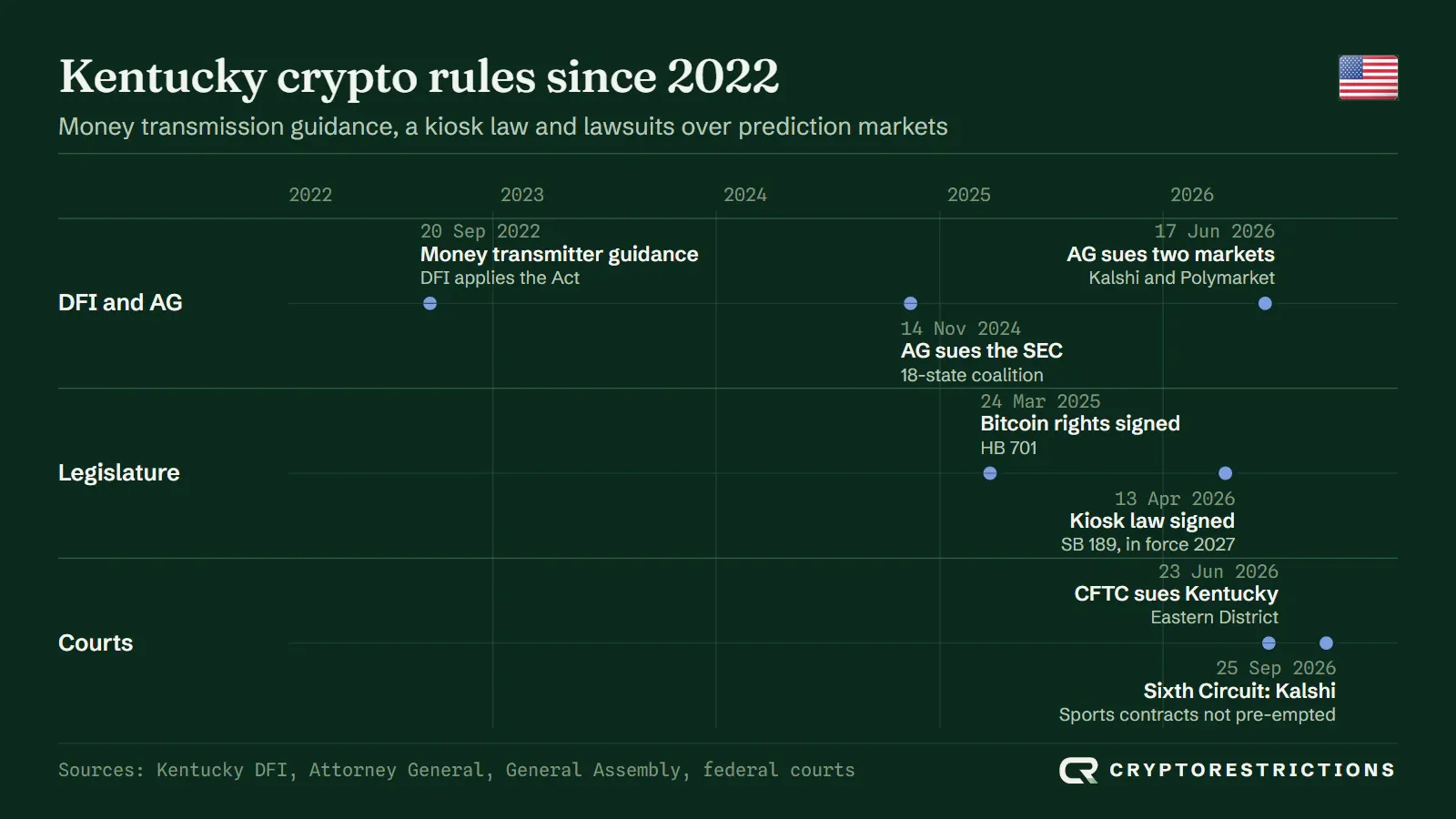
- DFI. Beyond the 2022 guidance, DFI will license kiosk operators under SB 189 and is due to write the kiosk rules by 1 January 2027. We found no DFI crypto orders in 2025 or 2026.
- Attorney General. On 14 November 2024 Russell Coleman and Nebraska led 18 states and the DeFi Education Fund in suing the SEC in the Eastern District of Kentucky. The court stayed the case for 60 days on 16 April 2025 at the SEC’s request, and the DeFi Education Fund still lists it as ongoing.
- General Assembly. HB 701 passed 91 to 0 in the House and 37 to 0 in the Senate. In 2026 the kiosk bill SB 189 became law on 13 April.
Are prediction markets legal in Kentucky?
Contested. Kentucky’s Attorney General sued Kalshi, with Coinbase, Robinhood and Webull, and separately Polymarket on 17 June 2026, calling their sports contracts illegal gambling. Neither case is decided, and we could not confirm that any platform has stopped serving Kentucky.
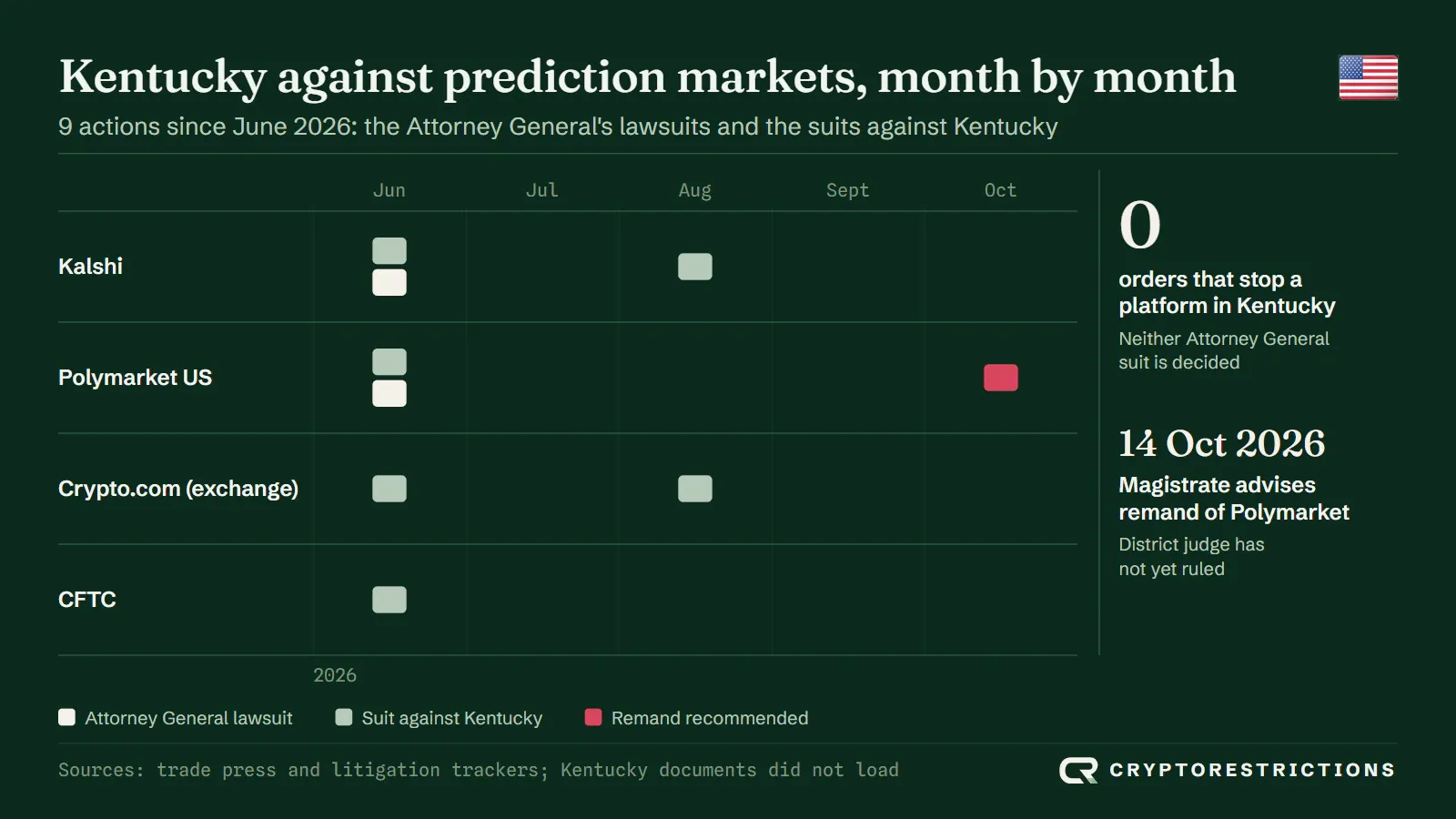
According to Sports Betting Dime, the three suits Coleman filed in Franklin Circuit Court on 17 June 2026 (the third is against the sweepstakes operator VGW) claim breaches of the Consumer Protection Act, the Loss Recovery Act and the state’s gambling laws, and ask for temporary and permanent injunctions. Polymarket moved its case to federal court the next day. On 14 October 2026 a magistrate judge recommended sending it back to state court; the district judge has not yet adopted that recommendation, and the Kalshi case is also pending, per the DeFi Rate tracker.
The federal government is on the platforms’ side. The CFTC and the United States sued Kentucky in the Eastern District on 23 June 2026 to stop it enforcing gambling law against CFTC-regulated exchanges, and an industry group of Kalshi, Crypto.com’s exchange and Polymarket US joined on 10 August. The Sixth Circuit, which covers Kentucky, held on 25 September 2026 that Kalshi’s sports contracts are not swaps and that federal law does not pre-empt state gambling law. The parties were told to brief its effect by 23 October.
Kentucky also acted by statute. DeFi Rate reported that an April 2026 package of three bills (HB 757, HB 904 and HB 869) created a 14.25% tax on prediction market transaction fees and new limits on licensed gambling operators dealing with such platforms. The same industry group sued to block it on 12 June 2026. Federal rules and the other states’ actions are in our United States guide.
How is crypto taxed in Kentucky?
At one flat income tax rate: 3.5% for 2026, down from 4% for 2025. Kentucky starts from your federal adjusted gross income, so a crypto gain is taxed the way the IRS counts it, with no separate capital gains rate. Sales tax is 6% with no local sales taxes.
The Department of Revenue’s 2025 Form 740 instructions put the individual rate at 4%, and its 2026 e-file handbook sets it at 3.5%. The standard deduction rises from $3,270 to $3,360. Kentucky adjusted gross income starts from the federal figure, so we expect gains to follow federal income, though we found no Department of Revenue page on crypto income tax. Federal capital gains rules are in our United States guide.
The sales and use tax rate is 6%, with no local sales taxes. A 2014 Department newsletter says that when a business accepts Bitcoin as payment, the coin is the consideration for the sale and the business must charge 6% sales tax on taxable goods. We found nothing taxing the purchase of crypto as an investment.