 United States · MD
Is crypto legal in Maryland?
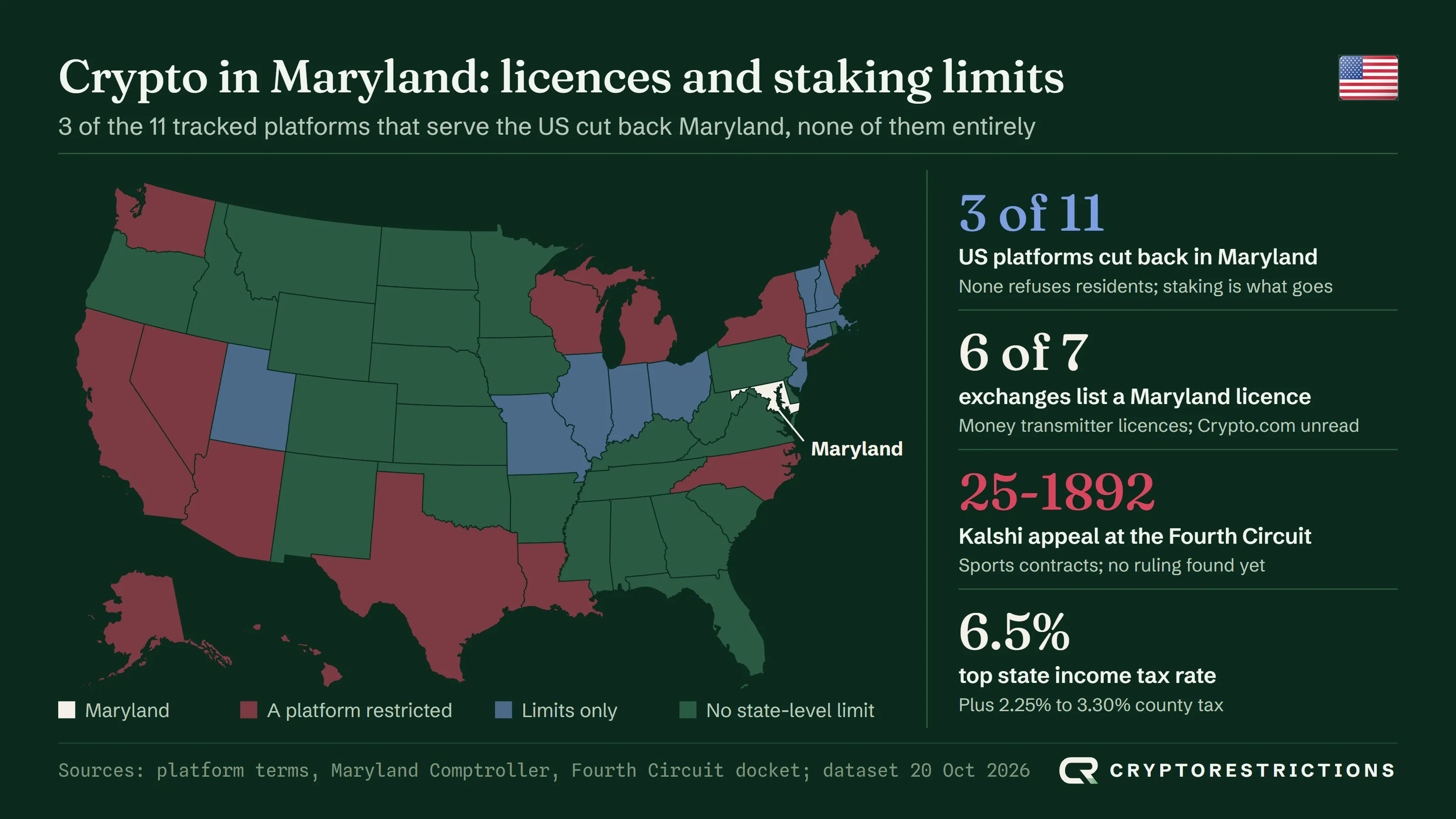
Yes. Owning and trading crypto is legal in Maryland, and the state has no crypto licence of its own: the exchanges we track hold ordinary money transmitter licences from the Commissioner of Financial Regulation, while kiosk operators must register under a 2025 law.
The Commissioner’s office (OCFR) said in a 2014 advisory that Maryland did not then regulate virtual currencies and sent residents to the NMLS list of licensed money transmitters. That is still how exchanges are checked. Two newer rules cover narrower products: SB 305 makes crypto kiosk operators register with the Commissioner, and the Maryland Stablecoin Act makes OCFR the state’s stablecoin regulator from 1 January 2027.
Federal rules from the SEC, CFTC, Treasury and IRS apply on top, as in every state, and offshore exchanges that refuse US users refuse Marylanders too. Both are covered in our United States guide.
Which crypto licences does Maryland require?
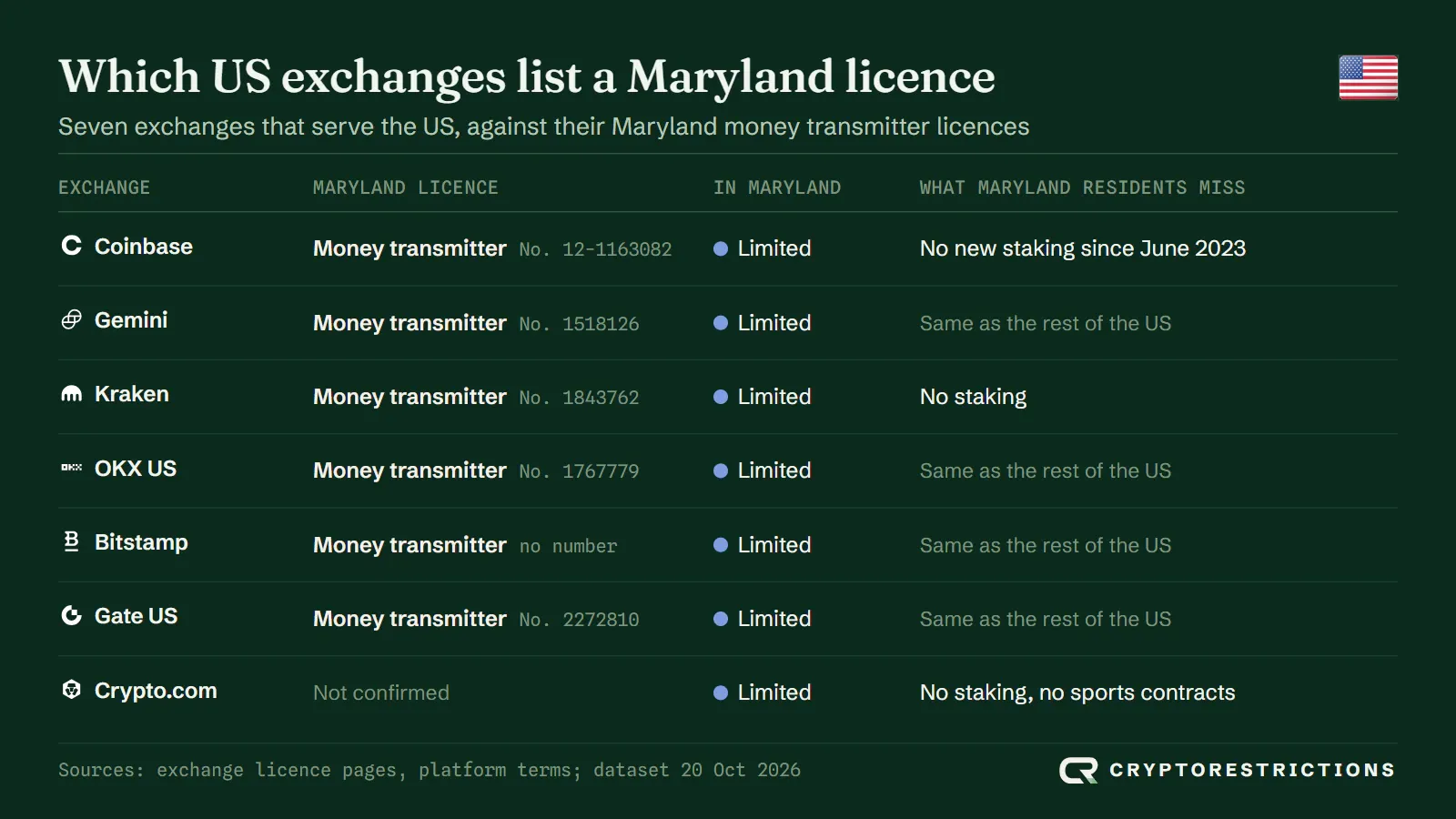
A money transmitter licence from the Commissioner of Financial Regulation. Of the seven US exchanges we track, six list one on their own pages: Coinbase, Gemini, Kraken, OKX US, Gate US and Bitstamp. We could not read Crypto.com’s Maryland entry.
Maryland has no BitLicense-style regime that licenses a firm for crypto as such, and no state list of approved coins. The licence numbers come from each exchange’s own licence page, and every exchange in the table keeps the federal limits described in our United States guide. Bitstamp names Maryland among its states but prints no number.
A licence is not a free pass. On 22 June 2023 the Commissioner advised that securities-law violations by a licensed money transmitter count against its licence and can lead to revocation. It came about two weeks after Maryland and other state securities agencies issued notices over Coinbase staking.
Best crypto platforms for Maryland residents
By our access score inside Maryland, Coinbase (8.9 out of 10) and Gemini (8.4) are the most open exchanges, Kalshi (7.3) the most open prediction market and Uniswap (8.0) the most open DeFi platform.
The score rates how fully a Maryland resident can use each platform, not its fees or safety. It is the US score with Maryland’s own limits applied: access status (4 points), the share of the platform’s products open in the state (3), the licences we hold on file (2) and what our geo-access test saw from a US address (1). Platforms that refuse Marylanders are not scored. The method is on our methodology page.
Exchanges

Coinbase
Best for Spot trading with a Maryland licence
8.9/10- Access
- 3.5/4
- Products
- 2.4/3
- Licences
- 2/2
- Our test
- 1/1
Read our Coinbase reportPros
- Maryland money transmitter licence 12-1163082
- Loans and DEX trading do not carve out Maryland
Cons
- No new staking for Marylanders since June 2023
- Existing stakes do not compound

Gemini
Best for Plain spot trading under one licence
8.4/10- Access
- 3.5/4
- Products
- 1.9/3
- Licences
- 2/2
- Our test
- 1/1
Read our Gemini reportPros
- Maryland money transmitter licence 1518126
- Lists spot as available in Maryland, in USD
Cons
- Gemini Derivatives excludes US persons

Crypto.com
Best for The App for spot trading
7.5/10- Access
- 3/4
- Products
- 1.5/3
- Licences
- 2/2
- Our test
- 1/1
Read our Crypto.com reportPros
- The App is available in Maryland
- CFTC-registered exchange and clearing house
Cons
- No staking in Maryland
- No sports event contracts in Maryland

Kraken
Best for A wide coin list, spot only
7.5/10- Access
- 3/4
- Products
- 1.5/3
- Licences
- 2/2
- Our test
- 1/1
Read our Kraken reportPros
- Maryland money transmitter licence 1843762
- No Maryland carve-out on funding or EUR pairs
Cons
- Marylanders cannot stake on Kraken

Bitstamp
Best for Plain spot trading
6.6/10- Access
- 3/4
- Products
- 0.6/3
- Licences
- 2/2
- Our test
- 1/1
Read our Bitstamp reportPros
- Lists Maryland among its money transmitter licences
- No Maryland carve-out in its US terms
Cons
- No staking or lending in the US
- No derivatives for US customers

OKX
Best for Spot trading under a Maryland licence
6.0/10- Access
- 3/4
- Products
- 1.5/3
- Licences
- 1/2
- Our test
- 0.5/1
Read our OKX reportPros
- Maryland money transmitter licence 1767779
- No Maryland carve-out in its US terms
Cons
- Covers token-to-token and USD-to-token services only
Prediction markets

Kalshi
Best for The broadest CFTC-regulated event contracts
7.3/10- Access
- 3/4
- Products
- 2.3/3
- Licences
- 1/2
- Our test
- 1/1
Read our Kalshi reportPros
- CFTC-designated contract market
- No Maryland court order makes it geofence the state
Cons
- Told by the gaming commission in April 2025 to stop sports contracts
- Its appeal against Maryland is undecided
DeFi

Uniswap
Best for Swapping tokens from your own wallet
8.0/10- Access
- 4/4
- Products
- 3/3
- Licences
- 0/2
- Our test
- 1/1
Read our Uniswap reportPros
- No Maryland limit on file
- No US state is named in its terms
Cons
- Leveraged products for US retail are barred

PancakeSwap
Best for BNB Chain swaps and pools
6.3/10- Access
- 3.5/4
- Products
- 1.8/3
- Licences
- 0/2
- Our test
- 1/1
Read our PancakeSwap reportPros
- Swaps, pools and staking are not excluded
Cons
- PCS Perps bars US users
- No US licence on file
Which platforms block or limit Maryland residents?
None of the exchanges that serve the rest of the US refuses Marylanders. Three cut staking: Coinbase, Kraken and Crypto.com, and Crypto.com also drops sports event contracts.
Maryland is one of four states, with California, New Jersey and Wisconsin, where staking is cut back at all three platforms. In Maryland the trigger was the state’s securities regulator: Coinbase’s help page says state securities agencies issued notices on 6 June 2023 and names Maryland among the states where no new principal can be staked.
Kraken’s own US support pages point the same way: its list of states with onchain staking and its bitcoin staking page both leave Maryland out. Crypto.com’s sports contracts are a separate matter, covered under prediction markets below.
Who regulates crypto in Maryland?
OCFR licenses money transmitters and now kiosks and, from 2027, stablecoin issuers; the securities regulator acts on unregistered offerings such as staking; and the gaming commission polices sports betting, where it puts prediction markets. Maryland’s legislature has added kiosk, stablecoin and task force laws since 2025.
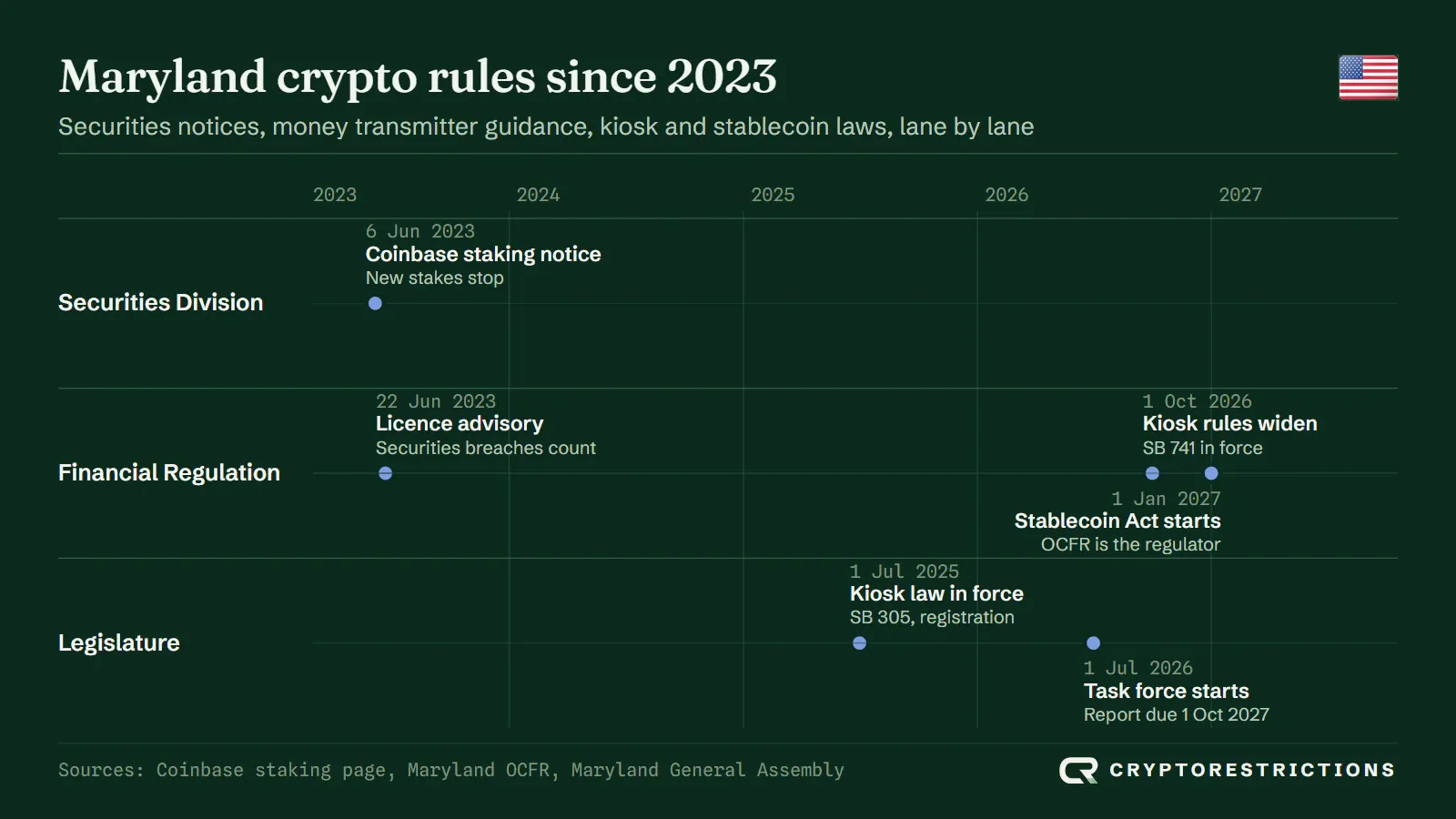
- OCFR. Besides the June 2023 licence advisory, the office registers kiosk operators. Under SB 305, in force since 1 July 2025, it can fine an operator up to $1,000 for each knowing and willful violation. Under SB 741, in force since 1 October 2026, software-based kiosk operators must register too and kiosks cannot offer the services of a bank ATM. The Maryland Stablecoin Act starts on 1 January 2027, with OCFR writing rules modelled on the federal standards.
- Securities Division. The notices of 6 June 2023 over Coinbase staking are the Maryland crypto action we could confirm, and the reason new Coinbase staking stopped in the state.
- Legislature. A Digital Asset and Blockchain Technology Task Force (HB 470 and SB 376) began on 1 July 2026 and must report to the Governor and General Assembly by 1 October 2027, with OCFR staffing it.
Are prediction markets legal in Maryland?
Not settled. The Maryland gaming commission told Kalshi, Robinhood and Crypto.com in April 2025 to stop offering sports event contracts, and the court fight is waiting on Kalshi’s appeal at the Fourth Circuit, where we found no ruling.
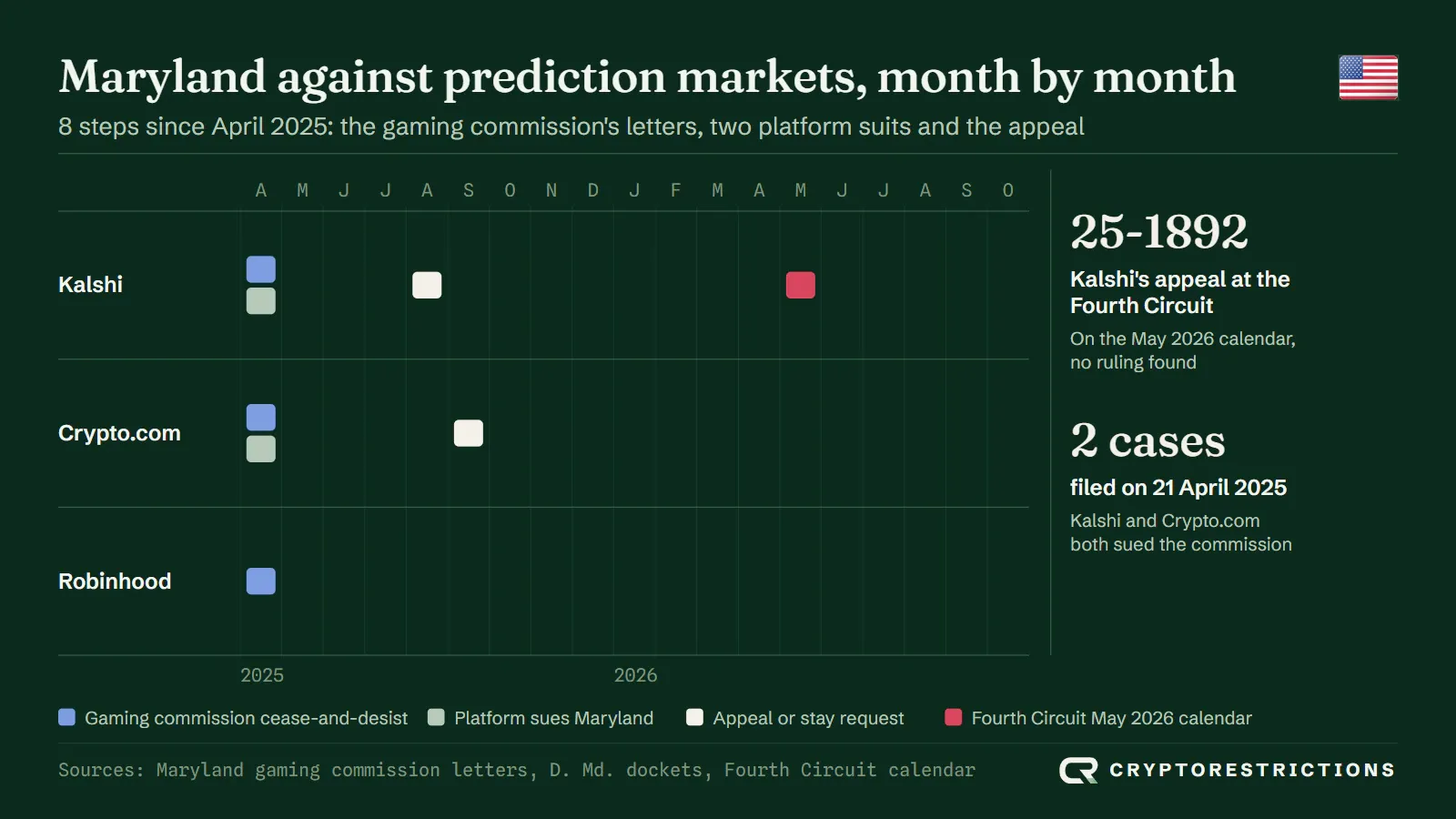
The Lottery and Gaming Control Commission sent its cease-and-desist letters on 7 April 2025, calling the contracts unlicensed sports wagering. On 21 April 2025 Kalshi sued in No. 1:25-cv-01283, and the North American Derivatives Exchange, behind Crypto.com’s exchange, filed No. 1:25-cv-01285. Kalshi appealed on 1 August 2025 as No. 25-1892, and on 21 August 2025 the district court stayed its case until the appeal ends.
The Fourth Circuit’s May 2026 calendar lists the appeal, asking whether federal commodities law preempts Maryland’s gambling laws. We found no opinion by 20 October 2026. Crypto.com was reported in December 2025 to have pulled sports contracts in Maryland and other states, and our data treats Maryland as limited for it. Federal rules and the other states’ fights are in our United States guide.
How is crypto taxed in Maryland?
As ordinary income: Maryland’s 2025 state rates run from 2% to 6.5%, counties add 2.25% to 3.30%, and an extra 2% applies to net capital gains once federal adjusted gross income is above $350,000.
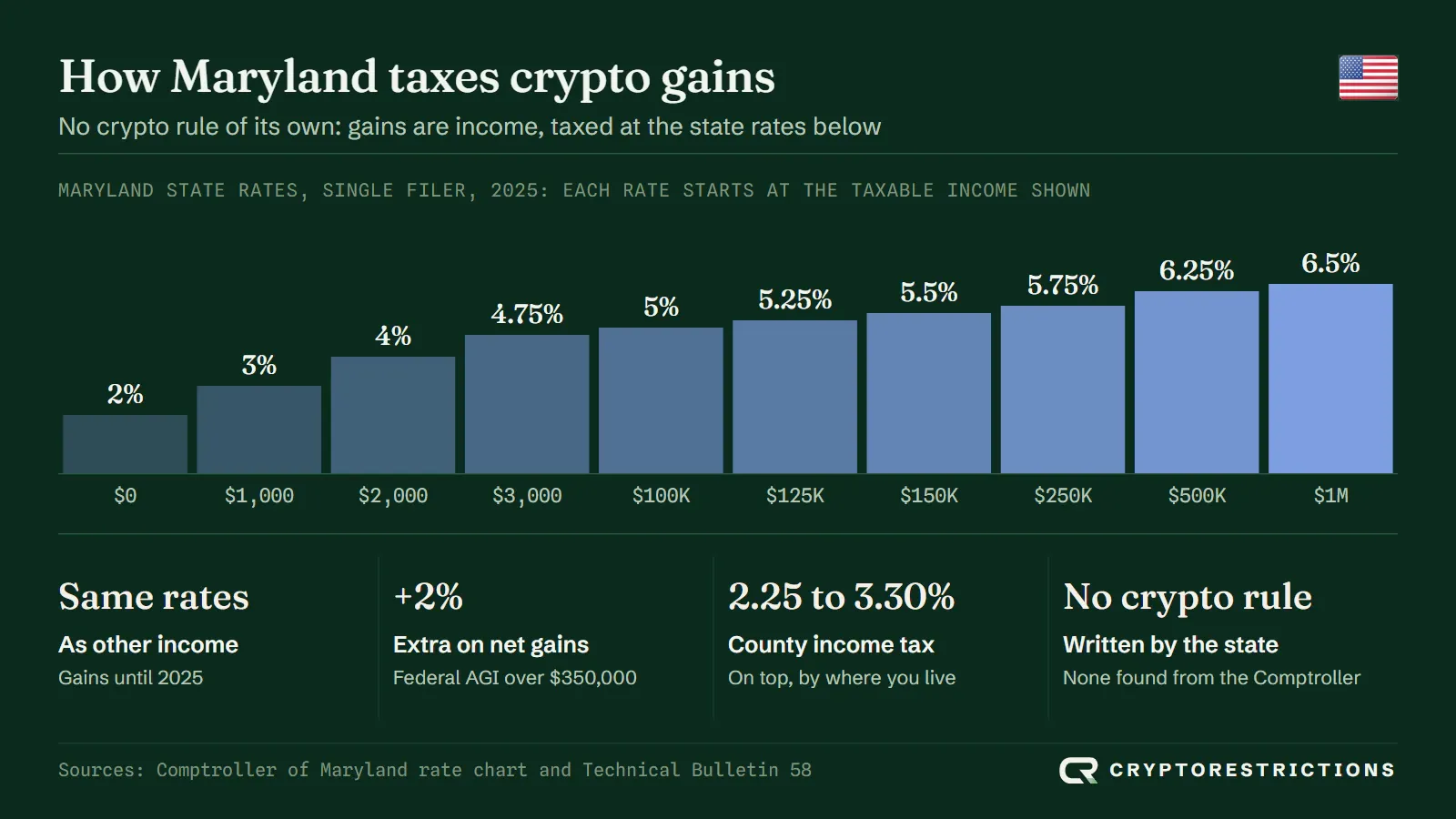
The bands are the Comptroller’s 2025 rate chart for single filers; joint filers have wider bands. Local rates on the same page run from 2.25% to 3.30% and depend on where you live, not where you work. Until 2025 capital gains were taxed at the same rates as other income; Technical Bulletin 58 says the extra 2% now applies to net capital gain for filers with federal adjusted gross income above $350,000, whatever their filing status. We found no Maryland tax rule written for crypto, so the federal treatment in our United States guide is the starting point.