
 United States · NY
Is crypto legal in New York?
Yes. Owning and trading crypto is legal in New York, but a firm that buys, sells, holds or exchanges crypto for New Yorkers needs a BitLicense or a New York trust charter from the Department of Financial Services (NYDFS).
The BitLicense rule, 23 NYCRR Part 200, has applied since 24 June 2015. It covers five activities: transmitting crypto, holding it in custody for others, buying and selling it as a business, running an exchange, and controlling or issuing a virtual currency. A limited purpose trust company chartered under the Banking Law may do the same business without a BitLicense. People who only hold crypto, and shops that accept it, need no licence.
Federal rules from the SEC, CFTC, Treasury and IRS apply on top, as in every state, and offshore exchanges that refuse US users refuse New Yorkers too. Both are covered in our United States guide.
Which crypto licences does New York require?
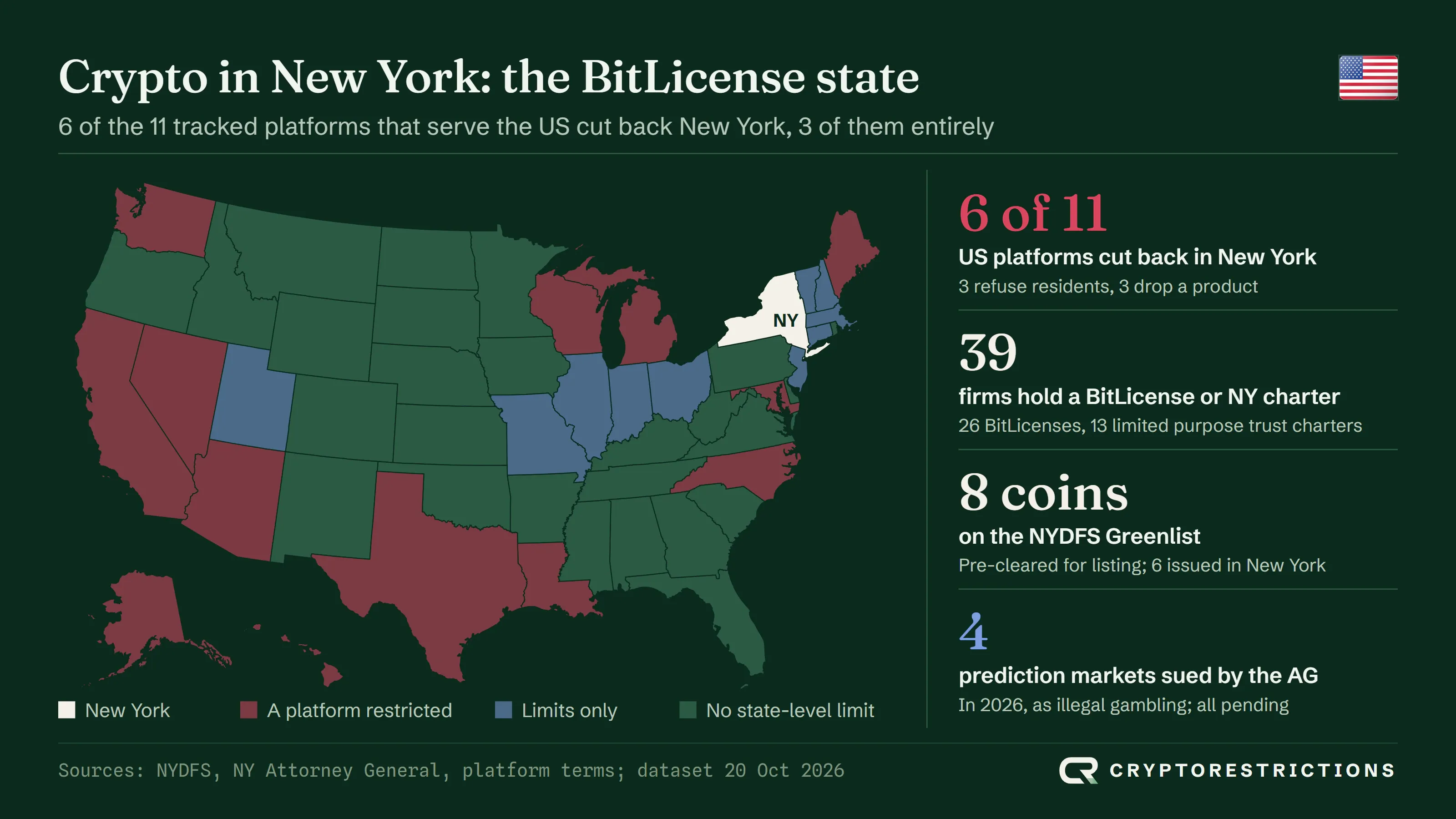
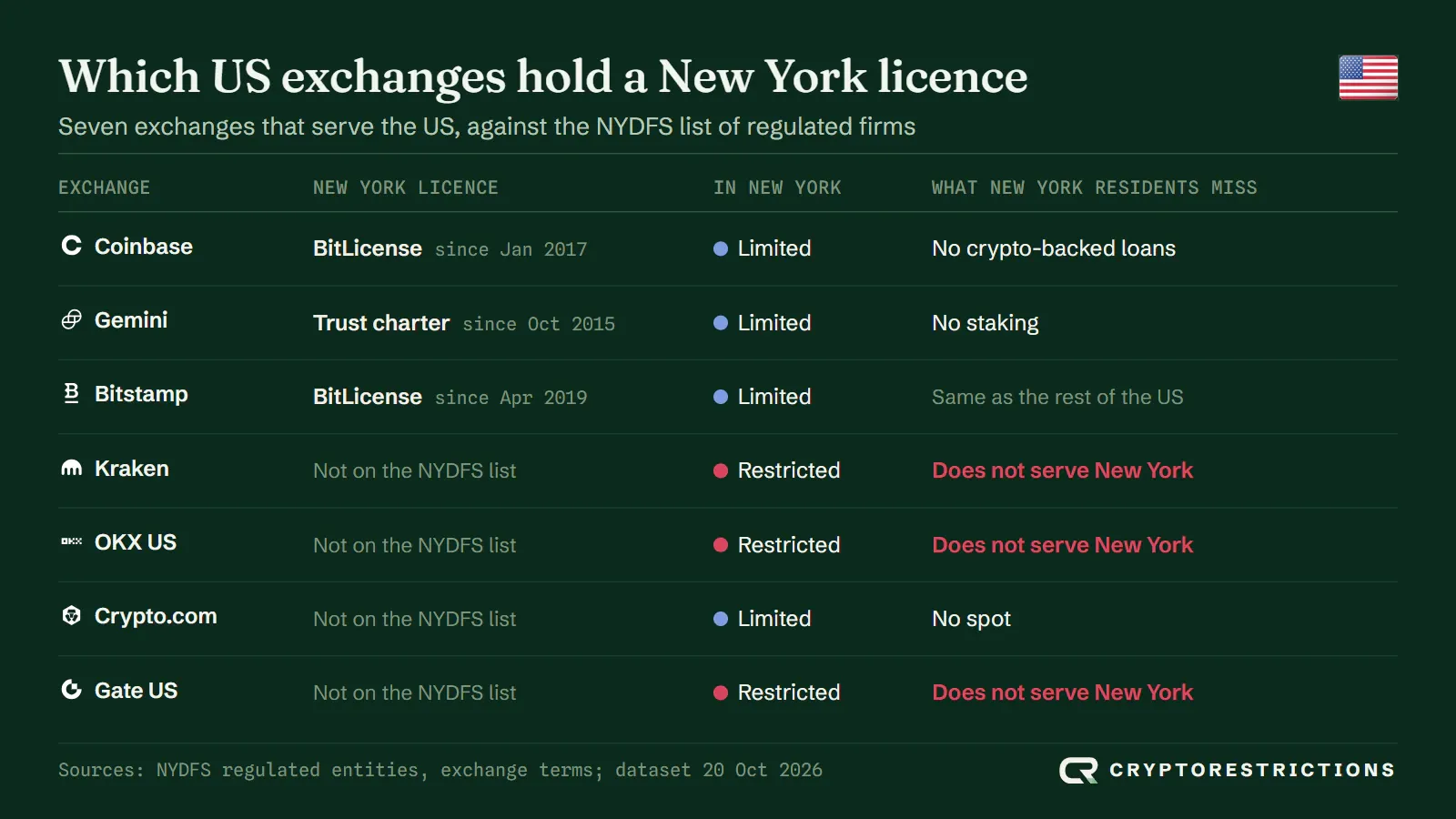
A BitLicense or a limited purpose trust charter from NYDFS. Of the seven US exchanges we track, three hold one: Coinbase and Bitstamp a BitLicense, Gemini a trust charter.
On 19 October 2026 the NYDFS list of regulated firms had 39 entries: 26 BitLicense holders (15 of them also licensed as money transmitters) and 13 trust companies. The other four exchanges we track that serve the US, Kraken, OKX, Crypto.com and Gate, are not on it.


A licence does not open every coin. Under the listing guidance of 15 November 2023, a licensee lists a coin only under a listing policy NYDFS has approved. Coins on the NYDFS Greenlist need just ten days’ notice. It holds 8: bitcoin, ether and six tokens issued by New York firms (GUSD, GYEN, ZUSD, RLUSD, USDW and GOLD). USDC is not on it.
Best crypto platforms for New York residents
By our access score inside New York, Coinbase (8.5 out of 10) and Gemini (7.8) are the most open exchanges, Kalshi (7.3) the most open prediction market and Uniswap (8.0) the most open DeFi platform.
The score rates how fully a New York resident can use each platform, not its fees or safety. It is the US score with New York’s own limits applied: access status (4 points), the share of the platform’s products open in the state (3), the licences we hold on file (2) and what our geo-access test saw from a US address (1). Platforms that refuse New Yorkers are not scored. The method is on our methodology page.
Exchanges

Coinbase
Best for The most products under a BitLicense
8.5/10- Access
- 3.5/4
- Products
- 2/3
- Licences
- 2/2
- Our test
- 1/1
Read our Coinbase reportPros
- BitLicense since January 2017, plus a New York trust company for custody
- Staking open in New York
- Prediction markets offered in New York
Cons
- No crypto-backed loans in New York
- DEX trading in the app excludes New York
- Sued by the Attorney General over sports contracts

Gemini
Best for A New York trust company since 2015
7.8/10- Access
- 3.5/4
- Products
- 1.3/3
- Licences
- 2/2
- Our test
- 1/1
Read our Gemini reportPros
- Chartered by NYDFS in October 2015
- Spot trading open in New York
Cons
- No staking (Asset Rewards) for New Yorkers
- Sued by the Attorney General in April 2026
- Gemini Derivatives excludes US persons

Crypto.com
Best for Event contracts through the OG app
6.8/10- Access
- 3/4
- Products
- 0.8/3
- Licences
- 2/2
- Our test
- 1/1
Read our Crypto.com reportPros
- OG Prediction Markets live in New York since June 2026
- CFTC-registered exchange and clearing house
Cons
- The Crypto.com App is not offered in New York
- Not on the NYDFS list of regulated firms

Bitstamp
Best for Plain spot trading under a BitLicense
6.6/10- Access
- 3/4
- Products
- 0.6/3
- Licences
- 2/2
- Our test
- 1/1
Read our Bitstamp reportPros
- BitLicense since April 2019
- No New York carve-out in its US terms
Cons
- No derivatives, staking or lending in the US
Prediction markets

Kalshi
Best for The broadest CFTC-regulated event contracts
7.3/10- Access
- 3/4
- Products
- 2.3/3
- Licences
- 1/2
- Our test
- 1/1
Read our Kalshi reportPros
- CFTC-designated contract market
- No court order stops it in New York
Cons
- Sued by the Attorney General on 31 July 2026
- Lost its injunction bid against the Gaming Commission

Polymarket
Best for Polymarket markets on a US exchange
6.3/10- Access
- 3/4
- Products
- 2.3/3
- Licences
- 1/2
- Our test
- 0/1
Read our Polymarket reportPros
- Polymarket US is a CFTC-designated exchange
- No court order stops it in New York
Cons
- Sued by New York on 24 September 2026
- polymarket.com itself blocks US users
DeFi

Uniswap
Best for Swapping tokens from your own wallet
8.0/10- Access
- 4/4
- Products
- 3/3
- Licences
- 0/2
- Our test
- 1/1
Read our Uniswap reportPros
- Terms do not exclude New York
- A New York company, under New York law
Cons
- Leveraged products for US retail are barred

PancakeSwap
Best for BNB Chain swaps and pools
6.3/10- Access
- 3.5/4
- Products
- 1.8/3
- Licences
- 0/2
- Our test
- 1/1
Read our PancakeSwap reportPros
- Swaps, pools and staking are not excluded
Cons
- PCS Perps bars US users
- No US licence on file
Which platforms block or limit New York residents?
Three exchanges that serve the rest of the US refuse New Yorkers: Kraken, OKX US and Gate US. Three more drop a product here: Coinbase its crypto-backed loans, Gemini its staking and Crypto.com its App.
None of the three that refuse the state holds a New York licence. Kraken left in 2015 rather than apply for a BitLicense. Two offshore exchanges were pushed out by the Attorney General before the federal bans: Bitfinex agreed in 2021 to end all trading with New Yorkers, and KuCoin was barred from New York in December 2023 after paying more than $22 million.
Who regulates crypto in New York?
NYDFS licenses and supervises crypto firms, the Attorney General takes them to court, and the Gaming Commission polices betting, which is where New York puts prediction markets. None of the crypto bills of 2025 and 2026 has become law.
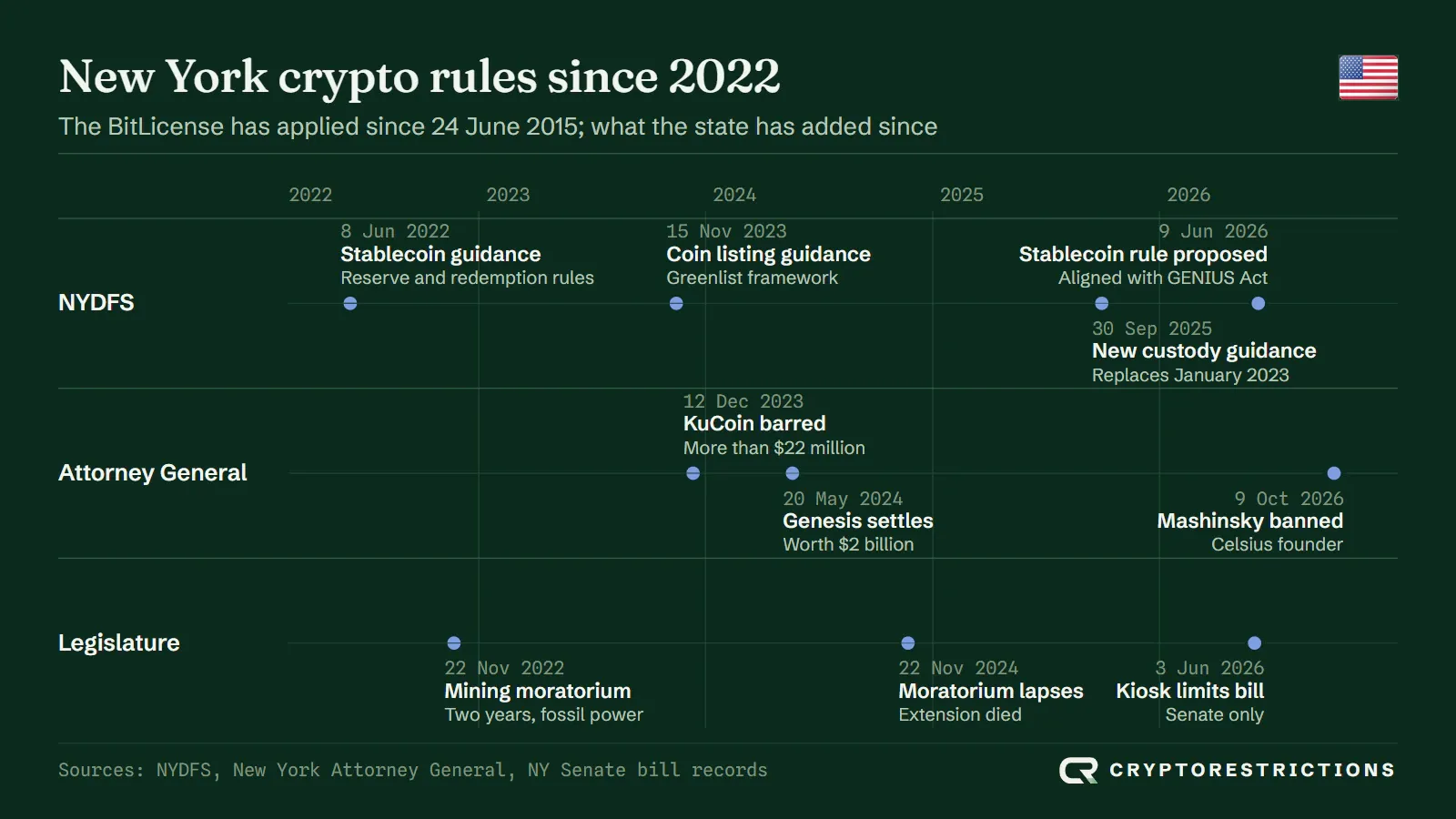
- NYDFS. Kaitlin Asrow has been Acting Superintendent since 18 October 2025. Its largest crypto penalties: Coinbase paid $50 million plus $50 million of compliance spending in January 2023, Block $40 million in April 2025 and Paxos $26.5 million in August 2025. On 9 June 2026 it proposed a stablecoin rule aligned with the federal GENIUS Act.
- Attorney General. Beyond the KuCoin ban, Genesis agreed to a settlement worth $2 billion in May 2024 over Gemini Earn, and on 9 October 2026 Celsius founder Alex Mashinsky was banned from the crypto industry.
- Legislature. The mining moratorium of 22 November 2022 paused new air permits for fossil-fuelled proof-of-work mining for two years and lapsed in November 2024. A crypto kiosk bill, S9891, passed the Senate 59 to 2 on 3 June 2026 with a $1,000 daily cap, but not the Assembly.
Are prediction markets legal in New York?
Not settled. New York treats sports event contracts as unlicensed gambling and has sued Coinbase, Gemini, Kalshi and Polymarket US, but no court has ordered any of them to stop serving the state.
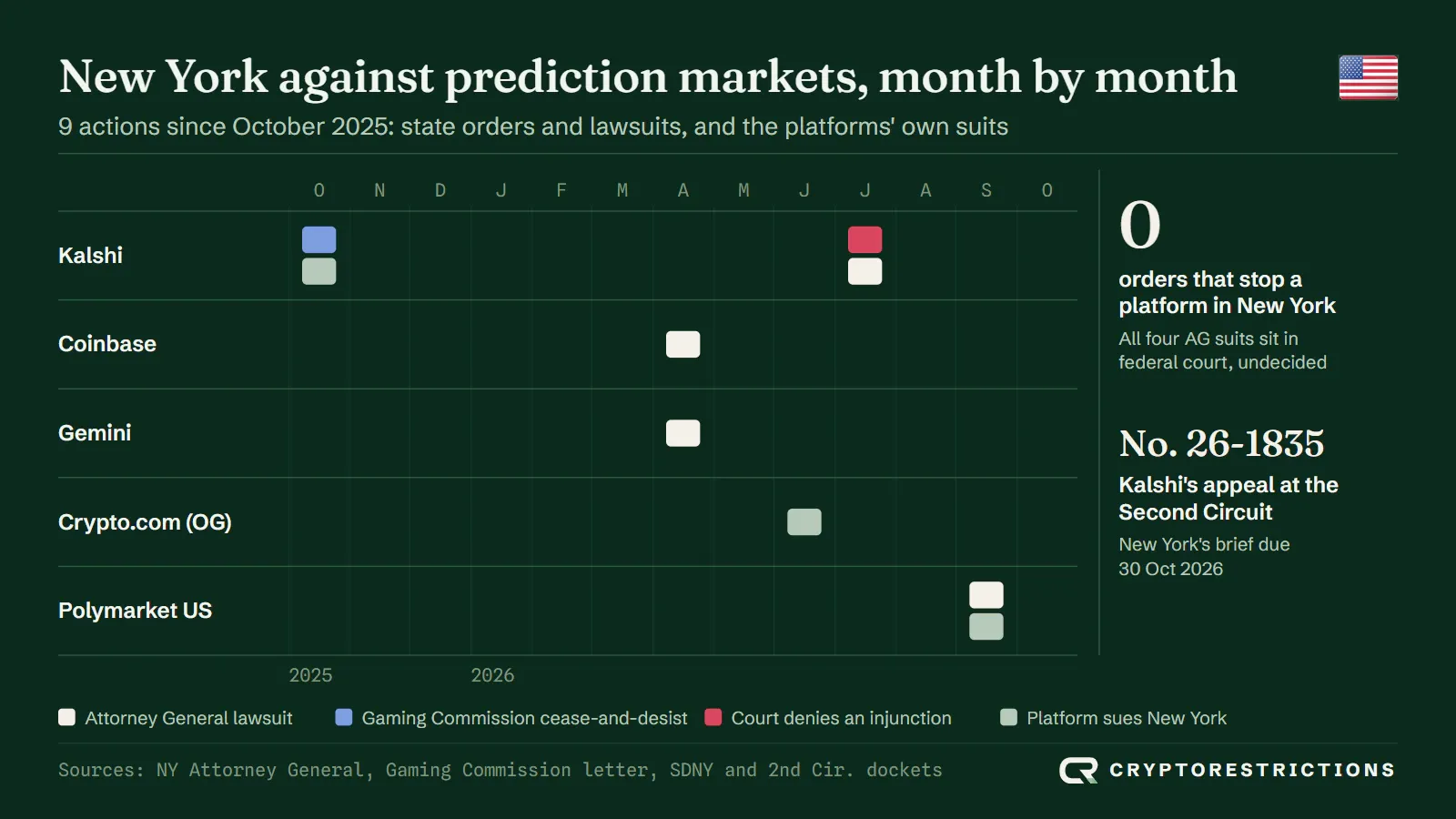
The fight began with the Gaming Commission. Its cease-and-desist letter of 24 October 2025, quoted in Kalshi’s complaint, said Kalshi’s sports contracts were illegal under the Penal Law and the Racing Law. Kalshi sued three days later, and on 7 July 2026 a federal judge in Manhattan denied its injunction, finding state gambling law not preempted. Kalshi’s appeal is No. 26-1835 at the Second Circuit.
The Attorney General then sued Coinbase and Gemini on 21 April 2026, Kalshi on 31 July and Polymarket US on 24 September, citing users aged 18 to 20 where licensed sports betting starts at 21. Every case was moved to federal court and none has been decided. The federal government sides with the platforms: the CFTC and the United States sued New York on 24 April 2026 to stop it enforcing state law against CFTC-registered exchanges.
Two bills would settle it by statute, and neither has passed: the ORACLE Act would bar sports, political and other event markets for New Yorkers, and S9414 would set a minimum age of 21.
How is crypto taxed in New York?
The same way the IRS taxes it: crypto is property, and a gain is added to your income and taxed at New York’s rates, 4% to 10.9% in 2025, plus 3.078% to 3.876% for New York City residents.
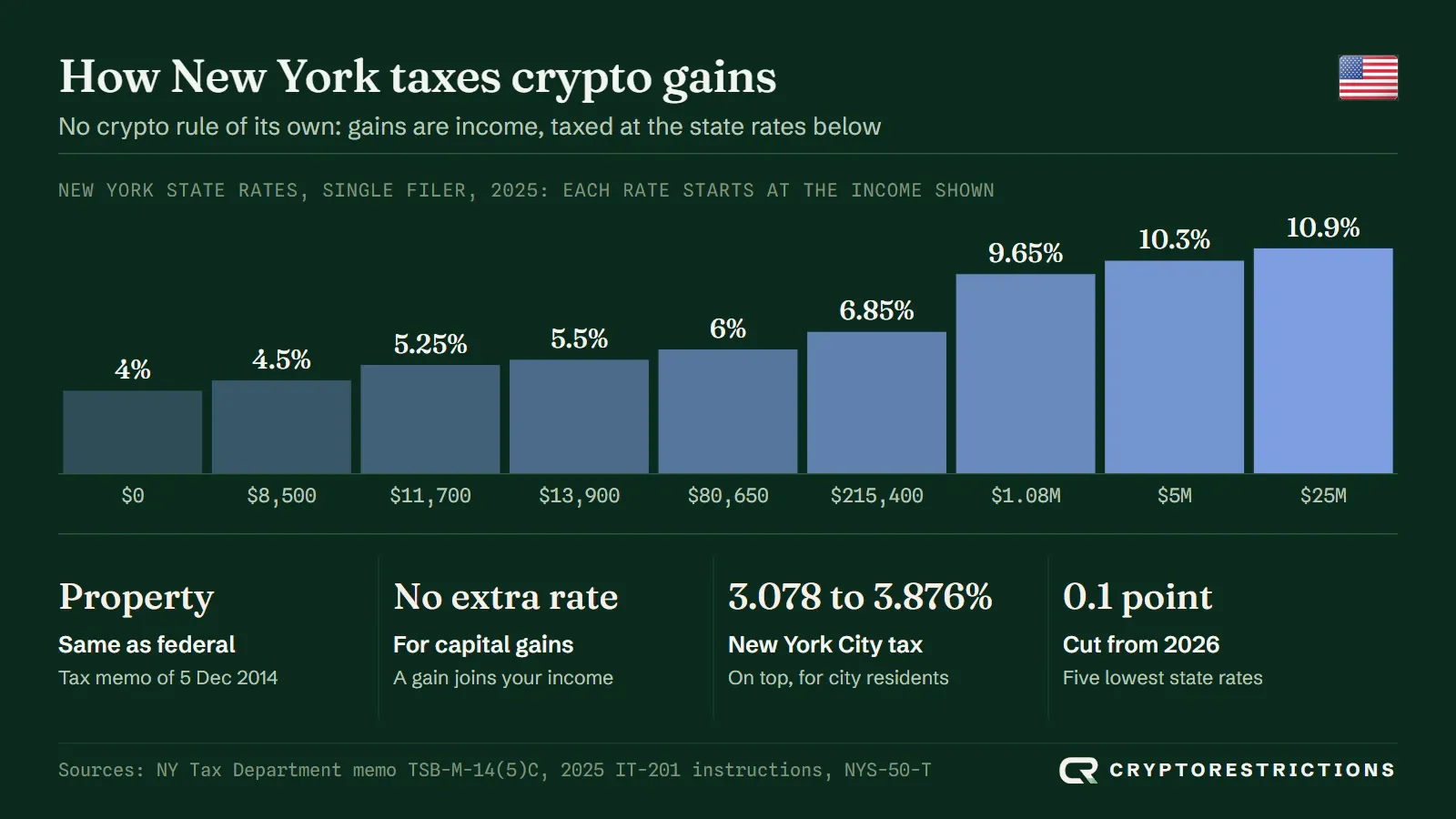
The Tax Department’s 2014 memo says New York follows the federal treatment for income tax. For sales tax, paying for taxable goods with crypto is a barter: sales tax is due on the coin’s dollar value. There is no separate capital gains rate; the bands are the 2025 rate schedule for a single filer, and Yonkers residents add a surcharge of 16.75% of their state tax. From 2026 the five lowest state rates fall by 0.1 point under the 2025 budget.
No crypto-specific state tax exists. A proposed 0.2% excise on digital asset transactions and a tax on the electricity used for proof-of-work mining are both still in committee.