
 United States · SC
Is crypto legal in South Carolina?
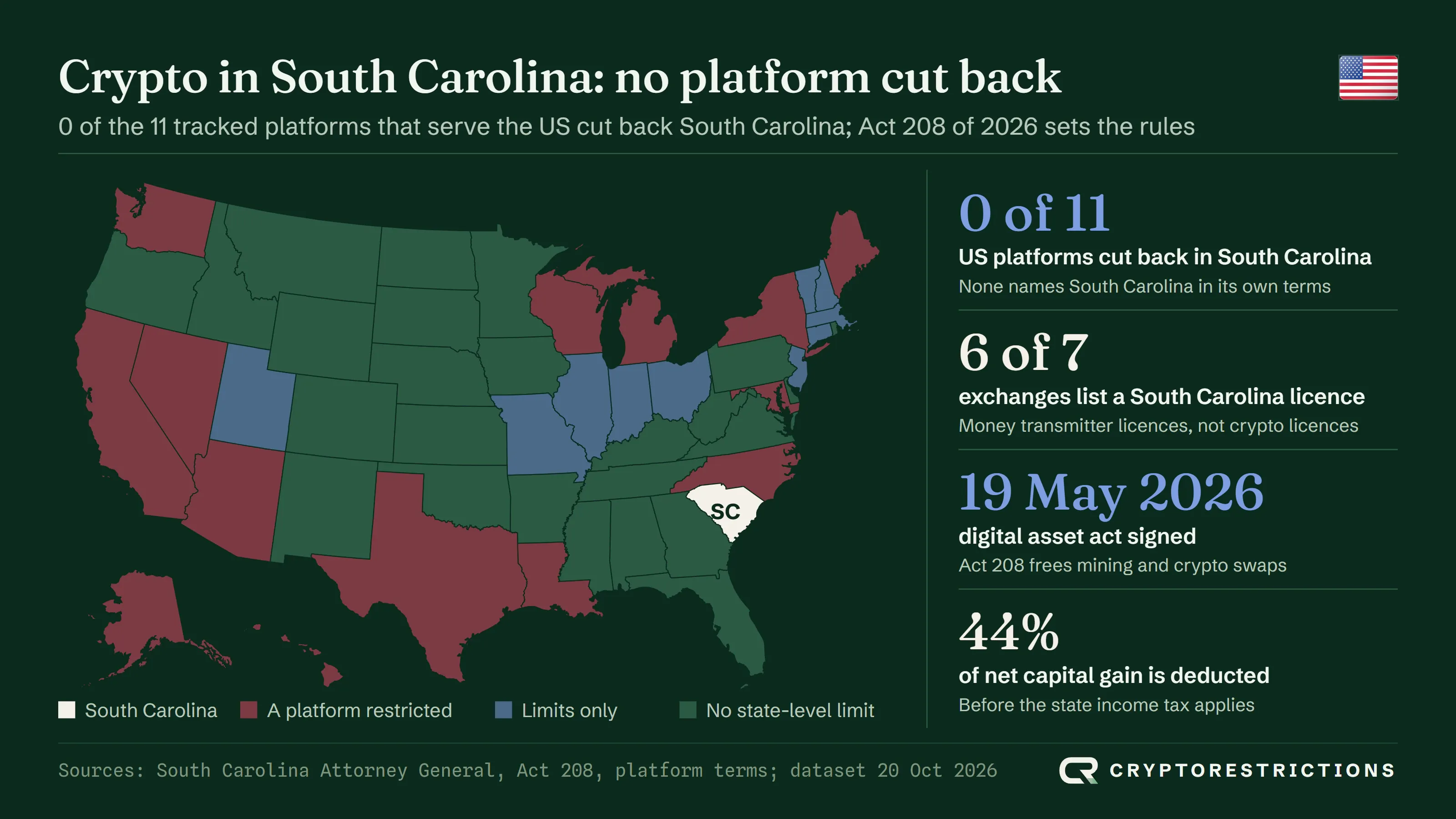
Yes. Owning and trading crypto is legal in South Carolina, the state has no crypto-specific licence, and since 19 May 2026 a state act protects self-custody, payments in crypto, mining and crypto-to-crypto swaps.
The Attorney General’s Money Services Division licenses money transmitters under the Uniform Money Services Act, and its FAQ says it “views virtual currencies as lacking the characteristics necessary to be a medium of exchange”. Virtual currency alone therefore does not count as monetary value, but a transaction that also moves fiat currency may be money transmission.
Act 208 of 2026 (S. 163) adds Chapter 47 to Title 34 of the state code. It bars state bodies from accepting a central bank digital currency, lets any person or business accept digital assets for legal goods and services, and protects self-hosted and hardware wallets. It passed the Senate 38 to 1 on 1 May 2025 and the House 110 to 1 on 5 May 2026, and Governor Henry McMaster signed it on 19 May 2026.
Federal rules from the SEC, CFTC, Treasury and IRS apply on top, as in every state, and offshore exchanges that refuse US users refuse South Carolinians too. Both are covered in our United States guide.
Which crypto licences does South Carolina require?
None for crypto as such. A firm that moves customers’ dollars needs a money transmitter licence from the Attorney General’s Money Services Division, and six of the seven US exchanges we track list one on their own pages: Coinbase, Gemini, Kraken, OKX US, Bitstamp and Gate US.
Applications go through the Nationwide Multistate Licensing System, and the Uniform Money Services Act has applied since 2 July 2024. We found no BitLicense-style regime, no approved coin list and no public licensee list on the Division’s pages. Where a machine is involved, the Division points to Order MSD-19003 to decide whether a licence is needed.
Act 208 narrows the licence. Under section 34-47-60, nobody needs a money transmitter licence for mining, running a node, developing blockchain software, or exchanging one digital asset for another without touching legal tender or bank deposits. Staking as a service is declared not to be a security.
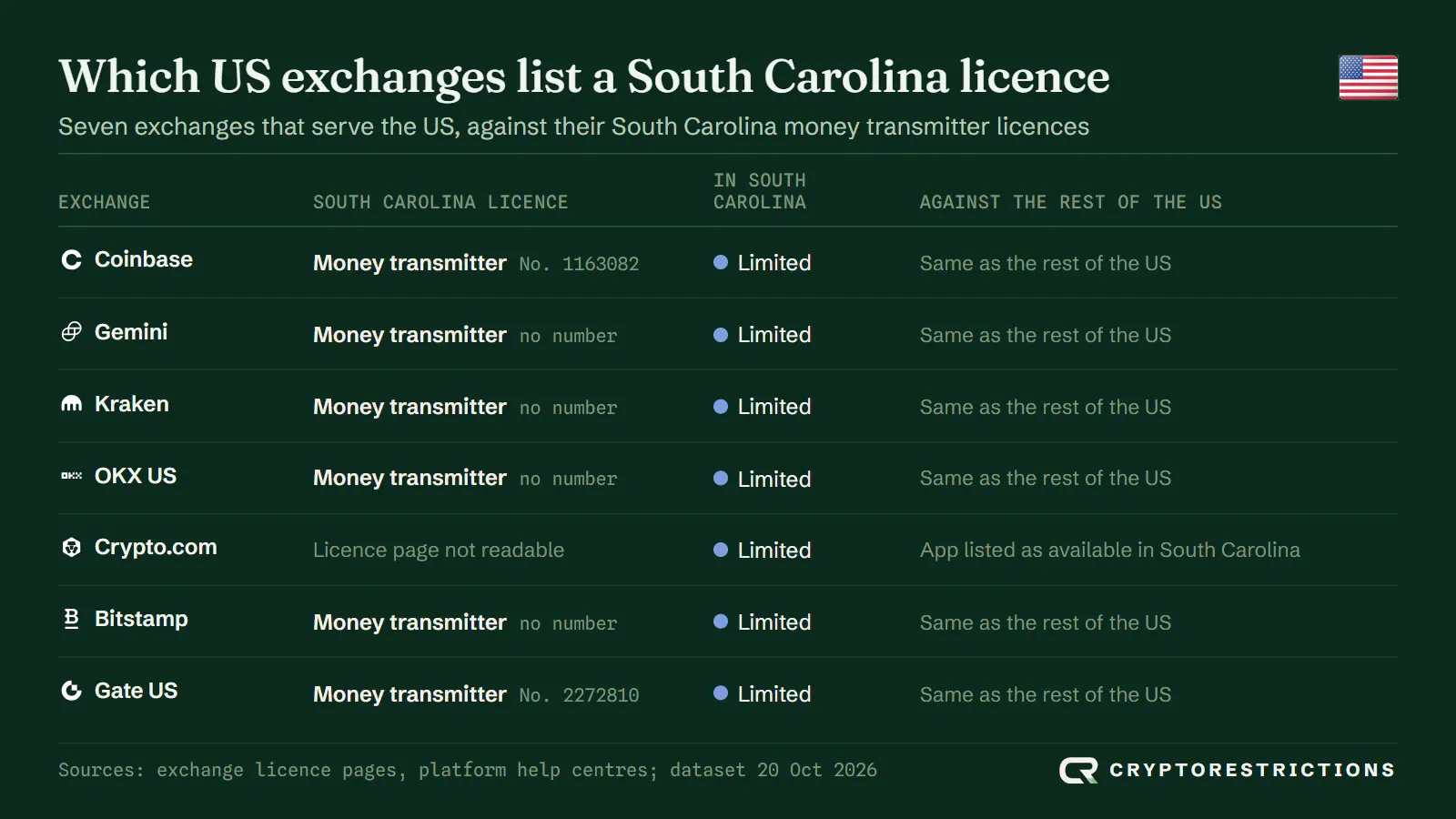
Crypto.com is the seventh. Its help centre lists South Carolina among the 49 states where the App is available, but its licence page is a download we could not read, so we do not count it. Only Coinbase (1163082) and Gate US (2272810) print a licence number.
Best crypto platforms for South Carolina residents
By our access score inside South Carolina, Coinbase (8.9 out of 10), Gemini (8.4) and Kraken (8.3) are the most open exchanges, Kalshi (7.3) the most open prediction market and Uniswap (8.0) the most open DeFi platform.
The score rates how fully a South Carolina resident can use each platform, not its fees or safety. It is the US score with South Carolina’s own limits applied: access status (4 points), the share of the platform’s products open in the state (3), the licences we hold on file (2) and what our geo-access test saw from a US address (1). No tracked platform has a South Carolina-specific cut, so the scores track the US ones. The method is on our methodology page.
Exchanges

Coinbase
Best for Spot trading plus staking
8.9/10- Access
- 3.5/4
- Products
- 2.4/3
- Licences
- 2/2
- Our test
- 1/1
Read our Coinbase reportPros
- South Carolina money transmitter licence 1163082
- Staking is open: its help page names only CA, MD, NJ and WI
Cons
- South Carolina took action against its staking in June 2023

Gemini
Best for Plain spot trading under one licence
8.4/10- Access
- 3.5/4
- Products
- 1.9/3
- Licences
- 2/2
- Our test
- 1/1
Read our Gemini reportPros
- Gemini lists South Carolina as available
- Licensed by the Attorney General's Money Services Division
Cons
- Fiat deposits are USD only
- Gemini Derivatives excludes US persons

Kraken
Best for A wide coin list under a state licence
8.3/10- Access
- 3/4
- Products
- 2.3/3
- Licences
- 2/2
- Our test
- 1/1
Read our Kraken reportPros
- Lists a South Carolina money transmitter licence for Payward Interactive and Payward Financial
Cons
- No licence number is printed in its disclosures

Crypto.com
Best for The App for spot trading
7.5/10- Access
- 3/4
- Products
- 1.5/3
- Licences
- 2/2
- Our test
- 1/1
Read our Crypto.com reportPros
- The App is listed as available in South Carolina
- Staking exclusions name NY, CA, MD, NJ and WI, not South Carolina
Cons
- Its South Carolina licence page could not be read

Bitstamp
Best for Plain spot trading
6.6/10- Access
- 3/4
- Products
- 0.6/3
- Licences
- 2/2
- Our test
- 1/1
Read our Bitstamp reportPros
- Lists South Carolina among its money transmitter licences
Cons
- No staking or lending in the US

OKX
Best for Spot trading under a US entity
6.0/10- Access
- 3/4
- Products
- 1.5/3
- Licences
- 1/2
- Our test
- 0.5/1
Read our OKX reportPros
- Its US licences page lists South Carolina for token-to-token and USD-to-token
- It excludes only New York and the territories
Cons
- No South Carolina licence number is printed on the page
Prediction markets

Kalshi
Best for The broadest CFTC-regulated event contracts
7.3/10- Access
- 3/4
- Products
- 2.3/3
- Licences
- 1/2
- Our test
- 1/1
Read our Kalshi reportPros
- CFTC-designated contract market
- We found no South Carolina order or cease-and-desist letter against it
Cons
- Its sports contracts are under challenge in other states

Polymarket
Best for Polymarket markets on a US exchange
6.3/10- Access
- 3/4
- Products
- 2.3/3
- Licences
- 1/2
- Our test
- 0/1
Read our Polymarket reportPros
- Polymarket US is a CFTC-designated exchange
- We found no South Carolina order against it
Cons
- polymarket.com itself blocks US users
- No state list is published, so South Carolina status rests on silence
DeFi

Uniswap
Best for Swapping tokens from your own wallet
8.0/10- Access
- 4/4
- Products
- 3/3
- Licences
- 0/2
- Our test
- 1/1
Read our Uniswap reportPros
- Terms do not exclude South Carolina
- Act 208 protects self-hosted wallets
Cons
- Leveraged products for US retail are barred

PancakeSwap
Best for BNB Chain swaps and pools
6.3/10- Access
- 3.5/4
- Products
- 1.8/3
- Licences
- 0/2
- Our test
- 1/1
Read our PancakeSwap reportPros
- Swaps, pools and staking are not excluded
Cons
- PCS Perps bars US users
- No US licence on file
Which platforms block or limit South Carolina residents?
None of the platforms we track. We found no exchange, prediction market or DeFi protocol that names South Carolina as excluded or limited in its own terms, licence page or help centre, so residents get the same product list as the rest of the US.
The exclusions we did read name other states. Coinbase halts new staking in California, Maryland, New Jersey and Wisconsin, and lets Washington residents keep staking. Crypto.com serves the App in every state but New York and bars staking in New York, California, Maryland, New Jersey and Wisconsin. OKX excludes New York and the territories.
South Carolina itself was once on Coinbase’s list. On 6 June 2023 the Securities Division was one of ten state regulators to act against Coinbase’s staking program, citing more than 43,000 South Carolina accounts holding about $37.7 million. The action did not ban staking, and Cointelegraph reported a joint stipulation dismissing it on 27 March 2025. Coinbase’s staking page no longer names the state.
Who regulates crypto in South Carolina?
The Attorney General’s office does most of it: its Money Services Division licenses money transmitters and its Securities Division polices offerings. The General Assembly sets the rules for mining, payments and kiosks. We found no prediction-market action by any South Carolina authority.
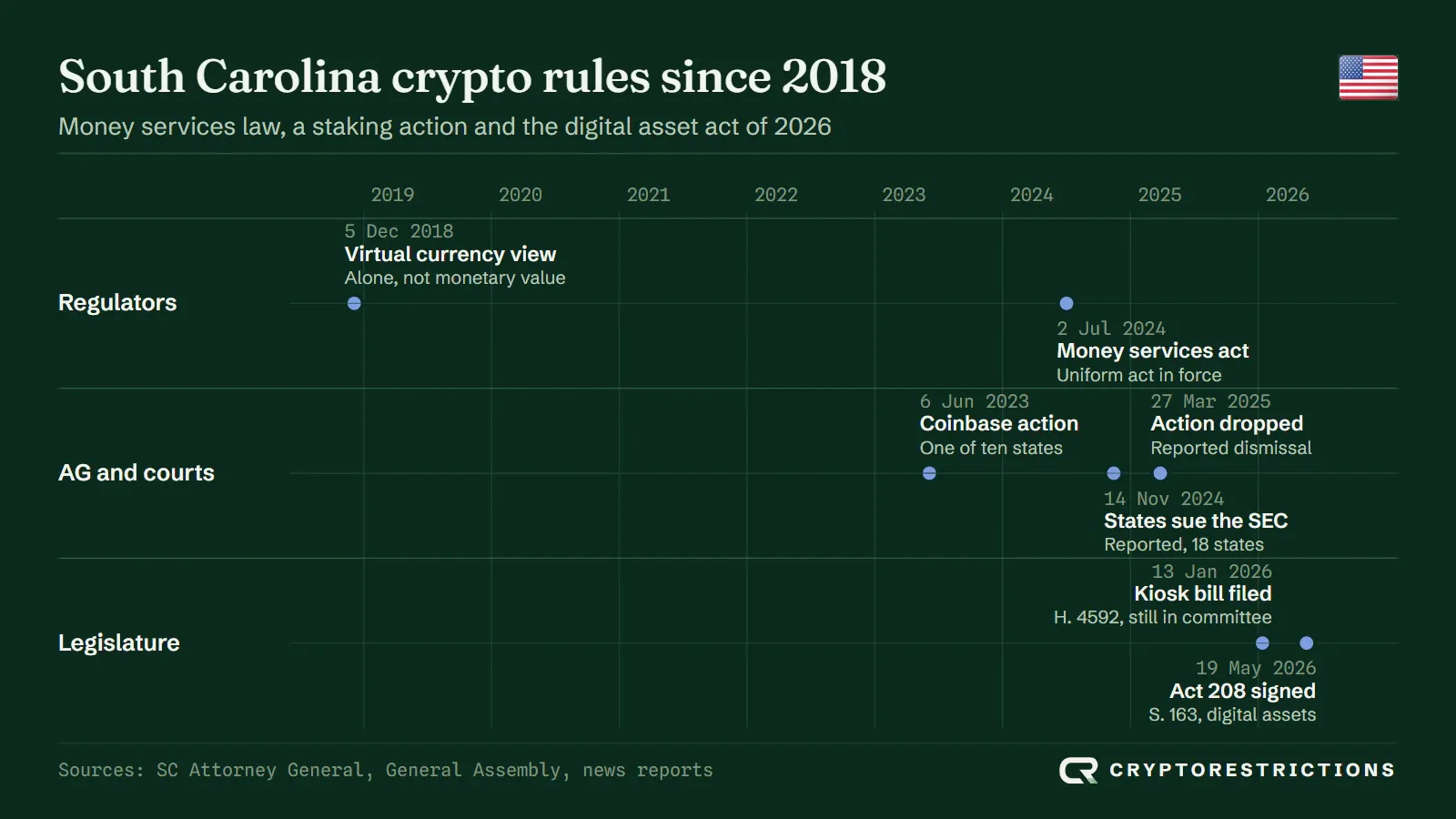
- Money Services Division. Its FAQ cites a 5 December 2018 interpretation on virtual currency, and the Uniform Money Services Act took effect on 2 July 2024.
- Securities Division. Besides the 2023 Coinbase action, CryptoSlate reports that Attorney General Alan Wilson joined the 18-state suit against the SEC filed in November 2024 in the Eastern District of Kentucky. We could not confirm the state list on the complaint itself.
- General Assembly. Act 208 is in force from 19 May 2026. Mining businesses above one megawatt must not add stress to the grid and must show the Public Service Commission a power purchase agreement on request, and cities and counties may not single out industrial-zoned mining with extra rules. A kiosk bill, H. 4592, would require kiosk operators to hold a money transmitter licence and show warnings on the screen. It was introduced on 13 January 2026 and is still in committee.
As of 20 October 2026 we found no cease-and-desist letter, lawsuit or court order from a South Carolina authority against Kalshi, Polymarket or another prediction market. The wider fight is in our United States guide.
How is crypto taxed in South Carolina?
As income, with a break: South Carolina deducts 44% of net capital gain before applying its rate. The top rate was 6% for tax year 2025, and from 2026 there are two brackets, 1.99% under $30,000 and 5.21% minus $966 above.
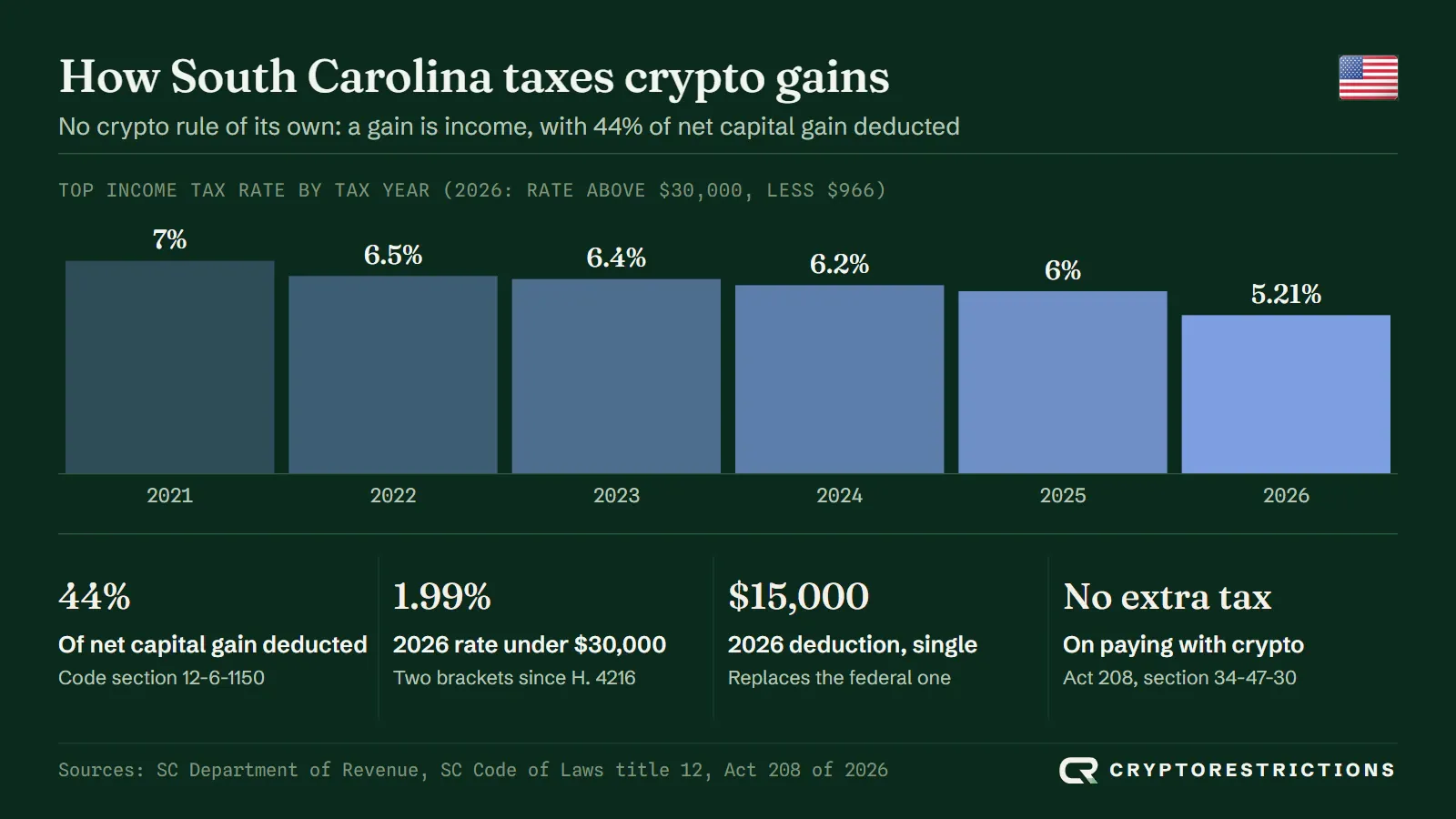
Section 12-6-1150 of the state code allows individuals a deduction equal to 44% of net capital gain recognised in the state, using the federal definition of net capital gain. The Department of Revenue’s notice on H. 4216, signed on 30 March 2026, sets the 2026 rates, starts the return from federal adjusted gross income and replaces the federal standard deduction with a state one of $15,000 for a single filer. The top rate can fall further if state economists project revenue growth of 5% or more, and 2025 returns are not affected. The Department’s rate page lists the earlier top rates.
We found no Department of Revenue guidance page on crypto. Act 208 says a digital asset used as payment may not be taxed more only because of that use, though any tax that would apply to a dollar payment still applies. Federal capital gains rules are in our United States guide.







