
Where is Bitfinex restricted?
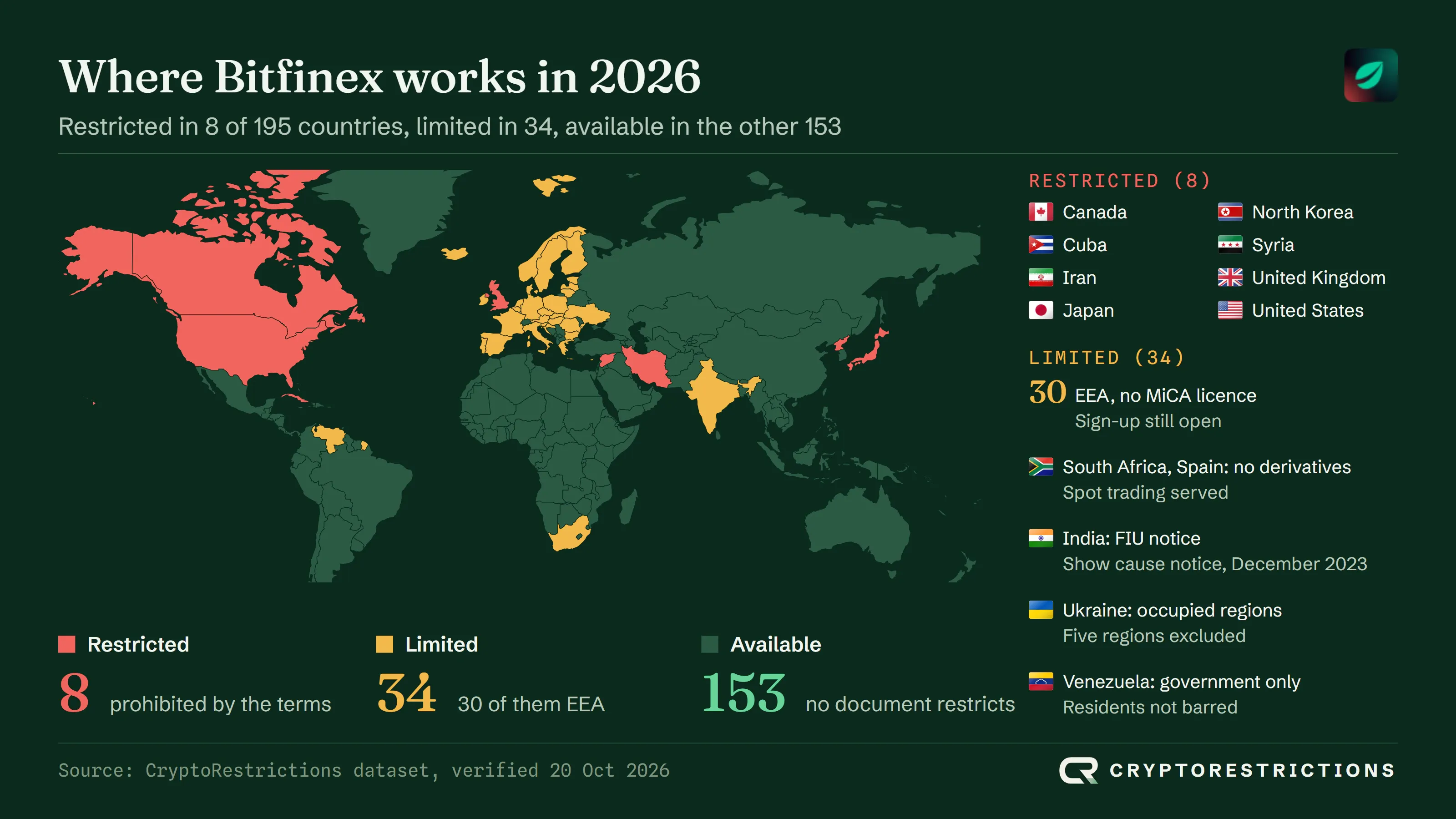
Bitfinex is restricted in 8 of the 195 countries we cover:  Canada,
 Cuba,
 Iran,
 Japan,
 North Korea,
 Syria, the
 United Kingdom and the
 United States.
All eight come from Bitfinex’s terms of service (updated 12 August 2026). Its list of prohibited persons names every US person, every Canadian person in any province or territory, and Japanese and UK persons unless Bitfinex treats them as exempt: in Japan only registered crypto exchanges trading for themselves, in the UK only those Bitfinex has assessed as exempt from the financial promotion rules. Its prohibited jurisdictions are the places under a comprehensive embargo by the British Virgin Islands, the US or the UN: Cuba, Iran, North Korea and Syria, plus five occupied regions of Ukraine. Cuba, Iran and North Korea are also under comprehensive US sanctions (OFAC programmes for Cuba, Iran and North Korea).
Two of the four country bans grew out of exits. Bitfinex stopped opening accounts for Ontario residents on 21 October 2021 and ended service there on 1 March 2022, according to its Ontario FAQ; the terms now cover all of Canada. In the UK, Bitfinex’s notice to UK customers says individuals who opened an account on or after 1 November 2023 can no longer be verified, and from 10 January 2024 some existing UK customers lost new deposits and orders.
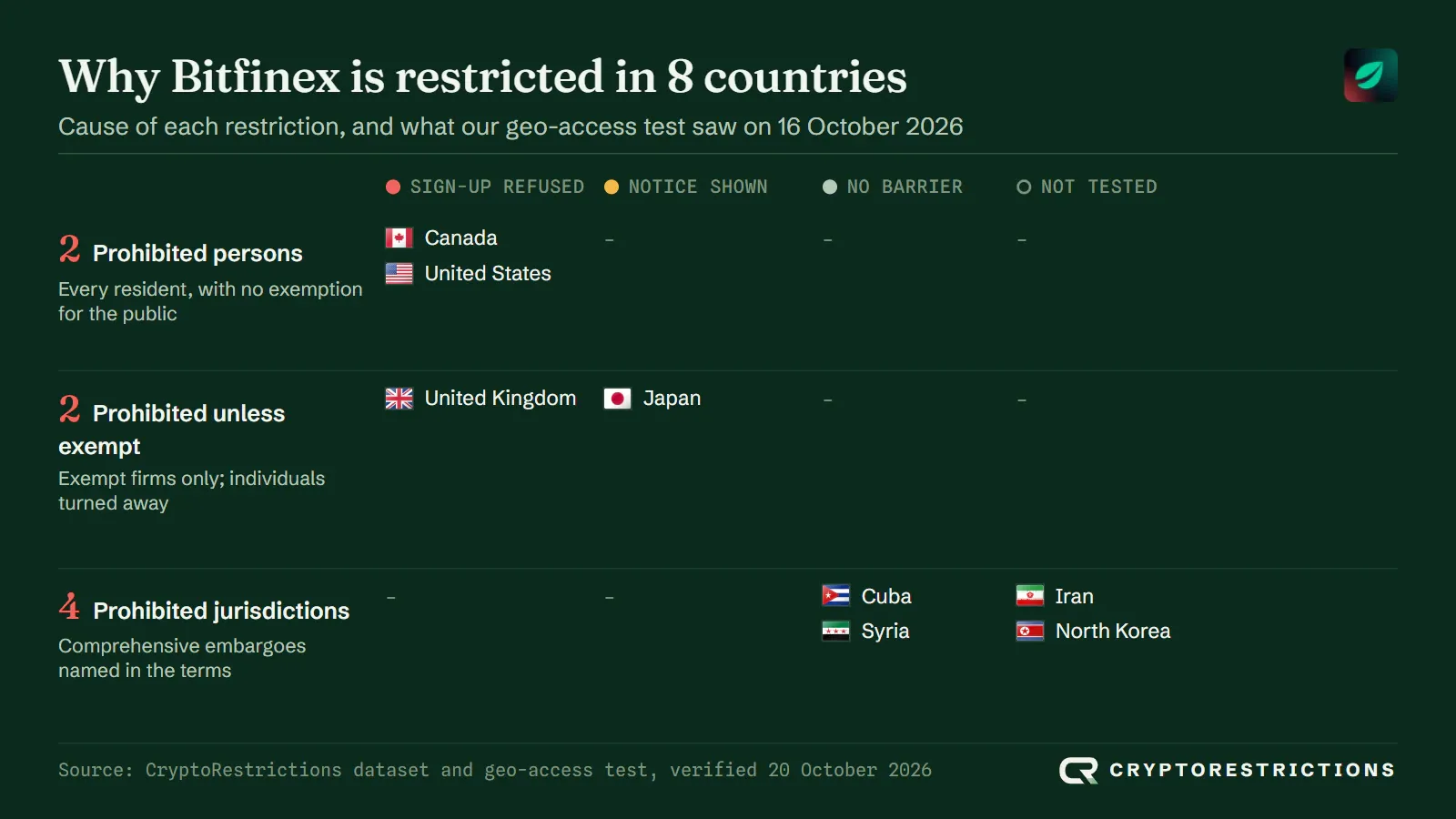
Bitfinex enforces the country bans at the sign-up page: the US, Canada and the UK got a pop-up refusing the account, and Japan a notice that new registrations are closed. The embargoed countries did not: Cuba and Syria loaded the sign-up form, so there the rule is applied at verification. The full list, with the reason for each country, is below.
| Category | Countries | Context | Last verified |
|---|---|---|---|
| Geographic block | Prohibited jurisdiction in Bitfinex's terms (comprehensive embargo). | 17 Oct 2026 | |
| Geographic block | Canadian persons, in every province and territory, are prohibited persons under Bitfinex's terms; the sign-up page refuses visitors from Canada. | 17 Oct 2026 | |
| Geographic block | Only Japanese crypto exchanges trading for themselves are exempt; every other Japanese person is prohibited, and the sign-up page refuses visitors from Japan. | 17 Oct 2026 | |
| Geographic block | UK persons are prohibited unless Bitfinex assesses them exempt from the financial promotion rules; individuals cannot be verified since 1 November 2023, and the sign-up page refuses them. | 17 Oct 2026 | |
| Geographic block | US persons are prohibited persons under Bitfinex's terms; the sign-up page refuses US visitors. | 17 Oct 2026 |
Where is Bitfinex limited?
Bitfinex is limited in 34 countries: all 30 EEA countries,  India,
 South Africa,
 Ukraine and
 Venezuela.
The EEA is limited because no Bitfinex company holds a MiCA licence (covered below), while Bitfinex keeps serving and signing up customers there. South Africa is a product cut: Bitfinex’s derivative terms (updated 6 April 2026) add South African and Spanish persons to the prohibited persons, so neither can trade derivatives, while spot trading stays open.  Spain is limited on both counts, with no MiCA licence and no derivatives. Ukraine is limited because the terms exclude Crimea, Donetsk, Luhansk, Kherson and Zaporizhzhia, and Venezuela because they bar its government, not its residents.
India is limited by a regulator. On 28 December 2023 India’s Financial Intelligence Unit sent show cause notices to nine offshore exchanges, Bitfinex’s operator iFinex among them, and asked the IT ministry to block their URLs. Bitfinex does not exclude India, and we found no FIU-IND registration for it. Kraken, named in the same notice, is also limited there in our data.

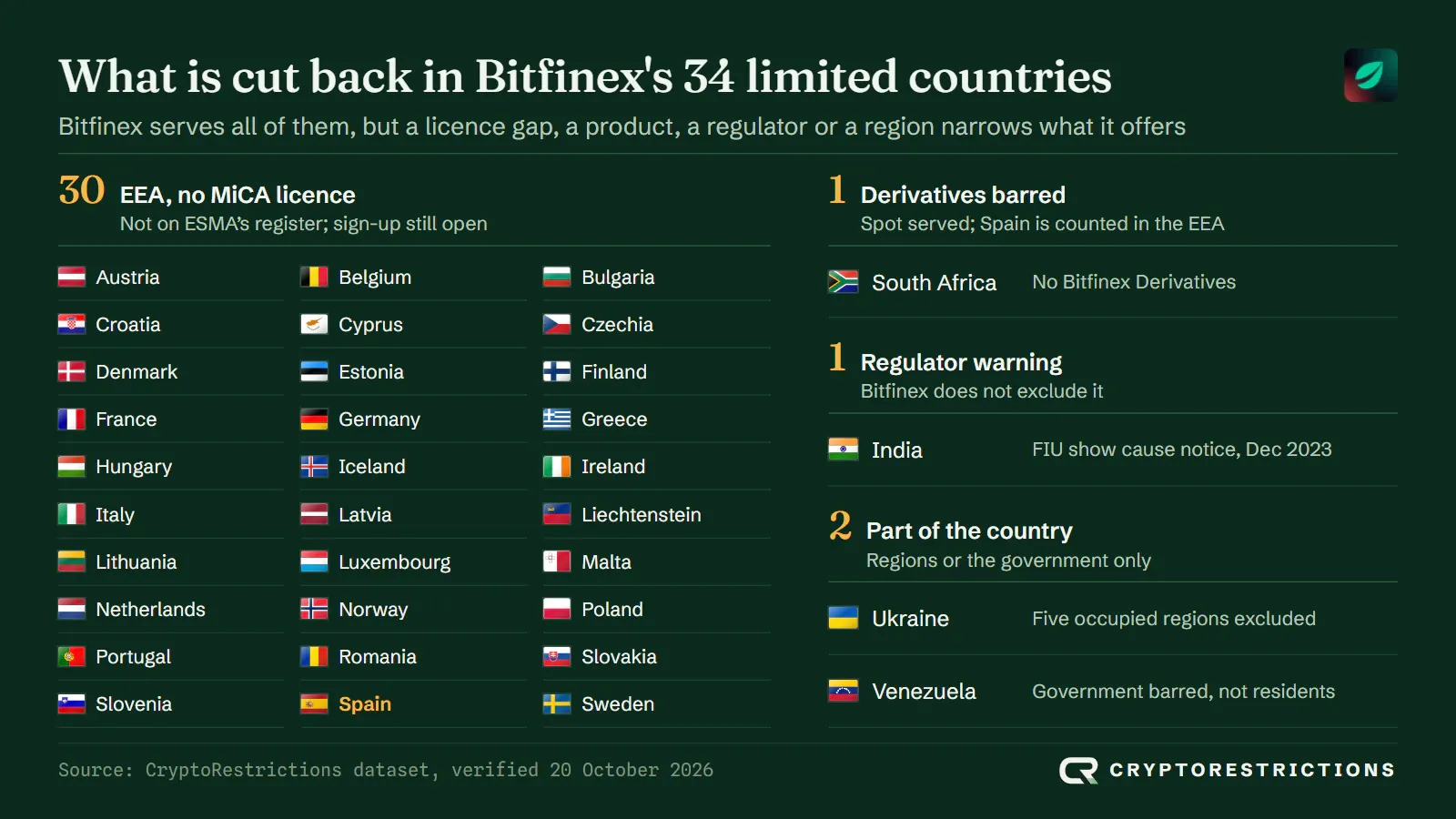
Limited means Bitfinex still serves the country, but something is cut back: a licence it lacks, a product it does not offer there, or part of the population. The countries and what applies in each are below.
| Category | Countries | Context | Last verified |
|---|---|---|---|
| License requirement | No MiCA licence: no Bitfinex company is on ESMA's register of authorised providers, and Bitfinex hides some pages from EEA customers while still signing them up. | 17 Oct 2026 | |
| Partial service | Crimea, Donetsk, Luhansk, Kherson and Zaporizhzhia are prohibited jurisdictions; the rest of Ukraine is served. | 17 Oct 2026 | |
| License requirement | No MiCA licence (no Bitfinex company on ESMA's register), and Spanish persons are prohibited from Bitfinex Derivatives. | 17 Oct 2026 | |
| License requirement | Not excluded by Bitfinex, but India's FIU sent its operator a show cause notice in December 2023 and asked for its URLs to be blocked; Bitfinex is not registered with FIU-IND. | 17 Oct 2026 | |
| Partial service | South African persons are prohibited from Bitfinex Derivatives; spot and other services are not restricted. | 17 Oct 2026 | |
| Partial service | The Government of Venezuela is a prohibited person; the terms do not bar other residents. | 17 Oct 2026 |
 Austria
 Belgium
 Cyprus
 Czechia
 Denmark
 France
 Hungary
 Italy
 Liechtenstein
 Luxembourg
 Malta
 Poland
 Portugal
 Romania
 Slovakia
 Sweden
Where is Bitfinex available?
Bitfinex is available in the other 153 of the 195 countries we cover, including  Switzerland,
 Turkey,
 South Korea,
 Brazil,
 Argentina and most of Africa and Asia.
Two host a Bitfinex licence (covered in the licences section below):  El Salvador, where four Bitfinex companies are registered, and
 Kazakhstan, where Bitfinex Securities runs a tokenised securities exchange in the Astana International Financial Centre. We checked 22 more by name against the prohibited lists in the terms, and the remaining 129 are available under our coverage rule: no official document from Bitfinex or a regulator restricts them.
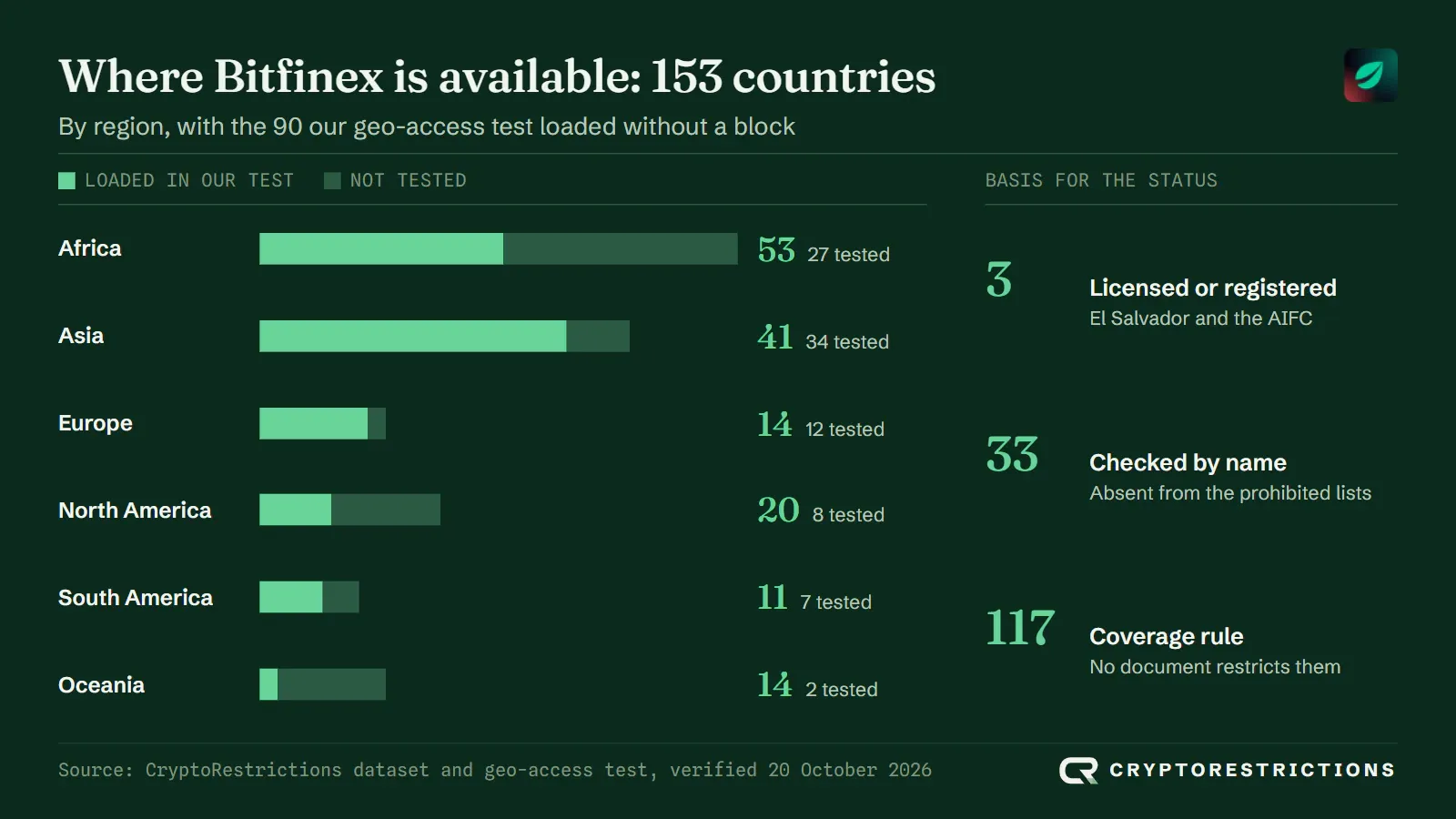
Our geo-access test loaded Bitfinex’s sign-up page without a barrier in 90 of the 153. Available means Bitfinex serves the country, not that local law allows crypto trading:  China and
 Russia are on this list because Bitfinex’s terms do not exclude them, whatever their own rules or other countries’ sanctions say. The countries we hold a written basis for are below.
| Category | Countries | Context | Last verified |
|---|---|---|---|
| No restriction | Not a prohibited person or jurisdiction under Bitfinex's terms, and not blocked in our geo-access test. | 07 Nov 2026 | |
| No restriction | Not a prohibited jurisdiction in Bitfinex's terms, and its pages loaded in our geo-access test. | 20 Oct 2026 | |
| No restriction | Four Bitfinex companies are registered with the CNAD as digital asset service providers, including the core platform since April 2026. | 17 Oct 2026 | |
| No restriction | Georgia is not a prohibited jurisdiction in Bitfinex's terms (12 August 2026), and its pages loaded in our geo-access test. | 19 Oct 2026 | |
| No restriction | Not a prohibited jurisdiction under Bitfinex's terms, and not blocked in our geo-access test. | 19 Oct 2026 | |
| No restriction | Not a prohibited person or jurisdiction under Bitfinex's terms; Bitfinex Securities operates in the AIFC FinTech Lab. | 17 Oct 2026 | |
| No restriction | Not a prohibited person or jurisdiction under Bitfinex's terms; the site loaded in our test. | 20 Oct 2026 | |
| No restriction | Not a prohibited person or jurisdiction under Bitfinex's terms. | 20 Oct 2026 | |
| No restriction | Not blocked in our geo-access test (virtual location); we could not read Bitfinex's terms as text. | 07 Nov 2026 |
 Australia
 Bahrain
 Belarus
 Chile
 Colombia
 Costa Rica
 Hong Kong
 Indonesia
 Israel
 Kenya
 Malaysia
 Nigeria
 Panama
 Peru
 Qatar
 Saudi Arabia
 Singapore
 Thailand
 United Arab Emirates
 Uruguay
 Vietnam
 Bangladesh
 Pakistan
 Morocco
 Myanmar
 Dominican Republic
Where do Bitfinex’s visitors come from?
Spain, South Korea and Taiwan send the most visitors to bitfinex.com in Similarweb’s September figures, and Canada, where Bitfinex is restricted, is fifth.
Similarweb puts Spain first for September 2026 with 16.71% of desktop visits, ahead of South Korea at 15.29%,  Taiwan at 11.69%, the
 Netherlands at 5.2% and Canada at 3.49%, on 546.7K visits over three months. A BitRSS report using Similarweb data puts the first quarter of 2026 at 1.85 million visits. Semrush has no traffic page for bitfinex.com, so we have no second country split to compare.
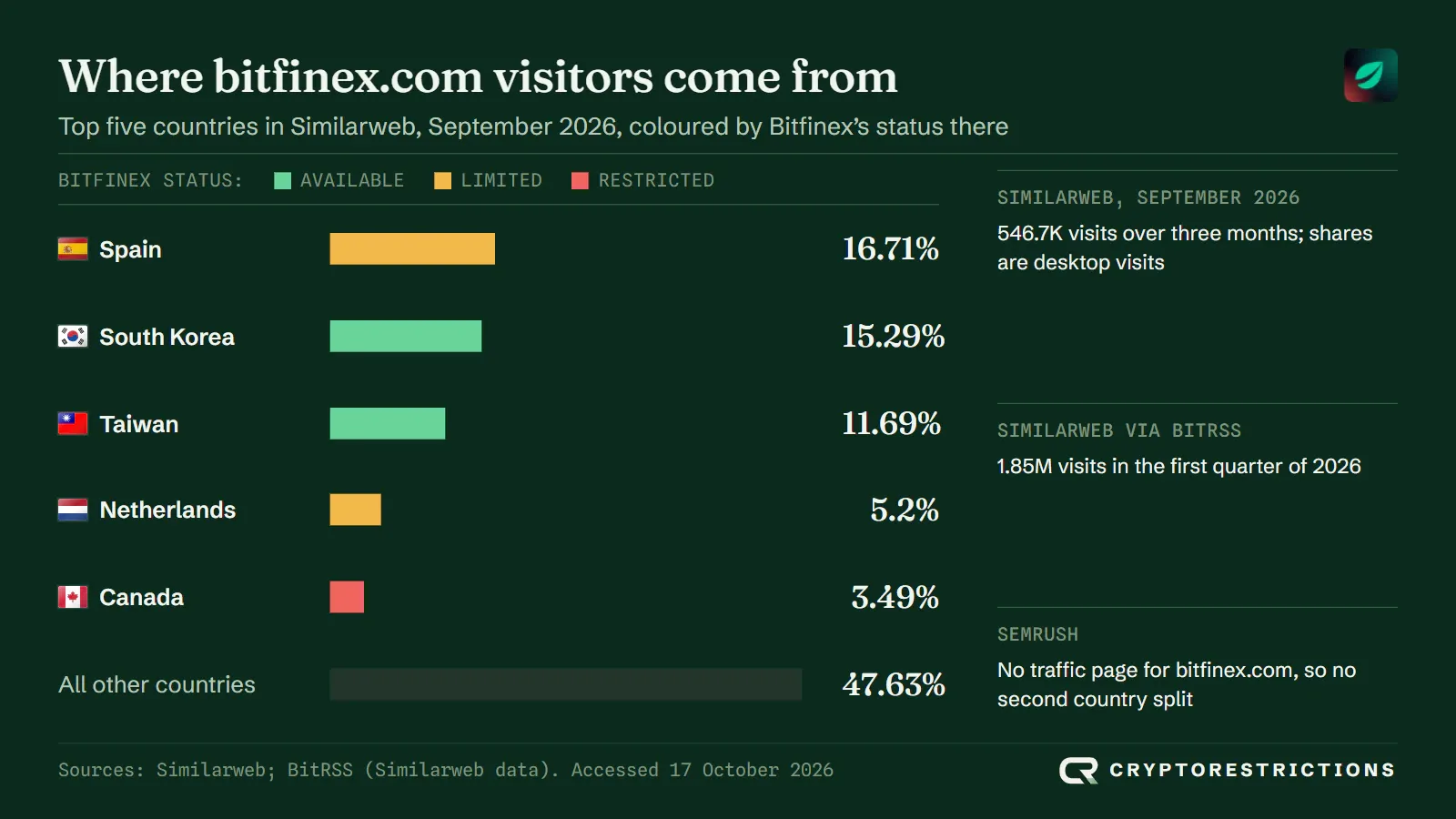
Canada’s share has an explanation in our test: from Canada, bitfinex.com’s home page loads normally and only the sign-up page refuses, so visitors can still read prices and log in. Spain and the Netherlands are limited, not restricted: their residents can still sign up. Estimators model traffic from panels and samples, so treat any single share as an estimate.
Bitfinex geo-access test: what we saw from 133 places
In our test Bitfinex’s sign-up page refused visitors by location in 3 of the 129 countries we reached, the US, Canada and the UK, and showed Japan a notice that it takes no new registrations; the home page loaded everywhere.
We ran the test ourselves on 16 October 2026, with the same method as for every platform. A browser with a VPN connected to one country at a time and loaded Bitfinex’s home page and its sign-up page, each time in a fresh private window with no cookies. Cookie banners were hidden but never accepted, and bot checks were waited out, never solved. Every run saved the page text and a screenshot.
Of the 133 places tested (129 of our 195 countries plus Hong Kong, Macau, Puerto Rico and Taiwan), 61 went through VPN servers located there and 72 through virtual locations hosted elsewhere, which an earlier run showed Bitfinex treats as the intended country: a US address was refused while virtual locations served from Miami were not. A virtual location tests Bitfinex’s own blocking only; it cannot see a block run by a country’s internet providers.
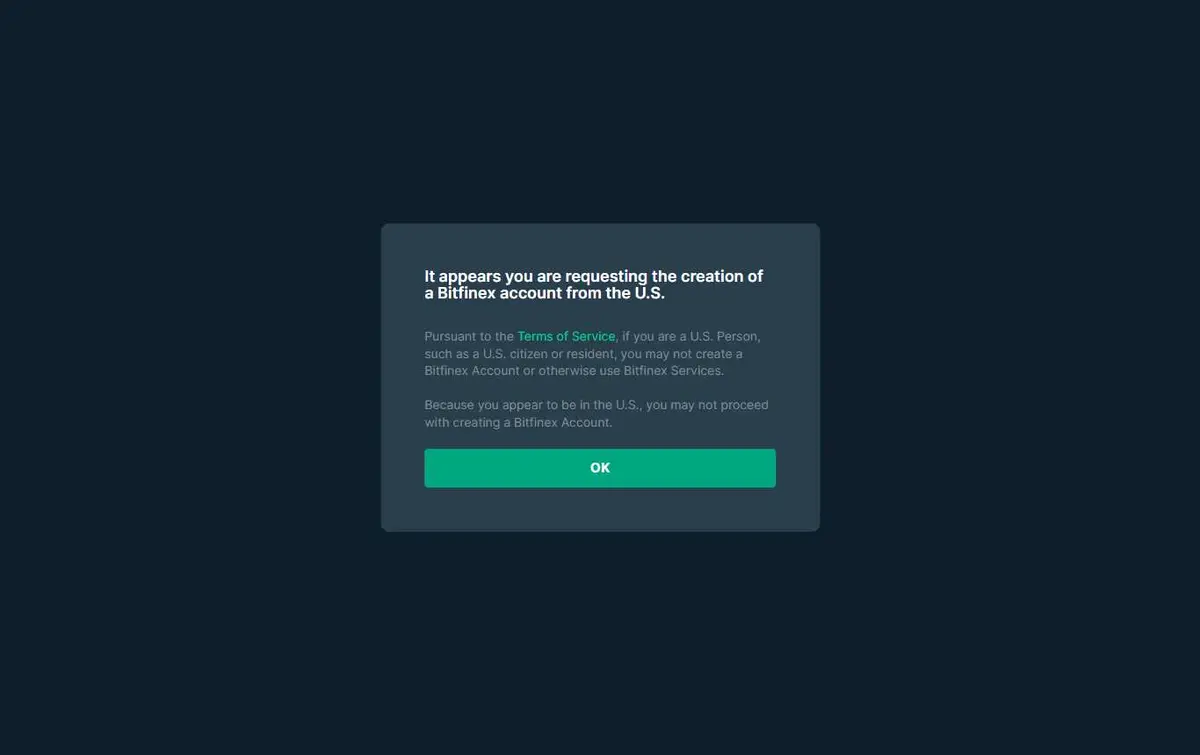
BlockedUnited States · Sign-up page
From the US, the sign-up page refuses to open an account
“It appears you are requesting the creation of a Bitfinex account from the U.S.”
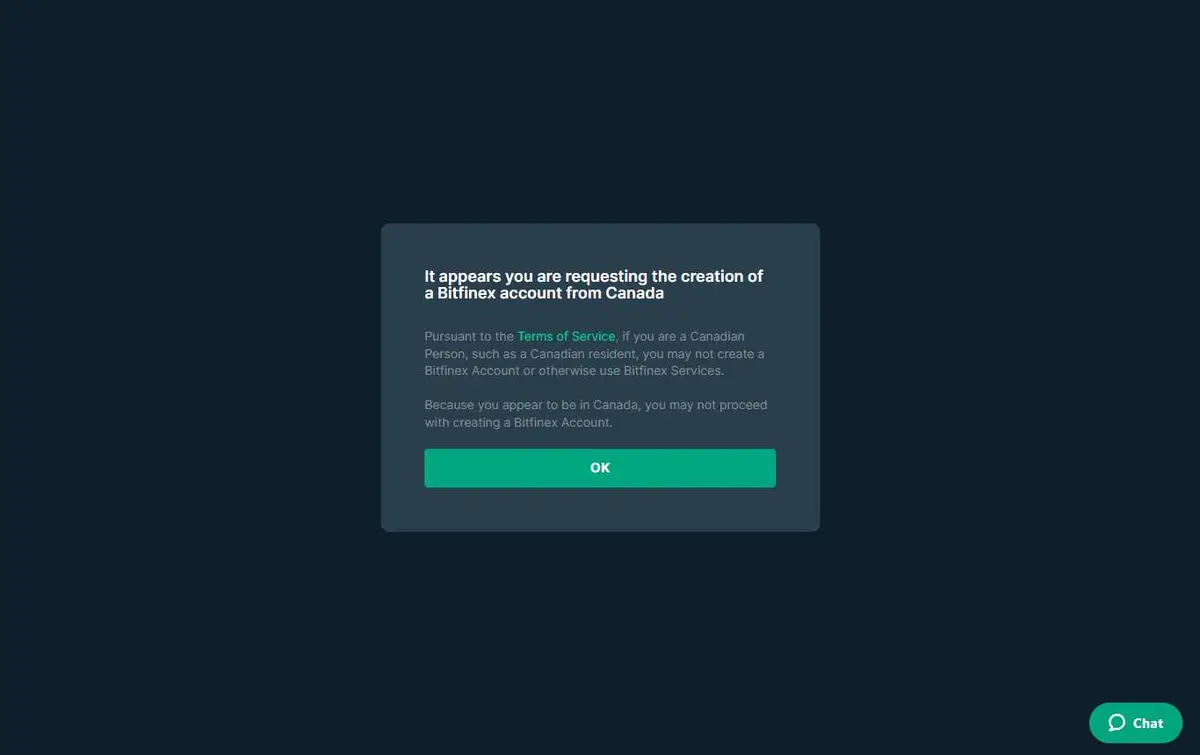
BlockedCanada · Sign-up page
Canada gets the same refusal, citing the terms of service
“It appears you are requesting the creation of a Bitfinex account from Canada”
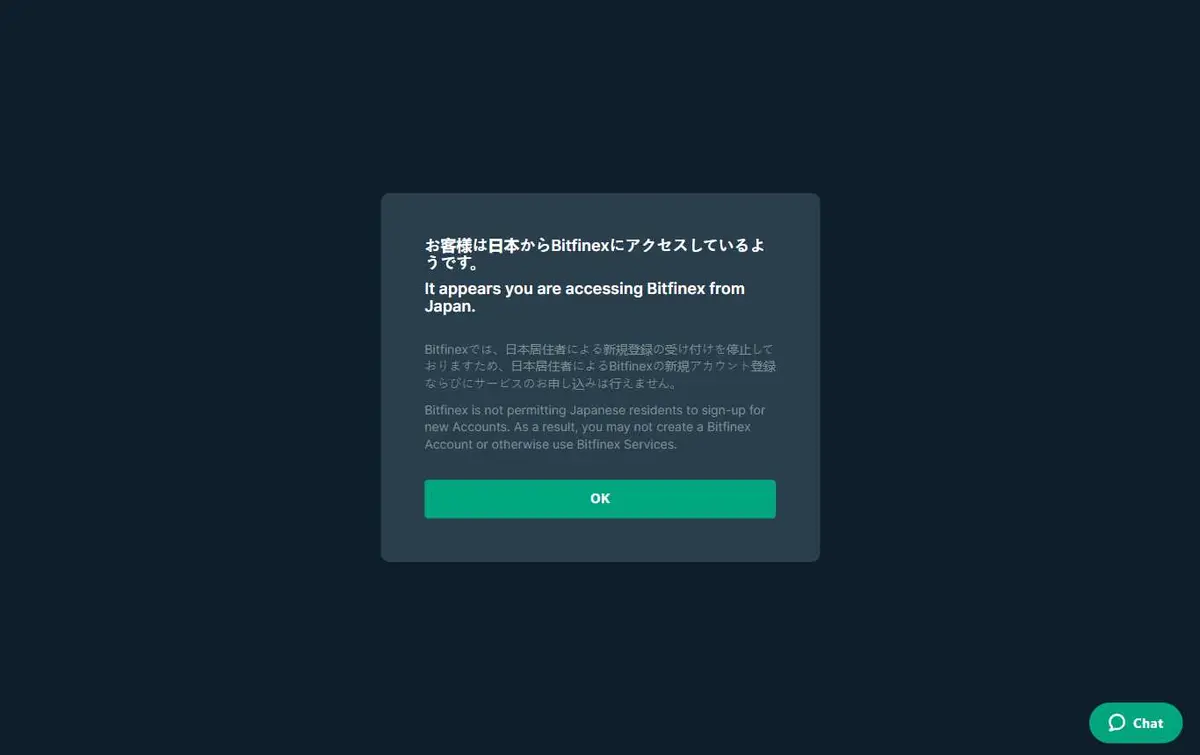
Notice shownJapan · Sign-up page
Japan: a bilingual notice that new registrations are closed
“Bitfinex is not permitting Japanese residents to sign-up for new Accounts.”
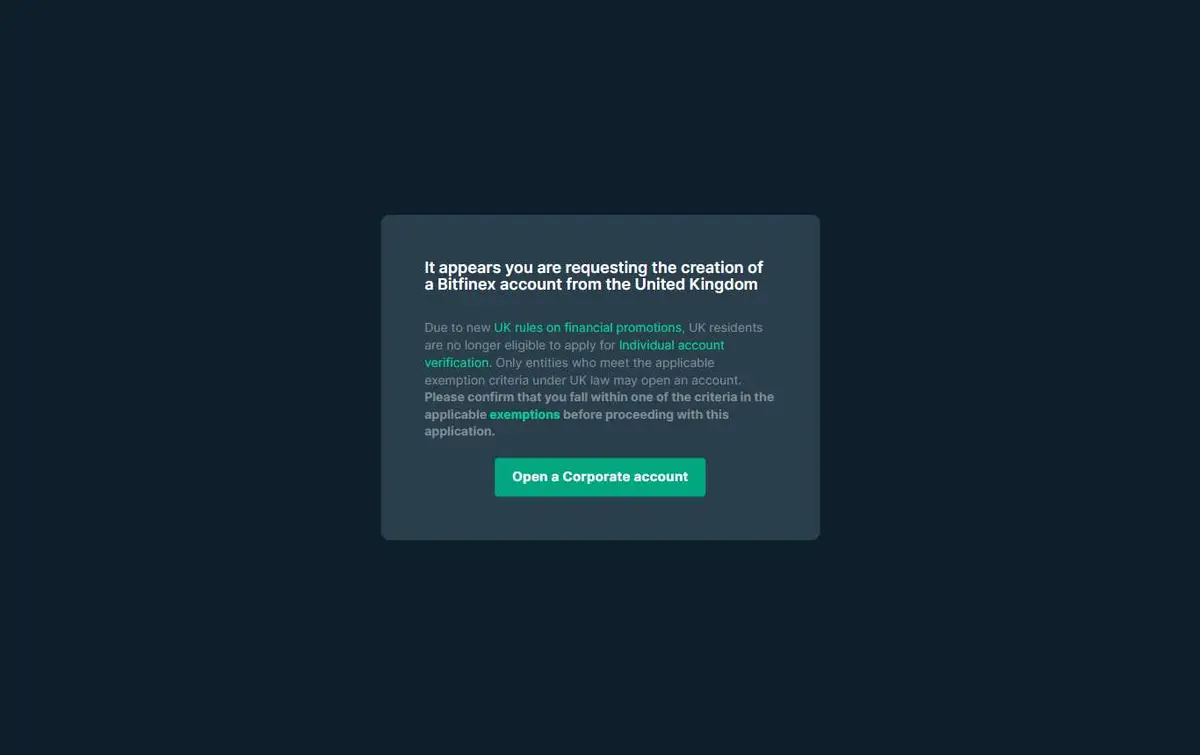
BlockedUnited Kingdom · Sign-up page
The UK: individuals turned away, only exempt entities may apply
“UK residents are no longer eligible to apply for Individual account verification.”
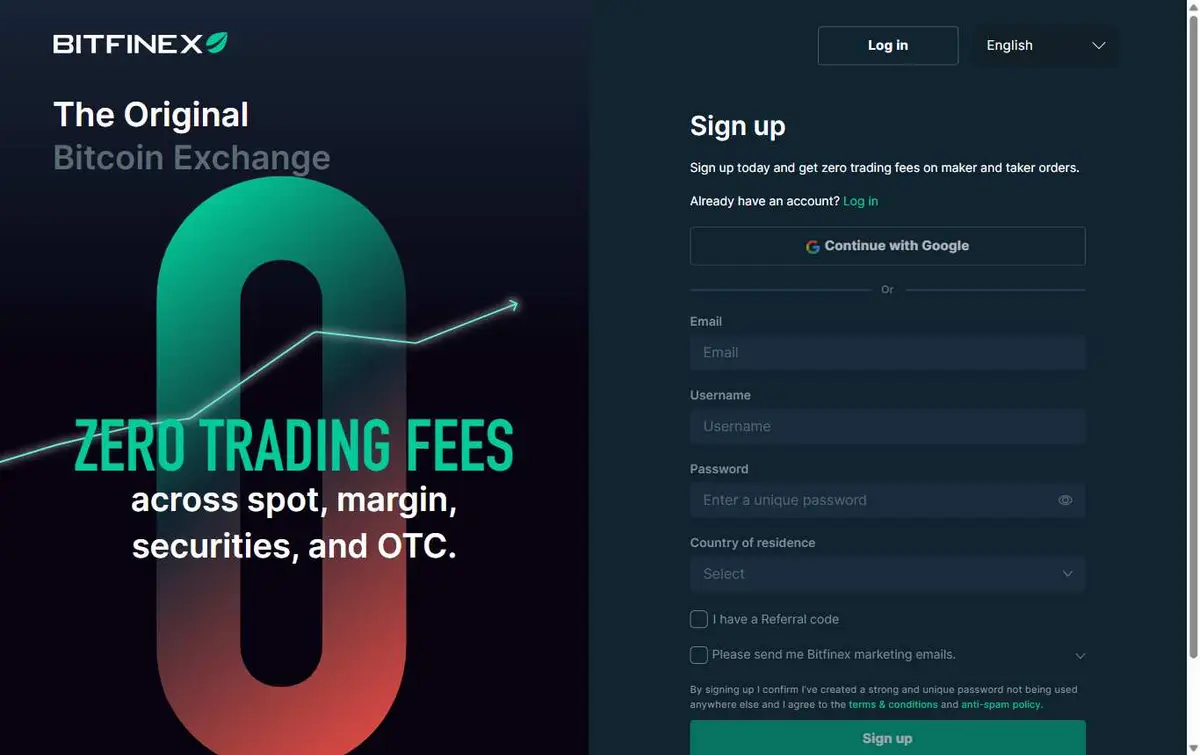
No barrierCuba · Sign-up page
Cuba is a prohibited jurisdiction, yet the sign-up form loads
“Sign up today and get zero trading fees on maker and taker orders.”
No barrierSyria · Sign-up page
Syria, also prohibited by the terms, loads the same form
“Sign up today and get zero trading fees on maker and taker orders.”
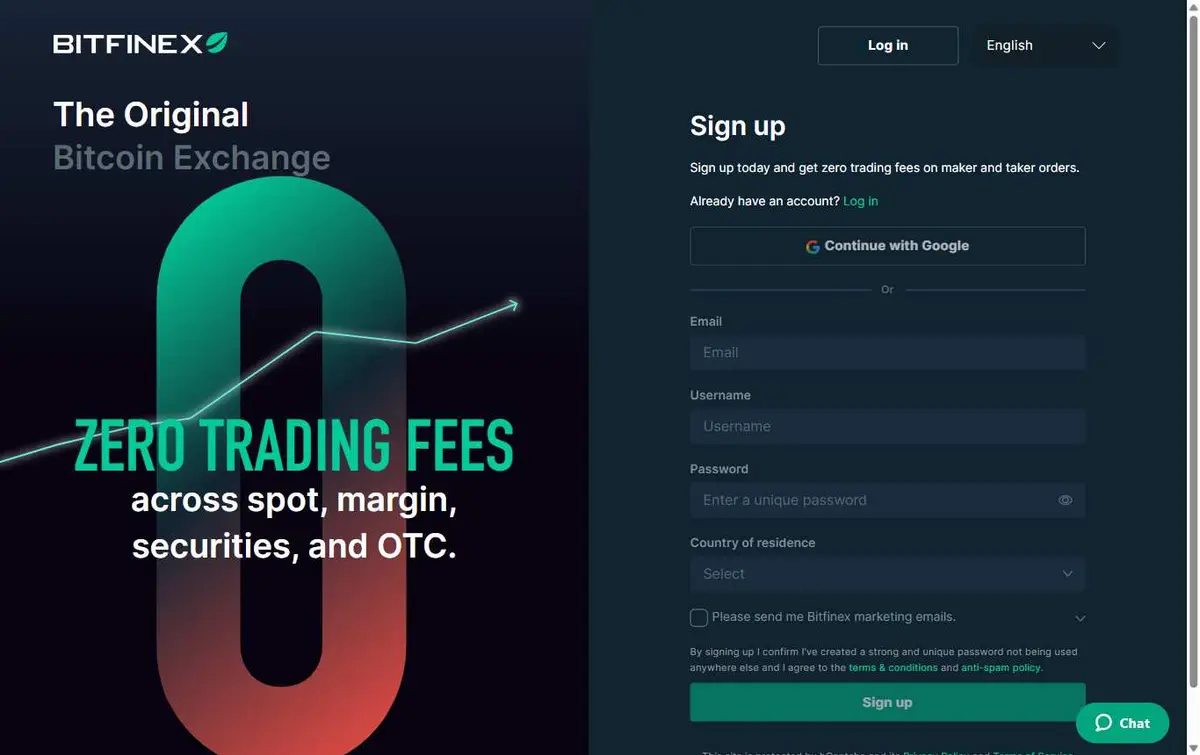
No barrier Germany · Sign-up page
Germany: sign-up open with no MiCA licence, and no referral code field
“Sign up today and get zero trading fees on maker and taker orders.”
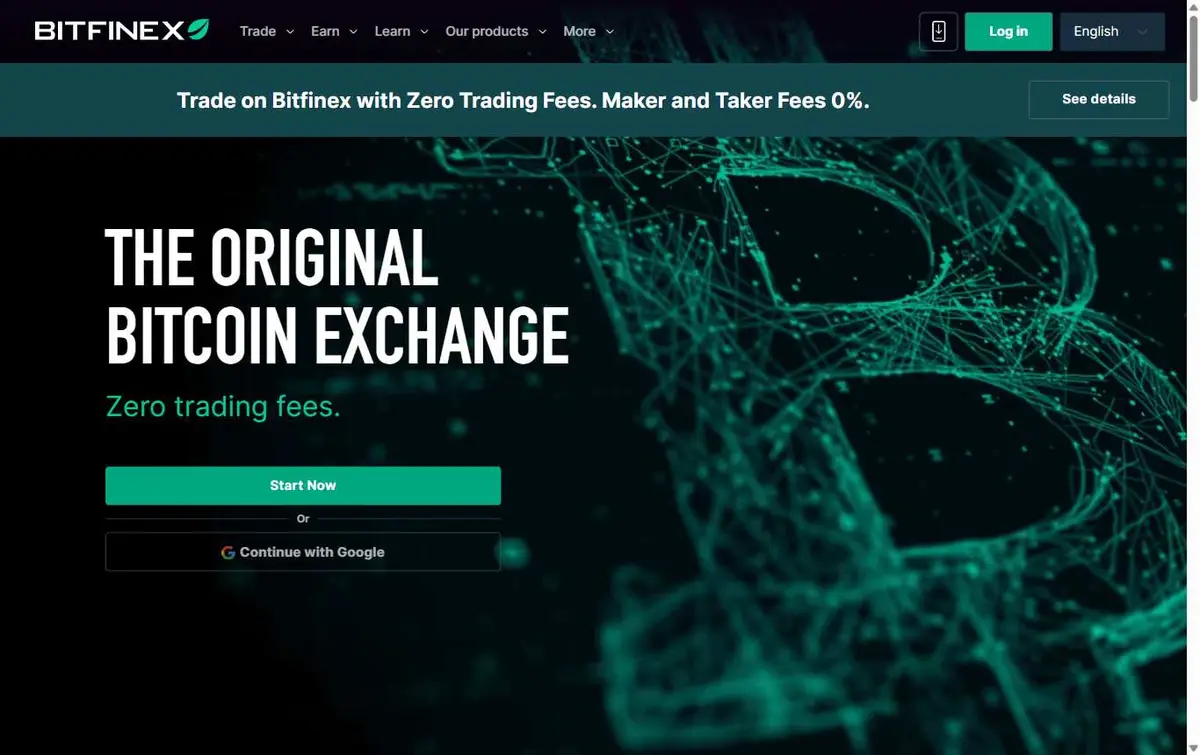
No barrierSpain · Home page
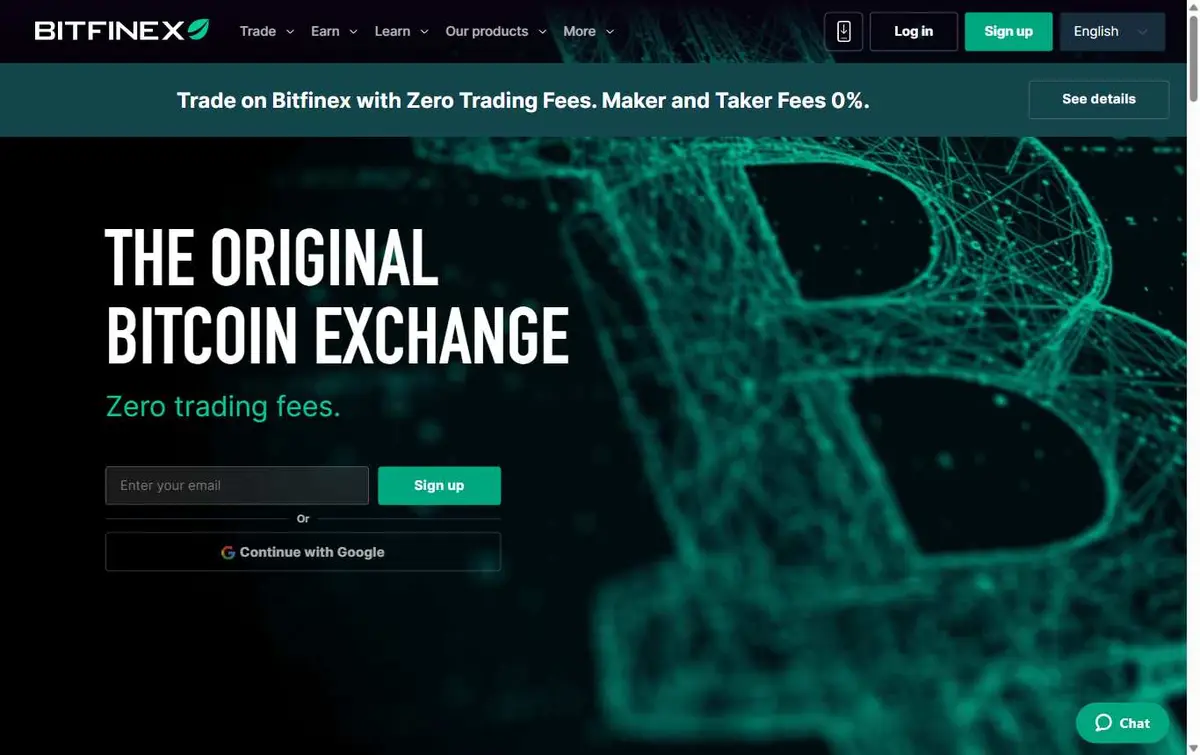
Spain, the top source of desktop visits, loads the full home page
“THE ORIGINAL BITCOIN EXCHANGE”
No barrierSouth Africa · Sign-up page
South Africa: sign-up open, but derivatives are barred by their own terms
“Sign up today and get zero trading fees on maker and taker orders.”
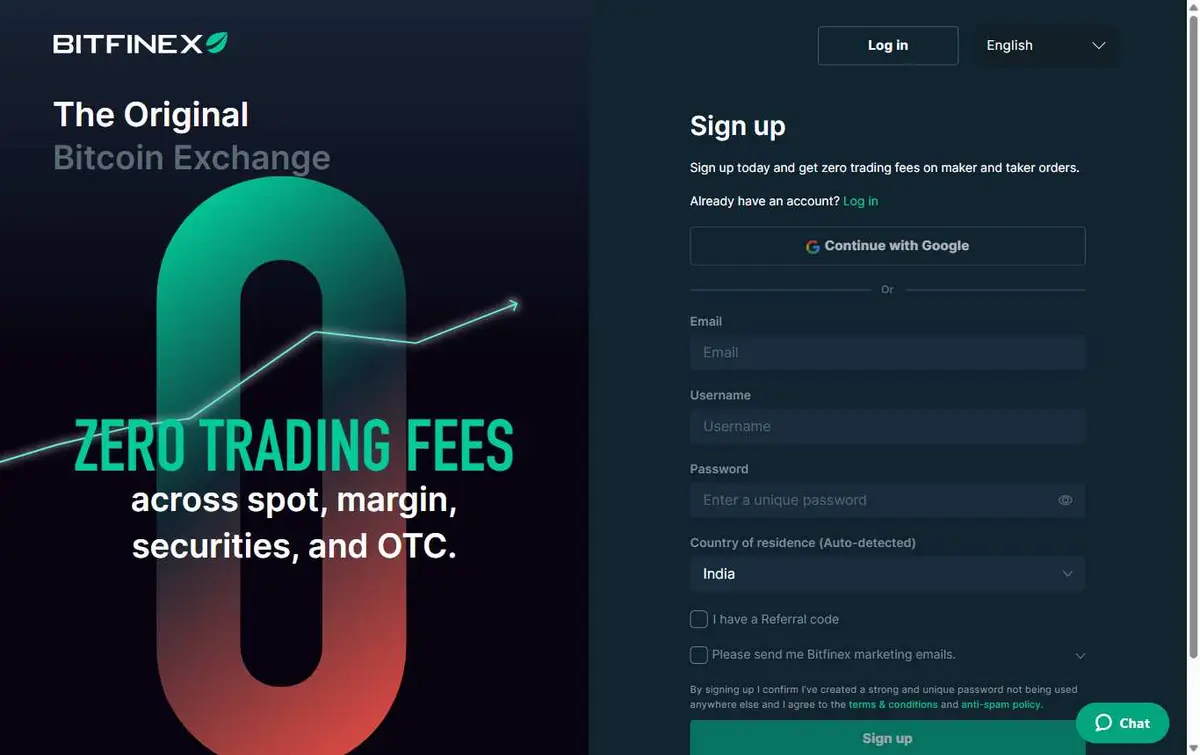
No barrierIndia · Sign-up page
India, where the FIU asked for Bitfinex's URLs to be blocked, from a virtual location
“Sign up today and get zero trading fees on maker and taker orders.”
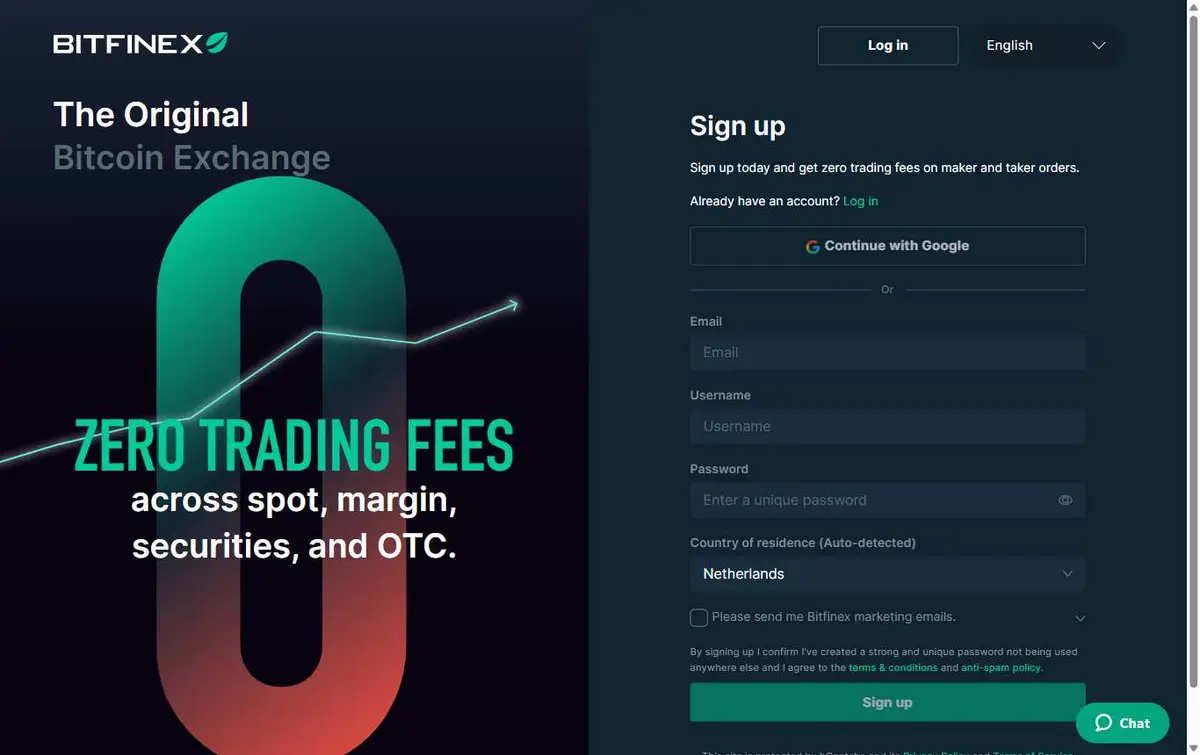
No barrierNetherlands · Sign-up page
The Netherlands: the sign-up form loads with no notice
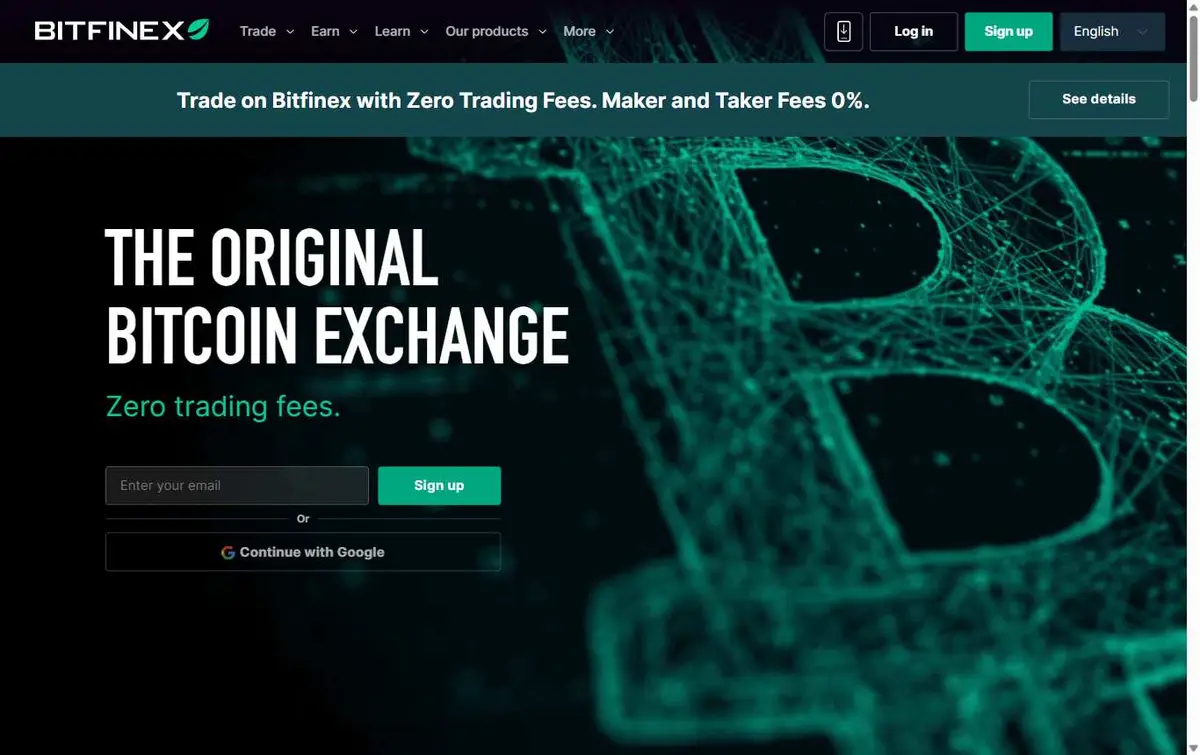
No barrierTurkey · Home page
Turkey: the home page loads with no notice
No barrier Philippines · Home page
Loaded with no barrier from a Philippine address
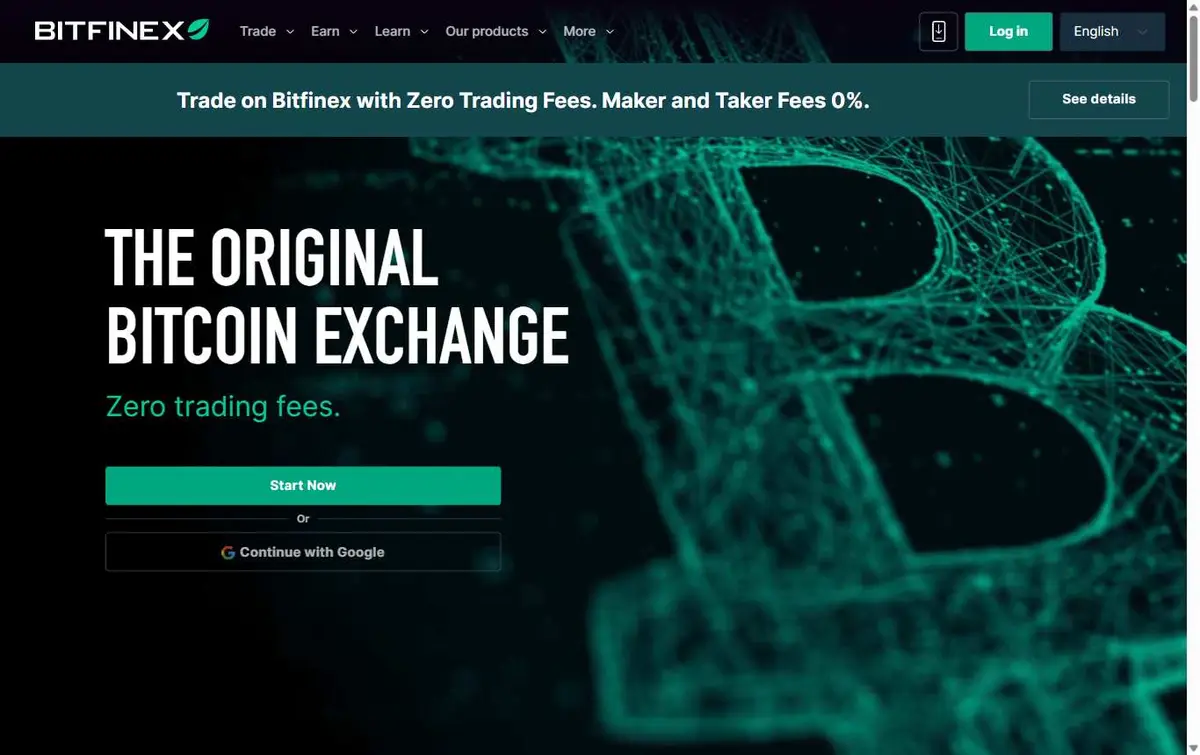
No barrier Mexico · Sign-up page
Mexico: the sign-up form loads with no barrier
“Sign up today”
No barrier Ireland · Home page
Ireland: the home page loads with no notice
No barrier New Zealand · Home page
New Zealand: the page loads with no notice
No barrier Norway · Home page
Norway: the home page loads with no notice
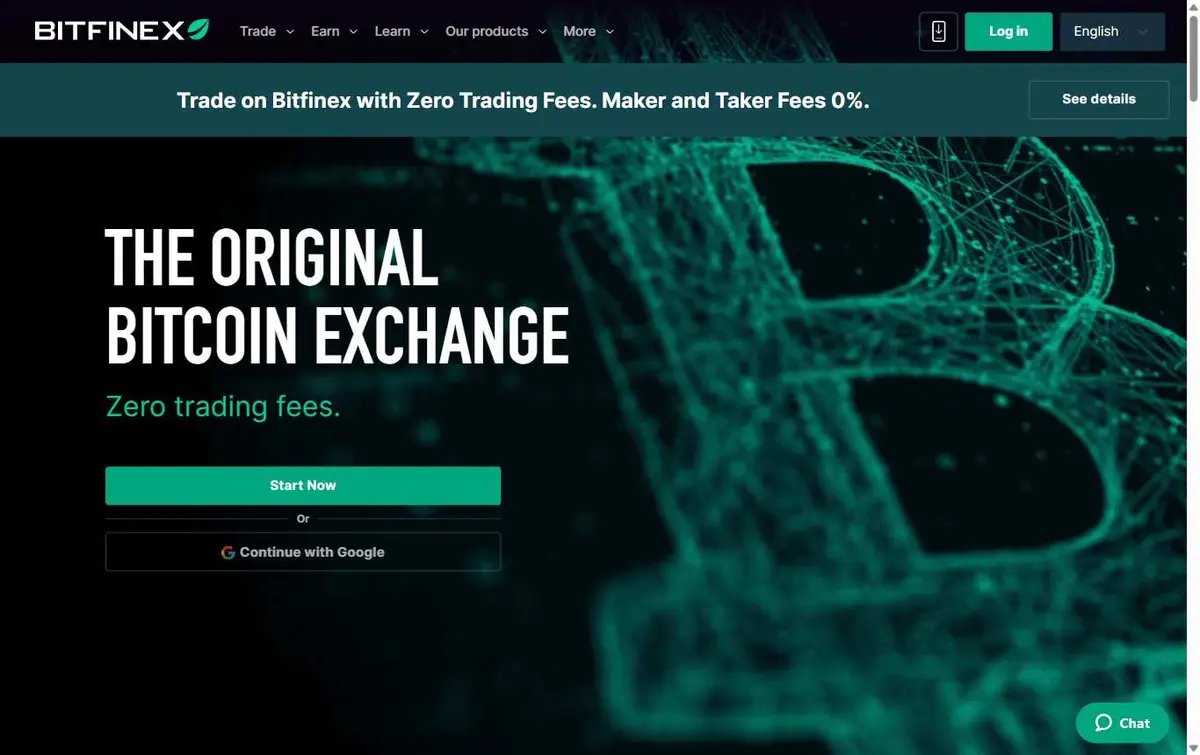
No barrier Finland · Home page
Finland: the home page loads with no notice
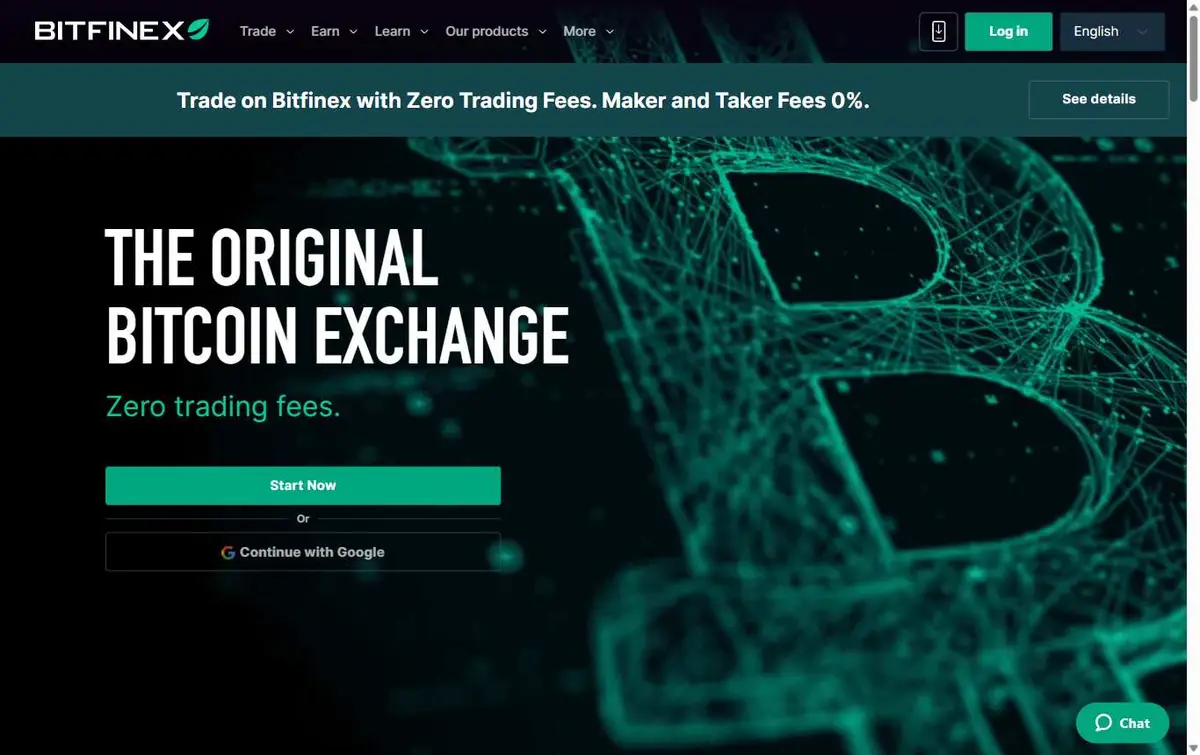
No barrier Greece · Home page
Greece: the home page loads with no notice
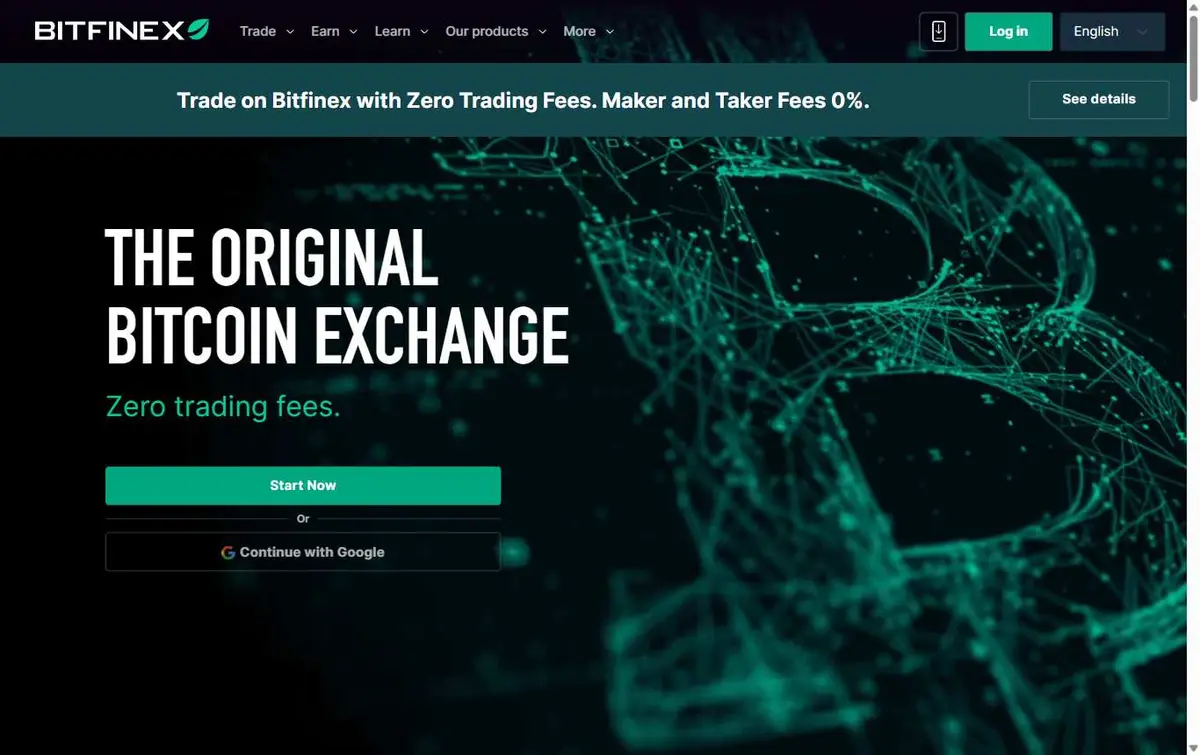
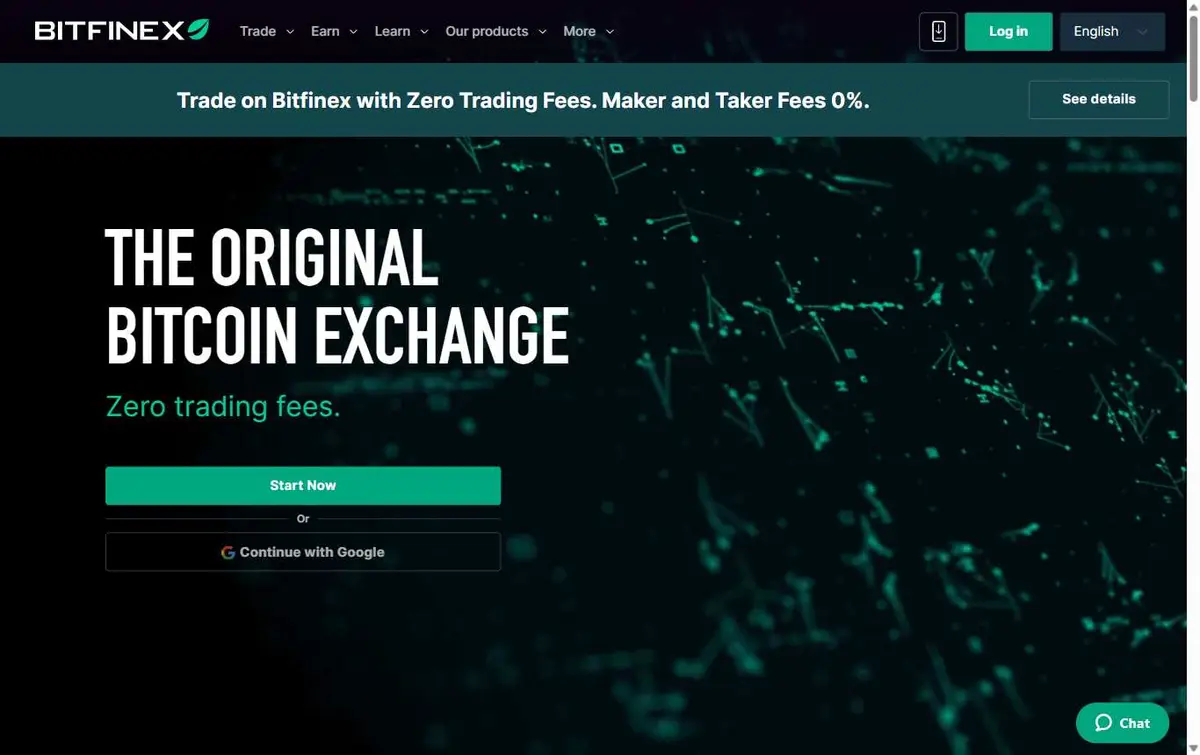
No barrier Bulgaria · Home page
Bulgaria: the home page loads with no notice
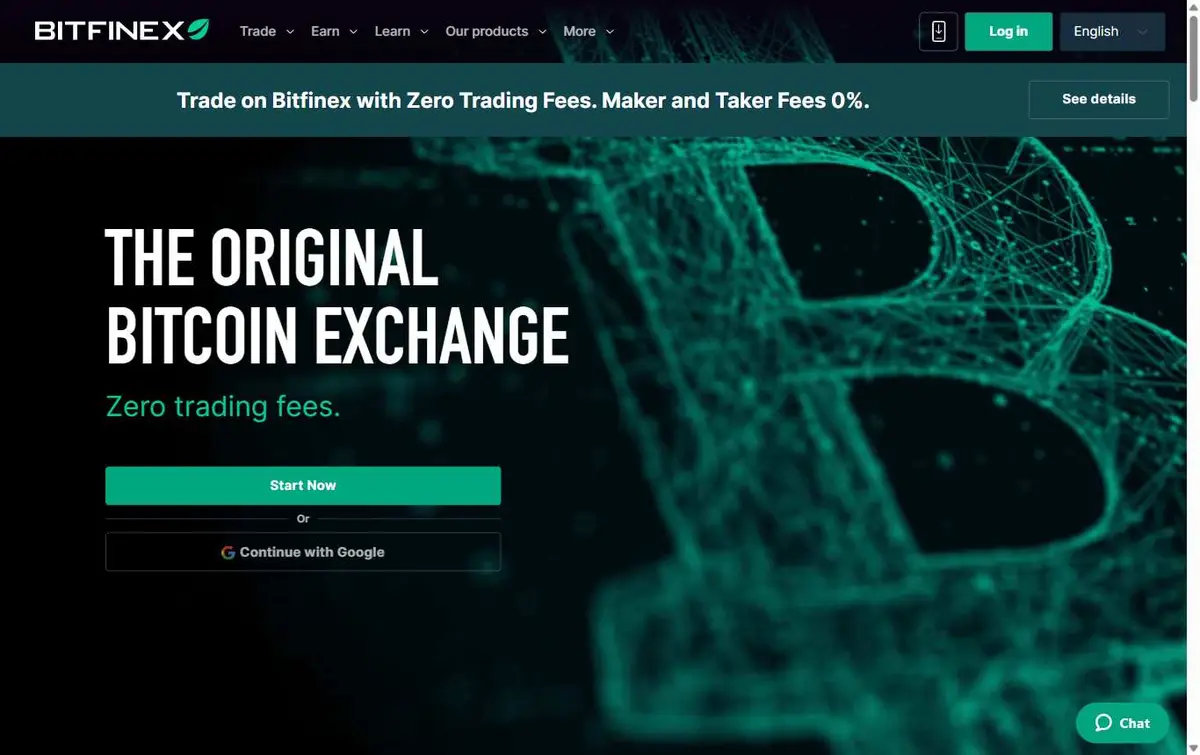
No barrier Croatia · Home page
Croatia: the home page loads with no notice
No barrier Latvia · Home page
Latvia: the home page loads with no notice
No barrier Estonia · Home page
Estonia: the home page loads with no notice
No barrier Egypt · Sign-up page
Egypt: sign-up loads with no notice
No barrier Lithuania · Home page
Lithuania: the home page loads with no notice
No barrier Slovenia · Home page
Slovenia: the home page loads with no notice
No barrier Iceland · Home page
Iceland: the home page loads with no notice
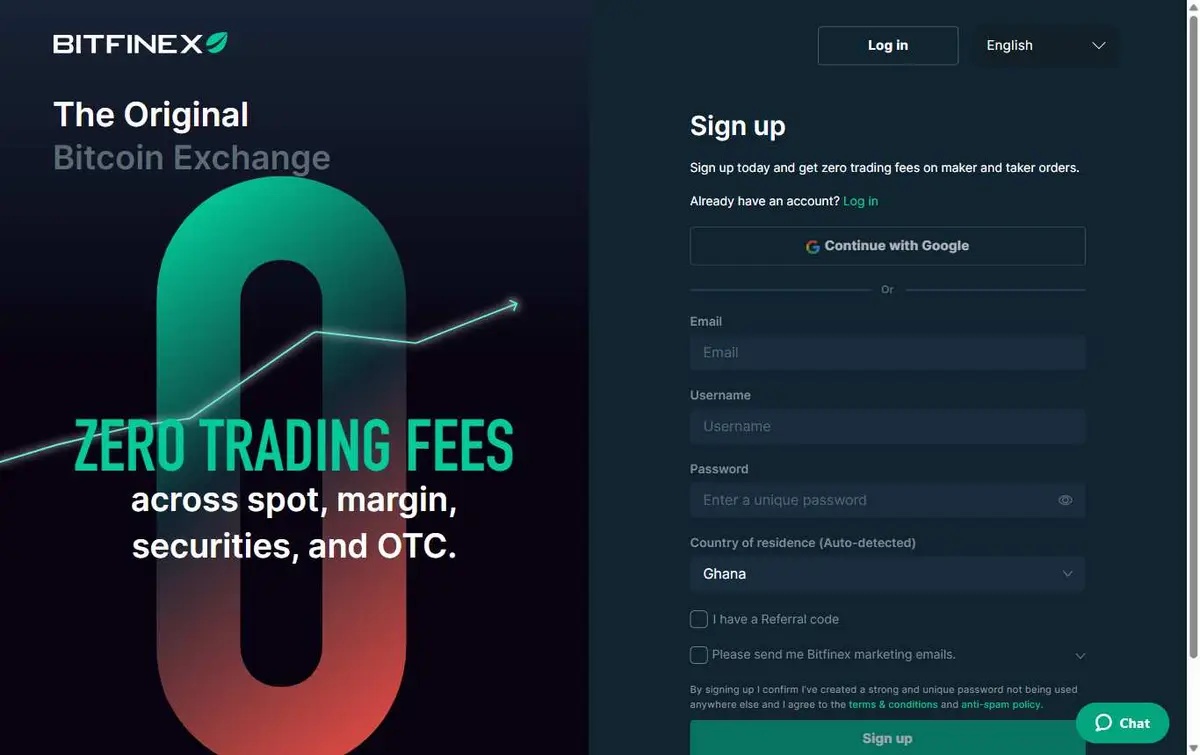
No barrier Ghana · Sign-up page
Ghana: the Bitfinex sign-up form auto-detects the country of residence
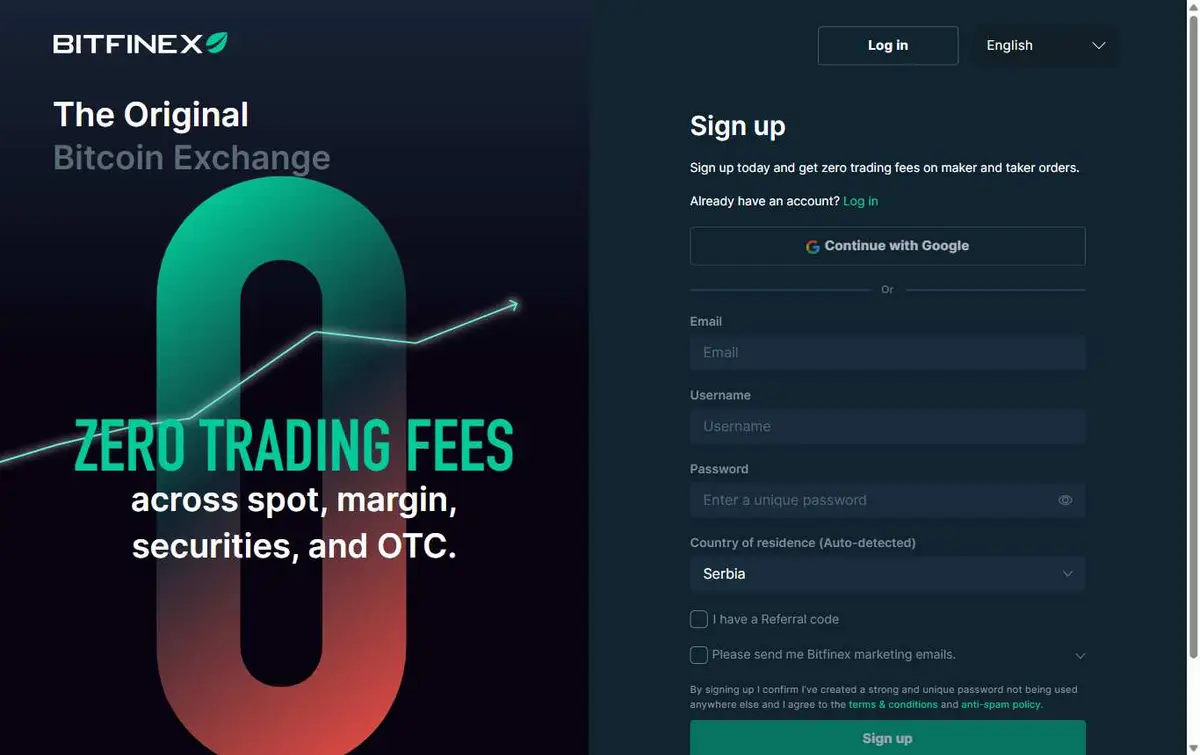
“Country of residence (Auto-detected)”
No barrier Georgia · Home page
Georgia: the home page loads with no notice
No barrier Serbia · Sign-up page
Serbia: sign-up loads with no barrier
 CRYPTORESTRICTIONS
The test does not decide a country’s status on its own: official documents come first, and a page that loads is not permission to use Bitfinex.
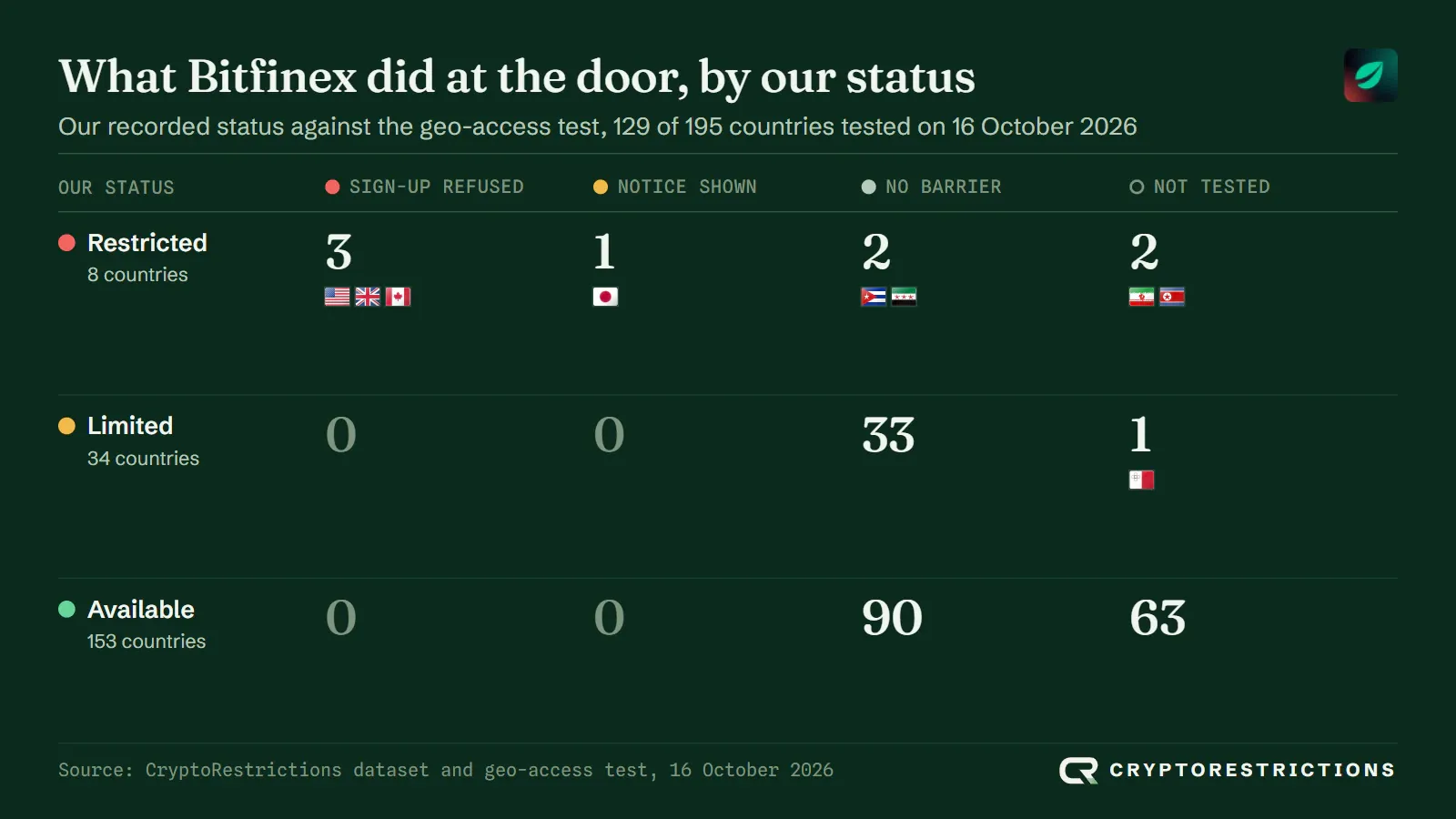
Three patterns stand out. First, Bitfinex blocks at sign-up, not at the door: every refusal came on the sign-up page, while the home page loaded in all 133 places. That is the opposite of OKX, whose home page refused visitors by IP in every listed country we reached. Second, the pop-ups match the terms word for word, citing US and Canadian persons, the UK’s financial promotion rules and Japan’s closed registrations. Third, the embargoed countries are left to verification: Cuba and Syria loaded the same sign-up form as Germany. India also loaded, through a virtual location that cannot see an internet provider’s block.

Iran and North Korea were not tested: our VPN offers no location in either. The full result for every country is below.
All 133 test results, country by country
Bitfinex licences and registrations
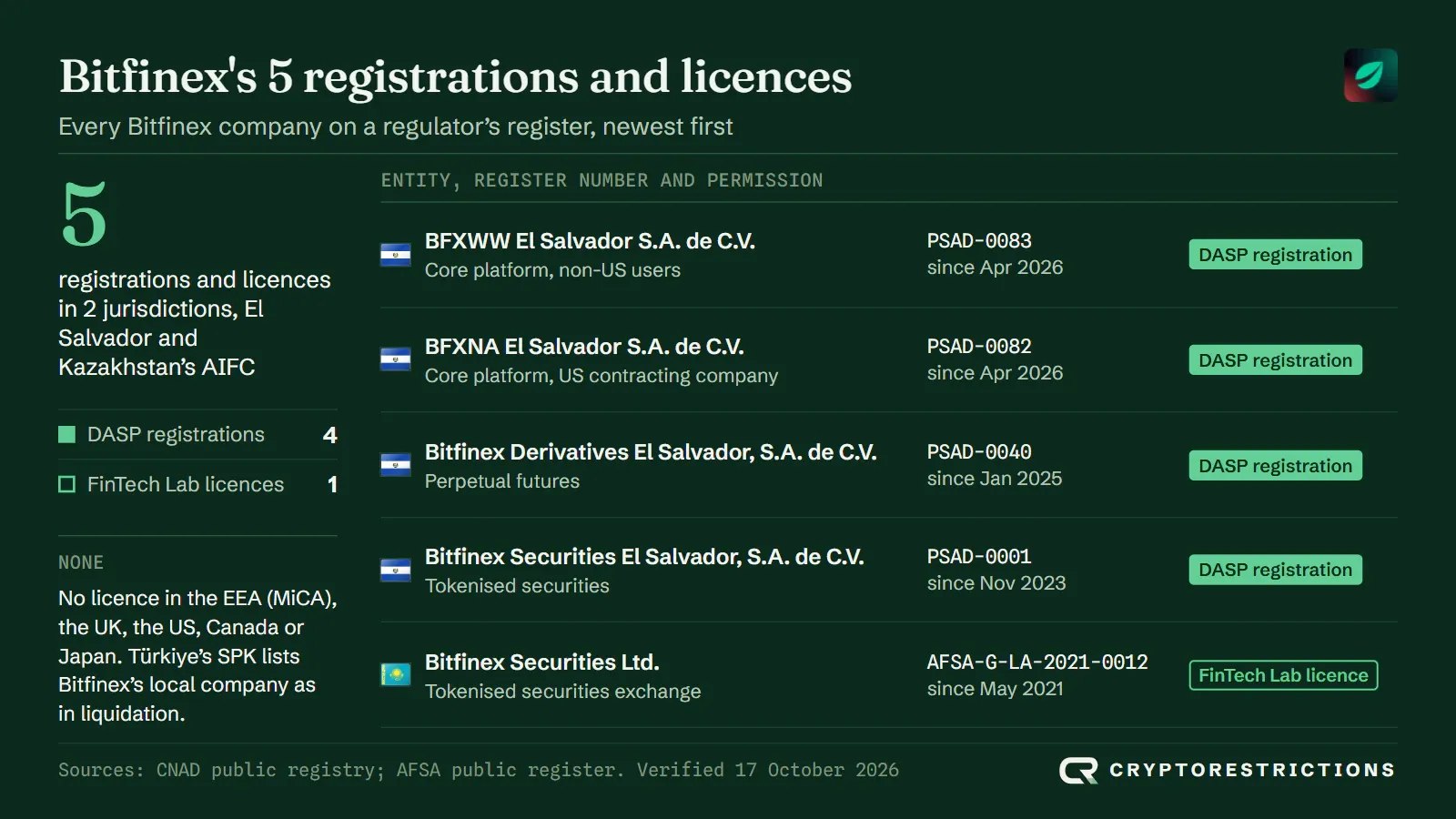
Bitfinex holds 5 registrations and licences in 2 jurisdictions, El Salvador and Kazakhstan’s AIFC, and none in the EEA, the UK, the US, Canada or Japan.
There is no licences page: we read them from the regulators’ registers. El Salvador’s CNAD registry lists four Bitfinex companies as digital asset service providers, and the AIFC’s AFSA register lists Bitfinex Securities in its FinTech Lab.
Americas
- El Salvador: BFXWW El Salvador (PSAD-0083) and BFXNA El Salvador (PSAD-0082) have been registered since 23 April 2026; Bitfinex announced the licence for its core platform in May 2026. Bitfinex Derivatives El Salvador (PSAD-0040, 6 January 2025) is the counterparty for derivatives, which moved there from a Seychelles company in January 2025 according to the derivative terms. Bitfinex Securities El Salvador (PSAD-0001) has been registered since 10 November 2023.
Central Asia
- Kazakhstan (AIFC): Bitfinex Securities Ltd. has held licence AFSA-G-LA-2021-0012 since 18 May 2021 to operate an exchange and a clearing house in the FinTech Lab, a limited regime rather than a full authorisation. In December 2025 Bitfinex said it was applying to become an Authorised Investment Exchange; the register does not show that yet.
The contracting company for most users is BFXWW Inc. in the British Virgin Islands, under BVI law, according to the terms.
Bitfinex and MiCA in the EU
Bitfinex has no MiCA licence: no Bitfinex, iFinex or BFX company is on ESMA’s register of authorised crypto-asset service providers, yet it still serves and signs up customers in all 30 EEA countries.
MiCA is the EU’s crypto rulebook, and since 30 December 2024 it has required exchanges serving EU clients to hold an authorisation from one member state (our MiCA article covers the rules). The transition period ended on 1 July 2026. We checked ESMA’s register of authorised providers and its list of non-compliant entities on 17 October 2026 and found Bitfinex on neither. Bitfinex has announced no EEA exit: its change log of 15 October 2026 adds a new sign-up flow for EEA customers.
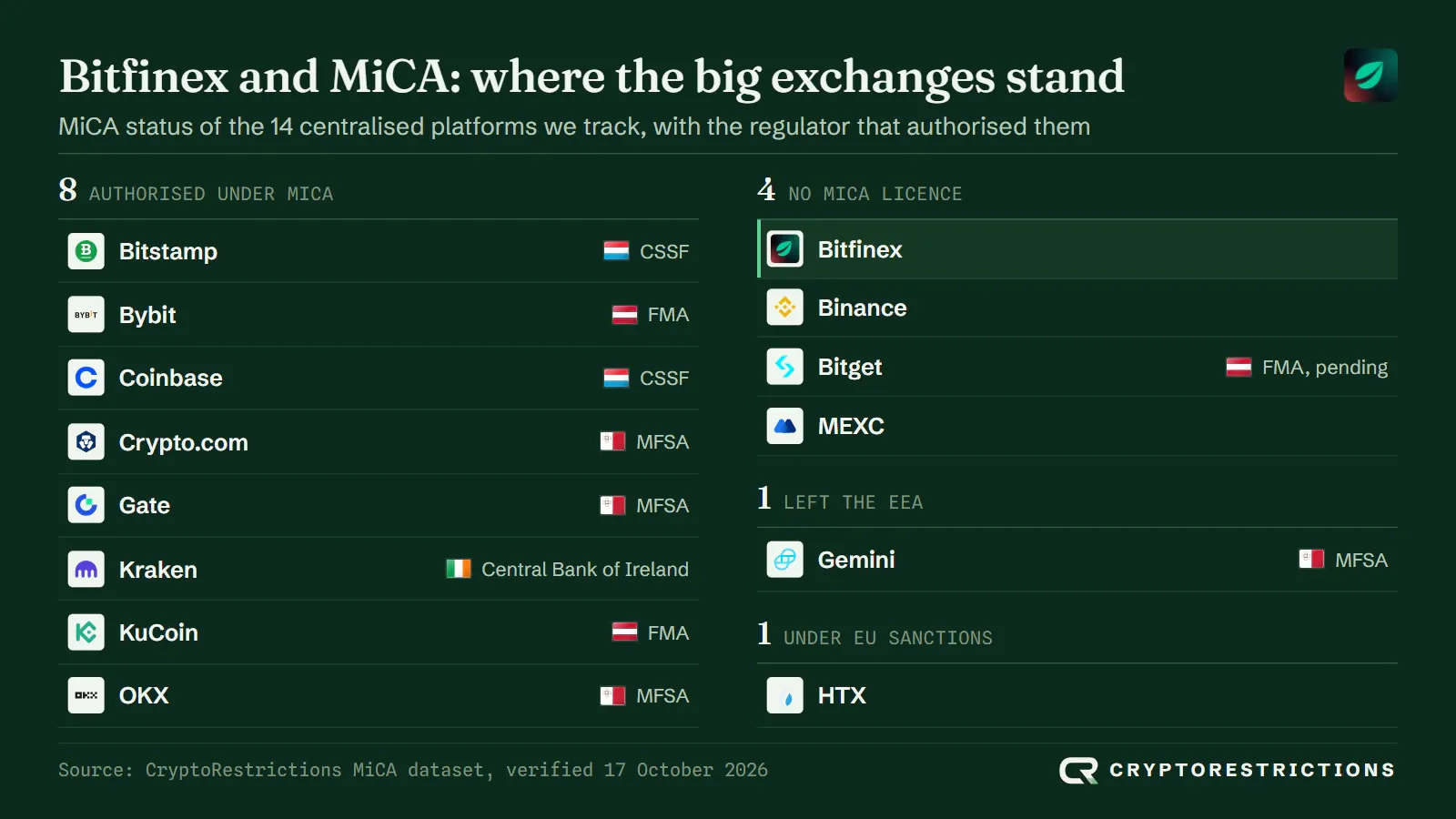
That puts Bitfinex with Binance, Bitget and MEXC among the four exchanges in our MiCA dataset without a licence. Unlike Bitstamp, authorised by Luxembourg’s CSSF more than a year before the deadline, we found no Bitfinex statement on a MiCA application. Our status follows our rule for the EEA: a platform without MiCA authorisation that still serves the EEA is limited there, not restricted.

Bitfinex MiCA timeline
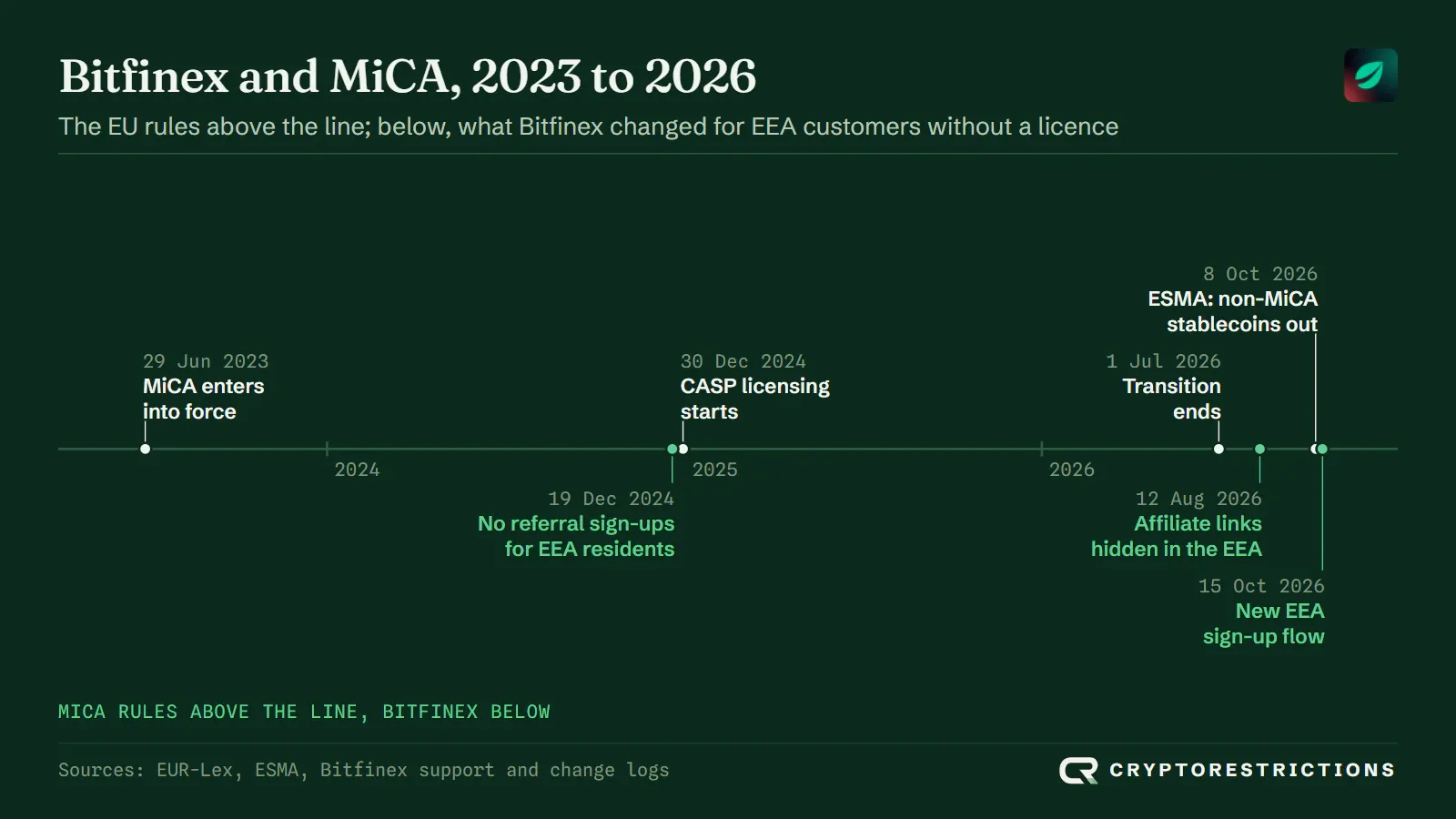
What Bitfinex has changed is around the edges. From 19 December 2024, its affiliate programme page says, EEA residents can no longer sign up with referral codes, citing new regulatory requirements, and the same day’s change log added pop-ups for EEA customers on some product pages. In August 2026 it hid affiliate links from EEA customers. In our test, the German sign-up form had no referral code field, unlike Cuba’s.
Is Bitfinex available in the US?
No. Bitfinex’s terms make every US person a prohibited person, its sign-up page refuses US visitors, and its US person FAQ says US citizens and residents cannot use the platform.
The terms keep one exception: Bitfinex may, at its discretion, accept US persons who are Eligible Contract Participants, a category of large institutions and wealthy investors under US commodities law, through a separate company, BFXNA Inc., and even they cannot lend or borrow. Retail Americans have been shut out since 2017: Bitfinex told its US individual customers in August 2017 that it would stop serving them within 90 days, Cointelegraph reported.
What Bitfinex has paid US authorities
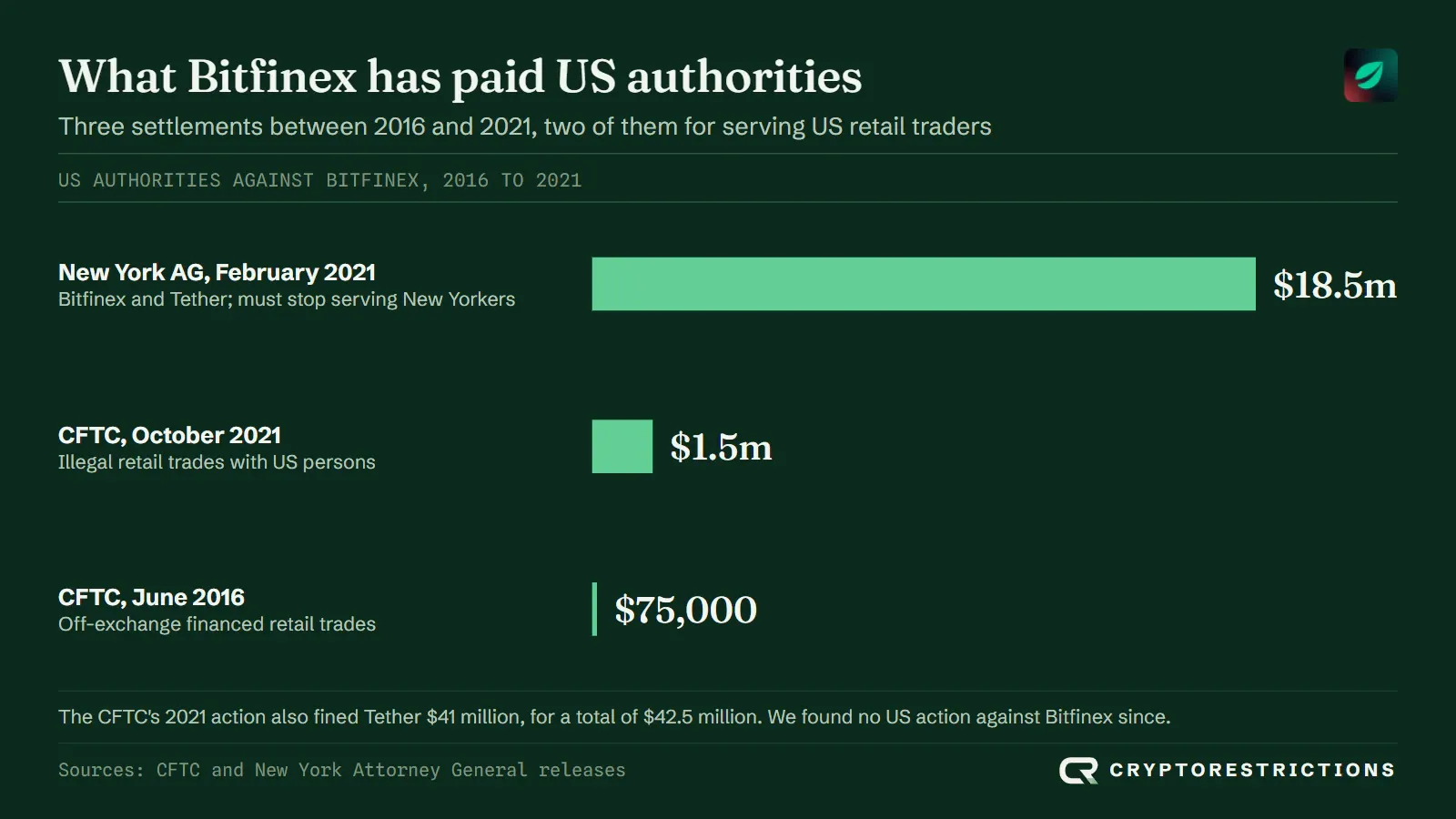
The penalties came from serving Americans. The CFTC fined Bitfinex $75,000 in June 2016 for off-exchange financed retail trades, and $1.5 million in October 2021 for illegal retail trades with US persons and for breaching the 2016 order, in the same action that fined Tether $41 million. In February 2021 the New York Attorney General settled with Bitfinex and Tether for $18.5 million and required them to end all trading with New Yorkers.
Bitfinex and the United States: timeline
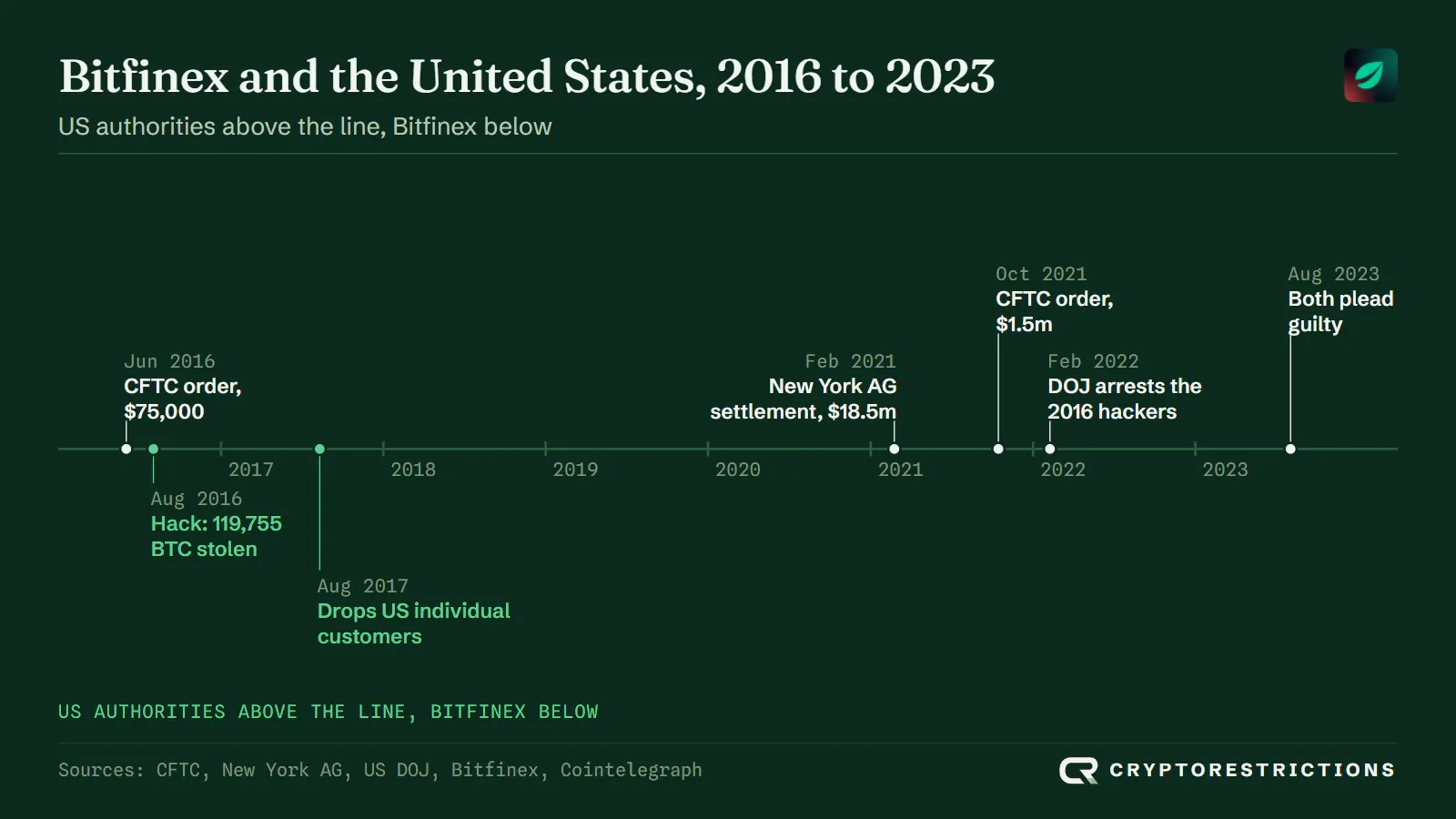
The US is also where Bitfinex’s biggest loss was pursued. Hackers took 119,755 BTC from Bitfinex on 2 August 2016, according to its recovery FAQ. The US Attorney’s Office in Washington charged a couple with laundering the proceeds; they were arrested in February 2022 and pleaded guilty on 3 August 2023.
Bitfinex KYC and identity verification
Bitfinex has three verification levels above a view-only Basic Access: Basic Plus opens spot trading, Intermediate adds margin and derivatives, and Full adds bank wires.
Bitfinex’s verification levels page (updated 4 September 2026) says an unverified account is view-only, though some can withdraw crypto worth less than $1,000. Its individual verification guide (updated 5 October 2026) asks for two government photo IDs, a selfie, a proof of address no older than three months and, for Full, a bank statement; users must be 18. Basic Plus is approved in 10 to 30 seconds, and Intermediate and Full in 2 to 3 working days, according to its verification times page.
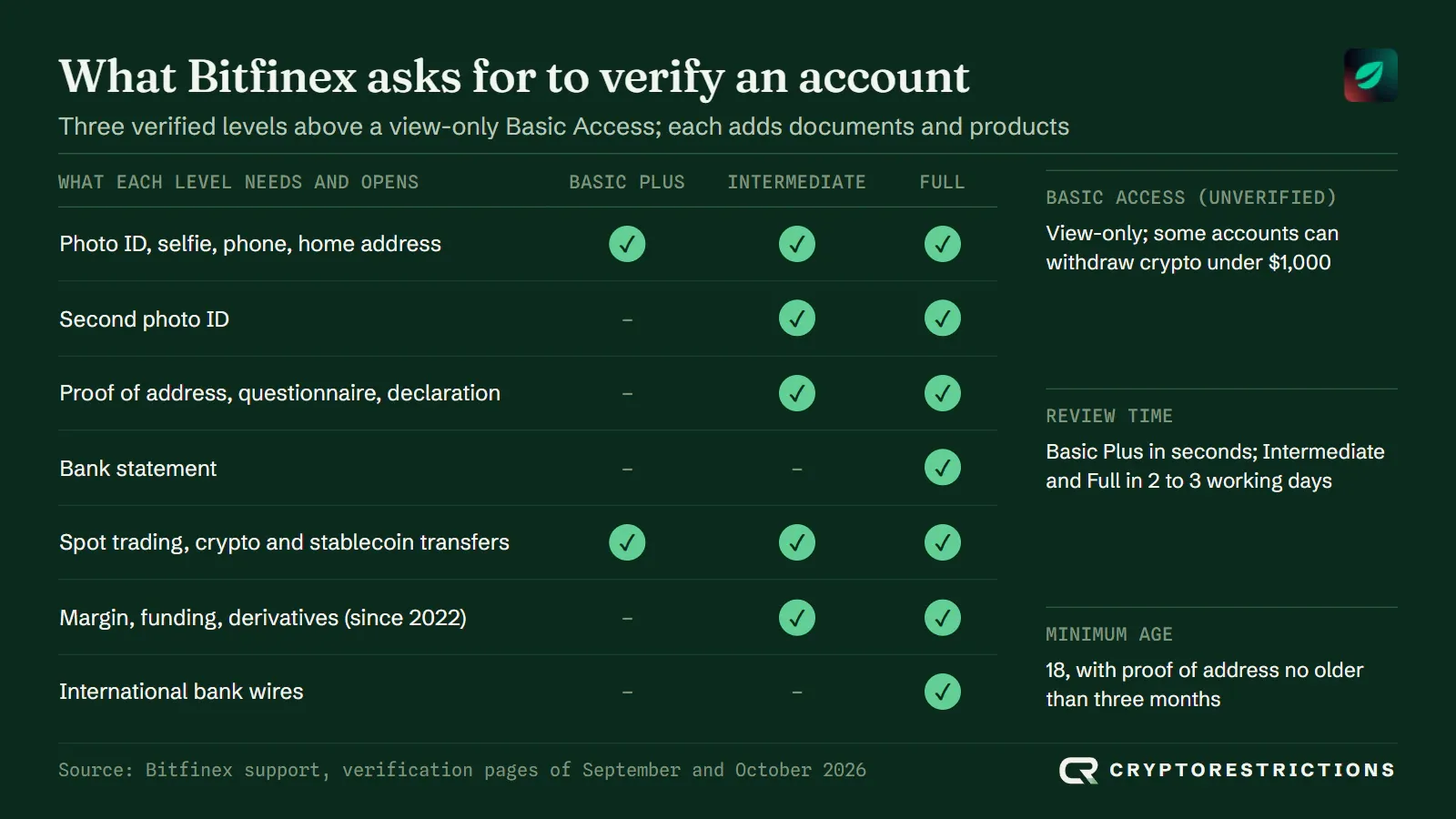
The levels page publishes no trading limits beyond the $1,000 withdrawal threshold and a $10,000 minimum for international wires, and Bitfinex reserves the right to ask for more information at any time. Its derivatives page says derivatives are open only to Intermediate users and above in eligible jurisdictions, with leverage of up to 100x.
Bitfinex verification history
Bitfinex once asked for a $10,000 balance before an account could trade; it dropped the minimum on 9 April 2019, and added the Intermediate level on 14 August 2019. Accounts opened since 1 March 2022 need Intermediate for margin, and since 9 November 2022 new accounts start view-only.
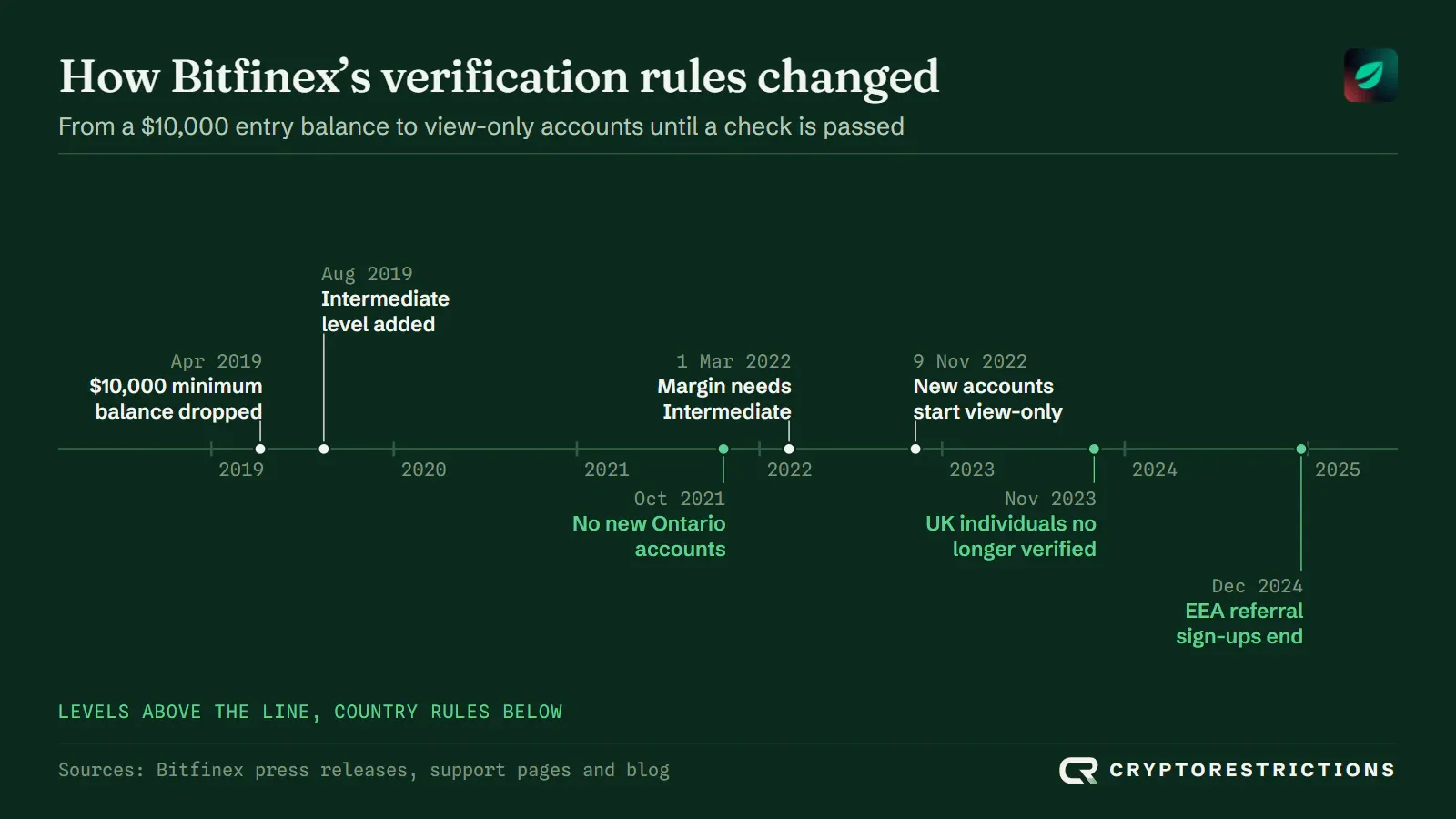
The country rules tightened over the same years: Ontario in 2021, UK individuals in 2023 and EEA referral sign-ups in 2024. For how Bitfinex’s checks compare with other exchanges, see our guide to crypto exchange KYC.
What if Bitfinex is restricted where you live?
It depends on the country: of the 21 other platforms we track, 8 are available in Syria, 6 in Japan and 4 in the UK, but only 1 in Cuba, Iran and North Korea.
A VPN is no route around it. Bitfinex’s terms forbid anyone covered by its prohibitions from using a VPN or proxy to disguise their location, and verification asks for two IDs and a proof of address. What is left is a platform that is allowed to serve you where you live.
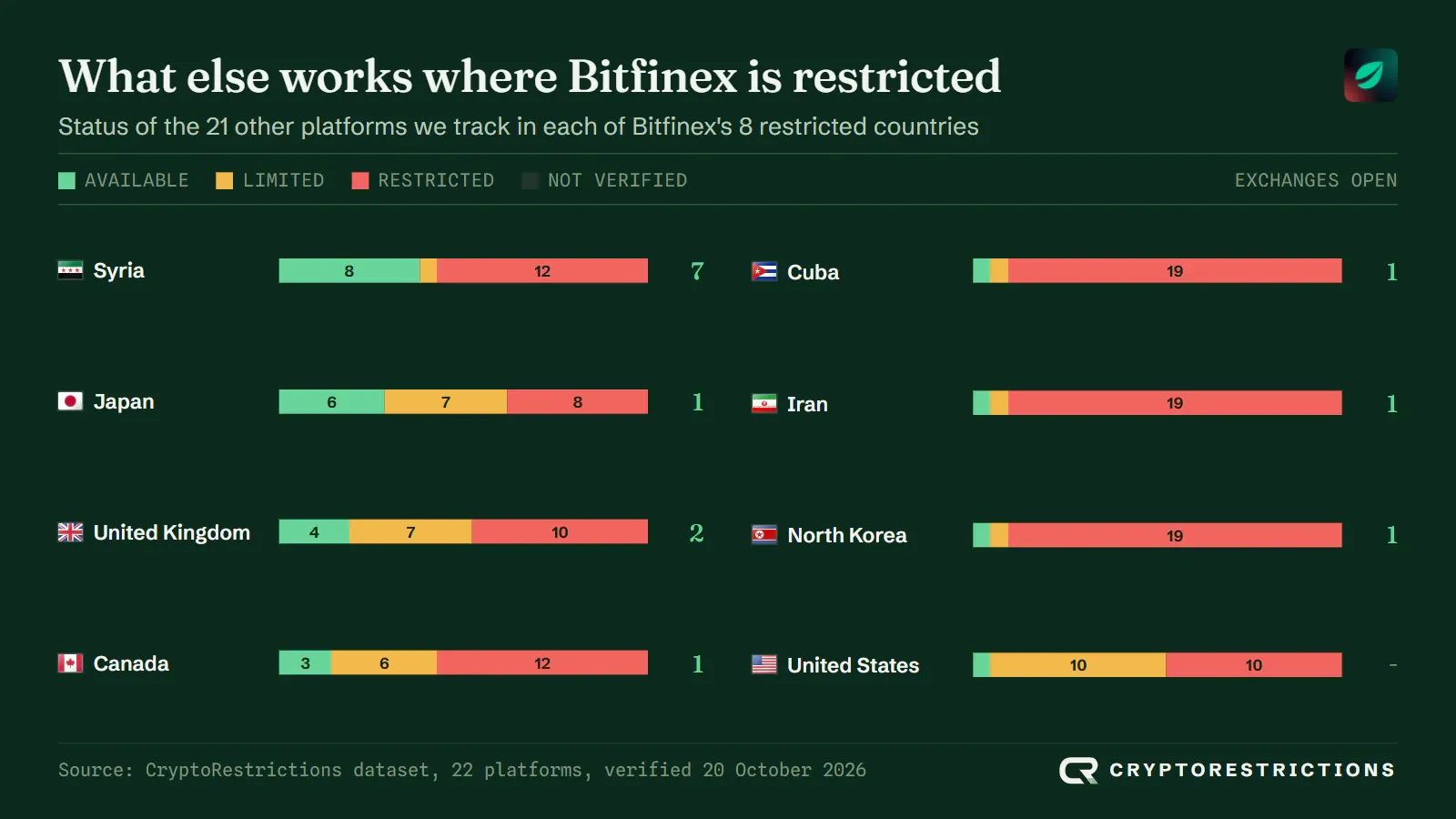
The chart shows how much choice each restricted country has. Japan and the UK keep several open platforms, though only two centralised exchanges each. Canada has one, Coinbase, and the US none: every other exchange we track restricts it or limits what it offers there. In Cuba, Iran and North Korea the one exchange recorded as available is KuCoin, under our coverage rule; Bitstamp is limited there.
Each country page lists every platform we track there with its status and sources; start from our country index.