
Is crypto legal in Georgia?
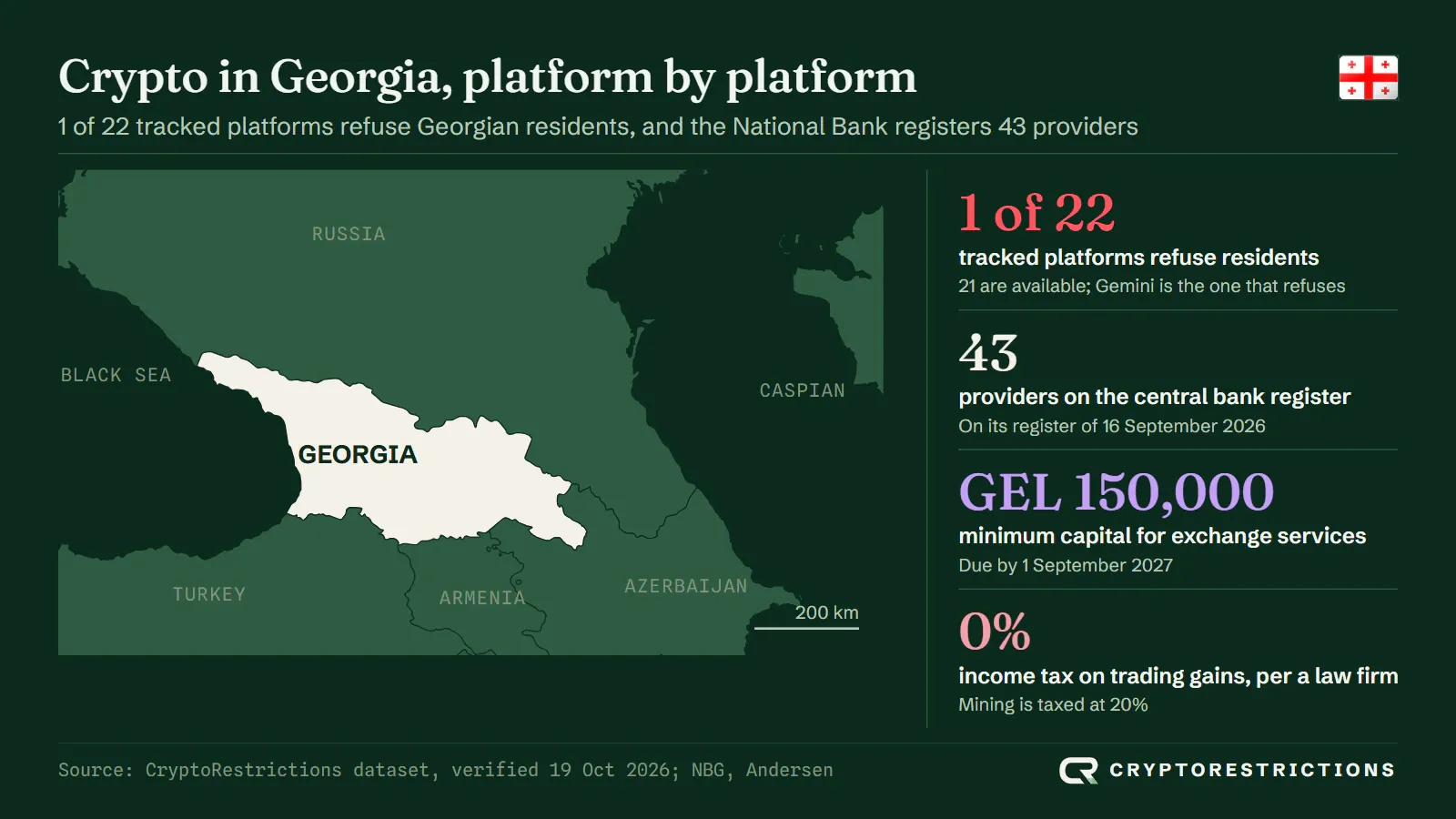
Crypto is not banned in Georgia, and since 1 July 2023 any business that exchanges, holds or moves it for other people has had to register with the National Bank of Georgia (NBG).
The NBG defines a virtual asset as a digital representation of value that can be traded or transferred and used for investment or payment, and it leaves out fiat currencies, securities and other financial instruments. It lists seven regulated services: exchange (including through kiosks), transfer, safekeeping, portfolio management, running a trading platform, lending and initial coin offerings. The NBG approved its registration rule on 20 June 2023, in force from 1 July 2023, with fit-and-proper tests for the people who run and own a provider. We found no Georgian law that bans holding or trading crypto.
Only registered providers may offer those services. The NBG’s notice of 7 October 2025 says the Organic Law on the National Bank bars anyone who is not registered, with an exception for banks, microbanks, microfinance organisations and brokerage companies, and that the same holds in the Free Industrial Zones. Amendments to that law, reprinted by Caucasus Business Week from an NBG release that carries no date, let the bank demand information through on-site and off-site inspections and set minimum capital and risk standards.
Georgia is not in the EU, and we found no Georgian law or bill that adopts MiCA, the EU’s crypto regulation. The rules are the NBG’s own.
Mining has a longer history. JAMnews reported in February 2018 that BitFury had built data centres in Gori and Tbilisi, the Tbilisi one on land that was then declared a free industrial zone, with exemptions from VAT, profit tax and property tax. The more recent problem is unlicensed mining on household supply: on 1 June 2026 the vice prime minister said illegal mining had pushed electricity use in Mestia to 133 million kilowatt-hours in 2025, more than 13 times comparable municipalities, and announced meters for every village there. The report does not say which law the miners broke or what licence, if any, a legal miner needs.
Which crypto exchanges work in Georgia?
Twenty-one of the 22 platforms we track serve Georgians by their own terms, but only Bybit is on the NBG register, which held 43 providers on 16 September 2026.
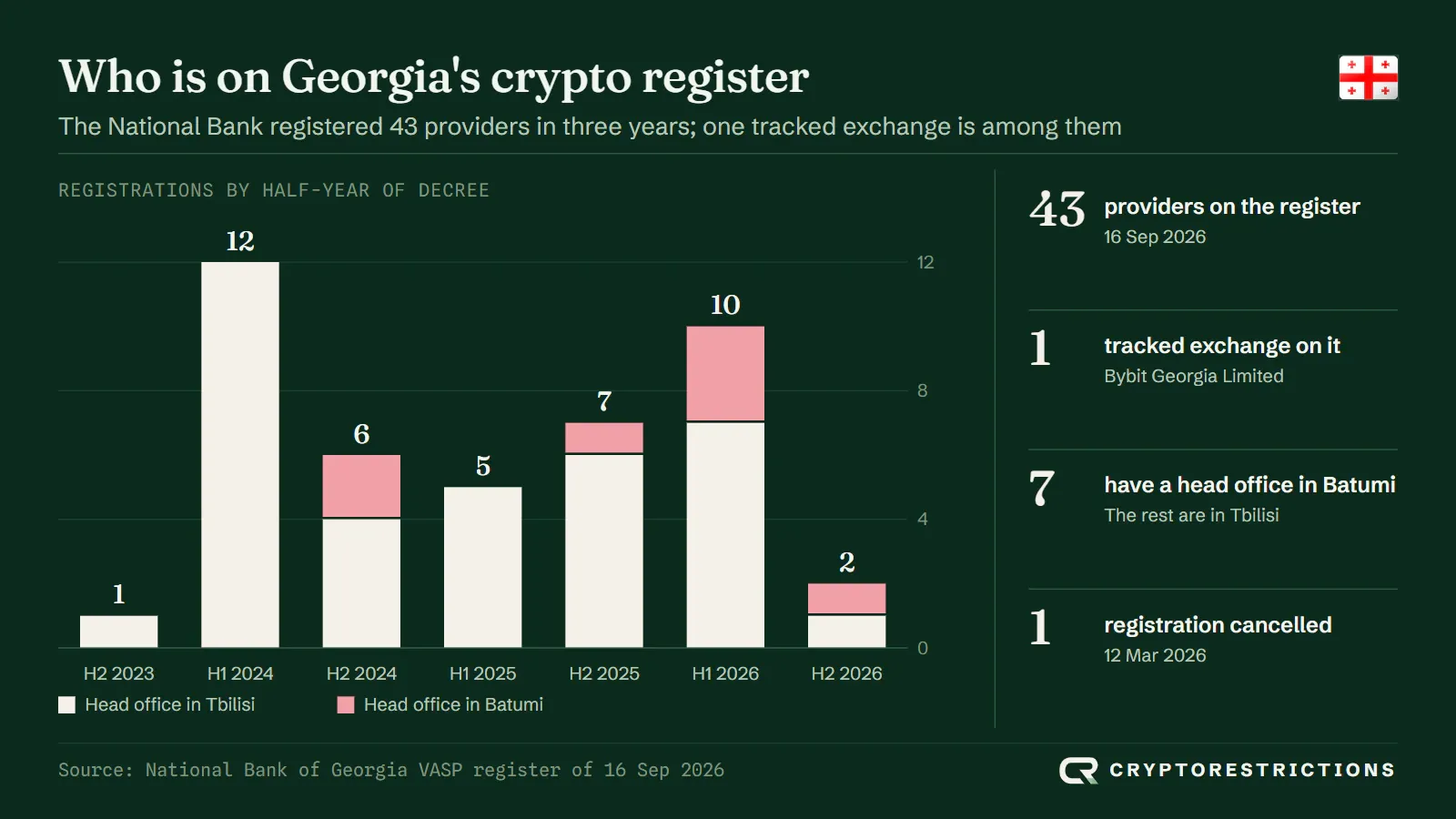
The register shows how the market grew: one provider in November 2023, 18 decrees in 2024, 12 in 2025 and 12 more by 26 August 2026. Thirty-six have a head office in Tbilisi and seven in Batumi, and the NBG cancelled one registration on 12 March 2026. The rest are local companies, with WhiteBit Georgia the one other international name we recognised.
Bybit is the one tracked exchange with a Georgian entity: Bybit Georgia Limited is registered under number 0019-9404, by a decree of 24 October 2024, and Bybit announced it in November 2024. We found no entity of any other tracked platform on the register. Bitget lists a licence in the Tbilisi Free Industrial Zone on its own licence page, and it is not on the NBG register; the NBG has said that providers in the free zones must register as well.
What decides access in practice is each platform’s own terms. The restricted lists we read name sanctioned places and a handful of countries, and none names Georgia. Gemini is the exception, because its lists of supported countries leave Georgia out.

Best crypto platforms for Georgian residents
Bybit leads our access score for Georgian residents at 9.0 out of 10, the only platform with a Georgian licence point; seven exchanges that loaded in our test follow at 8.0, and the platforms we could not test sit at 7.5.
The score rates how fully a Georgian resident can use each platform, not its fees or safety. It is computed from our data and moves when a row changes: access status (4 points), the share of the platform’s products open here (3), the Georgian licences we hold on file (2) and what our geo-access test saw from a Georgian address (1). Platforms that refuse Georgian residents are not scored. The full method is on our methodology page.
Exchanges

Bybit
Best for The one tracked exchange on the NBG register
9.0/10- Access
- 4/4
- Products
- 3/3
- Licences
- 1/2
- Our test
- 1/1
Read our Bybit reportPros
- Bybit Georgia Limited is registered (24 October 2024)
- Its pages loaded in our test
Cons
- Registered providers have until 1 September 2027 to meet the capital rules

Binance
Best for The widest product list on a global exchange
8.0/10- Access
- 4/4
- Products
- 3/3
- Licences
- 0/2
- Our test
- 1/1
Read our Binance reportPros
- Georgia is not on its List of Prohibited Countries
- Its pages loaded in our test
Cons
- We found no entity on the NBG register

Bitfinex
Best for Spot access without a local company
8.0/10- Access
- 4/4
- Products
- 3/3
- Licences
- 0/2
- Our test
- 1/1
Read our Bitfinex reportPros
- Georgia is not a prohibited jurisdiction in its terms
- Its pages loaded in our test
Cons
- We found no entity on the NBG register

Bitget
Best for An exchange that names a Tbilisi free-zone licence
8.0/10- Access
- 4/4
- Products
- 3/3
- Licences
- 0/2
- Our test
- 1/1
Read our Bitget reportPros
- Georgia is not on its prohibited list
- Its pages loaded in our test
Cons
- The free-zone licence is not an NBG registration

HTX
Best for A wide coin list with a long restricted list to check
8.0/10- Access
- 4/4
- Products
- 3/3
- Licences
- 0/2
- Our test
- 1/1
Read our HTX reportPros
- Georgia is on neither its all-services nor its derivatives-only list
Cons
- Its terms bar every EU state, so check the list before you move

KuCoin
Best for A wide coin list on a global exchange
8.0/10- Access
- 4/4
- Products
- 3/3
- Licences
- 0/2
- Our test
- 1/1
Read our KuCoin reportPros
- Georgia is not on its restricted list
- Its pages loaded in our test
Cons
- We found no entity on the NBG register

MEXC
Best for Spot access with a long coin list
8.0/10- Access
- 4/4
- Products
- 3/3
- Licences
- 0/2
- Our test
- 1/1
Read our MEXC reportPros
- Georgia is not on its list of places it does not serve
- Its pages loaded in our test
Cons
- We found no entity on the NBG register

OKX
Best for Spot trading from a global brand
8.0/10- Access
- 4/4
- Products
- 3/3
- Licences
- 0/2
- Our test
- 1/1
Read our OKX reportPros
- Georgia is not on its restricted list
- Its pages loaded in our test
Cons
- We found no entity on the NBG register

Bitstamp
Best for Plain spot trading
7.5/10- Access
- 4/4
- Products
- 3/3
- Licences
- 0/2
- Our test
- 0.5/1
Read our Bitstamp reportPros
- No Bitstamp document excludes Georgia
Cons
- We found no entity on the NBG register
- Not covered by our test

Coinbase
Best for A major brand with no Georgia restriction in its documents
7.5/10- Access
- 4/4
- Products
- 3/3
- Licences
- 0/2
- Our test
- 0.5/1
Read our Coinbase reportPros
- Its prohibited-regions page is sanctions-based and omits Georgia
Cons
- No supported-country list names Georgia
- Not covered by our test

Crypto.com
Best for Spot trading in an app
7.5/10- Access
- 4/4
- Products
- 3/3
- Licences
- 0/2
- Our test
- 0.5/1
Read our Crypto.com reportPros
- Georgia is not on its App or spot lists
Cons
- We found no entity on the NBG register
- Not covered by our test

Gate
Best for A wide coin list on a global exchange
7.5/10- Access
- 4/4
- Products
- 3/3
- Licences
- 0/2
- Our test
- 0.5/1
Read our Gate reportPros
- Georgia is not named in its restricted locations
Cons
- Our test showed an EU-region notice
- We found no entity on the NBG register

Kraken
Best for Plain spot trading
7.5/10- Access
- 4/4
- Products
- 3/3
- Licences
- 0/2
- Our test
- 0.5/1
Read our Kraken reportPros
- Georgia is not on its prohibited regions list
Cons
- We found no entity on the NBG register
- Not covered by our test
Prediction markets

Kalshi
Best for Event markets with no Georgia restriction
7.5/10- Access
- 4/4
- Products
- 3/3
- Licences
- 0/2
- Our test
- 0.5/1
Read our Kalshi reportPros
- Not on its restricted-jurisdictions list
Cons
- No Georgian ruling on whether event contracts count as betting
- Not covered by our test

Polymarket
Best for Event markets with no Georgia restriction
7.5/10- Access
- 4/4
- Products
- 3/3
- Licences
- 0/2
- Our test
- 0.5/1
Read our Polymarket reportPros
- Not on its blocked or close-only lists
Cons
- No Georgian ruling on whether event contracts count as betting
- Not covered by our test
DeFi

Aster
Best for Perpetuals from your own wallet
8.0/10- Access
- 4/4
- Products
- 3/3
- Licences
- 0/2
- Our test
- 1/1
Read our Aster reportPros
- Georgia is not on its prohibited list
- The trading app loaded in our test
Cons
- No Georgian authority has addressed it, and no registration applies

Hyperliquid
Best for Perpetuals from your own wallet
8.0/10- Access
- 4/4
- Products
- 3/3
- Licences
- 0/2
- Our test
- 1/1
Read our Hyperliquid reportPros
- Georgia is not a restricted place in its terms
- The app loaded in our test
Cons
- No Georgian authority has addressed it, and no registration applies

Lighter
Best for Perpetuals from your own wallet
8.0/10- Access
- 4/4
- Products
- 3/3
- Licences
- 0/2
- Our test
- 1/1
Read our Lighter reportPros
- Georgia is not on its restricted list
- The trading app loaded in our test
Cons
- No Georgian authority has addressed it, and no registration applies

Jupiter
Best for Solana swaps
7.5/10- Access
- 4/4
- Products
- 3/3
- Licences
- 0/2
- Our test
- 0.5/1
Read our Jupiter reportPros
- Georgia is not in its terms
Cons
- Not covered by our test

PancakeSwap
Best for BNB Chain swaps and pools
7.5/10- Access
- 4/4
- Products
- 3/3
- Licences
- 0/2
- Our test
- 0.5/1
Read our PancakeSwap reportPros
- Georgia is not barred by its terms or on its perpetuals list
Cons
- Not covered by our test

Uniswap
Best for Swapping tokens from your own wallet
7.5/10- Access
- 4/4
- Products
- 3/3
- Licences
- 0/2
- Our test
- 0.5/1
Read our Uniswap reportPros
- Its terms bar only places under comprehensive US sanctions
Cons
- Not covered by our test
Which platforms block Georgian users?
One of the 22 platforms we track refuses Georgian residents outright: Gemini. The other 21 are available, though two entries are worth a second look.
Gemini publishes its availability by region and does not name Georgia on either of its lists, so we record it as refusing under our rule for allow-lists. Georgia appears on that page only as a US state.
What our geo-access test saw from Georgia
From a Georgian address on 14 and 16 October 2026 we loaded 12 of the 22 platforms we track: 11 loaded with no barrier and 1 showed a notice.
The notice was on Gate, which said the visit looked like it came from the EU region and suggested its EU site; that is not a Georgia restriction. Ten platforms were not tested from Georgia: Coinbase, Kraken, Bitstamp, Gemini, Crypto.com, Polymarket, Kalshi, Uniswap, Jupiter and PancakeSwap. Our test uses a virtual Georgian location, so it sees a platform’s own geo-blocking and cannot see a block by Georgian internet providers. An open page is not permission to trade, because most platforms enforce at identity checks. Swipe through the screenshots below; each card quotes what the page showed.
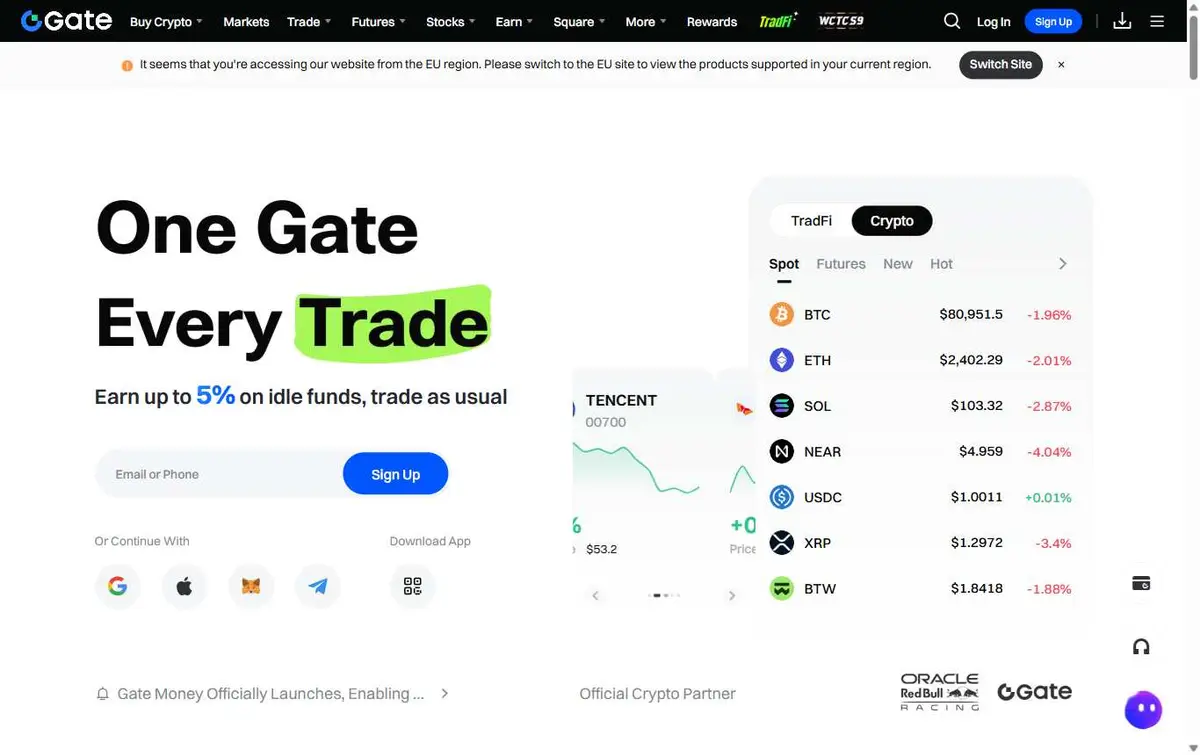
Notice shown Gate · Home page
Georgia: Gate shows a notice that the visit comes from the EU region
“It seems that you're accessing our website from the EU region.”
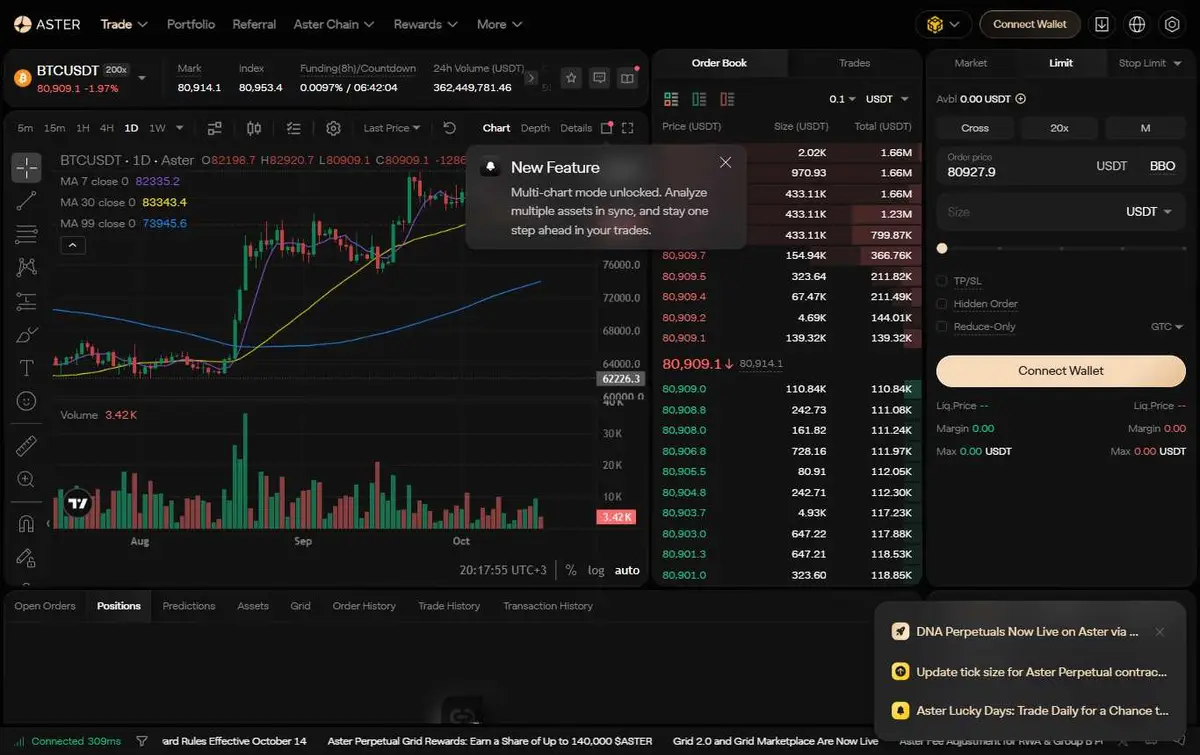
No barrier Aster · Trading app
Georgia: the trading app loads with no notice
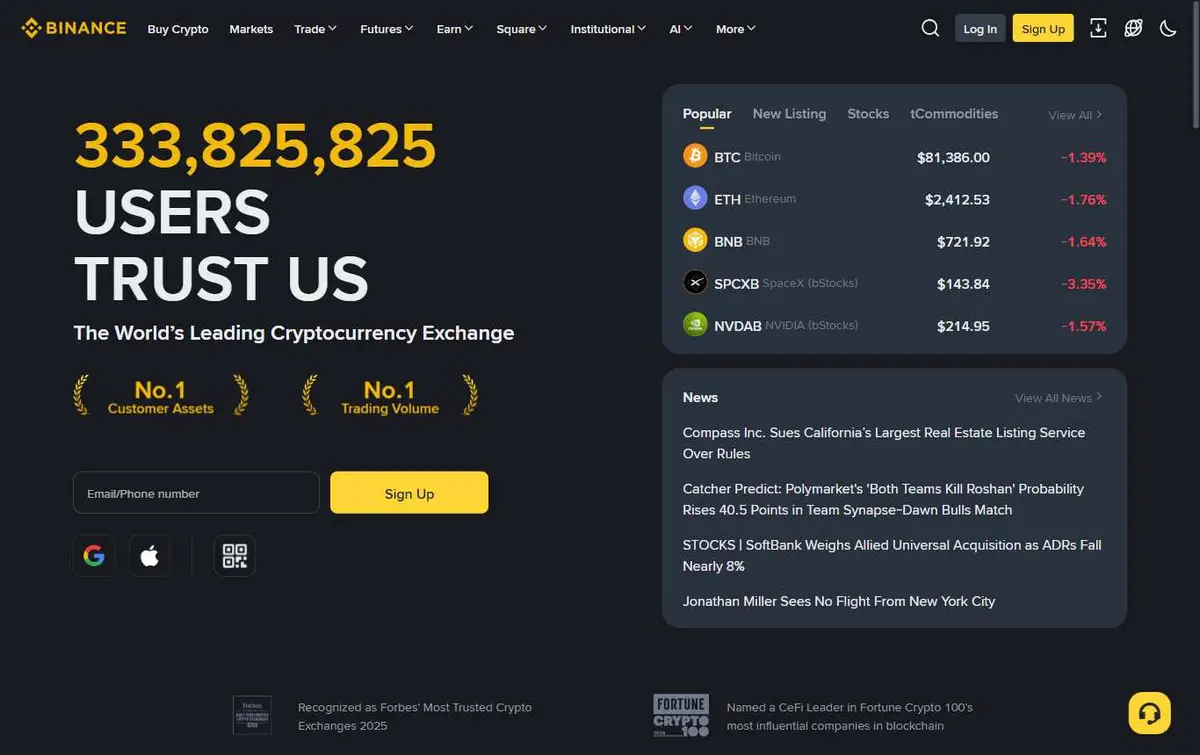
No barrier Binance · Home page
Georgia: the global site loads with no notice
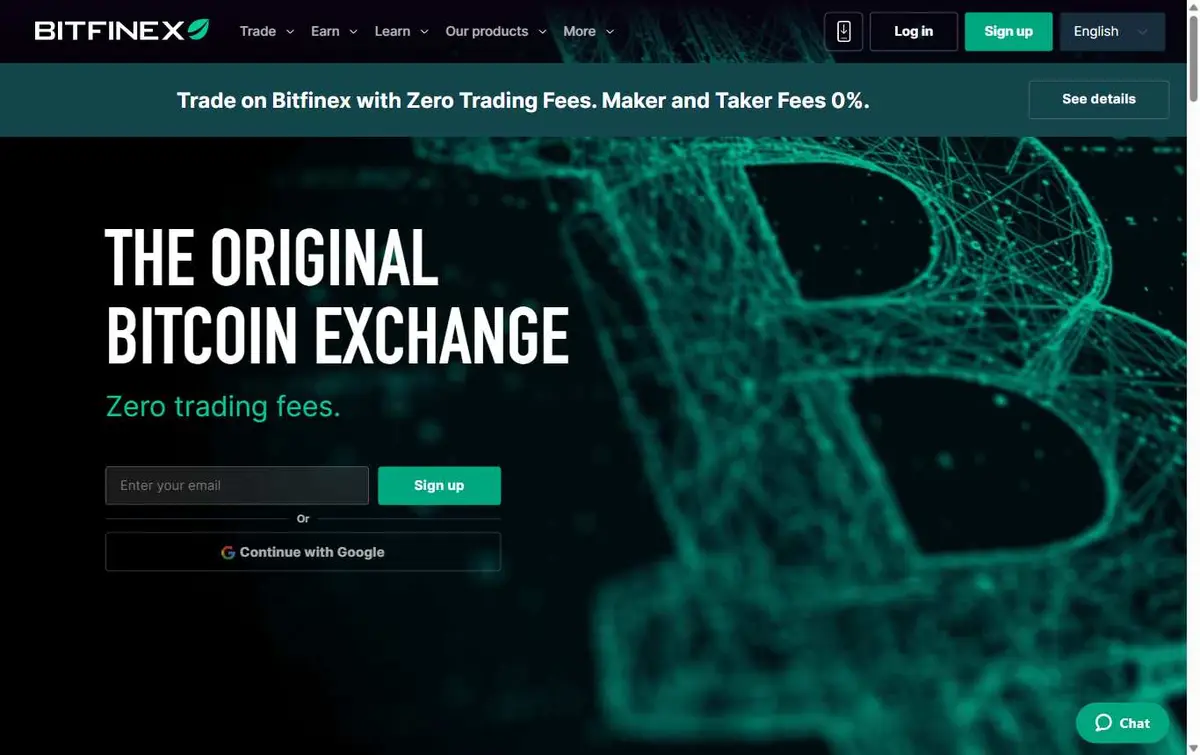
No barrier Bitfinex · Home page
Georgia: the home page loads with no notice
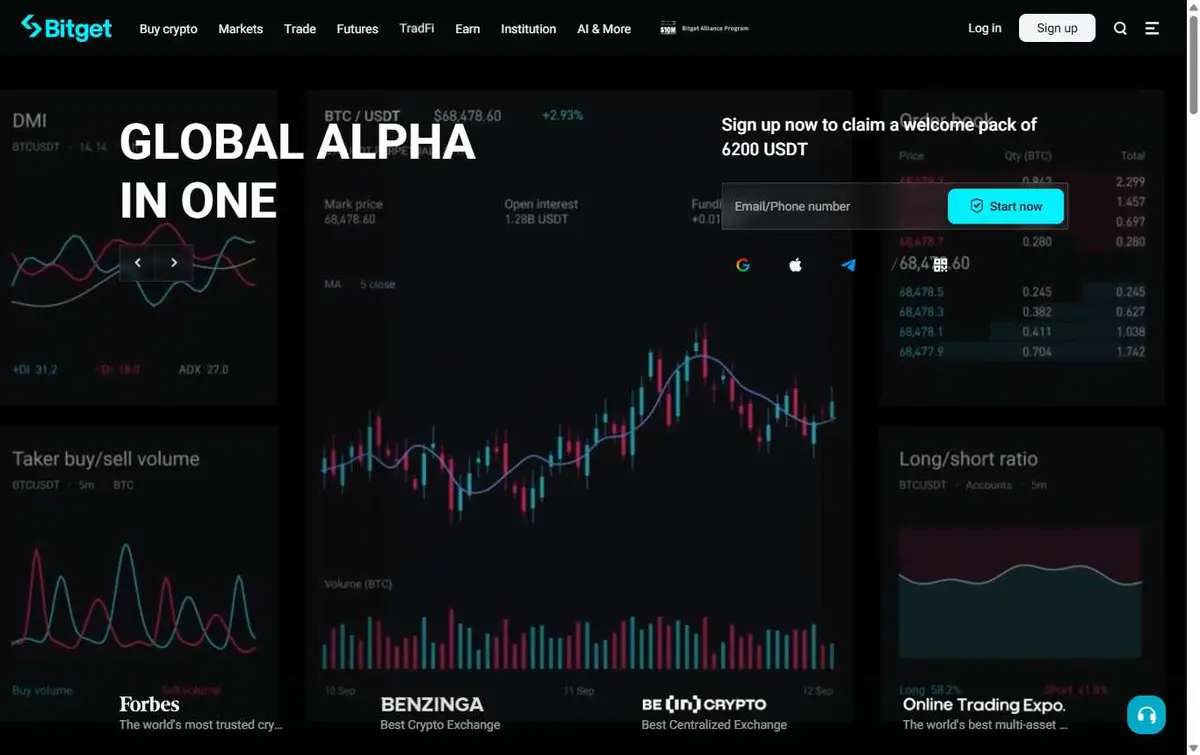
No barrier Bitget · Home page
Georgia: the home page loads with no notice
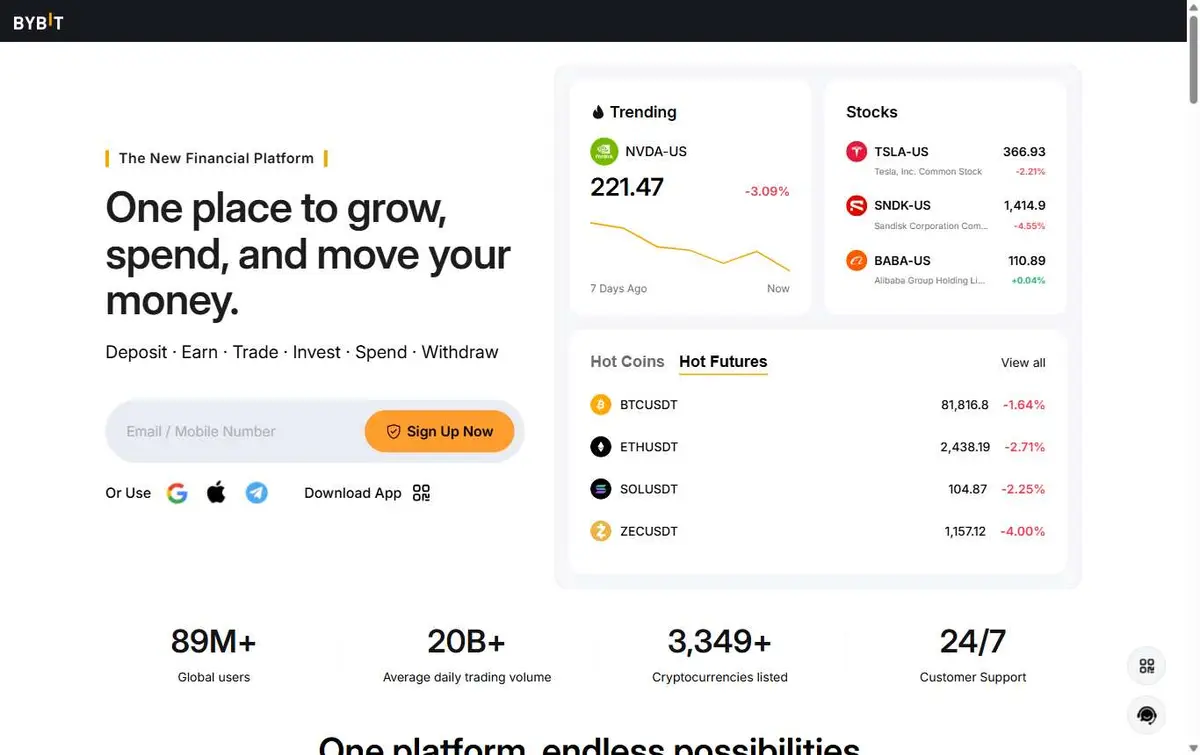
No barrier Bybit · Home page
Georgia: the global site loads with no notice
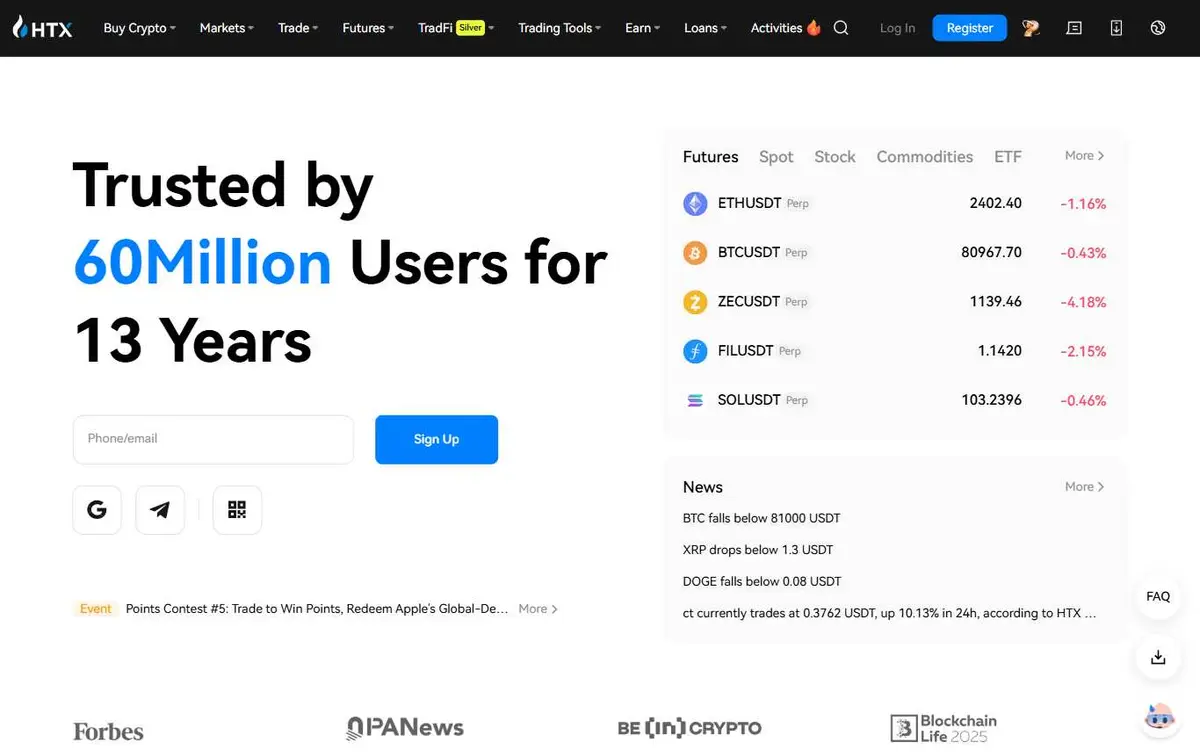
No barrier HTX · Home page
Georgia: the home page loads with no notice
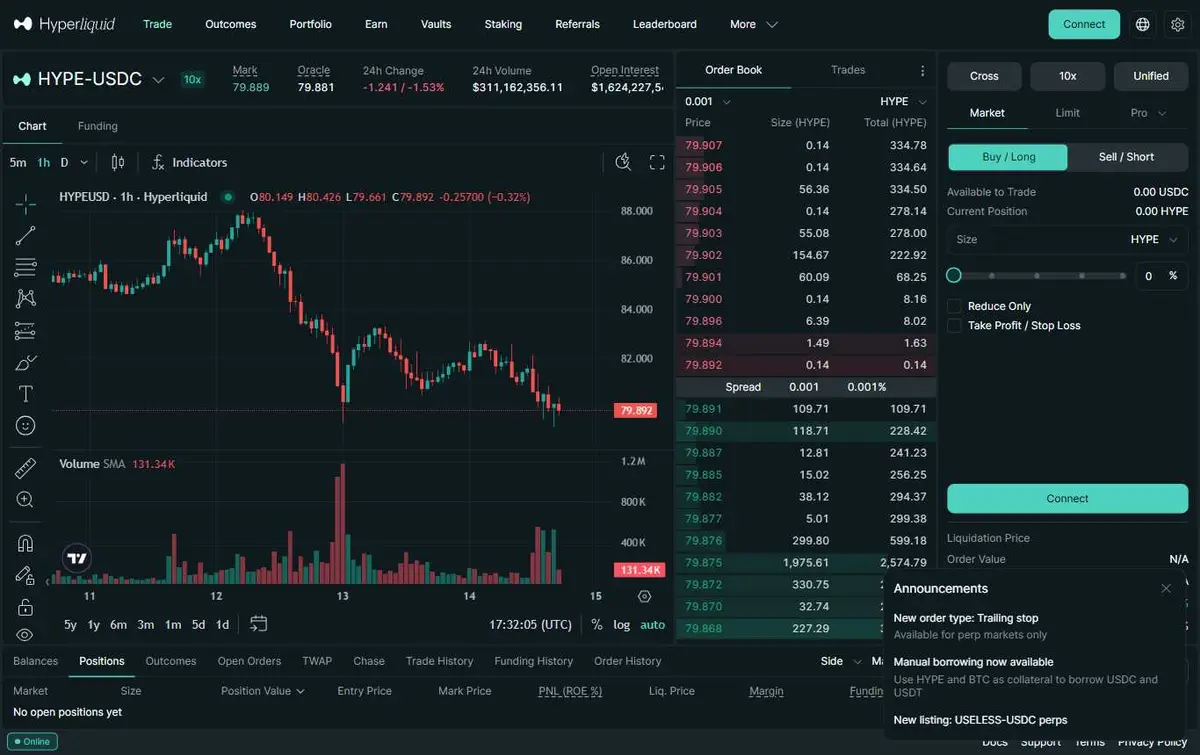
No barrierHyperliquid · Trading app
Georgia: the trading app loads with no notice
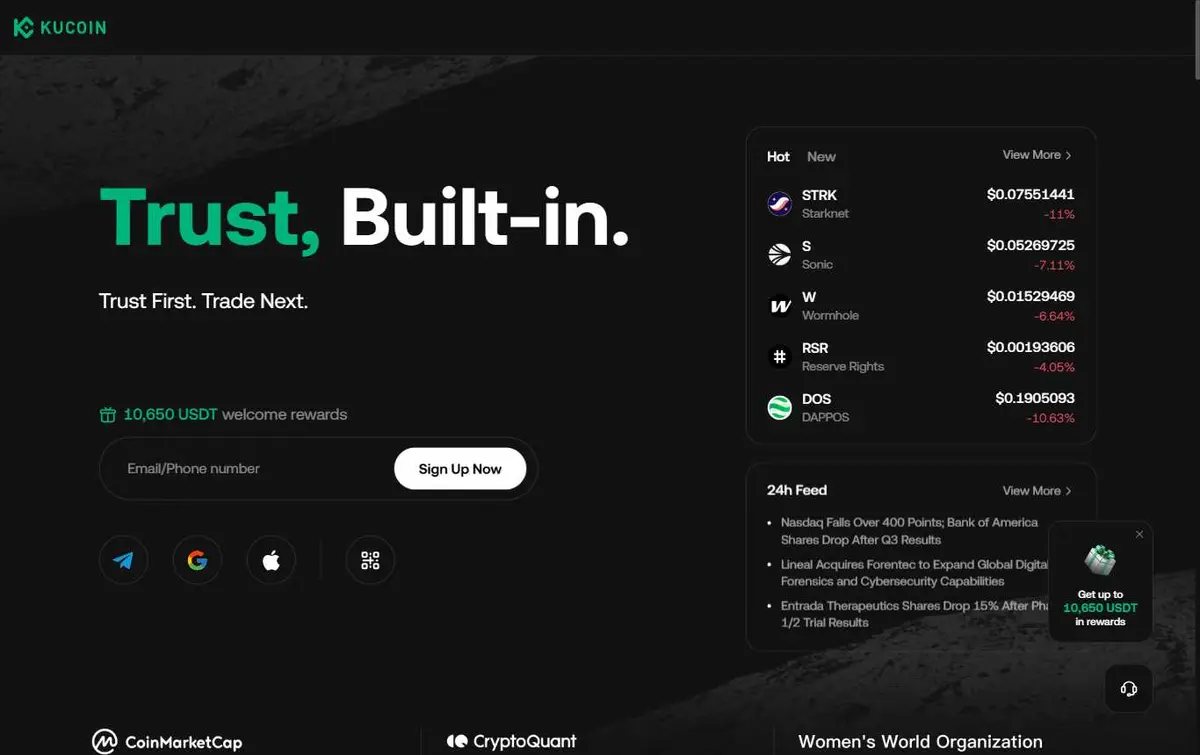
No barrier KuCoin · Home page
Georgia: the home page loads with no notice
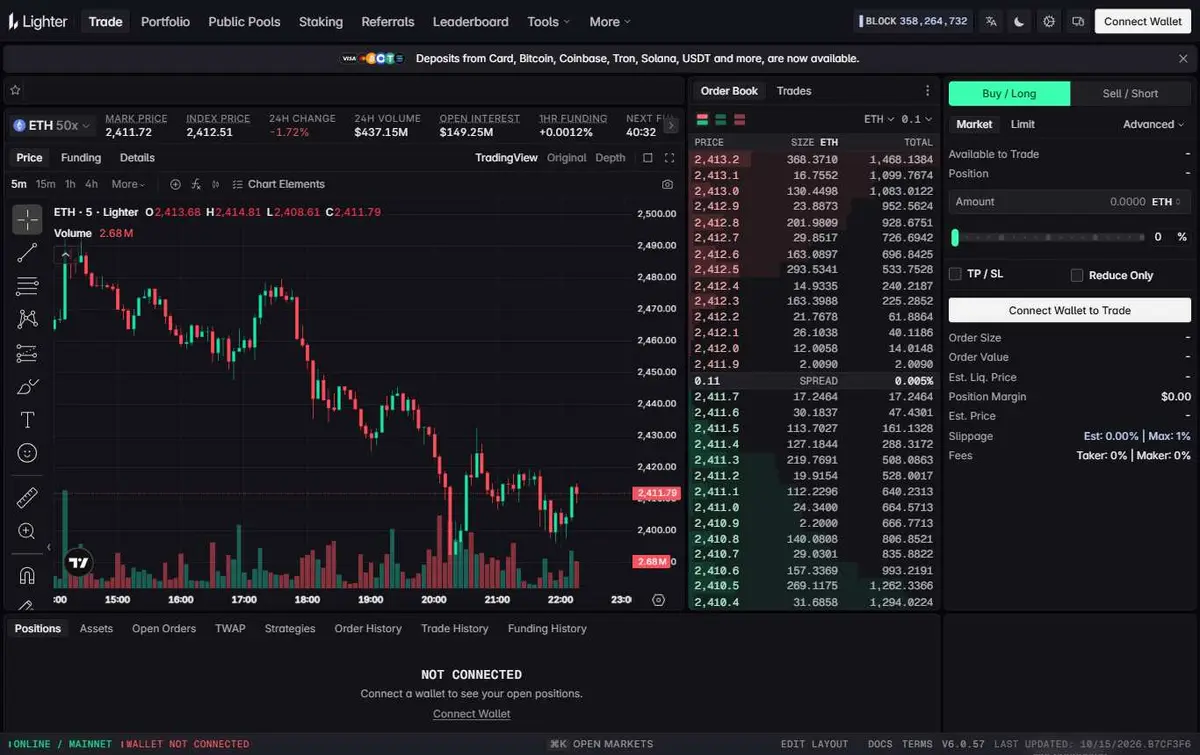
No barrier Lighter · Trading app
Georgia: the trading app loads with no notice
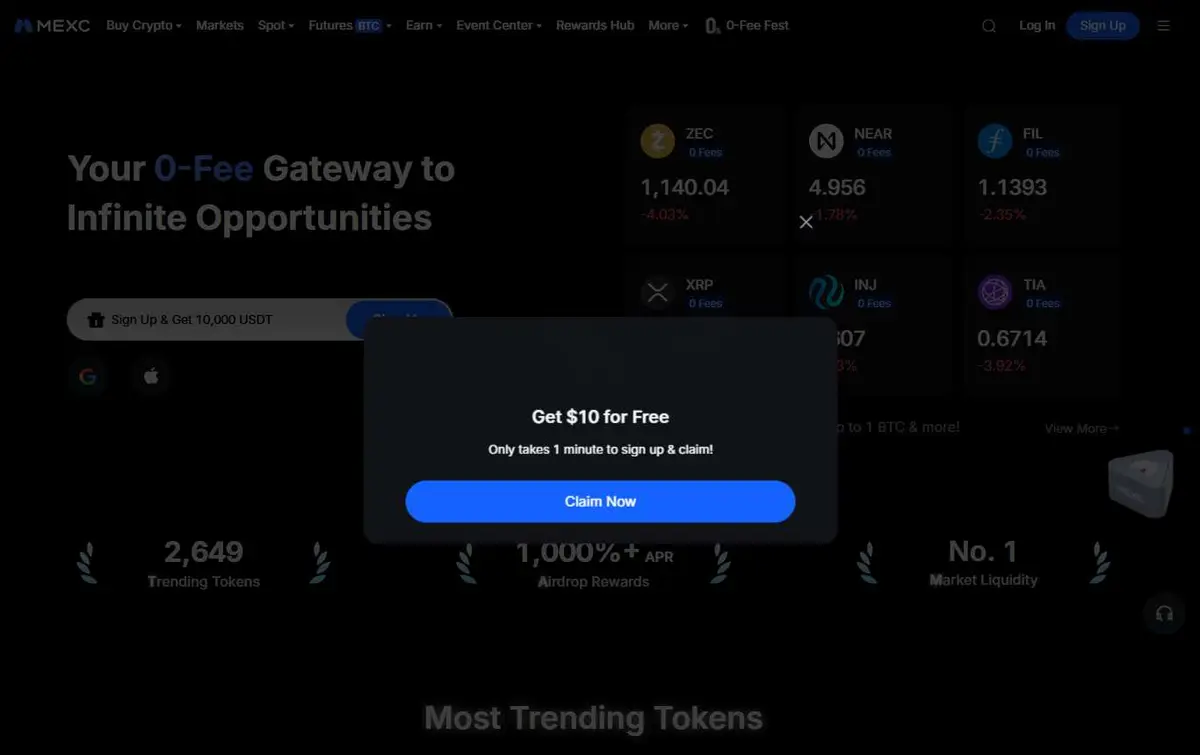
No barrier MEXC · Home page
Georgia: the home page loads with no notice
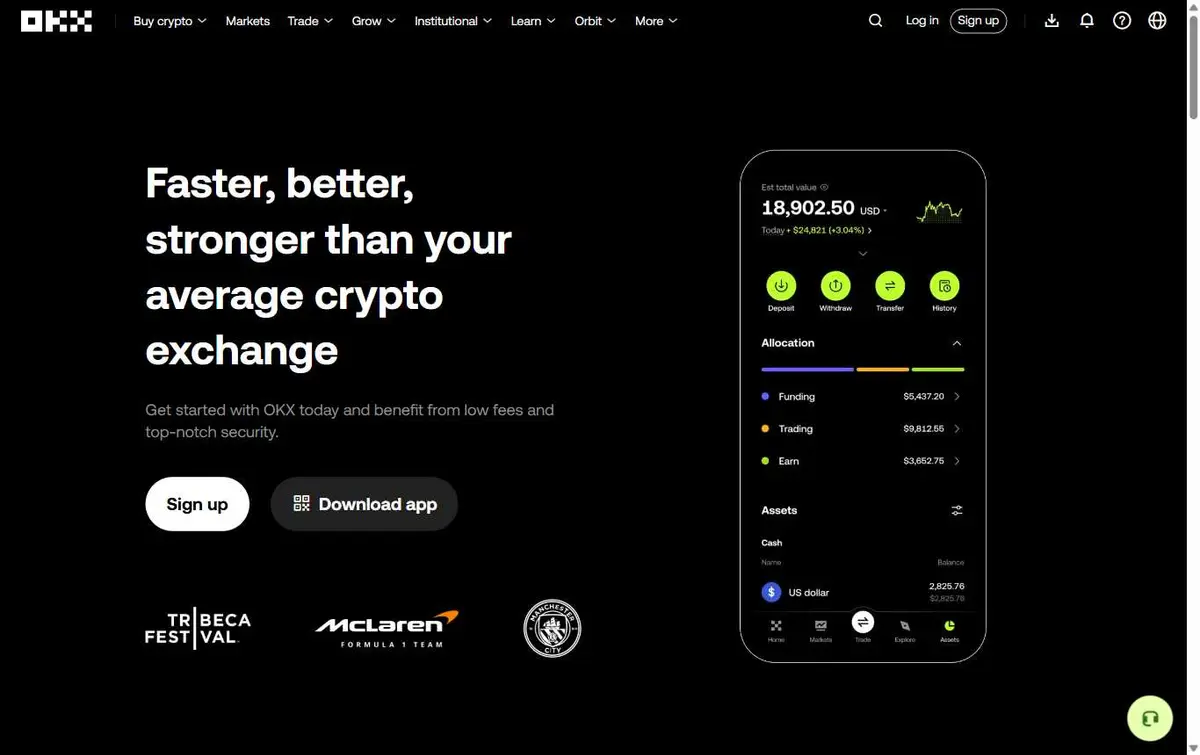
No barrier OKX · Home page
Georgia: the home page loads with no notice
 CRYPTORESTRICTIONS
Who regulates crypto in Georgia?
The National Bank of Georgia is the crypto regulator: it registers providers, supervises them and writes the rules, while the tax and gambling questions sit with other bodies.
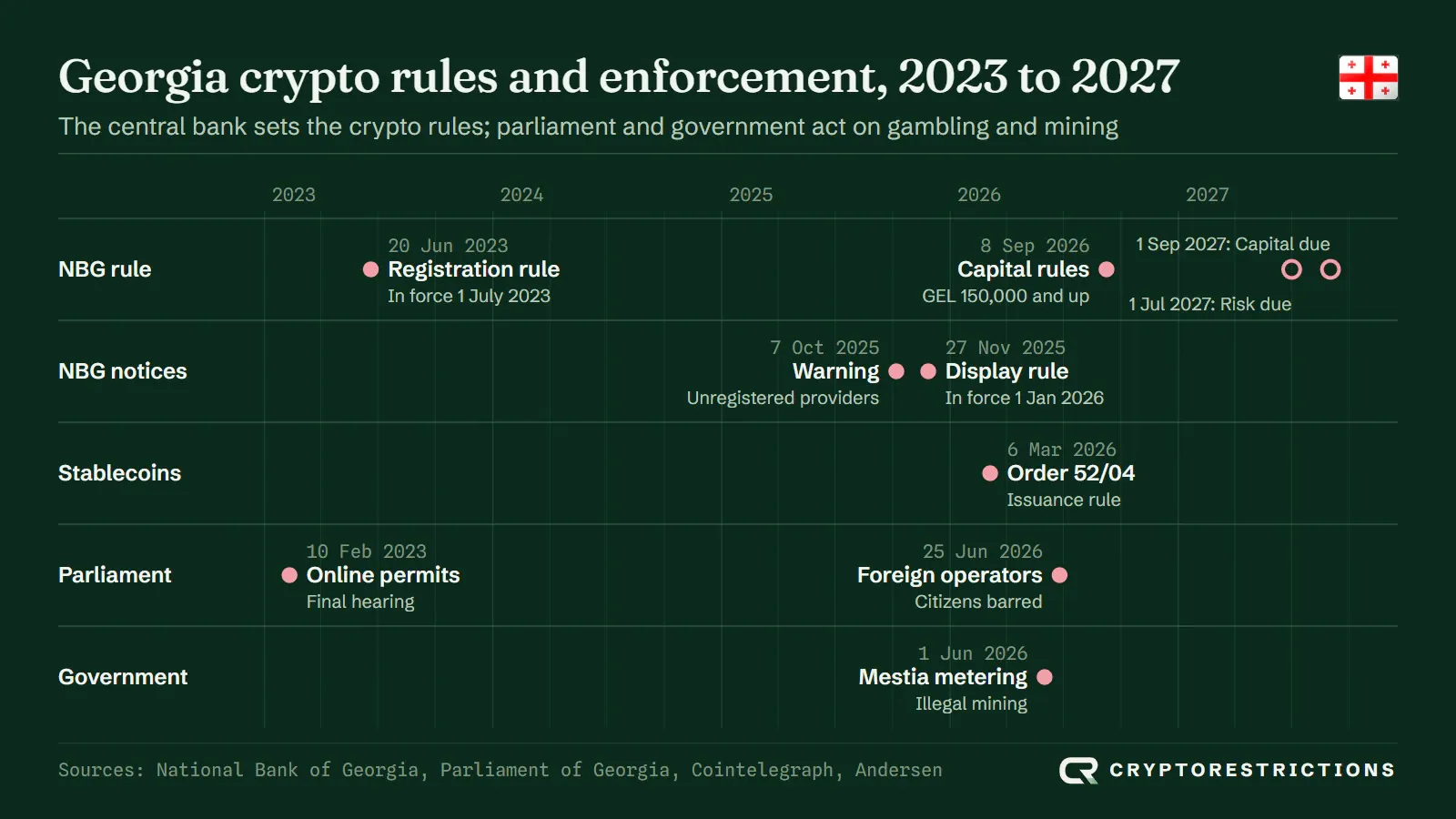
- NBG. The central bank keeps the VASP register and set the registration rule in 2023, aligned with the FATF’s recommendations. On 27 November 2025 it required every registered provider to display its registration act in each branch, kiosk, website and app, from 1 January 2026. On 8 September 2026 it added minimum capital by service and risk-management rules, with deadlines in 2027 (see the products section).
- Enforcement. The NBG said in October 2025 that it regularly finds people providing virtual asset services without registration, including in the Free Industrial Zones, and told the public to check a provider before using it. We found no named enforcement action against a tracked platform.
- Stablecoins. Order 52/04 of 6 March 2026 lets registered providers issue stablecoins under a rule of their own, with the issued coins at least fully backed.
- Parliament and government. Parliament writes the gambling law, covered in the prediction markets section, and the government set the Mestia mining crackdown in motion in June 2026.
- Revenue Service. It is the tax authority. Andersen reports that it has not issued detailed guidance on how VAT applies to providers.
- EU. We found no Georgian law or bill that applies MiCA.
Which crypto products are limited in Georgia?
The limits fall on providers more than on products: each service has its own minimum capital, from GEL 150,000 for an exchange to GEL 500,000 for stablecoin issuance.
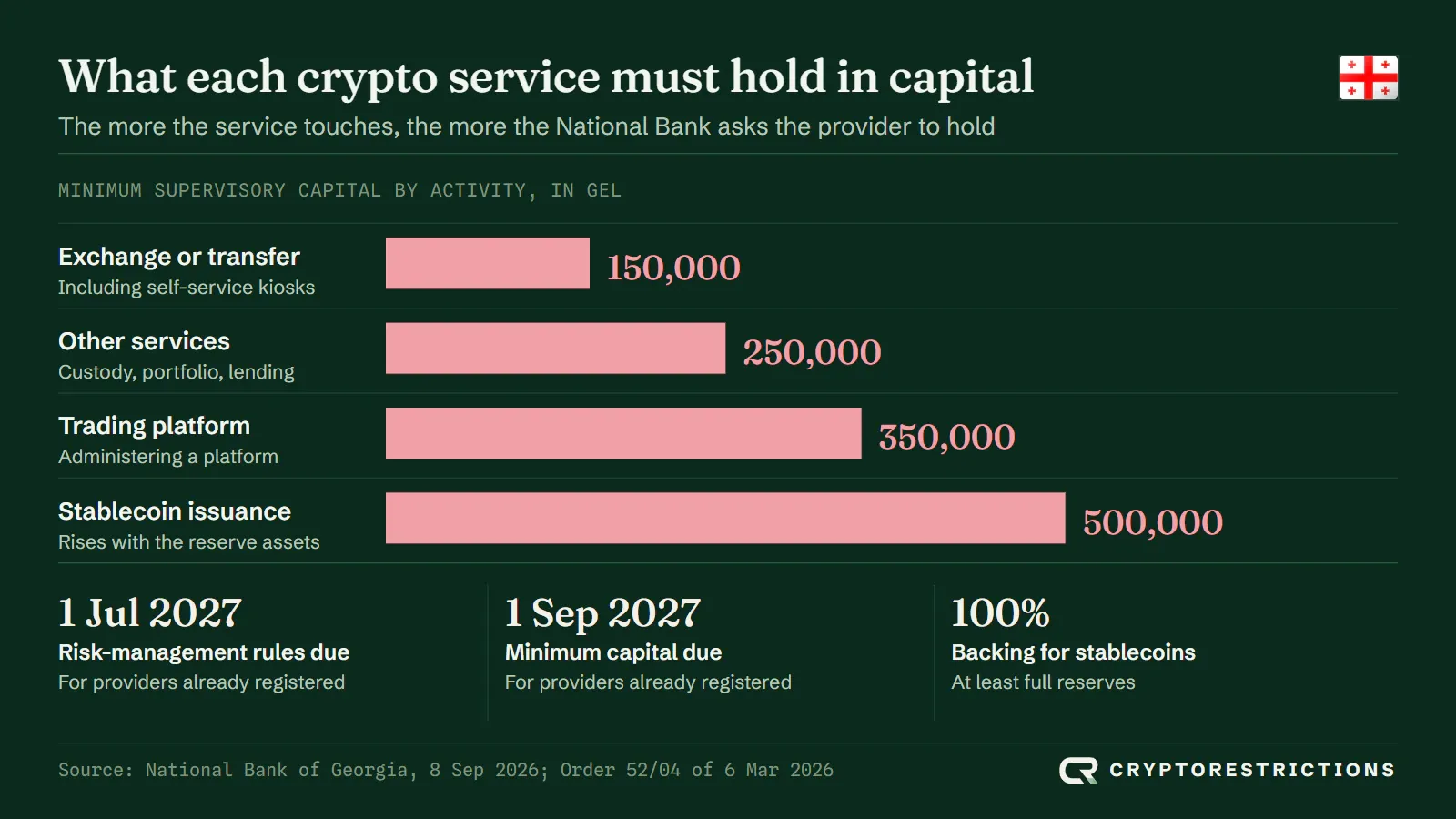
- Exchange and transfer. At least GEL 150,000 in capital, kiosks included, per the NBG’s notice of 8 September 2026.
- Other services. Running a trading platform needs at least GEL 350,000, and every other service except stablecoin issuance at least GEL 250,000. A provider that offers several services holds the highest minimum among them.
- Stablecoins. Issuing one is a separate registered service with at least GEL 500,000 of capital, rising with the value of the reserve assets, a whitepaper and governance requirements. Under Order 52/04 the reserves must cover at least the full value of the coins issued.
- Deadlines. Providers already registered have until 1 July 2027 to meet the risk-management rules (operational risk, cybersecurity, business continuity) and until 1 September 2027 to meet the capital minimums.
- By platform. We hold no Georgia-specific source for derivatives, staking or lari payment rails on any tracked platform, so we show no product matrix.
Are prediction markets legal in Georgia?
Georgian law licenses online betting and, since 25 June 2026, bars Georgian citizens from games run by foreign operators; we found no law or action naming prediction markets, and neither Polymarket nor Kalshi excludes Georgia.
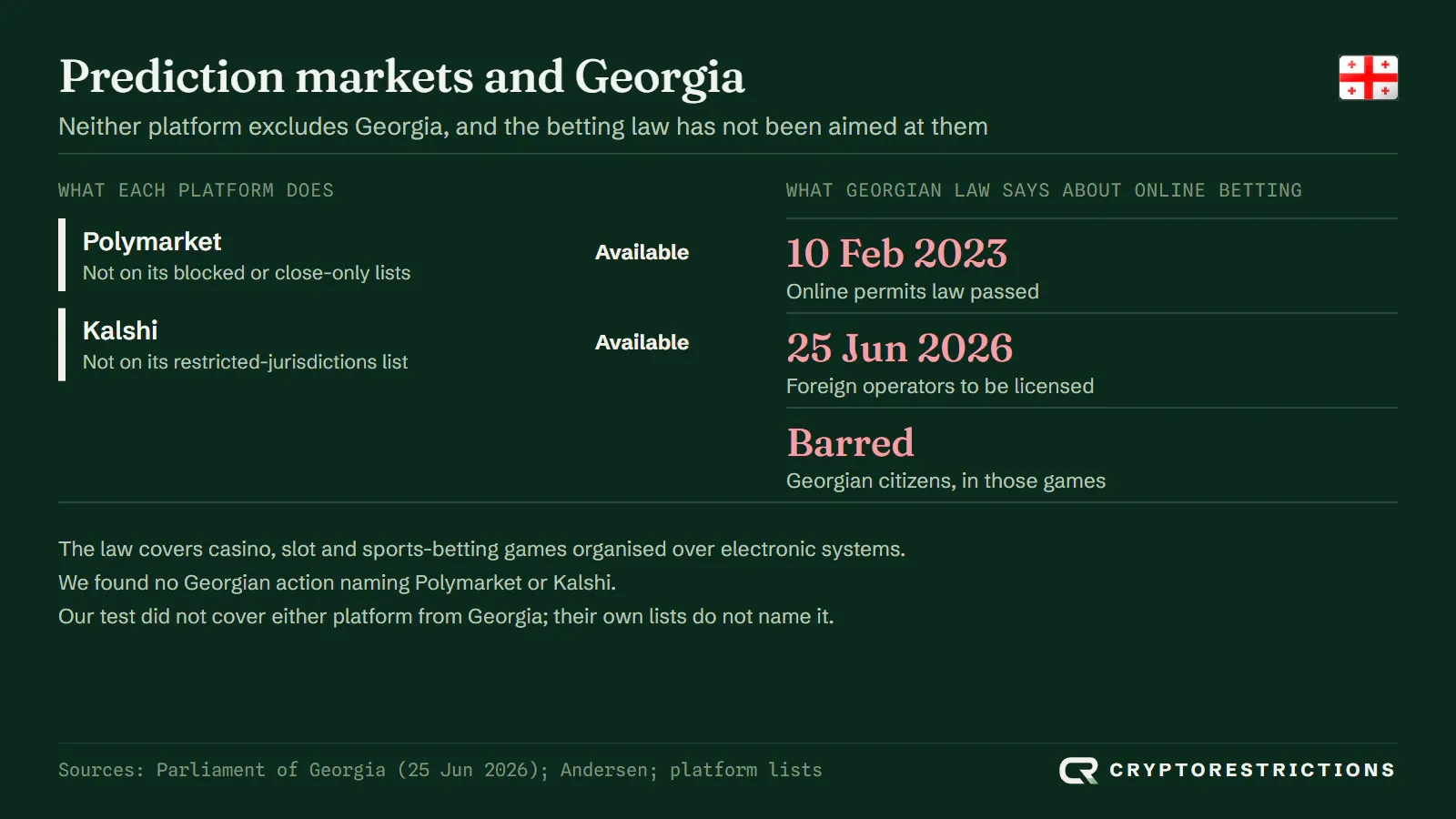
Andersen describes the permit system that Parliament passed after a final hearing on 10 February 2023: online casinos, slot halls and totalizators (sports betting) need their own permits for games run over the internet, telephone or an electronic platform, and each permit covers one website. On 25 June 2026 Parliament adopted at third reading a licensing regime for casino, slot and sports-betting games organised internationally by electronic means, and the law says Georgian citizens may not take part in them.
Whether an event contract counts as a bet under that law is not something we found a ruling on. Polymarket does not list Georgia among its blocked or close-only places, and Kalshi does not list it among its restricted jurisdictions. Our test did not cover either from Georgia, and we found no Georgian action naming either platform.
How is crypto taxed in Georgia?
A law firm reports that individuals pay no income tax on gains from trading crypto, because they are not Georgian-source income, while mining is taxed at 20% and companies pay 15% when they distribute profit.
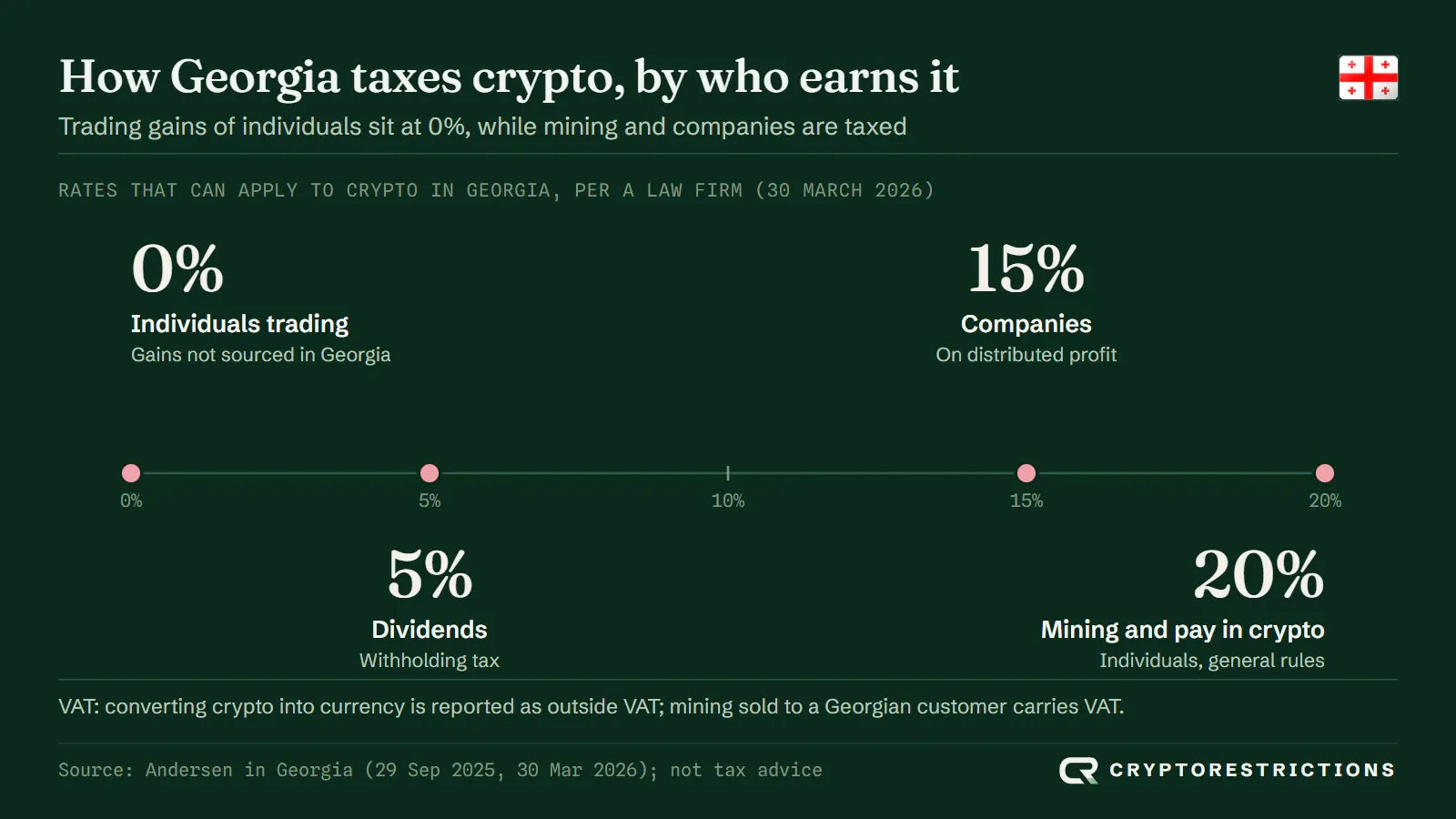
We could not open the Tax Code text or the Ministry of Finance ruling behind these rules, so this section rests on two published analyses by Andersen in Georgia (30 March 2026) and its earlier guide (29 September 2025). Check the Revenue Service before you rely on them.
Personal income tax applies only to income from Georgian sources, and Andersen says crypto has no physical form, no fixed location and usually no identifiable issuer, so exchanging it is treated as happening outside Georgia. The exemption covers residents and non-residents alike. It does not cover crypto received as salary or payment for goods and services, which falls under the general rules. Mining is different: it uses Georgian electricity and equipment, so it is Georgian-source income taxed at the standard 20%. Companies follow the Estonian model, paying 15% only when profit is distributed, with a 5% withholding tax on dividends.
On VAT, converting crypto into a currency is reported as outside VAT. Mining counts as a service, so it carries VAT only when the customer is established in Georgia, and the VAT paid on mining costs can be credited. Providers’ core services are reported as financial operations, exempt from VAT with no input credit. We found no Georgian commitment to the OECD’s crypto reporting framework, but could not open the OECD register to confirm. Working out your position takes four steps:
 Bahrain
 Qatar
 Israel
 Saudi Arabia
 Vietnam
 Pakistan
 Bangladesh
 Indonesia
 United Arab Emirates
 South Korea
 Kazakhstan