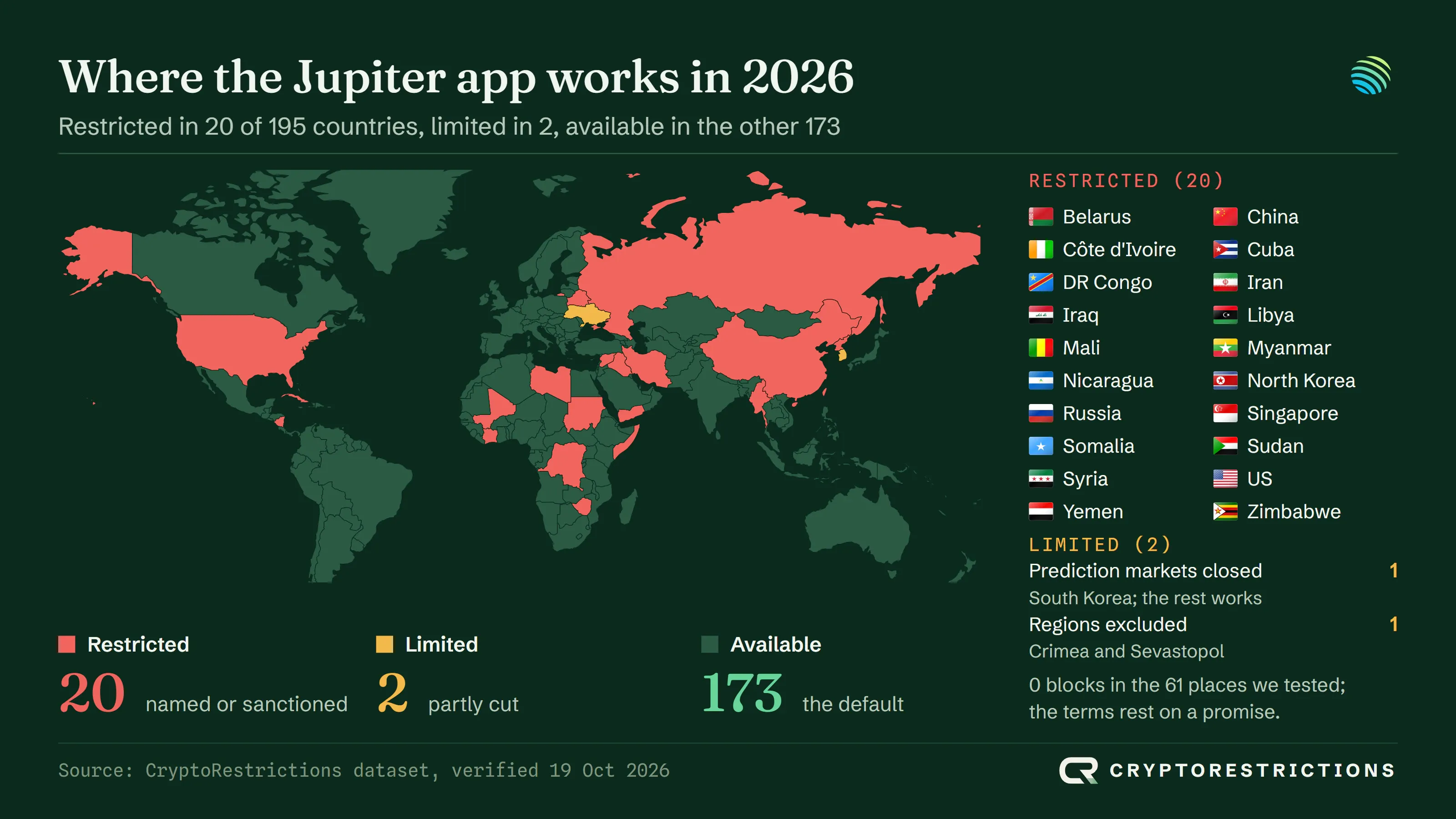
Where is Jupiter restricted?
Jupiter is restricted in 20 of the 195 countries we cover: the  United States,
 China,
 Singapore,
 Russia,
 Belarus,
 Myanmar,
 Cuba,
 Iran,
 Iraq,
 Libya,
 Syria,
 Yemen,
 Sudan,
 Somalia,
 Nicaragua,
 Zimbabwe,
 DR Congo,
 Côte d'Ivoire,
 Mali and
 North Korea.
The rule is one sentence in the terms of use for jup.ag, a page that shows no date: Jupiter “does not interact with digital wallets located in, established in, or a resident of” 19 named places, or “any other state, country or region that is subject to sanctions enforced by the United States, the United Kingdom or the European Union”. The interface is made available by Block Raccoon S.A., a Panama company. Eighteen of the named places are countries we track. The nineteenth, Crimea and Sevastopol, sits under limited, and Russia and Belarus, which are not named, fall under the catch-all because all three sanctioning bodies hit them broadly.
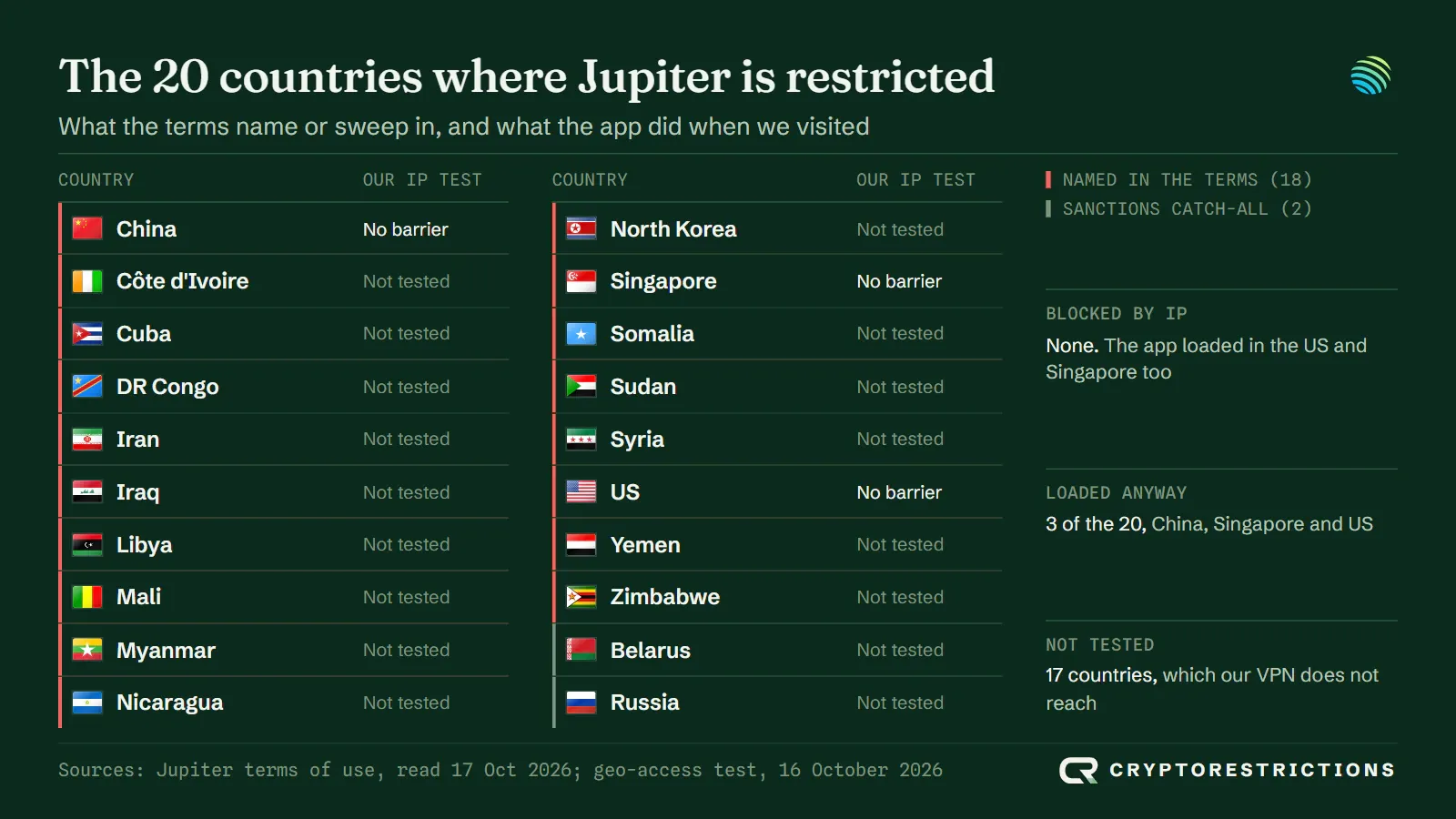
Two wordings needed a decision. The list says “the Republic of China”, Taiwan’s official name, but the Jupiter Mobile FAQ lists China among the restricted places, so we record China as restricted, and Taiwan, which is outside our 195, as restricted too. And Côte d'Ivoire and Mali are named, although our earlier data lacked them. Venezuela, Afghanistan, Lebanon and South Sudan face narrower measures only, and we do not read the catch-all as reaching them: they stay available, and are flagged for review.
In our test the app blocked none of these countries. It loaded from the US, Singapore and China, and the other 17 are outside our VPN’s reach. The full list is below: pick a country to see the cause, what applies and what our test saw.
How Jupiter’s list compares with other perps DEXs
Jupiter has the longest list of the four perpetuals platforms we compare and the weakest door. Its terms name 19 places, against 14 for Lighter, 11 for Aster and two, plus a sanctions clause, for Hyperliquid. Yet the Jupiter app refused none of the 61 places we tried, while Lighter’s app blocked 13 of 133, Hyperliquid’s five of 131 and Aster’s two of 133.


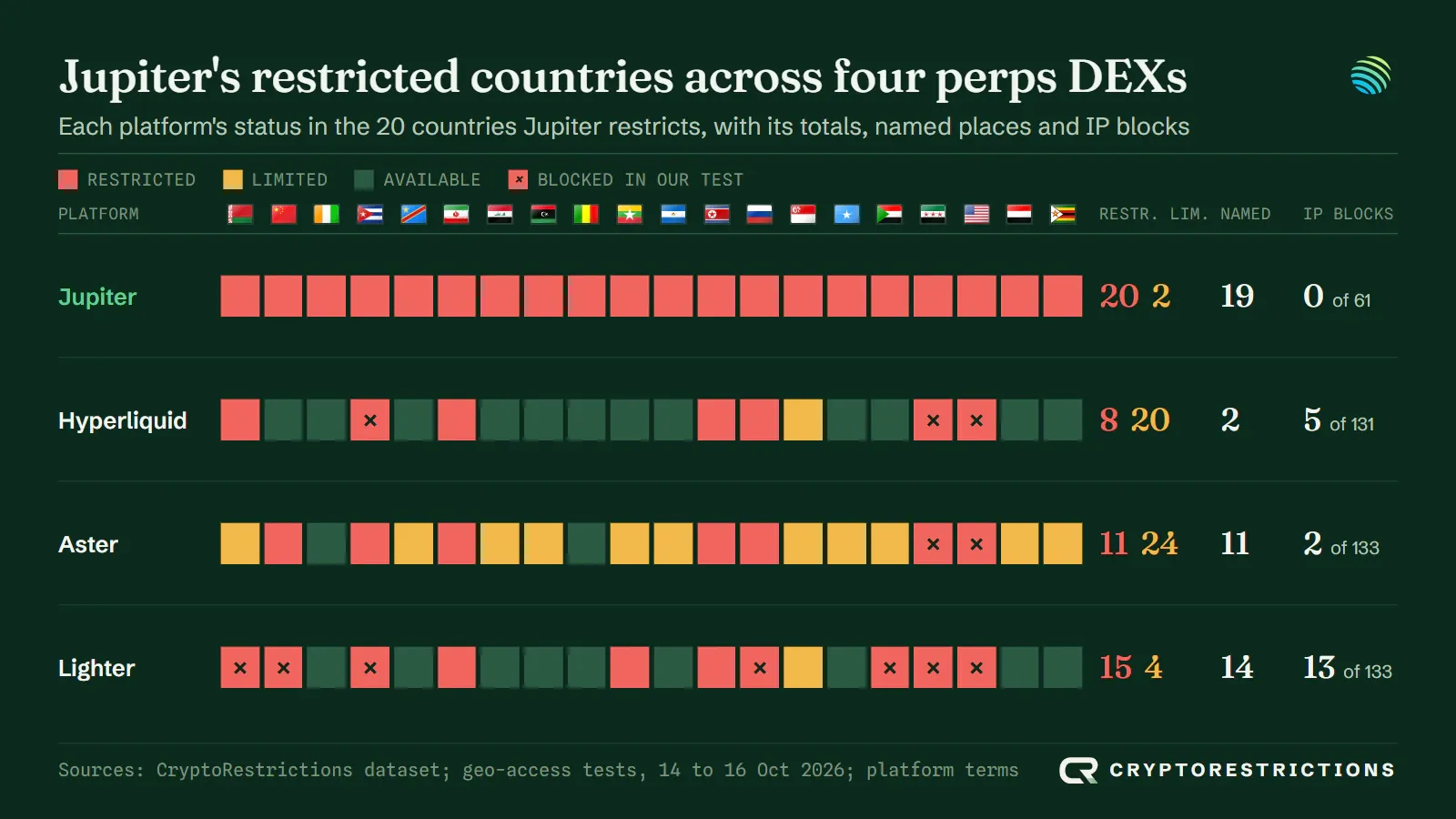
The three peers enforce at the door: Hyperliquid and Aster refuse US addresses, and Lighter also refuses the UK, Canada and Ireland. Jupiter does not, so for the 20 restricted countries the terms and the VPN ban are the only control. That makes the status here a statement about what Jupiter allows, not about what its app can stop. We tested fewer places for Jupiter than for the others, 61 against 131 to 133; none of the three named places we did test, the US, Singapore and China, was blocked.
Where is Jupiter limited?
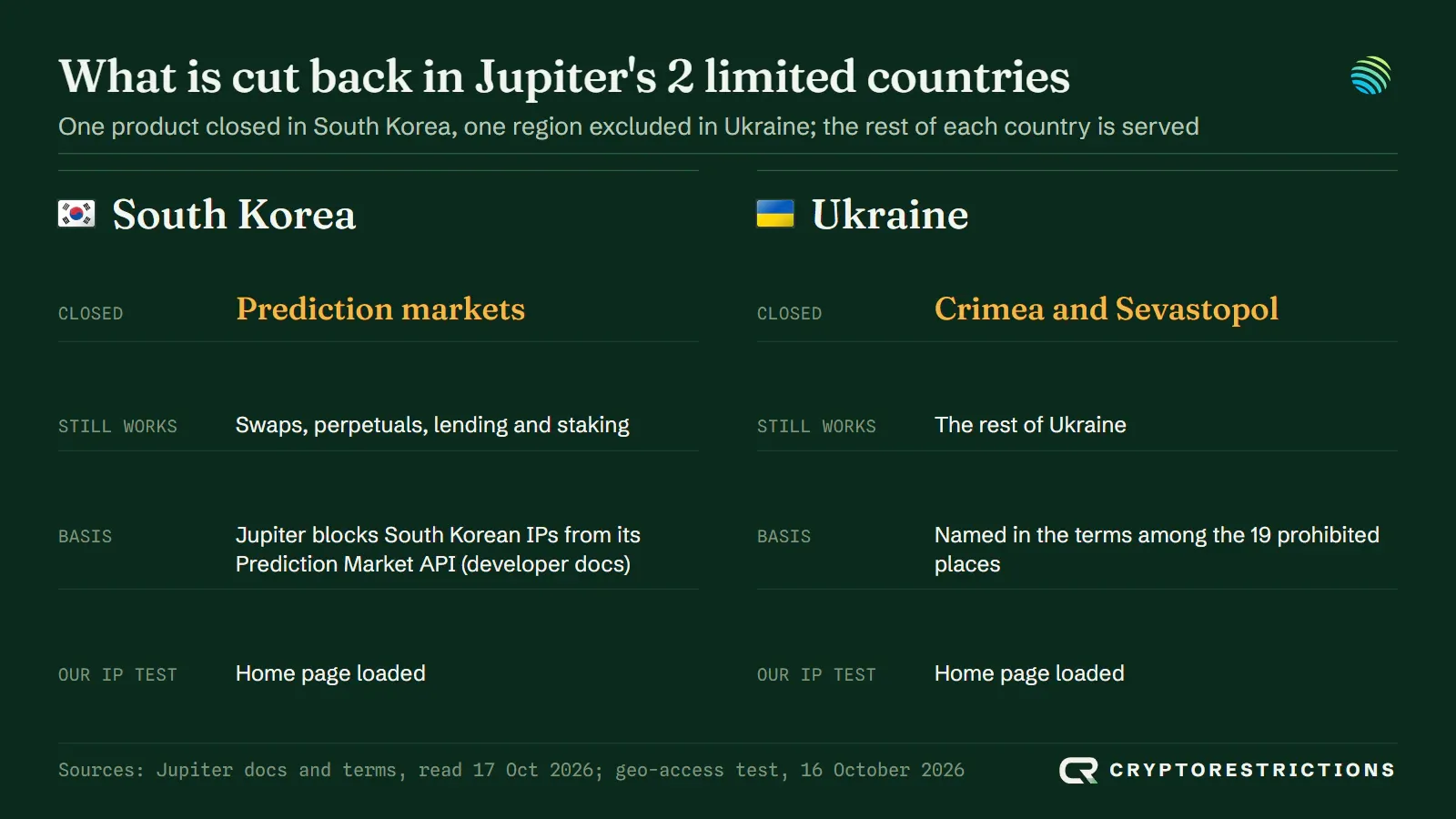
Jupiter is limited in two countries:  South Korea, where the docs close prediction markets, and
 Ukraine, where only Crimea and Sevastopol are excluded.
South Korea is the product cut. Jupiter’s prediction docs say: “We have restricted United States and South Korea IPs from accessing the Prediction Market API.” Wayback copies of that page from 14 and 19 February 2026 carry the same sentence, within days of the Polymarket launch on 2 February. Under our product-cut rule South Korea is limited, with prediction markets restricted and swaps, perpetuals and lending available. The app itself loaded from Seoul in our test, Predict menu included.
Jupiter Predict against Polymarket and Kalshi
Jupiter’s prediction markets come “mainly” from Polymarket, according to its Predict FAQ, and an October 2025 beta drew liquidity from Kalshi. Both platforms restrict far more countries than Jupiter names: Polymarket restricts 40 and limits 16, and Kalshi restricts 54 and limits four.


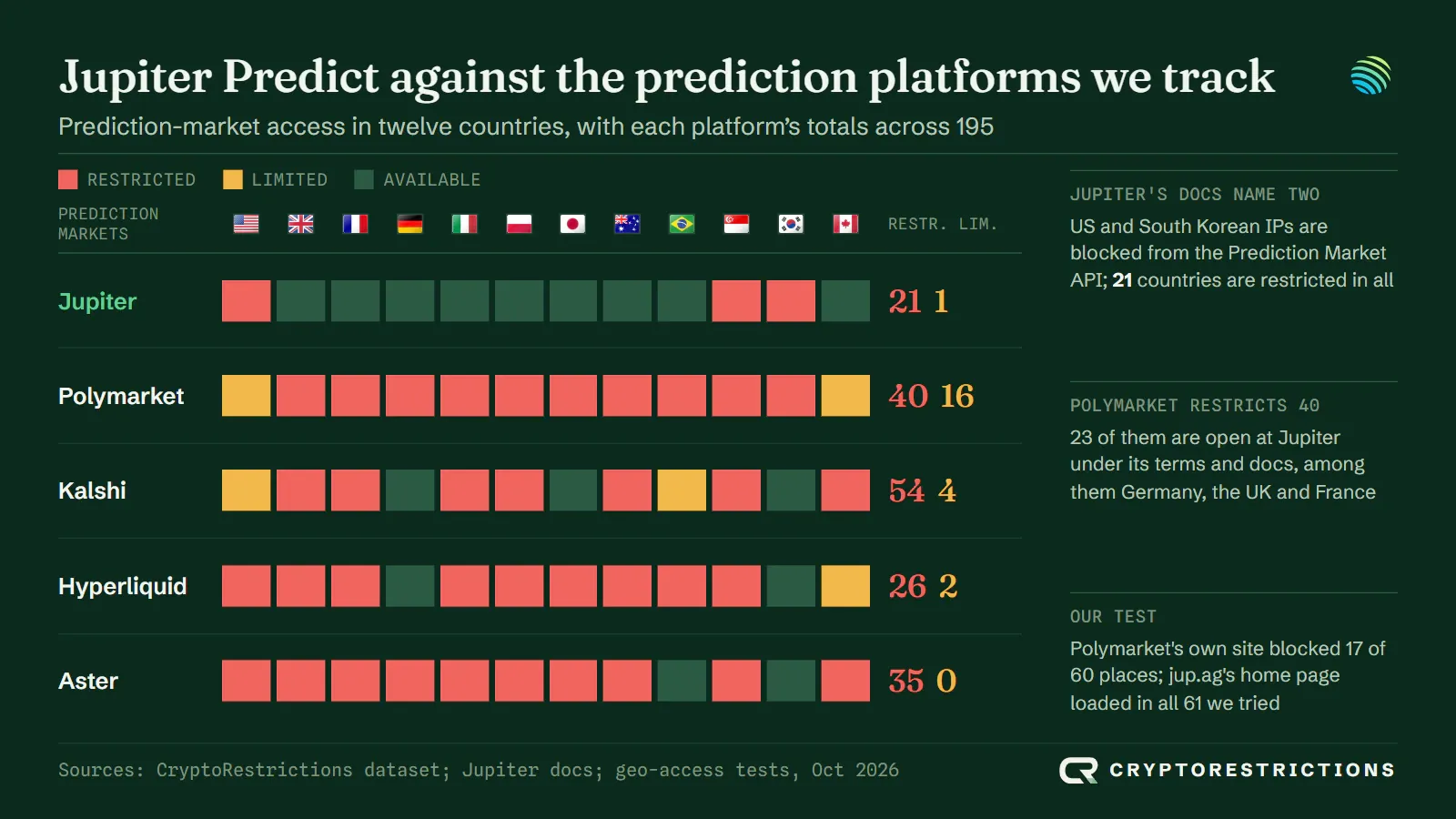
Of Polymarket’s 40 restricted countries, 23 are open at Jupiter under its terms and docs, among them Germany, the UK, France, Italy, Poland, Japan, Australia and Brazil. The Predict FAQ says trading is “unavailable in some regions” and that the mobile app restricts more than the web, without a list, so Jupiter may enforce more than it publishes. Our test cannot say: it loaded the Jupiter home screen, not Predict, and connected no wallet. Hyperliquid, which also hides its outcome markets by country, cuts 18 countries, and Aster bars its prediction add-on in 24 countries it otherwise serves.
Where is Jupiter available?
Jupiter is available in the other 173 of the 195 countries we cover, from  Germany and the
 United Kingdom to
 Nigeria,
 Brazil and
 Japan.
None of them rests on a licence, because Jupiter holds none. In 54 the terms do not name the country and our test loaded the app; 115 more are available under our coverage rule, since no document restricts them and we could not test them. The last four, Afghanistan, Lebanon, South Sudan and Venezuela, face narrower sanctions that the catch-all might be read to reach. We found no regulator that blocks Jupiter in any of the 173.
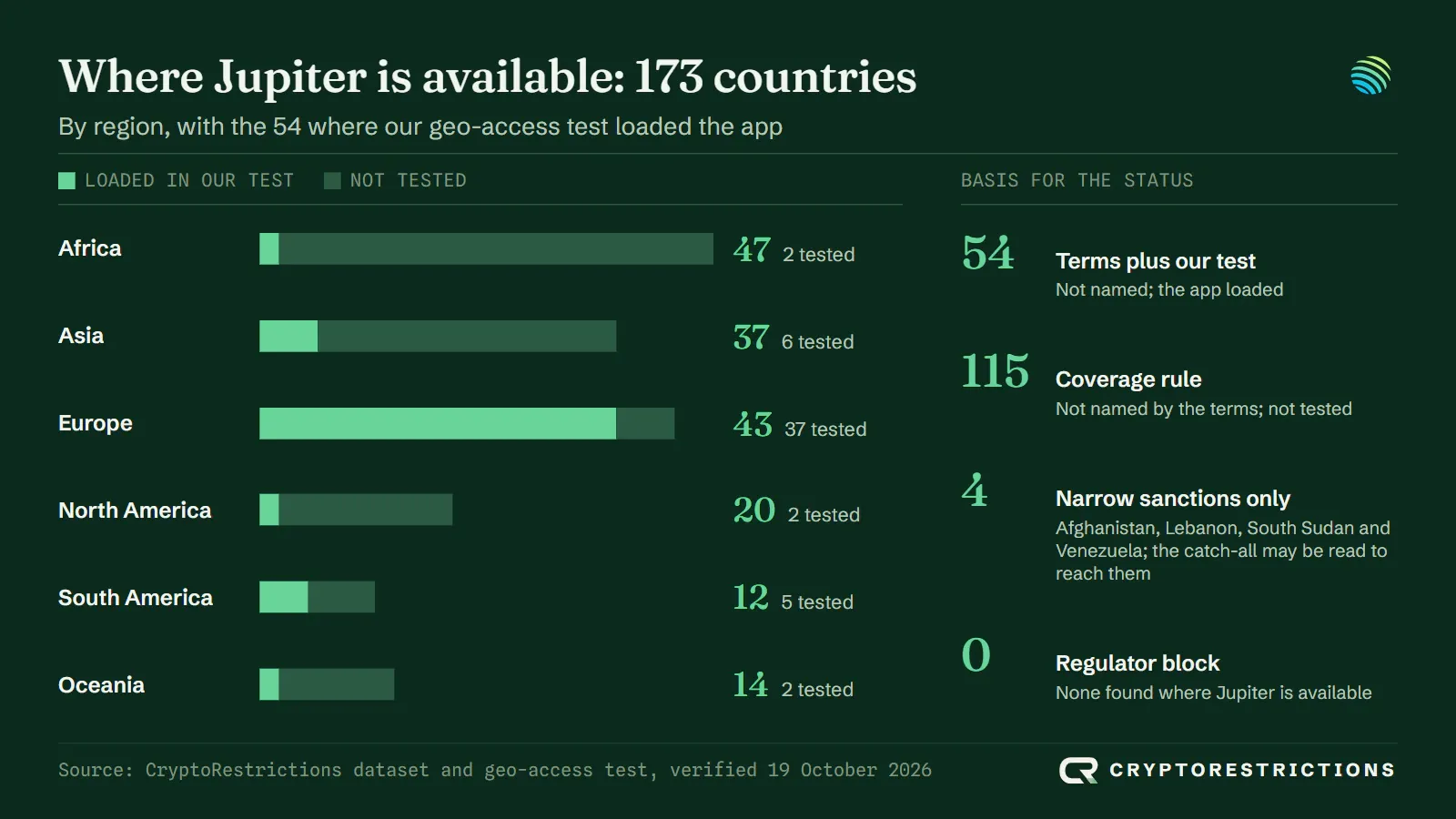
Available means the Jupiter app serves the country, not that local law allows trading there. Most of the EEA is here: Jupiter has no MiCA licence, but its terms exclude no EEA country and its app loaded in every EEA state we tested.
Where do Jupiter’s visitors come from?
The United States, which the terms bar, is second in Semrush’s September 2026 count of visits to jup.ag, behind Bangladesh. Semrush counts 4.2 million visits:  Bangladesh 25.65%, the US 14.76% (about 620,000 visits), Germany 3.7%, Brazil 3.4% and
 Indonesia 3.37%.
Similarweb answered our requests with a CloudFront error page every time, so this section rests on Semrush alone. Bangladesh’s lead needs care: 95.57% of its organic search traffic in Semrush’s table comes from one query, “x hamster coin price”, which suggests a search quirk rather than traders.
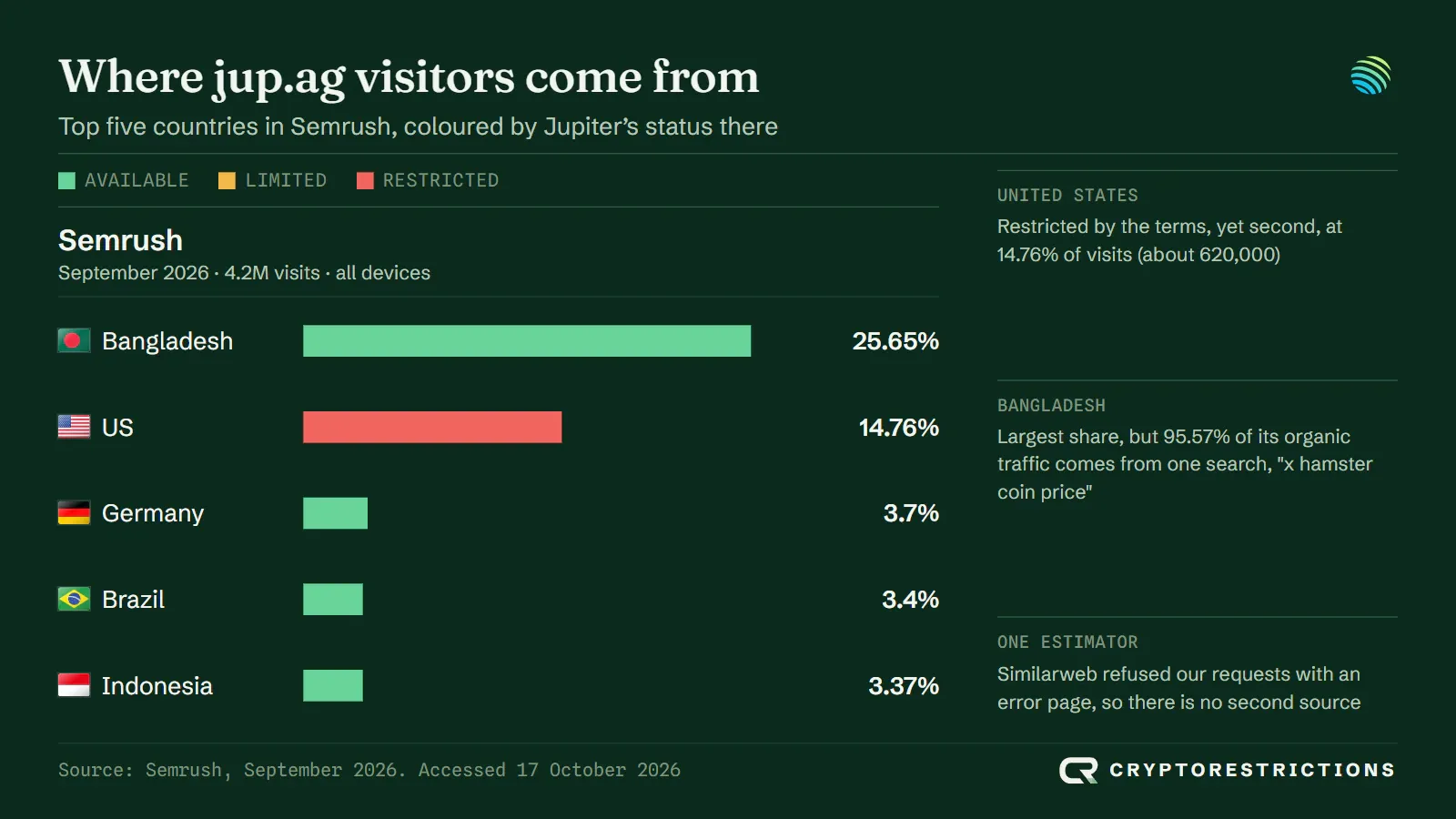
The US share is an estimate of home page visits. Jupiter’s app loaded without a banner from a US address, so nothing here shows that Americans trade, only that they visit.
Jupiter geo-access test: what we saw from 61 places
Jupiter’s app blocked none of the 61 places we tested, and showed no notice in any of them.
We ran the test ourselves on 16 October 2026. A browser with a VPN connected to one place at a time and loaded jup.ag in a fresh private window with no cookies and no wallet connected. Banners were never accepted and bot checks never solved, and every run saved the page text and a screenshot. All 61 runs used servers in the country. Of the 61 places, 59 are among our 195 countries and two are territories, Hong Kong and Taiwan.
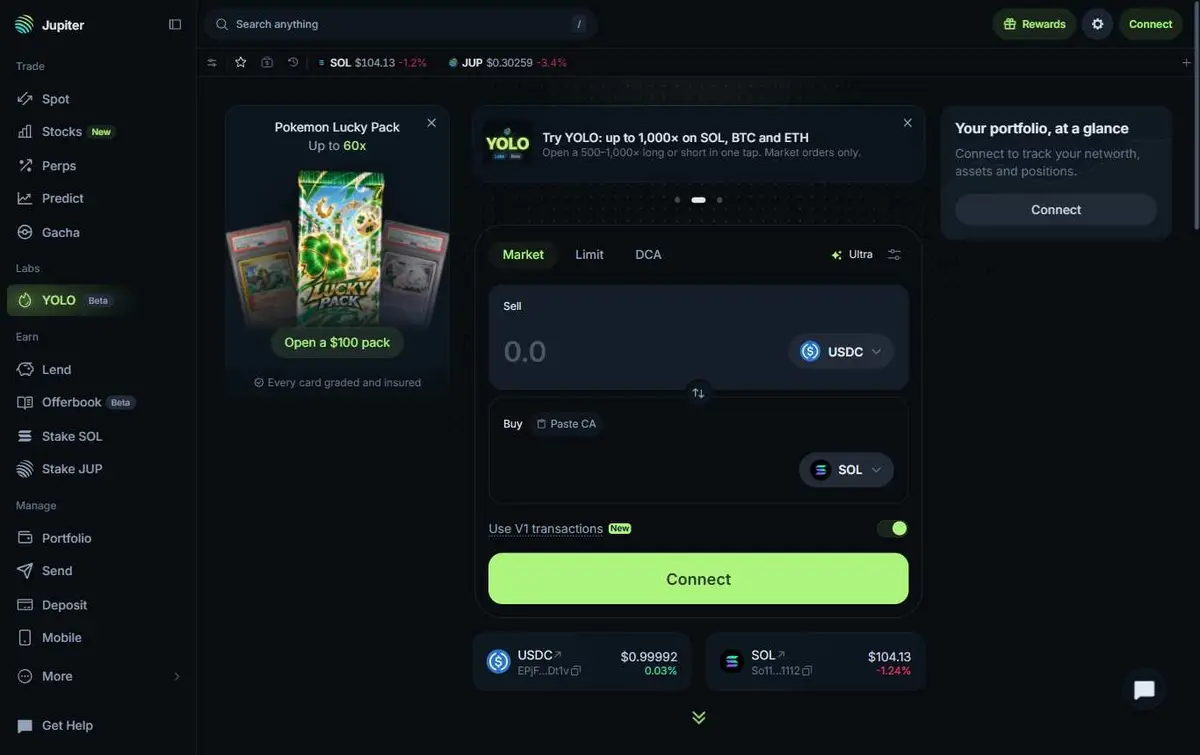
No barrierUnited States · Trading app
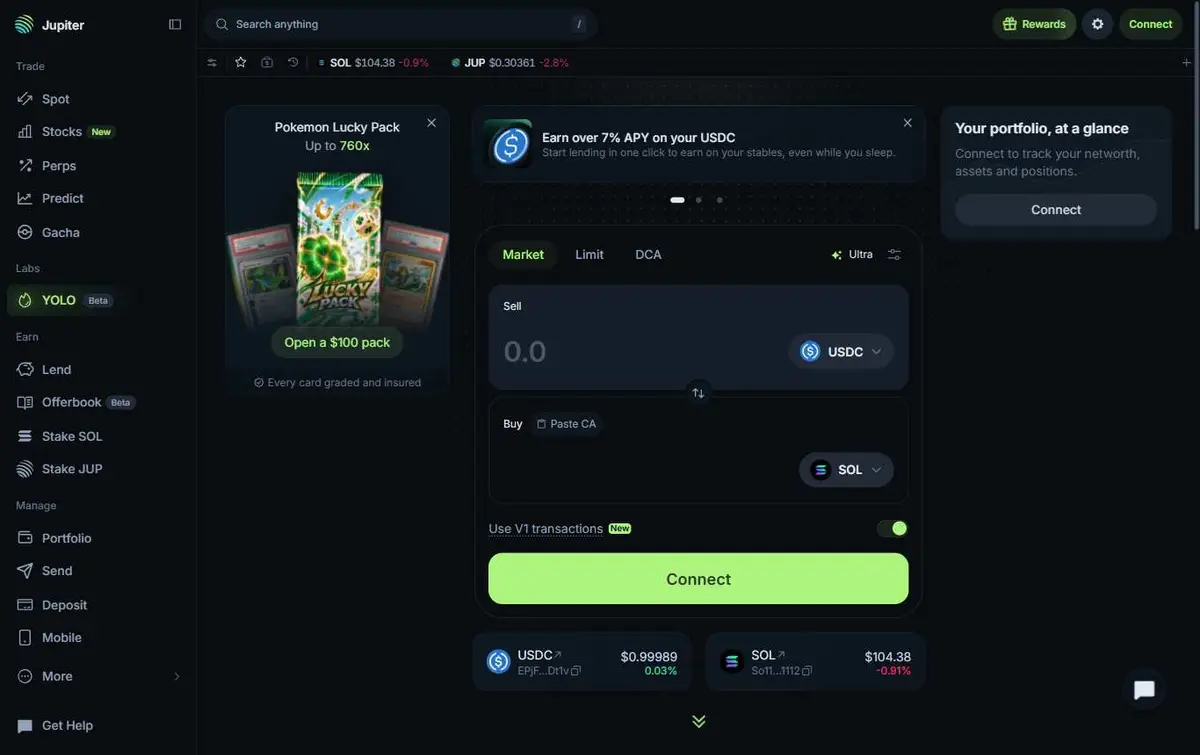
A US address: the swap screen, with Predict in the menu, loads with no banner though the terms name the US
No barrierSingapore · Trading app
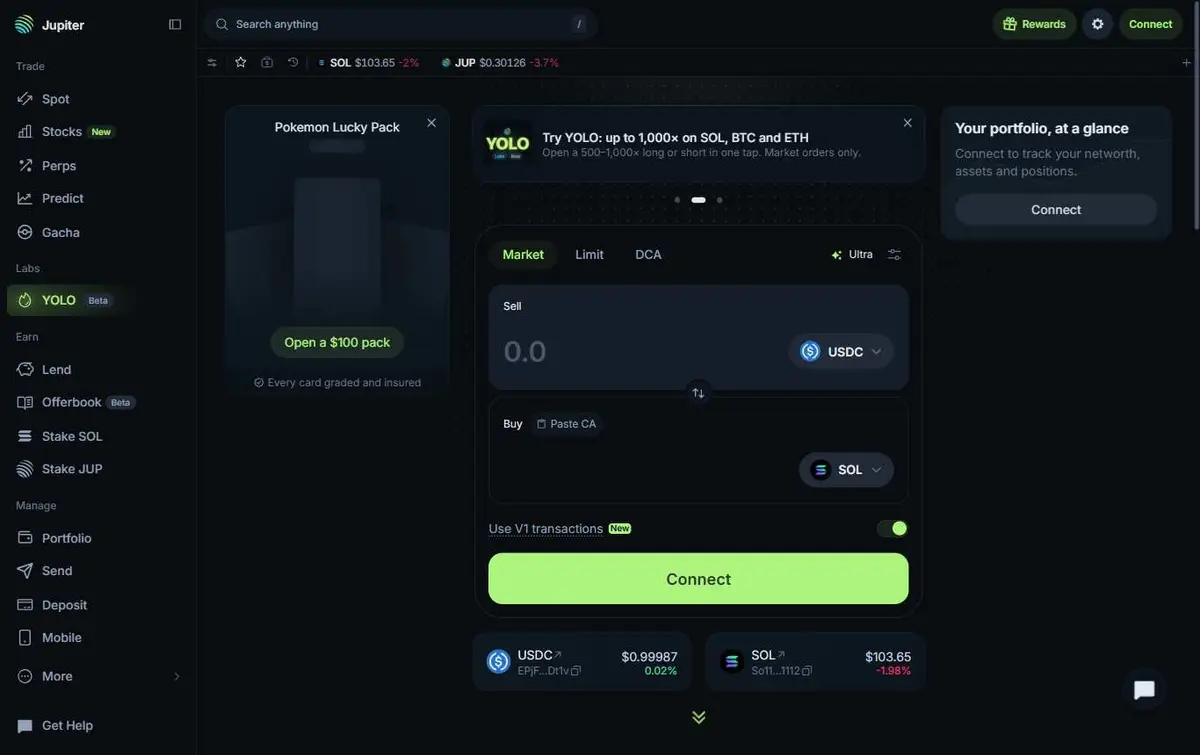
Singapore, also named in the terms: the same open swap screen
No barrierChina · Trading app
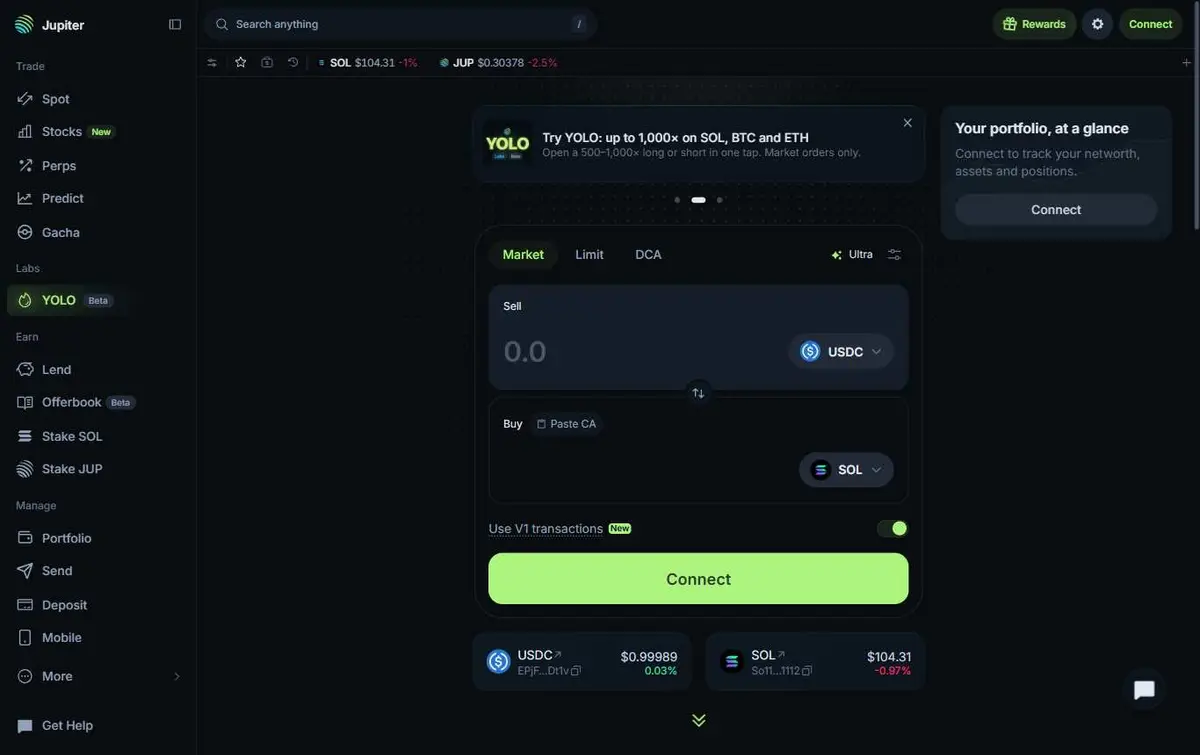
China, which the terms name as the Republic of China: no gate
No barrierSouth Korea · Trading app
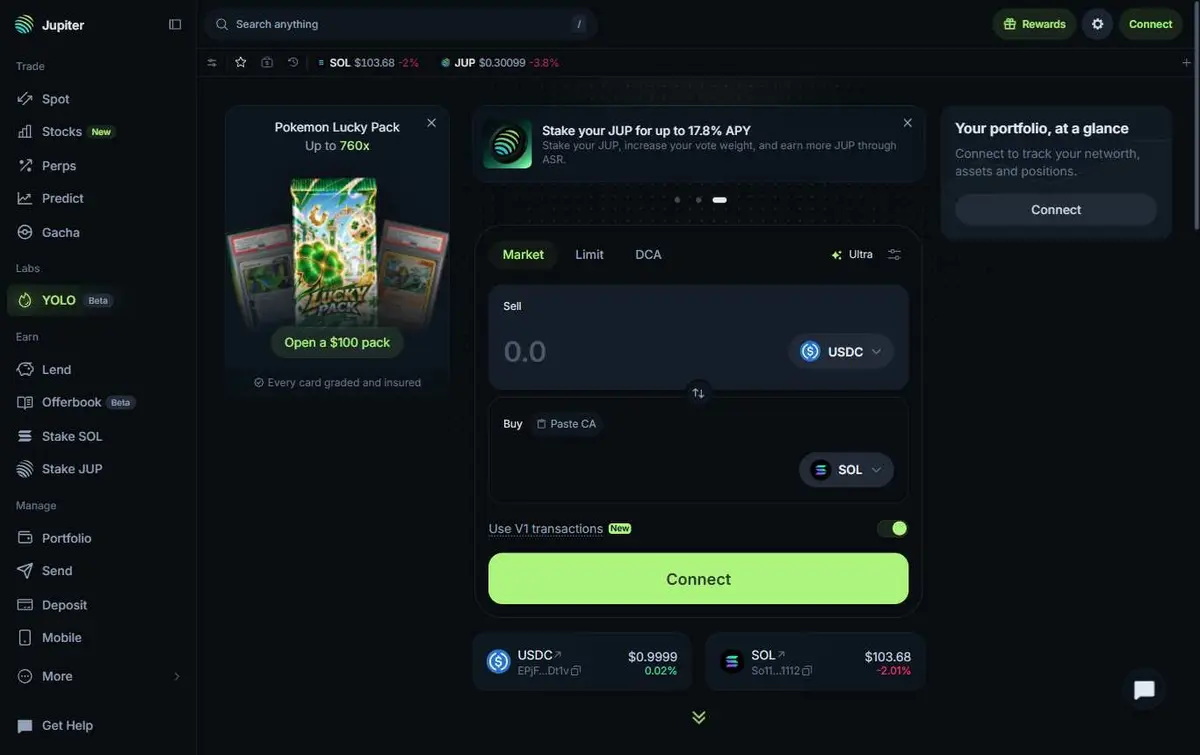
South Korea, where the docs block IPs from the Prediction Market API: the app itself loads and lists Predict
No barrierUkraine · Trading app
Ukraine, where only Crimea and Sevastopol are named: loads normally
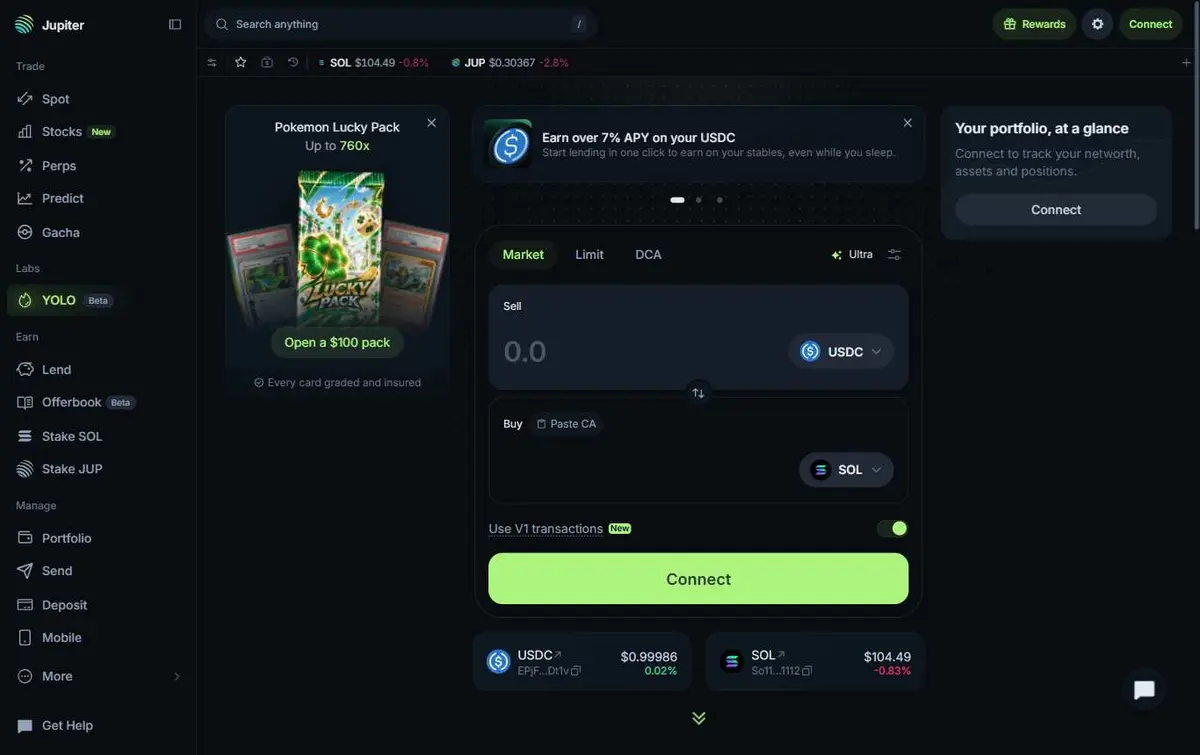
No barrierUnited Kingdom · Trading app
The UK, where Polymarket blocks its own site: Jupiter's app loads with Predict in the menu
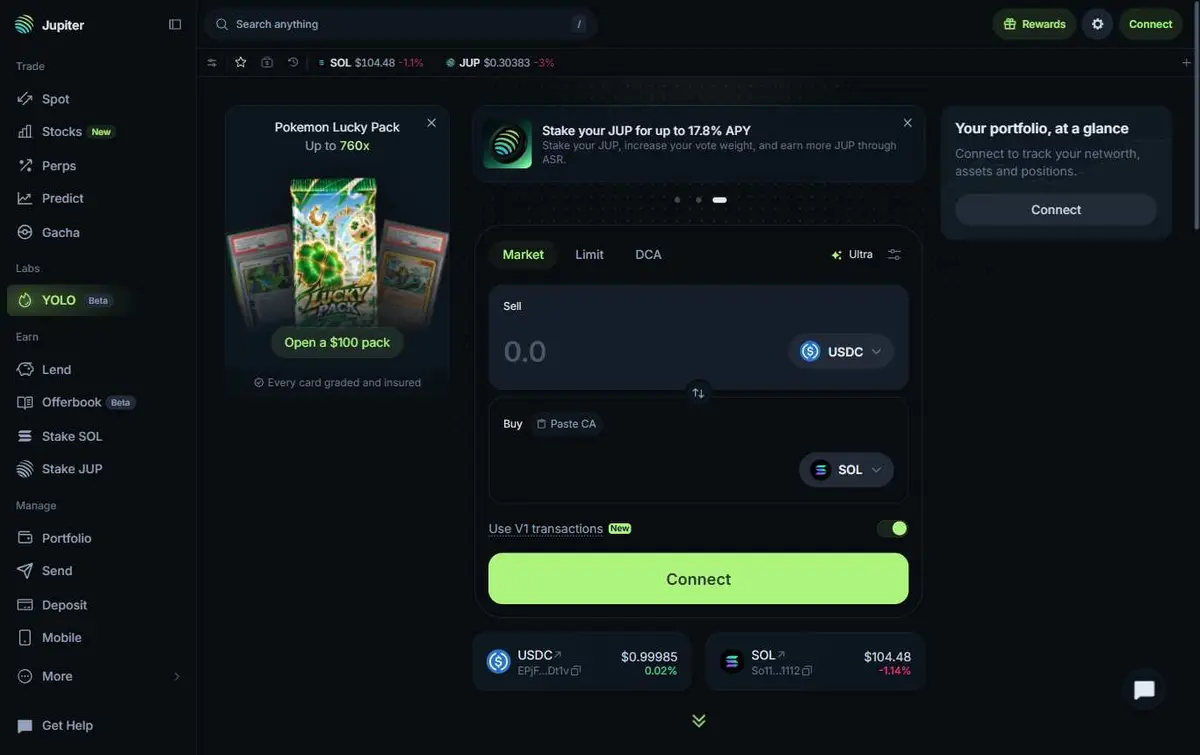
No barrierGermany · Trading app
Germany, another country where Polymarket's own site refuses visitors: open here
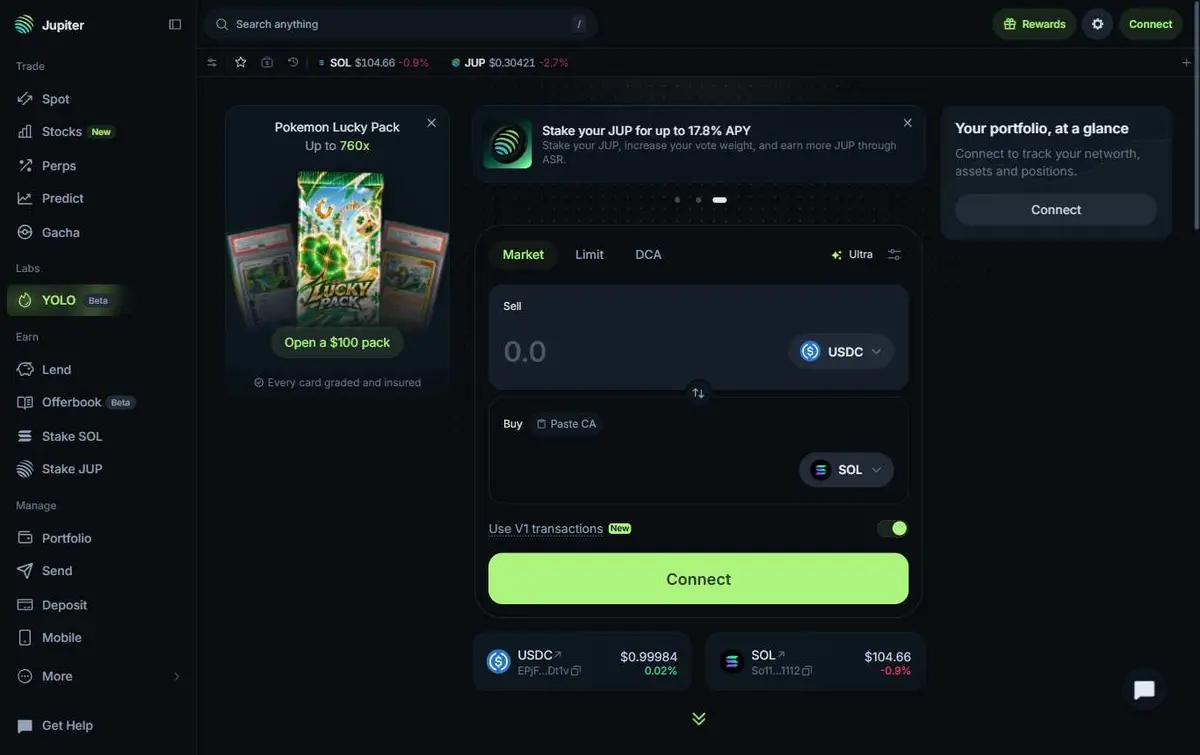
No barrier France · Trading app
France: the same open screen, perps and prediction markets included
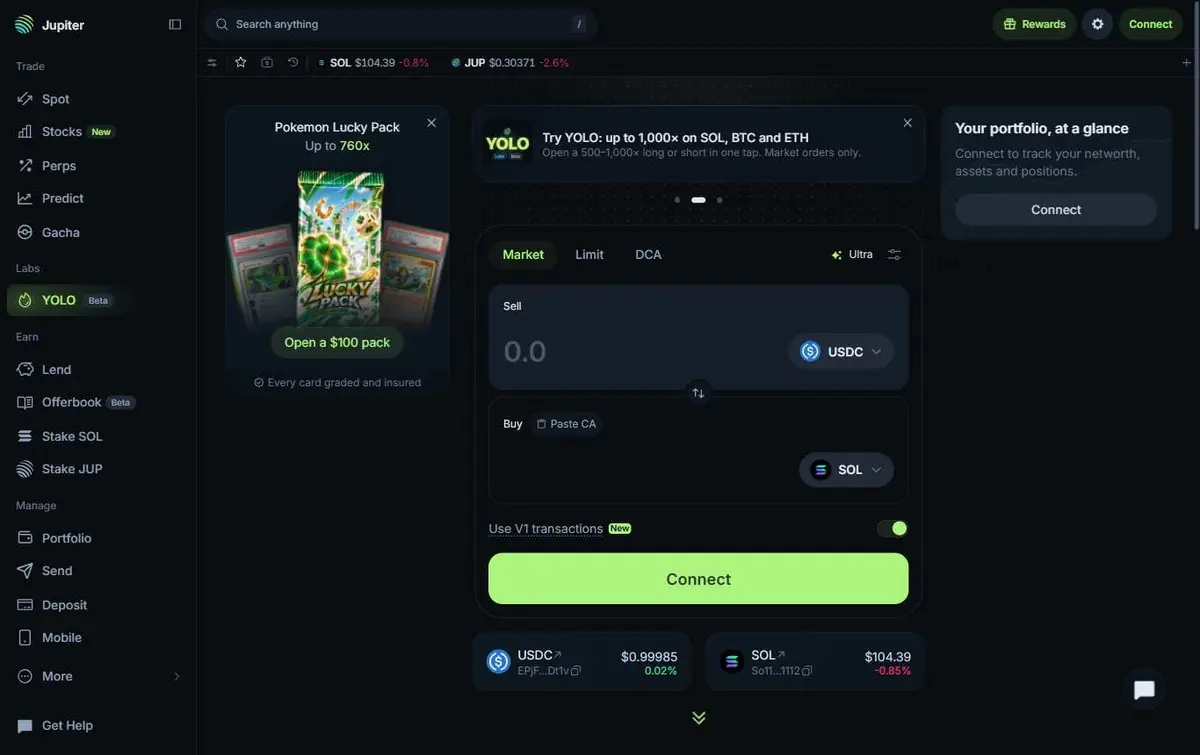
No barrierJapan · Trading app
Japan: no banner, no notice
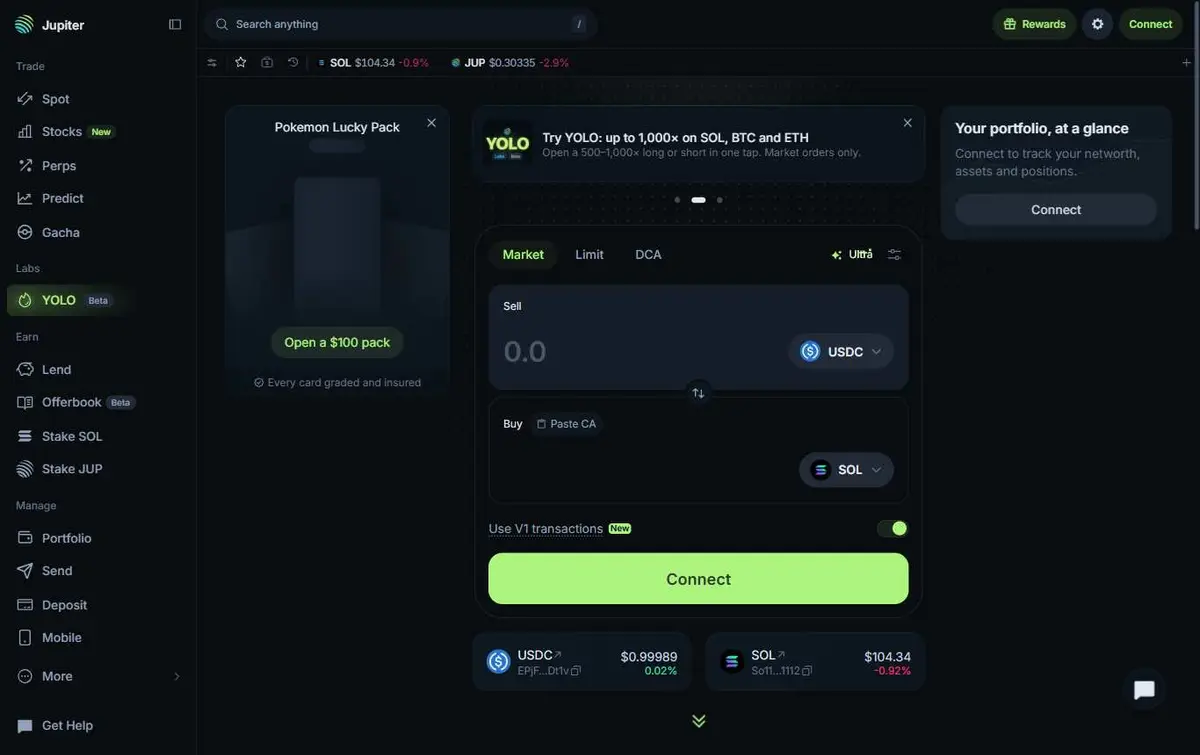
No barrier Australia · Trading app
Australia: no banner, no notice
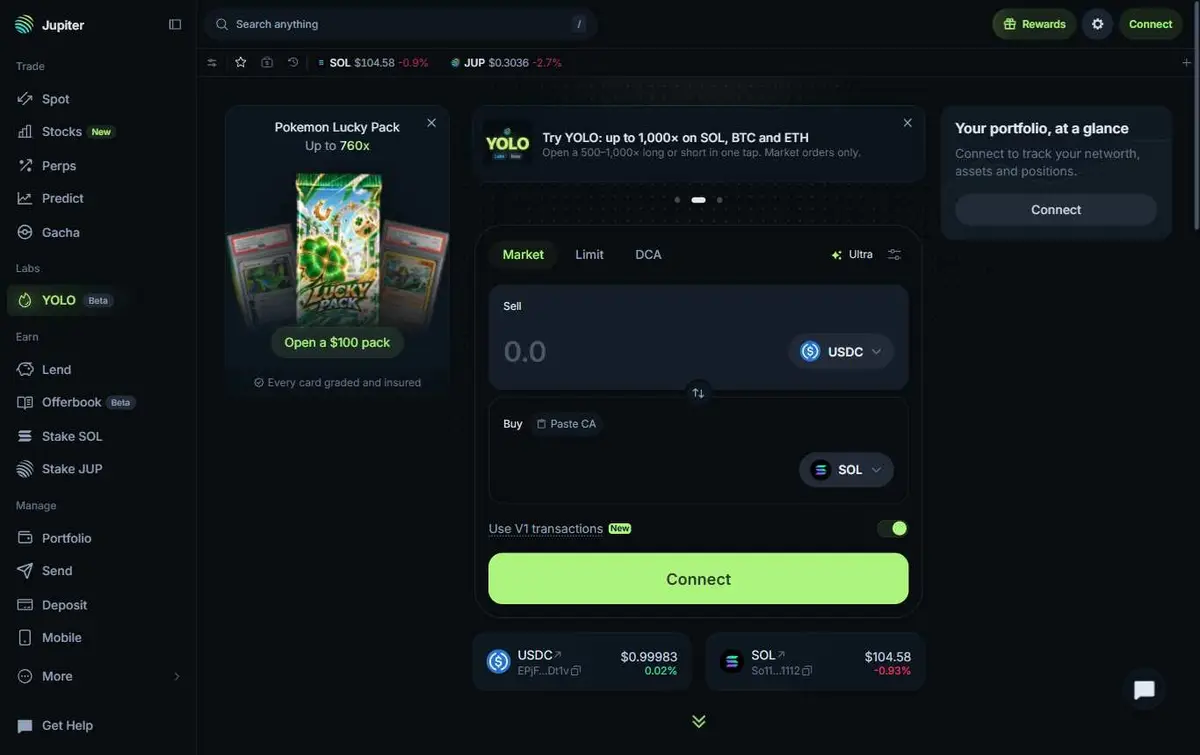
No barrier Netherlands · Trading app
The Netherlands: the swap app loads
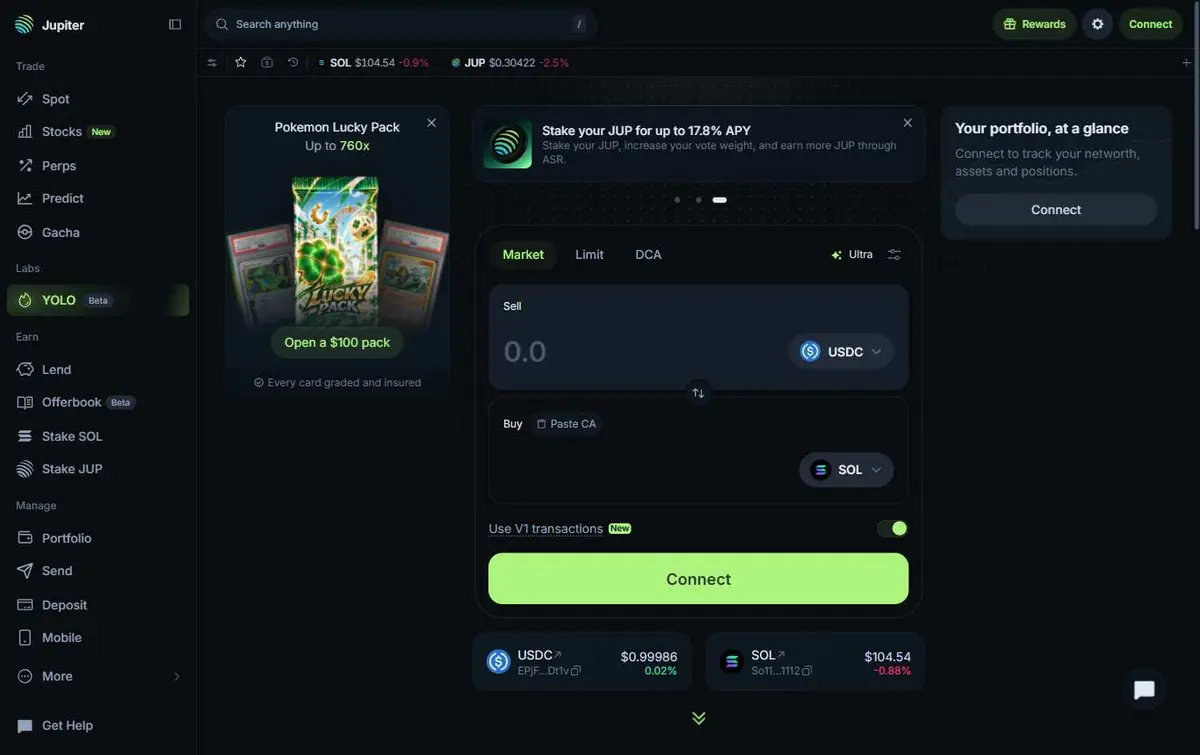
No barrier Turkey · Trading app
Turkey: the swap app loads with no notice
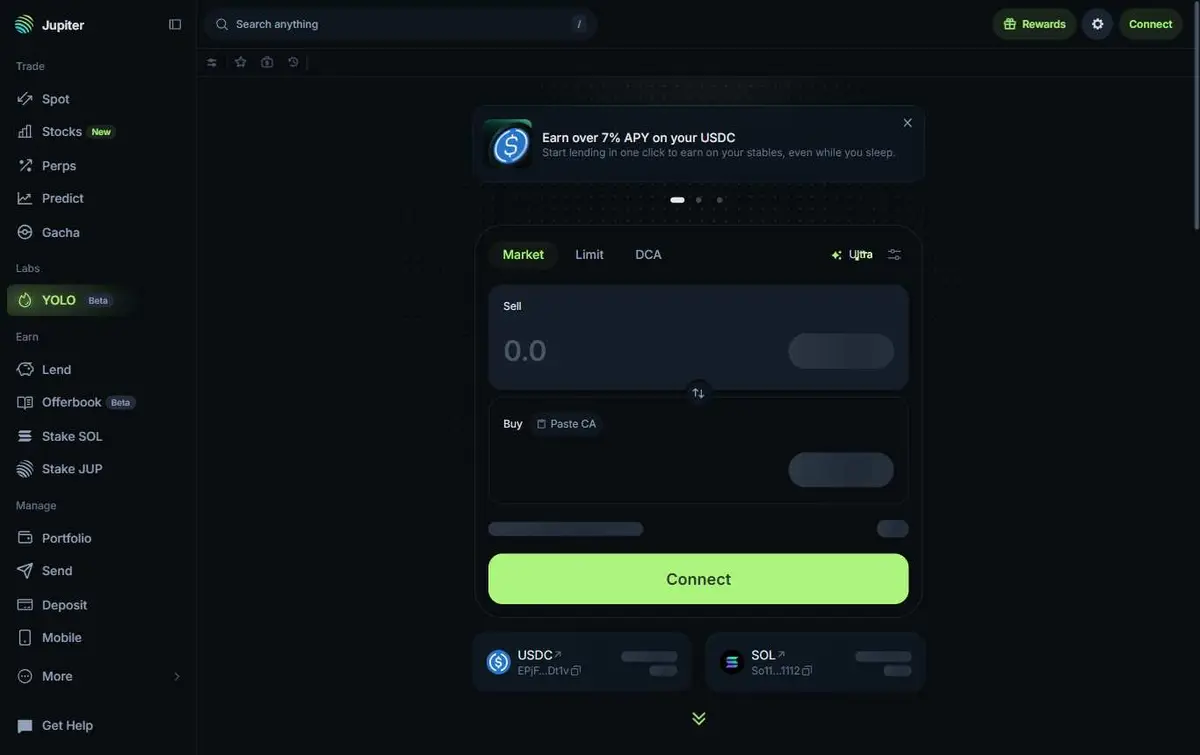
No barrier Mexico · Trading app
Mexico: the swap app loads with no barrier
“Connect Jupiter”
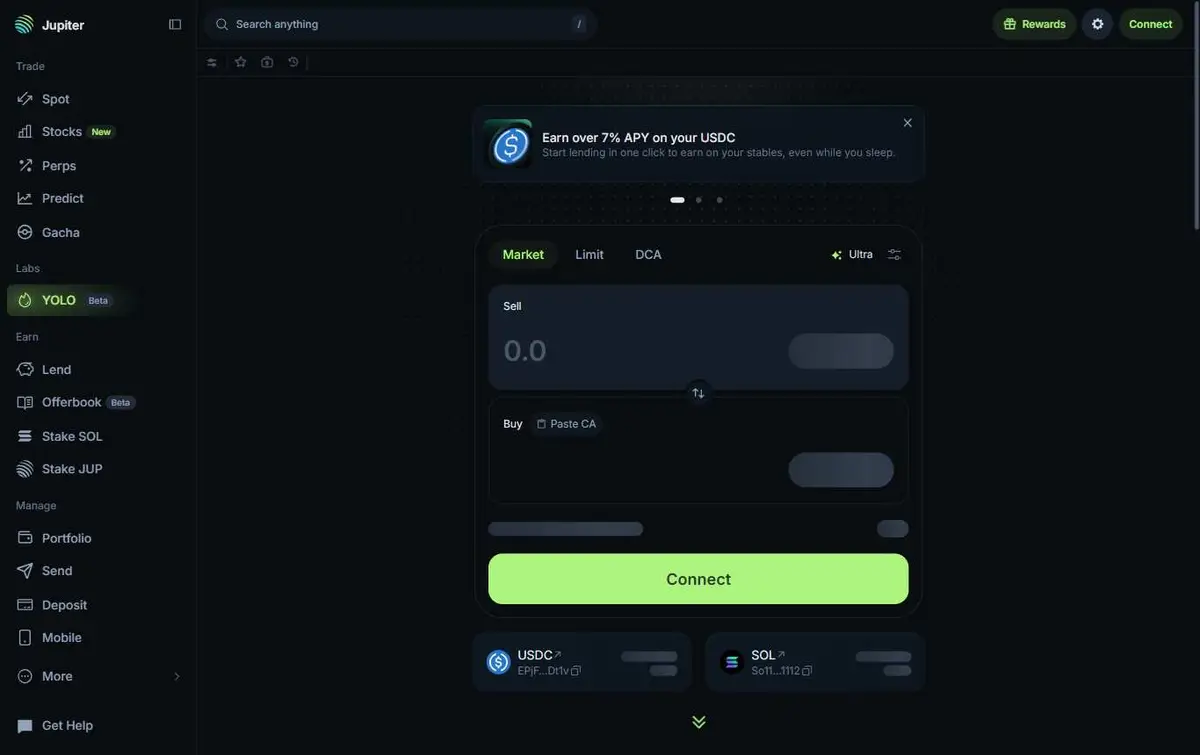
No barrier Ireland · Trading app
Ireland: the swap app loads with no notice
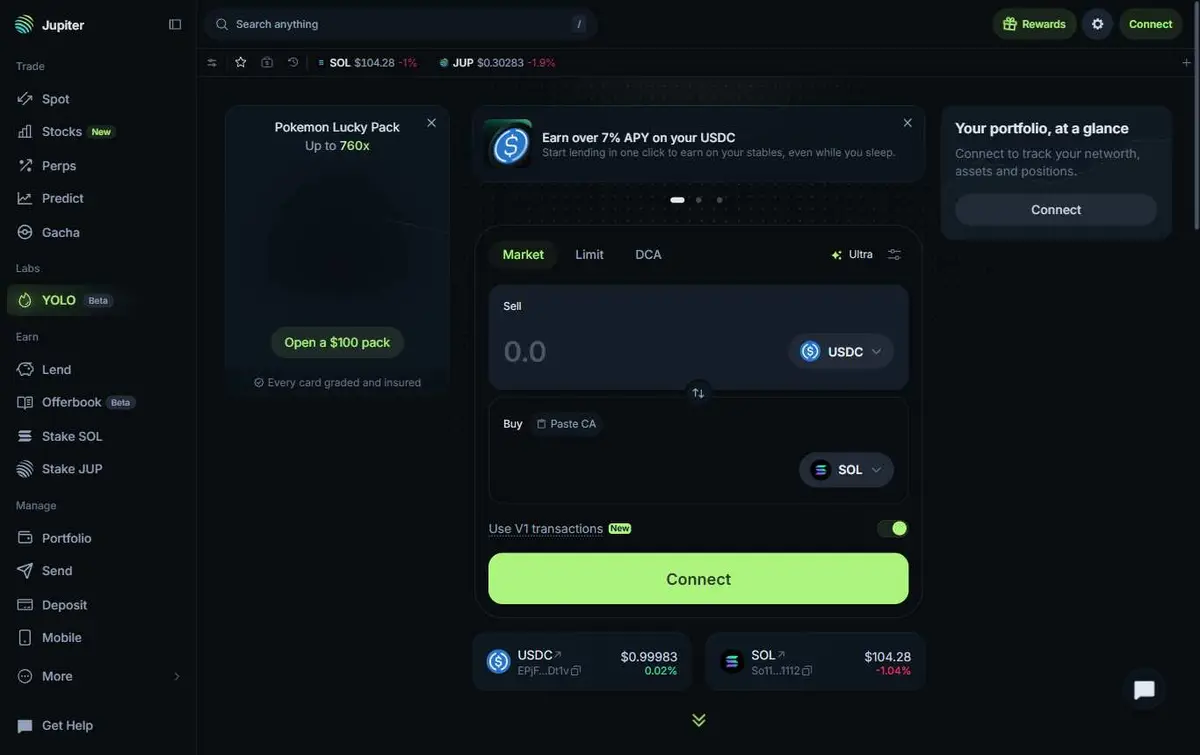
No barrier New Zealand · Trading app
New Zealand: the app loads with no notice
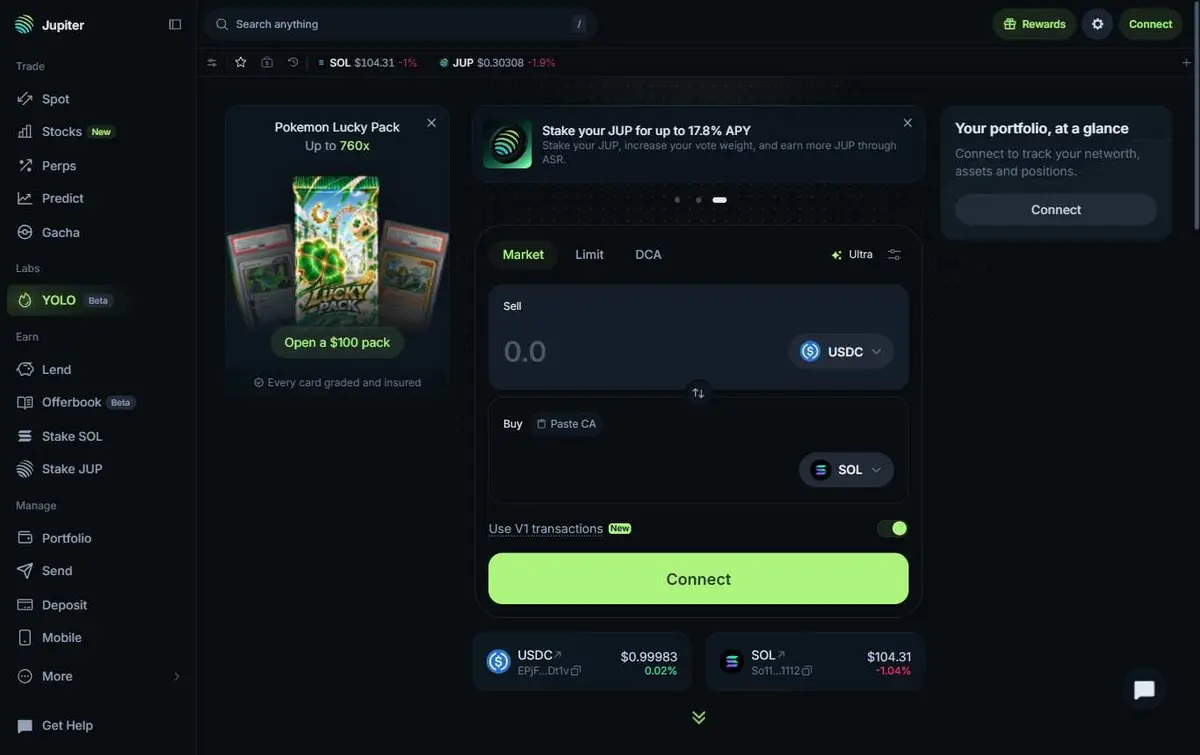
No barrier Norway · Trading app
Norway: the swap app loads with no notice
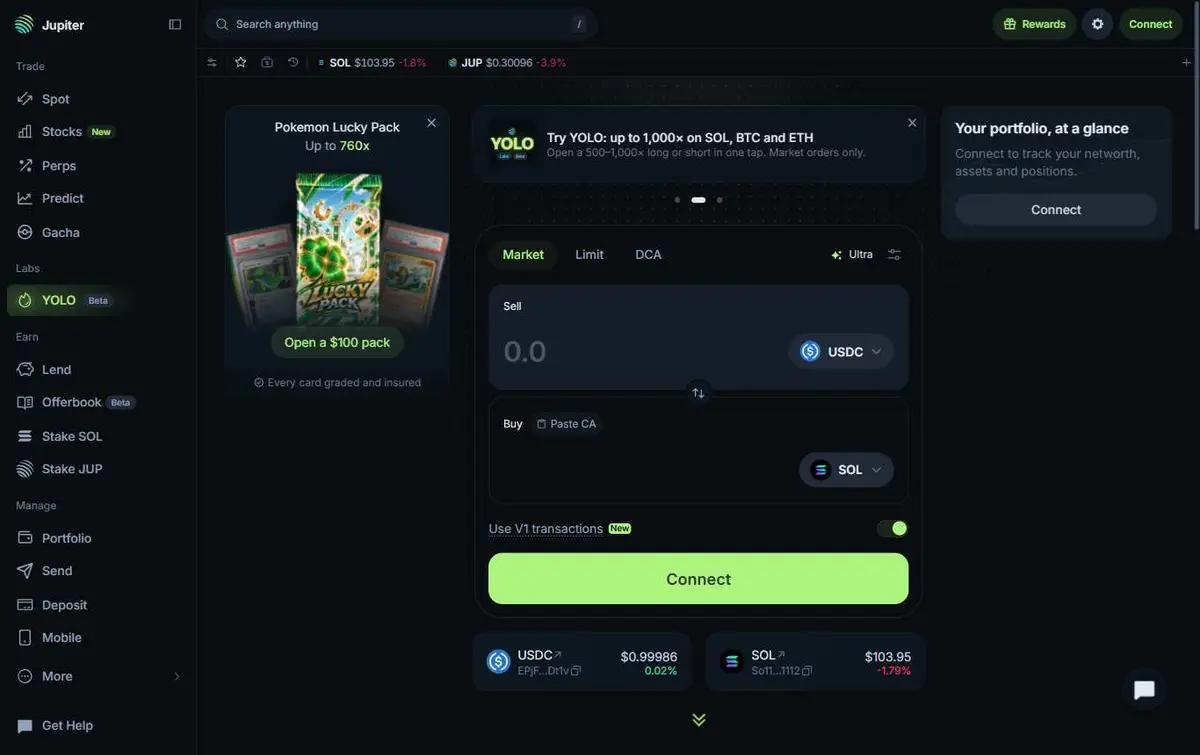
No barrier Greece · Trading app
Greece: the swap app loads with no notice
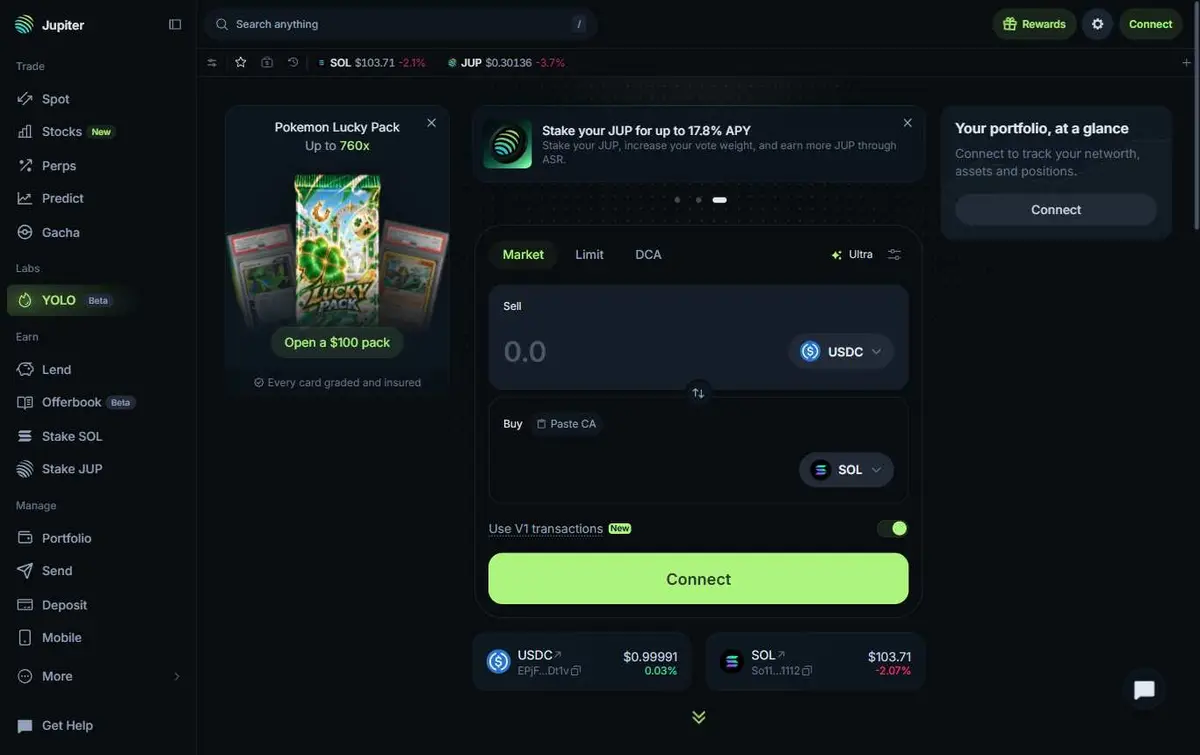
No barrier Bulgaria · Trading app
Bulgaria: the swap app loads with no notice
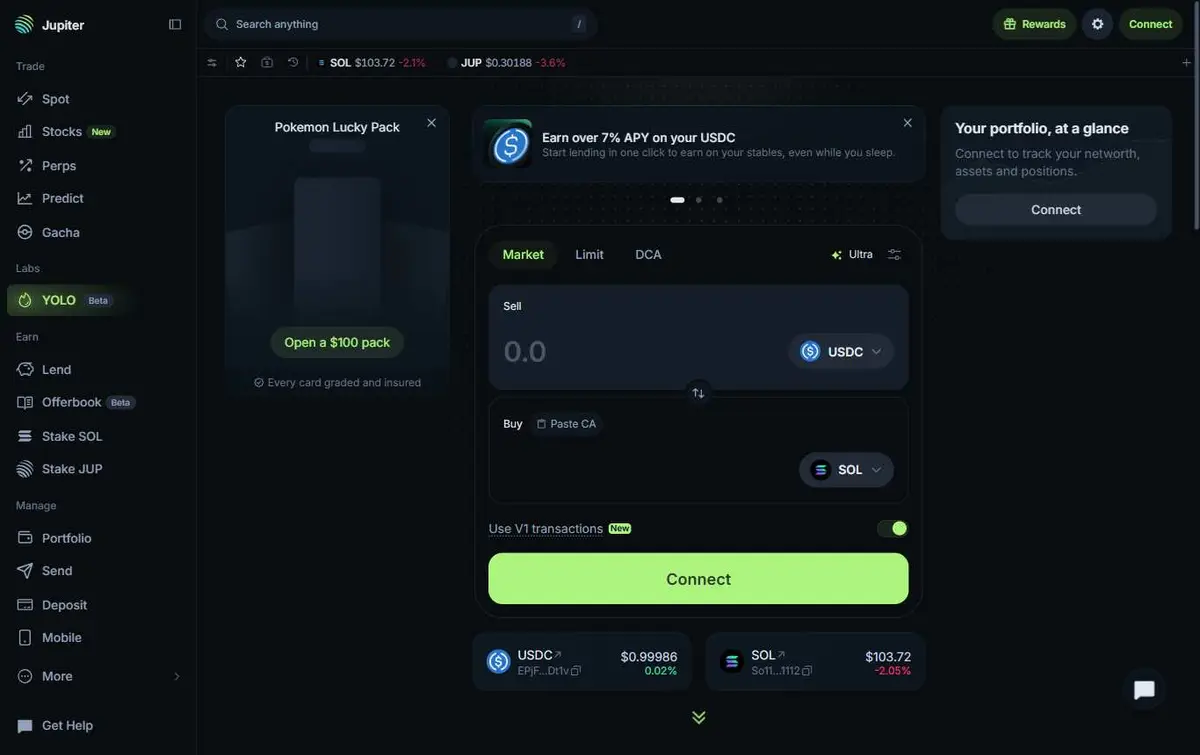
No barrier Croatia · Trading app
Croatia: the swap app loads with no notice
No barrier Lithuania · Trading app
Lithuania: the swap app loads with no notice
No barrier Slovenia · Trading app
Slovenia: the swap app loads with no notice
No barrier Iceland · Trading app
Iceland: the swap app loads with no notice
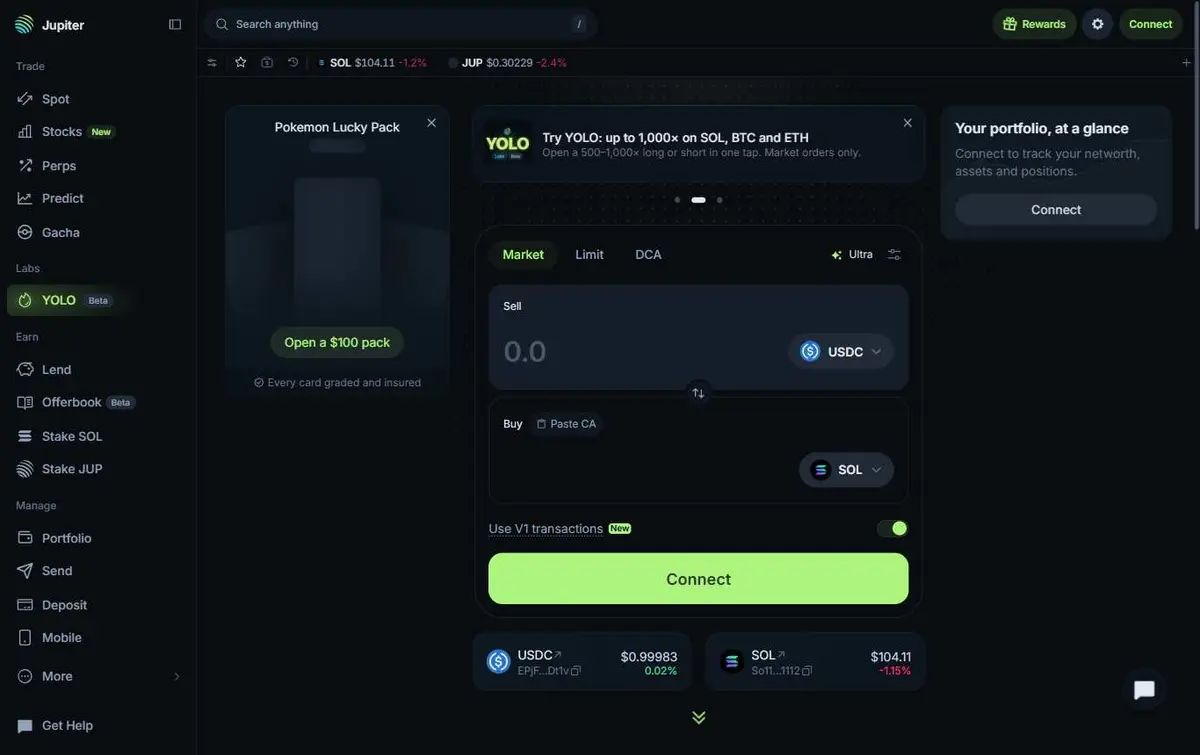
No barrier Serbia · Trading app
Serbia: the swap app loads with no barrier
 CRYPTORESTRICTIONS
The screen from a US address is the one Germany sees: the swap box, a menu with Perps and Predict, and no banner. We found no location check to trigger, and the terms speak of wallets, not IP addresses, so the rule is applied, if at all, at the wallet.
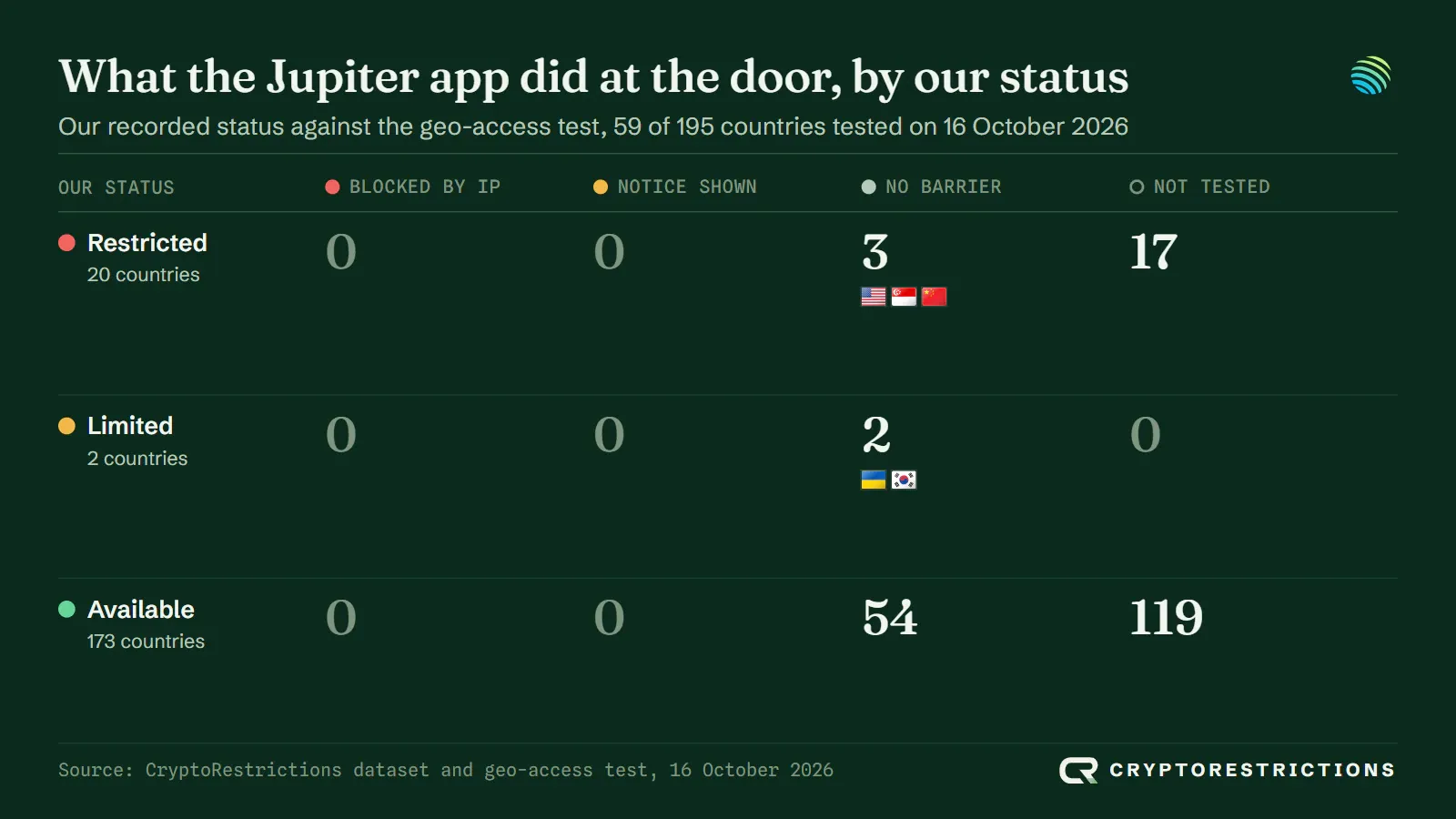
Two patterns stand out. The written list and the door do not match at all: the US, Singapore and China are named and loaded, so a “no barrier” result is no evidence of availability here. And a result for one product does not carry to another: the home screen says nothing about the Prediction Market API, which the docs say refuses US and South Korean IPs. The full result for every place is below.
All 61 test results, country by country
Jupiter licences and registrations
Jupiter holds no licence or registration that we could find, and its terms describe jup.ag as an interface to open-source software, not a regulated service.
The terms say the interface shows “a visual representation of Jupiter protocol”, software that Block Raccoon S.A. deployed in a permissionless manner, and that neither the company, the interface nor the protocol “provides any digital asset exchange or portfolio/fund management services”. Panama law governs. Jupiter is non-custodial: it “will not create any hosted wallet for you”. The exception is Jupiter Spend, a card product whose docs describe a five-step ID check. We found no regulator warning or block of Jupiter in searches covering the SEC, the CFTC, the FCA and the Thai and Korean regulators; the only FCA hits were clone warnings about an unrelated “Jupiter Investment Management”.
Jupiter and MiCA in the EU
Jupiter has no MiCA authorisation: neither Jupiter nor Block Raccoon appears in ESMA’s register of crypto-asset service providers, which we checked on 17 October 2026.
Whether it needs one is the open question for every decentralised exchange. MiCA says in recital 22 that crypto-asset services “provided in a fully decentralised manner without any intermediary” should fall outside the regulation. Jupiter’s interface is run by a company, but its terms say the protocol is a set of autonomous contracts with “no further control” by the entity that deployed them, and no EU regulator has acted against it that we found. That is why we record the EEA as available, unlike the centralised exchanges that closed new EEA accounts at the MiCA deadline. Jupiter excludes no EEA country in its terms or docs.
Is Jupiter available in the US?
No. The United States is first on Jupiter’s list, so the terms exclude US wallets from every product, the Prediction Market API blocks US IPs, and Jupiter Mobile is restricted there. Jupiter has no US company or registration. Yet the app loaded, with Predict in the menu, from our US address.
Jupiter availability by US state
The exclusion is nationwide, so no state is treated differently. It is also recent in the terms: the 10 August 2024 copy named a Singapore company, Dynamic Labs Limited, and a list without the US, and the 5 September 2024 copy named Block Raccoon S.A. of Panama and added the US, the Republic of China and Singapore.
Jupiter’s access rules and products, year by year
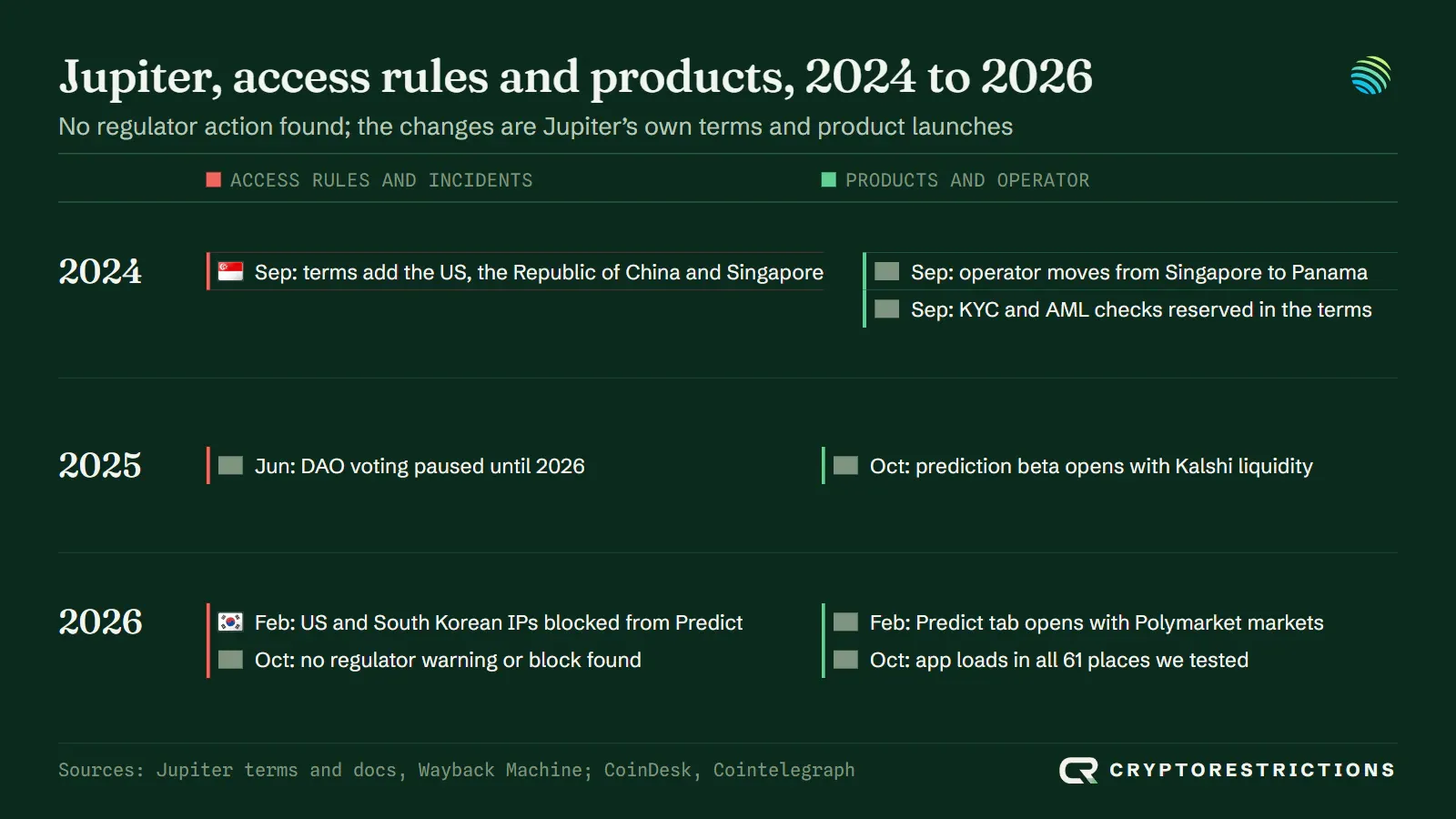
We found no SEC, CFTC, Justice Department or OFAC action against Jupiter, and no national regulator warning or block. The changes are Jupiter’s own: the 2024 terms, a DAO pause in June 2025 that Cointelegraph reported, and the prediction markets of 2025 and 2026.
Jupiter KYC and identity verification
Jupiter asks for no identity documents to swap, trade perpetuals or use Predict: you connect a Solana wallet and trade, and there is no sign-up.
The terms keep KYC and AML checks in reserve. They say Jupiter reserves the right to conduct them if it deems them necessary or a law requires them, and that it may refuse access until the information is provided. Documents named include passports, utility bills and photographs. The terms also bar VPNs and any technique that “disguises or interferes” with your IP address, though our test shows no IP check to evade.
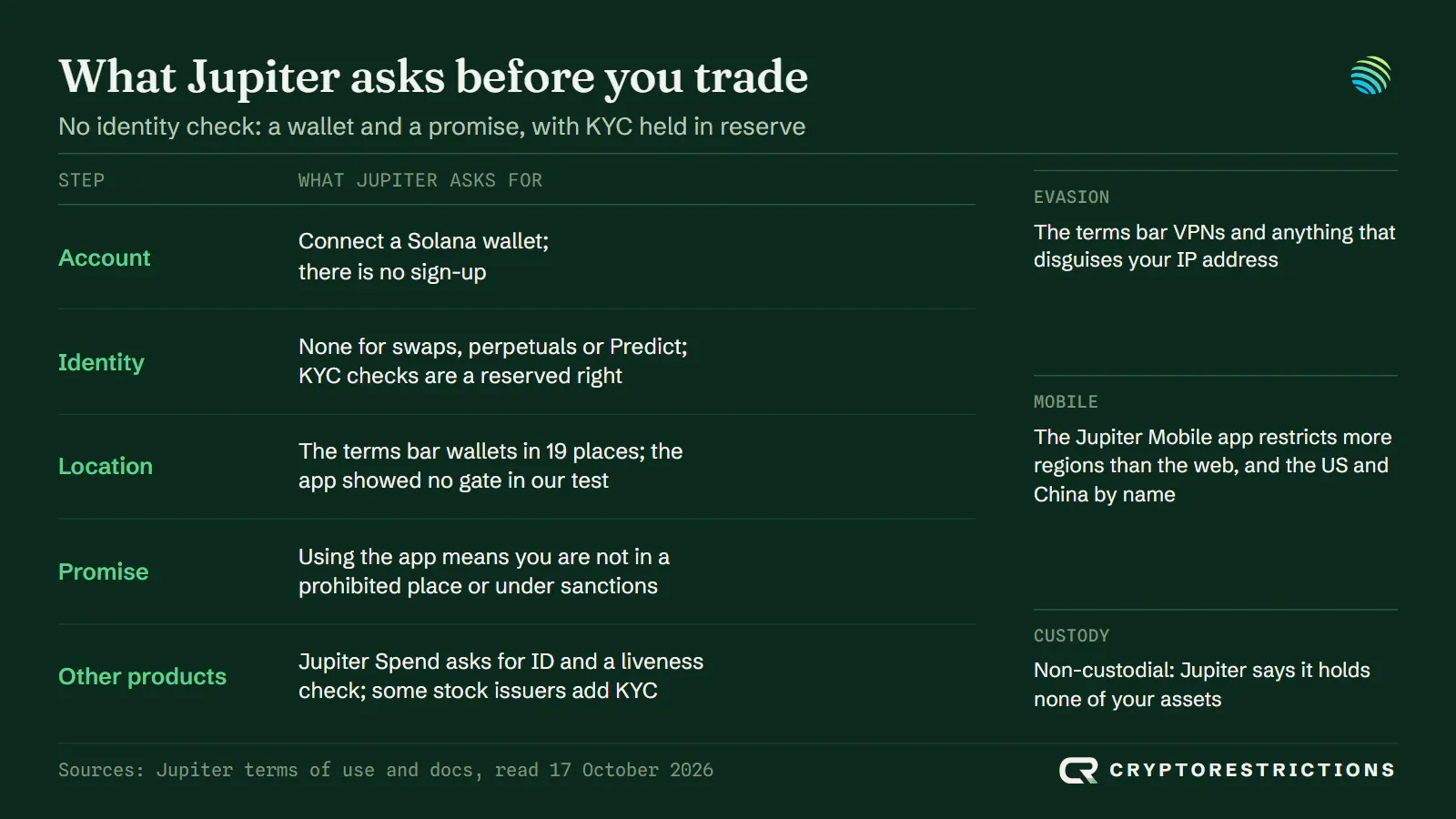
Other Jupiter products do ask: Jupiter Spend, the card, runs a five-step ID check that includes a liveness test, and the tokenised-stock docs say some issuers require KYC or restrict eligibility by jurisdiction. Trading on Jupiter itself, the docs say, does not.
Jupiter verification history
We found no record that Jupiter has ever asked swap or perpetuals users for identity documents. What changed is the paper: the KYC reservation is absent from the 10 August 2024 copy of the terms and present in the 5 September copy, with the Panama operator.
What if Jupiter is restricted where you live?
It depends on the country: of the 21 other platforms we track, 19 are available in Côte d’Ivoire, but only one each in Cuba, Iran, North Korea and the United States.
Using Jupiter from a restricted country is not allowed under the terms, which bar VPNs and anything that disguises your IP address, even though the app does not stop you. Other front ends set their own rules, and the platforms compared above do check at the door. What is left is a platform allowed to serve you where you live.
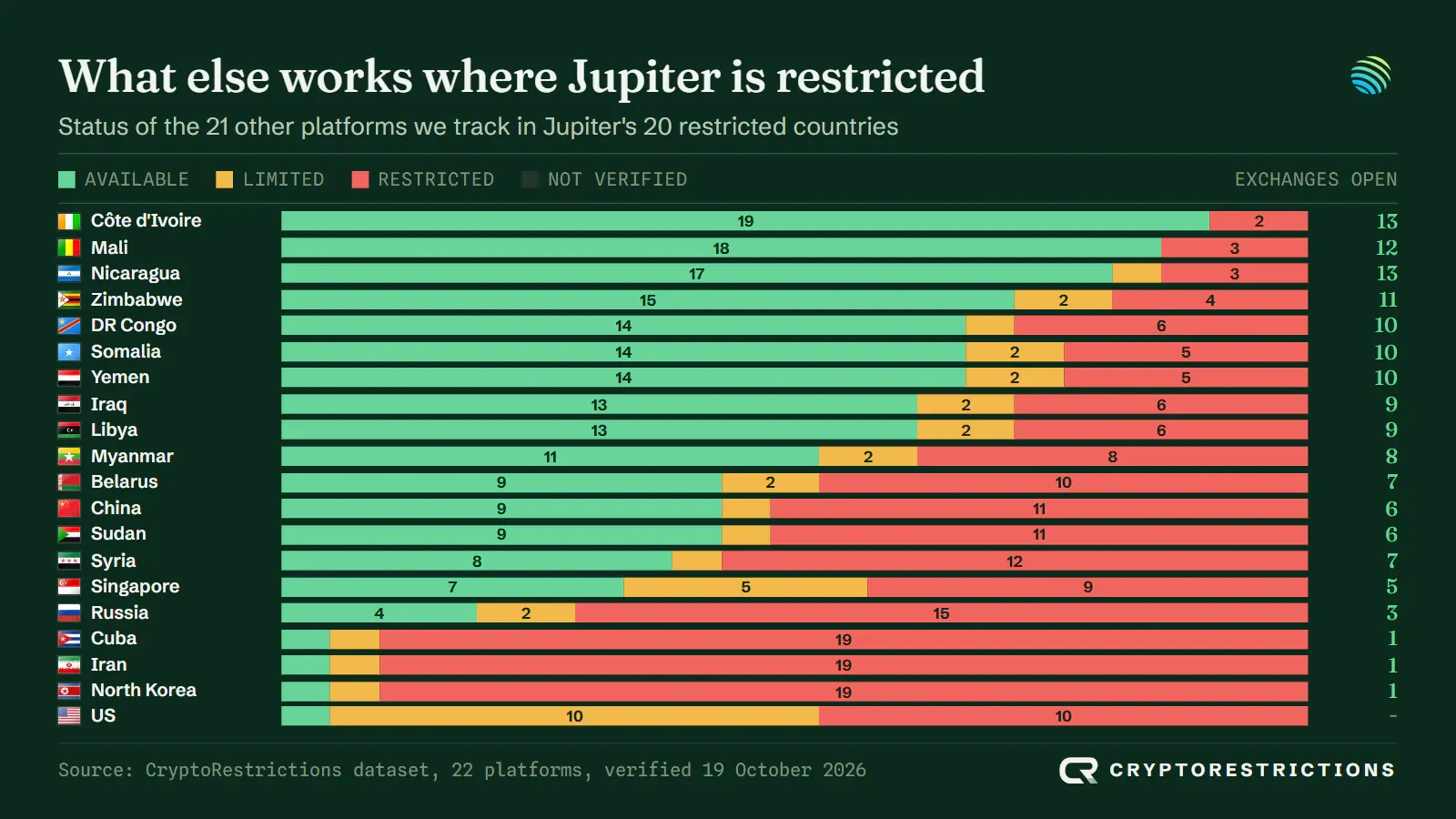
In the United States the field narrows to one platform, Uniswap, with ten more limited. In Singapore seven are open and five limited, and in China nine are open.
For a country-by-country comparison of exchanges, with residency rules and licences side by side, see our guide to exchange alternatives by country.