
Is crypto legal in Taiwan?
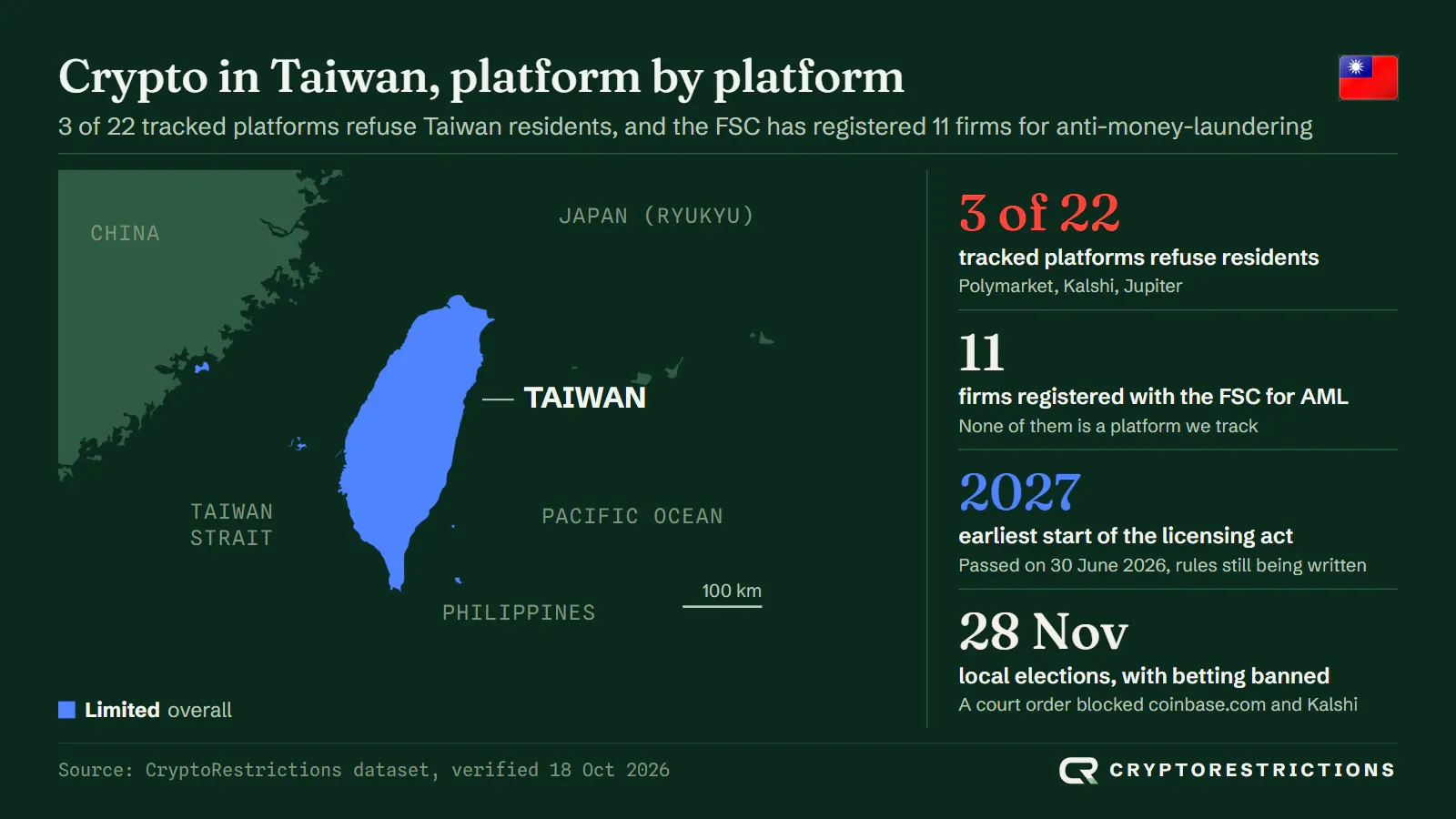
In practice yes. We found no rule that bans residents from owning or trading crypto, but only firms registered with the FSC may offer virtual asset services, and offshore exchanges that have not registered are warned about.
Taiwan runs its own financial regulators, so the rules below are Taiwan’s. Today the entry point is anti-money-laundering registration. The FSC publishes a list of firms that have completed it: its first list of 22 September 2025 named nine firms, and a report of 29 September 2026 puts the total at 11 after BitstreetX joined.
A licensing law is coming. The Legislative Yuan passed the Virtual Asset Service Act on 30 June 2026, The Block reported, and the Presidential Office Gazette of 22 July 2026 lists it among the promulgated laws. The sections below cover who is registered, what the new act changes, which platforms refuse residents and how profits are taxed.
Which crypto exchanges work in Taiwan?
None of the exchanges we track is on the FSC’s list of registered firms, yet 10 of the 14 exchanges serve Taiwan residents without a restriction on the service as a whole and none holds a Taiwan licence on our file.
The 11 registered firms are local companies, among them MaiCoin (MAX), Hoya Bit, BitoPro, TSG EX, Liminal’s Taiwan company and BitstreetX. The first list also held HzBit, which closed at the end of January 2026. Registration covers anti-money-laundering controls only and is not a licence; the new act turns it into one, as the regulators section explains.
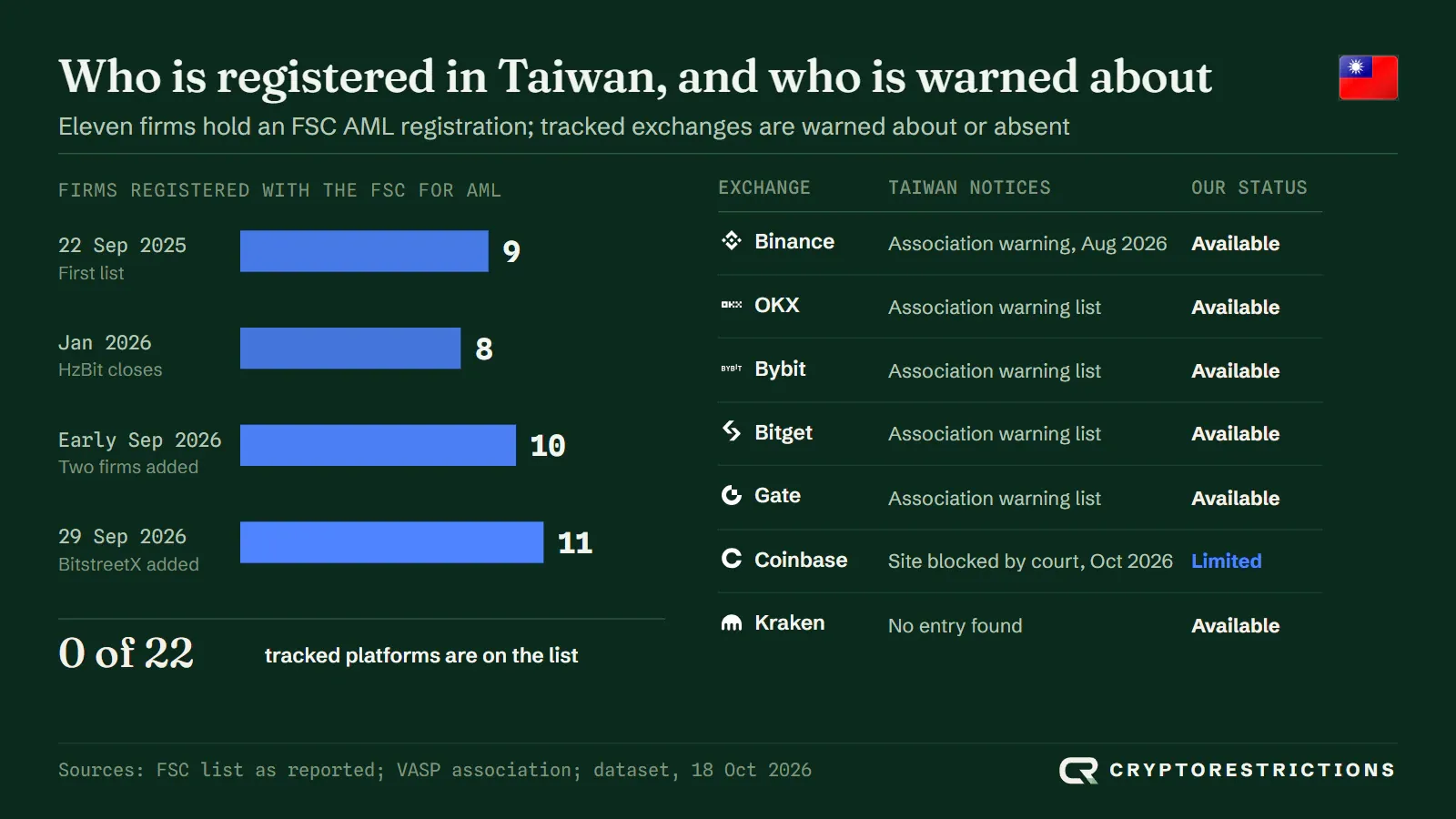
Foreign exchanges answer to a different body. The Taiwan VASP Association, set up under the FSC’s guidelines for self-regulation, keeps a warning list. On 10 August 2026 it added Binance, saying Binance had not completed AML registration with the FSC and may not offer services or solicit users in Taiwan, as BlockTempo reported. The same report says OKX, Bybit, Gate and Bitget were already listed. A warning is an industry notice, not a ruling, and all five still show as available in our data because their own terms do not exclude Taiwan.
We found no notice naming Kraken, Bitstamp, Bitfinex, KuCoin or MEXC, but the association says its list can be incomplete, so a missing entry is not clearance.
Best crypto platforms for Taiwan residents
By our access score, ten exchanges tie at 8.0 out of 10 because neither their terms nor our test show a Taiwan carve-out, followed by Crypto.com (6.3), Gemini (5.9), Coinbase (5.8) and HTX (5.7), where a product or the site itself is closed.
The score rates how fully a Taiwan resident can use each platform, not its fees or safety. It is computed from our data and moves when a row changes: access status (4 points), the share of the platform’s products open here (3), the Taiwan licences we hold on file (2) and what our geo-access test saw from a Taiwan address (1). Platforms that refuse Taiwan residents are not scored, which is why Polymarket, Kalshi and Jupiter are absent. The full method is on our methodology page.
Exchanges

Binance
Best for Spot and derivatives, with a regulatory warning
8.0/10- Access
- 4/4
- Products
- 3/3
- Licences
- 0/2
- Our test
- 1/1
Read our Binance reportPros
- Taiwan is not on its list of prohibited countries
Cons
- On the Taiwan VASP association warning list since August 2026
- Not among the FSC registered firms

Bitfinex
Best for Spot access with no Taiwan notice against it
8.0/10- Access
- 4/4
- Products
- 3/3
- Licences
- 0/2
- Our test
- 1/1
Read our Bitfinex reportPros
- Taiwan is not a prohibited jurisdiction in its terms
- Loaded without a block in our test
Cons
- Not among the FSC registered firms

Bitget
Best for Derivatives, with a regulatory warning
8.0/10- Access
- 4/4
- Products
- 3/3
- Licences
- 0/2
- Our test
- 1/1
Read our Bitget reportPros
- Taiwan is not on its prohibited-countries list
Cons
- On the Taiwan VASP association warning list
- Not among the FSC registered firms

Bitstamp
Best for Plain spot trading
8.0/10- Access
- 4/4
- Products
- 3/3
- Licences
- 0/2
- Our test
- 1/1
Read our Bitstamp reportPros
- No Bitstamp document we hold excludes Taiwan
- Loaded without a block in our test
Cons
- Not among the FSC registered firms

Bybit
Best for Derivatives, with a regulatory warning
8.0/10- Access
- 4/4
- Products
- 3/3
- Licences
- 0/2
- Our test
- 1/1
Read our Bybit reportPros
- Taiwan is not on its excluded-jurisdictions list
Cons
- On the Taiwan VASP association warning list
- Not among the FSC registered firms

Gate
Best for Spot and derivatives, with a regulatory warning
8.0/10- Access
- 4/4
- Products
- 3/3
- Licences
- 0/2
- Our test
- 1/1
Read our Gate reportPros
- Taiwan is not on the restricted-locations list in its user agreement
Cons
- On the Taiwan VASP association warning list
- Not among the FSC registered firms

Kraken
Best for Spot trading with no Taiwan notice against it
8.0/10- Access
- 4/4
- Products
- 3/3
- Licences
- 0/2
- Our test
- 1/1
Read our Kraken reportPros
- Taiwan is not on its do-not-serve list
- Loaded without a block in our test
Cons
- Not among the FSC registered firms

KuCoin
Best for Spot and derivatives with no Taiwan notice
8.0/10- Access
- 4/4
- Products
- 3/3
- Licences
- 0/2
- Our test
- 1/1
Read our KuCoin reportPros
- Taiwan is not on the restricted-locations list in its terms
Cons
- Not among the FSC registered firms

MEXC
Best for Spot and derivatives with no Taiwan notice
8.0/10- Access
- 4/4
- Products
- 3/3
- Licences
- 0/2
- Our test
- 1/1
Read our MEXC reportPros
- Taiwan is not on the prohibited-jurisdictions list in its user agreement
Cons
- Not among the FSC registered firms

OKX
Best for Spot trading, with a regulatory warning
8.0/10- Access
- 4/4
- Products
- 3/3
- Licences
- 0/2
- Our test
- 1/1
Read our OKX reportPros
- Taiwan is not on its restricted-locations list (July 2026)
Cons
- On the Taiwan VASP association warning list
- Not among the FSC registered firms

Crypto.com
Best for Buying in the app and spot trading
6.3/10- Access
- 3.5/4
- Products
- 1.8/3
- Licences
- 0/2
- Our test
- 1/1
Read our Crypto.com reportPros
- The app and spot trading serve Taiwan
Cons
- Derivatives geo-restriction list includes Taiwan

Gemini
Best for Perpetual futures only
5.9/10- Access
- 3/4
- Products
- 1.9/3
- Licences
- 0/2
- Our test
- 1/1
Read our Gemini reportPros
- Taiwan is on its perpetuals list
Cons
- Spot is not offered: Taiwan is not on its main list

Coinbase
Best for Nothing right now: its site is court-blocked
5.8/10- Access
- 3/4
- Products
- 2.3/3
- Licences
- 0/2
- Our test
- 0.5/1
Read our Coinbase reportPros
- Its guide still lists Taiwan as a sign-up country
Cons
- coinbase.com blocked by court order since 14 October 2026
- Its page told our test that stocks and prediction markets are unavailable

HTX
Best for Spot trading only
5.7/10- Access
- 3/4
- Products
- 1.7/3
- Licences
- 0/2
- Our test
- 1/1
Read our HTX reportPros
- Spot and other services are not restricted
Cons
- Derivatives barred in its user agreement
DeFi

Lighter
Best for Perpetuals on its main app
8.0/10- Access
- 4/4
- Products
- 3/3
- Licences
- 0/2
- Our test
- 1/1
Read our Lighter reportPros
- The trading app loaded in our test
Cons
- No Taiwan licence on file

PancakeSwap
Best for BNB Chain swaps and pools
8.0/10- Access
- 4/4
- Products
- 3/3
- Licences
- 0/2
- Our test
- 1/1
Read our PancakeSwap reportPros
- Taiwan is not excluded by its terms
Cons
- No Taiwan licence on file

Uniswap
Best for Swapping tokens from your own wallet
8.0/10- Access
- 4/4
- Products
- 3/3
- Licences
- 0/2
- Our test
- 1/1
Read our Uniswap reportPros
- Its terms bar only places under comprehensive US sanctions
Cons
- No Taiwan licence on file

Aster
Best for Perpetuals and spot trading
5.9/10- Access
- 3/4
- Products
- 1.9/3
- Licences
- 0/2
- Our test
- 1/1
Read our Aster reportPros
- Perps and spot are not barred by its terms
Cons
- Prediction trading is barred under its prediction rules

Hyperliquid
Best for Perpetuals and spot from your own wallet
5.9/10- Access
- 3/4
- Products
- 1.9/3
- Licences
- 0/2
- Our test
- 1/1
Read our Hyperliquid reportPros
- Perps and spot loaded in our test
Cons
- The outcome markets tab was hidden in our test
Which platforms block Taiwan users?
Polymarket, Kalshi and Jupiter refuse Taiwan residents in their own terms or lists, and Taiwanese authorities have also had Kalshi’s site blocked. No exchange we track refuses Taiwan outright.
Polymarket names Taiwan on its list of restricted places, close-only: existing positions can be sold and none opened. Kalshi names Taiwan among the restricted jurisdictions of its member agreement. Jupiter is the odd one: its terms list “the Republic of China”, which is Taiwan’s official name, while its mobile FAQ lists China, so we record Taiwan as restricted and flag the intent as unclear.



What our geo-access test saw from Taiwan
From a Taiwan address on 14 and 16 October 2026 we loaded all 22 platforms we track: 2 refused us, 1 showed a notice and 19 loaded with no barrier.
An open page is not permission. Most platforms enforce at identity verification rather than at the page, and Hyperliquid’s trading app loaded but hid its outcome markets tab. Polymarket refused the page and Kalshi’s sign-up page refused us. Coinbase’s page still loaded on 14 October, the day the court-ordered block began, with a notice that stocks and prediction markets are not available. Swipe through the screenshots below; each card quotes what the page showed.
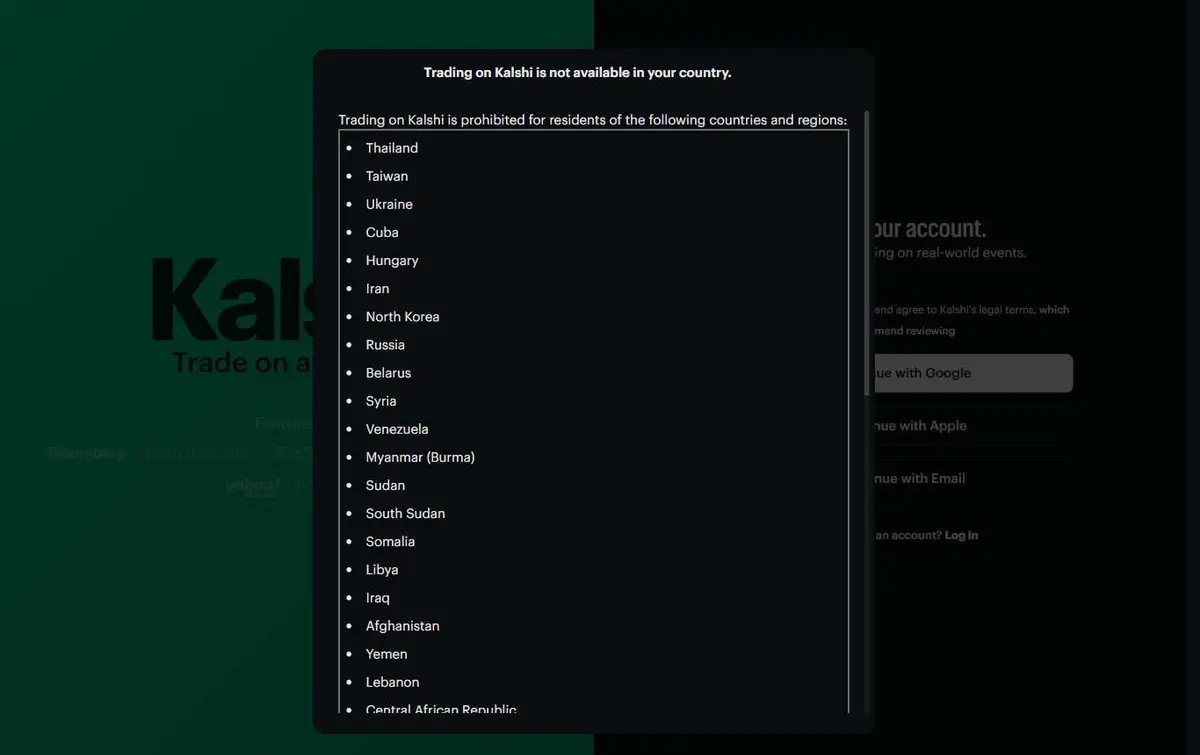
Blocked Kalshi · Sign-up page
Taiwan, where a court also had Kalshi blocked in October 2026: the same refusal on the sign-up page
“Trading on Kalshi is not available in your country.”
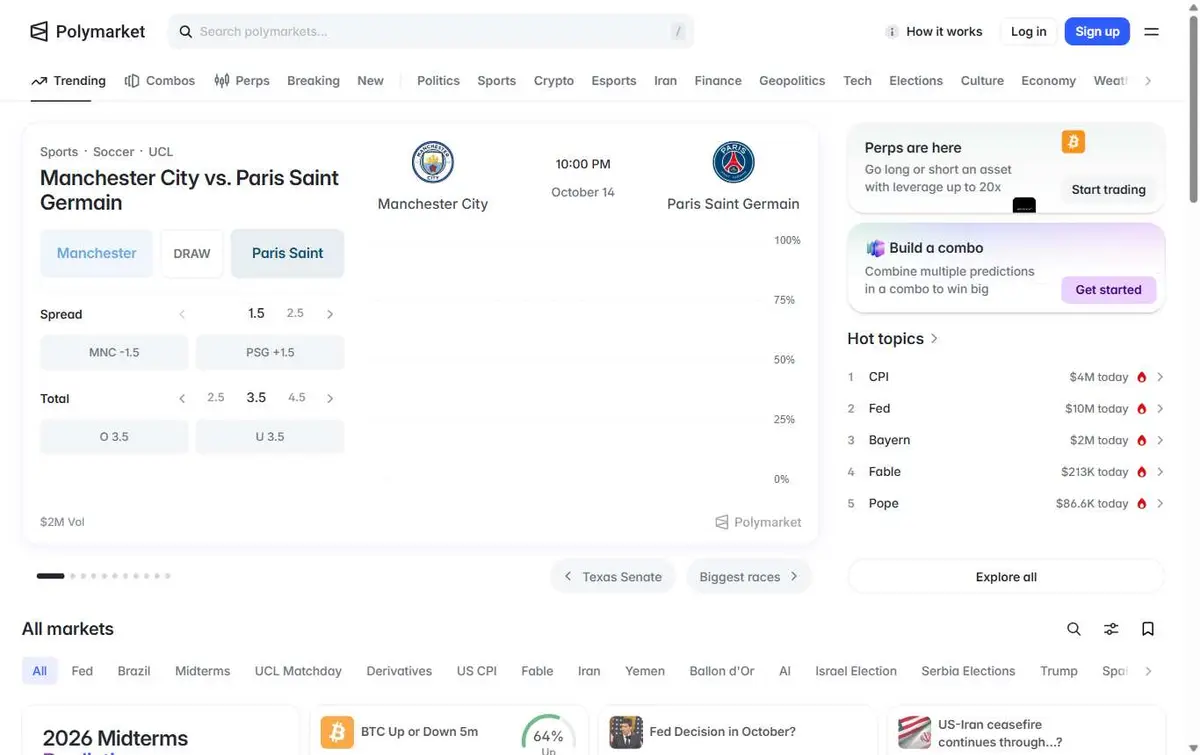
Blocked Polymarket · Home page
Taiwan, close-only on Polymarket's list, blocked the same silent way
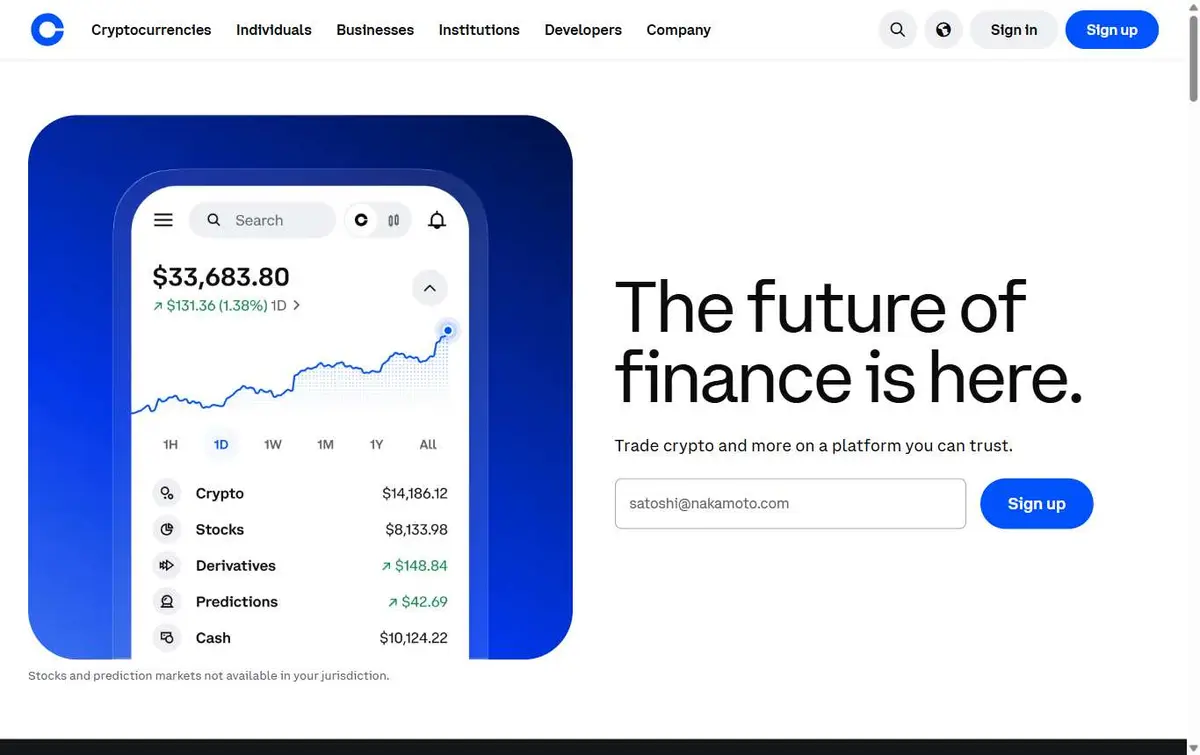
Notice shown Coinbase · Home page
Taiwan on 14 October, the day the court-ordered block began: the page still loaded
“Stocks and prediction markets not available in your jurisdiction.”
 CRYPTORESTRICTIONS
Who regulates crypto in Taiwan?
The FSC registers virtual asset firms and will license them under the new act, the industry association warns about unregistered offshore platforms, prosecutors and courts enforce the election betting law, and the Ministry of Finance sets how tokens are taxed.
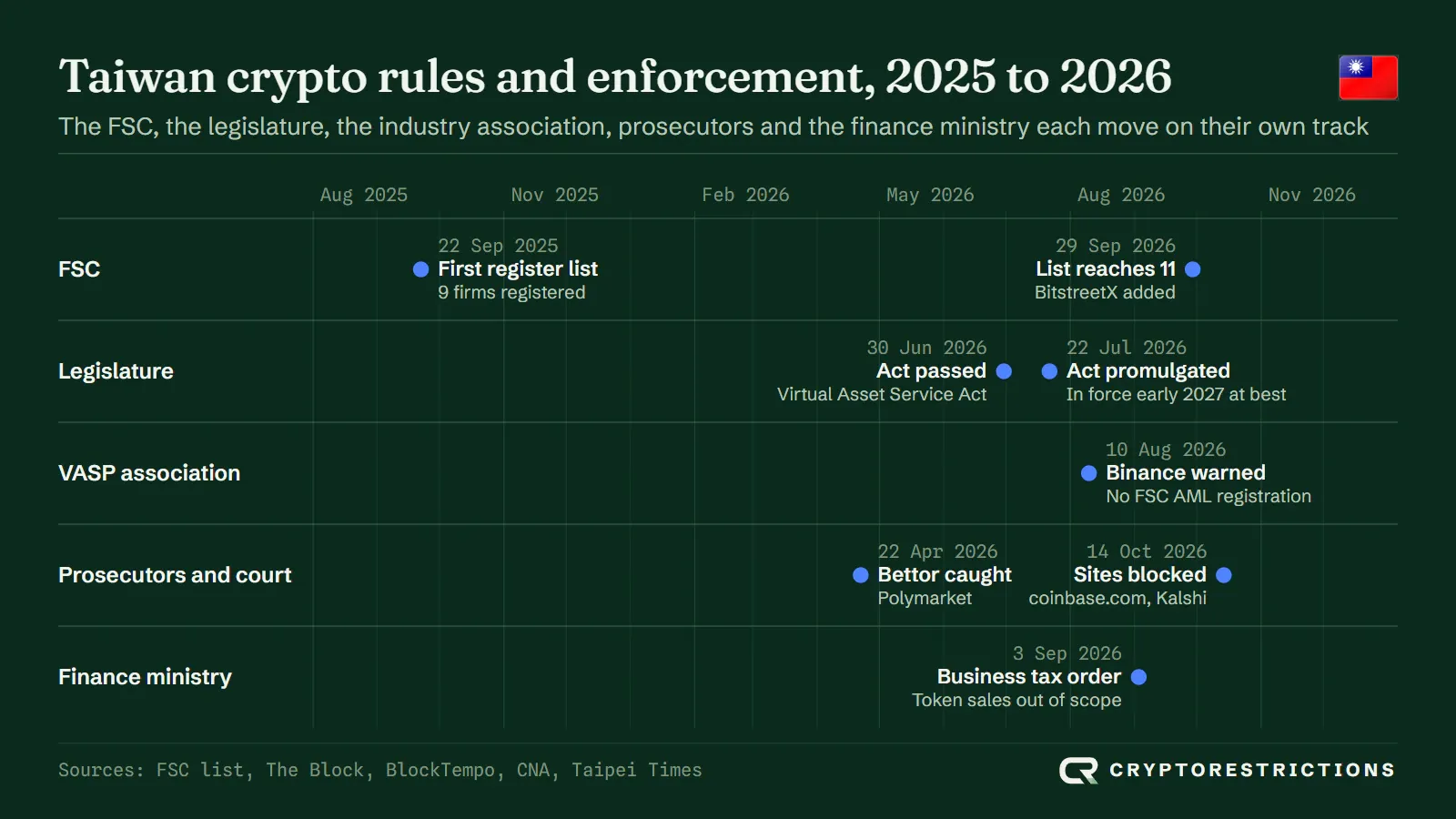
- FSC. It keeps the register of firms that completed anti-money-laundering registration and will license virtual asset service providers under the new act.
- The act. The Virtual Asset Service Act makes FSC permission mandatory for virtual asset service providers, requires stablecoin issuers to win approval from both the central bank and the FSC, and punishes illegal operation with up to seven years in prison and a fine of up to NT$100 million, The Block reported. Registered firms get 12 months after the act takes effect to apply and 21 months to be approved.
- Start date. The FSC says nine sub-regulations must be written first, and Storm Media reports that the act could start as early as the first quarter of 2027. We found no start date fixed by 18 October 2026.
- Taiwan VASP Association. The self-regulatory body described on its website, covered above for its warning list.
- Prosecutors, the Criminal Investigation Bureau and courts. They enforce the Public Officials Election and Recall Act, covered in the prediction markets section.
- Ministry of Finance. The tax authority, covered in the tax section.
Which crypto products are limited in Taiwan?
Derivatives are the most closed product: HTX and Crypto.com bar them for Taiwan, Gemini offers perpetuals only, and prediction markets are closed on every platform where we hold a Taiwan row.
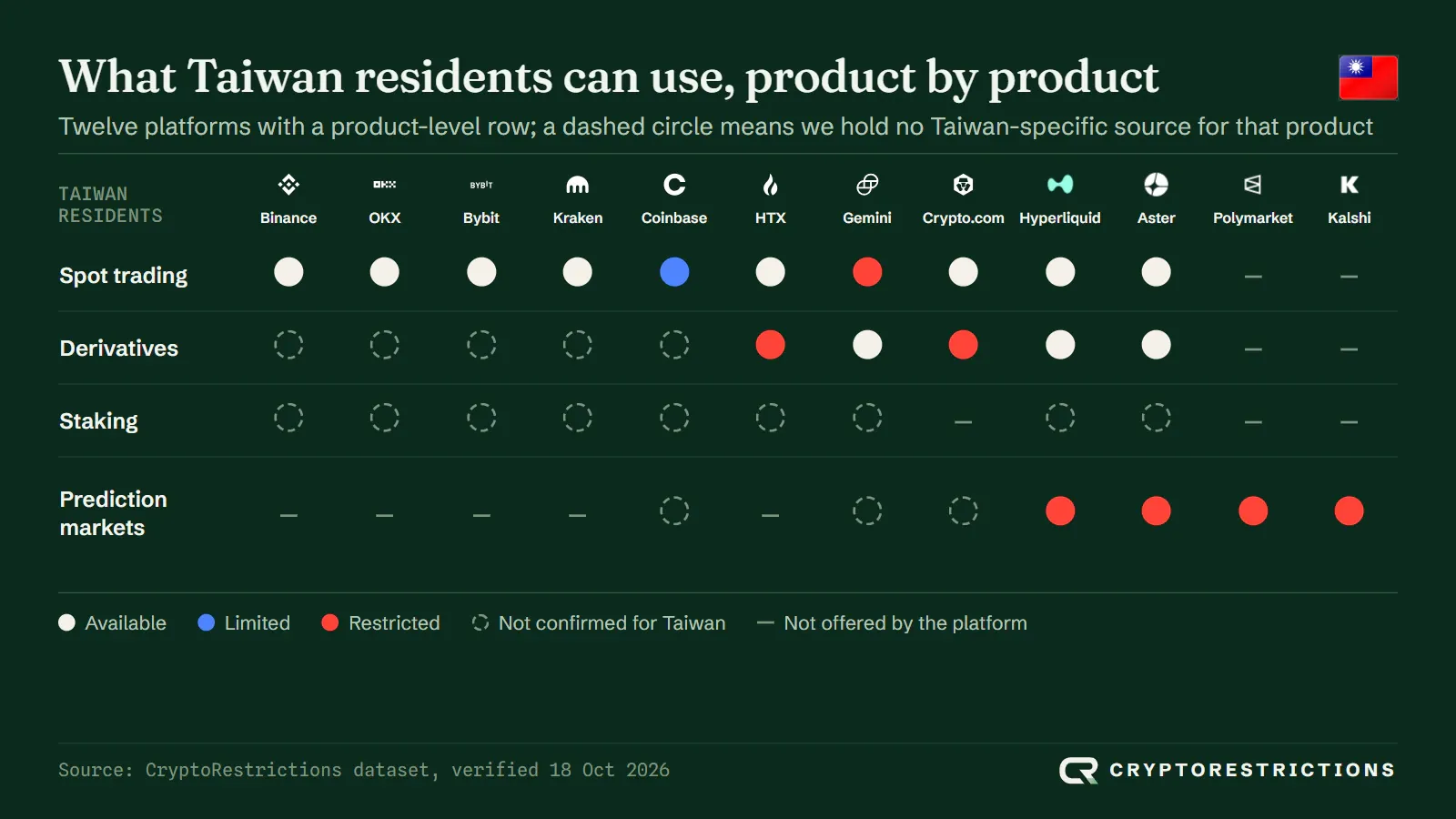
- Derivatives. HTX bars derivatives for Taiwan in its user agreement, and Crypto.com lists Taiwan on its derivatives geo-restrictions (updated 7 May 2025) while its app and spot trading serve Taiwan.
- Gemini. Gemini is split by its own lists: Taiwan appears on the perpetuals list but not on the main areas of availability, so spot is not offered.
- Stablecoins. Issuing one will need central bank and FSC approval under the new act. We found no licensed Taiwan issuer yet.
- Staking and lending. We hold no Taiwan source for staking or lending at any tracked platform, so the matrix shows them as not confirmed.
- Prediction markets. Polymarket and Kalshi refuse Taiwan, and Hyperliquid and Aster bar their outcome and prediction products here. The next section covers the law.
Are prediction markets legal in Taiwan?
Betting on an election result is a crime. Taiwan’s election law bans gambling for profit on election or recall outcomes, prosecutors have charged a Polymarket bettor, and a court has had Coinbase’s site and Kalshi blocked before the 28 November 2026 local elections.
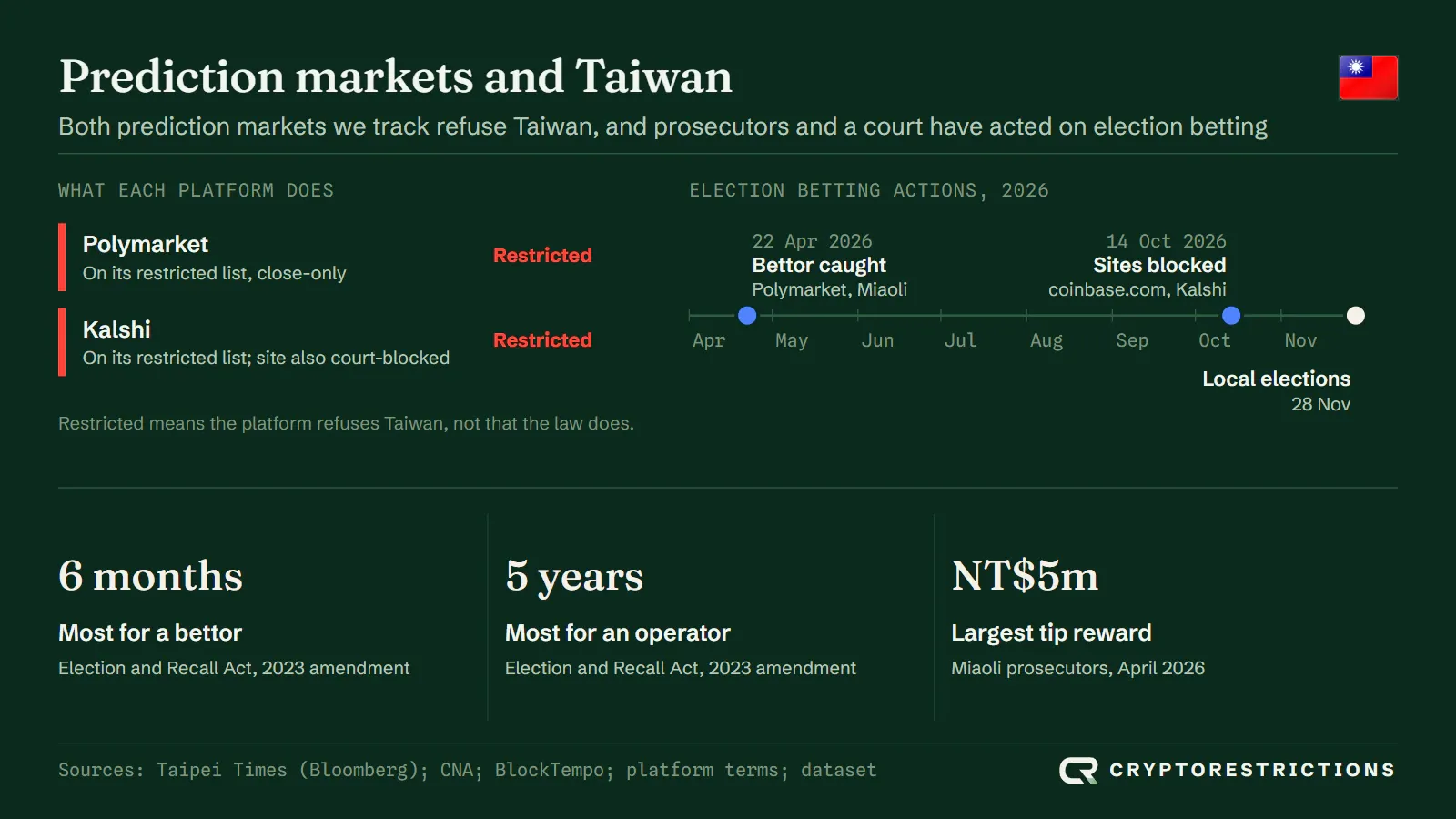
The law is the Public Officials Election and Recall Act. Taipei Times, citing Bloomberg, says that after a 2023 amendment bettors face up to six months in prison and operators up to five years. On 22 April 2026, CNA reported, Miaoli prosecutors caught a bettor who had staked crypto on Polymarket on which party would win the most mayoral seats in the 28 November elections, and they charged the person under Article 103-1(2) of the act. Tips about election gambling can earn rewards of up to NT$5 million.
The block came in October. The Criminal Investigation Bureau asked a New Taipei court for an order, and the court authorised the communications regulator and the internet registry to bar access to Coinbase and Kalshi, Taipei Times reported on 16 October 2026. BlockTempo saw the block page, which names a criminal ruling of the New Taipei District Court, and says coinbase.com has been blocked since 14 October. The bureau cited election integrity and overseas interference. The same report says Polymarket has also been blocked in Taiwan.
The law as reported targets election results. We found no Taiwan rule on other prediction-market topics such as sports or economic data, so what applies to those contracts is unconfirmed.
How is crypto taxed in Taiwan?
Gains are taxed as income. The Ministry of Finance treats an individual’s occasional sale of a non-securities token as property transaction income, and the new business tax order of 3 September 2026 puts token sales outside business tax.
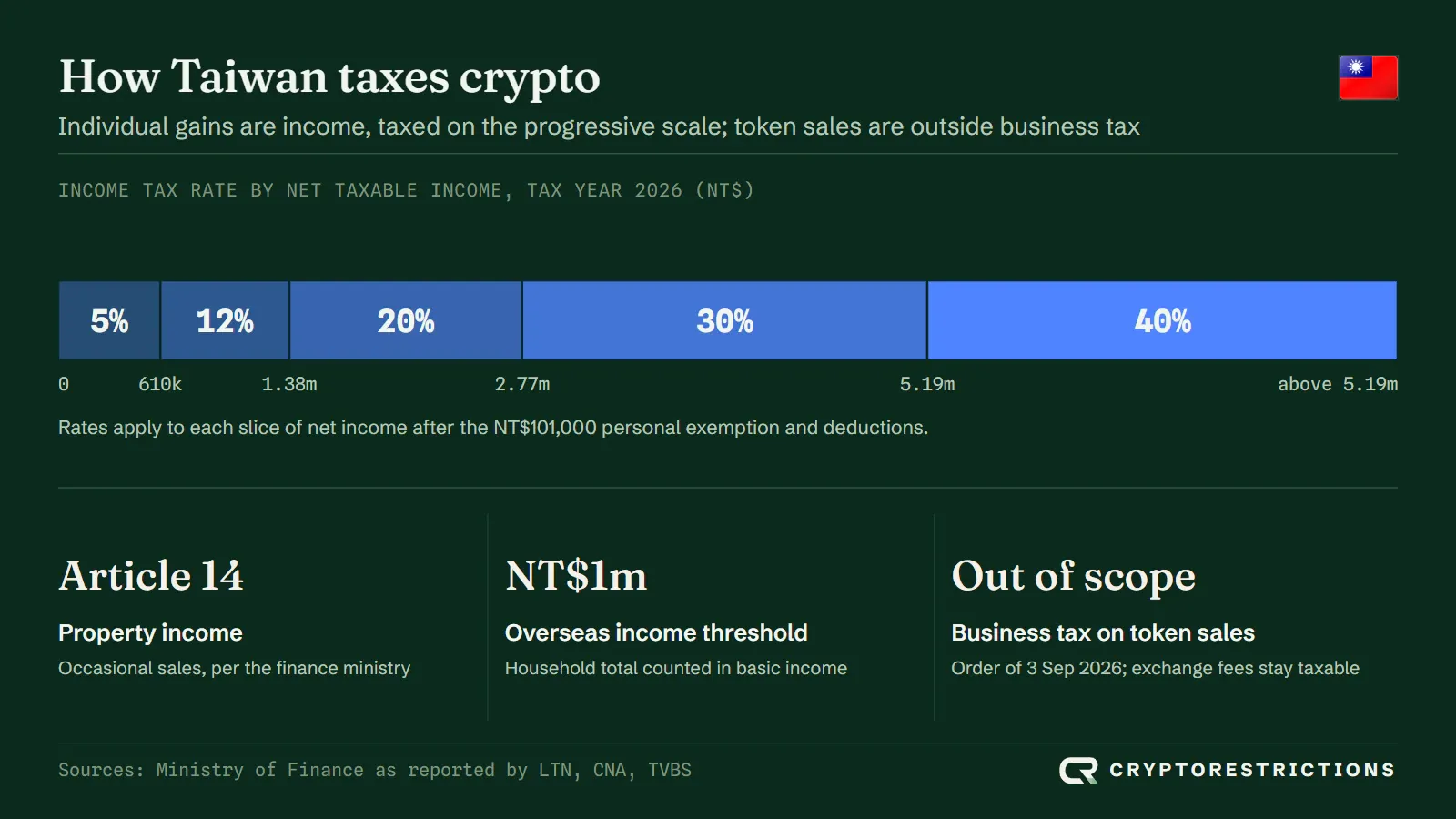
Deloitte Taiwan’s note, published by CNA on 24 November 2025, sets out the Ministry of Finance’s position. Gains from the occasional sale of a token that is not securities-type are property transaction income under Article 14(1) of the Income Tax Act: the sale price less the original cost and related expenses, added to comprehensive income. Losses offset property income in the same year and any excess carries forward for three years. Securities-type tokens are treated as securities gains under Article 4-1, with income tax on them suspended. Because most trading happens on overseas platforms, the income is usually overseas income, and under Article 12 of the Income Basic Tax Act a household with overseas income of NT$1 million or more in a year must include it in basic income. The note adds that the ministry had issued no dedicated tax rule for crypto at that date.
Income is taxed on a progressive scale. For tax year 2026, filed in May 2027, TVBS reported the rates as 5% up to NT$610,000 of net income, 12% to NT$1.38 million, 20% to NT$2.77 million, 30% to NT$5.19 million and 40% above, with a personal exemption of NT$101,000. TVBS noted the full figures were not yet final in December 2025, so check the ministry’s announcement before relying on them. Business tax is separate. In an order of 3 September 2026 the ministry said sales of virtual assets and stablecoins as defined in the new act are not within business tax scope, while fees and commissions charged by service providers and sales of NFTs remain taxable.
We found no Taiwan date for reporting under the OECD Crypto-Asset Reporting Framework. Working out your own position takes four steps:
 Bahrain
 Georgia
 Qatar
 Israel
 Saudi Arabia
 Vietnam
 Pakistan
 Bangladesh
 Indonesia
 United Arab Emirates
 South Korea