Where is Coinbase restricted?
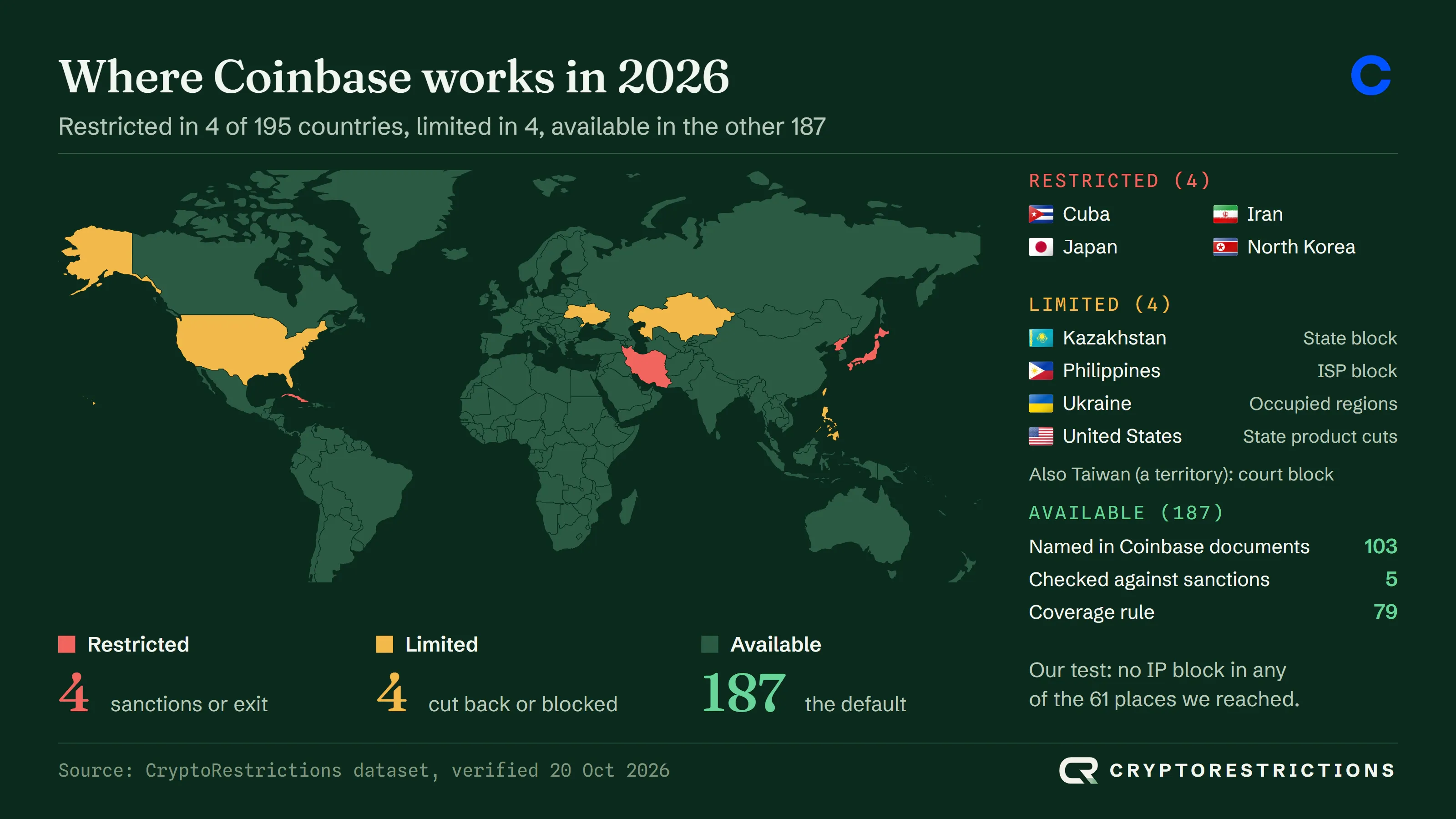
Coinbase is restricted in 4 of the 195 countries we cover:  Cuba,
 Iran,
 North Korea and
 Japan.
Coinbase publishes no country list. Its prohibited regions page says it blocks its website and app in any jurisdiction under US Treasury and other sanctions programmes, without naming one, and the US user agreement (updated 22 July 2026) applies the laws that bar dealings with comprehensively sanctioned jurisdictions. Cuba, Iran and North Korea are the countries under comprehensive US sanctions (OFAC programmes for Cuba, Iran and North Korea), and Coinbase’s sanctions post of March 2022 names North Korea and Iran among the geographies it blocks by IP address.
Japan is the one market exit. Coinbase halted its Japanese business in January 2023 and gave customers until 16 February 2023 to withdraw. The 2022 post also named Syria, but OFAC revoked the Syria sanctions programme on 1 July 2025, and no Coinbase document we read names Syria since, so we now record it as available.
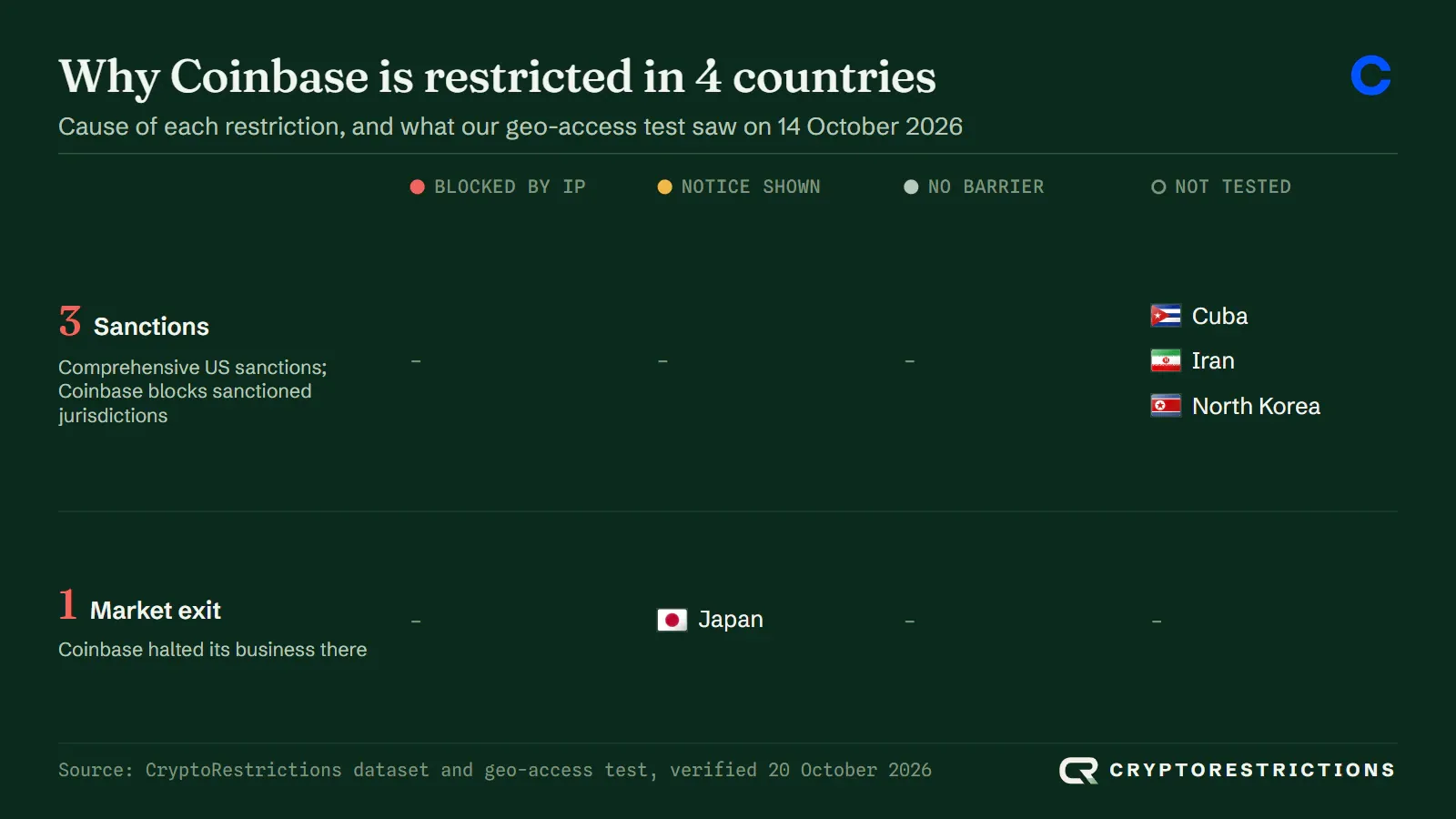
Coinbase applies these rules at login and at verification, not at the front door: Japan loaded in our test like any other country. The full list is below: pick a country to see the cause, what applies, when it started and what our test saw.
Where is Coinbase limited?
Coinbase is limited in 4 countries,  Kazakhstan, the
 Philippines,
 Ukraine and the
 United States, and in the territory of
 Taiwan, where a court has had coinbase.com blocked.
None of these cuts is a market Coinbase chose to leave. In the United States the cut is by product and state: staking, prediction markets and crypto-backed loans are not offered in some states, while spot trading is open everywhere (details in the US section below). In Kazakhstan the authorities confirmed in November 2023 that they had blocked access to Coinbase (reported, with no later report of the block lifting), while Coinbase still lists Kazakhstan as a signup country. Philippine internet providers have blocked coinbase.com since December 2025, BitPinas and Cointelegraph reported, after the telecoms regulator ordered access cut to 50 platforms the central bank had flagged as unlicensed, while Coinbase still lists the Philippines as a signup country. In Ukraine the occupied regions fall under US sanctions: Executive Order 13685 covers Crimea and Executive Order 14065 the so-called Donetsk and Luhansk republics. In Taiwan a New Taipei District Court order under the election and recall law has blocked coinbase.com since 14 October 2026, according to BlockTempo and the Taipei Times.
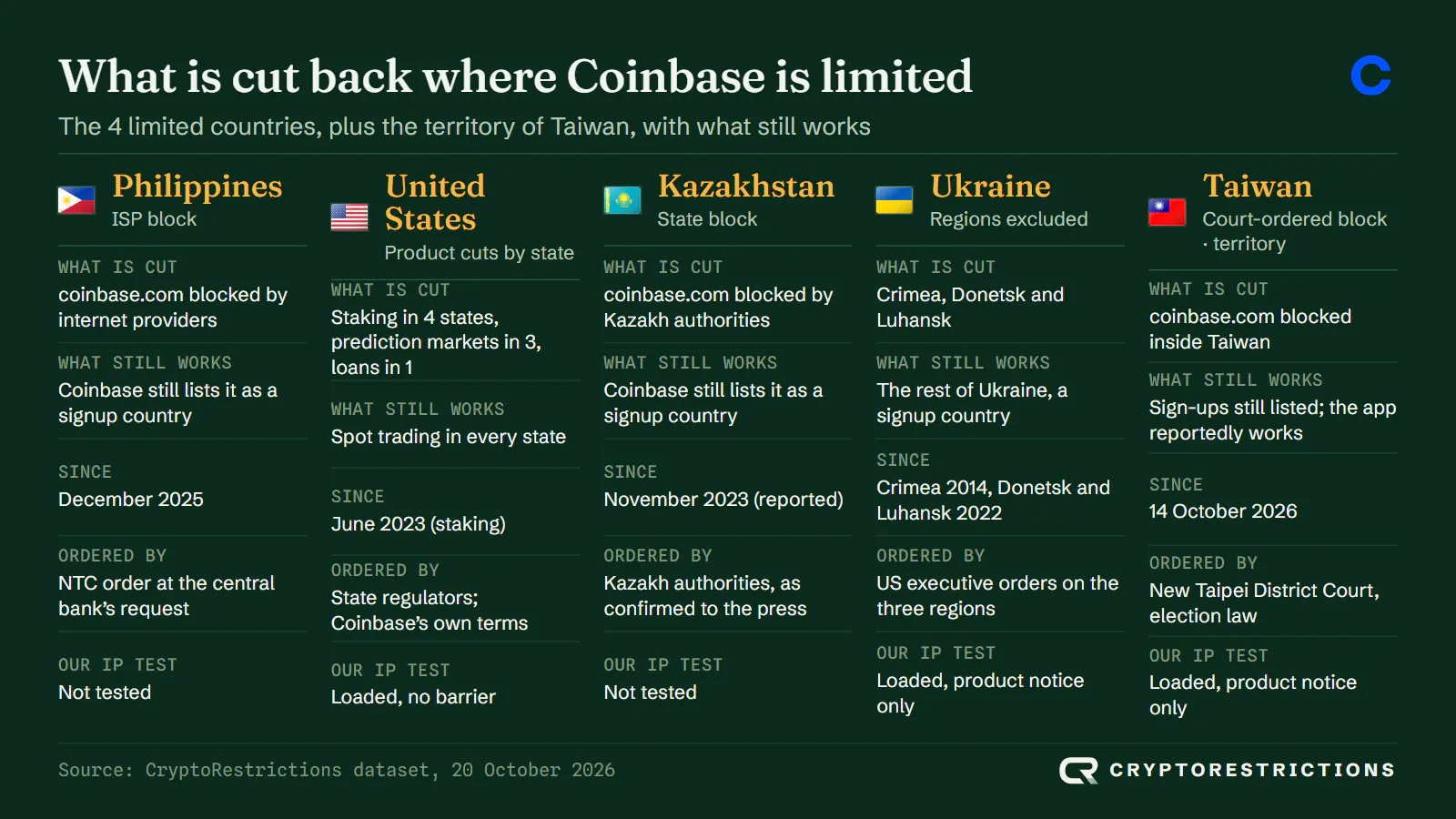
Limited means Coinbase still serves the place, but a product, part of the country or the website itself is out of reach. Unlike Bybit, whose sign-up page refused a Philippine address in our test, Coinbase does not enforce the Philippine order itself: the block sits with the internet providers. The groups are below.

Where is Coinbase available?
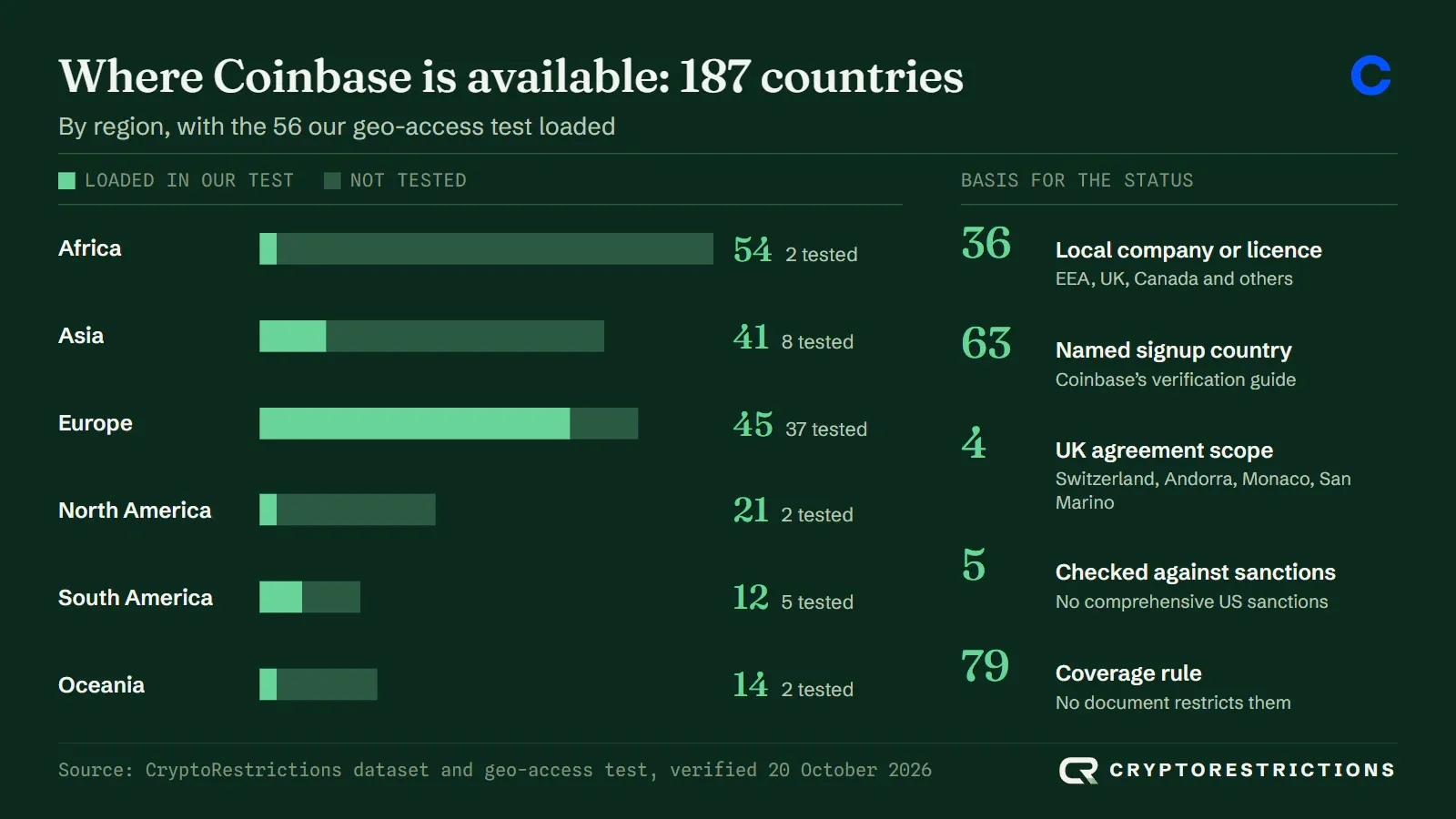
Coinbase is available in the other 187 of the 195 countries we cover, from the whole EEA and the United Kingdom to  India,
 Brazil and
 South Africa.
103 of them are named in Coinbase’s own documents. 36 are served by a local Coinbase company or licence: the 30 EEA states under the MiCA licence, the United Kingdom,  Canada,
 Australia,
 Singapore, India and Brazil. 63 more are listed as signup countries in Coinbase’s rest-of-world verification guide, and four,
 Switzerland,
 Andorra,
 Monaco and
 San Marino, fall under its UK user agreement. Five sanctioned countries we checked one by one,
 Russia,
 Belarus,
 Venezuela,
 Myanmar and
 Syria: none is comprehensively sanctioned by the US, and Coinbase names none of them.
The remaining 80 are available under our coverage rule: no official document restricts them. Coinbase used to publish a country list: its supported countries page, last archived in May 2023, said Coinbase was “available in 100+ countries” and now redirects to the home page. Our geo-access test reached 56 of the 187, and every one loaded.
Available means Coinbase serves the country, not that local law allows crypto trading.  China is on this list, as are Russia and Belarus, which the EU’s crypto bans cover for EU firms, because Coinbase does not exclude them.
Where do Coinbase’s visitors come from?
Two thirds of visits to coinbase.com come from the United States, and every country in the top five of either estimator is one Coinbase serves (the United States with some products cut by state).
Similarweb puts the United States at 67.39% of visits for September 2026, followed by the United Kingdom,  Germany, Canada and
 France, close to its May 2026 figures published by BitRSS (21.31 million visits, the US at 67.99%). Semrush counts 28.66 million visits for September and a smaller US share, 48.89%, with
 Bangladesh second at 7.96%.
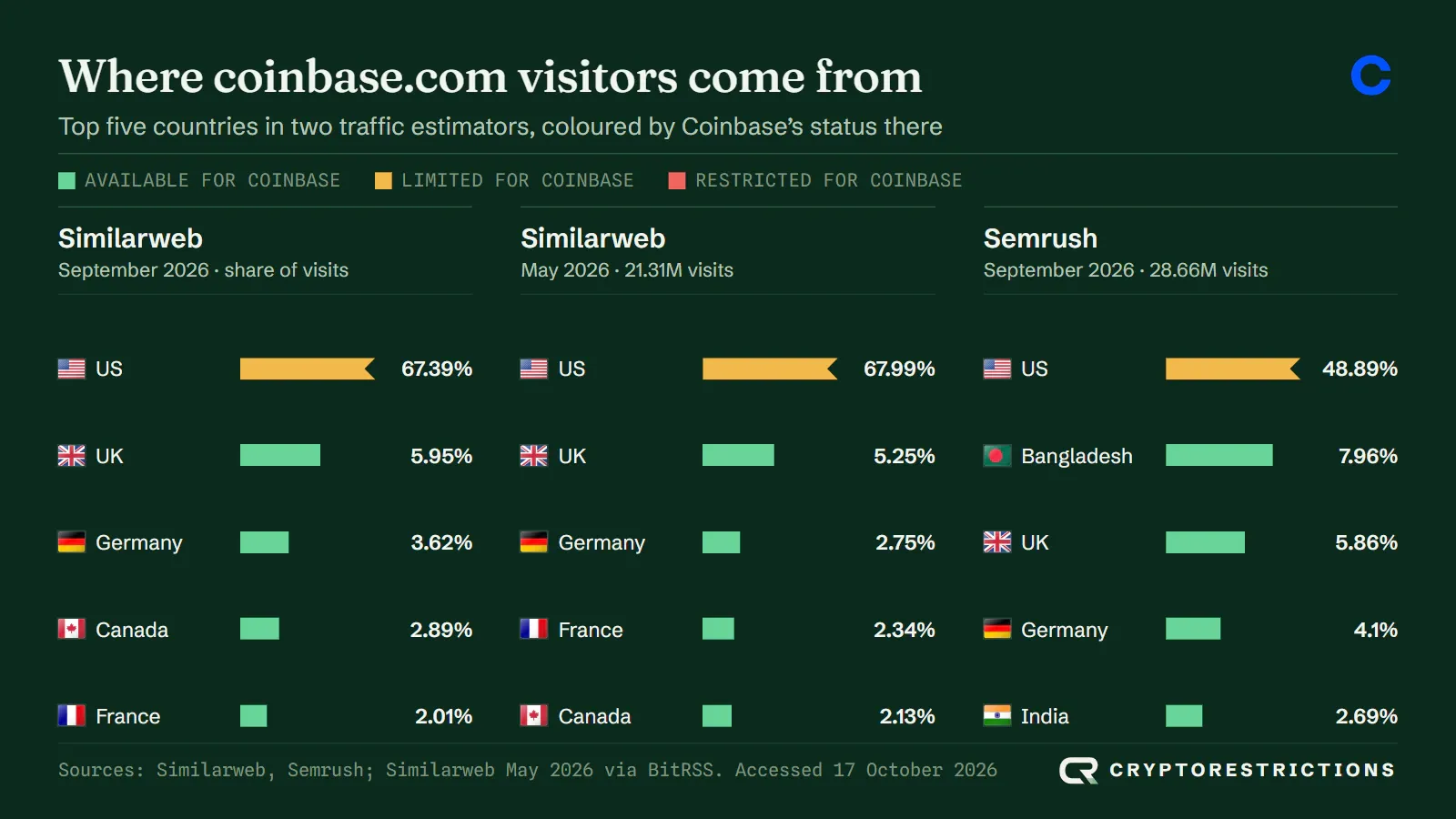
The estimators agree on the shape and differ on Bangladesh, which appears only in Semrush. Bangladesh is a named signup country, so the traffic is not a sign of a block being dodged. Estimators model traffic from panels and samples, so treat any single country share as an estimate.
Coinbase geo-access test: what we saw from 59 countries
In our test Coinbase blocked no visitor by IP address in any of the 59 countries we reached; the only message was a product notice.
We ran the test ourselves on 14 October 2026. A browser with a VPN connected to one country at a time and loaded Coinbase’s home page and its sign-up page, each time in a fresh private window with no cookies. Cookie banners were hidden but never accepted, and bot checks were waited out, never solved. Every run saved the page text and a screenshot.
All 61 places tested (59 of our 195 countries plus Hong Kong and Taiwan) went through VPN servers inside the country. We dropped virtual locations for Coinbase: when we tried them, Coinbase placed us by where the server really was and served its Singapore or US site instead. The sign-up page is a plain email form everywhere; the country of residence is chosen later, so the test cannot see that check.
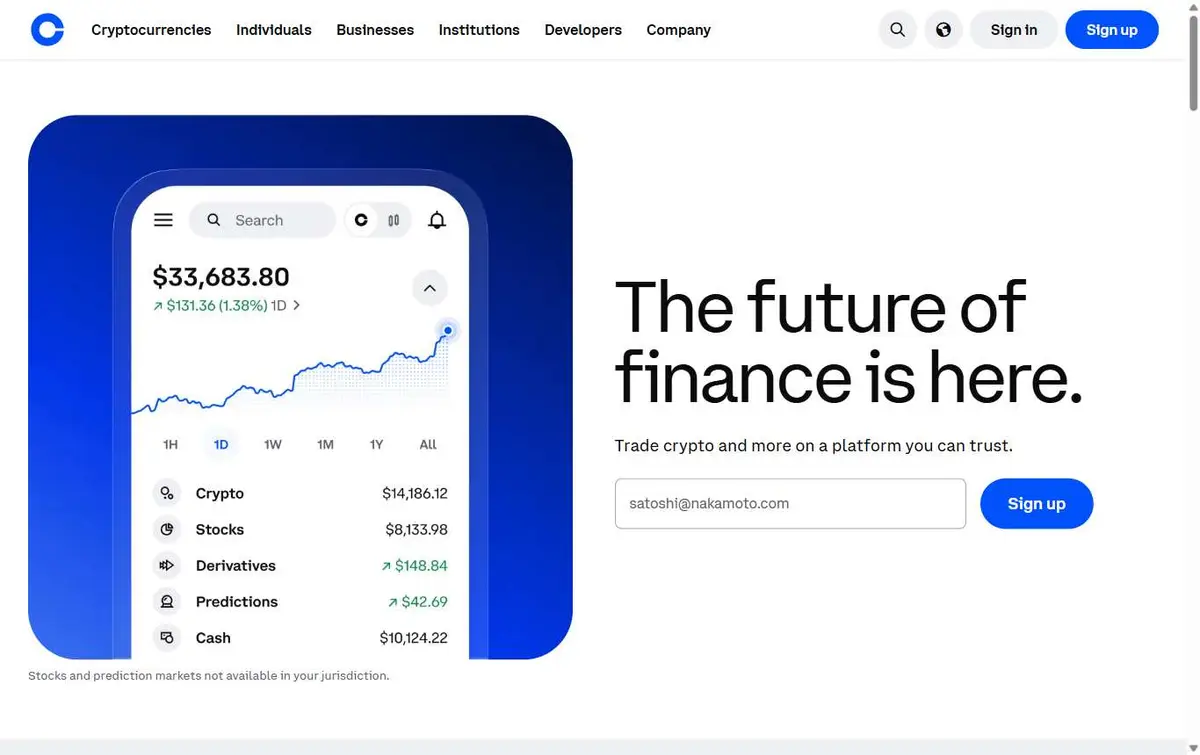
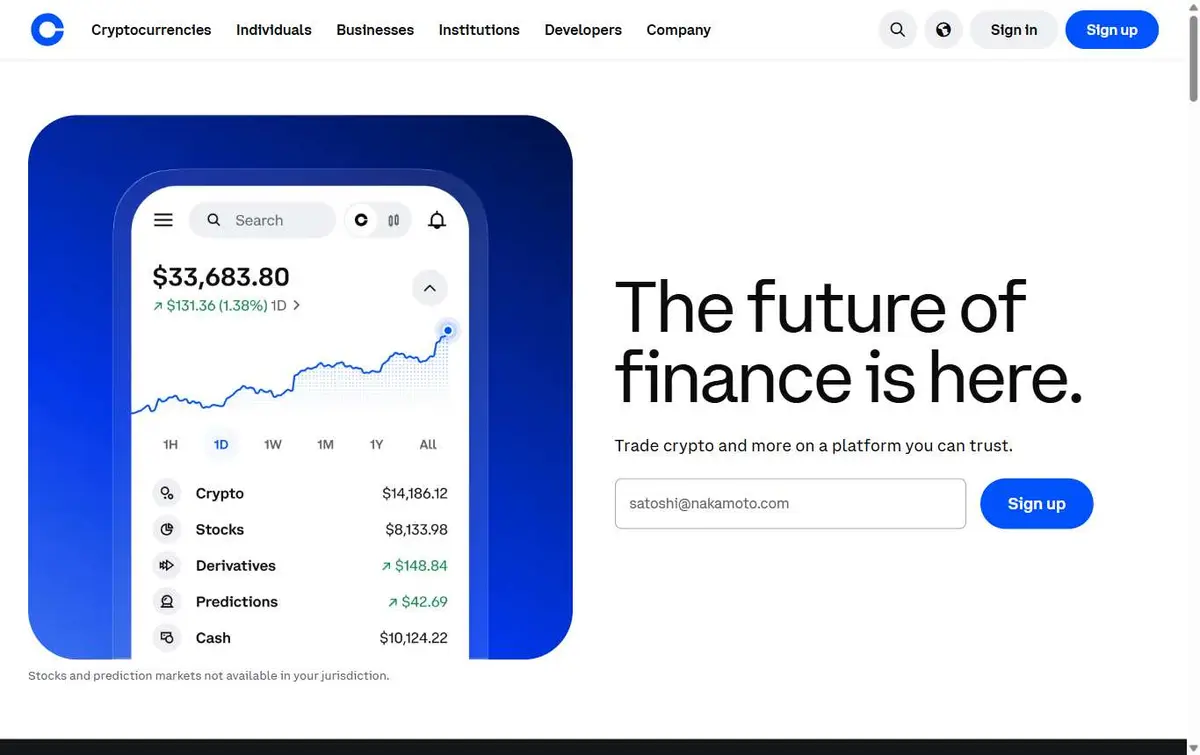
Notice shownUkraine · Home page
Ukraine, limited only in its occupied regions, gets the same product notice
“Stocks and prediction markets not available in your jurisdiction.”
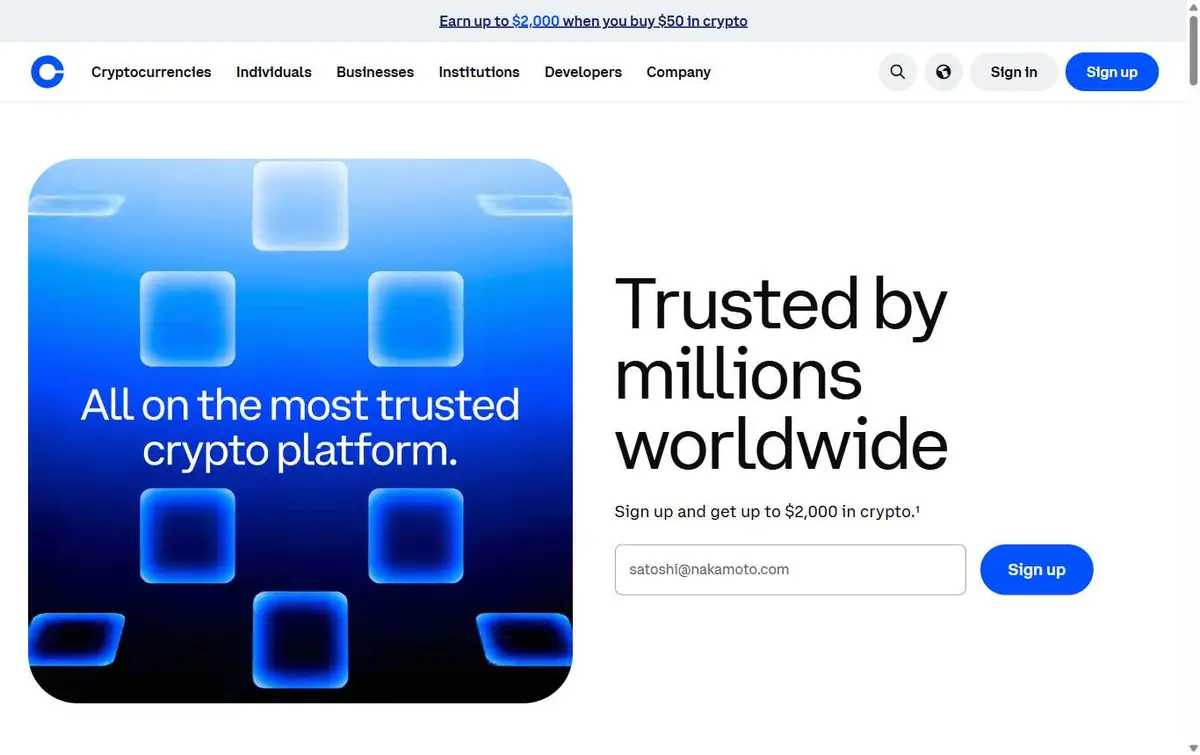
Notice shownTaiwan · Home page
Taiwan on 14 October, the day the court-ordered block began: the page still loaded
“Stocks and prediction markets not available in your jurisdiction.”
No barrierUnited States · Home page
From the United States, where stocks and prediction markets are offered, no notice
Notice shownChina · Home page
Mainland China, which no Coinbase document restricts, loads with the product notice
“Stocks and prediction markets not available in your jurisdiction.”
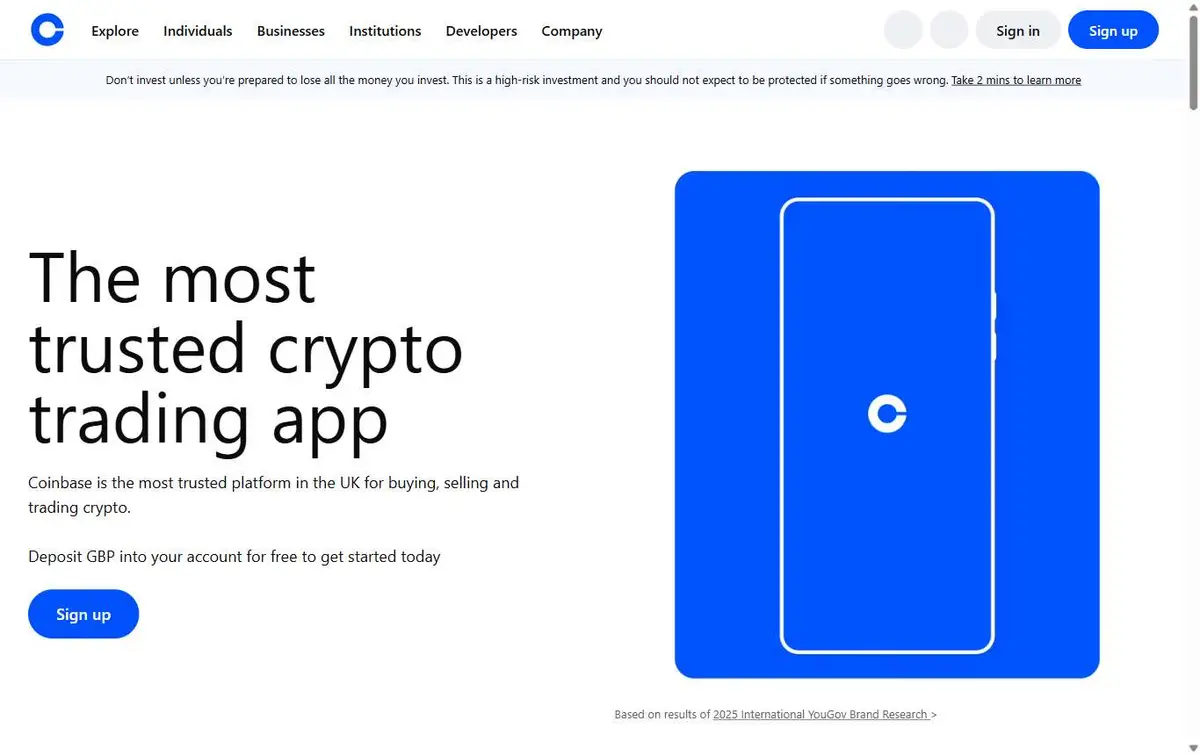
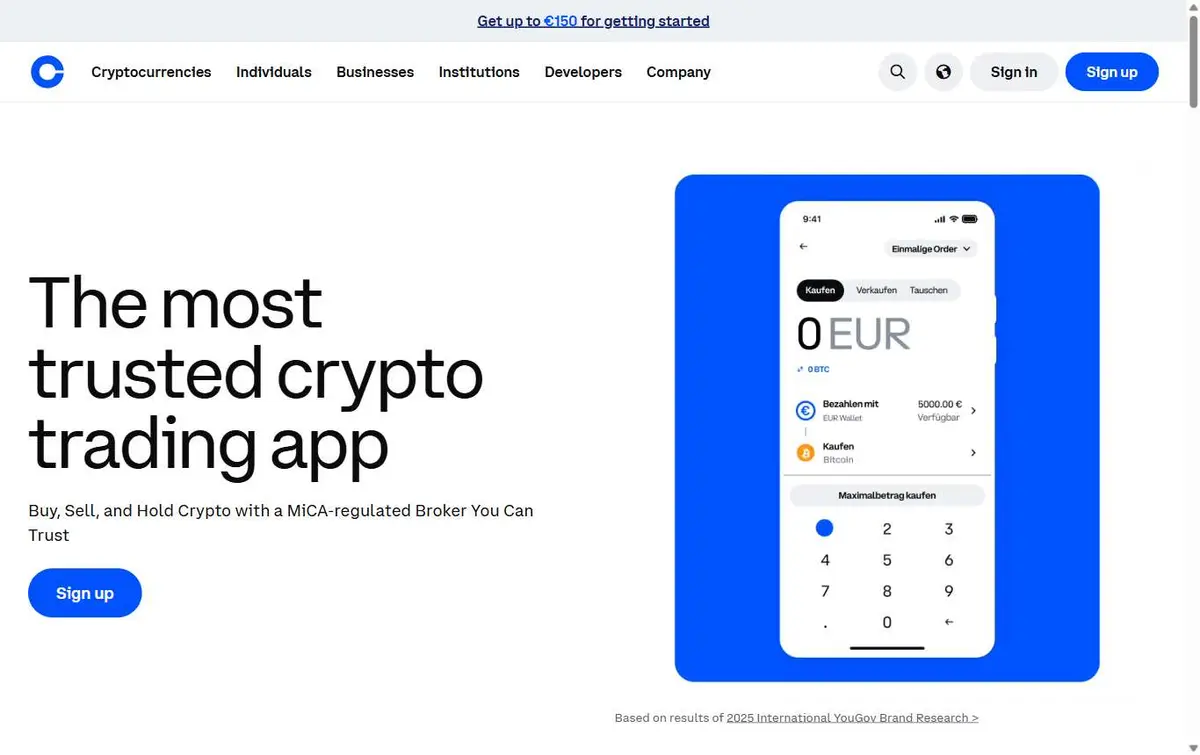
No barrier United Kingdom · Home page
The UK, served by CB Payments under FCA registration, loads with no notice
No barrierGermany · Home page
Germany, served under the MiCA licence from Luxembourg, loads with no notice
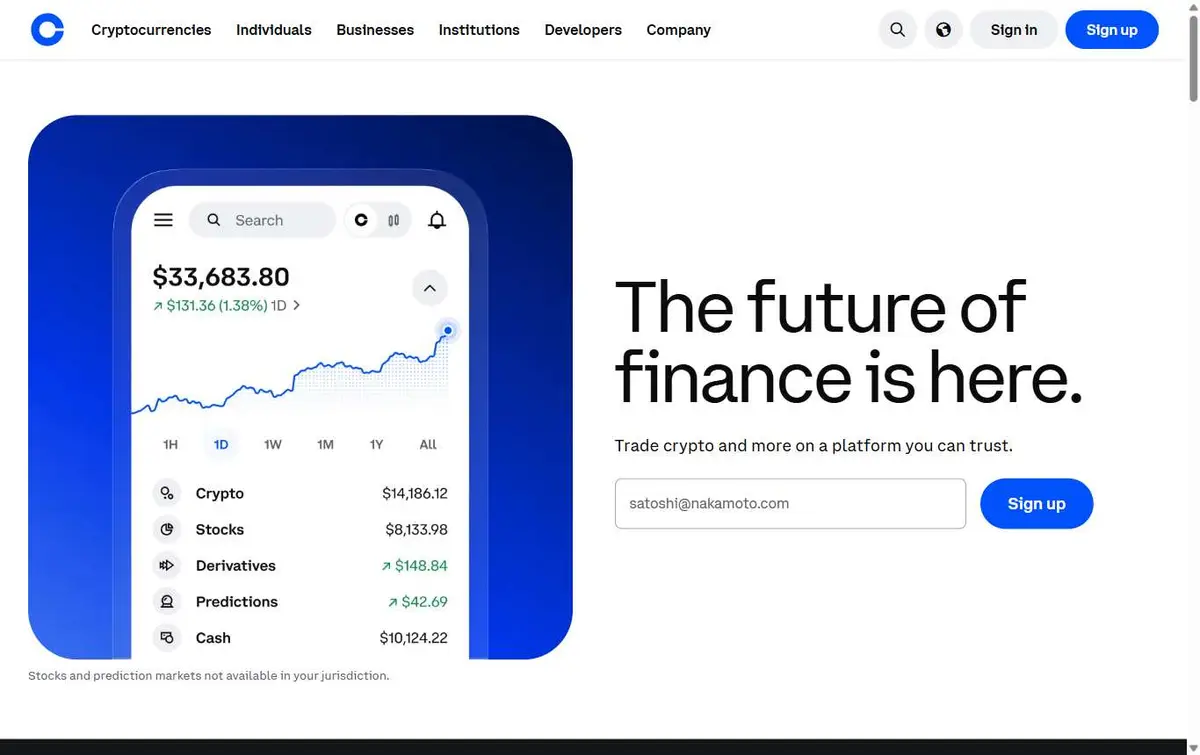
Notice shownSwitzerland · Home page
Switzerland, covered by the UK agreement, sees the product notice
“Stocks and prediction markets not available in your jurisdiction.”
Notice shown South Korea · Home page
South Korea, a signup country on Coinbase's list, sees the same notice
“Stocks and prediction markets not available in your jurisdiction.”
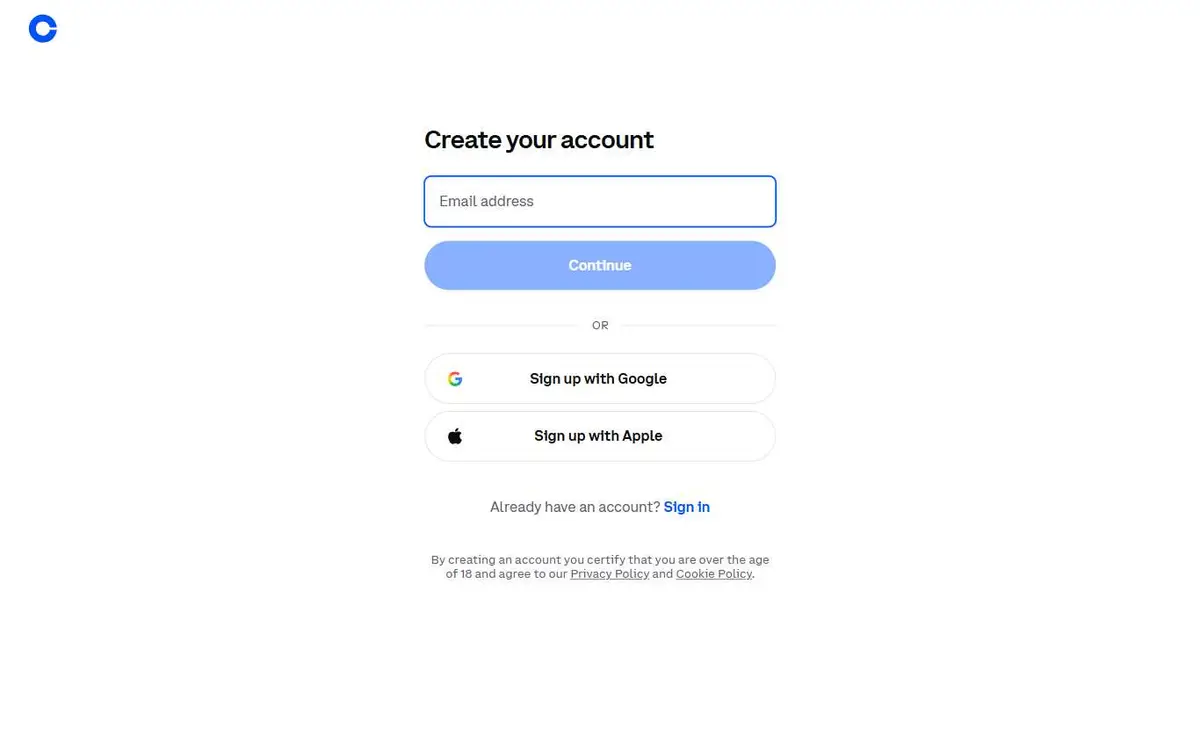
No barrier Nigeria · Sign-up page
Nigeria: the sign-up form opens as it does everywhere we tested
No barrier United Arab Emirates · Sign-up page
The United Arab Emirates, a named signup country: the form opens with no notice
No barrier Netherlands · Sign-up page
The Netherlands, served under Coinbase's Luxembourg MiCA licence: sign-up loads with no barrier
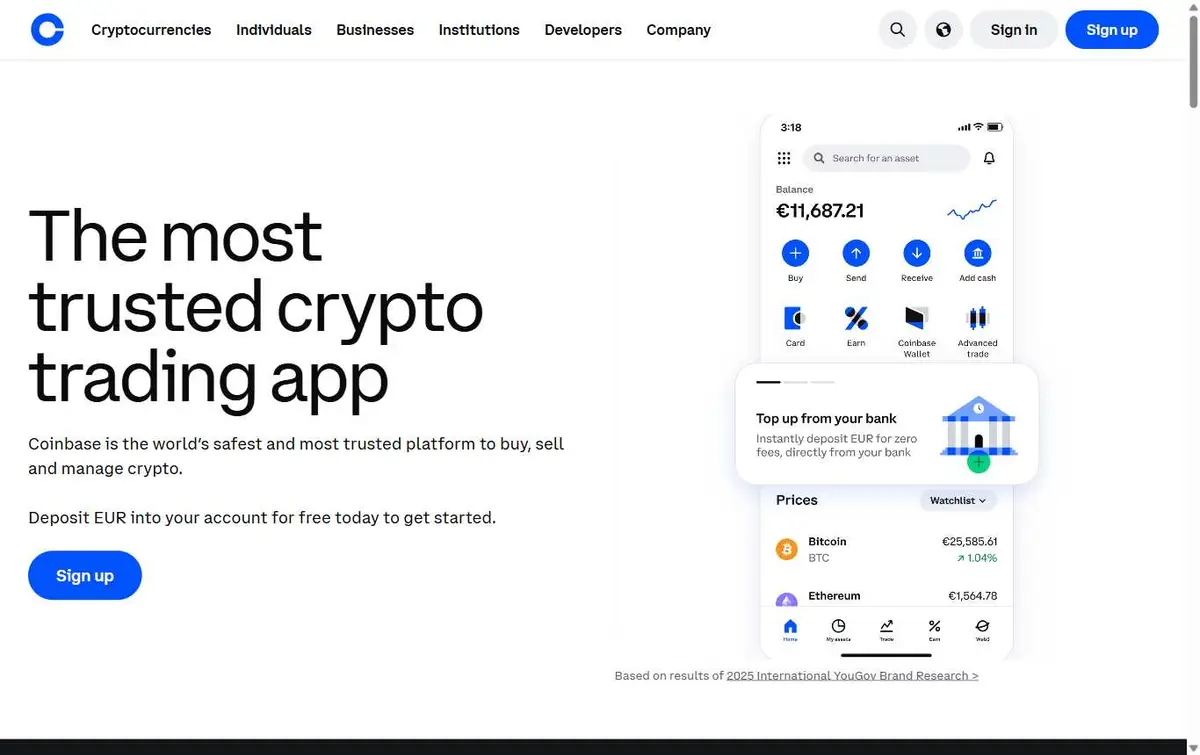
No barrier Italy · Home page
Coinbase has a page for Italy and takes EUR deposits, with no barrier
“Coinbase Italy”
No barrierAustralia · Home page
Australia: the local Coinbase Australia page loaded with no barrier
Notice shownSouth Africa · Home page
South Africa: the home page loads with a product notice
“Stocks and prediction markets not available in your jurisdiction.”
Notice shown Turkey · Home page
Turkey: the site loads, with a notice that stocks and prediction markets are not available
“Stocks and prediction markets not available in your jurisdiction.”
Notice shown Indonesia · Home page
Coinbase opens, with a notice that stocks and prediction markets are not available
“Stocks and prediction markets not available in your jurisdiction.”
Notice shown Mexico · Home page
Mexico: the home page loads but says stocks and prediction markets are not available here
“Stocks and prediction markets not available in your jurisdiction.”
Notice shown Argentina · Home page
Argentina: the home page says stocks and prediction markets are not available here
“Stocks and prediction markets not available in your jurisdiction.”
Notice shown Peru · Home page
Peru: the home page loads but says stocks and prediction markets are not available here
“Stocks and prediction markets not available in your jurisdiction.”
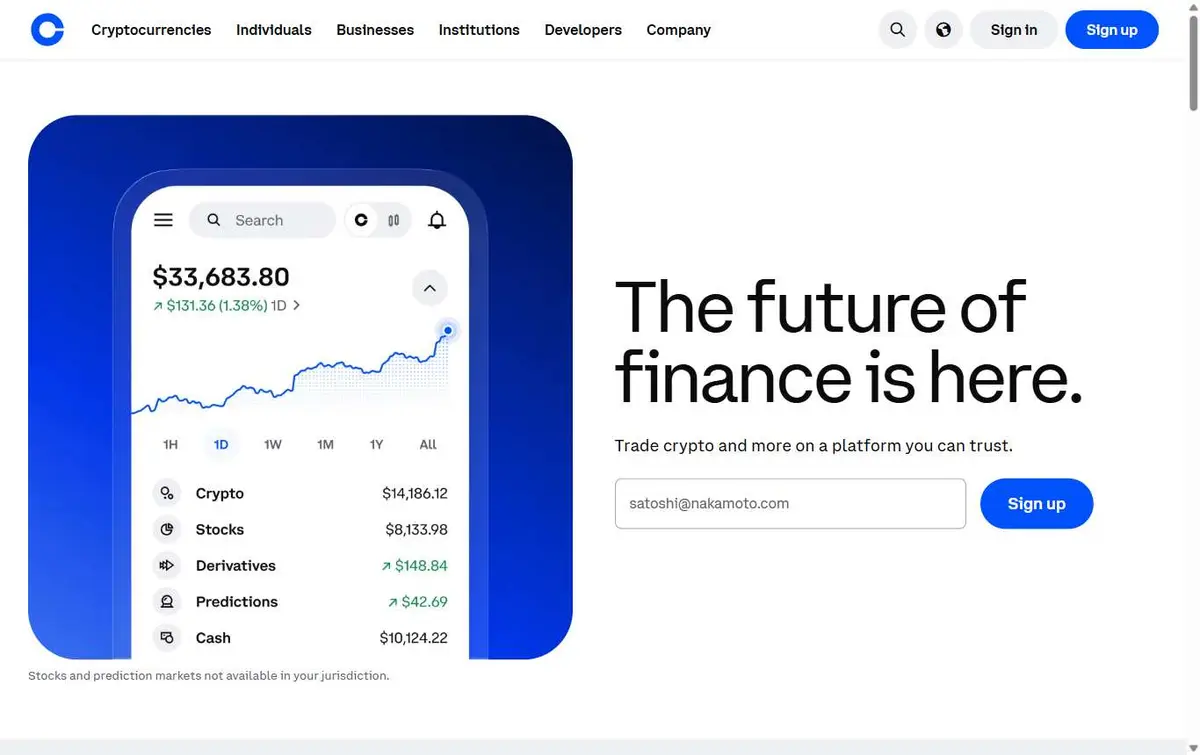
Notice shown Belgium · Home page
Belgium: Coinbase serves it, but hides stocks and prediction markets
“Stocks and prediction markets not available in your jurisdiction.”
Notice shown Portugal · Home page
Portugal: the home page notes that stocks and prediction markets are not available
“not available in your jurisdiction”
Notice shown Ireland · Home page
Ireland: the site loads, with a notice that stocks and prediction markets are not available
“Stocks and prediction markets not available in your jurisdiction.”
Notice shown Israel · Home page
Israel: the site loads, with a notice that stocks and prediction markets are not available
“Stocks and prediction markets not available in your jurisdiction.”
Notice shown Austria · Home page
Austria: stocks and prediction markets are unavailable at Coinbase
“Stocks and prediction markets not available in your jurisdiction.”
Notice shown New Zealand · Home page
New Zealand: the page loads, with a note that stocks and prediction markets are unavailable
“Stocks and prediction markets not available in your jurisdiction.”
Notice shown Sweden · Home page
Sweden: the page loads, with a note that stocks and prediction markets are unavailable
“Stocks and prediction markets not available in your jurisdiction.”
Notice shown Norway · Home page
Norway: the site loads, with a notice that stocks and prediction markets are not available
“Stocks and prediction markets not available in your jurisdiction.”
Notice shown Luxembourg · Home page
Luxembourg: the site loads, with a notice that stocks and prediction markets are not available
“Stocks and prediction markets not available in your jurisdiction.”
Notice shown Czechia · Home page
Czechia: the home page shows a notice that stocks and prediction markets are not available
“Stocks and prediction markets not available in your jurisdiction.”
Notice shown Romania · Home page
Romania: the site loads, with a notice that stocks and prediction markets are not available
“Stocks and prediction markets not available in your jurisdiction.”
Notice shown Hungary · Home page
Hungary: the home page loads, with a notice that stocks and prediction markets are unavailable
“Stocks and prediction markets not available in your jurisdiction.”
Notice shown Finland · Home page
Finland: the site loads, with a notice that stocks and prediction markets are not available
“Stocks and prediction markets not available in your jurisdiction.”
Notice shown Denmark · Home page
Denmark: the page loads, with a note that stocks and prediction markets are unavailable
“Stocks and prediction markets not available in your jurisdiction.”
Notice shown Greece · Home page
Greece: the site loads, with a notice that stocks and prediction markets are not available
“Stocks and prediction markets not available in your jurisdiction.”
Notice shown Bulgaria · Home page
Bulgaria: the site loads, with a notice that stocks and prediction markets are not available
“Stocks and prediction markets not available in your jurisdiction.”
Notice shown Croatia · Home page
Croatia: the site loads, with a notice that stocks and prediction markets are not available
“Stocks and prediction markets not available in your jurisdiction.”
Notice shown Latvia · Home page
Latvia: the site loads, with a notice that stocks and prediction markets are not available
“Stocks and prediction markets not available in your jurisdiction.”
Notice shown Estonia · Home page
Estonia: the site loads, with a notice that stocks and prediction markets are not available
“Stocks and prediction markets not available in your jurisdiction.”
Notice shown Lithuania · Home page
Lithuania: the site loads, with a notice that stocks and prediction markets are not available
“Stocks and prediction markets not available in your jurisdiction.”
Notice shown Slovakia · Home page
Slovakia: the home page shows a notice that stocks and prediction markets are not available
“Stocks and prediction markets not available in your jurisdiction.”
Notice shown Slovenia · Home page
Slovenia: the site loads, with a notice that stocks and prediction markets are not available
“Stocks and prediction markets not available in your jurisdiction.”
Notice shown Iceland · Home page
Iceland: the site loads, with a notice that stocks and prediction markets are not available
“Stocks and prediction markets not available in your jurisdiction.”
Notice shown Serbia · Home page
Serbia: the site loads, with a notice that stocks and prediction markets are not available
“Stocks and prediction markets not available in your jurisdiction.”
 CRYPTORESTRICTIONS
The test does not decide a country’s status on its own: official documents come first, and a page that loads is not permission to use Coinbase. What it shows is how Coinbase treats a visitor before sign-up.
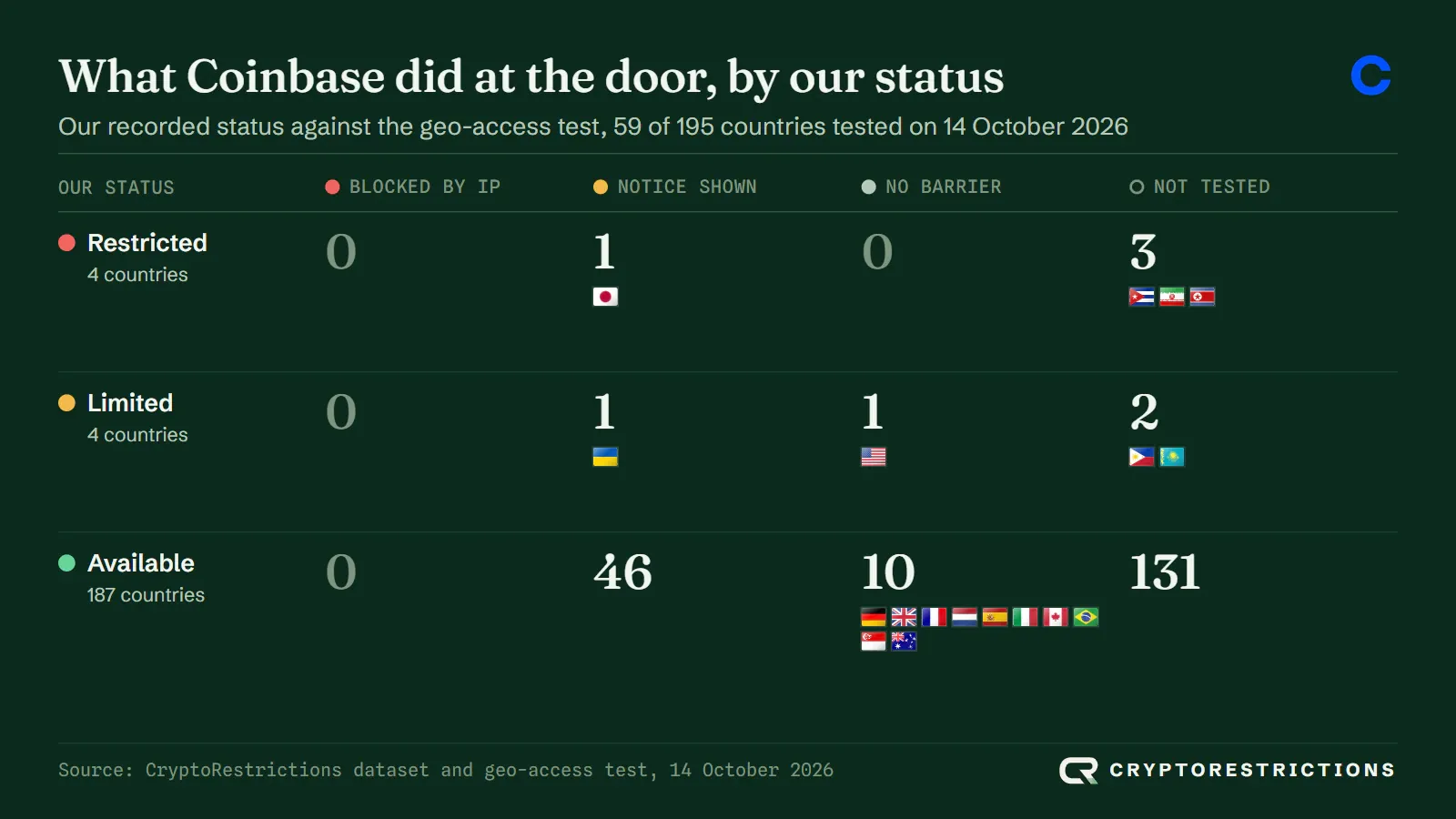
Two patterns stand out. Japan, which Coinbase left in 2023, loads with prices in yen and the same notice as everywhere else, so the exit is enforced at sign-up and verification. And the notice, “Stocks and prediction markets not available in your jurisdiction”, appeared in 48 countries and in none of eleven of its main markets: the United States, the United Kingdom, Canada, Australia, Brazil, Singapore, France, Germany, Italy, Spain and the Netherlands. It marks the edge of Coinbase’s product range, not of its service.
Cuba, Iran, North Korea and the Philippines were not among the countries we reached with an in-country server. The full result for every country is below.
All 61 test results, country by country
Coinbase licences and registrations
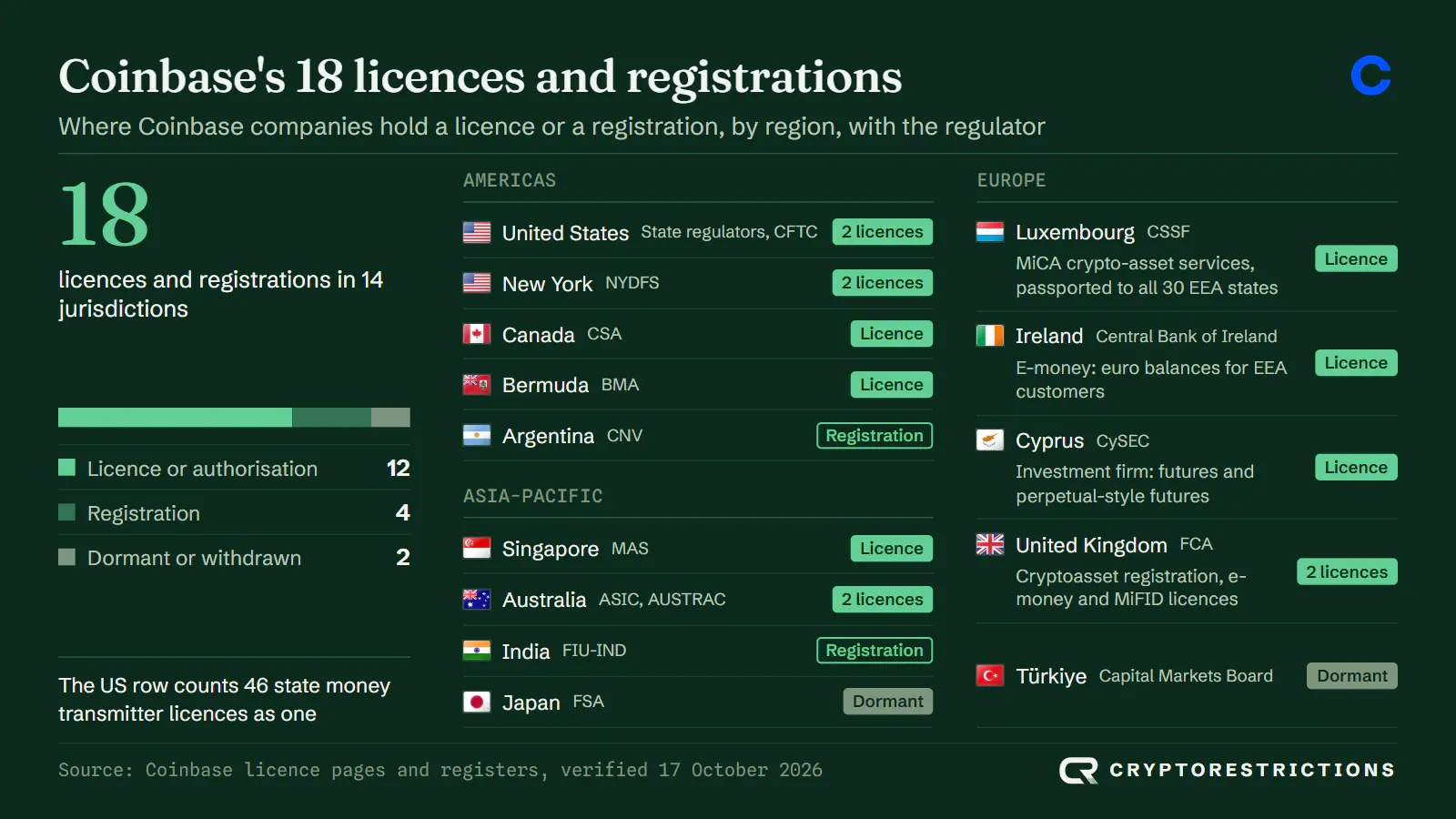
Coinbase holds 18 licences and registrations in 14 jurisdictions, from 46 US state licences, counted as one, to a MiCA licence passported across the EEA.
The list comes from Coinbase’s US licences page, its European licences page and its local user agreements, and we checked each entry against the regulator’s own register where we could reach it. Twelve are licences or authorisations, four are registrations, mostly for anti-money-laundering supervision, one, in Japan, is a registration with no business behind it, and one, in Türkiye, is a Capital Markets Board entry marked as in liquidation. We could not open the NMLS register (it serves a bot check) or Canada’s FINTRAC register, and the Bermuda, Argentine and Indian entries rest on Coinbase and press reports.
Americas
- United States: Coinbase, Inc. (NMLS 1163082) holds money transmitter licences in 44 states, Washington DC and Puerto Rico. Coinbase Derivatives, LLC is a designated contract market registered with the CFTC.
- New York: Coinbase, Inc. holds a BitLicense (122466) and a money transmitter licence from the Department of Financial Services, and Coinbase Custody Trust Company is chartered by the same regulator as a limited purpose trust company.
- Canada: Coinbase Canada Inc. is a restricted dealer in every province and territory, with the Ontario Securities Commission as principal regulator, since April 2024.
- Bermuda and Argentina: Coinbase Bermuda holds a Bermuda Monetary Authority digital asset business licence, and Coinbase registered as a virtual asset service provider with Argentina’s CNV in January 2025.
Europe
- Luxembourg: Coinbase Luxembourg S.A. is authorised by the CSSF under MiCA (N00000004, 20 June 2025); the ESMA register lists custody, exchange, execution, order handling and transfer services, passported to all 30 EEA states.
- Ireland: Coinbase Ireland Limited is an e-money institution authorised by the Central Bank of Ireland (C188493) and provides euro balances.
- Cyprus: Coinbase Financial Services Europe Ltd is a Cyprus investment firm, licence 374/19 from CySEC since 15 April 2019, passported to the other 29 EEA states for derivatives.
- United Kingdom: CB Payments Ltd (FRN 900635) is an FCA authorised e-money institution since 2018 and registered for cryptoasset activities since 3 February 2025; a second FCA entry covers MiFID investment services.
Asia-Pacific
- Singapore: Coinbase Singapore Pte. Ltd. is a major payment institution licensed by MAS for digital payment token and cross-border money transfer services.
- Australia: Coinbase Australia Pty Ltd holds ASIC licence AFSL 569752, which covers retail derivatives, and is on AUSTRAC’s register of virtual asset service providers.
- India: Coinbase registered with the Financial Intelligence Unit in March 2025.
- Japan: Coinbase KK is still on the FSA’s list of crypto-asset exchange service providers of 30 September 2026 (Kanto No. 00028, registered 18 June 2021), with no crypto assets handled since the 2023 exit.
Coinbase and MiCA in the EU
Coinbase holds a MiCA licence, so it serves all 30 EEA states from one company in Luxembourg; the cuts are to products, not countries.
MiCA is the EU’s crypto rulebook, and since 30 December 2024 it has required exchanges serving EU clients to hold an authorisation from one member state (our MiCA article covers the rules). Luxembourg’s CSSF authorised Coinbase Luxembourg on 20 June 2025, and Coinbase’s migration page lists when each country moved to it, from 18 August to 23 October 2025, with e-money staying at Coinbase Ireland. Futures and perpetual-style futures followed through the Cyprus firm in March 2026, which Coinbase’s launch post describes.
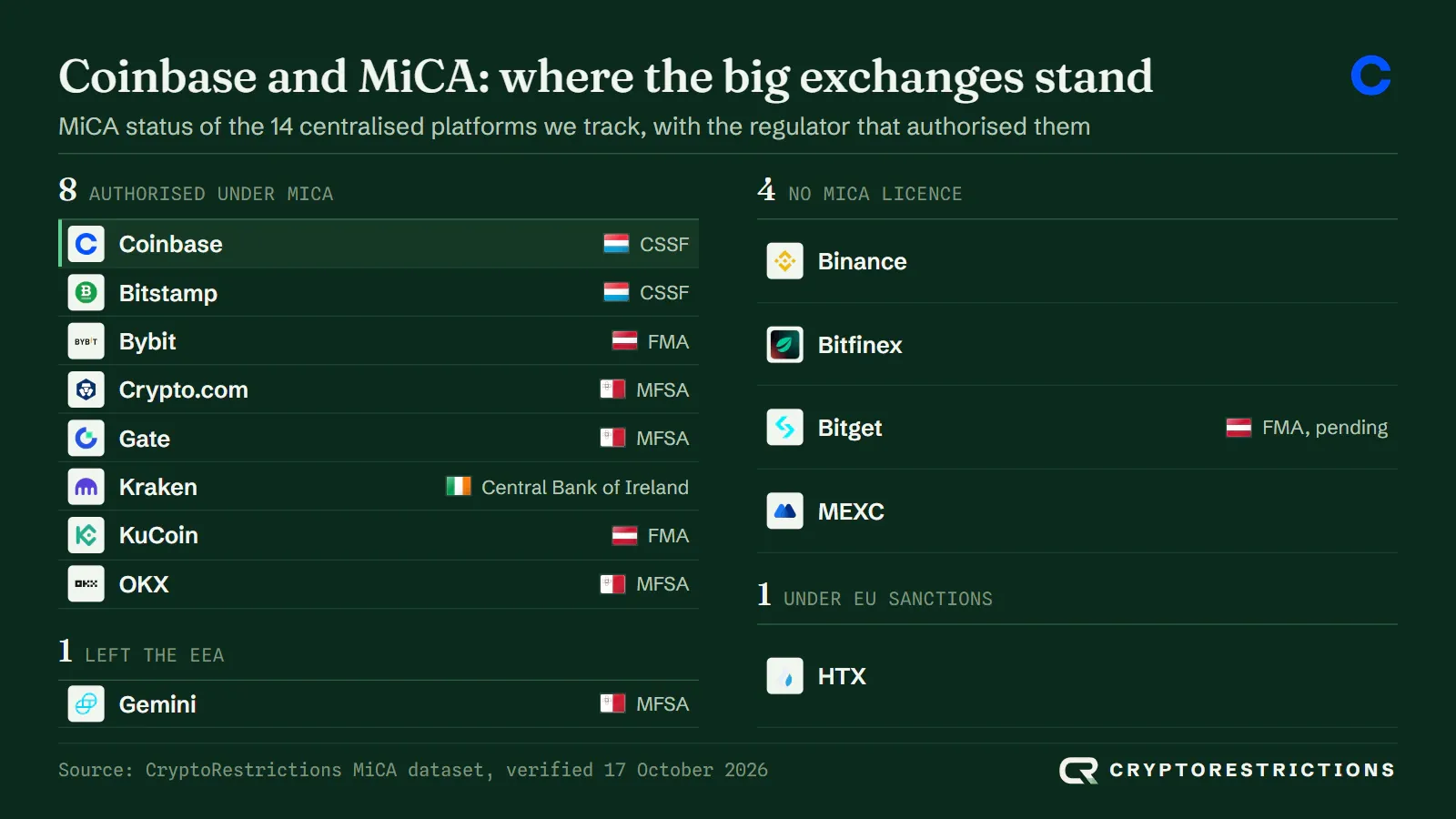
Coinbase is one of eight centralised platforms in our MiCA dataset with an authorisation, and one of two from the CSSF, with Bitstamp. Two product cuts came with the rules. Staking of Avalanche and Tezos ended for EEA residents on 26 November 2025, according to Coinbase’s staking eligibility page, and Coinbase’s stablecoin page says buying, selling and converting 14 stablecoins without MiCA authorisation, USDT among them, is restricted, with balances converted to USDC on 30 October 2026. Neither cut changes a country’s status: spot trading, custody and transfers stay open across the EEA.

Coinbase MiCA timeline
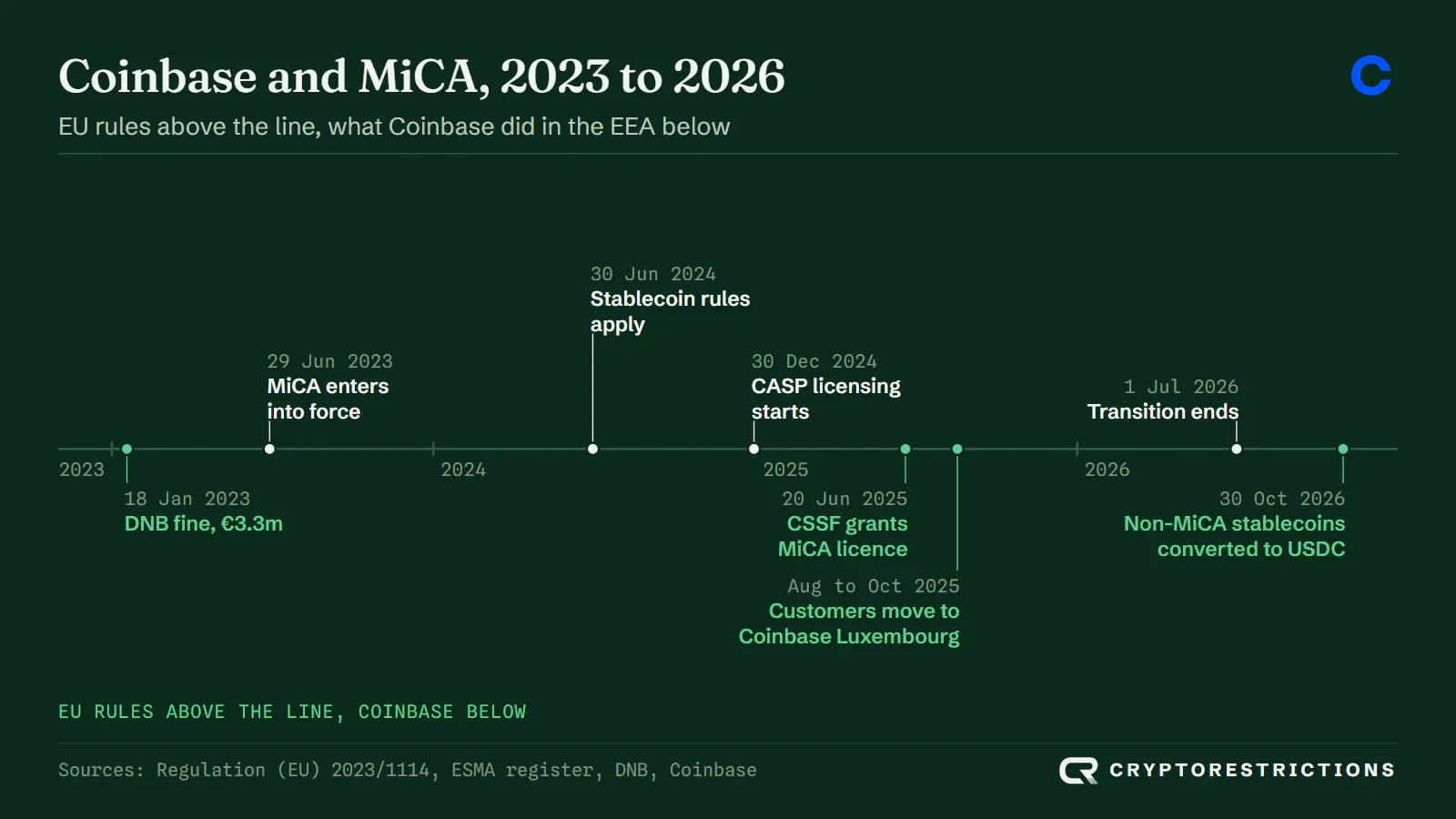
Before MiCA each country had its own register, and Coinbase was caught out once. The Dutch central bank fined Coinbase Europe €3,325,000 in January 2023 for serving Dutch customers without the required registration until 22 September 2022. Under MiCA one licence covers every member state, and Coinbase had it a year before the transition ended on 1 July 2026.
Is Coinbase available in the US?
Yes, in every state, but we record the United States as limited: Coinbase is a US company and its US user agreement only asks that you live in the country, yet three products are cut in some states.
Coinbase, Inc. lists money transmitter licences in 44 states, Washington DC and Puerto Rico, plus a New York BitLicense. California, Hawaii, Massachusetts, Montana and Wyoming have no row on the page, but the user agreement covers any US resident, and Coinbase returned to Hawaii in August 2024, years after leaving over the state’s reserve rules. Our test from a US address loaded with no notice. Unlike Binance, which sends Americans to the separate Binance.US, Coinbase serves them from the same company and app.

Where Coinbase cuts products by state
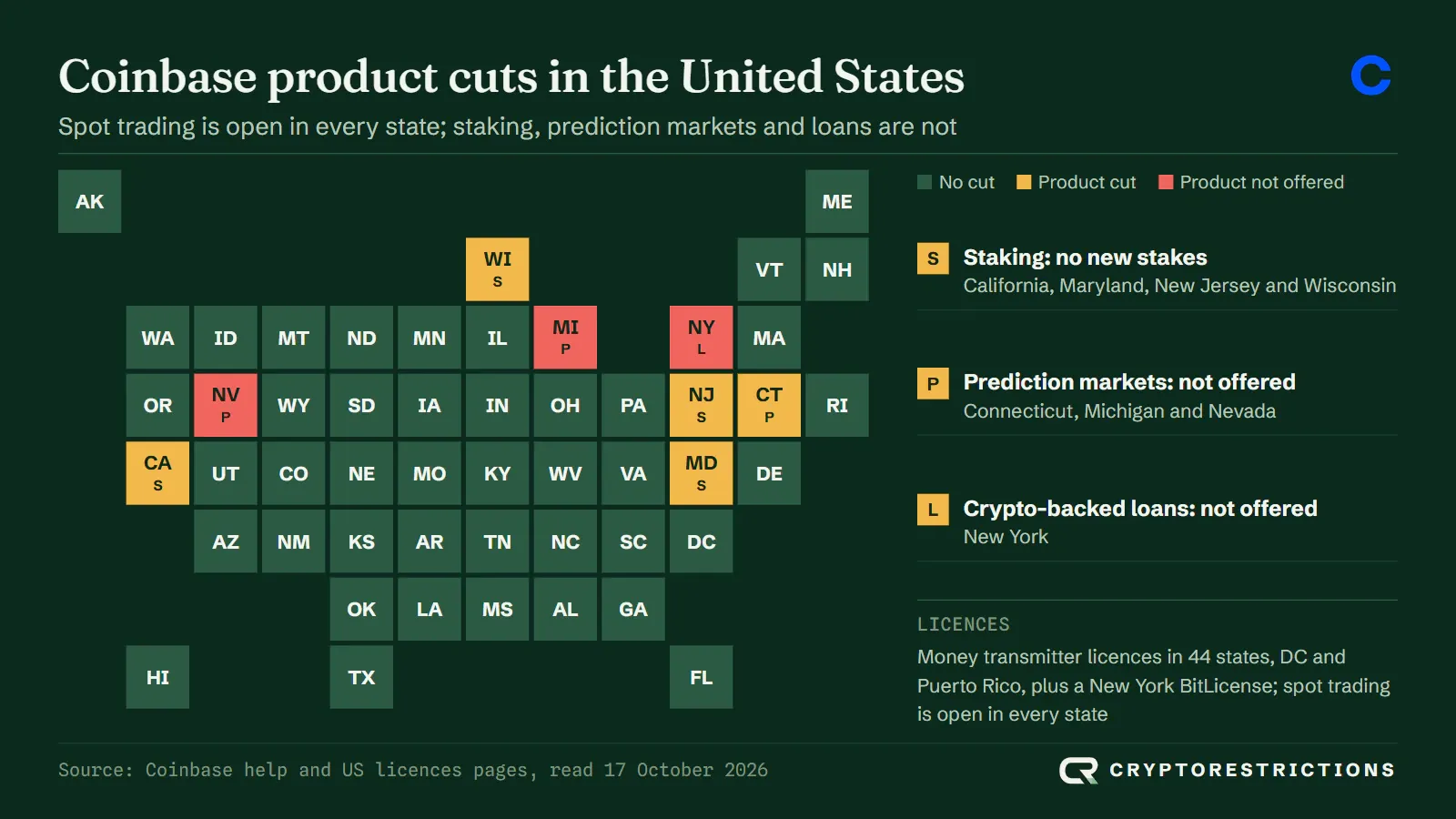
Coinbase’s help pages name three product cuts by state:
- Staking: no new stakes in California, Maryland, New Jersey and Wisconsin since the state securities actions of June 2023; existing stakes can stay until unstaked. Washington also sent a notice, but its residents can still stake.
- Prediction markets: offered to US residents except in Nevada and Michigan, according to Coinbase’s prediction markets page. In Michigan Coinbase agreed with the Gaming Control Board to stop sports event contracts by 10 October 2026. Connecticut issued a cease-and-desist order covering sports event contracts on 10 September 2026; Coinbase appealed in federal court and we have not confirmed compliance, so we record the state as limited.
- Crypto-backed loans: offered to US residents except in New York, according to Coinbase’s loans page.
New York is not excluded from prediction markets, although its Attorney General sued Coinbase in April 2026, alleging they are unlicensed gambling. We record New York as served while the case runs.
Coinbase fines, lawsuits and market moves
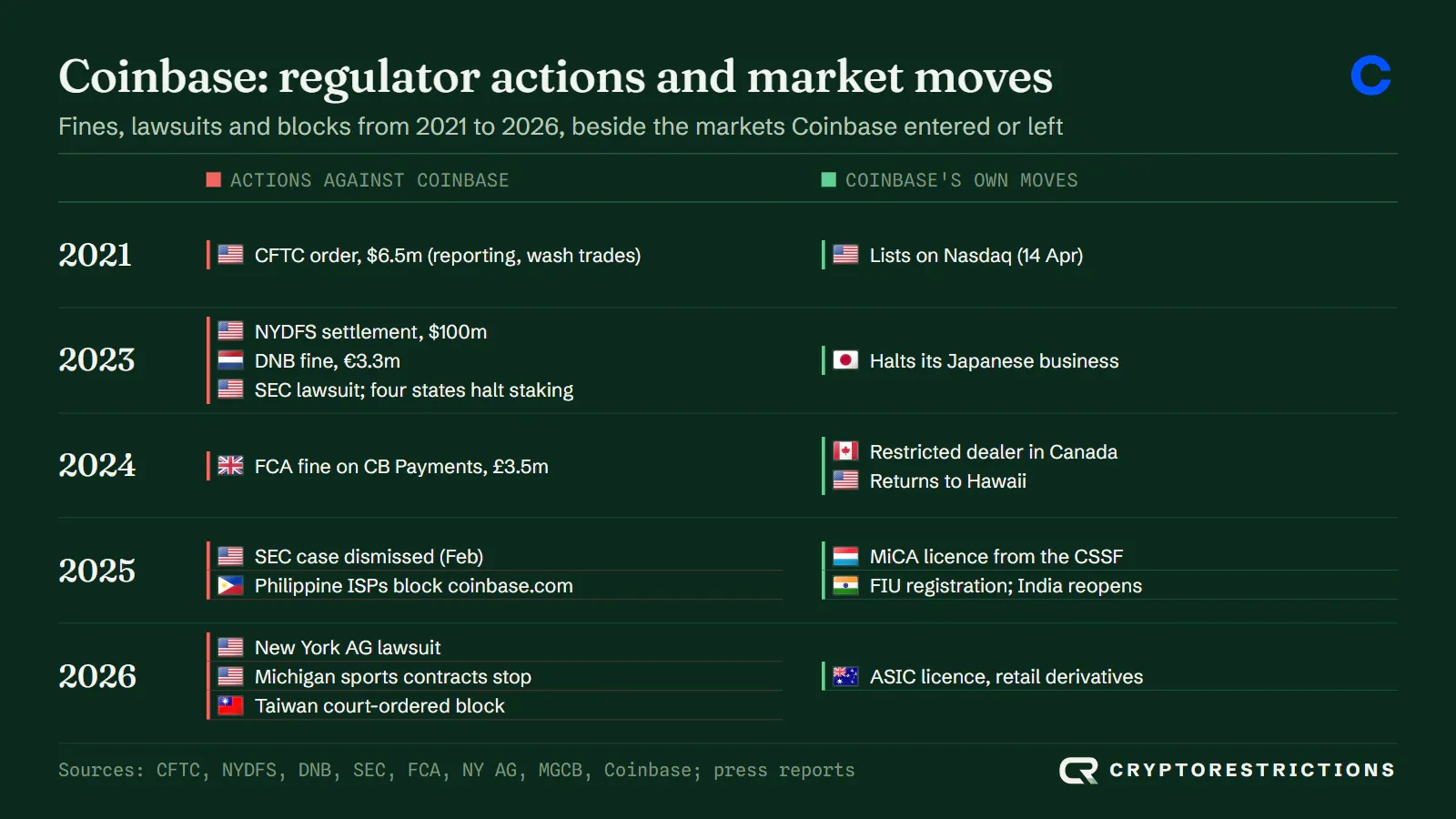
None of the fines closed a market. The CFTC ordered Coinbase to pay $6.5 million in March 2021 over inaccurate trade reporting and wash trades by a former employee. New York’s Department of Financial Services settled for $100 million in January 2023, a $50 million penalty plus $50 million of compliance spending over two years, and in July 2024 the FCA fined CB Payments £3,503,546 for taking on 13,416 high-risk customers in breach of a 2020 agreement.
The largest case ended without a penalty. The SEC sued Coinbase in June 2023 for running an unregistered exchange, broker and clearing agency, the same month four states moved against its staking, and it dropped the case in February 2025.
Coinbase KYC and identity verification
Coinbase verifies every customer’s identity when the account is opened and periodically after that, in three regional flows, and it publishes no fixed levels or limits.
Coinbase’s US verification page asks for a photo ID with your legal name, date of birth, address and document number, a photo of the ID and a selfie, and proof of address under three months old if requested, and says it reports the review status within 24 hours; the create account page adds the last four digits of the Social Security number. The EEA page asks for ID and a live selfie, and since 1 January 2026 customers in the EEA and other listed countries must give a tax identification number within 60 days of opening the account. In the rest of the world the ID must show your address and be in English or Latin script, and Hong Kong and South Korea accept only passports.
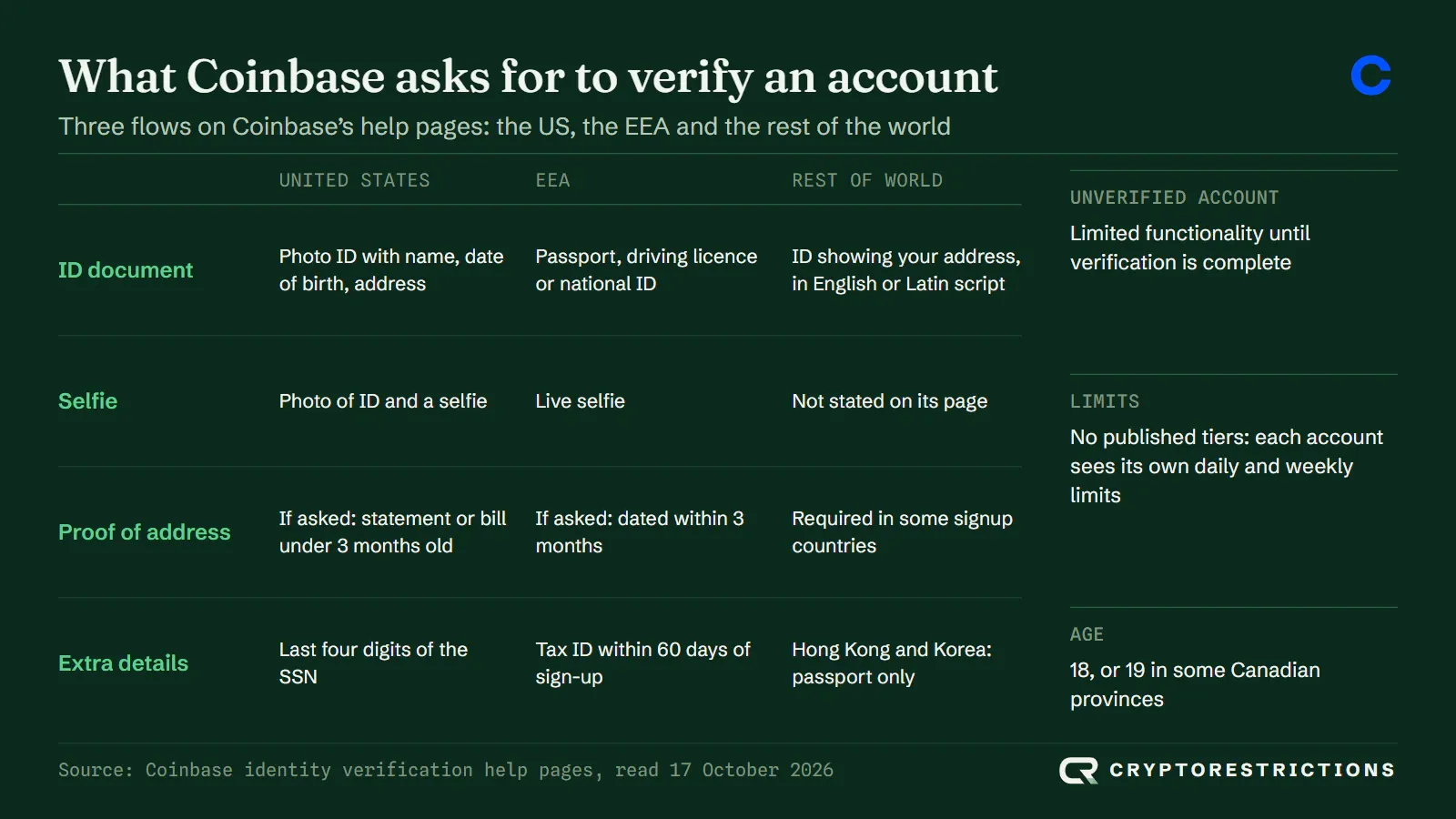
An unverified account has limited functionality until verification is complete; Coinbase does not list what that covers. Limits work the same way: its limits page says they depend on location, payment method, account activity and trading history, and each customer sees their own daily and weekly limits in their settings.
Coinbase customer data theft and tax reporting
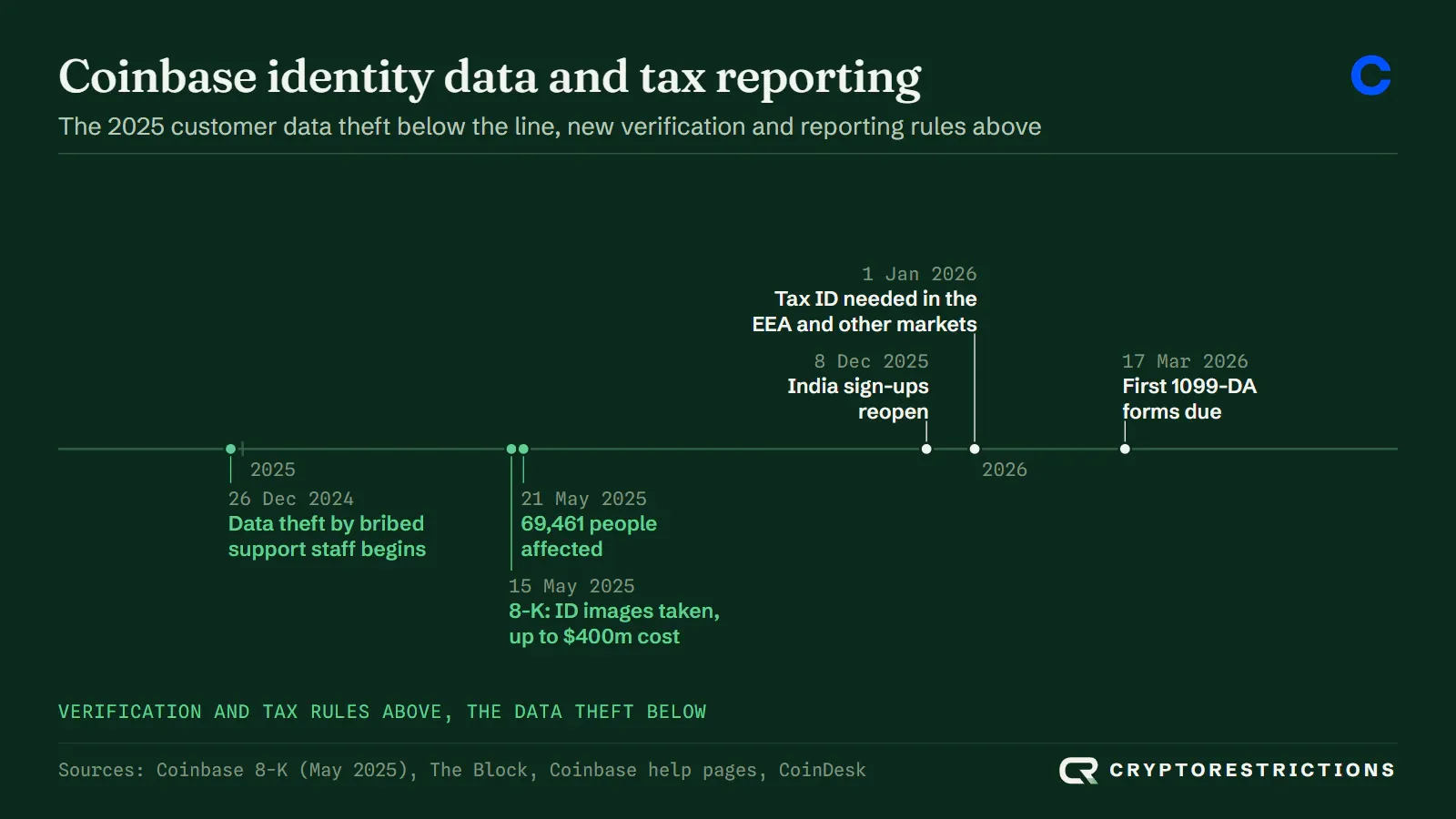
The identity data Coinbase collects was itself the target in 2025. In a filing of 15 May 2025 Coinbase said criminals had paid contractors and employees in support roles outside the United States to pass on customer data, including masked Social Security numbers and government ID images, and put the cost at $180 million to $400 million. A later filing with Maine’s Attorney General put the number of people affected at 69,461, The Block reported, and dated the start to 26 December 2024.
Verification also feeds tax reporting. From the 2025 tax year Coinbase must send US customers Form 1099-DA, due by 17 March 2026, and outside the US it reports account activity to local tax authorities under the OECD crypto and common reporting standards. For how these checks compare with other exchanges, see our guide to crypto exchange KYC.
What if Coinbase is restricted where you live?
It depends on the country: of the 21 other platforms we track, 6 are available in Japan and 1 in the United States, and in Cuba, Iran and North Korea only one is.
Coinbase’s agreements have no VPN clause, but they do not need one: its prohibited regions rule applies to where you log in from and where you live, and an account whose holder is found to live in a prohibited region is closed. In the three sanctioned countries the one platform open in our dataset is KuCoin, and only under our coverage default rather than any statement from it, with Bitstamp limited, so the realistic answer there is that no tracked exchange serves you. Our guide to crypto sanctions explains the rules behind those blocks.
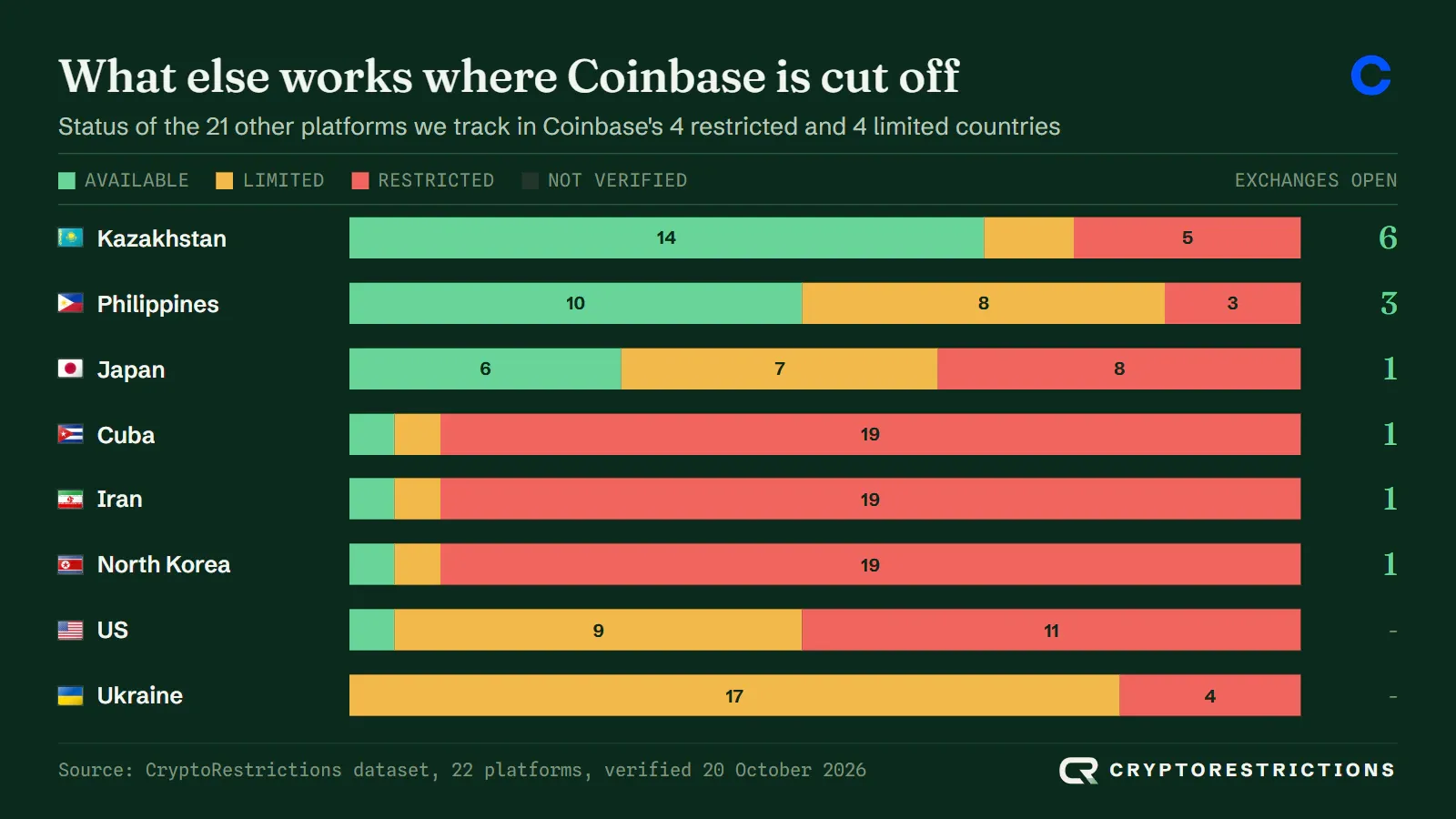
Kazakhstan has the most choice, with 14 open platforms, then the Philippines with 10 and Japan with six, though mostly among DeFi protocols and prediction markets. In the United States the only open platform is Uniswap, a DeFi protocol. Among centralised exchanges, only Gate is open in Japan, while the Philippines has Bitstamp, Crypto.com and Bitfinex and Kazakhstan has six. In Ukraine 17 of the platforms we track are limited, as Coinbase is, so outside Crimea, Donetsk and Luhansk Coinbase itself remains an option.