
Is crypto legal in Malaysia?
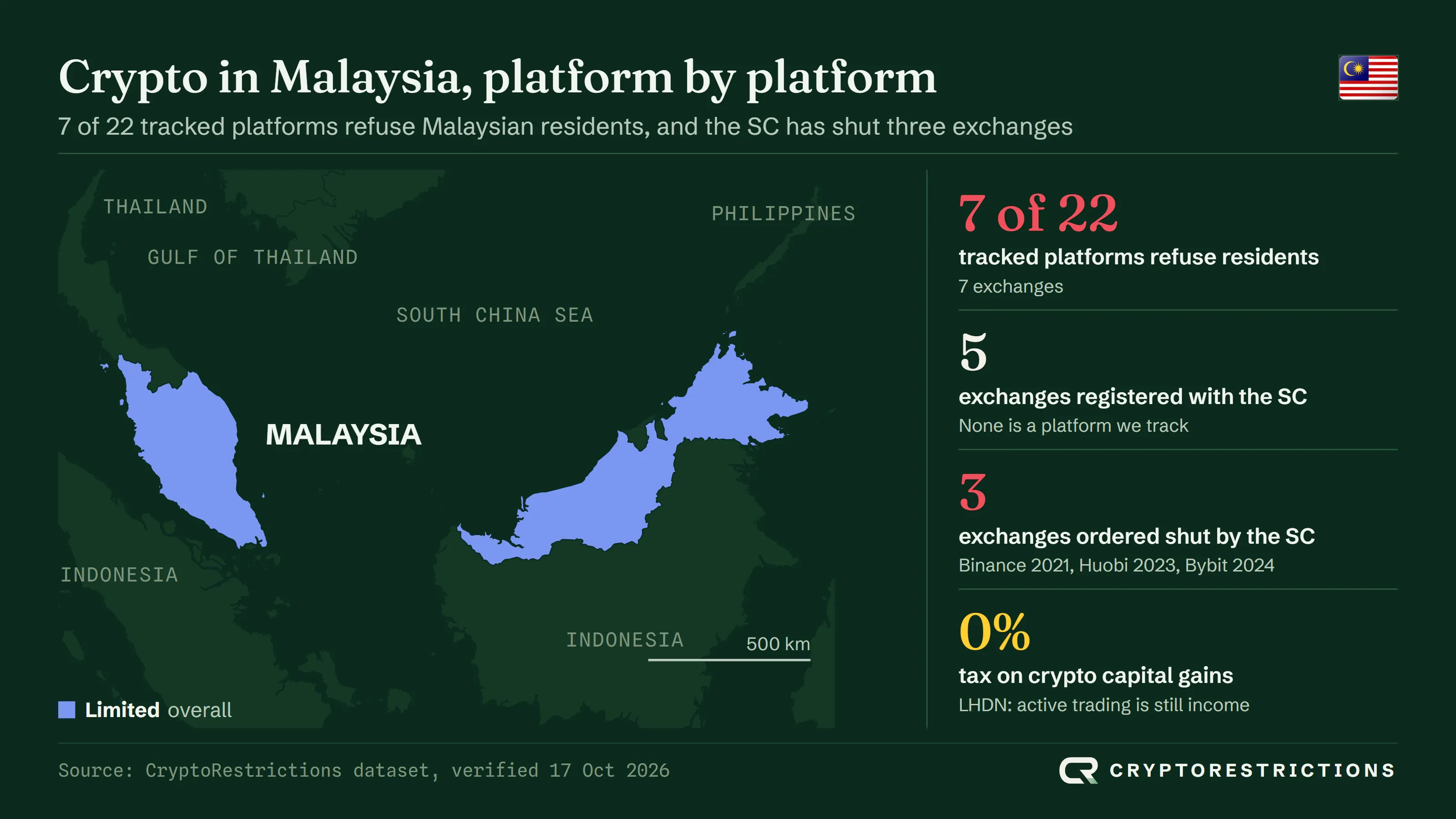
Yes. Nothing we read bans residents from buying, holding or trading crypto, but the central bank does not treat it as money and the Securities Commission only lets registered exchanges serve the public.
Bank Negara Malaysia said in its statement on Bitcoin of 3 January 2014 that Bitcoin is not recognised as legal tender in Malaysia and that the bank does not regulate its operations. The SC took over the rulemaking: the Capital Markets and Services (Prescription of Securities) (Digital Currency and Digital Token) Order 2019 took effect on 15 January 2019, per the SC’s 2019 release, and its Guidelines on Digital Assets followed on 28 October 2020.
The state’s tool is registration plus enforcement. The SC’s own releases treat running a digital asset exchange without registration as breaching section 7(1) of the Capital Markets and Services Act 2007, and its response to offshore exchanges has been to order the site and apps closed rather than to pursue the people who used them. The Investor Alert List names firms the SC says to avoid; it is a warning, not a ban on holding crypto.
Which crypto exchanges work in Malaysia?
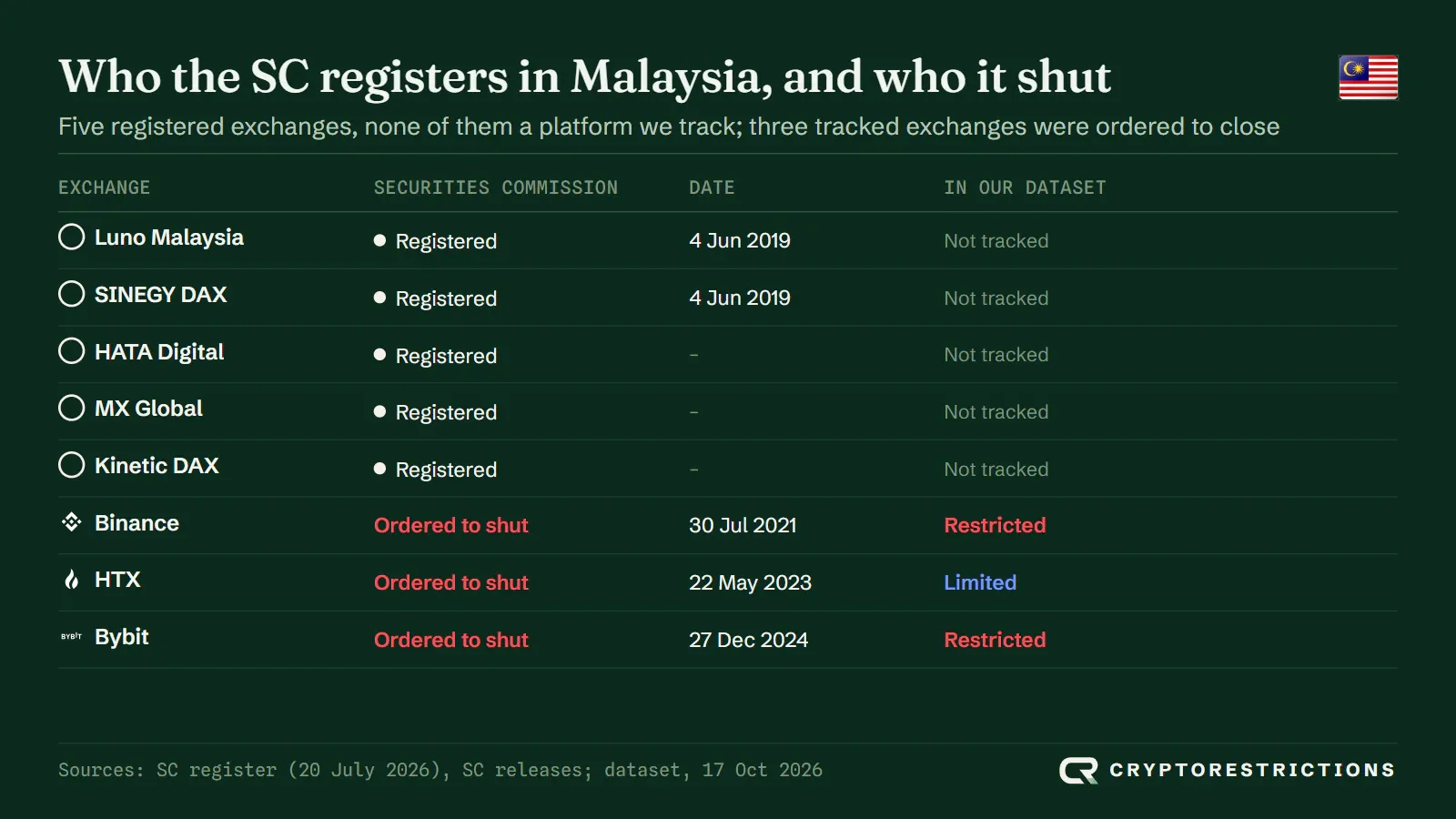
Only exchanges on the SC’s register are authorised to serve the public, and none of them is a platform we track. Offshore exchanges that serve Malaysians do so without that authorisation.
The SC register, updated as of 20 July 2026, names five registered operators: HATA Digital, Luno Malaysia, MX Global, SINEGY DAX and Kinetic DAX. The SC registered the first two, Luno and SINEGY, on 4 June 2019, alongside a third exchange; the register gives no dates for the rest.
The SC revised its recognized markets guidelines on 20 May 2026. Registered exchanges now have to join the Financial Markets Ombudsman Service in 2026, product approvals are meant to be faster, and updated ETF guidelines allow digital currency ETFs. The release puts registered exchange trading at RM17.14 billion in 2025, up 23% from RM13.93 billion in 2024, and says the SC took administrative action against four unregistered exchanges, unnamed, and worked with technology firms such as Google from 14 April 2026 to limit their promotion to Malaysians.
The nearest link between a tracked platform and the register is an investment. Bybit led HATA’s US$8 million Series A on 22 April 2026, per Fintech Global. That makes Bybit a backer of a registered exchange, not a registered exchange itself, and the SC’s order closing Bybit’s own platform still stands.

Best crypto platforms for Malaysian residents
By our access score, Bitfinex, Bitstamp, Crypto.com and Kraken (8.0 out of 10 each) are the exchanges most open to Malaysian residents, with Coinbase at 7.5. Every DeFi platform and both open prediction markets also score 8.0, and nothing scores higher because no tracked platform is SC-registered.
The score rates how fully a Malaysian resident can use each platform, not its fees or safety. It is computed from our data and moves when a row changes: access status (4 points), the share of the platform’s products open here (3), the Malaysian licences we hold on file (2) and what our geo-access test saw from a Malaysian address (1). No tracked platform holds an SC registration, so none earns the licence points. Platforms that refuse Malaysian residents are not scored. The full method is on our methodology page.
Exchanges

Bitfinex
Best for Spot access without a Malaysian company
8.0/10- Access
- 4/4
- Products
- 3/3
- Licences
- 0/2
- Our test
- 1/1
Read our Bitfinex reportPros
- Malaysia is not a prohibited jurisdiction in its terms
- Loaded without a block in our test
Cons
- No SC registration on file

Bitstamp
Best for Plain spot trading
8.0/10- Access
- 4/4
- Products
- 3/3
- Licences
- 0/2
- Our test
- 1/1
Read our Bitstamp reportPros
- No Bitstamp document excludes Malaysia
- Loaded without a block in our test
Cons
- No SC registration on file

Crypto.com
Best for Spot trading in the app
8.0/10- Access
- 4/4
- Products
- 3/3
- Licences
- 0/2
- Our test
- 1/1
Read our Crypto.com reportPros
- Not on its app, spot or sanctions lists
- Loaded without a block in our test
Cons
- No SC registration on file

Kraken
Best for Spot trading outside the SC register
8.0/10- Access
- 4/4
- Products
- 3/3
- Licences
- 0/2
- Our test
- 1/1
Read our Kraken reportPros
- Malaysia is not on its do-not-serve list
Cons
- No SC registration on file

Coinbase
Best for Spot trading with a US-listed brand
7.5/10- Access
- 4/4
- Products
- 3/3
- Licences
- 0/2
- Our test
- 0.5/1
Read our Coinbase reportPros
- Malaysia is a listed sign-up country in its identity verification guide
Cons
- No SC registration on file
- Stocks and prediction markets showed a notice in our test

HTX
Best for Spot and derivatives, with a warning attached
6.3/10- Access
- 3/4
- Products
- 2.3/3
- Licences
- 0/2
- Our test
- 1/1
Read our HTX reportPros
- Not on its restricted list
- Loaded without a block in our test
Cons
- The SC ordered Huobi Global to stop operating in Malaysia on 22 May 2023

Gemini
Best for Perpetuals only
5.9/10- Access
- 3/4
- Products
- 1.9/3
- Licences
- 0/2
- Our test
- 1/1
Read our Gemini reportPros
- Malaysia is on its perpetuals list
Cons
- Spot is not offered: Malaysia is not on its main list
DeFi

Aster
Best for Perpetuals and spot trading
8.0/10- Access
- 4/4
- Products
- 3/3
- Licences
- 0/2
- Our test
- 1/1
Read our Aster reportPros
- Malaysia is not on its prohibited list
- Perpetuals load in the trading app in our test
Cons
- No SC registration on file

Hyperliquid
Best for Perpetuals from your own wallet
8.0/10- Access
- 4/4
- Products
- 3/3
- Licences
- 0/2
- Our test
- 1/1
Read our Hyperliquid reportPros
- Not blocked in our geo-access test
Cons
- No SC registration on file

Jupiter
Best for Solana swaps
8.0/10- Access
- 4/4
- Products
- 3/3
- Licences
- 0/2
- Our test
- 1/1
Read our Jupiter reportPros
- Malaysia is not named in its terms
Cons
- No SC registration on file

Lighter
Best for Perpetuals on its trading app
8.0/10- Access
- 4/4
- Products
- 3/3
- Licences
- 0/2
- Our test
- 1/1
Read our Lighter reportPros
- Not named in its terms
- The trading app loaded in our test
Cons
- No SC registration on file

PancakeSwap
Best for BNB Chain swaps and pools
8.0/10- Access
- 4/4
- Products
- 3/3
- Licences
- 0/2
- Our test
- 1/1
Read our PancakeSwap reportPros
- Malaysia is not excluded by its terms
Cons
- No SC registration on file

Uniswap
Best for Swapping tokens from your own wallet
8.0/10- Access
- 4/4
- Products
- 3/3
- Licences
- 0/2
- Our test
- 1/1
Read our Uniswap reportPros
- Its terms bar only places under comprehensive US sanctions
Cons
- No SC registration on file
Prediction markets

Kalshi
Best for Regulated US event contracts
8.0/10- Access
- 4/4
- Products
- 3/3
- Licences
- 0/2
- Our test
- 1/1
Read our Kalshi reportPros
- Malaysia is not on its restricted-jurisdictions list
Cons
- No Malaysian ruling says whether prediction markets are legal

Polymarket
Best for Event contracts from your own wallet
8.0/10- Access
- 4/4
- Products
- 3/3
- Licences
- 0/2
- Our test
- 1/1
Read our Polymarket reportPros
- Malaysia is not on its blocked-countries list
- Its geoblock check returned open in our test
Cons
- No Malaysian ruling says whether prediction markets are legal
Which platforms block Malaysian users?
The SC ordered Binance and Bybit shut, and OKX, KuCoin, Bitget, Gate and MEXC list Malaysia in their own terms or notices. HTX, ordered shut in 2023, is the one case in between.
The SC announced its order against Binance on 30 July 2021, giving it 14 business days to disable its website and apps. The Finance Ministry told Parliament in July 2026 that Binance is not licensed and its site and app stay blocked, Malay Mail reported on 17 July 2026. On 13 October 2026 Fintech News reported that an SC update of 8 October 2026 put Binance back on the Investor Alert List; the SC’s list page did not load in full for us, so we have not confirmed that entry.

Bybit was reprimanded on 27 December 2024 and told to take its website and apps offline within 14 business days from 11 December 2024, stop advertising and close its Telegram group for Malaysians, without a fine. The SC says Bybit complied. BingX relayed a claim by Bybit’s chief executive in April 2026 that Bybit had come off the alert list; we could not confirm that on the SC’s page and found no sign Bybit reopened to Malaysians.
HTX is the middle case. The SC ordered Huobi Global on 22 May 2023 to stop operating, disable its site and app and withdraw customer funds, but HTX’s current terms do not list Malaysia and its site loaded in our test, so we mark it limited rather than restricted. The SC added “MEXC Global” to its alert list as at 5 September 2022. Bitget (16 October 2026), MEXC (13 October 2026), KuCoin (29 September 2026), Gate (22 July 2026) and OKX (8 July 2026) each name Malaysia in their current terms or restricted-location lists.
What our geo-access test saw from Malaysia
From a Malaysian address on 14 and 16 October 2026 we loaded all 22 platforms we track: 4 refused us, 1 showed a notice and 17 loaded with no barrier.
An open page is not permission. Binance, KuCoin and Gate loaded although the SC or their own terms close Malaysia, because most platforms enforce at identity verification rather than at the page. Bybit, MEXC, Bitget and OKX refused us: Bybit’s sign-up page said its services are not available in our region, MEXC cited local regulatory requirements, Bitget’s location check returned its prohibited-countries message, and OKX said its exchange is not available in Malaysia. Coinbase’s notice was narrower, saying stocks and prediction markets are not available. HTX loaded although the SC ordered Huobi Global shut in 2023. Swipe through the screenshots below; each card says what the page showed.
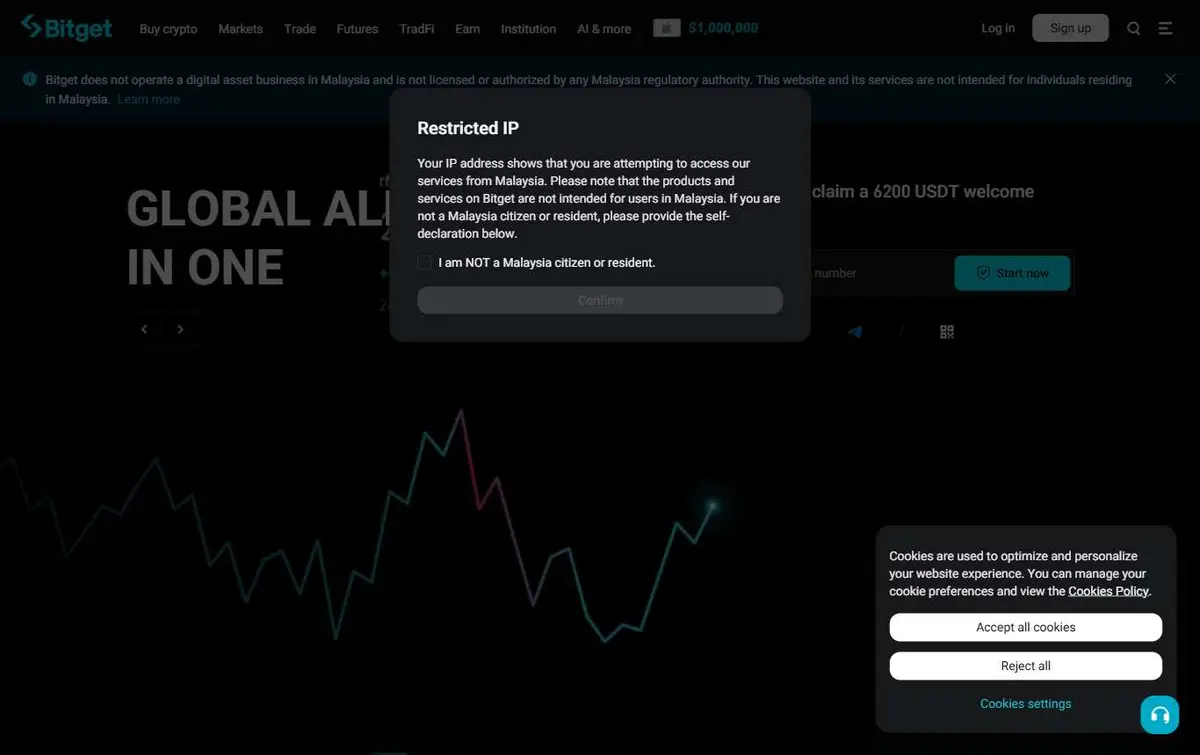
Blocked Bitget · Home page
Malaysia: Bitget's location check returned its prohibited-countries message, but the page showed no pop-up
“Please note that we are unable to provide services in prohibited countries.”
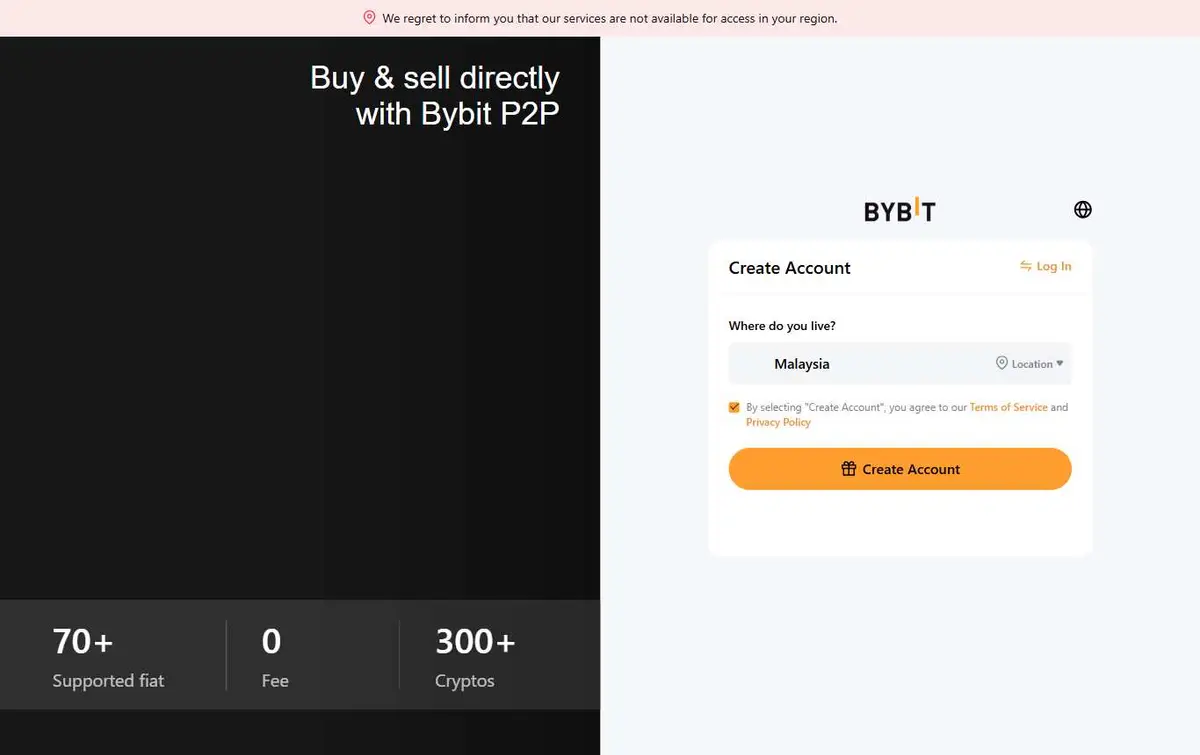
Blocked Bybit · Sign-up page
Malaysia, shut by its Securities Commission in 2024, is blocked too
“We regret to inform you that our services are not available for access in your region.”
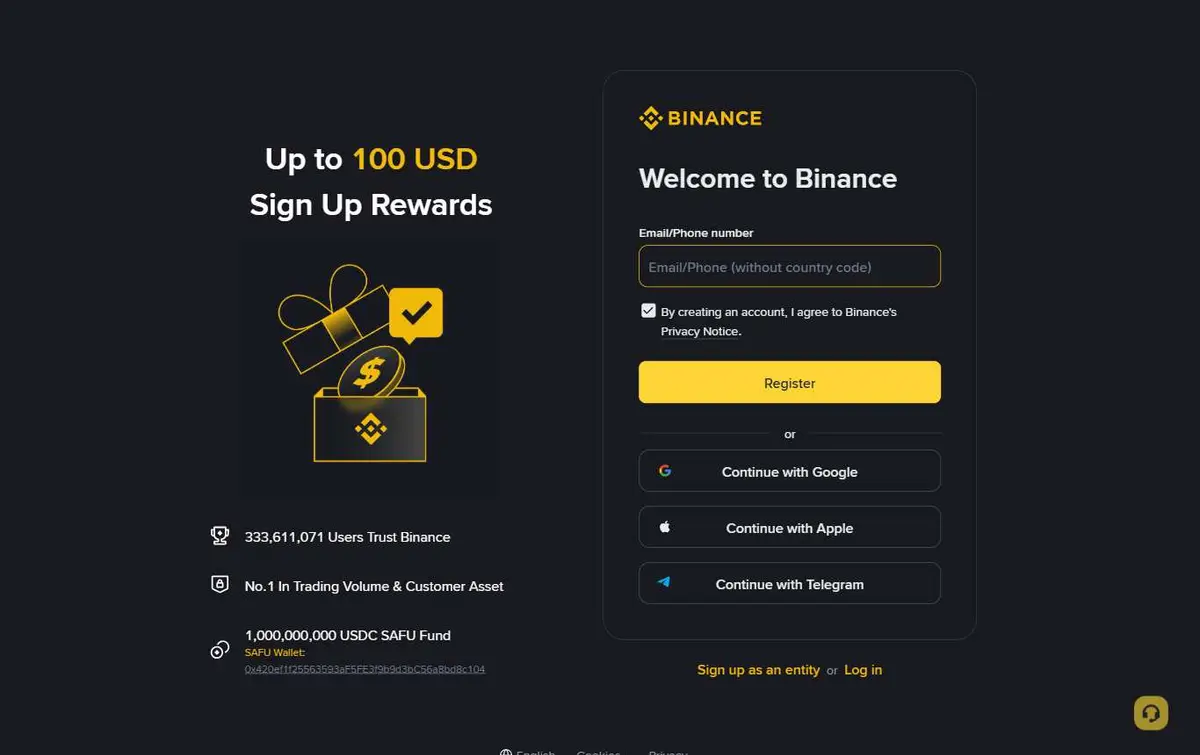
No barrier Binance · Sign-up page
Restricted by a 2021 order, yet sign-up loads
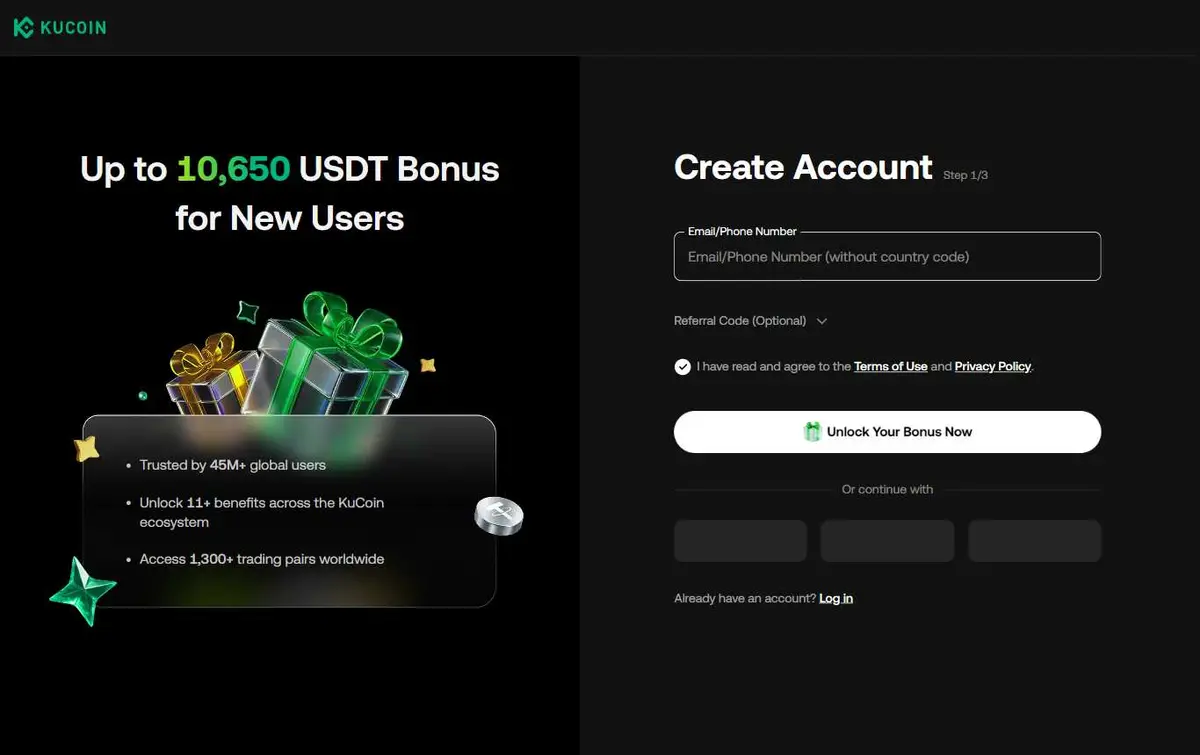
No barrier KuCoin · Sign-up page
Restricted, yet sign-up loads with no warning
 CRYPTORESTRICTIONS
Who regulates crypto in Malaysia?
The SC registers and polices exchanges, Bank Negara Malaysia holds the line on money and payments, the tax authority LHDN sets how gains are taxed, and courts apply two 1953 gambling statutes to online betting.
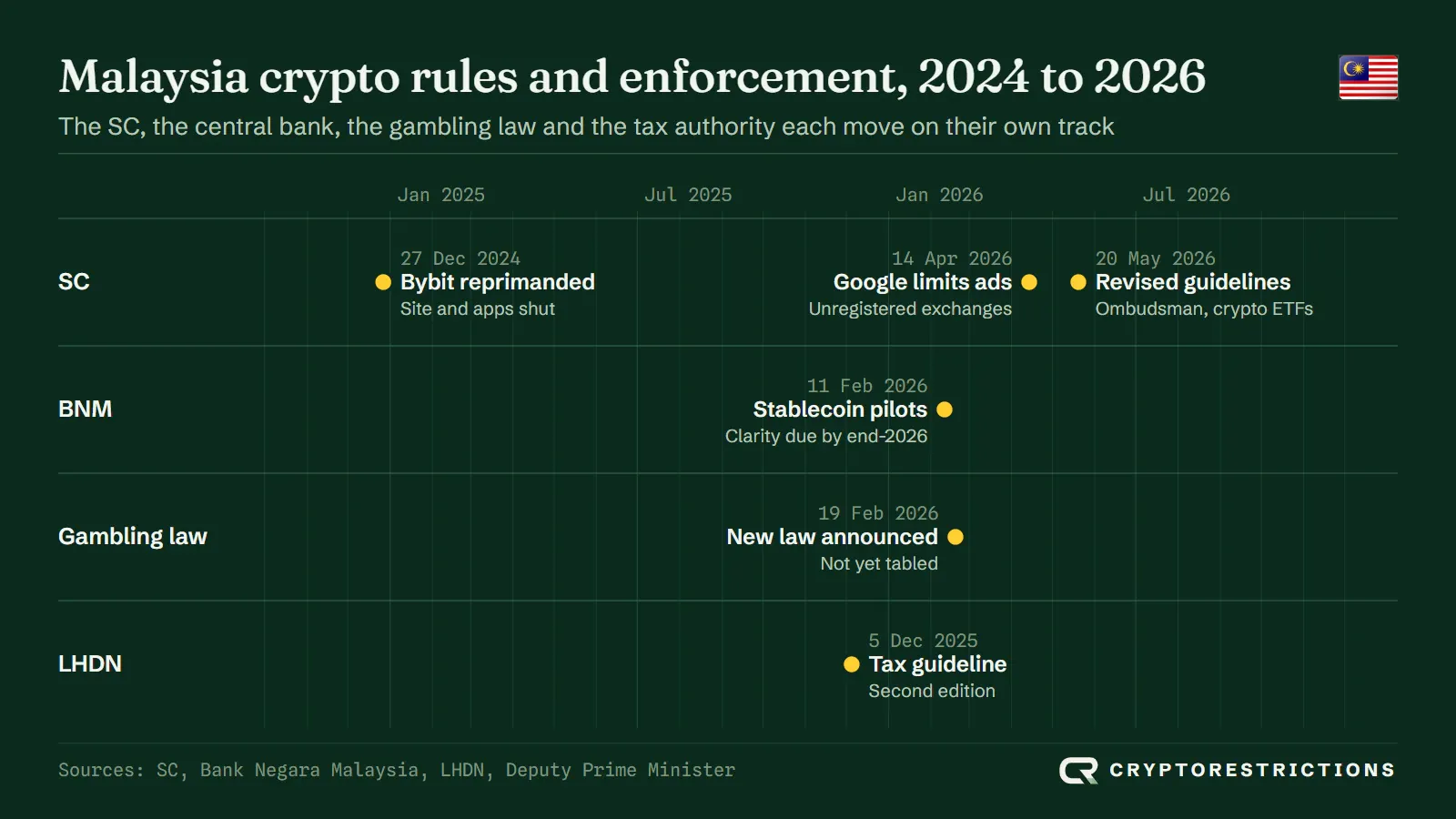
- Securities Commission. It registers digital asset exchanges as recognized market operators, approves token offerings and custodians under its Guidelines on Digital Assets, and keeps the Investor Alert List. The list itself is the place to check a name.
- Bank Negara Malaysia. Crypto is not legal tender. On 11 February 2026 the bank said its Digital Asset Innovation Hub had onboarded three initiatives testing ringgit stablecoins and tokenised deposits, and that it intends to give greater clarity on them by the end of 2026.
- LHDN. The Inland Revenue Board issued the second edition of its digital currency tax guideline on 5 December 2025, covered in the tax section.
- Gambling law. Courts apply the Common Gaming Houses Act 1953 to online gambling, covered in the prediction markets section.
Are prediction markets legal in Malaysia?
Unclear. Online gambling is an offence under existing law, but we found no Malaysian rule or ruling that names prediction markets, and the platforms we track do not list Malaysia as restricted.
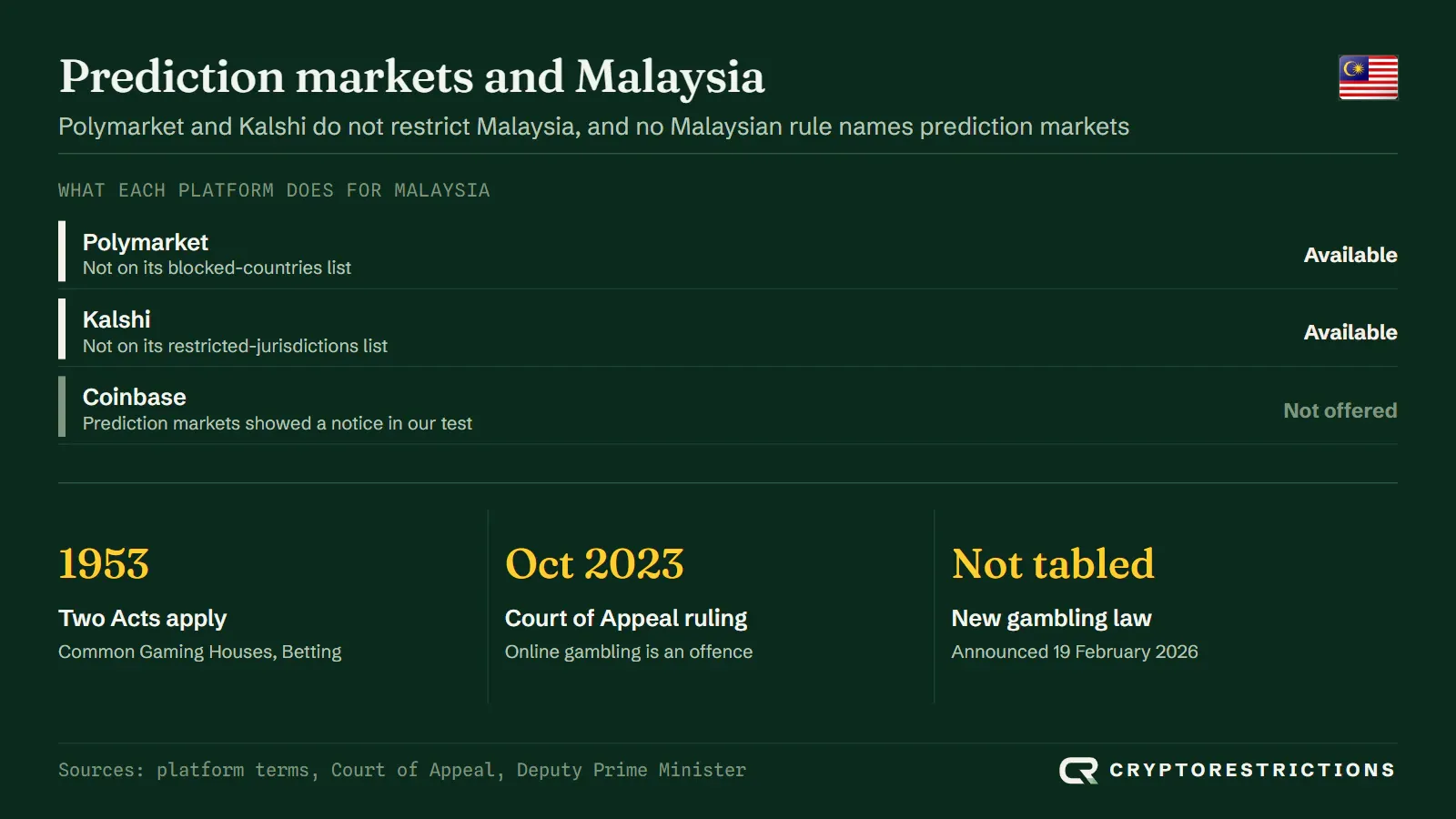
Two 1953 statutes cover gambling: the Common Gaming Houses Act and the Betting Act. The Court of Appeal held in October 2023 that online gambling is an offence under existing law, Free Malaysia Today reported. Charges against app users have been brought under section 7(2) of the Common Gaming Houses Act, which The Rakyat Post gives as a fine of up to RM5,000, up to six months in jail, or both, and phones have been treated as gaming machines under section 4B(a), with a minimum fine of RM10,000 per machine. We took those figures from that report, not from the Act’s text.
On 19 February 2026 the Deputy Prime Minister said a new law on illegal online gambling was drafted but not yet tabled, and we found no bill since. On the platform side, Polymarket and Kalshi do not list Malaysia as restricted, and Coinbase told us in our test that prediction markets are not available. Whether an event contract counts as gambling is, as far as we found, untested.
How is crypto taxed in Malaysia?
LHDN says capital gains from digital currency are not subject to capital gains tax, but active trading is taxable income at the resident rates, up to 30%.
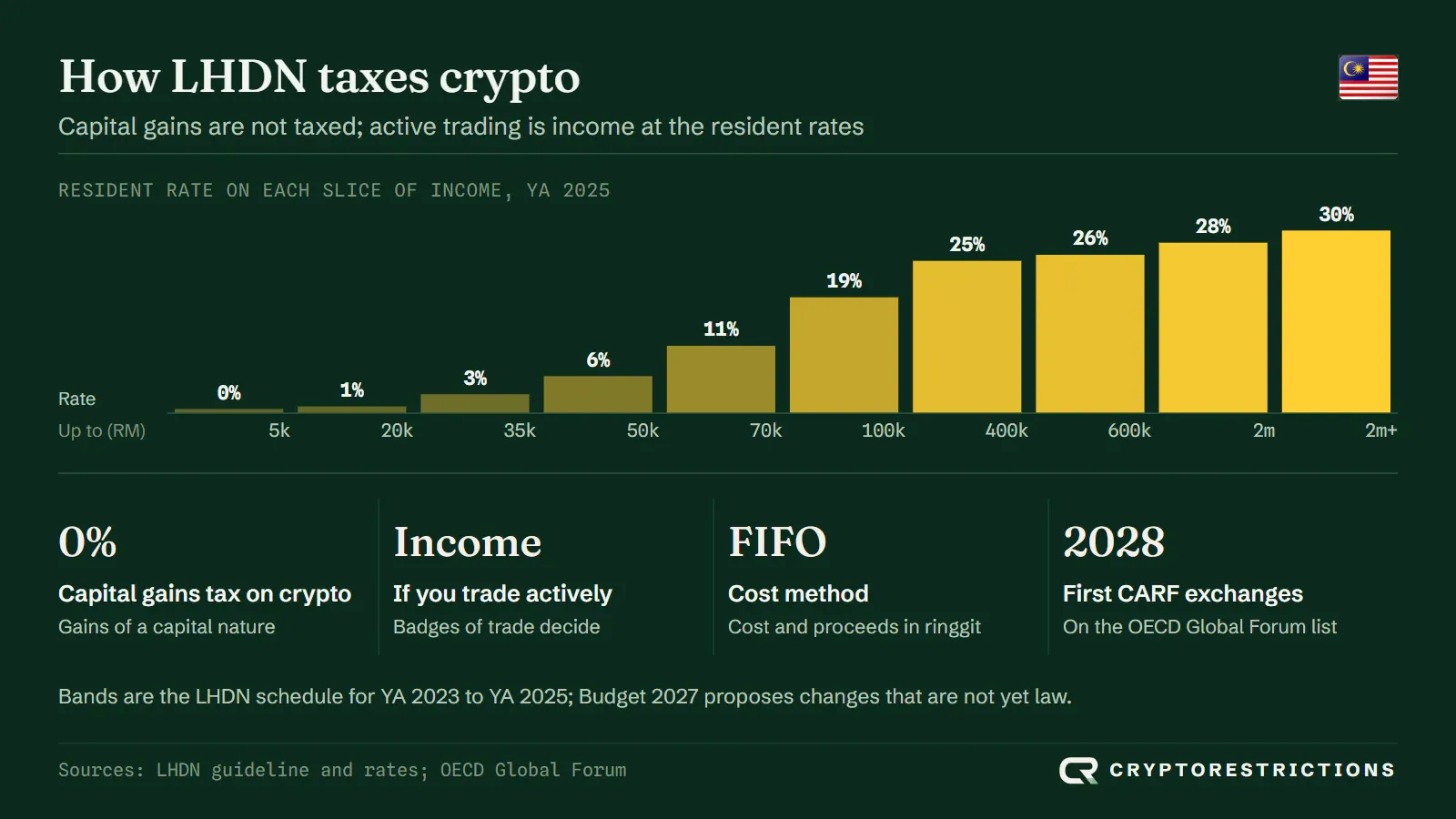
The line between the two is decided case by case. LHDN’s guideline of 5 December 2025, which replaced the 2022 edition, tests holding period, frequency, motive and financing rather than setting a number of days. Mining is treated as a business, and crypto received as pay is income at its ringgit value; airdrops are not income when received. The new capital gains tax that has applied to unlisted shares since 1 March 2024 does not reach crypto. Gains that are capital in nature and made on disposals in Malaysia are not taxed, though capital gains brought into Malaysia may be taxable for companies, LLPs and trusts.
The bands in the chart are LHDN’s schedule for YA 2023 to YA 2025; we did not find a separate YA 2026 page. Budget 2027, tabled on 9 October 2026, proposes changes to some bands and a higher personal relief, Bernama reported, and those are not law until Parliament passes them. On reporting, the OECD’s commitments list of 14 September 2026 puts Malaysia among the countries planning first exchanges of crypto-asset data by 2028; we found no Malaysian rules for it yet.


 Bahrain
 Georgia
 Qatar
 Israel
 Saudi Arabia
 Vietnam
 Pakistan
 Bangladesh
 Indonesia
 United Arab Emirates
 South Korea