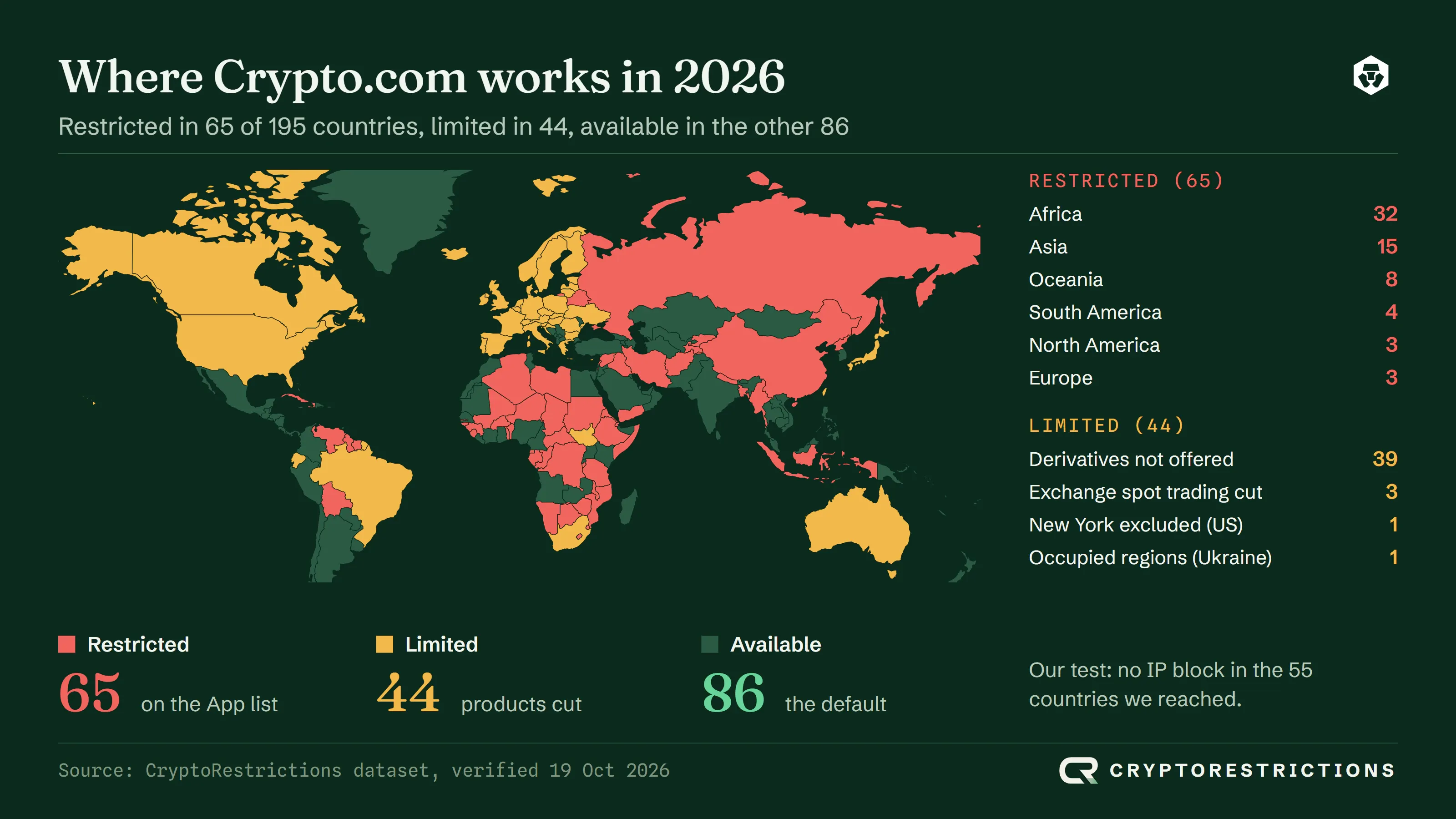
Where is Crypto.com restricted?
Crypto.com is restricted in 65 of the 195 countries we cover, among them  China,
 Indonesia,
 Bangladesh,
 Russia,
 Belarus,
 Iran,
 North Korea,
 Cuba,
 Venezuela,
 Ethiopia and
 Algeria, plus 54 more listed below.
Every one comes from Crypto.com’s own App geo-restrictions list (updated 12 May 2026), which says people from those locations are restricted from using the App. It is a closed table of 74 places: the 65 countries above, eight territories such as Macau, Mayotte and Western Sahara, and the Gaza Strip and West Bank. Crypto.com gives no reason per country, and its EEA terms name no countries either: they bar anyone in a sanctioned country or one Crypto.com has notified as restricted, which points back to the list. A second list, for Exchange spot trading, repeats 29 of the 65.
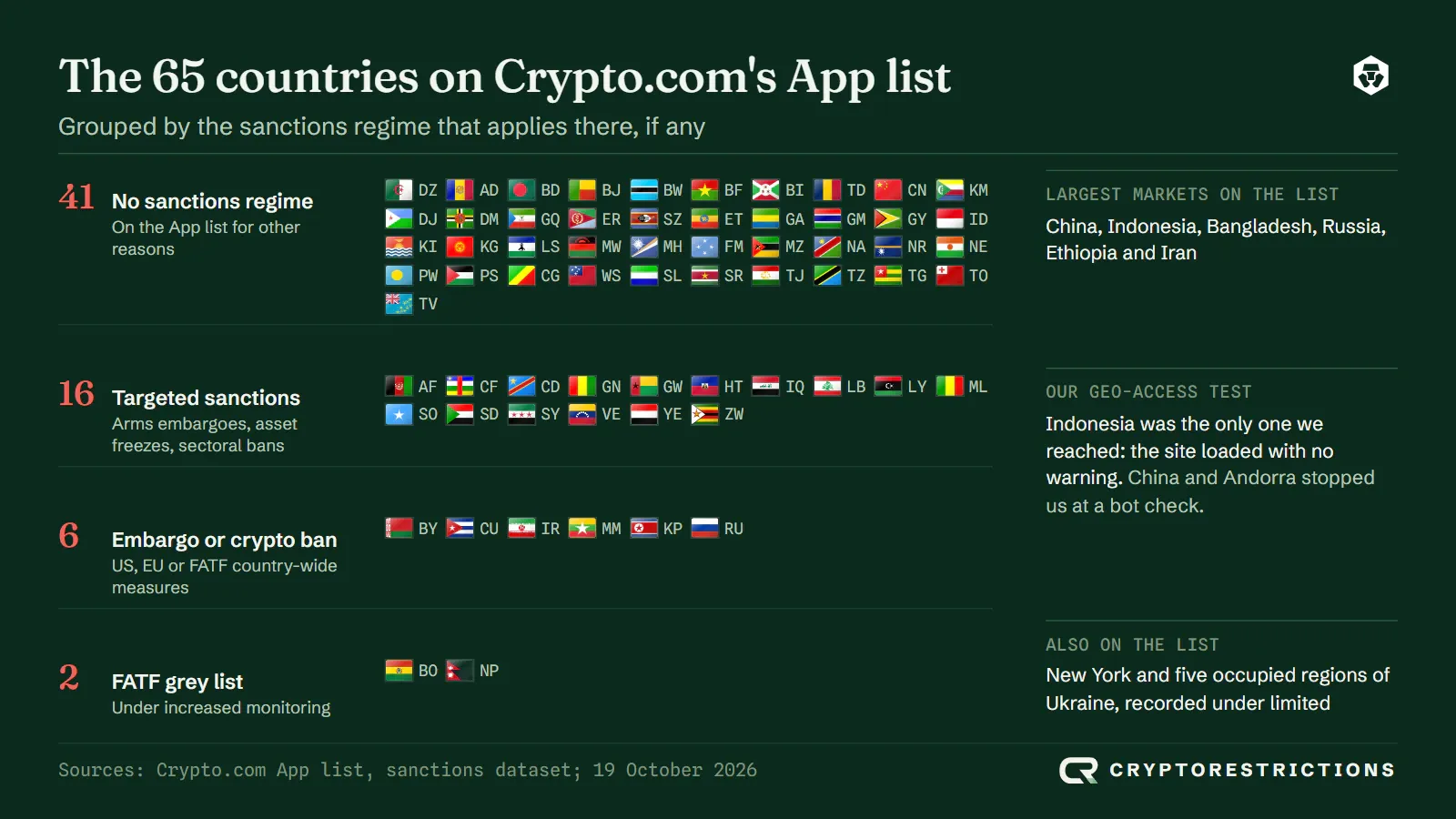
We grouped the list against our sanctions dataset. Only 24 of the 65 are under a sanctions regime of any kind; the other 41 are markets Crypto.com chose not to serve, from China and Indonesia to Pacific states such as Tonga and Tuvalu. The full list is below: pick a country to see the group, what applies and what our test saw.
Where is Crypto.com limited?
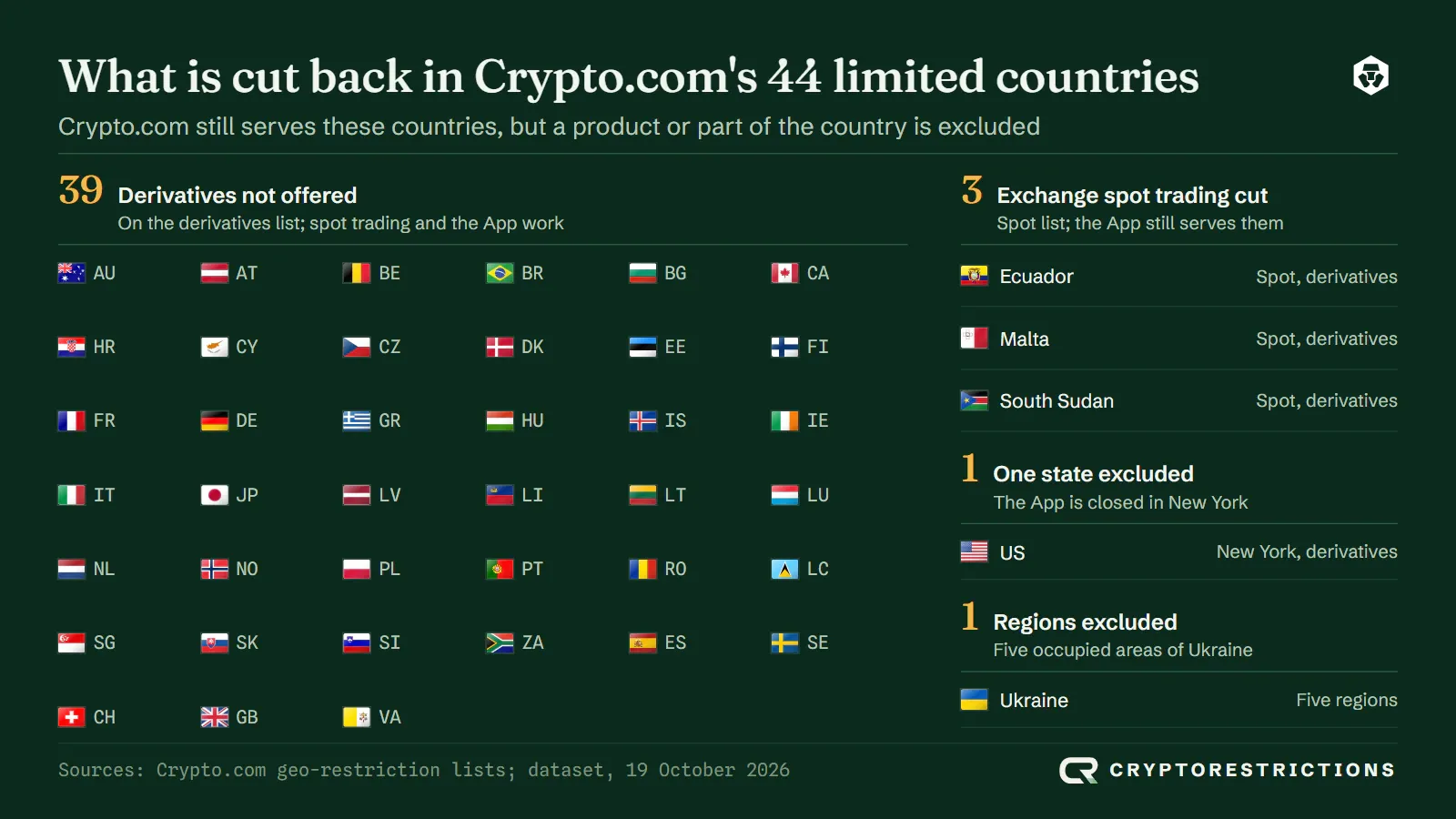
Crypto.com is limited in 44 countries: 39 where it offers no derivatives, among them every EEA state, the UK,  Canada,
 Australia,
 Brazil and
 Japan;
 Ecuador,
 Malta and
 South Sudan, where Exchange spot trading is cut too; the
 United States, where New York is excluded; and
 Ukraine, where five occupied regions are.
All of them rest on Crypto.com’s own lists. Its derivatives list (updated 7 May 2025) names the EEA, the UK, the US, Canada, Australia, Brazil, Japan, Singapore, Switzerland, South Africa and others; in those countries spot trading and the App still work, so we record the country as limited with a restricted derivatives row and an available spot row. Ecuador, Malta and South Sudan are on the spot trading list as well, though not on the App list. The App list names New York and the Zaporizhzhia, Kherson, Crimea, Luhansk and Donetsk regions. Malta is the odd one: it is the home state of Crypto.com’s MiCA licence, yet its residents cannot trade spot on the Exchange. Japan is limited only for derivatives: Crypto.com holds no Japanese registration, but it is not on the FSA’s warning list of unregistered providers.
Brazil is about to lose more: Crypto.com’s help centre says the BRL cash account closes on 25 October 2026, while crypto trading and the prepaid card continue. Hong Kong, a territory outside our 195, is in the same position as Ecuador. The groups are below.
Where is Crypto.com available?
Crypto.com is available in the other 86 of the 195 countries we cover, from  India,
 Nigeria and
 Mexico to the
 United Arab Emirates and
 South Korea.
Two rest on a licence or registration: the United Arab Emirates, where Foris DAX Middle East holds a VARA licence that includes derivatives, and South Korea, where Crypto.com runs a Korean site that says its VASP report was accepted. Twenty-six more we checked by name against the App, spot and sanctions lists and the regulator orders we track: Crypto.com is not among the nine exchanges India’s FIU sent notices in December 2023, not named in the Philippine SEC’s August 2025 advisory. The other 58 are available under our coverage rule: no official document restricts them.
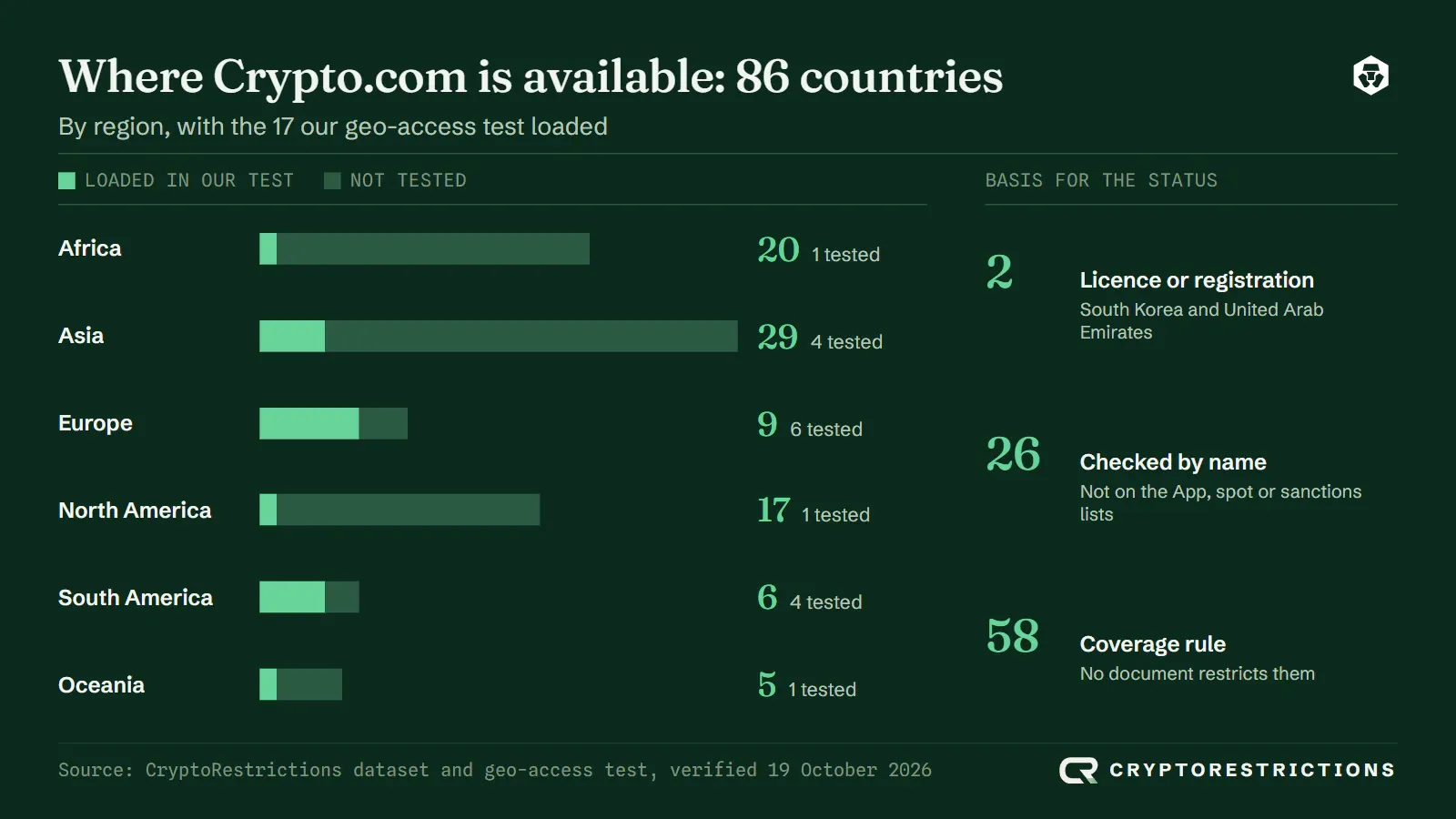
Available means Crypto.com serves the country, not that local law allows crypto trading. Most of the licensed markets are not on this list for a simple reason: derivatives are cut there, which makes them limited.
Where do Crypto.com’s visitors come from?
In both estimators we checked, the United States sends close to half of all visits to crypto.com, far ahead of Canada and the UK.
Similarweb’s May 2026 figures, published by BitRSS, put the United States at 44.02%, then Canada, the UK,  Germany and
 Singapore. Semrush counts 5.04 million visits in September 2026, 45.58% of them from the United States, with the UK second at 11.53% and Australia fifth. All of these are limited for Crypto.com, mostly because derivatives are cut. Similarweb’s own page for crypto.com had hit its free search limit when we checked, so we could not read a newer month there.
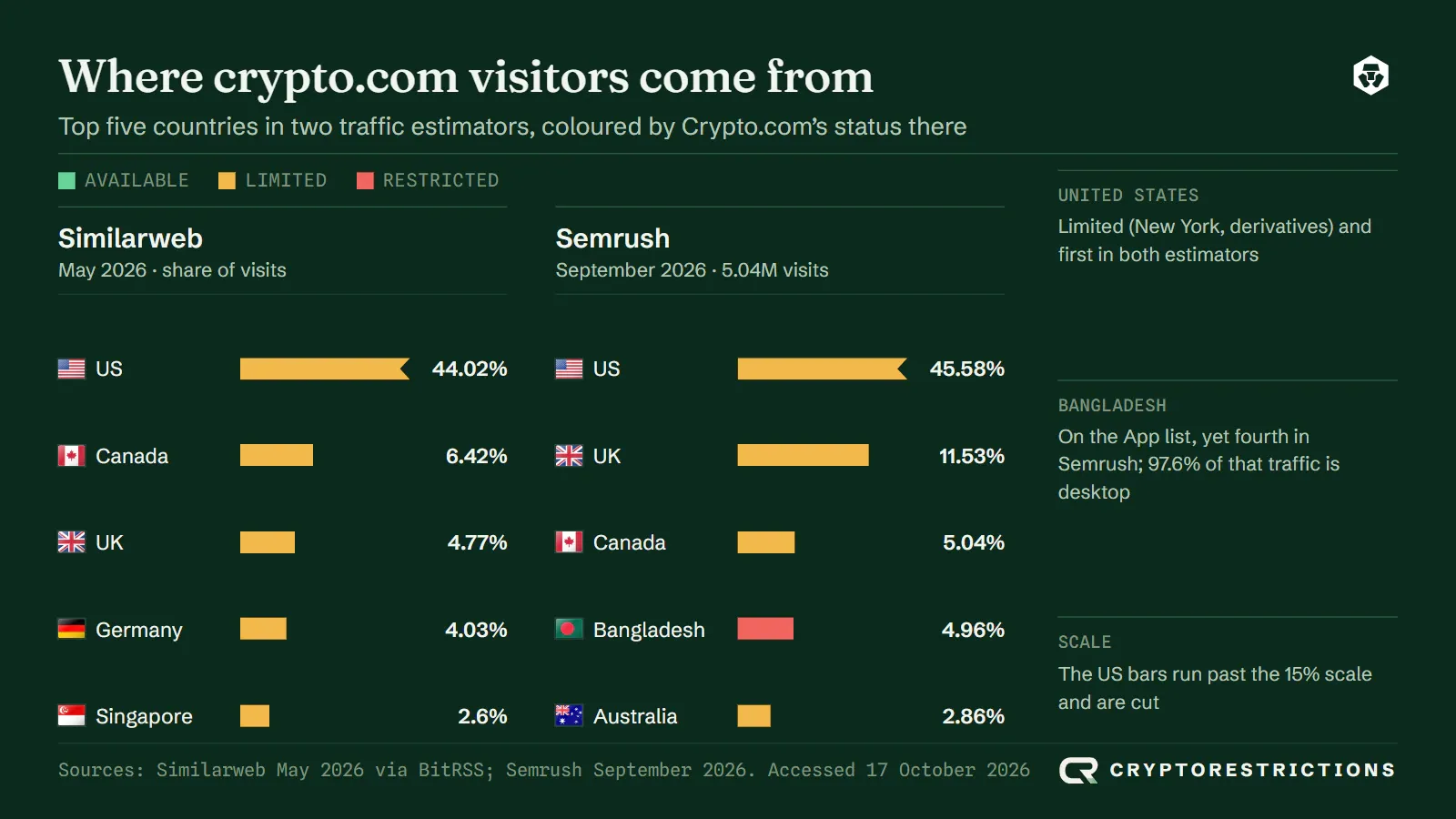
The one restricted country in either top five is Bangladesh, fourth in Semrush with 4.96%, although it is on the App list. Semrush puts 97.62% of that traffic on desktop, against 16.3% for the United States, and Bangladesh is absent from Similarweb’s list. A desktop visit to a price page is not an account, and our test shows the site itself does not turn anyone away, so treat a single country share as an estimate.
Crypto.com geo-access test: what we saw from 53 countries
In our test Crypto.com blocked nobody by IP address in the 53 of our 195 countries we reached; only Hong Kong, outside the 195, saw a notice.
We ran the test ourselves on 14 October 2026. A browser with a VPN connected to one country at a time and loaded Crypto.com’s home page and its Exchange page, each time in a fresh private window with no cookies. Cookie banners were hidden but never accepted, and bot checks were waited out, never solved. Every run saved the page text and a screenshot.
We used in-country VPN servers only. In earlier runs Crypto.com placed our virtual locations, IP addresses registered to one country but hosted in another, by the physical server, so those runs say nothing about the country they claim. Of the 55 places tested, 53 are among our 195 countries and two, Hong Kong and Taiwan, are territories. China, Andorra and Brunei stopped us at a bot check and count as not tested.
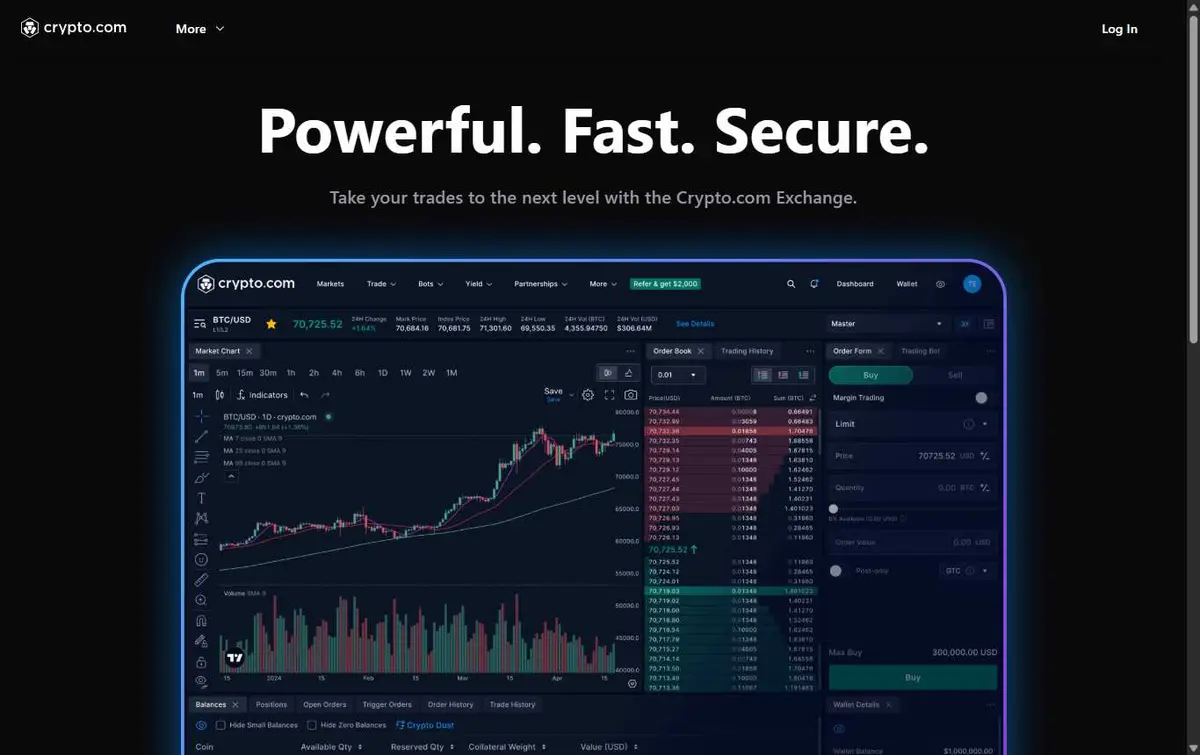
Notice shown Hong Kong · exchange
The one notice: the Exchange page in Hong Kong points to the lists that exclude it
“Please refer to the following links and ensure that you are not in any geo-restricted jurisdictions for: spot trading, derivatives trading, margin trading, on-chain staking, and lending.”

No barrierIndonesia · Home page
Indonesia is on the App list, yet the international site loads with no warning
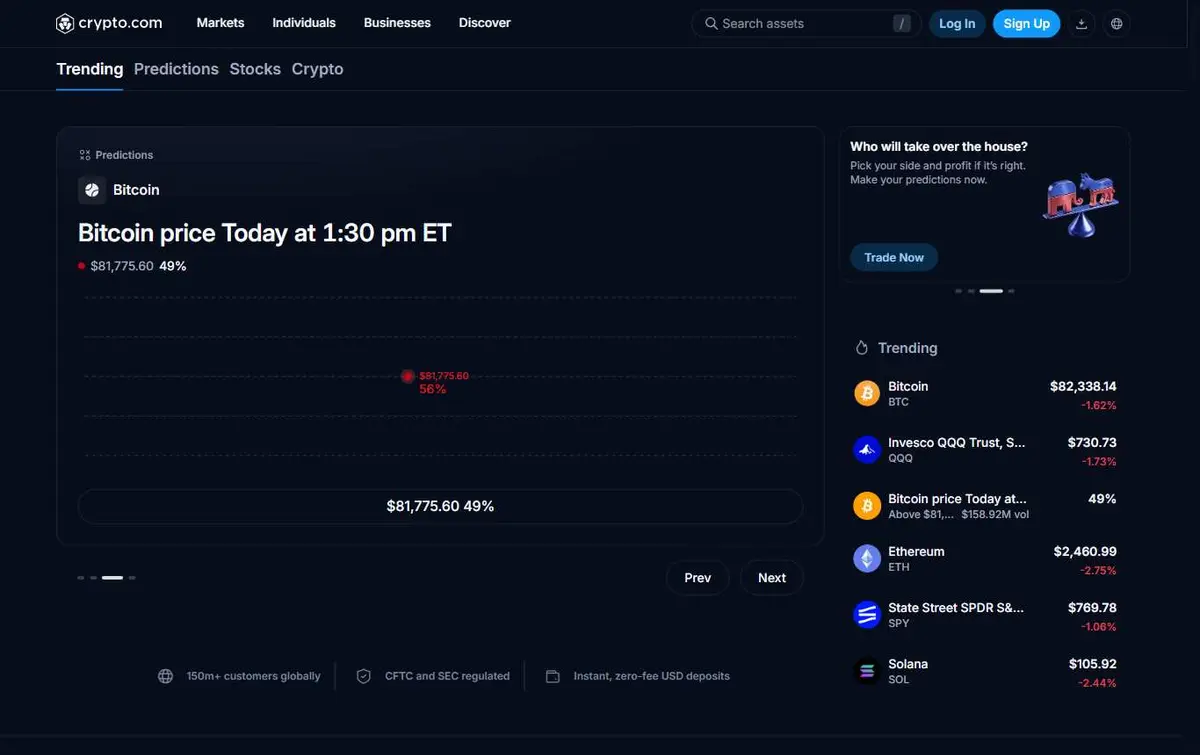
No barrierUnited States · Home page
A US address gets the American site, with predictions and stocks beside crypto

No barrierSouth Korea · Home page
South Korea is sent to a Korean site that says its VASP report was accepted
“Crypto.com Korea”

No barrier United Kingdom · Home page
The UK site, run by FCA-registered Foris DAX UK

No barrierSingapore · Home page
Singapore, Crypto.com's MAS-licensed home market

No barrierUnited Arab Emirates · Home page
The UAE site, under Crypto.com's VARA licence in Dubai

No barrier Turkey · Home page
Türkiye gets the international site with no warning
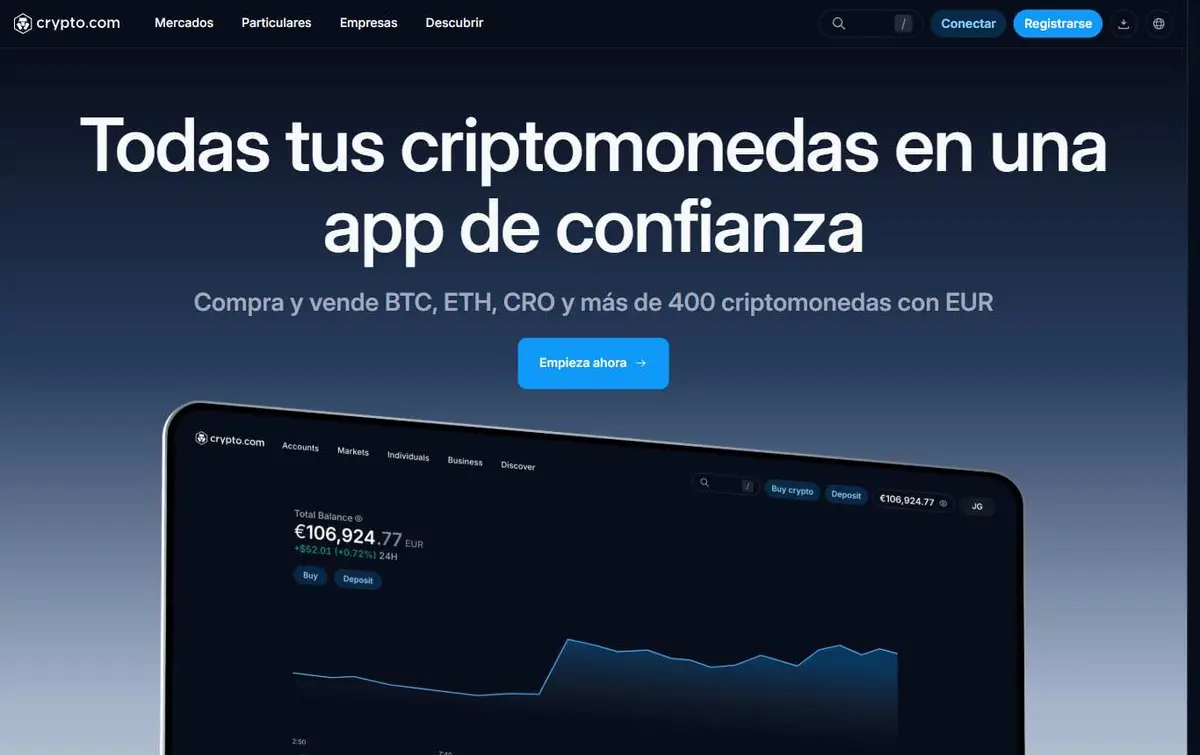
No barrier Spain · Home page
Spain, one of 29 EEA states served under the Malta MiCA licence
No barrierUkraine · Home page
Ukraine loads normally; only five occupied regions are excluded
No barrierMexico · Home page
Mexico: the home page loads with no barrier
“Crypto.com International”

No barrier Ireland · Home page
Ireland: the home page loads with no notice

No barrier New Zealand · Home page
New Zealand: the page loads with no notice

No barrier Norway · Home page
Norway: the home page loads with no notice

No barrier Finland · Home page
Finland: the home page loads with no notice
No barrier Greece · Home page
Greece: the home page loads with no notice
No barrier Bulgaria · Home page
Bulgaria: the home page loads with no notice

No barrier Croatia · Home page
Croatia: the home page loads with no notice
No barrier Latvia · Home page
Latvia: the home page loads with no notice
No barrier Estonia · Home page
Estonia: the home page loads with no notice

No barrier Lithuania · Home page
Lithuania: the home page loads with no notice
No barrier Slovenia · Home page
Slovenia: the home page loads with no notice
No barrier Iceland · Home page
Iceland: the home page loads with no notice
No barrier Serbia · Home page
Serbia: the home page loads with no notice
 CRYPTORESTRICTIONS
The test does not decide a country’s status on its own: official documents come first, and a page that loads is not permission to use Crypto.com. What it shows is that Crypto.com does not enforce its lists at the door.
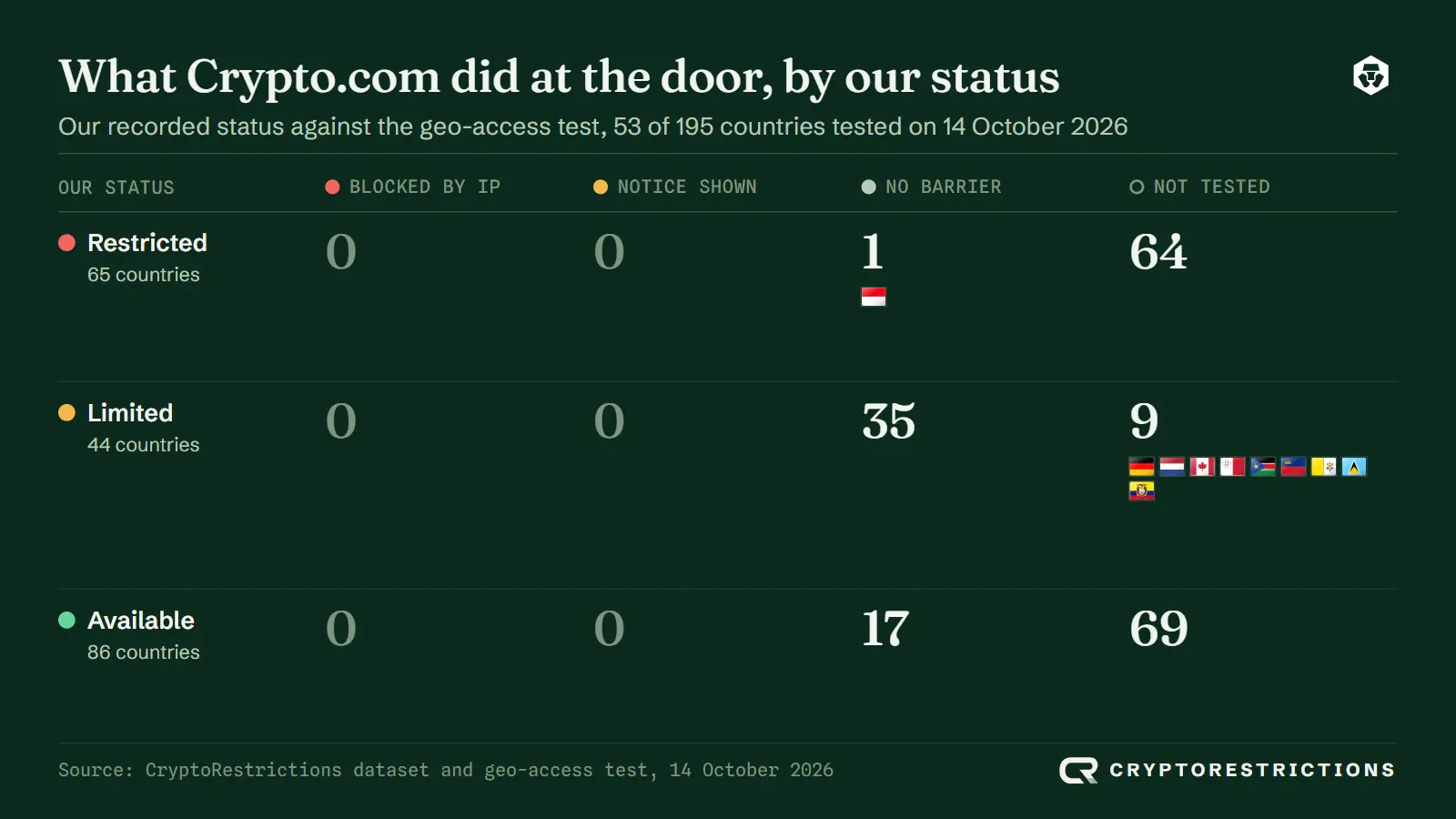
Two patterns stand out. Indonesia, the one restricted country we reached, loaded the international site with no warning, and so did all 35 limited countries we reached; the restriction applies when an account is opened, since onboarding runs only through the App with identity verification. That is the opposite of Binance, whose sign-up page refused visitors by IP in three countries in the same week. And Crypto.com sends many visitors to a local site: the UK, US, Singapore, UAE and Brazilian sites, and a Korean one that says its VASP report was accepted.

Our VPN offers no in-country server in most of Africa, Central Asia and the Pacific, which is where the App list is longest. The full result for every place we tested is below.
All 55 test results, country by country
Crypto.com licences and registrations
Crypto.com holds 17 licences and registrations we list, in 14 jurisdictions, through local companies most of them named Foris; we matched 6 of them on the regulator’s own register.
Crypto.com’s licences page names the jurisdiction and licence type for each. We checked the MiCA licence against ESMA’s register, the UK registration against the FCA register, Singapore against the MAS directory, Dubai against the VARA register and Canada against the Nova Scotia undertaking. The US state licences come from Crypto.com’s US legal page: we list 17 state money transmitter licences under the one US entry, and the South Korea entry is its VASP report in the FSC’s table of registered providers. AUSTRAC’s register requires a login, so Australia rests on Crypto.com’s page.
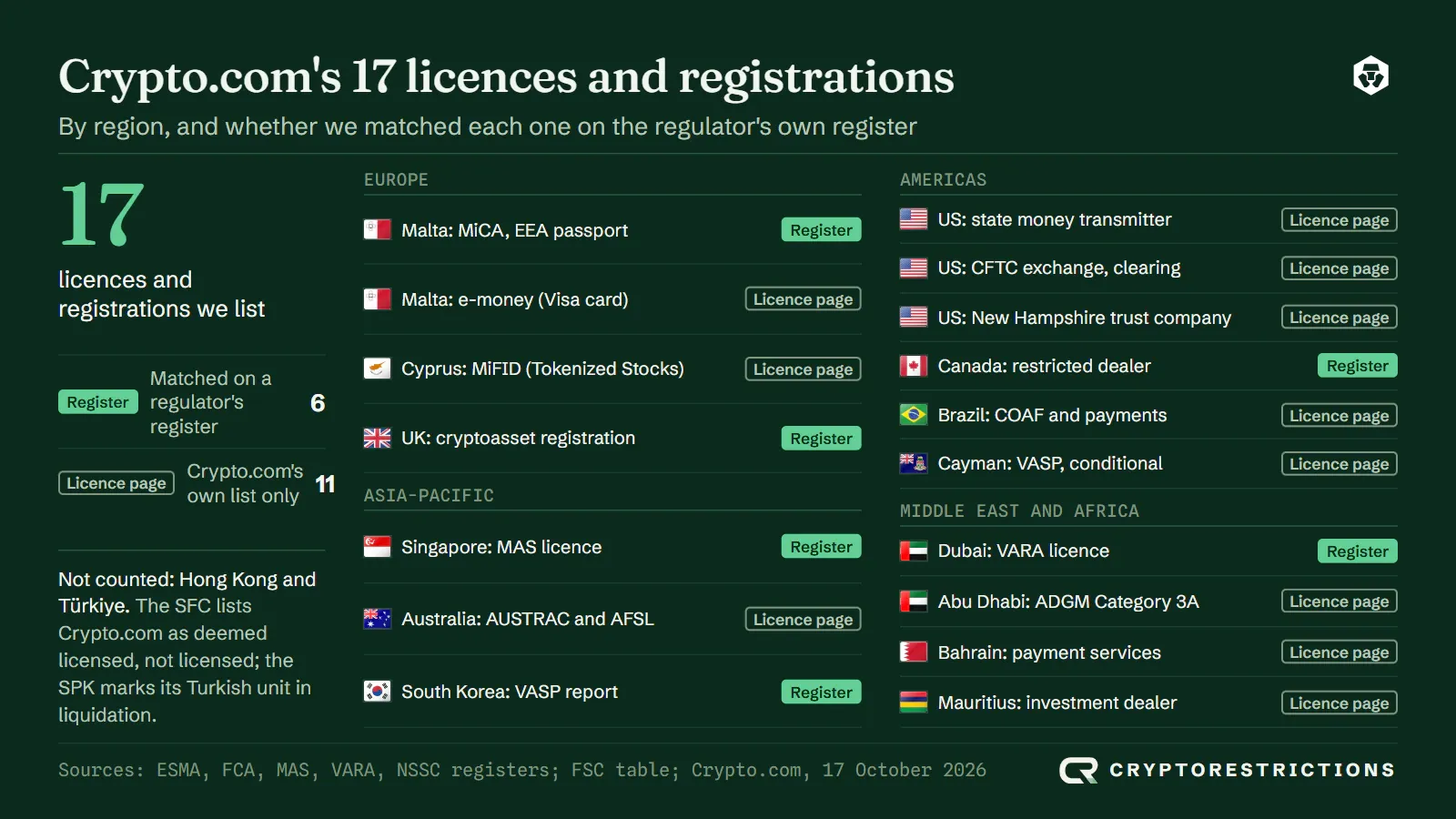
The licences page also lists a deemed licence in Hong Kong, which we do not count, and the SPK’s Turkish list marks Crypto.com’s unit as in liquidation, so that is not counted either: the SFC’s platform lists (16 October 2026) show Foris DAX HK as deemed licensed, not licensed.
Europe
- Malta (passported to the EEA): Foris DAX MT Limited is a MiCA crypto-asset service provider authorised by the Malta Financial Services Authority on 27 January 2025, passported to the other 29 EEA states.
- Malta: Foris MT Limited is an electronic money institution and issues the Crypto.com Visa Card in the EEA.
- Cyprus: Foris Capital CY Limited is a CySEC-licensed MiFID investment firm (licence 344/17) and issues Tokenized Stocks.
- United Kingdom: Foris DAX UK Limited is registered with the FCA for cryptoasset activities (FRN 941745).
Americas
- United States: Foris DAX, Inc. (NMLS 1966158) holds money transmitter licences in most states, DC and Puerto Rico; the Louisiana licence does not cover virtual currency. Crypto.com | Derivatives North America is a CFTC-regulated exchange and clearing house, and Foris DAX Trust Company is a New Hampshire non-depository trust company.
- Canada: Foris DAX CAN ULC is a restricted dealer in every province and territory since 8 May 2025.
- Brazil and the Cayman Islands: a COAF registration and a payment institution licence in Brazil, and a conditional VASP approval in the Caymans.
Asia-Pacific, Middle East and Africa
- Singapore: Foris DAX Asia Pte. Ltd. is a major payment institution licensed for digital payment token services.
- Australia: a digital currency exchange registration with AUSTRAC and a financial services licence.
- United Arab Emirates: Foris DAX Middle East FZE holds a VARA licence (VL/23/10/003) in Dubai covering broker-dealer, lending, management and exchange services including derivatives, and Crypto.com holds a Category 3A licence in Abu Dhabi’s ADGM.
- Bahrain and Mauritius: a payment service provider licence from the Central Bank of Bahrain and an investment dealer licence in Mauritius.
Crypto.com and MiCA in the EU
Crypto.com is authorised under MiCA: Foris DAX MT Limited got its licence from Malta’s MFSA on 27 January 2025, and ESMA’s register shows it passported to all 29 other EEA states.
The licence announcement came within a month of MiCA’s licensing rules applying on 30 December 2024. ESMA’s register lists six services: custody, exchange of crypto for money and for other crypto, executing orders, receiving and transmitting orders, and transfers. Derivatives and margin are not among them, and every EEA state is on Crypto.com’s derivatives list, so despite the licence we record the 29 passport states as limited, with spot trading available and derivatives restricted, and Malta as limited for spot too.
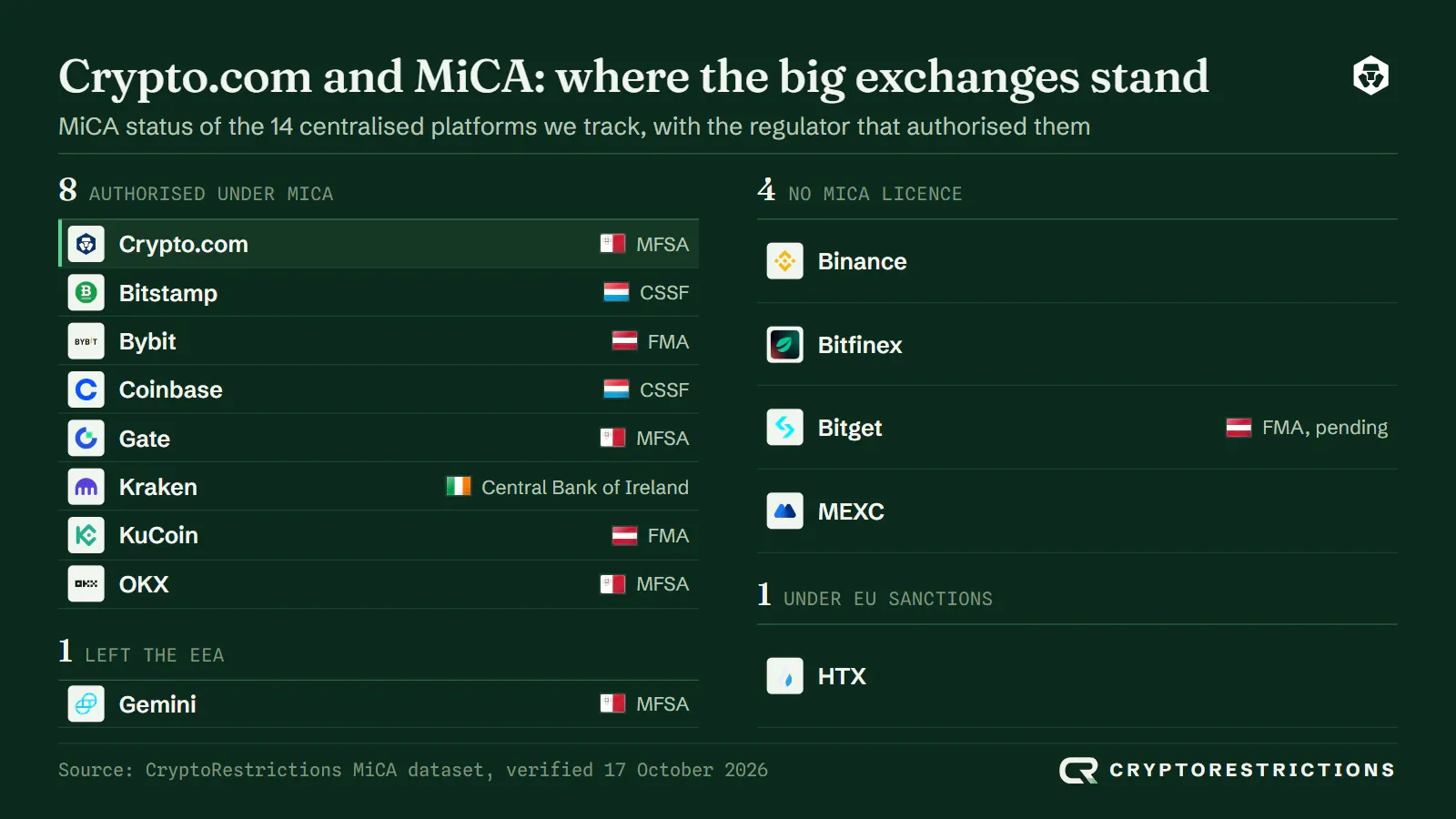
Crypto.com was among the first large exchanges authorised, and Malta is a popular home: OKX also holds its MiCA licence from the MFSA. Before MiCA, Crypto.com’s EU business had a run-in with a national regulator: the Dutch central bank fined Foris DAX MT €2.85 million on 2 October 2023 for serving Dutch clients without registration, a decision Crypto.com said it would appeal.

Crypto.com MiCA timeline
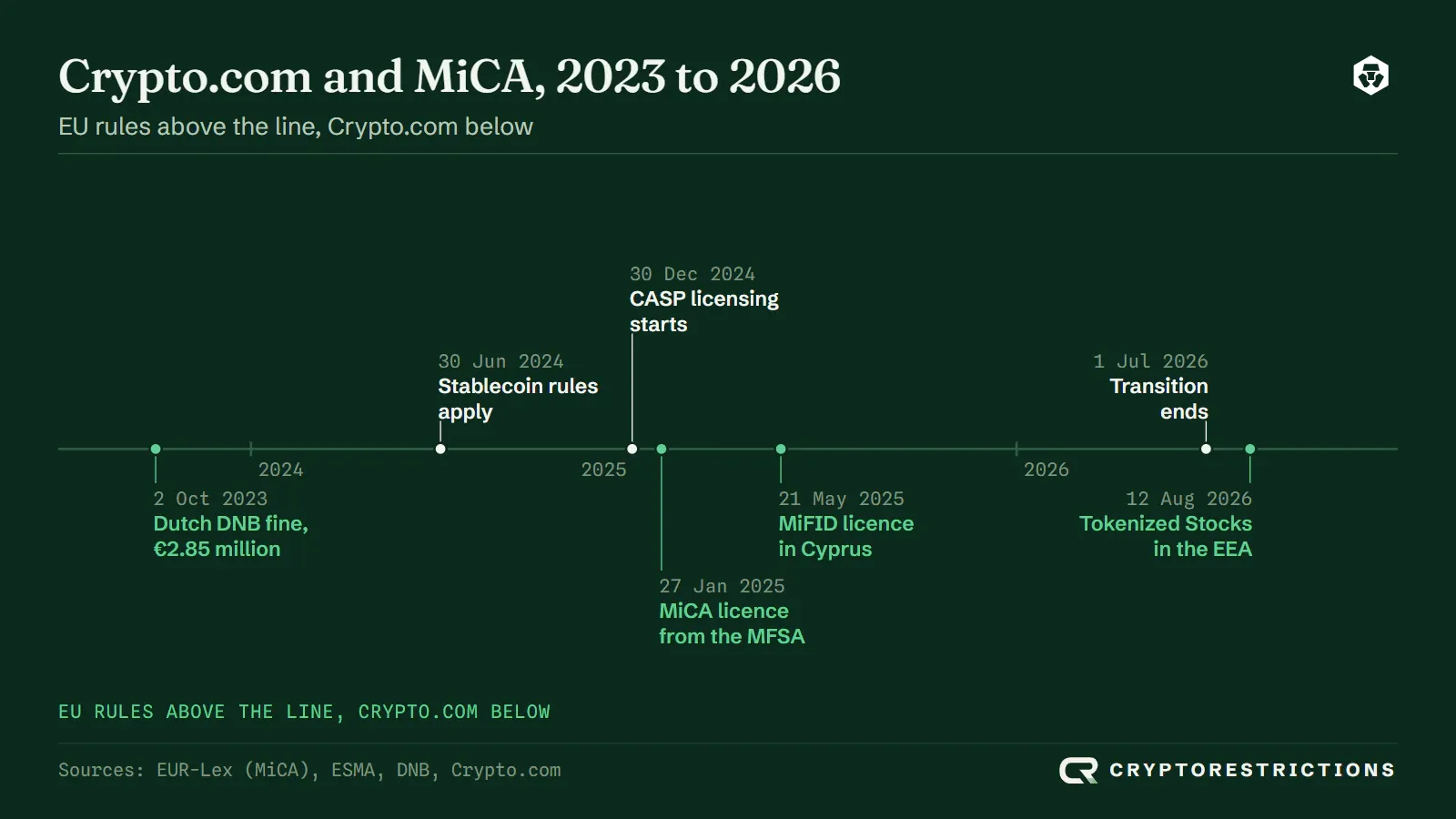
With the MiCA licence in place, Crypto.com has added investment products alongside it rather than derivatives. It bought a Cyprus investment firm for a MiFID licence in May 2025, and on 12 August 2026 launched Tokenized Stocks for eligible EEA users: derivatives that track share prices, issued under that MiFID licence, not crypto derivatives.
Is Crypto.com available in the US?
Yes, except in New York: Crypto.com says its App is available in 49 states, Washington DC and the US territories, while the international Exchange’s derivatives are closed to all US residents.
Crypto.com’s US states page names New York as the one state it does not serve and says it is working toward a licence there; the prepaid card is not offered in the territories. Our test from a US address loaded the American site, with predictions and stocks beside crypto. Event contracts run through a separate company, Crypto.com | Derivatives North America, under CFTC oversight.
Where does Crypto.com work in the US?
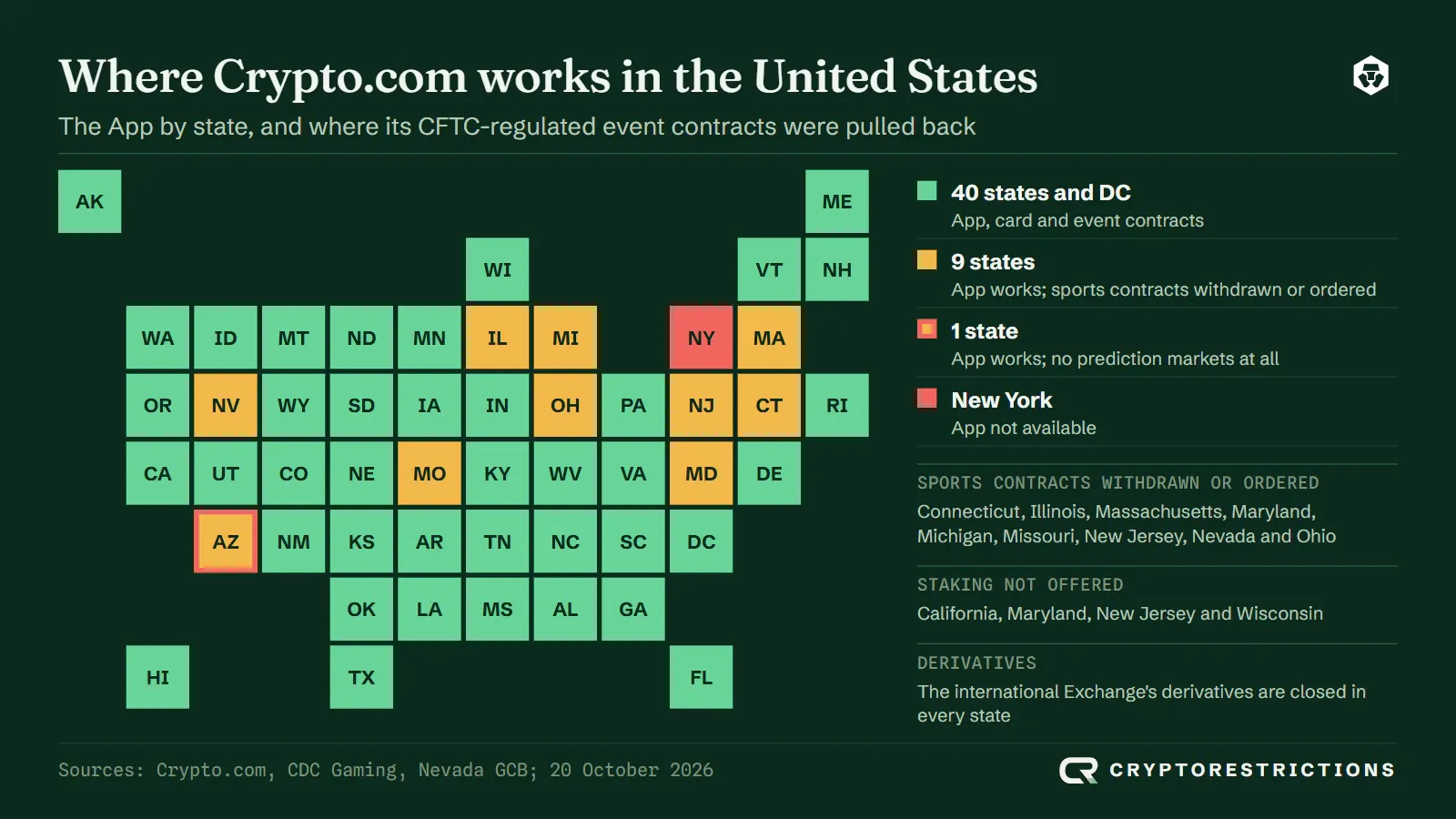
State gaming regulators are the pressure point. By December 2025, CDC Gaming reported, Crypto.com had stopped sports event contracts in eight states and withdrawn every prediction market from Arizona:
- App not available: New York.
- No sports event contracts: Illinois, Maryland, Massachusetts, Michigan, Nevada, New Jersey and Ohio.
- No prediction markets at all: Arizona, since 12 December 2025.
Connecticut also ordered Crypto.com to stop in December 2025; we have not confirmed a withdrawal there. Missouri’s cease-and-desist letter of 18 September 2026 also covers sports contracts, with no court order and no notice that Missouri users are blocked, so we record Connecticut and Missouri as limited like the rest. Staking is not offered in California and Maryland in the App, and Crypto.com Exchange liquid staking excludes New Jersey and Wisconsin.
Crypto.com fines, probes and court cases
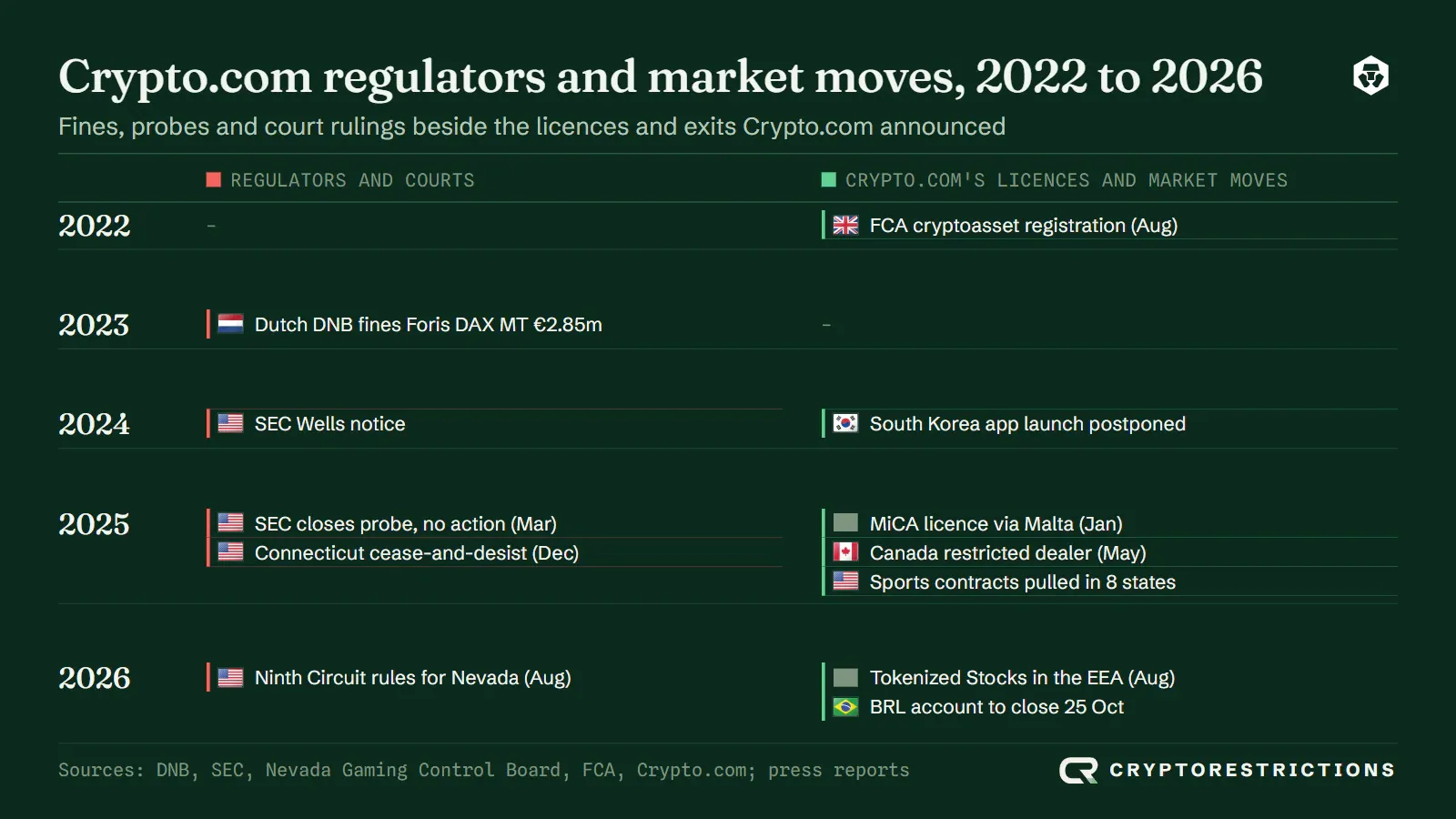
The federal case closed without a penalty. The SEC sent Crypto.com a Wells notice in 2024, and on 27 March 2025 Crypto.com said the SEC had closed its investigation with no action. The state fight over event contracts is still running. On 28 August 2026 the Ninth Circuit ruled 3-0 for Nevada that federal commodities law does not stop the state applying its gaming laws to the sports contracts offered by Crypto.com, Kalshi and Robinhood, the Nevada Gaming Control Board announced.

Crypto.com KYC and identity verification
Crypto.com asks every user for a full legal name, a government ID and a selfie video before the App’s features unlock, and adds steps in the US, the Netherlands, Canada and the UK.
Its KYC guide (updated 14 September 2026) says accounts are opened only through the App. A passport is the best document, with a national ID or driving licence usually enough, but US citizens and residents must use a state-issued licence or ID. The selfie is a short video in which you follow a green dot with your eyes. In the Netherlands you can verify through your bank with iDIN instead of uploading a document.
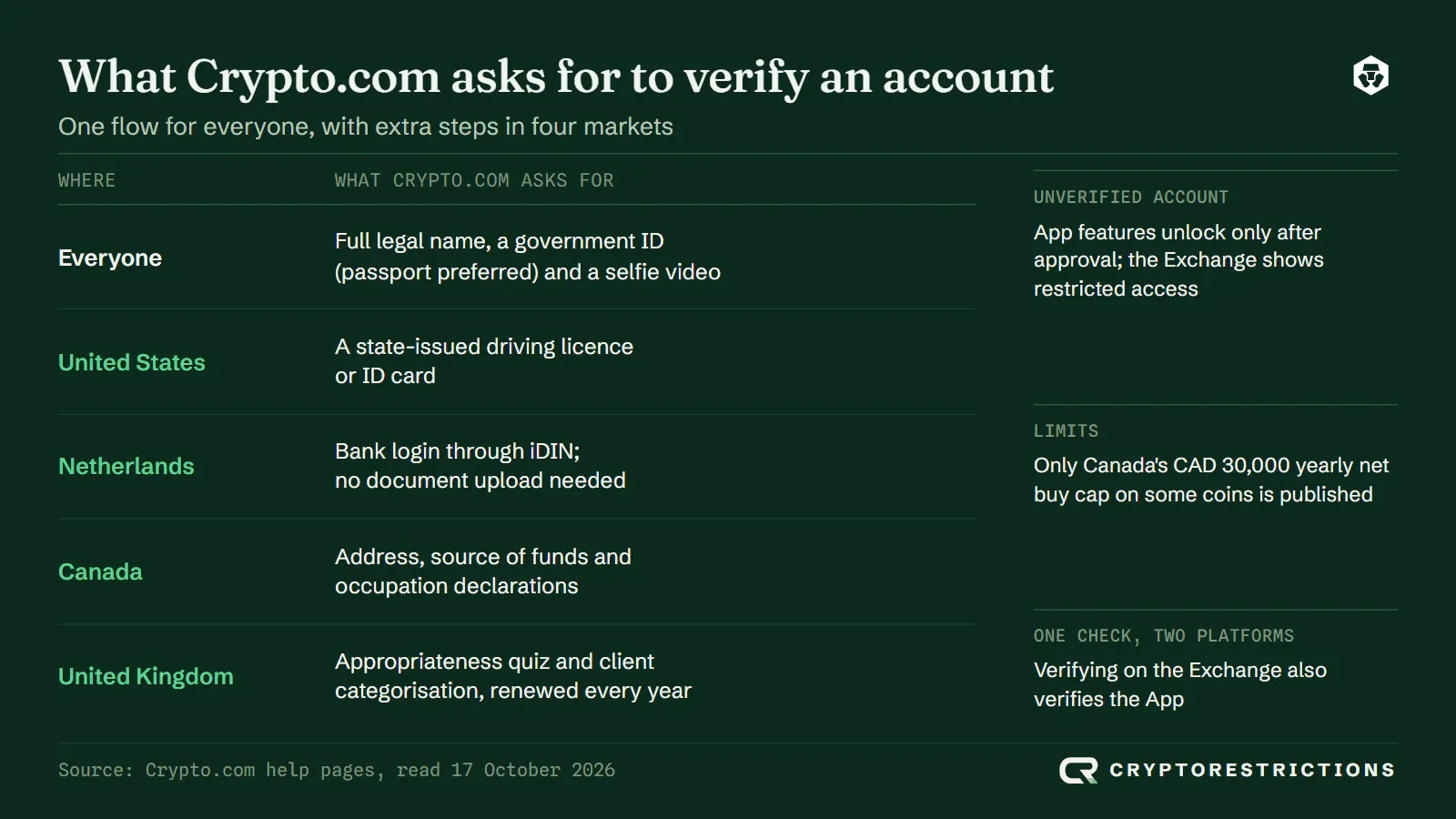
An unverified account does little. The App’s features, from buying crypto to the card, come with approval, and on the Exchange an unverified account shows restricted access until checks are done; verifying there also verifies the App. Canadians must add their address, source of funds and occupation, and in most provinces face a CAD 30,000 yearly net buy limit on some coins under Canadian rules.
Crypto.com verification history
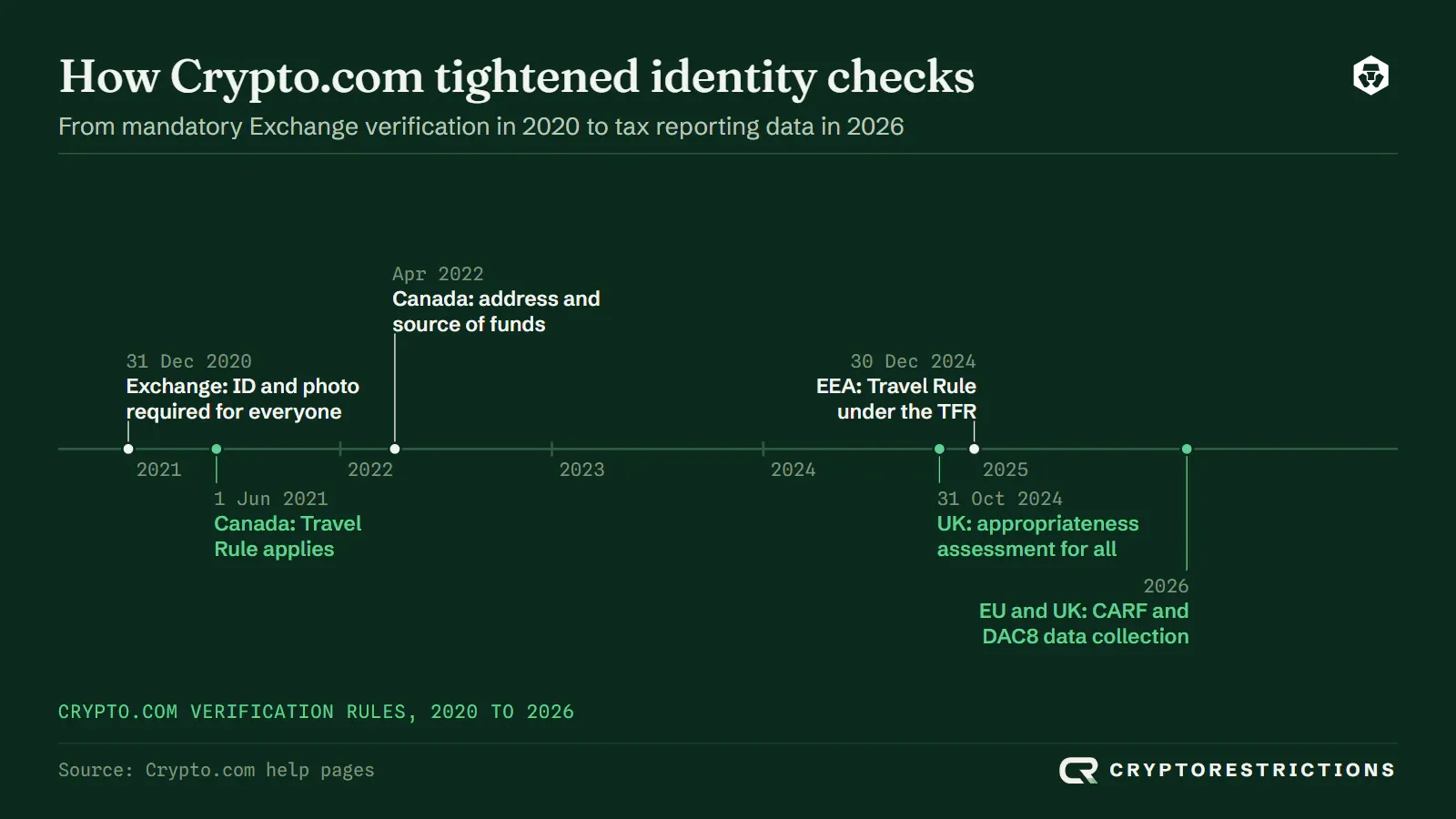
Crypto.com made identity checks mandatory on its Exchange from 31 December 2020, when every user had to submit an ID document and photo. Later steps followed regulation: Canada’s Travel Rule and declarations, the UK’s appropriateness assessment from 31 October 2024, the EU Travel Rule at the end of 2024, and the tax residence and tax number Crypto.com now asks for under CARF and DAC8.
What if Crypto.com is restricted where you live?
It depends on the country: of the 21 other platforms we track, 17 are available in Indonesia, but only 2 in Iran.
Getting around the list is not an option. Crypto.com’s terms bar anyone resident in a listed country and anyone concealing their identity, and every account passes identity verification in the App, where a VPN does not change your documents. What is left is a platform allowed to serve you where you live.
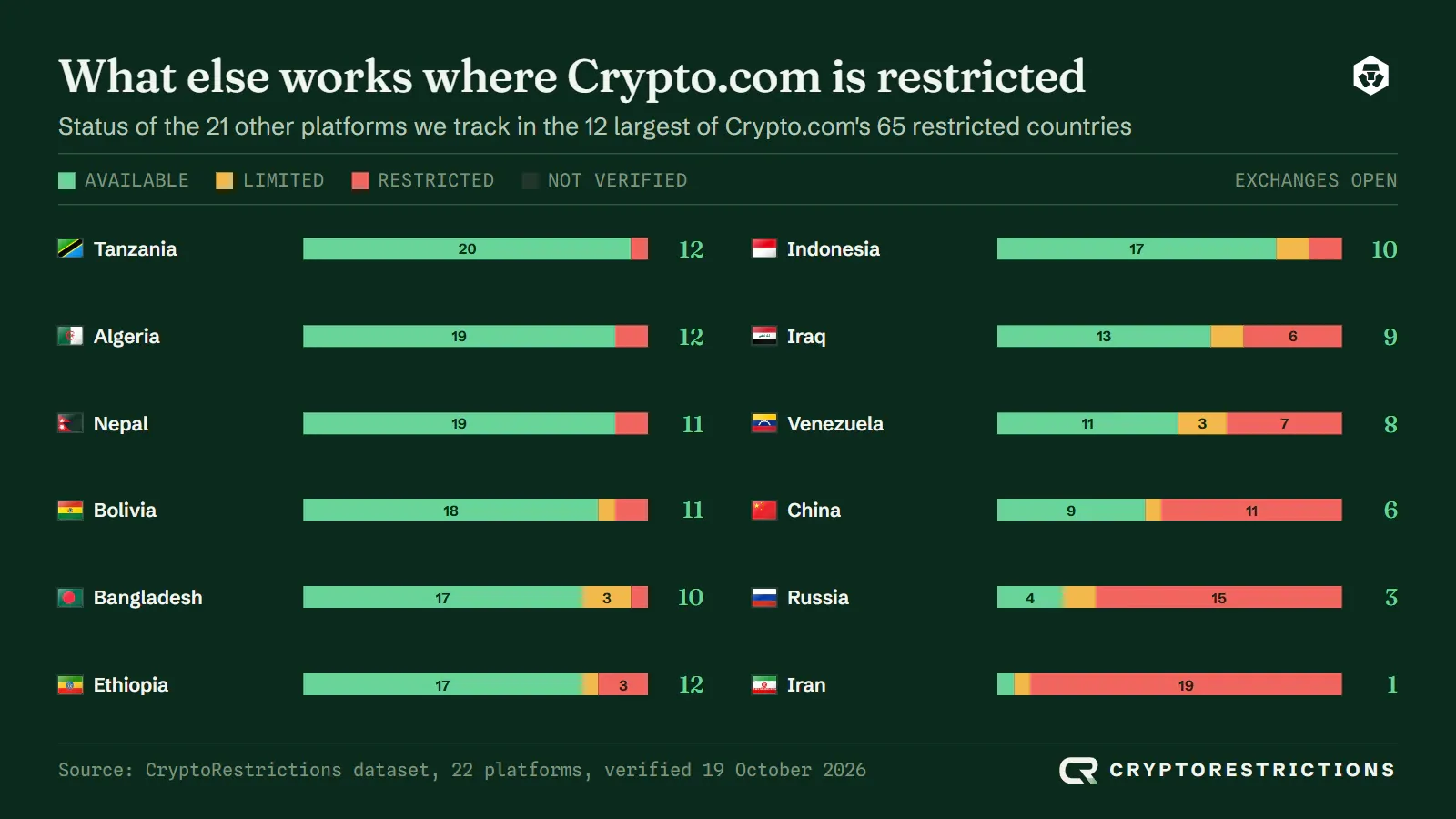
The chart shows the 12 largest of the 65 restricted countries. In Indonesia most tracked platforms are open, several of them exchanges. Across much of Africa and South Asia the choice is similar or wider: 17 to 20 available. In China and Russia only 9 and 4 are recorded as available, and in Iran just 2.
For a country-by-country comparison of exchanges, with residency rules and licences side by side, see our guide to exchange alternatives by country.