Is crypto legal in Japan?
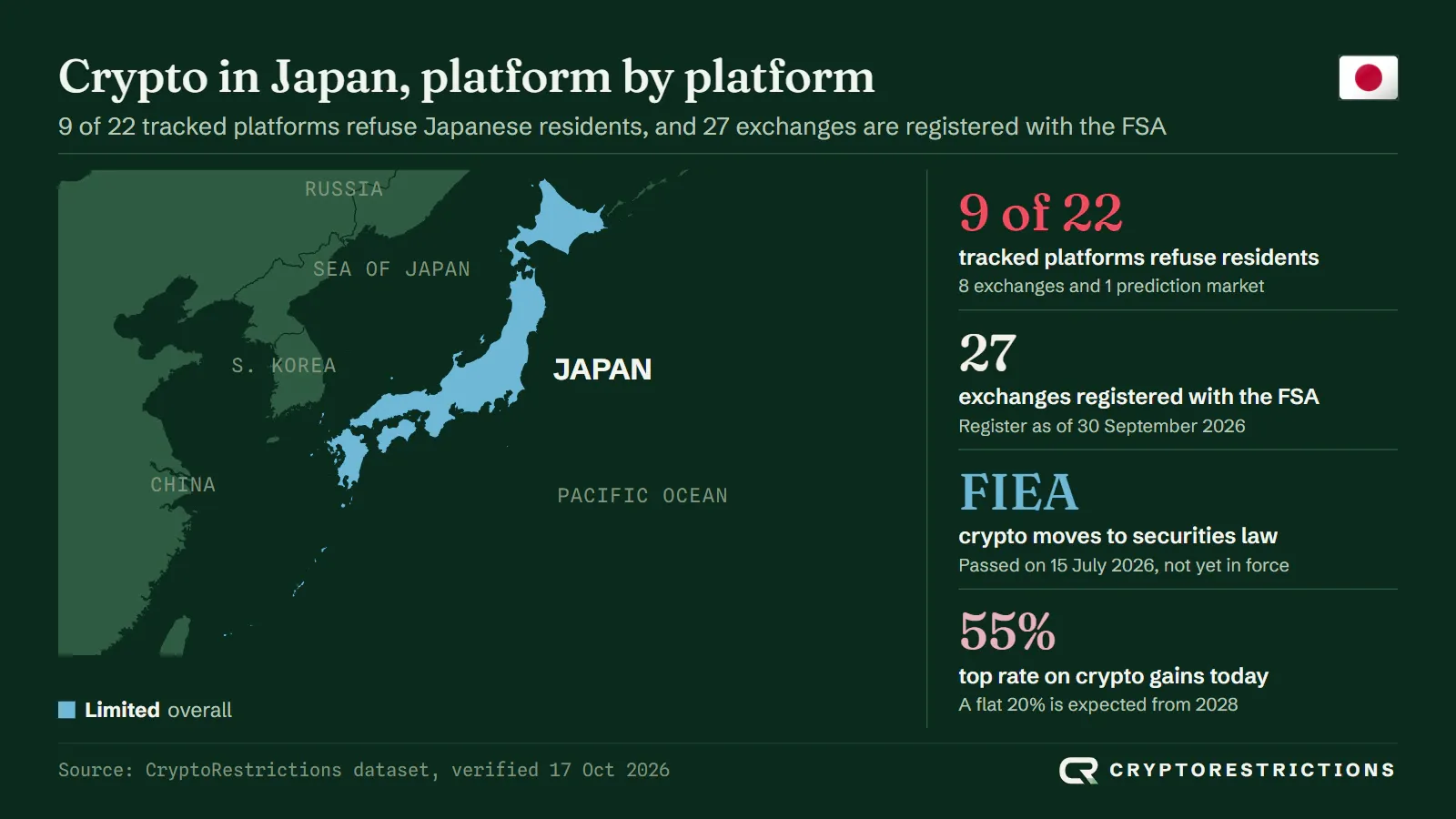
Yes. Nothing we read bans residents from buying, holding or trading crypto, but only a business registered with the Financial Services Agency (FSA) may run an exchange for them, and the rulebook is about to move from payments law to securities law.
The FSA’s register carries the state’s own warnings: crypto-assets are not legal tender, their prices can plummet, and exchange service providers need to be registered with the FSA and a Local Finance Bureau. Until now that registration has come from the Payment Services Act. A bill to move crypto into the Financial Instruments and Exchange Act (FIEA) was submitted to the Diet on 10 April 2026 and enacted on 15 July 2026. The FSA’s page lists the dates but not when it takes effect; the tax accountants’ association says the date is set by Cabinet order within a year of promulgation, which it puts at 23 July 2026. The FIEA route brings insider trading rules and issuer disclosure, and press reports on the bill say the maximum penalty for running an exchange without registration rises to 10 years in prison and ¥10 million. Regulators, products and tax are covered in the sections below.
Which crypto exchanges work in Japan?
Two of the exchanges we track serve Japan through an FSA-registered local company: Binance and Gate. Bitstamp and Crypto.com serve residents with no registration on file, and MEXC and KuCoin do so despite FSA warnings.
The FSA register of 30 September 2026 lists 27 registered providers, 25 supervised by the Kanto Finance Bureau and 2 by the Kinki Finance Bureau (Zaif and Gaia). The newest entry is Laser Digital Japan, registered on 21 August 2026. Domestic names on it include bitFlyer, Coincheck, bitbank, GMO Coin, SBI VC Trade and Rakuten Wallet. None of those is in our platform set, which tracks international platforms.
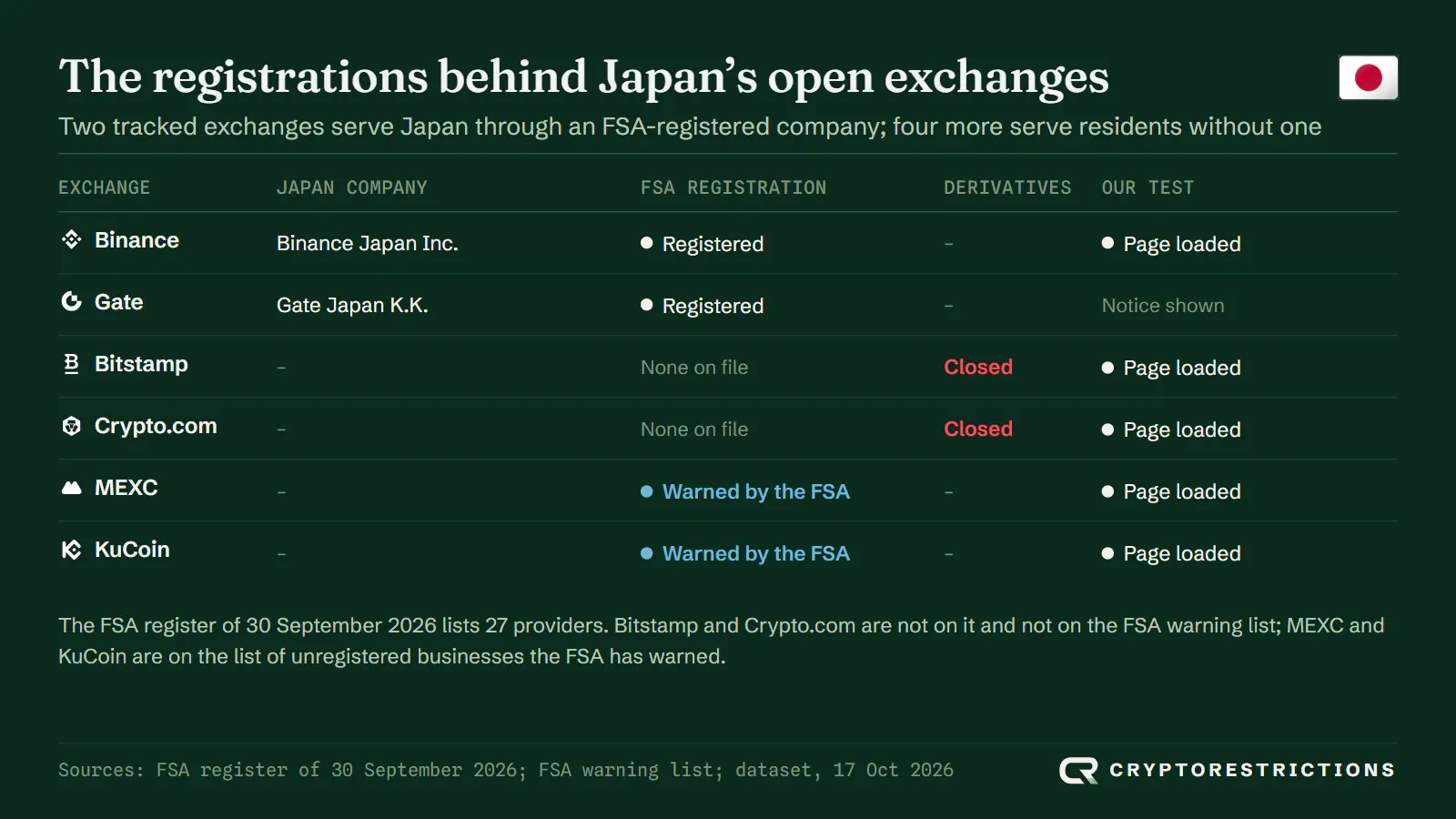
Binance serves Japan as Binance Japan Inc., registered on 14 October 2022 (formerly SAKURA Exchange BitCoin), and moved global accounts to it from August 2023 with a reduced product set. Gate serves Japan through Gate Japan, also on the register; global Gate lists Japan as restricted, so the local company is the only route. Coinbase is a special case: Coinbase Co., Ltd. is still on the register, but the company halted its Japanese business in January 2023 and handles no crypto assets there.

The exchanges below are not registered. The FSA’s warning list names MEXC (March 2023 and November 2024) and KuCoin (November 2024), though Japan is not named among the restricted locations in KuCoin’s terms of use. Bitstamp and Crypto.com are on neither the register nor the warning list, and both close derivatives to Japan. A firm that serves residents without registering sits outside the protections the regime exists to give, so treat an open sign-up page as a risk, not a permission.
Best crypto platforms for Japanese residents
By our access score, Gate (8.5 out of 10) and Binance (7.3) are the most open exchanges for Japanese residents, Jupiter, Lighter, PancakeSwap and Uniswap (8.0 each) are the most open DeFi platforms and Kalshi (8.0) is the only prediction market open to new positions.
The score rates how fully a Japanese resident can use each platform, not its fees or safety. It is computed from our data and moves when a row changes: access status (4 points), the share of the platform’s products open here (3), the Japan licences we hold on file (2) and what our geo-access test saw from a Japanese address (1). Platforms that refuse Japanese residents are not scored. The full method is on our methodology page.
Exchanges

Gate
Best for A registered local company for spot trading
8.5/10- Access
- 4/4
- Products
- 3/3
- Licences
- 1/2
- Our test
- 0.5/1
Read our Gate reportPros
- Gate Japan is on the FSA register of 30 September 2026
Cons
- Global Gate lists Japan as restricted, so only the local company serves residents

Binance
Best for A registered local company with a reduced product set
7.3/10- Access
- 3/4
- Products
- 2.3/3
- Licences
- 1/2
- Our test
- 1/1
Read our Binance reportPros
- Binance Japan Inc. has been FSA-registered since 14 October 2022
- Global accounts were moved to it from August 2023
Cons
- Fewer products than Binance.com offers elsewhere

Crypto.com
Best for Spot trading in the app
6.3/10- Access
- 3.5/4
- Products
- 1.8/3
- Licences
- 0/2
- Our test
- 1/1
Read our Crypto.com reportPros
- Spot trading and the App are offered
- Not on the FSA warning list
Cons
- Japan is on its derivatives geo-restrictions list
- No FSA registration on file

KuCoin
Best for Spot access outside the registered set
6.3/10- Access
- 3/4
- Products
- 2.3/3
- Licences
- 0/2
- Our test
- 1/1
Read our KuCoin reportPros
- Japan is not on its restricted-locations list
Cons
- The FSA warned it in November 2024
- Apple pulled its app in February 2025

MEXC
Best for Spot access outside the registered set
6.3/10- Access
- 3/4
- Products
- 2.3/3
- Licences
- 0/2
- Our test
- 1/1
Read our MEXC reportPros
- Japan is not on its restricted list
Cons
- The FSA warned it in 2023 and 2024
- Its app is not offered in Japan

Bitstamp
Best for Plain spot trading
5.3/10- Access
- 3.5/4
- Products
- 0.8/3
- Licences
- 0/2
- Our test
- 1/1
Read our Bitstamp reportPros
- Spot trading is not excluded for Japan
Cons
- No derivatives, Earn staking or Earn lending in Japan
- No FSA registration on file
Prediction markets

Kalshi
Best for The one prediction market open to new positions
8.0/10- Access
- 4/4
- Products
- 3/3
- Licences
- 0/2
- Our test
- 1/1
Read our Kalshi reportPros
- Japan is not on its restricted-jurisdictions list
Cons
- No Japanese licence, and no regulator statement on prediction markets
DeFi

Jupiter
Best for Solana swaps from your own wallet
8.0/10- Access
- 4/4
- Products
- 3/3
- Licences
- 0/2
- Our test
- 1/1
Read our Jupiter reportPros
- Japan is not named in its terms
Cons
- No Japan licence on file

Lighter
Best for Perpetuals on its main app
8.0/10- Access
- 4/4
- Products
- 3/3
- Licences
- 0/2
- Our test
- 1/1
Read our Lighter reportPros
- Japan is not named in its terms
Cons
- No Japan licence on file

PancakeSwap
Best for BNB Chain swaps and pools
8.0/10- Access
- 4/4
- Products
- 3/3
- Licences
- 0/2
- Our test
- 1/1
Read our PancakeSwap reportPros
- Japan is not excluded by its terms
Cons
- No Japan licence on file

Uniswap
Best for Swapping tokens from your own wallet
8.0/10- Access
- 4/4
- Products
- 3/3
- Licences
- 0/2
- Our test
- 1/1
Read our Uniswap reportPros
- Its terms bar only places under comprehensive US sanctions
Cons
- No Japan licence on file

Aster
Best for Perpetuals and spot trading
5.9/10- Access
- 3/4
- Products
- 1.9/3
- Licences
- 0/2
- Our test
- 1/1
Read our Aster reportPros
- Perpetuals and spot are not barred
Cons
- Prediction trading is barred under its prediction rules

Hyperliquid
Best for Perpetuals from your own wallet
5.9/10- Access
- 3/4
- Products
- 1.9/3
- Licences
- 0/2
- Our test
- 1/1
Read our Hyperliquid reportPros
- Perpetuals and spot are not excluded by its terms
Cons
- The trading app hides outcome markets in Japan
Which platforms block Japan users?
Eight exchanges (Coinbase, Kraken, Bybit, OKX, Gemini, Bitget, HTX and Bitfinex) and one prediction market (Polymarket) refuse Japanese residents in their own terms or notices.
Three of these are exits, not old blocks. Bybit finished closing its services to Japanese residents on 22 July 2026, leaving accounts able only to convert and withdraw. Bitget stopped new Japan registrations on 3 August 2026, applies account restrictions from 1 November and closes remaining positions from 31 December. Coinbase and Kraken both left in January 2023, and Kraken also deregistered with the FSA.


What our geo-access test saw from Japan
From a Japanese address on 14 and 16 October 2026 we loaded all 22 platforms we track: 4 refused us, 3 showed a notice and 15 loaded with no barrier.
An open page is not permission. Kraken, Bitget and HTX loaded although their terms or notices close Japan, because most platforms enforce at identity verification rather than at the page. Bybit refused the sign-up, OKX refused its home page, Gemini’s sign-up said it does not operate in Japan, and Polymarket’s geoblock check returned blocked. The three notices were Coinbase, Gate and Bitfinex. Swipe through the screenshots below; each card quotes what the page showed.
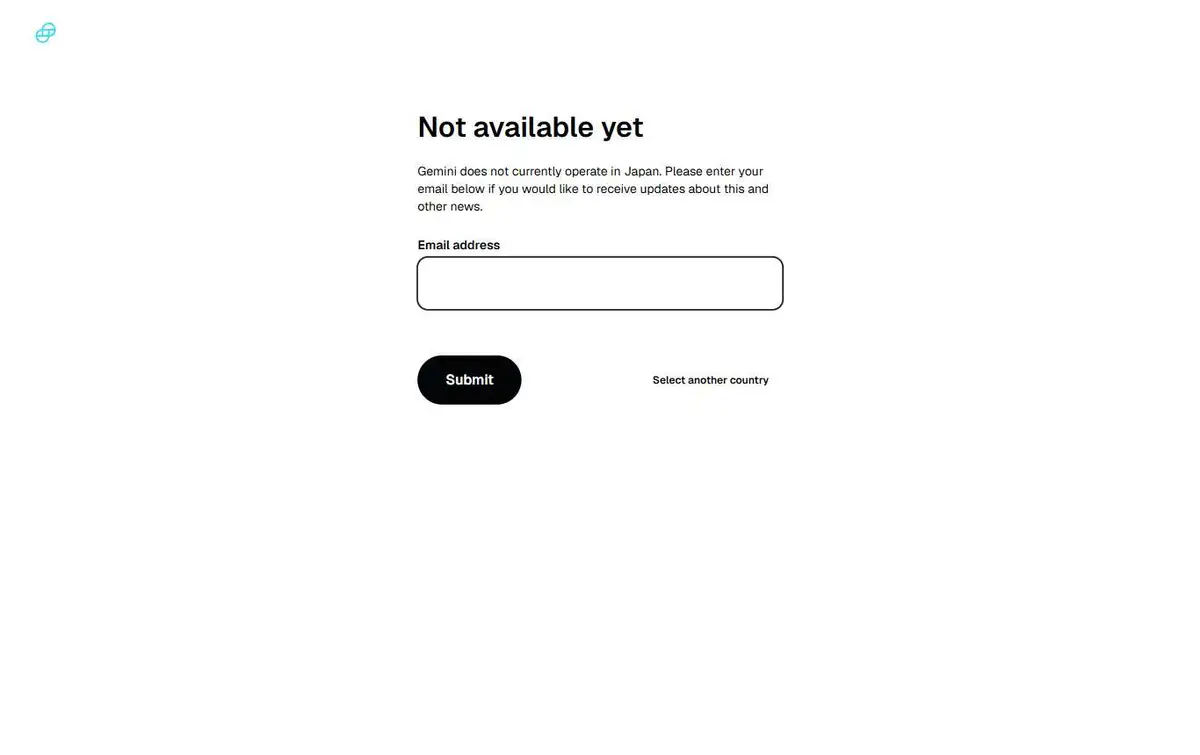
Blocked Gemini · Sign-up page
Japan, never on Gemini's list, refused in the same way
“Gemini does not currently operate in Japan.”
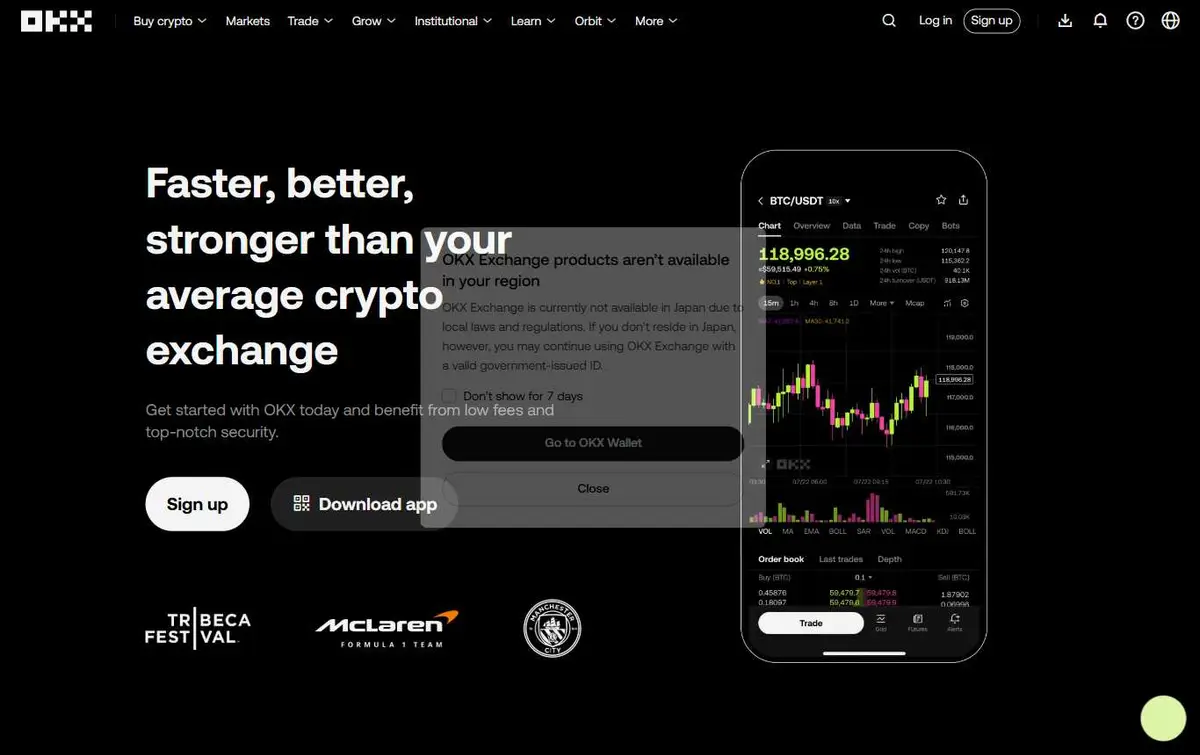
Blocked OKX · Home page
The same block from a Japanese address
“OKX Exchange is currently not available in Japan due to local laws and regulations.”
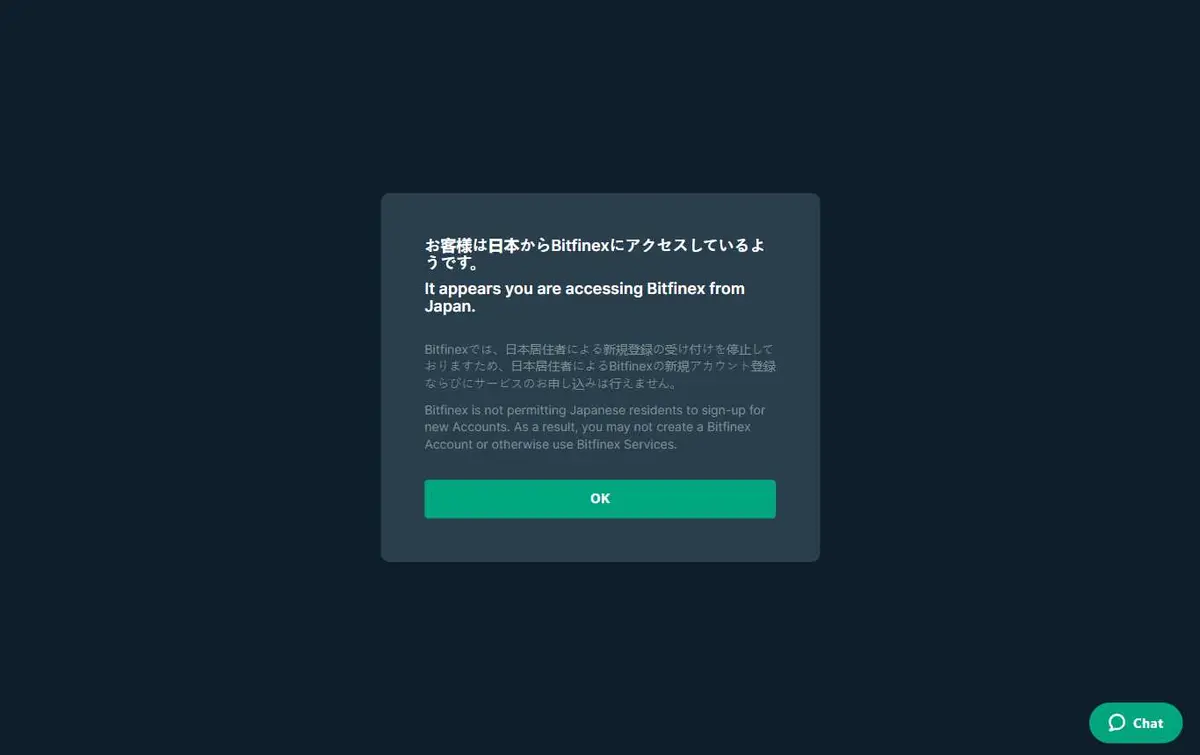
Notice shown Bitfinex · Sign-up page
Japan: a bilingual notice that new registrations are closed
“Bitfinex is not permitting Japanese residents to sign-up for new Accounts.”
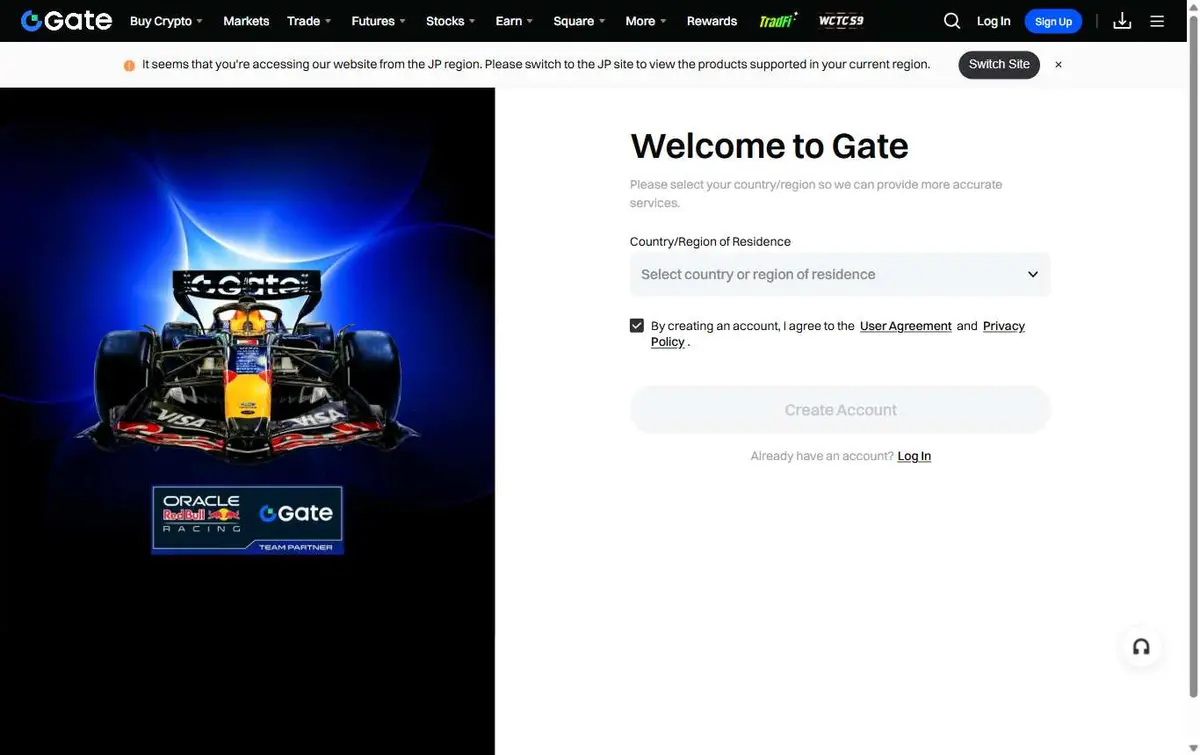
Notice shown Gate · Sign-up page
Japan: a banner pointing to Gate Japan, the registered local exchange
“It seems that you're accessing our website from the JP region.”
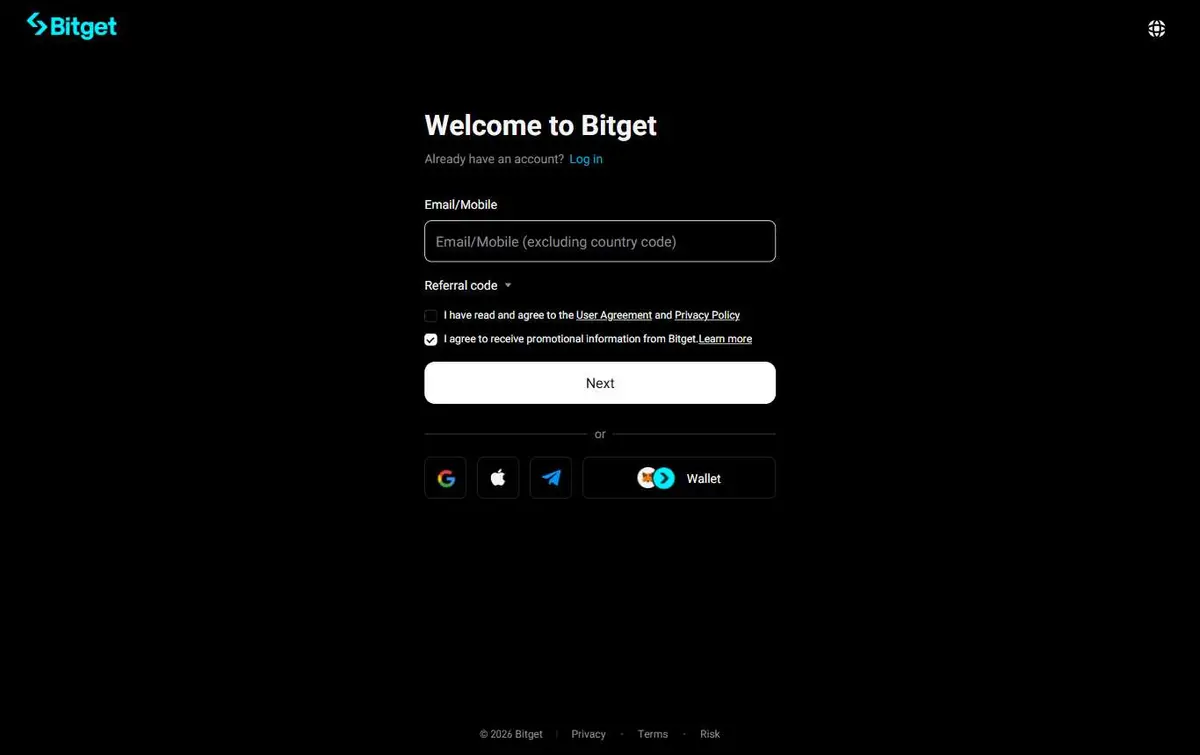
No barrier Bitget · Sign-up page
Japan is prohibited and closing, but the sign-up page loaded with no notice
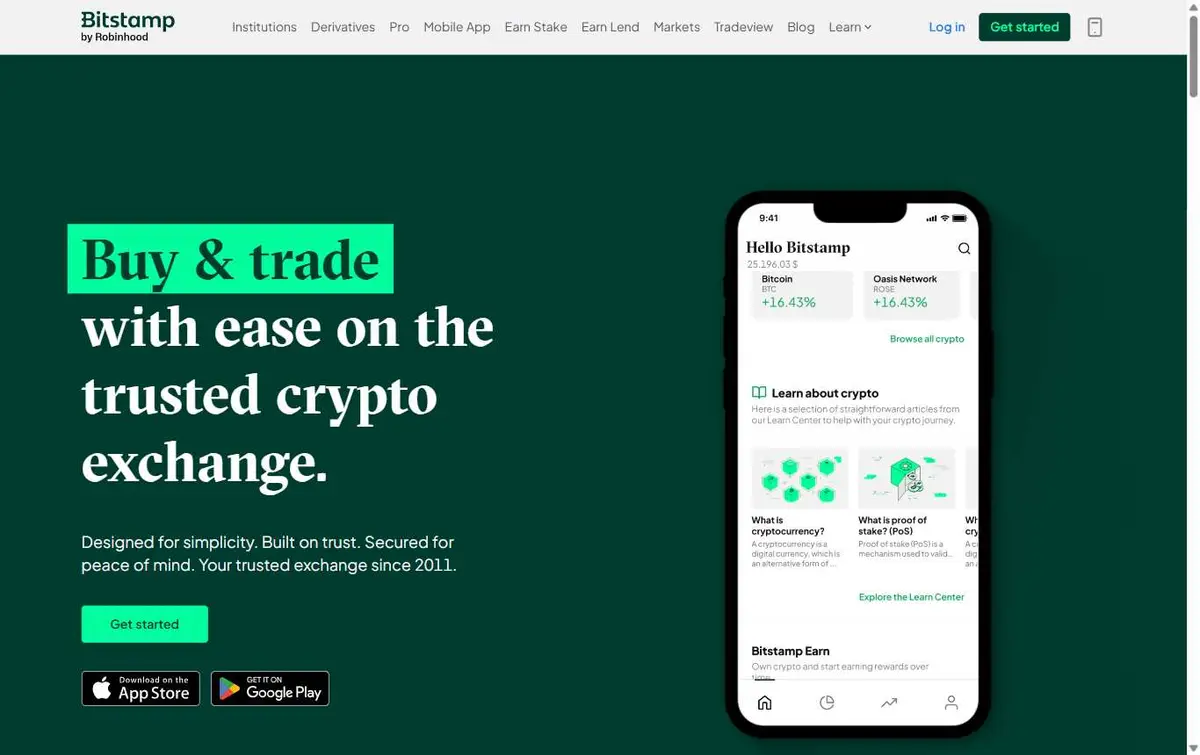
No barrier Bitstamp · Home page
Japan, where futures, staking and lending are cut, sees no product notice
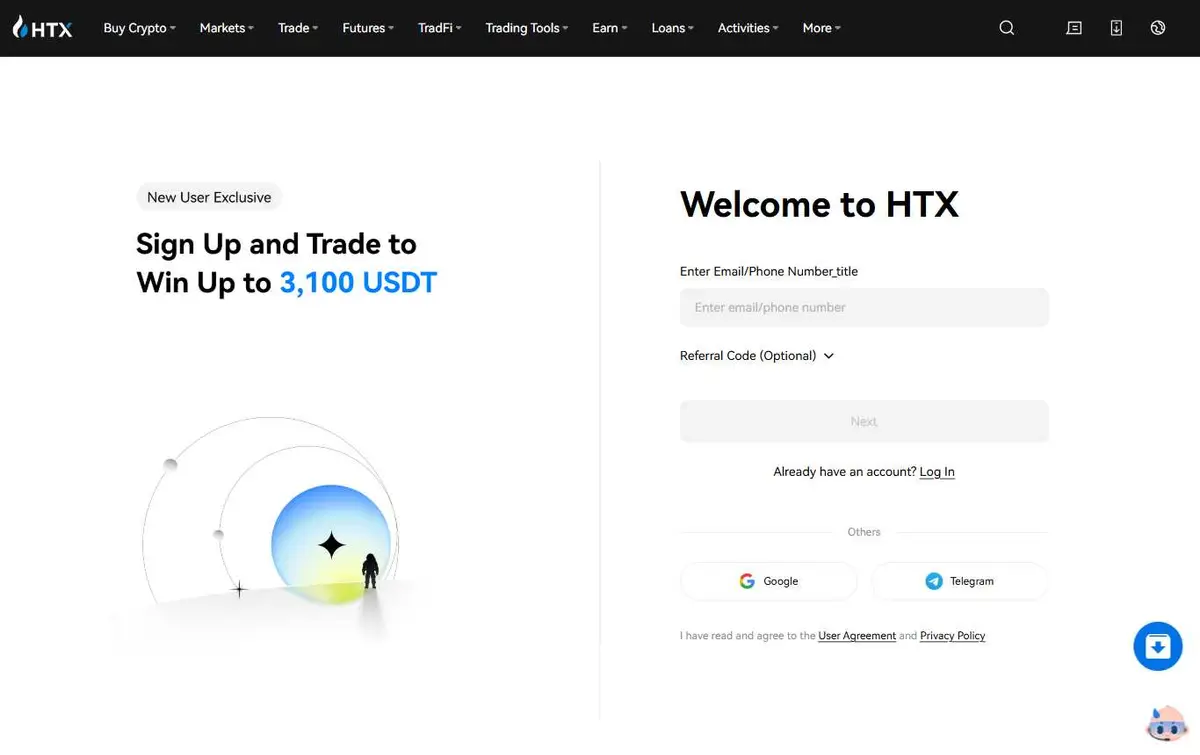
No barrier HTX · Sign-up page
No notice from Japan
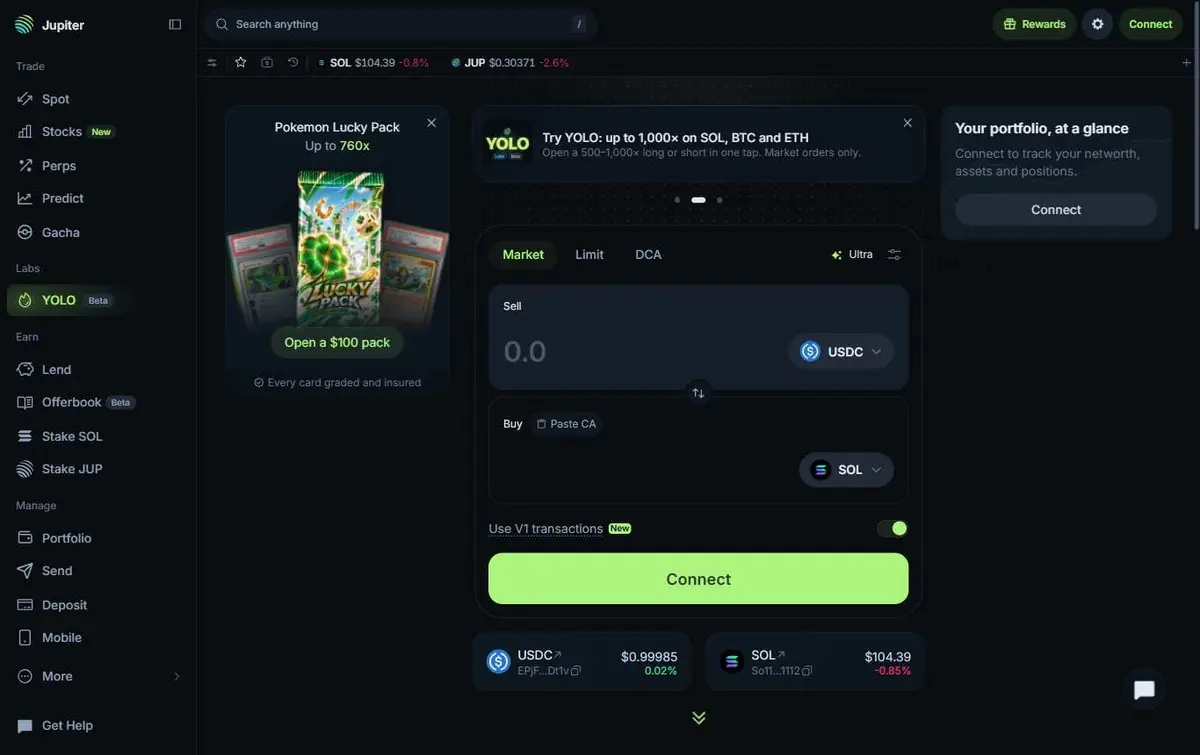
No barrier Jupiter · Trading app
Japan: no banner, no notice
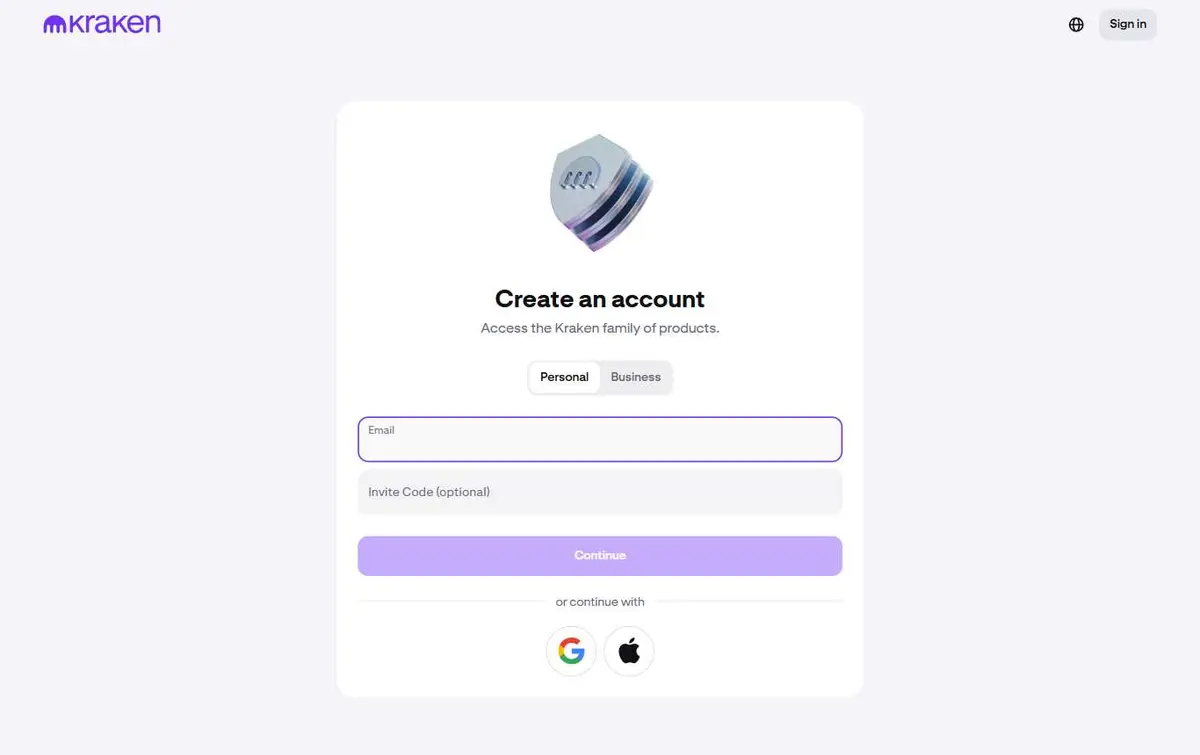
No barrier Kraken · Sign-up page
Japan is on Kraken's do-not-serve list, yet the sign-up form loads
“Create an account”
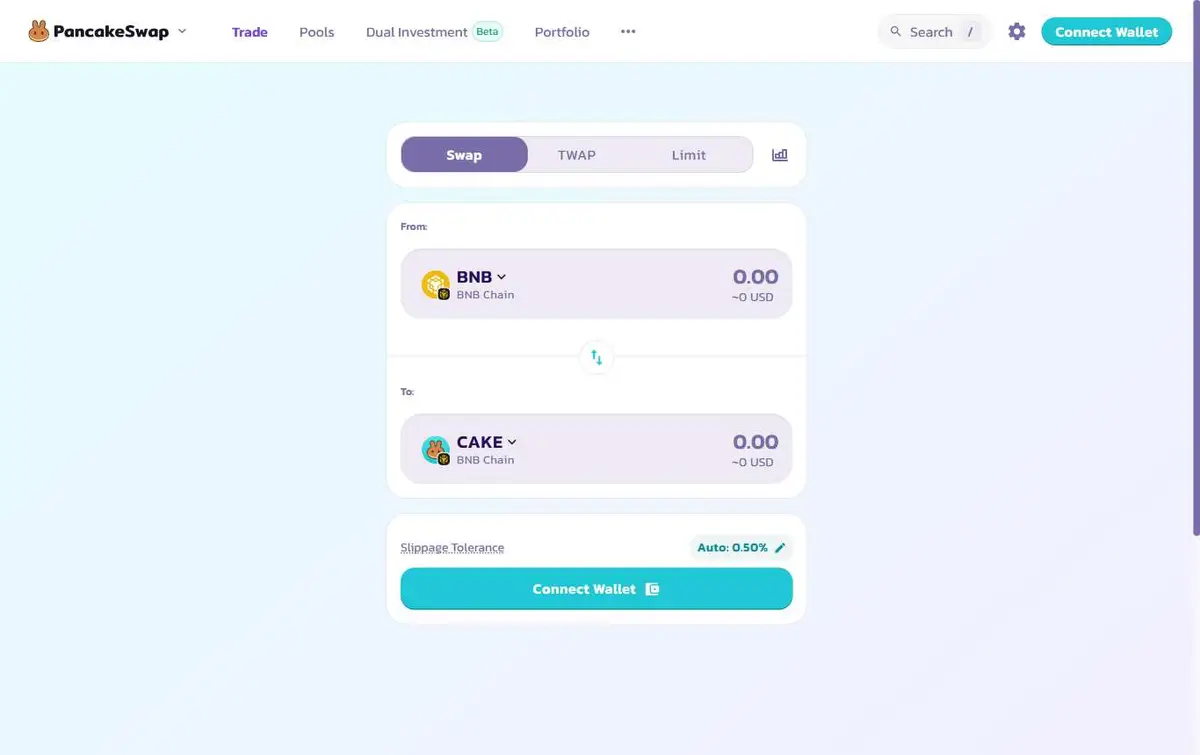
No barrier PancakeSwap · Trading app
Japan: the swap page loads
 CRYPTORESTRICTIONS
Who regulates crypto in Japan?
The FSA registers and supervises crypto businesses and writes the rules, the Japan Virtual and Crypto assets Exchange Association (JVCEA) is the industry’s self-regulatory body, and the National Tax Agency (NTA) and Ministry of Finance (MOF) set how crypto is taxed and reported.
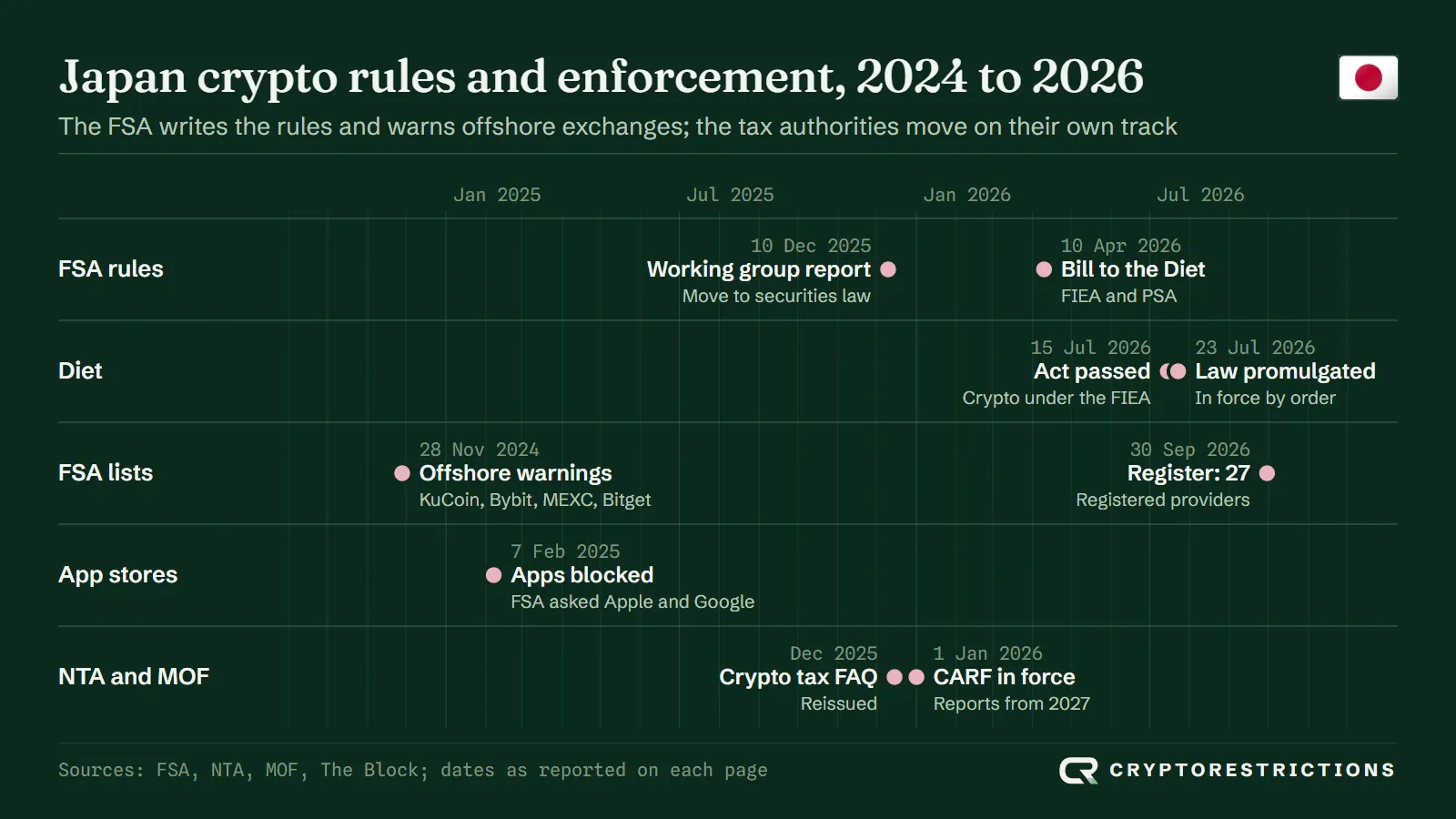
- FSA. Registers exchange service providers, through the Kanto and Kinki Finance Bureaus, and publishes the list of unregistered businesses it has warned. Its Working Group on Crypto-asset Systems published its report on 10 December 2025, proposing the move to the securities law, and the bill followed in April 2026.
- JVCEA. Describes itself as the self-regulatory body for crypto-asset exchange, electronic payment instrument, fund transfer and crypto-asset derivatives businesses. Its site publishes rulebooks and guidelines, handles disputes and announces newly handled and discontinued tokens. It lists business, business-preparation and supporting members, but no member total on the pages we read.
- Enforcement on offshore firms. The FSA’s list shows warnings in March 2023 to Bitget, MEXC and Bybit and in November 2024 to KuCoin, Bybit, MEXC and Bitget, among others. On 7 February 2025 The Block reported that the FSA asked Apple and Google to block five of these exchanges’ apps and that Apple had removed them. On 26 March 2026 Cointelegraph reported a further FSA warning to KuCoin for soliciting over-the-counter derivatives without FIEA registration.
- FIEA. The 2026 Act moves crypto to the securities law. Its effective date is set by Cabinet order and was not stated on the FSA page.
- NTA and MOF. Covered in the tax section.
Which crypto products are limited in Japan?
Derivatives are the most closed product: Bitstamp and Crypto.com both close them to Japan, and the FSA has warned KuCoin for offering them without registration.
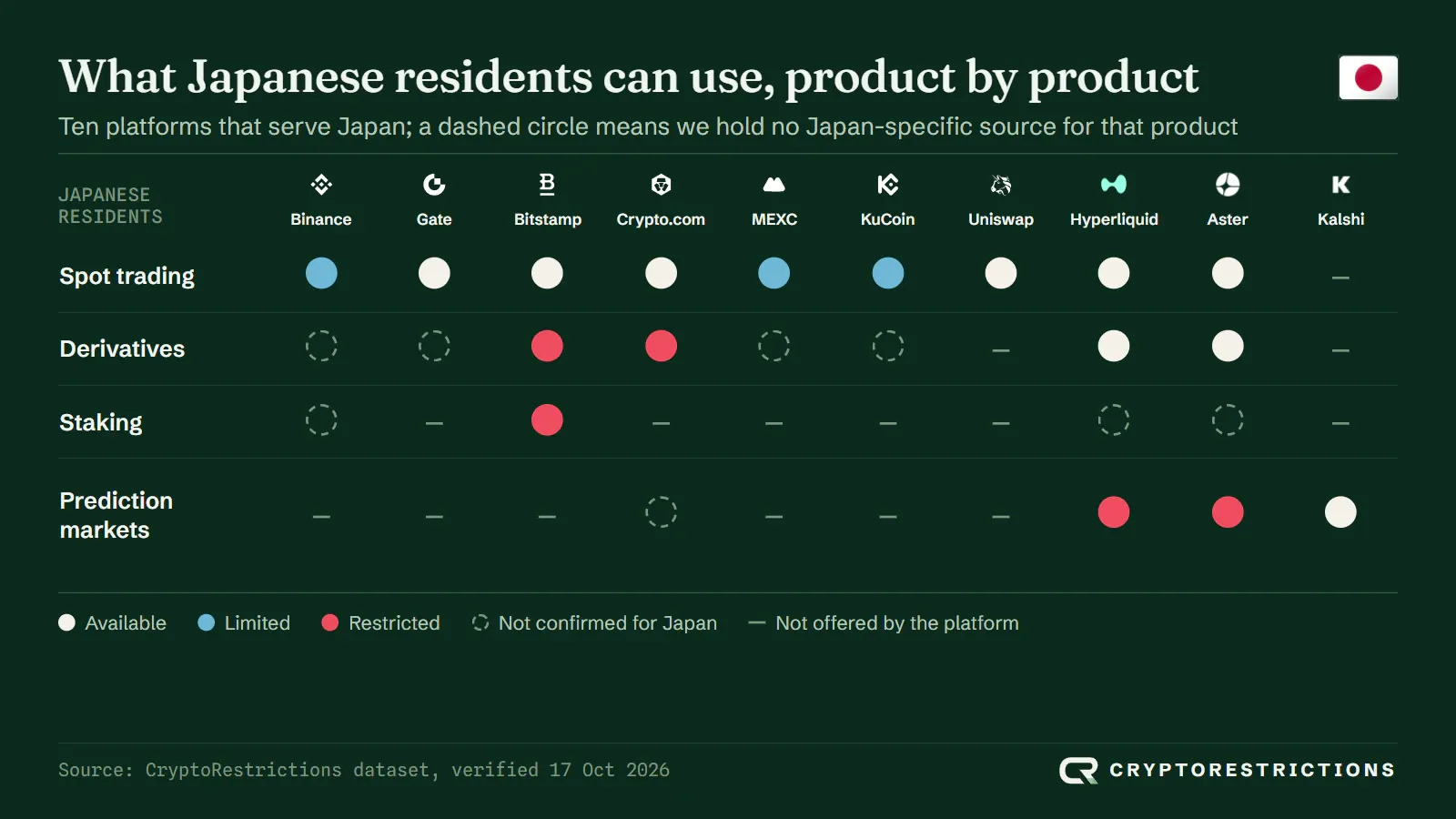
- Spot trading. Offered at every platform that serves Japan. Binance Japan offers a reduced product set against Binance.com.
- Derivatives. Bitstamp says derivatives trading is not available to customers in Japan, and Crypto.com lists Japan among its derivatives geo-restrictions. Hyperliquid and Aster load perpetuals in our test and do not exclude Japan in their terms. JVCEA names crypto-asset derivatives businesses among those it oversees, so a firm that offers them to residents falls under the FSA’s rules.
- Staking and lending. Bitstamp does not offer Earn staking or Earn lending in Japan. For other platforms we hold no Japan-specific source.
- Prediction markets. Covered in the next section.
Are prediction markets legal in Japan?
No licensed route exists that we found. Japan’s Penal Code treats gambling as an offence, we found no FSA or police statement on prediction markets, Polymarket is close-only for Japan and Kalshi is the one platform that does not list it.
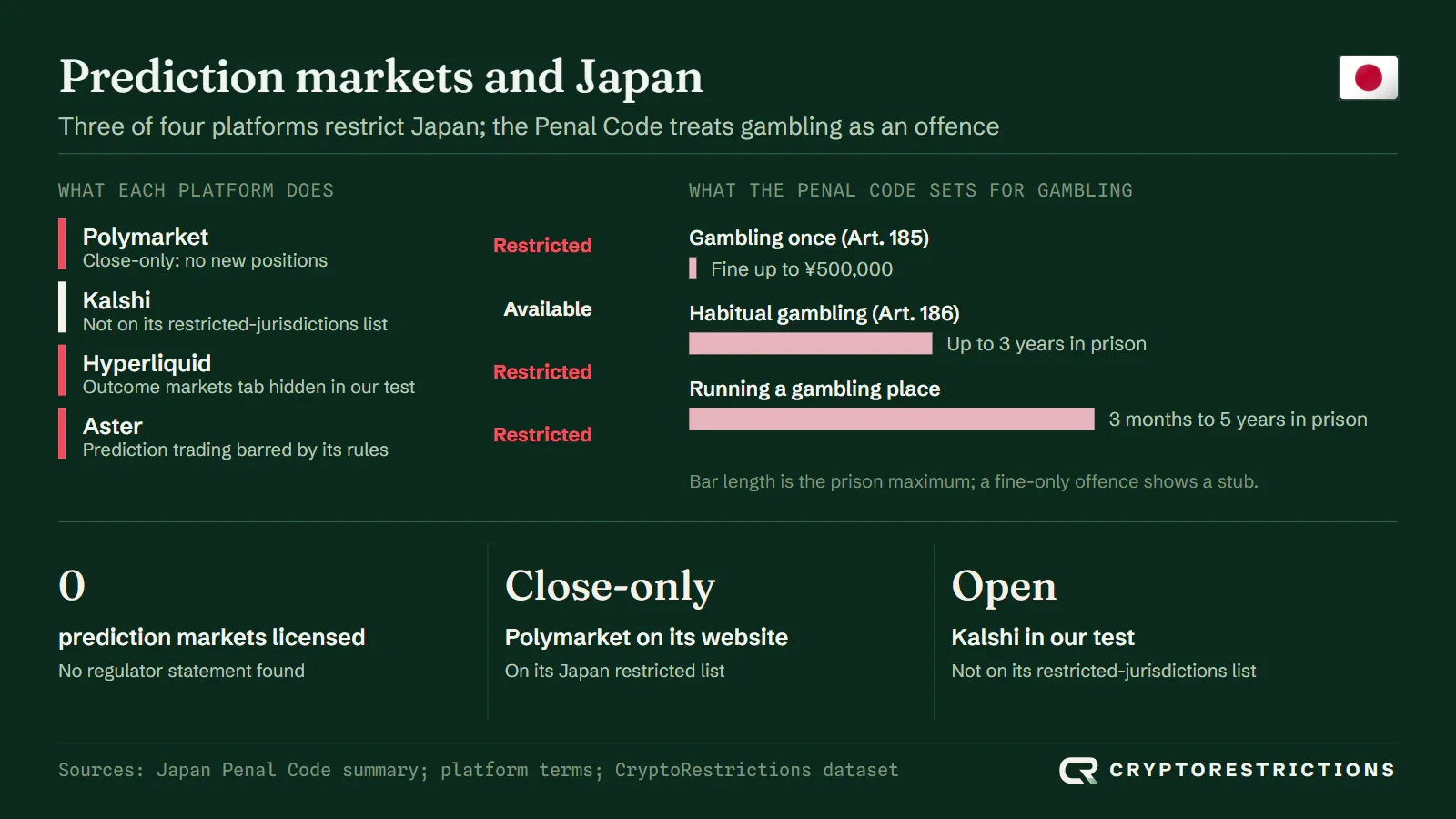
A law firm summary of the Penal Code puts the penalty for gambling once under Article 185 at a fine of up to ¥500,000, habitual gambling under Article 186 at up to 3 years in prison and running a gambling place at 3 months to 5 years, with public lotteries and authorised racing excepted. We could not read the statute itself, and we found no court ruling or agency statement that classes event contracts as gambling or as financial products, so their status is unsettled rather than settled either way.
On the platform side, Polymarket lists Japan as close-only: existing positions can be closed but no new ones opened. Kalshi does not list Japan among its restricted jurisdictions and its site loaded in our test, but that is a platform’s choice, not a licence. Hyperliquid hid its outcome markets tab in our test and Aster bars prediction trading under its prediction rules.

How is crypto taxed in Japan?
Crypto gains are miscellaneous income added to your other income and taxed at progressive national rates from 5% to 45%, plus local taxes. A flat rate of about 20% is planned, reported to start on 1 January 2028.
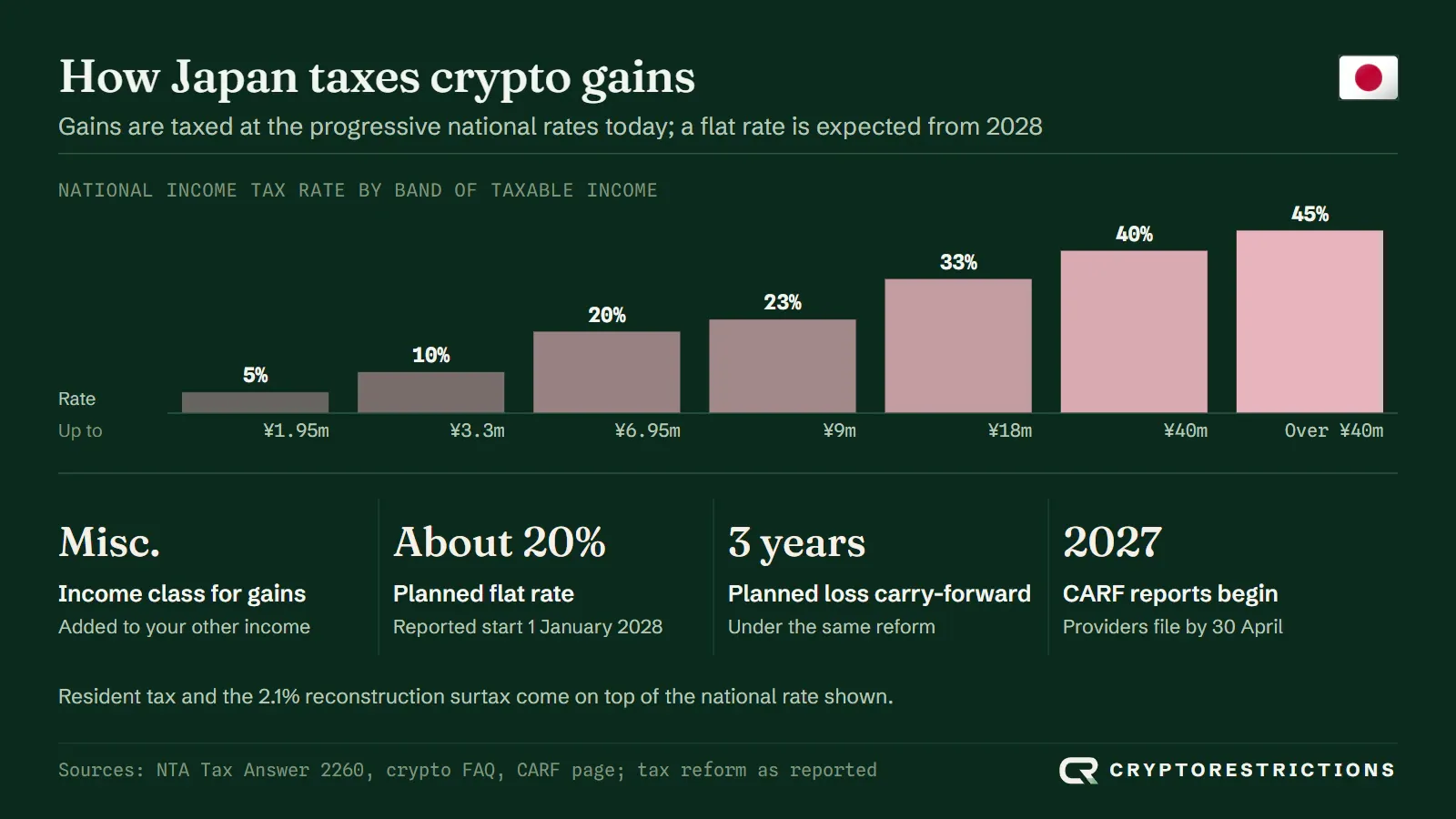
The bands are the national rates on the NTA rates page (law as of 1 April 2026), and a 2.1% reconstruction surtax on the tax calculated comes on top. The NTA’s crypto FAQ, reissued in December 2025, comes with calculation sheets for the two accepted cost methods, the moving average and the total average. Under the rules in the FAQ a swap of one crypto for another counts as a sale and a purchase, so it is taxed, and a loss on crypto cannot be set against other income. The tax accountants’ association puts the top combined rate today at about 55.9%.
The reform is not in force yet. The association’s summary of the FY2026 tax reform says gains on specified crypto assets will move to a separate taxation at a flat 20.315% (15% income tax and 5% resident tax, plus the surtax on the income tax part), with losses carried forward for 3 years if you keep filing. It applies to trades from 1 January of the year after the FIEA amendment takes effect, which it expects to be 2028. Only specified assets handled by registered operators qualify, so trades on minor overseas exchanges or directly on decentralised exchanges stay under the progressive rates. We read this from the association’s summary, not the outline itself, so check it against the final cabinet orders. Reporting is also changing: the NTA’s CARF page shows the OECD Crypto-Asset Reporting Framework in effect from 1 January 2026, with providers reporting by 30 April from 2027. Working out your own position takes four steps:


 Bahrain
 Georgia
 Qatar
 Israel
 Saudi Arabia
 Vietnam
 Pakistan
 Bangladesh
 Indonesia
 United Arab Emirates
 South Korea