

Is crypto legal in Bahrain?
Yes, if the firm behind it holds a licence from the Central Bank of Bahrain. The central bank’s Crypto-asset Module bars anyone from offering regulated crypto-asset services from Bahrain without one, and we found no rule that makes holding crypto an offence for an individual.
The Crypto-asset (CRA) Module sits in Volume 6 of the central bank’s Rulebook and was first issued in February 2019. Its rule CRA-1.1.1 says no person may market or undertake regulated crypto-asset services by way of business, within or from the Kingdom, without a licence. It also treats a company that tries to register with a name like “crypto exchange” without one as in breach. The module cites Article 38 of the central bank law (Decree 64 of 2006) as its legal basis.
The rule binds firms, not their customers. The text we read is the 2022 edition of the PDF on the central bank’s site, so later amendments are not reflected, and we could not open the central bank’s licence register.
Which crypto exchanges work in Bahrain?
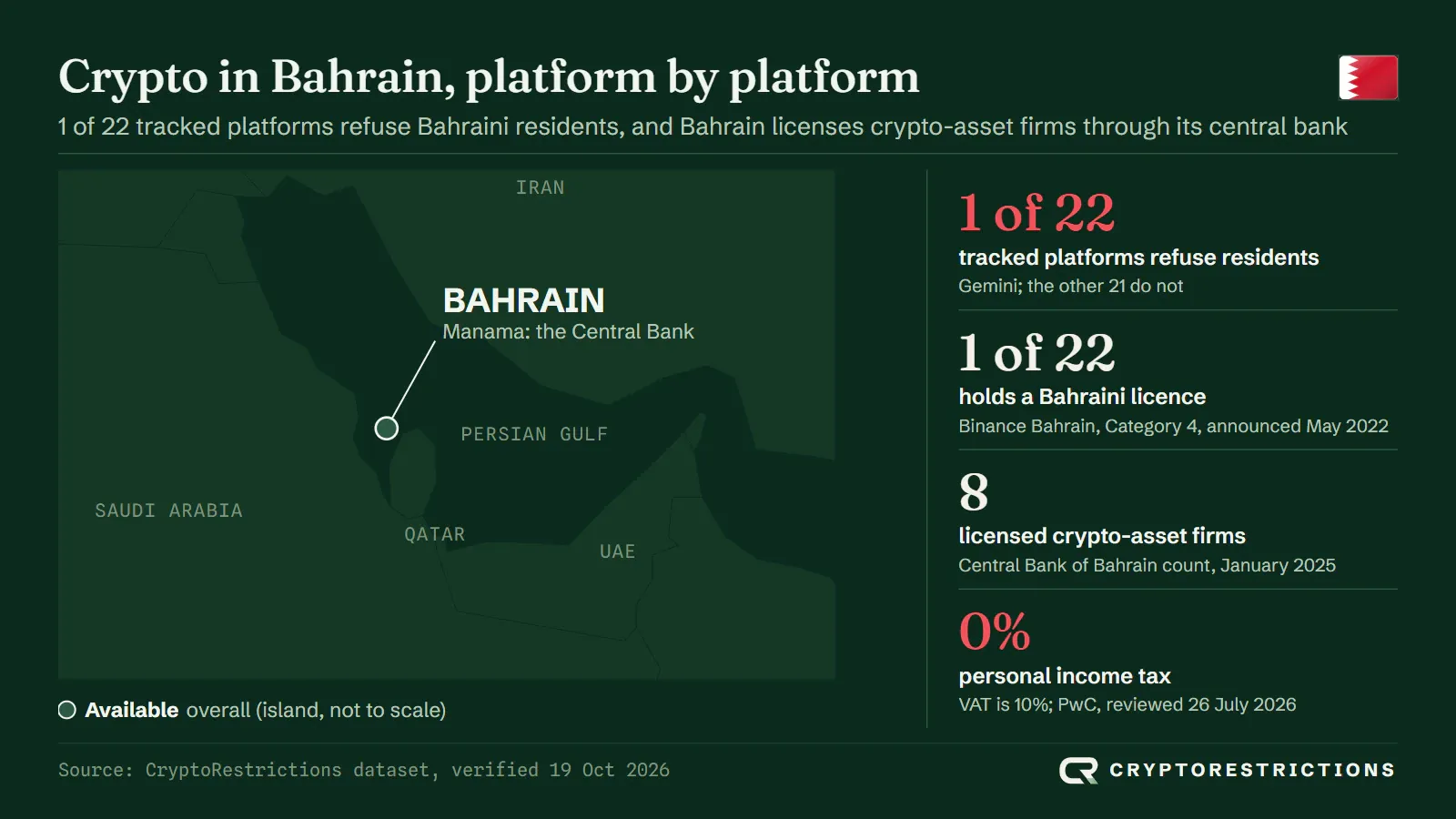
One platform we track holds a Bahraini licence, Binance. Most of the other platforms do not refuse Bahraini residents, which is their own policy and not a licence.
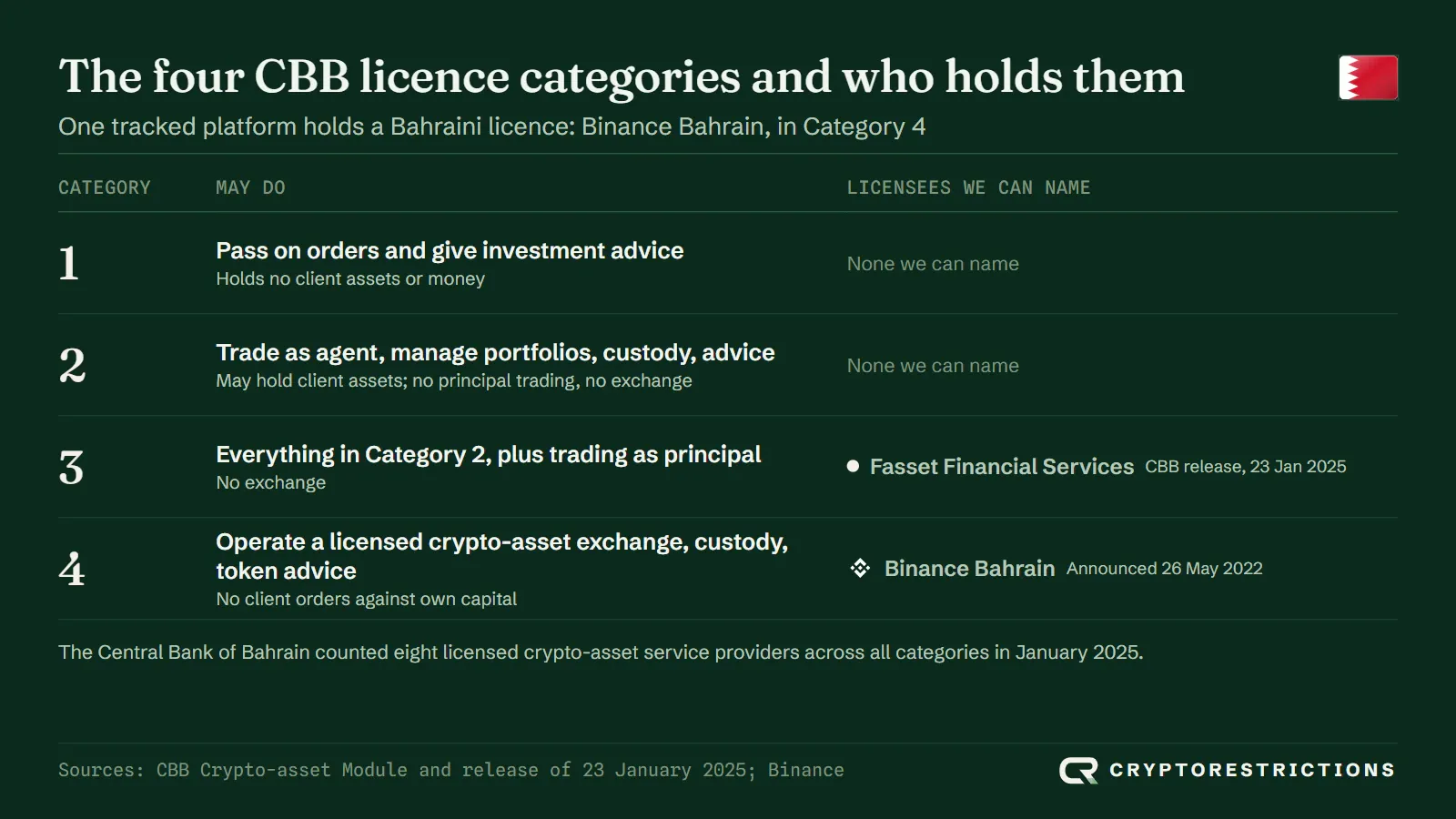
The licence categories decide what a firm may do, and only Category 4 may operate an exchange. The central bank said on 23 January 2025, when it licensed Fasset Financial Services in Category 3, that eight crypto-asset service providers held licences across all categories. We could not read a newer count or the register behind it, so we can name only the firms in the graphic. Press reports also name Rain and CoinMENA as licensed, but we did not confirm either against a central bank document.
Binance announced on 26 May 2022 that Binance Bahrain had received a Category 4 licence, which it described as the first exchange licence of that category. That is Binance’s own announcement, and we have not seen the central bank’s version of it.
Bitstamp is the one platform we could not test or check against a country list. Its Bitstamp global terms, updated 6 April 2026, carry no country list at all, so its row rests on the absence of a restriction in that document.

Best crypto platforms for Bahraini residents
The score ranks every platform that is open to Bahraini residents by how fully they can use it, not by fees or safety. It is computed from our data and moves when a row changes.
The score is made of access status (4 points), the share of the platform’s products open here (3), the Bahraini licences we hold on file (2) and what our geo-access test saw from a Bahraini address (1). Platforms that refuse Bahraini residents are not scored. The full method is on our methodology page.
Exchanges

Binance
Best for The only tracked licence in Bahrain
9.0/10- Access
- 4/4
- Products
- 3/3
- Licences
- 1/2
- Our test
- 1/1
Read our Binance reportPros
- Binance Bahrain announced a Category 4 licence in May 2022
- Its home page loaded in our test
Cons
- We could not read the central bank register to confirm the licence

Bybit
Best for Spot and derivatives
8.0/10- Access
- 4/4
- Products
- 3/3
- Licences
- 0/2
- Our test
- 1/1
Read our Bybit reportPros
- Not on its excluded-jurisdictions list
- Its sign-up page loaded in our test
Cons
- No Bahraini licence on file

OKX
Best for Spot and derivatives with a clear list
8.0/10- Access
- 4/4
- Products
- 3/3
- Licences
- 0/2
- Our test
- 1/1
Read our OKX reportPros
- Not on its restricted-locations list, updated 8 July 2026
- Its sign-up page loaded in our test
Cons
- No Bahraini licence on file
- Its list is open-ended

Coinbase
Best for Spot and staking with a listed sign-up
7.5/10- Access
- 4/4
- Products
- 3/3
- Licences
- 0/2
- Our test
- 0.5/1
Read our Coinbase reportPros
- Bahrain is a listed sign-up country in its identity guide
- Offers spot, staking and custody
Cons
- No Bahraini licence on file
- Not tested from Bahrain

Kraken
Best for Spot trading and staking
7.5/10- Access
- 4/4
- Products
- 3/3
- Licences
- 0/2
- Our test
- 0.5/1
Read our Kraken reportPros
- Not on its do-not-serve list
Cons
- No Bahraini licence on file
- Not tested from Bahrain
DeFi

Hyperliquid
Best for Perpetuals from your own wallet
8.0/10- Access
- 4/4
- Products
- 3/3
- Licences
- 0/2
- Our test
- 1/1
Read our Hyperliquid reportPros
- Its app and sign-up loaded in our test
- Not under broad sanctions
Cons
- No Bahraini licence on file
- The central bank allows derivatives only with its written approval

Jupiter
Best for Solana swaps and staking
7.5/10- Access
- 4/4
- Products
- 3/3
- Licences
- 0/2
- Our test
- 0.5/1
Read our Jupiter reportPros
- Bahrain is not in its terms
Cons
- No Bahraini licence on file
- Not tested from Bahrain

Uniswap
Best for Swapping tokens from your own wallet
7.5/10- Access
- 4/4
- Products
- 3/3
- Licences
- 0/2
- Our test
- 0.5/1
Read our Uniswap reportPros
- Its terms bar only places under comprehensive US sanctions
Cons
- No Bahraini licence on file
- Not tested from Bahrain
Prediction markets

Polymarket
Best for Event markets with no listed block
7.5/10- Access
- 4/4
- Products
- 3/3
- Licences
- 0/2
- Our test
- 0.5/1
Read our Polymarket reportPros
- Not on its blocked-countries list
Cons
- Bahraini law bans gambling and we found no ruling on event contracts
- Not tested from Bahrain
Which platforms block Bahrain users?
Only Gemini refuses Bahraini residents. The other 21 platforms do not name Bahrain on any restricted list we could read, and 12 that we tested from a Bahraini address all loaded.
Gemini serves a fixed list of countries, and Bahrain is on neither its main list nor its derivatives list, so we record it as restricted. We found no Bahraini order against any platform, so every other row follows the platform’s own documents.

What our geo-access test saw from Bahrain
From a virtual Bahraini address on 14 and 16 October 2026 we tested 12 of the 22 platforms we track. Eleven loaded with no barrier, and Gate showed a notice pointing us to its EU site.
An open page is not permission, and a virtual address tests a platform’s geo-blocking only, not a national internet block or a bank’s refusal to process a payment. Gate’s notice named the EU region rather than a restricted location, which looks like our virtual address being placed in Europe, so we did not record it as a block. We did not test the other ten platforms from Bahrain. Swipe through the screenshots below to see the pages as they loaded.
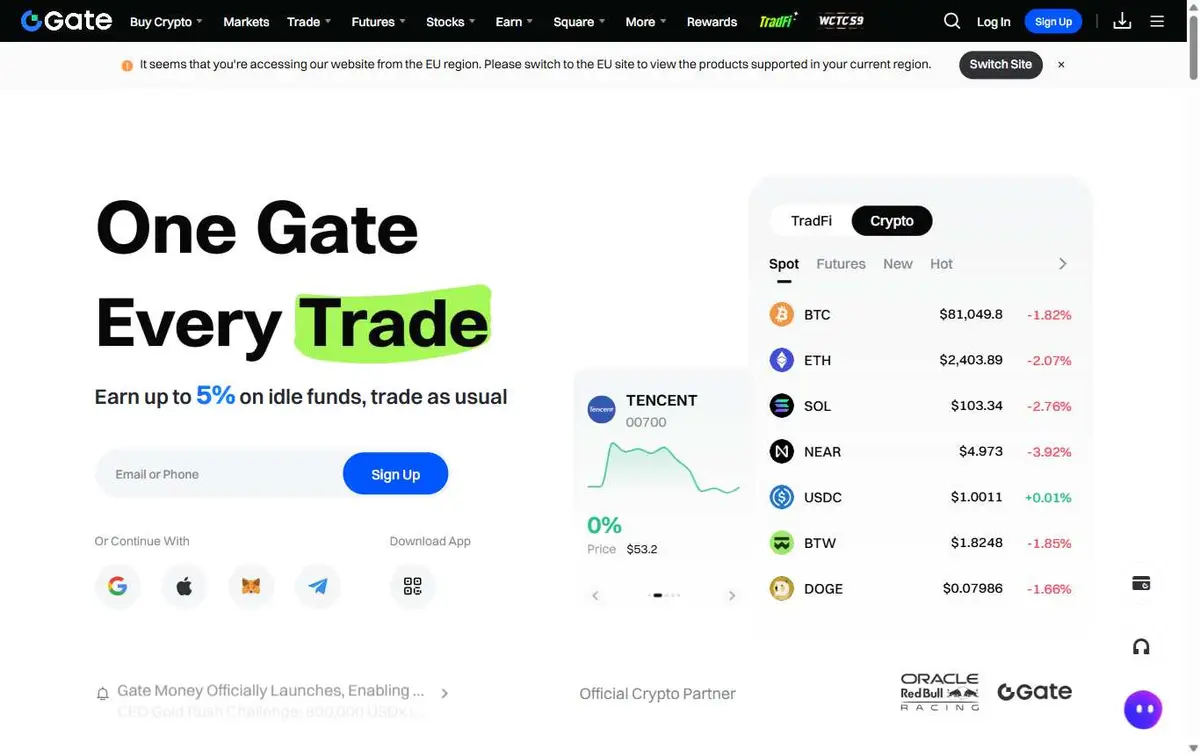
Notice shown Gate · Home page
Bahrain: a notice points us to Gate's EU site, but no restricted-location block
“It seems that you're accessing our website from the EU region.”
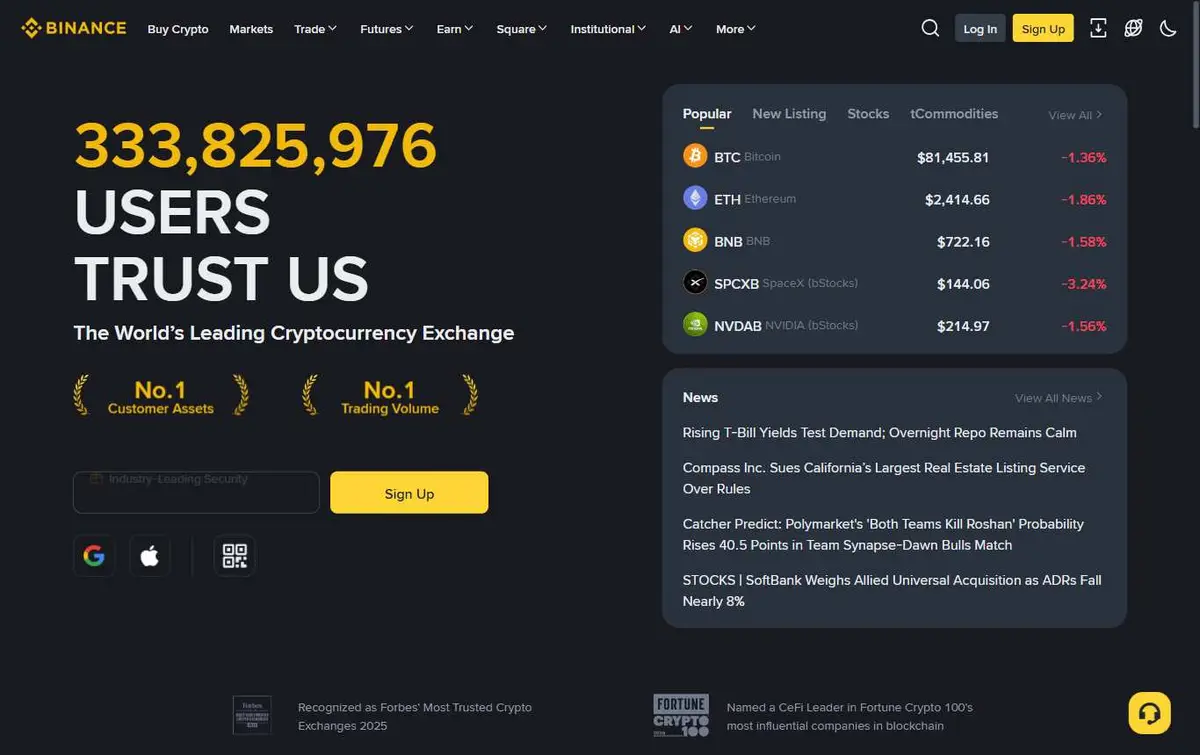
No barrier Binance · Home page
Bahrain: the home page loads with no barrier
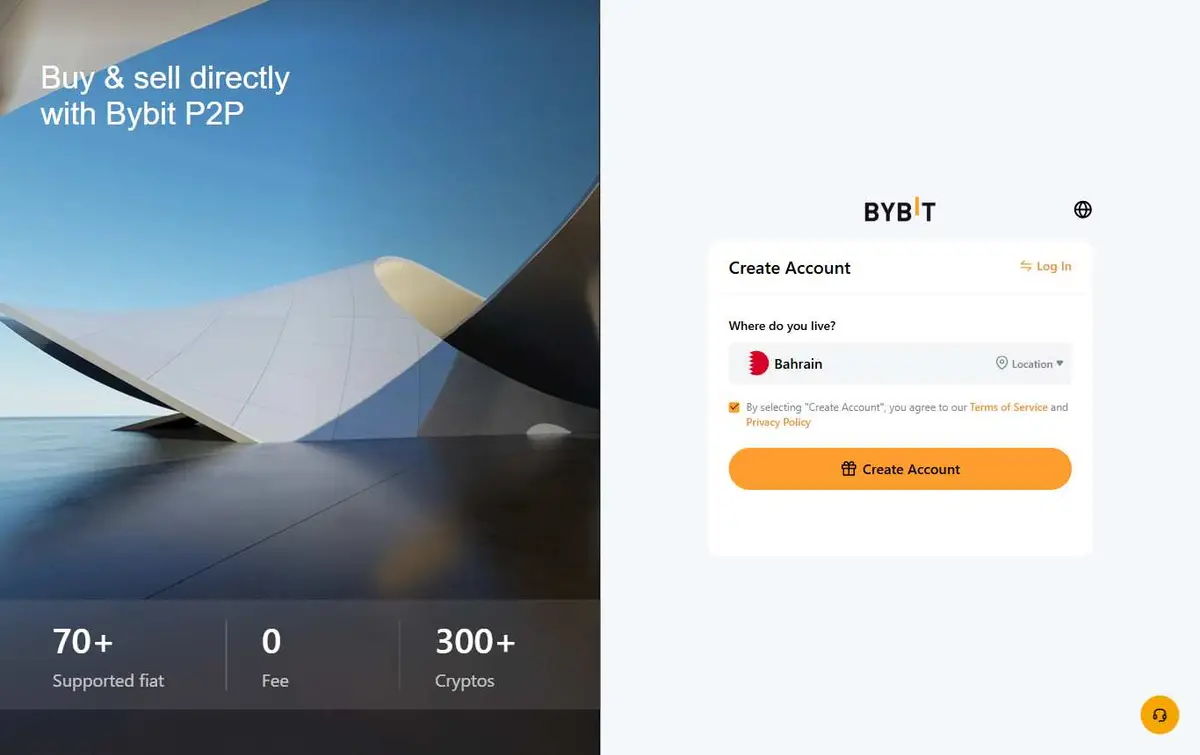
No barrier Bybit · Sign-up page
Bahrain: the sign-up page loads with no barrier
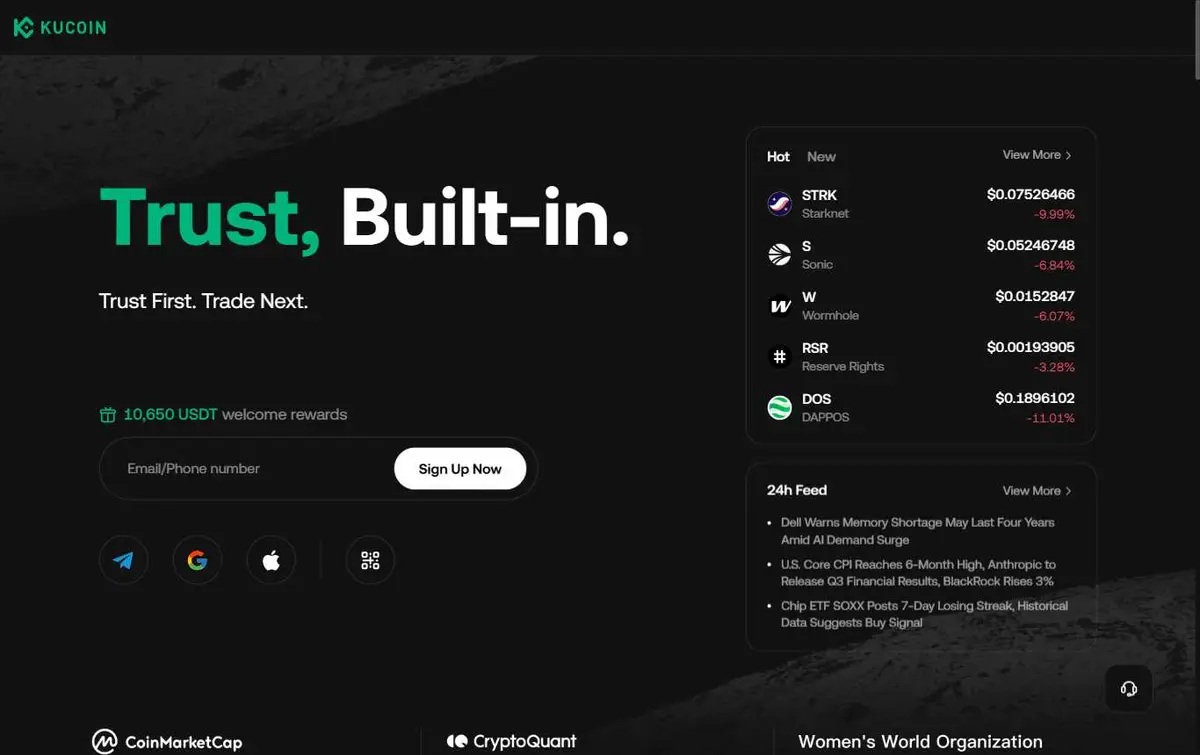
No barrier KuCoin · Home page
Bahrain: the home page loads with no barrier
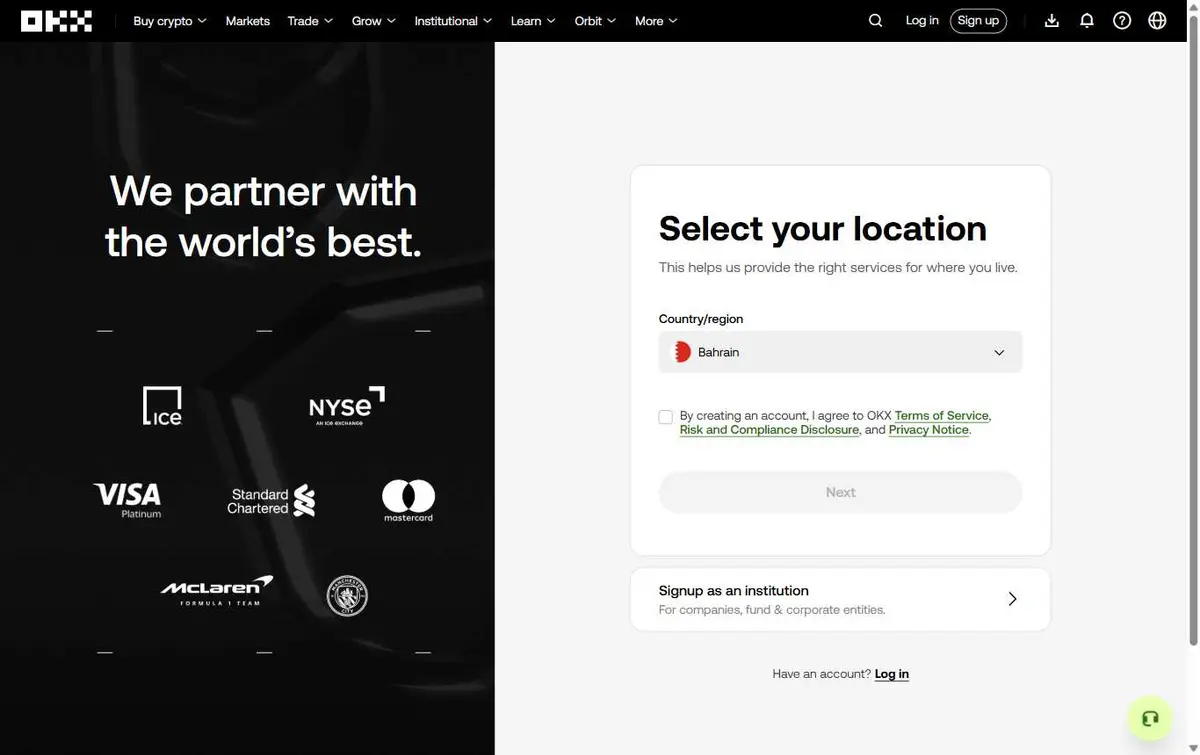
No barrier OKX · Sign-up page
Bahrain: the sign-up page loads with no barrier and no local-site redirect
 CRYPTORESTRICTIONS
Who regulates crypto in Bahrain?
One body: the Central Bank of Bahrain, which writes the rules and grants the licences. Its two crypto instruments we could read are the 2019 Crypto-asset Module and the July 2025 stablecoin module.
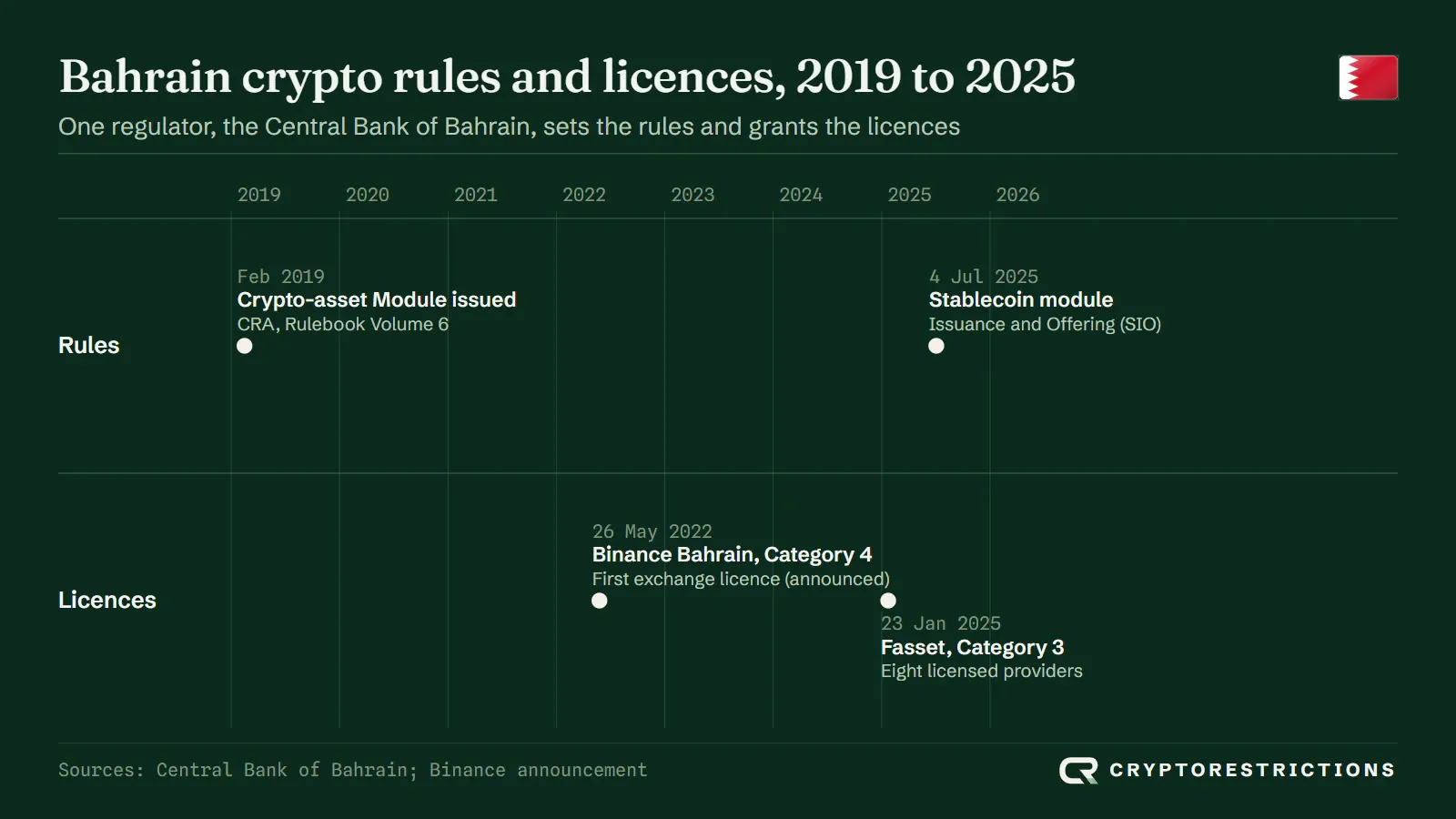
- Crypto-asset Module. Licensees fall into four categories, from Category 1, which may pass on orders and advise but hold no client assets, to Category 4, which may operate an exchange. The module also lets the central bank approve which crypto-assets a licensee may list, and it asks whether a token has built-in anonymisation.
- Stablecoin module. The Stablecoin Issuance and Offering Module, issued on 4 July 2025, lets licensed issuers issue single-currency stablecoins backed by Bahraini dinars, US dollars or another fiat currency the central bank accepts. We found no tracked platform that is a licensed issuer.
- Newer changes. One secondary source reports further amendments to the Crypto-asset Module in 2025 and 2026. We could not confirm them against the Rulebook, so this guide describes the 2022 edition.
Which crypto products are limited in Bahrain?
The central bank limits what licensed firms may offer: spot trading is the default, and derivatives need its written approval. Spot trading is the only product we found documented for licensed firms.
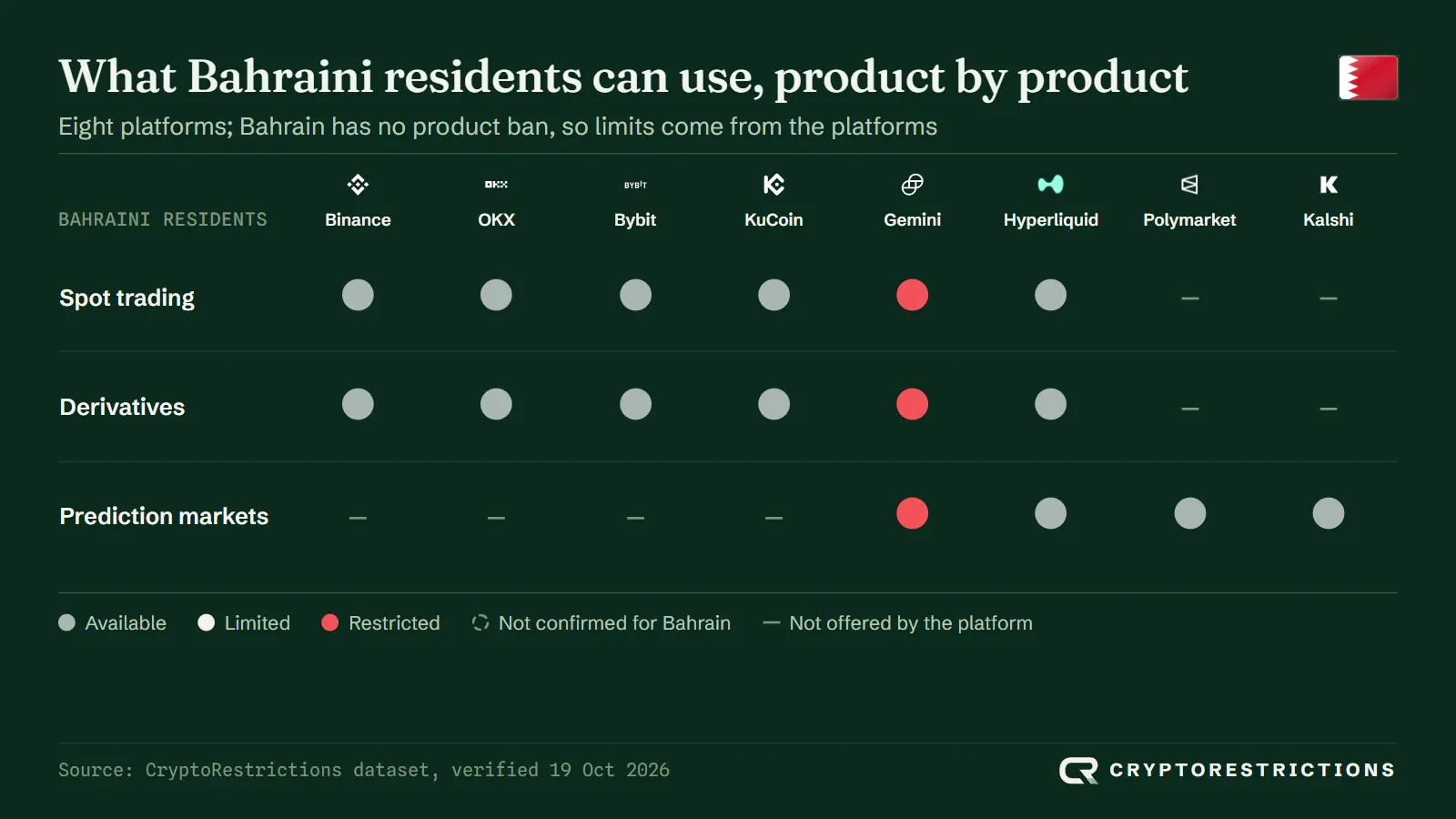
- Spot trading. Rule CRA-4.3.2A allows licensees to undertake spot trading in crypto-assets.
- Derivatives. Under CRA-4.3.2B, the central bank may allow a licensee to list futures, options and similar products if it is satisfied with the firm’s risk framework, and the firm must seek written approval first. An unlicensed platform that serves Bahrainis from abroad is outside this rule, so the matrix follows the platforms’ own documents.
- Stablecoins. Only a licensed issuer may issue them under the 2025 module; holding or trading one on a licensed exchange is a separate question that we did not find addressed.
- Bank access. We did not test card or bank-transfer purchases from Bahrain.
Are prediction markets legal in Bahrain?
Almost certainly not as gambling, though no Bahraini authority has ruled on event contracts. The Penal Code bans gambling, while Polymarket and Kalshi do not exclude Bahrain and Gemini refuses it.
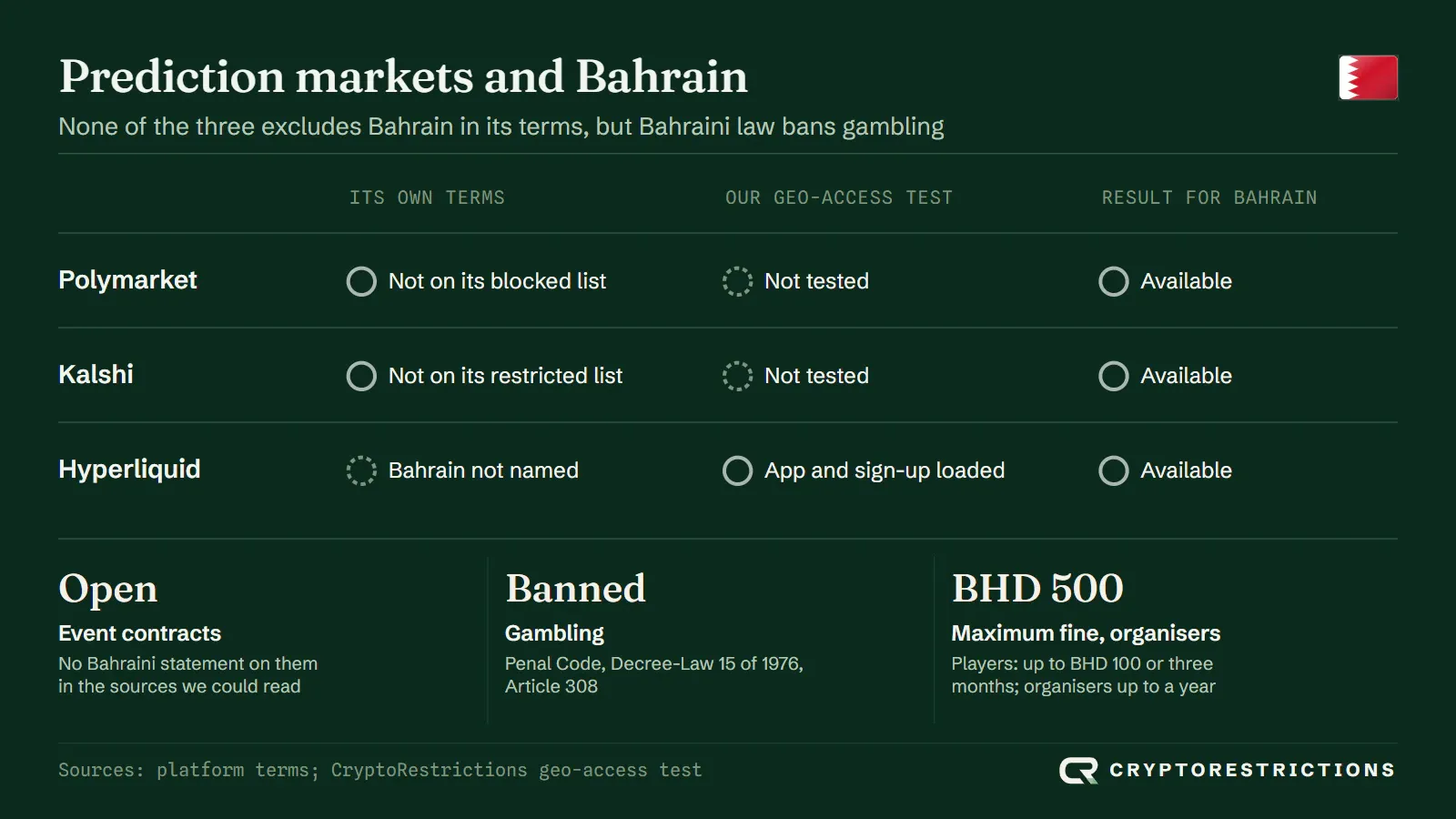
Article 308 of the Penal Code punishes gambling in a public place with up to three months in detention or a fine of up to BHD 100, and running or organising play with up to a year or BHD 500. It defines gambling as a game whose result depends on chance. We read the 1976 text and it shows no amendment note, so the current amounts may differ. We found no Bahraini statement on event contracts, so whether one counts as gambling is our inference. Polymarket and Kalshi do not name Bahrain on their lists and we did not test either from Bahrain.

How is crypto taxed in Bahrain?
Bahrain has no personal income tax and no general corporate income tax, and VAT is 10%. We found no tax authority guidance on crypto in the sources we could read.
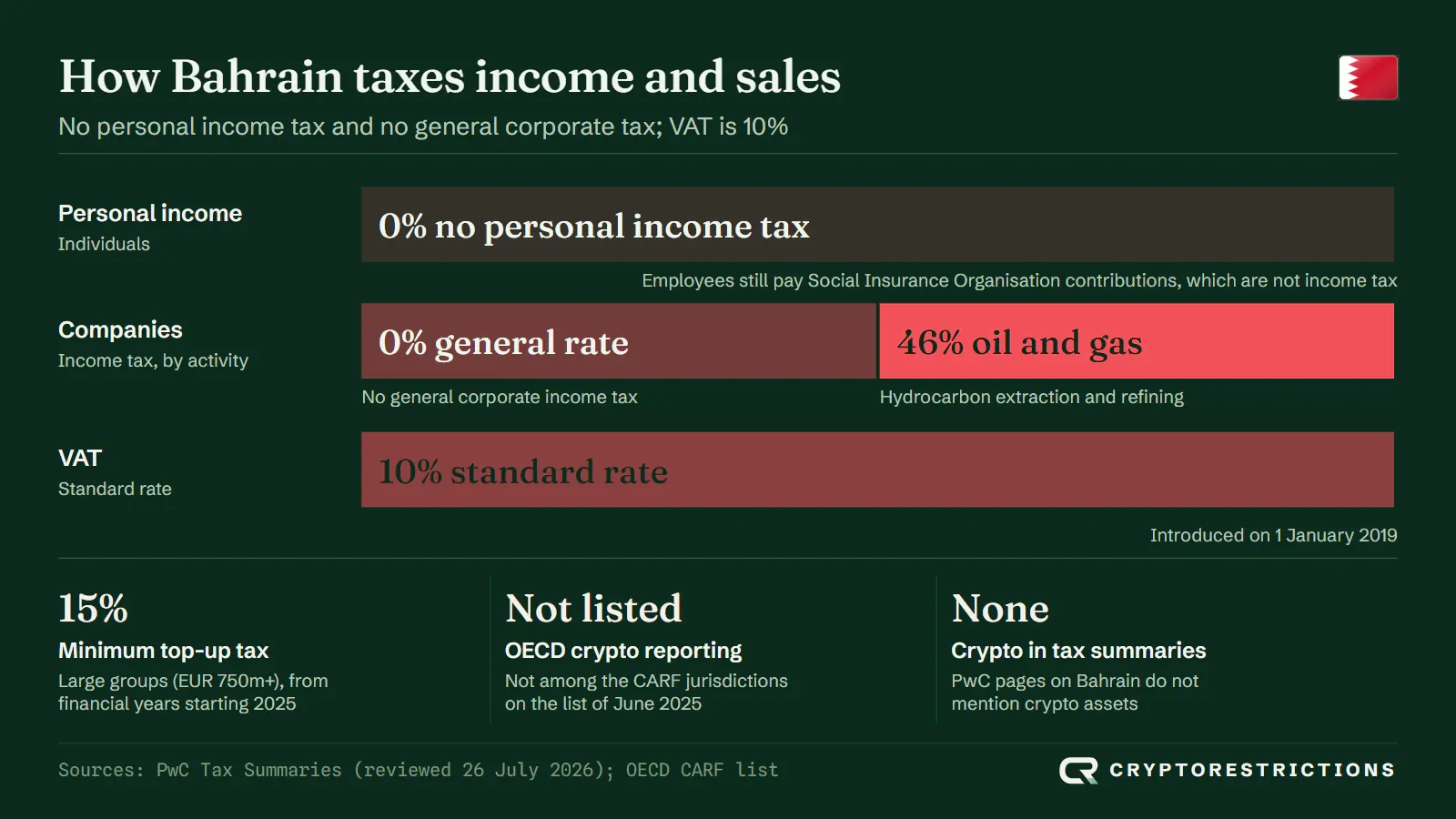
PwC’s summary, reviewed 26 July 2026, says there is no personal income tax regime in Bahrain, although employees pay social insurance contributions. For companies, PwC says there are no general corporate income taxes, apart from a 46% rate on hydrocarbon extraction and refining and a 15% domestic minimum top-up tax for groups with at least EUR 750 million in revenue, from financial years starting on or after 1 January 2025.
PwC puts the standard rate of VAT at 10%, in force since 1 January 2019. That page does not say how VAT treats crypto. The National Bureau for Revenue’s own pages would settle that, and we could not read them.
Bahrain was not among the jurisdictions committed to the OECD’s Crypto-Asset Reporting Framework on the list of 17 June 2025. We did not read later lists.






 Georgia
 Qatar
 Israel
 Saudi Arabia
 Vietnam
 Pakistan
 Bangladesh
 Indonesia
 United Arab Emirates
 South Korea
 Kazakhstan