
Is crypto legal in Vietnam?
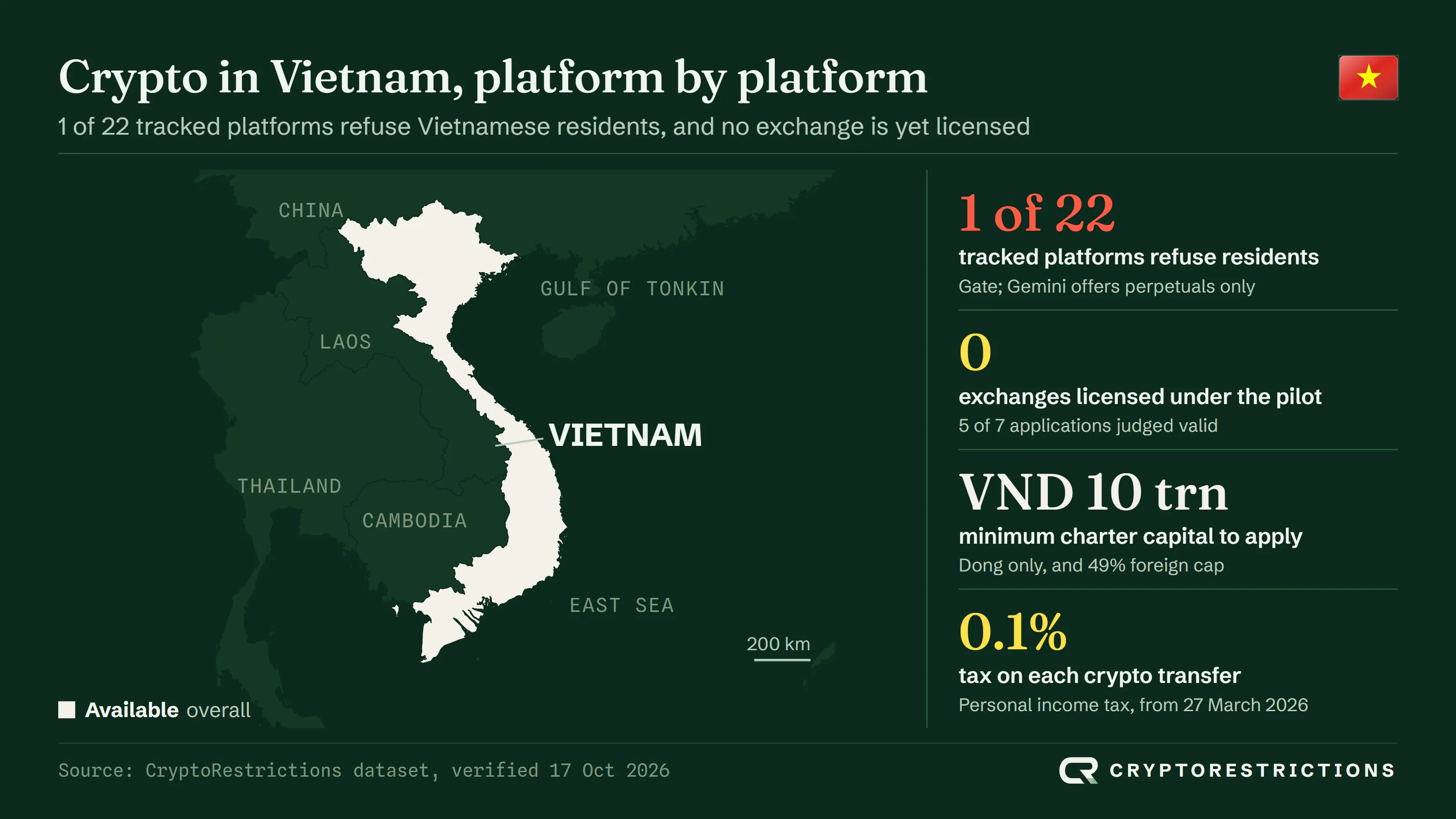
Yes, as property but not as money. Since 1 January 2026 the Law on the Digital Technology Industry recognises crypto assets, and a five-year pilot lets only Ministry of Finance licensees run exchanges, none of which is licensed yet.
The Law on the Digital Technology Industry (No. 71/2025/QH15) was passed on 14 June 2025. It defines digital assets as property under the Civil Code and names two types, virtual assets and crypto assets, neither of which includes securities or digital forms of fiat money. It sets out ownership, anti-money-laundering and business conditions for crypto services, and leaves the detail to a Government decree. Government Resolution 05/2025/NQ-CP, issued on 9 September 2025, is that detail for now: a five-year pilot in which offering, trading and payment happen in dong only.
Crypto is not a way to pay. The State Bank’s Directive 02/CT-NHNN of 13 April 2018 bars banks and intermediary payment providers from payment services, card transactions, transfers and currency conversion tied to virtual currencies. Holding and trading are not banned. What the state does is push trading toward licensed providers and fine residents who stay outside them, as the sections below show. A report in March 2026 said the Ministry of Finance was drafting a ban on citizens using foreign exchanges; we found no sign it was enacted.
Which crypto exchanges work in Vietnam?
Every exchange we track that serves Vietnamese residents does so from abroad, because no exchange holds a Vietnamese licence yet. The Ministry of Finance judged five of seven applications valid, and the stated capital of each is far below the VND 10,000 billion minimum.
Applications opened on 20 January 2026. The conditions in Resolution 05 are strict: a Vietnamese company with at least VND 10,000 billion of contributed charter capital paid in dong, at least 65% of it from institutions, foreign ownership capped at 49% and top-level information-system security. A deputy finance minister said on 5 October 2025 that at most five firms would be licensed. VietnamNet reported on 19 March 2026 that five of seven dossiers were valid, and that Dolphinex and SSID were rejected.
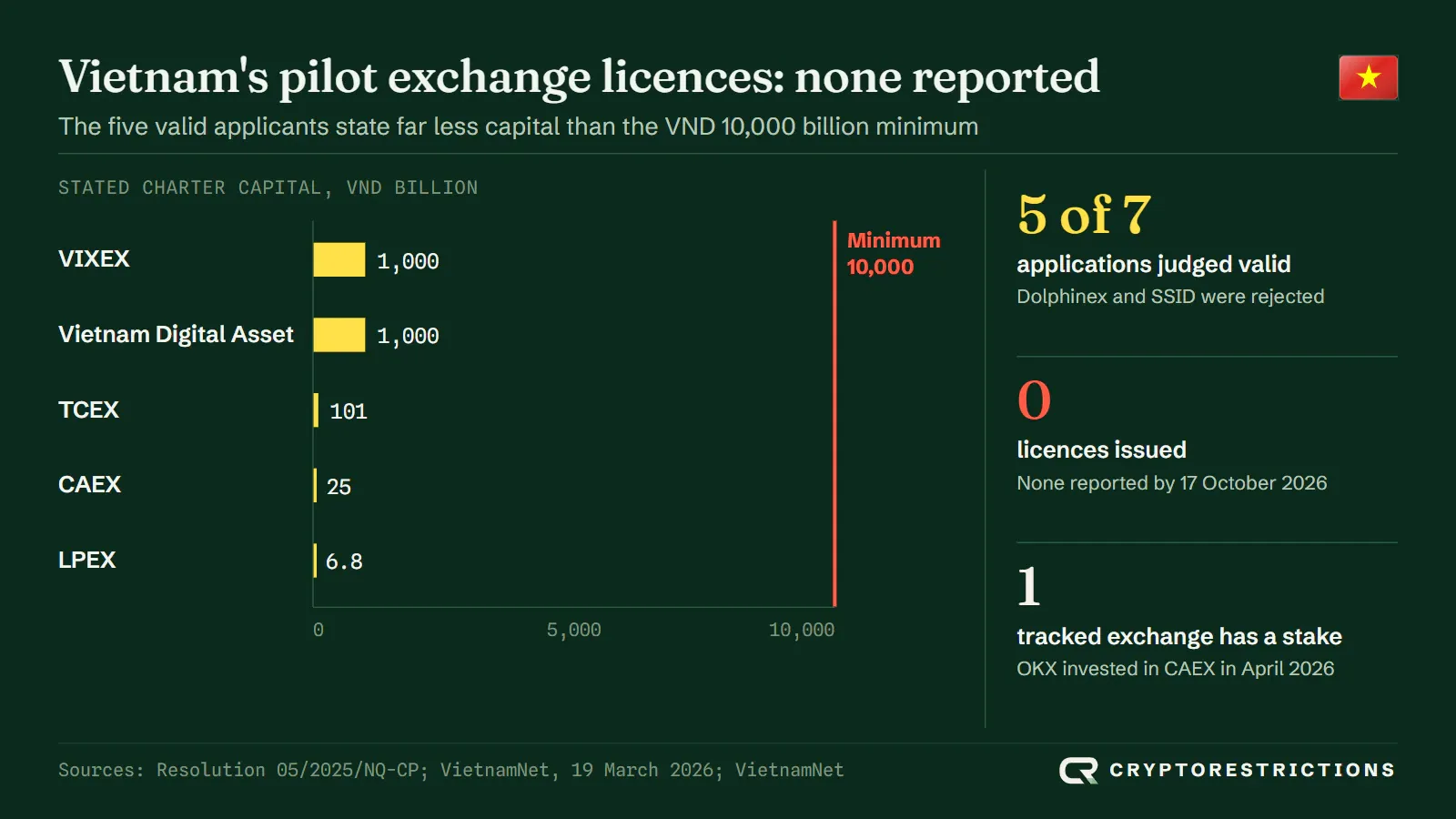
Foreign companies cannot apply, per VietnamNet, so the exchanges we track reach residents without a local entity. OKX is the one with a stake in the process: VietnamNet reports that it joined CAEX as a strategic partner in April 2026. We found no report of a licence granted by 17 October 2026, and the Ministry of Finance publishes no register we could read, so we hold no licence rows for Vietnam.
Best crypto platforms for Vietnamese residents
By our access score, Aster, Binance, Bitfinex, Bitget, Bybit, HTX, Hyperliquid, KuCoin, Lighter, MEXC and OKX tie at 8.0 out of 10, and no platform holds a Vietnamese licence to lift one above the others. Gemini scores lowest at 5.4 because it offers only perpetuals.
The score rates how fully a Vietnamese resident can use each platform, not its fees or safety. It is computed from our data and moves when a row changes: access status (4 points), the share of the platform’s products open here (3), the Vietnamese licences we hold on file (2) and what our geo-access test saw from a Vietnamese address (1). Platforms that refuse Vietnamese residents are not scored. With no licence on file for any platform, the picks differ by product coverage and test results. The full method is on our methodology page.
Exchanges

Binance
Best for Spot access without a Vietnamese company
8.0/10- Access
- 4/4
- Products
- 3/3
- Licences
- 0/2
- Our test
- 1/1
Read our Binance reportPros
- Vietnam is not on its prohibited list
- Loaded without a block in our test
Cons
- No Vietnamese licence on file

Bitfinex
Best for Spot access without a local company
8.0/10- Access
- 4/4
- Products
- 3/3
- Licences
- 0/2
- Our test
- 1/1
Read our Bitfinex reportPros
- Vietnam is not a prohibited jurisdiction in its terms
- Loaded without a block in our test
Cons
- No Vietnamese licence on file

Bitget
Best for Spot and derivatives without a local company
8.0/10- Access
- 4/4
- Products
- 3/3
- Licences
- 0/2
- Our test
- 1/1
Read our Bitget reportPros
- Not on its prohibited countries of 16 October 2026
- Loaded without a block in our test
Cons
- No Vietnamese licence on file

Bybit
Best for Spot and derivatives without a local company
8.0/10- Access
- 4/4
- Products
- 3/3
- Licences
- 0/2
- Our test
- 1/1
Read our Bybit reportPros
- Vietnam is not on its excluded-jurisdictions list
- Loaded without a block in our test
Cons
- No Vietnamese licence on file

HTX
Best for Spot and derivatives without a local company
8.0/10- Access
- 4/4
- Products
- 3/3
- Licences
- 0/2
- Our test
- 1/1
Read our HTX reportPros
- Not on its restricted list of September 2026
- Loaded without a block in our test
Cons
- No Vietnamese licence on file

KuCoin
Best for Spot and derivatives without a local company
8.0/10- Access
- 4/4
- Products
- 3/3
- Licences
- 0/2
- Our test
- 1/1
Read our KuCoin reportPros
- Not on its restricted locations of 29 September 2026
- Loaded without a block in our test
Cons
- No Vietnamese licence on file

MEXC
Best for Spot and derivatives without a local company
8.0/10- Access
- 4/4
- Products
- 3/3
- Licences
- 0/2
- Our test
- 1/1
Read our MEXC reportPros
- Not on its prohibited jurisdictions of 13 October 2026
- Loaded without a block in our test
Cons
- No Vietnamese licence on file

OKX
Best for Spot and derivatives without a local company
8.0/10- Access
- 4/4
- Products
- 3/3
- Licences
- 0/2
- Our test
- 1/1
Read our OKX reportPros
- Vietnam is not on its restricted locations of 8 July 2026
- Loaded without a block in our test
Cons
- No Vietnamese licence on file
- Holds a stake in applicant CAEX, which has no licence

Bitstamp
Best for Plain spot trading
7.5/10- Access
- 4/4
- Products
- 3/3
- Licences
- 0/2
- Our test
- 0.5/1
Read our Bitstamp reportPros
- No Bitstamp document excludes Vietnam
Cons
- No Vietnamese licence on file
- Not covered by our geo-access test

Coinbase
Best for Spot trading with a US-listed brand
7.5/10- Access
- 4/4
- Products
- 3/3
- Licences
- 0/2
- Our test
- 0.5/1
Read our Coinbase reportPros
- Vietnam is a listed sign-up country in its identity verification guide
Cons
- No Vietnamese licence on file
- We hold no Vietnamese source for its derivatives or staking

Crypto.com
Best for Spot trading in the app
7.5/10- Access
- 4/4
- Products
- 3/3
- Licences
- 0/2
- Our test
- 0.5/1
Read our Crypto.com reportPros
- Vietnam is not on its app, spot or sanctions lists
Cons
- No Vietnamese licence on file

Kraken
Best for Spot trading without a Vietnamese company
7.5/10- Access
- 4/4
- Products
- 3/3
- Licences
- 0/2
- Our test
- 0.5/1
Read our Kraken reportPros
- Vietnam is not on its do-not-serve list
Cons
- No Vietnamese licence on file

Gemini
Best for Perpetuals only
5.4/10- Access
- 3/4
- Products
- 1.9/3
- Licences
- 0/2
- Our test
- 0.5/1
Read our Gemini reportPros
- Vietnam is on its perpetuals list
Cons
- Spot is not offered: Vietnam is not on its main list
DeFi

Aster
Best for Perpetuals and spot trading
8.0/10- Access
- 4/4
- Products
- 3/3
- Licences
- 0/2
- Our test
- 1/1
Read our Aster reportPros
- Perpetuals load in the trading app in our test
Cons
- Prediction trading is barred under its prediction rules

Hyperliquid
Best for Perpetuals from your own wallet
8.0/10- Access
- 4/4
- Products
- 3/3
- Licences
- 0/2
- Our test
- 1/1
Read our Hyperliquid reportPros
- Not blocked in our geo-access test
Cons
- No Vietnamese licence on file

Lighter
Best for Perpetuals on its trading app
8.0/10- Access
- 4/4
- Products
- 3/3
- Licences
- 0/2
- Our test
- 1/1
Read our Lighter reportPros
- Not named in its terms
- The trading app loaded in our test
Cons
- No Vietnamese licence on file

Jupiter
Best for Solana swaps
7.5/10- Access
- 4/4
- Products
- 3/3
- Licences
- 0/2
- Our test
- 0.5/1
Read our Jupiter reportPros
- Vietnam is not named in its terms
Cons
- No Vietnamese licence on file

PancakeSwap
Best for BNB Chain swaps and pools
7.5/10- Access
- 4/4
- Products
- 3/3
- Licences
- 0/2
- Our test
- 0.5/1
Read our PancakeSwap reportPros
- Its terms bar only people and places under US sanctions
Cons
- No Vietnamese licence on file

Uniswap
Best for Swapping tokens from your own wallet
7.5/10- Access
- 4/4
- Products
- 3/3
- Licences
- 0/2
- Our test
- 0.5/1
Read our Uniswap reportPros
- Its terms bar only places under comprehensive US sanctions
Cons
- No Vietnamese licence on file
Prediction markets

Kalshi
Best for Event contracts with a US-regulated brand
7.5/10- Access
- 4/4
- Products
- 3/3
- Licences
- 0/2
- Our test
- 0.5/1
Read our Kalshi reportPros
- Vietnam is not on its restricted-jurisdictions list
Cons
- No Vietnamese licence on file
- Prediction markets are not addressed in Vietnamese law

Polymarket
Best for Event markets on a large order book
7.5/10- Access
- 4/4
- Products
- 3/3
- Licences
- 0/2
- Our test
- 0.5/1
Read our Polymarket reportPros
- Vietnam is not on its blocked-countries list
Cons
- No Vietnamese licence on file
- Prediction markets are not addressed in Vietnamese law
Which platforms block Vietnamese users?
Only Gate refuses Vietnam in its own terms, and Gemini offers Vietnamese residents perpetuals but not spot trading. No platform we track has been blocked by the state.
Gate lists Vietnam among the restricted locations in clause 2.5 of its user agreement (22 July 2026), a list that “includes but is not limited to” the countries named. Gemini’s areas of availability do not list Vietnam for spot trading, but its perpetuals list does.
Decree 284 targets residents rather than platforms: it describes no blocking mechanism, and we found no report of an internet provider blocking an exchange. VietnamNet writes that Binance staff have left Vietnamese community groups and a country manager role is advertised, and that experts expect BingX, Bitget, Gate and MEXC to block domestic investors. None of that is a platform notice, so every other row stays available at medium confidence.
What our geo-access test saw from Vietnam
From a Vietnamese address on 14 and 16 October 2026 we tested 12 platforms: 11 loaded with no barrier and Gate showed its restricted-location notice.
An open page is not permission. The test uses a virtual Vietnamese location, which sees a platform’s own geo-blocking but cannot see a block applied by Vietnamese internet providers, and most platforms enforce at identity verification rather than at the page. Gate’s notice named the United States, Canada, Cambodia, Thailand and others but not Vietnam, which its user agreement does. We have no Vietnamese test for the other ten platforms we track. Swipe through the screenshots below; each card says what the page showed.
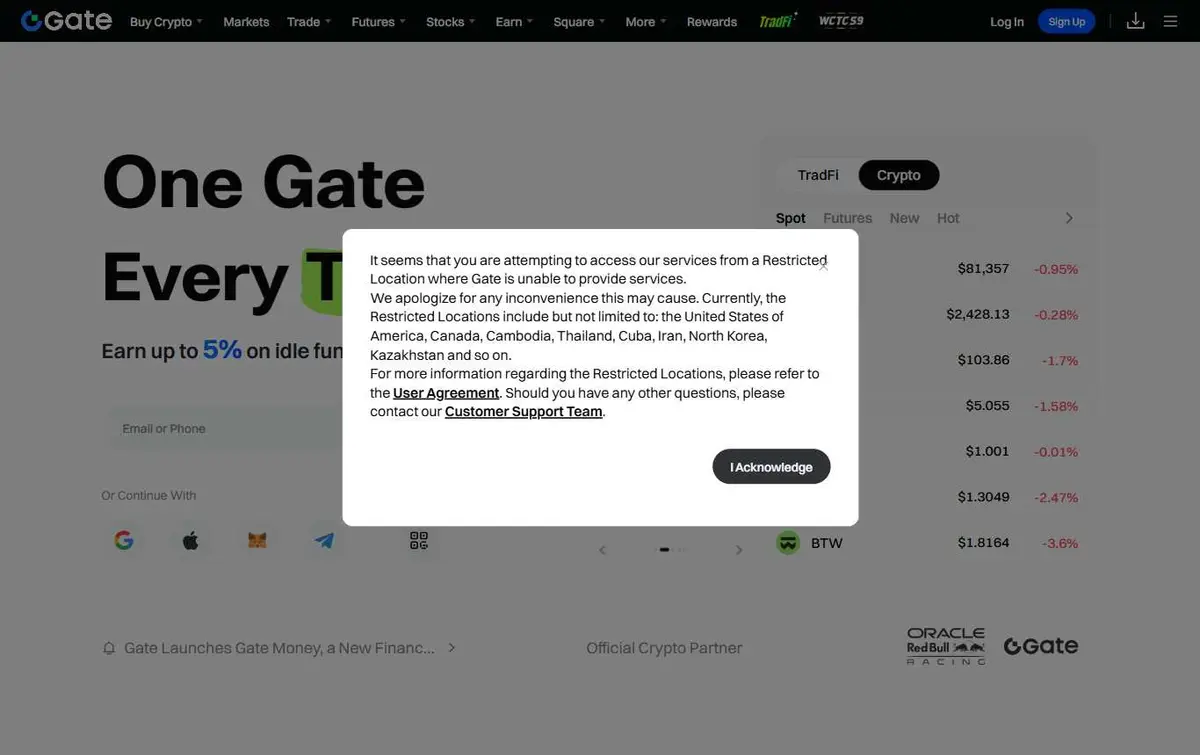
Blocked Gate · Home page
Blocked by IP: Gate shows its restricted-location pop-up, and Vietnam is on the list in its user agreement
“It seems that you are attempting to access our services from a Restricted Location where Gate is unable to provide services.”
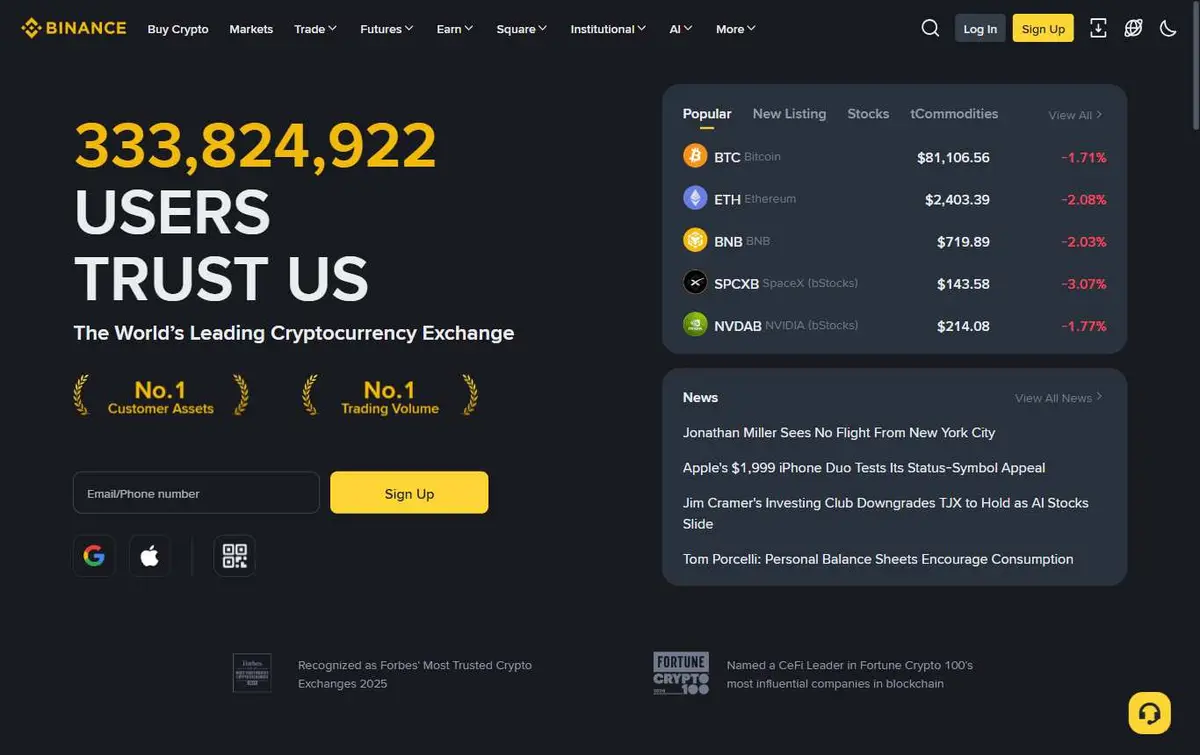
No barrier Binance · Home page
No barrier: the home page loads normally
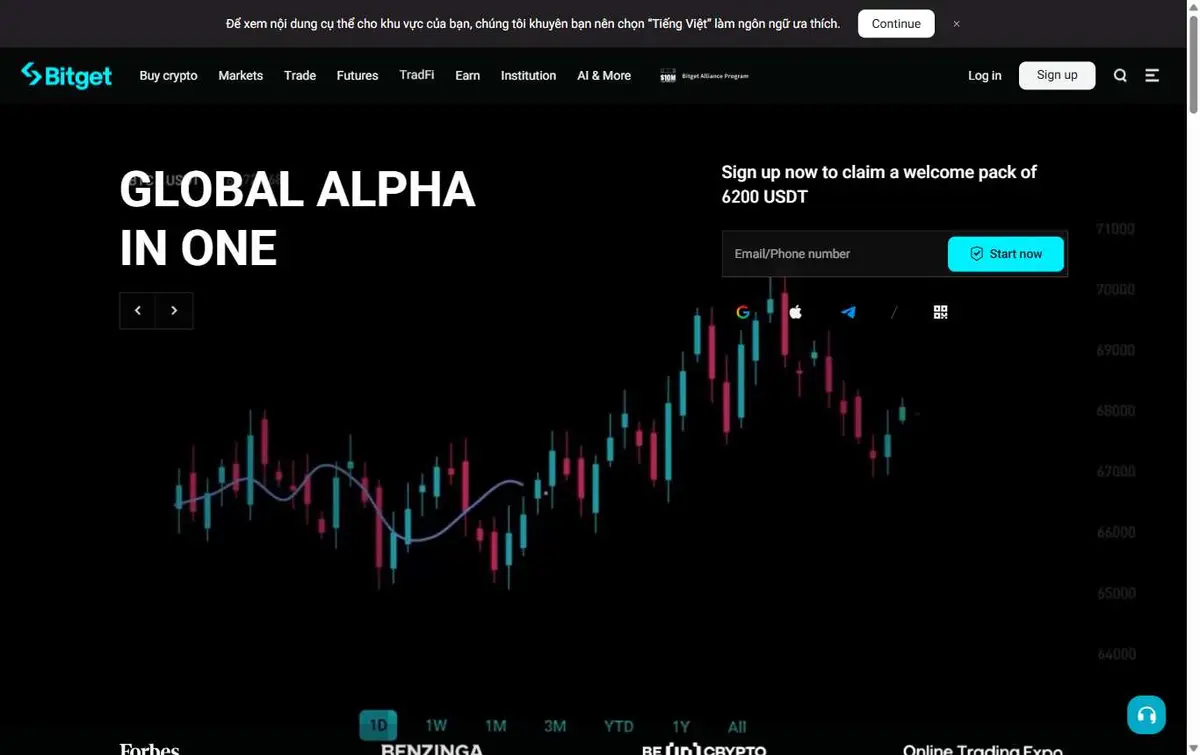
No barrier Bitget · Home page
No barrier: the home page loads normally
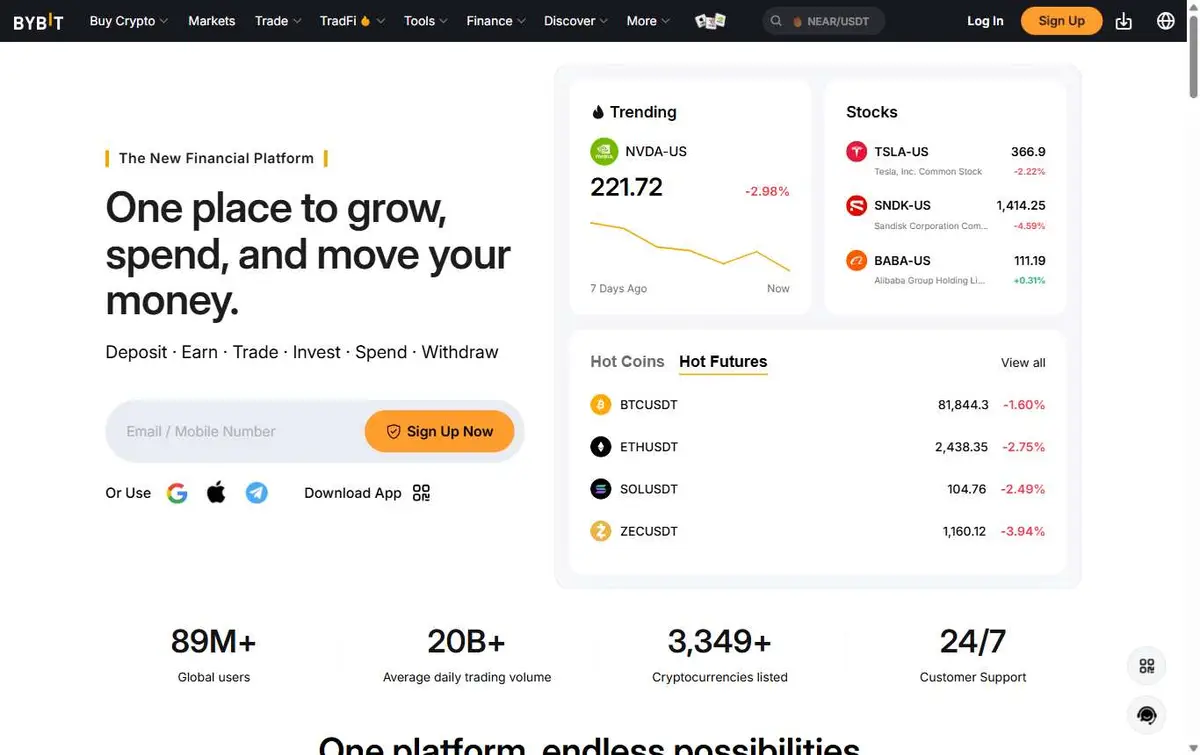
No barrier Bybit · Home page
No barrier: the home page loads normally
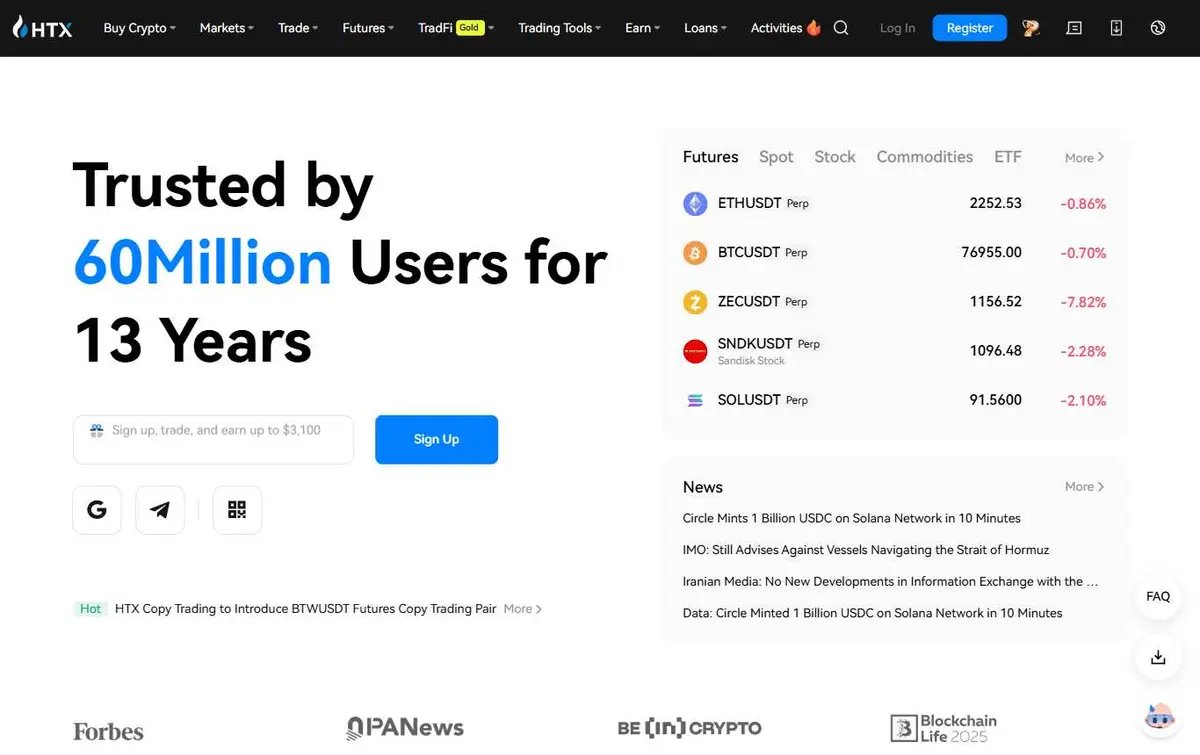
No barrier HTX · Home page
No barrier: the home page loads normally
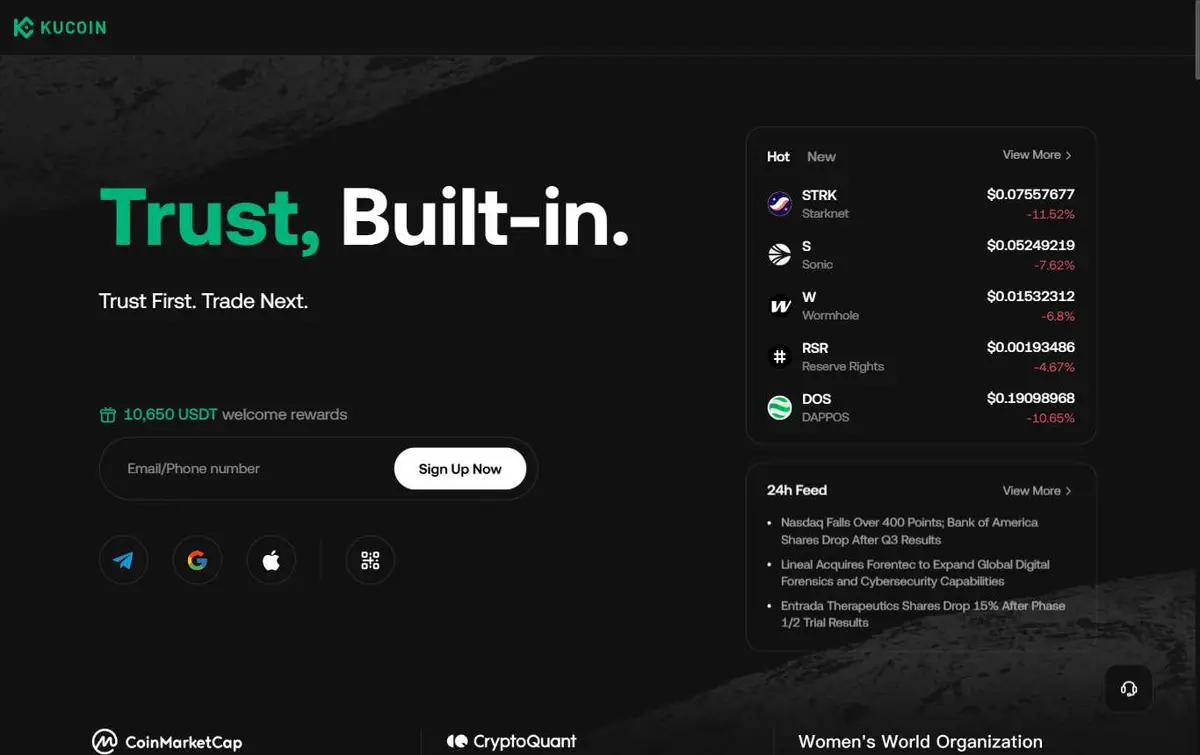
No barrier KuCoin · Home page
No barrier: the home page loads normally
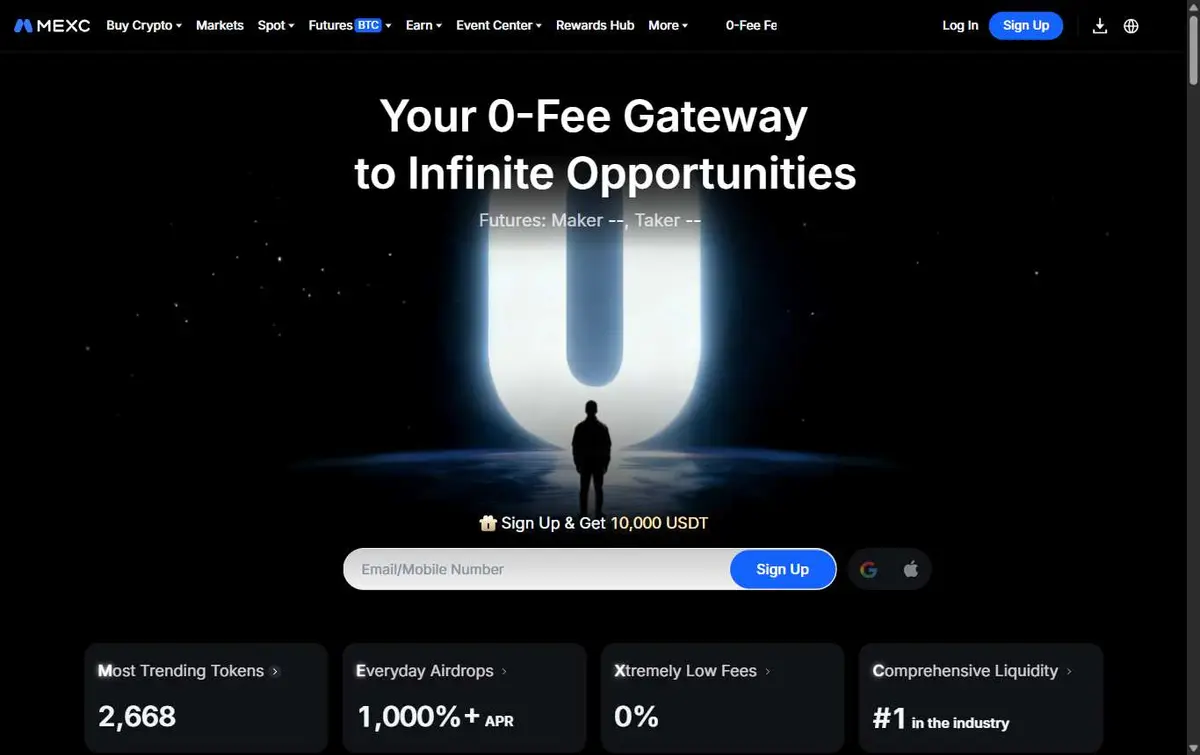
No barrier MEXC · Home page
No barrier: the home page loads normally
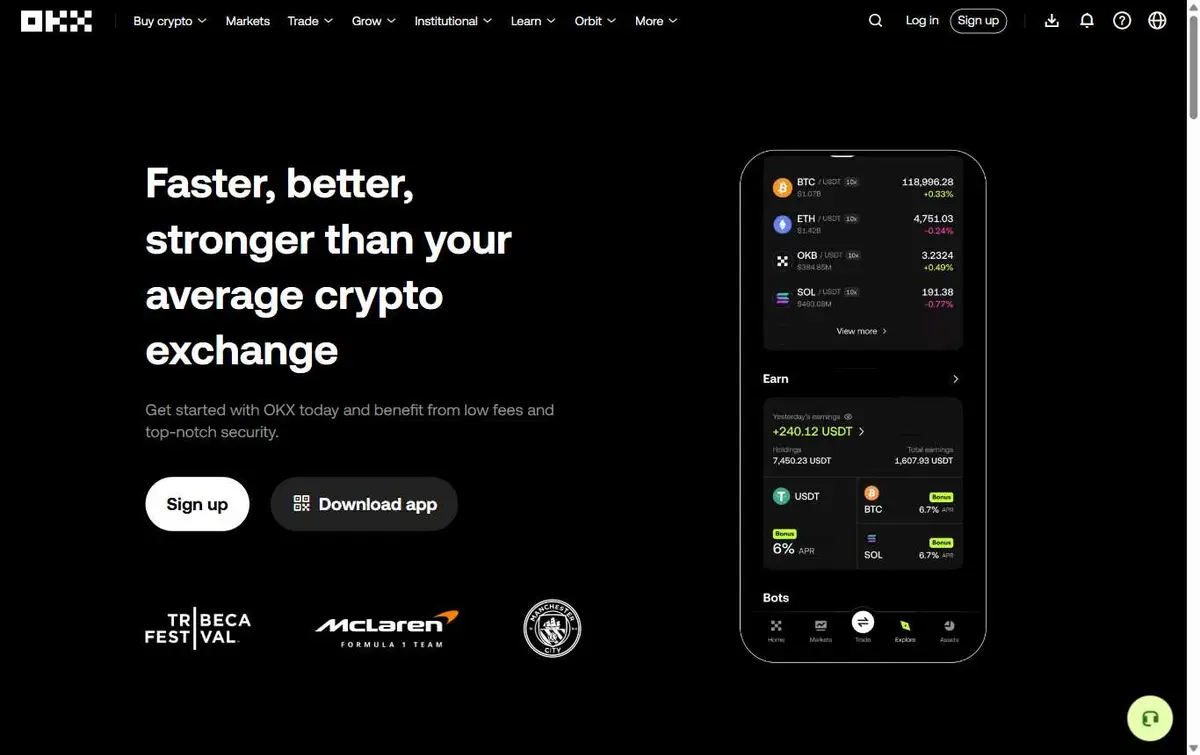
No barrier OKX · Home page
No barrier: the home page loads normally
 CRYPTORESTRICTIONS
Who regulates crypto in Vietnam?
The Ministry of Finance licenses, taxes and sanctions, the State Bank covers payments and money laundering, and the Ministry of Public Security appraises applicants’ security and pursues violations.
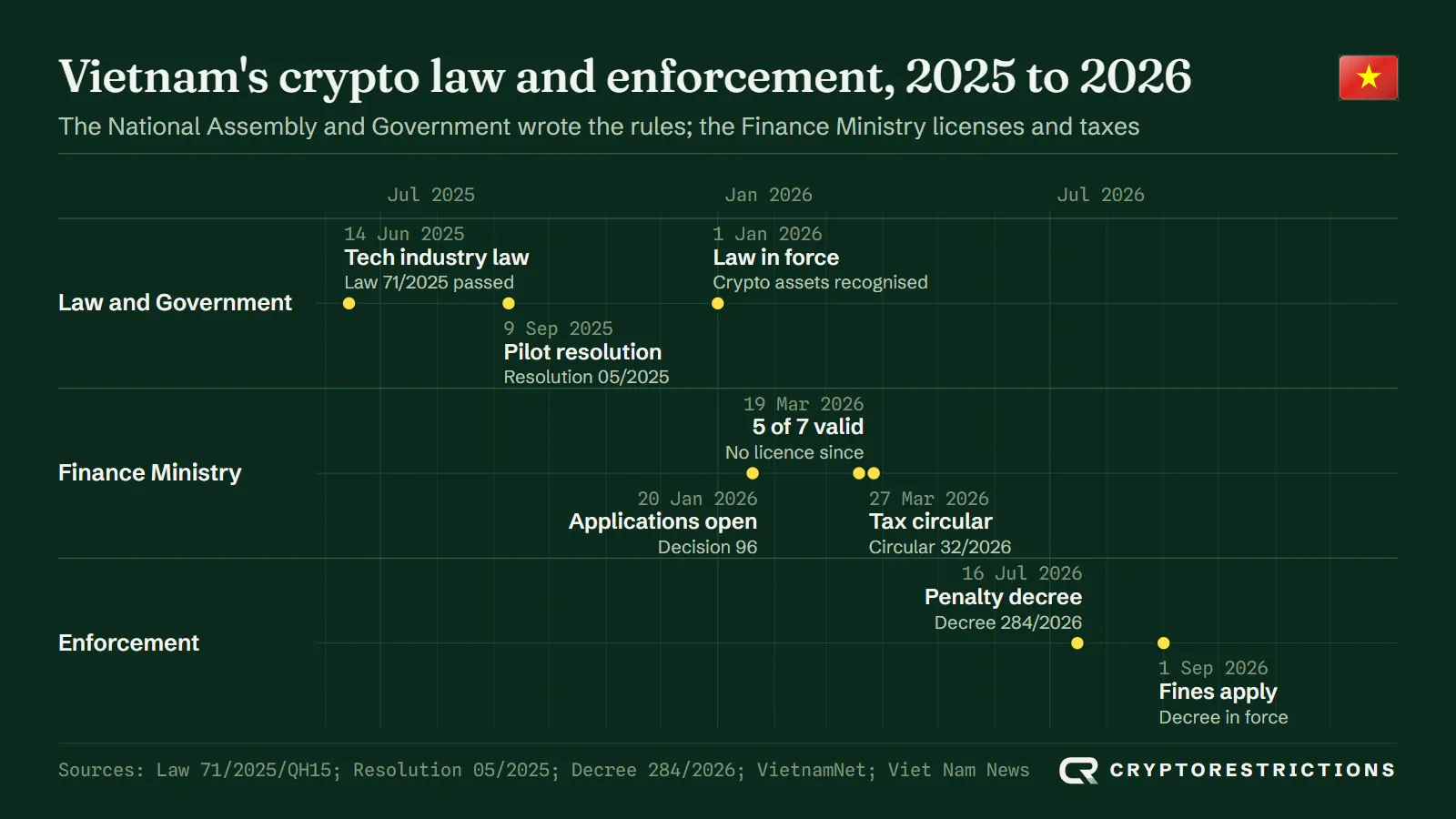
- Ministry of Finance. The lead regulator under Resolution 05: it decides licence applications within 30 days of a complete dossier, and it issued the tax circular. Decision 96/QD-BTC opened applications on 20 January 2026.
- State Bank of Vietnam. Directive 02 keeps banks out of crypto payments, and the Resolution has foreign investors trade through a dedicated dong account at a licensed bank.
- Ministry of Public Security. It appraises each applicant’s information-system security and is the enforcement arm for violations. VietnamNet reported that the five valid dossiers went to it and the State Bank for opinion.
- Penalties. Decree 284/2026/ND-CP, signed on 16 July 2026 and in force from 1 September 2026, fines unlicensed providers and advertisers VND 180 to 200 million and domestic investors who trade through them VND 30 to 50 million.
- Timing. Resolution 05 lets the state sanction domestic trading outside licensed providers six months after the first licence. We found no report of a licence, so we found no report of anyone fined.
Which crypto products are limited in Vietnam?
Paying with crypto is the one outright ban. Everything else is limited to licensed providers working in dong, and Gemini is the one tracked platform that offers only perpetuals.
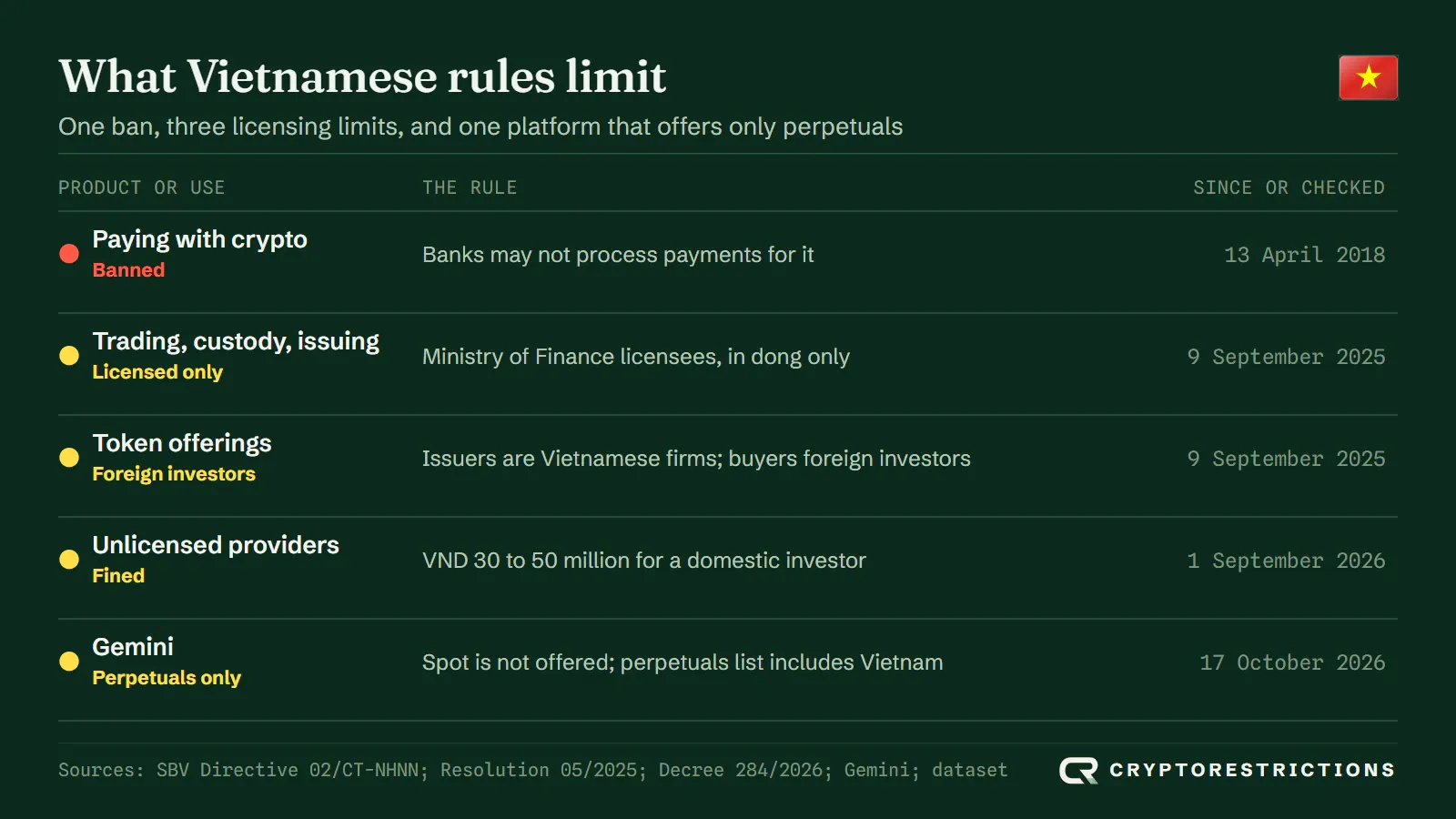
- Payments. Banks and payment intermediaries may not process crypto payments, under the State Bank’s 2018 directive, and the pilot allows offering, trading and payment in dong only.
- Trading, custody and issuing. Only Ministry of Finance licensees may offer these services or advertise them, and custody sits with licensed providers.
- Token offerings. Issuers must be Vietnamese firms and the assets must be backed by real assets. Offerings are limited to foreign investors.
- Leverage and derivatives. We found no Vietnamese rule on them. Gemini’s perpetuals list includes Vietnam, and we hold no Vietnamese source for the derivatives of the other platforms.
Are prediction markets legal in Vietnam?
The law does not say. The Penal Code makes gambling a crime and no licence for online gambling exists, but we found no official statement on prediction markets, and Polymarket and Kalshi both serve Vietnam.
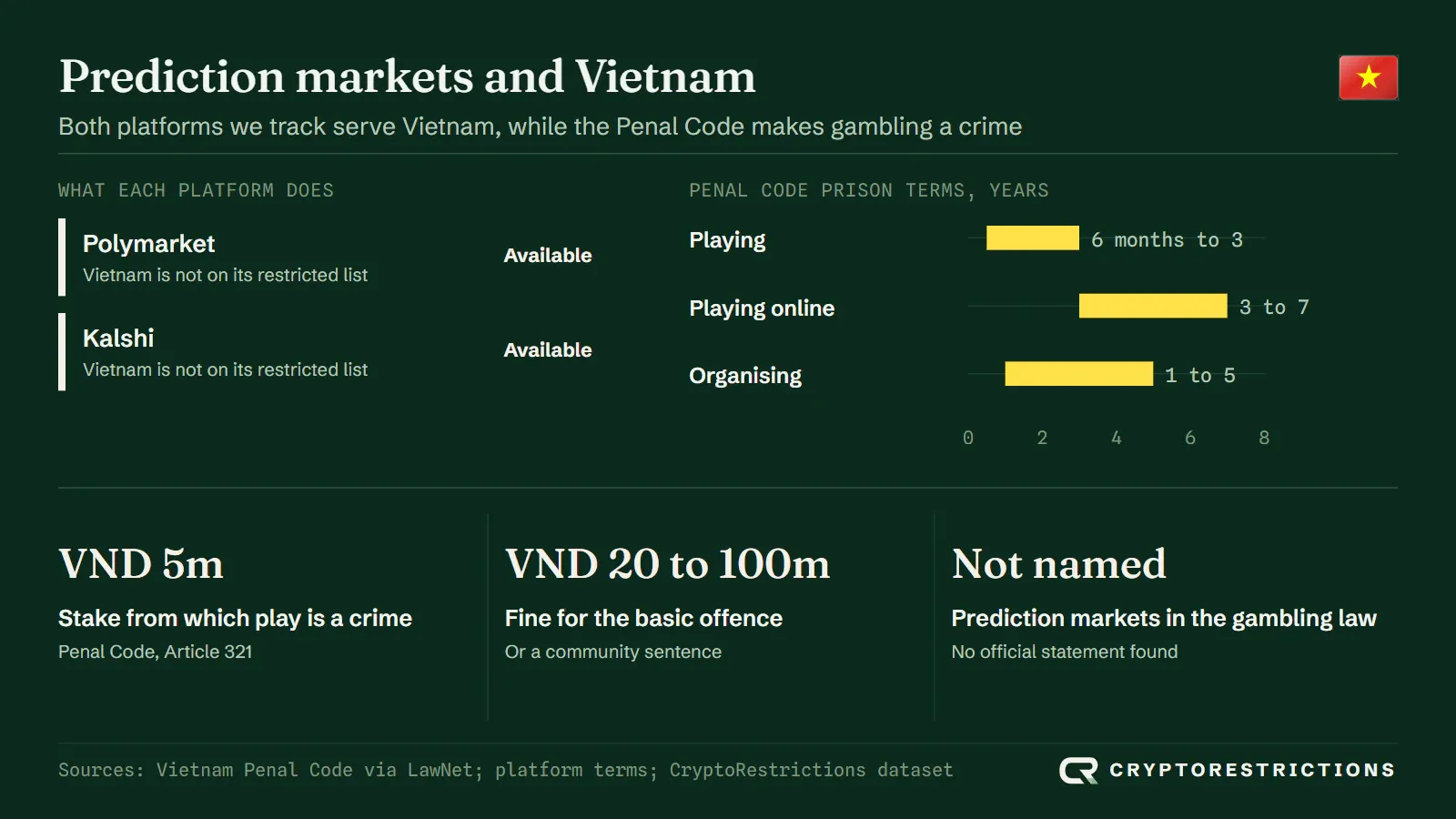
LawNet’s summary of Article 321 of the Penal Code says playing illegal gambling with a stake of VND 5 million or more carries a fine of VND 20 to 100 million, a community sentence of up to 3 years or 6 months to 3 years in prison, and 3 to 7 years in aggravated cases that include use of the internet. Article 322, on organising gambling, carries a fine of VND 50 to 300 million or 1 to 5 years. Whether a prediction market counts as gambling is not settled in anything we read, so we treat the risk as open rather than assume either answer.
Polymarket does not list Vietnam among its blocked countries, and Kalshi does not list it among its restricted jurisdictions. Both rows are medium confidence: the platforms enforce at sign-up, and a platform’s terms do not decide the local law.
How is crypto taxed in Vietnam?
Under the pilot, individuals pay 0.1% personal income tax on each crypto transfer, Vietnamese organisations pay 20% corporate tax on the gain, and transfers carry no VAT.
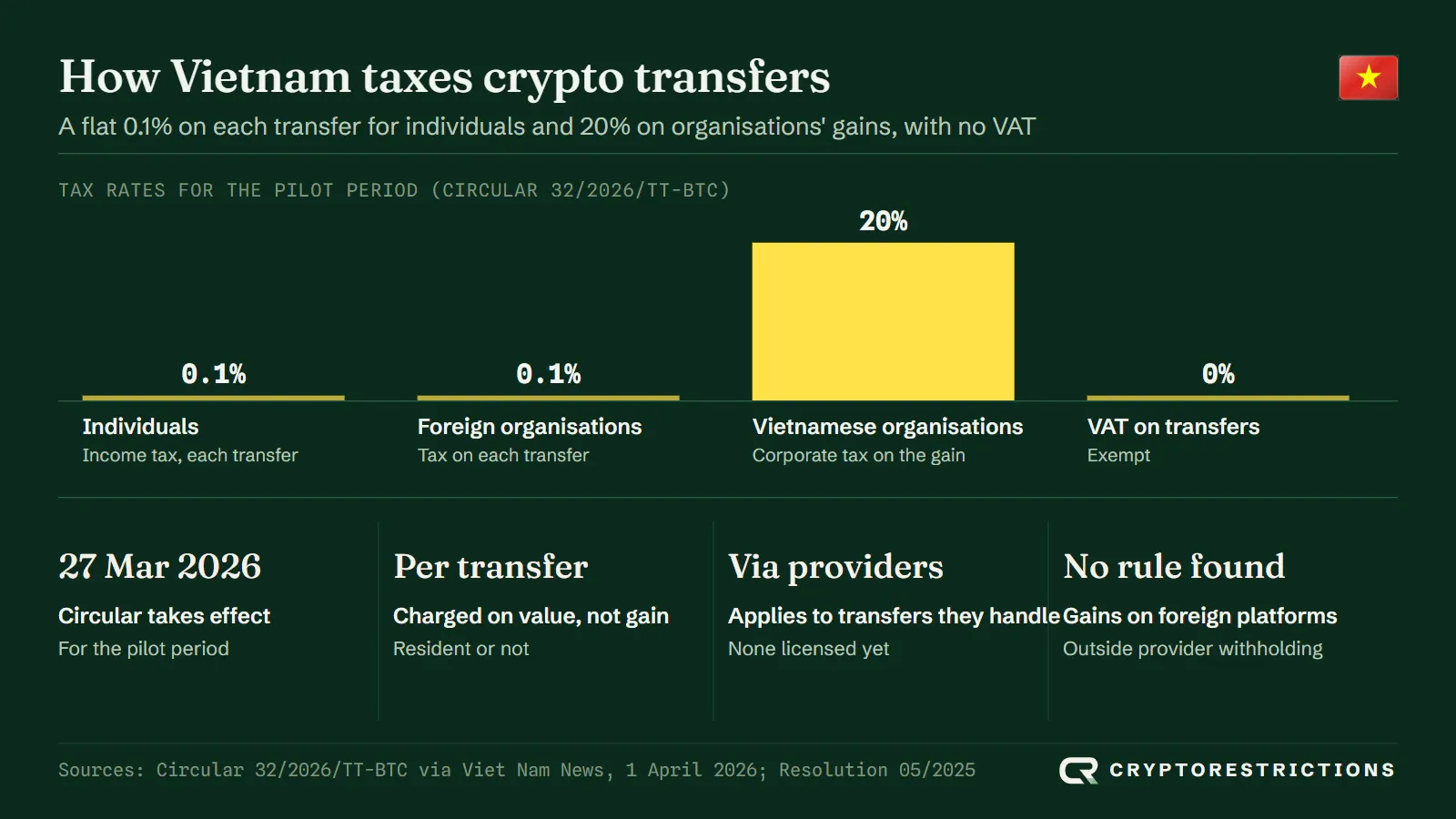
Ministry of Finance Circular 32/2026/TT-BTC took effect on 27 March 2026 for the pilot period, Viet Nam News reported. Individuals, resident or not, pay 0.1% of the value of each transfer, so the tax does not depend on whether they made a gain. Vietnamese organisations pay 20% on the sale price less the purchase price and documented costs. Foreign organisations pay 0.1% of the revenue from each transfer made through service providers in Vietnam. Transfers and trading are exempt from VAT, while related services such as custody stay under the normal rules. Resolution 05 says tax follows the rules for securities until a specific policy exists.
The rates apply to transfers through licensed service providers, and none is licensed yet. We found no rule on how an individual declares gains from a foreign platform, so we state none. Working out your position takes four steps:

 Bahrain
 Georgia
 Qatar
 Israel
 Saudi Arabia
 Pakistan
 Bangladesh
 Indonesia
 United Arab Emirates
 South Korea
 Kazakhstan