Is crypto legal in Kazakhstan?
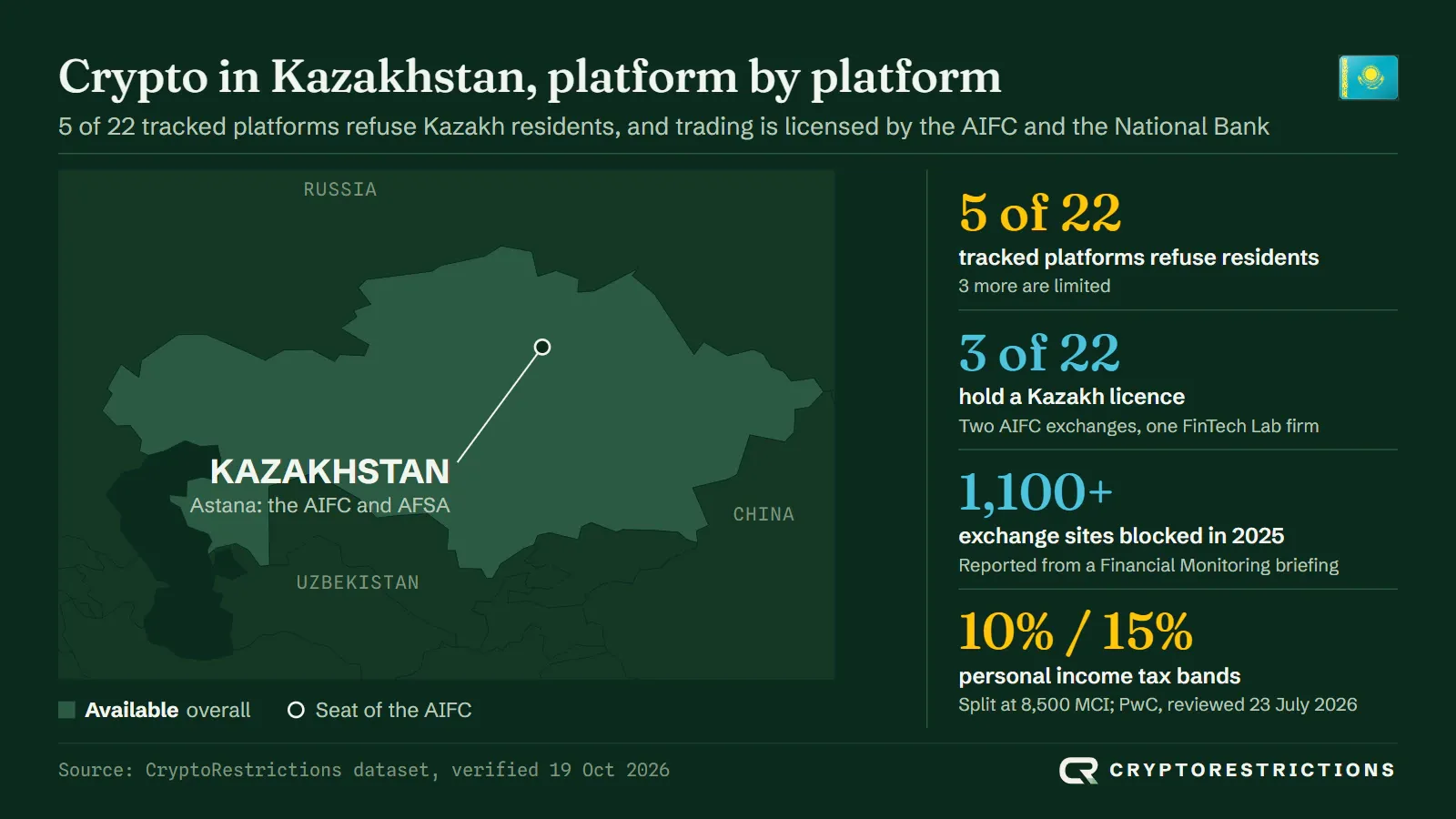
Yes, inside a licence. Trading crypto is lawful only through licensed operators, first in the Astana International Financial Centre (AIFC) and since 1 May 2026 through the National Bank as well, and we found no rule that bans an individual from holding crypto.
The Law on Digital Assets of 6 February 2023 (193-VII) set the legal framework for digital asset circulation and made mining a licensed activity. AFSA, the AIFC’s regulator, cites Article 11(5) of that law in its 29 April 2026 warning: organising the circulation of digital assets in Kazakhstan without a licence or authorisation is prohibited. The National Bank page adds that custodians, issuers and miners must be residents, while investors may be residents or non-residents.
For its first years the only licensing route was the AIFC, an English-law financial zone in Astana with its own regulator. The National Bank’s notice of 30 April 2026 opens a second one: from 1 May 2026 it licenses unsecured digital asset exchange operators and registers trading platform operators outside the AIFC, under a law it dates 16 January 2026. The AIFC keeps regulating the firms inside its own jurisdiction.
Which crypto exchanges work in Kazakhstan?
Binance, Bybit and Bitfinex hold a Kazakh licence, and most other platforms still accept Kazakh residents under their own terms without one. A licence is what makes an exchange lawful to serve residents, so open access on a global site is the platform’s choice, not Kazakh approval.
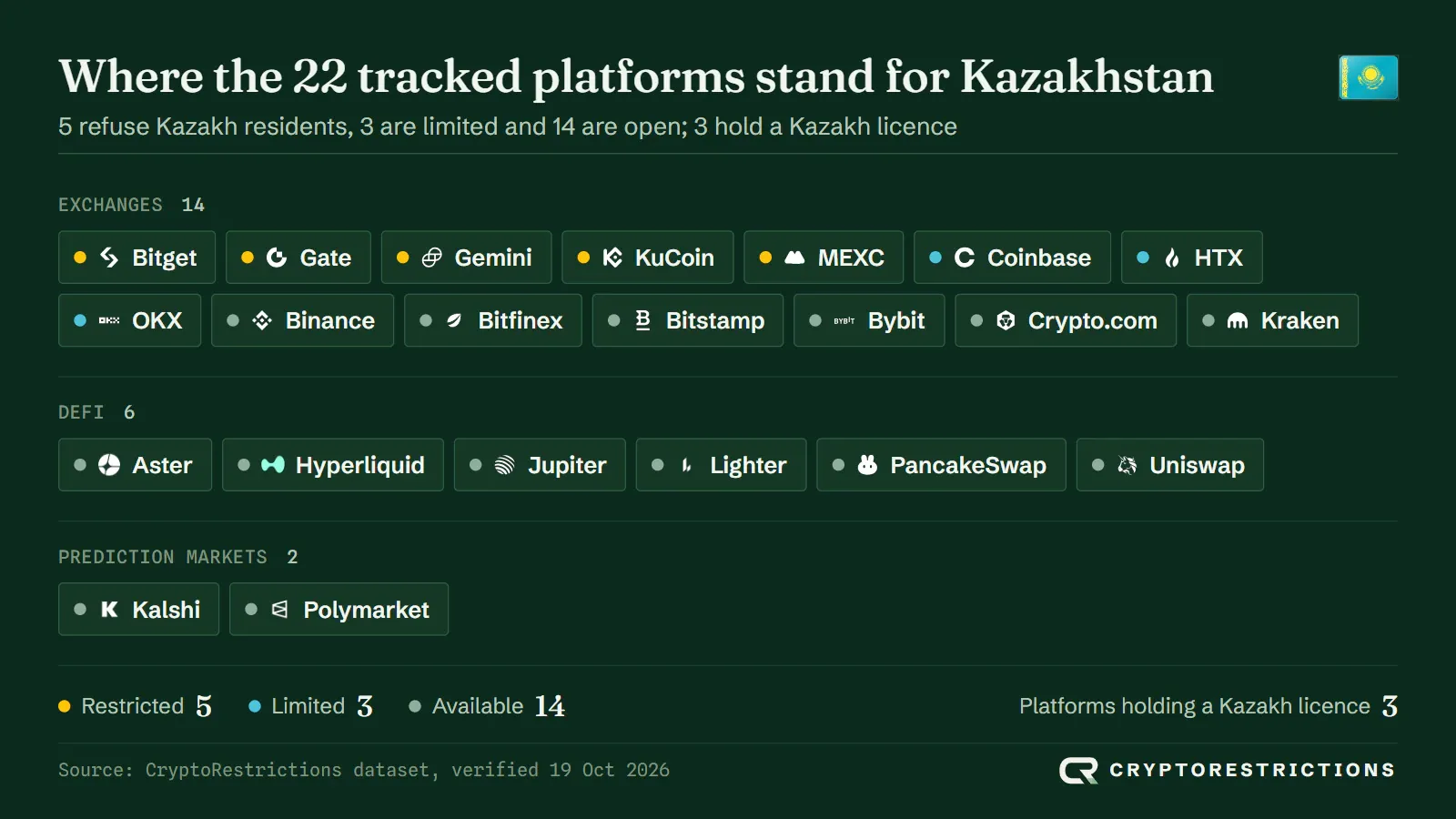
The AIFC’s news item of 7 October 2026 describes Bybit Kazakhstan and Binance Kazakhstan as registered with the AIFC and operating under AFSA licences. We could not read licence numbers: the AFSA public register returned an error on 19 October 2026, so neither entry carries a number or grant date on our site.
Binance also shows Kazakh visitors a notice that points them to Binance Kazakhstan. The third licence is Bitfinex Securities, a participant in the AIFC FinTech Lab since 18 May 2021 (AFSA-G-LA-2021-0012, read on the register on 17 October 2026), which tokenises securities and is not a retail spot exchange.
The register’s index page listed 36 digital asset service provider entries on 19 October 2026. That is a count of entries, not of exchanges, and it includes firms we do not track.
Best crypto platforms for Kazakh residents
The score ranks every platform that is open to Kazakh residents by how fully they can use it, not by fees or safety. It is computed from our data and moves when a row changes.
The score is made of access status (4 points), the share of the platform’s products open here (3), the Kazakh licences we hold on file (2) and what our geo-access test saw from a Kazakh address (1). Platforms that refuse Kazakh residents are not scored, and we left out the limited ones named in a regulator warning or blocked by the state (OKX, HTX and Coinbase). The full method is on our methodology page.
Exchanges

Binance
Best for A licensed local entity and the global site
9.0/10- Access
- 4/4
- Products
- 3/3
- Licences
- 1/2
- Our test
- 1/1
Read our Binance reportPros
- Binance Kazakhstan operates under AFSA licences
- Not on its prohibited-countries list
Cons
- Its notice says AIFC rules may restrict some services
- No licence number or date confirmed

Bitfinex
Best for Spot trading with a FinTech Lab link
9.0/10- Access
- 4/4
- Products
- 3/3
- Licences
- 1/2
- Our test
- 1/1
Read our Bitfinex reportPros
- Bitfinex Securities holds an AIFC FinTech Lab licence
- Its pages loaded in our test
Cons
- That licence covers tokenised securities, not retail spot

Bybit
Best for Spot and derivatives with a local entity
9.0/10- Access
- 4/4
- Products
- 3/3
- Licences
- 1/2
- Our test
- 1/1
Read our Bybit reportPros
- Bybit Kazakhstan operates under an AFSA licence
- Its sign-up page preselected Kazakhstan in our test
Cons
- No licence number or date confirmed

Bitstamp
Best for Plain spot trading
7.5/10- Access
- 4/4
- Products
- 3/3
- Licences
- 0/2
- Our test
- 0.5/1
Read our Bitstamp reportPros
- No Bitstamp document excludes Kazakhstan
Cons
- No Kazakh licence on file
- Not tested from Kazakhstan

Crypto.com
Best for App-based buying and spending
7.5/10- Access
- 4/4
- Products
- 3/3
- Licences
- 0/2
- Our test
- 0.5/1
Read our Crypto.com reportPros
- Not on its App, spot or sanctions lists
Cons
- No Kazakh licence on file
- Not tested from Kazakhstan

Kraken
Best for Spot trading and staking
7.5/10- Access
- 4/4
- Products
- 3/3
- Licences
- 0/2
- Our test
- 0.5/1
Read our Kraken reportPros
- Not on its do-not-serve list
Cons
- No Kazakh licence on file
- Not tested from Kazakhstan
DeFi

Hyperliquid
Best for Perpetuals from your own wallet
8.0/10- Access
- 4/4
- Products
- 3/3
- Licences
- 0/2
- Our test
- 1/1
Read our Hyperliquid reportPros
- Its app and sign-up loaded in our test
- Kazakhstan is not named in its terms
Cons
- No Kazakh licence on file

Jupiter
Best for Solana swaps and staking
7.5/10- Access
- 4/4
- Products
- 3/3
- Licences
- 0/2
- Our test
- 0.5/1
Read our Jupiter reportPros
- Kazakhstan is not in its terms
Cons
- No Kazakh licence on file
- Not tested from Kazakhstan

Uniswap
Best for Swapping tokens from your own wallet
7.5/10- Access
- 4/4
- Products
- 3/3
- Licences
- 0/2
- Our test
- 0.5/1
Read our Uniswap reportPros
- Its terms bar only places under comprehensive US sanctions
Cons
- No Kazakh licence on file
- Not tested from Kazakhstan
Prediction markets

Kalshi
Best for Regulated-style event contracts
7.5/10- Access
- 4/4
- Products
- 3/3
- Licences
- 0/2
- Our test
- 0.5/1
Read our Kalshi reportPros
- Not on its restricted-jurisdictions list
Cons
- AFSA allows event contracts only for professionals in its FinTech Lab
- Not tested from Kazakhstan

Polymarket
Best for Event markets with no listed block
7.5/10- Access
- 4/4
- Products
- 3/3
- Licences
- 0/2
- Our test
- 0.5/1
Read our Polymarket reportPros
- Not on its blocked-countries list
Cons
- AFSA allows event contracts only for professionals in its FinTech Lab
- Not tested from Kazakhstan
Which platforms block Kazakhstan users?
Gemini, KuCoin, Bitget, Gate and MEXC refuse Kazakh residents. Three more are limited: OKX and HTX, which AFSA named in a warning, and Coinbase, whose site Kazakh authorities confirmed blocking in 2023.
Gemini serves a fixed list of countries, and Kazakhstan is on neither its main list nor its derivatives list. KuCoin names Kazakhstan among its restricted locations in terms updated 29 September 2026, and Bitget lists it as prohibited in terms updated 16 October 2026. MEXC lists Kazakhstan in its user agreement of 13 October 2026, and Gate names it in its block notice although its user agreement does not.


AFSA’s warning is not a block. It says AFSA keeps no list of prohibited platforms, and it named OKX and HTX (with Bitget and MEXC) as platforms promoting crypto trading to Kazakh citizens without authorisation. OKX’s own restricted-locations list does not name Kazakhstan. Coinbase lists Kazakhstan as a sign-up country, but Cointelegraph reported on 7 November 2023 that the Ministry of Culture and Information blocked its website on a request from the Ministry of Digital Development. We did not read the order itself and found no report of the block being lifted.


What our geo-access test saw from Kazakhstan
From a virtual Kazakh address on 14 and 16 October 2026 we tested 12 of the 22 platforms we track. Ten loaded with no barrier, Gate showed a notice for the EU site, and MEXC refused us at sign-up.
An open page is not permission, and a virtual address tests a platform’s geo-blocking only, not a national internet block or a bank’s refusal to process a payment. Binance counts among the ten, but it loaded behind a notice offering Binance Kazakhstan. KuCoin and OKX loaded too, although KuCoin’s terms name Kazakhstan and AFSA named OKX. We did not test the other ten platforms from Kazakhstan. Swipe through the screenshots below to see the pages as they loaded.
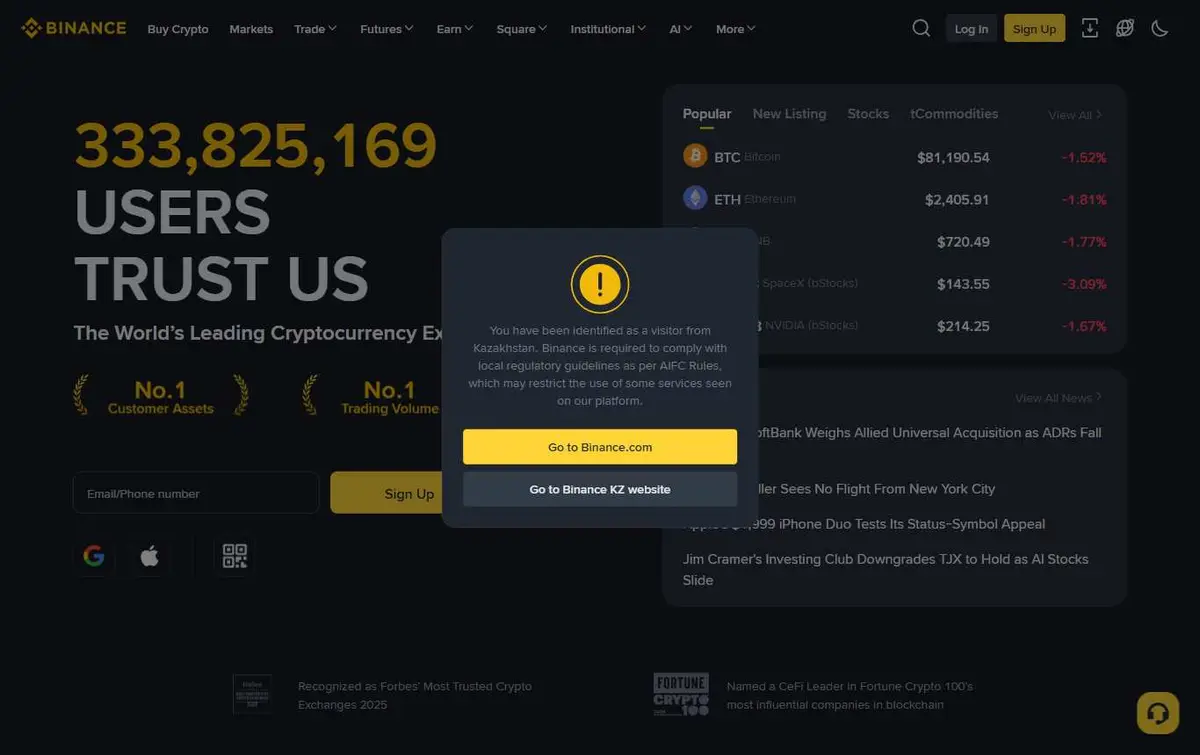
No barrier Binance · Home page
Kazakhstan: the home page loads behind a notice offering Binance Kazakhstan, under AIFC rules
“Binance is required to comply with local regulatory guidelines as per AIFC Rules, which may restrict the use of some services seen on our platform.”
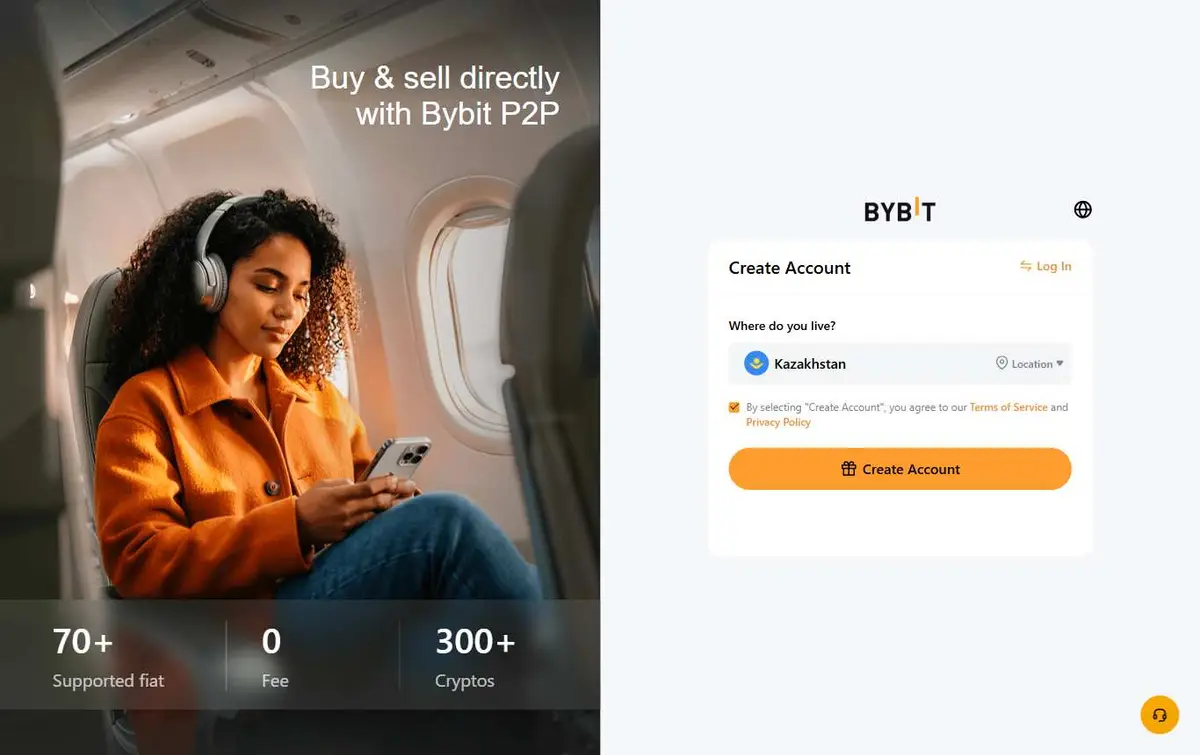
No barrier Bybit · Sign-up page
Kazakhstan: the sign-up page loads with Kazakhstan preselected as the location
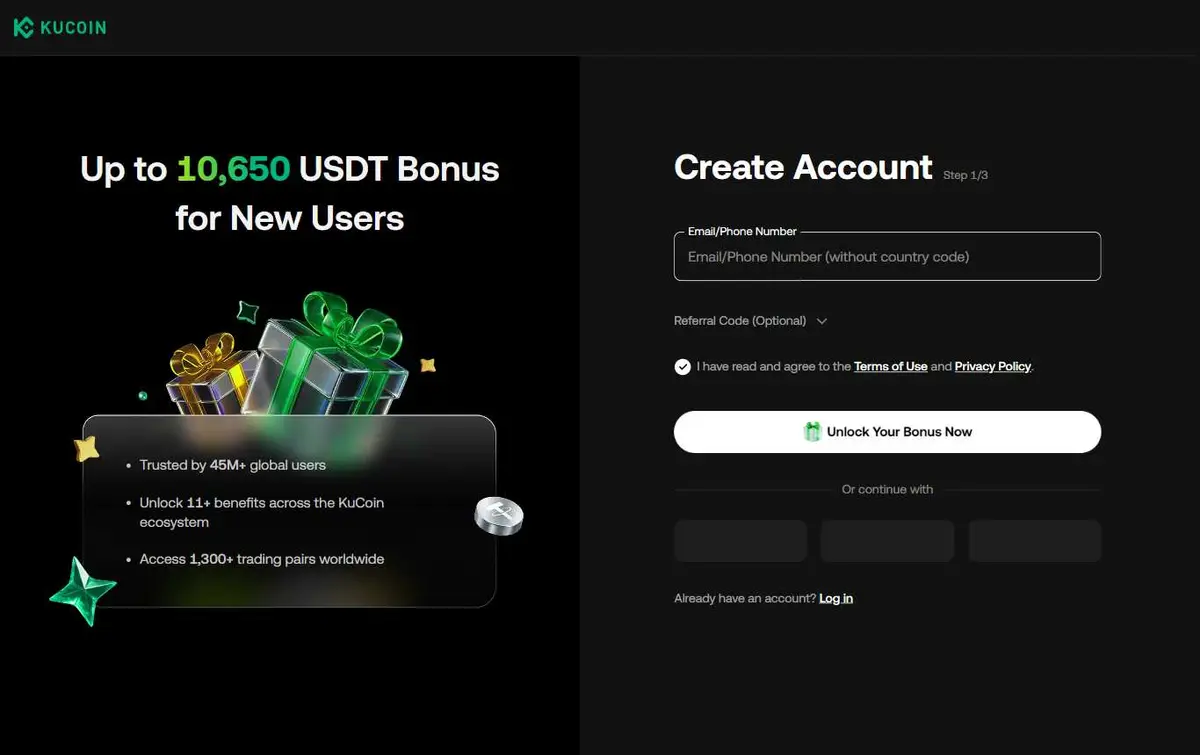
No barrier KuCoin · Sign-up page
Kazakhstan is on the list, yet a virtual location loaded with no block
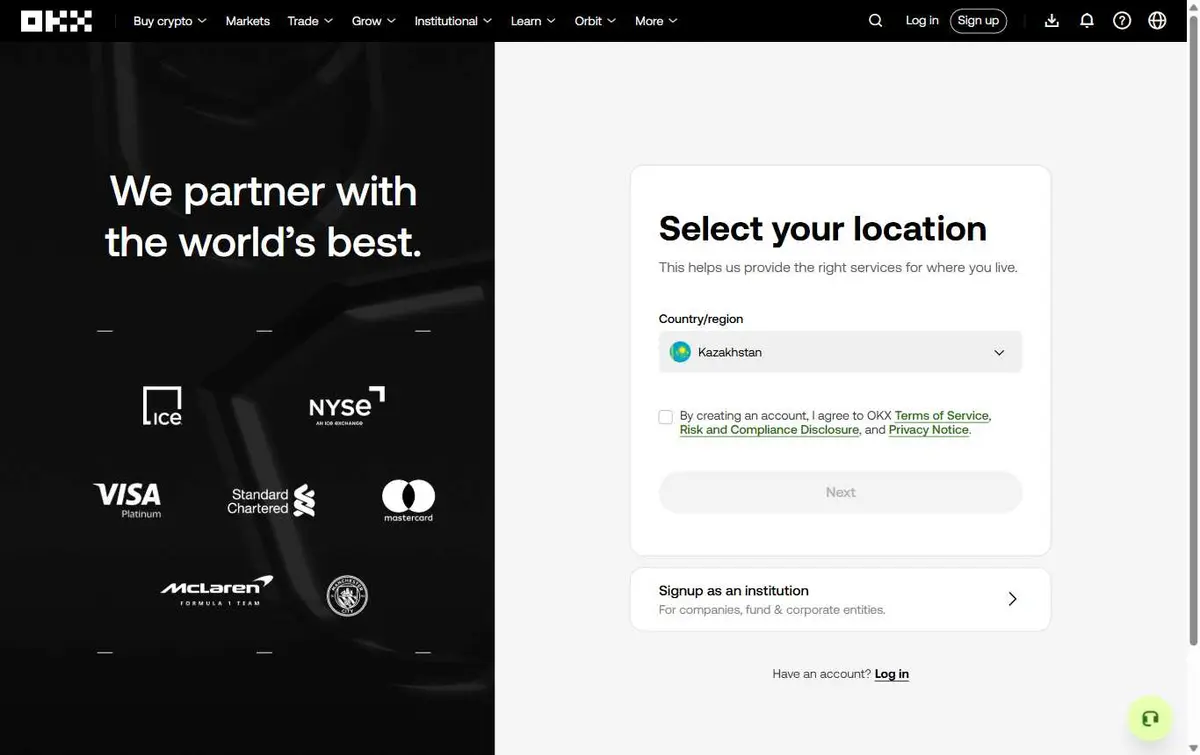
No barrier OKX · Sign-up page
Kazakhstan: the sign-up page loads with no barrier, though AFSA named OKX in an April 2026 warning
 CRYPTORESTRICTIONS
Who regulates crypto in Kazakhstan?
Two licensing regulators, split by where the firm sits: AFSA inside the AIFC and the National Bank outside it. Neither publishes a list of banned platforms, and blocking is done by other state bodies.
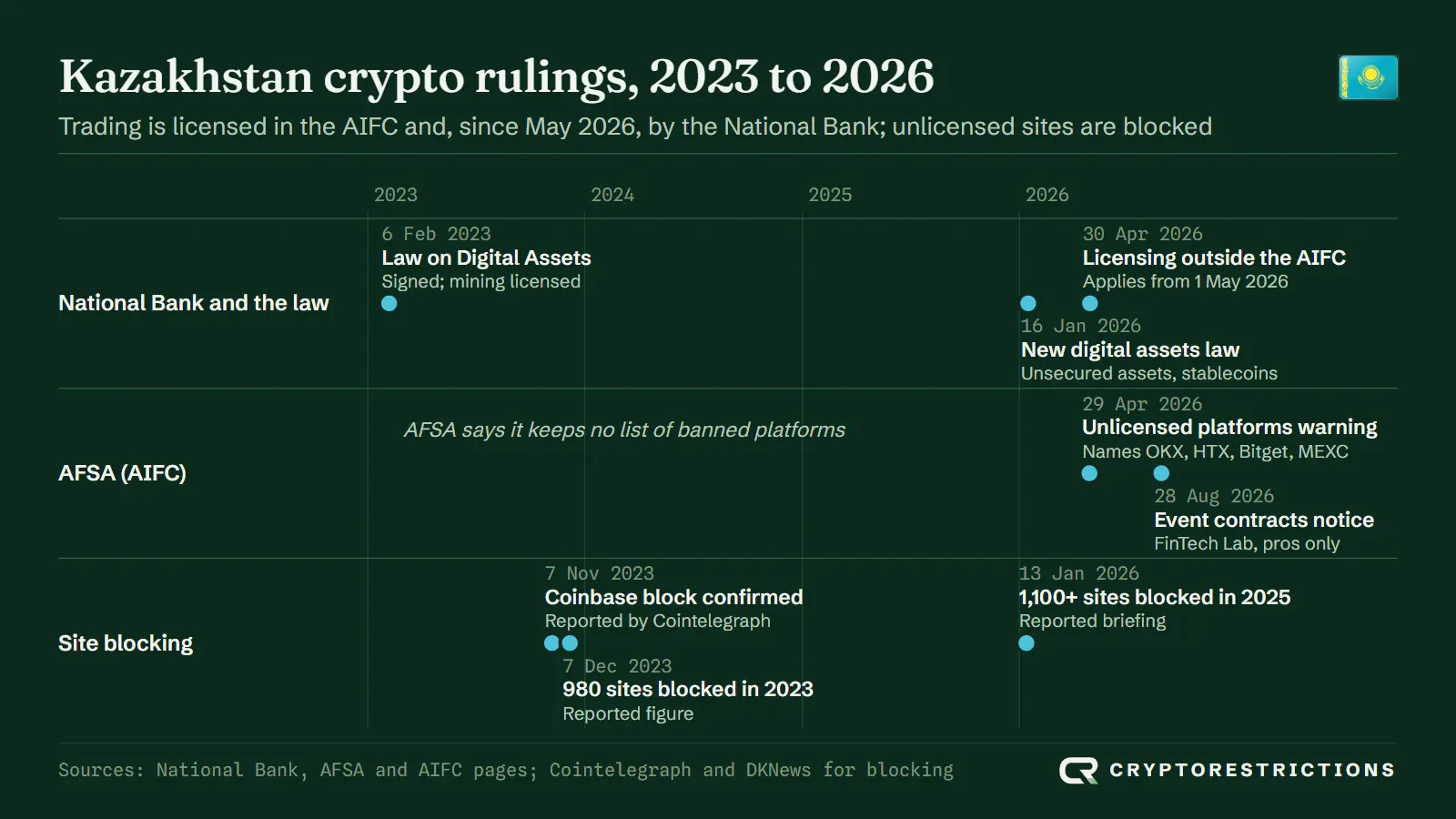
- AFSA. The regulator of the AIFC licenses digital asset trading facilities and the FinTech Lab. Its 29 April 2026 warning says it does not keep a list of prohibited platforms and sends reports about non-AIFC advertising to the Ministry of Culture and Information.
- National Bank. It licenses and supervises digital asset circulation outside the AIFC. The Agency for Regulation and Development of the Financial Market covers digital financial assets, except stablecoins, according to its notice.
- Blocking. The Financial Monitoring Agency reported blocking 980 unlicensed exchange sites in 2023, per Cointelegraph, and told the president in January 2026 that more than 1,100 were blocked in 2025 and 22 underground exchanges were shut. Both figures are secondary reports and name no platforms; the 2023 orders ran through the Ministry of Culture and Information.
Which crypto products are limited in Kazakhstan?
No Kazakh rule we read limits a trading product by name such as derivatives or staking. The limits are structural: who may run a platform, what mining needs, and a regulatory split that leaves stablecoins outside the digital financial asset rules.
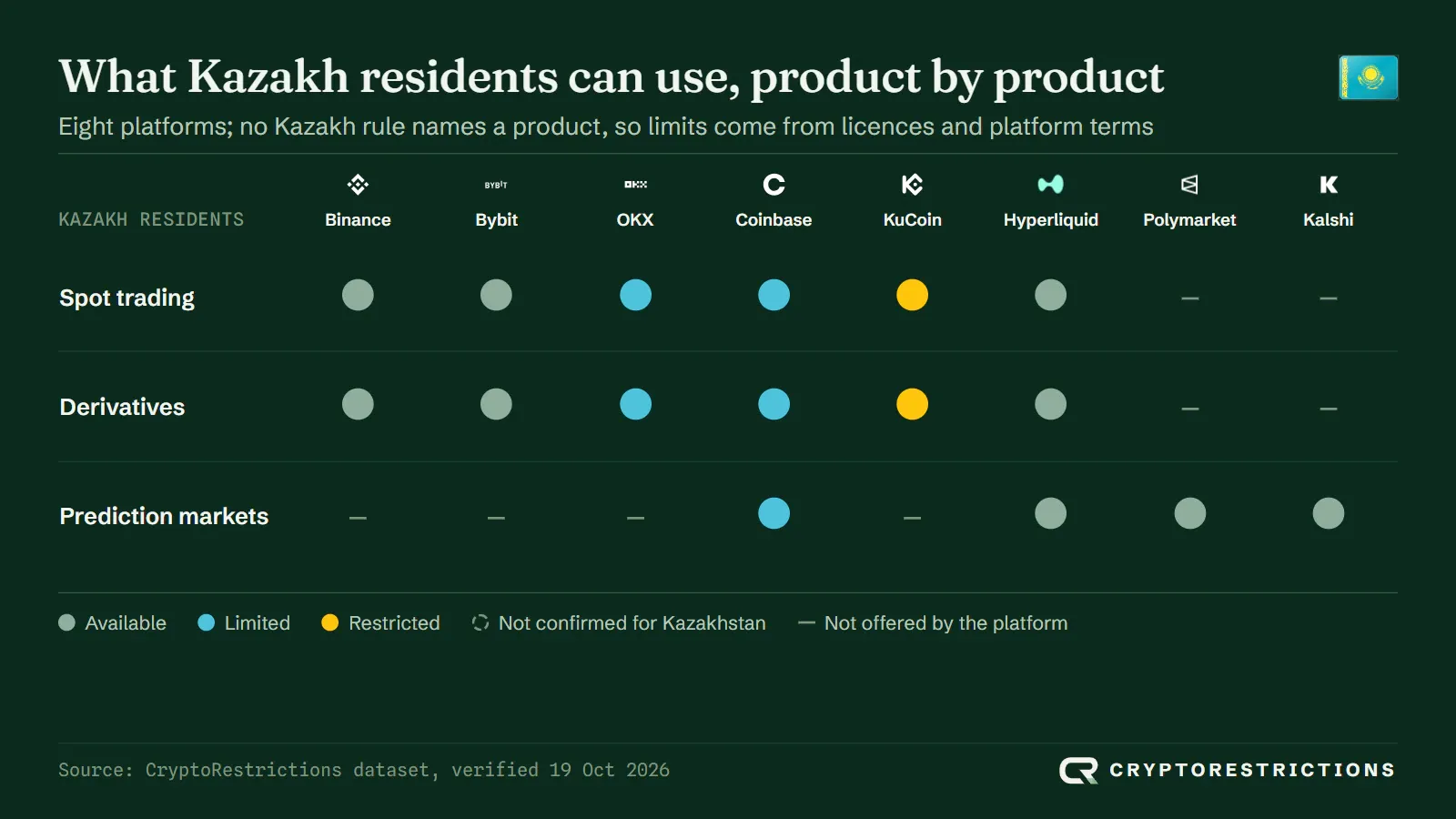
- Mining. Mining is a licensed activity under the 2023 law. A reported government resolution (638 of 18 July 2026), in force from 1 August 2026, sets strategic mining rules that send 10 percent of net mined assets to the state reserve, according to Crypto Briefing.
- Unsecured assets. Exchange operators for unsecured digital assets, such as most cryptocurrencies, are licensed by the National Bank from 1 May 2026.
- Stablecoins and tokenised assets. The digital financial asset regime excludes stablecoins, which the National Bank handles.
- Reserve. President Tokayev proposed a state digital asset fund in his 8 September 2025 address, and the Alem Crypto Fund launched on 29 September 2025, with its first purchase in BNB through Binance Kazakhstan.
Are prediction markets legal in Kazakhstan?
Only in a narrow, professional form. AFSA lets firms test event contracts in its FinTech Lab for professional clients and says they are not for the retail public, while the law bans online casinos.
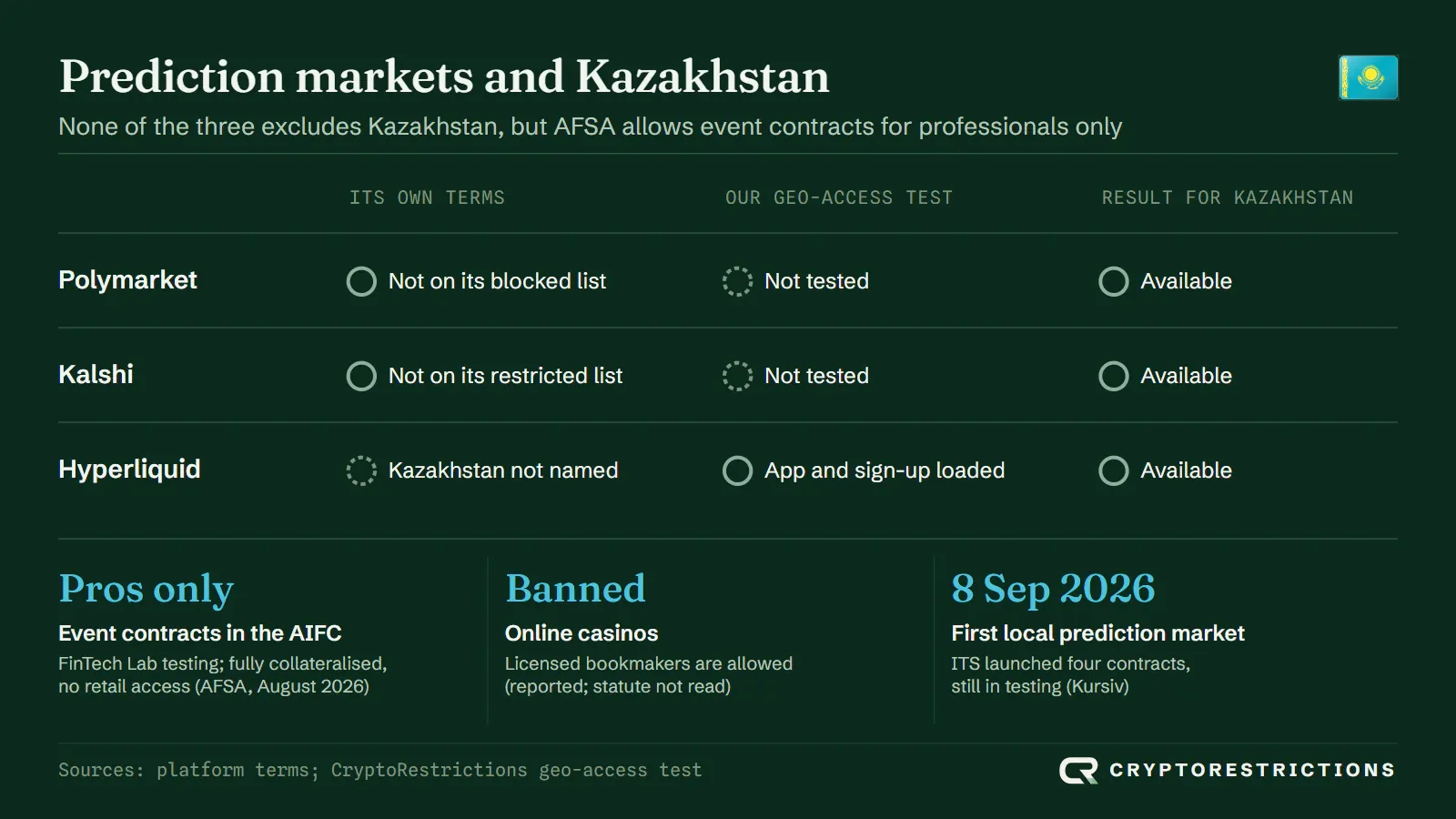
AFSA’s notice AFSA-FTD-NOT-2026-0025 (August 2026) says tested contracts may cover only financial and economic events, must be fully collateralised with no margin or leverage, and go to professional and eligible semi-professional clients only. The ITS prediction market, a local platform, launched on 8 September 2026 with four contracts and was still testing, Kursiv reported on 14 October 2026.
We found no Kazakh order against Polymarket or Kalshi, and neither names Kazakhstan on its list. Under the gambling law, as Zakon.kz reports, licensed bookmakers are allowed and online casinos are banned. We did not read the statute, so whether a global event-contract site counts as gambling is our inference.
How is crypto taxed in Kazakhstan?
Individuals pay personal income tax on gains at two bands, and companies pay a general corporate rate. An exemption for crypto income earned through licensed providers has been announced but is not law in the sources we read.
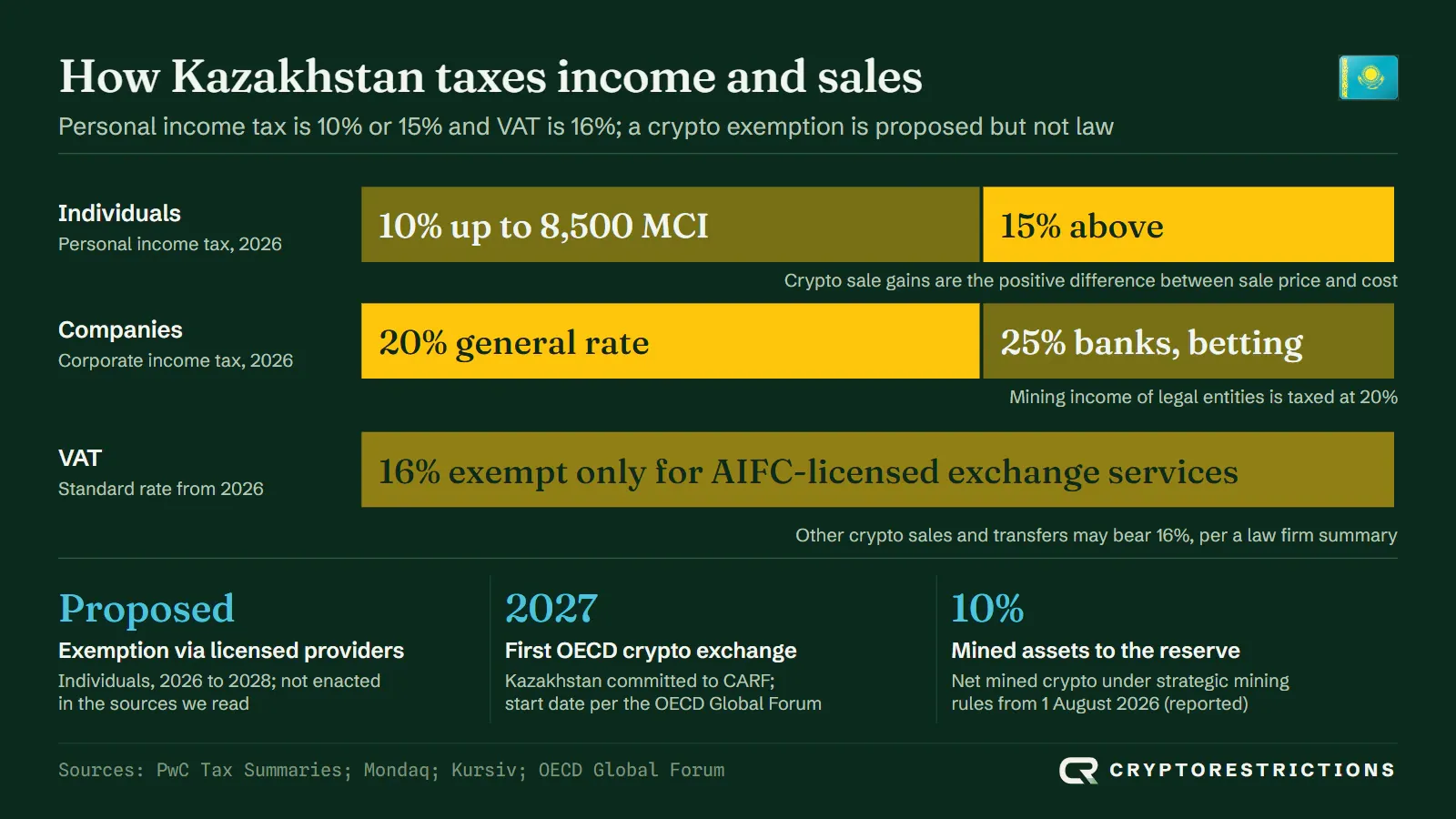
PwC’s summary, reviewed 23 July 2026, puts personal income tax at 10 percent up to 8,500 monthly calculation indices (MCI) and 15 percent above for 2026. Its corporate page gives a 20 percent general rate, 25 percent for banks and betting. We could not read the Tax Code itself or the declaration forms and deadlines, and we found no holding-period rule.
A law firm summary says a crypto sale is taxed on the positive difference between sale price and cost, that mining income is taxed when the coins are acquired, and that the 16 percent VAT exemption now covers only exchange services licensed by the AIFC. Kursiv reported on 8 July 2026 that individuals’ digital asset income is planned to be exempt from tax when handled through regulated infrastructure, and the proposals we found cover deals through Kazakh providers from 2026 to 2028. The OECD says Kazakhstan is on track for first crypto-asset exchanges in 2027; our fetch of that page failed, so the date comes from a search summary of its text.



 Bahrain
 Georgia
 Qatar
 Israel
 Saudi Arabia
 Vietnam
 Pakistan
 Bangladesh
 Indonesia
 United Arab Emirates
 South Korea