

Is crypto legal in Israel?
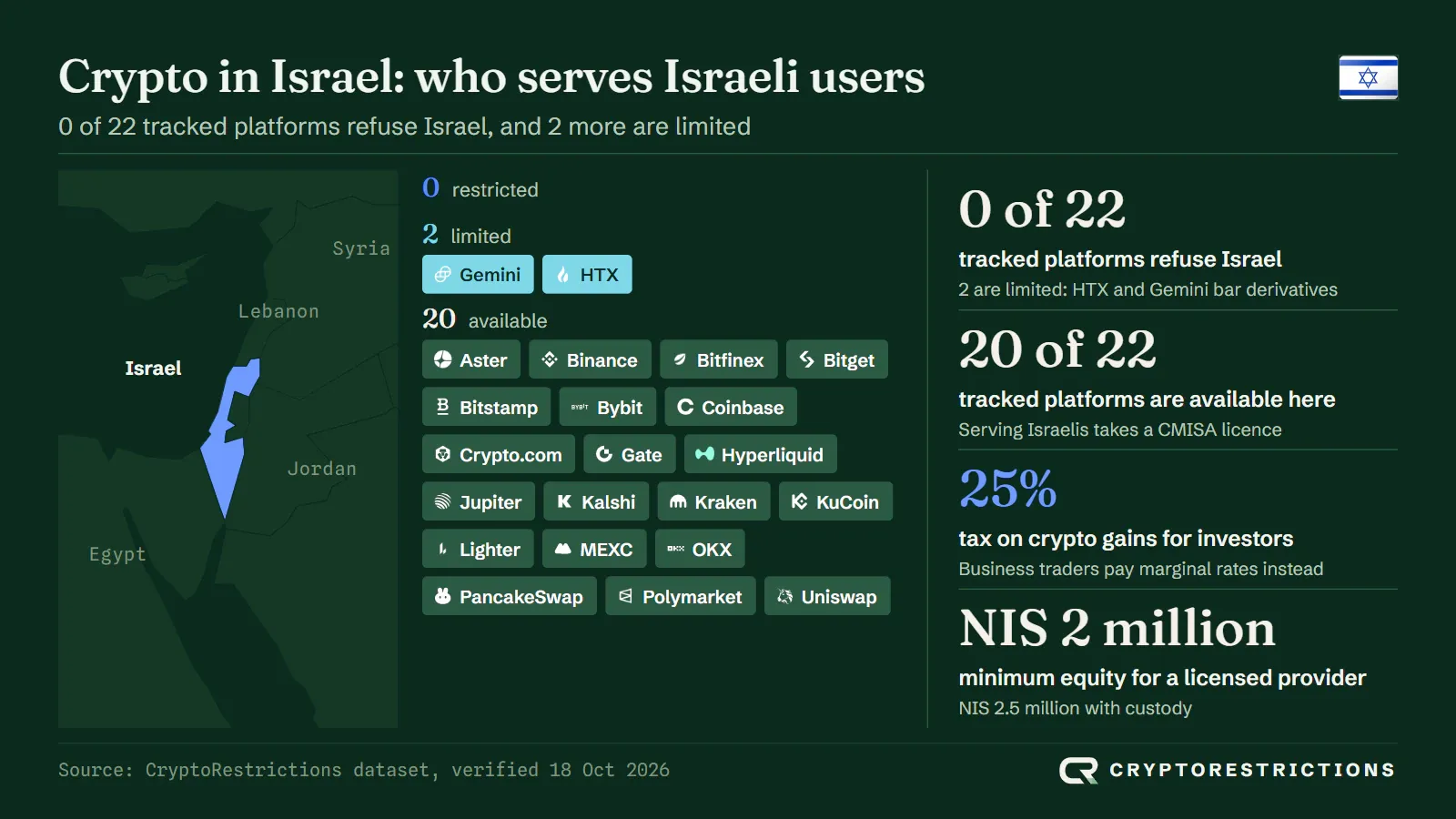
Yes. We found no ban on holding or trading crypto, and Israel taxes the gains. A business that serves the public in crypto needs a licence from the Capital Market, Insurance and Savings Authority (CMISA).
Crypto services sit under the Supervision of Financial Services (Regulated Financial Services) Law of 2016, according to Herzog Fox & Neeman’s May 2026 note on a bill that would amend it. The Bank of Israel’s 2022 circular refers to the same licensing procedure for entities that provide financial asset services, including virtual currency services. The rules are being filled in by circulars and drafts rather than one crypto statute, which the regulators section lists.
The Tax Authority treats crypto as an asset, not a currency, so sales are taxed as asset sales. The tax section has the rates. The consumer risk sits mostly with the banks: the Bank of Israel calls payments tied to virtual currency a high money-laundering risk, and the State Comptroller found in November 2024 that banks still refused some crypto-origin funds.
Which crypto exchanges work in Israel?
Twelve of the 14 exchanges we track serve Israel without limits, and HTX and Gemini are limited. No tracked exchange holds a CMISA licence on file, because we could not read the regulator’s licence register.
Israel has no passporting system, so the chart shows what each exchange’s own documents say. The open exchanges are open because Israel is missing from a published exclusion list, which is medium-confidence evidence; Coinbase’s identity guide lists Israel as a sign-up country, which is stronger evidence than a missing exclusion. KuCoin’s terms, Bitget’s terms, Gate’s user agreement and MEXC’s user agreement each name restricted places, and Israel is not among them.
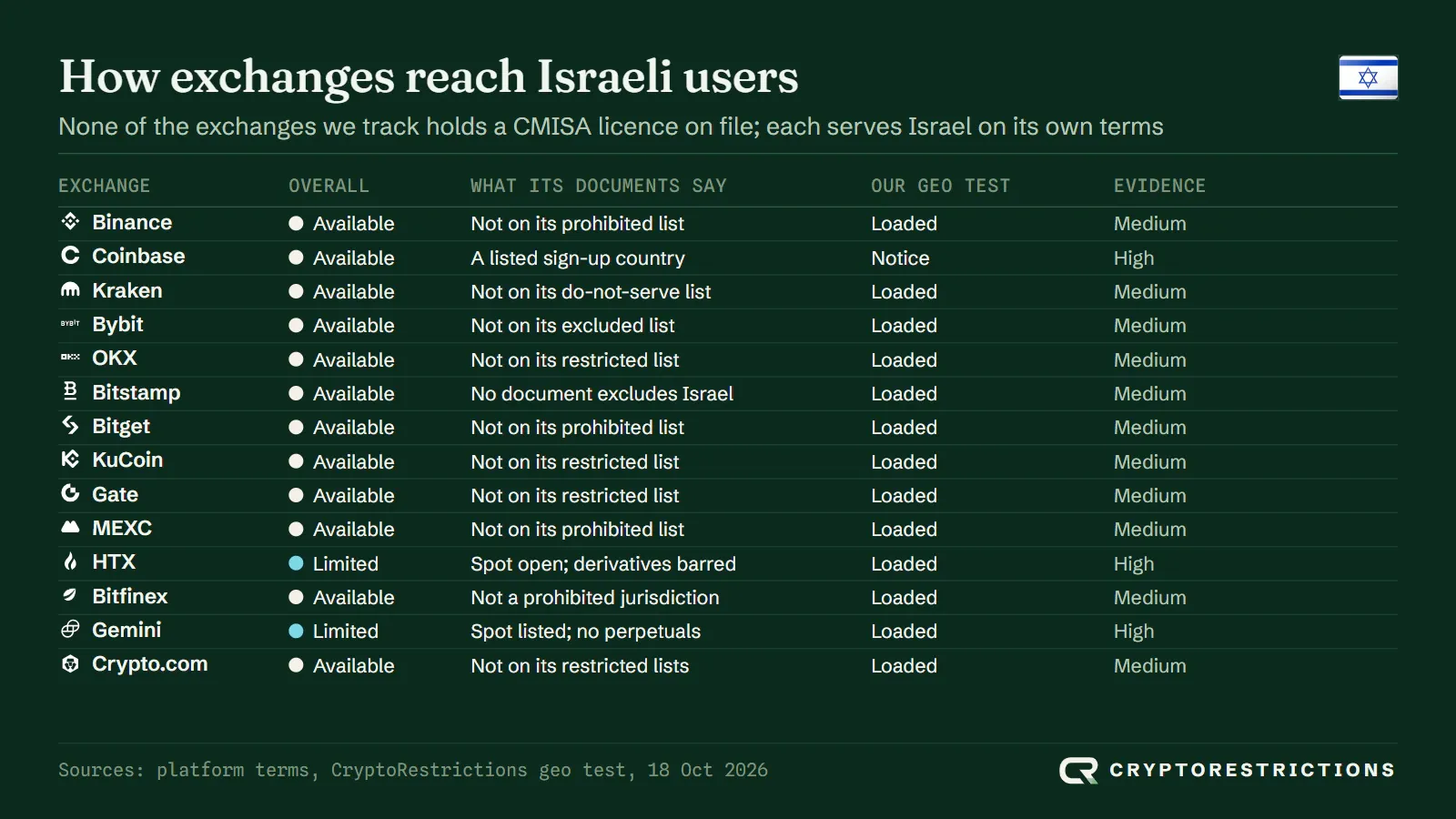
A licence gap is not a clean bill. The Globes report of 23 February 2022 says CMISA told Binance to obtain an Israeli licence or stop marketing to Israelis, and that Binance had not applied. We did not find a later CMISA statement about it, and Binance’s current prohibited list does not name Israel. Israeli-based exchanges sit outside our platform set.
Best crypto platforms for Israeli residents
By our access score seven exchanges tie at 8.0 out of 10: Binance, Bitget, Bitstamp, Bybit, Crypto.com, Kraken and OKX. Coinbase scores 7.5, Gemini 6.4 and HTX 5.7, while Kalshi, Polymarket and all six DeFi platforms we scored sit at 8.0.
The score rates how fully an Israeli resident can use each platform, not its fees or safety. It is computed from our data and moves when a row changes: access status (4 points), the share of the platform’s products open here (3), the licences we hold on file for Israel (2) and what our geo-access test saw from an Israeli address (1). We hold no Israeli licence row for any platform, so those two points are lost across the board. Platforms that refuse Israeli users are not scored, and none does here. The full method is on our methodology page.
Exchanges

Binance
Best for The largest exchange by trading volume
8.0/10- Access
- 4/4
- Products
- 3/3
- Licences
- 0/2
- Our test
- 1/1
Read our Binance reportPros
- Israel is not on its prohibited-countries list
Cons
- In February 2022 CMISA told it to get a licence or stop marketing to Israelis

Bitget
Best for Spot and derivatives from one account
8.0/10- Access
- 4/4
- Products
- 3/3
- Licences
- 0/2
- Our test
- 1/1
Read our Bitget reportPros
- Israel is not on its prohibited-countries list (16 June 2026)
Cons
- No Israeli licence on file

Bitstamp
Best for A long-running European exchange
8.0/10- Access
- 4/4
- Products
- 3/3
- Licences
- 0/2
- Our test
- 1/1
Read our Bitstamp reportPros
- No Bitstamp document excludes Israel
Cons
- No Israeli licence on file

Bybit
Best for Spot and derivatives from one account
8.0/10- Access
- 4/4
- Products
- 3/3
- Licences
- 0/2
- Our test
- 1/1
Read our Bybit reportPros
- Israel is not on its excluded-jurisdictions list
Cons
- No Israeli licence on file

Crypto.com
Best for Spot trading in an app
8.0/10- Access
- 4/4
- Products
- 3/3
- Licences
- 0/2
- Our test
- 1/1
Read our Crypto.com reportPros
- Israel is not on its app, spot or sanctions lists
Cons
- No Israeli licence on file

Kraken
Best for A major exchange with a published exclusion list
8.0/10- Access
- 4/4
- Products
- 3/3
- Licences
- 0/2
- Our test
- 1/1
Read our Kraken reportPros
- Israel is not on its do-not-serve list
Cons
- No Israeli licence on file

OKX
Best for A global exchange with a published list
8.0/10- Access
- 4/4
- Products
- 3/3
- Licences
- 0/2
- Our test
- 1/1
Read our OKX reportPros
- Israel is not on its restricted-locations list (updated 8 July 2026)
Cons
- No Israeli licence on file

Coinbase
Best for A US-listed exchange with a listed sign-up country
7.5/10- Access
- 4/4
- Products
- 3/3
- Licences
- 0/2
- Our test
- 0.5/1
Read our Coinbase reportPros
- Israel is a listed sign-up country in its identity guide
Cons
- Its home page shows a notice that stocks and prediction markets are unavailable here

Gemini
Best for Spot trading without derivatives
6.4/10- Access
- 3.5/4
- Products
- 1.9/3
- Licences
- 0/2
- Our test
- 1/1
Read our Gemini reportPros
- Israel is on its main list for spot trading
Cons
- Israel is not on its perpetuals list, so derivatives are not offered

HTX
Best for Spot trading on a global exchange
5.7/10- Access
- 3/4
- Products
- 1.7/3
- Licences
- 0/2
- Our test
- 1/1
Read our HTX reportPros
- Its spot and other services are not restricted here
Cons
- Its user agreement bars derivatives trading in Israel
Prediction markets

Kalshi
Best for A regulated US event-contract exchange
8.0/10- Access
- 4/4
- Products
- 3/3
- Licences
- 0/2
- Our test
- 1/1
Read our Kalshi reportPros
- Israel is not on its restricted-jurisdictions list
Cons
- We found no Israeli ruling on whether event contracts count as betting

Polymarket
Best for The largest crypto prediction market
8.0/10- Access
- 4/4
- Products
- 3/3
- Licences
- 0/2
- Our test
- 1/1
Read our Polymarket reportPros
- Israel is not on its blocked-countries list
Cons
- Two Israelis were indicted in February 2026 over bets placed with classified information
DeFi

Aster
Best for Perpetuals from your own wallet
8.0/10- Access
- 4/4
- Products
- 3/3
- Licences
- 0/2
- Our test
- 1/1
Read our Aster reportPros
- Israel is not on its prohibited-jurisdictions list
Cons
- No Israeli licence on file

Hyperliquid
Best for On-chain perpetuals
8.0/10- Access
- 4/4
- Products
- 3/3
- Licences
- 0/2
- Our test
- 1/1
Read our Hyperliquid reportPros
- Israel is not excluded by its terms
Cons
- No Israeli licence on file

Jupiter
Best for Solana swaps
8.0/10- Access
- 4/4
- Products
- 3/3
- Licences
- 0/2
- Our test
- 1/1
Read our Jupiter reportPros
- Israel is not in its terms
Cons
- No Israeli licence on file

Lighter
Best for On-chain perpetuals
8.0/10- Access
- 4/4
- Products
- 3/3
- Licences
- 0/2
- Our test
- 1/1
Read our Lighter reportPros
- Israel is not named in its terms
Cons
- No Israeli licence on file

PancakeSwap
Best for BNB Chain swaps and pools
8.0/10- Access
- 4/4
- Products
- 3/3
- Licences
- 0/2
- Our test
- 1/1
Read our PancakeSwap reportPros
- Not excluded by its terms
Cons
- No Israeli licence on file

Uniswap
Best for Swapping tokens from your own wallet
8.0/10- Access
- 4/4
- Products
- 3/3
- Licences
- 0/2
- Our test
- 1/1
Read our Uniswap reportPros
- Its terms bar only places under comprehensive US sanctions
Cons
- No Israeli licence on file
Which platforms block Israeli users?
None of the 22 platforms we track refuses Israel. Two are limited, HTX and Gemini, and both limits are about derivatives.
HTX’s user agreement bars derivatives trading here, while spot and its other services are not restricted. Gemini’s main list covers Israel, but its perpetuals list does not, so it offers spot only. Neither is an Israeli ban on crypto.
What our geo-access test saw from Israel
From an Israeli address on 14 and 16 October 2026 we loaded all 22 platforms we track: 21 showed no barrier and 1 showed a notice.
An open page is not permission, and most platforms enforce at identity verification. The notice was Coinbase’s note that stocks and prediction markets are unavailable here. HTX and Gemini loaded normally, so the derivatives limits above come from their documents and not from a page block. Swipe through the screenshots below; each card says what the page showed.
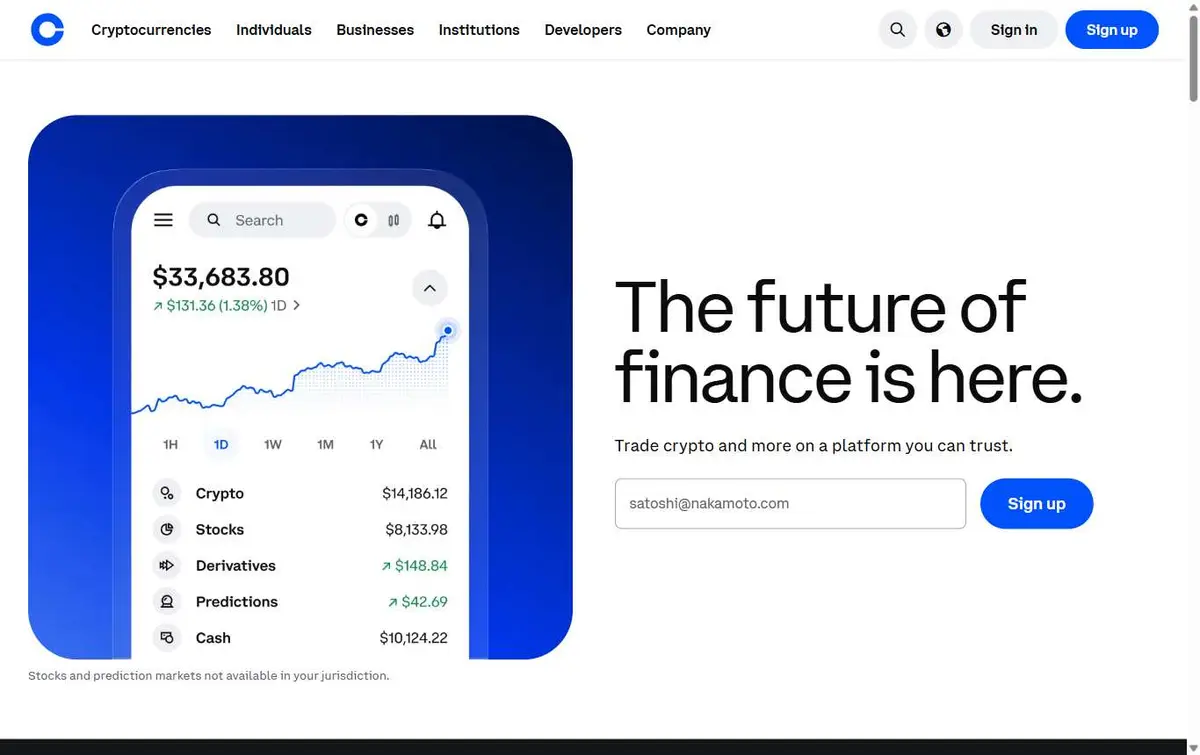
Notice shown Coinbase · Home page
Israel: the site loads, with a notice that stocks and prediction markets are not available
“Stocks and prediction markets not available in your jurisdiction.”
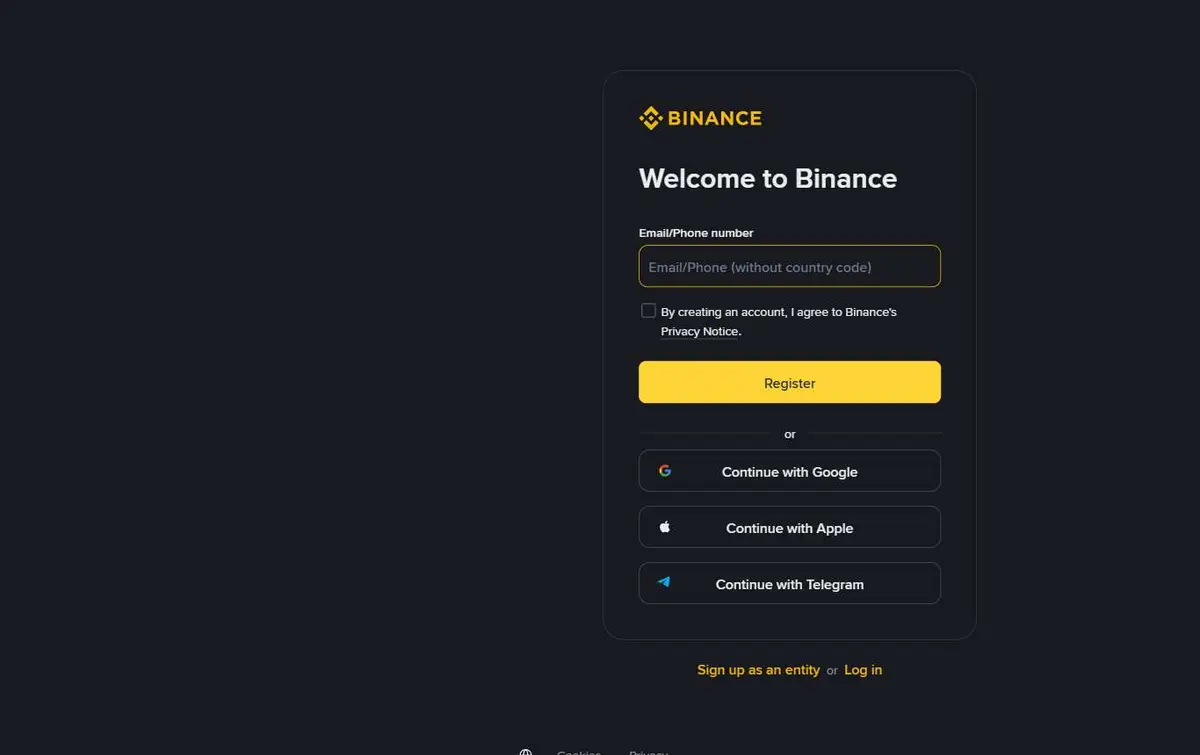
No barrier Binance · Sign-up page
Israel is not on the prohibited list, and the sign-up page loads with no barrier
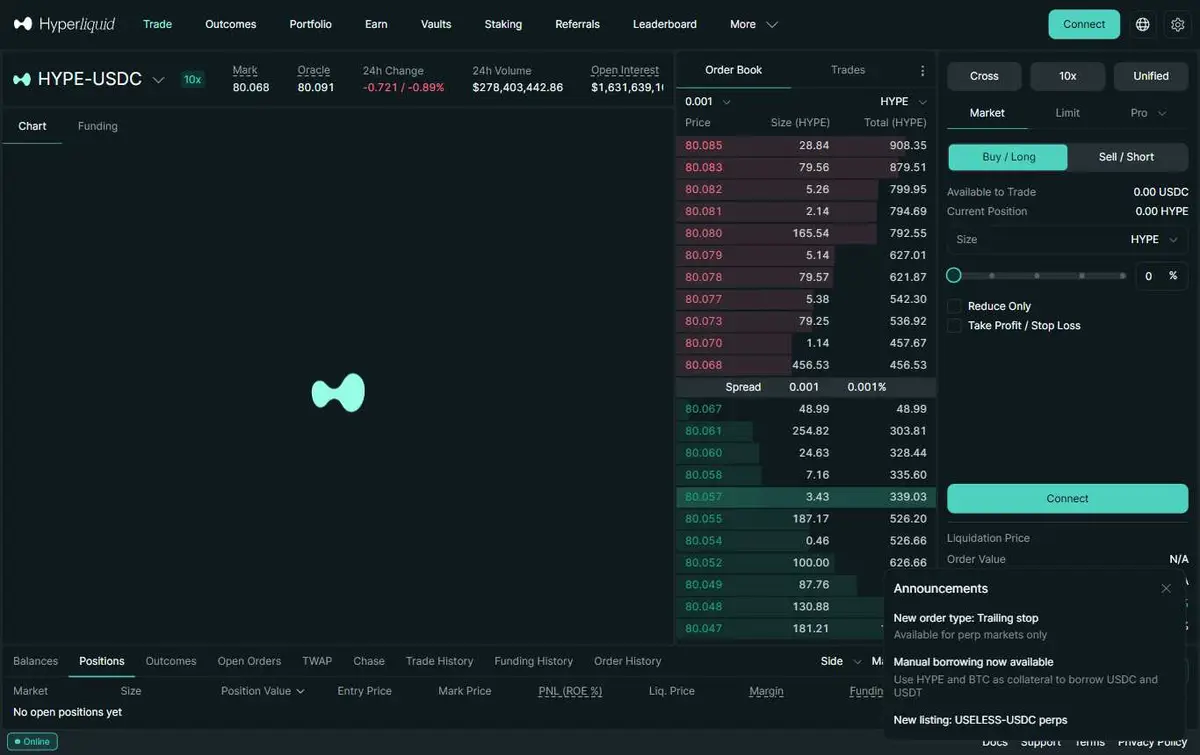
No barrierHyperliquid · Trading app
The trading app loads from an Israeli address with no barrier
 CRYPTORESTRICTIONS
Who regulates crypto in Israel?
CMISA licenses crypto service providers, the Bank of Israel sets the rules for banks, and the Israel Securities Authority decides when a token is a security. The Finance Ministry has stablecoin and foreign-provider bills out, and the NBCTF seizes wallets it links to terror groups.
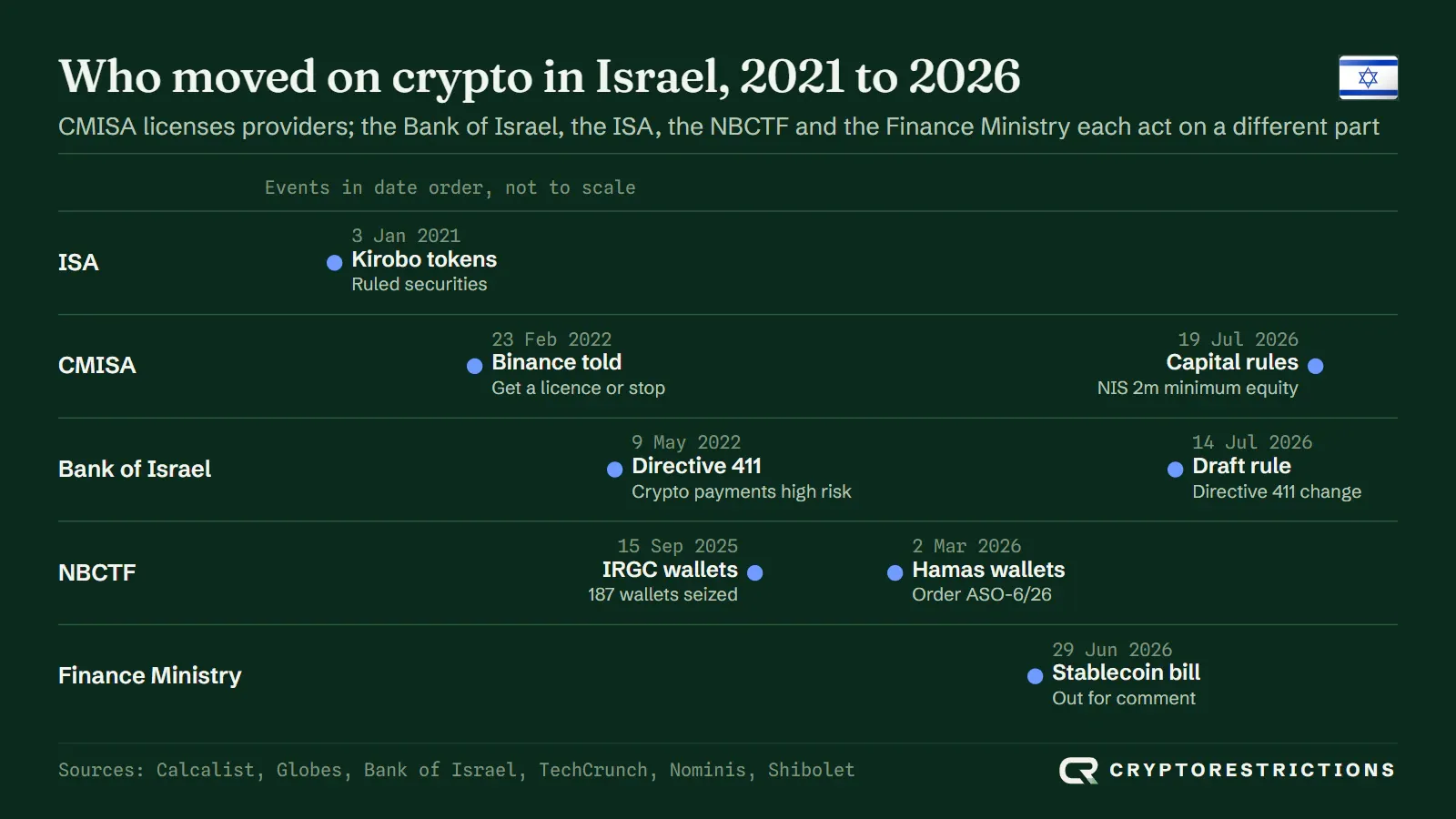
- CMISA. The licensing authority. On 19 July 2026 it published minimum equity for virtual-currency licence holders: NIS 2 million, or NIS 2.5 million with custody, plus 0.25% of the value of customer coins held, in force six months after publication (Shibolet, 7 September 2026). A draft circular of 28 July 2026 would require a listing policy and let a coin qualify by default only if at least five licensed entities in the EU or New York list it, it has held a market value of USD 500 million for six months and ranks in the top 50; NFTs and privacy coins would be excluded.
- Israel Securities Authority (ISA). On 3 January 2021 it ruled that the tokens Kirobo planned to sell were securities, because buyers expected a return. We found no ISA crypto statement dated 2024 to 2026.
- Bank of Israel. Its Banking Supervision Department’s circular of 9 May 2022 added section 87A to Directive 411, which treats payments tied to virtual currency as high-risk activity. Banks must assess the risk, publish their policy and report to their boards every six months. A draft amendment of 14 July 2026 would move banks to a risk-based approach, bar refusing a payment only because it involves crypto, and drop the review of source of funds above NIS 100,000 a year; it is not yet binding.
- Finance Ministry. A stablecoin bill published for comment on 29 June 2026 would license issuers, require NIS 2 million of equity and reserves of at least 100% of holder claims. A separate bill of 11 May 2026 would let CMISA grant a tailored licence to a foreign-regulated provider; it was sent to the Knesset for a first reading.
- IMPA. The money-laundering authority receives suspicious-transaction reports from covered institutions, a list that includes trading platforms.
- National Bureau for Counter Terror Financing (NBCTF). Part of the Defence Ministry. Order ASO-6/26 of 2 March 2026 seizes three wallets as Hamas property and requires anyone holding or processing them to report to the police and the NBCTF. On 15 September 2025 it ordered the seizure of 187 wallets it says belong to Iran’s Revolutionary Guards; the blockchain firm Elliptic said it could not confirm that. These are enforcement facts about named wallets, not rules for ordinary users.
Which crypto products are limited in Israel?
Spot trading is the open product. Derivatives are the narrow one, barred outright on HTX and missing from Gemini, and Coinbase tells Israeli visitors that its stock and prediction-market products are unavailable.
- Derivatives. HTX bars them in its user agreement, and Gemini lists Israel for spot but not for perpetuals. The other exchanges we track do not name Israel in their derivatives restrictions, based on the lists we read.
- Stablecoins. CMISA’s draft rules would exempt stablecoins from an Israeli licensed issuer from the listing criteria, and the Finance Ministry’s bill would be the first licensing law for issuers. Both are drafts as of 17 October 2026.
- Custody. The July 2026 capital rule adds 0.25% of customer coins held in custody to the NIS 2.5 million minimum, so custody carries a higher bar than trading alone.
- Bank deposits. Taking sale proceeds into an Israeli bank account is the practical limit. The State Comptroller’s November 2024 report says banks refused crypto-origin funds in some cases even after the Directive 411 amendment, which is why the Tax Authority built a separate payment route, covered in the tax section.
Are prediction markets legal in Israel?
That is untested. Israel’s penal law defines betting broadly and bans organising or taking part in it, but we found no ruling or regulator statement on Polymarket or Kalshi, and both load from Israel.
The Penal Law’s English text, Article Twelve, defines betting as any arrangement in which money or a benefit can be won depending on a guess. Section 225 makes organising a bet punishable by up to three years in prison, and section 226 makes playing a prohibited game punishable by up to one year. Section 230 exempts small social games, and section 231 exempts lotteries and Pais sports-betting events that the Finance Minister permits. The translation we read is the sixth edition and may predate later amendments. Whether a prediction-market contract fits the definition is a legal question we found no authority on.
The one Israeli action we found is not a market ban. On 12 February 2026 a Tel Aviv court unsealed indictments against a reservist and a civilian for placing Polymarket bets using classified military information, on charges of serious security offences, bribery and obstruction of justice. In our data Polymarket and Kalshi are both available, and Coinbase’s notice means its own prediction markets are not offered to Israeli visitors.
How is crypto taxed in Israel?
An investor pays 25% on crypto gains, because the Tax Authority treats crypto as an asset, not a currency. Trading that amounts to a business is taxed at company or marginal rates instead.
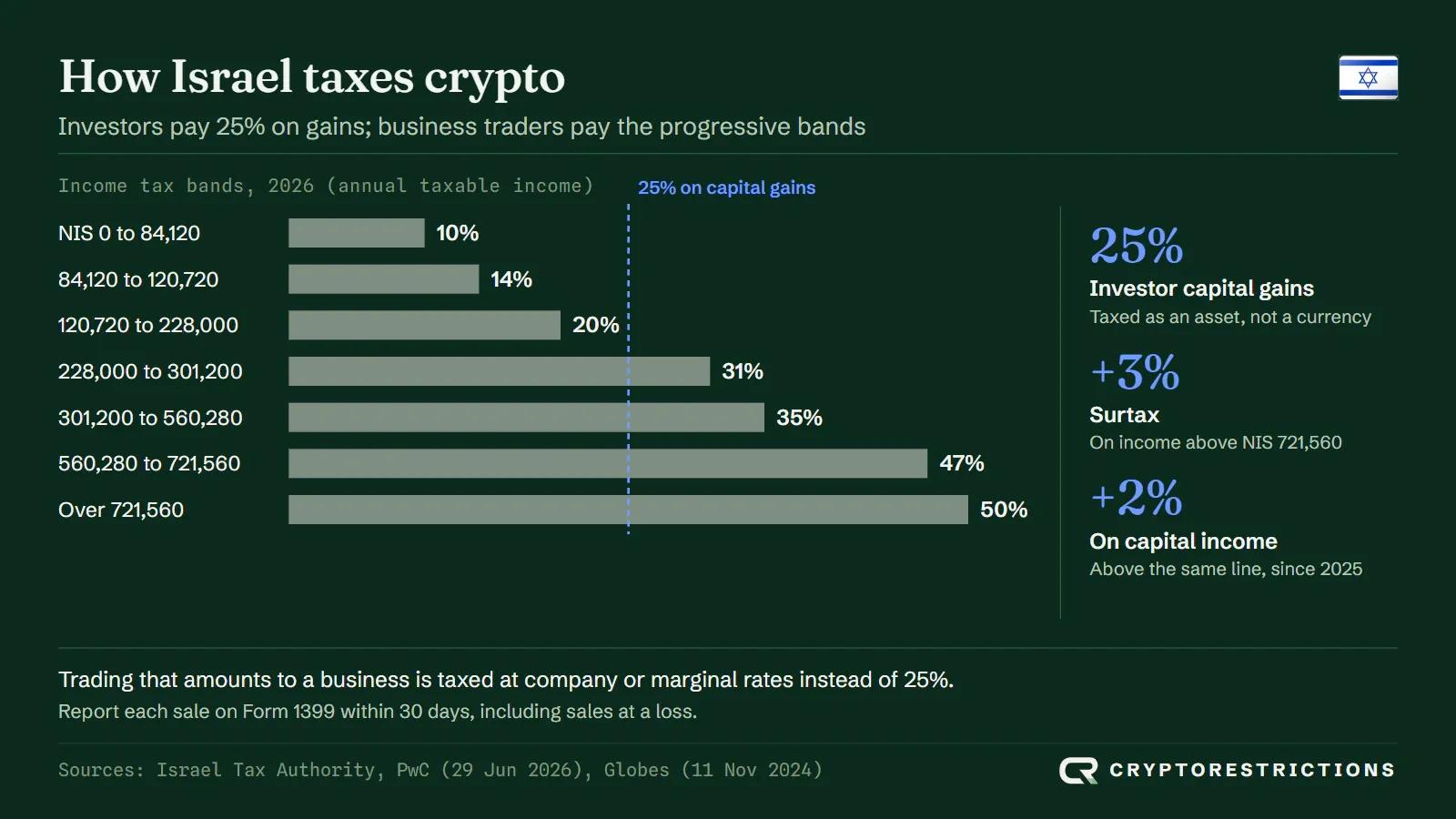
The position comes from the Tax Authority’s Circular 5/2018. A 2019 court report says the circular treats Bitcoin as an asset and that a court agreed it is not a currency under Israeli law, so the exchange-rate exemption did not apply. Globes reported on 11 November 2024 that the 25% rate applies while the activity is not a business, and that a Tax Authority draft bill would write digital assets, including tokens and NFTs, into the Income Tax Ordinance as assets. That bill would also tax a gain as Israeli-sourced when the seller was a resident at purchase and exempt crypto bought before immigration. We could not confirm that it passed. The 2026 income tax bands in the graphic are from PwC’s summary, which adds a 3% surtax above NIS 721,560 and a further 2% on capital income above the same line.
Reporting is where the rules are thinnest. The Tax Authority’s Form 1399 page lists virtual currencies among assets whose sale must be reported within 30 days, including sales at a loss, with the capital gains tax paid at the same time. The State Comptroller’s November 2024 report found that the crypto rules were not in legislation, that only about 500 people a year reported crypto activity in 2018 to 2022 against a potential of at least 200,000, and that Israel had not yet committed to the OECD’s Crypto-Asset Reporting Framework, whose exchanges could start as early as 2027.
Banks create a second problem: tax due on crypto profits has to be paid from a bank. The Tax Authority’s Form 909 procedure lets an individual whose bank refused crypto-origin funds pay the tax through the Tax Authority’s account at the Bank of Israel, with proof of the origin of the funds. A voluntary disclosure procedure ran until 31 August 2026, with a faster track for digital-asset income up to NIS 500,000 over the disclosure period; we did not find an extension.


 Bahrain
 Georgia
 Qatar
 Saudi Arabia
 Vietnam
 Pakistan
 Bangladesh
 Indonesia
 United Arab Emirates
 South Korea
 Kazakhstan