

Is crypto legal in Saudi Arabia?
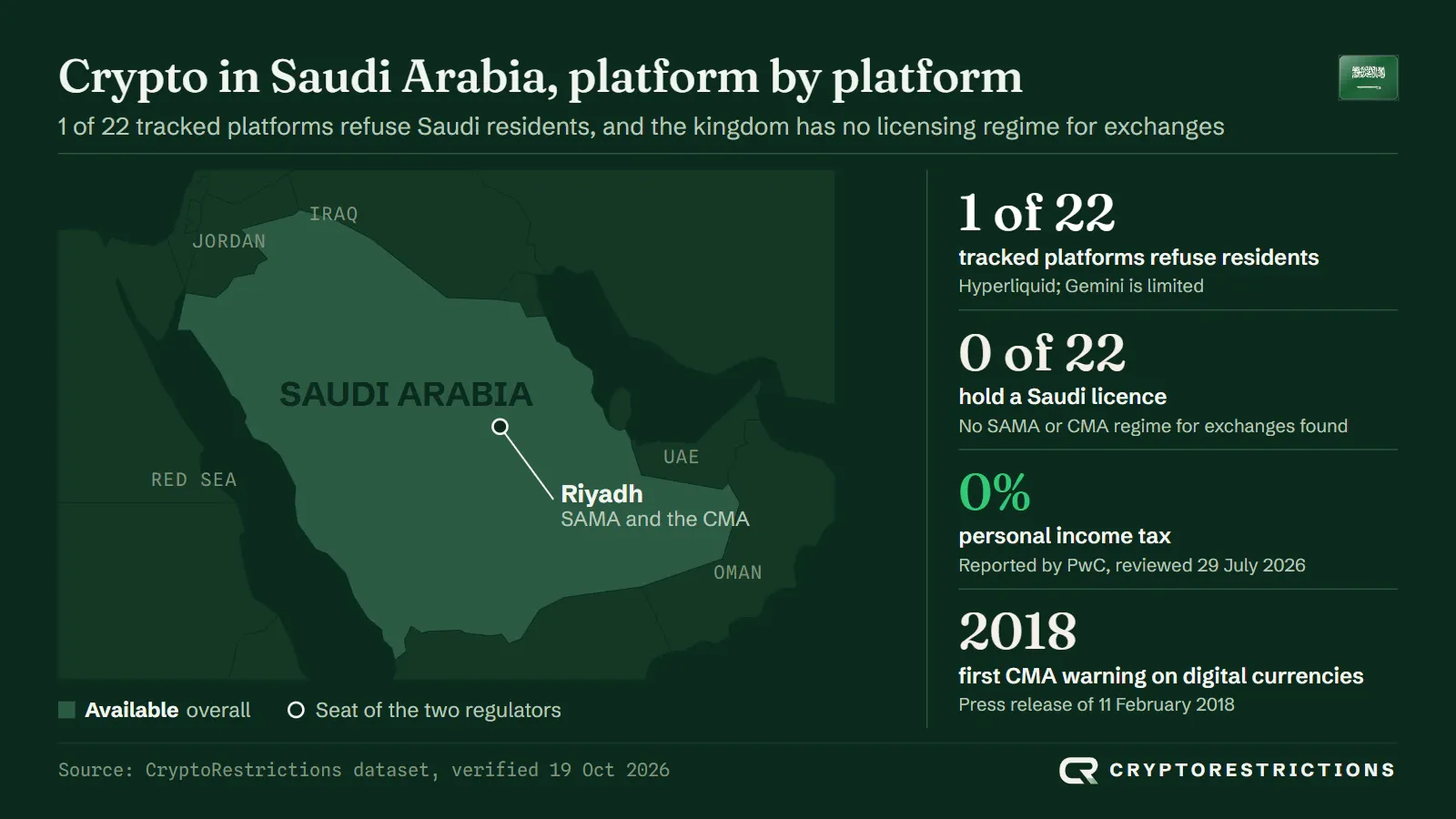
Not recognised, and not banned for individuals either. Saudi authorities have warned against digital currencies since 2018 and no law licenses crypto exchanges, but we found no statute that makes holding crypto a crime.
The Capital Market Authority (CMA) warned investors on 11 February 2018 that digital currency offers carry a high risk of capital loss and fraud, and that the investments sit outside any supervisory authority. On 21 August 2019 the Ministry of Finance added on the central bank’s site that virtual currencies are not recognised by legal entities in the kingdom, sit outside the regulatory framework and are not traded by financial institutions. It also warned that using the riyal’s name or the national emblem to market crypto will draw legal action.
A warning is not a prohibition. The Library of Congress found that no Saudi law addressed crypto specifically as of December 2024, and that it is not explicitly banned but lacks legal recognition. A 2026 law-firm tracker reports no statutory ban on holding or trading for personal use, adds that using unlicensed platforms may create legal exposure, and says the absence of a ban is not a positive right. Both are secondary sources, because the regulators’ own pages say nothing newer.
Which crypto exchanges work in Saudi Arabia?
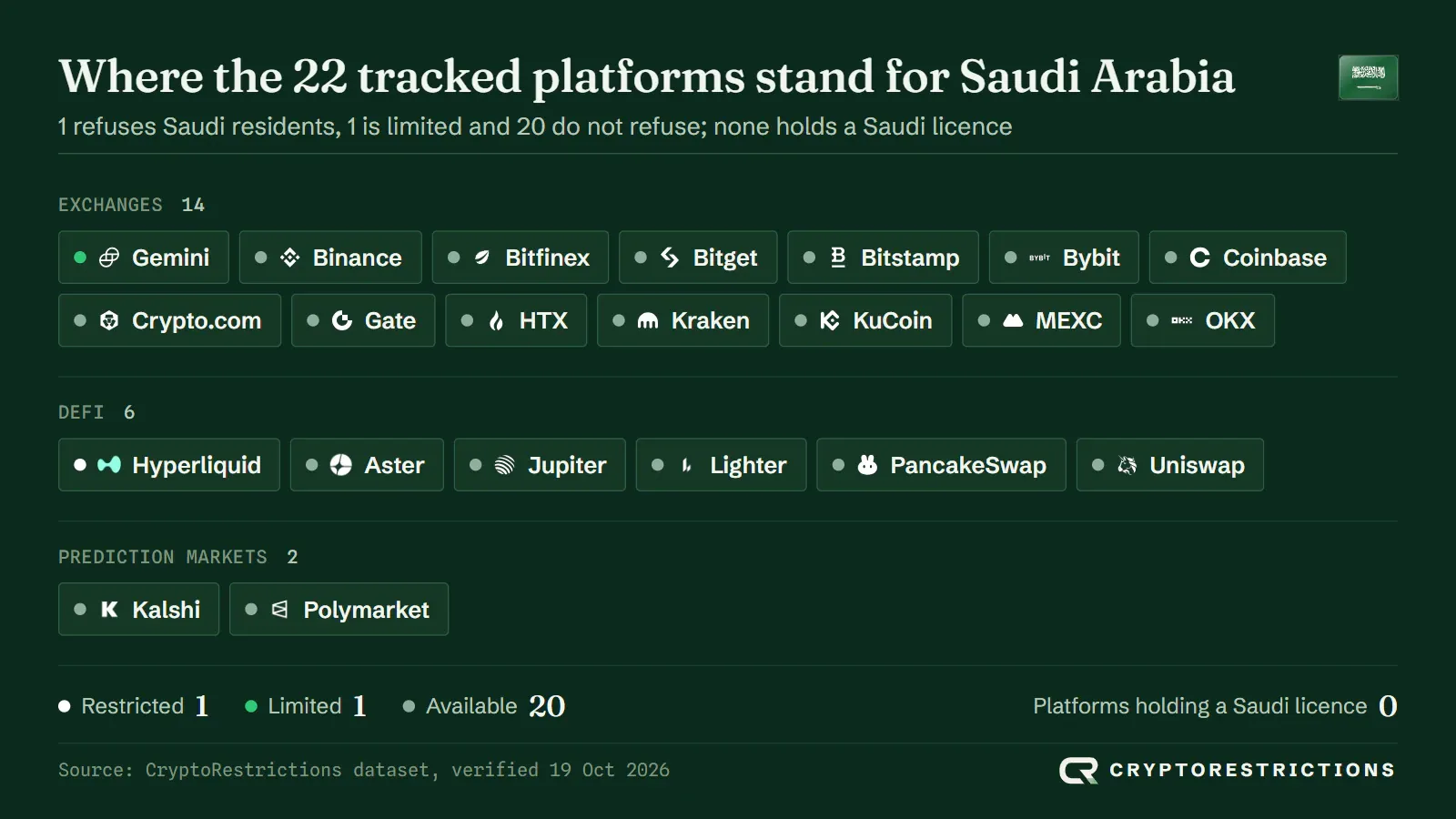
None of the 22 platforms we track holds a Saudi licence, because the kingdom has no licensing regime for crypto exchanges that we could find. Twenty do not refuse Saudi residents, which is their own policy and not Saudi approval.
Exchanges for non-security crypto can reach the market only through a regulatory sandbox or a payment-institution licence with a digital-asset endorsement, according to the same tracker, which says a dedicated exchange framework is reportedly under development with no date. It also reports that SAMA and the CMA treat regulated services offered to Saudi residents without authorisation as a violation wherever the platform is based, and that foreign licences, including UAE and EU ones, carry no passport into the kingdom. We found no register of licensed crypto firms on the pages of either regulator, and we could not search the CMA’s site.
Bitstamp is the one platform we did not test. Its Bitstamp global terms, updated 6 April 2026, carry no country list, so its row rests on the absence of a restriction in that document.

Best crypto platforms for Saudi residents
The score ranks every platform that is open to Saudi residents by how fully they can use it, not by fees or safety. It is computed from our data and moves when a row changes.
The score is made of access status (4 points), the share of the platform’s products open here (3), the Saudi licences we hold on file (2) and what our geo-access test saw from a Saudi address (1). Every platform here scores zero on licences, so the ranking turns on the other three parts. Platforms that refuse Saudi residents are not scored. The full method is on our methodology page.
Exchanges

Binance
Best for Widest product range
8.0/10- Access
- 4/4
- Products
- 3/3
- Licences
- 0/2
- Our test
- 1/1
Read our Binance reportPros
- Not on its prohibited-countries list
- Its home and sign-up pages loaded in our test
Cons
- No Saudi licence on file
- No Saudi rule covers its derivatives or lending

Bybit
Best for Spot and derivatives
8.0/10- Access
- 4/4
- Products
- 3/3
- Licences
- 0/2
- Our test
- 1/1
Read our Bybit reportPros
- Not on its excluded-jurisdictions list
- Its pages loaded in our test
Cons
- No Saudi licence on file
- A UAE licence gives no right to serve Saudi residents (reported)

OKX
Best for Spot and derivatives with a clear list
8.0/10- Access
- 4/4
- Products
- 3/3
- Licences
- 0/2
- Our test
- 1/1
Read our OKX reportPros
- Not on its restricted-locations list, updated 8 July 2026
- Its pages loaded in our test
Cons
- No Saudi licence on file
- Its list is open-ended

Coinbase
Best for Spot and staking with a listed sign-up
7.5/10- Access
- 4/4
- Products
- 3/3
- Licences
- 0/2
- Our test
- 0.5/1
Read our Coinbase reportPros
- Saudi Arabia is a listed sign-up country in its identity guide
- Offers spot, staking and custody
Cons
- No Saudi licence on file
- Not tested from Saudi Arabia

Kraken
Best for Spot trading and staking
7.5/10- Access
- 4/4
- Products
- 3/3
- Licences
- 0/2
- Our test
- 0.5/1
Read our Kraken reportPros
- Not on its do-not-serve list
Cons
- No Saudi licence on file
- Not tested from Saudi Arabia
DeFi

Jupiter
Best for Solana swaps and staking
7.5/10- Access
- 4/4
- Products
- 3/3
- Licences
- 0/2
- Our test
- 0.5/1
Read our Jupiter reportPros
- Saudi Arabia is not in its terms
Cons
- No Saudi licence on file
- Not tested from Saudi Arabia

PancakeSwap
Best for BNB Chain swaps and pools
7.5/10- Access
- 4/4
- Products
- 3/3
- Licences
- 0/2
- Our test
- 0.5/1
Read our PancakeSwap reportPros
- Not excluded by its terms
Cons
- No Saudi licence on file
- Not tested from Saudi Arabia

Uniswap
Best for Swapping tokens from your own wallet
7.5/10- Access
- 4/4
- Products
- 3/3
- Licences
- 0/2
- Our test
- 0.5/1
Read our Uniswap reportPros
- Its terms bar only places under comprehensive US sanctions
Cons
- No Saudi licence on file
- Not tested from Saudi Arabia
Prediction markets

Polymarket
Best for Event markets with no listed block
7.5/10- Access
- 4/4
- Products
- 3/3
- Licences
- 0/2
- Our test
- 0.5/1
Read our Polymarket reportPros
- Not on its blocked-countries list
Cons
- We found no Saudi ruling on event contracts
- Not tested from Saudi Arabia
Which platforms block Saudi users?
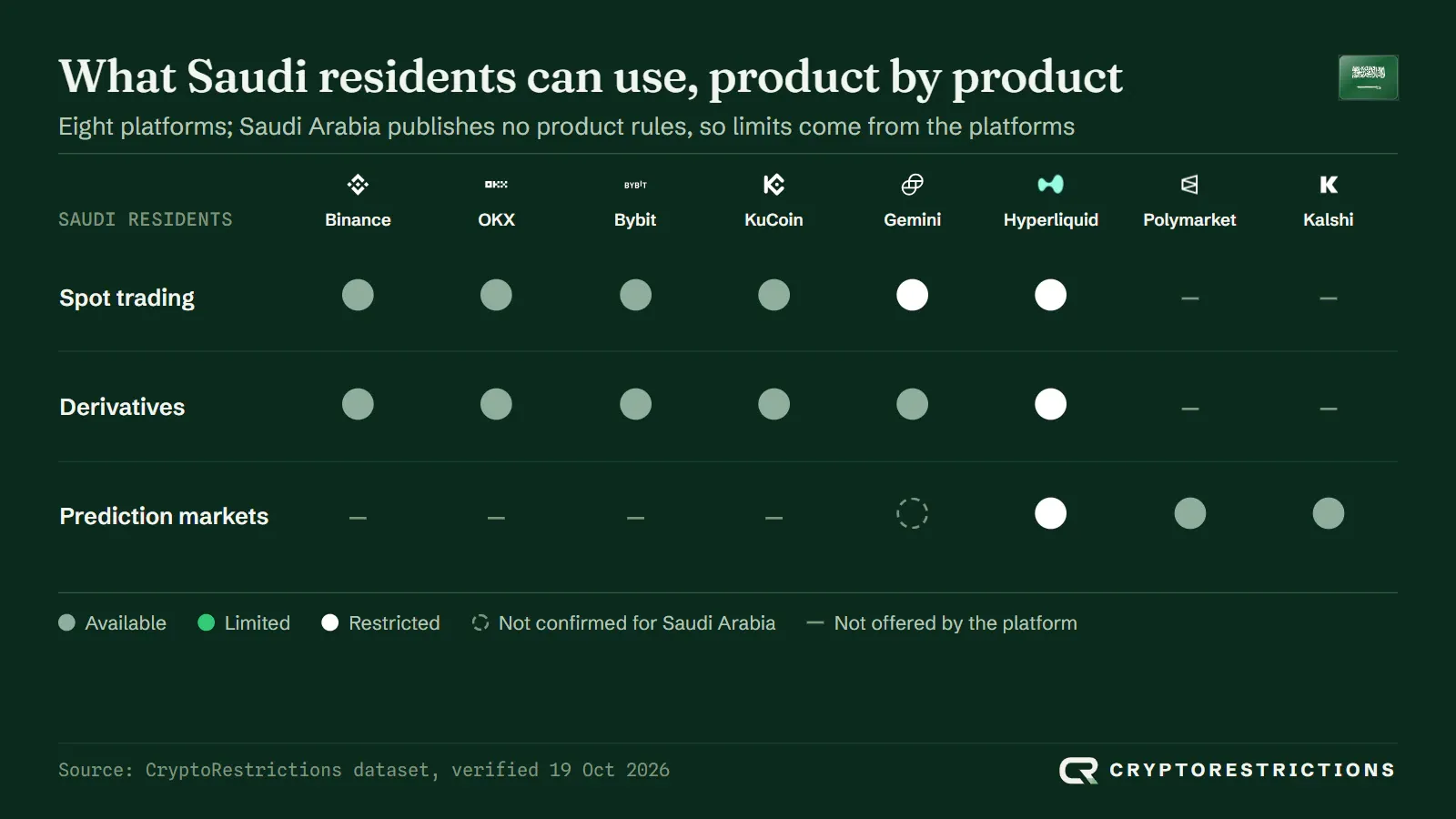
Hyperliquid refuses Saudi residents and Gemini is limited to perpetuals. The other 20 platforms do not name Saudi Arabia on any list we could read.
Hyperliquid does not name Saudi Arabia in its terms, but its trading app refused our Saudi address with a restricted-jurisdiction banner, so we record it as restricted. Gemini serves Saudi Arabia only through perpetuals: the country is on its perpetuals list but not on its main list, so spot trading is not offered.

What our geo-access test saw from Saudi Arabia
From a virtual Saudi address on 14 and 16 October 2026 we tested 12 of the 22 platforms we track: 10 loaded with no barrier, 1 showed a notice and 1 refused us.
An open page is not permission, and a virtual address tests a platform’s geo-blocking only, not a national internet block. Gate showed a banner that names the EU, not Saudi Arabia, so it reflects how our test address was read and not a Saudi rule. Hyperliquid’s home page loaded but its trading app and sign-up were blocked. We did not test the other ten platforms from Saudi Arabia. Swipe through the screenshots below; each card quotes the message the page showed.
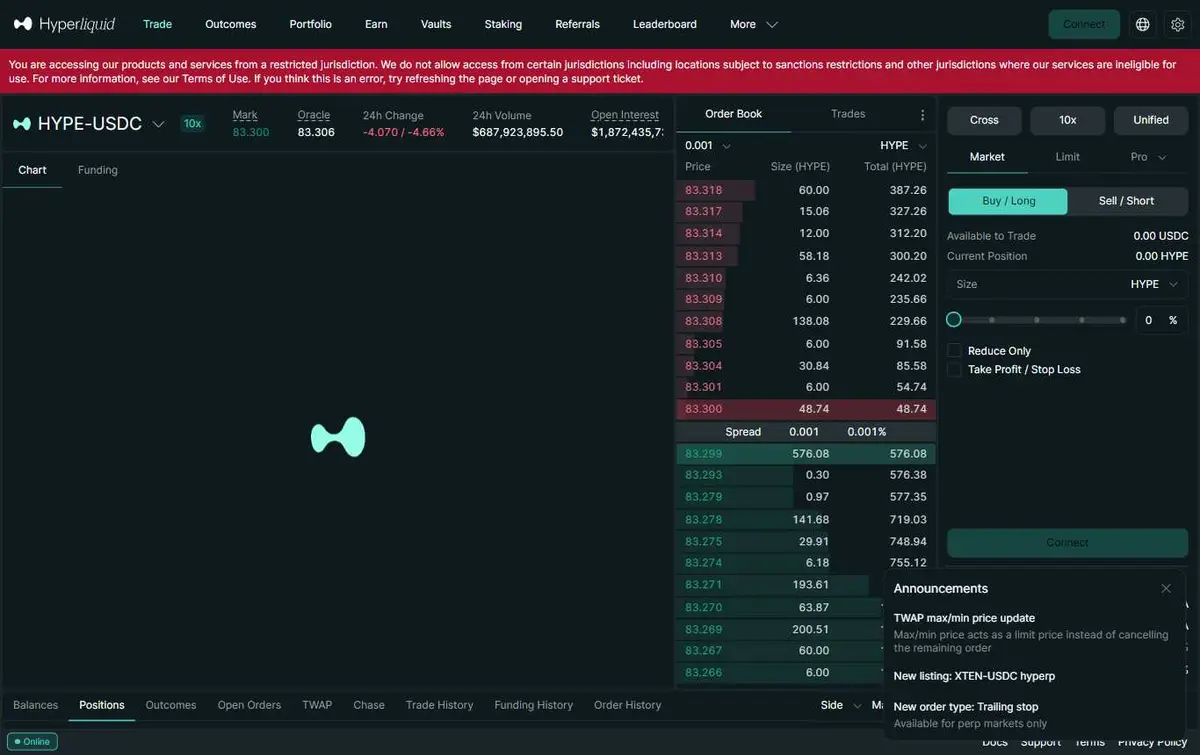
Blocked Hyperliquid · Trading app
Saudi Arabia is not named in the terms, yet the app shows the same block
“You are accessing our products and services from a restricted jurisdiction.”
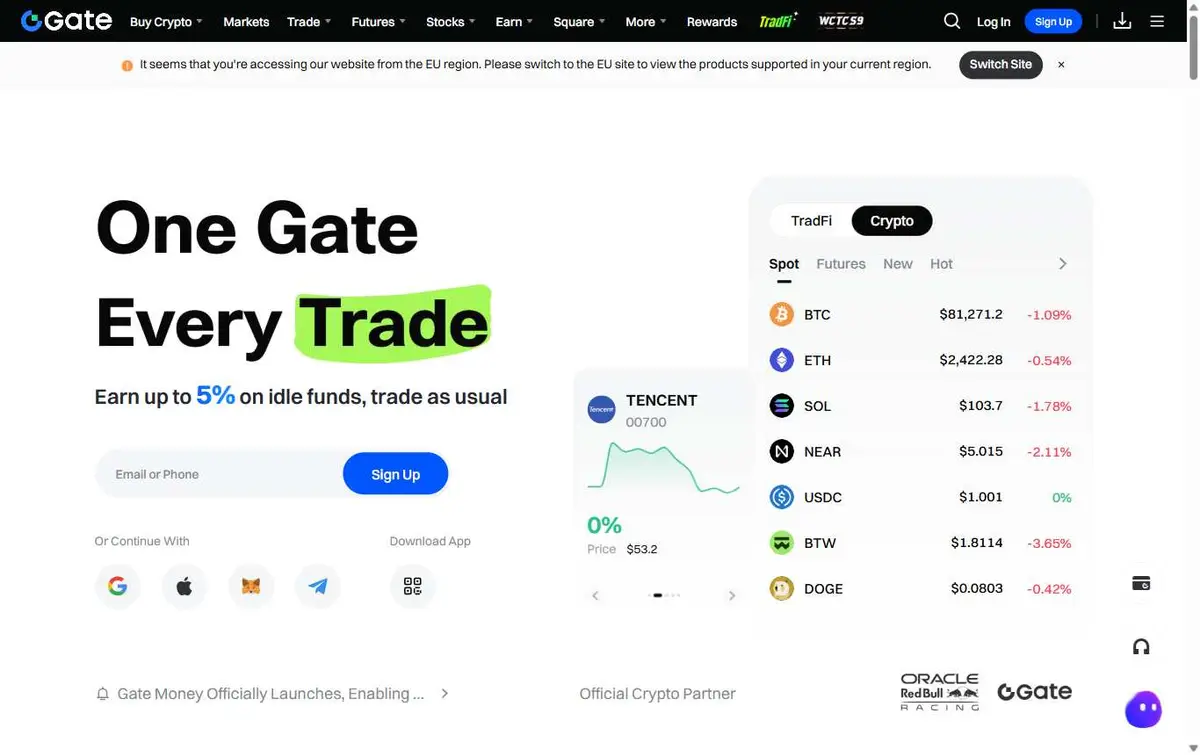
Notice shown Gate · Home page
Saudi Arabia: the home page shows a banner pointing to the EU site (our virtual address reads as EU); no restriction is named
“It seems that you're accessing our website from the EU region.”

No barrier KuCoin · Home page
Saudi Arabia: the home page loads with no barrier

No barrier MEXC · Home page
Saudi Arabia: the home page loads with no barrier
 CRYPTORESTRICTIONS
Who regulates crypto in Saudi Arabia?
Two bodies, the Saudi Central Bank (SAMA) and the Capital Market Authority (CMA), with the Ministry of Finance warning the public. We found no crypto rule, licence or consultation from any of them in 2025 or 2026.
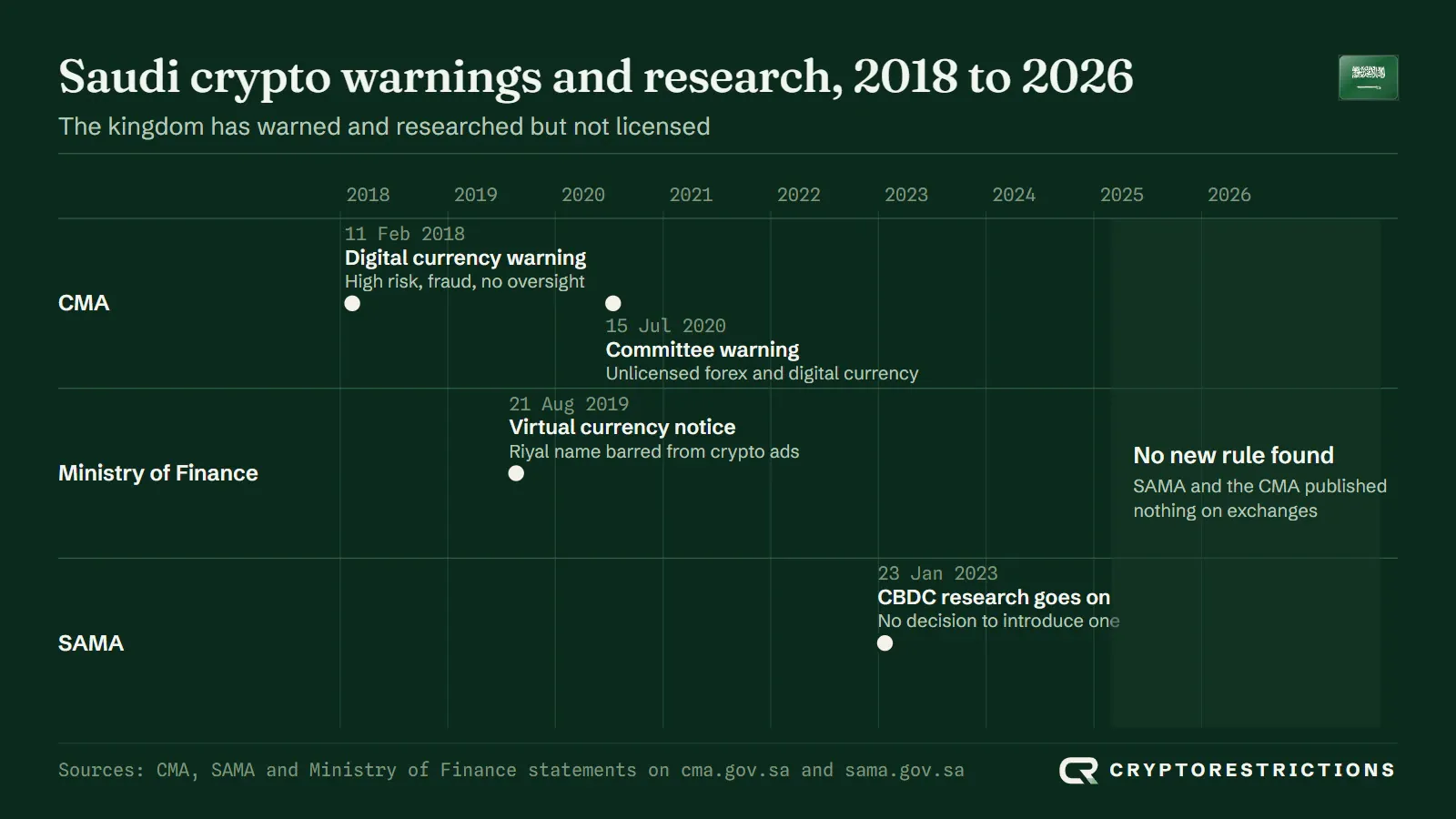
- SAMA. The central bank hosts the Ministry of Finance’s 2019 notice. On 23 January 2023 it said it was still experimenting with a central bank digital currency, including a wholesale phase with local banks, and that no decision had been made to introduce one. The same page notes its 2019 Project Aber with the UAE central bank. A law-firm tracker reports that SAMA guidance restricts licensed banks and payment institutions from dealing in certain crypto assets without approval and that SAMA runs a sandbox. We could not read that guidance ourselves.
- CMA. The securities regulator issued the 2018 warning. Its 2026 consultations that we saw concern other markets, such as securitization on 21 April 2026. The same tracker reports it treats security-like tokens as securities and allows licensed tokenised instruments, which we also could not confirm on its own pages.
- Standing Committee. A committee chaired by the CMA, with the Ministry of Interior, the Ministry of Information, the Ministry of Trade and SAMA as members, warned on 15 July 2020 against unlicensed forex and the marketing of unlicensed digital currencies, and asked the public to report offers to the authorities.
- Financial intelligence. The tracker reports that the Financial Intelligence Unit under the Presidency of State Security enforces the anti-money-laundering rules for crypto firms.
Which crypto products are limited in Saudi Arabia?
No Saudi rule limits a crypto product by name that we could read. The limits we can document come from platforms: Gemini offers only perpetuals and Hyperliquid is blocked, and banks are reported to avoid crypto.
- Banks. Reported guidance restricts banks and payment institutions from dealing in certain crypto assets without approval. We found no published rule and nothing specific to cards or transfers.
- Stablecoins. The tracker says stablecoins with monetary characteristics fall under SAMA. We found no stablecoin licensing or reserve rule.
- Tokenised securities. Reported as a CMA matter, through licensed platforms, and not confirmed on its own pages.
- Digital riyal. SAMA has researched a central bank digital currency since at least 2019 and decided nothing, as its January 2023 statement says.
- Marketing. The riyal’s name and the national emblem may not be used to promote crypto, per the 2019 notice.
Are prediction markets legal in Saudi Arabia?
Unclear. We found no Saudi statement on event contracts and no licensed betting industry, and gambling is widely reported as forbidden. Polymarket and Kalshi do not exclude Saudi Arabia, while Hyperliquid refused our Saudi address.
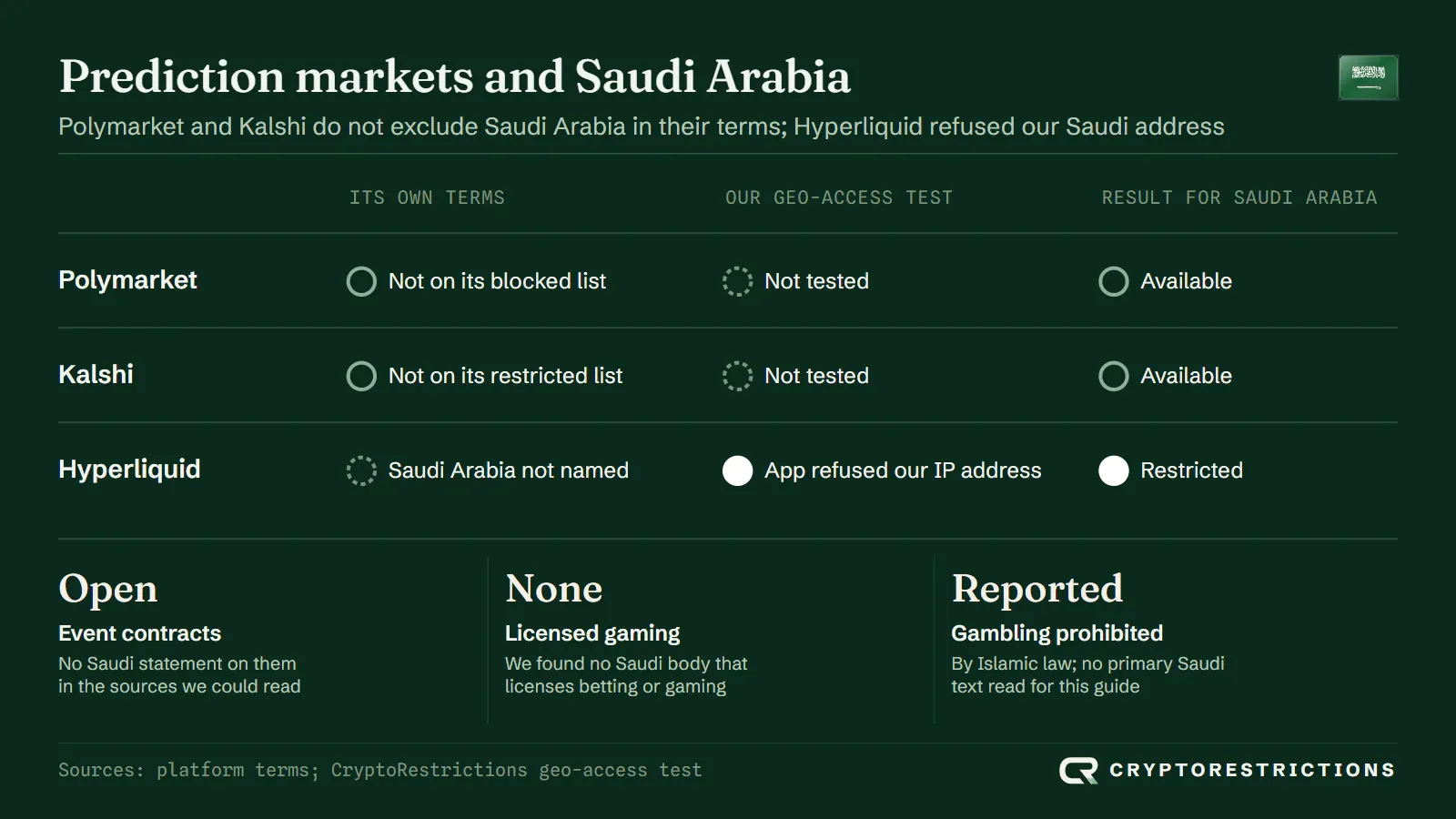
We could not read a Saudi statute or regulator page on gambling. What we found is a religious ruling column in Arab News saying that Islam forbids gambling in all forms, which is a religious view and not the law’s text, so the legal position of an event contract is open. Polymarket and Kalshi do not name Saudi Arabia on their blocked lists, and we did not test either from the kingdom. Hyperliquid blocked our address.

How is crypto taxed in Saudi Arabia?
Individuals pay no income tax, so personal crypto gains appear untaxed on the law-firm and PwC summaries we read, but the tax authority has published nothing on crypto. Companies pay 20 percent income tax or 2.5 percent zakat depending on who owns them, and VAT is 15 percent.
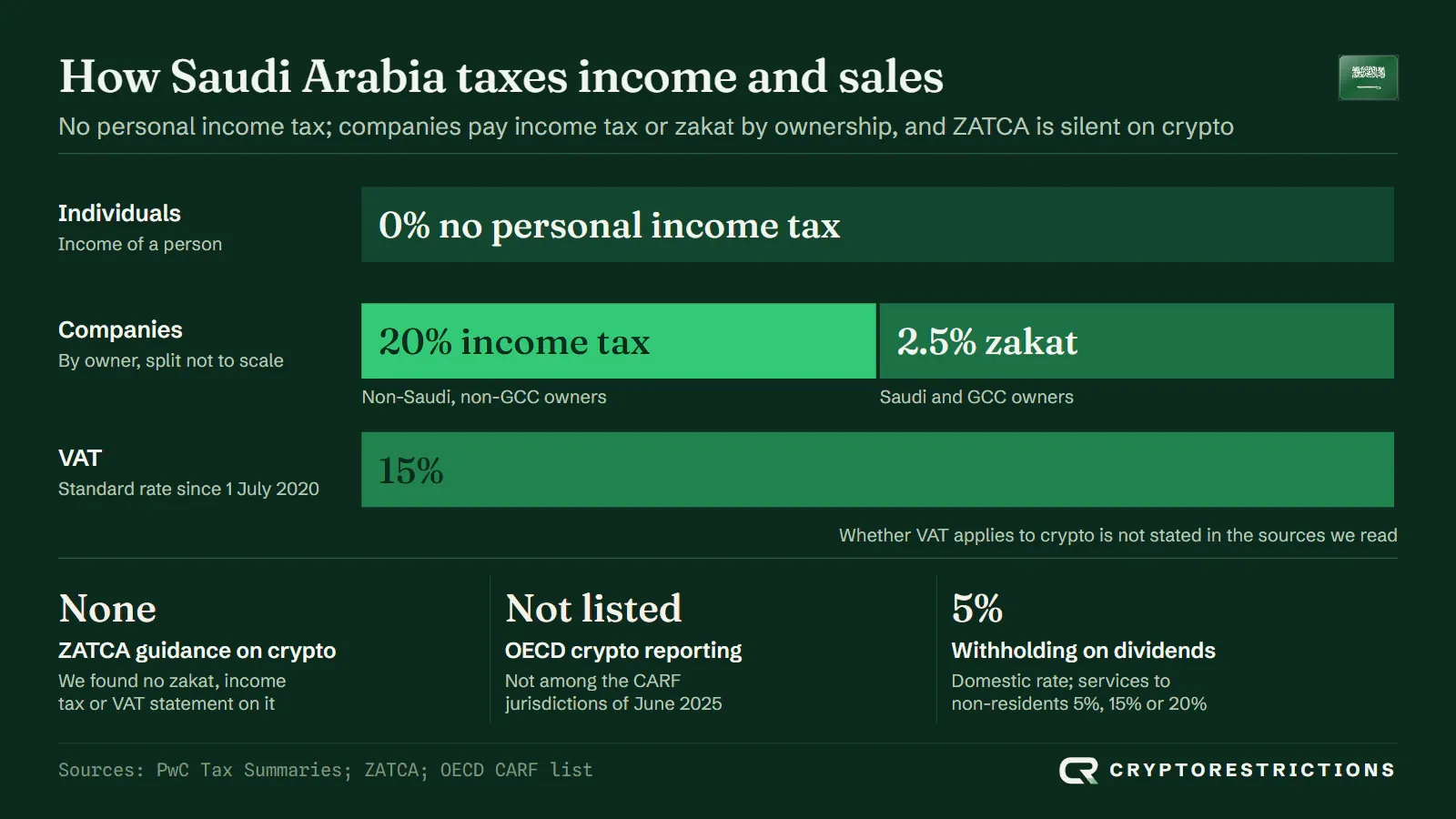
PwC’s summaries, last reviewed 29 July 2026, say there is no individual income tax scheme. For companies, the share held by non-Saudi, non-GCC owners pays 20 percent income tax and the Saudi and GCC share pays 2.5 percent zakat. ZATCA’s own income tax page defines taxable business activity broadly, including investments and transfers, but never mentions crypto, so a company trading crypto should expect to be treated as carrying on business. That reading is ours.
The standard VAT rate has been 15 percent since 1 July 2020. We found no ZATCA guidance on VAT for crypto, and blog claims that it is exempt or out of scope cite no source. Domestic withholding tax is 5 percent on dividends, and payments for services to non-residents carry 5, 15 or 20 percent depending on the service.
Saudi Arabia was not among the jurisdictions committed to the OECD’s Crypto-Asset Reporting Framework on the list of 17 June 2025. We did not check later lists, and no Saudi crypto reporting duty for exchanges or users is documented in what we read.





 Bahrain
 Georgia
 Qatar
 Israel
 Vietnam
 Pakistan
 Bangladesh
 Indonesia
 United Arab Emirates
 South Korea
 Kazakhstan