
Where is Bitstamp restricted?
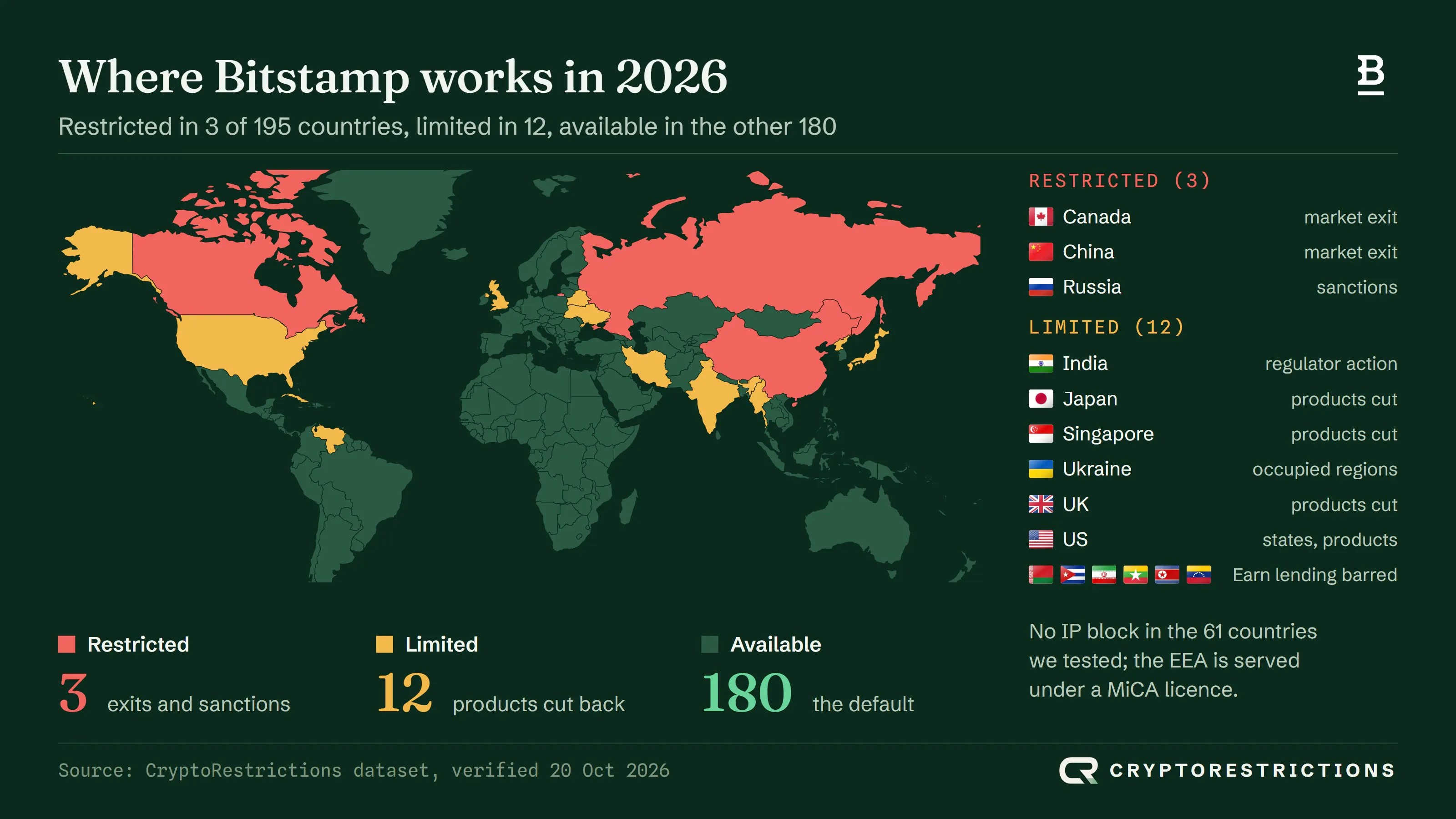
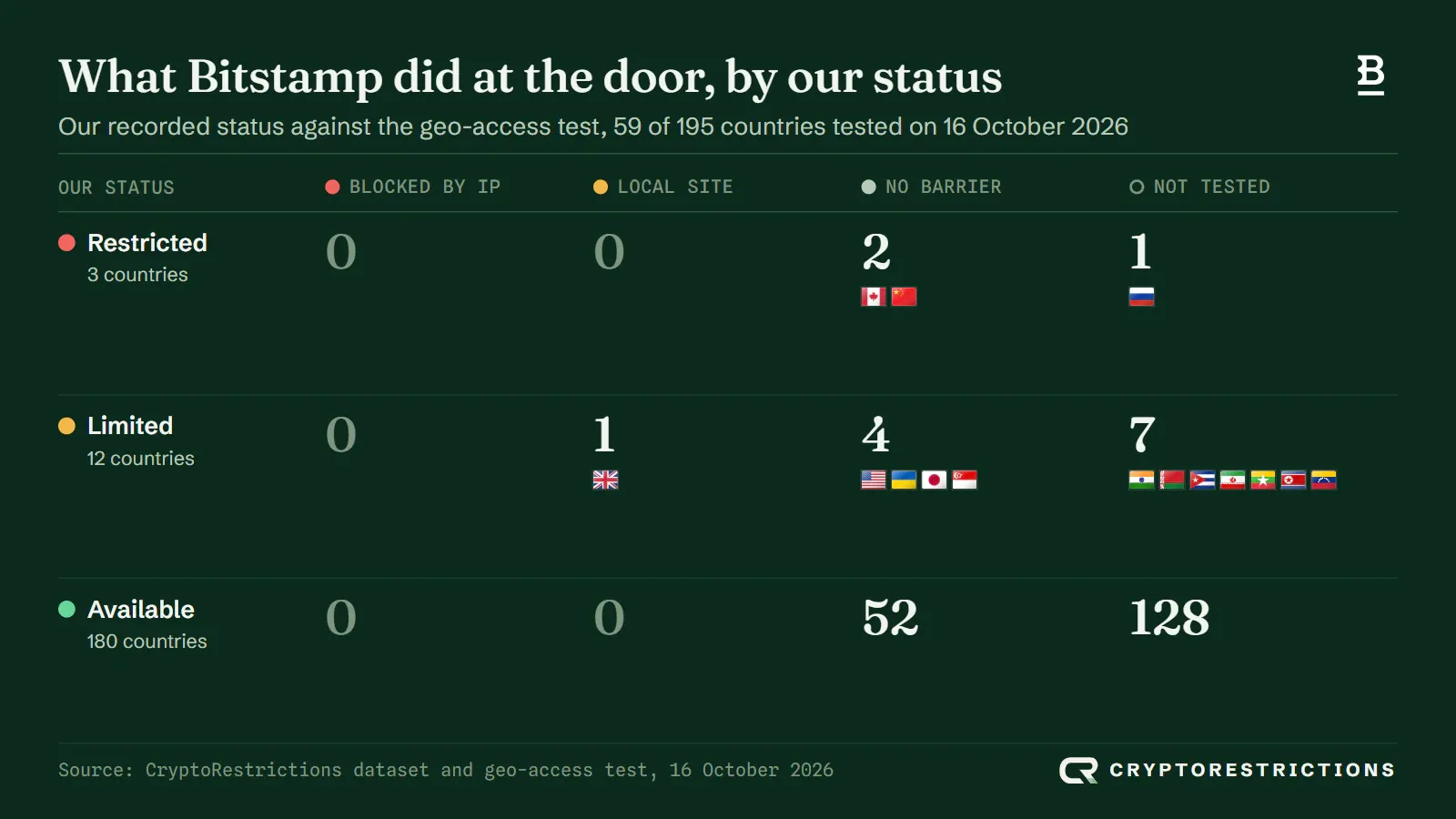
Bitstamp is restricted in 3 of the 195 countries we cover:  Canada,
 China and
 Russia.
Bitstamp publishes no list of banned countries. The terms of Bitstamp Global (updated 6 April 2026), which serves customers outside its licensed regions, only say it may not seek business where its services are not authorised. Two of the three restrictions are market exits Bitstamp announced itself. It stopped serving PRC nationals in mainland China and closed their accounts by 30 November 2021. In Canada, the Bitstamp Limited terms say residents could not open accounts from 24 March 2023, and the remaining accounts moved to Bitbuy in 2024.
Russia is the third. Bitstamp’s sanctions FAQ says it does not offer services to residents of Russia, citing US, UK, EU and Singapore sanctions, and the same line excludes five regions of Ukraine (covered below). Iran, Cuba and North Korea are named only in the US company’s terms, so outside the US no Bitstamp document restricts them and our coverage rule records them as available.
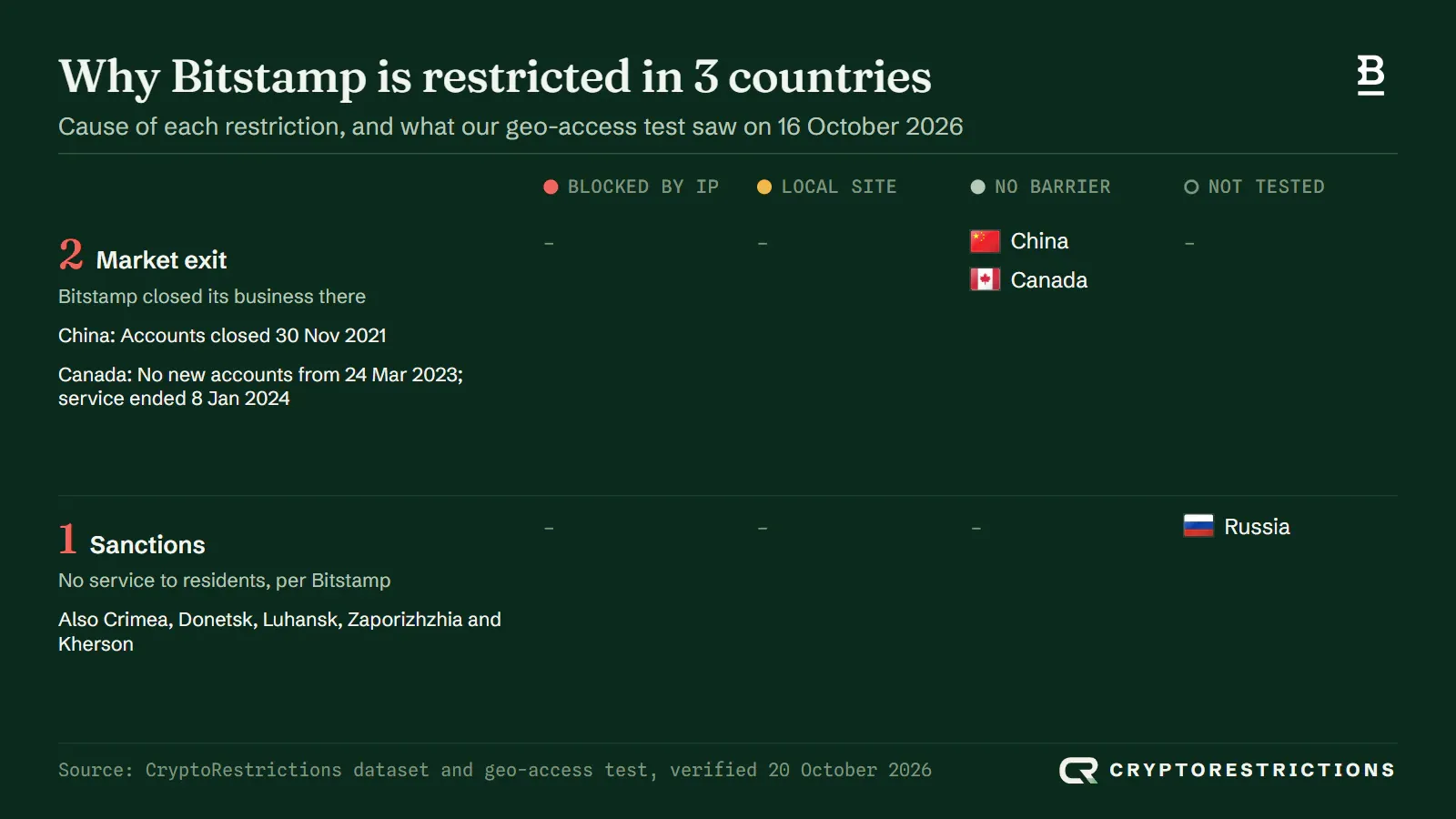
None of the three is blocked at the door. bitstamp.net loaded with no barrier from Canada and China in our test, and Russia was not tested; Bitstamp checks where you live when you verify your account. The list is below.
| Category | Countries | Context | Last verified |
|---|---|---|---|
| Geographic block | Bitstamp does not offer services to residents of Russia, citing US, UK, EU and Singapore sanctions. | 17 Oct 2026 | |
| Geographic block | Bitstamp left Canada: no new accounts since March 2023, and remaining accounts moved to Bitbuy in 2024. | 17 Oct 2026 | |
| Geographic block | Bitstamp stopped serving PRC nationals in mainland China; their accounts closed on 30 November 2021. | 17 Oct 2026 |
Where is Bitstamp limited?
Bitstamp is limited in 12 countries:  Belarus,
 Cuba,
 India,
 Iran,
 Japan,
 Myanmar,
 North Korea,
 Singapore,
 Ukraine, the
 United Kingdom, the
 United States and
 Venezuela.
Three are product cuts. The Earn terms (updated 8 July 2026) close staking in the US, Canada and Singapore and lending in the US, the UK, Canada and Singapore, and Bitstamp’s staking and lending FAQs add Japan to both. Its perpetual futures launch of 9 April 2026 says derivatives are not available in the US, Canada, Japan and some other countries, and describes the product as one for EU traders. Spot trading stays open in all three.
Three more are not product cuts. The United States is served by a separate company with spot trading only, and not in two states (covered below). Ukraine is limited because the sanctions FAQ excludes Crimea, Donetsk, Luhansk, Zaporizhzhia and Kherson. India is limited by a regulator: on 28 December 2023 India’s Financial Intelligence Unit sent show cause notices to nine offshore exchanges, four Bitstamp companies among them, and asked the IT ministry to block their URLs. We found no FIU-IND registration for Bitstamp since. Kraken, named in the same notice, is also limited there in our data.

The last six are Belarus, Cuba, Iran, Myanmar, North Korea and Venezuela, all under sanctions regimes. No Bitstamp exchange terms name them, but its Earn terms with Tesseract bar clients from all six from lending, so we record lending as restricted and the country as limited. Bitstamp’s US terms name Iran, Cuba and North Korea as embargoed, but they govern US customers only. We could not test any of the six.
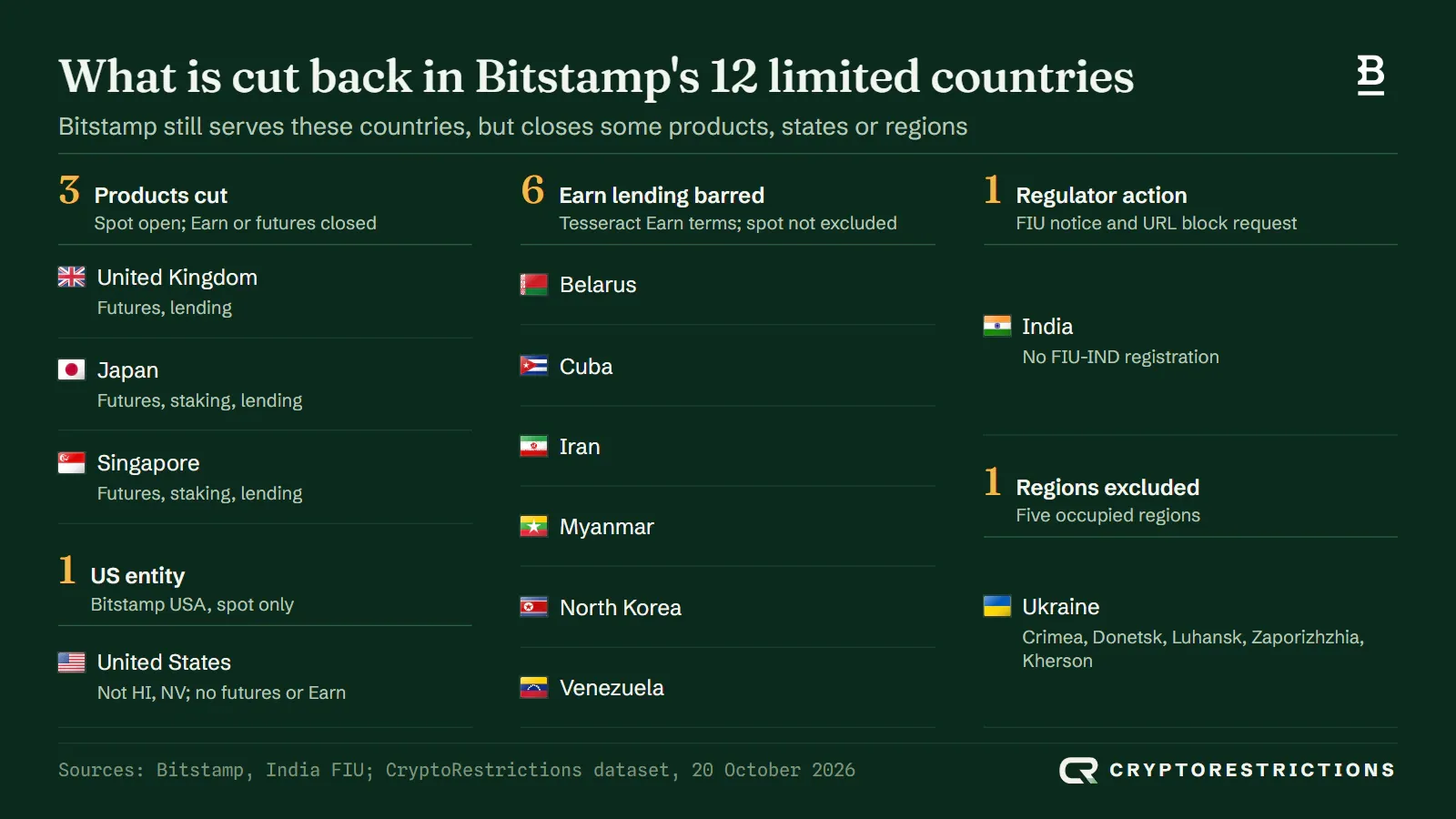
Limited means Bitstamp still serves the country, but something is cut back. The countries and what applies in each are below.
| Category | Countries | Context | Last verified |
|---|---|---|---|
| Partial service | Bitstamp's Earn lending terms bar clients from here; its exchange terms name no country. Not tested. | 20 Oct 2026 | |
| Partial service | Bitstamp does not serve residents of Crimea, Donetsk, Luhansk, Zaporizhzhia and Kherson; the rest of Ukraine is not excluded. | 17 Oct 2026 | |
| Partial service | Bitstamp names Japan among the countries without perpetual futures, Earn staking or Earn lending; spot trading is not excluded. | 17 Oct 2026 | |
| License requirement | Not excluded by Bitstamp, but India's FIU sent four Bitstamp entities a show cause notice in December 2023 and asked for their URLs to be blocked; we found no FIU-IND registration. | 17 Oct 2026 | |
| Partial service | Served by Bitstamp Asia Pte. Ltd. (MAS-licensed), but Earn staking, Earn lending and perpetual futures are not offered in Singapore. | 17 Oct 2026 | |
| Partial service | Served by Bitstamp UK Limited (FCA-registered), but Earn lending and perpetual futures are not offered in the UK. | 17 Oct 2026 | |
| Partial service | Served by Bitstamp USA, Inc. under a NYDFS BitLicense; residents of Hawaii and Nevada are not served. | 17 Oct 2026 |
Where is Bitstamp available?
Bitstamp is available in 180 of the 195 countries we cover, including all 30 EEA countries,  Switzerland,
 Australia,
 Brazil and
 South Africa.
The 30 EEA countries are served by Bitstamp Europe S.A. under its Luxembourg MiCA licence, which ESMA’s register shows passported to every EEA state. Swiss retail customers are served by the same company, according to Bitstamp’s notice of 28 September 2026. Customers elsewhere are served by Bitstamp Global, registered in the British Virgin Islands. For 23 more countries, such as  Turkey,
 Mexico and
 Nigeria, our test loaded the site and no Bitstamp document excludes them. The rest are available under our coverage rule: no official document from Bitstamp or a regulator restricts them.
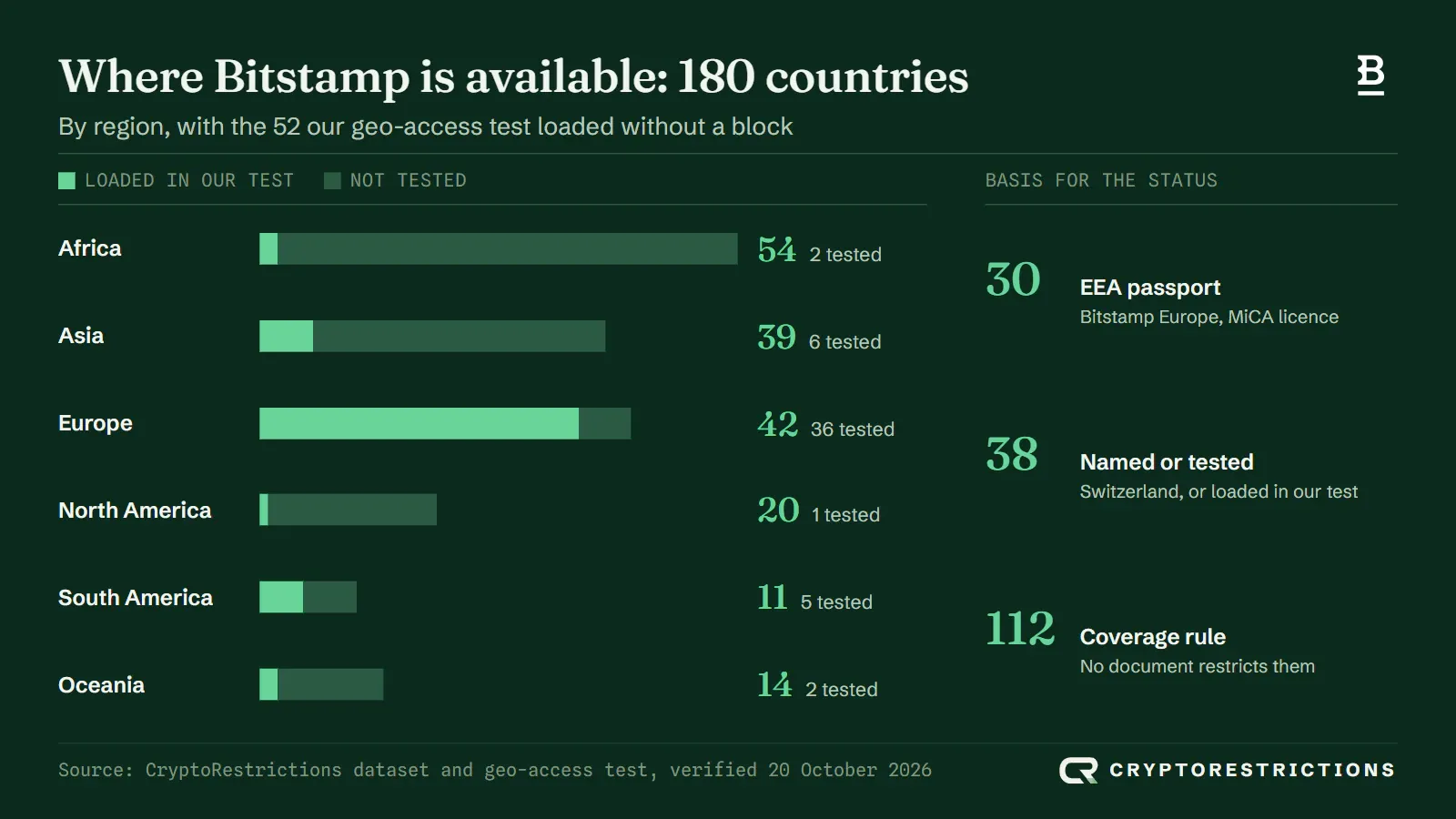
Available means Bitstamp serves the country, not that local law allows crypto trading, and it does not mean the app is there: Bitstamp’s app availability list is shorter than the list of countries it serves on the web. The countries we hold a written basis for are below.
| Category | Countries | Context | Last verified |
|---|---|---|---|
| No restriction | Served by Bitstamp Europe S.A. under a CSSF MiCA licence (May 2025), passported across the EEA. | 19 Oct 2026 | |
| No restriction | No Bitstamp document excludes it, and bitstamp.net loaded without a block in our geo-access test. | 18 Oct 2026 | |
| No restriction | No Bitstamp document excludes it. | 20 Oct 2026 | |
| No restriction | No Bitstamp document excludes it. Not tested. | 19 Oct 2026 | |
| No restriction | Bitstamp's global terms of use (updated 6 April 2026) name no excluded country; not tested from Bahrain. | 19 Oct 2026 | |
| No restriction | Bitstamp's global terms of use (updated 6 April 2026) name no excluded country; not tested from Egypt. | 19 Oct 2026 | |
| No restriction | Bitstamp's global terms of use (updated 6 April 2026) name no excluded country; not tested from Qatar. | 19 Oct 2026 | |
| No restriction | Bitstamp's global terms of use (updated 6 April 2026) name no excluded country; not tested from Saudi Arabia. | 19 Oct 2026 | |
| No restriction | No Bitstamp document excludes Bangladesh. | 20 Oct 2026 | |
| No restriction | No Bitstamp document excludes Georgia (global terms updated 6 April 2026). | 19 Oct 2026 | |
| No restriction | No Bitstamp document excludes Pakistan. | 19 Oct 2026 | |
| No restriction | No Bitstamp document excludes Thailand (terms of 6 April 2026); not covered by our geo-access test. | 17 Oct 2026 | |
| No restriction | No Bitstamp document excludes Vietnam (terms of 6 April 2026); not covered by our geo-access test. | 17 Oct 2026 | |
| No restriction | Swiss retail customers are served by Bitstamp Europe S.A., which is moving them to the Robinhood app from 15 October 2026. | 17 Oct 2026 |
 Austria
 Belgium
 Cyprus
 Czechia
 Denmark
 Hungary
 Italy
 Liechtenstein
 Luxembourg
 Malta
 Poland
 Portugal
 Romania
 Slovakia
 Spain
 Sweden
 Albania
 Andorra
 Argentina
 Bosnia and Herzegovina
 Brunei
 Chile
 Colombia
 Indonesia
 Israel
 Malaysia
 Moldova
 North Macedonia
 Peru
 South Korea
 Taiwan
 United Arab Emirates
 Costa Rica
 El Salvador
 Kazakhstan
 Morocco
 Panama
 Uruguay
 Ghana
 Kenya
 Bahrain
 Egypt
 Qatar
 Saudi Arabia
 Bangladesh
 Georgia
 Pakistan
 Thailand
 Vietnam
Where do Bitstamp’s visitors come from?
The two traffic estimators we checked disagree on almost everything except that the United States, France and Germany matter.
Similarweb puts the United States first for September 2026 with 35.41% of visits, ahead of  Slovenia at 8.01% and
 France at 6.09%; its August figures, which we read on 29 September, had the US at 26.48% of desktop visits and Spain second. Semrush counts 1.17 million visits in September and puts Hong Kong first at 44.18%, then Austria at 16.04%, with the US fourth at 4.27%.
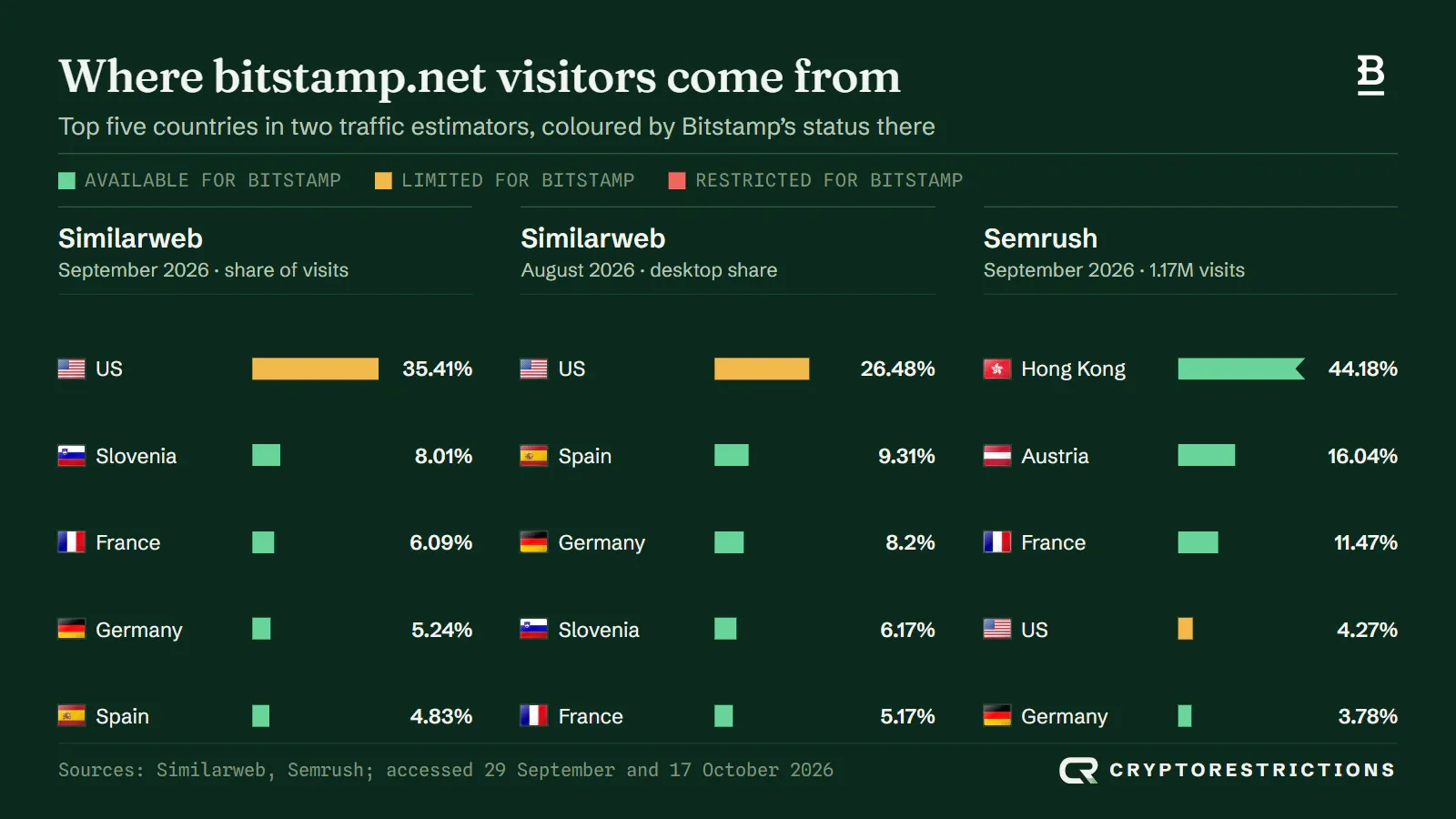
No restricted country appears in either list. Slovenia’s place in Similarweb has an explanation: Bitstamp’s derivatives company is based in Ljubljana. Semrush’s Hong Kong and Austria shares have none we could find in Bitstamp’s own documents, and Similarweb does not show them, so treat them with care; estimators model traffic from panels and samples, and any single share is an estimate.
Bitstamp geo-access test: what we saw from 61 places
In our test bitstamp.net blocked no one by IP in any of the 61 places we reached; the only notice was a pop-up in the UK offering Bitstamp’s UK site.
We ran the test ourselves on 16 October 2026, with the same method as for every platform. A browser with a VPN connected to one country at a time and loaded Bitstamp’s home page, each time in a fresh private window with no cookies. Cookie banners were hidden but never accepted, and bot checks were waited out, never solved. Every run saved the page text and a screenshot.
All 61 places (59 of our 195 countries plus Hong Kong and Taiwan) went through VPN servers located in the country. The sign-up address our tool used returned a “page not found” error in every run, so only the home page counts, and the sign-up column in the results stays empty.
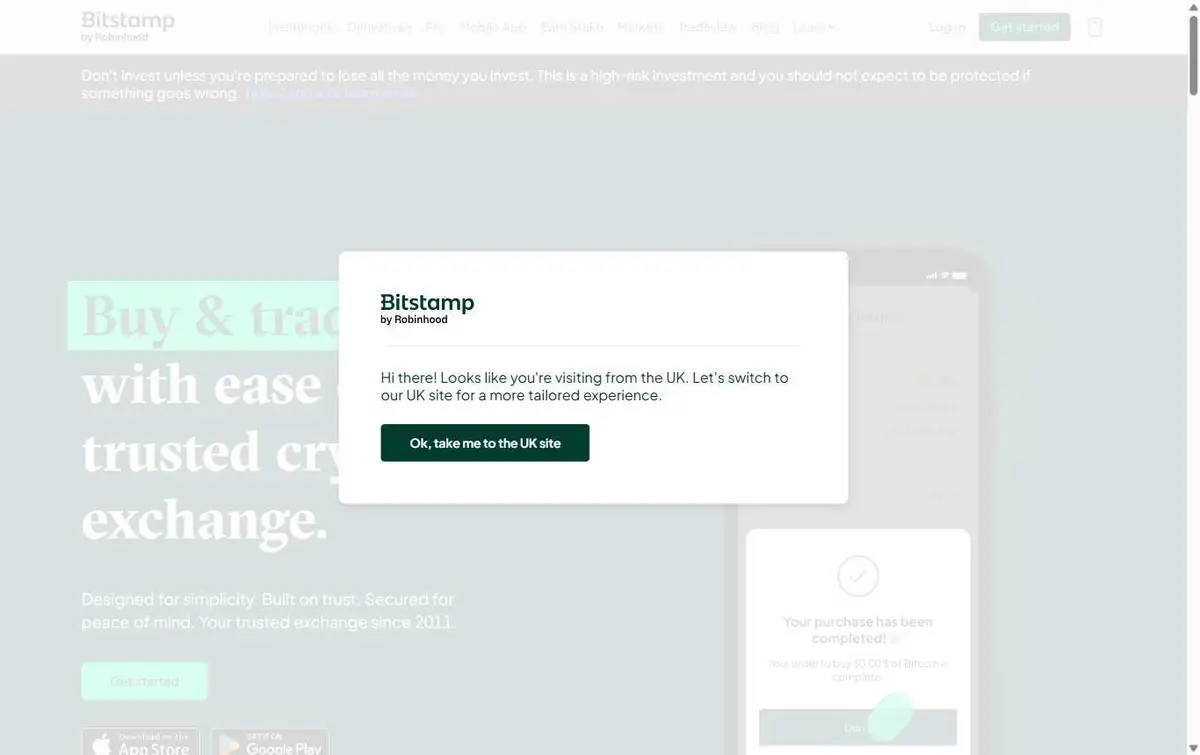
Notice shownUnited Kingdom · Home page
The UK, limited by product cuts: a pop-up offers Bitstamp's UK site, above the FCA risk warning
“Looks like you're visiting from the UK. Let's switch to our UK site for a more tailored experience.”
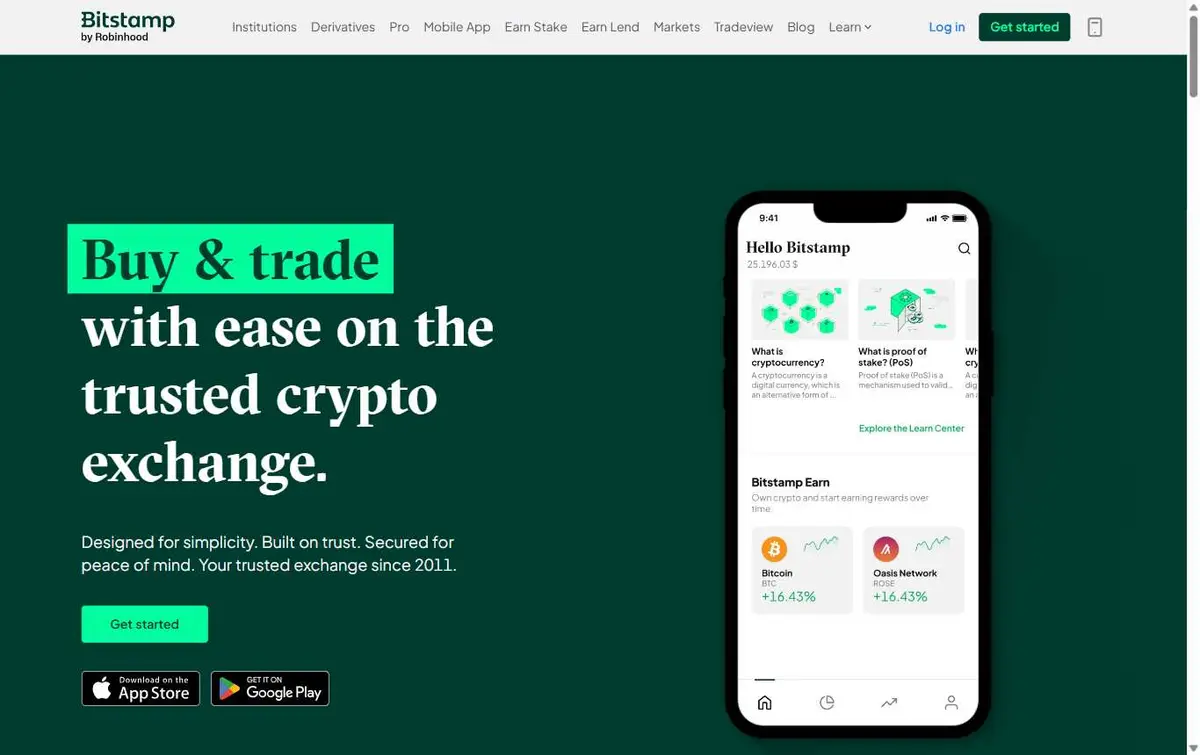
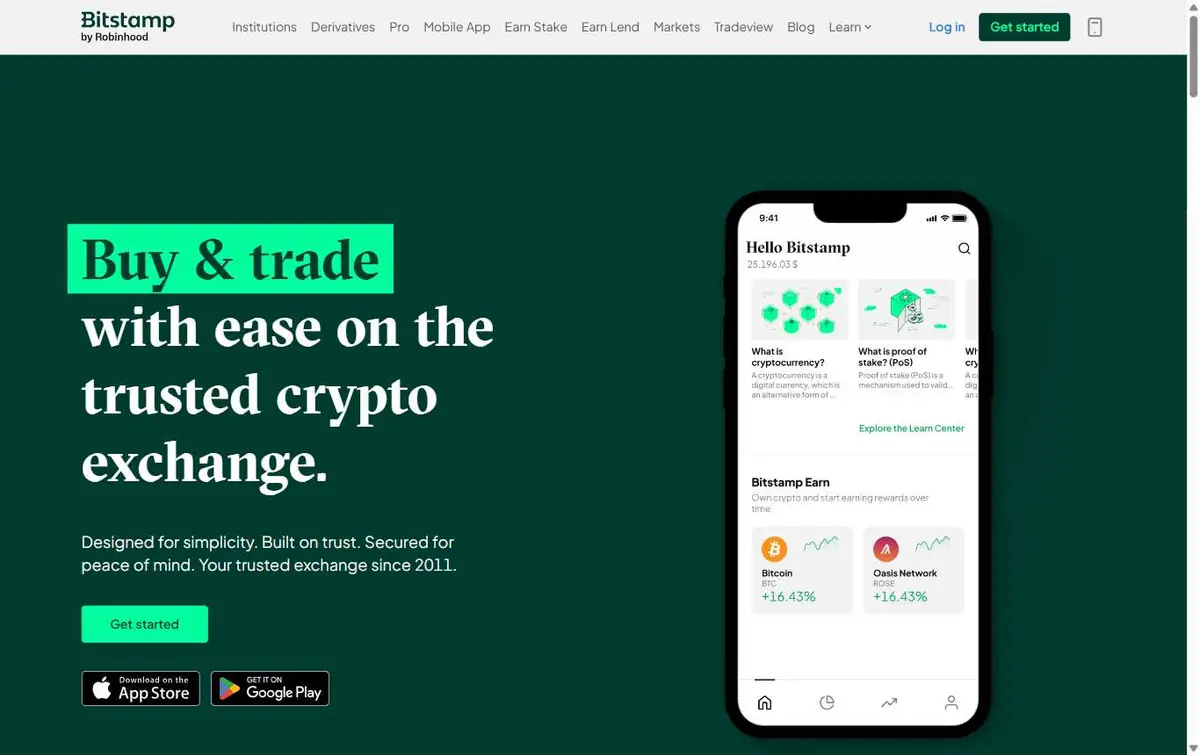
No barrierCanada · Home page
Canada, which Bitstamp left in 2024: the global home page loads with no notice
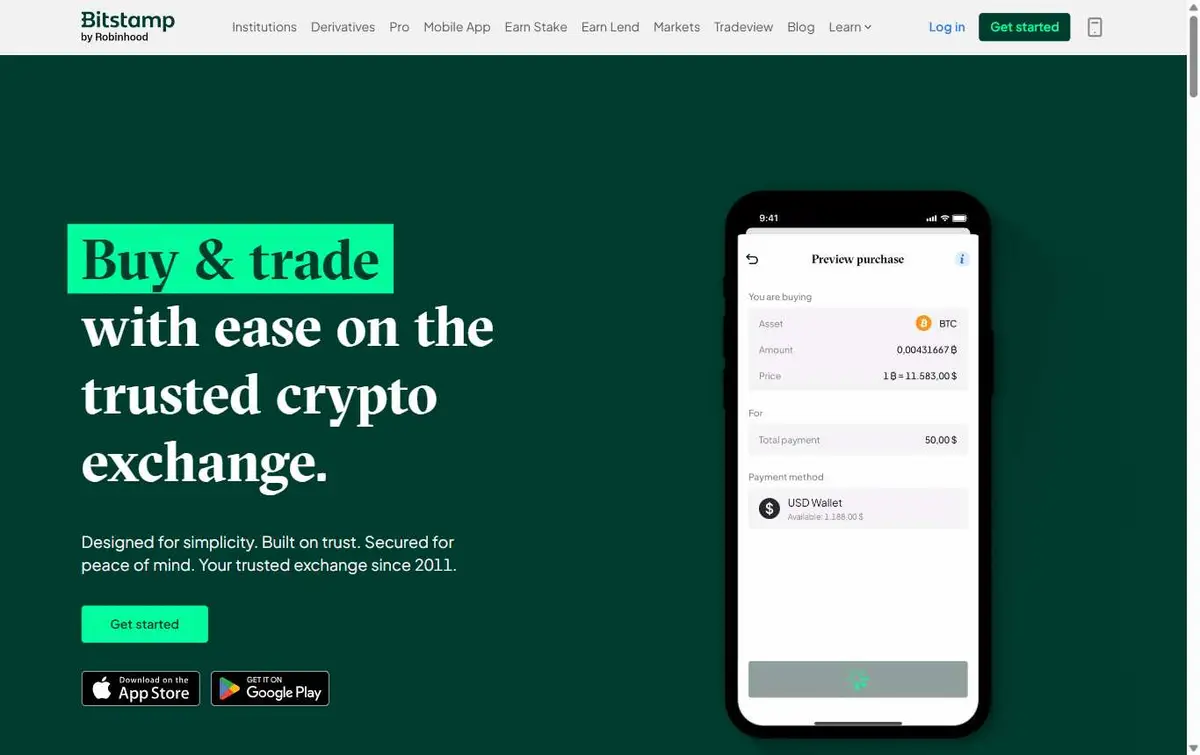
No barrierChina · Home page
Mainland China, closed to customers since 2021, loads the same page
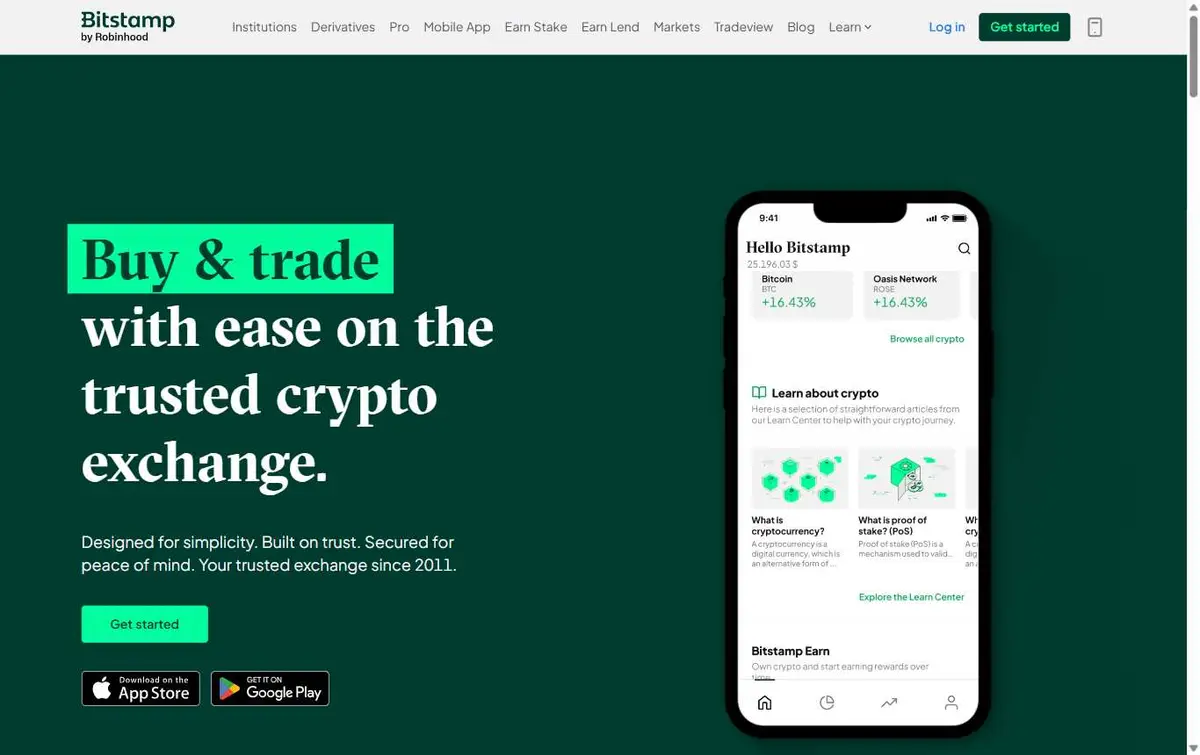
No barrierUnited States · Home page
The United States: no switch to a US site at the door; Bitstamp USA takes over at sign-up
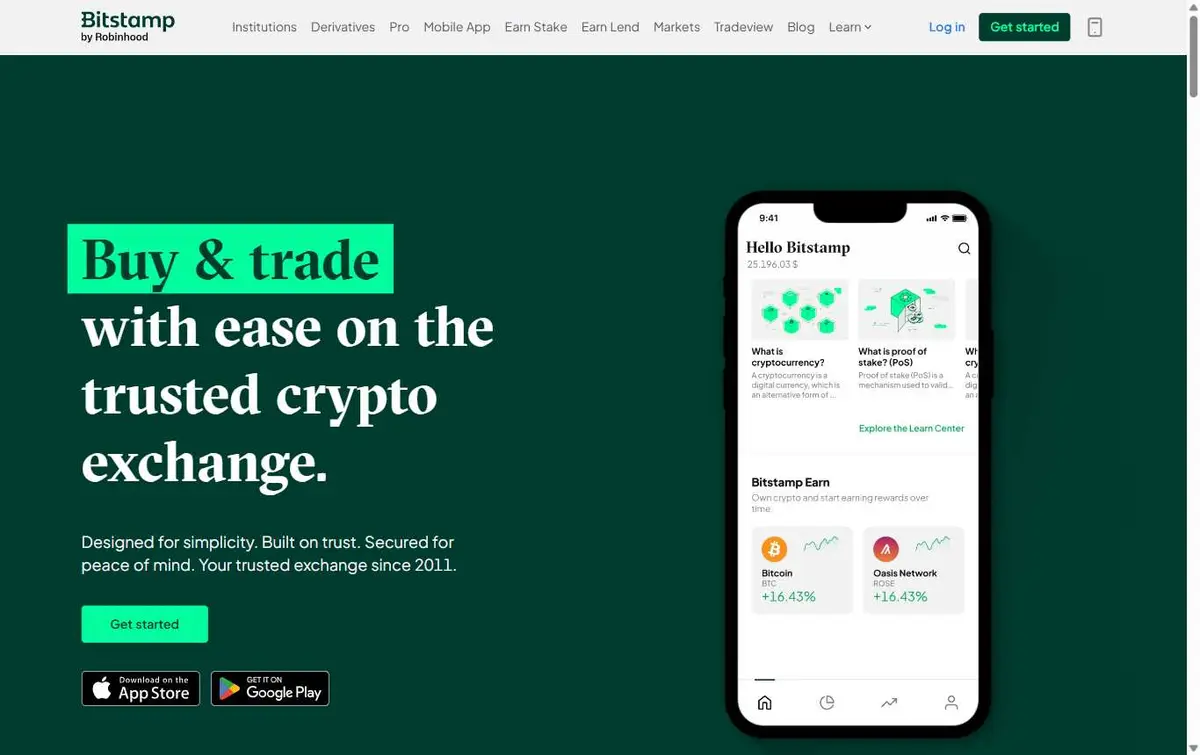
No barrierJapan · Home page
Japan, where futures, staking and lending are cut, sees no product notice
No barrierSingapore · Home page
Singapore, served by Bitstamp Asia under a MAS licence
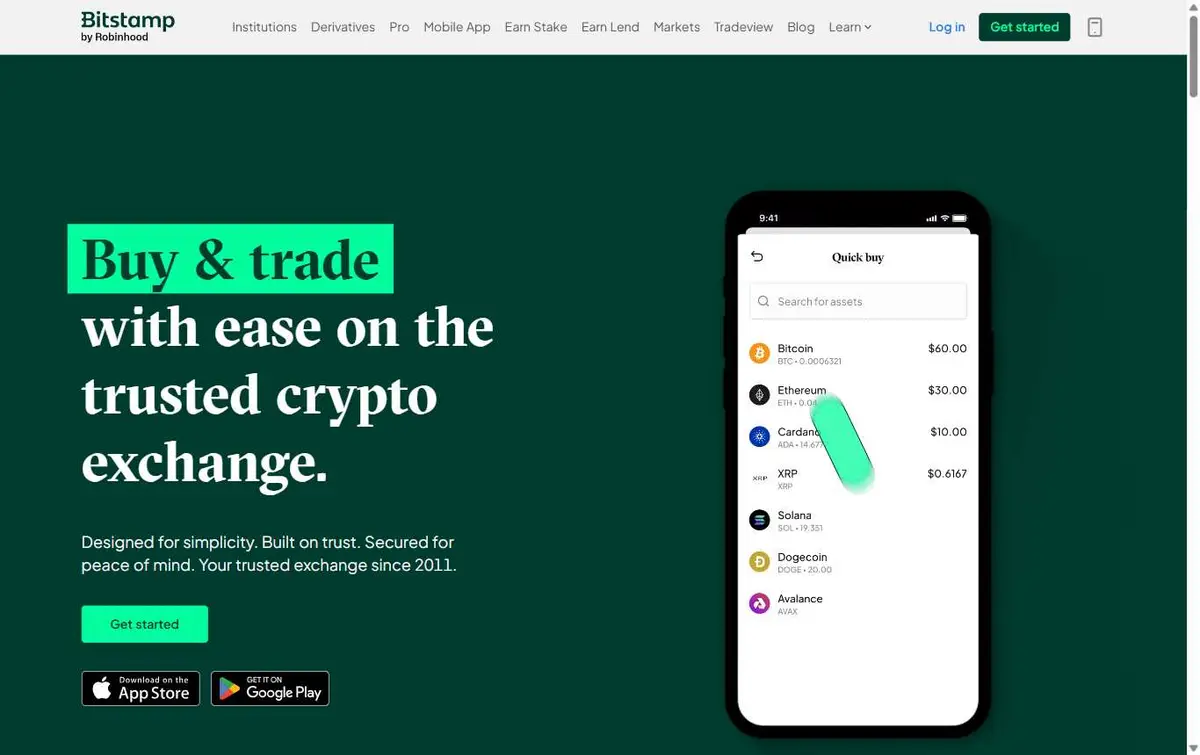
No barrier Germany · Home page
Germany, served by Bitstamp Europe under the Luxembourg MiCA licence
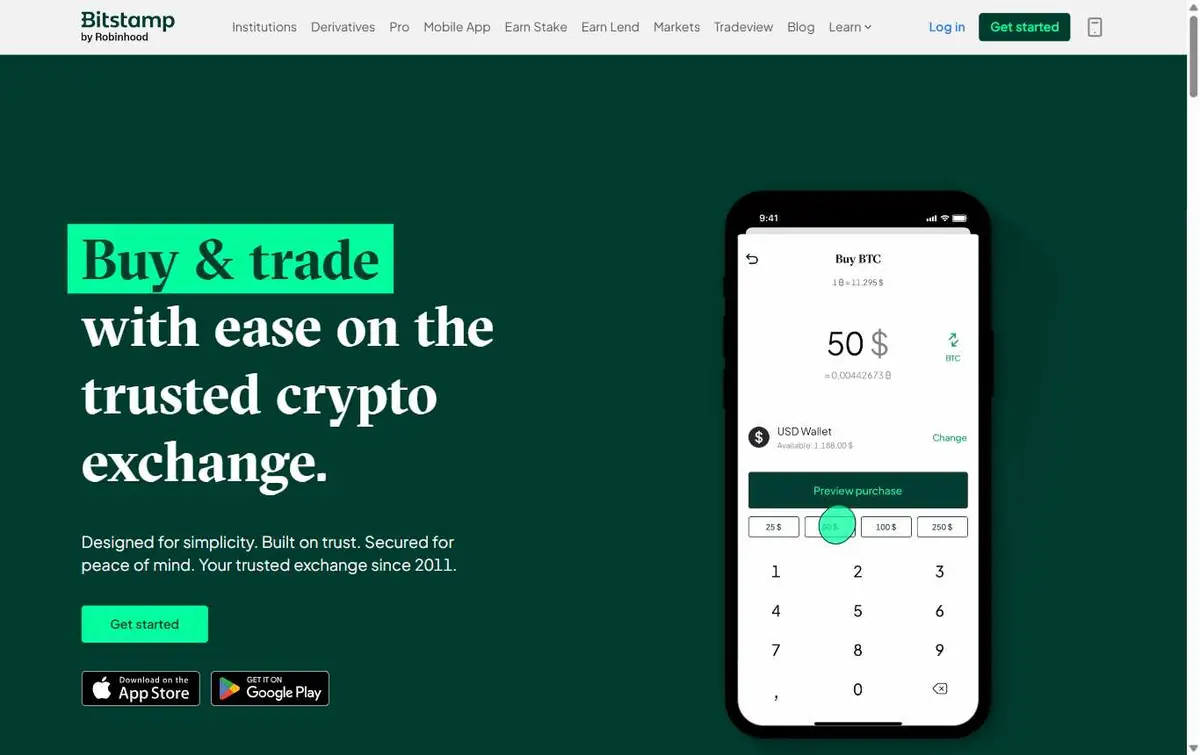
No barrierUkraine · Home page
Ukraine, limited only in five occupied regions, loads with no notice
No barrierNigeria · Home page
Nigeria, one of the countries no Bitstamp document excludes
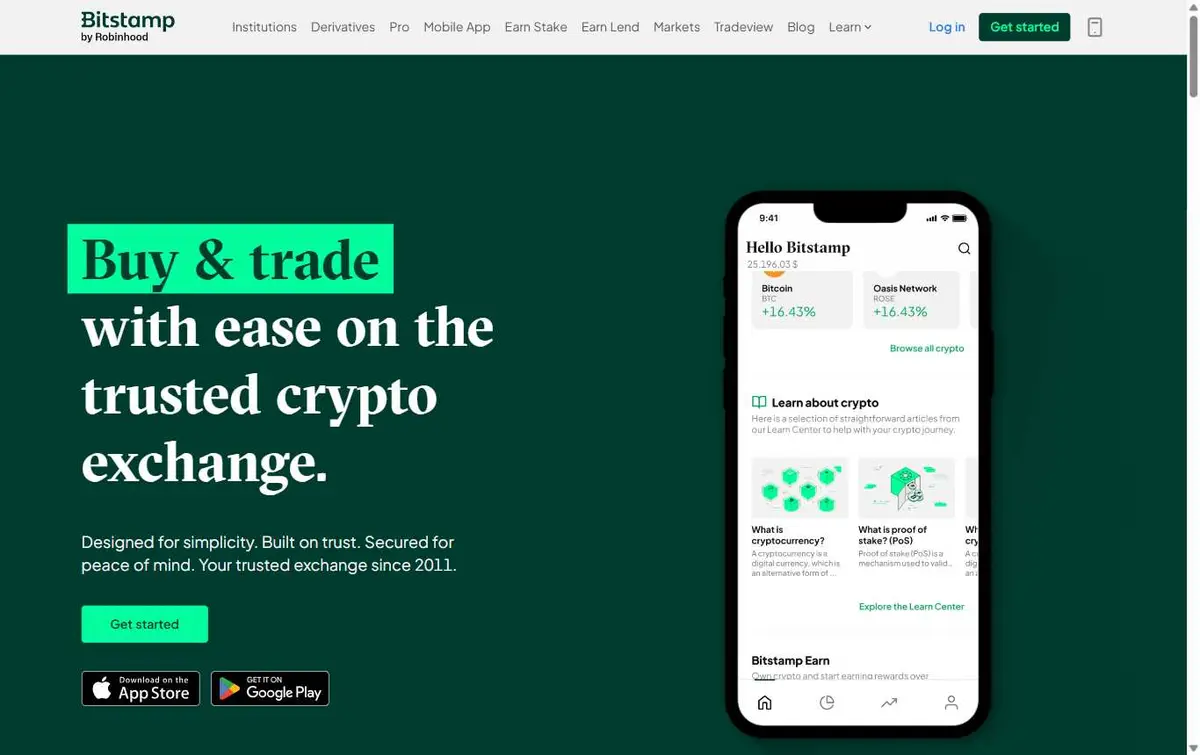
No barrier Hong Kong · Home page
Hong Kong, which leads Semrush's traffic estimate for bitstamp.net
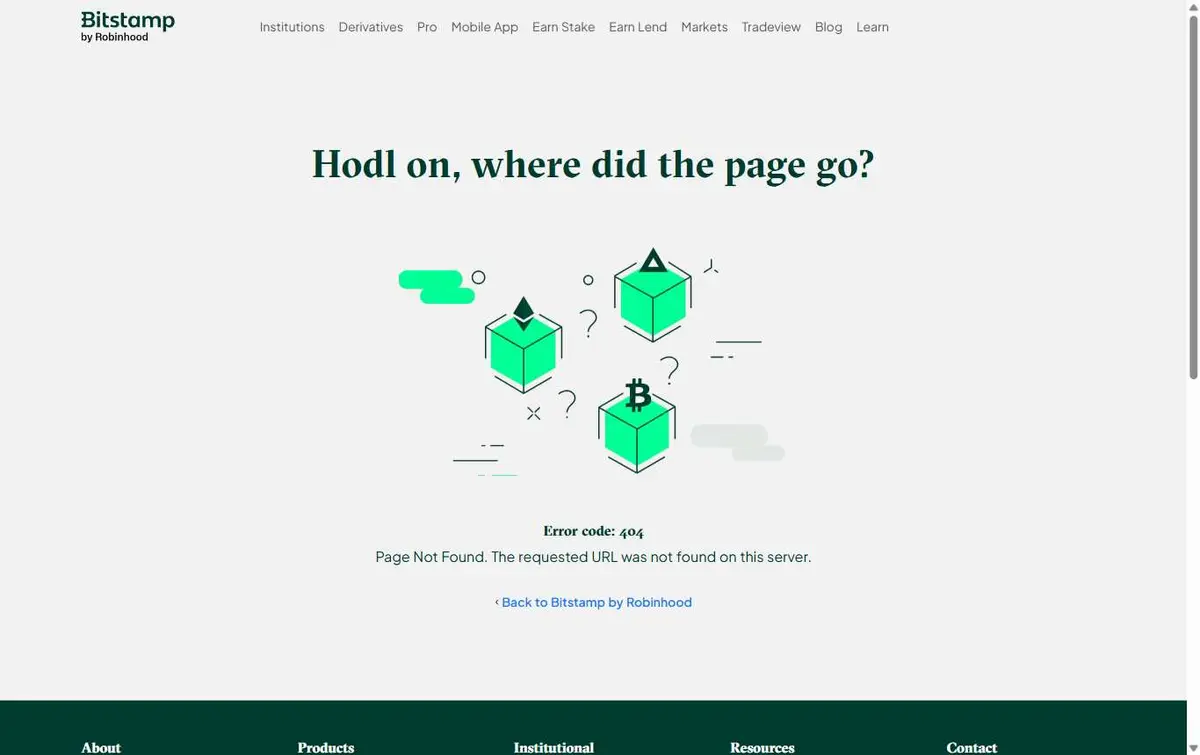
No barrier Netherlands · Sign-up page
The Netherlands, served by Bitstamp Europe under the Luxembourg MiCA licence
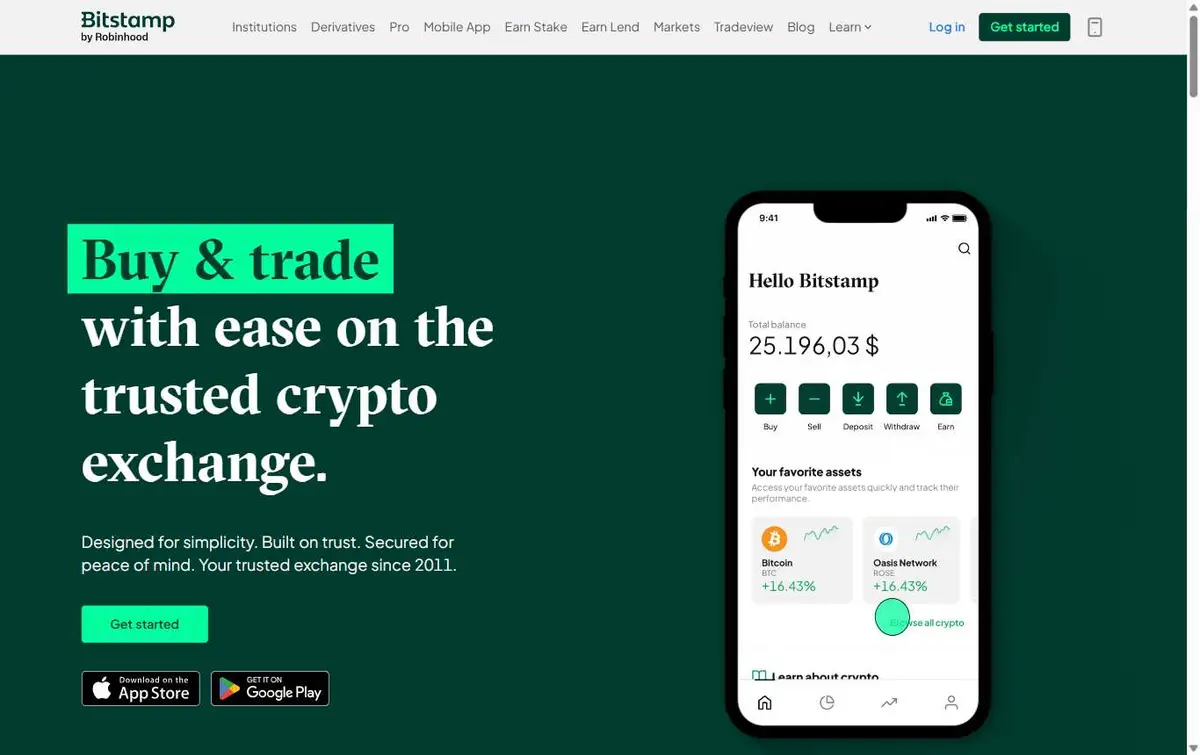
No barrierTurkey · Home page
Turkey: the home page loads with no notice
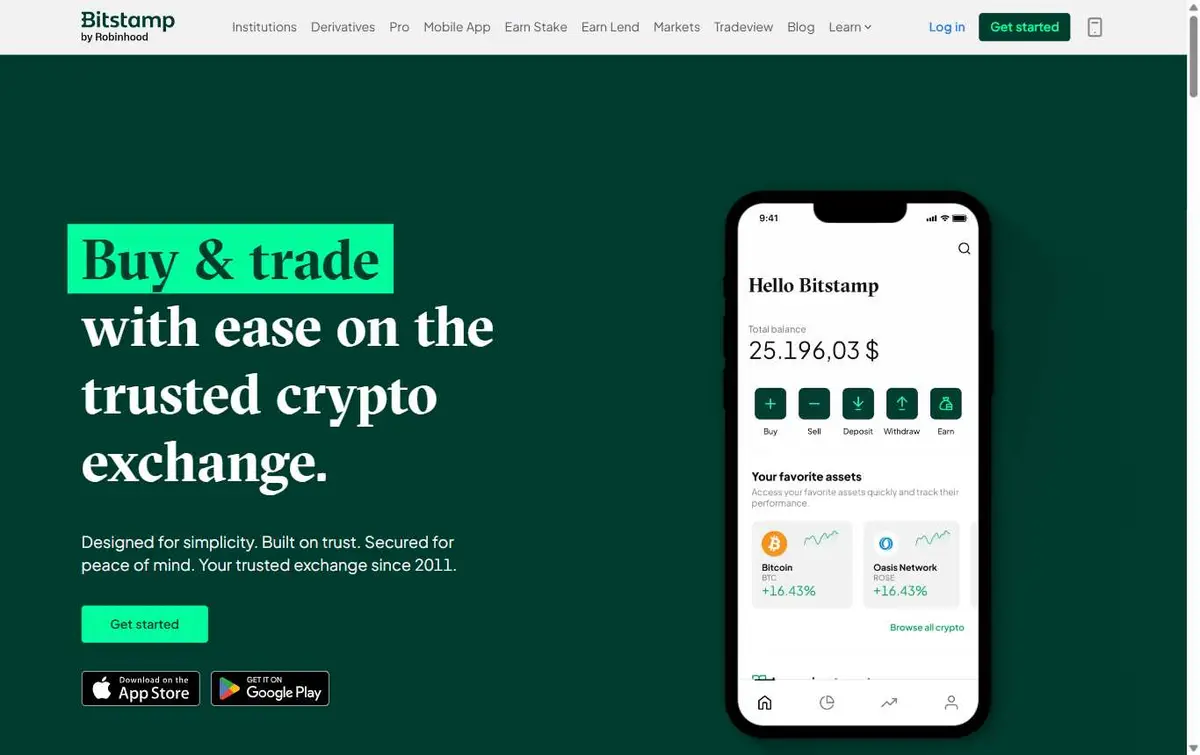
No barrierMexico · Home page
Mexico: the home page loads with no barrier
“Trusted Crypto Exchange”
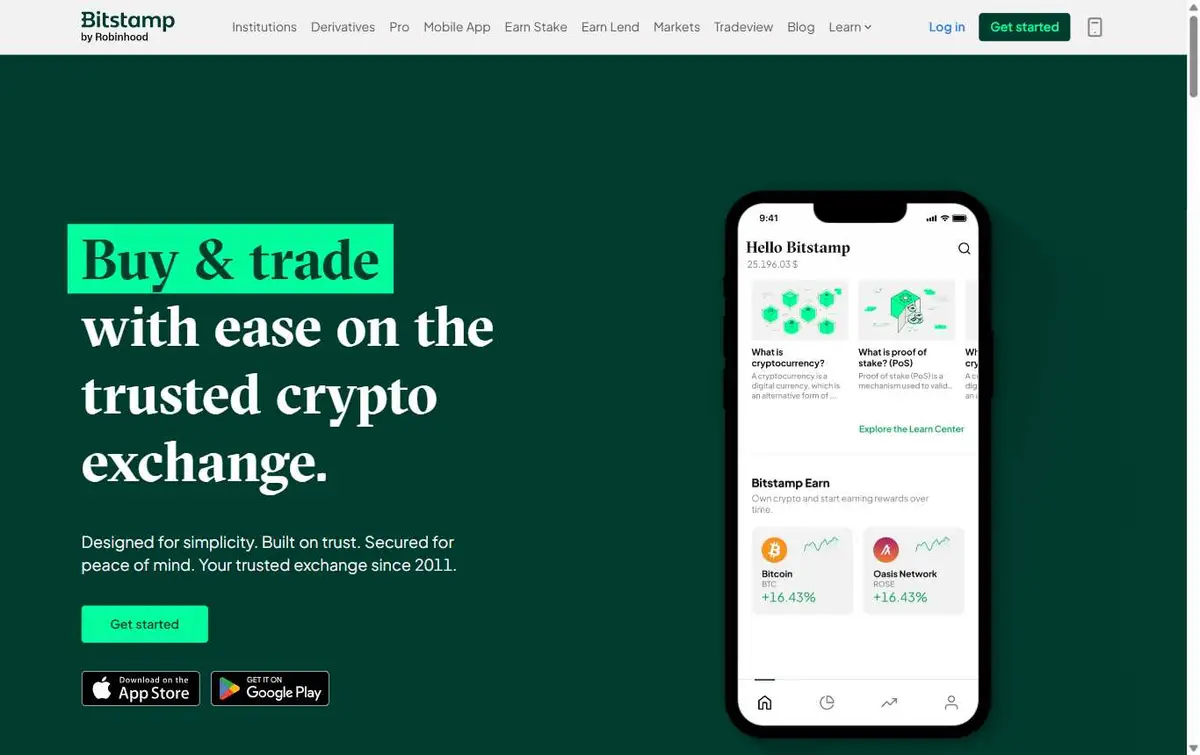
No barrier Ireland · Home page
Ireland: the home page loads with no notice
No barrier New Zealand · Home page
New Zealand: the page loads with no notice
No barrier Norway · Home page
Norway: the home page loads with no notice
No barrier Finland · Home page
Finland: the home page loads with no notice
No barrier Greece · Home page
Greece: the home page loads with no notice
No barrier Bulgaria · Home page
Bulgaria: the home page loads with no notice
No barrier Croatia · Home page
Croatia: the home page loads with no notice
No barrier Latvia · Home page
Latvia: the home page loads with no notice
No barrier Estonia · Home page
Estonia: the home page loads with no notice
No barrier Lithuania · Home page
Lithuania: the home page loads with no notice
No barrierSlovenia · Home page
Slovenia: the home page loads with no notice
No barrier Iceland · Home page
Iceland: the home page loads with no notice
No barrier Serbia · Sign-up page
Serbia: sign-up loads with no barrier
 CRYPTORESTRICTIONS
The test does not decide a country’s status on its own: official documents come first, and a page that loads is not permission to use Bitstamp.
The pattern is simple. Bitstamp serves one global home page everywhere, and the UK, where risk warnings are required by law, is the only place that saw anything different. Canada and China, both restricted, loaded the same page as Germany. That is the opposite of OKX, whose home page refused visitors by IP in every listed country we reached. Bitstamp enforces its rules when you sign up instead: each customer is assigned to a Bitstamp company by country of residence, backed by a proof of residence document.

Russia, India and Iran were not in the test. The full result for every place is below.
All 61 test results, country by country
Bitstamp licences and registrations
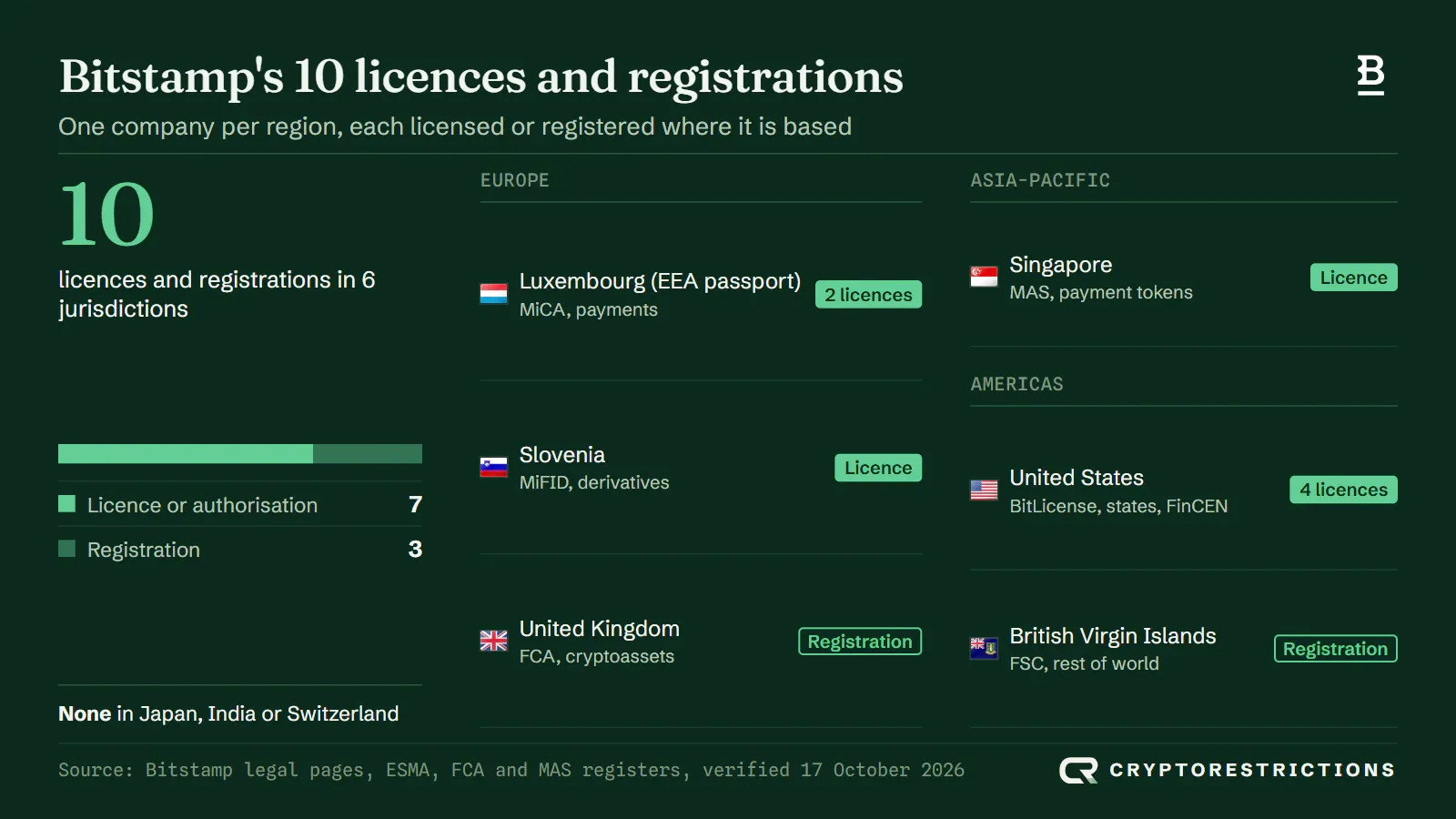
Bitstamp holds 10 licences and registrations in 6 jurisdictions, one company per region, and none in Japan, India or Switzerland.
Every company is named in the footer of each Bitstamp page and on its legal page, and we checked the licences against regulators’ registers where we could. Seven are licences or authorisations and three are registrations.
Europe
- Luxembourg (EEA passport): Bitstamp Europe S.A. is authorised by the CSSF as a crypto-asset service provider under MiCA (licence N00000003, granted 15 May 2025) and as a payment institution (Z00000012).
- Slovenia: Bitstamp Financial Services Ltd. is a MiFID investment firm supervised by the Securities Market Agency, which granted it a multilateral trading facility licence in October 2024; it runs Bitstamp’s derivatives.
- United Kingdom: Bitstamp UK Limited is registered with the FCA as a cryptoasset firm under the Money Laundering Regulations (FRN 978690) since June 2023.
Asia-Pacific
- Singapore: Bitstamp Asia Pte. Ltd. is a major payment institution licensed by the Monetary Authority of Singapore (PS20200667).
Americas
- United States: Bitstamp USA, Inc. holds a New York BitLicense, money transmitter licences in 38 states, Washington DC and Puerto Rico, a Louisiana virtual currency licence and a FinCEN registration (NMLS 1905429), according to its licence page.
- British Virgin Islands: Bitstamp Global Ltd. was registered as a virtual asset service provider in February 2026 and is supervised by the Financial Services Commission.
Bitstamp and MiCA in the EU
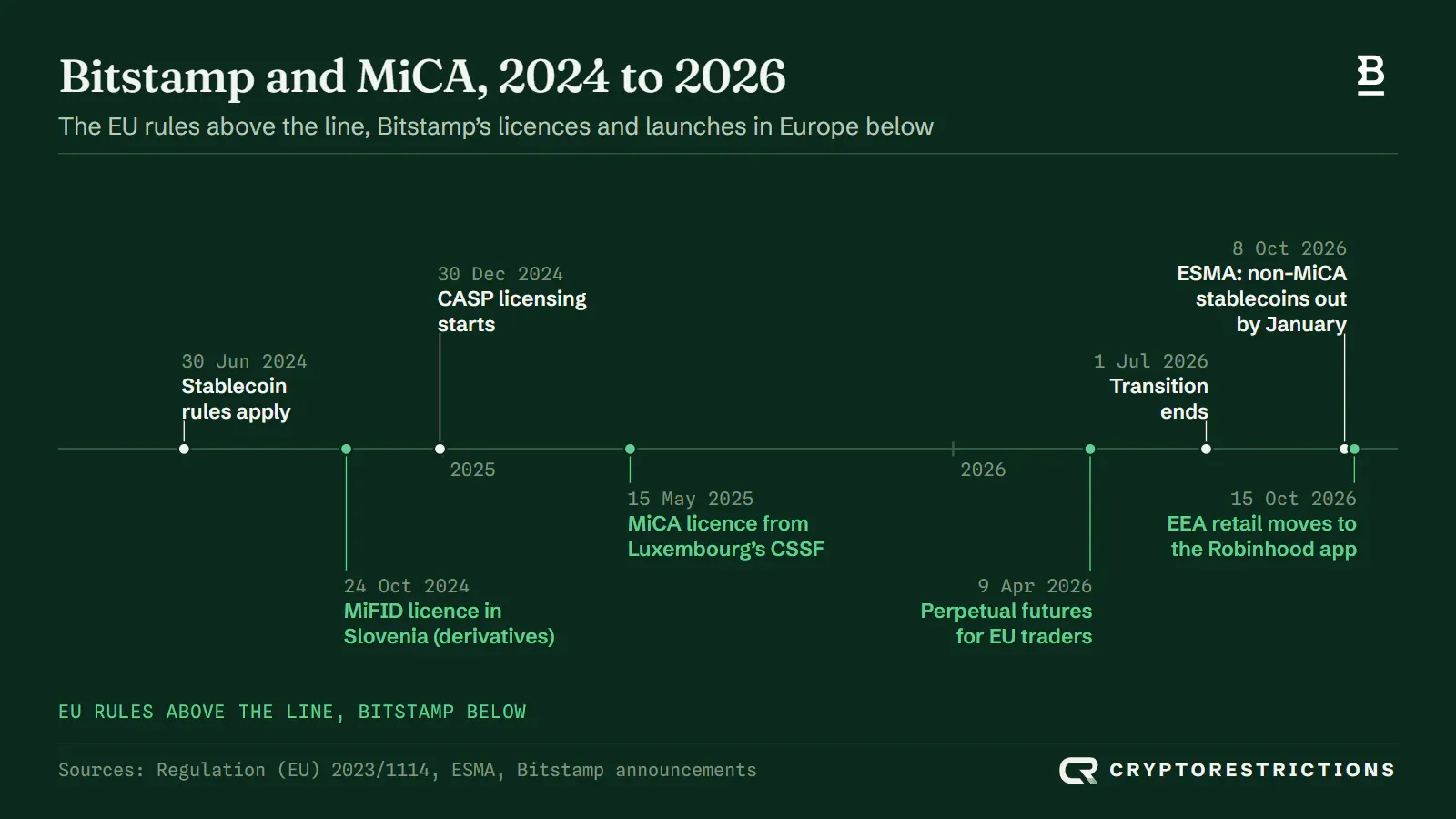
Bitstamp has held a MiCA licence since 15 May 2025, so Bitstamp Europe serves all 30 EEA countries, and the end of the transition period on 1 July 2026 changed nothing for its users there.
MiCA is the EU’s crypto rulebook, and since 30 December 2024 it has required exchanges serving EU clients to hold an authorisation from one member state (our MiCA article covers the rules). Bitstamp chose Luxembourg, where it has held a payment institution licence since 2016. ESMA’s register lists seven of the services MiCA defines for Bitstamp Europe, and its EEA terms (version of 15 October 2026) say crypto-assets in its custody are legally segregated from the company’s own estate. Derivatives sit outside MiCA, in the Slovenian MiFID company.
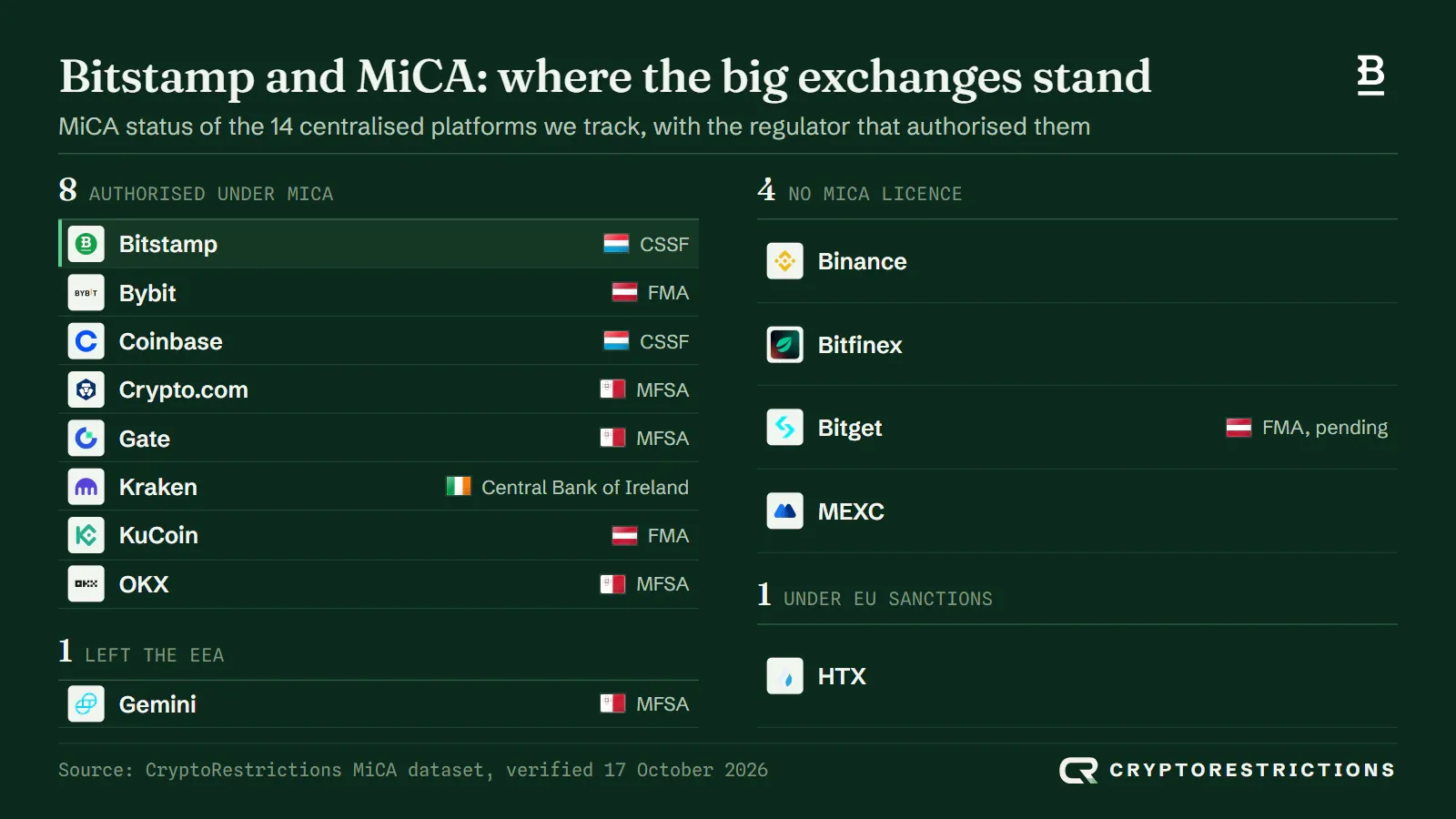
Bitstamp is one of eight authorised platforms among the 14 centralised exchanges in our MiCA dataset, and one of two licensed by Luxembourg’s CSSF, with Coinbase. Unlike Binance, which has no MiCA licence, Bitstamp had its authorisation more than a year before the deadline.


MiCA shapes what EEA customers can buy. Bitstamp’s unsupported assets list shows Bitstamp Europe without USDT, DAI or WBTC, among others. And the app is changing: from 15 October 2026 Bitstamp is inviting retail customers of Bitstamp Europe in the EEA and Switzerland to connect their accounts to the Robinhood app, and after 14 November the Bitstamp interface becomes read-only for those invited. Bitstamp Europe stays their contractual provider, and institutional and corporate clients are not part of the move.
Bitstamp MiCA timeline
Is Bitstamp available in the US?
Yes, in every state except Hawaii and Nevada, through Bitstamp USA, Inc., but with spot trading only, and from 1 February 2027 US customers can no longer open new positions on Bitstamp.
Bitstamp USA has held a New York BitLicense since April 2019. Its US terms (updated 23 July 2026) require customers to live in the United States or a US territory and bar anyone in a jurisdiction the US embargoes. US customers get no derivatives, no Earn staking and no Earn lending. Robinhood, which completed its takeover of Bitstamp on 2 June 2025, is now moving them to its own app: its help page says that from 1 February 2027 Bitstamp accounts can only view, sell and withdraw.
Where does Bitstamp work in the US?
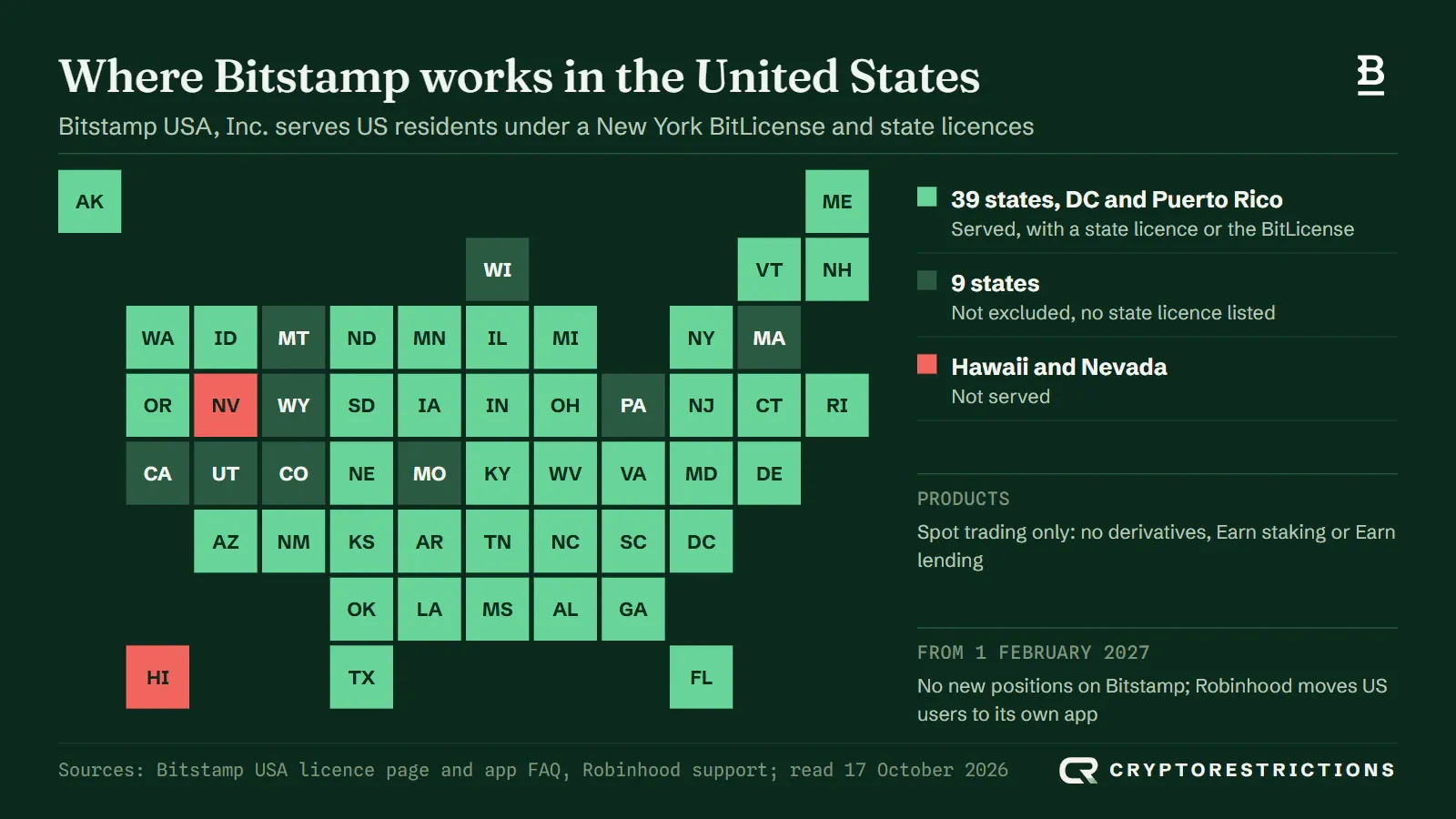
Bitstamp’s app FAQ lists the United States “excluding Hawaii & Nevada”, the only US exclusion we found in its documents:
- States not served: Hawaii and Nevada.
- No state licence listed, but not excluded: California, Colorado, Massachusetts, Missouri, Montana, Pennsylvania, Utah, Wisconsin and Wyoming.
New York is covered by the BitLicense, though New York customers lose about 20 more assets on top of the US list, USDT among them.
Bitstamp exits and regulator actions: timeline
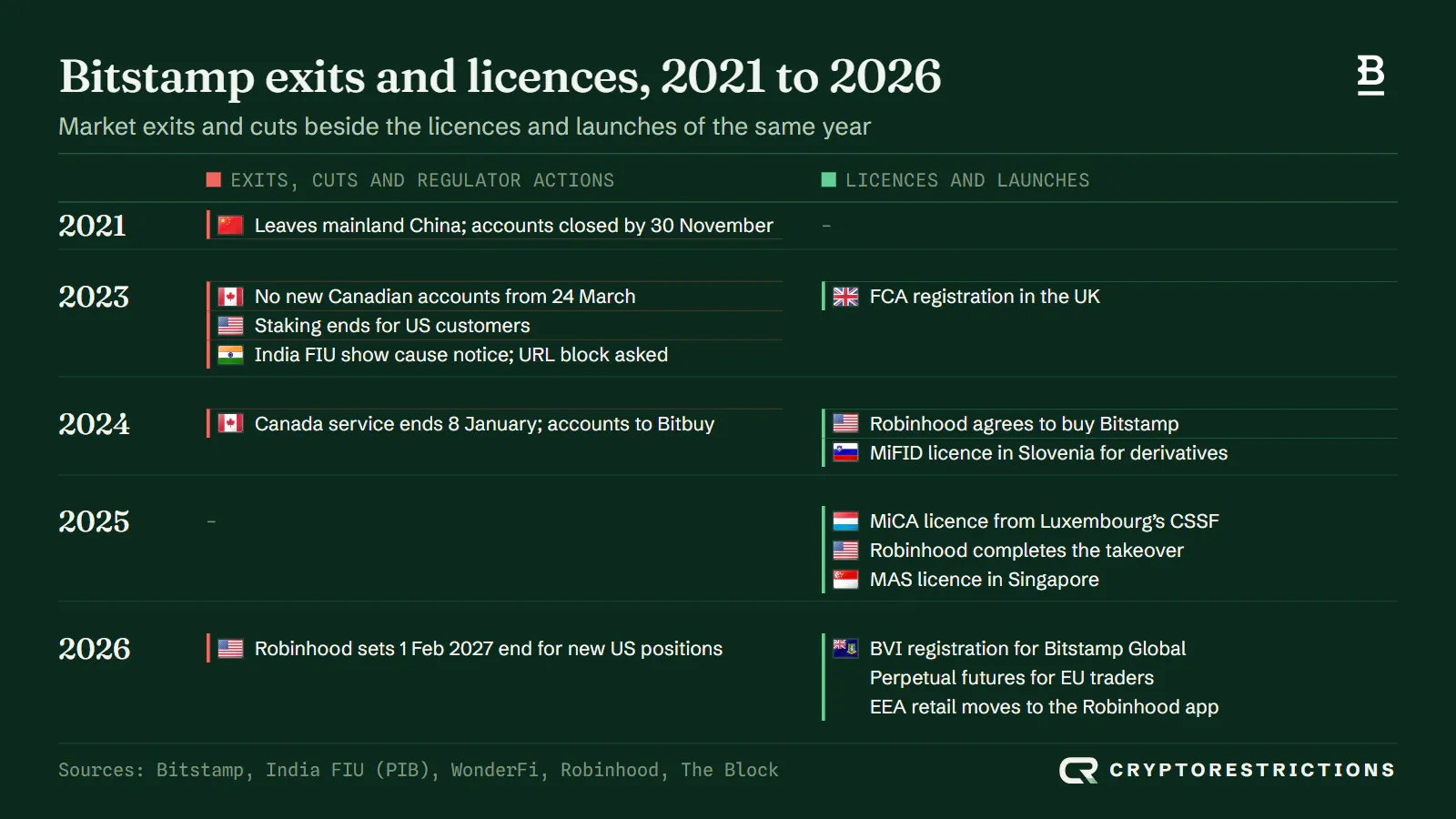
Bitstamp’s record is light on enforcement. We found no SEC or CFTC action against it, and no warning naming it on the Japanese FSA’s list of unregistered operators. The regulator action that counts in our data is India’s: the FIU notice and URL block request of December 2023. Its exits were its own decisions: mainland China in 2021, and Canada, which Bitstamp left citing timing and resource allocation challenges. Ending staking for US customers in September 2023, The Block reported, was the first of its US product cuts.
Bitstamp KYC and identity verification
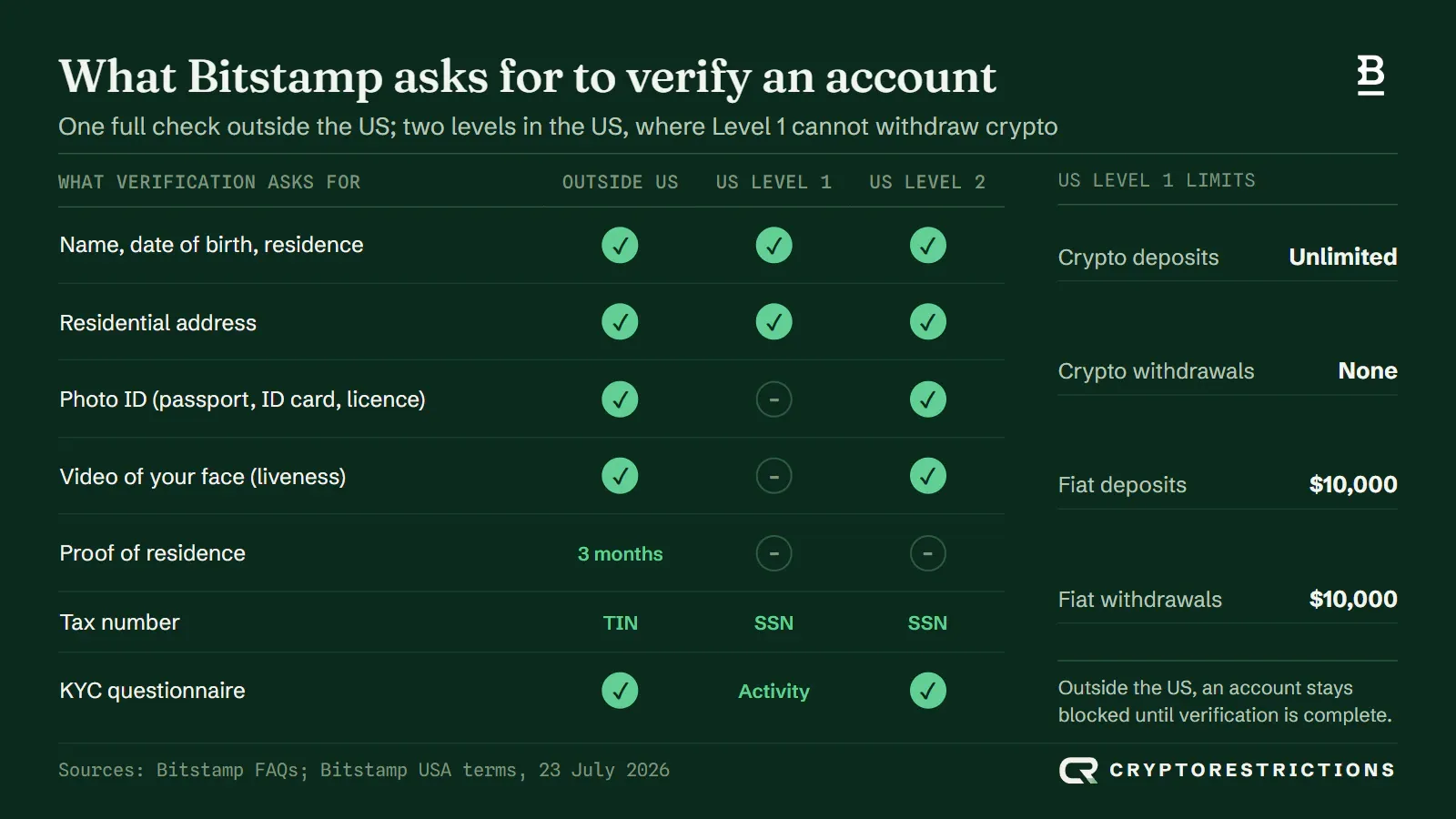
Outside the US, Bitstamp has one full verification and an account stays blocked until it is complete; in the US there are two levels, and Level 1 cannot withdraw crypto.
Bitstamp’s verification guide asks for a current identity document (passport, national identity card or driver’s licence) and a proof of residence, and the app adds a video of your face. A proof of residence must be issued within three months, or a year for government documents; phone bills are not accepted. Bitstamp also asks for your tax residence and tax number, and can ask later about source of funds. The US terms set out two levels: Level 1 needs name, address, Social Security Number and an explanation of activity, and allows fiat deposits and withdrawals up to $10,000 but no crypto withdrawals; Level 2 adds a photo ID, a liveness video and a questionnaire, and removes the limits.
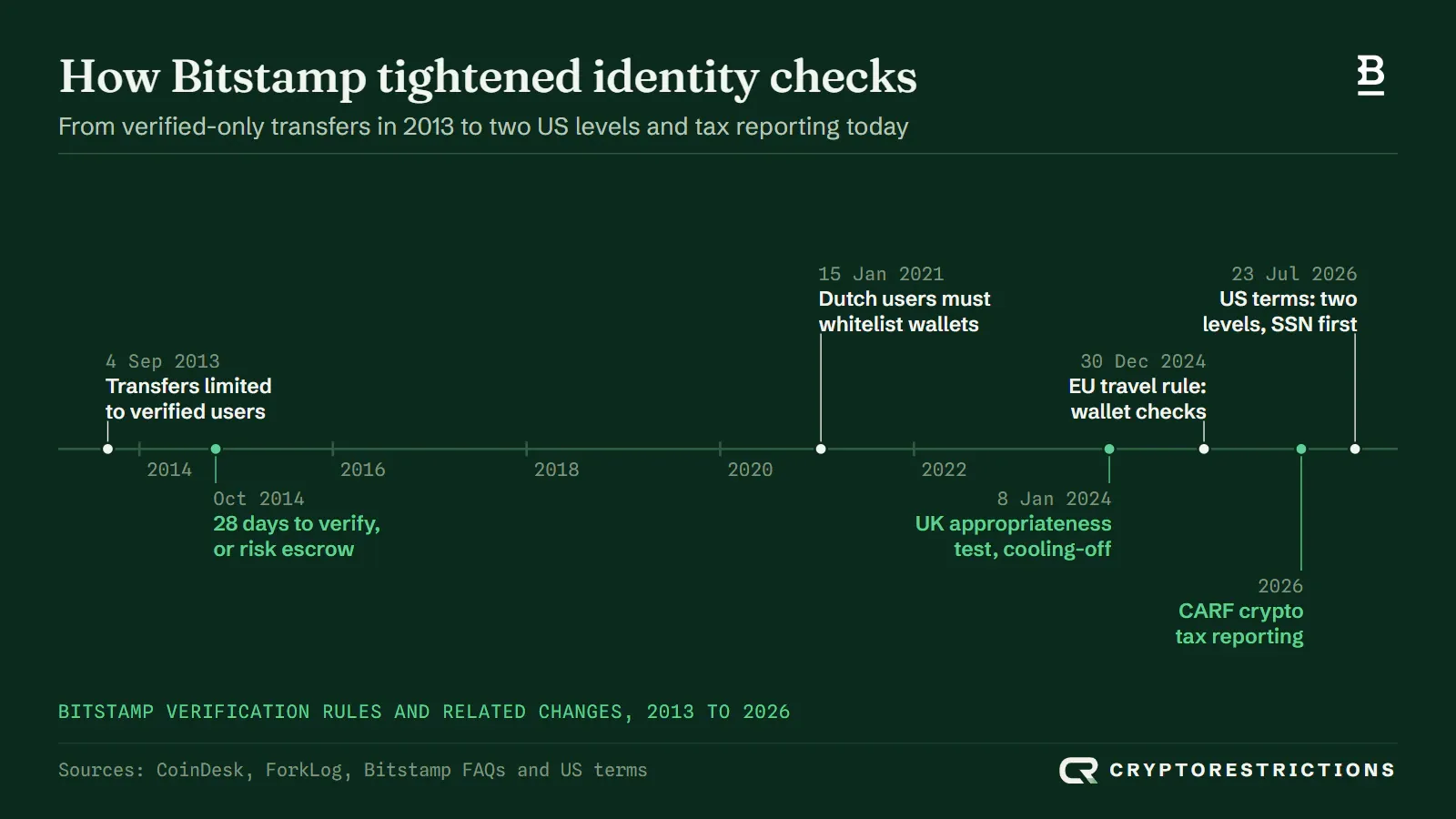
The UK adds its own steps. Since 8 January 2024 UK customers must pass an appropriateness test and fit an investor category before trading, according to Bitstamp’s UK FAQ, and anyone who fails a second attempt waits 24 hours to try again. In the EU, withdrawals over €1,000 to your own wallet need a one-time liveness check under the travel rule.
Bitstamp verification history
Bitstamp has required verification for a long time. On 4 September 2013 it told customers that bitcoin and bank transfers would be limited to verified accounts, and in October 2014 it gave remaining unverified users 28 days to verify, CoinDesk reported. Inactive unverified accounts can still be moved to a third-party escrow under today’s terms. In January 2021 Dutch users had to whitelist their withdrawal wallets, ForkLog reported.
Bitstamp publishes limits only for the US levels; outside the US there is no tier table, so we do not repeat third-party ones. For how Bitstamp’s checks compare with other exchanges, see our guide to crypto exchange KYC.
What if Bitstamp is restricted where you live?
There is some choice in each of Bitstamp’s three restricted countries: of the 21 other platforms we track, 9 are available in China, 4 in Russia and 3 in Canada, though only one of Canada’s is a centralised exchange.
A VPN is no route around it. Bitstamp’s terms make you responsible for the law where you live and where you log in from, and it assigns your account by country of residence, proved with a document. What is left is a platform that is allowed to serve you where you live.
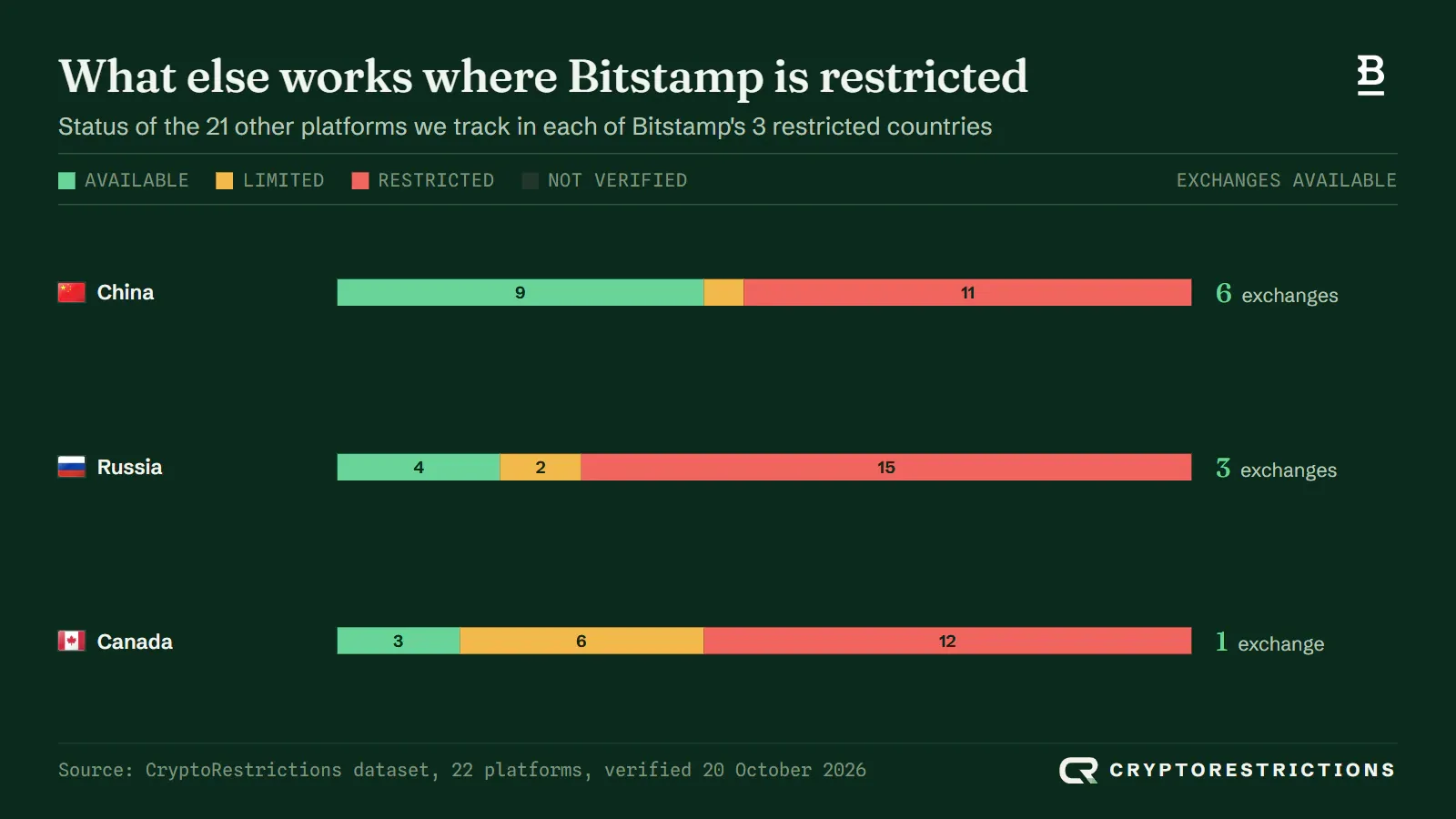
In Canada the one centralised exchange recorded as available is Coinbase; the other two are decentralised protocols. In China, six centralised exchanges are available under our coverage rule because their documents do not exclude it, which says nothing about China’s own ban. In Russia, three exchanges are recorded as available, against 15 platforms that restrict it.
Each country page lists every platform we track there with its status and sources; start from our country index.