Is crypto legal in Singapore?
Yes. Nothing in the rules we read bans residents from buying, holding or trading crypto, but the state warns against it and regulates every business that serves them, which is where the limits sit.
MAS told Parliament on 5 March 2025 that cryptocurrencies are highly volatile and speculative, that regulation cannot fully protect consumers from losses, and that consumers should stay clear of them. The state’s tool is licensing rather than prohibition. MAS says digital token services that serve people in Singapore are already regulated under existing laws, and the tax authority treats a payment token as intangible property, not currency. The sections below cover who holds a licence, what they may sell to retail customers and how gains are taxed.
Which crypto exchanges work in Singapore?
Five of the exchanges we track serve Singapore through a MAS-licensed local company: Coinbase, OKX, Bitstamp, Gemini and Crypto.com. Kraken and Bitfinex also serve residents with no licence on file.
The licence is the major payment institution licence for digital payment token services, issued under the Payment Services Act 2019. MAS widened what the Act covers from 4 April 2024: custody of tokens, facilitating transfers and facilitating exchange now need a licence even when the provider never holds the customer’s money. The firm count and register are on the MAS Financial Institutions Directory, which we could not read in bulk, so we quote no total.
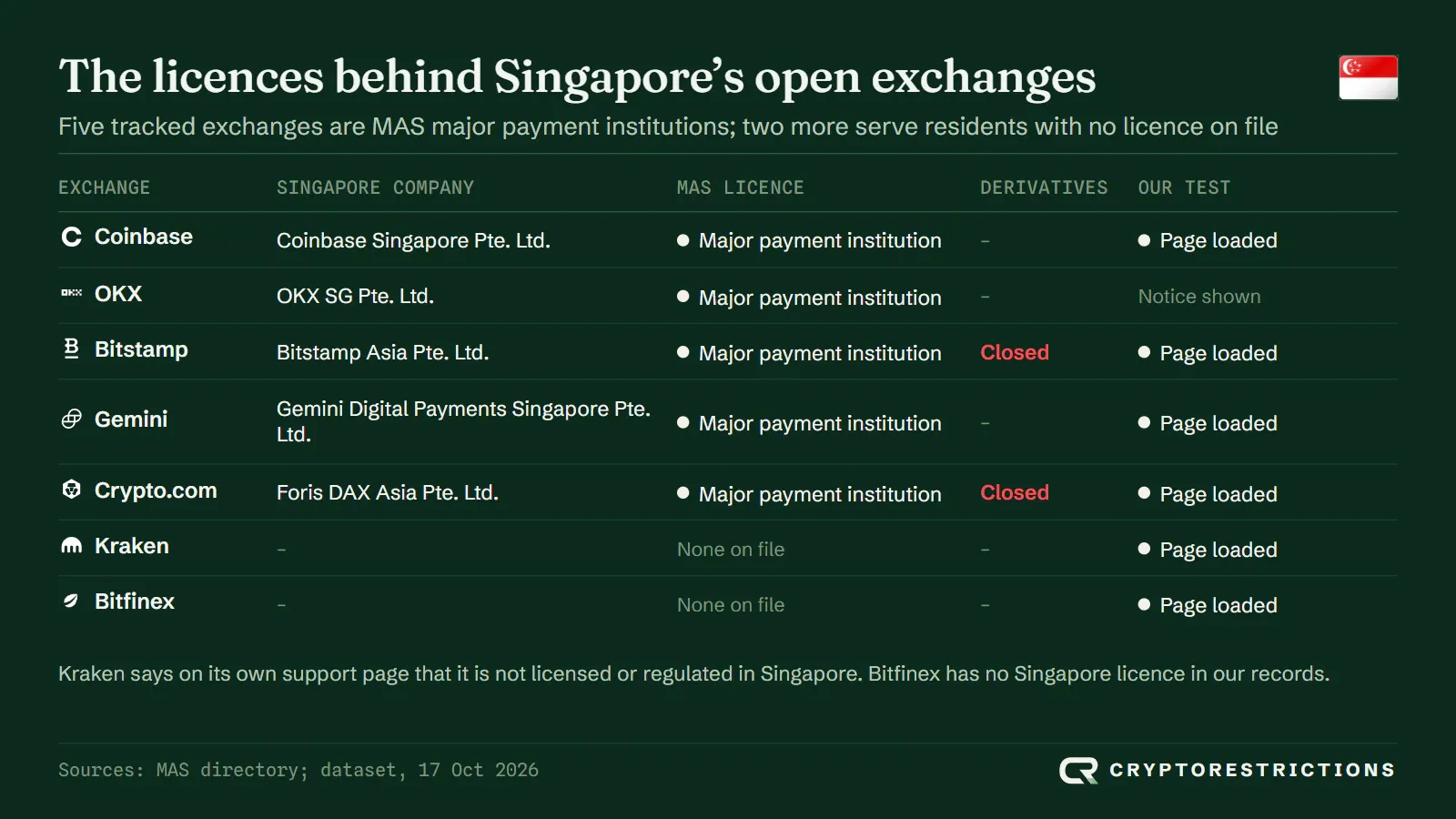
Coinbase serves Singapore as Coinbase Singapore Pte. Ltd., OKX as OKX SG Pte. Ltd., which the MAS directory lists as a major payment institution for digital payment token and cross-border money transfer services, and Bitstamp as Bitstamp Asia Pte. Ltd. Crypto.com holds its licence through Foris DAX Asia Pte. Ltd. Gemini announced its full licence on 8 September 2026, and its Singapore accounts moved to Gemini Digital Payments Singapore on 2 April 2025.
Kraken is the exception worth knowing: its own support page says it is not licensed or regulated in Singapore, yet Singapore is not on its do-not-serve list. A firm that serves Singapore customers without a licence is outside the protections the regime is built to give, so treat the label as a risk, not a ruling.
Best crypto platforms for Singapore residents
By our access score, Coinbase and Gemini (9.0 out of 10 each) and OKX (8.5) are the exchanges most open to Singapore residents, PancakeSwap and Uniswap (8.0 each) are the most open DeFi platforms, and no prediction market is open to new positions.
The score rates how fully a Singapore resident can use each platform, not its fees or safety. It is computed from our data and moves when a row changes: access status (4 points), the share of the platform’s products open here (3), the Singapore licences we hold on file (2) and what our geo-access test saw from a Singapore address (1). Platforms that refuse Singapore residents are not scored. The full method is on our methodology page.
Exchanges

Coinbase
Best for A licensed local company for spot trading
9.0/10- Access
- 4/4
- Products
- 3/3
- Licences
- 1/2
- Our test
- 1/1
Read our Coinbase reportPros
- Coinbase Singapore Pte. Ltd. is a MAS major payment institution
Cons
- We hold no Singapore source for its derivatives or staking

Gemini
Best for A newly licensed local company
9.0/10- Access
- 4/4
- Products
- 3/3
- Licences
- 1/2
- Our test
- 1/1
Read our Gemini reportPros
- Full MAS licence announced on 8 September 2026
- Singapore is on its perpetuals list
Cons
- We hold no Singapore source for its staking

OKX
Best for Spot trading with a licensed local company
8.5/10- Access
- 4/4
- Products
- 3/3
- Licences
- 1/2
- Our test
- 0.5/1
Read our OKX reportPros
- OKX SG Pte. Ltd. is listed by MAS as a major payment institution
Cons
- We hold no Singapore source for its derivatives or staking

Bitfinex
Best for Spot access without a Singapore company
8.0/10- Access
- 4/4
- Products
- 3/3
- Licences
- 0/2
- Our test
- 1/1
Read our Bitfinex reportPros
- Singapore is not a prohibited jurisdiction in its terms
Cons
- No MAS licence on file

Kraken
Best for Spot trading outside the licensing regime
8.0/10- Access
- 4/4
- Products
- 3/3
- Licences
- 0/2
- Our test
- 1/1
Read our Kraken reportPros
- Singapore is not on its do-not-serve list
Cons
- Says it is not licensed or regulated in Singapore

Crypto.com
Best for Spot trading in the app, with a licensed company
7.3/10- Access
- 3.5/4
- Products
- 1.8/3
- Licences
- 1/2
- Our test
- 1/1
Read our Crypto.com reportPros
- Foris DAX Asia Pte. Ltd. is a MAS major payment institution
Cons
- No derivatives for Singapore
- On Crypto.com's derivatives geo-restrictions list

Bitstamp
Best for Plain spot trading with a licensed company
6.3/10- Access
- 3.5/4
- Products
- 0.8/3
- Licences
- 1/2
- Our test
- 1/1
Read our Bitstamp reportPros
- Bitstamp Asia Pte. Ltd. is a MAS major payment institution
Cons
- Earn staking and Earn lending are not offered in Singapore
- Perpetual futures are not offered here
DeFi

PancakeSwap
Best for BNB Chain swaps and pools
8.0/10- Access
- 4/4
- Products
- 3/3
- Licences
- 0/2
- Our test
- 1/1
Read our PancakeSwap reportPros
- Singapore is not excluded by its terms
Cons
- No Singapore licence on file

Uniswap
Best for Swapping tokens from your own wallet
8.0/10- Access
- 4/4
- Products
- 3/3
- Licences
- 0/2
- Our test
- 1/1
Read our Uniswap reportPros
- Its terms bar only places under comprehensive US sanctions
Cons
- No Singapore licence on file

Lighter
Best for Perpetuals on its main app
6.3/10- Access
- 3/4
- Products
- 2.3/3
- Licences
- 0/2
- Our test
- 1/1
Read our Lighter reportPros
- The main app is not restricted
Cons
- Barred from Lighter on Robinhood Chain and its points program

Aster
Best for Perpetuals and spot trading
5.9/10- Access
- 3/4
- Products
- 1.9/3
- Licences
- 0/2
- Our test
- 1/1
Read our Aster reportPros
- Perpetuals and spot are not barred
Cons
- Prediction trading is barred under its prediction user agreement

Hyperliquid
Best for Perpetuals from your own wallet
5.9/10- Access
- 3/4
- Products
- 1.9/3
- Licences
- 0/2
- Our test
- 1/1
Read our Hyperliquid reportPros
- Perpetuals and spot are not excluded by its terms
Cons
- Outcome markets are closed to Singapore
Which platforms block Singapore users?
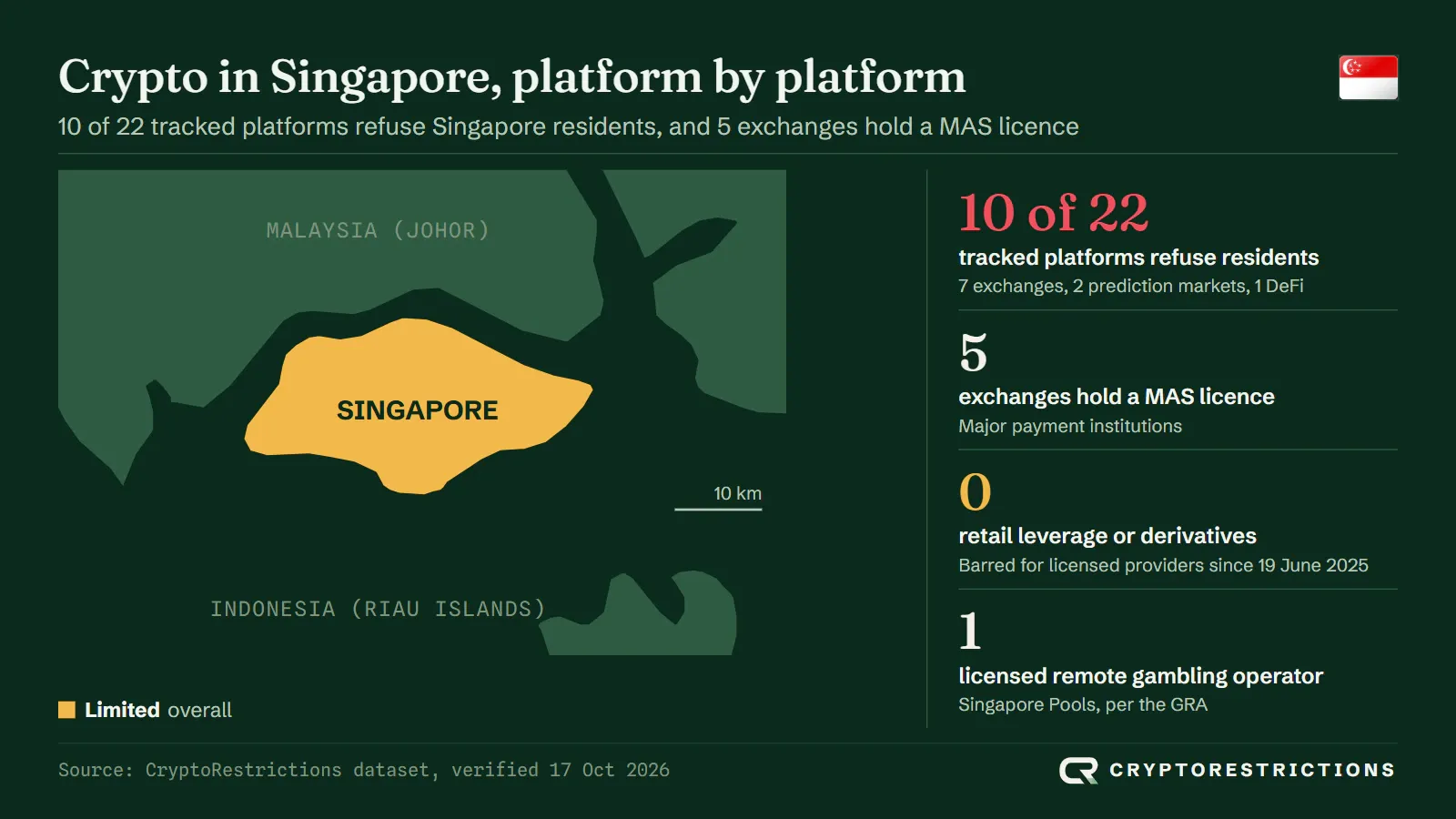
Seven exchanges (Binance, Bybit, KuCoin, Bitget, Gate, MEXC and HTX), two prediction markets (Polymarket and Kalshi) and one DeFi platform (Jupiter) refuse Singapore residents in their own terms or notices.
Binance is the old case. It stopped Singapore users from trading and depositing fiat on Binance.com in October 2021, and its local Binance.sg platform closed in February 2022. No Binance page we read names Singapore today, so that status rests on those events and stays at medium confidence. Most of the others list Singapore among their restricted locations in current terms: Bitget on 16 October 2026, MEXC on 13 October 2026, KuCoin on 29 September 2026 and Gate on 22 July 2026.
What our geo-access test saw from Singapore
From a Singapore address on 14 and 16 October 2026 we loaded all 22 platforms we track: 4 refused us, 2 showed a notice and 16 loaded with no barrier.
An open page is not permission. Binance, KuCoin, Bitget, Gate and Jupiter loaded although their notices or terms close Singapore, because most platforms enforce at identity verification rather than at the page. Bybit, HTX and MEXC refused the page outright, and Polymarket’s geoblock check returned blocked. Two notices were not refusals in the usual sense: Kalshi said prediction markets are not available, and OKX sent us to its local site, OKX Singapore. Swipe through the screenshots below; each card quotes what the page showed.
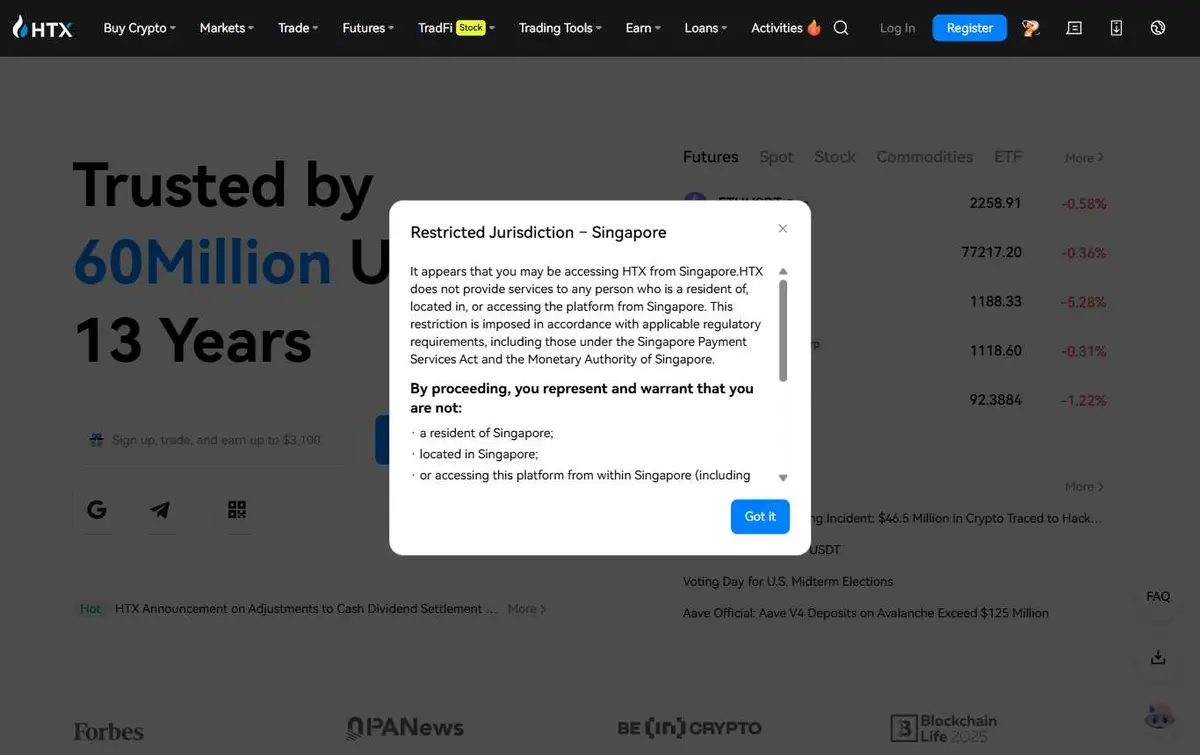
Blocked HTX · Home page
The one IP block: a Singapore pop-up citing the Payment Services Act
“It appears that you may be accessing HTX from Singapore.”
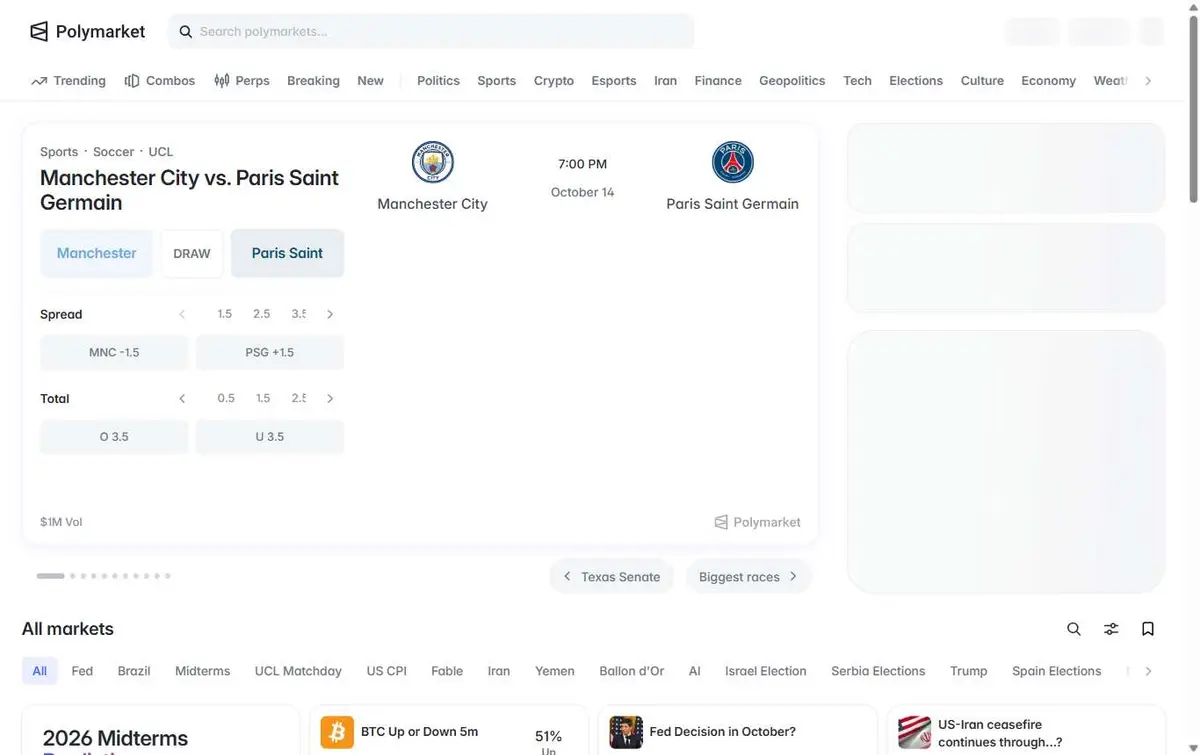
Blocked Polymarket · Home page
Singapore, a close-only country: the page loads and the location check returns blocked
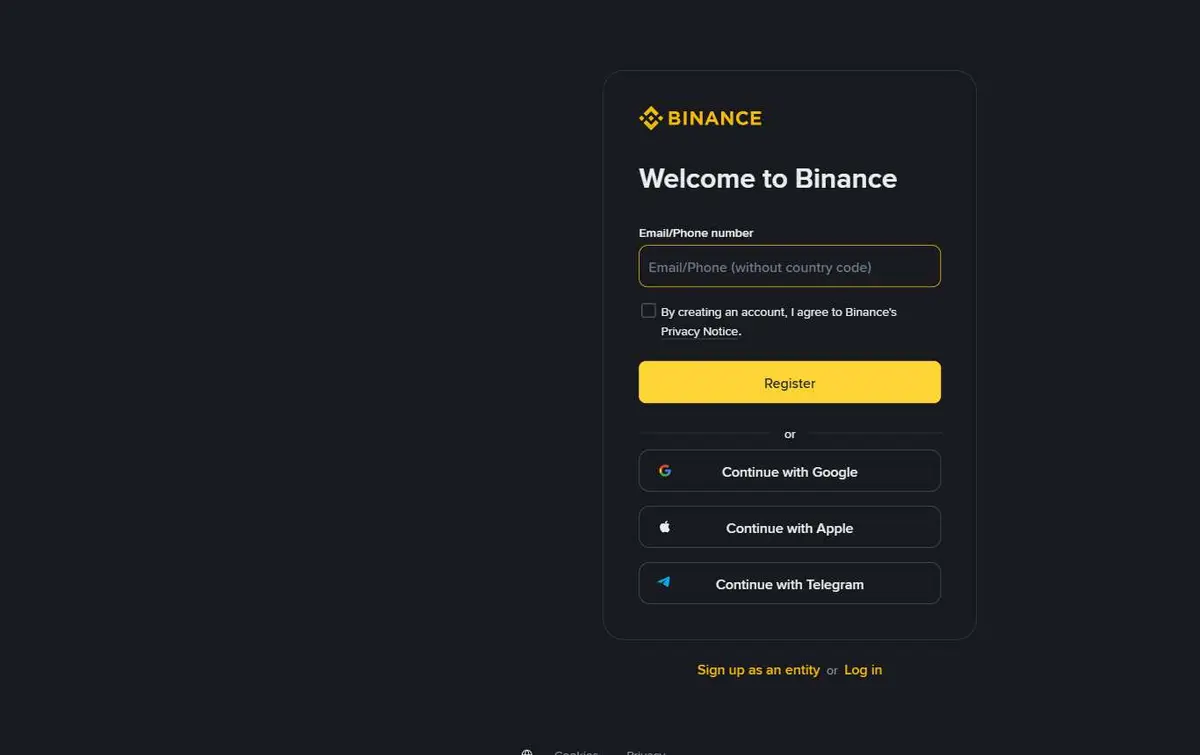
No barrier Binance · Sign-up page
Restricted, yet sign-up loads with no warning
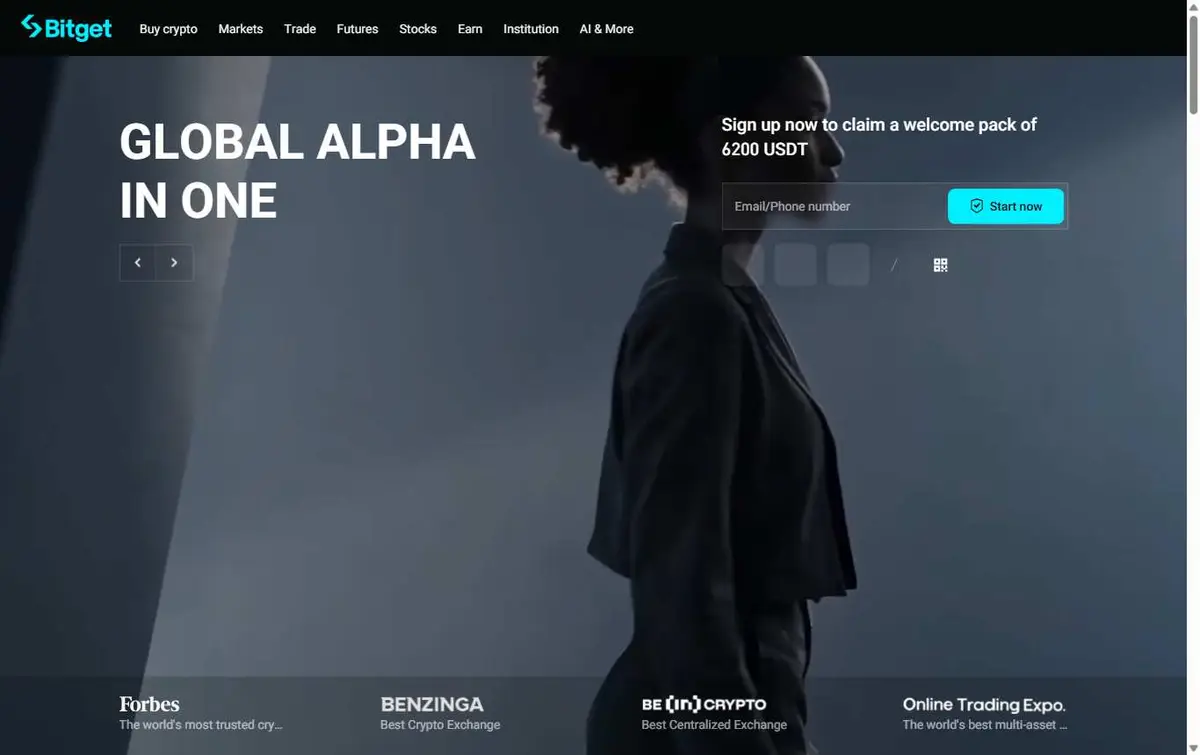
No barrier Bitget · Home page
Singapore, on the prohibited list, loaded with no barrier
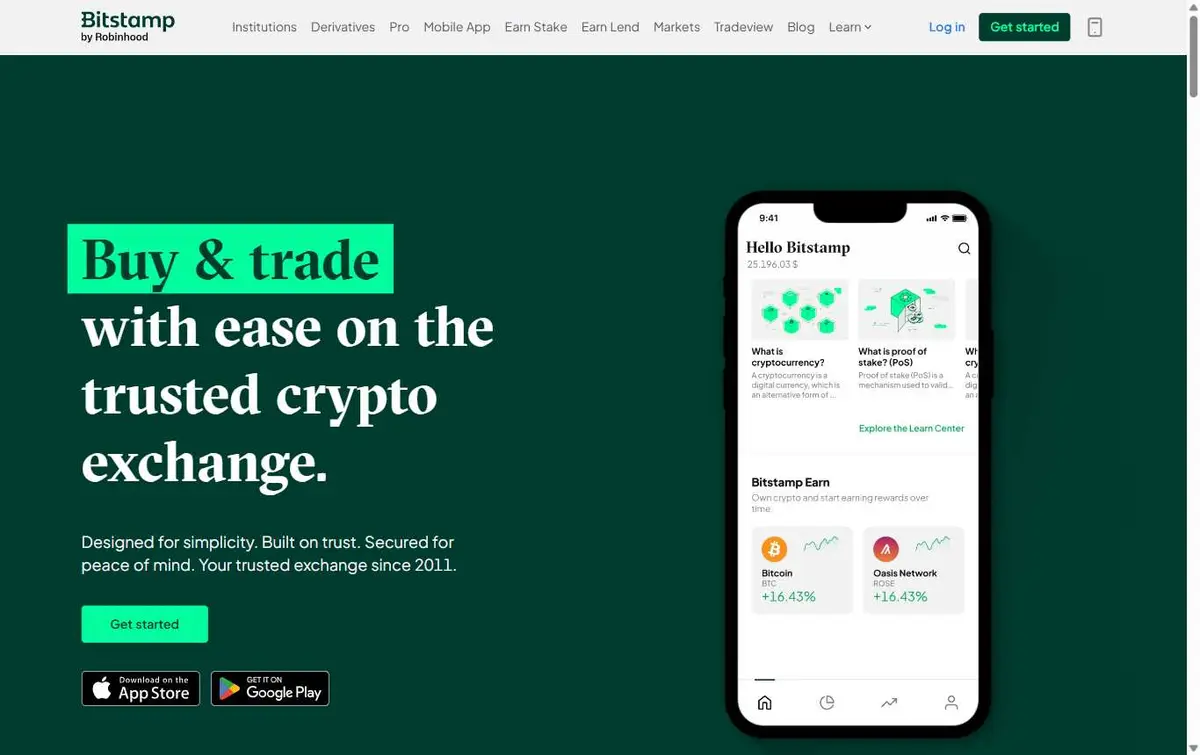
No barrier Bitstamp · Home page
Singapore, served by Bitstamp Asia under a MAS licence
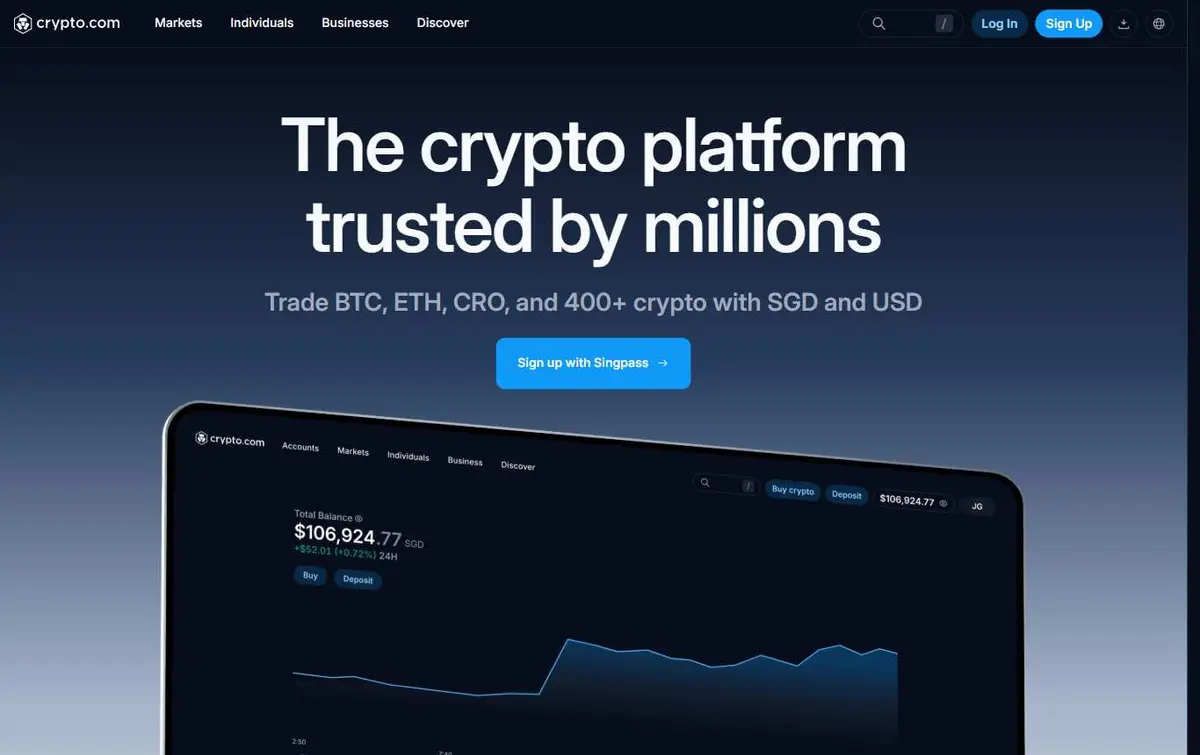
No barrier Crypto.com · Home page
Singapore, Crypto.com's MAS-licensed home market
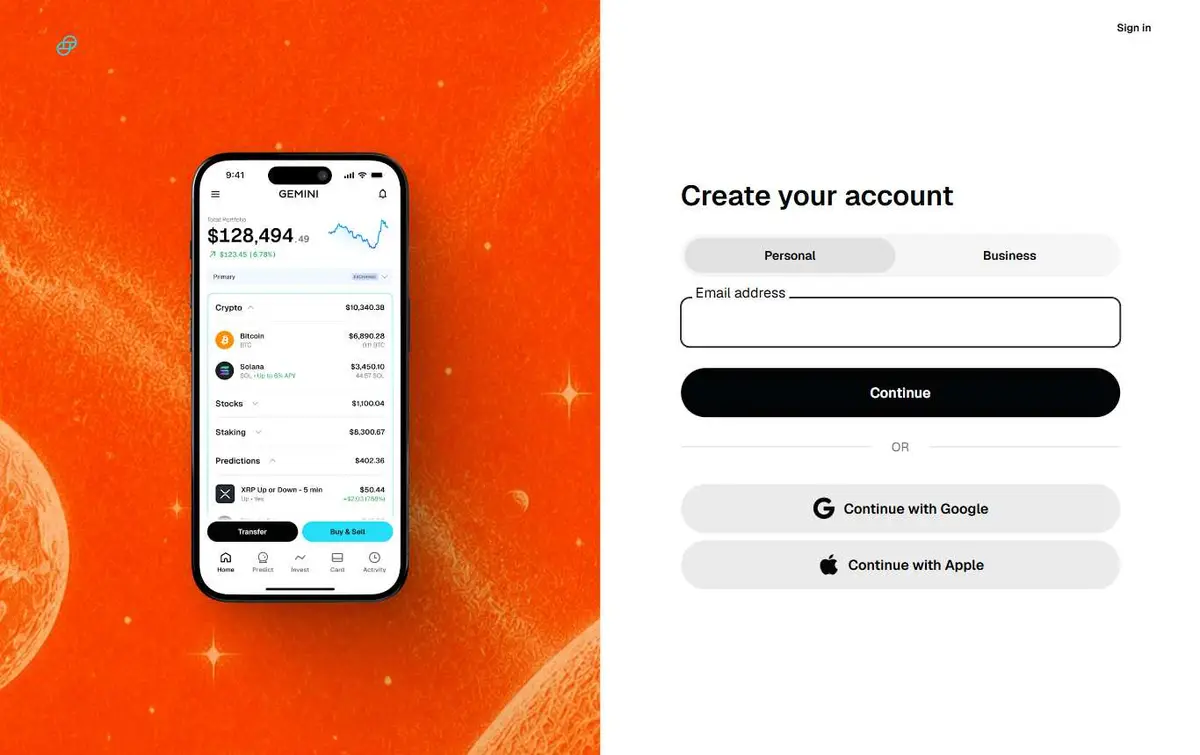
No barrier Gemini · Sign-up page
Singapore, served by Gemini's MAS-licensed local company: the form loads
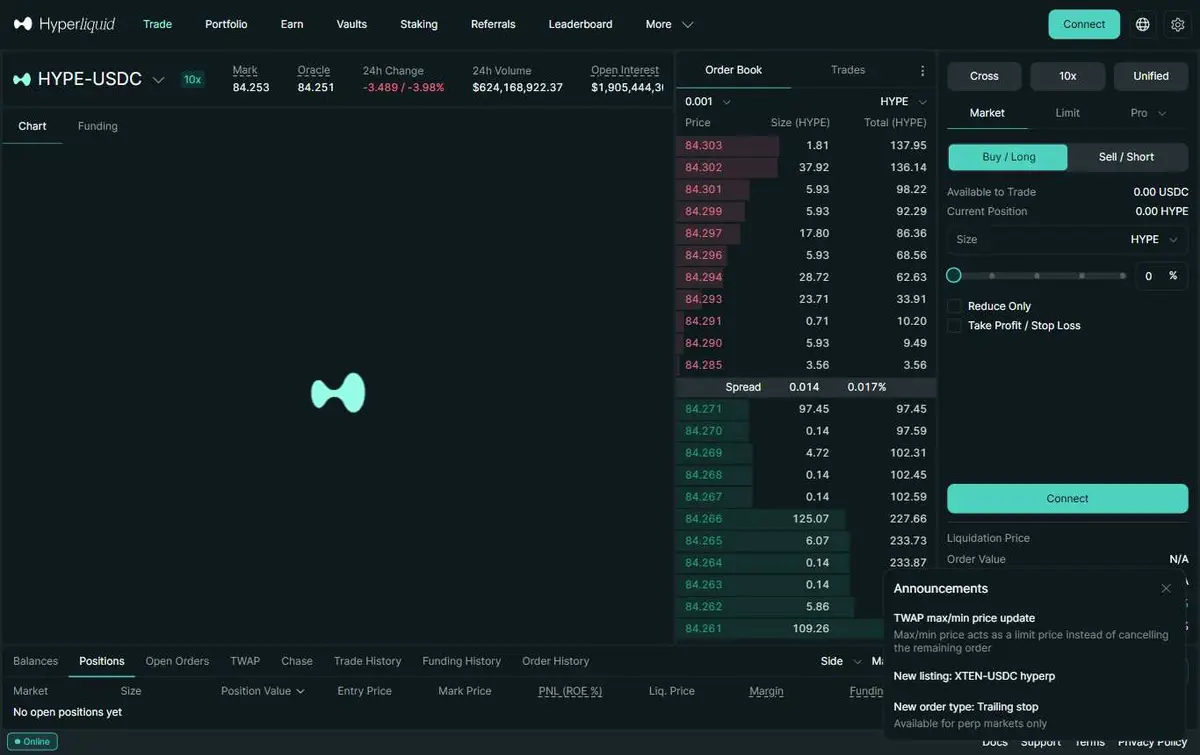
No barrierHyperliquid · Trading app
Singapore, second in Similarweb's traffic list: no Outcomes tab
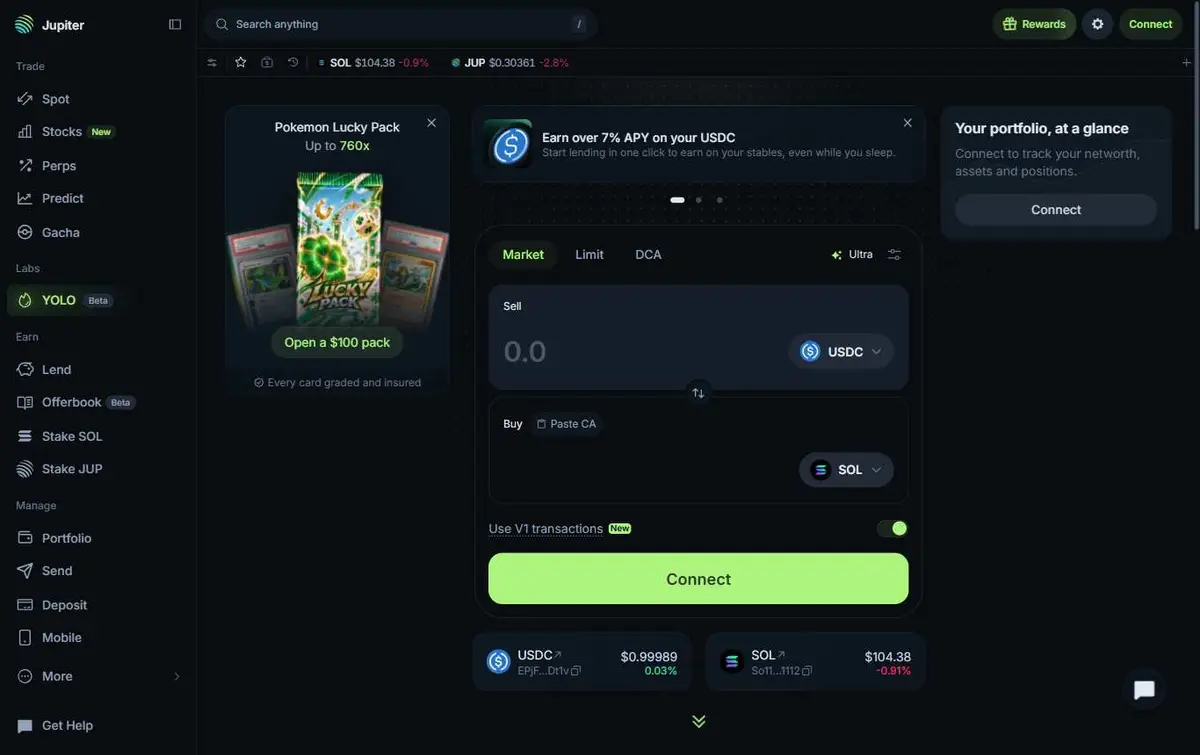
No barrier Jupiter · Trading app
Singapore, also named in the terms: the same open swap screen
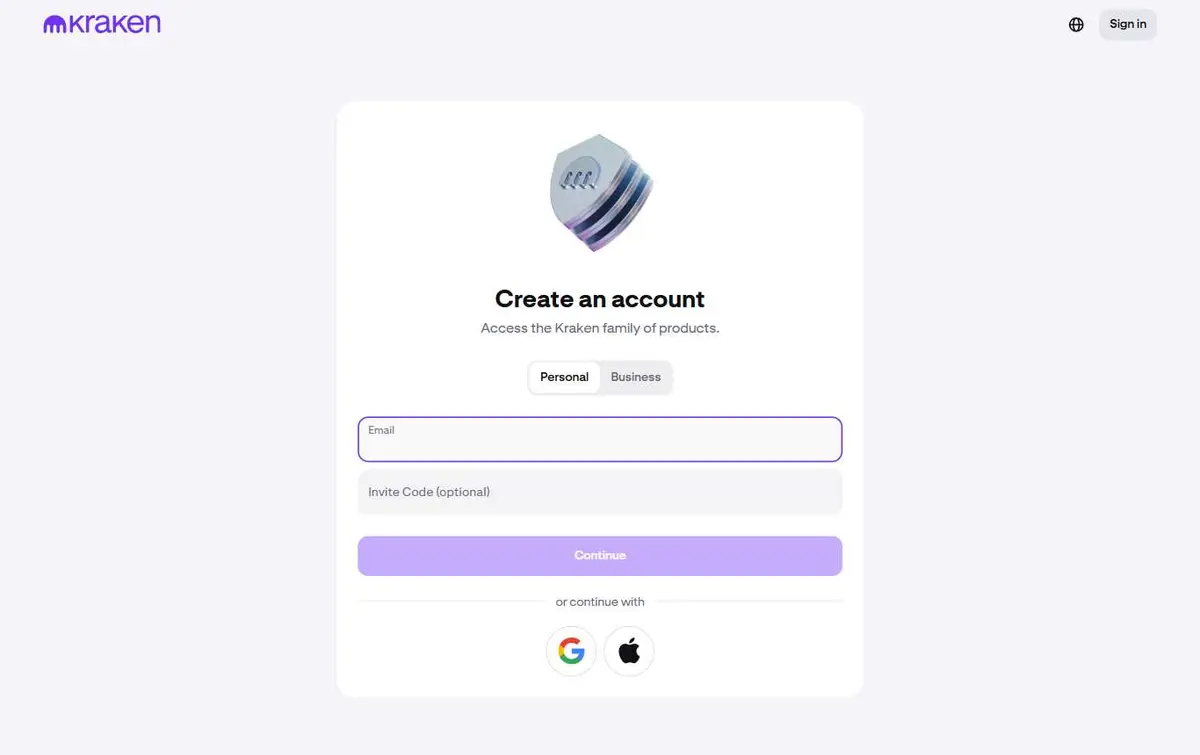
No barrier Kraken · Sign-up page
Singapore, where Kraken says it holds no licence, is still served
“Create an account”
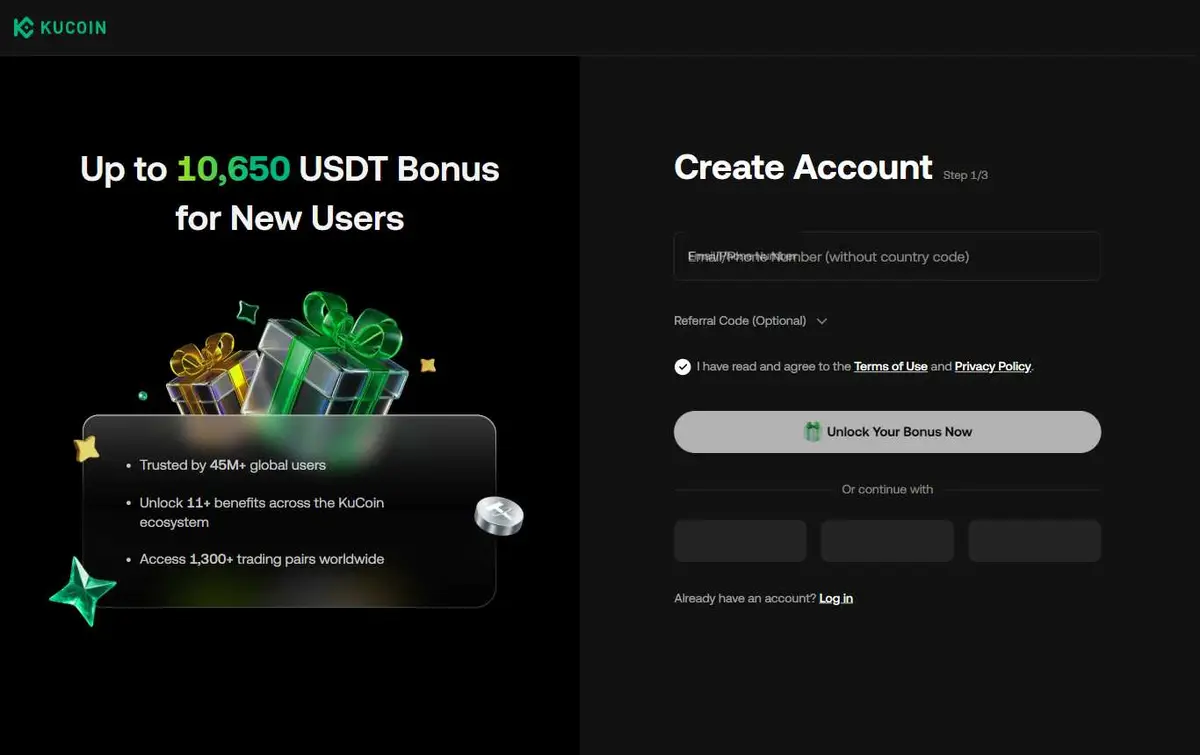
No barrier KuCoin · Sign-up page
Restricted, yet sign-up loads with no warning
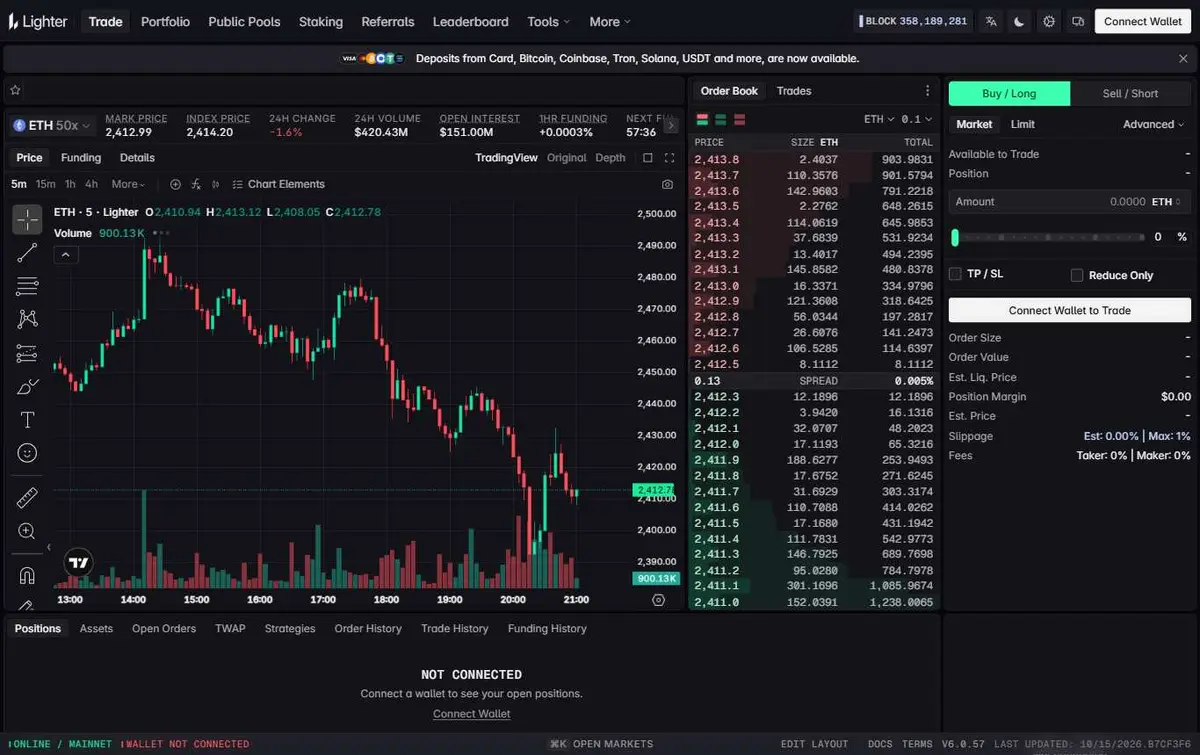
No barrier Lighter · Trading app
Singapore is barred from Lighter on Robinhood Chain, but the main app loads in full
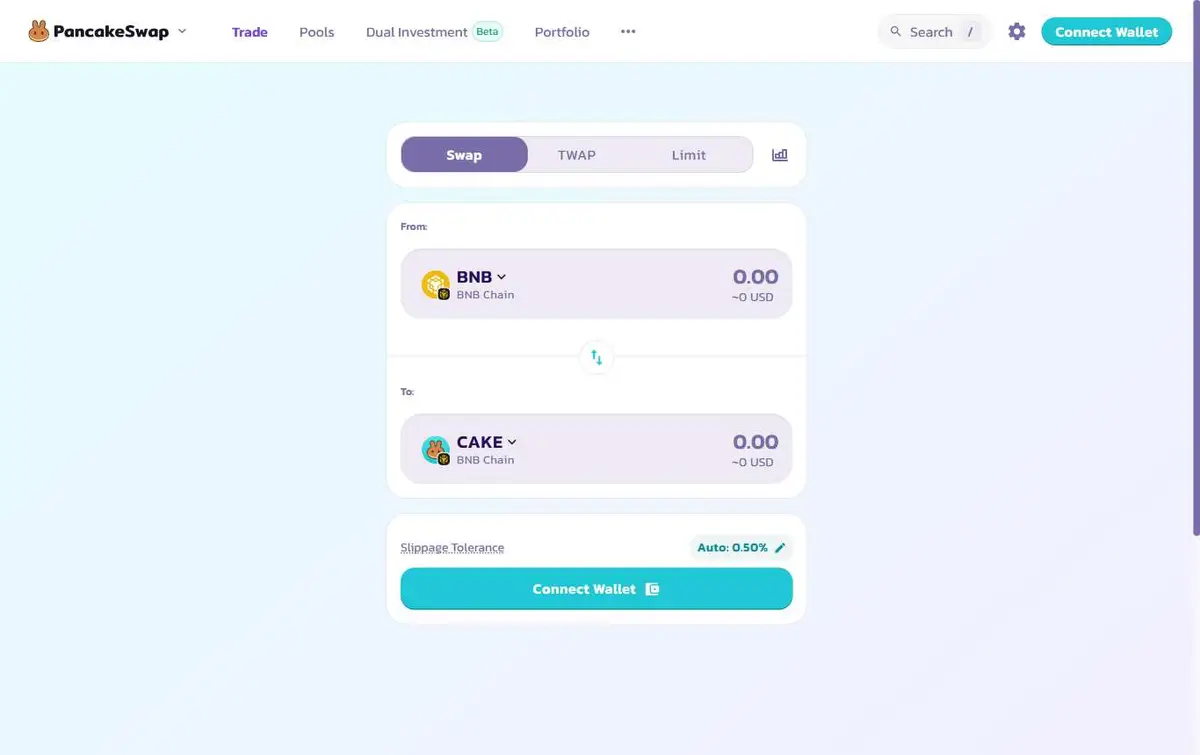
No barrier PancakeSwap · Trading app
Singapore: the swap page loads
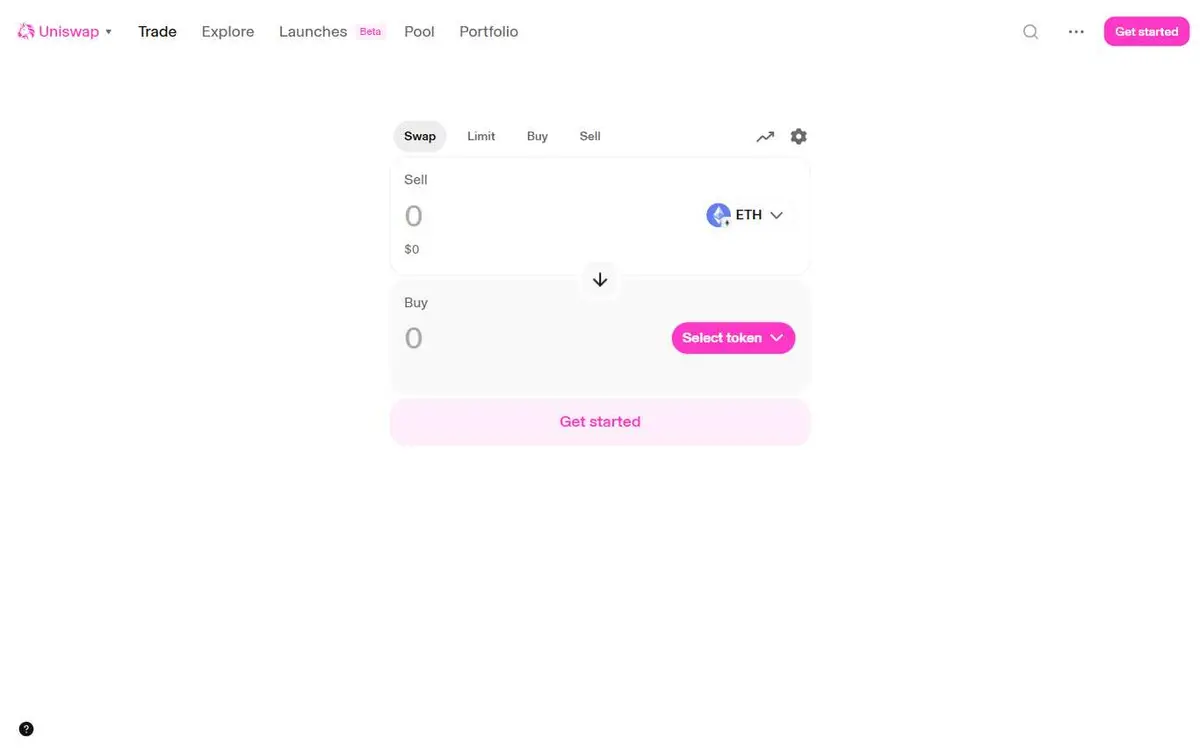
No barrier Uniswap · Trading app
Singapore, where Jupiter's terms bar users: Uniswap loads
 CRYPTORESTRICTIONS
Who regulates crypto in Singapore?
MAS licenses and supervises crypto businesses and leads on stablecoins, the police enforce against unlicensed operators and unlawful remote gambling, the GRA licenses gambling, and IRAS sets how tokens are taxed.
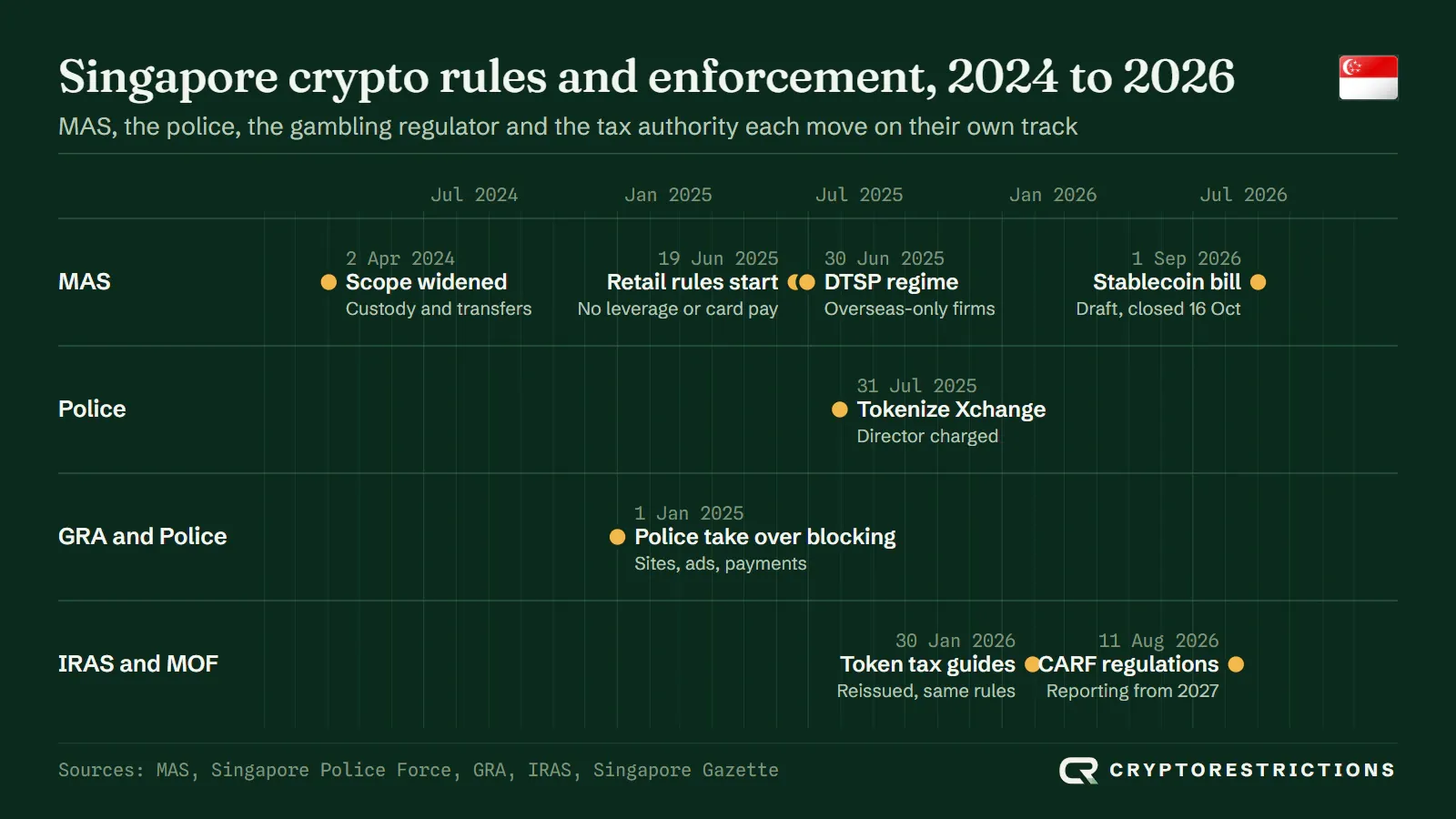
- MAS. Under the Payment Services Act it licenses firms that deal in digital payment tokens. From 30 June 2025 a second regime under Part 9 of the Financial Services and Markets Act 2022 also covers Singapore-based firms that serve only customers outside Singapore. MAS has set the bar high, says it will generally not issue such a licence, gave no grace period and contacted affected firms about an orderly wind-down. Firms that serve Singapore customers are not affected.
- Retail rules. MAS guideline PS-G03 sets what licensed providers may offer retail customers. Most of its chapters took effect on 19 June 2025, and the products section below lists what it closes.
- Enforcement. AmazingTech, which ran Tokenize Xchange, lost its licensing exemption on 4 July 2025 after MAS rejected its licence application. The police said on 1 August 2025 that its director had been charged on 31 July; a charge is an allegation, not a finding.
- Stablecoins. On 1 September 2026 MAS published draft amendments to the Payment Services Act. Only licensed issuers could call a coin MAS-regulated, interest on those coins would be banned, and a few foreign stablecoins could be recognised. Comments were due by 16 October 2026; it is not yet law.
- GRA and the police. The GRA licenses gambling; since 1 January 2025 the Singapore Police Force blocks unlawful remote gambling.
- IRAS. The tax authority, covered in the tax section.
Which crypto products are limited in Singapore?
Leverage and derivatives are the most closed product: since 19 June 2025 MAS guidelines bar licensed providers from offering them to retail customers, and Bitstamp and Crypto.com both close derivatives to Singapore.
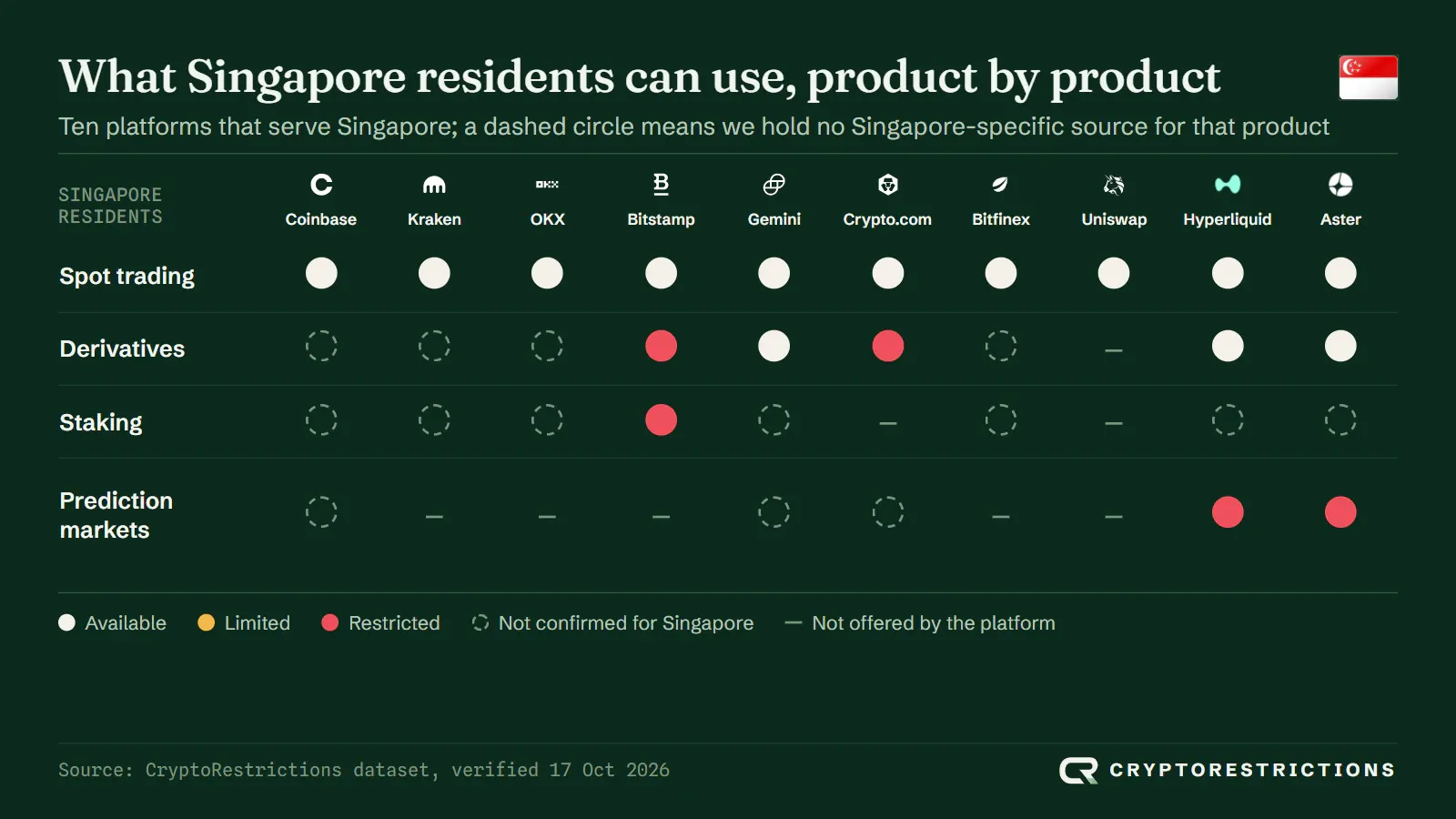
The rules sit in PS-G03. A retail customer is anyone who is not an accredited investor, an institutional investor or a DPT service provider, and an accredited investor has to opt in to being treated as one.
- Credit and leverage. A provider may not lend a retail customer money or tokens to buy tokens, enter into leveraged transactions with them (margin trading is the guide’s own example) or induce them into one with anyone else.
- Derivatives. No contracts that reference tokens, which the guide says includes contracts for difference and futures. Gemini lists Singapore on its perpetuals list, and we have not confirmed who can use it.
- Card payments. No credit or charge card payments from retail customers where the card is issued by a Singapore bank or licensed card issuer.
- Staking and lending. A provider may not entice a retail customer to stake, lend, pledge or mortgage their assets, which is why Bitstamp does not offer Earn staking or lending here. These provisions took effect on 4 October 2024.
- Incentives. No incentive to entice retail customers, and none paid to anyone, existing customers or celebrities included, to promote or refer the service. The guide counts sign-up, referral and trading rewards.
- Risk checks. A risk awareness assessment before a retail customer gets service.
Are prediction markets legal in Singapore?
Not through any licensed route. The GRA says Singapore Pools is the only licensed remote gambling operator, taking part in unlicensed remote gambling is an offence, and every prediction market we track restricts Singapore.
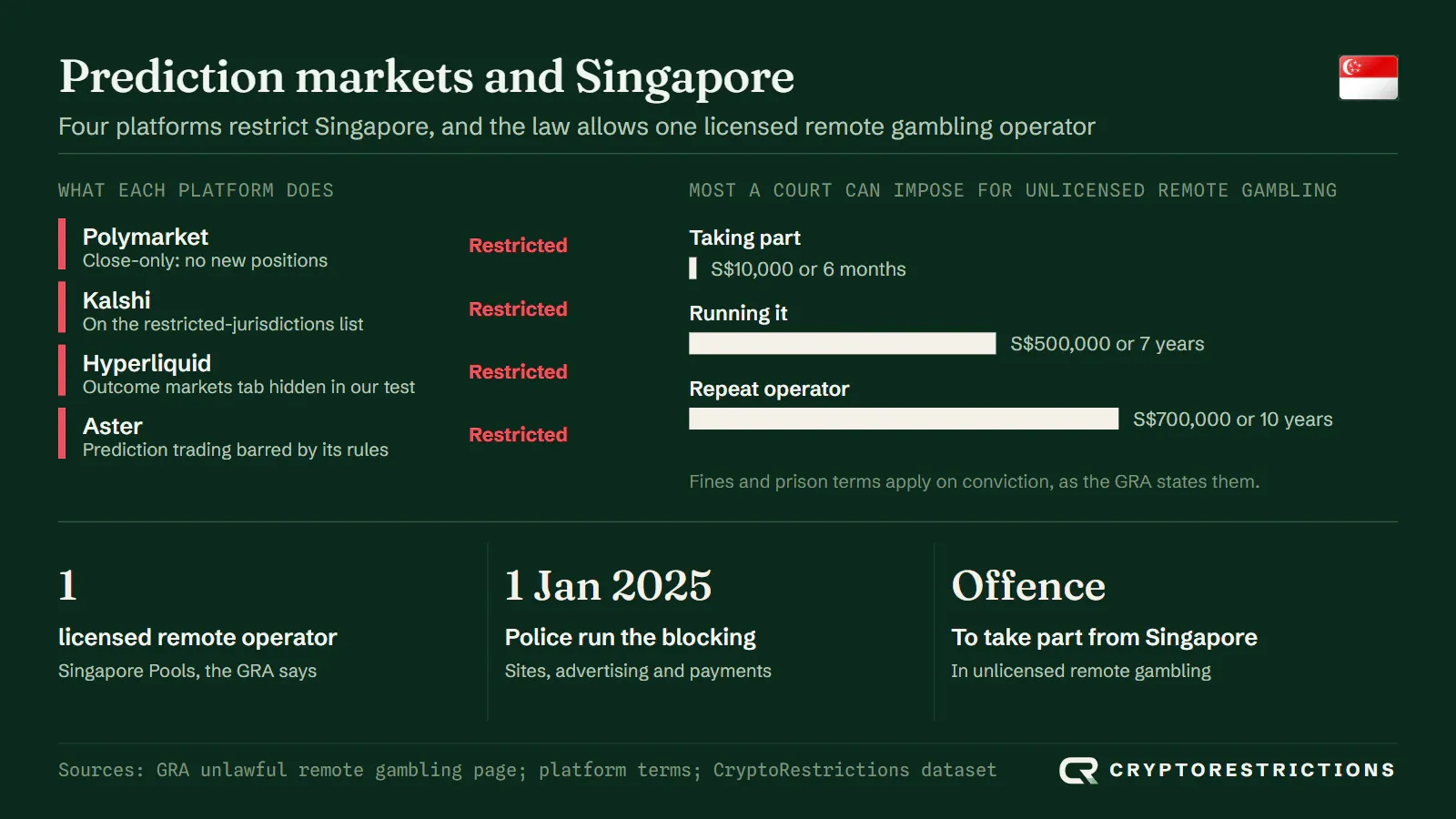
The GRA page says it is unlawful to offer unlicensed remote gambling in or from Singapore, or from outside to people in Singapore, and an offence for anyone in Singapore to take part. A participant faces a fine of up to S$10,000, up to 6 months in prison, or both; operators face up to S$500,000 and 7 years, and repeat offenders up to S$700,000 and 10 years. Since 1 January 2025 the police block unlawful sites, advertising and payments. The page does not mention prediction markets by name, and we found no MAS or GRA statement classing them either way.
On the platform side, Polymarket lists Singapore as close-only: existing positions can be closed but no new ones opened. Kalshi lists Singapore among its restricted jurisdictions. Hyperliquid hid its outcome markets tab in our test and Aster bars prediction trading under its prediction rules.


How is crypto taxed in Singapore?
IRAS treats gains on digital tokens held as personal investments as generally not taxable. Income from trading or mining as a business is taxed at the resident income tax rates, up to 24%.
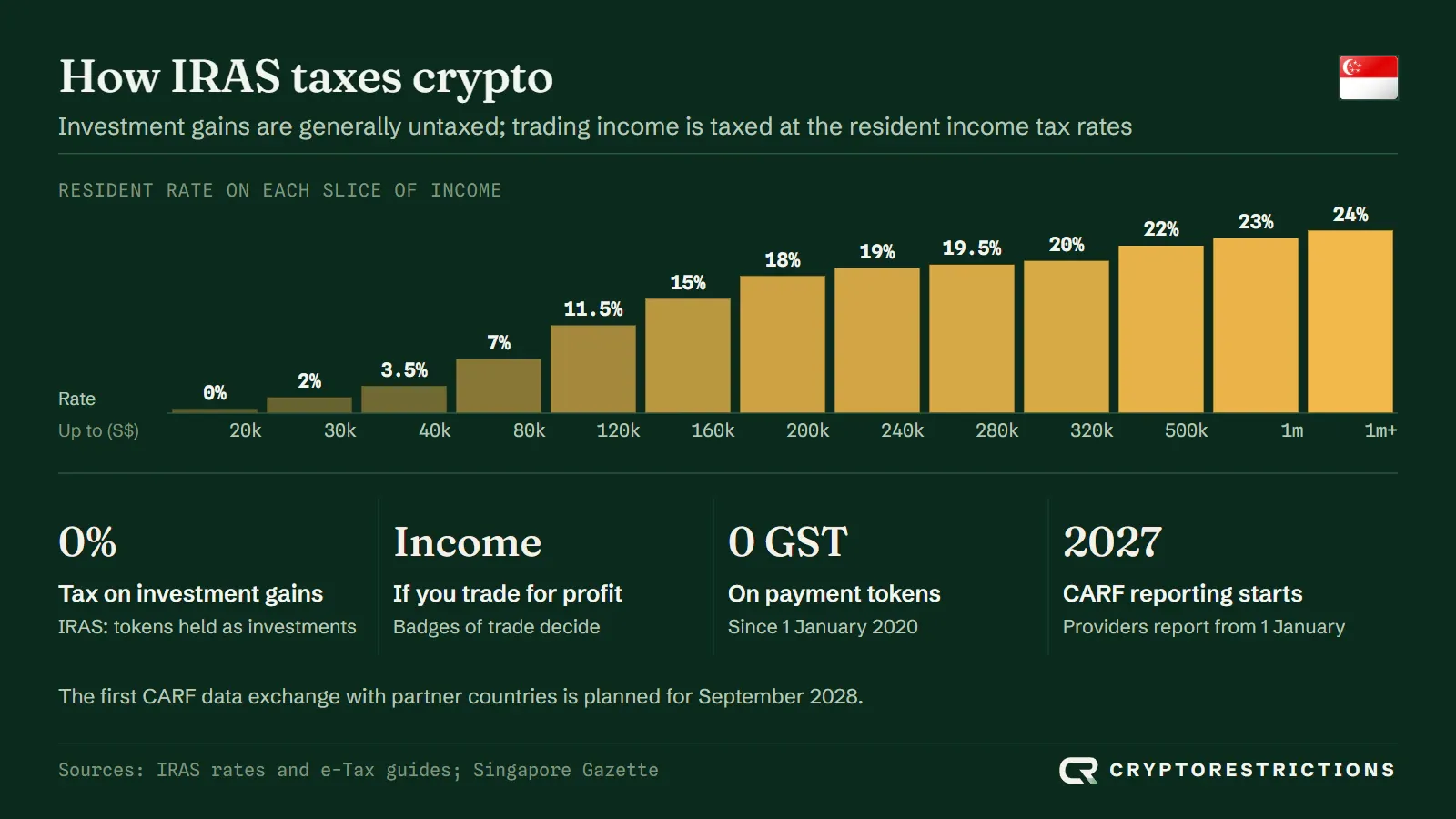
The line between the two is intent. IRAS says its individual page (updated 27 February 2026) views profits from financial instruments, digital tokens included, as personal investments, and the e-Tax guide reissued on 30 January 2026 says a purchase is not a taxable event and that the buyer’s intention, tested against the badges of trade, decides whether a later disposal is trading income. Paying with tokens is barter, valued at the goods or services received. Tokens received as pay are taxable to the employee. An individual who mines is presumed to be doing it as a hobby, so sale gains are not taxable, unless the effort is habitual and systematic. Airdrops are not income unless given in return for a service. The guide says nothing on staking or lending rewards, so we state no IRAS position on them.
The bands are the resident rates on the IRAS rates page for YA 2024 onwards (updated 27 April 2026). Payment tokens have been exempt from GST since 1 January 2020, per IRAS’s GST guide. Reporting is changing: regulations gazetted on 11 August 2026 bring the OECD Crypto-Asset Reporting Framework into force on 1 January 2027, so Singapore-based providers collect user data from then, and IRAS plans the first exchanges with partner countries from September 2028. Working out your own position takes four steps:


 Bahrain
 Georgia
 Qatar
 Israel
 Saudi Arabia
 Vietnam
 Pakistan
 Bangladesh
 Indonesia
 United Arab Emirates
 South Korea