Where is Binance restricted?
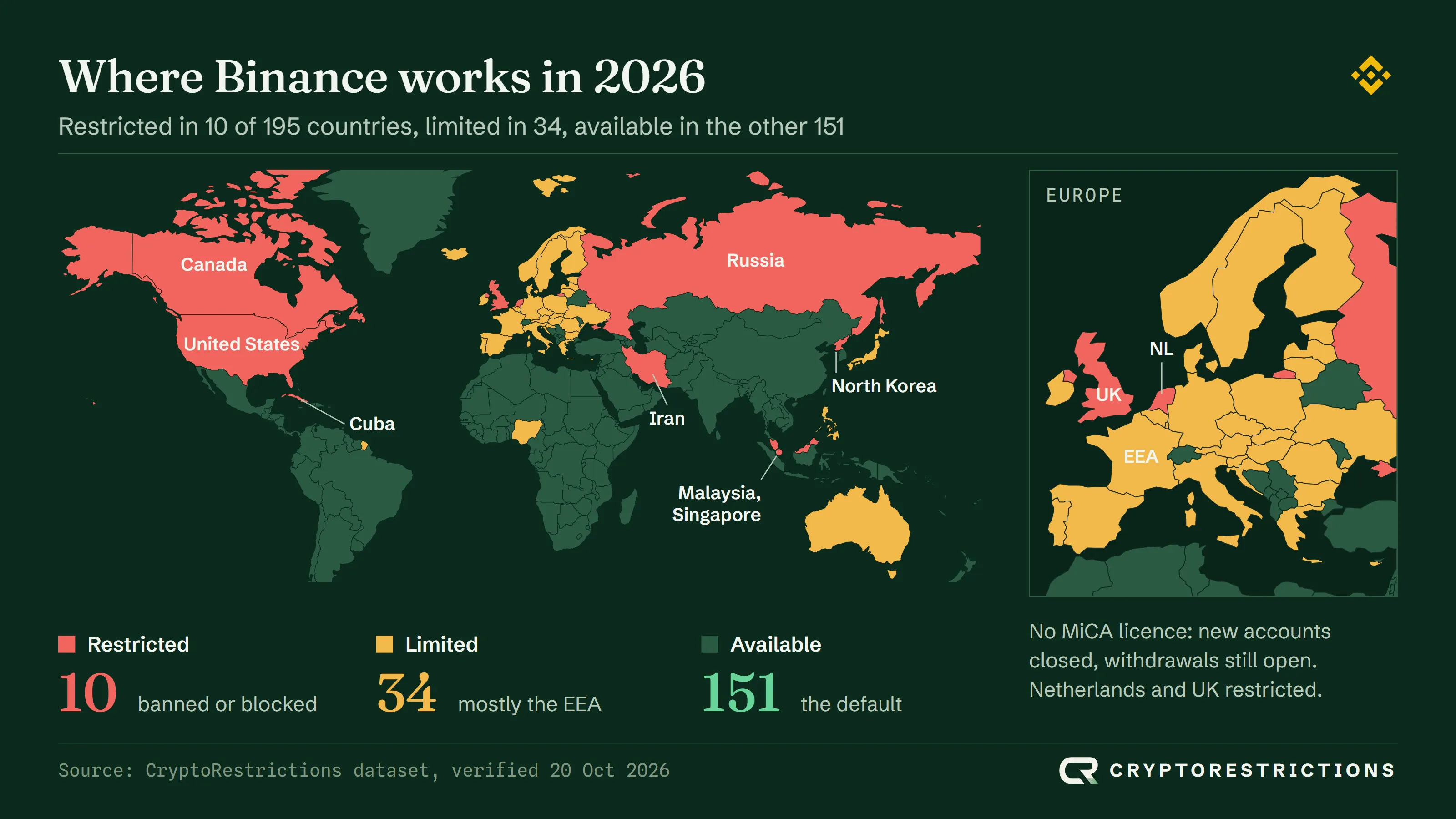
Binance is restricted in 10 of the 195 countries we cover:  Canada,
 Cuba,
 Iran,
 Malaysia, the
 Netherlands,
 North Korea,
 Russia,
 Singapore, the
 United Kingdom and the
 United States.
We started from Binance’s own documents. Its list of prohibited countries (updated 5 January 2026) names the United States, Canada, the Netherlands, Cuba, Iran and North Korea, and Binance told US senators in a published letter that American residents are served by the separate Binance.US. Its own announcements cover three more countries: it closed to new UK users in October 2023, left the Dutch market in July 2023 and sold its Russian business to CommEX the same year.
For Malaysia we used the Securities Commission’s enforcement order of July 2021, and for Singapore Reuters’ report that Binance stopped Singapore users trading on its main platform. Cuba, Iran and North Korea are also under comprehensive US sanctions (OFAC programmes for Cuba, Iran and North Korea). Finally, on 14 October 2026 we loaded Binance’s sign-up page from every country we could reach, to see whether each block is enforced at the door.
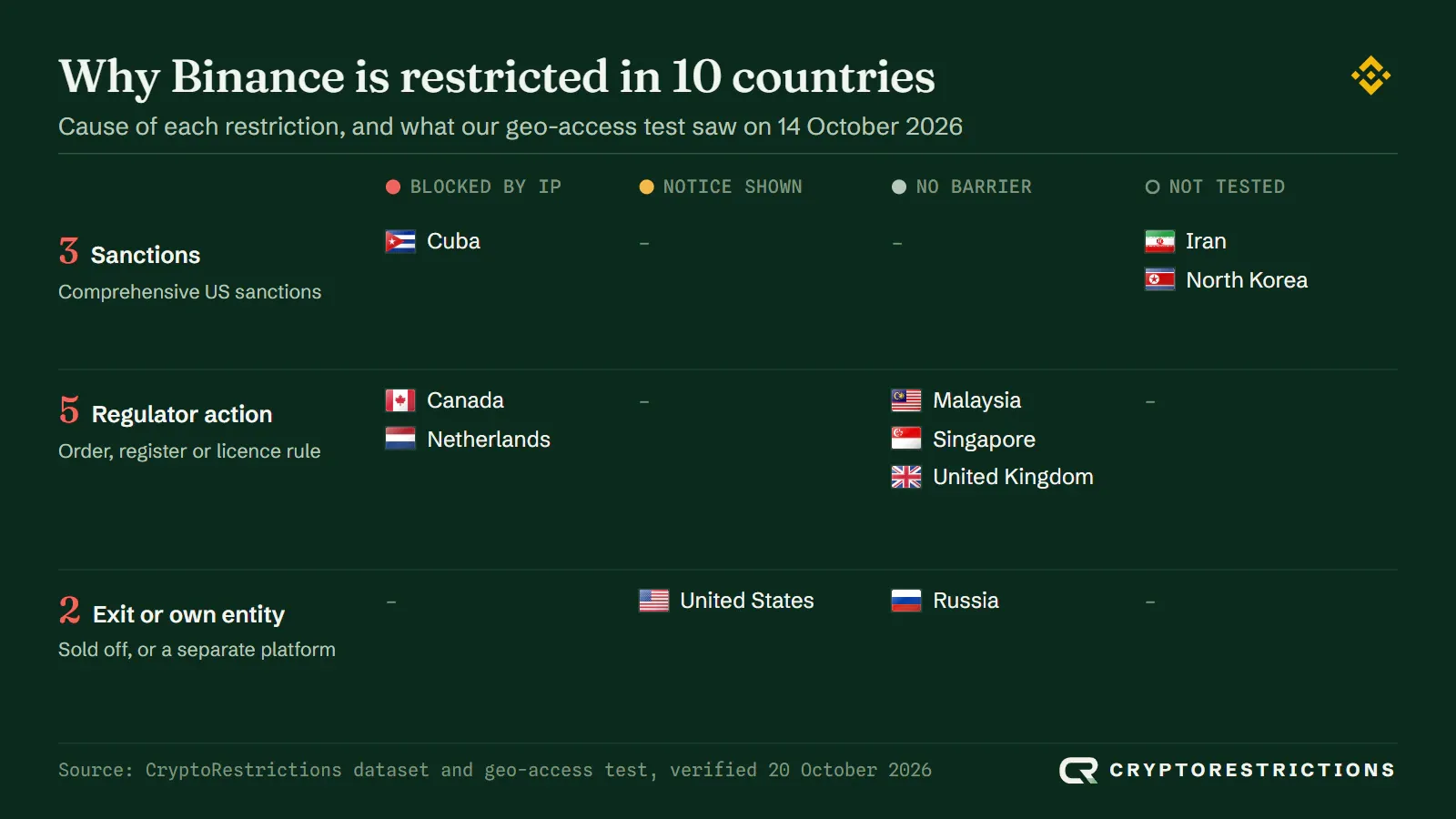
Only three of the ten refused our visit by IP address; elsewhere Binance applies the restriction at identity verification. The full list is below: pick a country to see the cause, what applies, when it started and what our test saw.
Where is Binance limited?
Binance is limited in 34 countries: the 29 EEA countries where it has no MiCA licence, plus  Australia,
 Japan,
 Nigeria, the
 Philippines and
 Ukraine.
For the EEA we used Binance’s update on its MiCA licensing of 16 June 2026 and its withdrawal of the Greek application, with the 1 July 2026 cut-off confirmed by CoinDesk and Euronews. The other five come from regulators and Binance: Australia’s ASIC cancelled the Binance Australia Derivatives licence in 2023, Binance ended Nigerian naira services in March 2024, the Philippine SEC moved to block Binance in 2024 and the central bank says neither Binance nor its local partner is licensed, Japanese residents are served by Binance Japan, and the prohibited list excludes Crimea, Donetsk and Luhansk in Ukraine.
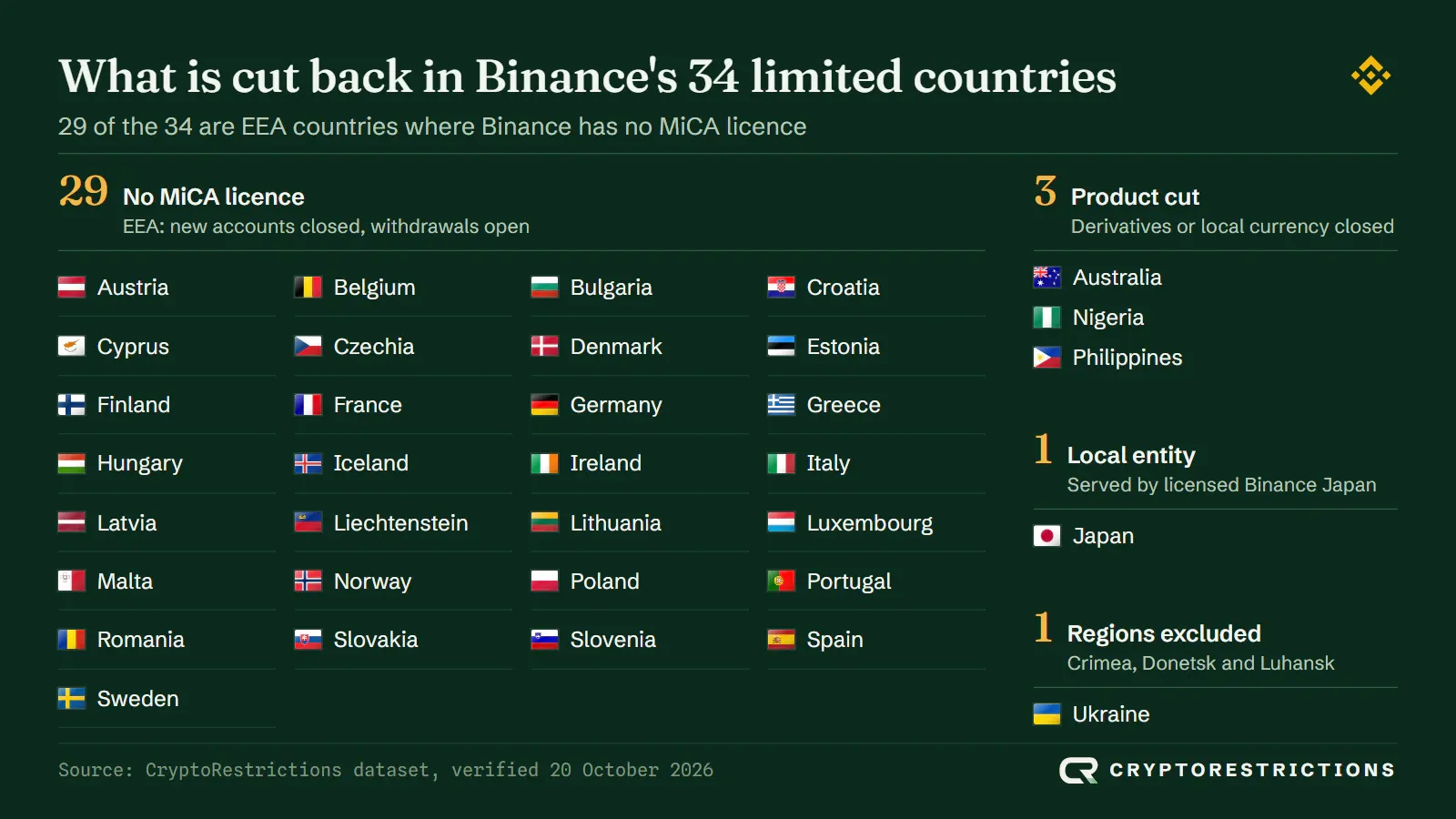
Limited means Binance still serves the country, but something is cut back. The groups are below: pick one to see what is closed, what still works and when it changed.
Where is Binance available?
Binance is available in the other 151 of the 195 countries we cover, from  Brazil,
 India and
 Turkey to most of Africa, Asia and Latin America.
Twelve of them host a Binance licence, registration or exemption (listed in the licences section below):  Argentina,
 Bahrain,
 El Salvador, India,
 Indonesia,
 Kazakhstan,
 Mexico,
 New Zealand,
 South Africa,
 Thailand, Turkey and the
 United Arab Emirates. For 33 more we checked the country by name against the prohibited countries list and found it absent.
The remaining 106 are available under our coverage rule: no official document from Binance or a regulator restricts them, so we record them as available rather than unknown. Our geo-access test backs this up where it reached: the sign-up page loaded without a block in 89 of the 151. Only New Zealand showed a notice, that some features are not available there.
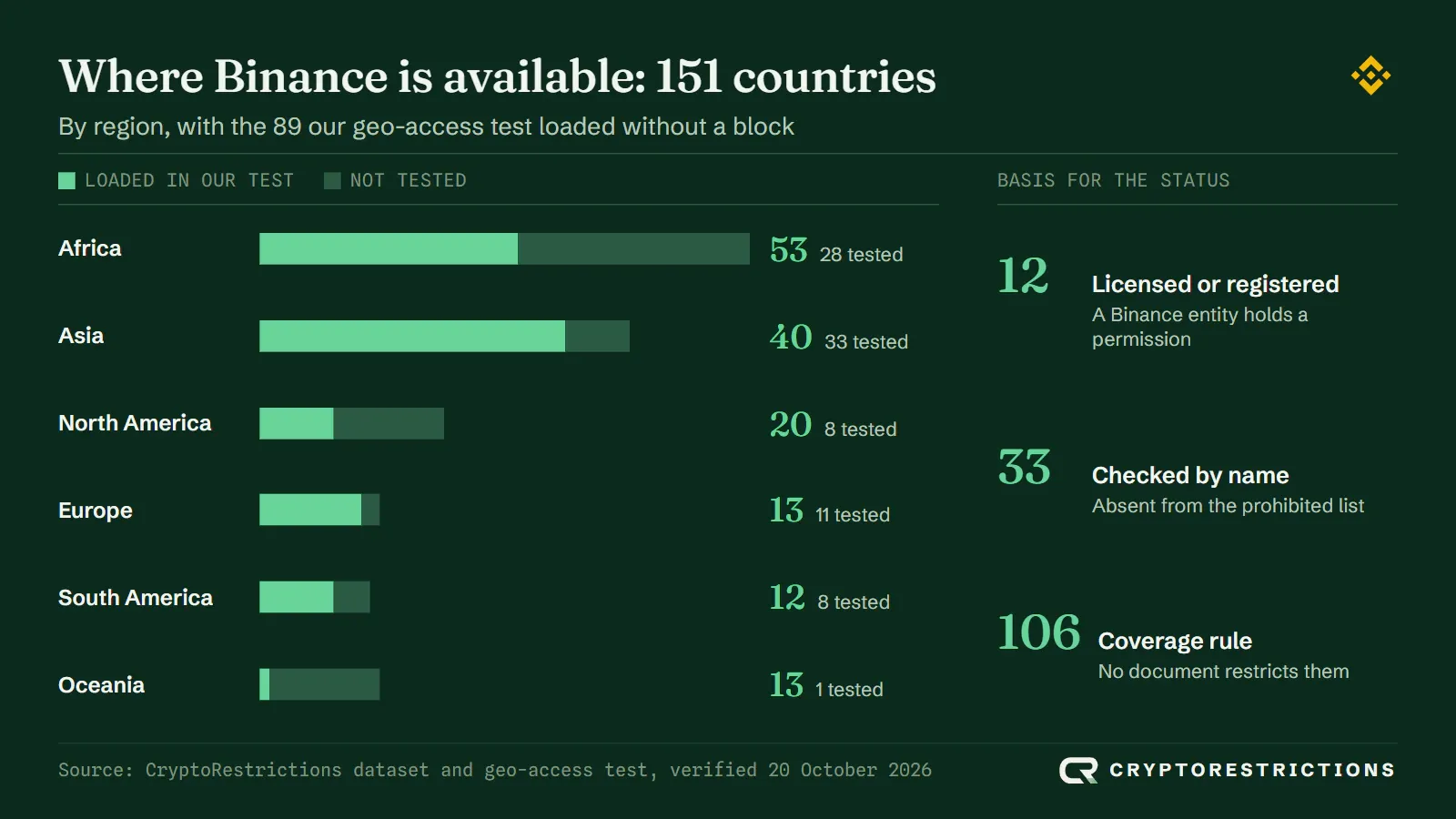
Available means Binance serves the country, not that local law allows crypto trading.  China,
 Egypt and
 Syria are on this list because Binance does not exclude them, whatever their own rules say about using an offshore exchange.
Where do Binance’s visitors come from?
In Similarweb’s estimates, binance.com’s top visitors come from  South Korea, India, Brazil, Ukraine, Turkey and
 Venezuela, all countries Binance serves.
We compared two traffic estimators. Similarweb puts South Korea first for September 2026 (10.94% of visits), and its May 2026 figures, published by BitRSS, had India narrowly ahead of South Korea. Semrush disagrees for the same September:  Bangladesh at 45.2% and the United States second at 4.5%, on a total of 94.44 million visits against Similarweb’s 34.7 million.
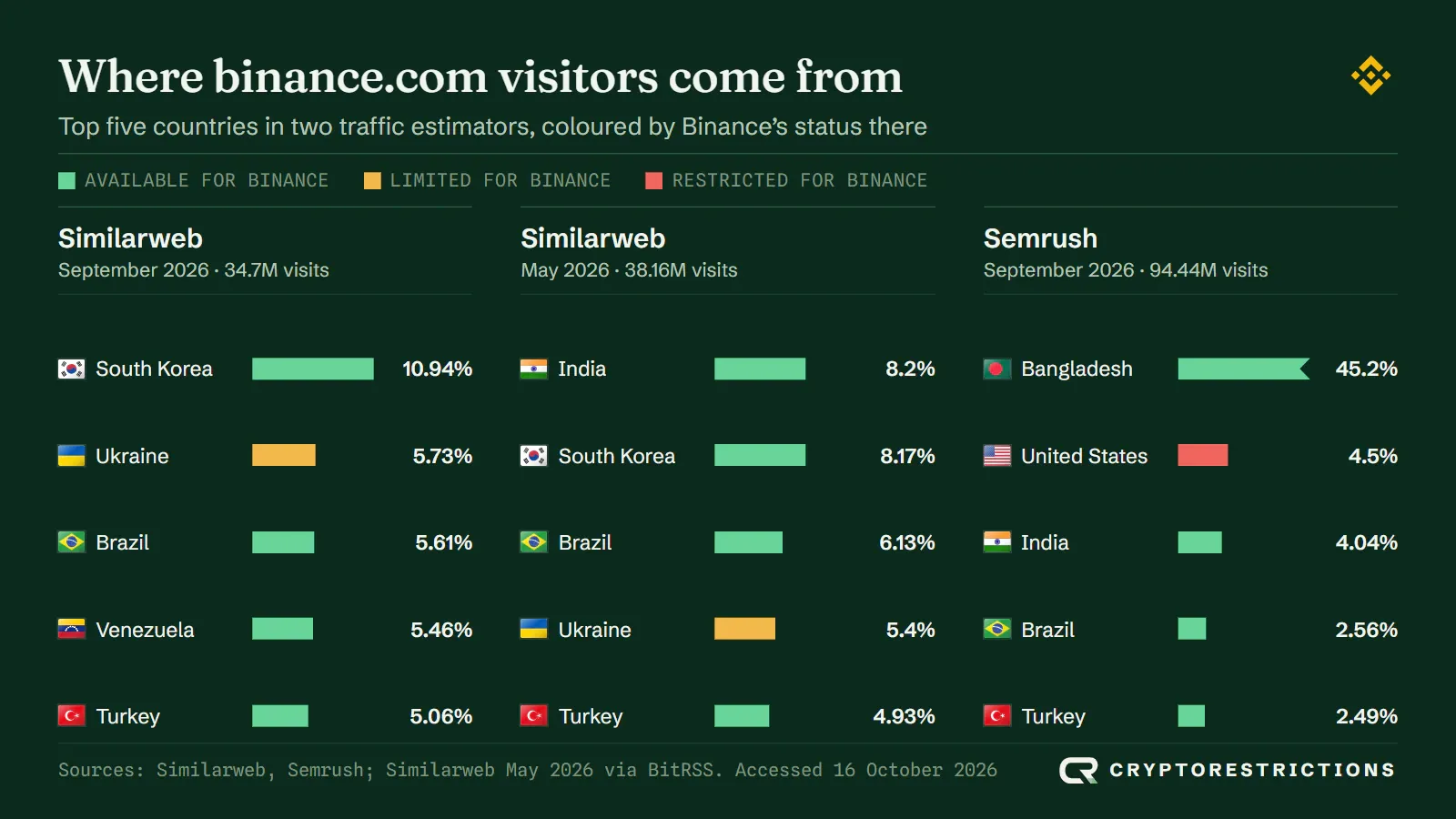
The United States is the one restricted country in either top five, and a visit is not an account. Our geo-access test shows why it can appear: from a US address binance.com still loads, with a prompt to switch to Binance.US, so anyone reading prices or Binance’s own articles is counted. The restriction applies when someone tries to open an account. American trading happens on the separate domain: Similarweb counts 728,300 visits to binance.us in September, 79.59% of them from the United States.
Ukraine is in both Similarweb lists because Binance only excludes Crimea, Donetsk and Luhansk, so the rest of the country is served. The Bangladesh figure we could not confirm: it is 45.2% in Semrush, 98.6% of it desktop, and Bangladesh is absent from both Similarweb lists, while Semrush’s total for binance.com jumped from 65.25 million visits in August to 94.44 million in September. Estimators model traffic from panels and samples, so treat any single country share as an estimate. No restricted country other than the United States appears in either top five.
Binance geo-access test: what we saw from 130 countries
In our test Binance’s sign-up page refused visitors by IP address in only 3 of the 130 countries we reached, Canada, Cuba and the Netherlands; everywhere else the pages loaded, sometimes with a notice.
We ran the test ourselves on 14 October 2026. A browser with a VPN connected to one country at a time and loaded Binance’s home page and its sign-up page, each time in a fresh private window with no cookies. Cookie banners were hidden but never accepted, and bot checks were waited out, never solved. Every run saved the page text and a screenshot, and recorded where Binance’s own location check placed us.
Of the 134 places tested (130 of our 195 countries plus four territories), 61 went through VPN servers located in the country. For the other 73 the VPN only offers virtual locations hosted elsewhere, and there we relied on Binance’s location check to confirm the country. The Cuba and Russia screenshots below come from a repeat run on 16 October with the same result.
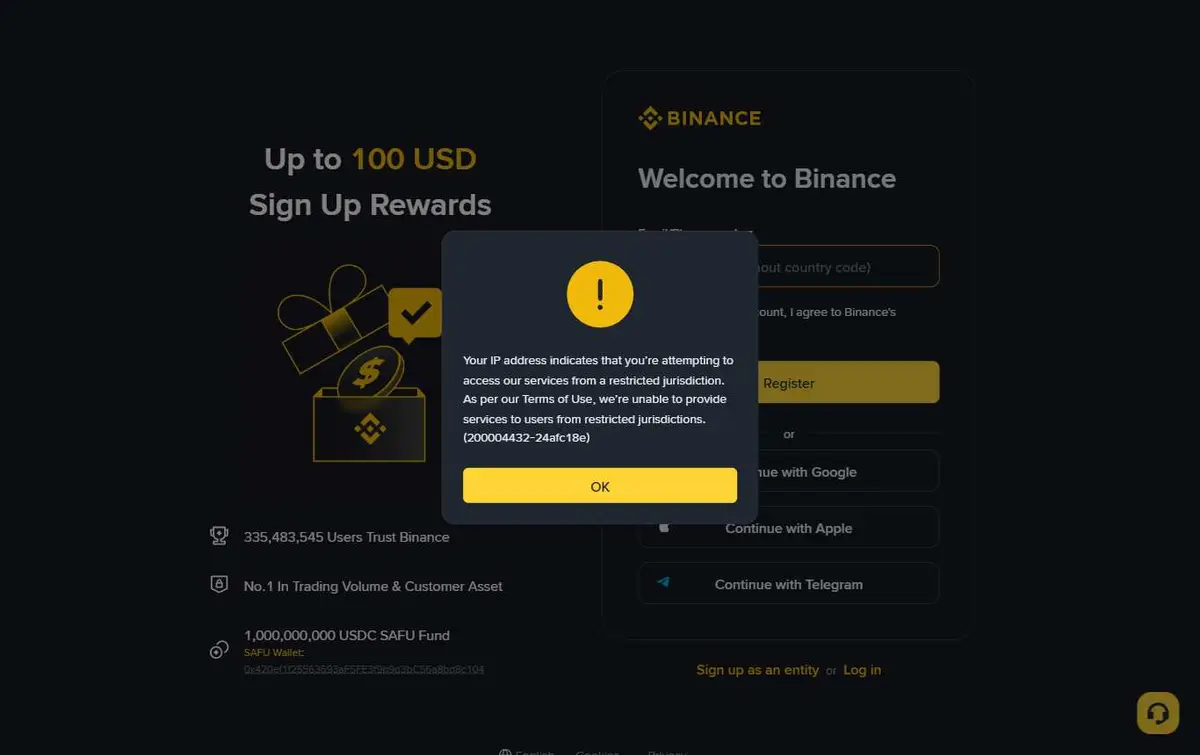
BlockedCanada · Sign-up page
Sign-up refused by IP address: a restricted jurisdiction
“Your IP address indicates that you're attempting to access our services from a restricted jurisdiction.”
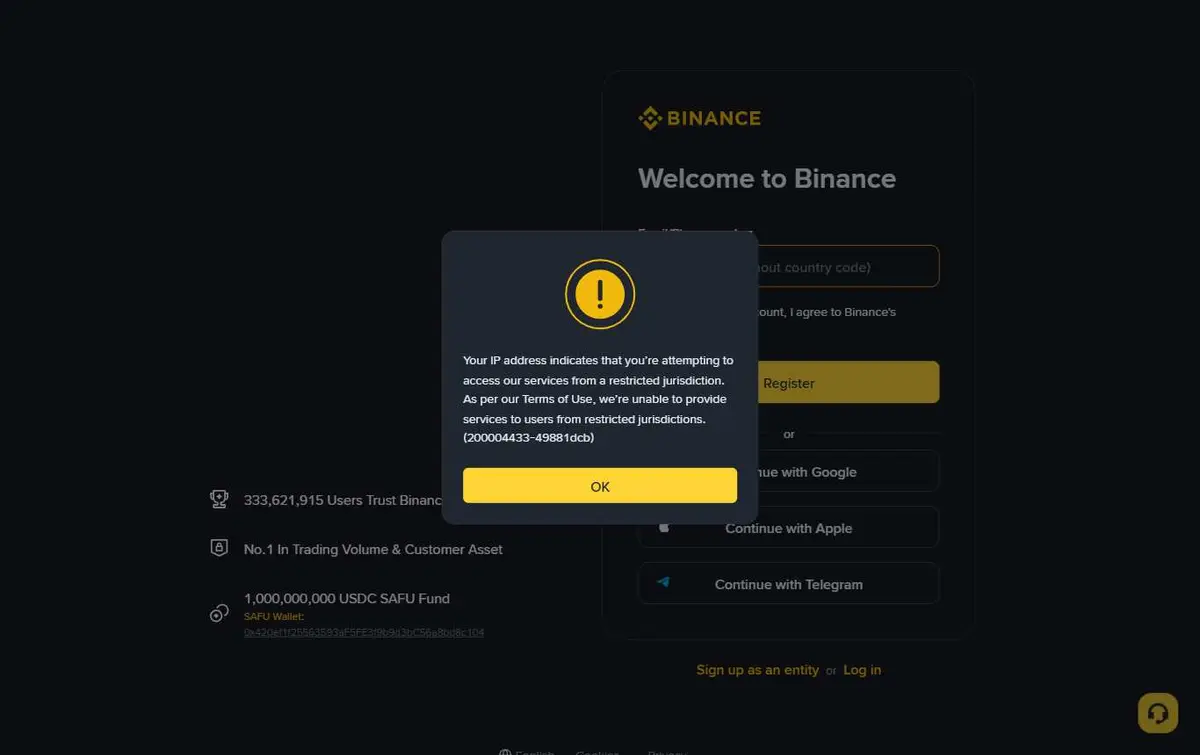
BlockedNetherlands · Sign-up page
The same refusal from a Dutch address
“Your IP address indicates that you're attempting to access our services from a restricted jurisdiction.”
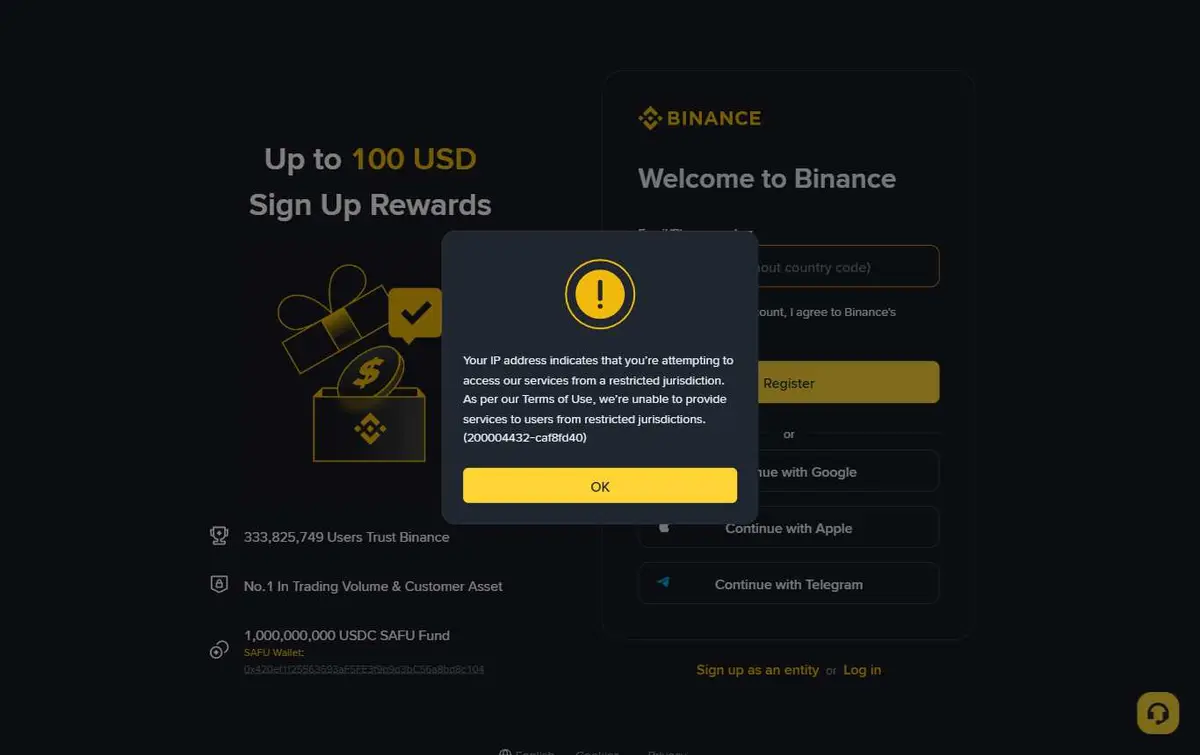
BlockedCuba · Sign-up page
Refused again; Binance's own check placed us in Cuba
“Your IP address indicates that you're attempting to access our services from a restricted jurisdiction.”
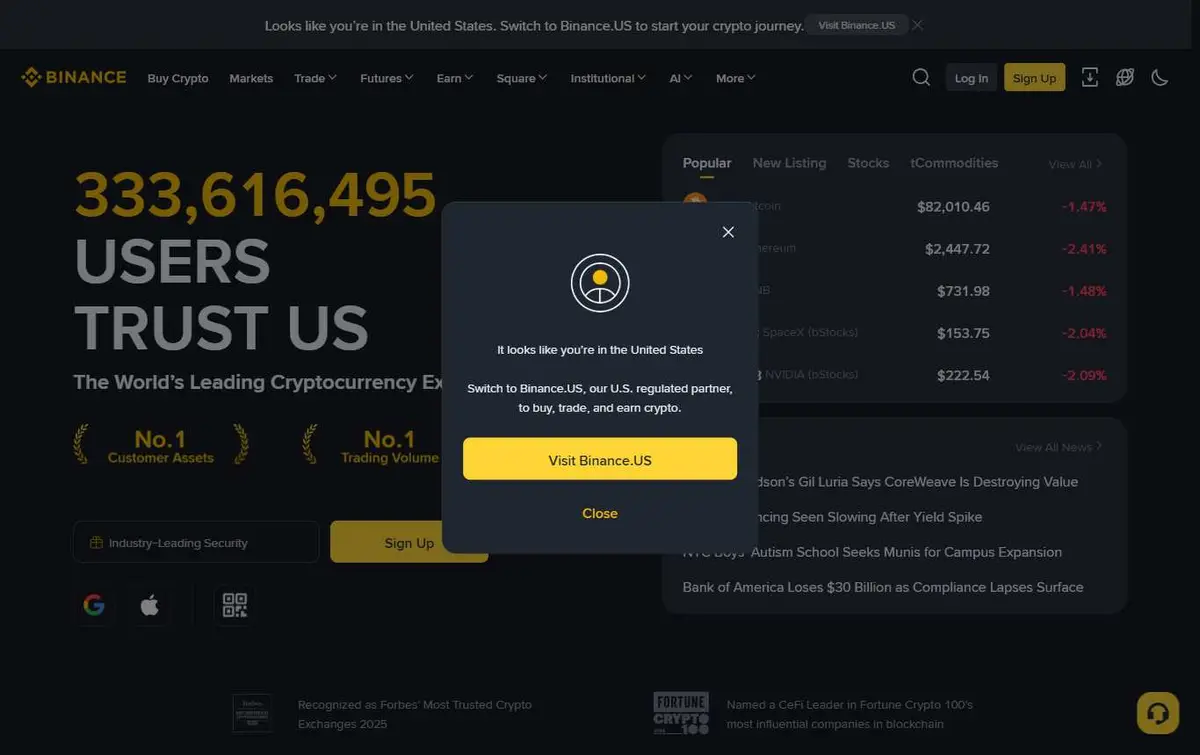
Notice shownUnited States · Home page
No block: a prompt to switch to Binance.US
“Looks like you're in the United States. Switch to Binance.US to start your crypto journey.”
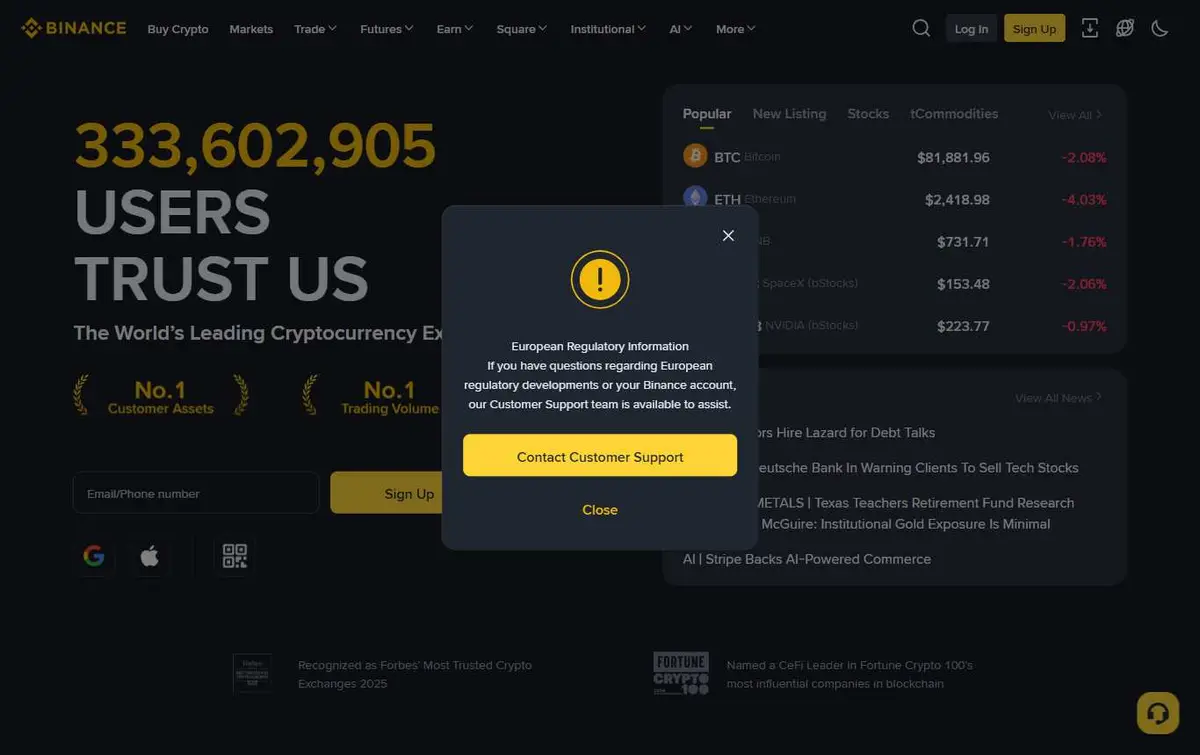
Notice shown Germany · Home page
A European regulatory notice; the sign-up page still loads
“European Regulatory Information”
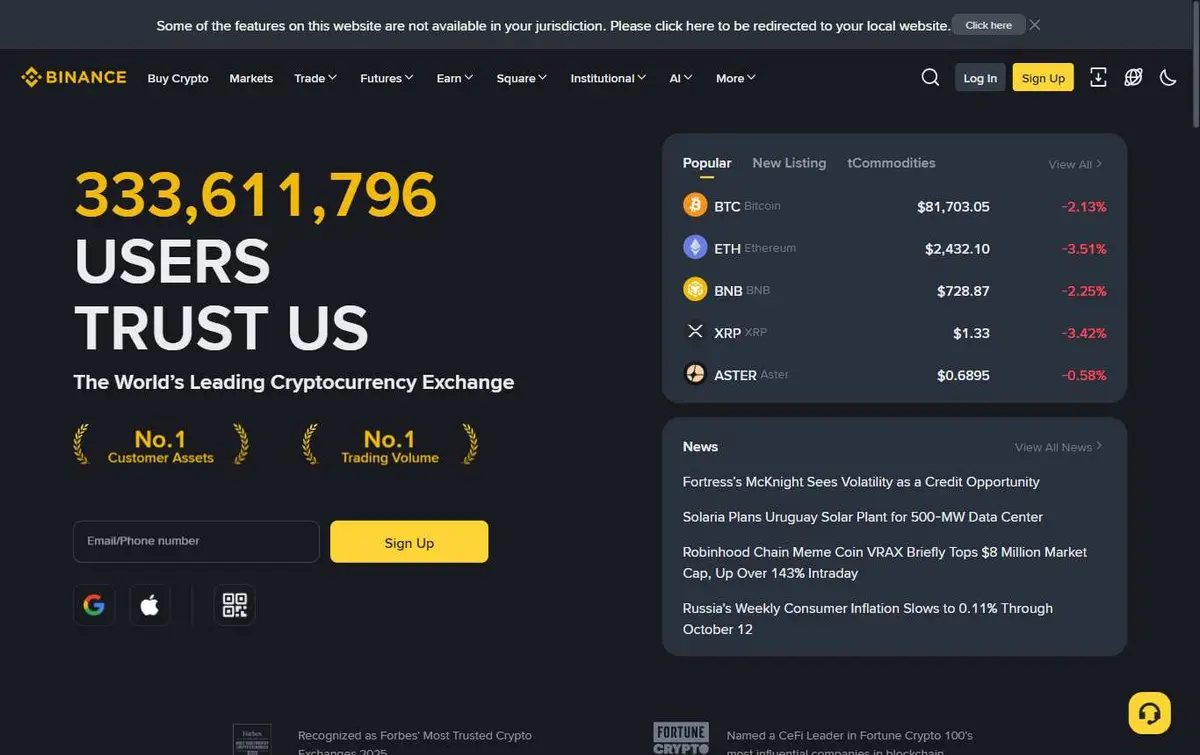
Notice shownNew Zealand · Home page
A banner: some features are not available here
“Some of the features on this website are not available in your jurisdiction.”
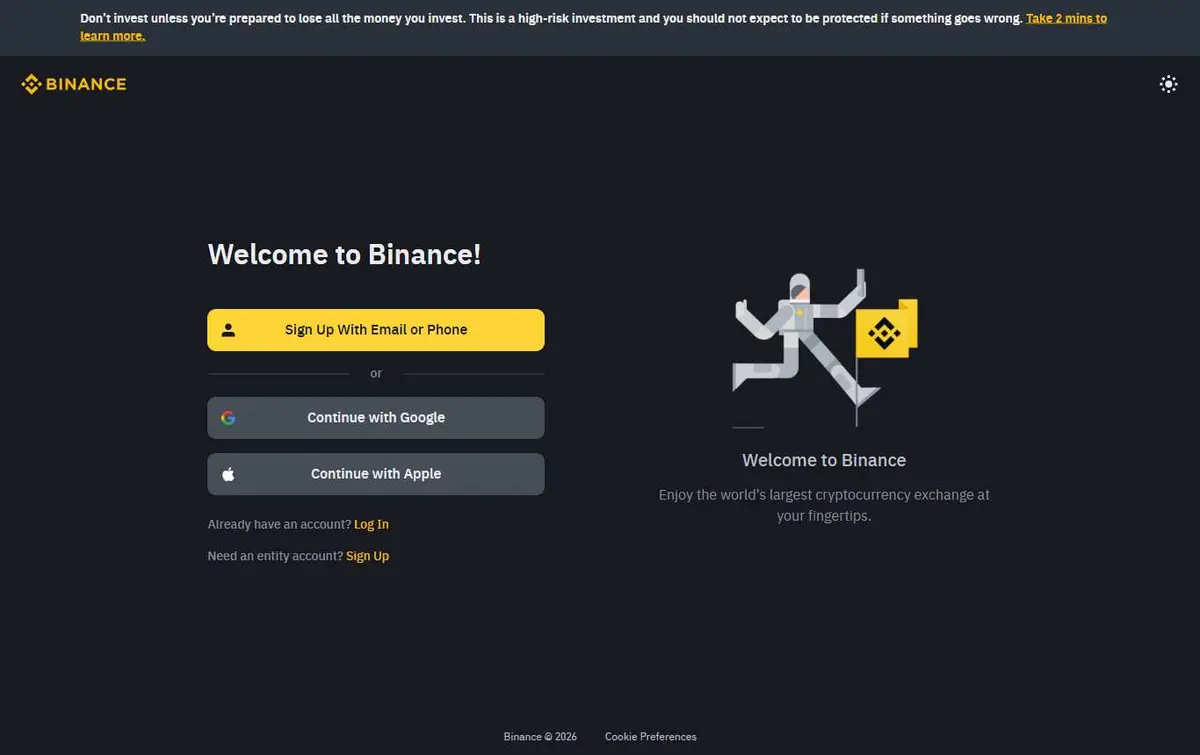
No barrierUnited Kingdom · Sign-up page
Restricted, yet sign-up loads, under a UK risk warning
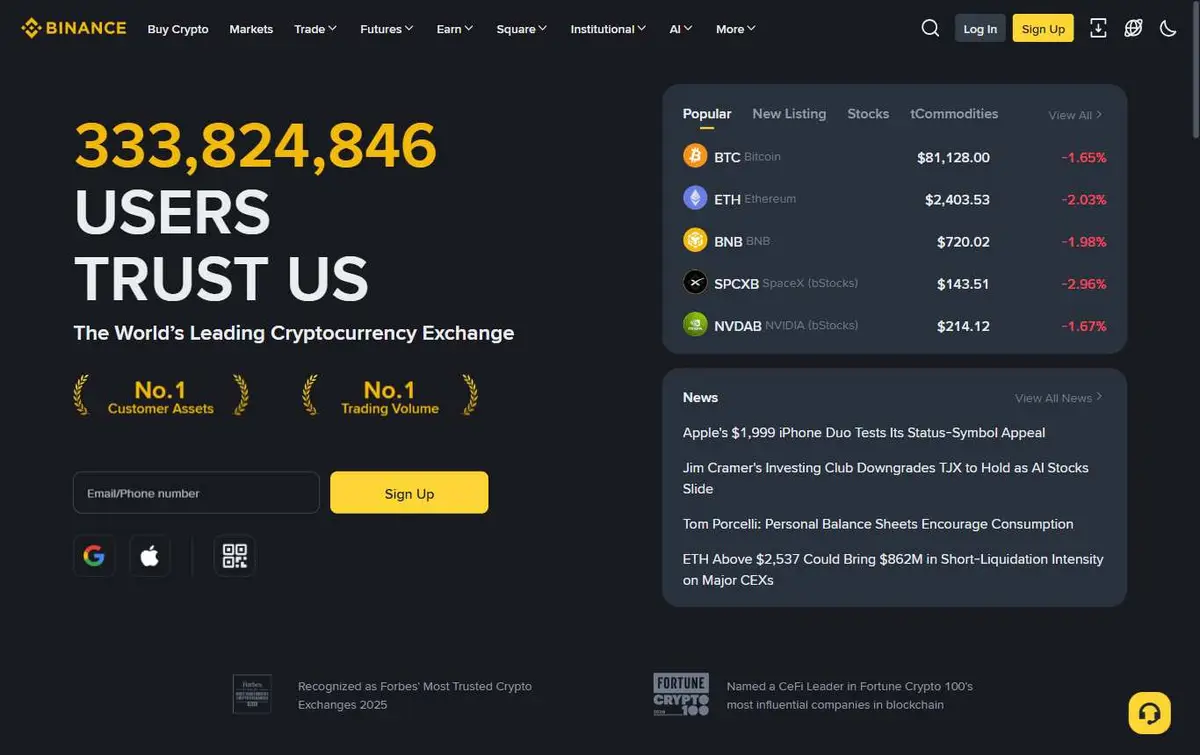
No barrierRussia · Home page
Restricted since the 2023 exit, yet the page loads
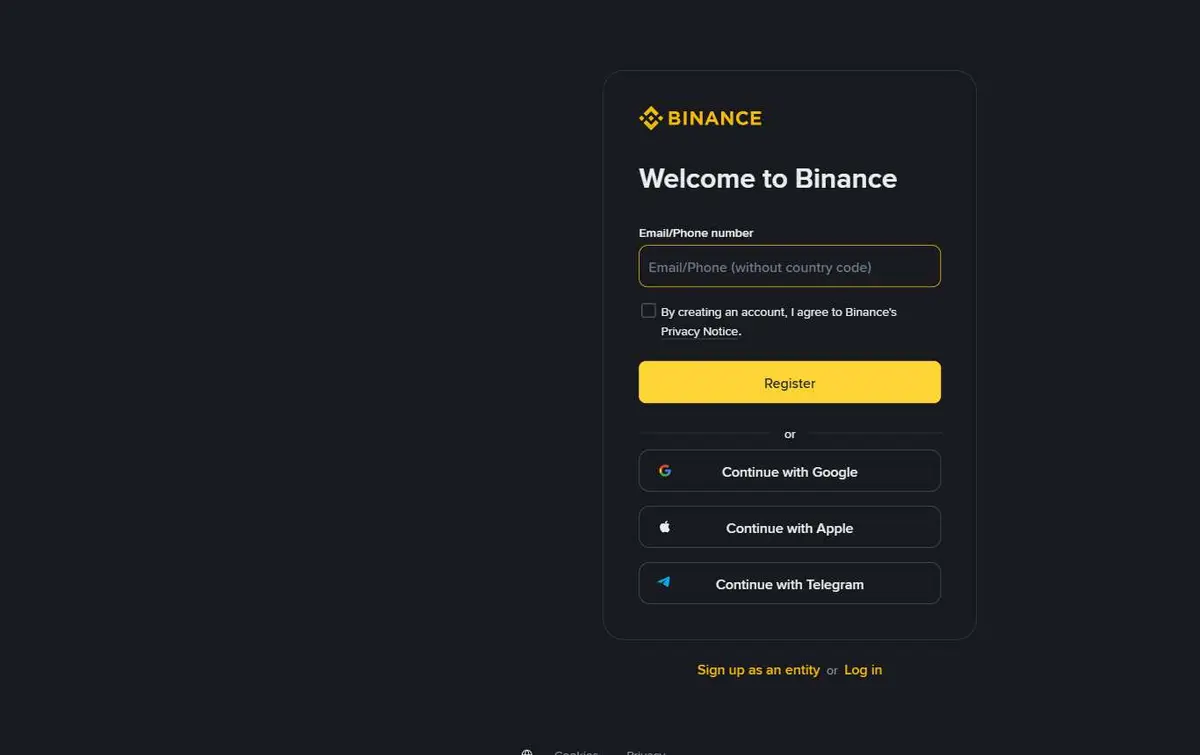
No barrierSingapore · Sign-up page
Restricted, yet sign-up loads with no warning
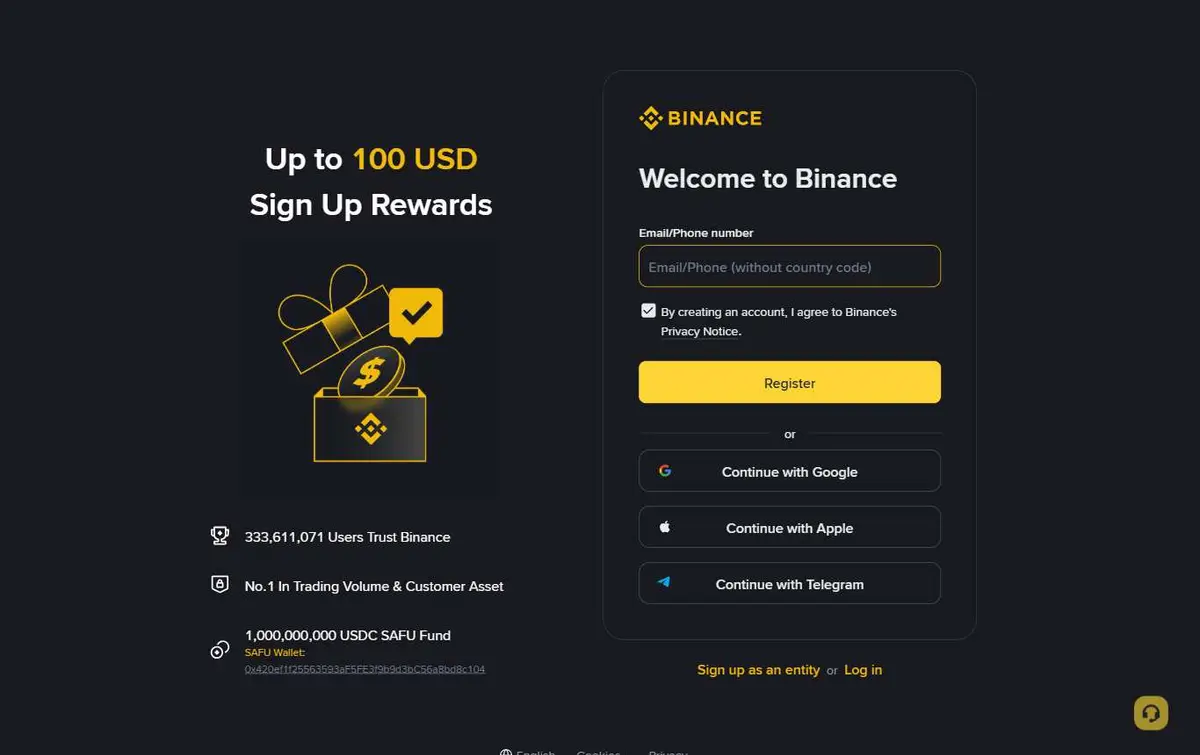
No barrierMalaysia · Sign-up page
Restricted by a 2021 order, yet sign-up loads
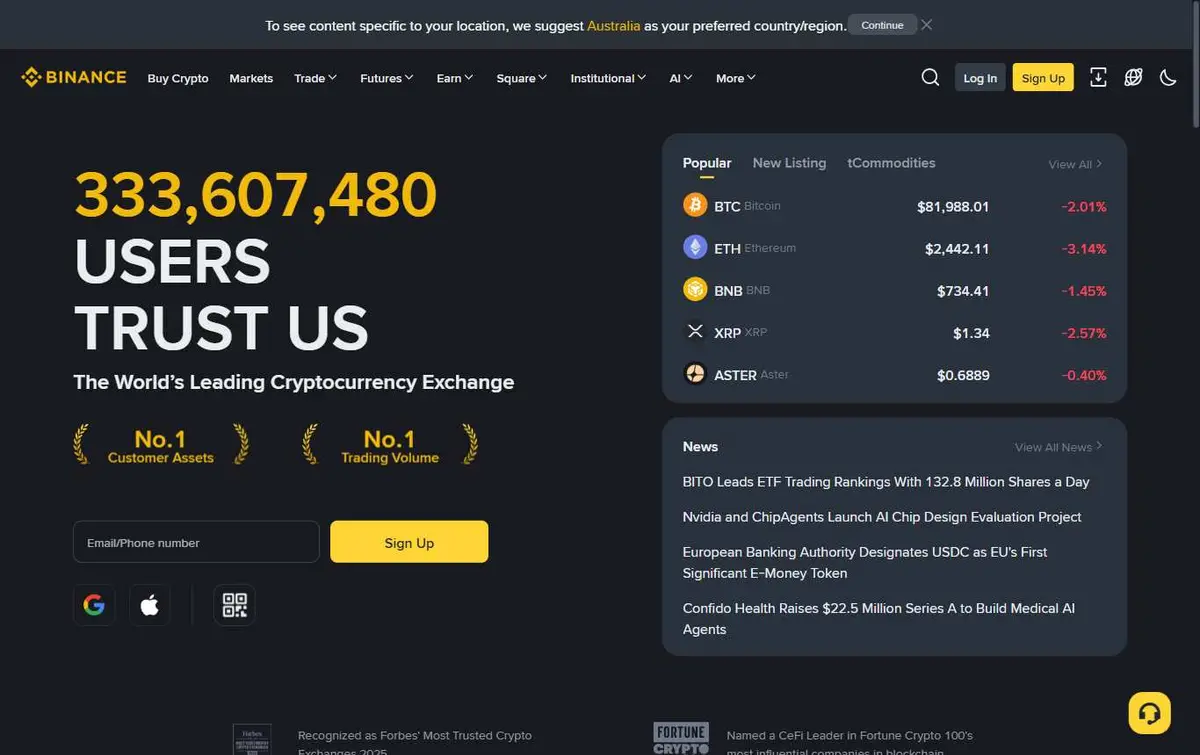
No barrierAustralia · Home page
Australia, where only derivatives are closed: the home page loaded with no barrier
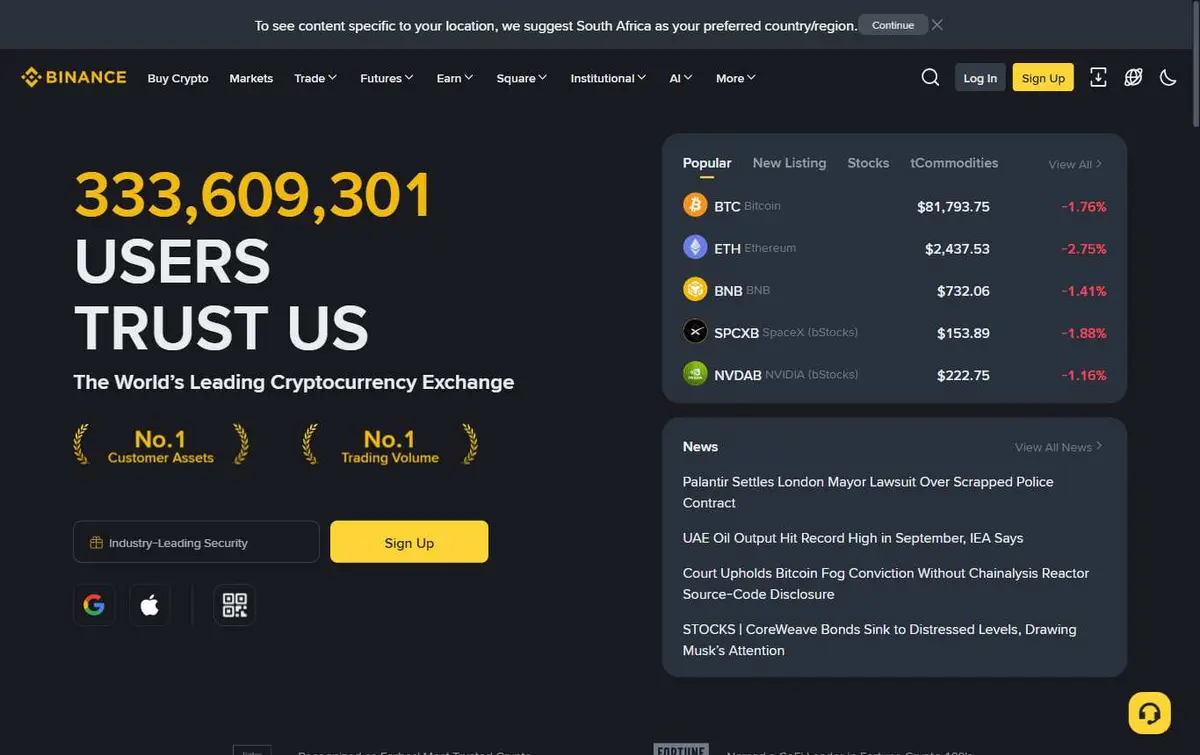
No barrierSouth Africa · Home page
South Africa: the home page loaded with no barrier
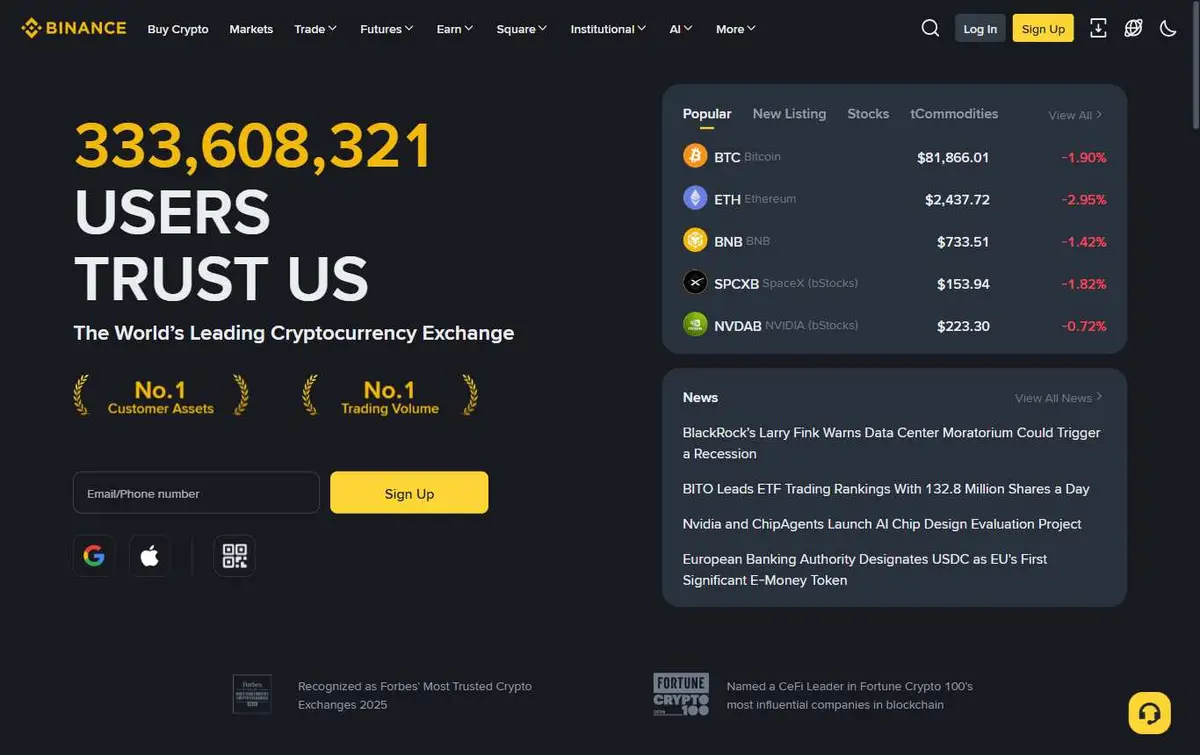
No barrierTurkey · Home page
Turkey: the global site loads with no notice
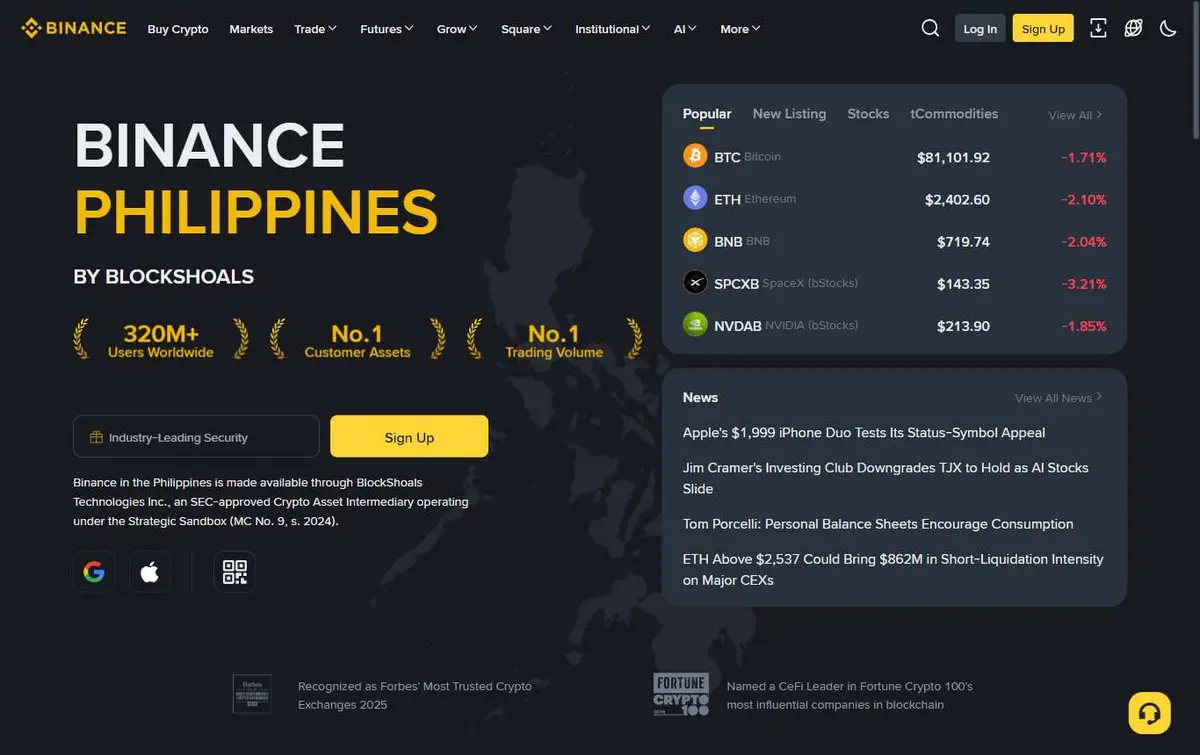
No barrierPhilippines · Home page
Loaded with no barrier from a Philippine address
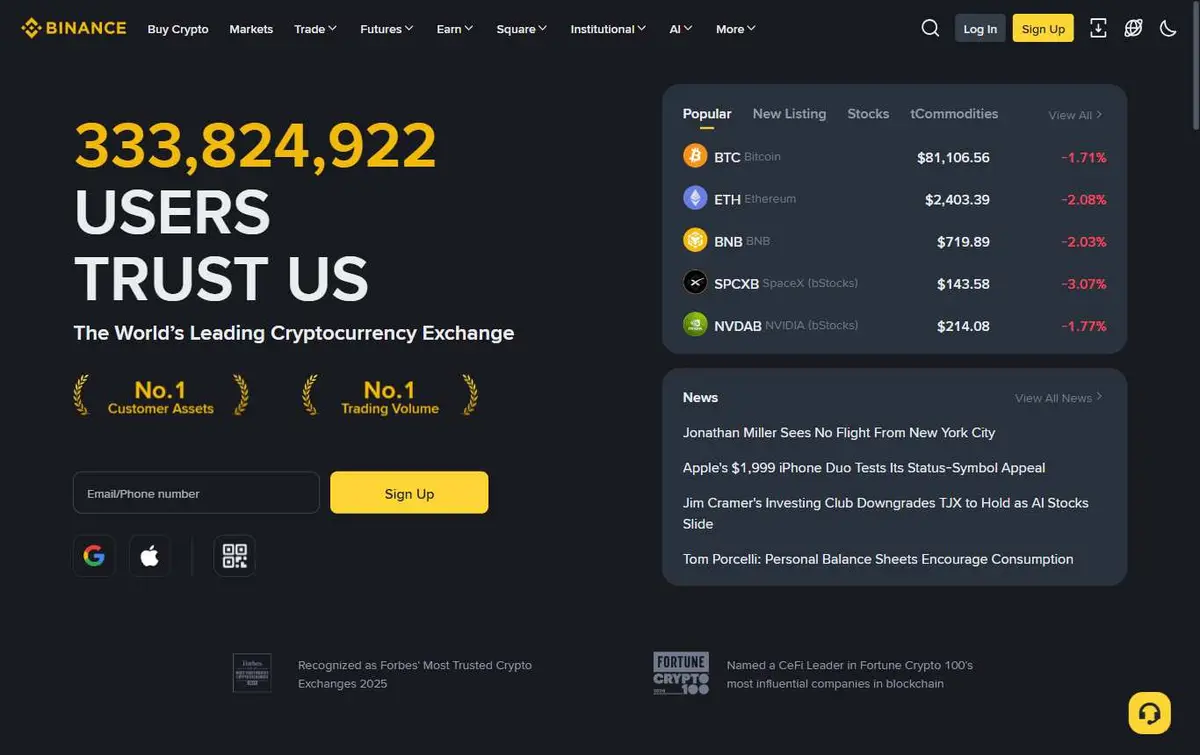
No barrier Vietnam · Home page
No barrier: the home page loads normally
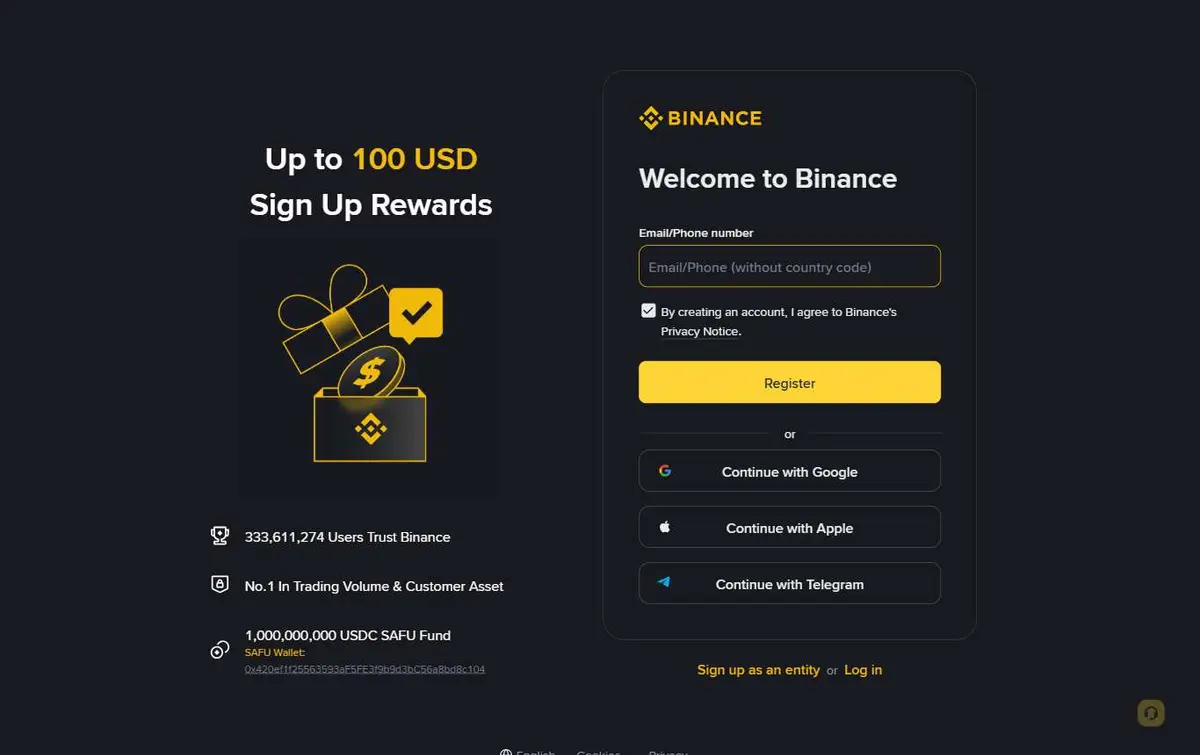
No barrierNigeria · Sign-up page
Nigeria: the sign-up form opens, although naira trading ended in March 2024
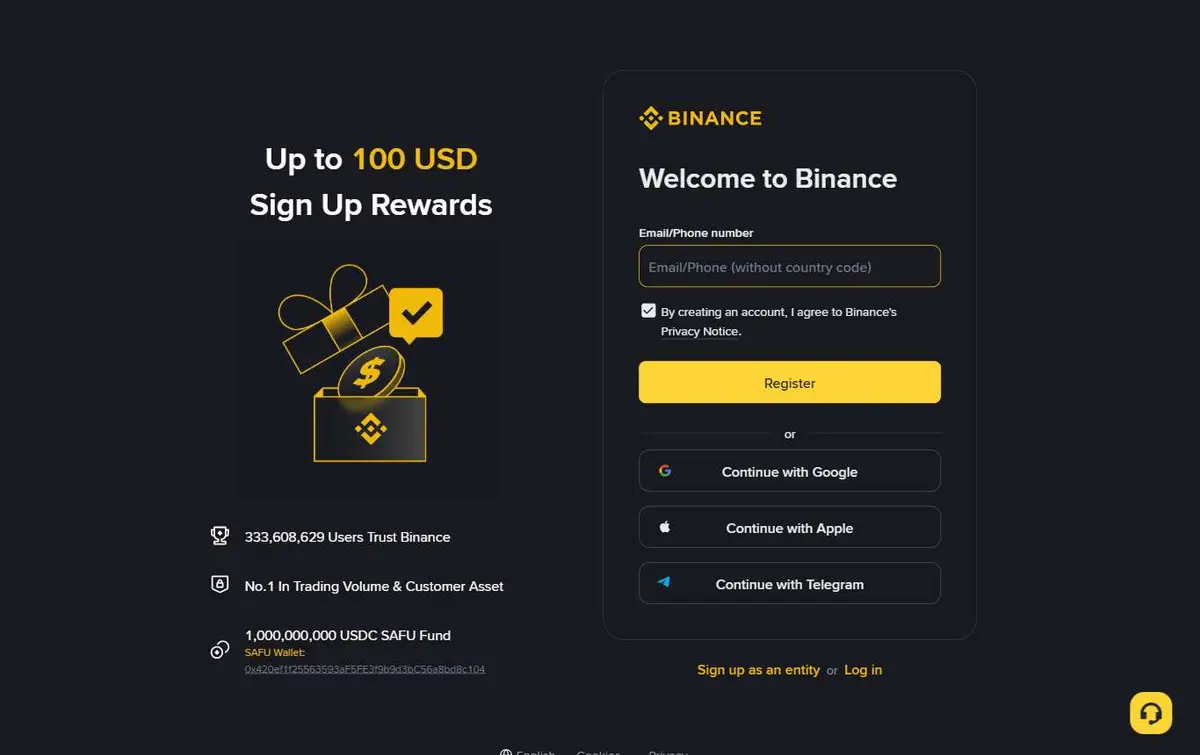
No barrierMexico · Sign-up page
Mexico: the sign-up form loads with no barrier
“Create a free account”
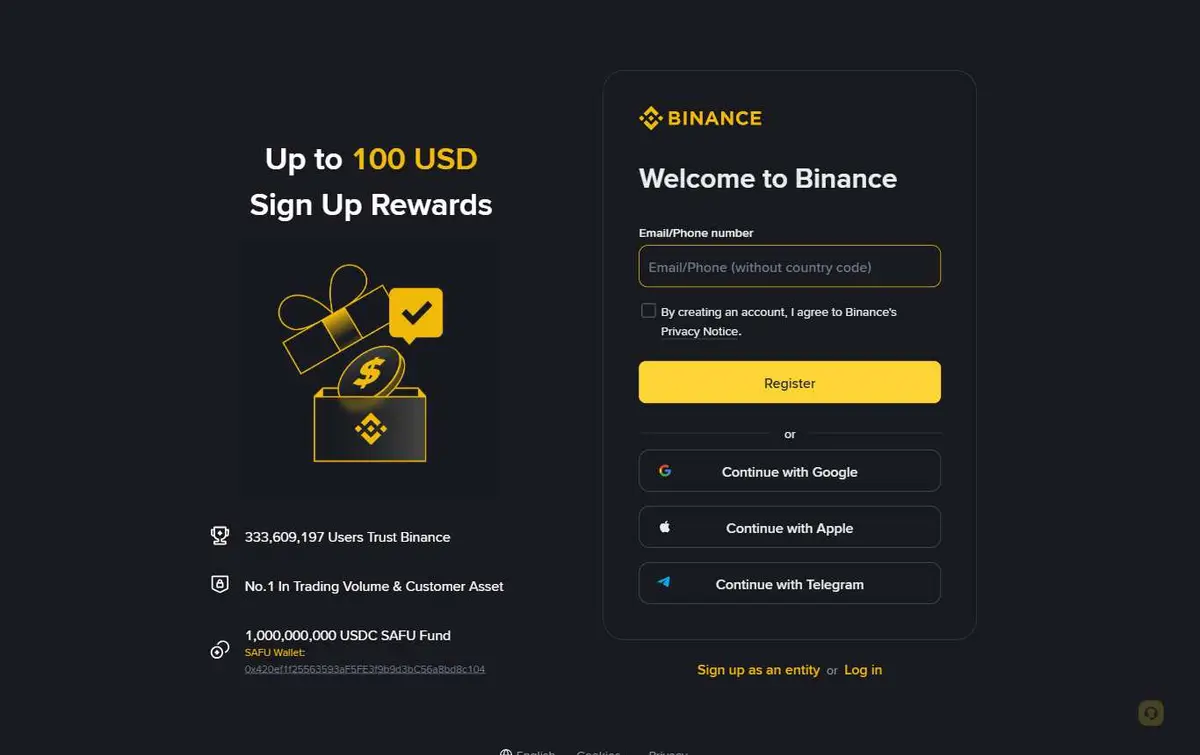
No barrierArgentina · Sign-up page
Argentina: the sign-up form loads; Binance is registered with the CNV
“Create a free account”
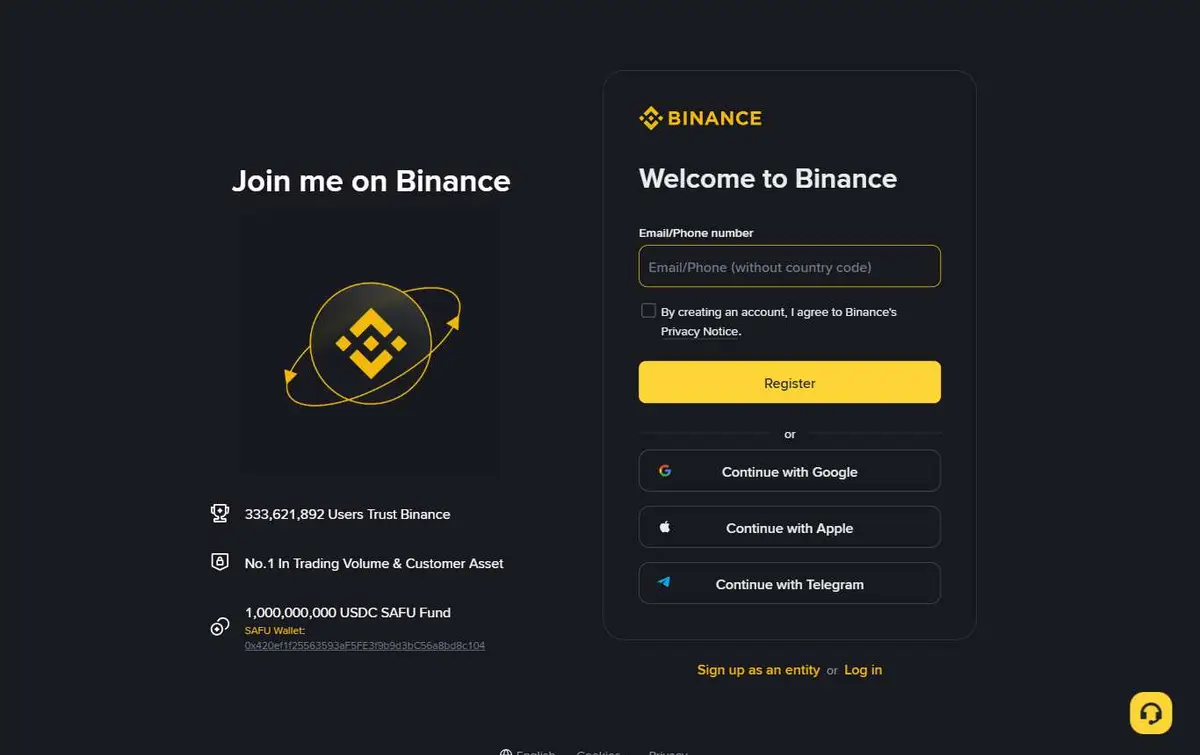
No barrier Belgium · Sign-up page
Belgium: the sign-up page loads with no barrier, although Binance has no MiCA authorisation
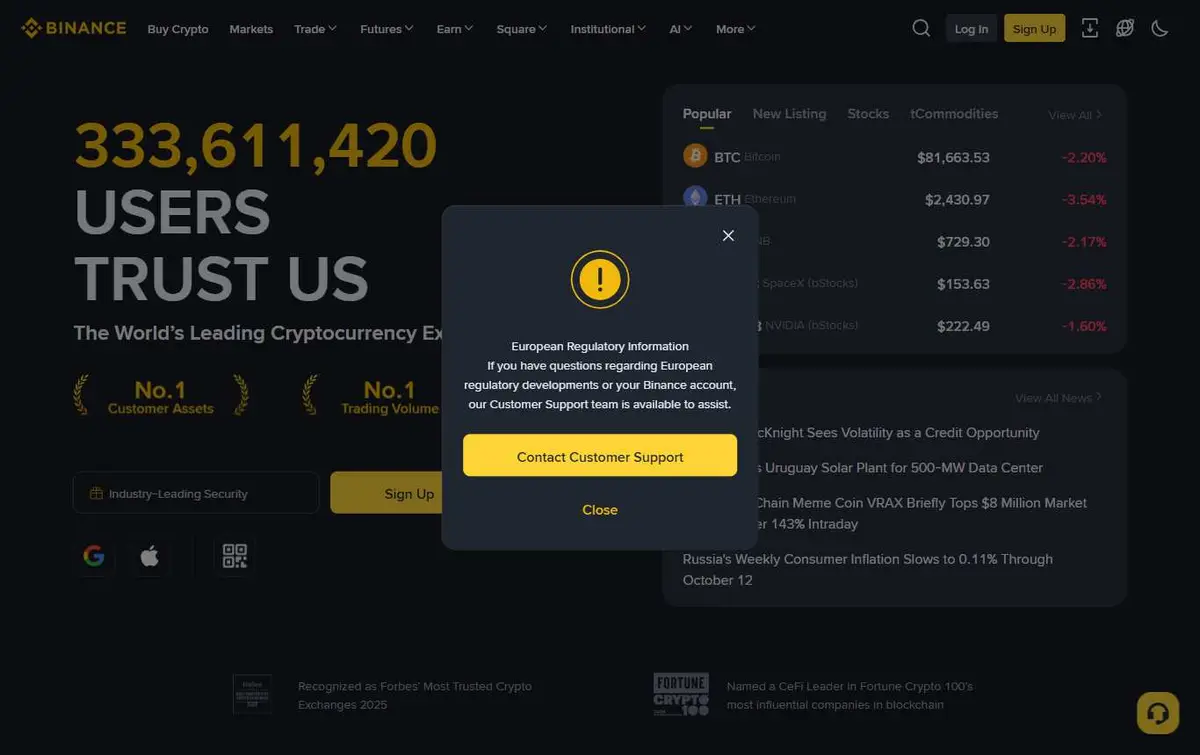
Notice shown Portugal · Home page
Portugal: the home page opens with a pop-up headed European Regulatory Information
“European Regulatory Information”
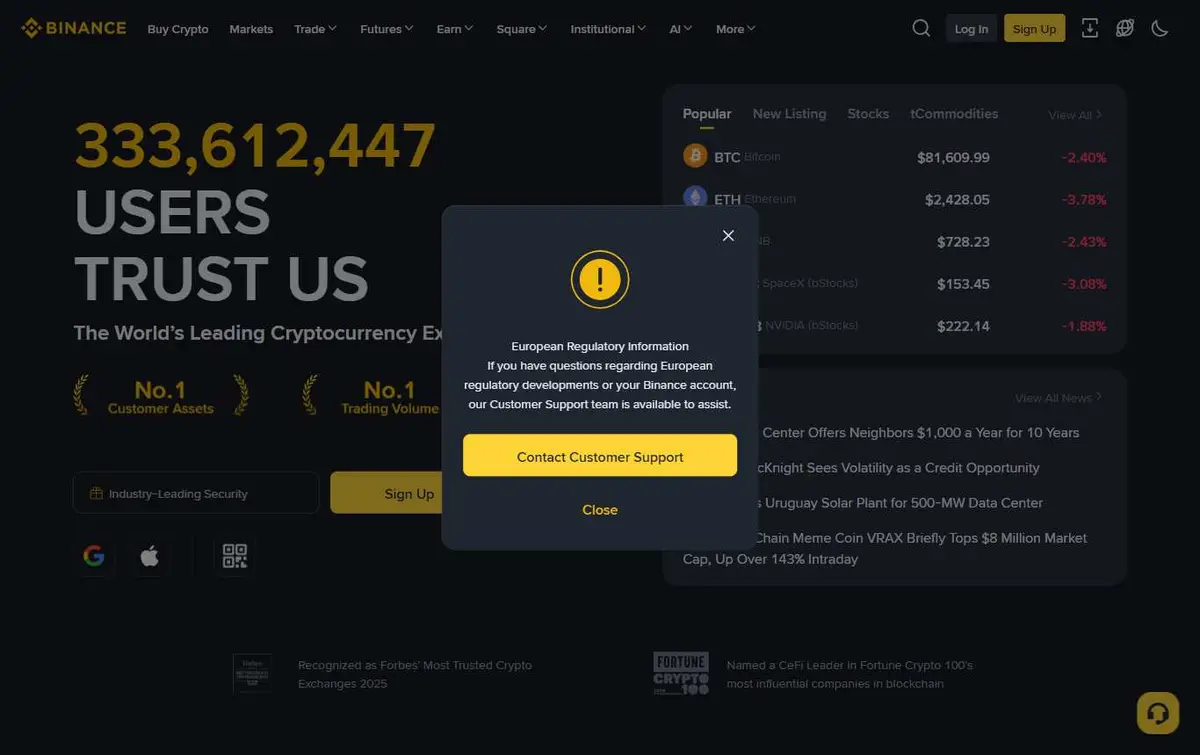
Notice shown Ireland · Home page
Ireland: the global site loads, with a European regulatory information link
No barrier Israel · Sign-up page
Israel is not on the prohibited list, and the sign-up page loads with no barrier
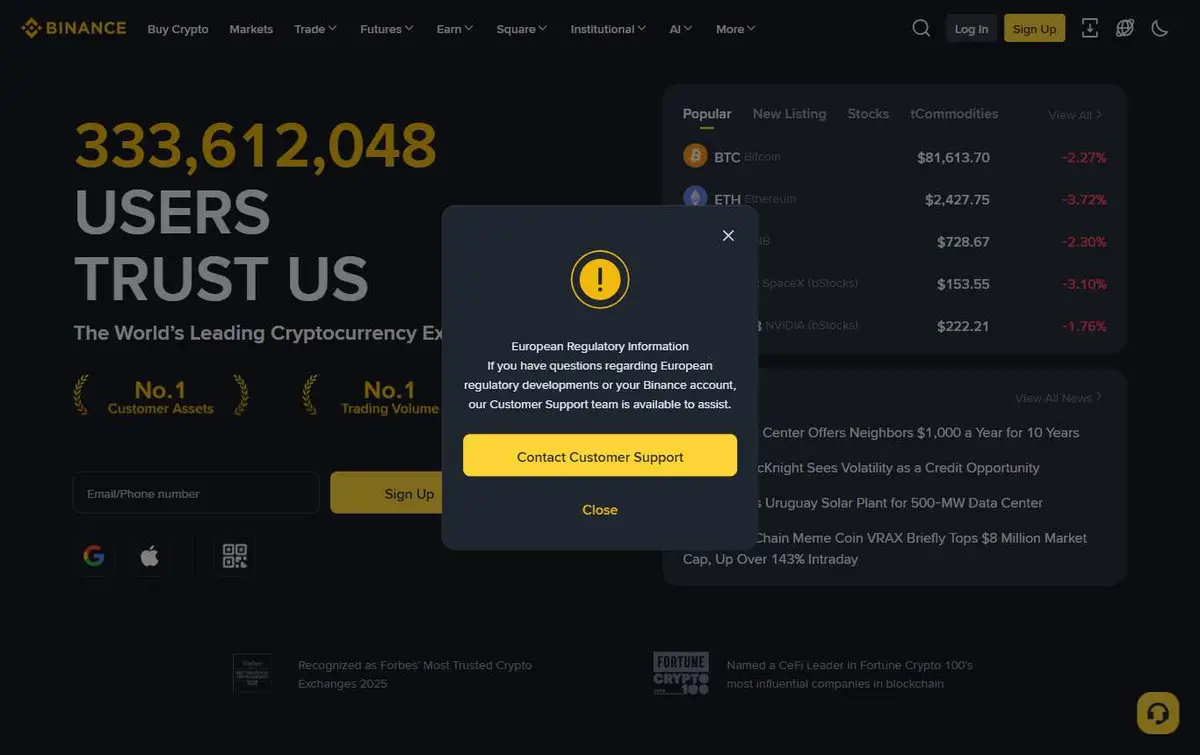
Notice shown Austria · Home page
Austria: Binance's home page carries its European regulatory notice
“European Regulatory Information”
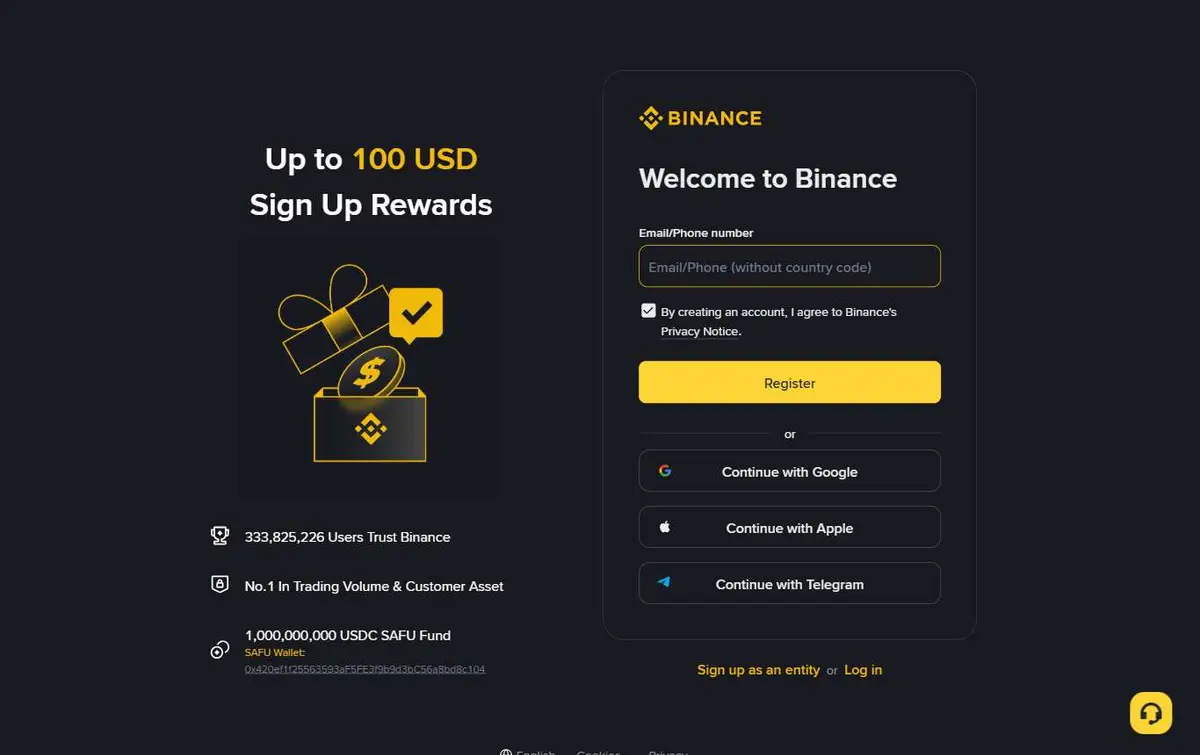
No barrier Kenya · Sign-up page
Kenya: the Binance sign-up page loads with no barrier
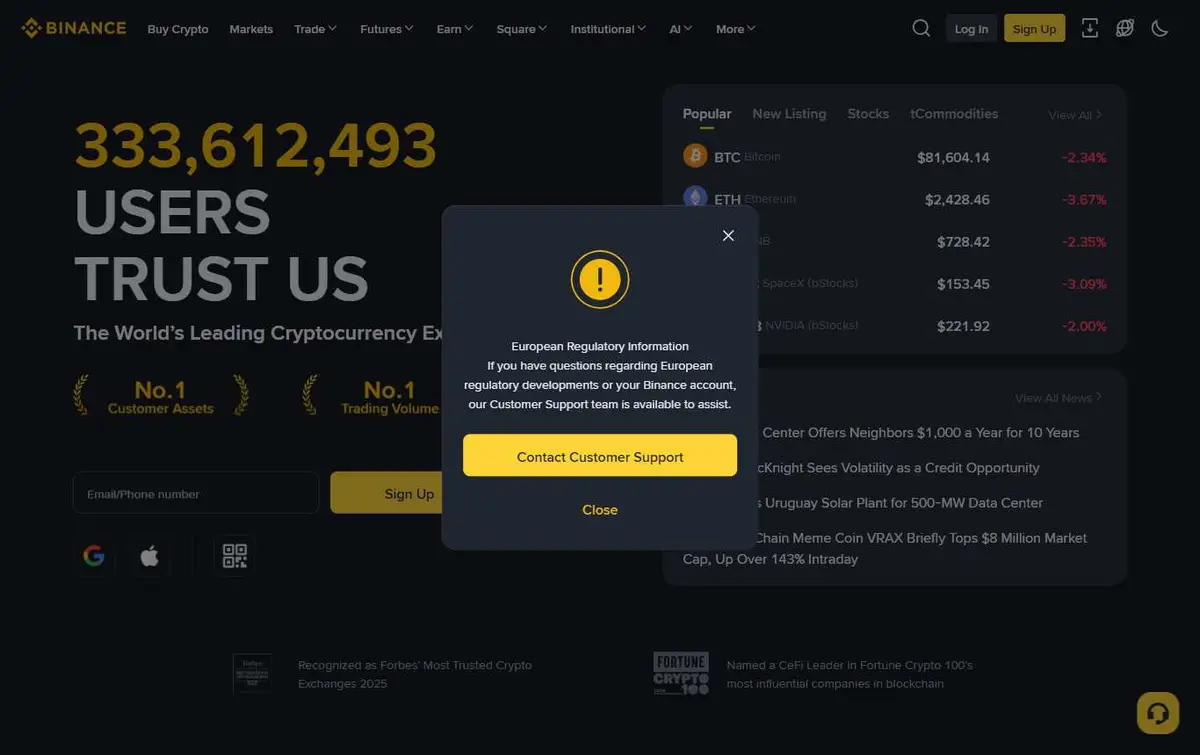
Notice shown Norway · Home page
Norway: the global site loads, with a European regulatory information link
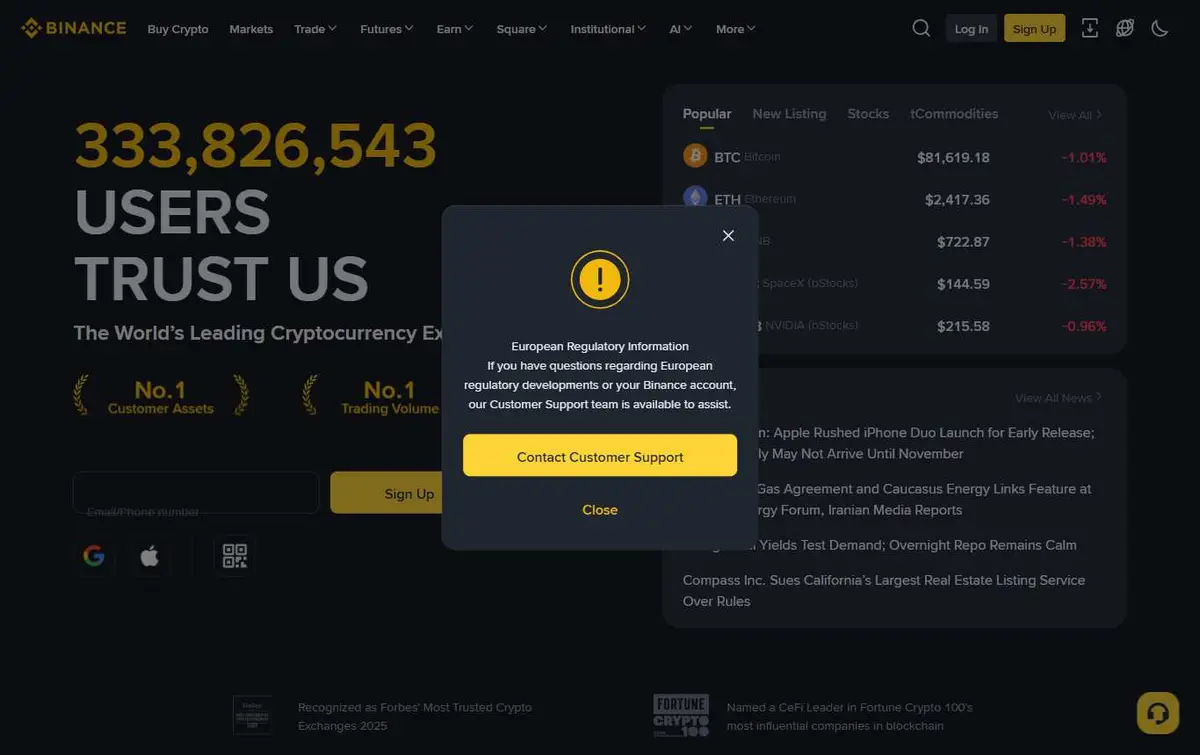
Notice shown Liechtenstein · Home page
Liechtenstein: the global site loads, with a European regulatory information link
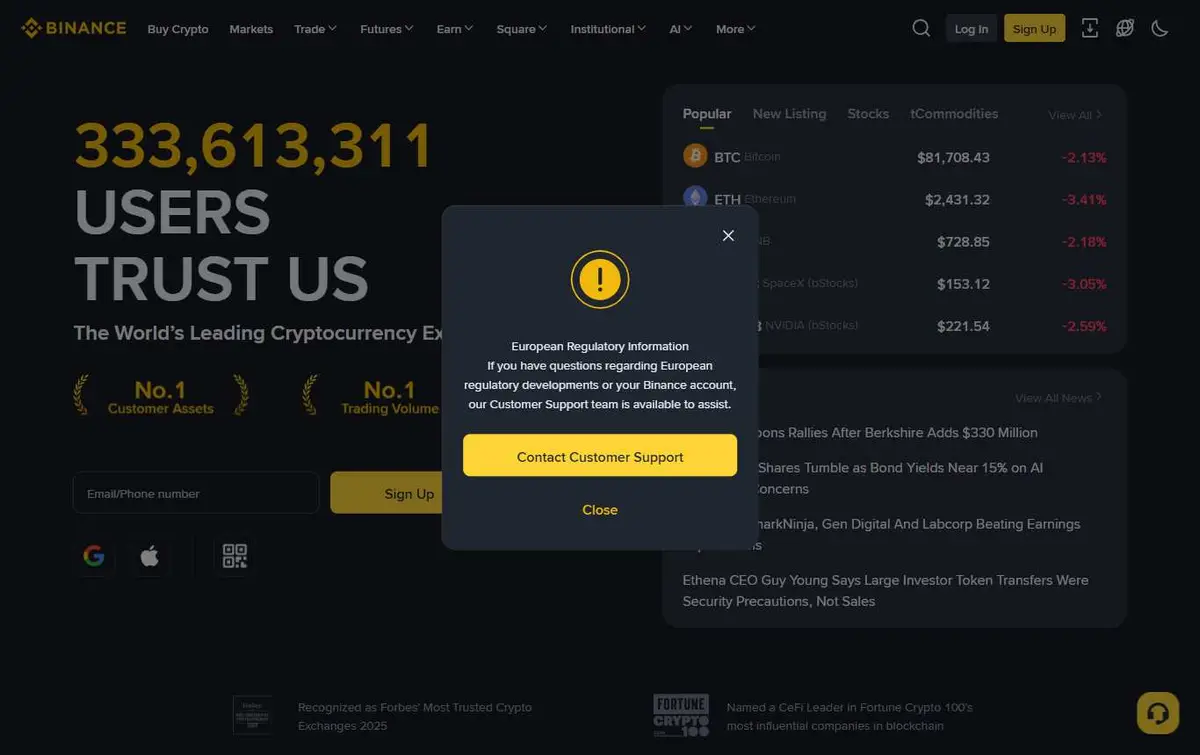
Notice shown Luxembourg · Home page
Luxembourg: the global site loads, with a European regulatory information link
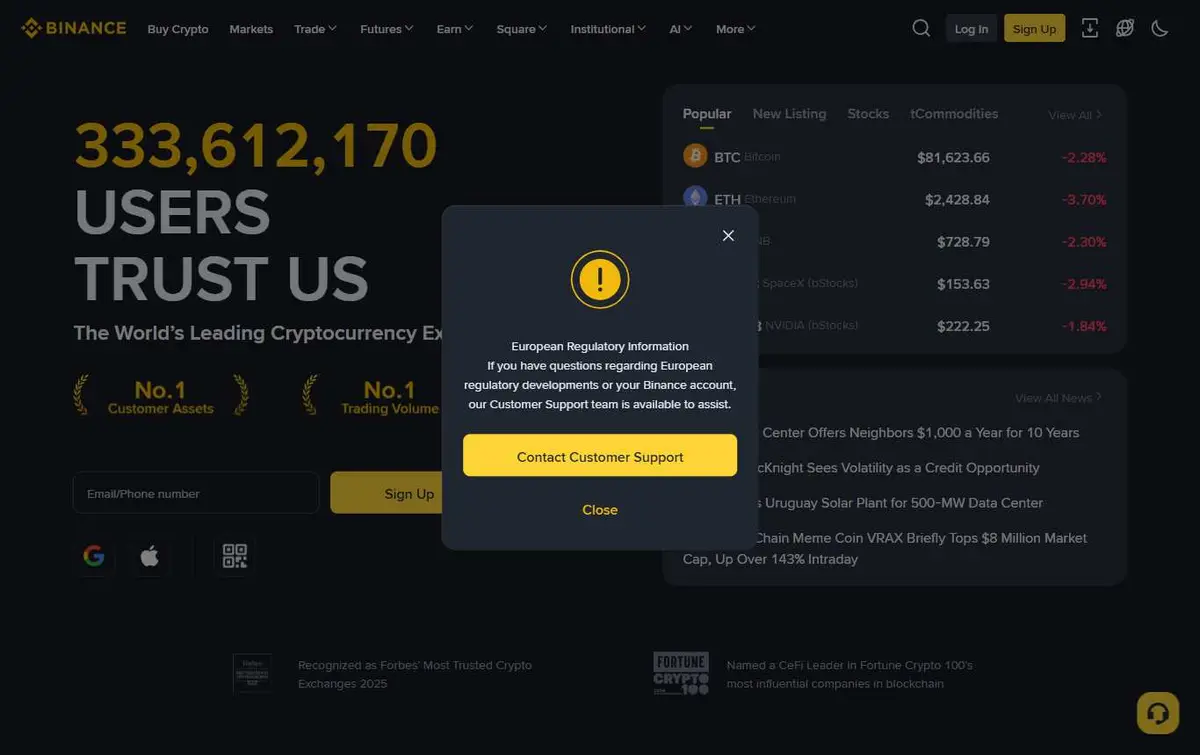
Notice shown Czechia · Home page
Czechia: the home page loads with a link to European regulatory information
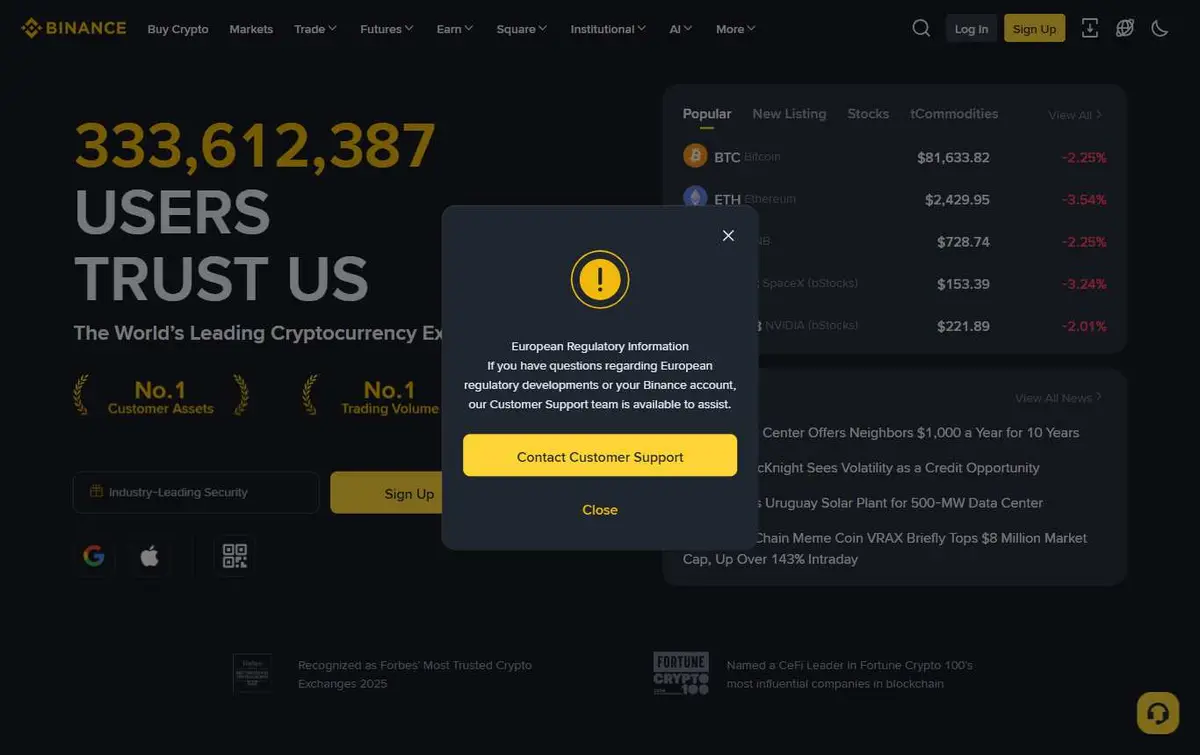
Notice shown Romania · Home page
Romania: the global site loads, with a European regulatory information link
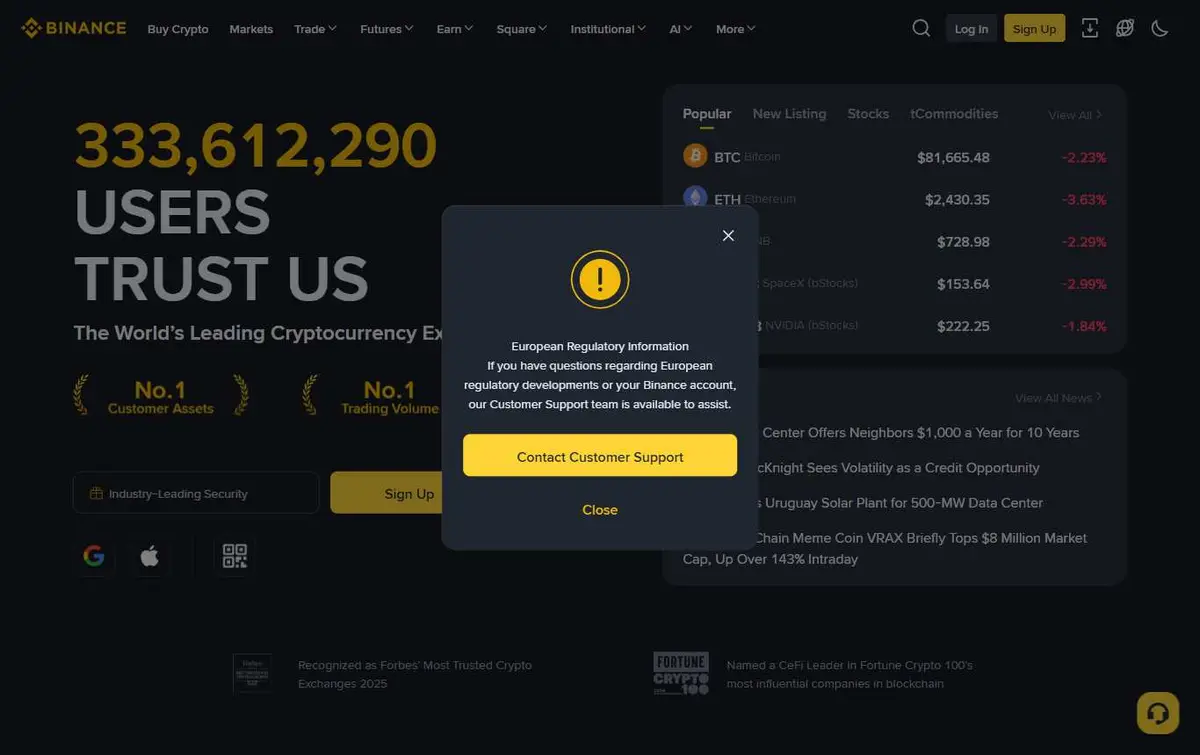
Notice shown Finland · Home page
Finland: the global site loads, with a European regulatory information link
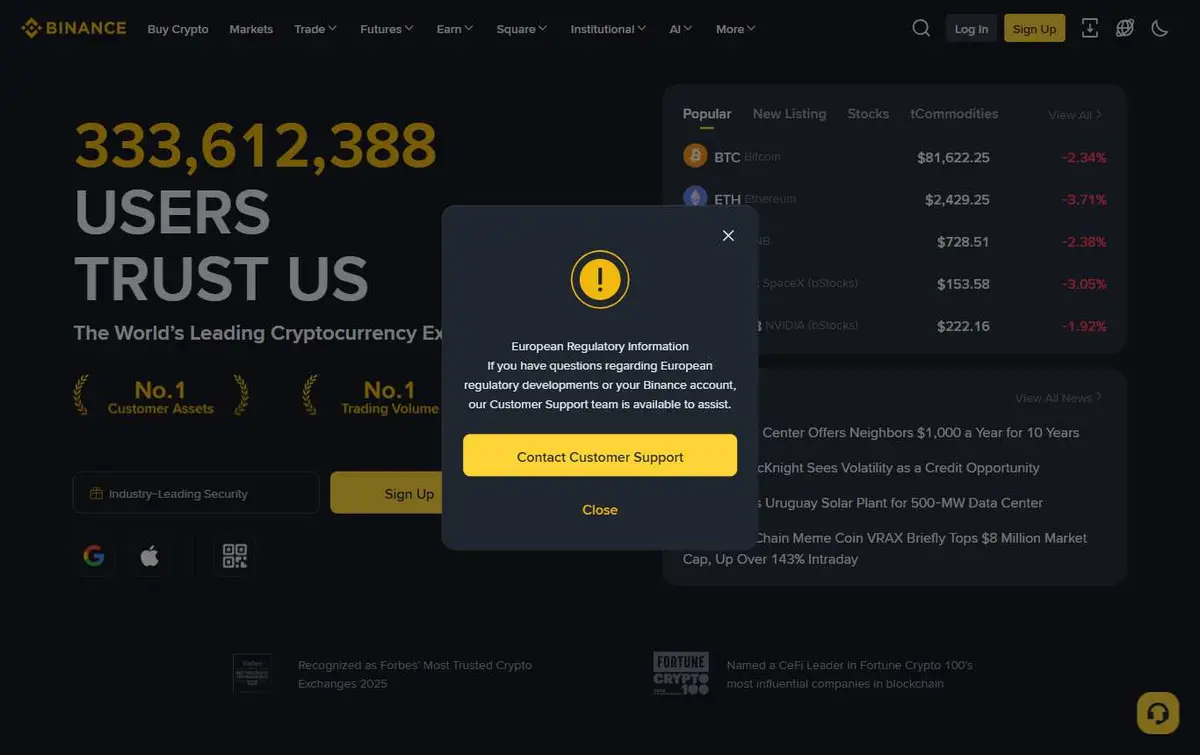
Notice shown Greece · Home page
Greece: the global site loads, with a European regulatory information link
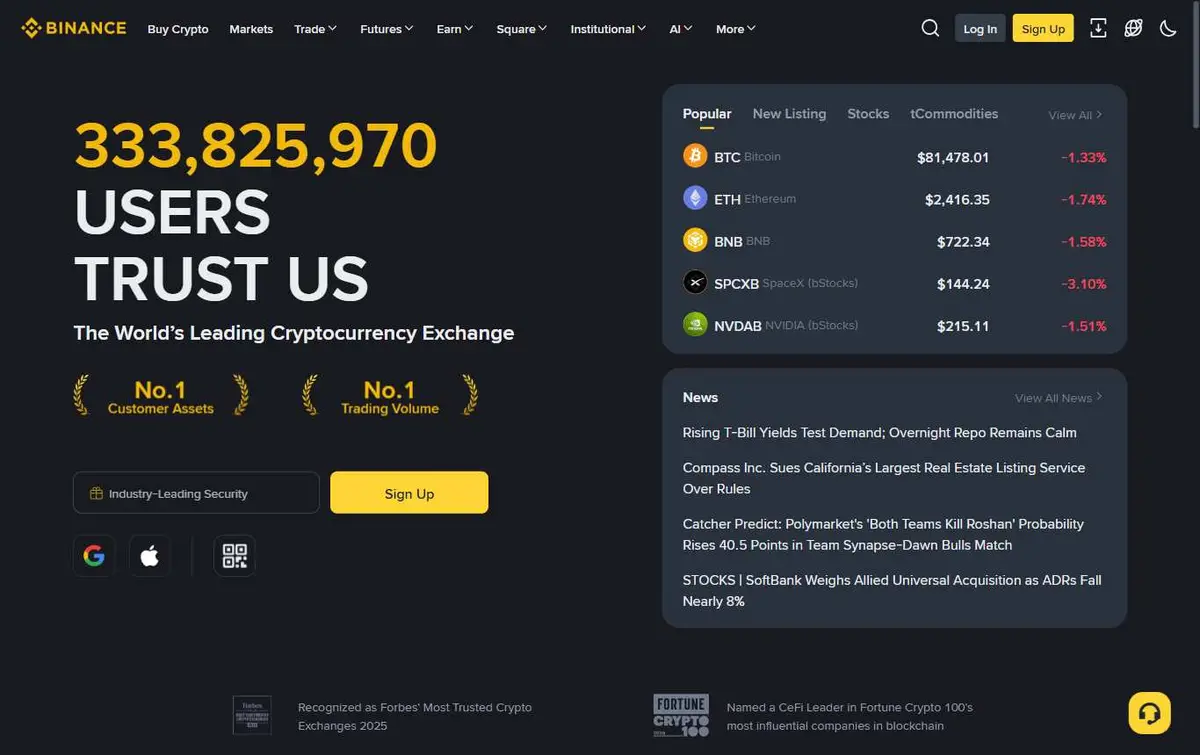
No barrier Qatar · Home page
Qatar: the home page loads with no barrier
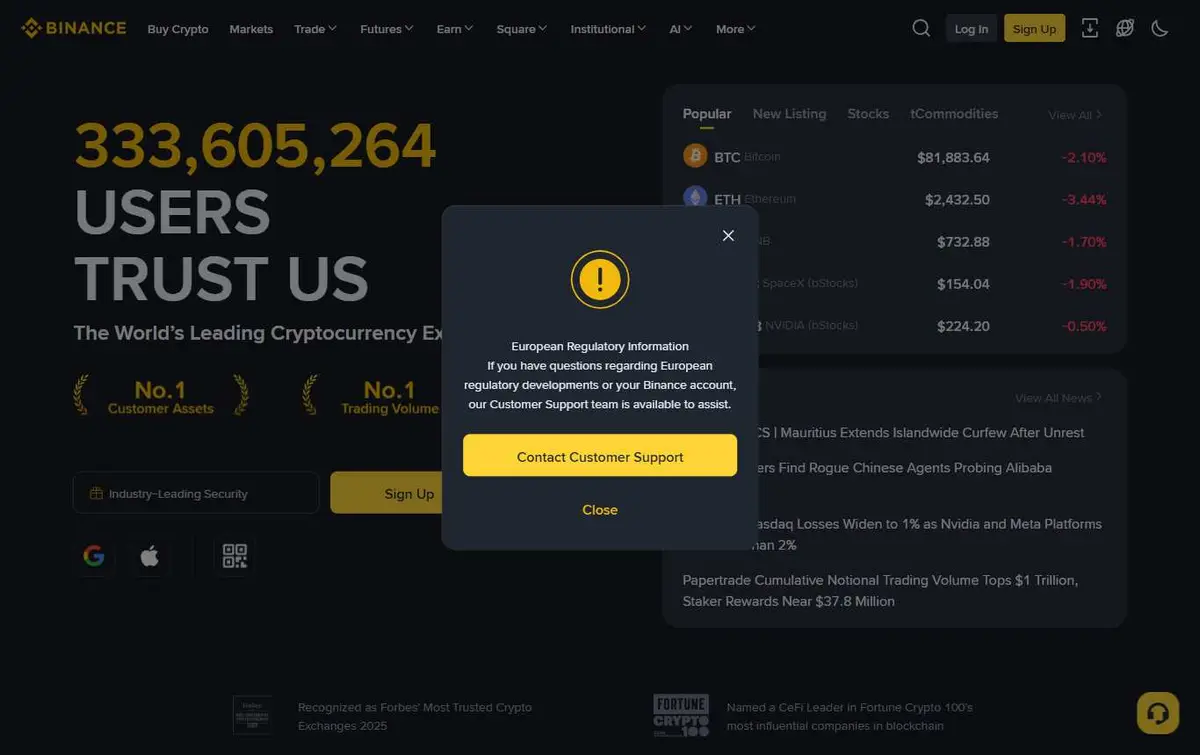
Notice shown Bulgaria · Home page
Bulgaria: the global site loads, with a European regulatory information link
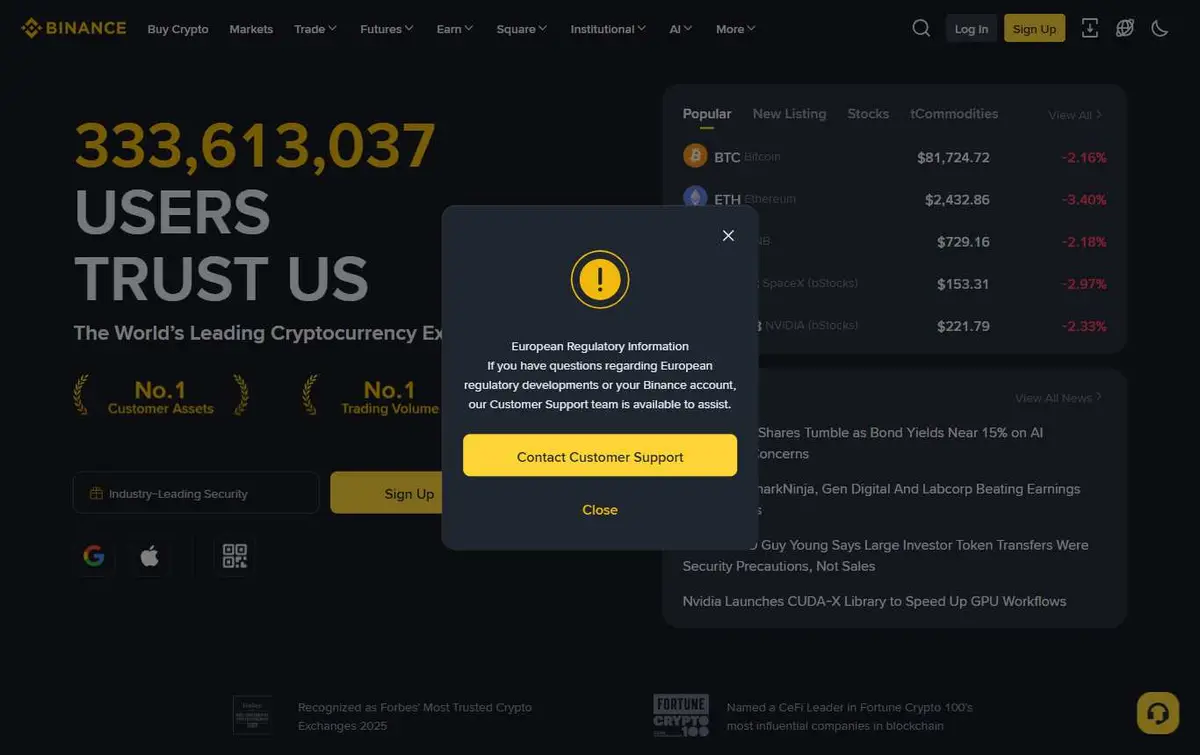
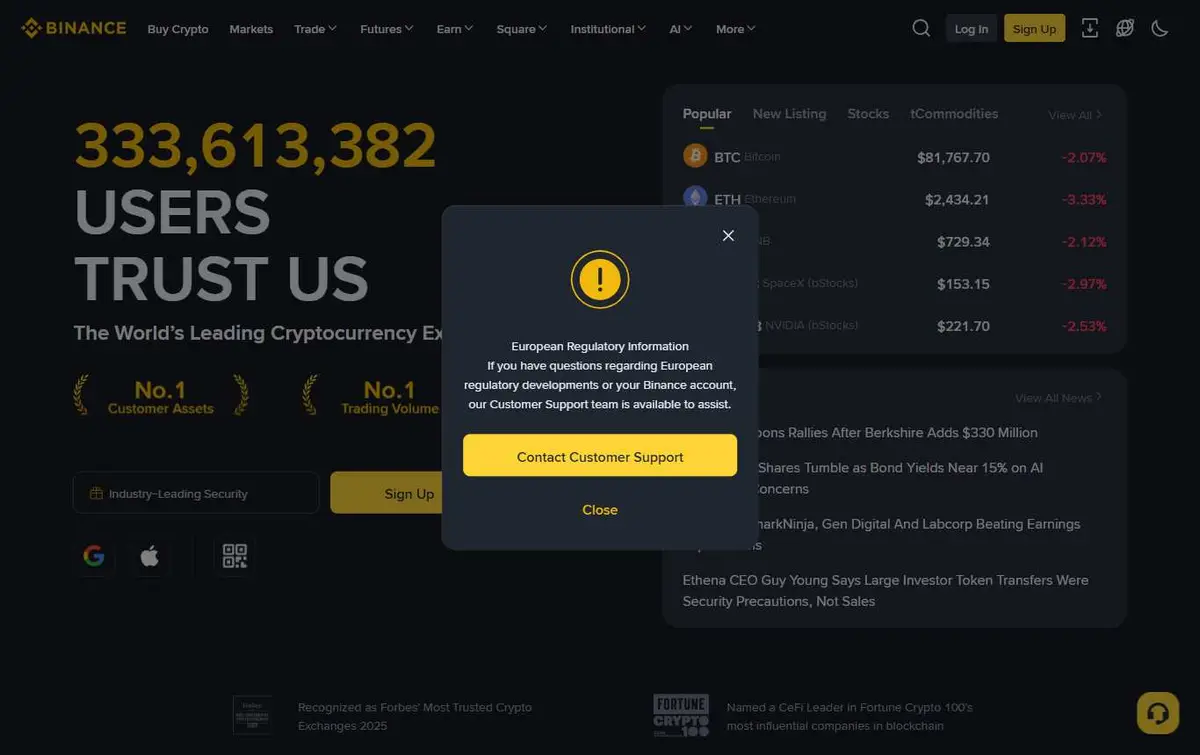
Notice shown Croatia · Home page
Croatia: the global site loads, with a European regulatory information link
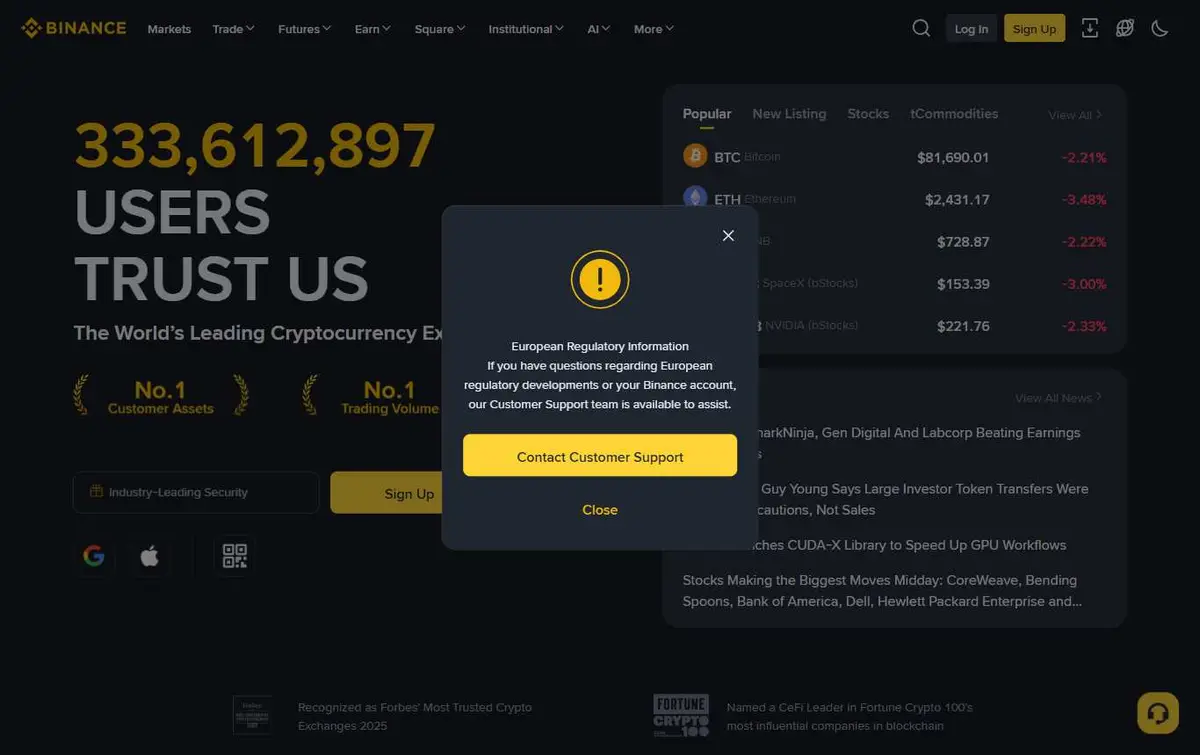
Notice shown Latvia · Home page
Latvia: the global site loads, with a European regulatory information link
Notice shown Estonia · Home page
Estonia: the global site loads, with a European regulatory information link
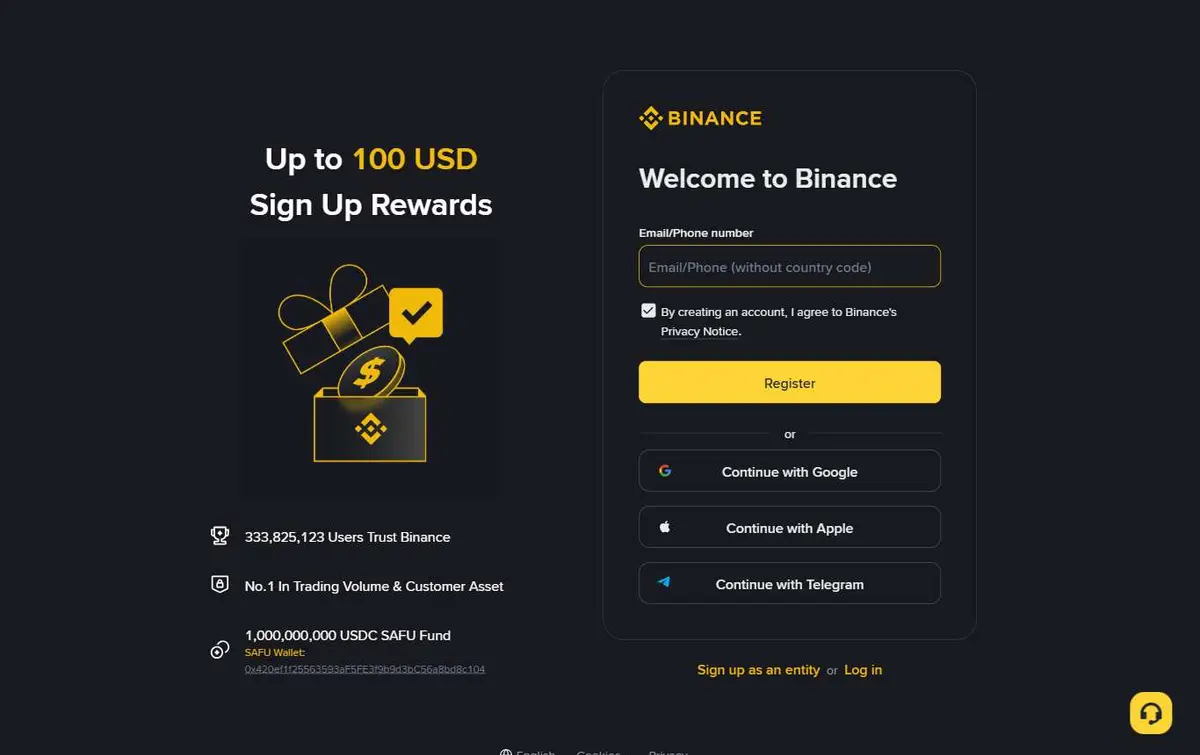
No barrierEgypt · Sign-up page
Egypt: sign-up loads with no notice
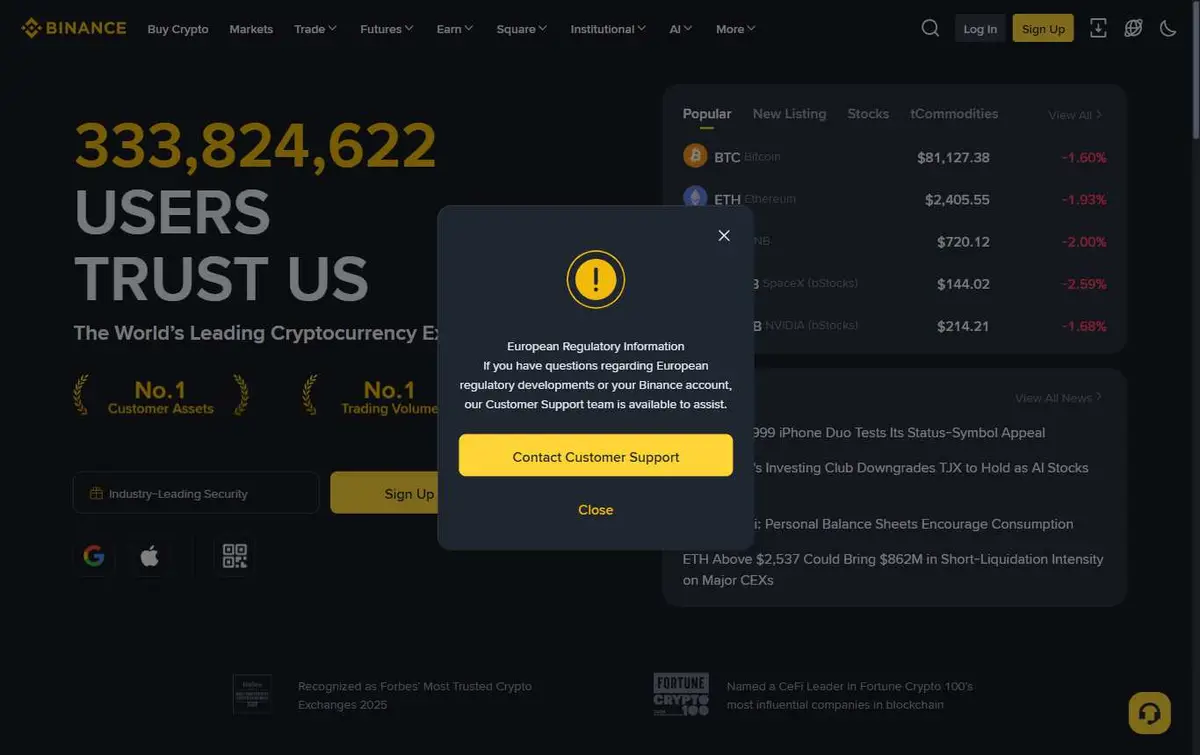
Notice shown Lithuania · Home page
Lithuania: the global site loads, with a European regulatory information link
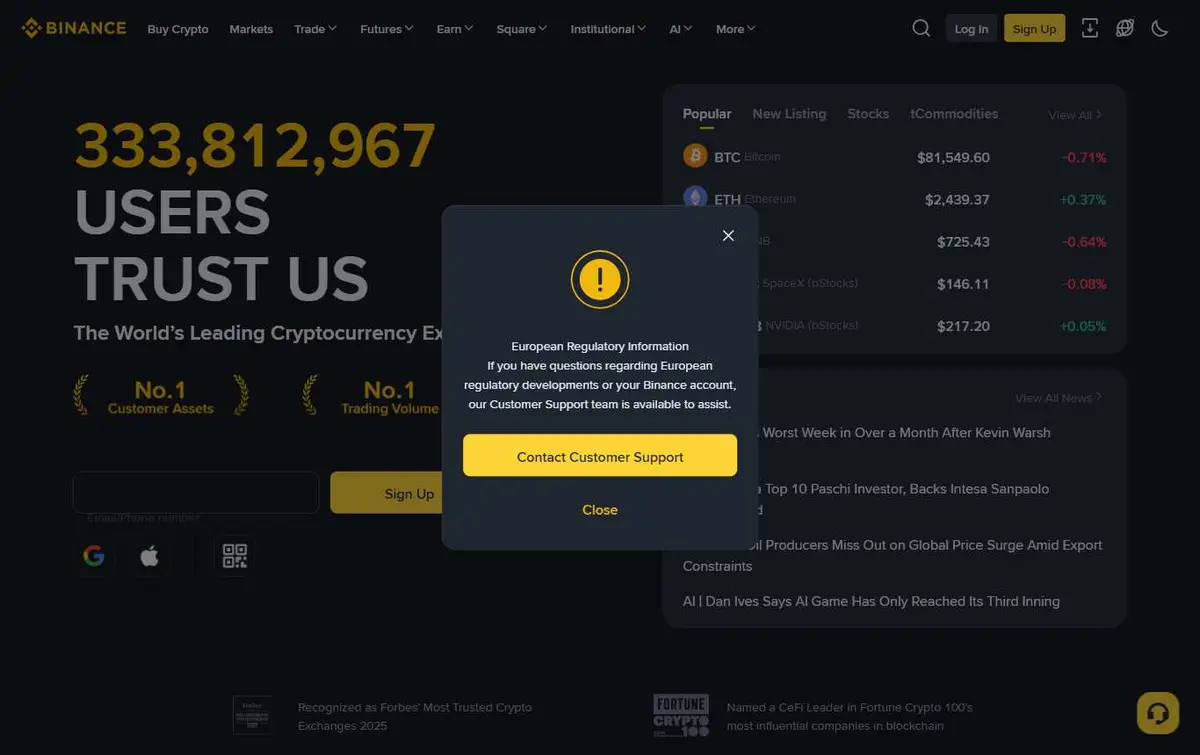
Notice shown Slovakia · Home page
Slovakia: the home page loads with a link to European regulatory information
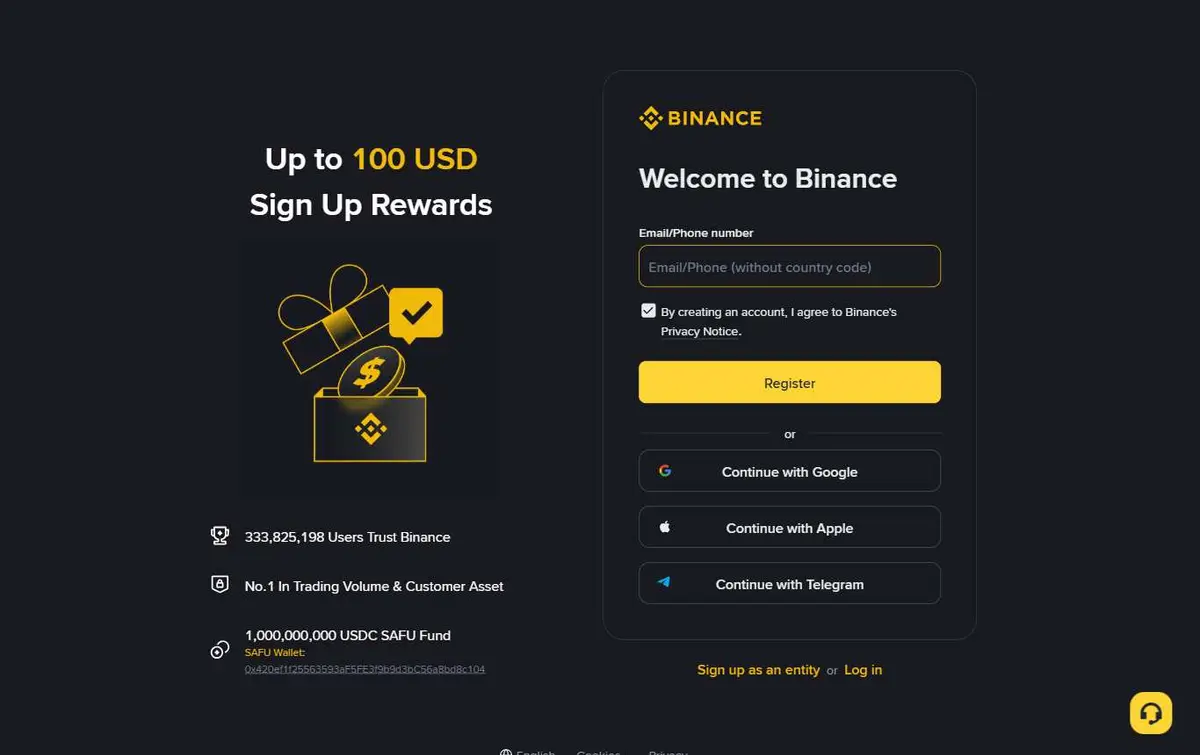
No barrier Morocco · Sign-up page
Morocco: the Binance sign-up page loads with no barrier
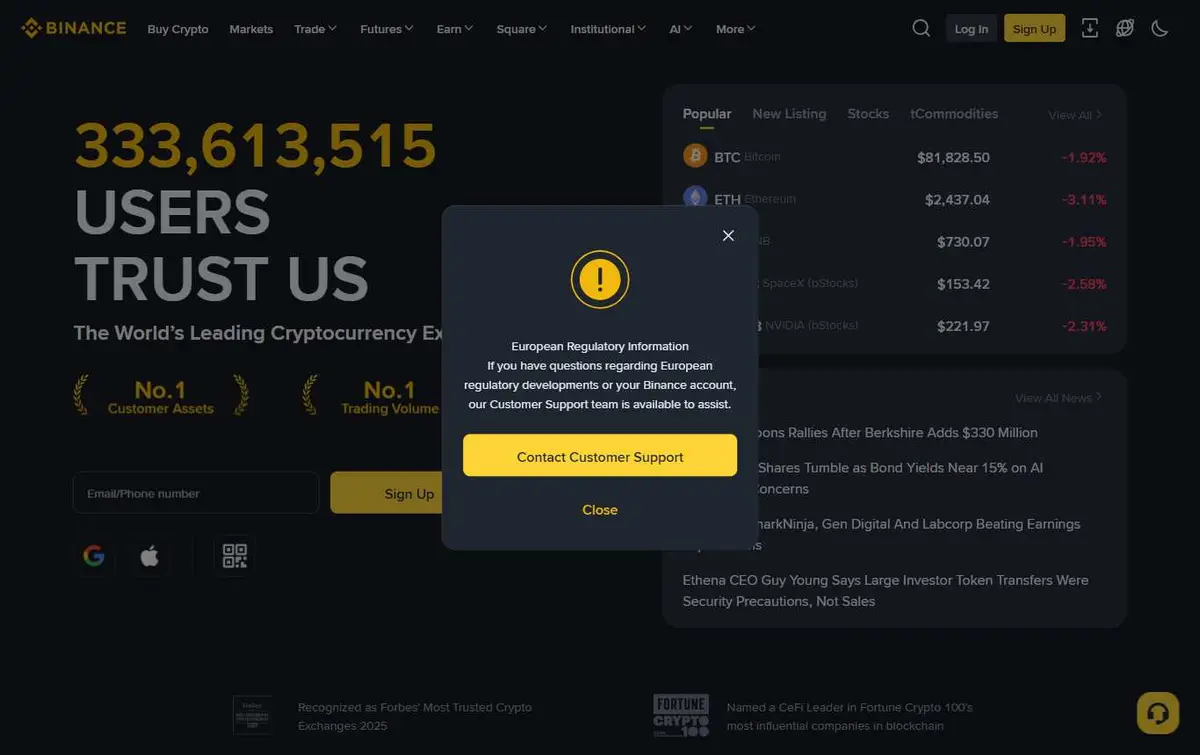
Notice shown Slovenia · Home page
Slovenia: the global site loads, with a European regulatory information link
“European Regulatory Information”
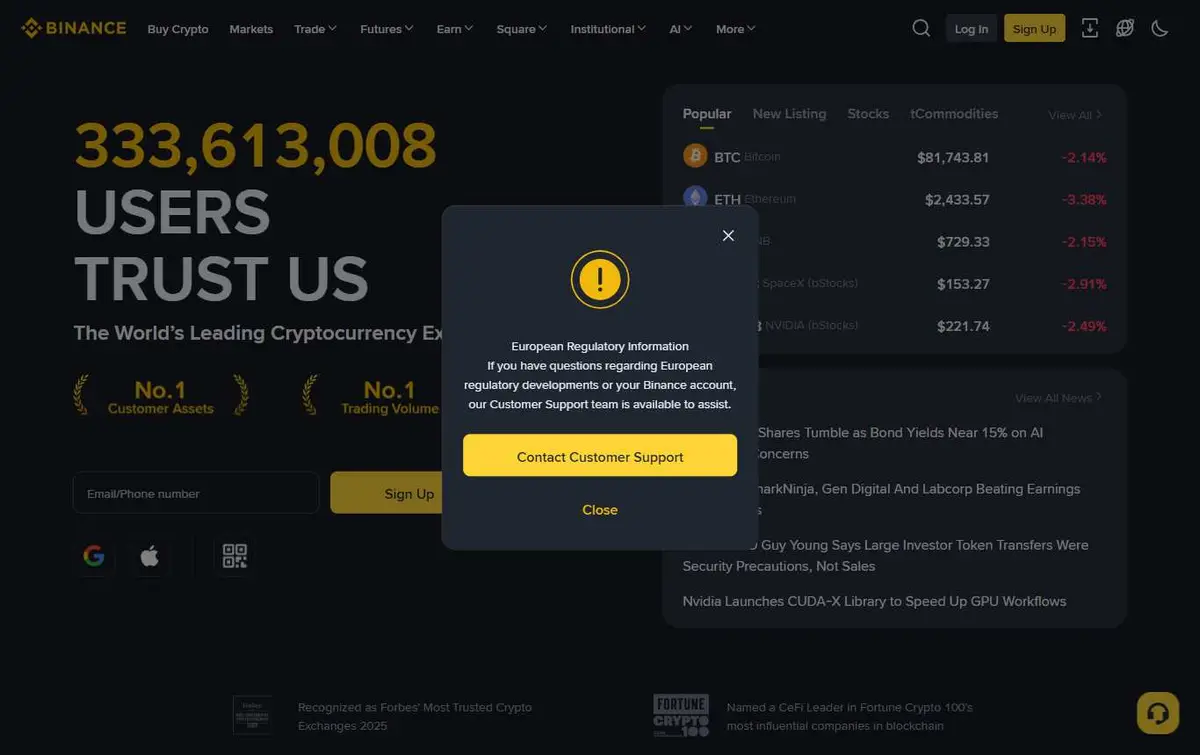
Notice shown Iceland · Home page
Iceland: the global site loads, with a European regulatory information link
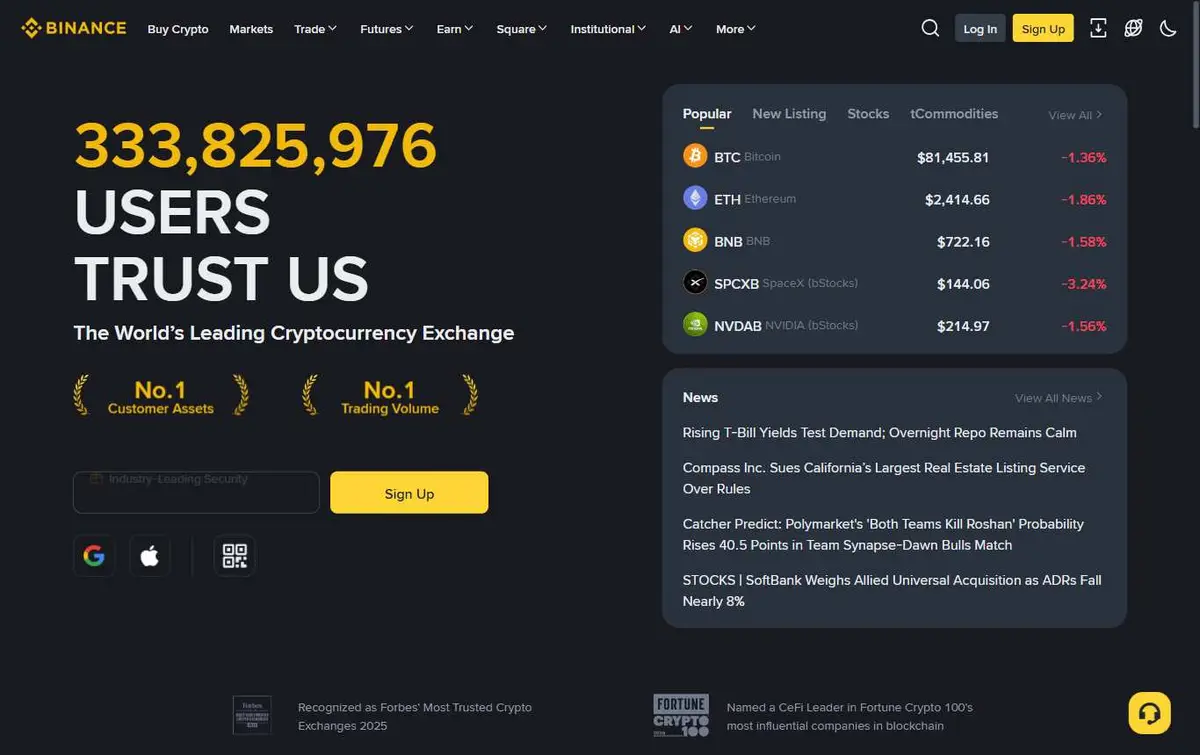
No barrierBahrain · Home page
Bahrain: the home page loads with no barrier
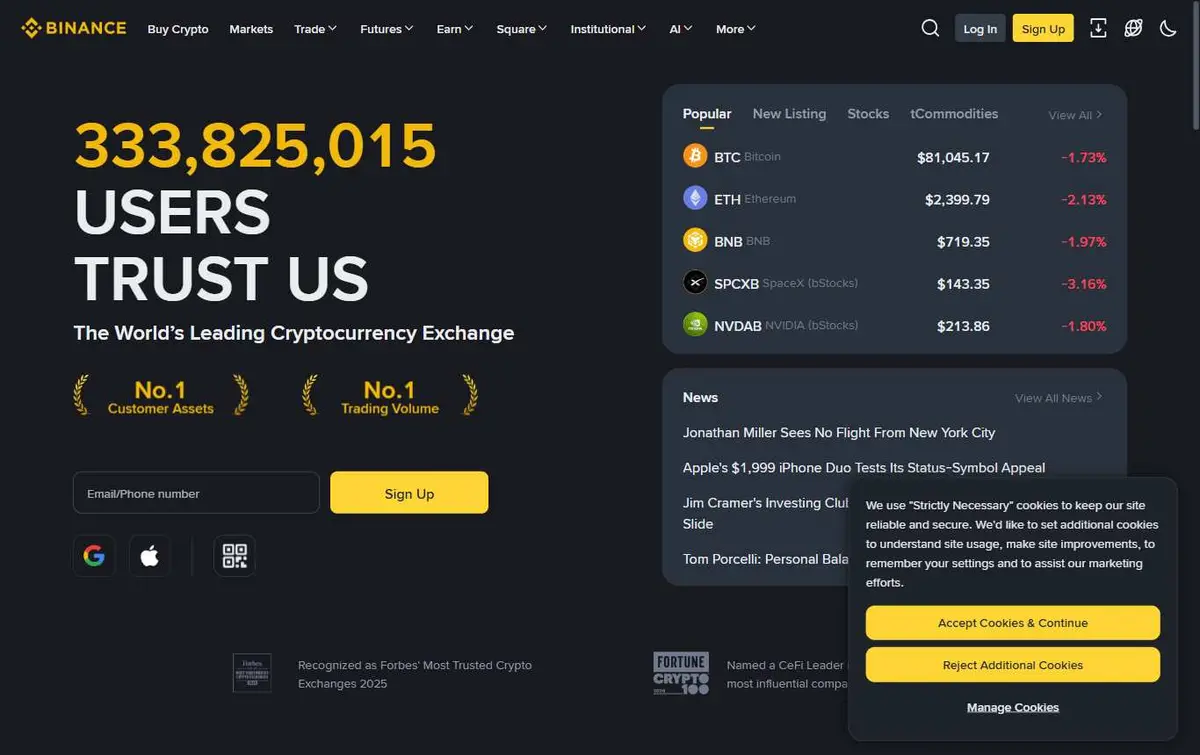
No barrier Pakistan · Home page
Pakistan: the global site loads with no notice
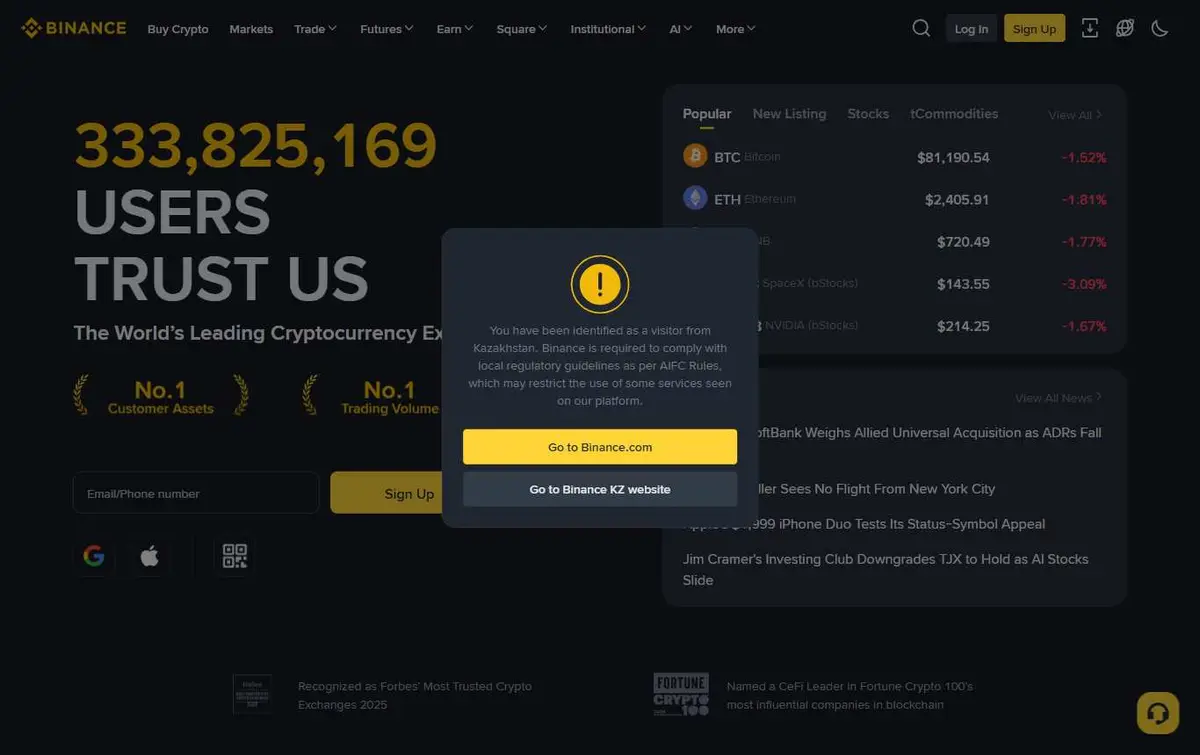
No barrierKazakhstan · Home page
Kazakhstan: the home page loads behind a notice offering Binance Kazakhstan, under AIFC rules
“Binance is required to comply with local regulatory guidelines as per AIFC Rules, which may restrict the use of some services seen on our platform.”
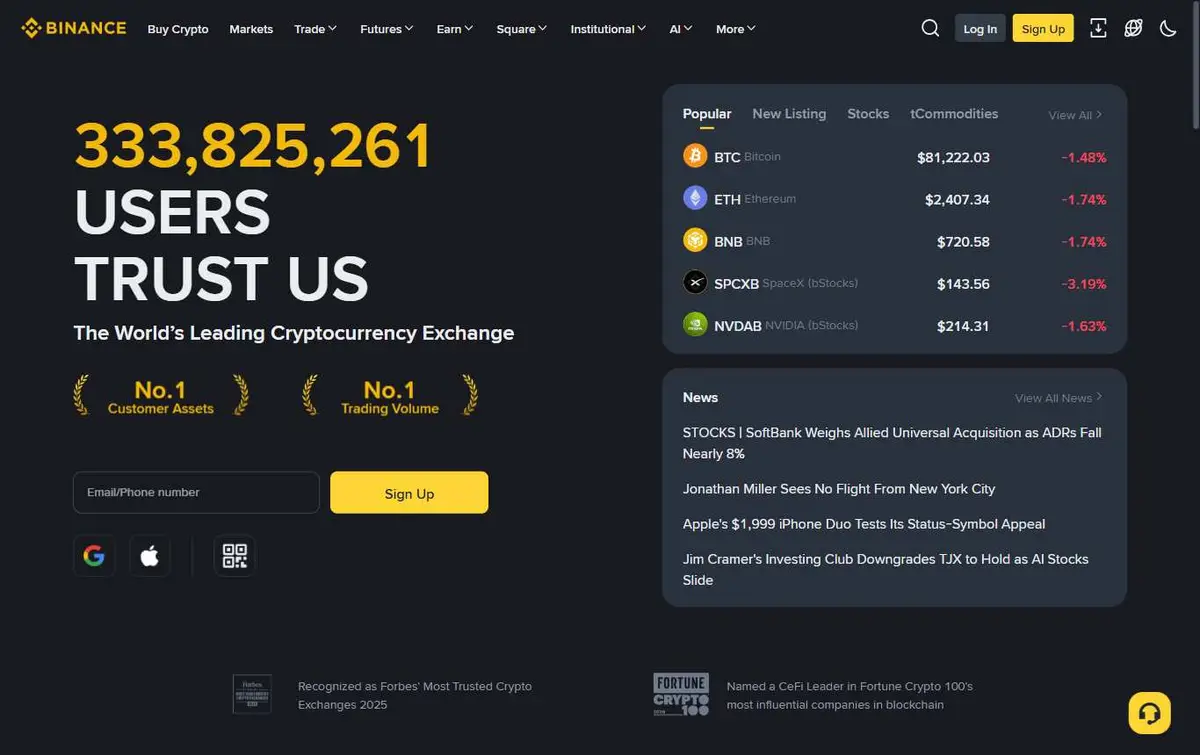
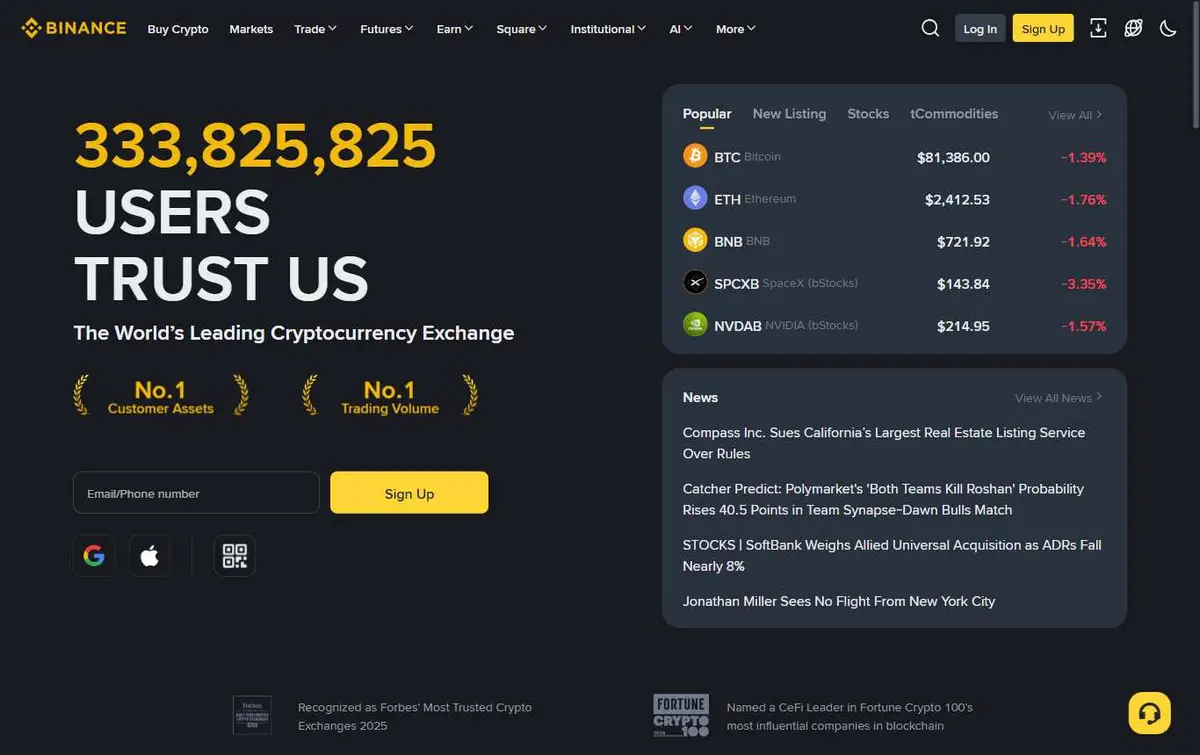
No barrier Ghana · Home page
Ghana: the global Binance home page loads with no notice
No barrier Georgia · Home page
Georgia: the global site loads with no notice
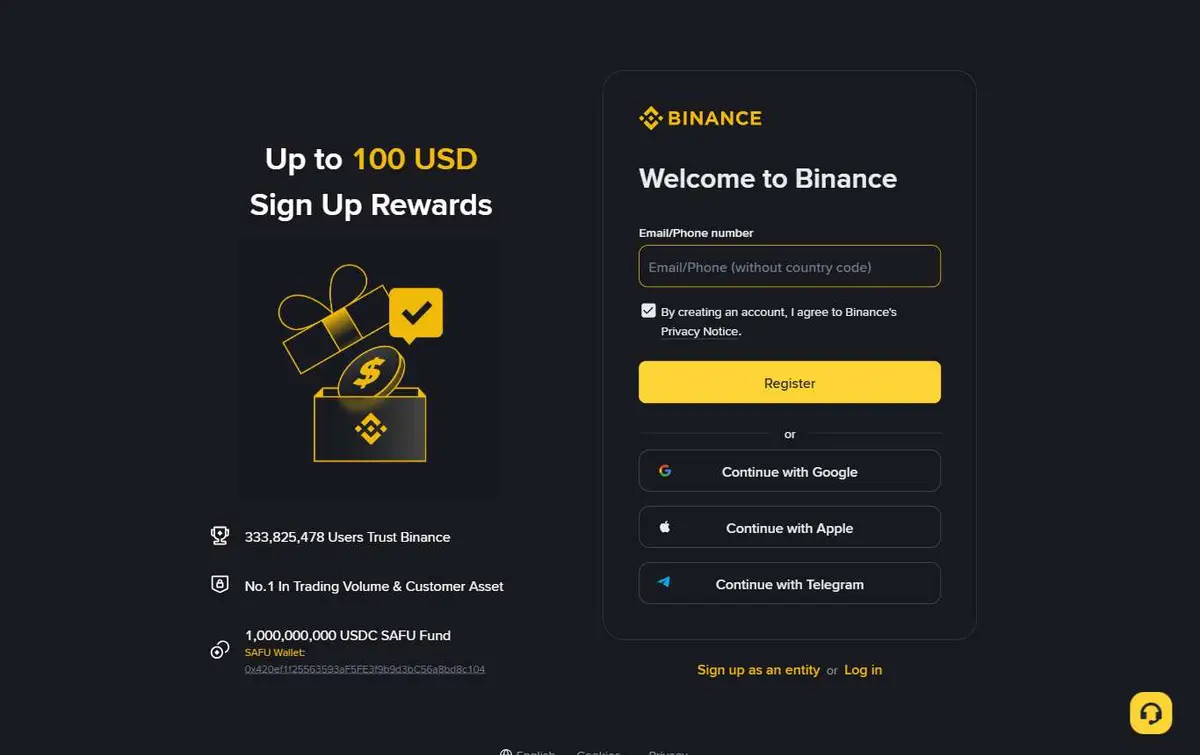
No barrierVenezuela · Sign-up page
Venezuela: sign-up loads with no barrier
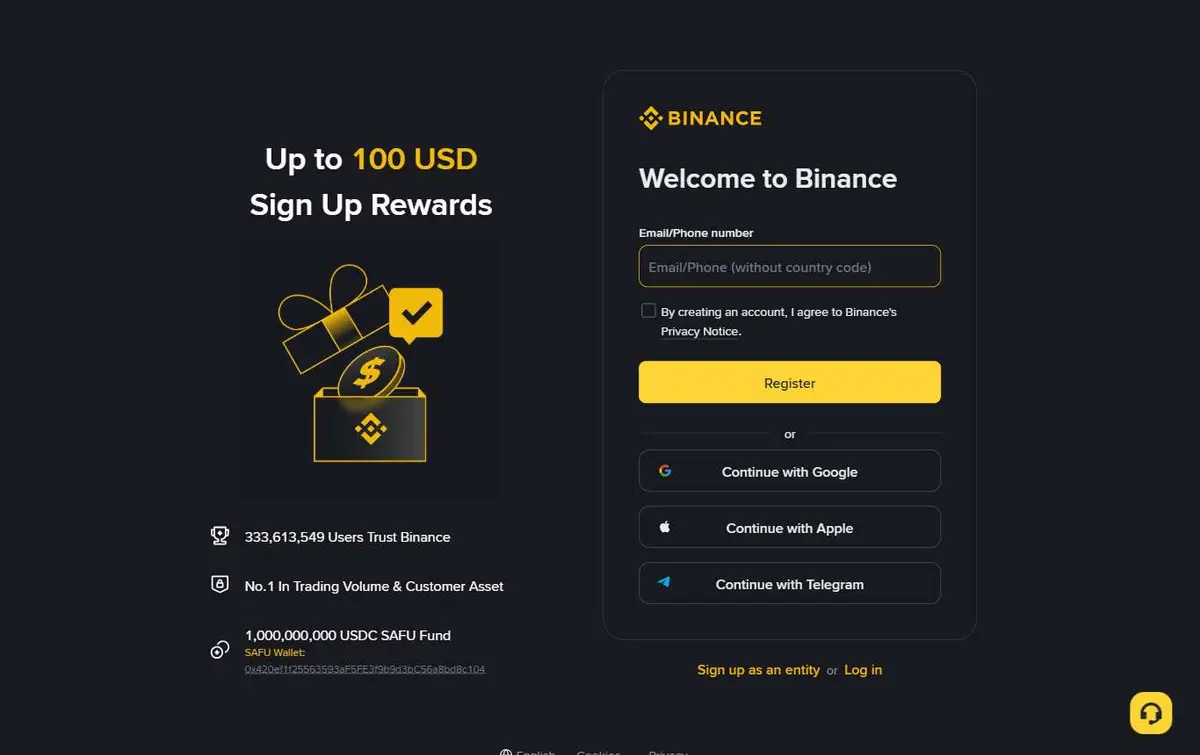
No barrier Serbia · Sign-up page
Serbia: sign-up loads with no barrier
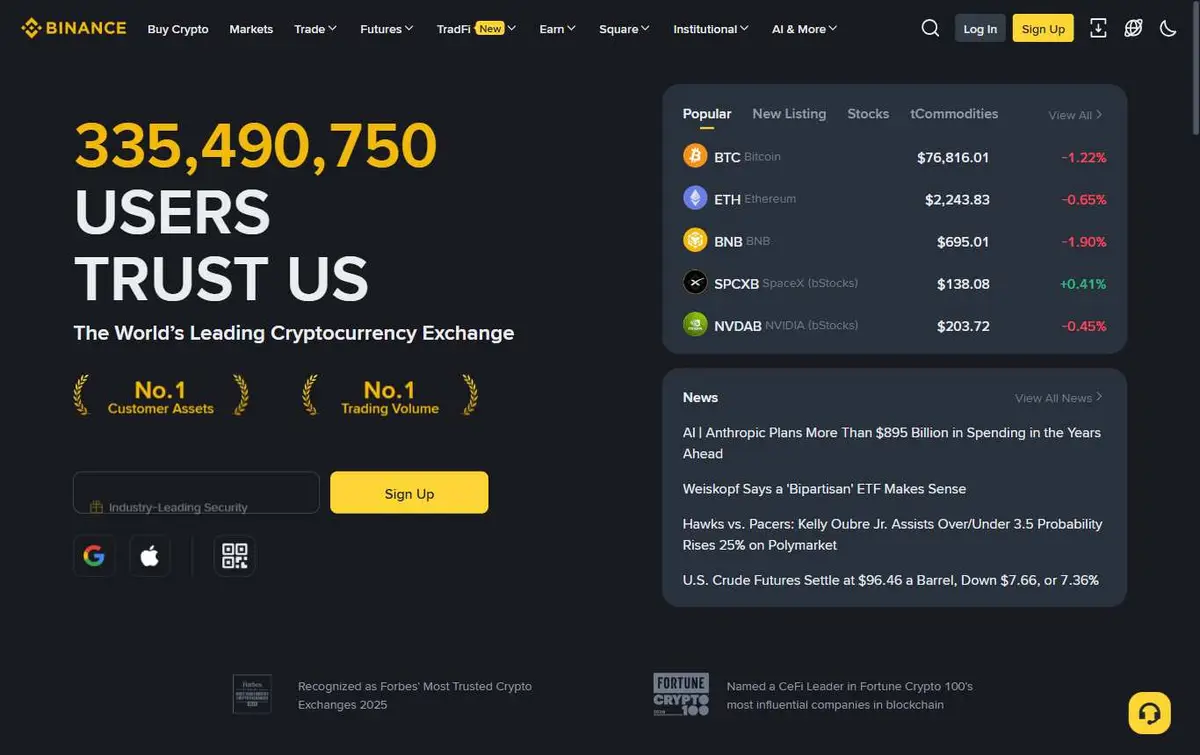
No barrierBangladesh · Home page
Bangladesh: the home page loads with no notice and a sign-up button
 CRYPTORESTRICTIONS
The test does not decide a country’s status on its own: official documents come first, and a page that loads is not permission to use Binance. What it shows is how Binance enforces its rules at the door.
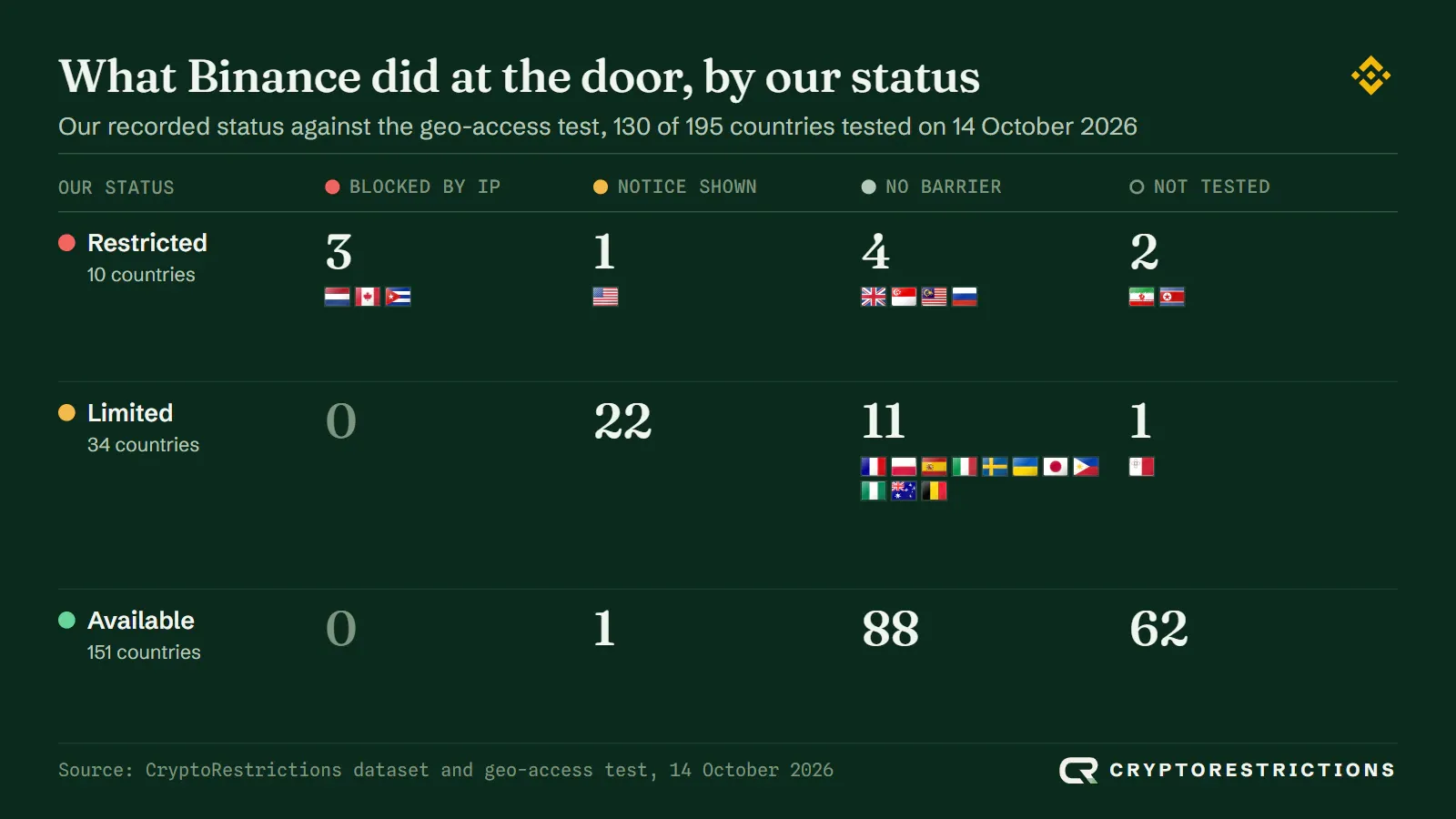
Three patterns stand out. Only three of the ten restricted countries are blocked at the door; the United States gets a prompt to switch to Binance.US, and in the United Kingdom, Singapore, Malaysia and Russia both pages load as if nothing were wrong. Binance applies those restrictions later, at identity verification. In the EEA, 22 of the 34 limited countries see a European regulatory notice on the home page, while 11, including France, Spain, Italy and Poland, saw none, so the notice is not a reliable sign of what an account can do. Among the 151 available countries only New Zealand showed anything, a banner saying some features are not available there.
Iran and North Korea were not tested: our VPN offers no location in either country. The full result for every country, with the exact message where there was one, is below.
All 134 test results, country by country
Binance licences and registrations
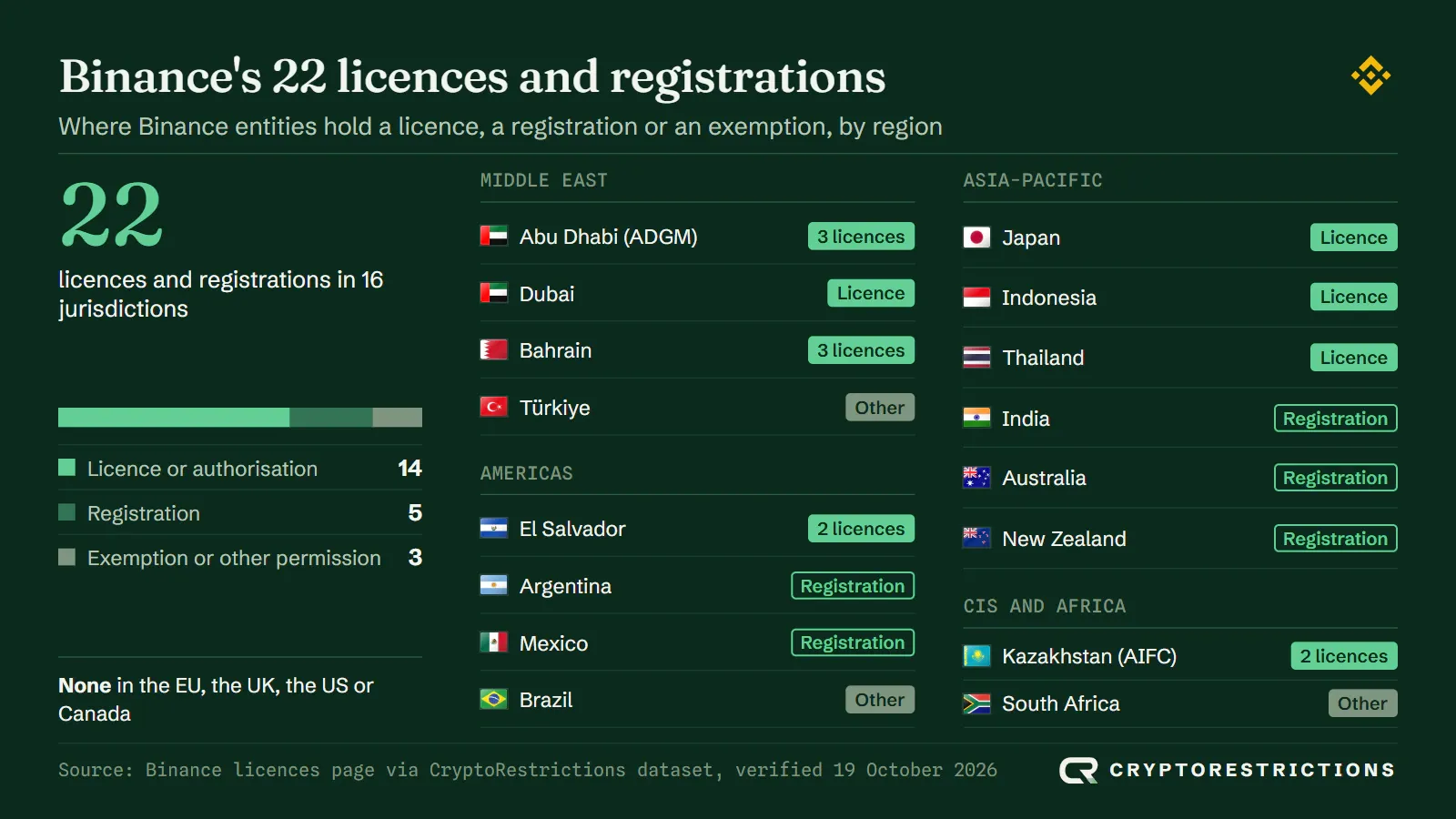
Binance holds 22 licences and registrations in 16 jurisdictions, none of them in the EU, the UK, the US or Canada.
The list comes from Binance’s own licences and registrations page, which names the entity, the regulator and the permission for each, and was last checked against it on 28 September 2026. Fourteen are licences or authorisations to run an exchange, a broker or a custody service. Five are registrations, mostly for anti-money-laundering reporting, which let Binance operate but are not a full licence. The other three are an exemption, a payments licence that does not cover crypto, and a place on Türkiye’s transitional list of providers, which is not an authorisation.
Middle East
- Abu Dhabi (ADGM), United Arab Emirates: three entities regulated by the ADGM Financial Services Regulatory Authority. Nest Exchange Limited is a recognised investment exchange, Nest Clearing and Custody Limited a recognised clearing house and custodian, and Nest Trading Limited is authorised for dealing, arranging deals, managing assets, money services and arranging custody.
- Dubai, United Arab Emirates: Binance FZE holds a VARA licence covering broker-dealer, exchange (including virtual asset derivatives), management and investment, and lending and borrowing services.
- Bahrain: Binance Bahrain BSC(c) is a Category 4 crypto-asset service provider licensed by the Central Bank of Bahrain, and BPay Global BSC(c) holds an ancillary payment services licence.
- Türkiye: Binance Turkey Kripto Varlık Alım Satım Platformu AŞ is on the Capital Markets Board’s transitional list of crypto-asset service providers in operation, which lets it keep operating while it applies; the board says the listing is not an authorisation.
Asia-Pacific
- Japan: Binance Japan Inc. is registered with the Financial Services Agency as a crypto asset exchange service provider.
- Indonesia: PT Aset Digital Berkat (Tokocrypto) holds a Bappebti licence as a physical crypto asset trader, granted on 6 September 2024.
- Thailand: Gulf Binance Co., Ltd., a joint venture with Gulf Edge, holds digital asset exchange and broker licences from the Ministry of Finance, through the Thai SEC.
- India: Nest Exchange Limited is registered with the Financial Intelligence Unit as an offshore reporting entity.
- Australia: InvestbyBit Pty Ltd (Binance Australia) is registered with AUSTRAC as a digital currency exchange provider.
- New Zealand: Investbybit Limited is on the Financial Service Providers Register. Binance notes that this is a registration and does not mean active supervision by a New Zealand regulator.
Americas
- El Salvador: Binance Services Latinoamérica S.A. de C.V. holds digital asset and bitcoin service provider licences from the CNAD and the central bank.
- Argentina: the same entity is registered with the Comisión Nacional de Valores as a virtual asset service provider, since 11 September 2024.
- Mexico: Bmex Techfin is registered with the Tax Administration Service under the anti-money-laundering rules for virtual asset services.
- Brazil: Simpaul Corretora de Câmbio e Valores Mobiliários S.A. is a securities brokerage with an e-money licence, a payments permission rather than a crypto authorisation. Binance says further services depend on Brazil’s crypto rules.
Kazakhstan and Africa
- Kazakhstan: BN KZ Technologies Limited is licensed by the Astana Financial Services Authority to run a digital asset trading facility, provide custody and deal as principal.
- South Africa: Binance RSA operates under an FSCA exemption (FAIS Notice 25 of 2023) for spot products; futures and options run through Binance Bahrain as a juristic representative of a licensed provider.
Binance and MiCA in the EU
Binance has no MiCA licence, so since 1 July 2026 it has stopped opening accounts and taking deposits and trades from users in the EEA, while existing users can still withdraw.
MiCA is the EU’s crypto rulebook, and from 30 December 2024 it required exchanges serving EU clients to hold an authorisation from one member state (our MiCA article covers the rules). Firms already operating under national law could carry on until 1 July 2026 at the latest. ESMA, the EU markets authority, said in a statement of 17 April 2026 that any firm still serving EU clients without a licence after that date is in breach of EU law and must stop.
Binance applied in Greece. On 16 June 2026 it said in an update on its licensing that, as it understood it, the Hellenic Capital Market Commission had finished its review, but no licence had been granted. About a week later it withdrew the Greek application, citing the lack of a formal decision, and said it would apply in another member state. Euronews reported Binance telling French clients that its  France entity would stop providing crypto services from 1 July, and CoinDesk reported the same emails reaching users in Italy, Poland and Spain, along with a Financial Times report that Binance plans to seek authorisation in France.
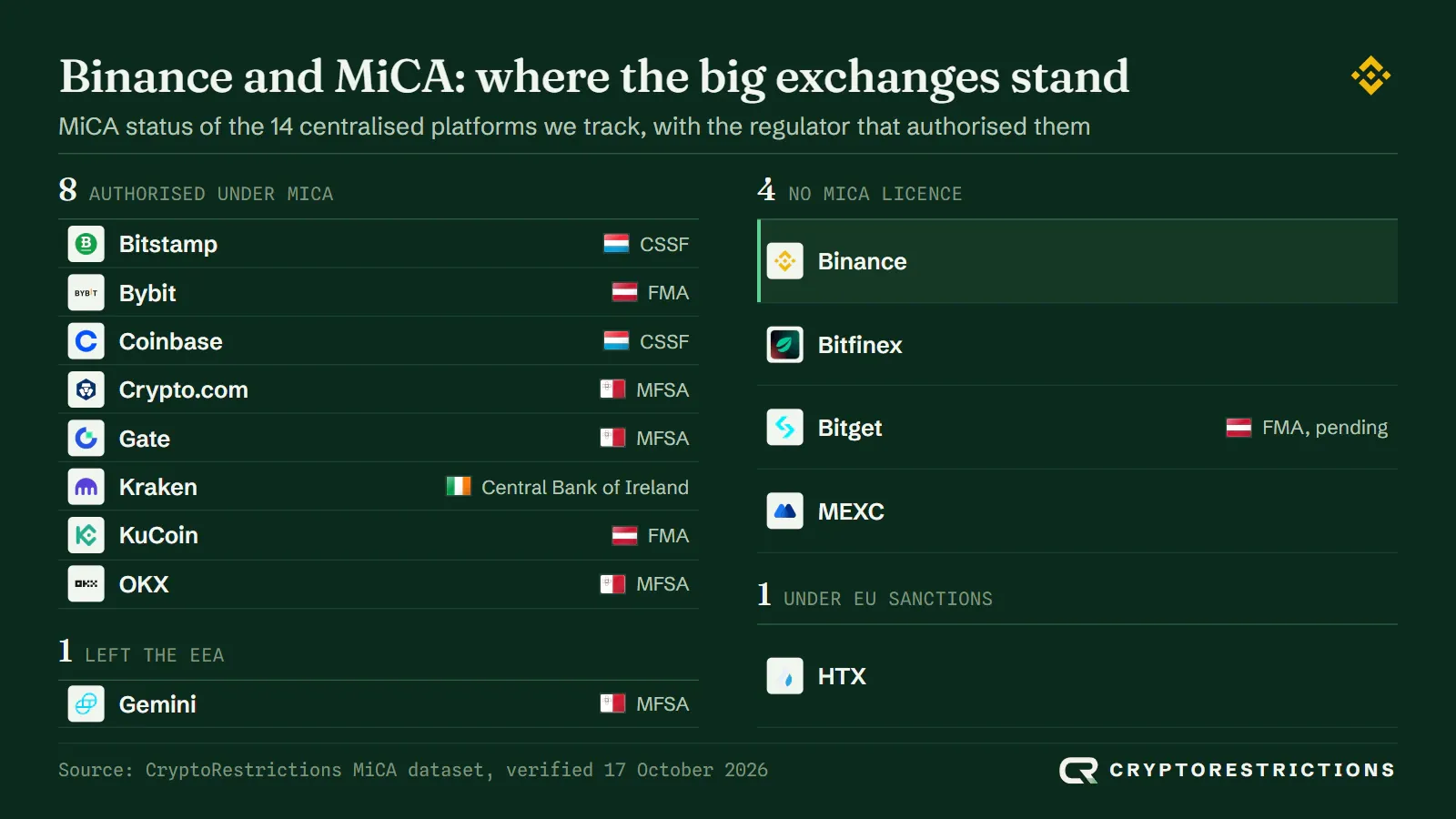
Binance is the largest exchange we track without a MiCA licence. Eight of the 14 centralised platforms in our MiCA dataset are authorised, by regulators in Ireland, Luxembourg,  Malta and Austria, and each authorisation is passported across the EEA. Bitget is the only other one without a licence; its EU entity applied to Austria’s FMA on 2 July 2026, the day after the deadline.

Stablecoins were the first part of Binance’s EEA service to change. Binance’s stablecoin compliance note says EEA users have not been able to buy stablecoins that lack MiCA authorisation through Convert since 30 June 2024, the day MiCA’s stablecoin rules applied, although they could still sell, hold and withdraw them.
Binance MiCA timeline
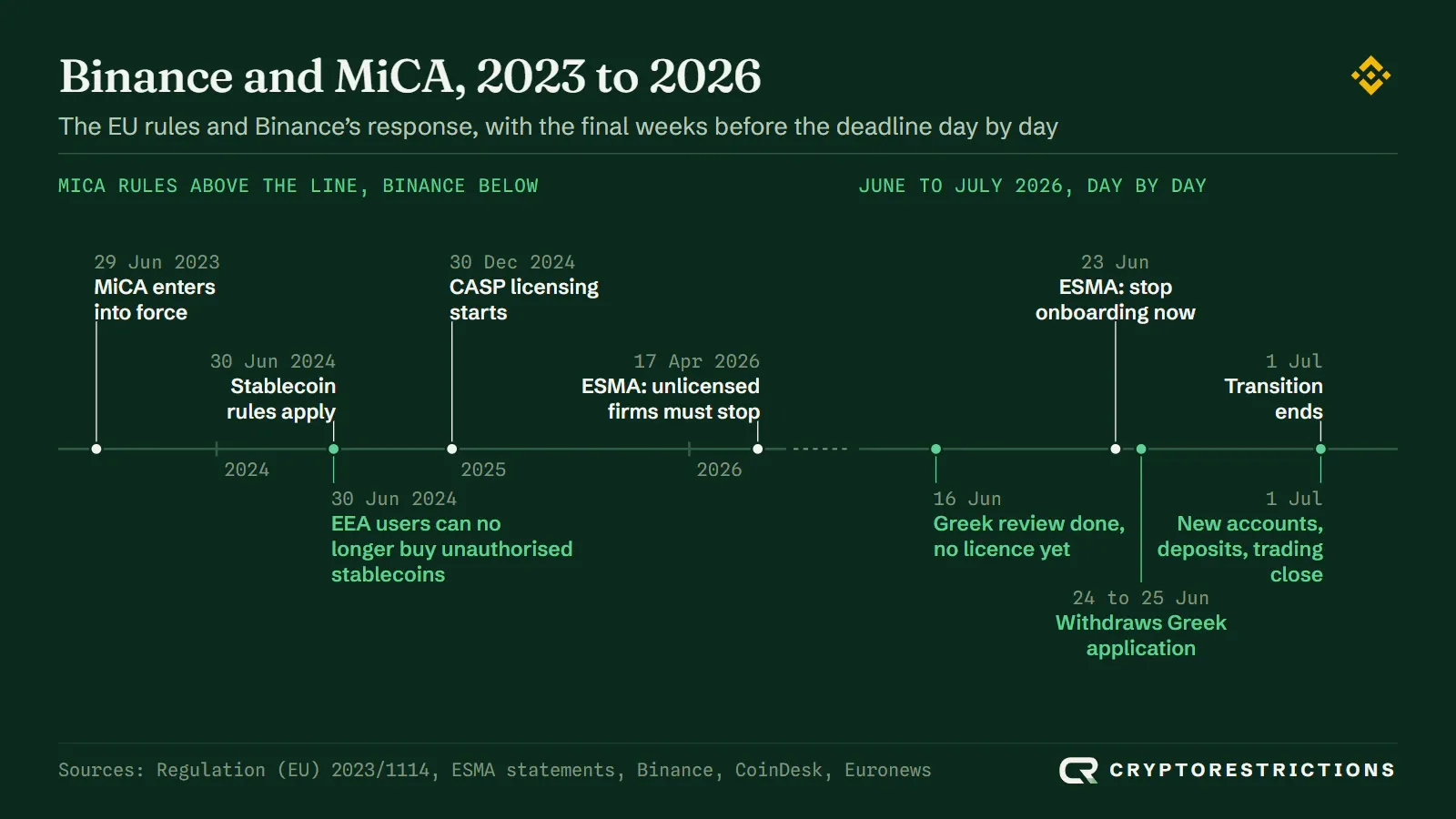
MiCA entered into force on 29 June 2023 but applied in steps: the stablecoin rules on 30 June 2024, and licensing for exchanges and other crypto service providers on 30 December 2024. For Binance the decisive weeks came at the end of the transition. ESMA followed its April warning with a statement on 23 June 2026 telling firms that would miss the deadline to stop onboarding clients and marketing at once, and to limit what remained to what clients need to sell, transfer or close positions.
That matches what Binance did. Between Binance’s 16 June update and the 1 July deadline it withdrew from Greece, wrote to users in France, Italy, Poland, Spain and other EU markets, and closed new accounts, deposits and trading across the EEA. Withdrawals stay open. Until Binance announces where it has reapplied and a regulator grants a licence, we record all 29 EEA countries it still served as limited.
Is Binance available in the US?
No: Binance.com does not serve anyone in the United States, and Americans are sent to Binance.US, a separate exchange that operates in 38 states, Washington DC and Puerto Rico.
Binance’s prohibited countries list names the United States, and as part of its 2023 settlement with FinCEN, Binance gave undertakings to ensure its complete exit from the country. We saw how that works from the outside: when we loaded binance.com from a US address on 14 October 2026, the page did not block us, it asked us to switch to Binance.US. Binance.US is run by BAM Trading Services, and its terms of use say BAM and Binance Holdings share majority owners but are separate companies, with BAM using Binance technology under a licensing agreement.
Where does Binance.US work?
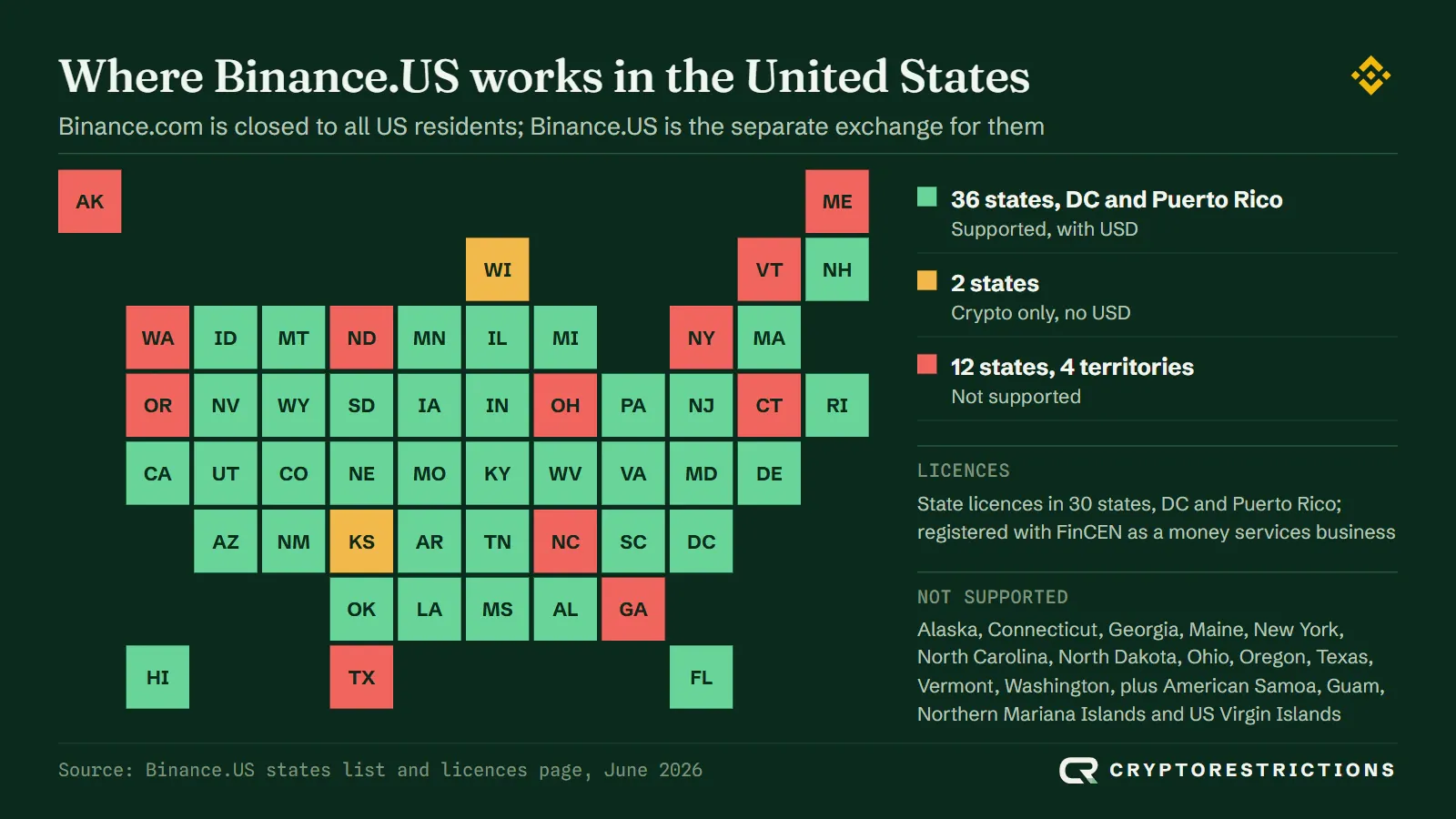
Binance.US’s state list (updated 3 June 2026) names 16 places it does not serve:
- States: Alaska, Connecticut, Georgia, Maine, New York, North Carolina, North Dakota, Ohio, Oregon, Texas, Vermont and Washington.
- Territories: American Samoa, Guam, the Northern Mariana Islands and the US Virgin Islands.
In two more states, Kansas and Wisconsin, Binance.US runs as a crypto-only exchange, with no US dollar deposits or withdrawals. Its licences page lists state licences in 30 states, DC and Puerto Rico, and a federal registration with FinCEN as a money services business; it notes that some of those state licences do not cover virtual currency.
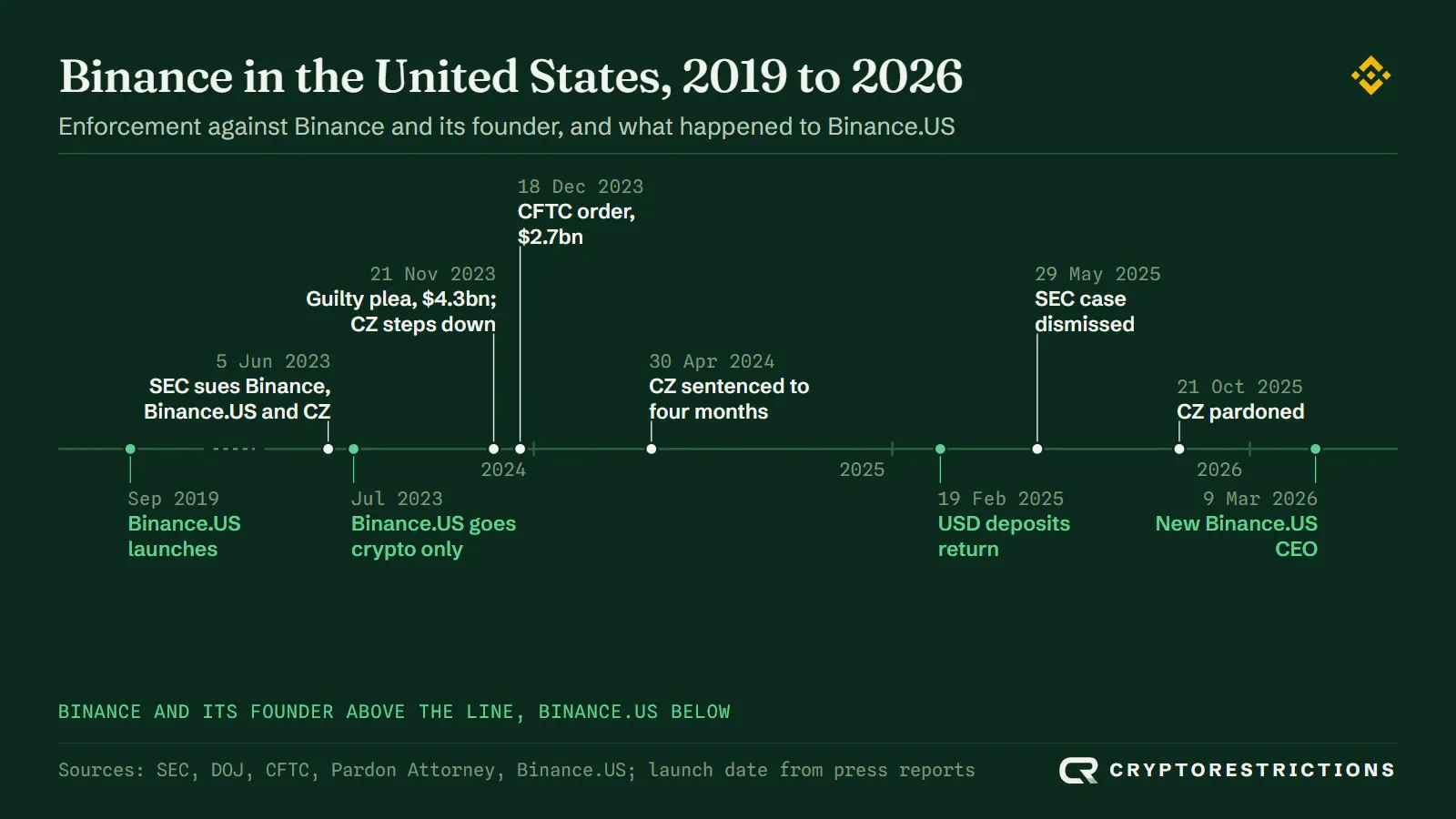
The whole exchange was crypto only from July 2023, after the SEC sued, until US dollar deposits and withdrawals by bank transfer came back on 19 February 2025. Stephen Gregory became chief executive on 9 March 2026, according to a Binance.US leadership update.
Binance’s US fines and guilty plea
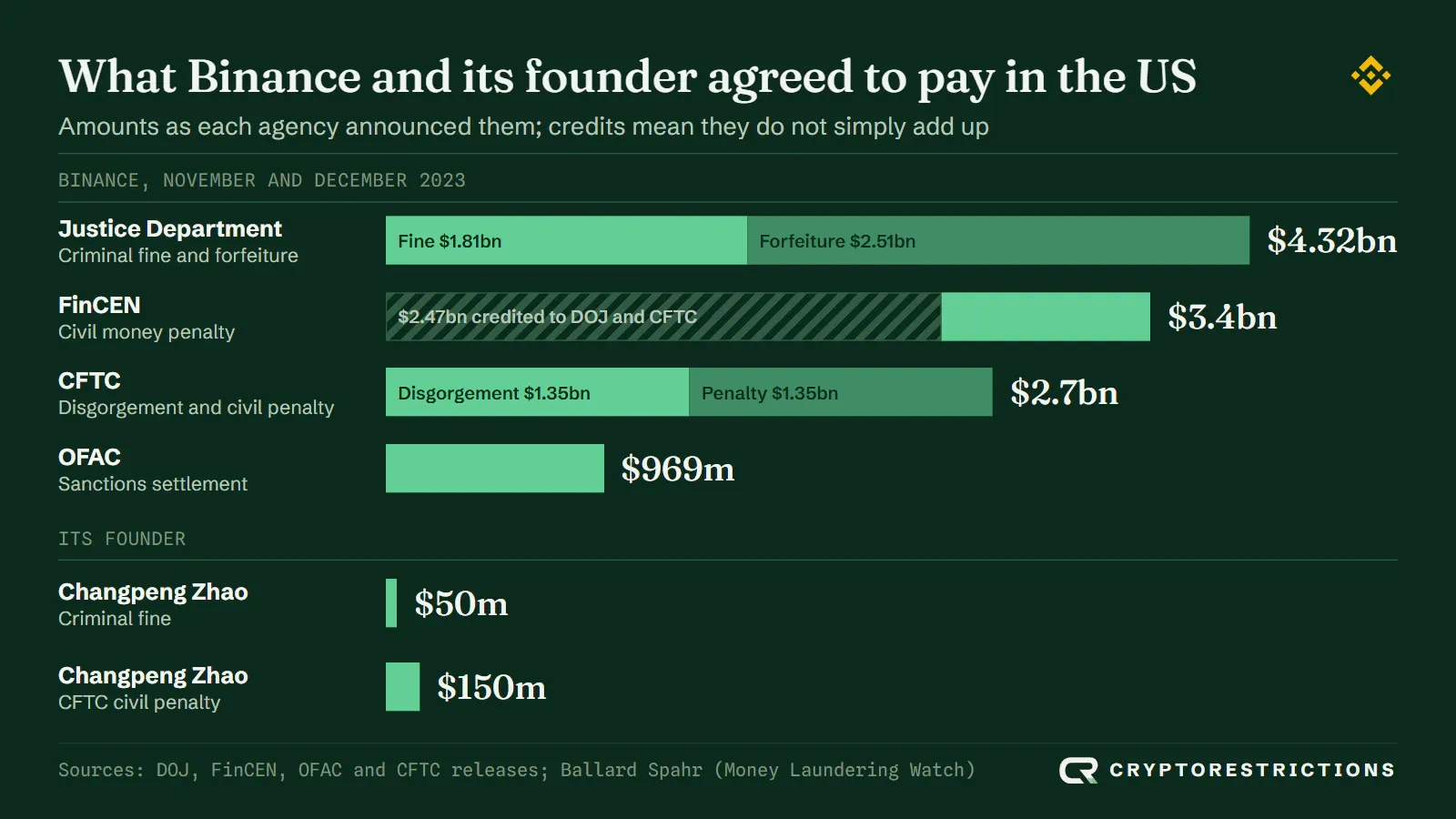
On 21 November 2023 Binance pleaded guilty to conspiring to violate the Bank Secrecy Act, failing to register as a money transmitting business and violating US sanctions law (IEEPA), and agreed to pay $4.3 billion, according to the Justice Department’s case page. The same day FinCEN assessed a $3.4 billion civil money penalty with a five-year monitorship, and OFAC settled for $968.6 million over 1,667,153 apparent sanctions violations. The CFTC followed on 18 December 2023 with a $2.7 billion order, half disgorgement of fees and half civil penalty.
The amounts overlap. A Ballard Spahr analysis notes that FinCEN credited $2.47 billion of its penalty against payments to the DOJ and CFTC, and that most of the CFTC amount is covered by the other payments, while the OFAC settlement comes on top.
The SEC had sued Binance, Binance.US and Zhao separately on 5 June 2023, alleging unregistered exchanges, brokers and clearing agencies and at least $11.6 billion in revenue. That case ended on 29 May 2025, when both sides agreed to dismiss it with prejudice.
Changpeng Zhao: plea, prison and pardon
Binance’s founder pleaded guilty the same day as the company, to failing to maintain an effective anti-money-laundering program, and stepped down as chief executive; Binance named Richard Teng in his place. On 30 April 2024 he was sentenced to four months in prison and a $50 million fine, on top of the $150 million he agreed to pay the CFTC. The Justice Department’s record of presidential pardons lists a pardon for him dated 21 October 2025.
The pardon applies to Zhao’s conviction, not to Binance’s access: its terms still exclude US users, and the restriction recorded on this page stands.
Binance in the US: timeline
Binance KYC and identity verification
Binance requires every new user to pass one level of identity verification, called Verified, before depositing or trading, and it publishes no fixed limits for that level: each account sees its own limits on its Identification page.
Binance’s verification page (updated 5 June 2026) sets out the flow. You choose your country of residence, the country that issued your document and the document type, upload photos of the front and back of the ID, pass a liveness check and confirm personal details that match the ID, which cannot be changed afterwards. Binance says it usually reviews documents within 48 hours.
The EEA flow asks for more. Binance’s EEA verification guide (updated 12 March 2026) adds a residential address and a set of compliance questions, and its re-verification page (13 March 2026) told existing EEA users to verify again after Binance raised its standards to the EU’s anti-money-laundering rules. Anyone who verified before the change, never gave a proof of address or the enhanced due diligence answers, or used the old ID vendor had to redo it. Since 1 July 2026 Binance no longer opens new EEA accounts, so this flow now matters mainly to existing users.
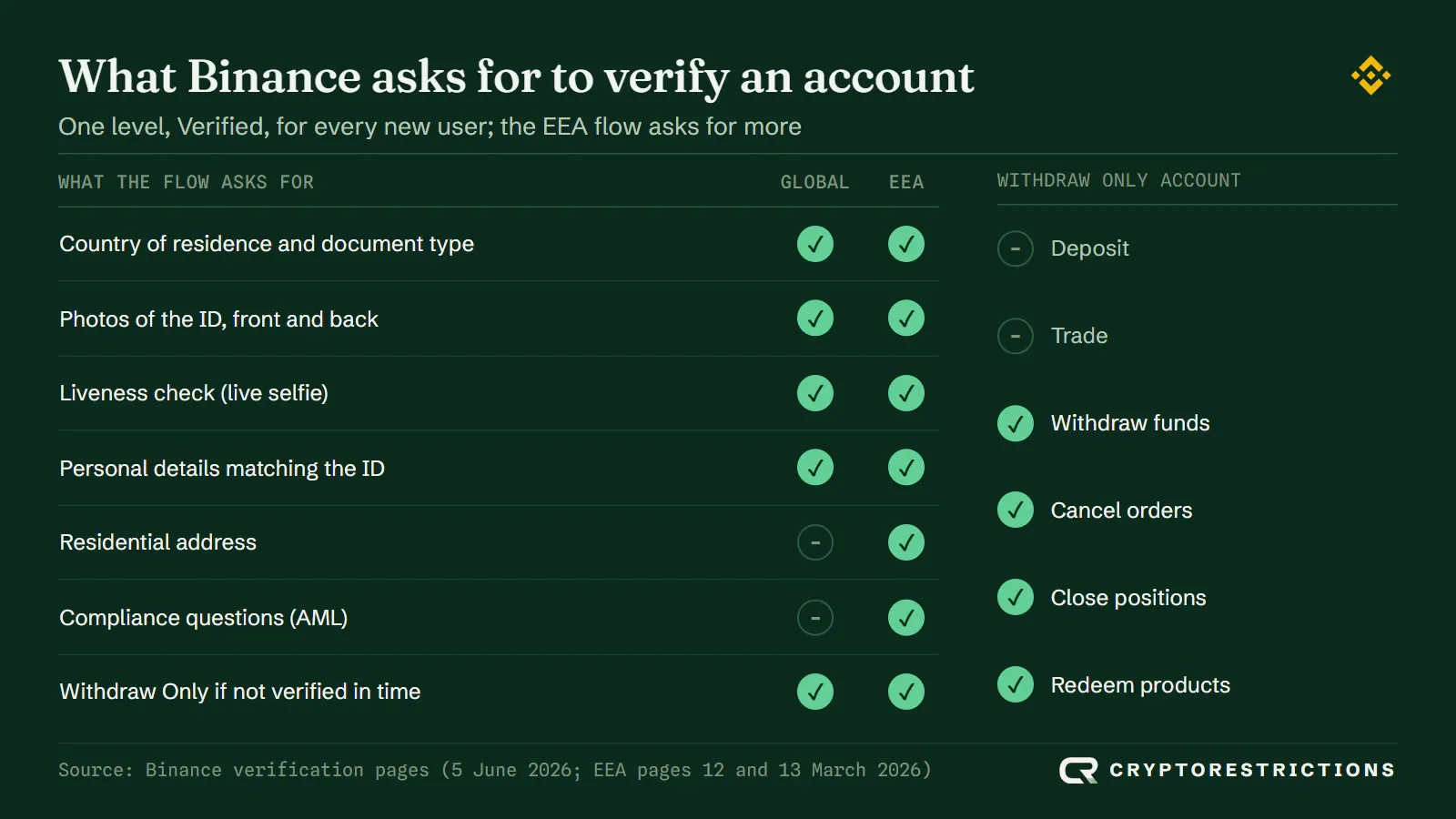
Missing verification does not lock the money in. An existing account that has not completed Verified, or an EEA account that misses its re-verification deadline, is switched to Withdraw Only: it can withdraw funds, cancel orders, close positions and redeem products, but cannot deposit or trade.
Binance verification levels and limits
Binance used to publish limits by level. In July 2021 it announced that accounts with only basic verification would have their daily withdrawals cut from 2 BTC to 0.06 BTC, while fully verified accounts could withdraw up to 100 BTC a day, Decrypt reported. A month later, on 20 August 2021, it made its intermediate level, a government ID plus facial verification, mandatory for every user, with unverified existing accounts moved to withdrawal only by 19 October 2021.
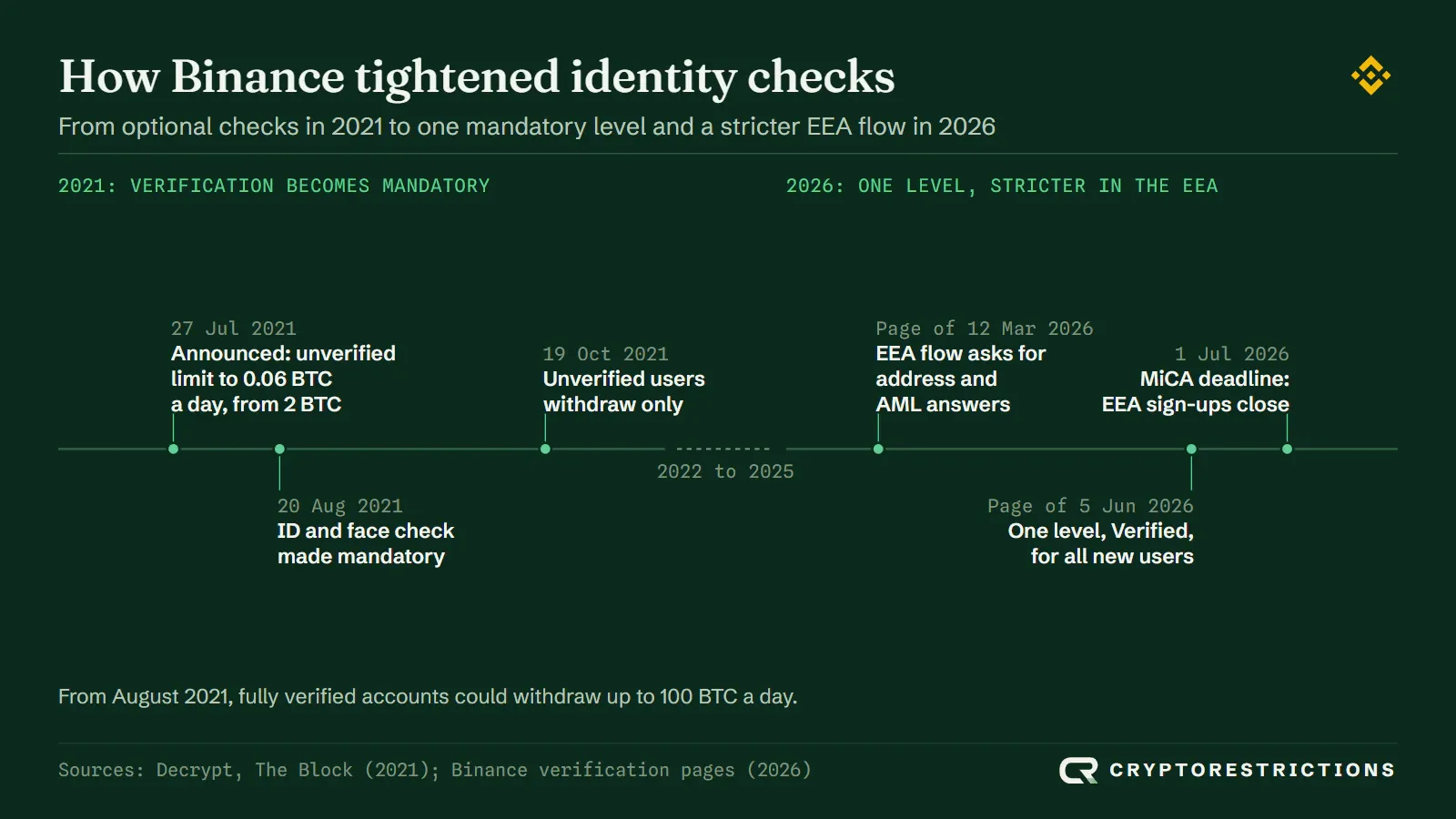
Today’s pages name a single level and no amounts. Tables of higher tiers and fiat limits still circulate on third-party sites, but they do not appear on Binance’s current pages and vary by source, so we do not repeat them. For how Binance’s checks compare with Coinbase and Kraken, see our guide to crypto exchange KYC.
What if Binance is restricted where you live?
It depends on the country: of the 21 other platforms we track, 13 are available in Malaysia and 11 in the Netherlands, but only one, KuCoin, in Cuba, Iran and North Korea, where Bitstamp is limited.
Getting around the block is not an option either. Binance’s terms of use forbid using a VPN or any other tool to get past a geographic restriction, and the restrictions above are enforced at identity verification, where a VPN does not help. What is left is a platform that is allowed to serve you where you live.
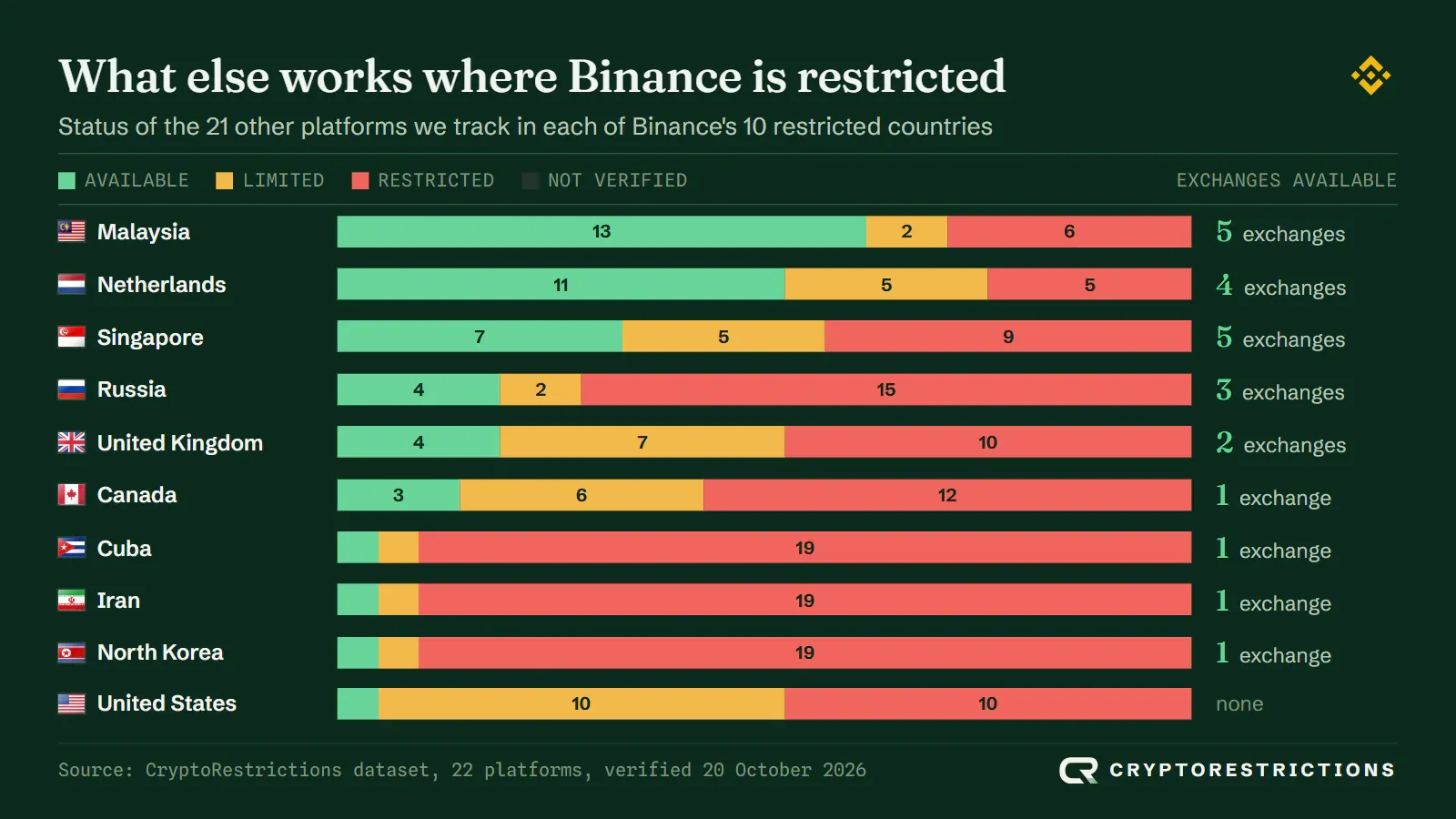
The chart shows how much choice each restricted country has. Malaysia and the Netherlands keep 11 or more open platforms, Singapore seven and the United Kingdom four, with two to five centralised exchanges each. In the United States the only open option is one DeFi protocol, Uniswap, while Coinbase is limited by product cuts in some states, alongside the separate Binance.US covered above. In Russia four exchanges are recorded as available under our coverage rule, Bitfinex, Bybit, Coinbase and KuCoin, and in Cuba, Iran and North Korea only KuCoin is.

For a country-by-country comparison of what to use instead, with residency rules, licences and products side by side, see our guide to Binance alternatives by country.