
Is crypto legal in Malta?
Yes. Individuals may buy, hold and trade crypto. Since 3 July 2026 the only licence is a MiCA authorisation from the Malta Financial Services Authority (MFSA) or another EU regulator.
Malta’s first regime was the Virtual Financial Assets Act (Cap. 590). The EU’s Markets in Crypto-Assets Regulation (MiCA) replaced it, and Malta’s implementing law is the Markets in Crypto-Assets Act (Cap. 647), enacted as Act XXXVI of 2024. Firms licensed under the old Act could keep operating while they applied. In a letter of 25 June 2026 the MFSA and the Financial Intelligence Analysis Unit (FIAU) said those transitional measures expire on 30 June 2026, that from 1 July clients of such firms no longer have MiCA safeguards, and that firms without authorisation must begin an orderly wind-down.
Legislation Malta now shows the Virtual Financial Assets Act as not in force, repealed by Act XXXVI of 2024, with a withdrawal date of 3 July 2026. ESMA’s statement of 23 June 2026 set the same line EU-wide: firms without a MiCA licence must wind down once the transition ends.
Which crypto exchanges work in Malta?
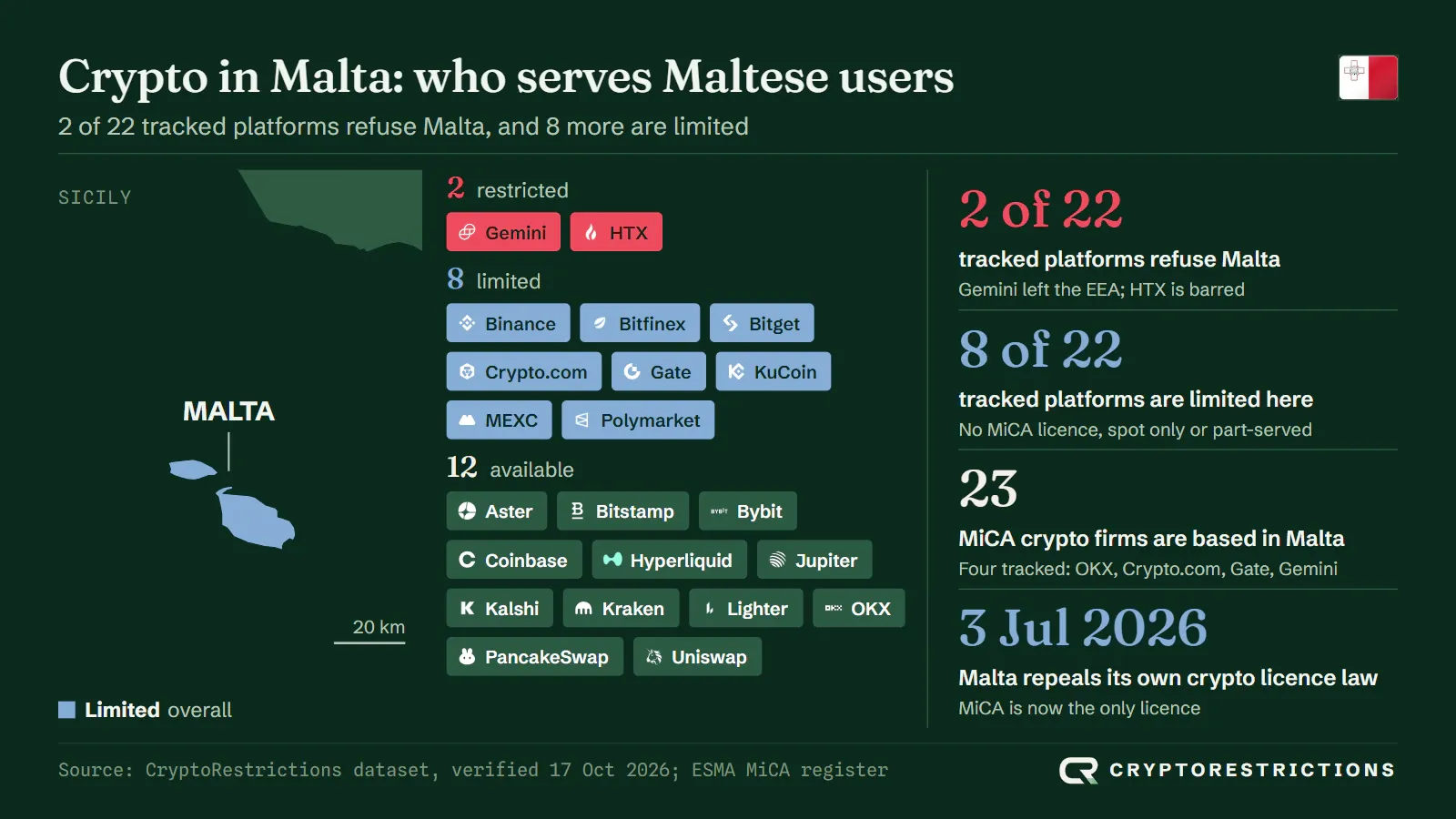
Six of the exchanges we track serve Maltese users under a MiCA licence: OKX, Crypto.com and Gate, licensed by the MFSA itself, and Kraken, Coinbase and Bitstamp on passports from Ireland and Luxembourg. Four are fully available; Crypto.com and Gate are limited.
The register is ESMA’s interim MiCA list, which names 23 firms with Malta as their home state. The first authorisations came on 27 January 2025: OKX and Crypto.com (as Foris DAX MT Limited), alongside Bitpanda’s Maltese company. Gate followed on 29 September 2025, and seven more firms were listed between 23 and 30 June 2026, just before the transition ended. Other names on the Maltese list include Blockchain.com, Strike, FalconX and BVNK.
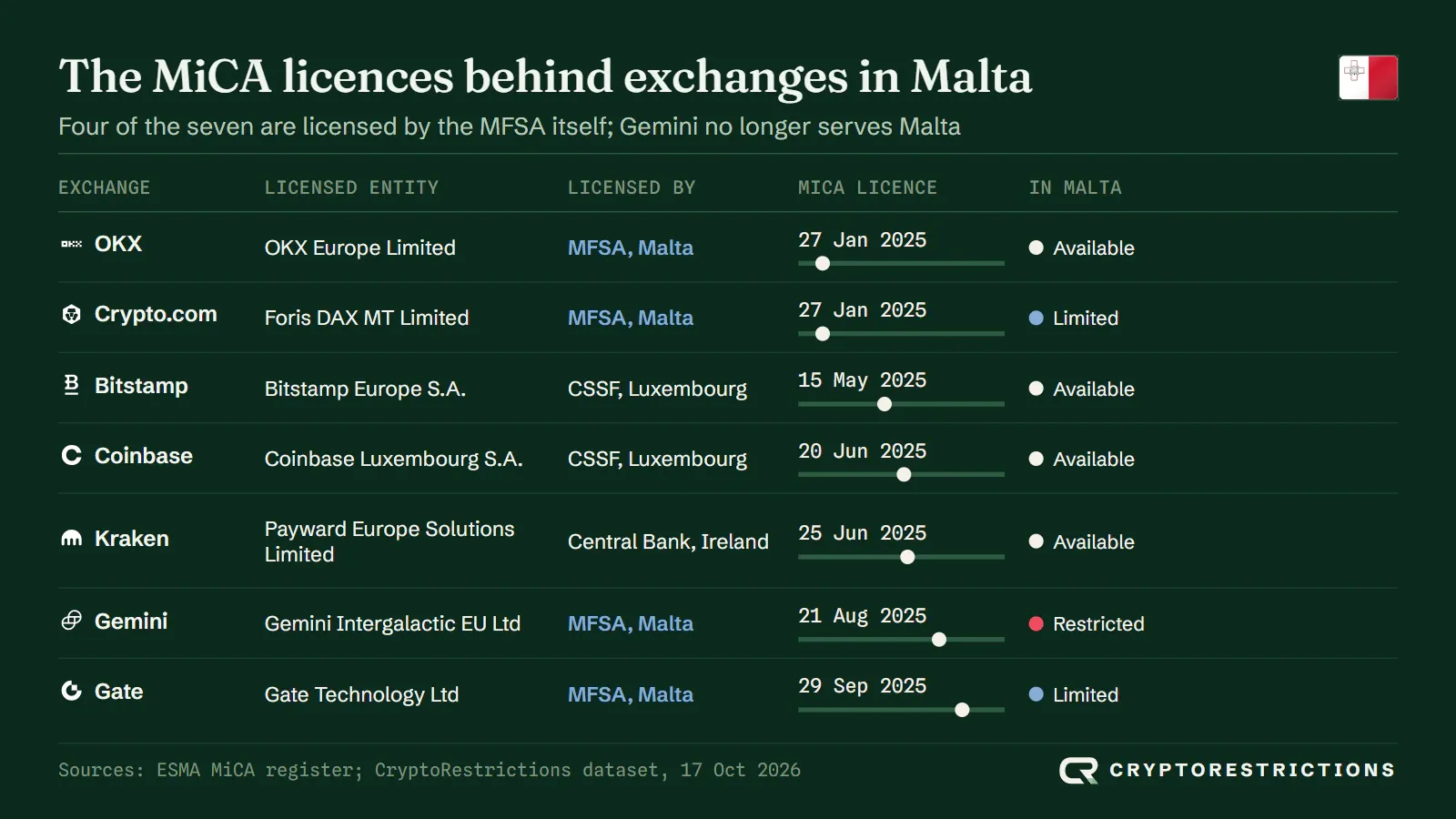
Gemini also holds a Maltese licence, as Gemini Intergalactic EU Ltd, dated 21 August 2025, but it closed every UK, EEA and Australian account on 6 April 2026, so the licence is unused. Kraken reaches Malta from Ireland, Coinbase from Luxembourg and Bitstamp from Luxembourg. The register has no Maltese company for Binance, MEXC, Bitget, Bitfinex or HTX.

Best crypto platforms for Maltese residents
By our access score, OKX (9.5 out of 10) is the most open exchange for Maltese users, ahead of Bitstamp, Bybit, Coinbase and Kraken (7.5 each). Kalshi (7.5) leads the prediction markets, and the six DeFi platforms we track tie at 7.5.
The score rates how fully a Maltese resident can use each platform, not its fees or safety. It is computed from our data and moves when a row changes: access status (4 points), the share of the platform’s products open here (3), the licences we hold on file for Malta (2) and a geo-access test from Malta (1), which we have not yet run, so every platform gets the half point for an untested country. Platforms that refuse Maltese users are not scored. The full method is on our methodology page.
Exchanges

OKX
Best for An exchange licensed in Malta itself
9.5/10- Access
- 4/4
- Products
- 3/3
- Licences
- 2/2
- Our test
- 0.5/1
Read our OKX reportPros
- OKX Europe Limited holds an MFSA MiCA licence from 27 January 2025, passported to 29 other EEA states
- A second Maltese company, OKX Europe Markets Limited, carries its MiFID licence
Cons
- Perpetuals and options run under the MiFID entity, not the MiCA licence

Bitstamp
Best for Spot trading from a long-running EU licence
7.5/10- Access
- 4/4
- Products
- 3/3
- Licences
- 0/2
- Our test
- 0.5/1
Read our Bitstamp reportPros
- Bitstamp Europe S.A. holds a CSSF MiCA licence from May 2025
Cons
- Served from Luxembourg, with no Maltese entity

Bybit
Best for Derivatives from a global platform
7.5/10- Access
- 4/4
- Products
- 3/3
- Licences
- 0/2
- Our test
- 0.5/1
Read our Bybit reportPros
- Bybit's global platform does not exclude Malta
Cons
- Bybit EU is not passported to Malta, so residents have no EU-licensed Bybit option
- No Maltese or EU licence behind the service

Coinbase
Best for A MiCA-licensed exchange with the widest reach
7.5/10- Access
- 4/4
- Products
- 3/3
- Licences
- 0/2
- Our test
- 0.5/1
Read our Coinbase reportPros
- Coinbase Luxembourg S.A. holds a CSSF MiCA licence passported to all 30 EEA states
Cons
- Served from Luxembourg, with no Maltese entity

Kraken
Best for A MiCA licence from the Central Bank of Ireland
7.5/10- Access
- 4/4
- Products
- 3/3
- Licences
- 0/2
- Our test
- 0.5/1
Read our Kraken reportPros
- Payward Europe Solutions holds an Irish MiCA licence, passported across the EEA
- Available in Malta with no carve-outs in our data
Cons
- Served from Ireland, with no Maltese entity

Gate
Best for Spot trading on a Maltese-licensed arm
6.5/10- Access
- 3.5/4
- Products
- 1.5/3
- Licences
- 1/2
- Our test
- 0.5/1
Read our Gate reportPros
- Gate Technology Ltd holds an MFSA MiCA licence from 29 September 2025
- Spot trading is served here by Gate EU
Cons
- No derivatives: Gate EU offers none, and global Gate lists Malta as restricted

Crypto.com
Best for An app from a Maltese-licensed company
5.3/10- Access
- 3/4
- Products
- 0.8/3
- Licences
- 1/2
- Our test
- 0.5/1
Read our Crypto.com reportPros
- Foris DAX MT Limited holds an MFSA MiCA licence from 27 January 2025
- Foris MT Limited, a Maltese e-money institution, is listed for its Visa card
Cons
- Malta is on the Exchange's spot and derivatives geo-restriction lists
Prediction markets

Kalshi
Best for A regulated US exchange that does not exclude Malta
7.5/10- Access
- 4/4
- Products
- 3/3
- Licences
- 0/2
- Our test
- 0.5/1
Read our Kalshi reportPros
- Malta is not on Kalshi's restricted-jurisdictions list
Cons
- No licence from the Malta Gaming Authority on file
- Malta has no dedicated prediction-market licence yet

Polymarket
Best for Non-sports markets
5.8/10- Access
- 3/4
- Products
- 2.3/3
- Licences
- 0/2
- Our test
- 0.5/1
Read our Polymarket reportPros
- Markets other than sports stay open to users in Malta
Cons
- Sports markets are close-only under its geoblock documentation
- Its help page lists Malta without that qualifier
DeFi

Aster
Best for Perpetual futures on several chains
7.5/10- Access
- 4/4
- Products
- 3/3
- Licences
- 0/2
- Our test
- 0.5/1
Read our Aster reportPros
- Malta is not on its prohibited-jurisdictions list
Cons
- No licence on file for Malta

Hyperliquid
Best for Perpetual futures from your own wallet
7.5/10- Access
- 4/4
- Products
- 3/3
- Licences
- 0/2
- Our test
- 0.5/1
Read our Hyperliquid reportPros
- Excludes only the US, Ontario and broadly sanctioned places
Cons
- No licence on file for Malta

Jupiter
Best for Solana swaps
7.5/10- Access
- 4/4
- Products
- 3/3
- Licences
- 0/2
- Our test
- 0.5/1
Read our Jupiter reportPros
- Malta is not in its terms
Cons
- No licence on file for Malta

Lighter
Best for Perpetual futures on an order-book DEX
7.5/10- Access
- 4/4
- Products
- 3/3
- Licences
- 0/2
- Our test
- 0.5/1
Read our Lighter reportPros
- Malta is not named in its terms
Cons
- No licence on file for Malta

PancakeSwap
Best for BNB Chain swaps and pools
7.5/10- Access
- 4/4
- Products
- 3/3
- Licences
- 0/2
- Our test
- 0.5/1
Read our PancakeSwap reportPros
- Its terms bar only persons and places under US sanctions
Cons
- No licence on file for Malta

Uniswap
Best for Swapping tokens from your own wallet
7.5/10- Access
- 4/4
- Products
- 3/3
- Licences
- 0/2
- Our test
- 0.5/1
Read our Uniswap reportPros
- Its terms bar only places under comprehensive US sanctions
Cons
- No licence on file for Malta
Which platforms block Maltese users?
Two of the 22 platforms we track refuse Maltese users: Gemini and HTX. Eight more are limited, because they have no working MiCA licence here or serve only part of their product: Binance, KuCoin, MEXC, Bitget, Bitfinex, Crypto.com, Gate and Polymarket.
Most limits trace to MiCA. Gemini closed every account in the UK, the EEA and Australia on 6 April 2026. Binance has had no MiCA authorisation since 1 July 2026, closing sign-ups, deposits and trading while existing users can withdraw. HTX’s terms bar every EU state, and since 23 August 2026 EU sanctions on Russia-linked providers ban dealings with it, under Regulation (EU) 2026/1848.
Malta also falls through two MiCA passports. Bybit EU is not passported here, and KuCoin EU’s licence covers the EEA excluding Malta. Bybit therefore keeps Maltese users on its global platform, while KuCoin Global no longer takes new EEA users.
Who regulates crypto in Malta?
The MFSA authorises and supervises crypto firms under MiCA, the FIAU supervises their anti-money-laundering controls, the Malta Gaming Authority (MGA) is the likely home for prediction markets, and the tax administration receives the EU’s DAC8 crypto reports.
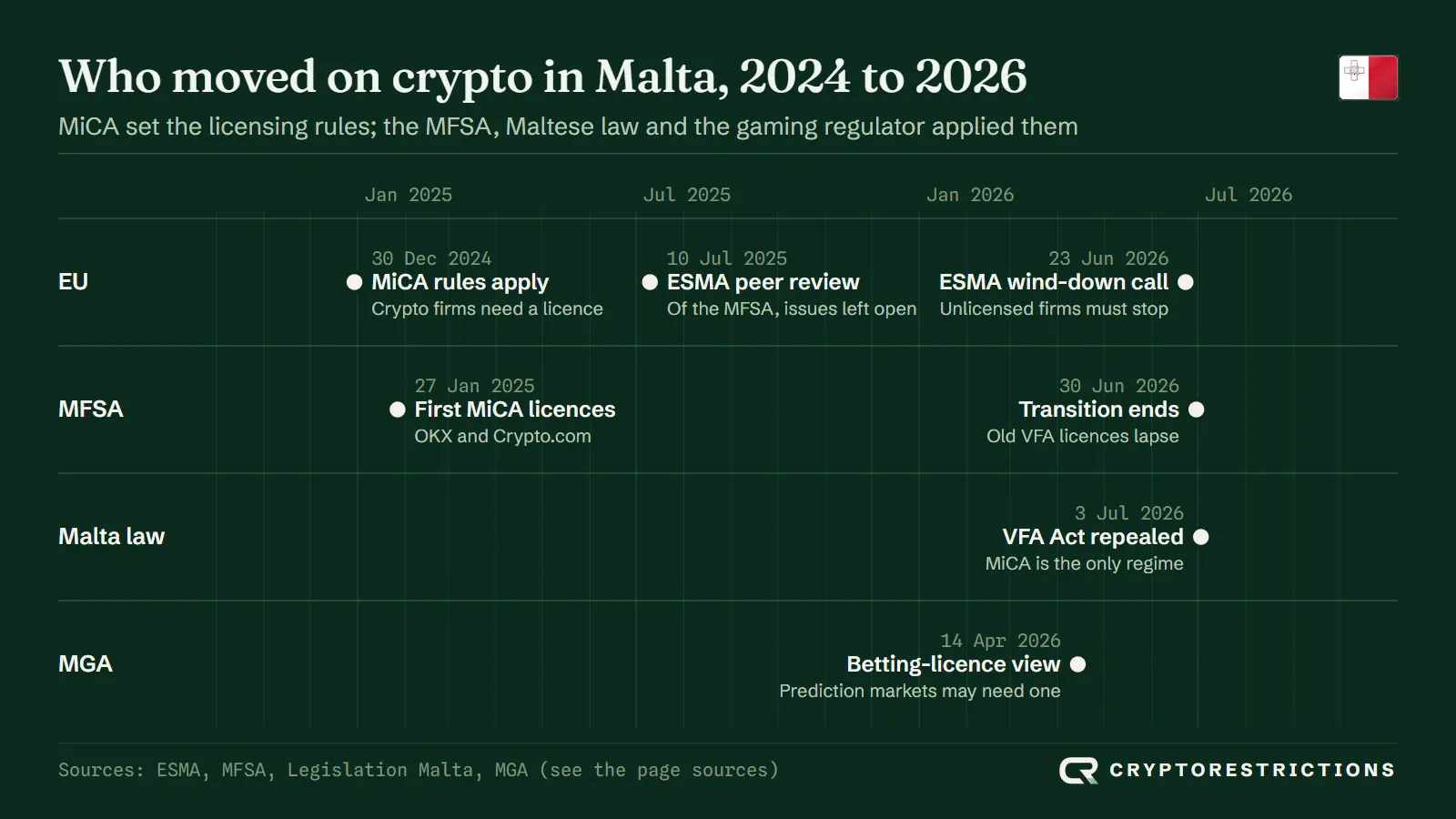
- MFSA. The competent authority under the Markets in Crypto-Assets Act. ESMA’s peer review of 10 July 2025 looked at one MFSA authorisation of a crypto-asset service provider. It found some material issues were not fully resolved when the MFSA granted it and some risk areas were not adequately assessed, while noting a good level of expertise and supervisory cooperation.
- FIAU. The anti-money-laundering supervisor, and co-signatory of the MFSA’s transition letter of 25 June 2026.
- MGA. Licenses gaming and betting. Its stance on prediction markets is covered below.
- Malta Tax and Customs Administration. Successor to the Commissioner for Revenue, which issued Malta’s crypto tax guidelines in 2018, and the recipient of DAC8 reports.
Which crypto products are limited in Malta?
Spot trading is the open product. Derivatives are the narrowest, because the Maltese-licensed exchanges either carve them out or run them through a separate licence, and Crypto.com’s Exchange lists Malta as restricted for both spot and derivatives.
- Derivatives. Gate EU offers none, and global Gate lists Malta as restricted. OKX runs perpetuals and options through OKX Europe Markets Limited, a separate MiFID investment firm with registration number OEML-15905, not under its MiCA licence. Malta is on Crypto.com’s derivatives geo-restrictions list.
- Spot at Crypto.com. Malta also appears on the Exchange’s spot geo-restrictions list, even though its MiCA company, Foris DAX MT Limited, is based here. Both pages were updated on 7 May 2025.
- Bybit. Bybit EU, the licensed arm, is not passported to Malta, so Maltese users stay on Bybit’s global platform, outside any EU licence.
Are prediction markets legal in Malta?
Not under a dedicated law yet. The MGA has said prediction markets may need a betting licence, the government says it is exploring a framework, and we found no enforcement action against Polymarket or Kalshi.
An MGA spokesperson said on 14 April 2026 that such products may fall within a Type 2 (fixed-odds) or Type 3 (exchange) betting licence. BDO Malta reports that Economy Minister Silvio Schembri said in March 2026 that Malta was exploring a statutory framework, and that Prime Minister Robert Abela proposed in May that the MGA license and oversee them. Both accounts are secondary: we found no enacted law, no dedicated licence and no MGA or MFSA warning naming a prediction market.
In our data Kalshi is available, because Malta is not on its restricted list. Polymarket is limited: its geoblock documentation lists Malta for sports only, so sports markets are close-only while others stay open, although its help page lists Malta without that qualifier.
How is crypto taxed in Malta?
Malta has no crypto-specific tax. Trading or mining profit is income, taxed at 0% to 35% for residents, while coins held as an investment fall outside capital gains tax. The rules come from guidelines, and we could read them only through advisers’ summaries.
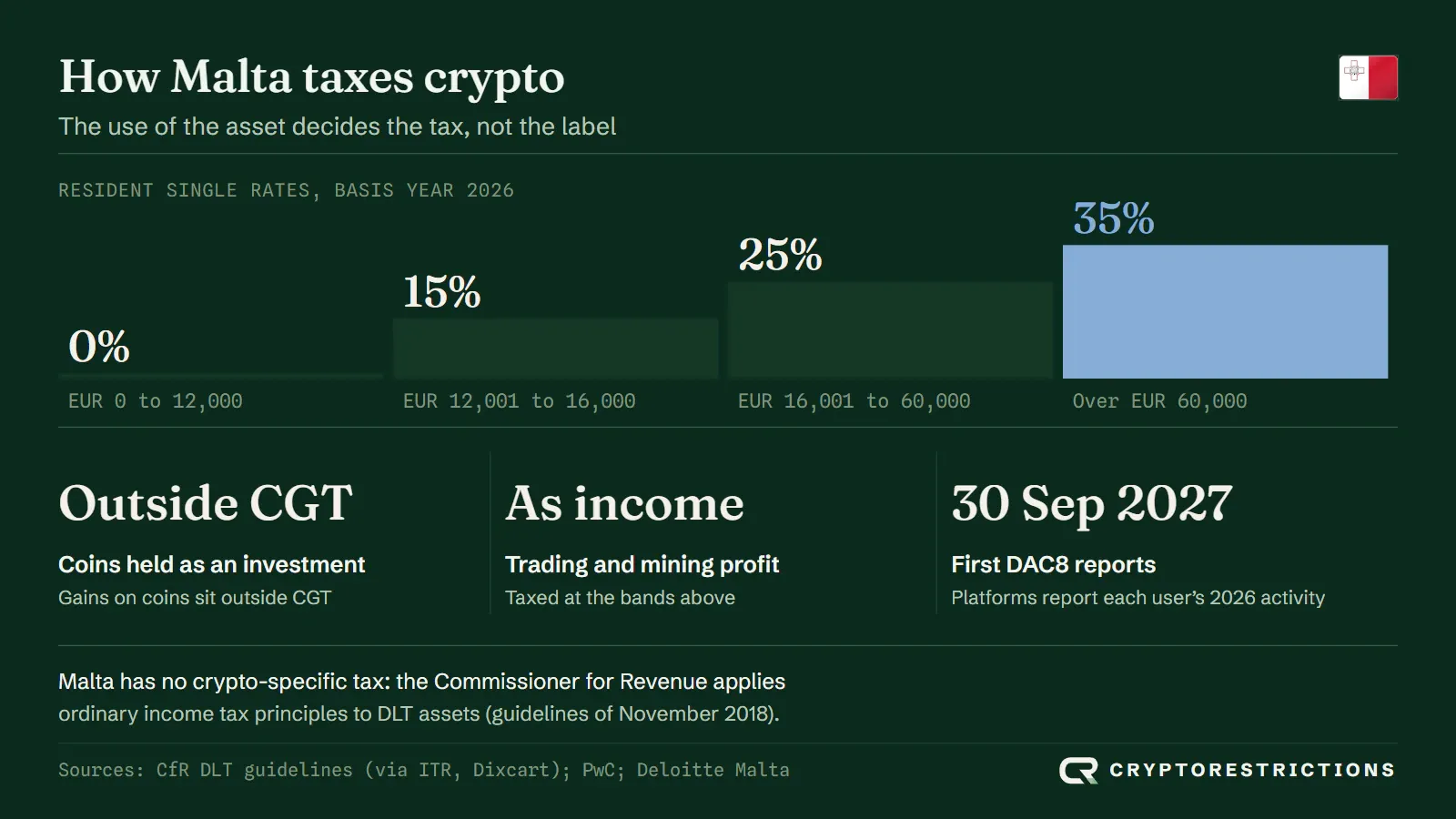
The Commissioner for Revenue published its guidelines on distributed ledger assets in November 2018, and its site refused our automated reads on 18 October 2026, so this section rests on secondary sources. International Tax Review reports that the tax treatment depends on the purpose and context in which the asset is used, not its label. Dixcart says DLT coins fall outside capital gains tax, while trading profit, trading stock and revenue-account mining are taxed as income. The two advisers differ on whether disposals of financial tokens fall under capital gains, so treat that case as open.
For a single resident in basis year 2026, PwC lists 0% up to EUR 12,000, 15% to EUR 16,000, 25% to EUR 60,000 and 35% above. Crypto paid as salary is taxable under general principles, and Dixcart says it is valued at an official rate or the average exchange price that day. Using crypto only as a means of payment is exempt from VAT, according to International Tax Review.
Reporting is changing. Deloitte Malta says Legal Notice 162 of 2026 transposes the EU’s DAC8 rules and is deemed in force from 1 January 2026. Authorised crypto-asset service providers must file their first reports by 30 September 2027. We found no crypto-specific box on the individual tax return, and no new Commissioner guidance since 2018.


 Serbia
 Turkey
 Switzerland
 Iceland
 Liechtenstein
 Norway
 Croatia
 Estonia
 Finland
 Greece
 Latvia