

Is crypto legal in Switzerland?
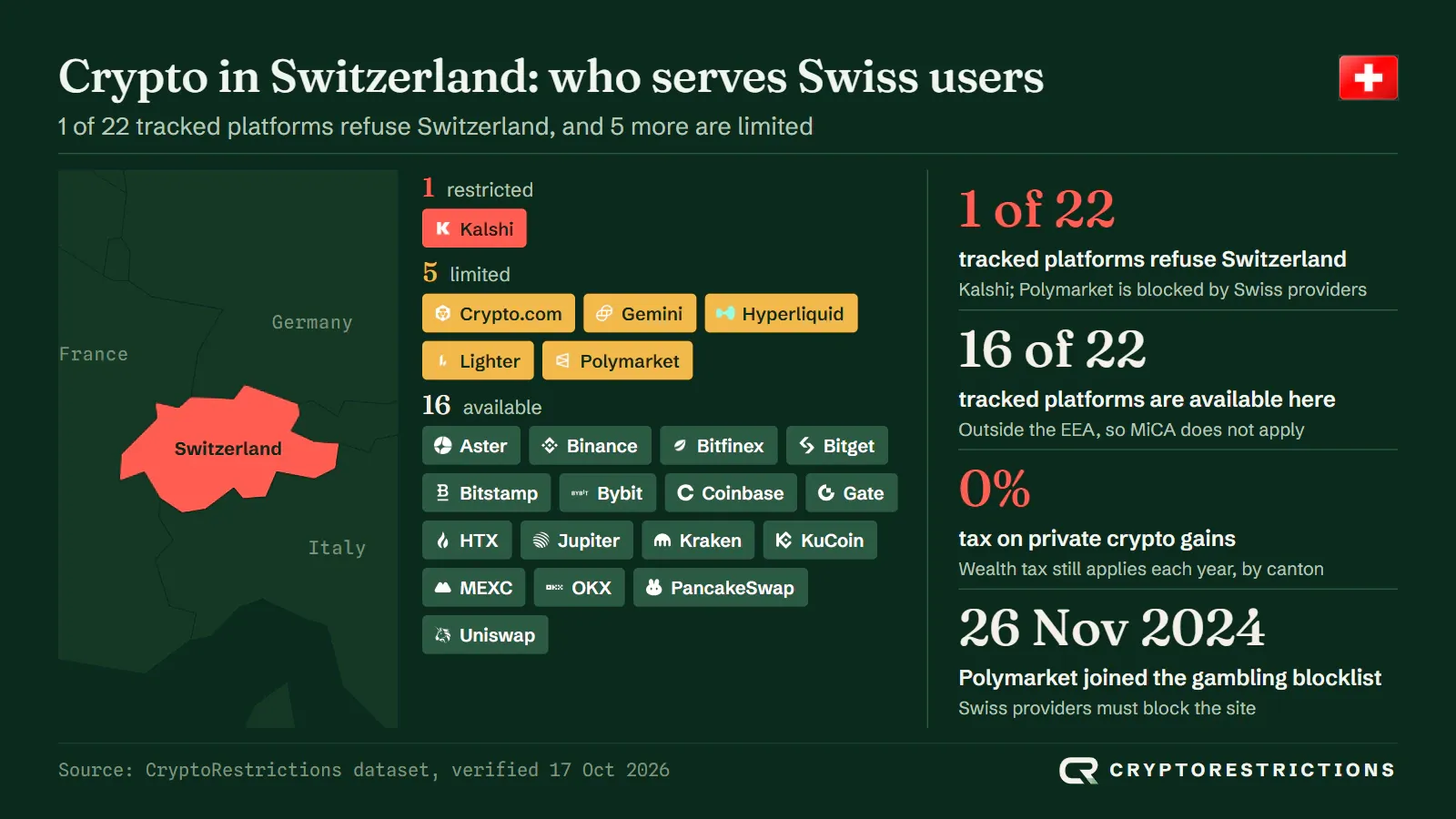
Yes. Individuals may buy, hold and trade crypto, and FINMA supervises the firms that serve them under technology-neutral financial-market law. Switzerland is not in the EEA, so the EU’s MiCA licensing rules do not apply here.
FINMA’s 2025 annual report says it assesses new business models in a risk-based and technology-neutral way, so a crypto firm is judged by what it does: taking deposits, trading, safekeeping or issuing. Its FinTech page sets out the options. A firm that holds client money or crypto for more than 20 clients can need a banking licence, the fintech licence covers up to CHF 100 million of client deposits or collective crypto custody, and a business trading virtual currencies must join a self-regulatory organisation (SRO) under the anti-money-laundering act.
The Distributed Ledger Technology Act, which lets securities exist as tokens in a ledger, came into force in two steps: 1 February 2021 and, in full, 1 August 2021. FINMA’s Guidance 02/2019 applies the travel rule to blockchain payments: a supervised firm may send to or receive from an external wallet only if it belongs to one of its own verified customers.
Which crypto exchanges work in Switzerland?
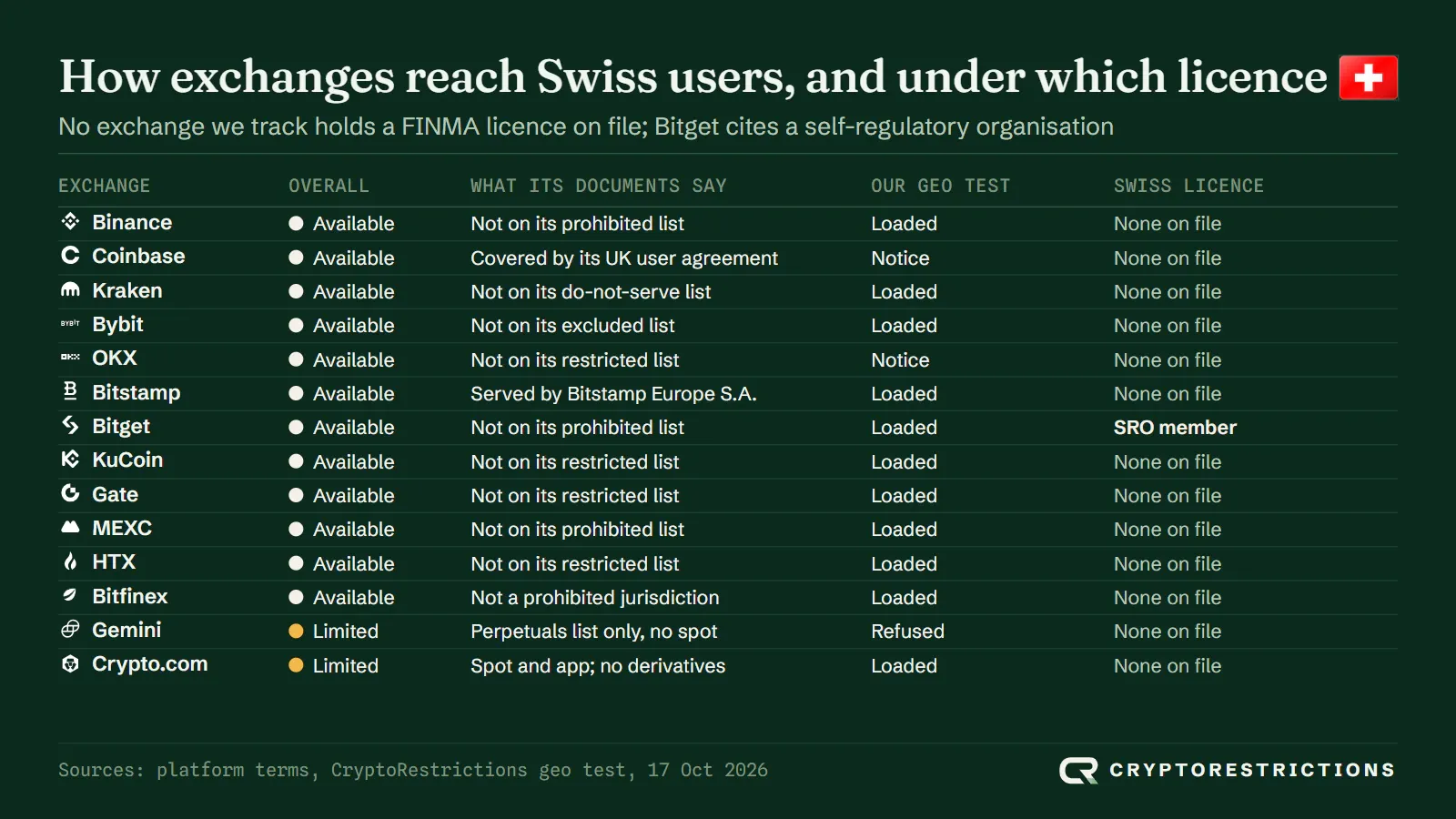
Twelve of the 14 exchanges we track serve Swiss users without limits, and Gemini and Crypto.com are limited. None holds a FINMA licence on file: foreign exchanges serve Switzerland on their own terms, and one, Bitget, says it belongs to an SRO.
Switzerland has no passporting system like the EU’s, so the chart shows what each exchange’s own documents say rather than a regulator’s register. Ten of the twelve open exchanges, among them Binance, Bybit and OKX, are open because Switzerland is missing from a published exclusion list, which is medium-confidence evidence. Coinbase is covered by its UK user agreement. Bitstamp serves Swiss retail customers from Bitstamp Europe S.A. and is moving them to the Robinhood app from 15 October 2026. Bitget’s licence page lists membership of a FINMA-recognised SRO; we have not matched it to an SRO’s member list.
Swiss-based providers sit outside our platform set. PostFinance, a bank, offers crypto trading to customers whose tax home is in Switzerland.
Best crypto platforms for Swiss residents
By our access score Bitget (9.0 out of 10) is the most open exchange for Swiss users, ahead of Binance, Bitstamp, Bybit and Kraken (8.0 each). Polymarket (6.3) is the only scored prediction market, and Aster, Jupiter, PancakeSwap and Uniswap (8.0) lead the DeFi platforms.
The score rates how fully a Swiss resident can use each platform, not its fees or safety. It is computed from our data and moves when a row changes: access status (4 points), the share of the platform’s products open here (3), the licences we hold on file for Switzerland (2) and what our geo-access test saw from a Swiss address (1). Only Bitget has a licence row for Switzerland, which is why it leads: the row rests on its own page, and every other platform loses those points. Platforms that refuse Swiss users are not scored. The full method is on our methodology page.
Exchanges

Bitget
Best for An exchange that cites Swiss anti-money-laundering oversight
9.0/10- Access
- 4/4
- Products
- 3/3
- Licences
- 1/2
- Our test
- 1/1
Read our Bitget reportPros
- Says it belongs to a FINMA-recognised SRO
- Switzerland is not on its prohibited list
Cons
- The SRO claim comes from its own page; we have not matched it to a member list

Binance
Best for The largest exchange by trading volume
8.0/10- Access
- 4/4
- Products
- 3/3
- Licences
- 0/2
- Our test
- 1/1
Read our Binance reportPros
- Switzerland is not on its prohibited-countries list
Cons
- No licence on file for Switzerland

Bitstamp
Best for Retail accounts served from Luxembourg
8.0/10- Access
- 4/4
- Products
- 3/3
- Licences
- 0/2
- Our test
- 1/1
Read our Bitstamp reportPros
- Swiss retail customers are served by Bitstamp Europe S.A.
Cons
- Swiss retail customers are being moved to the Robinhood app from 15 October 2026

Bybit
Best for Spot and derivatives from one account
8.0/10- Access
- 4/4
- Products
- 3/3
- Licences
- 0/2
- Our test
- 1/1
Read our Bybit reportPros
- Switzerland is not on its excluded-jurisdictions list
Cons
- No licence on file for Switzerland

Kraken
Best for A major exchange with a published exclusion list
8.0/10- Access
- 4/4
- Products
- 3/3
- Licences
- 0/2
- Our test
- 1/1
Read our Kraken reportPros
- Switzerland is not on its do-not-serve list
Cons
- No licence on file for Switzerland

Coinbase
Best for A US-listed exchange covered by its UK agreement
7.5/10- Access
- 4/4
- Products
- 3/3
- Licences
- 0/2
- Our test
- 0.5/1
Read our Coinbase reportPros
- Covered by Coinbase's UK user agreement, which also serves Switzerland
Cons
- No licence on file for Switzerland

OKX
Best for A global exchange with a European site
7.5/10- Access
- 4/4
- Products
- 3/3
- Licences
- 0/2
- Our test
- 0.5/1
Read our OKX reportPros
- Switzerland is not on its restricted-locations list (updated 8 July 2026)
Cons
- No licence on file for Switzerland

Crypto.com
Best for Spot trading in an app
6.3/10- Access
- 3.5/4
- Products
- 1.8/3
- Licences
- 0/2
- Our test
- 1/1
Read our Crypto.com reportPros
- Spot trading and the app are offered
Cons
- Switzerland is on its derivatives geo-restrictions list

Gemini
Best for Perpetual futures only
4.9/10- Access
- 3/4
- Products
- 1.9/3
- Licences
- 0/2
- Our test
- 0/1
Read our Gemini reportPros
- Switzerland is on its perpetuals list
Cons
- Not on its main list, so spot trading is not offered
Prediction markets

Polymarket
Best for The one prediction market we can score here
6.3/10- Access
- 3/4
- Products
- 2.3/3
- Licences
- 0/2
- Our test
- 1/1
Read our Polymarket reportPros
- Switzerland is not on Polymarket's own restricted list
Cons
- polymarket.com has been on the Gespa blocklist since 26 November 2024
- Swiss internet providers are required to block it
DeFi

Aster
Best for Perpetuals from your own wallet
8.0/10- Access
- 4/4
- Products
- 3/3
- Licences
- 0/2
- Our test
- 1/1
Read our Aster reportPros
- Switzerland is not on its prohibited-jurisdictions list
Cons
- No licence on file for Switzerland

Jupiter
Best for Solana swaps
8.0/10- Access
- 4/4
- Products
- 3/3
- Licences
- 0/2
- Our test
- 1/1
Read our Jupiter reportPros
- Switzerland is not in its terms
Cons
- No licence on file for Switzerland

PancakeSwap
Best for BNB Chain swaps and pools
8.0/10- Access
- 4/4
- Products
- 3/3
- Licences
- 0/2
- Our test
- 1/1
Read our PancakeSwap reportPros
- Not excluded by its terms
Cons
- No licence on file for Switzerland

Uniswap
Best for Swapping tokens from your own wallet
8.0/10- Access
- 4/4
- Products
- 3/3
- Licences
- 0/2
- Our test
- 1/1
Read our Uniswap reportPros
- Its terms bar only places under comprehensive US sanctions
Cons
- No licence on file for Switzerland

Lighter
Best for On-chain perpetuals outside the points program
6.3/10- Access
- 3/4
- Products
- 2.3/3
- Licences
- 0/2
- Our test
- 1/1
Read our Lighter reportPros
- Only its Robinhood Chain deployment and points program bar Switzerland
Cons
- Switzerland is barred from Lighter on Robinhood Chain (effective 10 August 2026)

Hyperliquid
Best for On-chain perpetuals
5.9/10- Access
- 3/4
- Products
- 1.9/3
- Licences
- 0/2
- Our test
- 1/1
Read our Hyperliquid reportPros
- Perpetuals are not excluded by its terms
Cons
- Its outcome markets are hidden by a location check here
Which platforms block Swiss users?
One of the 22 platforms we track refuses Swiss users: Kalshi. Five more are limited: Gemini, Crypto.com, Hyperliquid, Lighter and Polymarket.
None of these exits is a Swiss ban on crypto. Kalshi lists Switzerland among its restricted jurisdictions, and Gespa has also had kalshi.com on its blocklist since 25 November 2025. Gemini’s areas of availability leave Switzerland off its main list, but its perpetuals list includes it, which is why Gemini is limited rather than restricted. Polymarket does not list Switzerland among its own restricted places; the limit comes from the Swiss blocklist, covered in the prediction-markets section.
What our geo-access test saw from Switzerland
From a Swiss address on 14 and 16 October 2026 we loaded all 22 platforms we track: 1 refused us, 3 showed a notice or a redirect, and 18 loaded with no barrier.
An open page is not permission. Polymarket loaded normally although its domain sits on the Swiss blocklist, so the test sees the platform’s own geo-blocking, not a local provider’s block. The refusal was Gemini (“Gemini does not currently operate in Switzerland”). The notices were Coinbase’s note that stocks and prediction markets are unavailable, Kalshi’s prediction-markets notice and OKX’s redirect to its European site. Swipe through the screenshots below; each card quotes what the page showed.
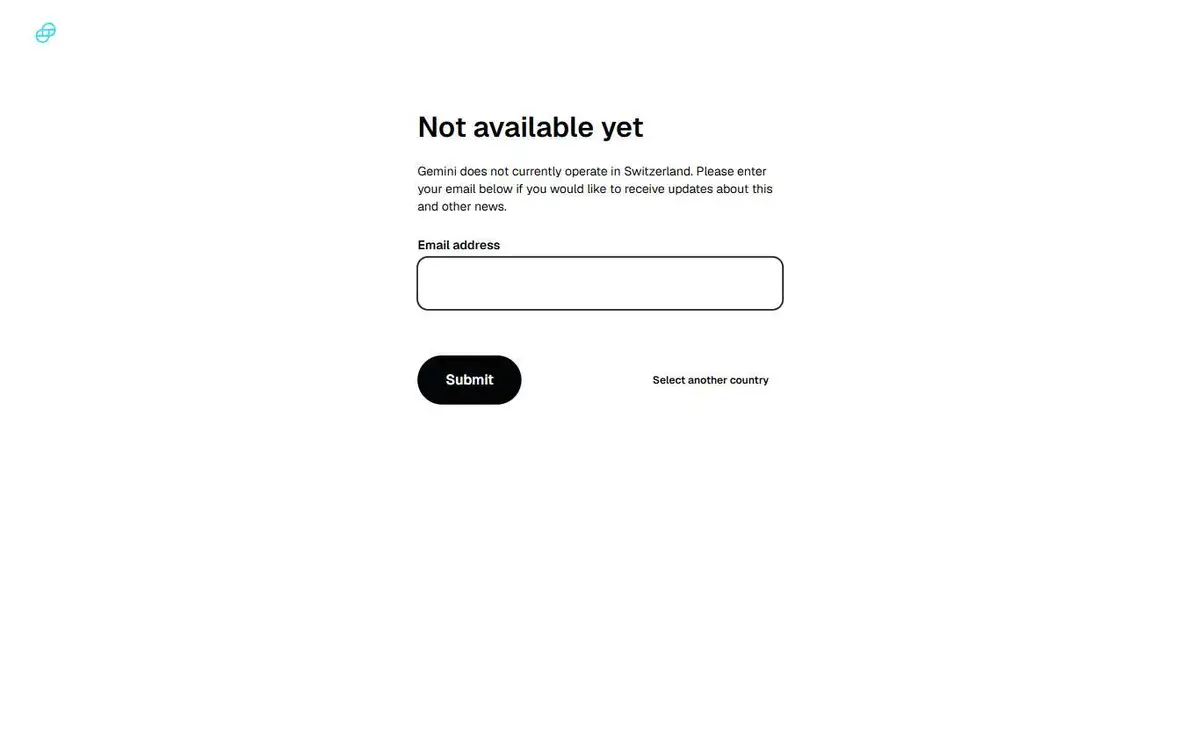
Blocked Gemini · Sign-up page
Switzerland, named on Gemini's perpetuals list, is still refused at sign-up
“Gemini does not currently operate in Switzerland.”
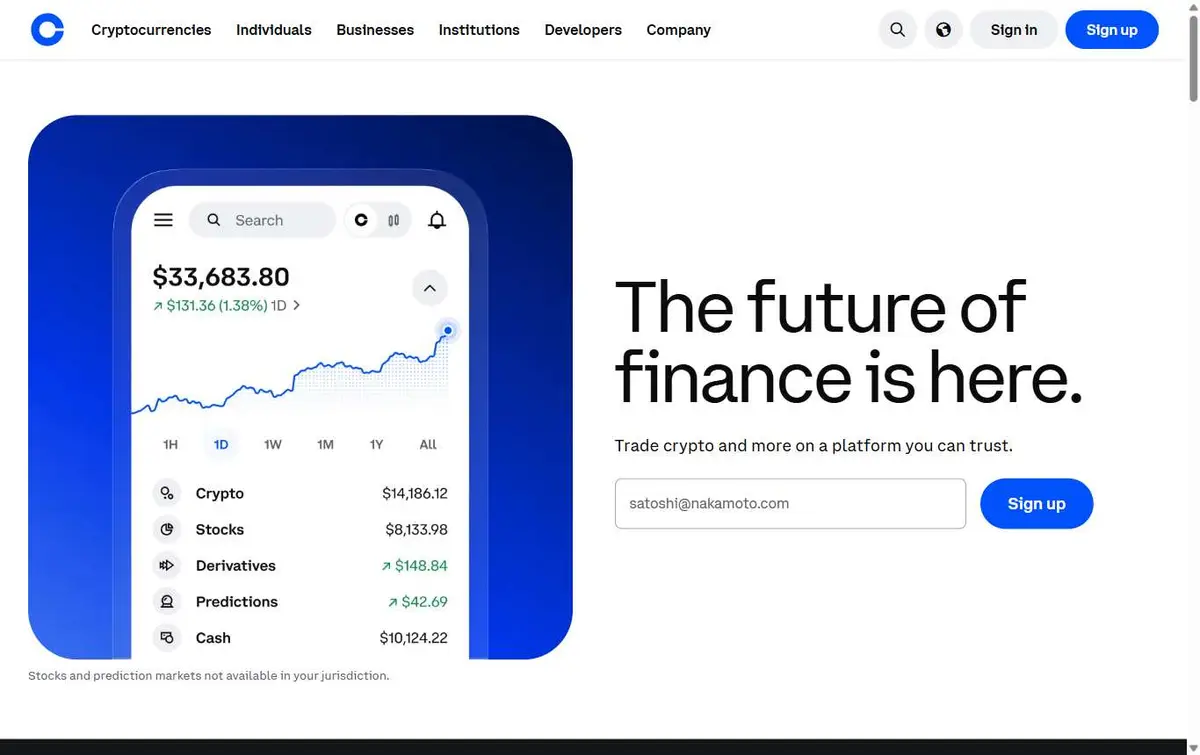
Notice shown Coinbase · Home page
Switzerland, covered by the UK agreement, sees the product notice
“Stocks and prediction markets not available in your jurisdiction.”
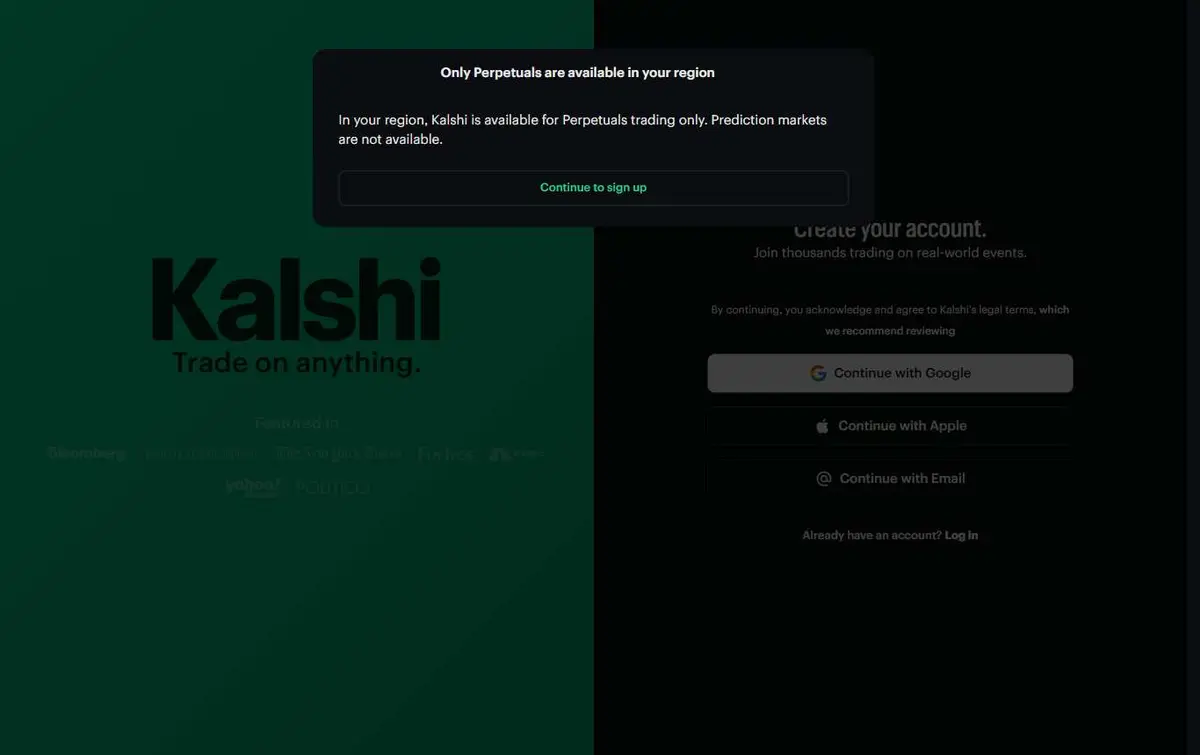
Notice shown Kalshi · Sign-up page
Switzerland, also on Gespa's blocklist: the same perps-only notice, which Kalshi's sign-up page leaves off its prohibited list
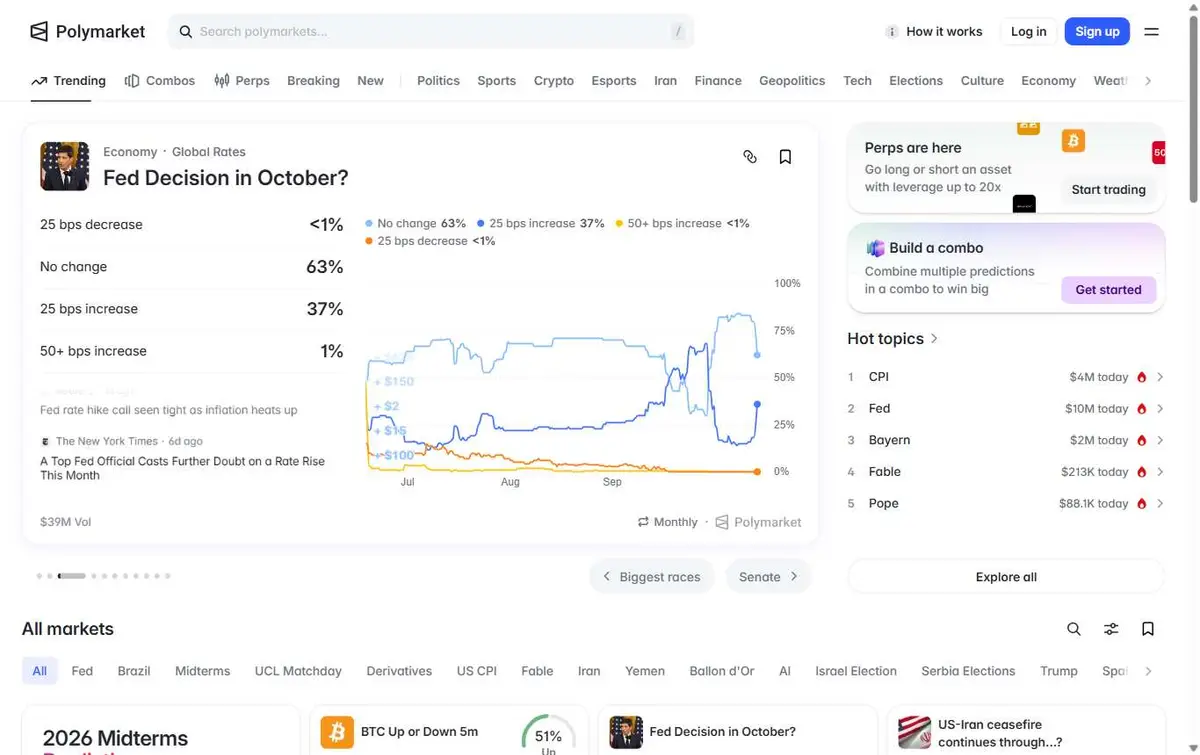
No barrier Polymarket · Home page
Switzerland, on the Gespa blocklist since 2024: Polymarket itself does not refuse the visit
 CRYPTORESTRICTIONS
Who regulates crypto in Switzerland?
FINMA licenses and supervises crypto firms and recognises the SROs that police anti-money-laundering rules. The Federal Council is drafting new licence categories, Gespa blocks gambling sites, and the federal tax administration (ESTV) sets how crypto is taxed.
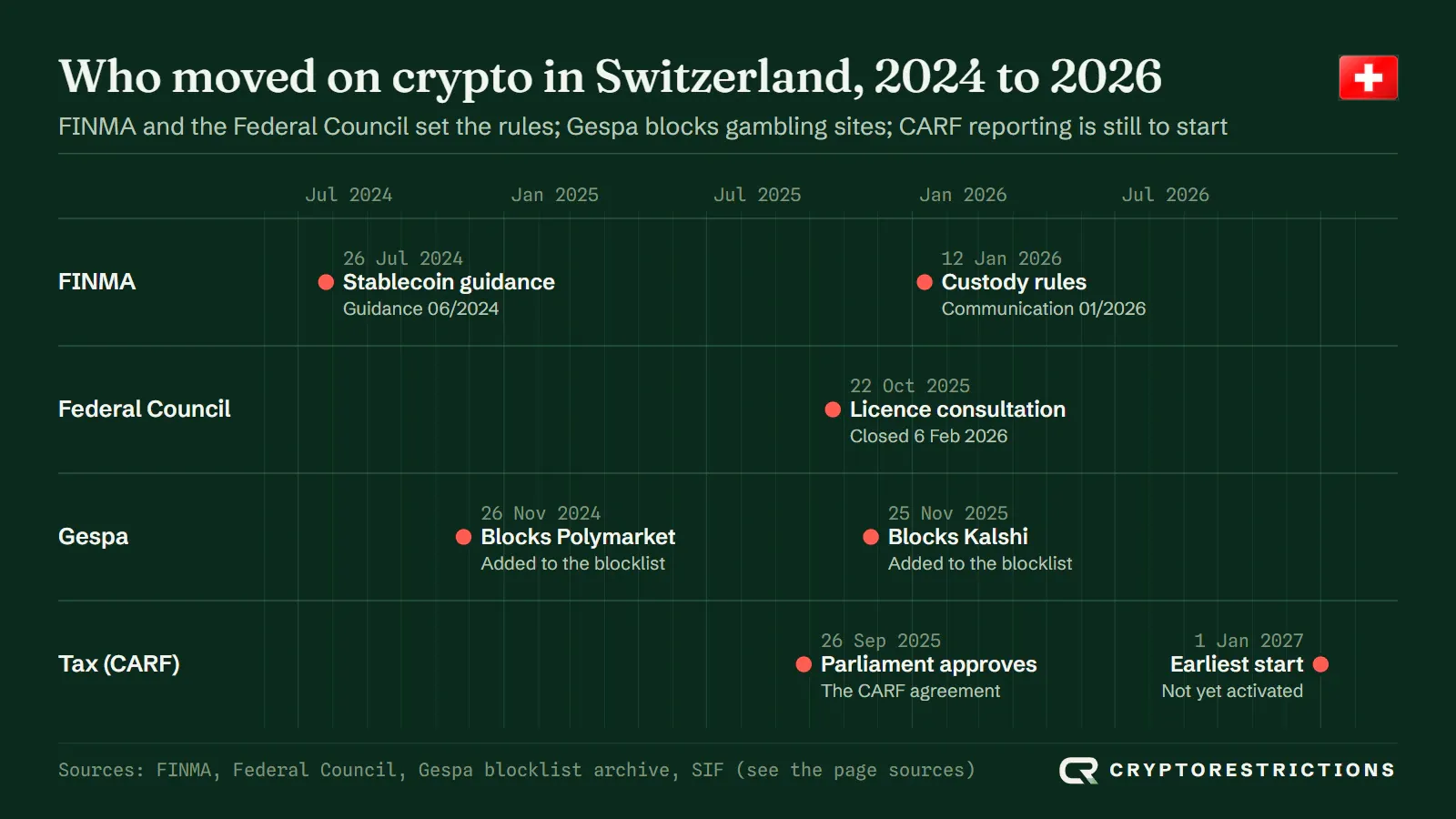
- FINMA. The Swiss Financial Market Supervisory Authority runs the banking, fintech and securities-firm licences and recognises SROs. It issued stablecoin guidance on 26 July 2024 and a custody communication on 12 January 2026, which says client crypto must not fall into the custodian’s bankruptcy estate. Its warning list names unlicensed operators and says a listing alone does not prove unlawful conduct.
- Federal Council and the State Secretariat for International Finance (SIF). On 22 October 2025 the Federal Council opened a consultation, which closed on 6 February 2026, on two new categories. Payment instrument institutions would replace the fintech licence, drop its CHF 100 million deposit cap and be able to issue a special type of stablecoin. Crypto institutions would be licensed on securities-firm rules, but less comprehensive ones. As of 17 October 2026 we found no dispatch to Parliament and no official start date.
- Gespa and the ESBK. Gespa supervises lotteries and sports betting and publishes the blocklist covered below. The Federal Gaming Board (ESBK) keeps a separate list for casino games, which we did not read.
- ESTV. The Federal Tax Administration publishes the working paper on crypto tax, and the cantons apply it. The tax section covers it.
A popular initiative that would have required the central bank to hold bitcoin lapsed in May 2026 at about 50,000 of the 100,000 signatures needed, according to Baker McKenzie.
Which crypto products are limited in Switzerland?
Spot trading is the open product. The narrow ones are derivatives, which Crypto.com does not offer to Swiss users and which Gemini offers only as perpetuals, and prediction markets, which are blocked or hidden.
- Derivatives. Crypto.com’s derivatives geo-restrictions list Switzerland. Gemini has no spot trading here but offers perpetuals. Hyperliquid’s perpetuals load, though its outcome markets tab does not.
- Stablecoins. FINMA’s guidance says an issuer can avoid a banking licence with a Swiss bank’s default guarantee. The consultation would instead give issuance to payment instrument institutions.
- Custody. The January 2026 communication puts the duty on the licensed firm: it stays responsible when it uses an outside custody provider.
- Transfers. Under the travel rule, a supervised exchange can only send to or receive from external wallets that belong to its own verified customers.
Are prediction markets legal in Switzerland?
Not without a Swiss licence. Gespa’s blocklist has named polymarket.com since 26 November 2024 and kalshi.com since 25 November 2025, and Swiss internet providers are required to block listed domains.
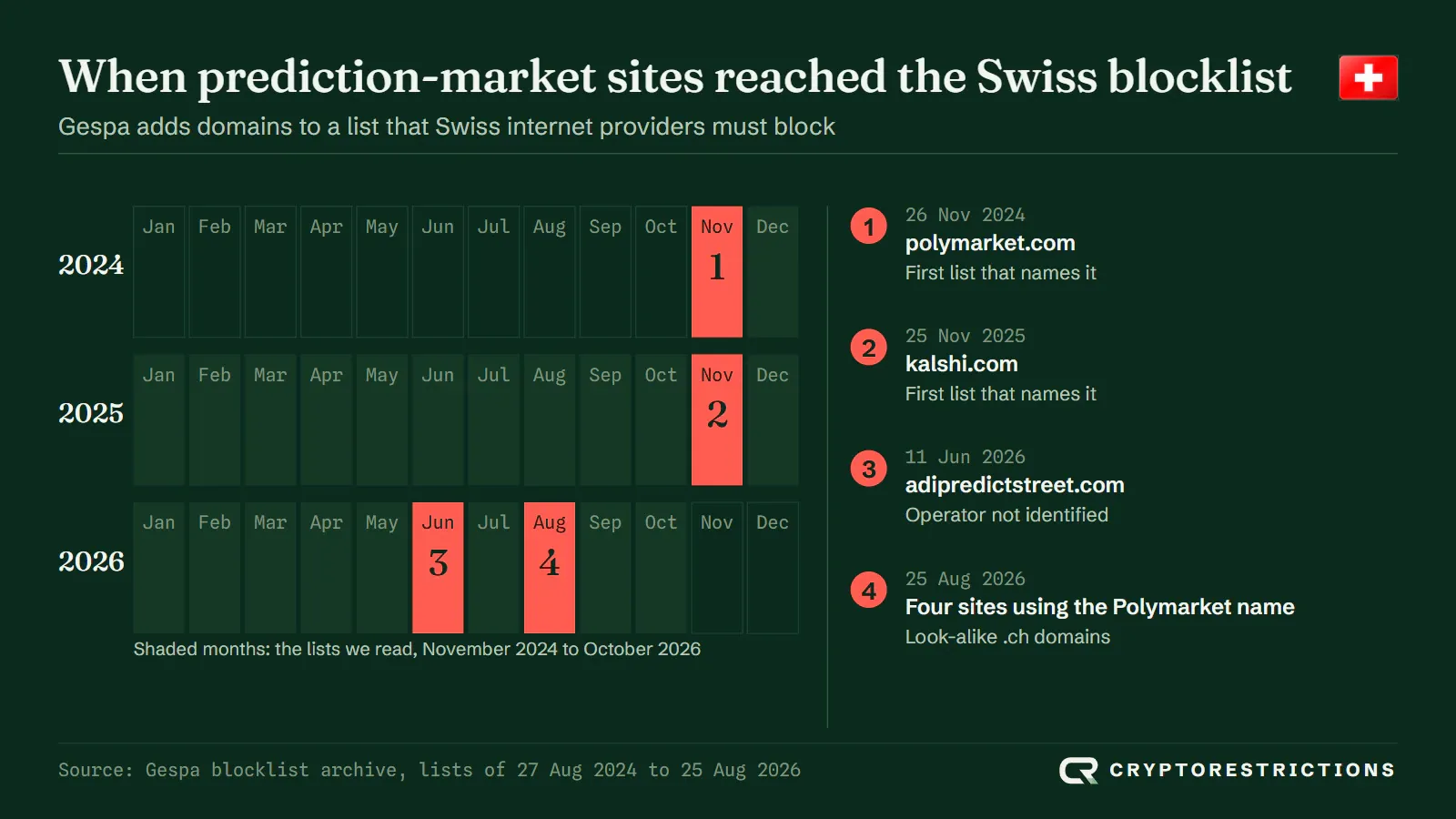
Gespa’s archive shows each dated list. polymarket.com is absent from the list of 27 August 2024 and present from 26 November 2024 on, in every list we checked up to 25 August 2026. kalshi.com is absent on 21 October 2025 and present from 25 November 2025. A third entry, adipredictstreet.com, appeared on 11 June 2026; we could not identify its operator. On 25 August 2026 Gespa also listed four .ch domains that use the Polymarket name, which look like third-party sites rather than Polymarket’s own.
SRF reported on 10 April 2026 that platforms like Polymarket are illegal in Switzerland, and that Gespa does not treat people who visit and bet as punishable. We found no FINMA statement on whether event contracts count as derivatives, so the legal question is open from the financial-markets side. In our data Polymarket is limited and Kalshi restricted; Hyperliquid’s outcome markets are hidden here.
How is crypto taxed in Switzerland?
Private capital gains on crypto are tax-free. You still pay wealth tax every year on what you hold, at rates your canton sets, and mining, staking and crypto pay count as income.
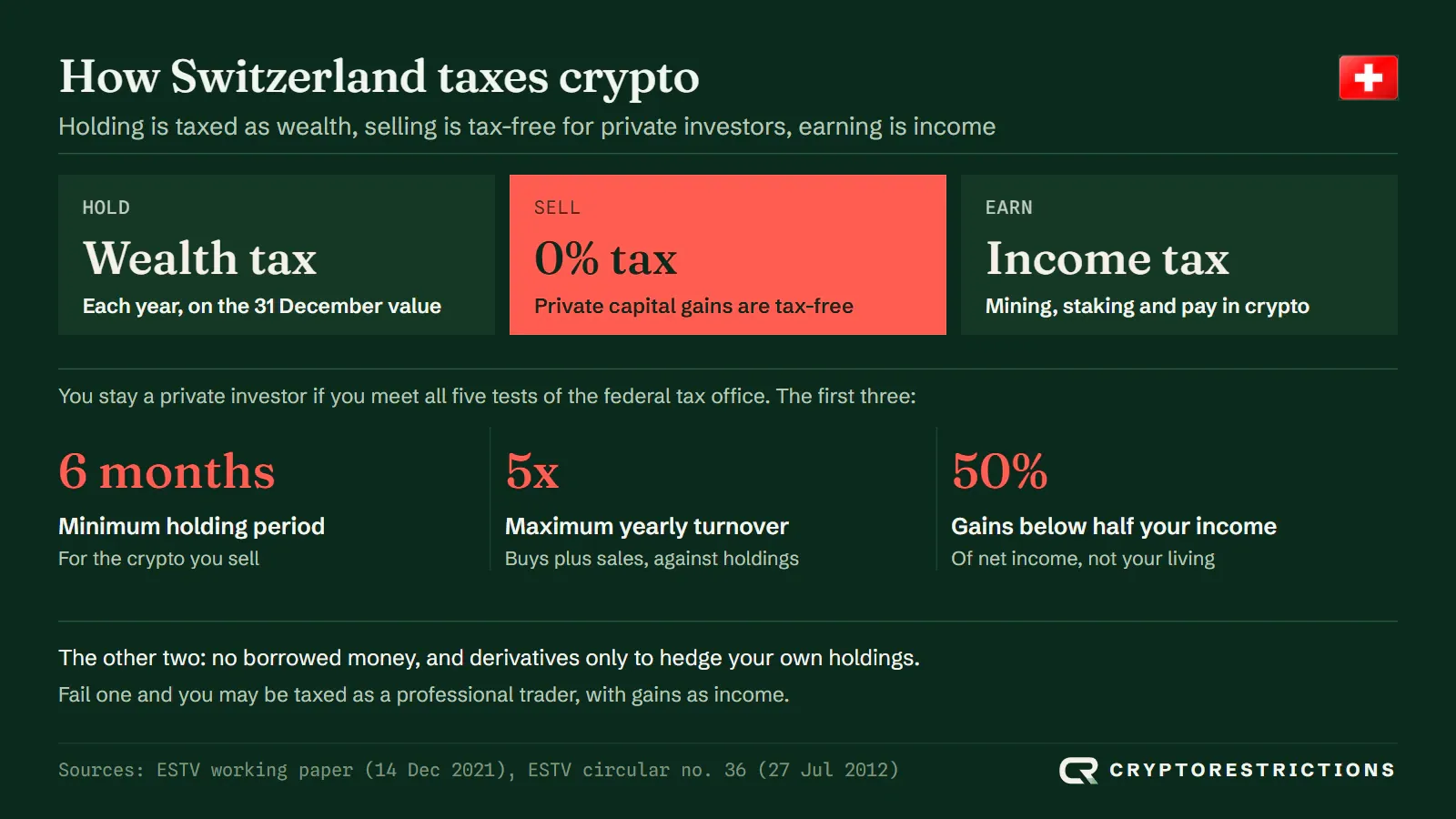
The rule comes from the ESTV’s working paper of 14 December 2021, which treats buying and selling payment tokens like trading in currencies: gains are tax-free capital gains and losses are not deductible for a private person. The wealth tax is cantonal and is based on the value on 31 December. The ESTV publishes official values for the 20 best-known coins in its tax information; for others the year-end price on the exchange you use applies. Zurich’s tax book says to list crypto among other assets and keep a wallet printout as proof.
The tax-free treatment ends if the tax office sees you as a professional trader. Circular no. 36 lists five tests; if you meet all of them, private management is assumed, and if not, it is judged on all the facts. Mining rewards are income, and a pool staking reward counts as income from movable assets, valued in francs when it arrives. Airdrops are income at market value on receipt, and pay in crypto goes on your salary certificate at its value on receipt.
Reporting is coming but not yet here. The SIF’s CARF FAQ of 18 May 2026 says Switzerland will apply the OECD’s Crypto-Asset Reporting Framework at the earliest from 1 January 2027. Parliament approved the agreement on 26 September 2025, but the Federal Council can activate it only once Parliament approves the partner states, so no CARF duties apply in 2026.





 Serbia
 Turkey
 Iceland
 Liechtenstein
 Norway
 Croatia
 Estonia
 Finland
 Greece
 Latvia
 Luxembourg