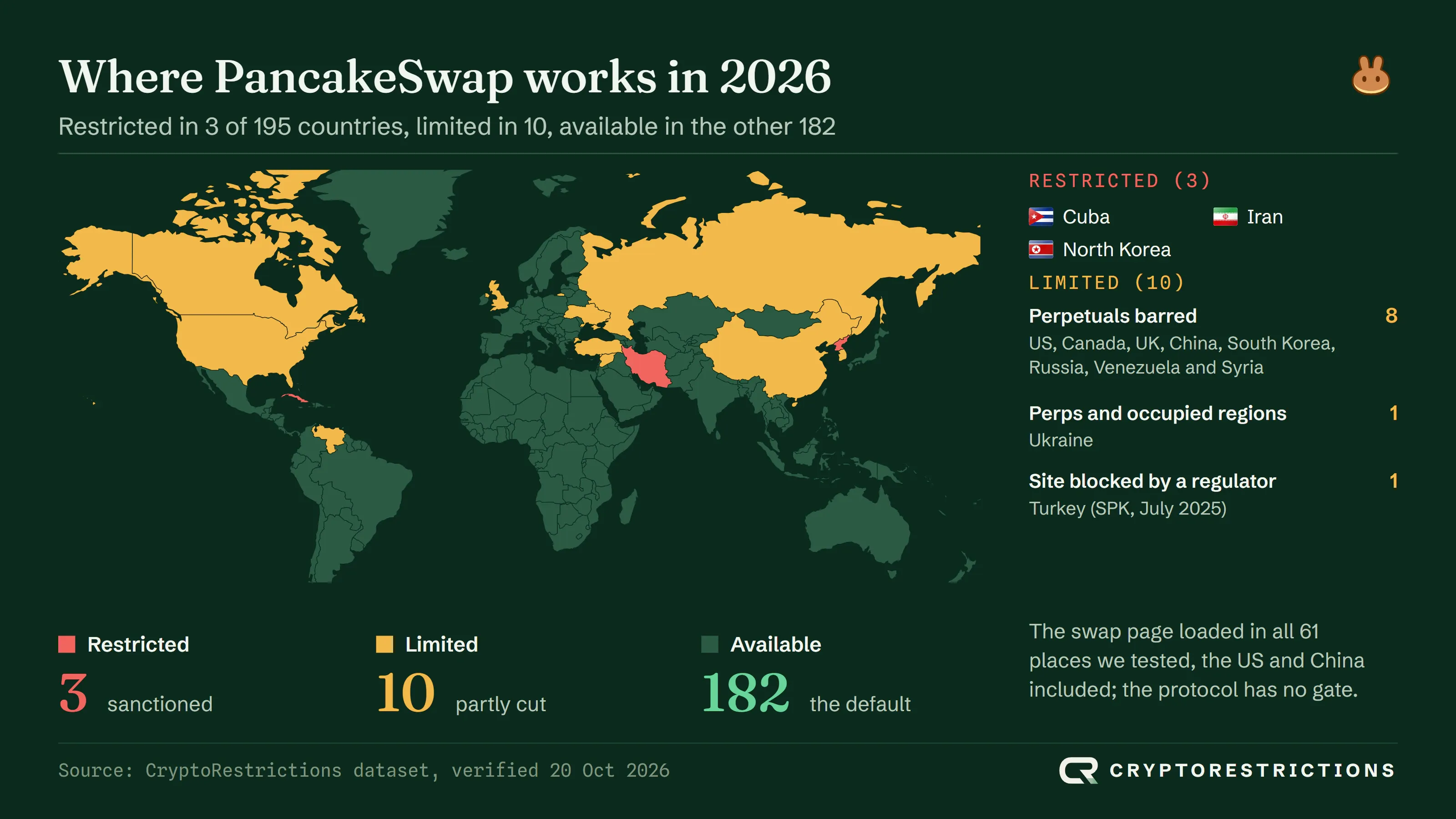
Where is PancakeSwap restricted?
PancakeSwap is restricted in 3 of the 195 countries we cover:  Cuba,
 Iran and
 North Korea.
The rule comes from the terms of service, last modified on 28 February 2023 and unchanged when we re-read them on 17 October 2026. They bar anyone who is the subject of sanctions, and anyone who is a citizen or resident of, or organised in, a place under comprehensive US sanctions. No country is named, so we apply the clause to the three countries that still fall under a US embargo.  Syria used to be in this group and is not now: the US ended its comprehensive sanctions on 1 July 2025 (OFAC).
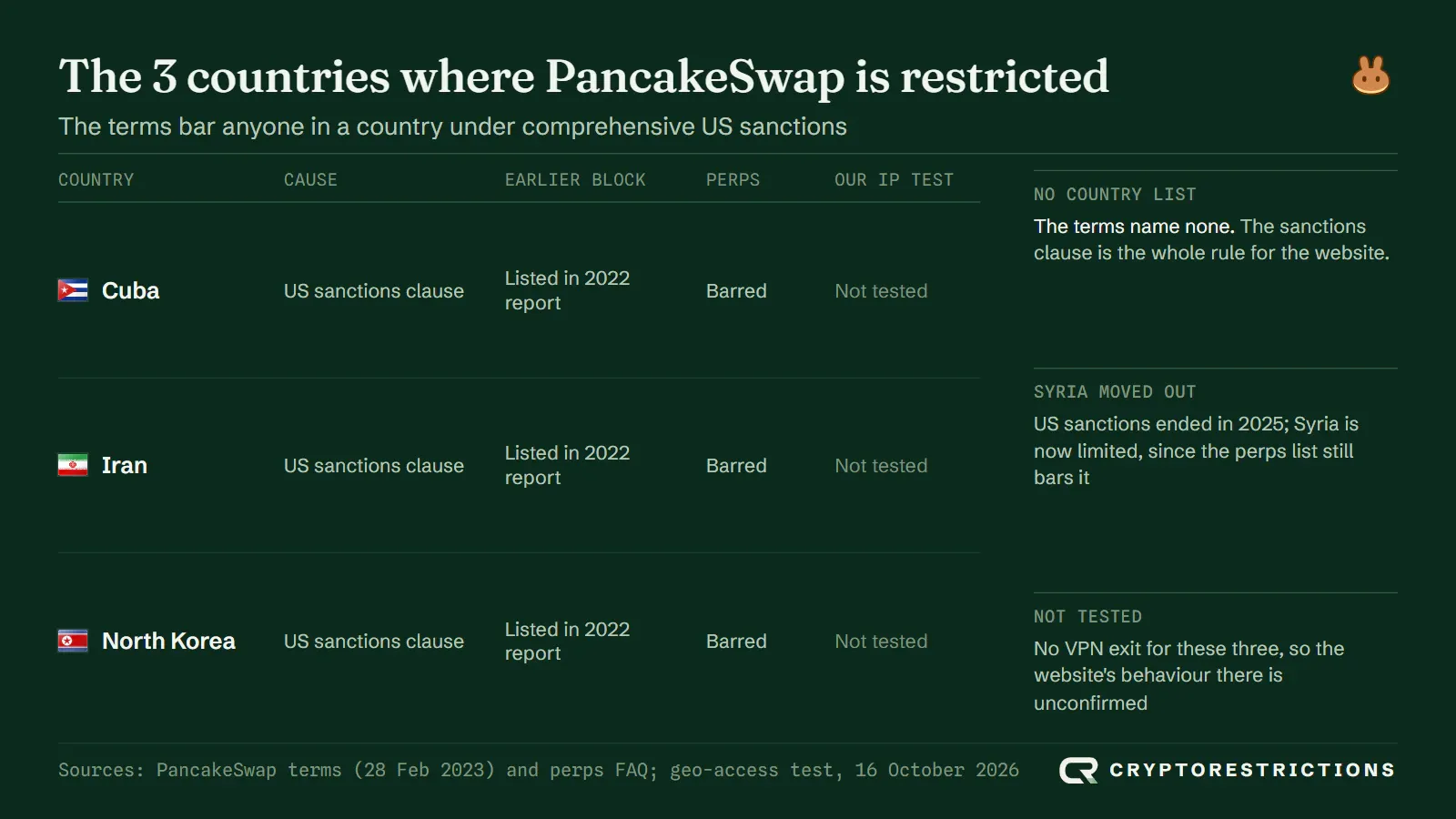
All three were also on a list of ten places that PancakeSwap reportedly planned to block by IP address from 9 March 2022, according to crypto.news, which relied on a community message and had no confirmation. We could not reach the three through our VPN, so we cannot say whether the website still blocks them. The list is below.
Where is PancakeSwap limited?
PancakeSwap is limited in 10 countries: 8 where its perps product is barred, among them the  United States, the
 United Kingdom,
 Canada,
 China and
 South Korea, plus
 Ukraine and
 Turkey.
PCS Perps is PancakeSwap’s perpetual futures product, built on the order book of Aster. The perps FAQ says users located in, or accessing the service from, the United States, Canada, the United Kingdom, China, North Korea, South Korea, Russia, Ukraine, Cuba, Iran, Venezuela or Syria are not permitted to use the product. Three of those are restricted anyway. Under our product-cut rule each of the other nine has the whole platform limited, with perps restricted and swaps, pools and staking available.
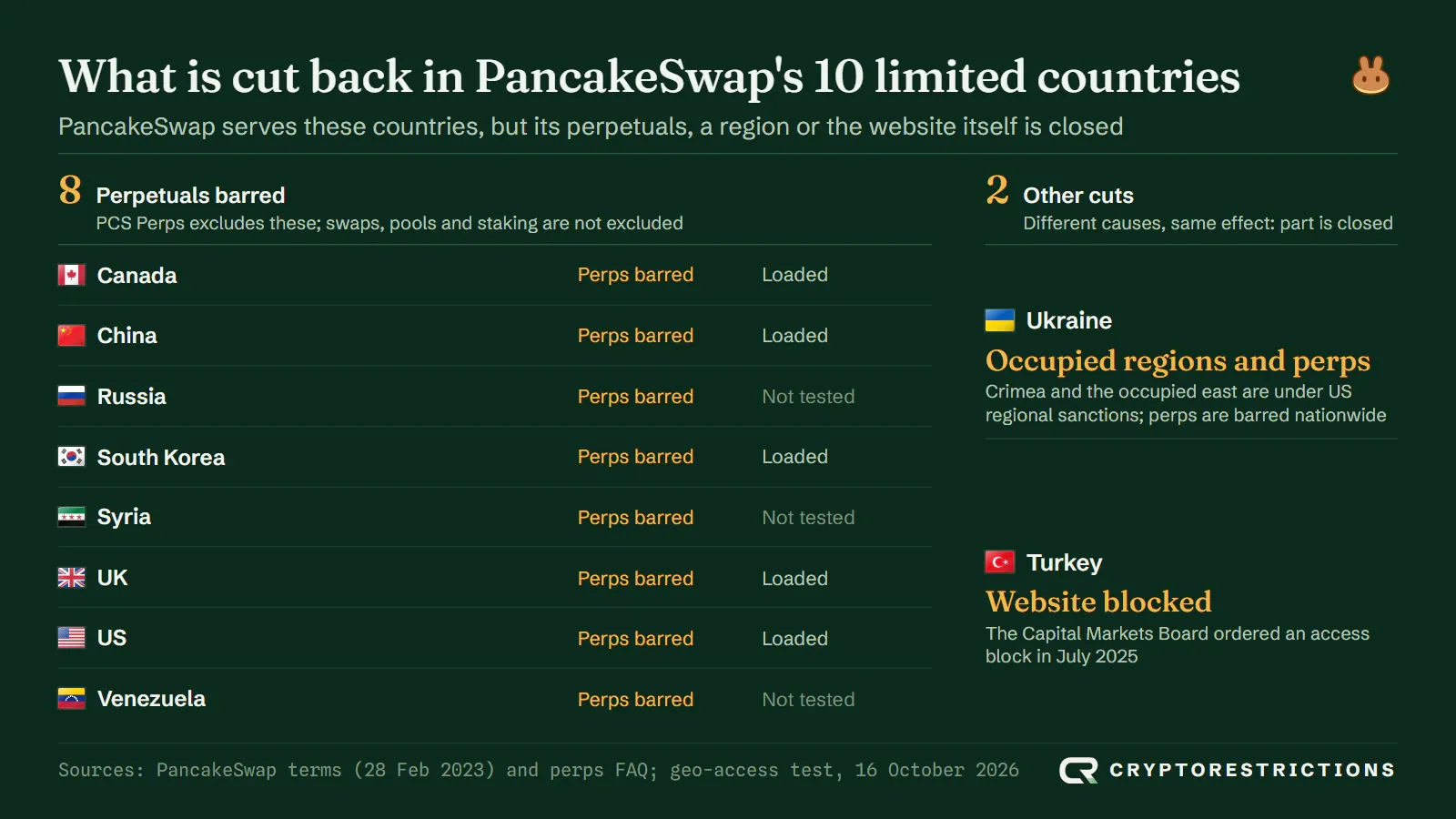
Two countries are limited for other reasons. In Ukraine the terms’ sanctions clause reaches Crimea and the occupied regions, and perps are barred across the country. In Turkey the Capital Markets Board (SPK) listed PancakeSwap in its bulletin of 3 July 2025 and ordered access to the website blocked, reported by Forbes Türkiye for unauthorised crypto asset services. A Turkish VPN exit still loaded the swap page in our test, which a national block need not contradict. The groups are below.
Which PancakeSwap products have their own country rules?
Four products carry country rules of their own, and only the first changes a status here.
- PCS Perps: the twelve places above. Aster applies the same list but for South Korea, which Aster’s own terms do not bar, so South Korea is limited here and available there.
- Tokenised stocks: the docs list countries per issuer: 57 for bStocks, 70 for rStocks, 21 for Ondo and for Reserve, 4 for xStocks (the US, Canada, the UK and Australia), 1 for Coinbase and none for St0X. Because one issuer has no restriction, no country is shut out of every stock token, and we record no status from these lists.
- Initial Farm Offerings: the terms exclude thirteen named countries or regions, among them Belarus, Iraq, New Zealand, Sudan and the United States. This is a legacy clause. The CAKE.PAD launchpad FAQ names no countries and says anyone holding CAKE can take part, so we record no rows for it.
- Prediction and lottery: the terms and docs we read name no countries for them.
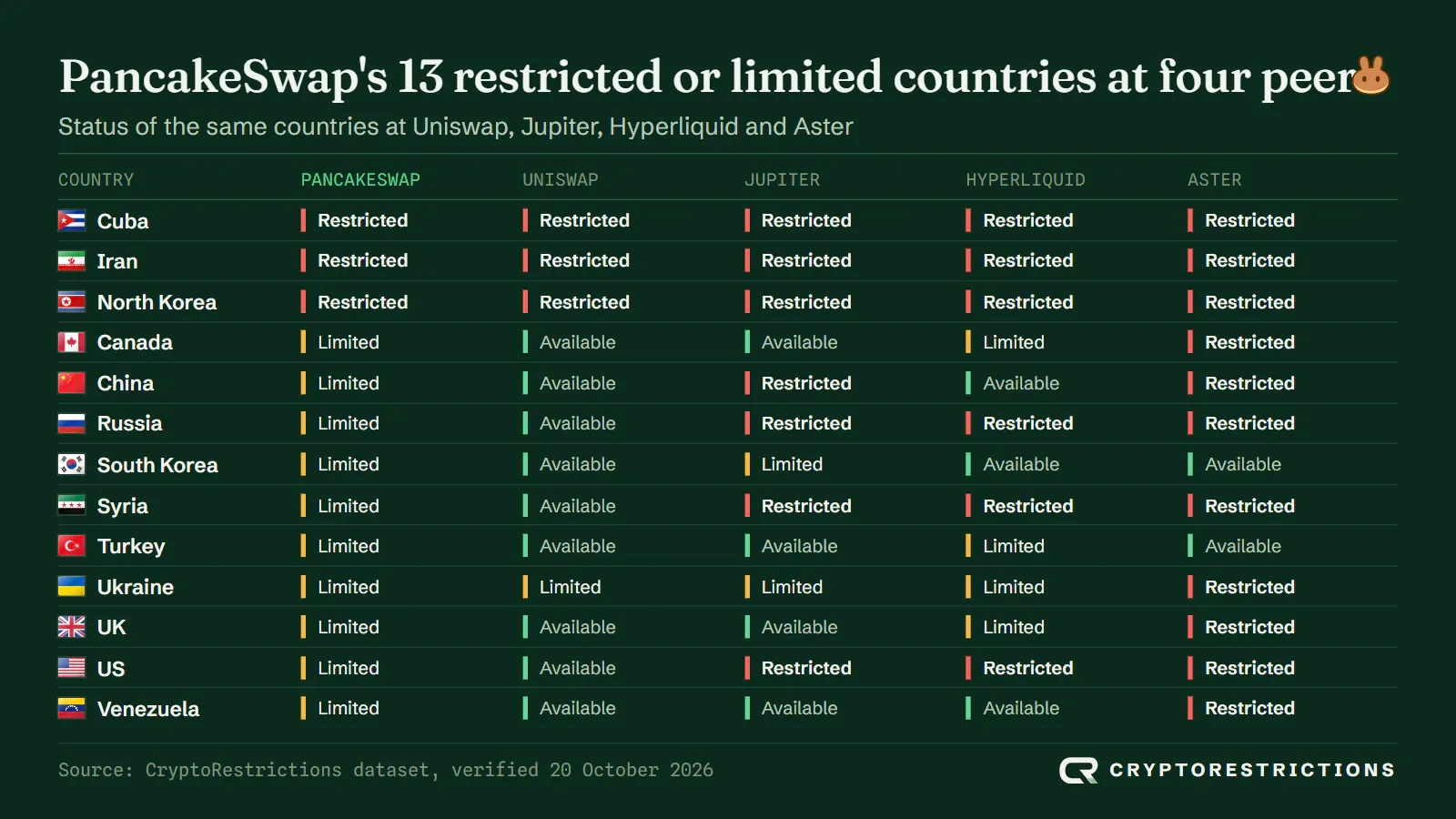
Set against peers, PancakeSwap keeps its website open more widely than most platforms that bar by country. Uniswap, the other large spot DEX, names no country in its terms either and restricts only the same three sanctioned countries. Jupiter names the United States and Singapore among its prohibited localities and restricts seven of the thirteen countries above. Aster restricts eleven and Hyperliquid six. PancakeSwap’s difference is that the website stays open nearly everywhere and the cut falls on the product that needs it.


Where is PancakeSwap available?
PancakeSwap is available in the other 182 of the 195 countries we cover, from  Germany and
 Japan to
 Brazil,
 Nigeria and
 Mexico.
None of them rests on a licence, because PancakeSwap holds none. In 52 the terms do not exclude the country and our test loaded the swap page; the other 130 are available under our coverage rule, since no document restricts them and we could not test them. We found no regulator that blocks PancakeSwap in any of the 182 besides Turkey, which is limited above.
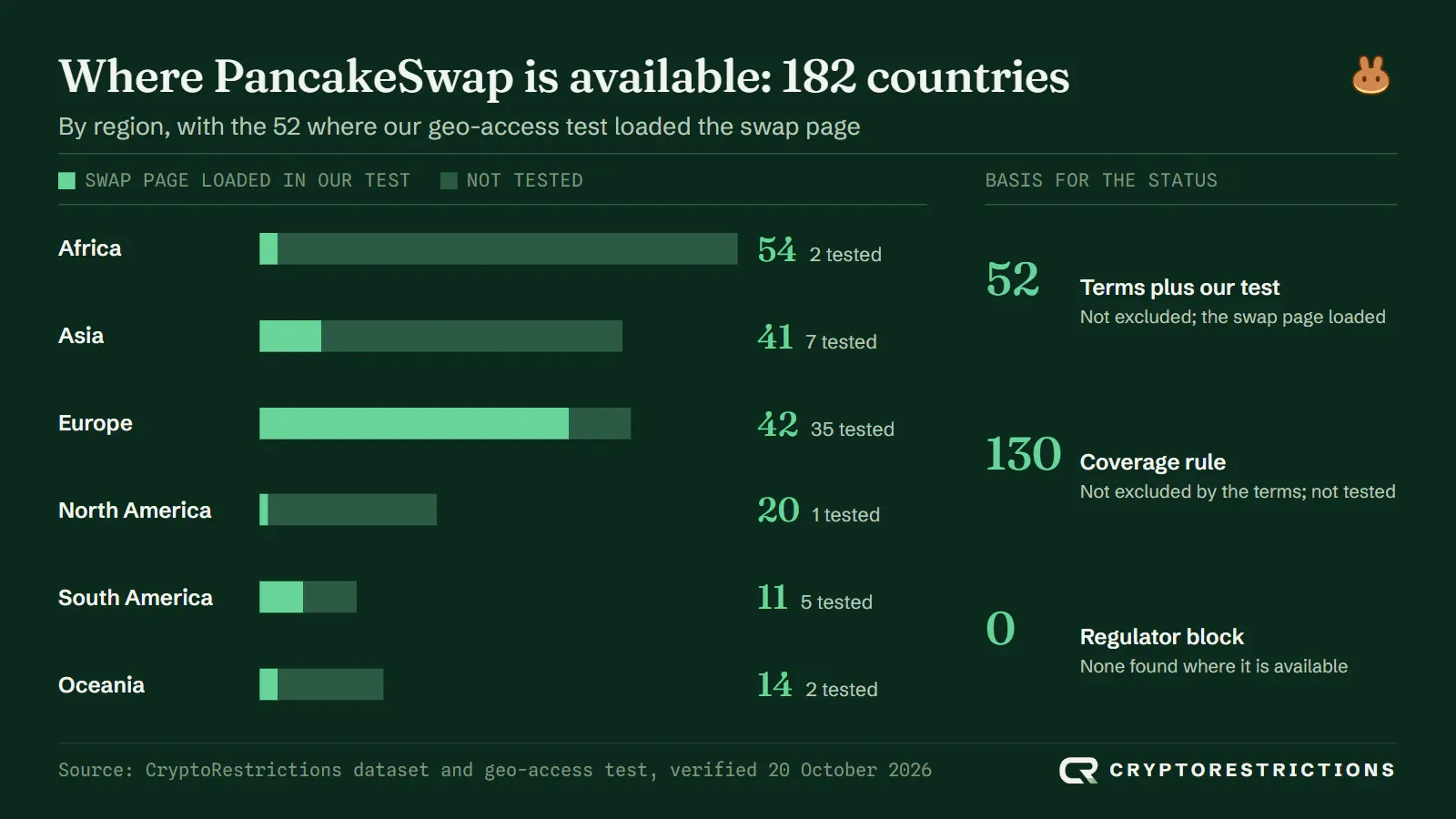
Available means PancakeSwap’s own rules leave the country open, not that local law allows decentralised trading. Belarus and Myanmar are in this group under the coverage rule although both are under other sanctions regimes, because the terms’ clause does not reach them; their country pages carry the local picture.
Where do PancakeSwap’s visitors come from?
Bangladesh is the largest source of visits to pancakeswap.finance by a wide margin, ahead of the United States, Japan and Brazil.
Semrush counts 1.59 million visits in September 2026, 0.94% more than in August. Bangladesh accounts for 44.43% of them, the US for 8.35%, Japan for 3.71%, Brazil for 3.39% and Russia for 2.8%. Similarweb returned an error to our browser, so Semrush is the only traffic estimator on this page.
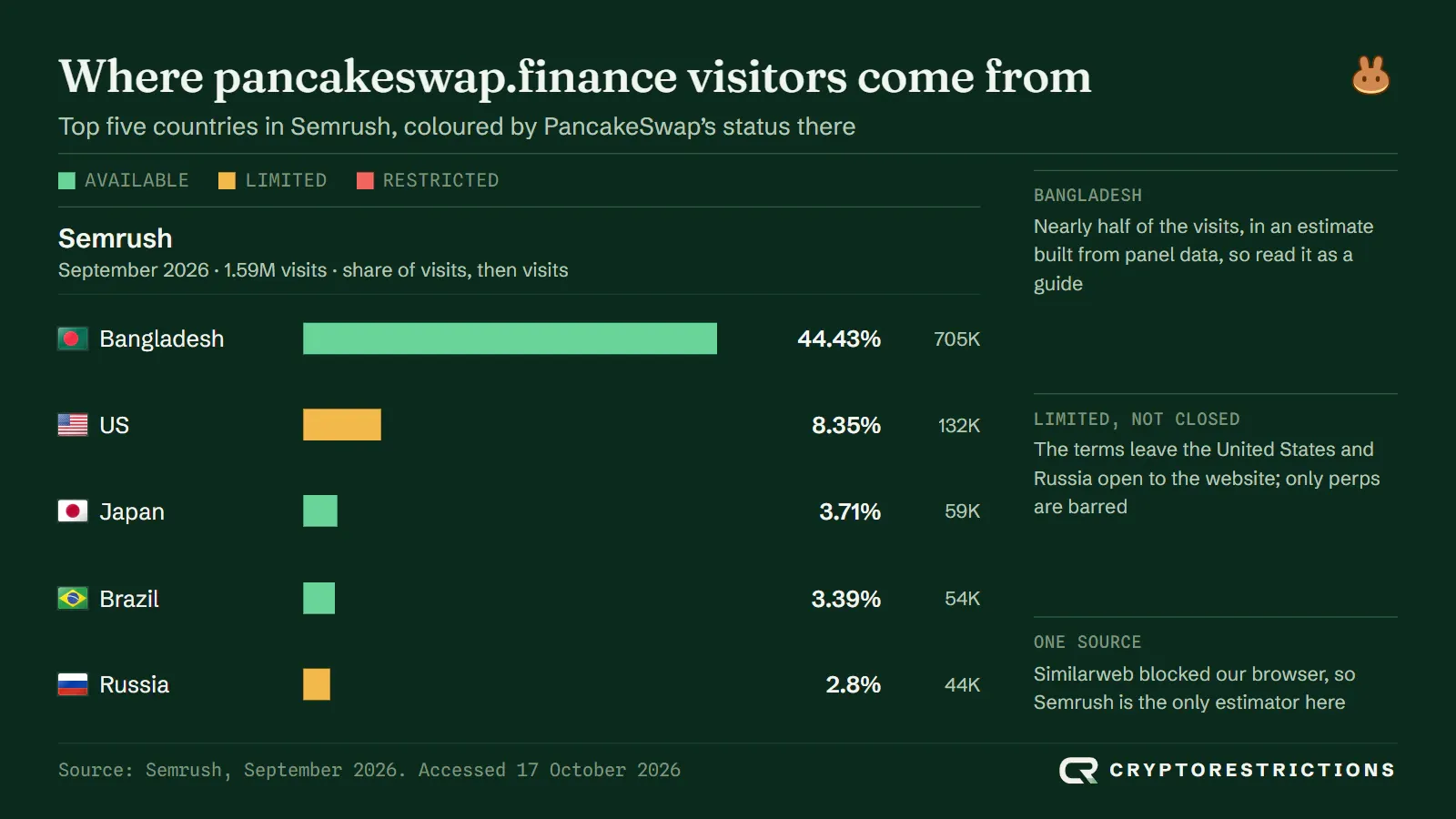
The US and Russia are both limited, not closed: the terms leave the website open to them and only the perps product is barred. A visit to the website is not an account, and PancakeSwap has none, so treat each country share as an estimate of curiosity rather than of traders.
PancakeSwap geo-access test: what we saw from 61 places
The swap page loaded with no block, banner or notice in all 61 places we tested, including the United States, China, Turkey and Ukraine.
We ran the test ourselves on 16 October 2026. A browser with a VPN connected to one place at a time and loaded pancakeswap.finance/swap, each time in a fresh private window with no cookies and no wallet connected. Banners were never accepted and bot checks never solved, and every run saved the page text and a screenshot.
Of the 61 places, 59 are among our 195 countries and two are territories, Hong Kong and Taiwan. Every run used a server in the country, none a virtual location. We tested only the swap page, because PancakeSwap has no sign-up page, and not the perps product or the prediction and lottery pages, which sit behind the same website.
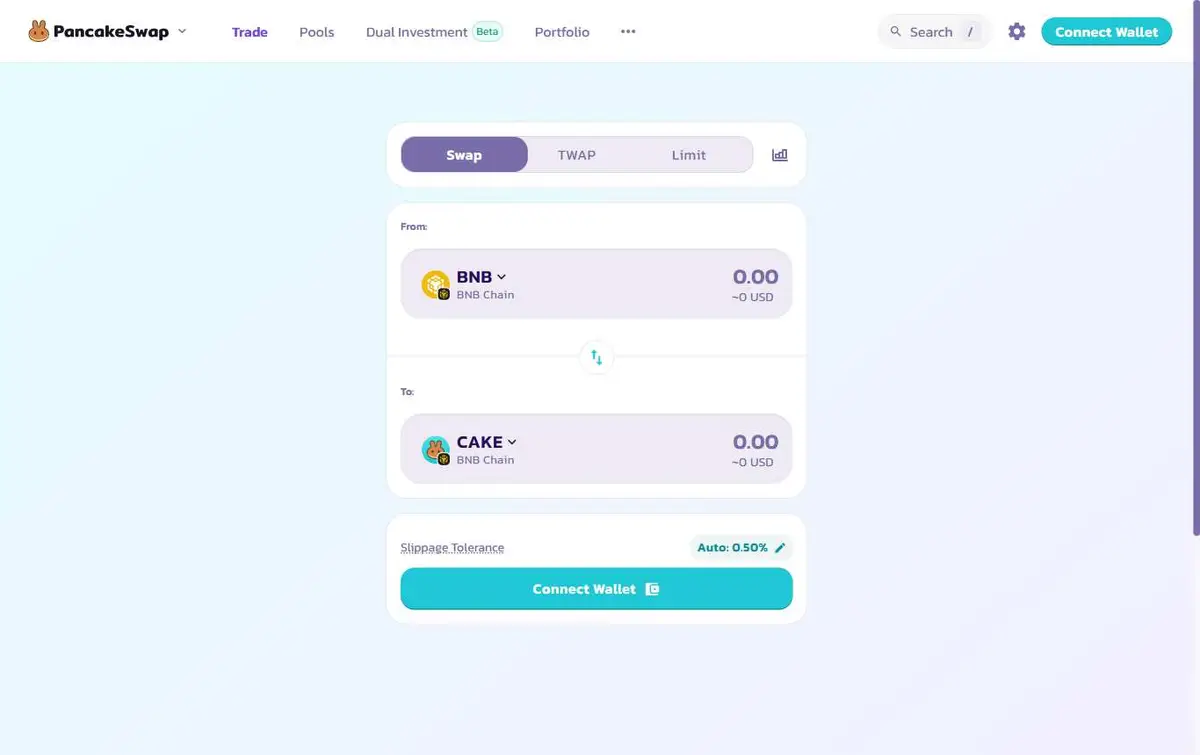
No barrierUnited States · Trading app
A US address: the swap page loads with no banner or block, though the perps product bars the US
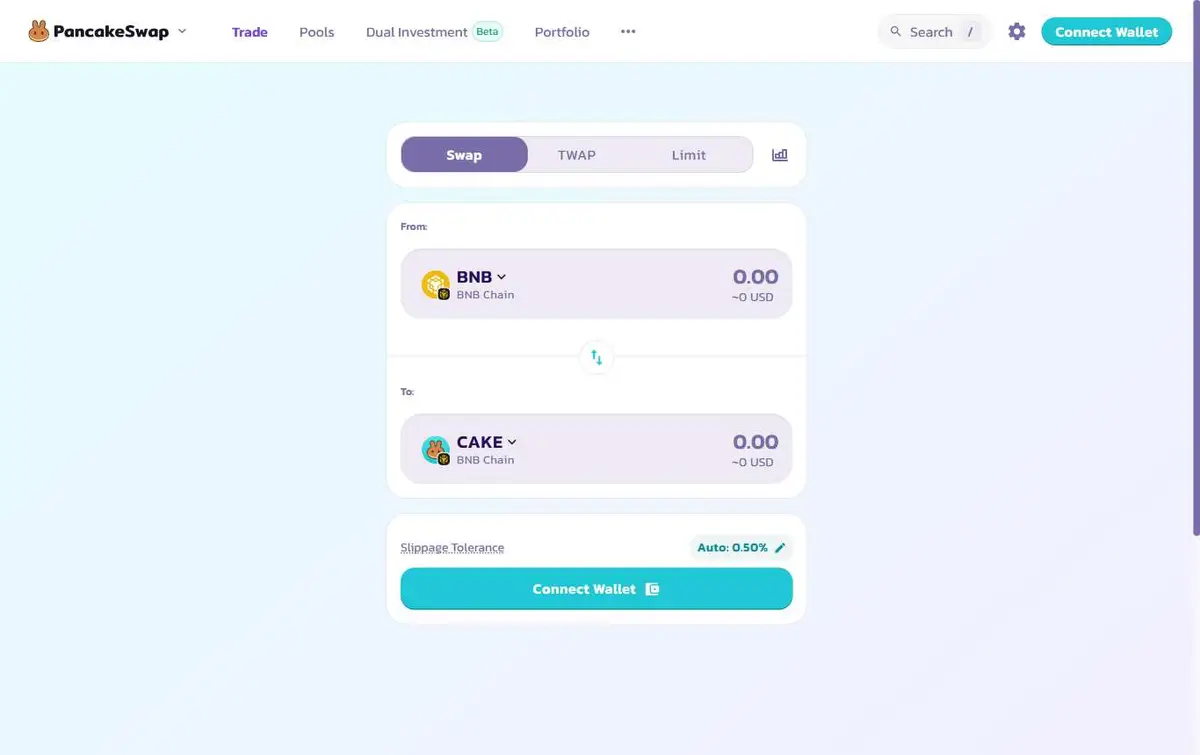
No barrierUnited Kingdom · Trading app
The UK, where perps are barred: the swap page loads as it does elsewhere
No barrierChina · Trading app
China, another perps exclusion: the swap page loads
No barrierSouth Korea · Trading app
South Korea, which the perps FAQ bars and Aster's own list does not: the swap page loads
No barrierCanada · Trading app
Canada, barred from perps: the swap page loads
No barrierTurkey · Trading app
Turkey, where the Capital Markets Board ordered a block in July 2025: a Turkish VPN exit loads the page, since a national block need not show through a VPN
No barrierUkraine · Trading app
Ukraine, limited because of occupied regions and perps: the page loads
No barrierGermany · Trading app
Germany, in the EEA where PancakeSwap holds no MiCA licence: the page loads
No barrier Singapore · Trading app
Singapore: the swap page loads
No barrierJapan · Trading app
Japan: the swap page loads
No barrier Netherlands · Trading app
The Netherlands: the swap page loads
No barrierMexico · Trading app
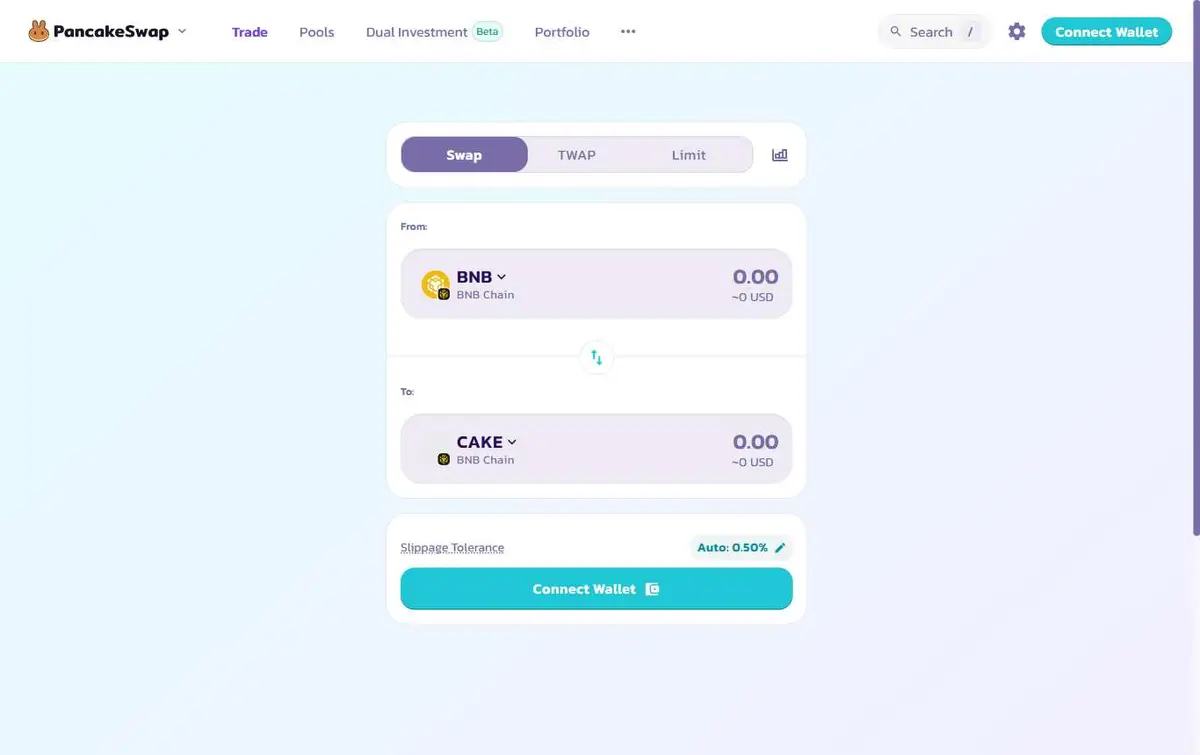
Mexico: the swap page loads with no barrier
“Connect Wallet”
No barrier Ireland · Trading app
Ireland: the swap app loads with no notice
No barrier New Zealand · Trading app
New Zealand: the swap app loads with no notice
No barrier Norway · Trading app
Norway: the swap app loads with no notice
No barrier Finland · Trading app
Finland: the swap app loads with no notice
No barrier Greece · Trading app
Greece: the swap app loads with no notice
No barrier Bulgaria · Trading app
Bulgaria: the swap app loads with no notice
No barrier Croatia · Trading app
Croatia: the swap app loads with no notice
No barrier Latvia · Trading app
Latvia: the swap app loads with no notice
No barrier Estonia · Trading app
Estonia: the swap app loads with no notice
No barrier Lithuania · Trading app
Lithuania: the swap app loads with no notice
No barrier Slovenia · Trading app
Slovenia: the swap app loads with no notice
No barrier Iceland · Trading app
Iceland: the swap app loads with no notice
No barrier Serbia · Trading app
Serbia: the swap app loads with no barrier
 CRYPTORESTRICTIONS
Unlike the trading apps of Hyperliquid, which blocked US IP addresses in its own test, PancakeSwap’s swap page showed an American visitor the same screen as a German one. The country rules are in the terms and the perps product, not in an IP check on the swap page.

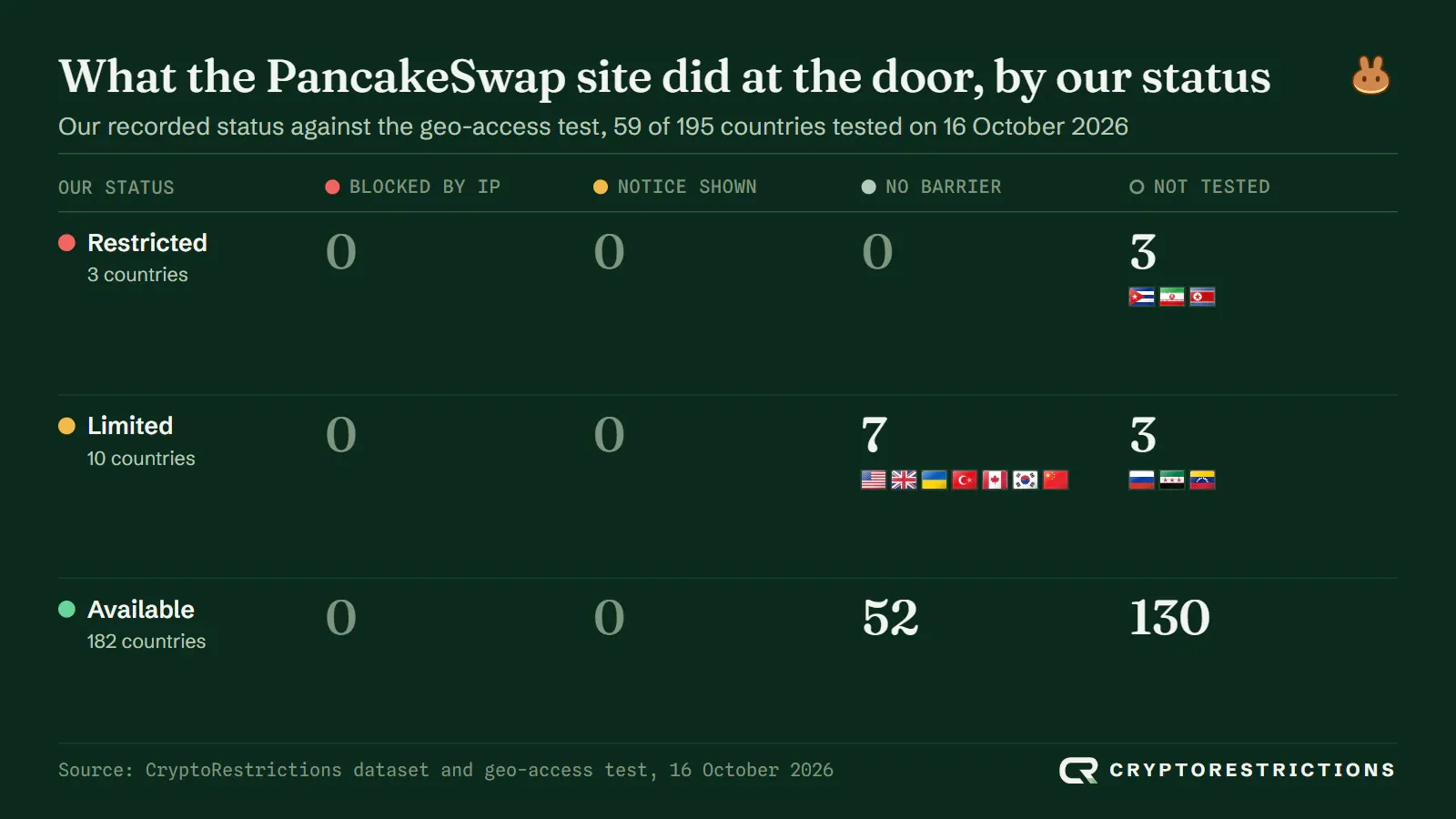
The “no barrier” cells mean only that the page loaded: with no account to verify, the swap page enforces nothing at the door, and the three restricted countries, which we could not reach, are the places where it matters most. The full result for every place is below.
All 61 test results, country by country
PancakeSwap licences and registrations
PancakeSwap holds no licence or registration anywhere that we could find, and its terms say it is not registered with the US SEC “or in any other capacity”.
The terms describe the website as one, but not the exclusive, way to reach the PancakeSwap protocol, which runs as smart contracts on BNB Chain and other networks, and they name no operating company. They say PancakeSwap does not broker orders: trades settle on the blockchains themselves. That is why our statuses describe the website, not every route to the contracts. We found no warning naming PancakeSwap from the FCA, MAS, the Thai SEC or the SEC in the US, though absence from our searches is not a clearance. The one block we found is Turkey’s.
PancakeSwap and MiCA in the EU
PancakeSwap has no MiCA authorisation: no PancakeSwap entity appears in ESMA’s register of crypto-asset service providers, which we checked on 17 October 2026.
Whether it needs one is the open question for every decentralised exchange. MiCA says in recital 22 that crypto-asset services “provided in a fully decentralised manner without any intermediary” should fall outside the regulation. The terms name no company behind the website, and no EU regulator has taken action against PancakeSwap that we found. That is why we record the EEA as available here, unlike the centralised exchanges that closed new EEA accounts at the MiCA deadline. The swap page loaded in 28 of the 30 EEA states, every one we tested; Liechtenstein and Malta were not among them.
Is PancakeSwap available in the US?
Yes, for the website. US residents are not barred from the swap page and no US state is excluded, but PCS Perps bars the United States, so we record the country as limited.
The terms add a US rule of their own: the prohibited-activity clause forbids using the website to offer “leveraged and margined commodity products to retail customers” in the United States. Initial Farm Offerings exclude the US and its territories, most of the stock-token issuers exclude it, and in the Buy Crypto docs MoonPay and Transak list BNB as non-US. Our test loaded the swap page from a US address with no banner.
PancakeSwap availability by US state
PancakeSwap regulators and access rules
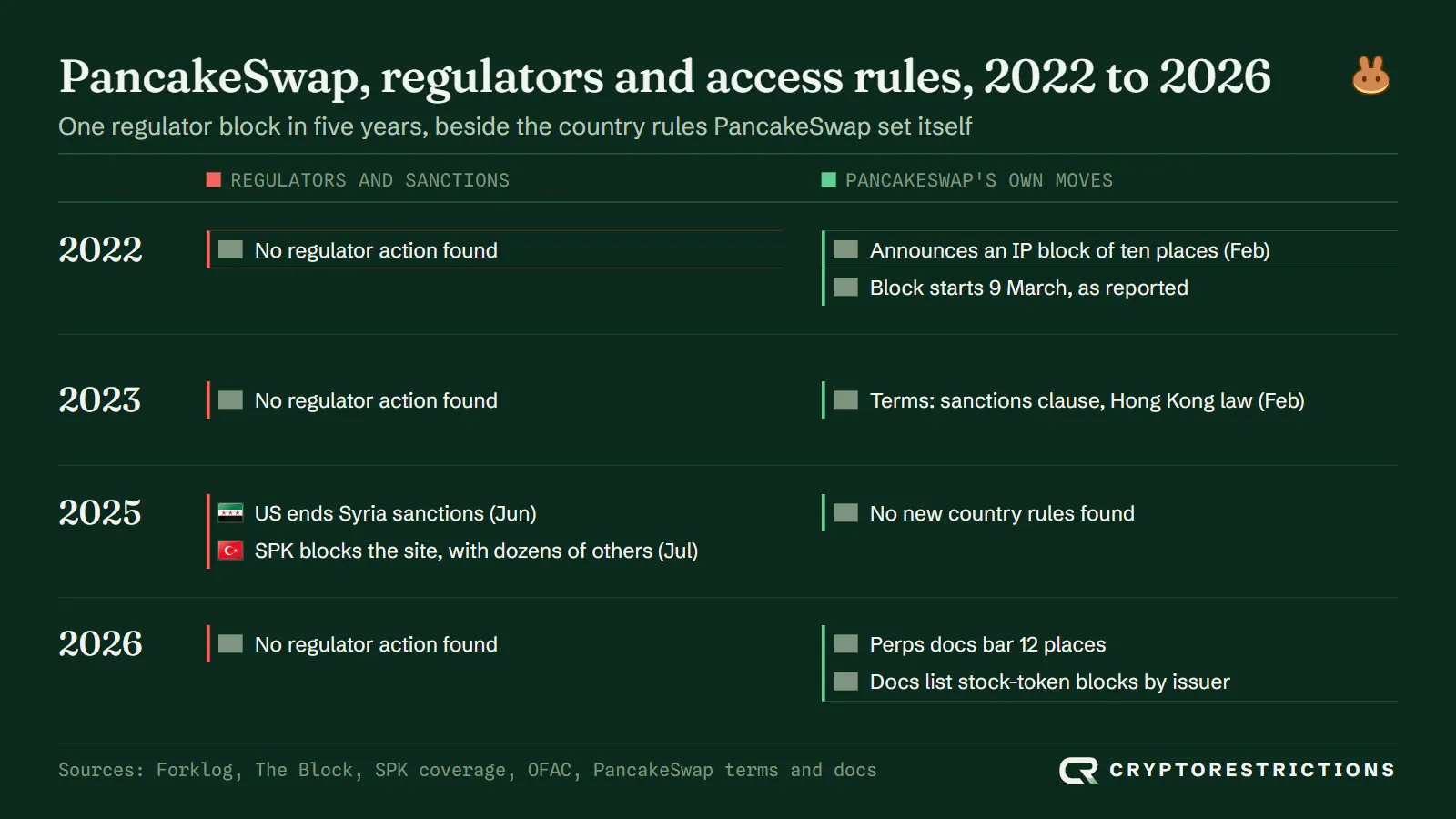
We found no CFTC, SEC or Justice Department action against PancakeSwap, and no regulator warning outside Turkey. The sequence is short. In February 2022 PancakeSwap reportedly planned an IP block of ten places, described above. In February 2023 it published the current terms. In July 2025 Turkey’s SPK blocked the website, and the end of US sanctions on Syria took that country out of the terms’ clause. The 2026 additions are product rules in the docs: the perps list and the issuer lists for stock tokens, neither dated on the page.
PancakeSwap KYC and identity verification
PancakeSwap asks for no identity documents: you connect a self-custody wallet and, in the docs’ words, no registration or account is needed.
The docs overview gives that line for swaps, and the perps FAQ says PCS Perps needs no KYC either. What you give is a promise. By using the website you state that you are of age, not under sanctions, not a resident of a sanctioned place and that your use follows the laws that apply to you. The terms contain no clause on VPNs.
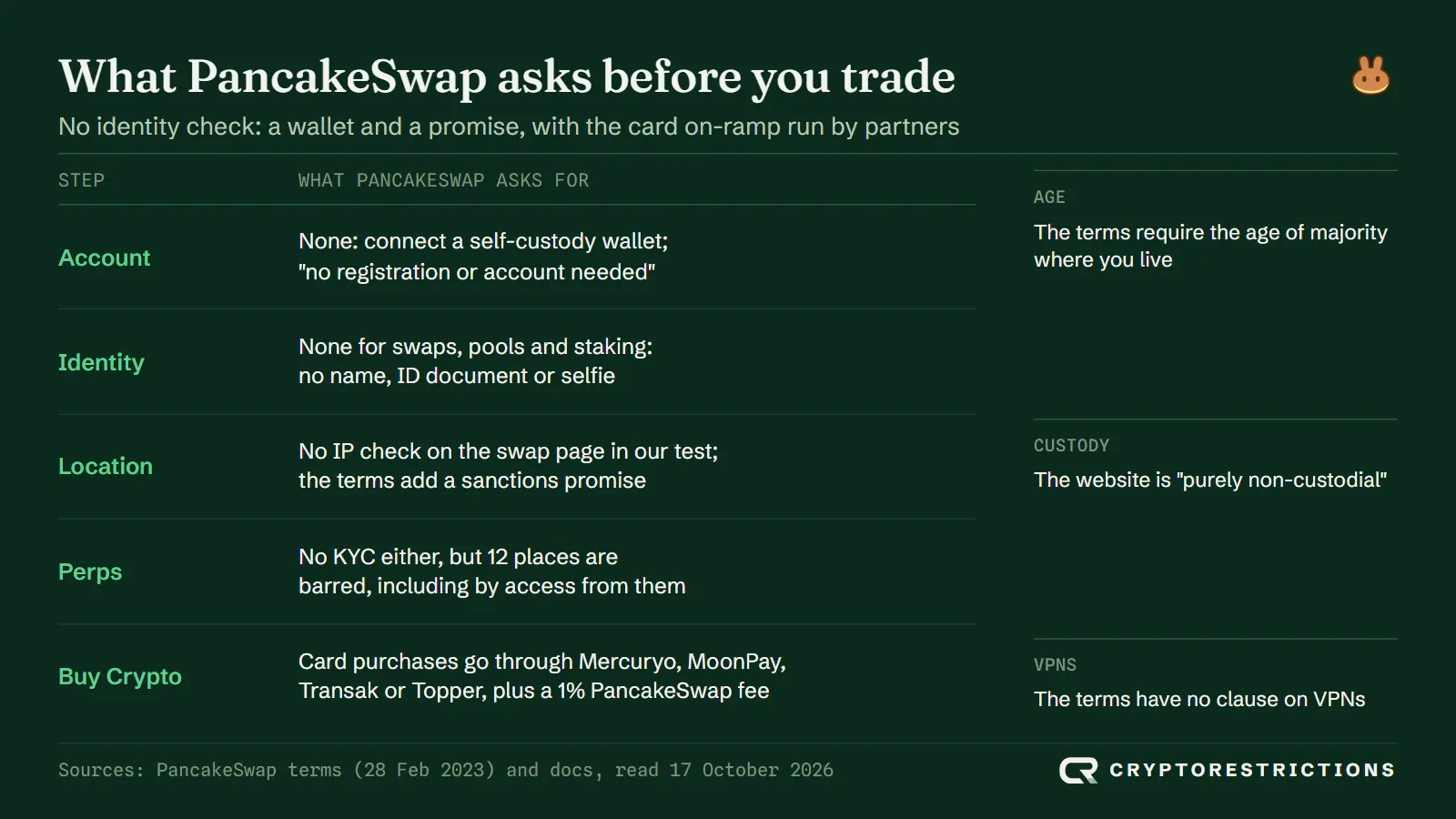
The one place an identity check can appear is the card on-ramp. The Buy Crypto page routes purchases through Mercuryo, MoonPay, Transak and Topper, adds PancakeSwap’s own 1% fee, and says the partners comply with all applicable regulations. It does not describe their identity checks, which are theirs to run.
PancakeSwap verification history
We found no record that PancakeSwap has ever asked for identity documents on the swap page, and no announced plan to. What has changed is the list of places: the 2022 IP block report, the Feb 2023 terms, and the 2026 perps and stock-token lists.
What if PancakeSwap is restricted where you live?
It depends on the country: of the 21 other platforms we track, 16 are available in Turkey, but only one in Cuba, Iran and North Korea.
The terms bar residents and citizens of sanctioned places, and the perps FAQ bars both living in and accessing the product from one of the twelve places. The terms say nothing about VPNs. Other front ends to the same contracts set their own rules. What is left is a platform allowed to serve you where you live.
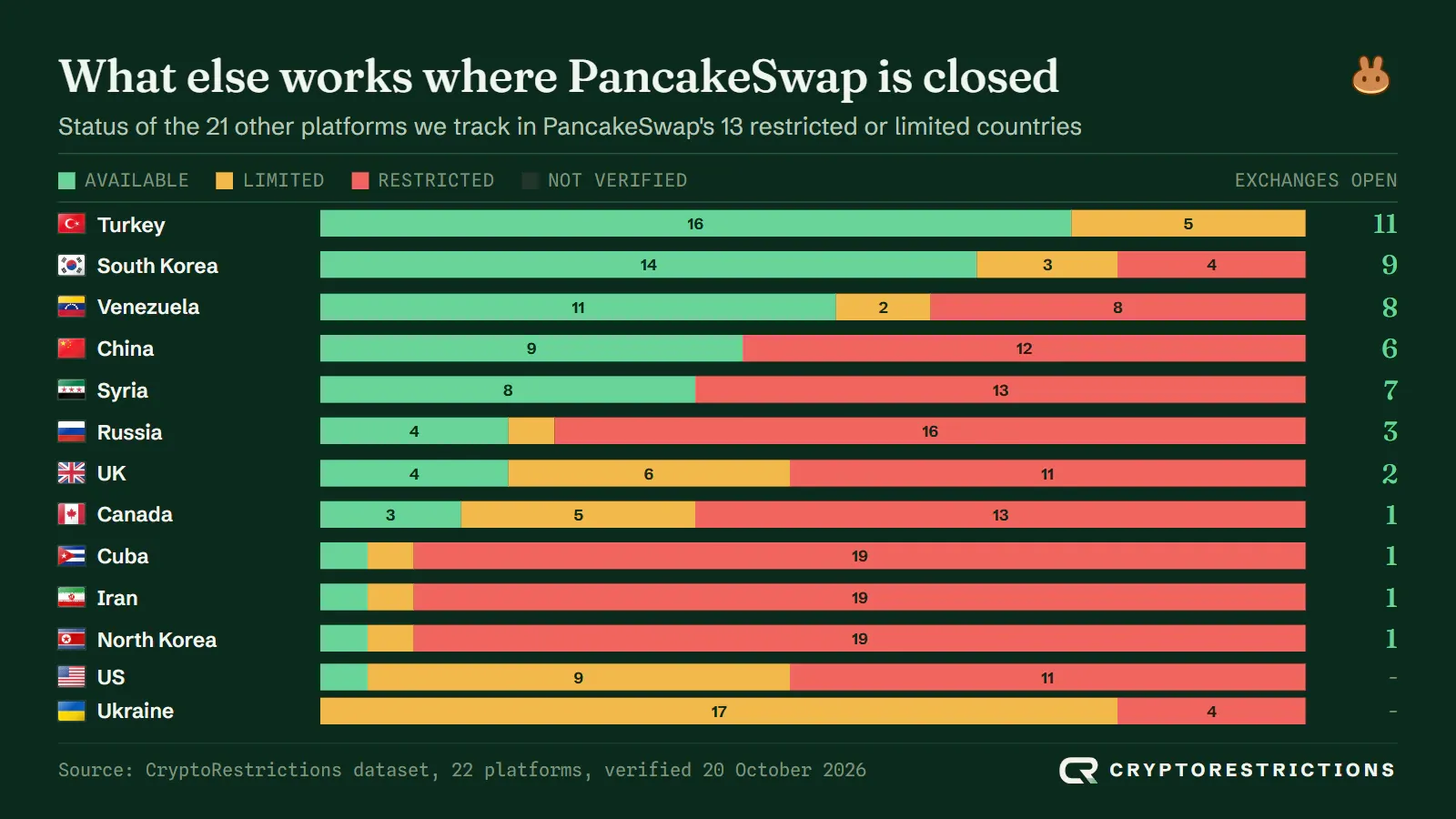
Turkey, where only the website is blocked, keeps 17 platforms open, 12 of them centralised exchanges. In the United States the field narrows to one platform available and nine limited, and in Ukraine none is available. Canada and the United Kingdom, two of the perps exclusions, leave three and four.
For a country-by-country comparison of exchanges, with residency rules and licences side by side, see our guide to exchange alternatives by country.