
 United States · OR
Is crypto legal in Oregon?
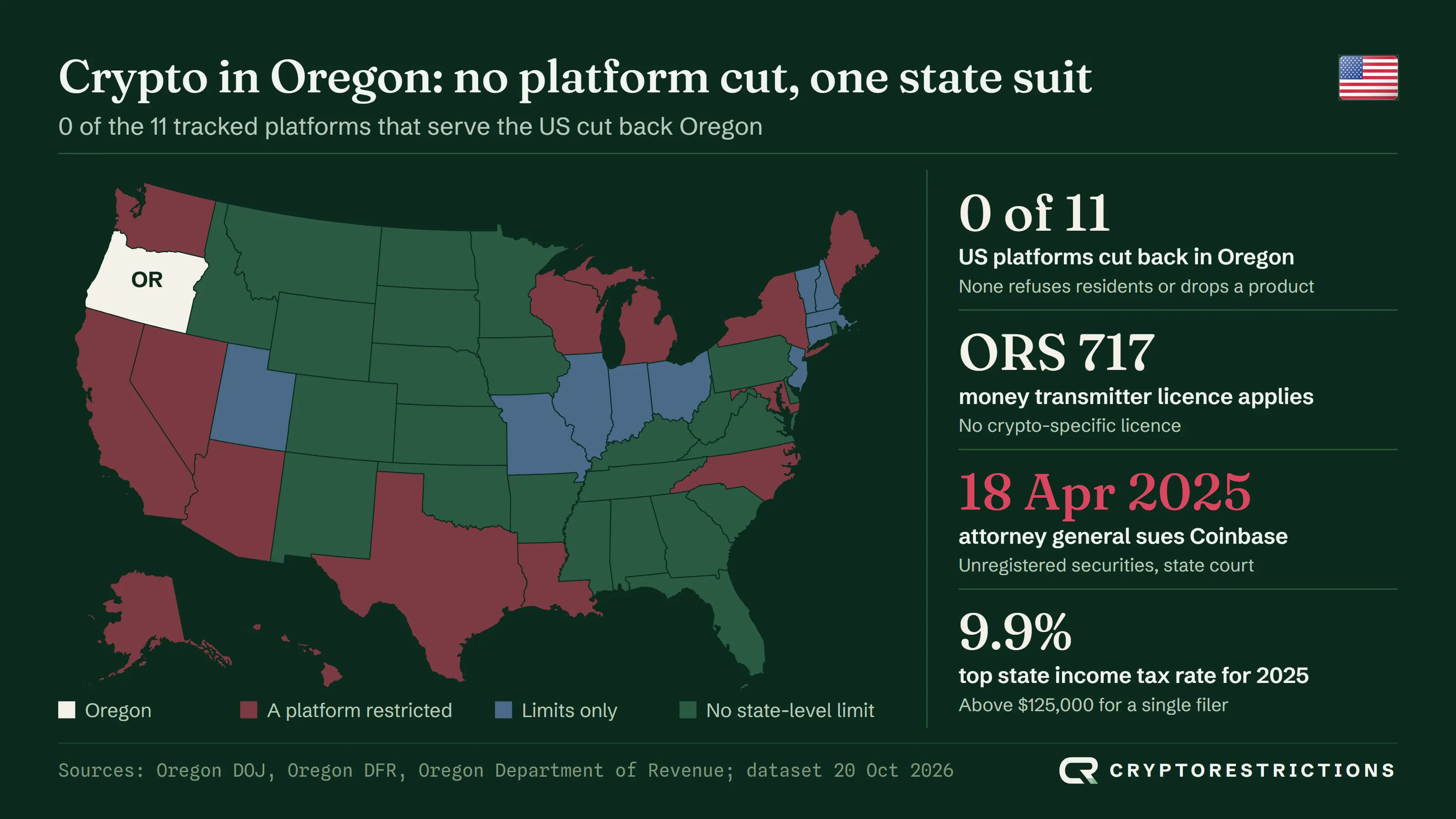
Yes. Owning and trading crypto is legal in Oregon, and the state has no crypto-specific licence: businesses that sell, issue or exchange virtual currency need an ordinary money transmitter licence from the Division of Financial Regulation.
The Division of Financial Regulation (DFR) says that anyone who sells or issues virtual currency, or runs a virtual currency exchange, needs a money transmitter licence under Oregon Revised Statutes chapter 717. Oregon reads the statute’s definition of “money” (ORS 717.200) to cover virtual currency, so no separate digital asset licence exists. We found no Oregon law on crypto kiosks in the 2025 or 2026 sessions, and no state bitcoin reserve. Our access to the DFR site was limited, so treat that guidance as the regulator’s position as quoted in search results, not as a page we read in full.
Federal rules from the SEC, CFTC, Treasury and IRS apply on top, as in every state, and offshore exchanges that refuse US users refuse Oregonians too. Both are covered in our United States guide.
Which crypto licences does Oregon require?
A money transmitter licence under ORS chapter 717, for firms that handle customer money or transfer virtual currency. We could not read the DFR licensee list, so we show no licence for any tracked exchange rather than guess.
Gemini publishes an Oregon availability page for its customers; we did not find the Oregon licence number in text we could read. The licence list that decides who may serve Oregonians sits on the DFR site, which did not load for us on 20 October 2026. Where an exchange’s Oregon licence is not confirmed in a document we read, we do not credit it in the access score.
Best crypto platforms for Oregon residents
No platform we track cuts Oregon back, so its scores match the US scores: Gemini (8.4 out of 10), Kraken (8.3) and Coinbase (7.9) are the most open exchanges, Kalshi (7.3) the most open prediction market and Uniswap (8.0) the most open DeFi platform.
The score rates how fully an Oregon resident can use each platform, not its fees or safety. It is the US score with Oregon’s own limits applied: access status (4 points), the share of the platform’s products open in the state (3), the licences we hold on file (2) and what our geo-access test saw from a US address (1). Oregon has no state rows, so nothing is subtracted. The method is on our methodology page.
Exchanges

Gemini
Best for Plain spot trading in dollars
8.4/10- Access
- 3.5/4
- Products
- 1.9/3
- Licences
- 2/2
- Our test
- 1/1
Read our Gemini reportPros
- Gemini has a dedicated Oregon availability page
- Spot is open in all 50 states
Cons
- Gemini Derivatives excludes US persons

Kraken
Best for A wide coin list, with staking
8.3/10- Access
- 3/4
- Products
- 2.3/3
- Licences
- 2/2
- Our test
- 1/1
Read our Kraken reportPros
- Oregon is on Kraken's US onchain staking list
- US futures through Kraken Derivatives US
Cons
- Fiat deposits are USD only for US residents

Coinbase
Best for Spot trading plus staking and loans
7.9/10- Access
- 3.5/4
- Products
- 2.4/3
- Licences
- 1/2
- Our test
- 1/1
Read our Coinbase reportPros
- Spot is open in every state, Oregon included
- No Oregon carve-out for staking or loans in our data
Cons
- Oregon's attorney general is suing it over unregistered securities
- Staking is cut in four other states

Crypto.com
Best for The App for spot trading
7.5/10- Access
- 3/4
- Products
- 1.5/3
- Licences
- 2/2
- Our test
- 1/1
Read our Crypto.com reportPros
- The App is available in 49 states, Oregon included
Cons
- The Exchange does not offer US residents derivatives

Bitstamp
Best for Plain spot trading
6.6/10- Access
- 3/4
- Products
- 0.6/3
- Licences
- 2/2
- Our test
- 1/1
Read our Bitstamp reportPros
- Does not bar Oregon; only Hawaii and Nevada are excluded
Cons
- No staking or lending in the US
- No derivatives for US customers
Prediction markets

Kalshi
Best for The broadest CFTC-regulated event contracts
7.3/10- Access
- 3/4
- Products
- 2.3/3
- Licences
- 1/2
- Our test
- 1/1
Read our Kalshi reportPros
- CFTC-regulated US exchange
- No Oregon order makes it geofence the state
Cons
- Other states have won court rulings against its sports contracts

Polymarket
Best for Polymarket markets on a US exchange
6.3/10- Access
- 3/4
- Products
- 2.3/3
- Licences
- 1/2
- Our test
- 0/1
Read our Polymarket reportPros
- Polymarket US is a CFTC-designated exchange
- No Oregon order stops it
Cons
- polymarket.com itself blocks US users
DeFi

Uniswap
Best for Swapping tokens from your own wallet
8.0/10- Access
- 4/4
- Products
- 3/3
- Licences
- 0/2
- Our test
- 1/1
Read our Uniswap reportPros
- Terms do not exclude Oregon
- No US state is named in its terms
Cons
- Leveraged products for US retail are barred

PancakeSwap
Best for BNB Chain swaps and pools
6.3/10- Access
- 3.5/4
- Products
- 1.8/3
- Licences
- 0/2
- Our test
- 1/1
Read our PancakeSwap reportPros
- Swaps, pools and staking are not excluded
Cons
- PCS Perps bars US users
- No US licence on file
Which platforms block or limit Oregon residents?
None of the platforms we track blocks or limits Oregon residents. We found no platform document that names Oregon as excluded for any product.
Kraken’s US quick start page, updated on 30 March 2026, names Oregon among the states where onchain staking is available and excludes only New York and Maine. Crypto.com’s state availability page, updated on 15 September 2025, lists Oregon among 49 states and excludes only New York. Some other platform pages would not load for our tools, so this list is a check of what we could read, not proof that no limit exists. Where a platform treats the rest of the US differently from a state, the United States guide covers it.
Who regulates crypto in Oregon?
The Division of Financial Regulation licenses money transmitters, the Department of Justice under Attorney General Dan Rayfield enforces the state’s securities law against crypto sellers, and the Legislature has so far written only a commercial-law update.
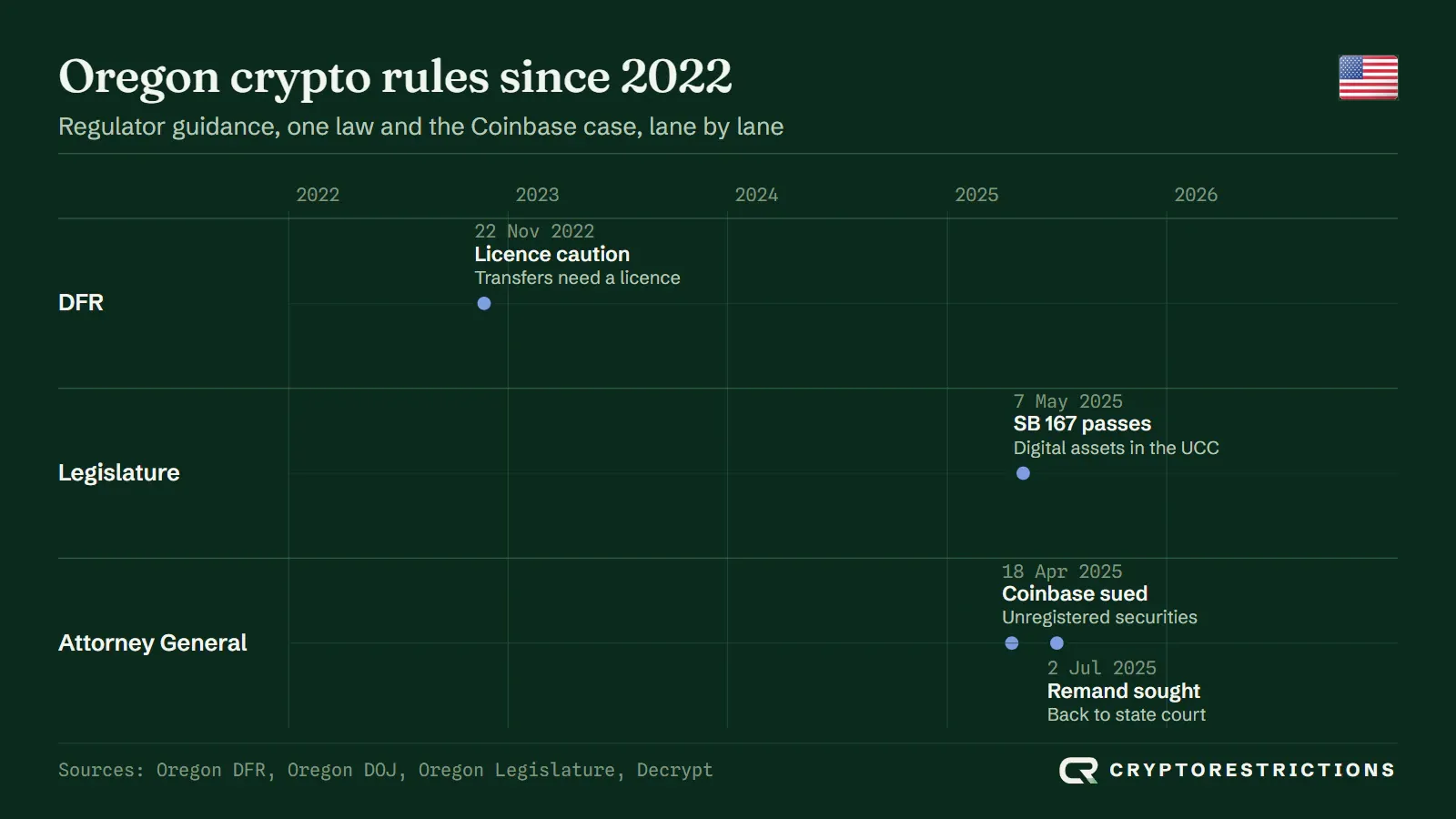
- DFR. Its guidance puts crypto sellers, issuers and exchange operators under the money transmitter law. A November 2022 DFR release repeated that firms moving digital currency for people need a licence; we saw that release only in a search excerpt.
- Legislature. SB 167 in 2025 added the Uniform Commercial Code’s rules for digital assets and other controllable electronic records. It is a commercial-law update, not a licensing law, and reports differ on whether the Governor signed it on 7 May or later.
- Attorney General. On 18 April 2025 Oregon sued Coinbase in Multnomah County Circuit Court under the Oregon Securities Law, alleging it encouraged and facilitated sales of unregistered crypto to Oregonians. The complaint cites ICP, which fell from about $700 to $72 within a month of listing. Coinbase moved the case to federal court, and Oregon asked on 2 July 2025 to send it back. We found no ruling after that. These are the state’s allegations, not findings.
Are prediction markets legal in Oregon?
We found no Oregon order, lawsuit or Lottery action against Kalshi, Polymarket or any other event-contract platform, so they remain available in Oregon in our data. That can change: other states have won court rulings that let them enforce gambling law.
Oregon has no state law on event contracts that we could find. The fights that have already forced geofences or court rulings in other states are covered in our United States guide.
How is crypto taxed in Oregon?
Oregon taxes personal income in four brackets, from 4.75% to 9.9% for 2025, with the top rate starting above $125,000 for a single filer. The Department of Revenue’s guide sets no separate crypto rate.
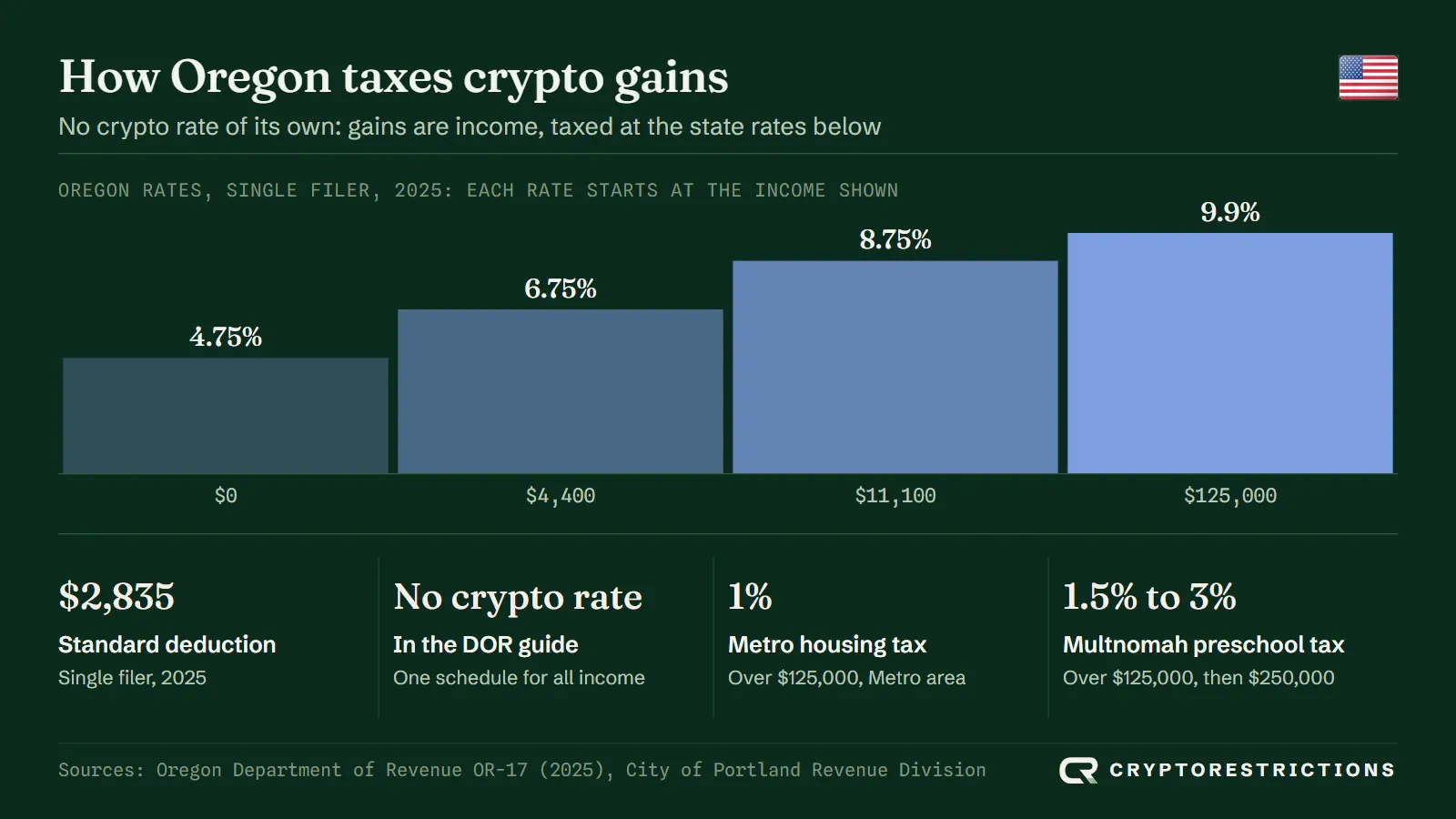
The Department of Revenue’s OR-17 guide lists the 2025 rates for a single filer as 4.75% on the first $4,400, 6.75% to $11,100, 8.75% to $125,000 and 9.9% above that. Married couples filing jointly and heads of household reach each step at double the single amounts, except that the top rate starts at $250,000. The standard deduction for a single filer is $2,835. The guide does not mention crypto, so a gain is taxed as part of income at these rates; that is our reading, not a Revenue Department statement.
Some Portland-area residents pay more. The City of Portland Revenue Division lists a 1% Metro supportive housing tax on income over $125,000 (single) or $200,000 (joint), and a Multnomah County preschool tax of 1.5% over the same thresholds plus another 1.5% over $250,000 (single) or $400,000 (joint). How a crypto gain or loss is counted is a federal question, covered in our United States guide.








