 United States · NC
Is crypto legal in North Carolina?
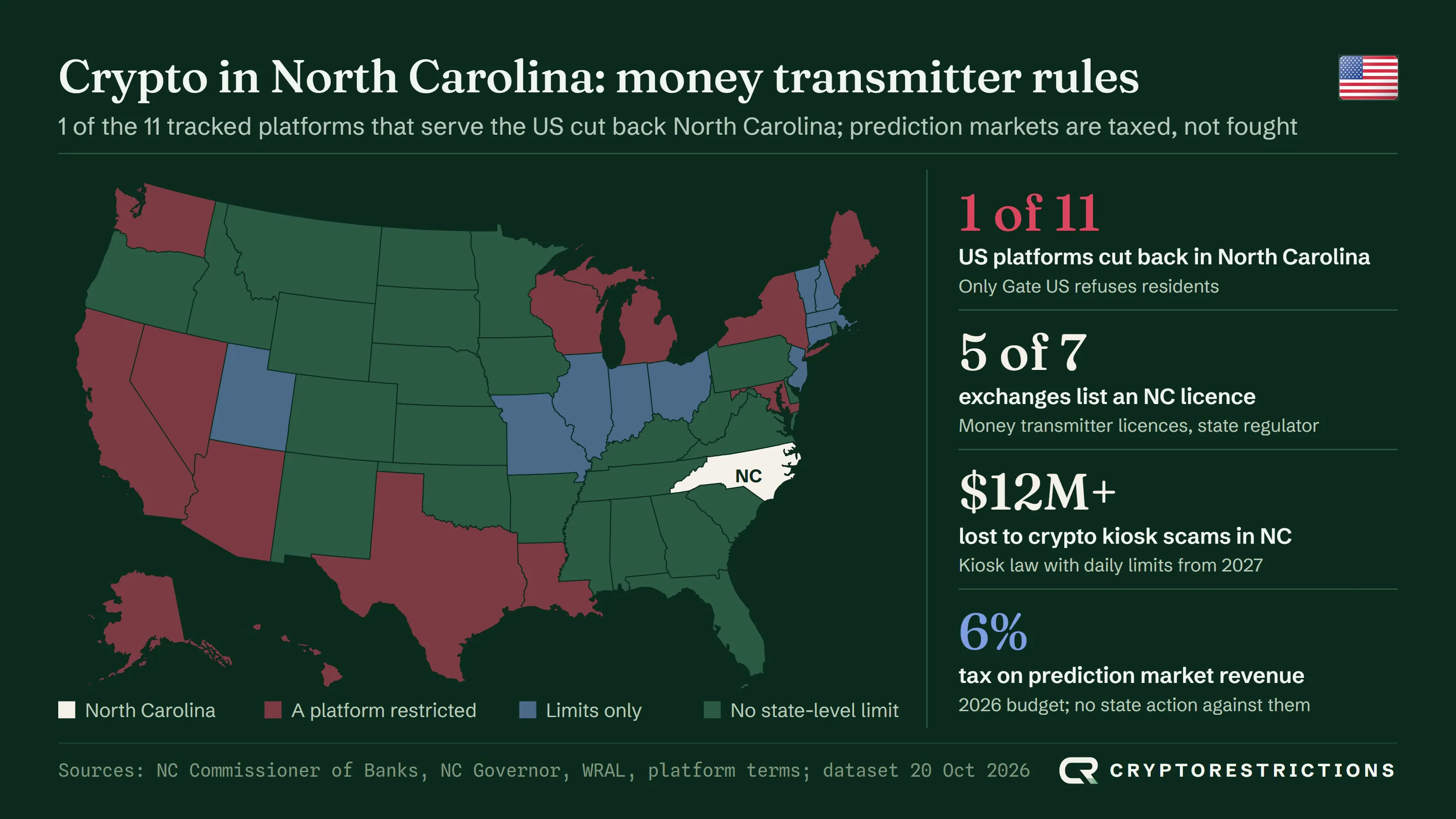
Yes. Owning and trading crypto is legal in North Carolina, and a firm that transmits or holds crypto for residents needs a money transmitter licence from the Commissioner of Banks. There is no separate crypto licence.
North Carolina regulates crypto under its Money Transmitters Act (G.S. 53, Article 16B), which the Commissioner of Banks treats as in force since 1 October 2016. The regulator’s FAQ says the act covers virtual currency and that one licence applies to every transmitter. That licence is perpetual, with no renewal, and it lists “Virtual Currency exchange or holding” among the authorized activities. A firm that advertises to North Carolinians on a website counts as doing business in the state, and any company running a crypto kiosk needs the licence.
The Commissioner leaves three things outside the act: self-custody wallets, multi-signature providers that cannot sign a transaction alone, and software uses such as smart contracts. People who only hold crypto need no licence.
Federal rules from the SEC, CFTC, Treasury and IRS apply on top, as in every state, and offshore exchanges that refuse US users refuse North Carolinians too. Both are covered in our United States guide.
Which crypto licences does North Carolina require?
A Money Transmitter License from the Commissioner of Banks. Of the seven US exchanges we track, five list one on their own pages: Coinbase, Gemini, Bitstamp, OKX US and Crypto.com. Kraken’s page lists none, and Gate US does not serve the state.
The Commissioner’s online licensee list was not readable for this guide, so the table shows what each exchange says on its own licence page. The surety bond starts at $150,000, according to the regulator’s FAQ.
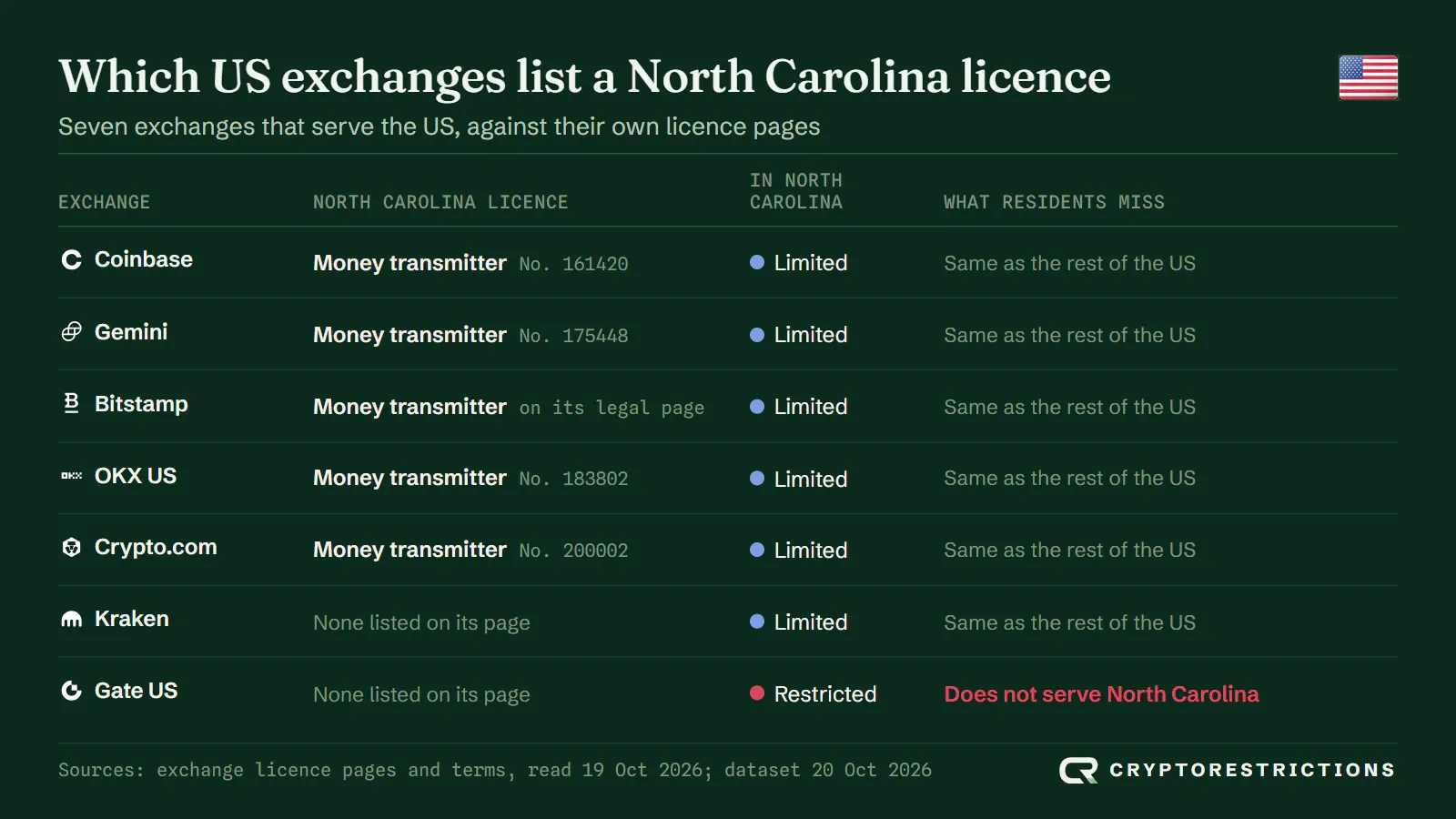
A licence does not widen what an exchange offers. The five that list one serve North Carolina on the same terms as the rest of the US, and Kraken does too, with only New York and Maine excluded. The one exchange that cuts the state back is Gate.

Best crypto platforms for North Carolina residents
By our access score inside North Carolina, Gemini (8.4 out of 10) and Kraken (8.3) are the most open exchanges, Kalshi (7.3) the most open prediction market and Uniswap (8.0) the most open DeFi platform.
The score rates how fully a North Carolina resident can use each platform, not its fees or safety. It is the US score with North Carolina’s own limits applied: access status (4 points), the share of the platform’s products open in the state (3), the licences we hold on file (2) and what our geo-access test saw from a US address (1). Platforms that refuse North Carolinians are not scored. The method is on our methodology page.
Exchanges

Gemini
Best for Spot trading with staking open
8.4/10- Access
- 3.5/4
- Products
- 1.9/3
- Licences
- 2/2
- Our test
- 1/1
Read our Gemini reportPros
- Money transmitter licence 175448 in North Carolina
- Staking (Asset Rewards) open to North Carolina residents
- Prediction markets for US residents
Cons
- Gemini Derivatives excludes US persons
- Sports contracts stopped in Connecticut in October 2026

Kraken
Best for Regulated futures for US residents
8.3/10- Access
- 3/4
- Products
- 2.3/3
- Licences
- 2/2
- Our test
- 1/1
Read our Kraken reportPros
- Serves North Carolina: only New York and Maine are excluded
- US futures through a CFTC-registered futures commission merchant
Cons
- No North Carolina licence listed on its page
- Does not serve New York or Maine

Coinbase
Best for The widest product range in the state
7.9/10- Access
- 3.5/4
- Products
- 2.4/3
- Licences
- 1/2
- Our test
- 1/1
Read our Coinbase reportPros
- Money transmitter licence 161420 in North Carolina
- Staking, loans and DEX trading are not excluded here
- Prediction markets offered in North Carolina
Cons
- No new staking in California, Maryland, New Jersey or Wisconsin
- Prediction markets closed in Nevada and Michigan

Bitstamp
Best for Plain spot trading
6.6/10- Access
- 3/4
- Products
- 0.6/3
- Licences
- 2/2
- Our test
- 1/1
Read our Bitstamp reportPros
- Lists a North Carolina money transmitter licence
- Serves the state with no carve-out in its US terms
Cons
- No derivatives, staking or lending in the US
- Does not serve Hawaii or Nevada

OKX
Best for Spot and conversions from a global brand
6.0/10- Access
- 3/4
- Products
- 1.5/3
- Licences
- 1/2
- Our test
- 0.5/1
Read our OKX reportPros
- Money transmitter licence 183802 in North Carolina
- okx.com redirects US visitors to OKX United States
Cons
- Spot and OTC conversions only: no derivatives
- Does not serve New York or four US territories
Prediction markets
Kalshi
Best for The broadest CFTC-regulated event contracts
7.3/10- Access
- 3/4
- Products
- 2.3/3
- Licences
- 1/2
- Our test
- 1/1
Read our Kalshi reportPros
- CFTC-designated contract market and clearing house
- No North Carolina action against it that we found
Cons
- Court orders geofence Nevada, Washington and Michigan
- North Carolina taxes prediction market revenue from residents

Polymarket
Best for Polymarket markets on a US-regulated exchange
6.3/10- Access
- 3/4
- Products
- 2.3/3
- Licences
- 1/2
- Our test
- 0/1
Read our Polymarket reportPros
- Polymarket US (QCX LLC) is a CFTC-designated exchange
- No North Carolina action against it that we found
Cons
- polymarket.com itself blocks US users
- North Carolina taxes prediction market revenue from residents
DeFi

Uniswap
Best for Swapping tokens from your own wallet
8.0/10- Access
- 4/4
- Products
- 3/3
- Licences
- 0/2
- Our test
- 1/1
Read our Uniswap reportPros
- Terms do not exclude North Carolina
- SEC closed its investigation with no action in February 2025
Cons
- Leveraged products for US retail are barred
- CFTC fined Uniswap Labs $175,000 in 2024 over leveraged tokens

PancakeSwap
Best for BNB Chain swaps and pools
6.3/10- Access
- 3.5/4
- Products
- 1.8/3
- Licences
- 0/2
- Our test
- 1/1
Read our PancakeSwap reportPros
- Swaps, pools and staking are not excluded by the terms
Cons
- PCS Perps bars users in the United States
- No US licence on file
Which platforms block or limit North Carolina residents?
Only one that serves the rest of the US: Gate US lists North Carolina among the jurisdictions where it does not operate. No other tracked platform names the state as excluded in the documents we read.
Gate US gives the same answer for Alaska, Louisiana, New York, Texas, Washington and the US Virgin Islands, and its licence table has no North Carolina entry. For the strictest state, where three exchanges refuse residents, see the New York guide.
Who regulates crypto in North Carolina?
The Commissioner of Banks licenses crypto firms as money transmitters, the Attorney General and the Secretary of State warn consumers about scams, and the General Assembly has passed a kiosk law, a ban on state use of a central bank digital currency and a prediction market tax. A bill to invest state funds in crypto has not become law.
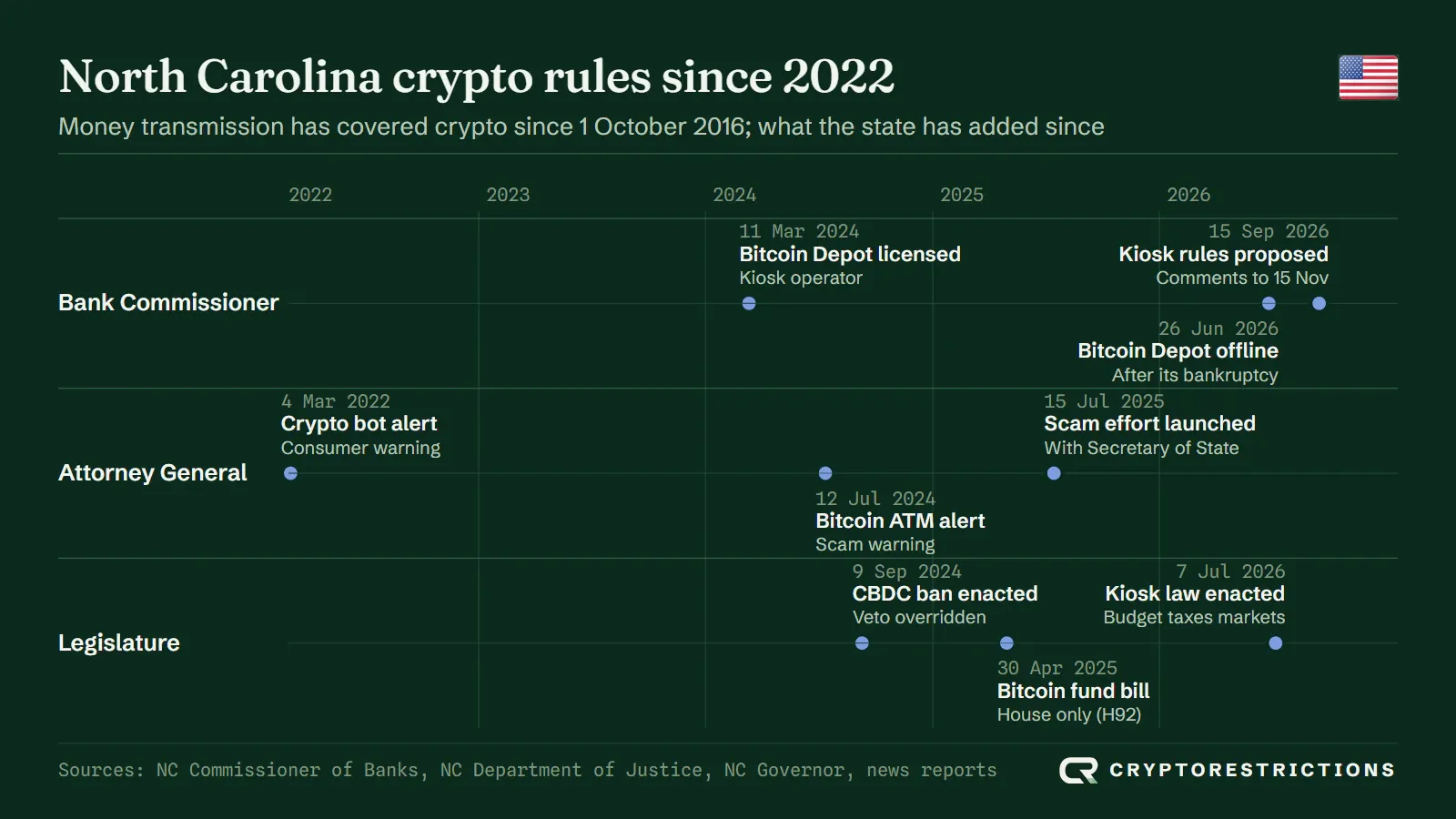
- Commissioner of Banks. Bitcoin Depot, a kiosk operator, was licensed on 11 March 2024. It filed for bankruptcy on 18 May 2026, and the Commissioner’s notice of 26 June 2026 says it took its kiosks offline and stopped operating in the state; customers can claim against its surety bond. On 15 September 2026 the Commissioner published proposed kiosk rules, open for comment until 15 November 2026.
- Kiosk law. Governor Stein signed House Bill 920 on 7 July 2026. It requires kiosks to be licensed and regulated under state law, with daily transaction limits, scam alert signs, live customer service, receipts and the right to cancel a transaction in progress. The Governor’s release cites more than $12 million lost in North Carolina to kiosk scams. The proposed rules would take effect on 1 January 2027.
- Attorney General. The Department of Justice issued a Bitcoin ATM alert on 12 July 2024, and on 15 July 2025 the Attorney General and the Secretary of State launched a joint effort against crypto ATM scams.
- General Assembly. House Bill 690 barred state agencies from accepting central bank digital currency payments. The Governor vetoed it on 5 July 2024 and the Senate completed the override on 9 September 2024. House Bill 92, which would let the Treasurer invest up to 5% of designated funds in digital assets, passed the House 71 to 44 on 30 April 2025 and has not become law.
Are prediction markets legal in North Carolina?
In practice, yes. We found no North Carolina cease-and-desist letter, lawsuit or court order against any prediction market, and the 2026 budget taxes them at 6% of net revenue instead of licensing them.
North Carolina is the opposite of New York, which has sued four platforms. The state’s betting regulator is the State Lottery Commission, which oversees sports wagering under the law the Governor signed on 14 June 2023. In its place the legislature moved on prediction markets in 2026:
- 27 May 2026. Executive Order 37 bars state employees from trading on prediction markets with nonpublic work information. It does not address whether the platforms are legal.
- 30 April 2026. House Bill 1171 would make betting on a prediction market a misdemeanor. It was sent to the House Rules committee on 4 May 2026 and has not moved.
- 7 July 2026. The governor signed the state budget. WRAL reports that it authorizes prediction market companies in the state, sets a 6% tax on their net revenue and imposes no rules or licence on them, while the sportsbook tax rises from 18% to 23%. The budget text itself could not be read for this guide.
- 7 October 2026. The Attorney General joined 38 other states and DC in a Supreme Court brief against Kalshi in a New Jersey case. That is a filing in another state’s dispute, not an action against a platform in North Carolina.
How is crypto taxed in North Carolina?
North Carolina starts from your federal adjusted gross income, so a crypto gain is taxed as the IRS treats it and then at one flat rate: 4.25% for 2025 and 3.99% for 2026.
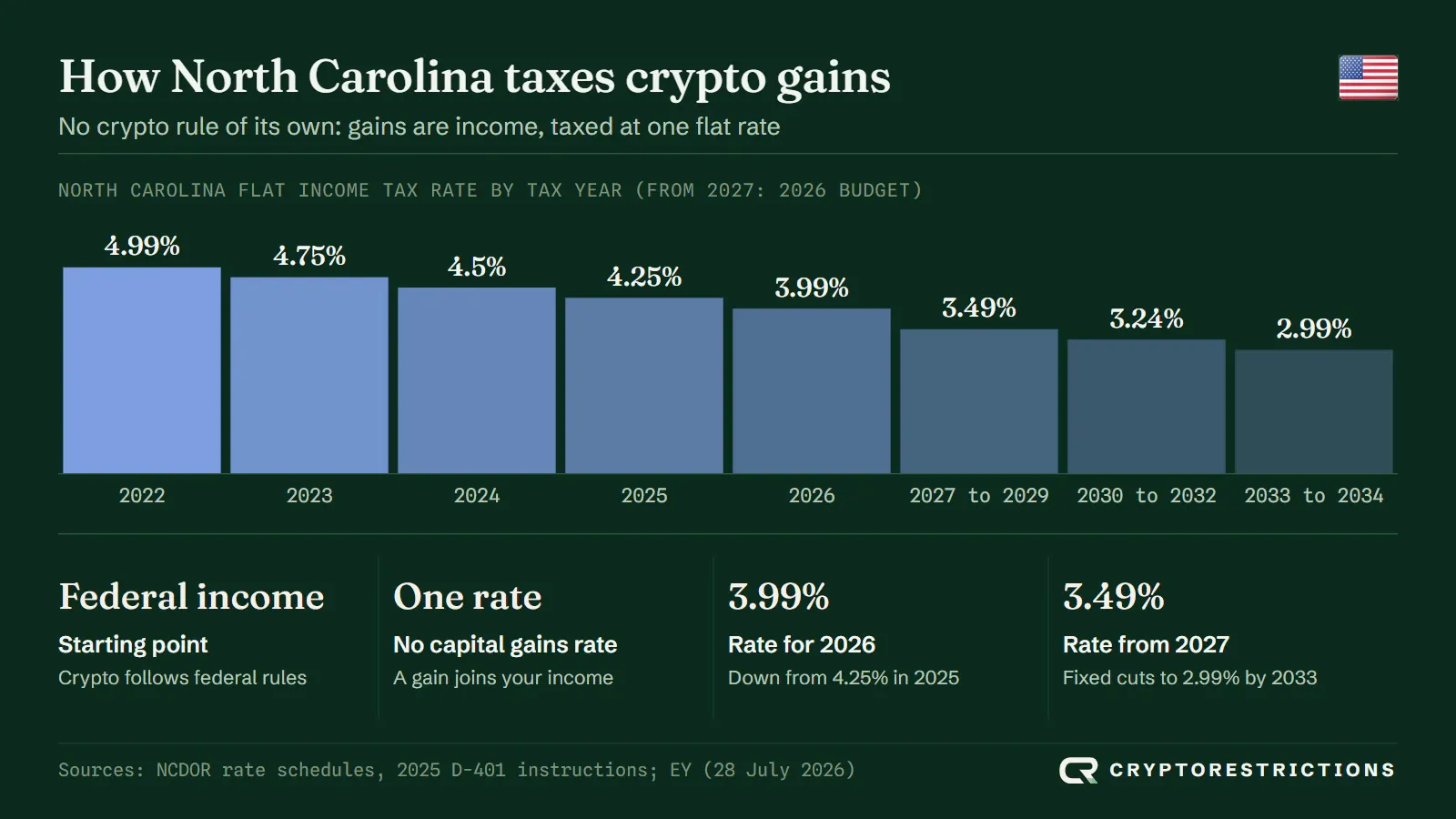
The 2025 D-401 instructions name federal adjusted gross income as the starting point, so there is no separate rate for capital gains: a gain is added to income. The Department of Revenue’s rate page sets 4.25% for 2025 and 3.99% for later years. The 2026 budget replaces the revenue-triggered cuts with fixed ones, which EY reports as 3.49% for 2027 to 2029, 3.24% for 2030 to 2032 and 2.99% for 2033 and 2034. The Department’s rate page has not yet been updated for them.
A new itemized deduction for gambling losses applies from tax year 2025, according to a Department of Revenue notice. The prediction market tax is paid by the companies, covered above.