 United States · WV
Is crypto legal in West Virginia?
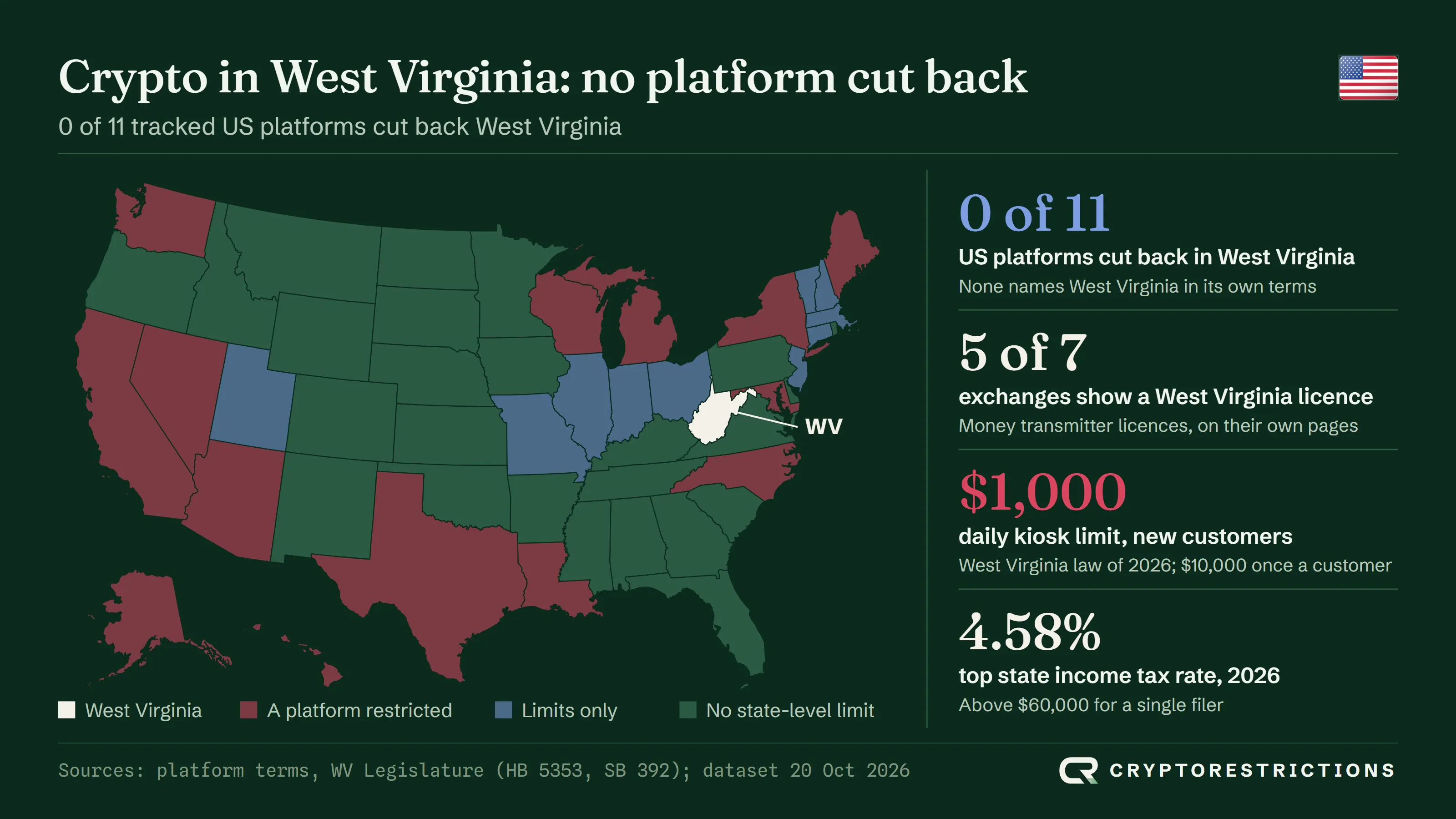
Yes. Owning and trading crypto is legal in West Virginia, and the only crypto-specific law we found is a 2026 act that makes crypto kiosk operators get a money transmitter licence and caps what a kiosk can take from a customer in a day.
The act is House Bill 5353. Its engrossed text adds owning or operating a virtual currency kiosk to the state’s definition of money transmission, so operators come under the Division of Financial Institutions. Existing operators had to apply through NMLS “within 90 days of the effective date” of the section. The engrossed text caps a kiosk’s fee and commission at 15 percent of a transaction and its daily limits at $1,000 for a new customer and $10,000 for an existing one. Law firm Orrick’s summary, dated 16 April 2026, adds refund rights for new customers who are defrauded and holds of up to 72 hours. We read the engrossed bill, not the enrolled one, so check the final wording before relying on a figure; press reports date the Governor’s signature to 1 April 2026.
The kiosk law is about machines. Buying and trading crypto on an exchange is not touched by it, and we could not read the section of the money transmission code as it stood before 2026, so we cannot say whether an exchange needed a state licence for crypto before then. We found no state securities action against a crypto platform. Federal rules from the SEC, CFTC, Treasury and IRS apply on top, as in every state, and offshore exchanges that refuse US users refuse West Virginians too. Both are covered in our United States guide.
Which crypto licences does West Virginia require?
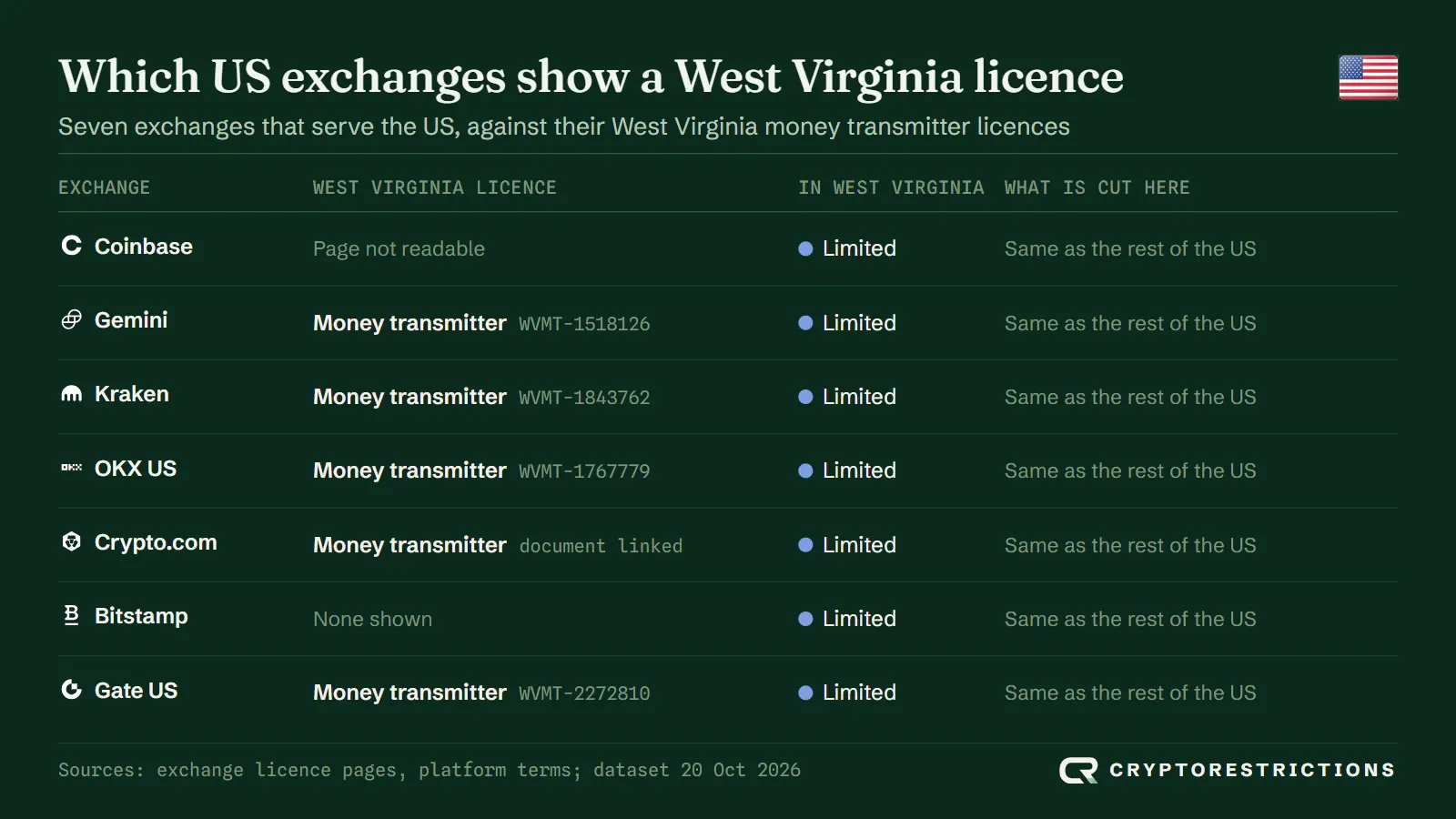
A crypto kiosk operator needs a West Virginia money transmitter licence under the 2026 law. For exchanges we found no crypto-specific licence, and five of the seven US exchanges we track list a West Virginia money transmitter licence on their own pages: Gemini, Kraken, OKX US, Gate US and Crypto.com.
Licences come from the Division of Financial Institutions and are applied for through NMLS. Gemini’s West Virginia page says “Gemini is available in West Virginia” and lists licence WVMT-1518126. Kraken lists WVMT-1843762, OKX lists WVMT-1767779, and Gate US lists WVMT-2272810. Crypto.com’s US legal page links a West Virginia licence document whose text we could not read, so we have no number. Coinbase’s licence page would not load for us, and Bitstamp’s US legal page was empty and no West Virginia licence turned up in a search, so we assert neither. We found no official West Virginia licensee list or count; NMLS Consumer Access is the place to check a firm.
Best crypto platforms for West Virginia residents
By our access score inside West Virginia, the most open exchanges are Gemini (8.4 out of 10), Kraken (8.3) and Coinbase (7.9), the most open prediction market is Kalshi (7.3) and the most open DeFi platform is Uniswap (8.0).
The score rates how fully a West Virginia resident can use each platform, not its fees or safety. It is the US score with West Virginia’s own limits applied: access status (4 points), the share of the platform’s products open in the state (3), the licences we hold on file (2) and what our geo-access test saw from a US address (1). No tracked platform has a West Virginia-specific cut, so the scores track the US ones. The method is on our methodology page.
Exchanges

Gemini
Best for Plain spot trading under one licence
8.4/10- Access
- 3.5/4
- Products
- 1.9/3
- Licences
- 2/2
- Our test
- 1/1
Read our Gemini reportPros
- Its West Virginia page lists licence WVMT-1518126
- Gemini says it is available in West Virginia
Cons
- Fiat deposits are USD only
- Gemini Derivatives excludes US persons

Kraken
Best for A wide coin list, with EUR still open
8.3/10- Access
- 3/4
- Products
- 2.3/3
- Licences
- 2/2
- Our test
- 1/1
Read our Kraken reportPros
- Lists West Virginia licence WVMT-1843762
- Its excluded states are Maine and New York
Cons
- Federal limits on US customers still apply
- Its own pages disagree on which states lose funding

Coinbase
Best for Spot trading plus staking and loans
7.9/10- Access
- 3.5/4
- Products
- 2.4/3
- Licences
- 1/2
- Our test
- 1/1
Read our Coinbase reportPros
- Spot is open in every US state
- Its staking cut-offs name CA, MD, NJ and WI, not West Virginia
Cons
- Its licence page would not load for us, so a West Virginia licence is unconfirmed
- Its prediction markets run through Kalshi

Crypto.com
Best for The App for spot trading
7.5/10- Access
- 3/4
- Products
- 1.5/3
- Licences
- 2/2
- Our test
- 1/1
Read our Crypto.com reportPros
- The App is available in West Virginia; New York is the only state missing
- Its staking exclusions name NY, CA, MD, NJ and WI
Cons
- The Exchange does not offer US residents derivatives
- Its West Virginia licence is a PDF with no number on the page

Bitstamp
Best for Plain spot trading
6.6/10- Access
- 3/4
- Products
- 0.6/3
- Licences
- 2/2
- Our test
- 1/1
Read our Bitstamp reportPros
- No West Virginia carve-out in its US terms
- Spot trading under a New York BitLicense
Cons
- No staking or lending in the US
- We found no West Virginia licence for it

OKX
Best for Spot trading under a US entity
6.0/10- Access
- 3/4
- Products
- 1.5/3
- Licences
- 1/2
- Our test
- 0.5/1
Read our OKX reportPros
- Lists West Virginia licence WVMT-1767779
- Its US licences page excludes only New York and the territories
Cons
- Spot and convert only, no derivatives for US customers
Prediction markets

Kalshi
Best for The broadest CFTC-regulated event contracts
7.3/10- Access
- 3/4
- Products
- 2.3/3
- Licences
- 1/2
- Our test
- 1/1
Read our Kalshi reportPros
- CFTC-designated contract market
- We found no West Virginia order against it
Cons
- Its help centre names no state, so West Virginia status rests on the absence of a carve-out
- Other states are in court with it over sports contracts

Polymarket
Best for Polymarket markets on a US exchange
6.3/10- Access
- 3/4
- Products
- 2.3/3
- Licences
- 1/2
- Our test
- 0/1
Read our Polymarket reportPros
- Polymarket US is a CFTC-designated exchange
- We found no West Virginia action against it
Cons
- polymarket.com itself blocks US users
- No state list is published, so West Virginia status rests on silence
DeFi

Uniswap
Best for Swapping tokens from your own wallet
8.0/10- Access
- 4/4
- Products
- 3/3
- Licences
- 0/2
- Our test
- 1/1
Read our Uniswap reportPros
- Terms do not exclude US users
- No US state is named in its terms
Cons
- Leveraged products for US retail are barred

PancakeSwap
Best for BNB Chain swaps and pools
6.3/10- Access
- 3.5/4
- Products
- 1.8/3
- Licences
- 0/2
- Our test
- 1/1
Read our PancakeSwap reportPros
- Swaps, pools and staking are not excluded
Cons
- PCS Perps bars US users
- No US licence on file
Which platforms block or limit West Virginia residents?
None of the platforms we track. We found no tracked exchange, prediction market or DeFi protocol that names West Virginia as excluded or limited in its own terms, licence page or help centre, so West Virginia residents get the same product list as the rest of the US.
The exclusions we did find name other states. Kraken does not serve Maine or New York, Crypto.com bars its App and staking in New York and staking in California, Maryland, New Jersey and Wisconsin, Gate does not operate in Alaska, Texas, Louisiana, New York, Washington and North Carolina, and OKX excludes New York and the territories. Several platforms’ pages did not load for us (Coinbase, Polymarket’s terms and Kalshi’s member agreement), so for them the absence of a West Virginia entry rests on the US-wide record in our dataset and on what their help centres say, not a state page we read.

The one West Virginia rule that touches a platform type is the kiosk law above, and it applies to machines, not to online exchanges.
Who regulates crypto in West Virginia?
The Division of Financial Institutions licenses money transmitters and, since the 2026 law, crypto kiosk operators. The Legislature passed that law, and we found no crypto action by the Attorney General or the state’s securities regulator.
- Division of Financial Institutions. Licenses money transmitters through NMLS under Chapter 32A, Article 2 of the state code, and now kiosk operators. We found no official licensee list.
- Legislature. Passed House Bill 5353 in March 2026 (the Senate vote was 33 to 1; the House total is reported as 93 to 4 on the roll call and 89 to 3 in press reports). A separate bill, Senate Bill 143, would have let the state treasury put up to 10 percent of certain funds into precious metals and qualifying digital assets, in practice bitcoin. Its status page shows it introduced on 14 January 2026 and referred to Banking and Insurance, with no later action.
- Attorney General. We found no West Virginia lawsuit against a kiosk operator or exchange. Kiosk suits we found came from other states’ attorneys general.
Are prediction markets legal in West Virginia?
Unsettled. Searches found no West Virginia action against Kalshi, Polymarket, Crypto.com or Robinhood: no cease-and-desist letter, lawsuit, court order or bill. We did not read the Attorney General’s or the Lottery Commission’s own sites, so a recent letter is possible.
Other states have acted, and the federal courts are split on whether federal law pre-empts them, so West Virginia could move. The pick lists above keep the US status for these platforms. Actions in other states and the federal side are in our United States guide.
How is crypto taxed in West Virginia?
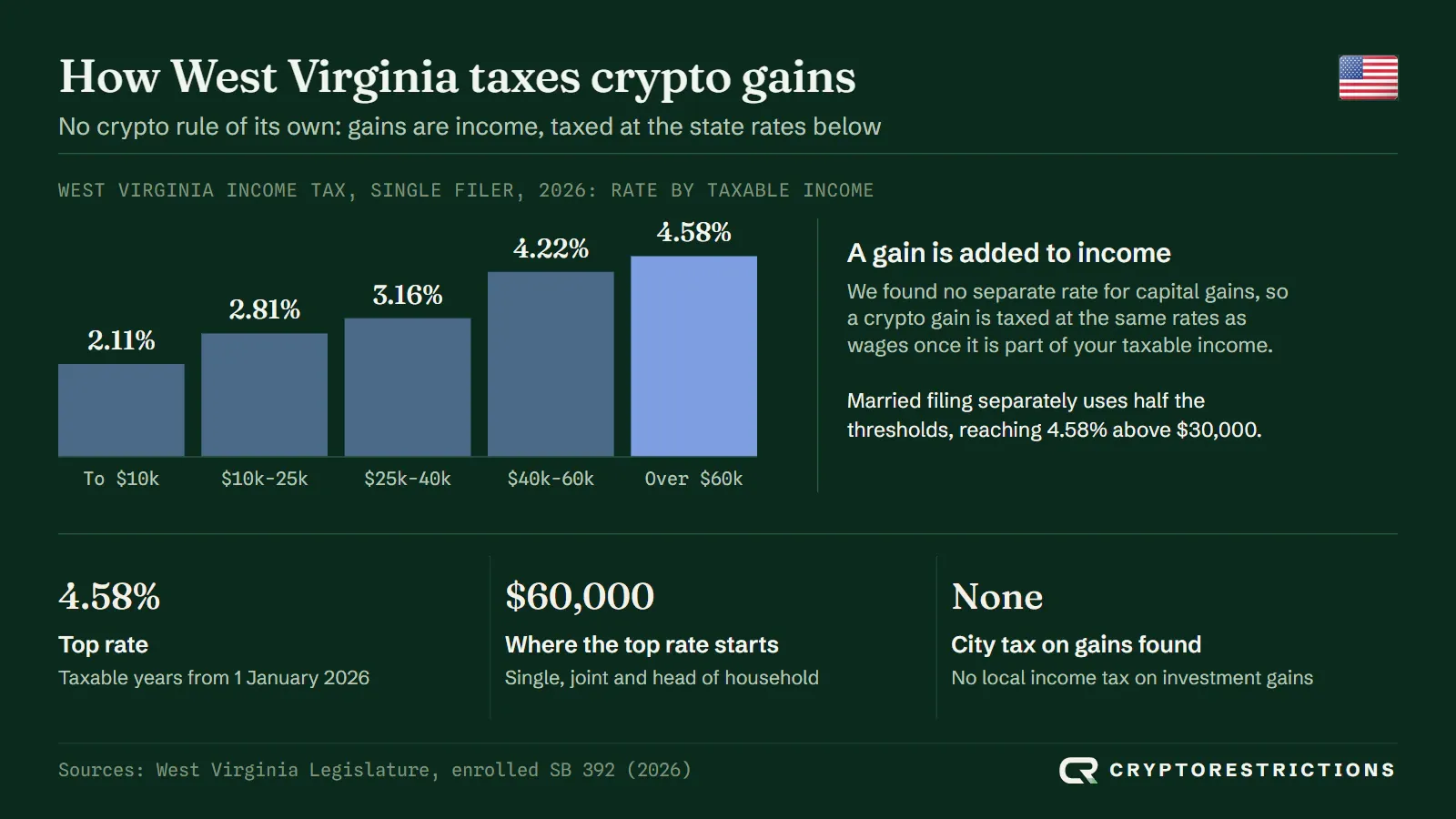
As income, with no crypto-specific rate that we found. For tax years from 1 January 2026 a single filer pays 2.11% on the first $10,000 up to 4.58% above $60,000, and we found no separate rate or exemption for capital gains.
The schedule is in the enrolled Senate Bill 392, which passed on 14 March 2026. For single, joint and head-of-household filers the rates are 2.11% to $10,000, 2.81% to $25,000, 3.16% to $40,000, 4.22% to $60,000 and 4.58% above that. Married people filing separately use half the thresholds and reach 4.58% above $30,000. The bill also lets later revenue findings trim the rates. The State Tax Department’s site would not load for us, so we found no department guidance on crypto; treat a gain as income that follows your federal return, covered in our United States guide. A 2026 bill that would have exempted crypto and bullion gains (Senate Bill 866) was introduced, but we could not confirm what became of it. We found no city income tax on investment gains.