
 United States · DC
Is crypto legal in Washington, D.C.?
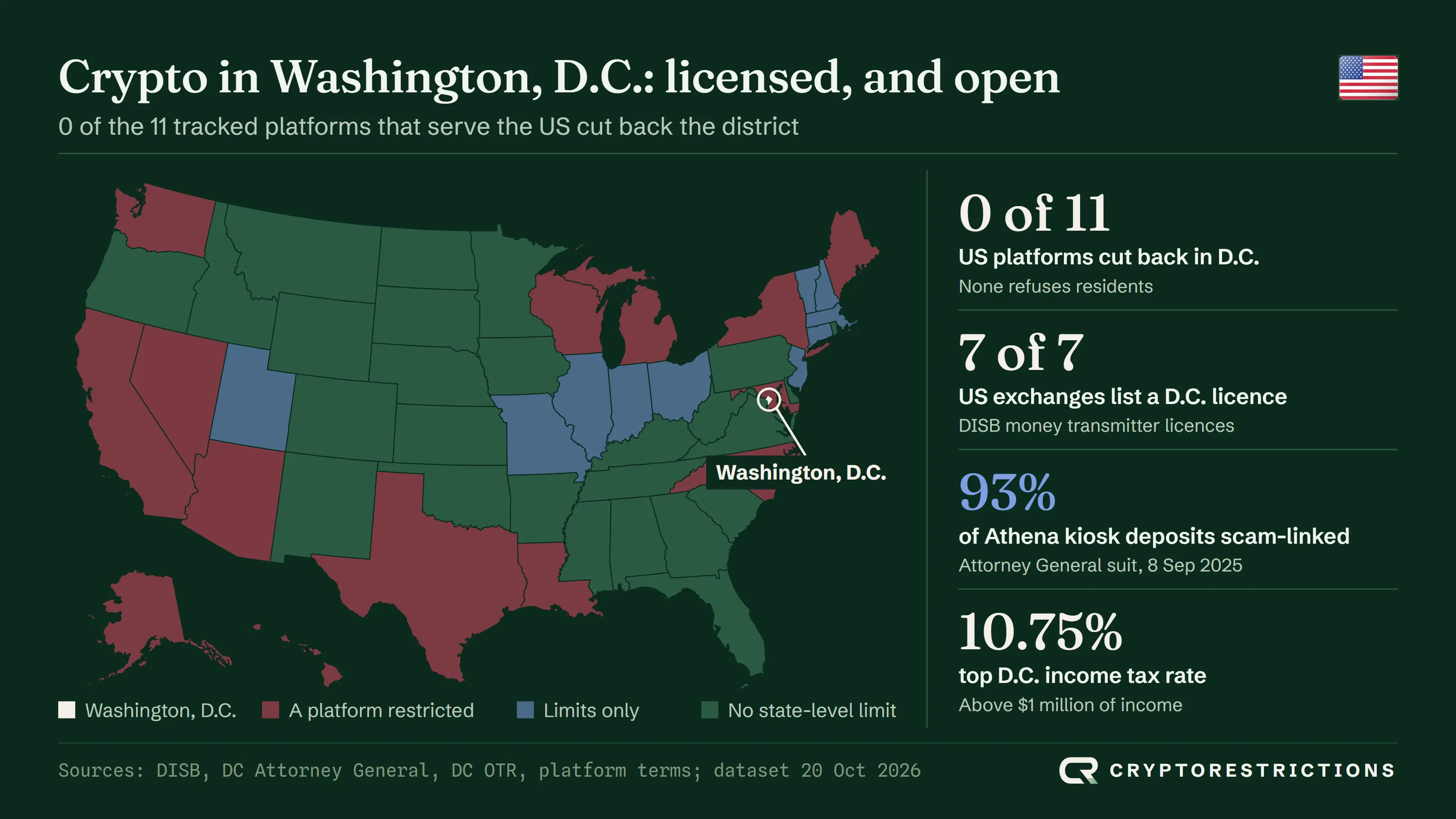
Yes. Owning and trading crypto is legal in Washington, D.C., and a firm that takes custody of or transmits crypto for District residents needs a money transmitter licence from the Department of Insurance, Securities and Banking (DISB). There is no BitLicense-style regime.
The District has no law written for crypto. DISB applies its Money Transmitters Act (DC Code § 26-1001 and following) by guidance. In Bulletin 22-BB-001 of 4 August 2022 it said that firms that receive for transmission, store or take custody of Bitcoin and other virtual currency from consumers, through kiosks, mobile apps or online, are money transmitters and need a licence. It leaned on a 2020 federal ruling, United States v. Harmon, that Bitcoin is money under the Act. DISB does not treat buying and selling crypto for cash through kiosks or online as money transmission. People who only hold crypto, and shops that accept it, need no licence.
Federal rules from the SEC, CFTC, Treasury and IRS apply on top, and offshore exchanges that refuse US users refuse District residents too. Both are covered in our United States guide. We found no DC Council bill on digital assets, kiosks or stablecoins as of 20 October 2026.
Which crypto licences does Washington, D.C. require?
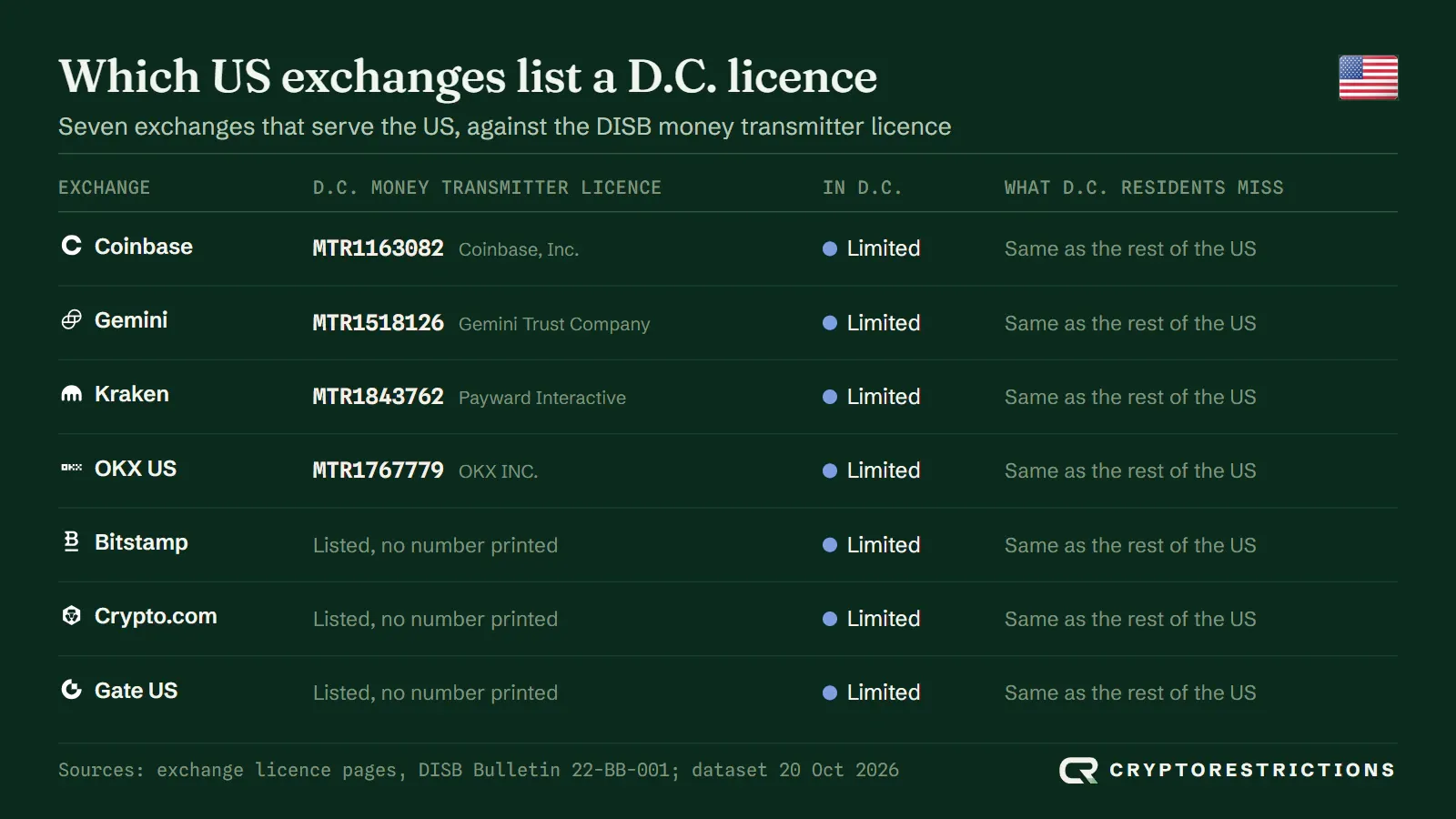
A DISB money transmitter licence, applied for through NMLS. All seven US exchanges we track list a District licence: Coinbase, Gemini, Kraken and OKX US print their numbers, and Bitstamp, Crypto.com and Gate US name D.C. among their licensed states.
Licence numbers come from each exchange’s own licence page, read on 20 October 2026: Coinbase MTR1163082, Gemini MTR1518126, Kraken MTR1843762 (held by Payward Interactive) and OKX MTR1767779. Bitstamp, Crypto.com and Gate list D.C. but we could not read a number.

A licence does not widen what an exchange may offer: every federal product limit in the US guide still applies. DISB’s rule also reaches kiosks. On 16 March 2023 its Notice 23-BB-04 said it would actively investigate Bitcoin ATM operators, and that operating one without a licence is a violation of DC Code § 26-1002 that can bring civil action and felony prosecution.
Best crypto platforms for Washington, D.C. residents
By our access score inside Washington, D.C., Coinbase (8.9 out of 10) and Gemini (8.4) are the most open exchanges, Kalshi (7.3) the most open prediction market and Uniswap (8.0) the most open DeFi platform.
The score rates how fully a District resident can use each platform, not its fees or safety. It is the US score with the District’s own limits applied: access status (4 points), the share of the platform’s products open in D.C. (3), the licences we hold on file (2) and what our geo-access test saw from a US address (1). The method is on our methodology page.
Exchanges

Coinbase
Best for The most products under one licence
8.9/10- Access
- 3.5/4
- Products
- 2.4/3
- Licences
- 2/2
- Our test
- 1/1
Read our Coinbase reportPros
- DC money transmitter licence MTR1163082
- No D.C. carve-out on staking or loans
- Prediction markets offered outside Nevada and Michigan
Cons
- Loans exclude New York and prediction markets exclude Nevada and Michigan
- No new staking in four states since June 2023

Gemini
Best for Spot trading with staking-style rewards
8.4/10- Access
- 3.5/4
- Products
- 1.9/3
- Licences
- 2/2
- Our test
- 1/1
Read our Gemini reportPros
- DC money transmitter licence MTR1518126
- Spot trading served in all 50 states and D.C.
- D.C. is not among the states barred from Asset Rewards
Cons
- Gemini Derivatives excludes US persons

Kraken
Best for A wide coin list with staking
8.3/10- Access
- 3/4
- Products
- 2.3/3
- Licences
- 2/2
- Our test
- 1/1
Read our Kraken reportPros
- DC money transmitter licence MTR1843762
- D.C. is on Kraken's list of states for onchain staking
Cons
- US futures run through a separate CFTC-registered exchange, for US residents only
- Does not serve Maine or New York

Crypto.com
Best for The App for spot trading
7.5/10- Access
- 3/4
- Products
- 1.5/3
- Licences
- 2/2
- Our test
- 1/1
Read our Crypto.com reportPros
- The App is available in D.C., per its US page
- CFTC-registered exchange and clearing house
Cons
- The Exchange does not offer US residents its derivatives
- Event contracts are carved out in several states

Bitstamp
Best for Plain spot trading
6.6/10- Access
- 3/4
- Products
- 0.6/3
- Licences
- 2/2
- Our test
- 1/1
Read our Bitstamp reportPros
- Lists D.C. among its money transmitter licences
- No D.C. carve-out in its US terms
Cons
- No staking or lending in the US
- No derivatives for US customers

OKX
Best for Spot trading under a DC licence
6.0/10- Access
- 3/4
- Products
- 1.5/3
- Licences
- 1/2
- Our test
- 0.5/1
Read our OKX reportPros
- DC money transmitter licence MTR1767779
- D.C. is named among the states it serves
Cons
- Covers token-to-token and USD-to-token services only
Prediction markets

Kalshi
Best for The broadest CFTC-regulated event contracts
7.3/10- Access
- 3/4
- Products
- 2.3/3
- Licences
- 1/2
- Our test
- 1/1
Read our Kalshi reportPros
- CFTC-designated contract market
- Court orders make it geofence sports contracts only in Nevada, Washington and Michigan, not D.C.
Cons
- Contests state gambling regulators over sports contracts elsewhere

Polymarket
Best for Polymarket markets on a US exchange
6.3/10- Access
- 3/4
- Products
- 2.3/3
- Licences
- 1/2
- Our test
- 0/1
Read our Polymarket reportPros
- Polymarket US is a CFTC-designated exchange
- No DC order or lawsuit found
Cons
- polymarket.com itself blocks US users
DeFi

Uniswap
Best for Swapping tokens from your own wallet
8.0/10- Access
- 4/4
- Products
- 3/3
- Licences
- 0/2
- Our test
- 1/1
Read our Uniswap reportPros
- No D.C. limit on file
- No US state is named in its terms
Cons
- Leveraged products for US retail are barred

PancakeSwap
Best for BNB Chain swaps and pools
6.3/10- Access
- 3.5/4
- Products
- 1.8/3
- Licences
- 0/2
- Our test
- 1/1
Read our PancakeSwap reportPros
- Swaps, pools and staking are not excluded
Cons
- PCS Perps bars US users
- No US licence on file
Which platforms block or limit Washington, D.C. residents?
None of the 11 tracked platforms that serve the US cuts back Washington, D.C. The only District limit we hold is Manifold’s: its cash prize drawings are void there.
That is unusual for a state-level guide, so here is what we checked. Kraken lists D.C. among the states with onchain staking. Gemini bars only California, Illinois, New Jersey, Texas, Washington, Massachusetts and New York from Asset Rewards. Coinbase names California, Maryland, New Jersey, Wisconsin and Washington in its staking notices, New York for loans, and Nevada and Michigan for prediction markets. OKX and the others print District licences.
Manifold’s official rules list Washington, D.C. among the restricted territories where prize drawings are void; the play-money markets stay open.
Who regulates crypto in Washington, D.C.?
DISB licenses and supervises crypto firms, the Attorney General takes them to court, and the Council passes the District’s laws. we found no Council crypto bill that has passed.
- DISB. Its Bulletin 22-BB-001 of 4 August 2022 brought custody and transmission of virtual currency under the money transmitter licence. The notice of 16 March 2023 put kiosk operators on notice that DISB would investigate them.
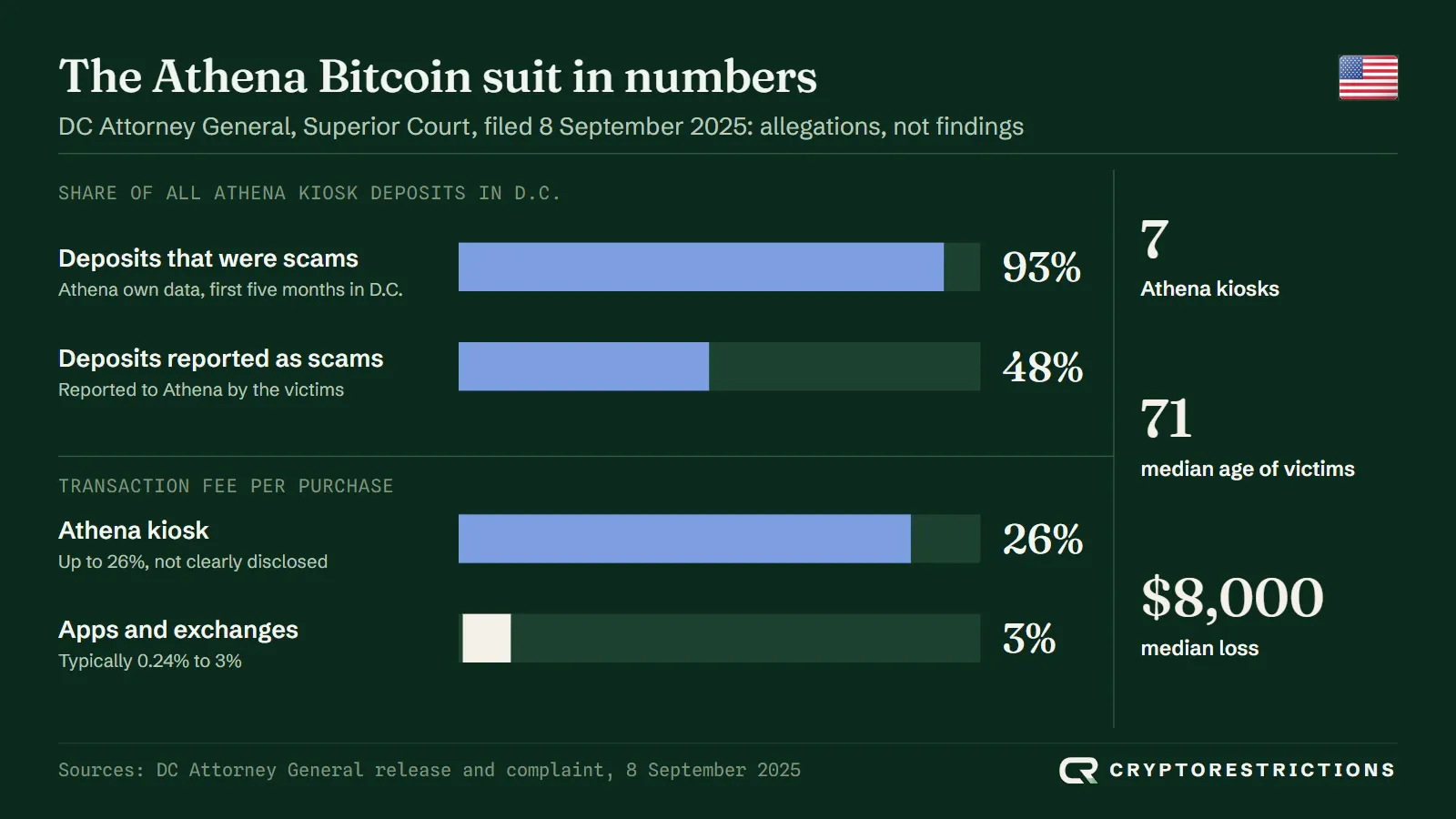
- Attorney General. On 8 September 2025 Attorney General Brian Schwalb sued Athena Bitcoin, one of the largest kiosk operators, in DC Superior Court.
- Council. We found no digital asset, kiosk or stablecoin bill on the Council’s books as of 20 October 2026.
The Athena complaint is the District’s main crypto case. It alleges that the company charges fees of up to 26% per transaction without clearly disclosing them, refuses refunds to scam victims, and operates seven kiosks in the District without the licence DC Code § 26-1002 requires. The release says 93% of deposits in Athena’s first five months in D.C. were scams, by the company’s own data, and that victims’ median age was 71. These are the Attorney General’s allegations: we found no ruling.
Are prediction markets legal in Washington, D.C.?
Not settled by any District rule we could find. As of 20 October 2026 we found no DC regulator, Attorney General action or Council bill aimed at Kalshi, Polymarket US or another event-contract platform.
That differs from states such as New York, which has sued four platforms. Federal rules, including the CFTC’s role and the court fights in other states, are covered in our United States guide. District law on sports betting is separate and we have not tied it to event contracts.
How is crypto taxed in Washington, D.C.?
As income, at the District’s rates of 4% to 10.75%. The Office of Tax and Revenue publishes one rate table, with no separate rate for capital gains and no crypto-specific rule that we could find.
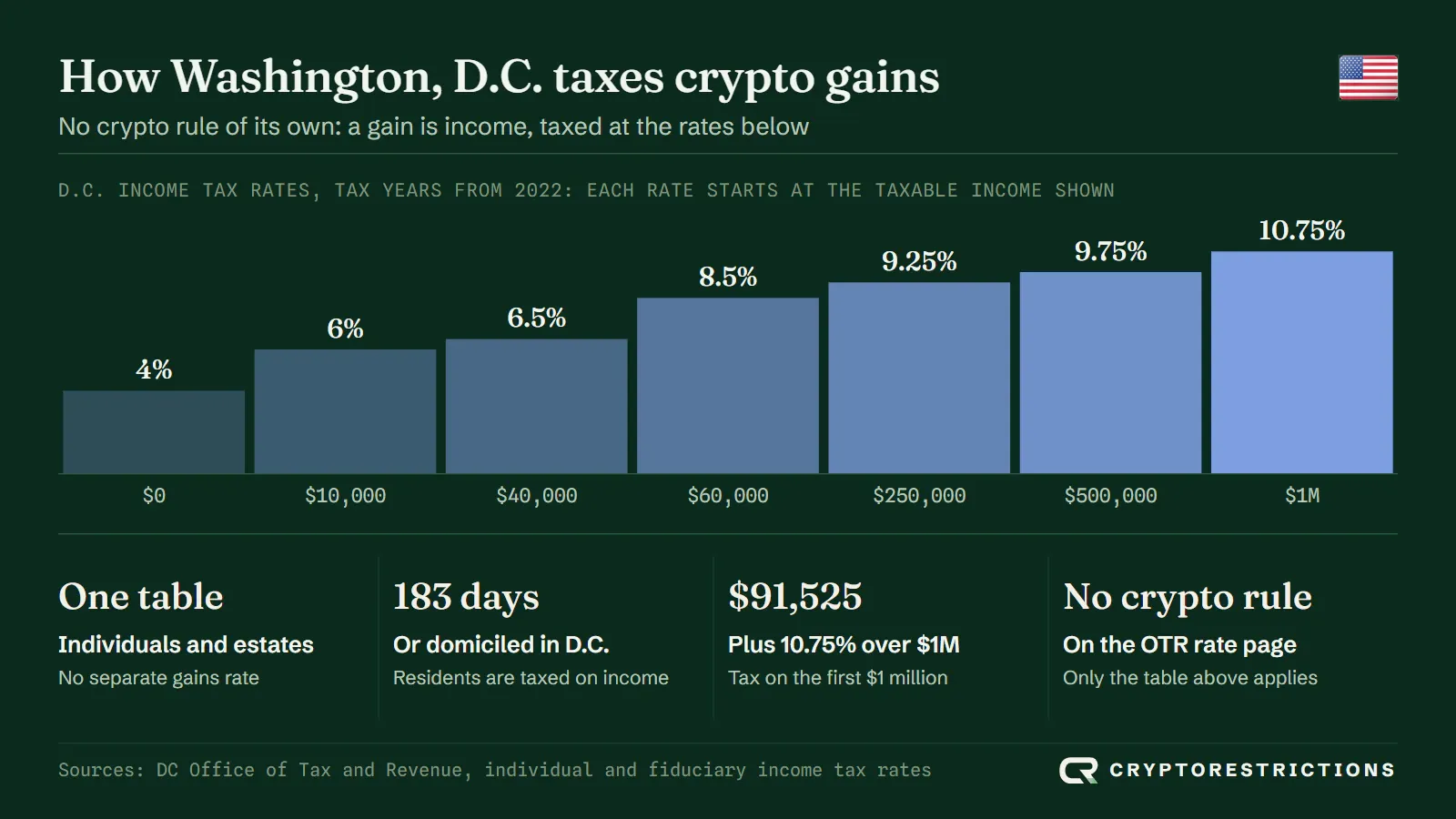
The OTR rate page says the taxable income of anyone domiciled in the District at any time in the year, or with an abode there for 183 days or more, is taxed at these rates for tax years beginning after 31 December 2021: 4% up to $10,000, then $400 plus 6% to $40,000, $2,200 plus 6.5% to $60,000, $3,500 plus 8.5% to $250,000, $19,650 plus 9.25% to $500,000, $42,775 plus 9.75% to $1,000,000, and $91,525 plus 10.75% above that. How the IRS treats crypto is covered in our United States guide.







