
 United States · AZ
Is crypto legal in Arizona?
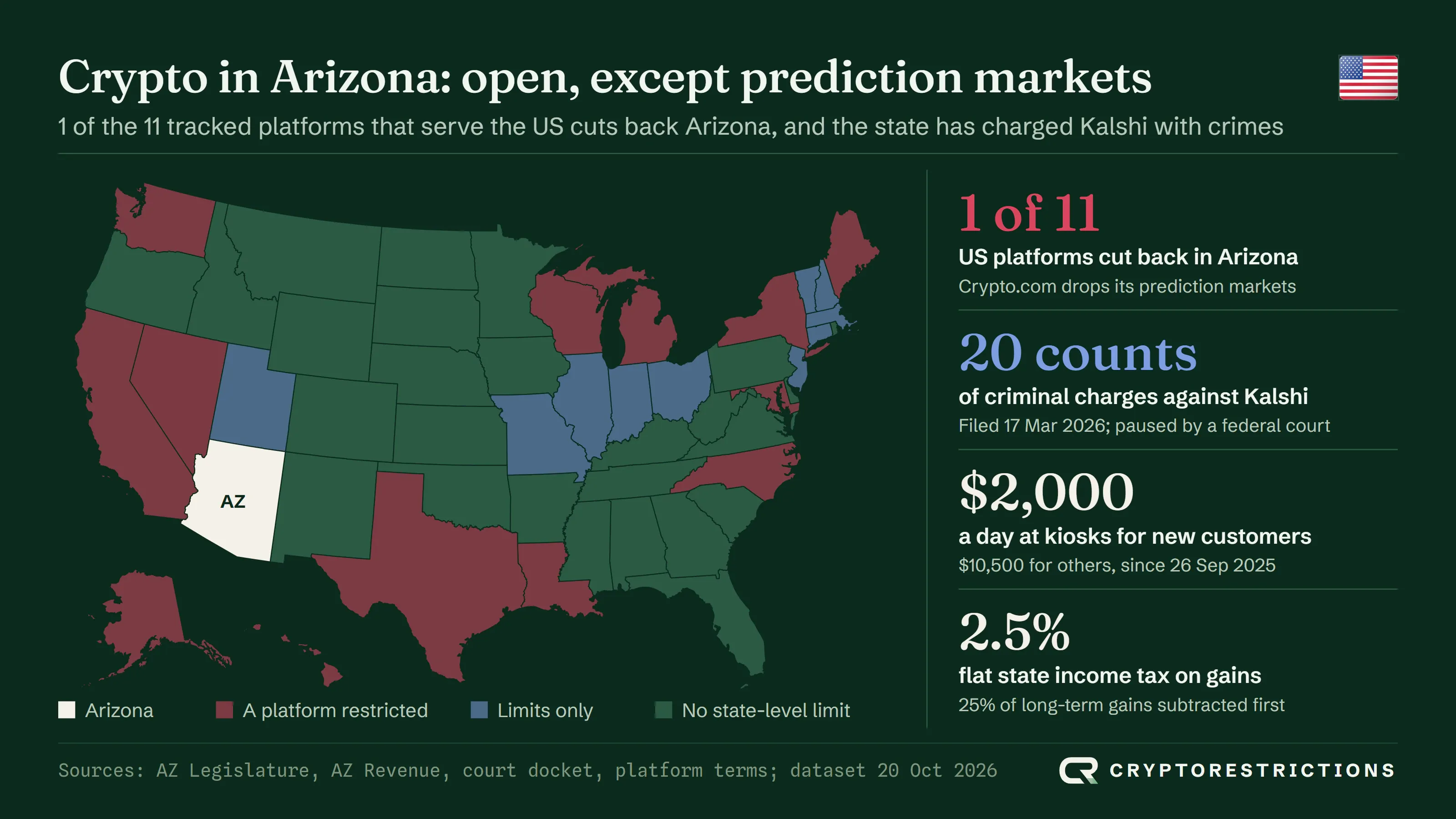
Yes. Owning and trading crypto is legal in Arizona, and the state has no crypto-specific licence: exchanges that serve Arizonans register as money transmitters with the Department of Insurance and Financial Institutions (DIFI).
Arizona’s money transmitter definitions do not mention virtual currency. The exchanges we track hold the licence in practice, and Arizona has no BitLicense-style rule. Crypto kiosks are the one product the state regulates directly, under a 2025 law described below.
Federal rules from the SEC, CFTC, Treasury and IRS apply on top, as in every state, and offshore exchanges that refuse US users refuse Arizonans too. Both are covered in our United States guide.
Which crypto licences does Arizona require?
A money transmitter licence from DIFI, not a crypto licence. Every exchange we track that serves the US lists an Arizona licence on its own page, and six show the number.
Coinbase holds MT-0928767, and Kraken, Gemini, Crypto.com, OKX and Gate publish theirs. Bitstamp USA lists Arizona among its money transmitter states without a number. We read each platform’s own licence page on 19 October 2026 and did not check the numbers against the NMLS register.


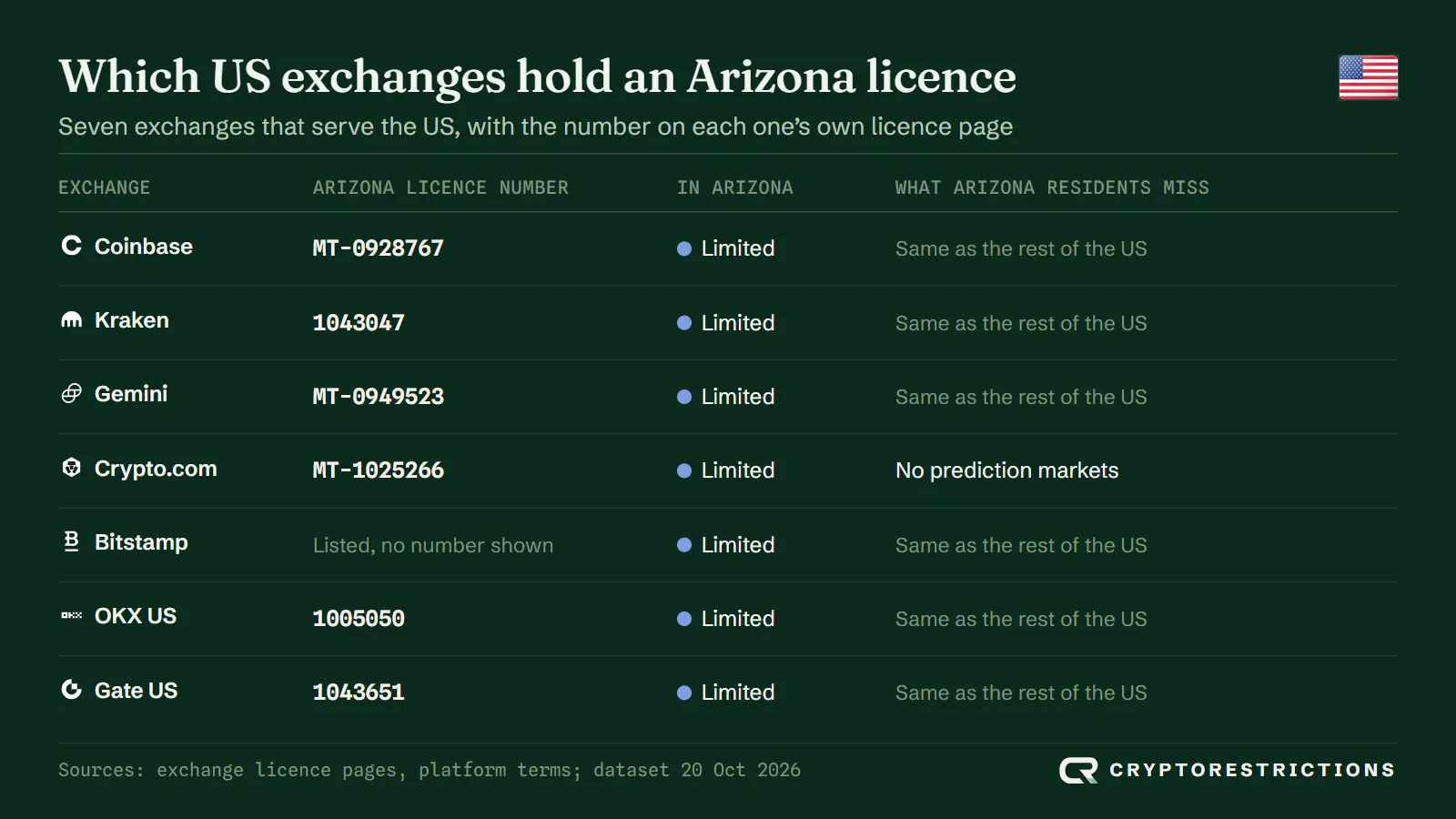
Arizona does not cut any exchange back at the state level, so the status you see for each is its US status. The one carve-out is Crypto.com’s prediction markets, covered below.
Best crypto platforms for Arizona residents
By our access score inside Arizona, Gemini (8.4 out of 10) and Kraken (8.3) are the most open exchanges, Kalshi (7.3) the most open prediction market and Uniswap (8.0) the most open DeFi platform.
The score rates how fully an Arizona resident can use each platform, not its fees or safety. It is the US score with Arizona’s own limits applied: access status (4 points), the share of the platform’s products open in the state (3), the licences we hold on file (2) and what our geo-access test saw from a US address (1). The method is on our methodology page.
Exchanges

Gemini
Best for Spot and staking with a published Arizona licence
8.4/10- Access
- 3.5/4
- Products
- 1.9/3
- Licences
- 2/2
- Our test
- 1/1
Read our Gemini reportPros
- Arizona money transmitter licence MT-0949523
- Staking is barred only in New York
Cons
- Gemini Derivatives excludes US persons

Kraken
Best for A US exchange that serves nearly every state
8.3/10- Access
- 3/4
- Products
- 2.3/3
- Licences
- 2/2
- Our test
- 1/1
Read our Kraken reportPros
- Arizona money transmitter licence 1043047
- Only Maine and New York are excluded
Cons
- Does not serve New York or Maine if you move there

Coinbase
Best for The most products in every state but a few
7.9/10- Access
- 3.5/4
- Products
- 2.4/3
- Licences
- 1/2
- Our test
- 1/1
Read our Coinbase reportPros
- Arizona money transmitter licence MT-0928767
- Staking, loans and in-app DEX trading do not exclude Arizona
Cons
- Prediction markets come from Kalshi, which Arizona has charged with crimes

Crypto.com
Best for The Crypto.com App in 49 states
6.8/10- Access
- 3/4
- Products
- 0.8/3
- Licences
- 2/2
- Our test
- 1/1
Read our Crypto.com reportPros
- The App is offered in Arizona; only New York is excluded
- Arizona money transmitter licence MT-1025266
Cons
- No prediction markets in Arizona since 12 December 2025
Prediction markets

Kalshi
Best for The broadest CFTC-regulated event contracts
7.3/10- Access
- 3/4
- Products
- 2.3/3
- Licences
- 1/2
- Our test
- 1/1
Read our Kalshi reportPros
- CFTC-designated contract market
- A federal injunction since 5 May 2026 bars Arizona from enforcing its gambling laws against it
Cons
- Charged with 20 criminal counts by the Attorney General
- Received a Gaming Department cease-and-desist on 21 May 2025

Polymarket
Best for Polymarket markets on a US exchange
6.3/10- Access
- 3/4
- Products
- 2.3/3
- Licences
- 1/2
- Our test
- 0/1
Read our Polymarket reportPros
- Polymarket US is a CFTC-designated exchange
Cons
- polymarket.com itself blocks US users
DeFi

Uniswap
Best for Swapping tokens from your own wallet
8.0/10- Access
- 4/4
- Products
- 3/3
- Licences
- 0/2
- Our test
- 1/1
Read our Uniswap reportPros
- Terms do not exclude Arizona
Cons
- Leveraged products for US retail are barred

PancakeSwap
Best for BNB Chain swaps and pools
6.3/10- Access
- 3.5/4
- Products
- 1.8/3
- Licences
- 0/2
- Our test
- 1/1
Read our PancakeSwap reportPros
- Swaps, pools and staking are not excluded
Cons
- PCS Perps bars US users
- No US licence on file
Which platforms block or limit Arizona residents?
Only one of the platforms we track that serve the US cuts back Arizona: Crypto.com withdrew all of its prediction markets from the state in December 2025. Every other platform treats Arizona like the rest of the US.
None of the platform pages we read names Arizona as excluded. Coinbase, Kraken, Gemini, OKX US and Gate US list other states as excluded (Maine and New York, New York, and Alaska, Texas, Louisiana, Washington and North Carolina among them), never Arizona. Crypto.com’s OG Prediction Markets says: “New York and Arizona residents are not permitted to trade on any markets.” Press reports date the exit in two steps: sports contracts ended on 2 December 2025 and the remaining markets on 12 December.
Who regulates crypto in Arizona?
DIFI licenses the money transmitters, the Attorney General enforces the kiosk law and prosecutes crypto fraud, and the Legislature has passed two crypto laws since 2025 while the governor vetoed its Bitcoin reserve bills.
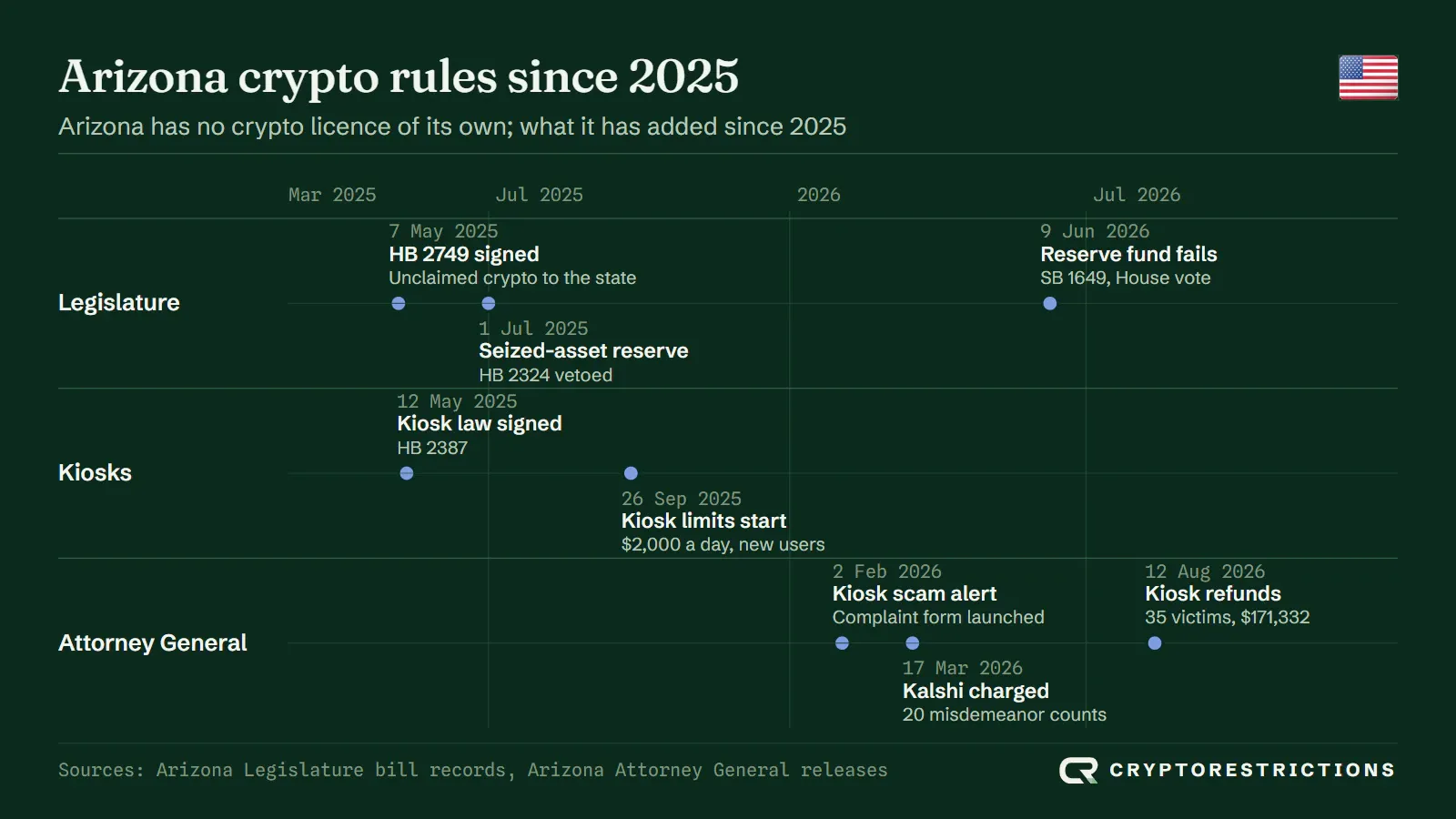
- Legislature. HB 2749, signed on 7 May 2025, makes holders of abandoned crypto deliver it to the Department of Revenue in its native form and creates a bitcoin and digital assets reserve fund. Governor Hobbs vetoed SB 1025 (a state Bitcoin reserve) on 2 May 2025, SB 1373 on 12 May and HB 2324 on 1 July. In 2026 a reserve fund bill, SB 1649, failed its House vote on 9 June.
- Kiosks. HB 2387, signed on 12 May 2025, has applied since 26 September 2025. Under A.R.S. 6-1236 a kiosk may take $2,000 a day from a customer of fewer than ten days and $10,500 from anyone else, and a new customer who was tricked into a transaction gets a full refund, fees included, after reporting it within 30 days. The Attorney General enforces it.
- Attorney General. On 2 February 2026 Kris Mayes warned of kiosk scams, saying Arizonans lost more than $177 million to them in 2024. On 12 August 2026 her office reported refunds of $171,332 to 35 victims. We found no kiosk lawsuit against an operator.
Are prediction markets legal in Arizona?
Contested. Arizona treats unlicensed event contracts as illegal gambling and charged Kalshi with 20 criminal counts, but a federal injunction since 5 May 2026 bars the state from enforcing its gambling laws against CFTC-regulated exchanges while appeals run.
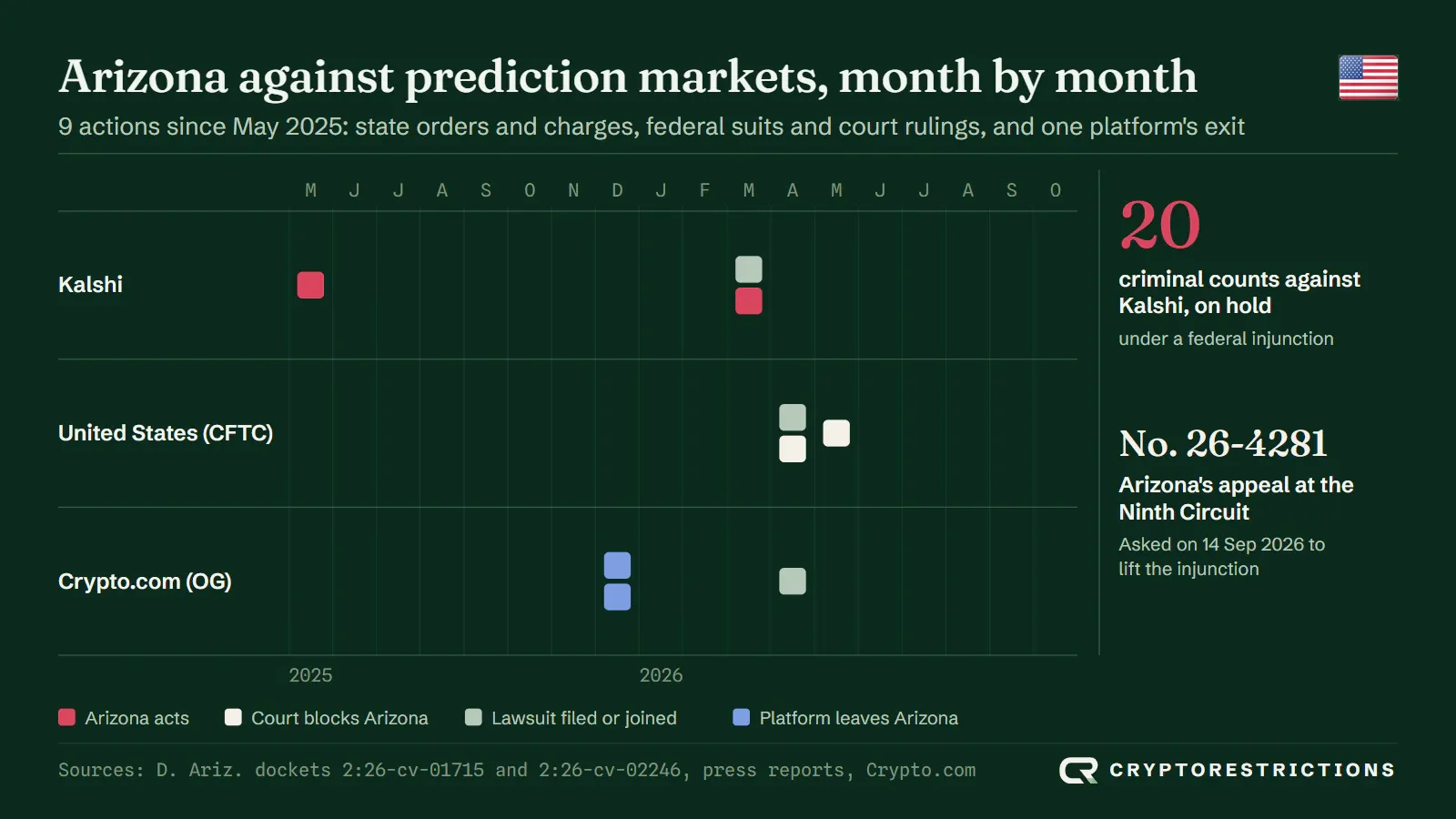
The Department of Gaming sent Kalshi a cease-and-desist letter on 21 May 2025, filed as an exhibit in Kalshi’s lawsuit against the state. Kalshi sued on 12 March 2026, and five days later the Attorney General filed 20 misdemeanor counts against it, four of them on election wagering. The federal judge denied Kalshi’s own request for an injunction in April, and Kalshi appealed.
The United States then sued Arizona on 2 April 2026 for the CFTC. In that case the court paused enforcement on 10 April, Crypto.com’s exchange joined as a plaintiff on 22 April, and on 5 May the temporary order became a preliminary injunction. The district case is stayed, and Arizona has appealed to the Ninth Circuit as No. 26-4281.
On 28 August 2026 the Ninth Circuit held, in a Nevada case, that federal law likely does not override state gambling law for sports event contracts. Arizona asked on 14 September that the court lift its injunction. We found no ruling by 20 October 2026, so the injunction appears to stand. We found no Arizona bill on event contracts in 2026.
How is crypto taxed in Arizona?
As income at a flat 2.5% state rate for 2025, after Arizona subtracts 25% of a net long-term capital gain. Arizona has no crypto-specific tax and does not accept crypto for tax payments.
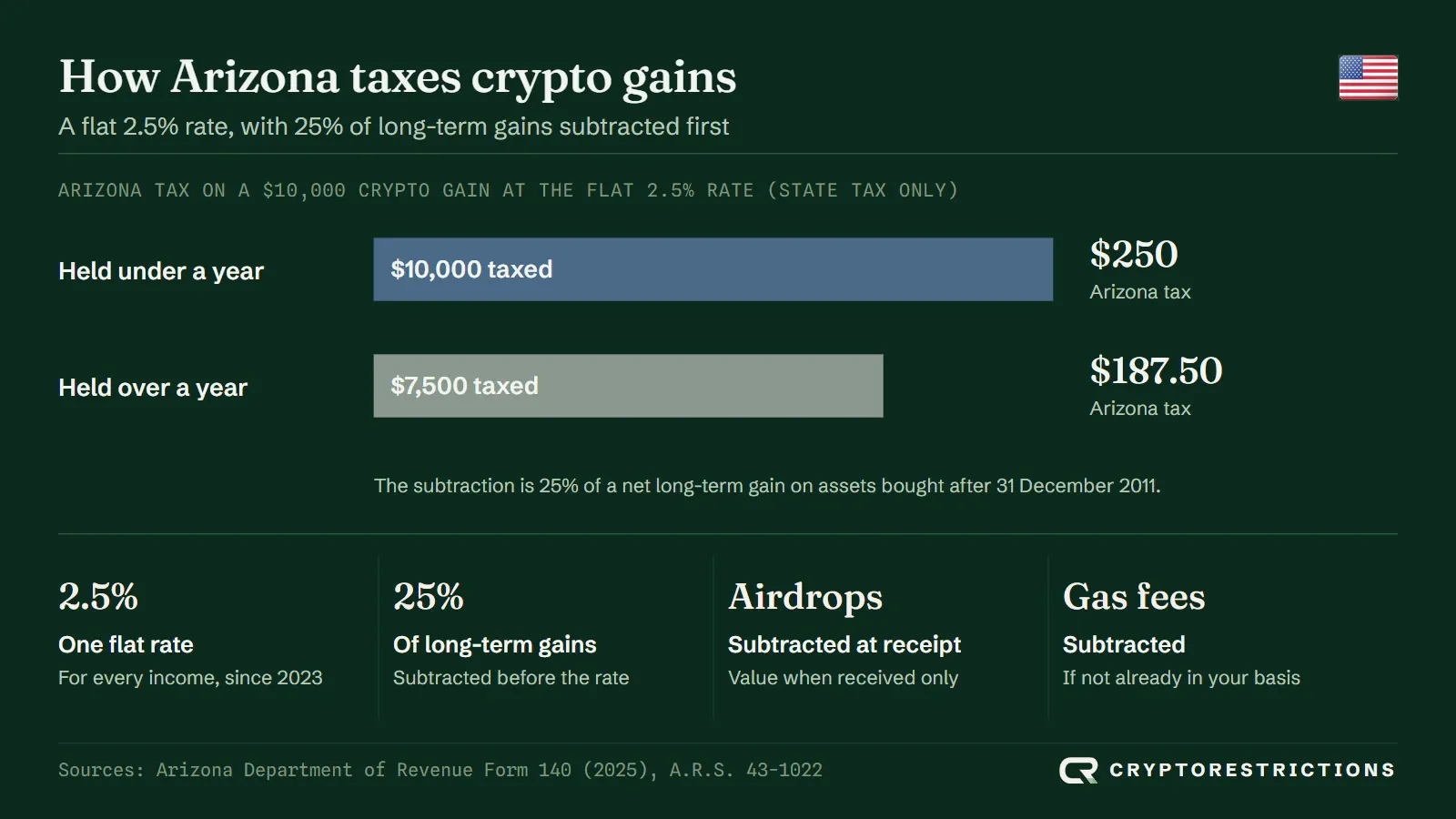
The 2025 Form 140 booklet sets one rate, 2.5%, on Arizona taxable income and retires the old tax tables. A.R.S. 43-1022 lets you subtract 25% of a net long-term gain on assets acquired after 31 December 2011, the value of airdropped crypto and NFTs at receipt, and gas fees not already in your basis. We found no Arizona Department of Revenue guidance on virtual currency.
Paying state taxes in crypto is not law: the governor vetoed SB 1024 in May 2025 and SB 1043 failed in the House on 11 June 2026. The federal treatment of crypto gains is in our United States guide.







