 United States · HI
Is crypto legal in Hawaii?
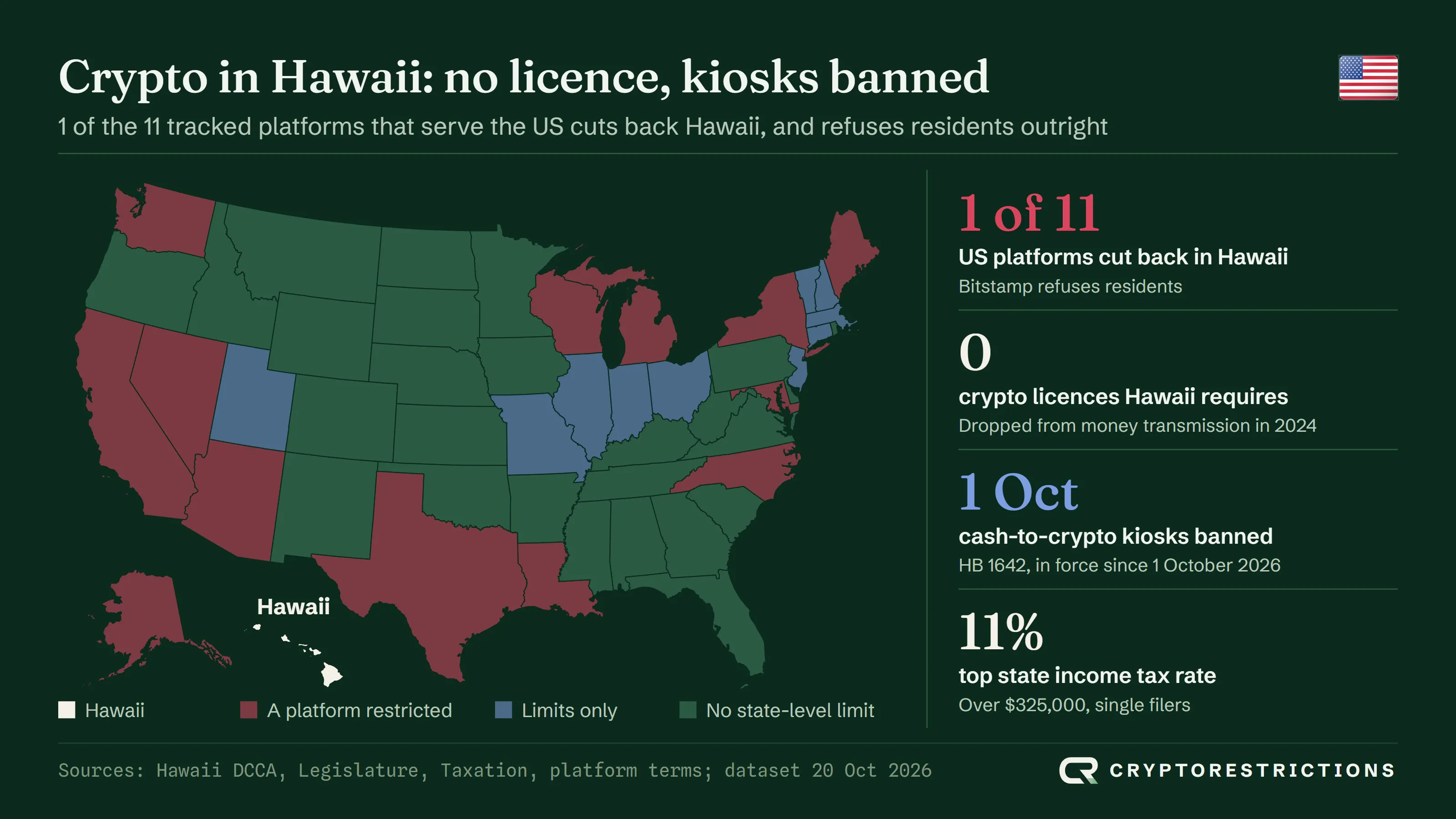
Yes. Owning and trading crypto is legal in Hawaii, and since January 2024 crypto firms need no Hawaii licence at all. The one hard limit is a ban on kiosks that take cash for crypto, in force since 1 October 2026.
Hawaii has no crypto licence of its own, and it no longer fits crypto into its money transmitter law. On 25 January 2024 the Department of Commerce and Consumer Affairs (DCCA) said that crypto activity “did not align with the concept of money transmission” in chapter 489D and that digital currency companies “will no longer require” a Hawaii money transmitter licence. Federal licensing and registration duties still apply to them. As far back as 2014 the Division of Financial Institutions (DFI) had said it licensed no crypto companies.
Federal rules from the SEC, CFTC, Treasury and IRS apply on top, as in every state, and offshore exchanges that refuse US users refuse Hawaii residents too. Both are covered in our United States guide.
Which crypto licences does Hawaii require?
None for crypto. Hawaii issues no crypto licence and, since January 2024, does not require a money transmitter licence for it, so none of the seven US exchanges we track lists a Hawaii crypto licence and none needs one.
The state ran a sandbox, the Digital Currency Innovation Lab, which the DCCA release said would conclude on 30 June 2024. Gemini still names itself a Hawaii sandbox participant on its licences page. Coinbase returned to Hawaii in August 2024, per The Block, without a state licence.
A missing licence is therefore not a warning sign in Hawaii. What matters is what each exchange says about the state itself.
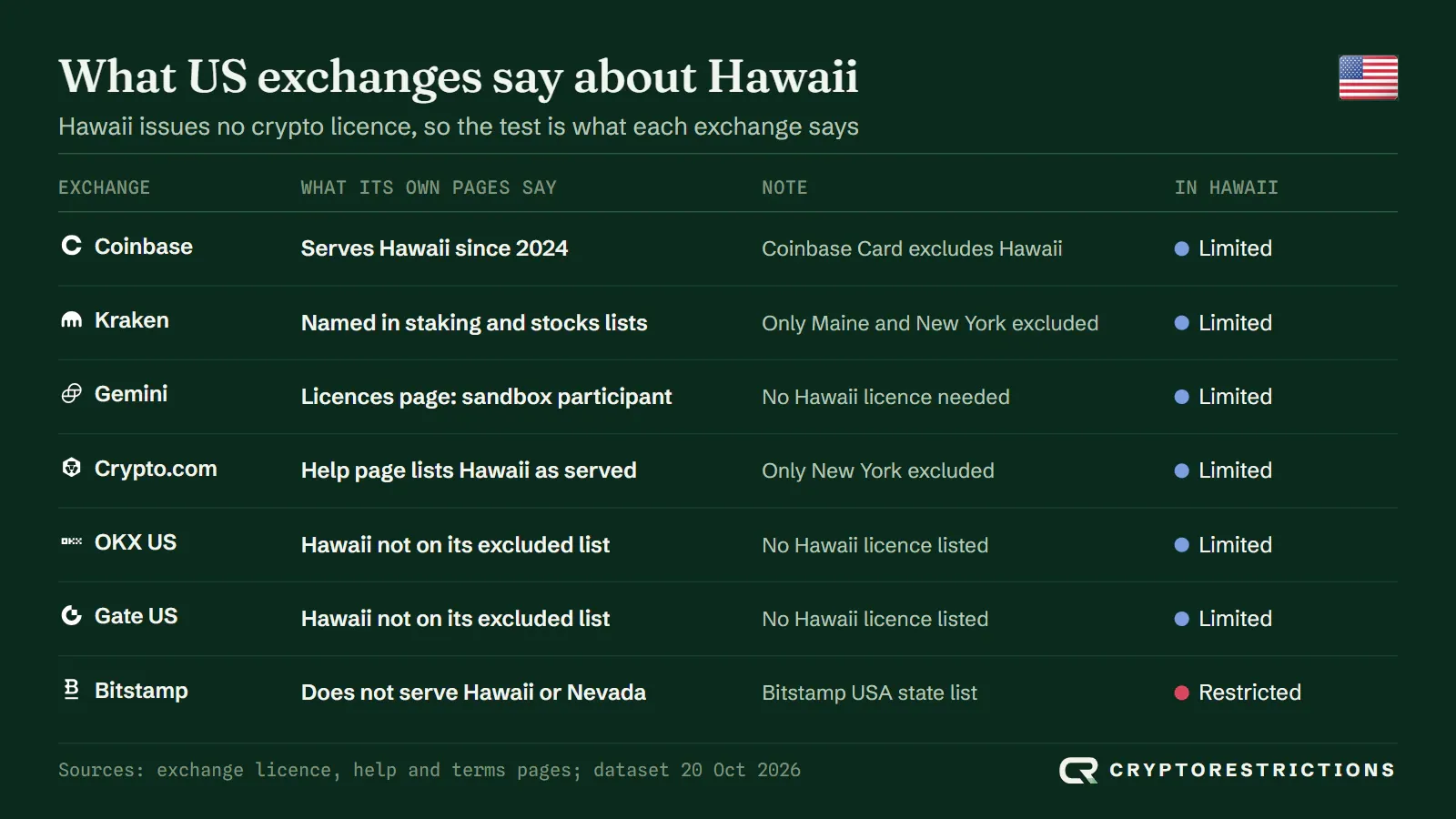
Only one exchange refuses Hawaii residents outright, Bitstamp, which does not serve Hawaii or Nevada. Coinbase serves the state but says its Coinbase Card is available in every state except Hawaii; our data has no card service, so that limit is not scored.

Best crypto platforms for Hawaii residents
By our access score inside Hawaii, Gemini (8.4 out of 10), Kraken (8.3) and Coinbase (7.9) are the most open exchanges, Kalshi (7.3) the most open prediction market and Uniswap (8.0) the most open DeFi platform.
The score rates how fully a Hawaii resident can use each platform, not its fees or safety. It is the US score with Hawaii’s own limits applied: access status (4 points), the share of the platform’s products open in the state (3), the licences we hold on file (2) and what our geo-access test saw from a US address (1). Platforms that refuse Hawaii residents are not scored. The method is on our methodology page.
Exchanges

Gemini
Best for Spot trading with a Hawaii sandbox history
8.4/10- Access
- 3.5/4
- Products
- 1.9/3
- Licences
- 2/2
- Our test
- 1/1
Read our Gemini reportPros
- Licences page names it a Hawaii sandbox participant
- Asset Rewards excludes only New York
Cons
- Gemini Derivatives excludes US persons
- Sued by New York over sports contracts

Kraken
Best for Regulated futures for US residents
8.3/10- Access
- 3/4
- Products
- 2.3/3
- Licences
- 2/2
- Our test
- 1/1
Read our Kraken reportPros
- Hawaii named as served for onchain staking and stocks
- Excludes only Maine and New York
Cons
- Transfer or EUR limits in six states
- No Hawaii licence on its disclosures page

Coinbase
Best for The widest product range, back in Hawaii since 2024
7.9/10- Access
- 3.5/4
- Products
- 2.4/3
- Licences
- 1/2
- Our test
- 1/1
Read our Coinbase reportPros
- Serves Hawaii without needing a state licence
- No Hawaii limit on staking, loans or DEX trading
Cons
- Coinbase Card is not available in Hawaii
- Prediction markets closed in Nevada and Michigan

Crypto.com
Best for Event contracts beside a crypto app
7.5/10- Access
- 3/4
- Products
- 1.5/3
- Licences
- 2/2
- Our test
- 1/1
Read our Crypto.com reportPros
- Its US help page lists Hawaii among states served
- Only New York is excluded
Cons
- No derivatives for US residents on the Exchange
- The App is not available in New York
Prediction markets

Kalshi
Best for The broadest CFTC-regulated event contracts
7.3/10- Access
- 3/4
- Products
- 2.3/3
- Licences
- 1/2
- Our test
- 1/1
Read our Kalshi reportPros
- CFTC-designated contract market and clearing house
- No Hawaii order or lawsuit against it
Cons
- Hawaii bans gambling, and a bill would have named event contracts as gambling
- Court orders geofence Nevada, Washington and Michigan

Polymarket
Best for Polymarket markets on a US-regulated exchange
6.3/10- Access
- 3/4
- Products
- 2.3/3
- Licences
- 1/2
- Our test
- 0/1
Read our Polymarket reportPros
- Polymarket US is a CFTC-designated exchange
- No Hawaii order or lawsuit against it
Cons
- polymarket.com itself blocks US users
- Polymarket opposed the Hawaii bill in 2026
DeFi

Uniswap
Best for Swapping tokens from your own wallet
8.0/10- Access
- 4/4
- Products
- 3/3
- Licences
- 0/2
- Our test
- 1/1
Read our Uniswap reportPros
- Terms exclude only sanctioned jurisdictions, no states
Cons
- Leveraged products for US retail are barred

PancakeSwap
Best for BNB Chain swaps and pools
6.3/10- Access
- 3.5/4
- Products
- 1.8/3
- Licences
- 0/2
- Our test
- 1/1
Read our PancakeSwap reportPros
- Swaps, pools and staking are not excluded
Cons
- PCS Perps bars US users
- No US licence on file
Which platforms block or limit Hawaii residents?
One exchange that serves the rest of the US refuses Hawaii residents: Bitstamp. We found no platform that drops a single product in Hawaii, apart from the Coinbase Card, which Coinbase does not offer there.
Bitstamp does not serve Hawaii at all, and Nevada is cut with it. The other platforms we checked name no Hawaii exclusion on the pages we could read.
We could not read the full state terms of Kalshi, Polymarket US or PancakeSwap, so a state limit on one of them could be missing. They carry no Hawaii row until a primary page says otherwise.
Who regulates crypto in Hawaii?
The Division of Financial Institutions under the DCCA decides whether crypto firms need a licence, and it decided in 2024 that they do not. The Legislature is the active regulator: it banned cash-to-crypto kiosks in 2026.
- Division of Financial Institutions. Its 2014 bitcoin warning said it had licensed no crypto company. On 25 January 2024 the DCCA and the Hawaii Technology Development Corporation ended the licence question: crypto firms need no Hawaii money transmitter licence, and the sandbox closed on 30 June 2024.
- Crypto kiosks. HB 1642, passed in 2026, makes it unlawful to own, operate or manage a kiosk that accepts US currency in exchange for digital assets. It took effect on 1 October 2026. Hawaii News Now reports that existing account holders can still convert crypto to cash and make withdrawals, and cites $3.85 million of kiosk-related fraud losses in 2025 from FBI data.
- Consumer protection. We found no Hawaii attorney general or Office of Consumer Protection lawsuit against an exchange or kiosk operator.
Are prediction markets legal in Hawaii?
Hawaii has taken no action against a prediction market that we could find, but it bans gambling, and in 2026 the House passed a bill that would have classed event contracts as gambling.
Civil Beat reported on 29 July 2026 that Hawaii bans all forms of gambling, in person and online, yet event contracts on Hawaii politics still trade. It names attorney general actions only in other states. Representative Scot Matayoshi’s HB 2198 would have defined prediction contracts as gambling; it passed the House, got no Senate hearing, and he plans to bring it back. Polymarket opposed the bill, citing the federal CFTC framework. We found no Hawaii cease-and-desist letter, lawsuit or court order naming Kalshi, Polymarket, Crypto.com or Coinbase. The federal side of the fight is in our United States guide.
How is crypto taxed in Hawaii?
Hawaii taxes a crypto gain as income at the state rates, from 1.4% to 11% for single filers. The 11% rate starts above $325,000.
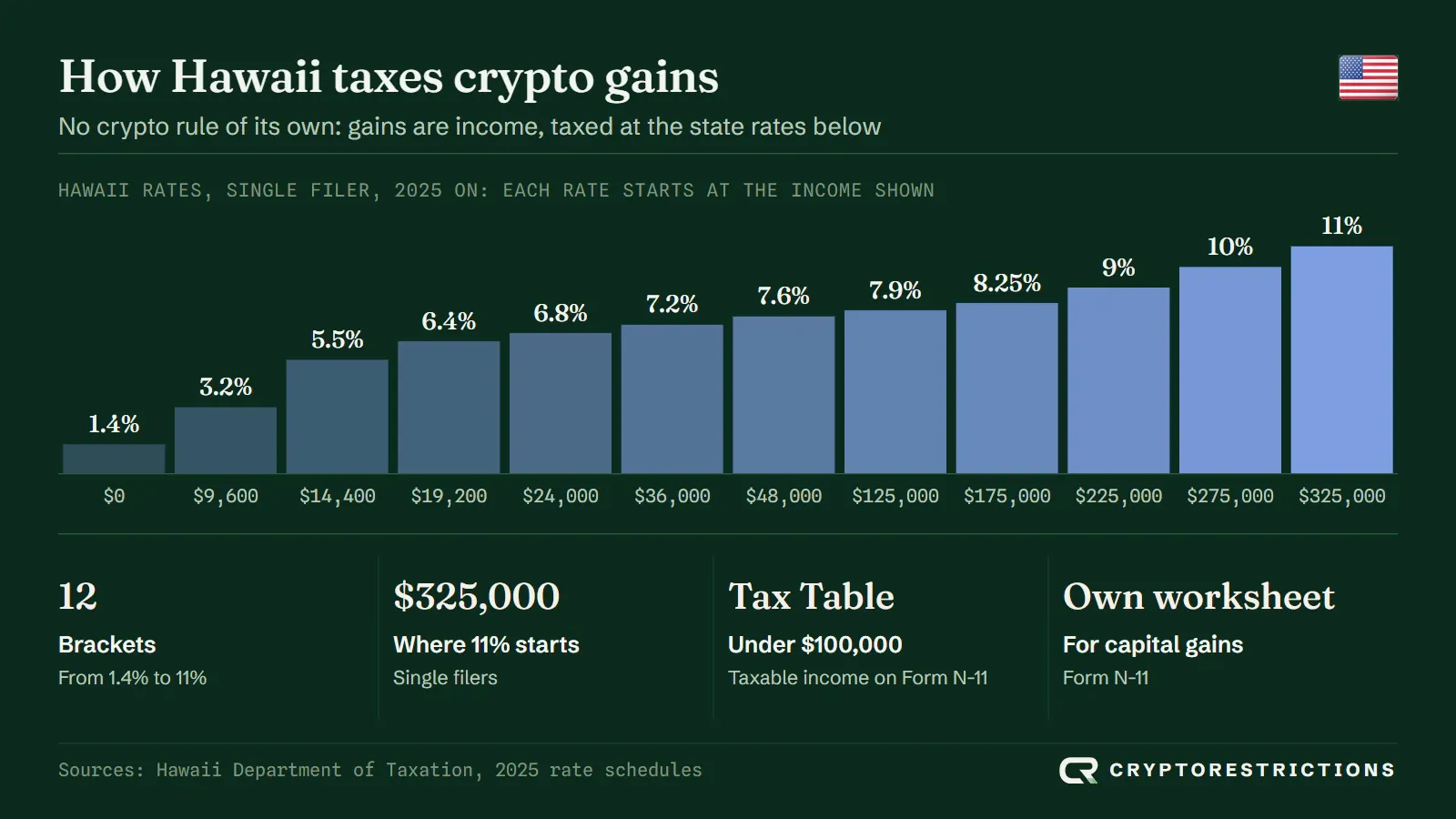
The Department of Taxation schedule for tax years after 31 December 2024 has 12 brackets for single filers, and filers with taxable income under $100,000 use the Tax Table. Form N-11 has a separate worksheet for capital gains, whose threshold the Department corrected in April 2026. We found no Hawaii guidance on whether general excise tax applies to buying or selling crypto, so we make no claim either way. Federal tax rules are in our United States guide.