 United States · IN
Is crypto legal in Indiana?
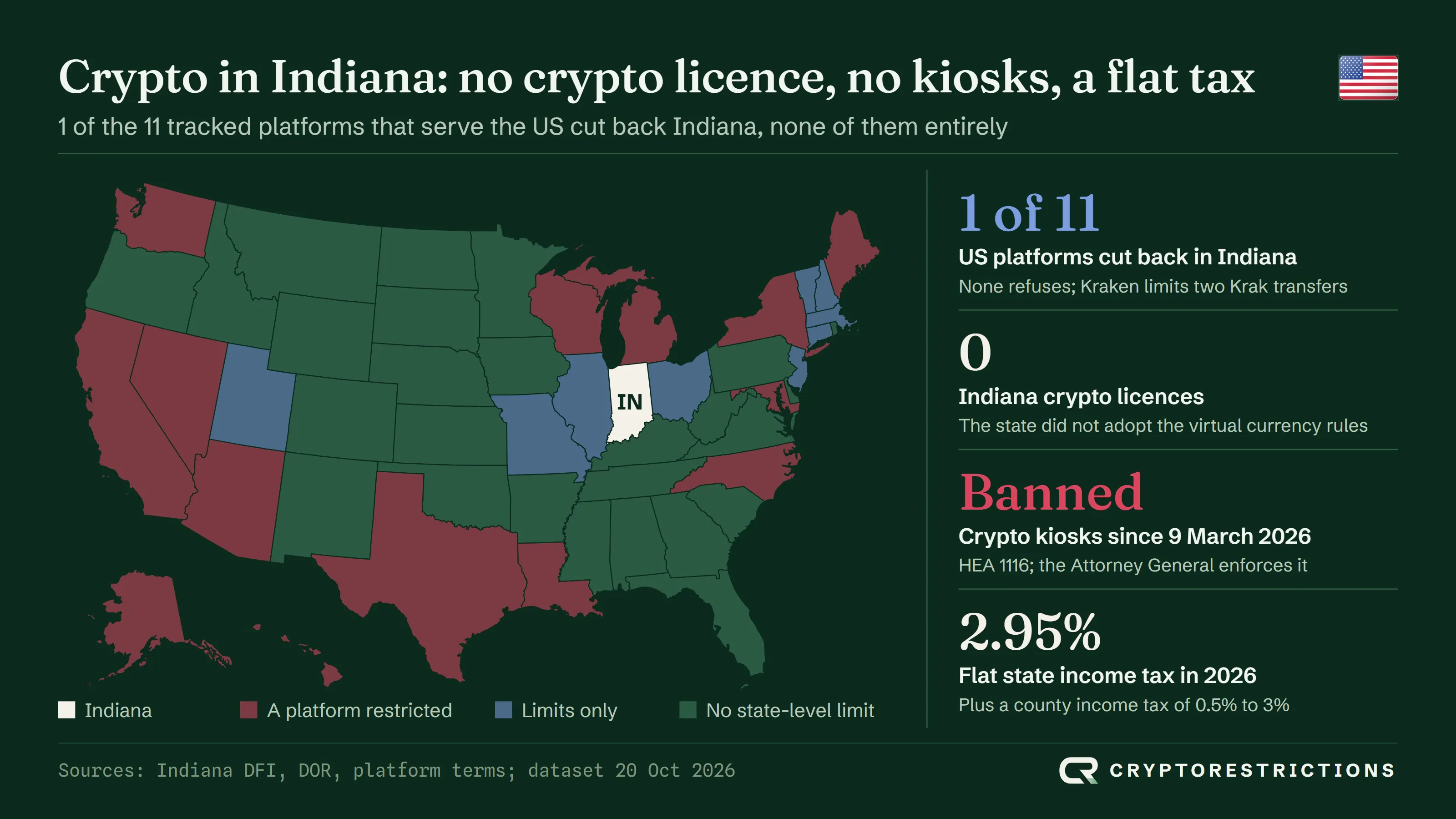
Yes. Owning and trading crypto is legal in Indiana, and the state has no crypto licence of its own. The one firm product it has banned is the crypto kiosk.
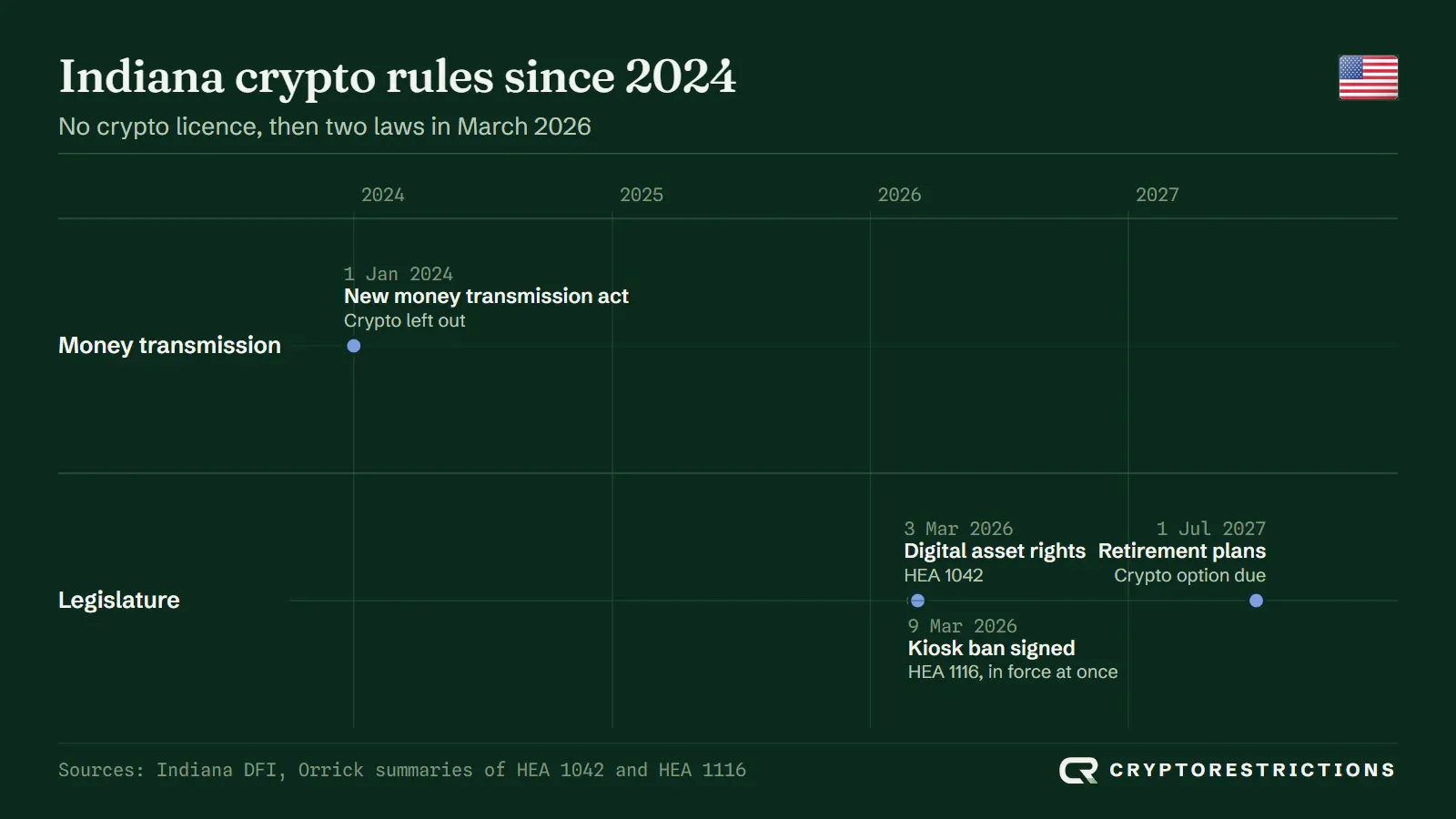
The Department of Financial Institutions says in its licensing guidance that Indiana “did not adopt the virtual currency portion” of the model Money Transmission Modernization Act, which took effect on 1 January 2024. A firm that moves fiat currency may still need a money transmitter licence. A firm that only moves crypto does not.
Two laws passed in March 2026. House Enrolled Act 1042, signed on 3 March, bars public agencies other than the Department from restricting self-custody wallets, mining or crypto payments, and requires state retirement plans to offer a crypto option by 1 July 2027. House Enrolled Act 1116 bans crypto kiosks, covered below.
Federal rules from the SEC, CFTC, Treasury and IRS apply on top, as in every state, and offshore exchanges that refuse US users refuse Hoosiers too. Both are covered in our United States guide.
Which crypto licences does Indiana require?
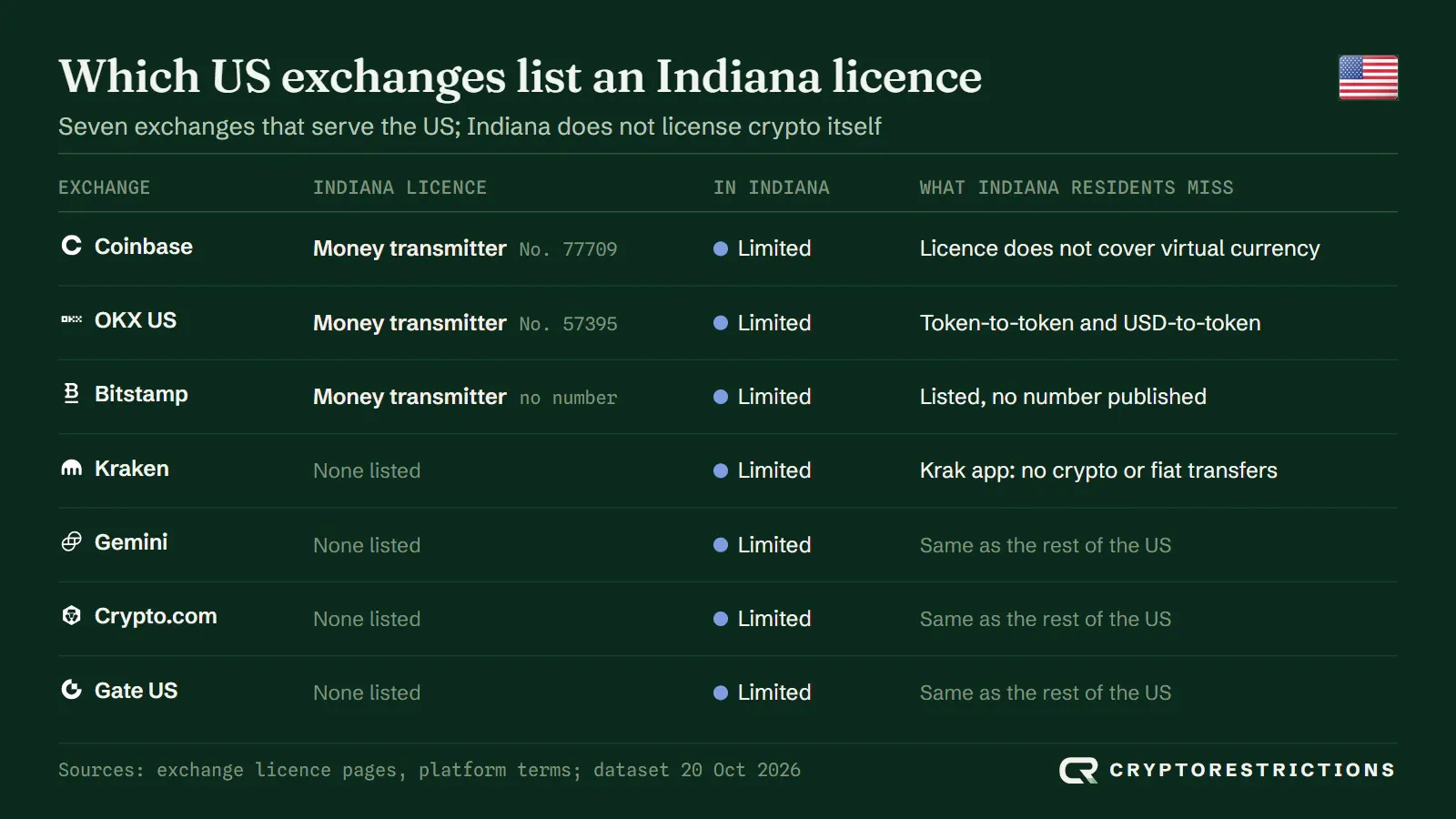
None for crypto itself. Indiana licenses fiat money transmission only, so Kraken and Gemini serve Indiana with no Indiana licence listed, while Coinbase and OKX US hold a fiat licence.
Coinbase lists Indiana money transmitter licence 77709 and states that it “does not cover virtual currency transactions”. OKX US lists licence 57395 for token-to-token and USD-to-token services. Bitstamp names Indiana among its money transmitter states without a number. Kraken, Gemini and Crypto.com list no Indiana licence on the pages we read. Every exchange in the table keeps the federal limits described in our United States guide.
Crypto kiosks are the exception to the light-touch approach. Before 2026 Indiana had no kiosk licence either, and the Department’s own summary says House Enrolled Act 1116 began as a licensing bill and was amended into a ban. Kiosks have been banned since 9 March 2026, and the law took effect the day the governor signed it. The Attorney General enforces it as a deceptive act, can pursue property owners who knowingly allow a kiosk, and can ask a court to order forfeiture of fees and of kiosks owned in Indiana, according to an Orrick summary. The ban covers kiosks only, not online exchanges or apps.
Best crypto platforms for Indiana residents
By our access score inside Indiana, Coinbase (8.9 out of 10), Gemini (8.4) and Kraken (8.3) are the most open exchanges, Kalshi (7.3) the most open prediction market and Uniswap (8.0) the most open DeFi platform.
The score rates how fully an Indiana resident can use each platform, not its fees or safety. It is the US score with Indiana’s own limits applied: access status (4 points), the share of the platform’s products open in the state (3), the licences we hold on file (2) and what our geo-access test saw from a US address (1). Platforms that refuse Hoosiers are not scored. The method is on our methodology page.
Exchanges

Coinbase
Best for Spot trading plus staking and loans
8.9/10- Access
- 3.5/4
- Products
- 2.4/3
- Licences
- 2/2
- Our test
- 1/1
Read our Coinbase reportPros
- Indiana is not on its staking exclusion list
- Indiana fiat licence 77709 on file
Cons
- The Indiana licence does not cover virtual currency

Gemini
Best for Plain spot trading and rewards
8.4/10- Access
- 3.5/4
- Products
- 1.9/3
- Licences
- 2/2
- Our test
- 1/1
Read our Gemini reportPros
- Gemini lists spot as available in Indiana
- Asset Rewards enrolls Indiana accounts automatically, with no opt-in
Cons
- No Indiana licence listed
- Gemini Derivatives excludes US persons

Kraken
Best for A wide coin list on Kraken Pro
8.3/10- Access
- 3/4
- Products
- 2.3/3
- Licences
- 2/2
- Our test
- 1/1
Read our Kraken reportPros
- Indiana is not in its geographic restrictions
- US futures through Kraken Derivatives US
Cons
- No crypto or fiat transfers in the Krak app for Indiana
- No Indiana licence listed

Crypto.com
Best for The App for spot trading and a card
7.5/10- Access
- 3/4
- Products
- 1.5/3
- Licences
- 2/2
- Our test
- 1/1
Read our Crypto.com reportPros
- The App is available in Indiana
- Indiana is not on its staking exclusion list
Cons
- The Exchange does not offer US residents derivatives
- No Indiana licence listed

Bitstamp
Best for Plain spot trading
6.6/10- Access
- 3/4
- Products
- 0.6/3
- Licences
- 2/2
- Our test
- 1/1
Read our Bitstamp reportPros
- Lists Indiana among its money transmitter states
- No Indiana carve-out in its US terms
Cons
- No staking or lending in the US
- No derivatives for US customers

OKX
Best for Spot trading and conversion
6.0/10- Access
- 3/4
- Products
- 1.5/3
- Licences
- 1/2
- Our test
- 0.5/1
Read our OKX reportPros
- Indiana money transmitter licence 57395
- Only New York and US territories are excluded
Cons
- Spot and convert only, no derivatives for US customers
Prediction markets

Kalshi
Best for The broadest CFTC-regulated event contracts
7.3/10- Access
- 3/4
- Products
- 2.3/3
- Licences
- 1/2
- Our test
- 1/1
Read our Kalshi reportPros
- CFTC-designated contract market
- We found no Indiana order against it
Cons
- Court orders do geofence it in Nevada, Washington and Michigan

Polymarket
Best for Polymarket markets on a US exchange
6.3/10- Access
- 3/4
- Products
- 2.3/3
- Licences
- 1/2
- Our test
- 0/1
Read our Polymarket reportPros
- Polymarket US is a CFTC-designated exchange
- We found no Indiana order against it
Cons
- polymarket.com itself blocks US users
DeFi

Uniswap
Best for Swapping tokens from your own wallet
8.0/10- Access
- 4/4
- Products
- 3/3
- Licences
- 0/2
- Our test
- 1/1
Read our Uniswap reportPros
- Terms do not exclude Indiana
- No US state is named in its terms
Cons
- Leveraged products for US retail are barred

PancakeSwap
Best for BNB Chain swaps and pools
6.3/10- Access
- 3.5/4
- Products
- 1.8/3
- Licences
- 0/2
- Our test
- 1/1
Read our PancakeSwap reportPros
- Swaps, pools and staking are not excluded
Cons
- PCS Perps bars US users
- No US licence on file
Which platforms block or limit Indiana residents?
No exchange that serves the rest of the US refuses Indiana. Kraken limits its Krak app there: no crypto transfers and no fiat transfers.
Kraken’s licensing page lists Indiana under its Krak restrictions, with Louisiana, Massachusetts and Utah also named for fiat. The page does not give a reason, and it does not name Indiana among the states where Kraken offers no service at all, which are Maine and New York. It also does not say whether the Krak bullets reach Kraken Pro, so we read them as limits on the Krak app, as their heading says. Indiana is not named on Kraken’s domestic funding page. Gate US lists seven places where it does not operate, and Indiana is not one of them.
Crypto kiosks are not a platform in our dataset, but they are the largest cut Indiana makes. See the licence section above.
Who regulates crypto in Indiana?
The Department of Financial Institutions licenses fiat money transmission and leaves crypto alone, the Legislature set the rules in March 2026, and the Attorney General enforces the kiosk ban.
- Department of Financial Institutions. It runs the money transmitter regime and says crypto-only firms are outside it. House Enrolled Act 1042 exempts the Department from its limits on restricting payments, custody and blockchain activity.
- Attorney General. The office enforces the kiosk ban under the Deceptive Consumer Sales Act. We found no crypto lawsuit by the Attorney General against an exchange.
- Legislature. The 2026 session passed House Enrolled Acts 1042 and 1116. State retirement plans must offer a crypto option by 1 July 2027. We found no Indiana strategic bitcoin reserve law.
Are prediction markets legal in Indiana?
Not settled, but untested. We found no Indiana agency or court action against any prediction market as of 20 October 2026.
We found no cease-and-desist letter, lawsuit or court order from the Indiana Gaming Commission or the Attorney General against Kalshi, Polymarket, Crypto.com, Coinbase or another operator, and no 2026 bill on the subject. Coinbase’s own help page excludes only Nevada and Michigan. Kalshi and Polymarket US therefore keep their US status in Indiana. States that have acted are covered in our United States guide.
How is crypto taxed in Indiana?
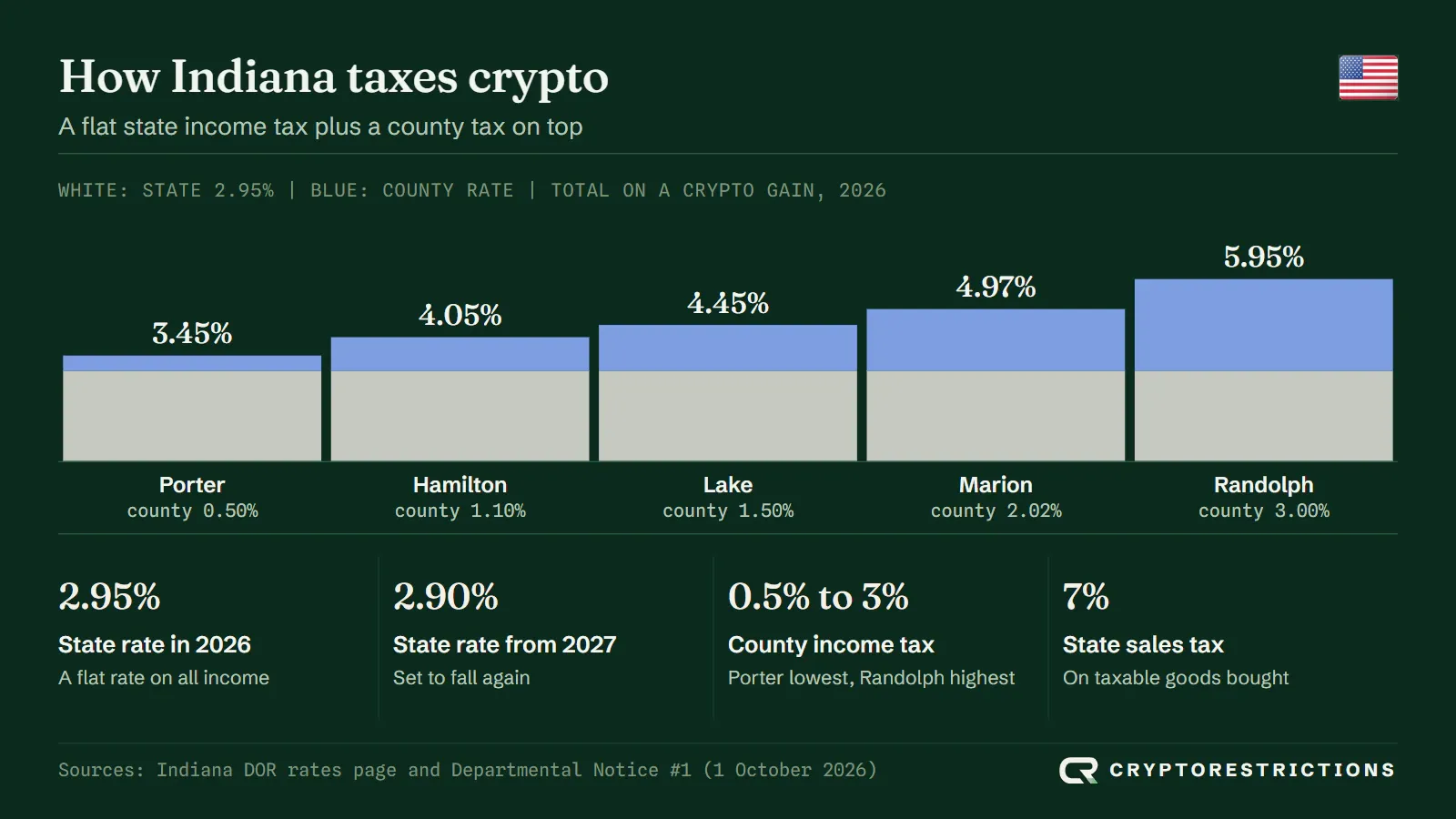
Indiana taxes a crypto gain as income at a flat 2.95% state rate for 2026, plus a county income tax of 0.5% to 3%, so the combined rate runs from 3.45% to 5.95%.
The Department of Revenue sets the state rate at 2.95% for 2026, falling to 2.90% in 2027. County rates come from Departmental Notice #1, effective 1 October 2026: Porter County charges 0.5%, Hamilton 1.1%, Lake 1.5%, Marion 2.02% and Randolph 3%. The state sales tax is 7%. We found no Revenue Department bulletin specific to crypto. Federal capital gains rules are in our United States guide.