
 United States · NJ
Is crypto legal in New Jersey?
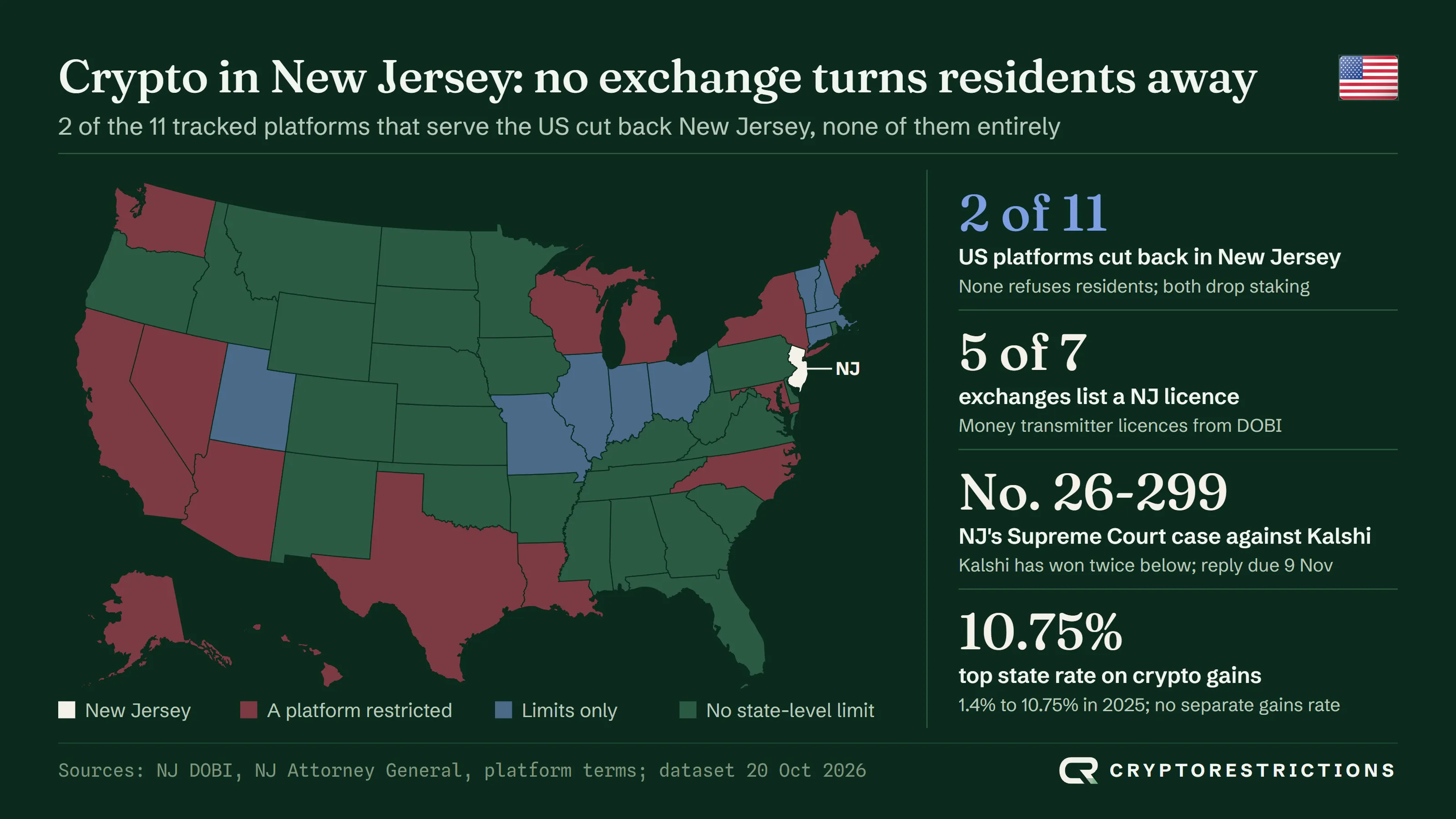
Yes. Owning and trading crypto is legal in New Jersey, and the state has no crypto licence of its own: exchanges that serve New Jerseyans register as money transmitters with the Department of Banking and Insurance (DOBI).
New Jersey has no equivalent of New York’s BitLicense. Instead, Coinbase, Gemini, OKX and Crypto.com each name a New Jersey money transmitter licence on their own licence pages, and Bitstamp lists the state among those that licence it. The Bureau of Securities has gone after crypto products it considers securities, and tax guidance follows the federal rules.
Federal rules from the SEC, CFTC, Treasury and IRS apply on top, as in every state, and offshore exchanges that refuse US users refuse New Jerseyans too. Both are covered in our United States guide.
Which crypto licences does New Jersey require?
A money transmitter licence from DOBI, not a crypto-specific one. Of the seven US exchanges we track, five name a New Jersey licence or list the state among their licensed states.
Coinbase lists money transmitter licence L067513, OKX lists licence L071981, and Gemini holds a trust certificate and a money transmitter licence (2406338 C22). A DOBI verification letter of 16 October 2025 shows Crypto.com’s Foris DAX, Inc. active since 17 February 2022 and valid to 30 June 2027. Bitstamp names New Jersey among its US licensing states. Kraken does not name a New Jersey licence on its licensing page but serves the state, and Gate names New Jersey neither among its licences nor among the states it does not serve.


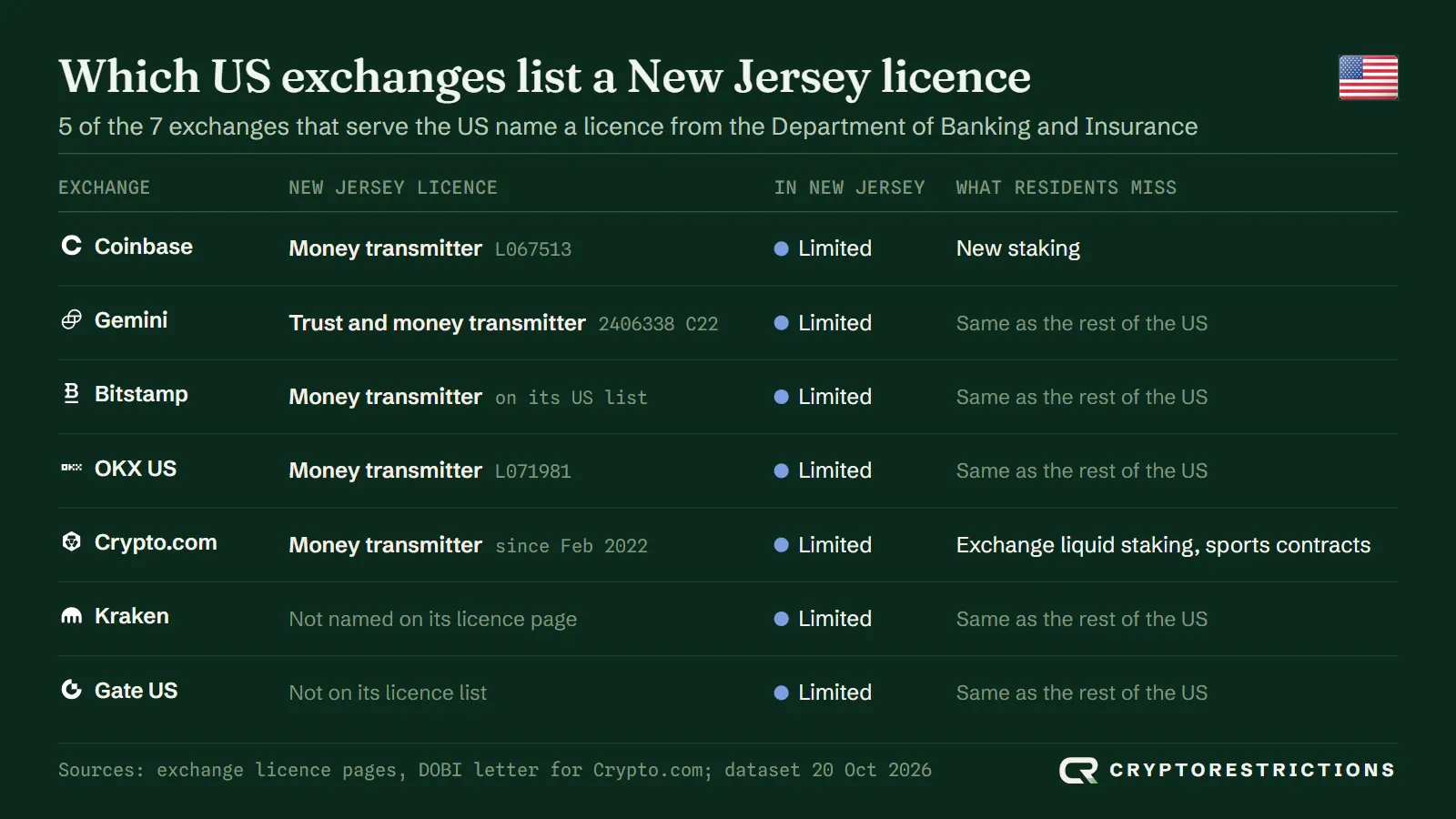
A licence line on a platform’s own page is not the same as DOBI’s licensee list, which we could not query for this guide. Treat the table as what each exchange says about itself.
Best crypto platforms for New Jersey residents
No tracked exchange refuses New Jersey. Two drop a product: Coinbase has taken no new staking since June 2023 and Crypto.com offers no Exchange liquid staking here.
The score rates how fully a New Jersey resident can use each platform, not its fees or safety. It is the US score with New Jersey’s own limits applied: access status (4 points), the share of the platform’s products open in the state (3), the licences we hold on file (2) and what our geo-access test saw from a US address (1). The method is on our methodology page.
Exchanges

Gemini
Best for A trust certificate and a money transmitter licence
8.4/10- Access
- 3.5/4
- Products
- 1.9/3
- Licences
- 2/2
- Our test
- 1/1
Read our Gemini reportPros
- Licence 2406338 C22 from DOBI
- No New Jersey carve-out in its terms
Cons
- Gemini Derivatives excludes US persons

Kraken
Best for Serving every state but Maine and New York
8.3/10- Access
- 3/4
- Products
- 2.3/3
- Licences
- 2/2
- Our test
- 1/1
Read our Kraken reportPros
- New Jersey is not on its excluded list
- No New Jersey product limits on its licensing page
Cons
- No New Jersey licence named on its licensing page

Coinbase
Best for The widest product range, minus staking
7.9/10- Access
- 3.5/4
- Products
- 2.4/3
- Licences
- 1/2
- Our test
- 1/1
Read our Coinbase reportPros
- New Jersey money transmitter licence L067513
- Spot trading open in New Jersey
Cons
- No new staking since June 2023
- Fined $5 million by the Bureau of Securities over staking

Crypto.com
Best for A DOBI-verified licence since 2022
7.5/10- Access
- 3/4
- Products
- 1.5/3
- Licences
- 2/2
- Our test
- 1/1
Read our Crypto.com reportPros
- Active money transmitter licence since 17 February 2022
- The App is offered in New Jersey
Cons
- No Exchange liquid staking for New Jersey residents
- Sports event contracts dropped in December 2025 (reported)
Prediction markets

Kalshi
Best for The broadest CFTC-regulated event contracts
7.3/10- Access
- 3/4
- Products
- 2.3/3
- Licences
- 1/2
- Our test
- 1/1
Read our Kalshi reportPros
- A federal injunction stops New Jersey enforcing its gambling law against it
- Won the Third Circuit appeal 2 to 1
Cons
- Ordered to stop by the Gaming Enforcement division in March 2025
- New Jersey is asking the Supreme Court to reverse the ruling
DeFi

Uniswap
Best for Swapping tokens from your own wallet
8.0/10- Access
- 4/4
- Products
- 3/3
- Licences
- 0/2
- Our test
- 1/1
Read our Uniswap reportPros
- Its terms do not exclude New Jersey
Cons
- Leveraged products for US retail are barred
Which platforms block or limit New Jersey residents?
None blocks New Jersey outright. Coinbase takes no new staking and Crypto.com offers neither Exchange liquid staking nor, as of December 2025, sports event contracts.
The Coinbase limit goes back to the 6 June 2023 order, when the Bureau of Securities said Coinbase had sold unregistered securities through staking and fined it $5 million. The order did not bar staking if Coinbase complied with New Jersey law, and the help page still lists New Jersey among the states with no new stakes.
Who regulates crypto in New Jersey?
DOBI licenses money transmitters, the Bureau of Securities polices crypto products that look like securities, and the Division of Gaming Enforcement handles prediction markets. No crypto-specific licence or kiosk law has been enacted.
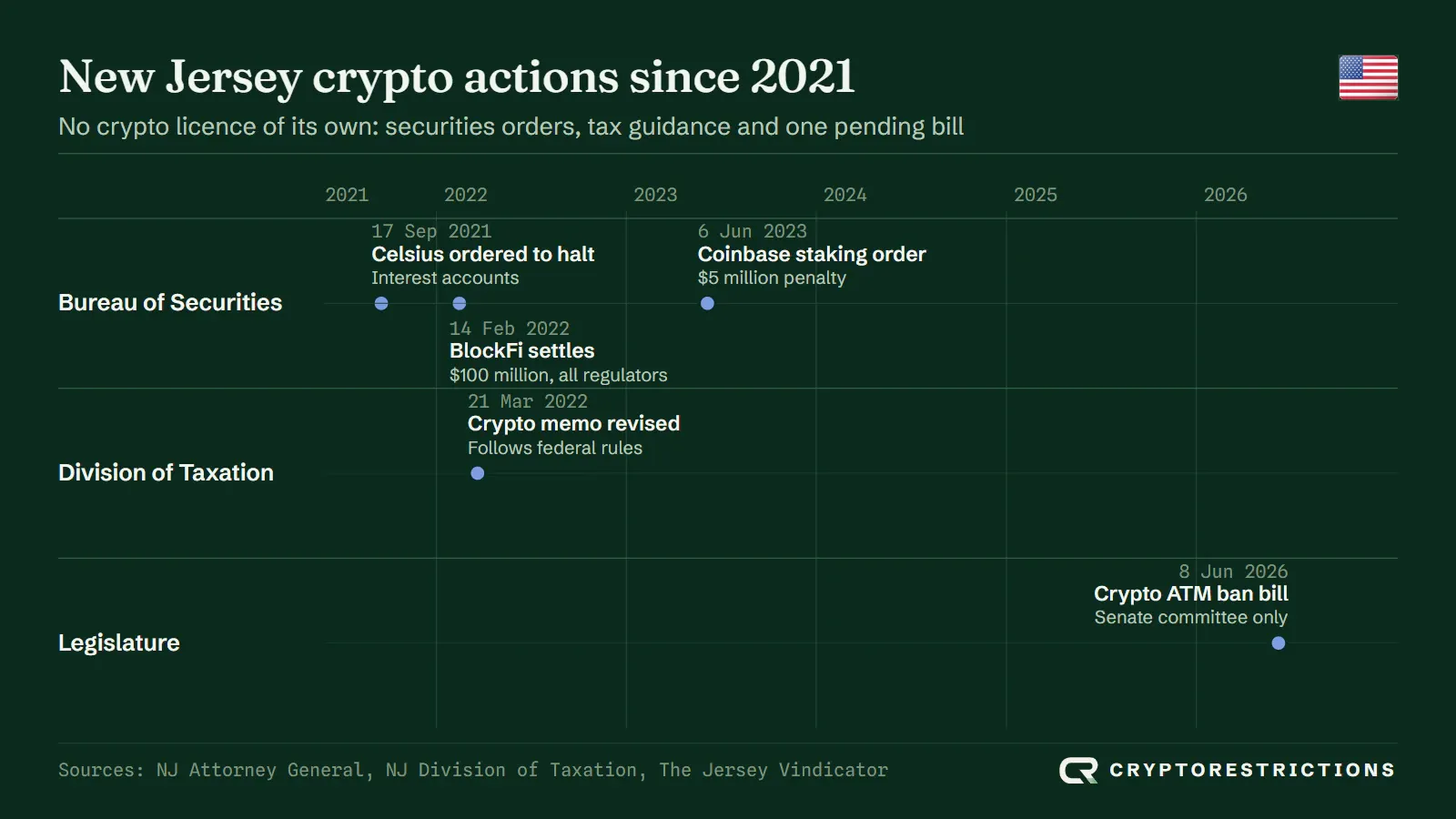
- Bureau of Securities. In July 2021 it ordered BlockFi to stop selling its interest accounts, then on 17 September 2021 issued the same kind of order against Celsius. BlockFi settled for $100 million with state and federal regulators in February 2022, New Jersey’s share being $943,396.22.
- Division of Taxation. Its memo of 21 March 2022 revised guidance to follow the federal treatment of virtual currency; see the tax section below.
- Legislature. Sen. Paul Moriarty’s bill S2141, which would ban crypto ATMs in New Jersey, cleared the Senate Commerce Committee unanimously on 8 June 2026, according to The Jersey Vindicator. We could not reach the Legislature’s own site, so check its status before relying on it.
Are prediction markets legal in New Jersey?
Not settled. New Jersey says sports event contracts are unlicensed sports betting, but a federal injunction stops it enforcing that against Kalshi, and the Third Circuit upheld the injunction 2 to 1 in April 2026.
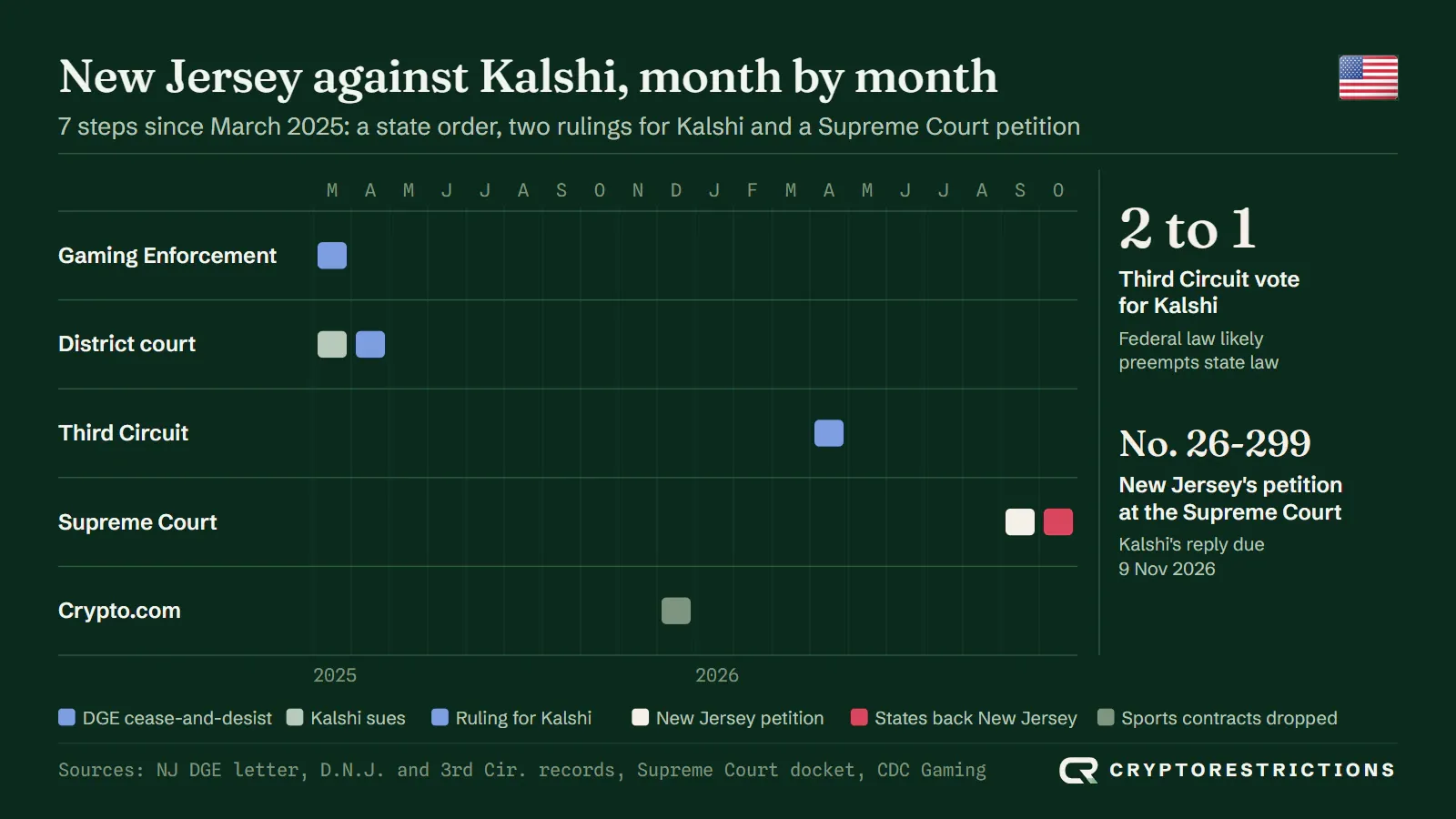
The Division of Gaming Enforcement’s cease-and-desist letter of 27 March 2025 said Kalshi was listing sports wagers that only licensed operators may offer, and that wagers on New Jersey college sports break the state constitution. Kalshi sued the next day (No. 1:25-cv-02152) and won a preliminary injunction on 28 April 2025. On 6 April 2026 the Third Circuit affirmed, finding federal commodities law likely preempts New Jersey’s gambling laws for contracts traded on a CFTC-licensed exchange.
New Jersey then asked the Supreme Court to hear the case (No. 26-299). Ohio led a group of states filing briefs in support in October 2026, and Kalshi’s reply is due 9 November 2026. Other states are on the opposite side of the same question: see the prediction markets section of our United States guide.
How is crypto taxed in New Jersey?
As property, the same way the IRS treats it: a gain is added to your income and taxed at New Jersey’s rates, 1.4% to 10.75% in 2025, with no separate capital gains rate.
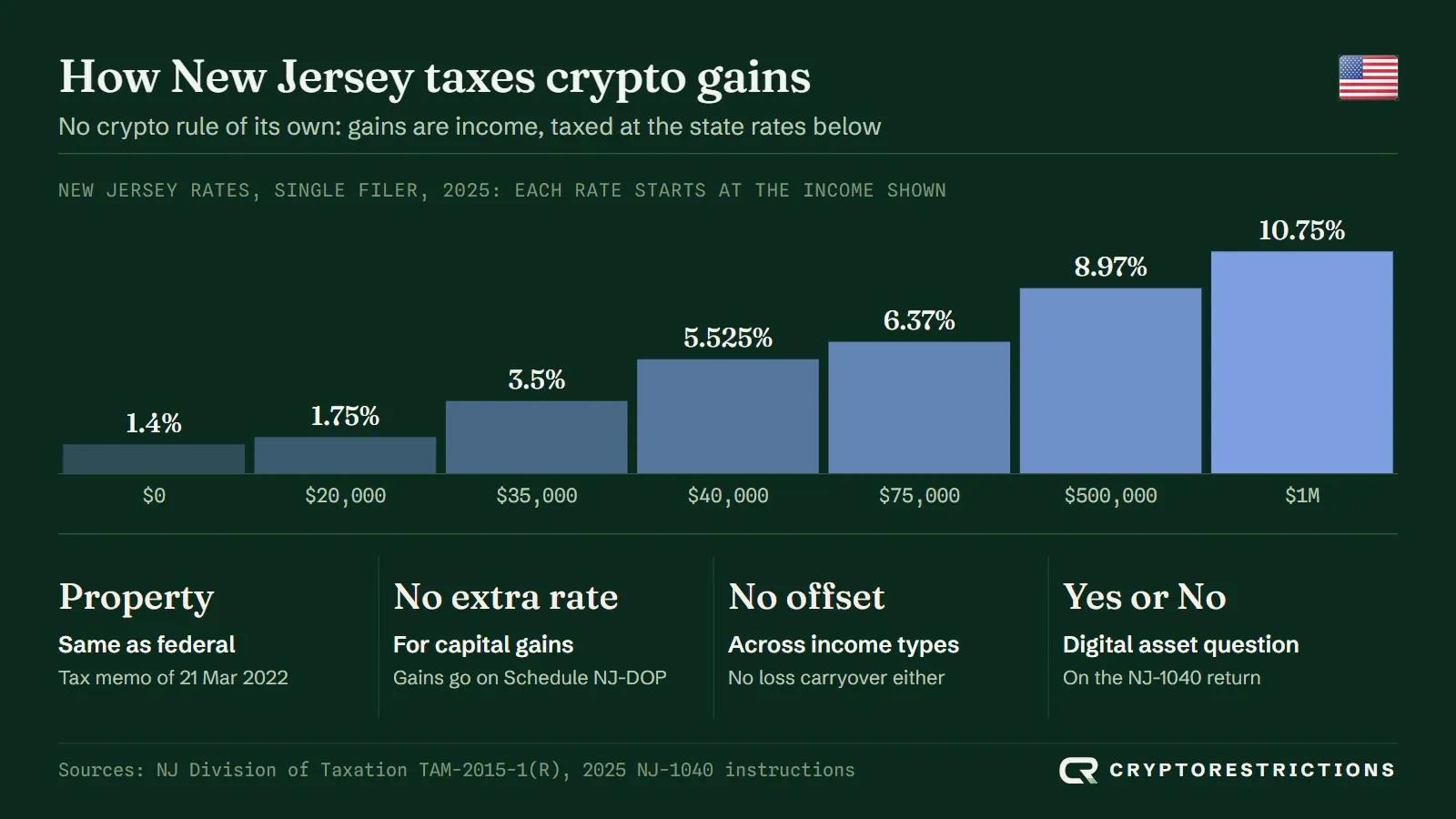
The Division of Taxation’s memo TAM-2015-1(R) says New Jersey conforms to the federal treatment of convertible virtual currency, and that the Gross Income Tax follows the federal rules for gain or loss on a sale or exchange of property. The 2025 NJ-1040 instructions ask every filer whether they received or disposed of a digital asset, and capital-asset gains go on Schedule NJ-DOP.
Losses work differently from the federal return: a net loss in one income category cannot offset income in another, and no carryback or carryover is allowed. The federal reporting rules apply as well.