 United States · CT
Is crypto legal in Connecticut?
Yes. Owning and trading crypto is legal in Connecticut, which licenses crypto firms as money transmitters through the Department of Banking and has no separate crypto licence.
The state keeps its older Money Transmission Act (General Statutes chapter 672a) and has widened it. Public Act 25-66, signed on 30 June 2025 and in force from 1 October 2025, reaches virtual currency sent through apps and digital wallets, not only kiosks. The same act bars the state and its towns from accepting crypto payments or holding a crypto reserve, so Connecticut, unlike Texas, is not a buyer.
Crypto kiosks need their own licence and may not charge more than a 15% fee. The Department of Banking suspended Bitcoin Depot’s licence on 9 March 2026 for fees above that cap, refund failures and gaps in its anti-money-laundering checks.
Federal rules from the SEC, CFTC, Treasury and IRS apply on top, and offshore exchanges that refuse US users refuse Connecticut residents too. Both are covered in our United States guide.
Which crypto licences does Connecticut require?
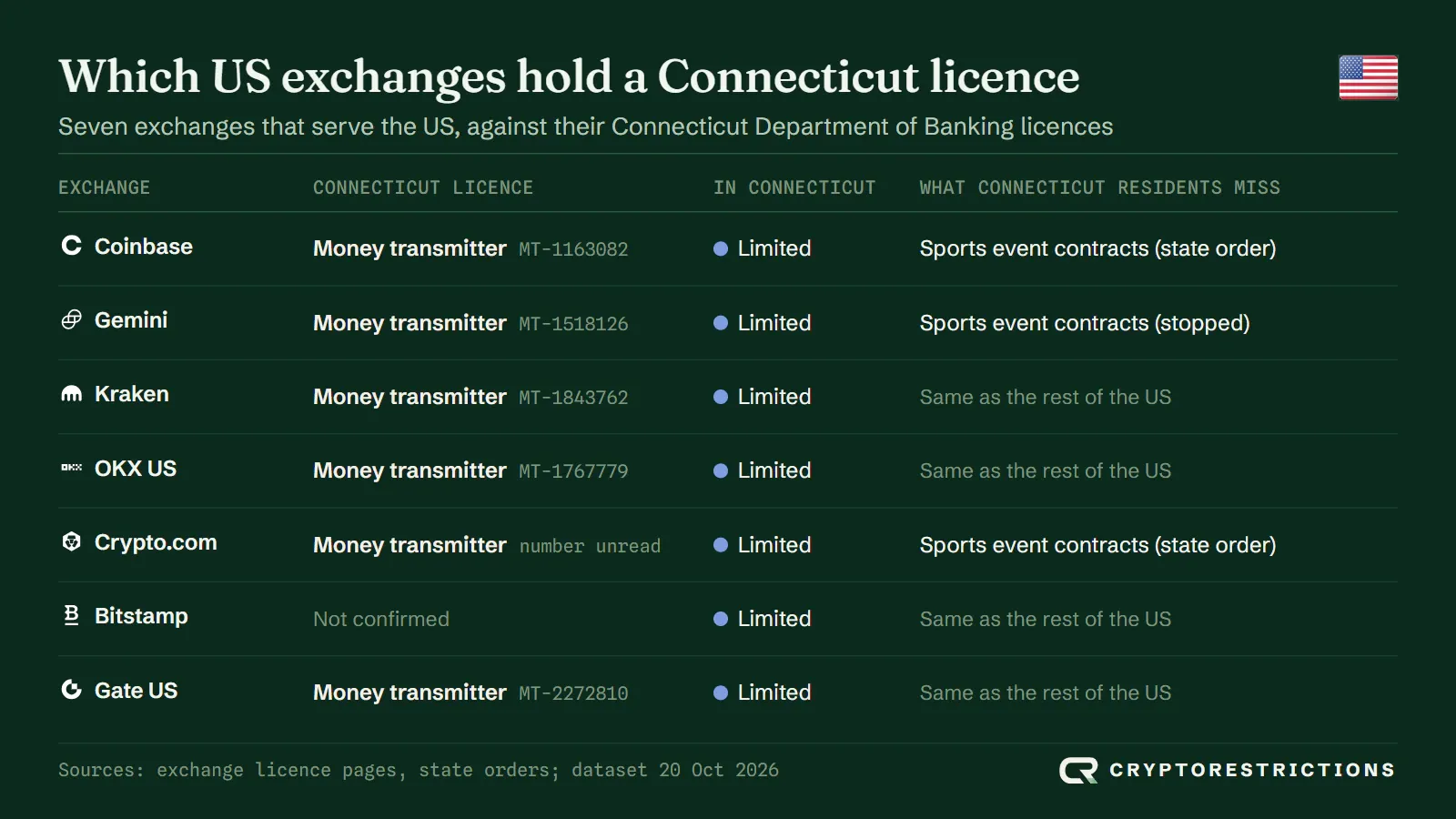
A money transmitter licence from the Department of Banking for any firm that moves customers’ money or virtual currency. Five of the seven US exchanges we track publish a Connecticut licence number: Coinbase, Gemini, Kraken, OKX US and Gate US.
There is no BitLicense-style regime and no state list of approved coins. Licences are issued through the NMLS system and can be checked on its Consumer Access site. Crypto.com lists Connecticut among its state licences, but the copy it publishes is a scan whose number we could not read, and Bitstamp serves its US licence page behind a bot check, so we could not confirm either. Every exchange in the table keeps the federal limits in our United States guide.

Best crypto platforms for Connecticut residents
By our access score inside Connecticut, Coinbase (8.9 out of 10), Gemini (8.4) and Kraken (8.3) are the most open exchanges, Kalshi (7.3) the most open prediction market and Uniswap (8.0) the most open DeFi platform.
The score rates how fully a Connecticut resident can use each platform, not its fees or safety. It is the US score with Connecticut’s own limits applied: access status (4 points), the share of the platform’s products open in the state (3), the licences we hold on file (2) and what our geo-access test saw from a US address (1). The method is on our methodology page.
Exchanges

Coinbase
Best for Spot trading plus staking and loans
8.9/10- Access
- 3.5/4
- Products
- 2.4/3
- Licences
- 2/2
- Our test
- 1/1
Read our Coinbase reportPros
- Connecticut money transmitter licence MT-1163082
- Spot, staking and loans do not carve out Connecticut
Cons
- Named in the 10 September 2026 order on sports event contracts
- Its prediction markets run on Kalshi, which Connecticut is suing

Gemini
Best for Plain spot trading under one licence
8.4/10- Access
- 3.5/4
- Products
- 1.9/3
- Licences
- 2/2
- Our test
- 1/1
Read our Gemini reportPros
- Connecticut money transmitter licence MT-1518126
- Gemini lists spot as available in Connecticut
Cons
- Stopped sports prediction contracts in Connecticut after the state order
- Gemini Derivatives excludes US persons

Kraken
Best for A wide coin list, in dollars
8.3/10- Access
- 3/4
- Products
- 2.3/3
- Licences
- 2/2
- Our test
- 1/1
Read our Kraken reportPros
- Connecticut money transmitter licence MT-1843762
- US futures through Kraken Derivatives US
Cons
- Derivatives sit in a separate US entity
- Staking is offered only in some US states

Crypto.com
Best for The App for spot trading
7.5/10- Access
- 3/4
- Products
- 1.5/3
- Licences
- 2/2
- Our test
- 1/1
Read our Crypto.com reportPros
- The App lists Connecticut among its available states
- Publishes a Connecticut licence copy
Cons
- Named in both Connecticut sports contract orders
- The Exchange does not offer US residents derivatives

OKX
Best for Spot trading with a short exclusion list
6.0/10- Access
- 3/4
- Products
- 1.5/3
- Licences
- 1/2
- Our test
- 0.5/1
Read our OKX reportPros
- Connecticut money transmitter licence MT-1767779
- Excludes only New York and four US territories
Cons
- Spot and convert only, no derivatives for US customers

Gate
Best for Spot trading on a Connecticut licence
5.1/10- Access
- 3/4
- Products
- 1.1/3
- Licences
- 1/2
- Our test
- 0/1
Read our Gate reportPros
- Connecticut money transmitter licence MT-2272810
- Connecticut is not among its non-operating states
Cons
- Licensed in 35 states, fewer than Coinbase or Kraken
Prediction markets

Kalshi
Best for Event contracts outside sports
7.3/10- Access
- 3/4
- Products
- 2.3/3
- Licences
- 1/2
- Our test
- 1/1
Read our Kalshi reportPros
- CFTC-designated contract market
- Contesting the state order in federal court
Cons
- Ordered to stop sports contracts in Connecticut, and sued by the state on 26 August 2026
- A federal judge denied its injunction in August 2026

Polymarket
Best for Polymarket markets on a US exchange
6.3/10- Access
- 3/4
- Products
- 2.3/3
- Licences
- 1/2
- Our test
- 0/1
Read our Polymarket reportPros
- Polymarket US is a CFTC-designated exchange
- No court order has yet stopped it
Cons
- Named in the 10 September 2026 order on sports event contracts
- polymarket.com itself blocks US users
DeFi

Uniswap
Best for Swapping tokens from your own wallet
8.0/10- Access
- 4/4
- Products
- 3/3
- Licences
- 0/2
- Our test
- 1/1
Read our Uniswap reportPros
- Terms do not exclude Connecticut
- No US state is named in its terms
Cons
- Leveraged products for US retail are barred

PancakeSwap
Best for BNB Chain swaps and pools
6.3/10- Access
- 3.5/4
- Products
- 1.8/3
- Licences
- 0/2
- Our test
- 1/1
Read our PancakeSwap reportPros
- Swaps, pools and staking are not excluded
Cons
- PCS Perps bars US users
- No US licence on file
Which platforms block or limit Connecticut residents?
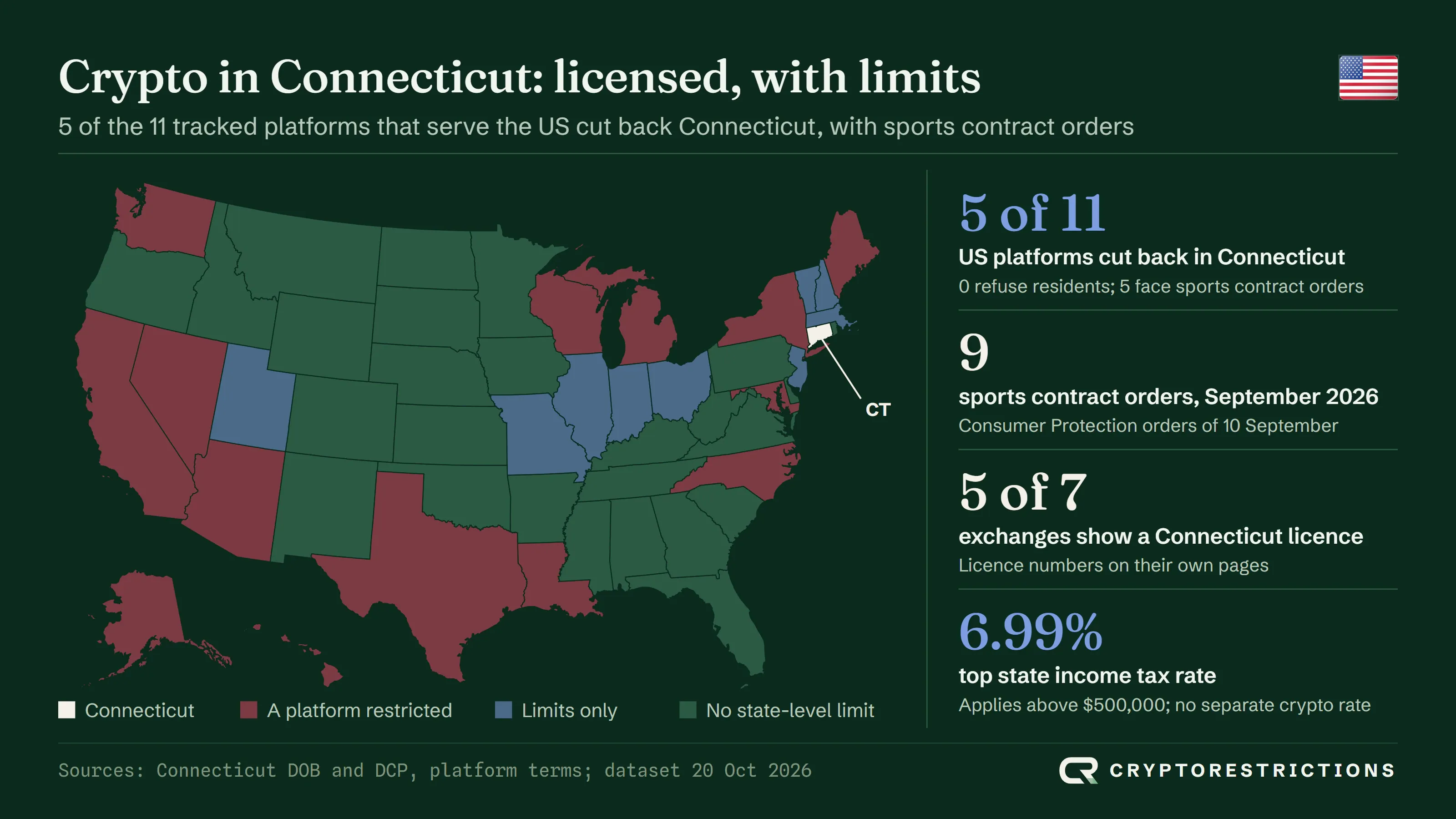
None refuses Connecticut residents outright. Five platforms are limited in the state, all over sports event contracts: Coinbase, Crypto.com, Gemini, Kalshi and Polymarket.
The orders came from the Department of Consumer Protection, not the Department of Banking. WFSB reported on 10 September 2026 that nine companies were told to stop offering sports event contracts to residents and to let them withdraw their funds. Gemini then stopped its sports contracts, a step that only secondary reports confirm; the others are listed as limited until we see their own notices.
Who regulates crypto in Connecticut?
The Department of Banking licenses money transmitters and kiosk operators, the Department of Consumer Protection and the Attorney General go after prediction markets, and the General Assembly writes the rules. We found no Connecticut Attorney General action against a crypto exchange.
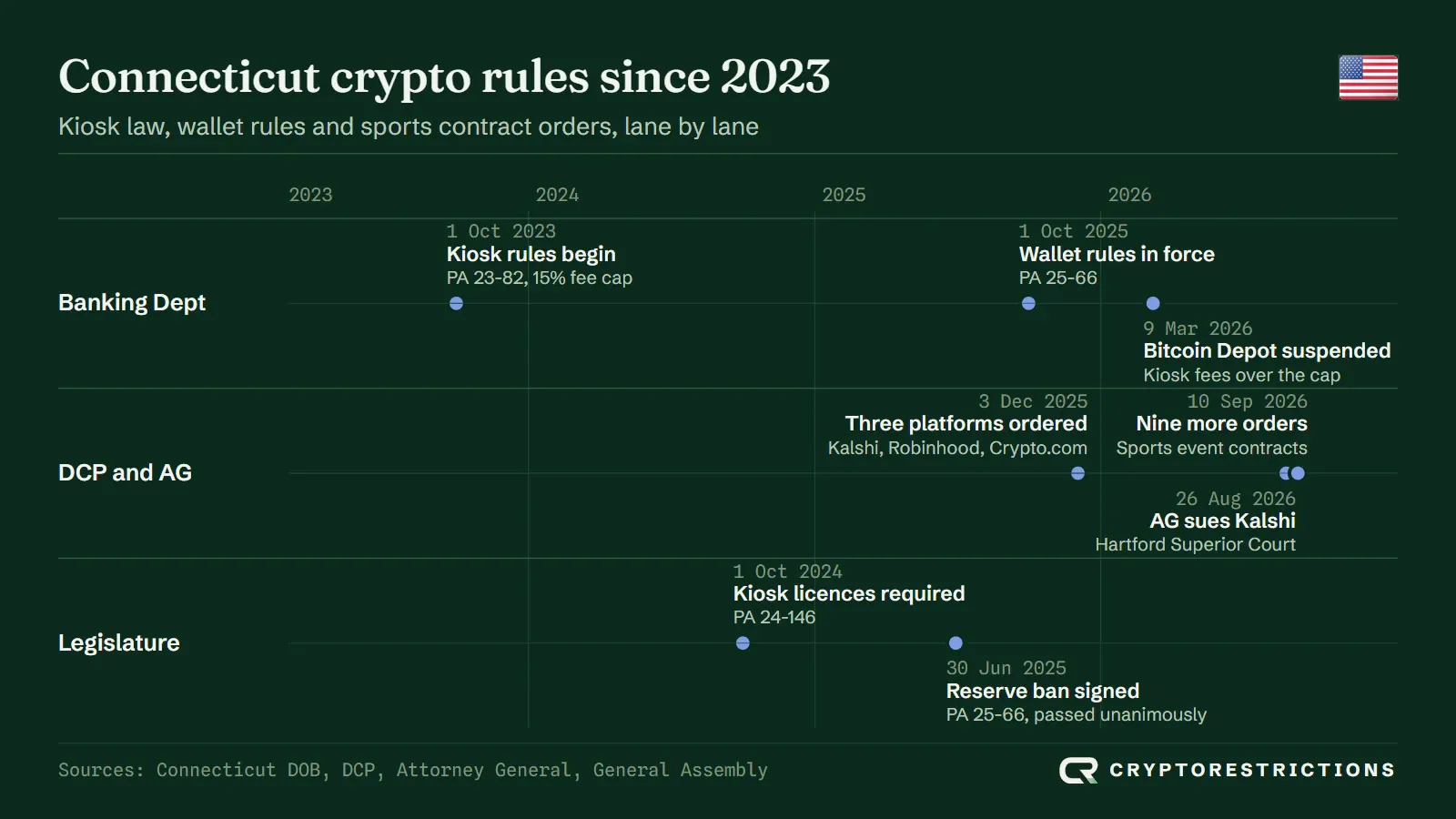
- Department of Banking. It enforces the Money Transmission Act. Its March 2026 order against Bitcoin Depot alleged fees above the 15% cap, a shortfall in required net worth and inadequate refunds to scam victims.
- Consumer Protection and Attorney General. The Department of Consumer Protection’s gaming division issued the prediction market orders. Attorney General William Tong sued Kalshi in Hartford Superior Court on 26 August 2026, and the case was moved to federal court the same day.
- General Assembly. Kiosk rules began on 1 October 2023 and kiosk licensing on 1 October 2024. Public Act 25-66 passed without opposition. We found no crypto bill passed in the 2026 session.
Are prediction markets legal in Connecticut?
Not for sports. Connecticut treats sports event contracts as unlicensed gambling, has ordered eleven platforms to stop since December 2025 and is suing Kalshi, while the platforms argue that federal law overrides the state.
The Department of Consumer Protection ordered Kalshi, Robinhood and Crypto.com to stop on 3 December 2025, and Kalshi sued the state the same week. In a ruling dated 7 August 2026, a federal judge denied Kalshi’s request to block the order, and Kalshi appealed to the Second Circuit as No. 26-2239 on 12 August. Coinbase appealed on 17 August, and the court consolidated the appeals, according to press reports. The CFTC sued Connecticut on 2 April 2026, claiming exclusive authority.
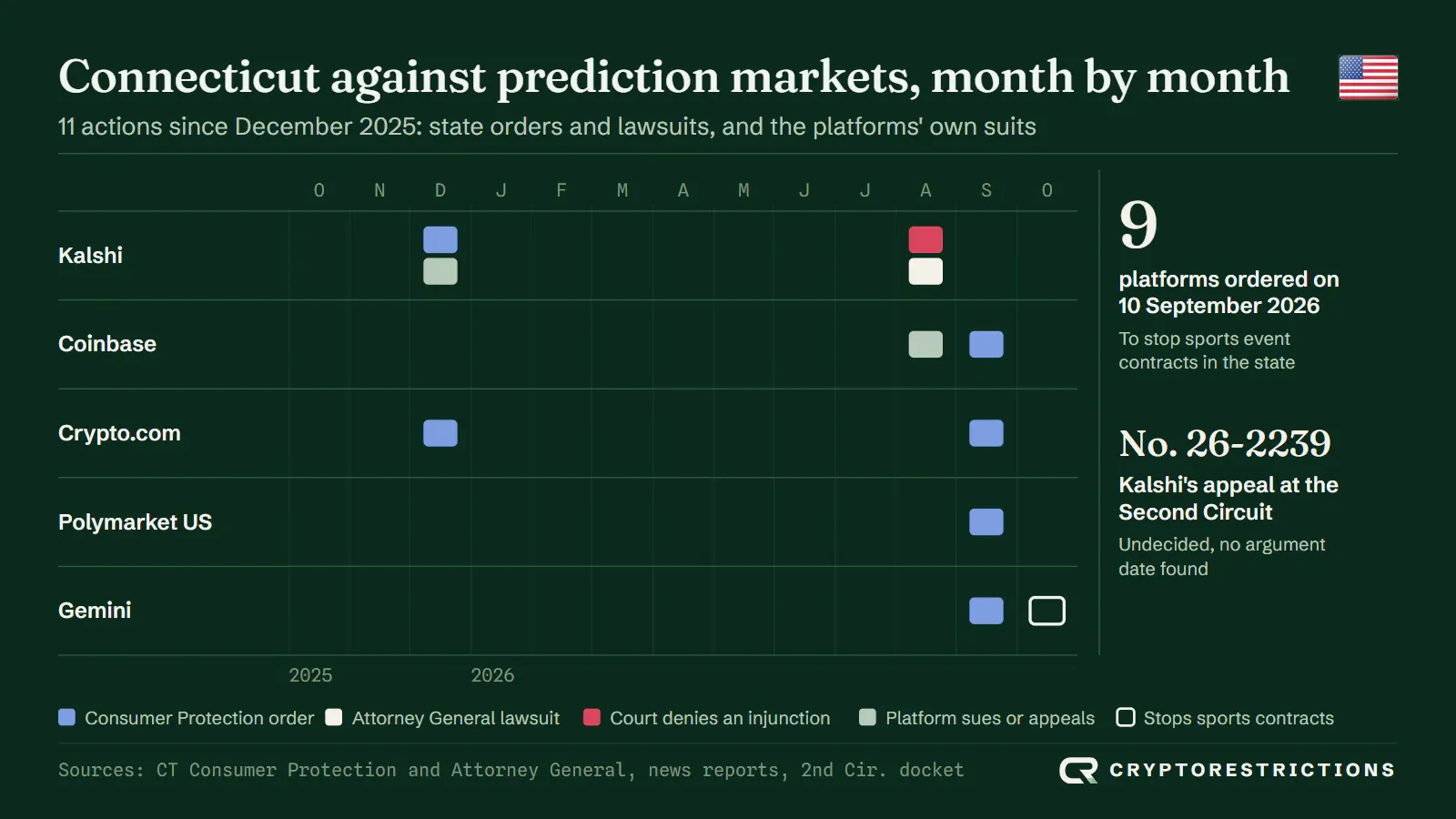
On 26 August 2026 the Attorney General sued Kalshi for illegal wagering, underage gambling and deceptive practices. The orders of 10 September covered nine companies: Polymarket, Coinbase, Crypto.com, Gemini, Novig, ProphetX, Robinhood, Underdog Predict and Webull. ProphetX, Gemini and Webull then withdrew from the state, on about 7 October, and Underdog has sued Connecticut. The appeal has no ruling yet. Other states’ actions are covered in our United States guide.
How is crypto taxed in Connecticut?
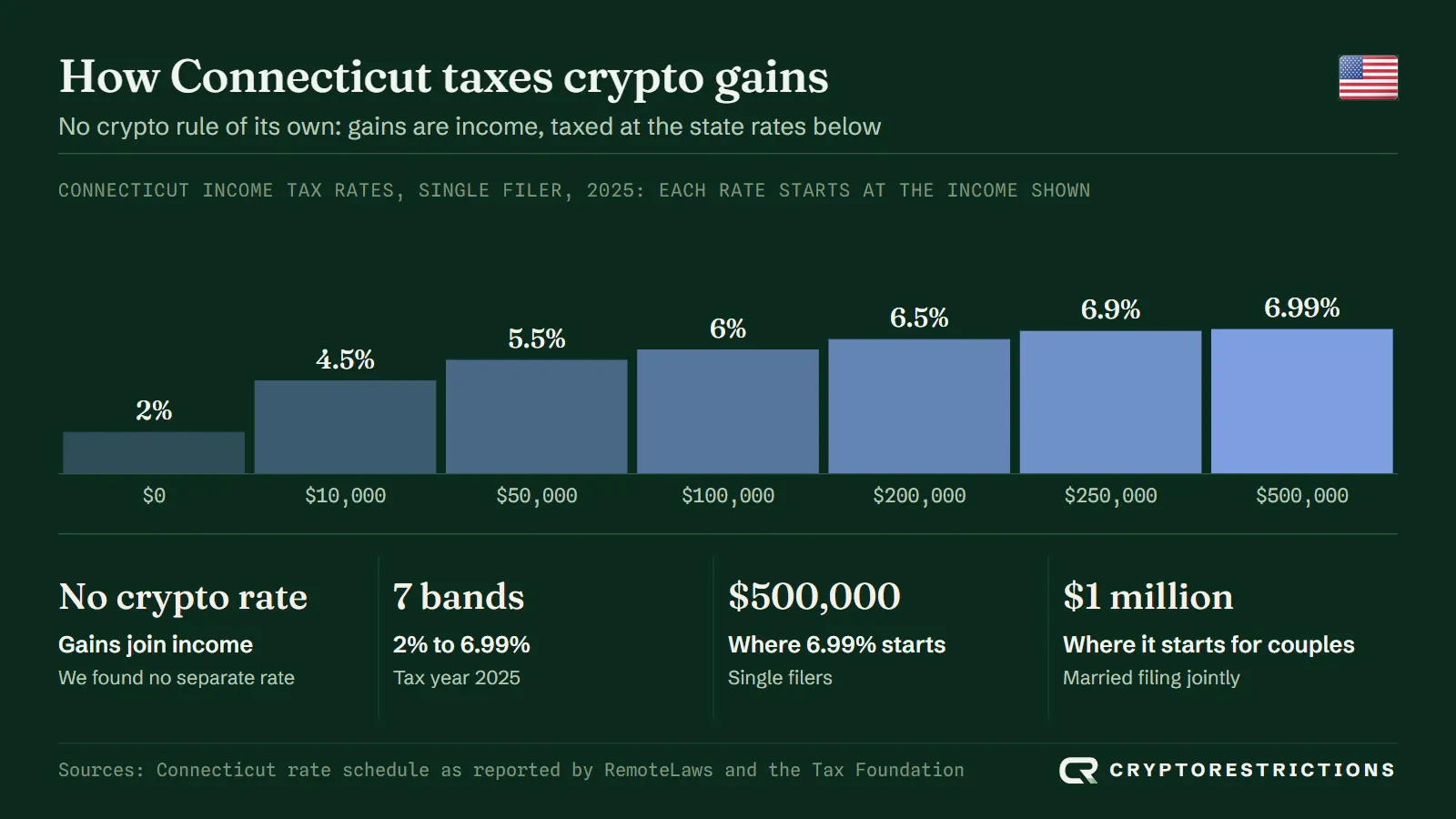
Connecticut has a graduated income tax of 2% to 6.99%, and we found no separate rate for crypto, so a gain is taxed inside it. The top rate starts at $500,000 for single filers.
For tax year 2025, single filers pay 2% on the first $10,000, 4.5% up to $50,000 and 5.5% on the next band, with seven bands in all. Married couples filing jointly reach the top rate at $1 million. Federal capital gains rules are in our United States guide.