 United States · MN
Is crypto legal in Minnesota?
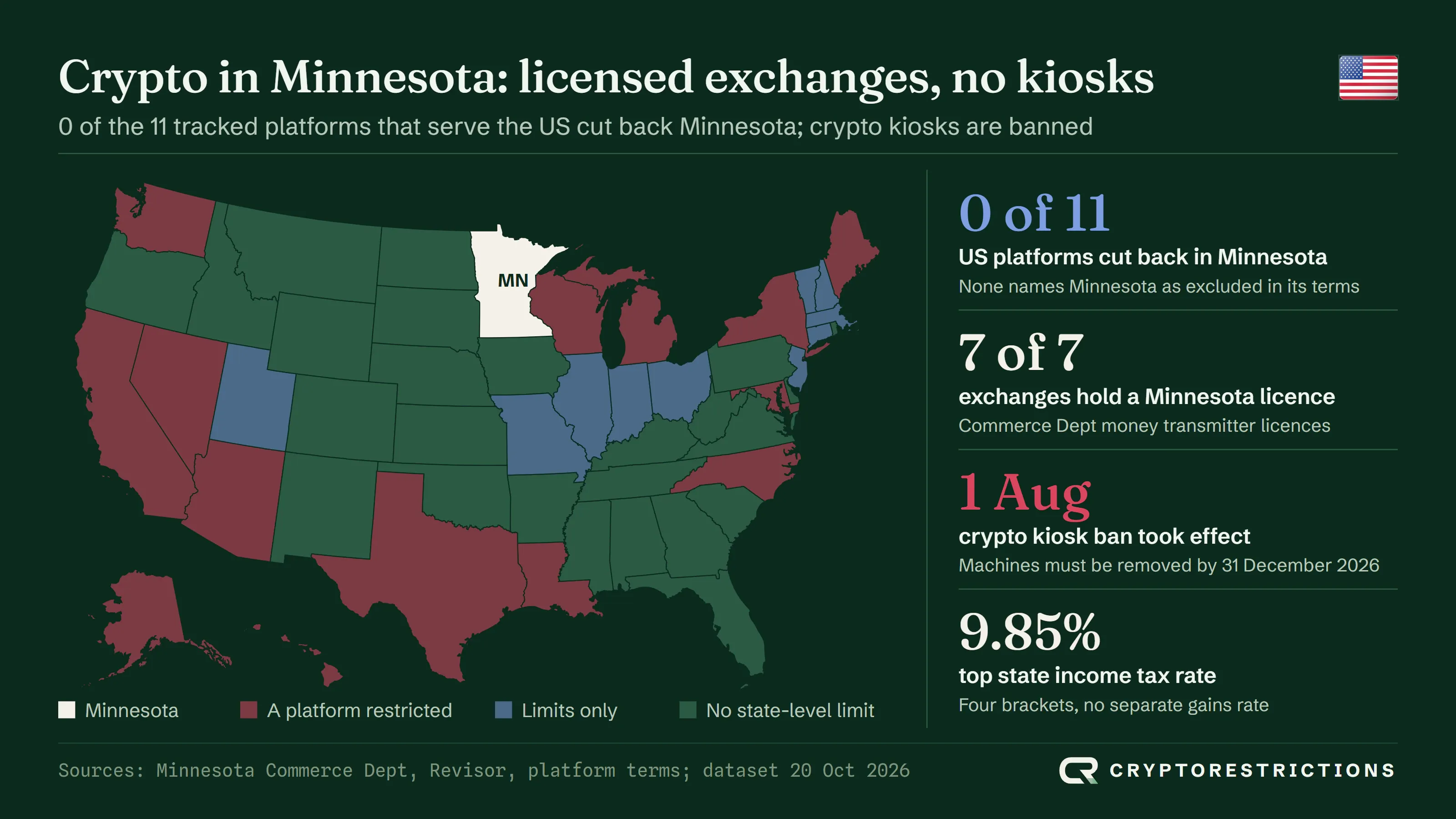
Yes. Owning and trading crypto is legal in Minnesota, and the state has no crypto licence of its own: the Department of Commerce licenses money transmission under chapter 53B, which defines virtual currency as a digital representation of value that is “not money”. Crypto kiosks are banned.
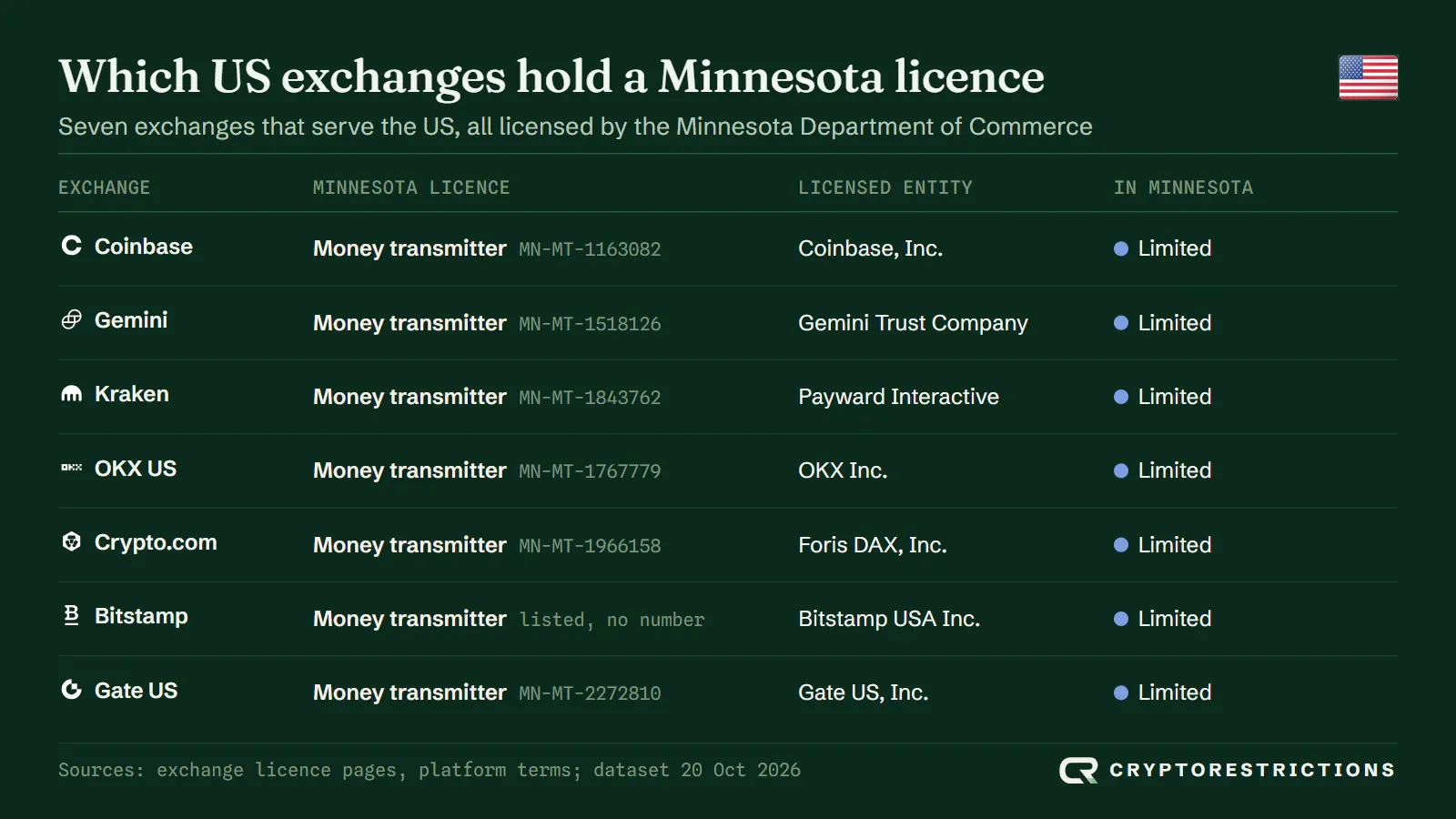
Chapter 53B is the Money Transmission Modernization Act, added in 2023, and its definitions section treats virtual currency as separate from money. Each exchange we track holds a Minnesota money transmitter licence from Commerce, and the numbers are in the table below. Federal rules from the SEC, CFTC, Treasury and IRS apply on top, as in every state, and offshore exchanges that refuse US users refuse Minnesotans too. Both are covered in our United States guide.
The kiosk ban is the rule that sets Minnesota apart. A 2024 law capped new customers at $2,000 a day on a crypto kiosk. Then Laws 2026 chapter 65, signed on 5 May 2026, went further: from 1 August 2026 nobody may install, operate, maintain or make available a virtual currency kiosk, and every machine must be out of public view by 31 December 2026. A Commerce notice of July 2026 adds that state banks and credit unions may offer nonfiduciary crypto custody from the same date.
Which crypto licences does Minnesota require?
A money transmitter licence from the Department of Commerce. All seven US exchanges we track hold one: Coinbase, Gemini, Kraken, OKX US, Crypto.com, Gate US and Bitstamp.
Minnesota has no BitLicense-style regime that licenses a firm for crypto as such. The licence numbers come from each exchange’s own licence page, and every exchange keeps the federal limits described in our United States guide. Bitstamp lists Minnesota among its money transmitter states without printing a number, and the Crypto.com number is read from its published legal document.
Best crypto platforms for Minnesota residents
By our access score inside Minnesota, Coinbase (8.9 out of 10), Gemini (8.4) and Kraken (8.3) are the most open exchanges, Kalshi (7.3) the most open prediction market and Uniswap (8.0) the most open DeFi platform.
The score rates how fully a Minnesota resident can use each platform, not its fees or safety. It is the US score with Minnesota’s own limits applied: access status (4 points), the share of the platform’s products open in the state (3), the licences we hold on file (2) and what our geo-access test saw from a US address (1). Platforms that refuse Minnesotans are not scored. The method is on our methodology page.
Exchanges

Coinbase
Best for Spot trading plus staking and loans
8.9/10- Access
- 3.5/4
- Products
- 2.4/3
- Licences
- 2/2
- Our test
- 1/1
Read our Coinbase reportPros
- Minnesota money transmitter licence MN-MT-1163082
- Its staking page names no Minnesota exclusion
Cons
- Its prediction markets stay open in Minnesota while the state ban is enjoined, not repealed

Gemini
Best for Plain spot trading under one licence
8.4/10- Access
- 3.5/4
- Products
- 1.9/3
- Licences
- 2/2
- Our test
- 1/1
Read our Gemini reportPros
- Gemini states it is available in Minnesota
- Minnesota money transmitter licence MN-MT-1518126
Cons
- Gemini Derivatives excludes US persons

Kraken
Best for A wide coin list and onchain staking
8.3/10- Access
- 3/4
- Products
- 2.3/3
- Licences
- 2/2
- Our test
- 1/1
Read our Kraken reportPros
- Minnesota money transmitter licence MN-MT-1843762
- Minnesota is on its list of states for onchain staking
- US bank funding is cut only in Texas, New York and Maine
Cons
- US futures run through a separate entity, Kraken Derivatives US

Crypto.com
Best for The App for spot trading
7.5/10- Access
- 3/4
- Products
- 1.5/3
- Licences
- 2/2
- Our test
- 1/1
Read our Crypto.com reportPros
- The App is available in 49 states, Minnesota included
- Minnesota money transmitter licence MN-MT-1966158
Cons
- The Exchange does not offer US residents derivatives

Bitstamp
Best for Plain spot trading
6.6/10- Access
- 3/4
- Products
- 0.6/3
- Licences
- 2/2
- Our test
- 1/1
Read our Bitstamp reportPros
- Lists Minnesota among its money transmitter licences
- No Minnesota carve-out in its US terms
Cons
- No staking or lending in the US
- No derivatives for US customers

OKX
Best for Spot trading with a Minnesota licence
6.0/10- Access
- 3/4
- Products
- 1.5/3
- Licences
- 1/2
- Our test
- 0.5/1
Read our OKX reportPros
- Minnesota money transmitter licence MN-MT-1767779
- Its US page excludes only New York and the territories
Cons
- Spot and convert only, no derivatives for US customers

Gate
Best for A US spot account with a wide token list
5.1/10- Access
- 3/4
- Products
- 1.1/3
- Licences
- 1/2
- Our test
- 0/1
Read our Gate reportPros
- Minnesota money transmitter licence MN-MT-2272810
- Minnesota is not on its list of states it does not operate in
Cons
- Gate US is closed to Alaska, Louisiana, New York, North Carolina, Texas and Washington
Prediction markets

Kalshi
Best for The broadest CFTC-regulated event contracts
7.3/10- Access
- 3/4
- Products
- 2.3/3
- Licences
- 1/2
- Our test
- 1/1
Read our Kalshi reportPros
- CFTC-designated contract market
- A federal court bars Minnesota from enforcing its ban against it
Cons
- The ban is still law and the injunction lasts only until a final decision

Polymarket
Best for Polymarket markets on a US exchange
6.3/10- Access
- 3/4
- Products
- 2.3/3
- Licences
- 1/2
- Our test
- 0/1
Read our Polymarket reportPros
- Polymarket US is a CFTC-designated exchange
- It is covered by the same injunction
Cons
- polymarket.com itself blocks US users
DeFi

Uniswap
Best for Swapping tokens from your own wallet
8.0/10- Access
- 4/4
- Products
- 3/3
- Licences
- 0/2
- Our test
- 1/1
Read our Uniswap reportPros
- Its terms do not name Minnesota
- No US state is named in its terms
Cons
- Leveraged products for US retail are barred

PancakeSwap
Best for BNB Chain swaps and pools
6.3/10- Access
- 3.5/4
- Products
- 1.8/3
- Licences
- 0/2
- Our test
- 1/1
Read our PancakeSwap reportPros
- Swaps, pools and staking are not excluded
Cons
- PCS Perps bars US users
- No US licence on file
Which platforms block or limit Minnesota residents?
None of the platforms we track names Minnesota as excluded in its own terms, licence page or help centre, so no platform has a Minnesota-specific limit in our data.
That is a finding, not a gap in our checks. Gate publishes a list of the jurisdictions where it does not operate, and Minnesota is not on it. Gemini says it is available in Minnesota, and Crypto.com’s help centre lists Minnesota among the 49 states where its App works. Kraken names Minnesota on its list of states for onchain staking. Coinbase excludes only Nevada and Michigan from its prediction markets.
The rules that do bind Minnesotans are the federal ones, plus the kiosk ban above. Where a platform treats a state differently, the other state guides list it: see the United States guide for the full map.
Who regulates crypto in Minnesota?
The Department of Commerce licenses money transmitters, the Legislature wrote the crypto laws of 2026, and the Attorney General is a named defendant in the federal suits over the prediction market ban.
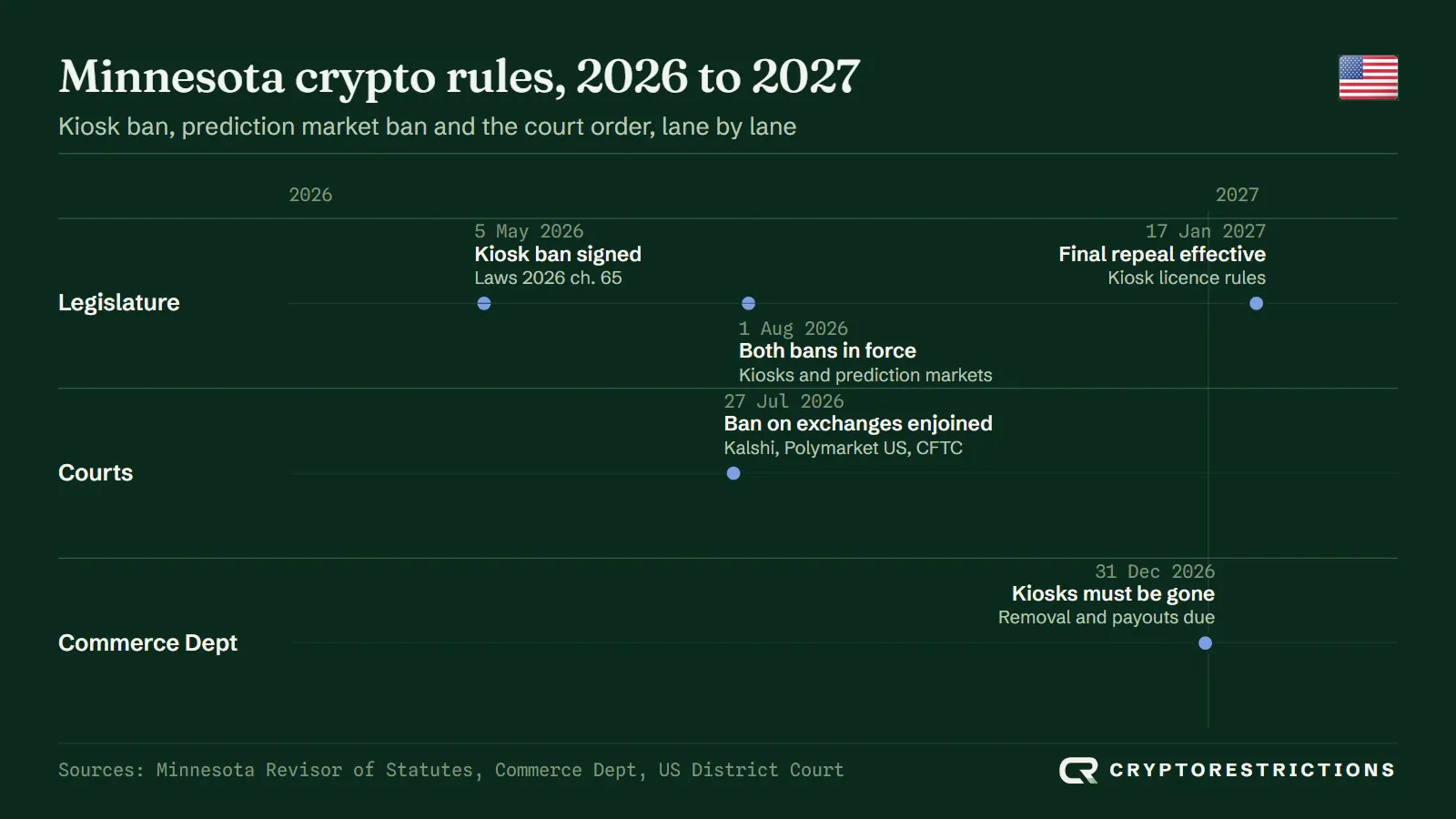
- Commerce Department. It licenses money transmitters under chapter 53B and published the July 2026 notice summarising the new crypto laws. The kiosk law gives 31 December 2026 as the deadline for removing machines and paying customers.
- Legislature. Chapter 65 banned kiosks. A second law, chapter 118, made operating a prediction market a felony from 1 August 2026, and a third, chapter 124, sets unclaimed-property rules for crypto, also from that date.
- Attorney General and courts. Keith Ellison is a defendant in the suits below, along with the Department of Public Safety.
Are prediction markets legal in Minnesota?
Not under state law, but the ban cannot be enforced against CFTC-registered exchanges. Minnesota made creating or operating a prediction market a felony from 1 August 2026, and on 27 July 2026 a federal judge enjoined that law for Kalshi, Polymarket US and any other CFTC-registered exchange.
Minnesota Statutes 609.7615, as adopted by SF 3432 (Laws 2026 chapter 118), makes it a felony to create a prediction market, to run a platform on which consumers place wagers, or to advertise products that promote them. Three federal cases followed in the District of Minnesota, all assigned to Judge Katherine Menendez: United States and CFTC v. Minnesota (26-cv-2661), KalshiEX v. Ellison (26-cv-2778) and QCX LLC d/b/a Polymarket US v. Ellison (26-cv-2841).
In her order of 27 July 2026 the judge found the plaintiffs likely to succeed on their claim that federal law preempts the statute, at least in part, and enjoined the state from enforcing it “against entities that are registered as designated contract markets by the CFTC”. The order does not reach the plaintiffs’ free speech claims about advertising, and it notes that some contracts, such as pop-culture markets, may not be swaps. The injunction lasts until a final decision. We did not find a ruling after 27 July, so check the docket before relying on it.
In our data Kalshi and Polymarket US keep their US status in Minnesota. States that have acted against them are covered in our United States guide.
How is crypto taxed in Minnesota?
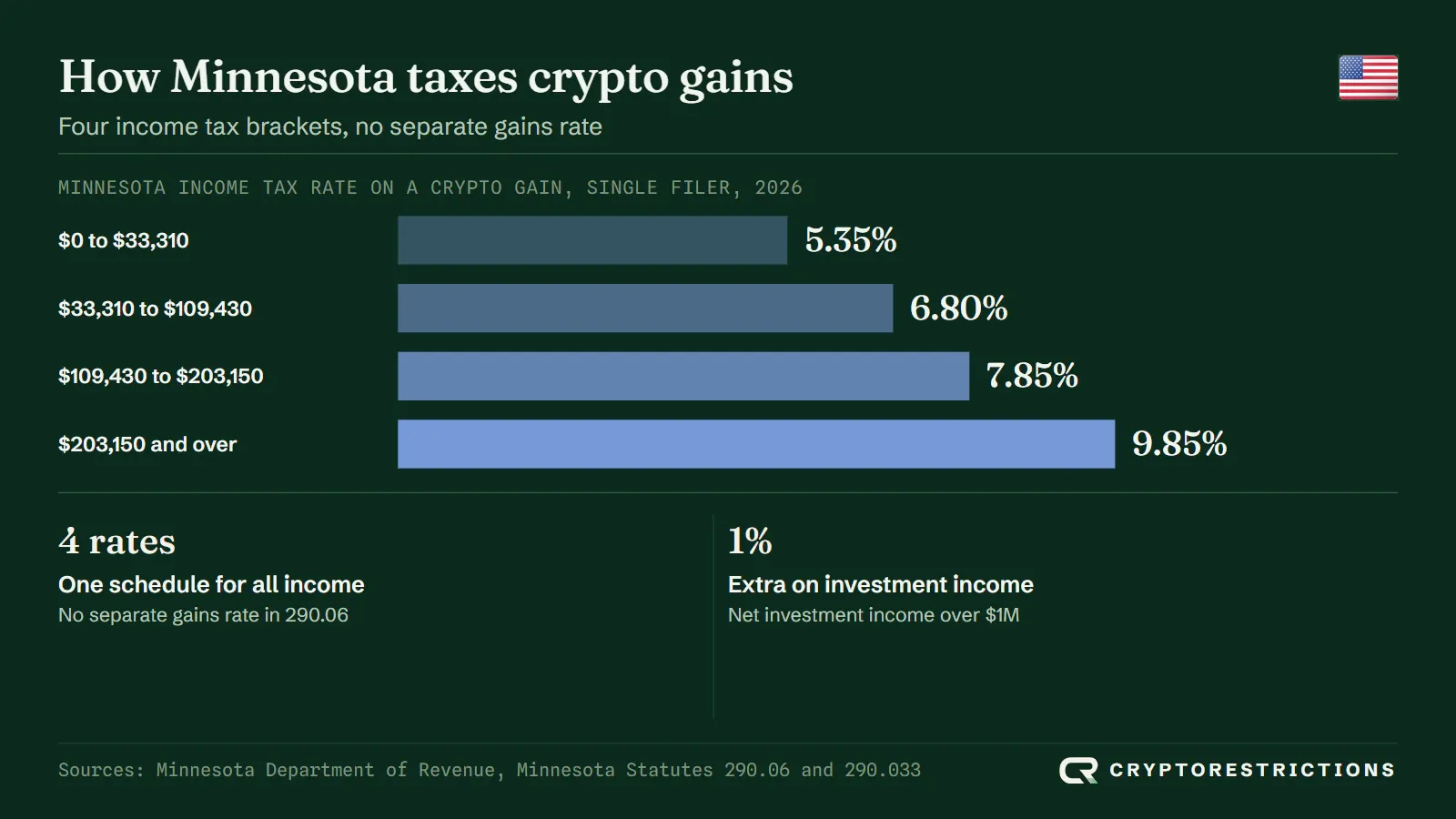
A crypto gain falls under Minnesota’s individual income tax, whose four rates are 5.35%, 6.80%, 7.85% and 9.85% depending on taxable income, and the state adds 1% on net investment income above $1,000,000. Section 290.06 sets no separate rate for gains, and we found no crypto-specific Minnesota tax page.
Section 290.06 sets four rates for every filing status. For the 2026 tax year the Department of Revenue puts the start of the second, third and fourth brackets at $33,310, $109,430 and $203,150 for a single filer, and $48,700, $193,480 and $337,930 for married couples filing jointly. Federal capital gains rules are in our United States guide. The net investment income tax adds 1% on net investment income above $1,000,000.