 United States · VT
Is crypto legal in Vermont?
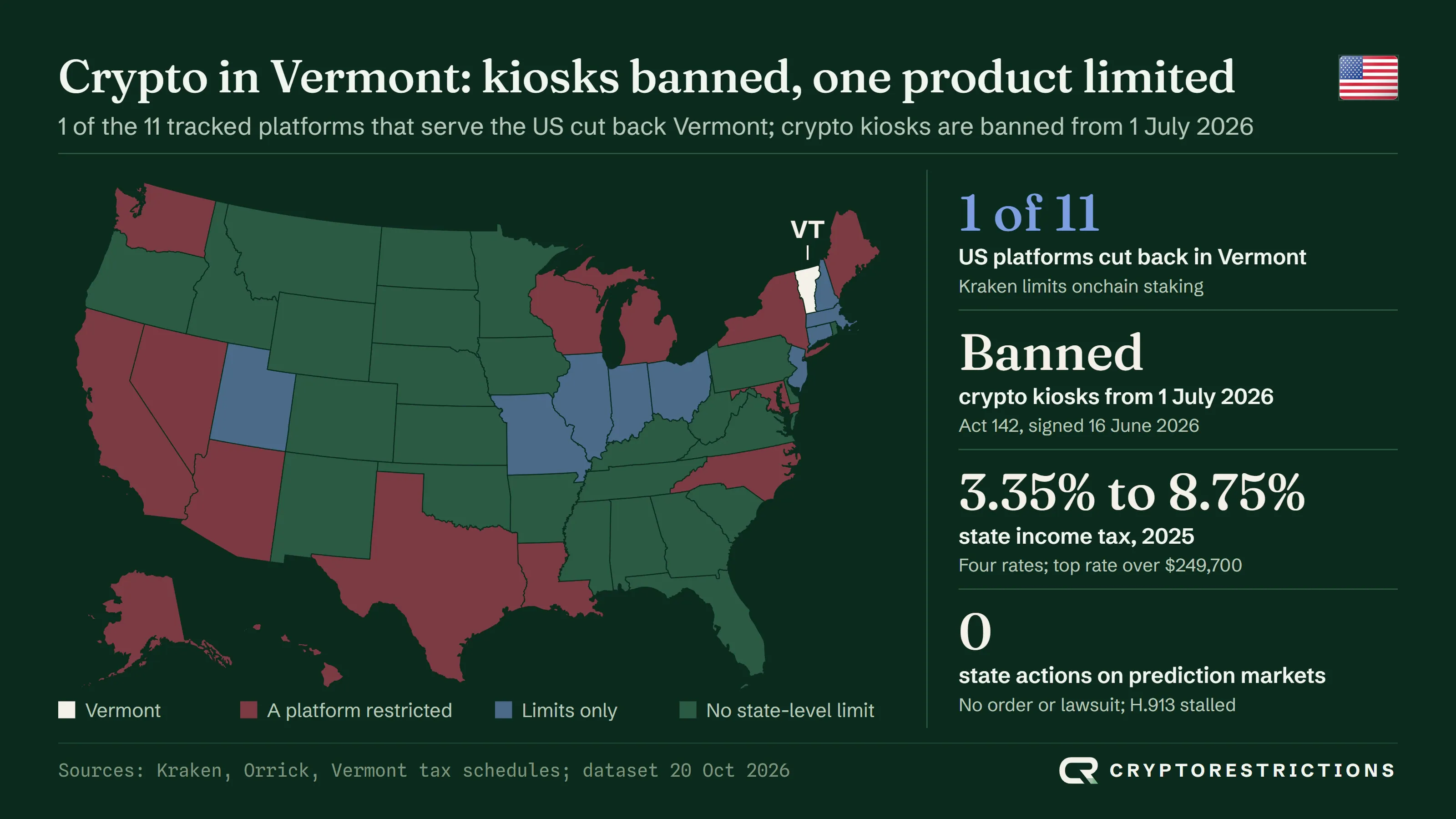
Yes. Owning and trading crypto is legal in Vermont, and a business that moves crypto for other people is regulated as a money transmitter by the Department of Financial Regulation. The one thing banned outright is the crypto kiosk.
We found no crypto-specific licence in Vermont. A 26 June 2026 summary by the law firm Orrick says Act 142 (H.648) widened the state’s definition of money transmission to cover virtual currency business activity, so an exchange that serves Vermonters sits inside the same licensing rules as a payments company. The Department’s own pages and the Legislature’s site did not load for us on 20 October 2026, so the points on Vermont law in this guide rest on that summary and on news reports, and we say so where it matters.
Federal rules from the SEC, CFTC, Treasury and IRS apply on top, as in every state, and offshore exchanges that refuse US users refuse Vermonters too. Both are covered in our United States guide.
Which crypto licences does Vermont require?
A money transmitter licence, the same one that covers dollars. Of the seven US exchanges we track, Gemini, OKX US and Gate US show a Vermont licence on their own pages; Coinbase, Crypto.com and Bitstamp are not confirmed here.
There is no BitLicense-style regime and no list of approved coins that we could find. Gemini’s Vermont page says “Gemini is available in Vermont” and lists money transmitter licences 100-119 (Gemini Trust Company) and MT-2403509 (Moonbase). OKX US lists licences #100-156 and #MT-1767779-1 on its US licences page, updated on 15 September 2026, and excludes only New York and the US territories. Gate US lists Vermont licence MT-2272810 on its licences page, and its list of states where it does not operate (Alaska, Texas, Louisiana, New York, Washington, North Carolina) does not include Vermont. We could not read Coinbase’s or Bitstamp’s licence pages, and did not check Crypto.com’s. Kraken publishes no Vermont licence on its licensing page but serves the state.
Kiosks are different. Orrick reports that Act 142, signed by Governor Phil Scott on 16 June 2026, bans virtual currency kiosks permanently from 1 July 2026, ends existing kiosk registrations on that date and entitles customers to refunds on non-compliant transactions. AARP Vermont reported the ban on 1 September 2026 as the first in the Northeast.
Best crypto platforms for Vermont residents
By our access score inside Vermont, Gemini (8.4 out of 10), Kraken (8.3) and Coinbase (7.9) are the most open exchanges, Kalshi (7.3) the most open prediction market and Uniswap (8.0) the most open DeFi platform.
The score rates how fully a Vermont resident can use each platform, not its fees or safety. It is the US score with Vermont’s own limits applied: access status (4 points), the share of the platform’s products open in the state (3), the licences we hold on file (2) and what our geo-access test saw from a US address (1). Platforms that refuse Vermonters are not scored. The method is on our methodology page.
Exchanges

Gemini
Best for Plain spot trading under a US trust company
8.4/10- Access
- 3.5/4
- Products
- 1.9/3
- Licences
- 2/2
- Our test
- 1/1
Read our Gemini reportPros
- Its own Vermont page says Gemini is available in Vermont
- Lists two Vermont money transmitter licences
Cons
- Fiat deposits are USD only
- Gemini Derivatives excludes US persons

Kraken
Best for Spot trading and bitcoin staking
8.3/10- Access
- 3/4
- Products
- 2.3/3
- Licences
- 2/2
- Our test
- 1/1
Read our Kraken reportPros
- Vermont is not on its list of excluded states (Maine and New York)
- Bitcoin staking is open to Vermont residents
Cons
- Onchain staking is not offered in Vermont
- No Vermont licence on its licensing page

Coinbase
Best for Spot trading plus staking and loans
7.9/10- Access
- 3.5/4
- Products
- 2.4/3
- Licences
- 1/2
- Our test
- 1/1
Read our Coinbase reportPros
- Vermont dropped its staking case in March 2025, so staking is not cut back in the state
- No Vermont carve-out in its US terms
Cons
- We could not read its licence page to confirm a Vermont licence
- Its prediction markets run through Kalshi

Crypto.com
Best for The App for spot trading
7.5/10- Access
- 3/4
- Products
- 1.5/3
- Licences
- 2/2
- Our test
- 1/1
Read our Crypto.com reportPros
- Its US page lists Vermont among the available states
- Staking exclusions name NY, CA, MD, NJ and WI, not Vermont
Cons
- The Exchange does not offer US residents derivatives

Bitstamp
Best for Plain spot trading
6.6/10- Access
- 3/4
- Products
- 0.6/3
- Licences
- 2/2
- Our test
- 1/1
Read our Bitstamp reportPros
- No Vermont carve-out in its US terms
Cons
- We could not confirm a Vermont licence on its page
- No staking, lending or derivatives in the US

OKX
Best for Spot trading under a US entity
6.0/10- Access
- 3/4
- Products
- 1.5/3
- Licences
- 1/2
- Our test
- 0.5/1
Read our OKX reportPros
- Two Vermont licences listed on its US page
- Its US page excludes only New York and the territories
Cons
- Spot and convert only, no derivatives for US customers
Prediction markets

Kalshi
Best for The broadest CFTC-regulated event contracts
7.3/10- Access
- 3/4
- Products
- 2.3/3
- Licences
- 1/2
- Our test
- 1/1
Read our Kalshi reportPros
- CFTC-designated contract market
- We found no Vermont order against it
Cons
- Its help pages publish no Vermont-specific terms we could read

Polymarket
Best for Polymarket markets on a US exchange
6.3/10- Access
- 3/4
- Products
- 2.3/3
- Licences
- 1/2
- Our test
- 0/1
Read our Polymarket reportPros
- Polymarket US is a CFTC-designated exchange
- We found no Vermont order against it
Cons
- polymarket.com itself blocks US users
- No state list is published, so Vermont status rests on silence
DeFi

Uniswap
Best for Swapping tokens from your own wallet
8.0/10- Access
- 4/4
- Products
- 3/3
- Licences
- 0/2
- Our test
- 1/1
Read our Uniswap reportPros
- Terms do not exclude Vermont
- No US state is named in its terms
Cons
- Leveraged products for US retail are barred

PancakeSwap
Best for BNB Chain swaps and pools
6.3/10- Access
- 3.5/4
- Products
- 1.8/3
- Licences
- 0/2
- Our test
- 1/1
Read our PancakeSwap reportPros
- Swaps, pools and staking are not excluded
Cons
- PCS Perps bars US users
- No US licence on file
Which platforms block or limit Vermont residents?
One, and only for one product: Kraken does not offer onchain staking in Vermont. We found no tracked platform that bars Vermont residents outright.
Kraken’s US quick start page, updated on 30 March 2026, says onchain staking is “only available in these US states and territories” and lists 37 states, the District of Columbia and Puerto Rico. Vermont is not among them. Its bitcoin staking page, updated on 23 September 2026, excludes only Maine and New York, so bitcoin staking is open. Kraken’s licensing page lists Maine and New York as the places it does not serve. Coinbase staking was once at issue in Vermont: the Department rescinded its show cause order against the exchange on 13 March 2025, without prejudice, after the SEC dropped its own case.
Who regulates crypto in Vermont?
The Department of Financial Regulation licenses money transmitters, including crypto businesses, and the General Assembly wrote the 2026 kiosk ban. We found no Attorney General lawsuit against a crypto exchange.
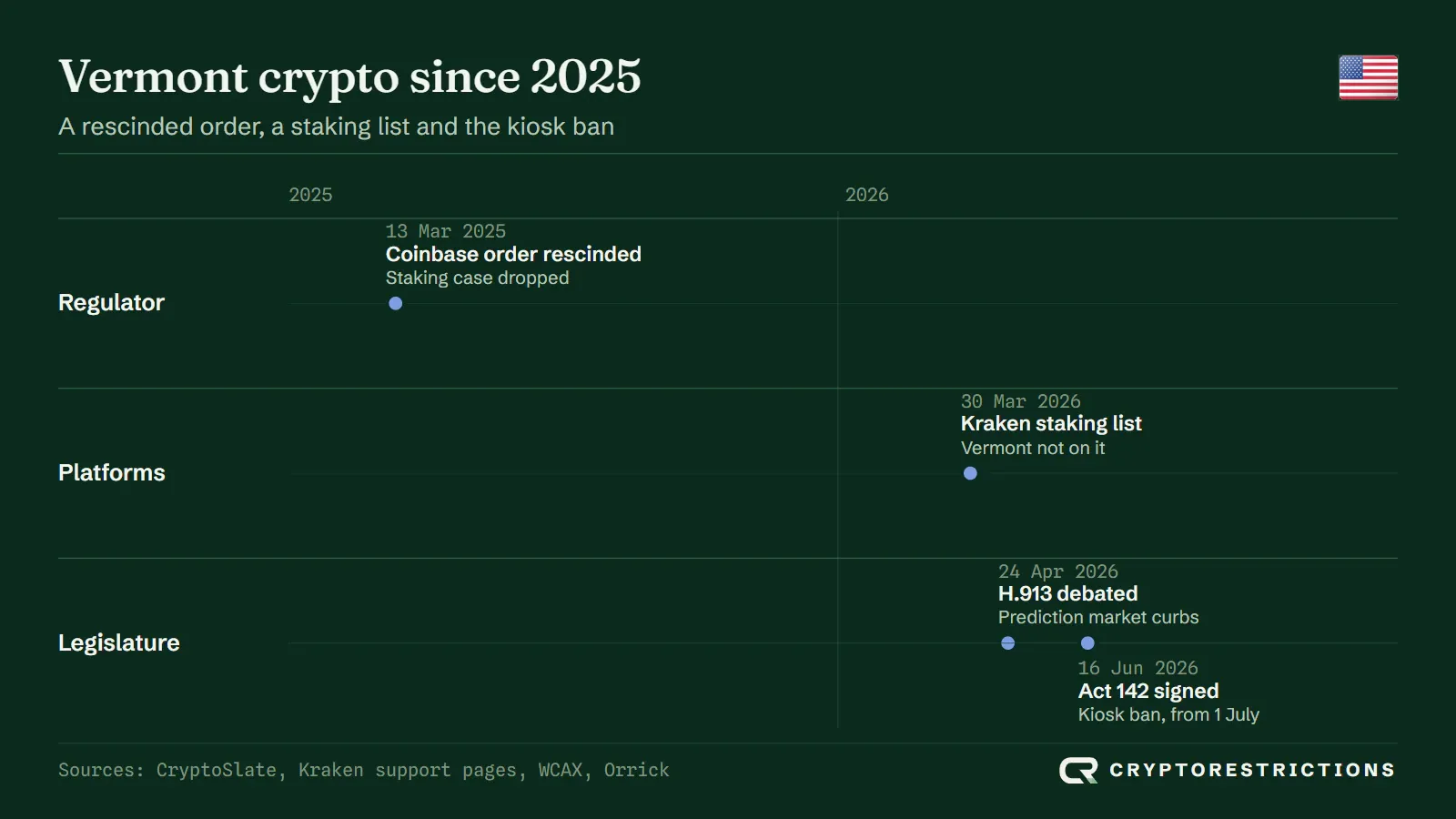
- Department of Financial Regulation. On 13 March 2025 it rescinded its pending show cause order against Coinbase over staking, “without prejudice”, citing the SEC’s dismissal of its federal case. We read this through CryptoSlate, because the Department’s site returned an access error.
- General Assembly. Act 142 (H.648) was signed on 16 June 2026 and bans virtual currency kiosks from 1 July 2026; see the licences section above.
- Platforms. Kraken’s staking list is the only product-level cut we found, described above.
Are prediction markets legal in Vermont?
Unsettled, and quiet. We found no cease-and-desist letter, lawsuit or court order against Kalshi, Polymarket or any other event contract platform in Vermont, and the one bill to curb them is not expected to pass.
On 24 April 2026 WCAX reported that Representative Tom Stevens had put forward a House bill (H.913) to rein in prediction markets, and that the Department of Liquor and Lottery called it “an unserious action”. The report says the bill has “little to no chance” of passing that year, that Vermont “has not joined” the states that sued the platforms, and that Attorney General Charity Clark has voiced support for states’ rights to regulate them. Vermont’s own pages were not reachable for us, so this section may lag events. The federal side and the suits in other states are in our United States guide.
How is crypto taxed in Vermont?
Vermont taxes income at 3.35%, 6.60%, 7.60% and 8.75% for tax year 2025. We found no Vermont page that sets a separate rule for crypto, so check federal treatment in our United States guide.
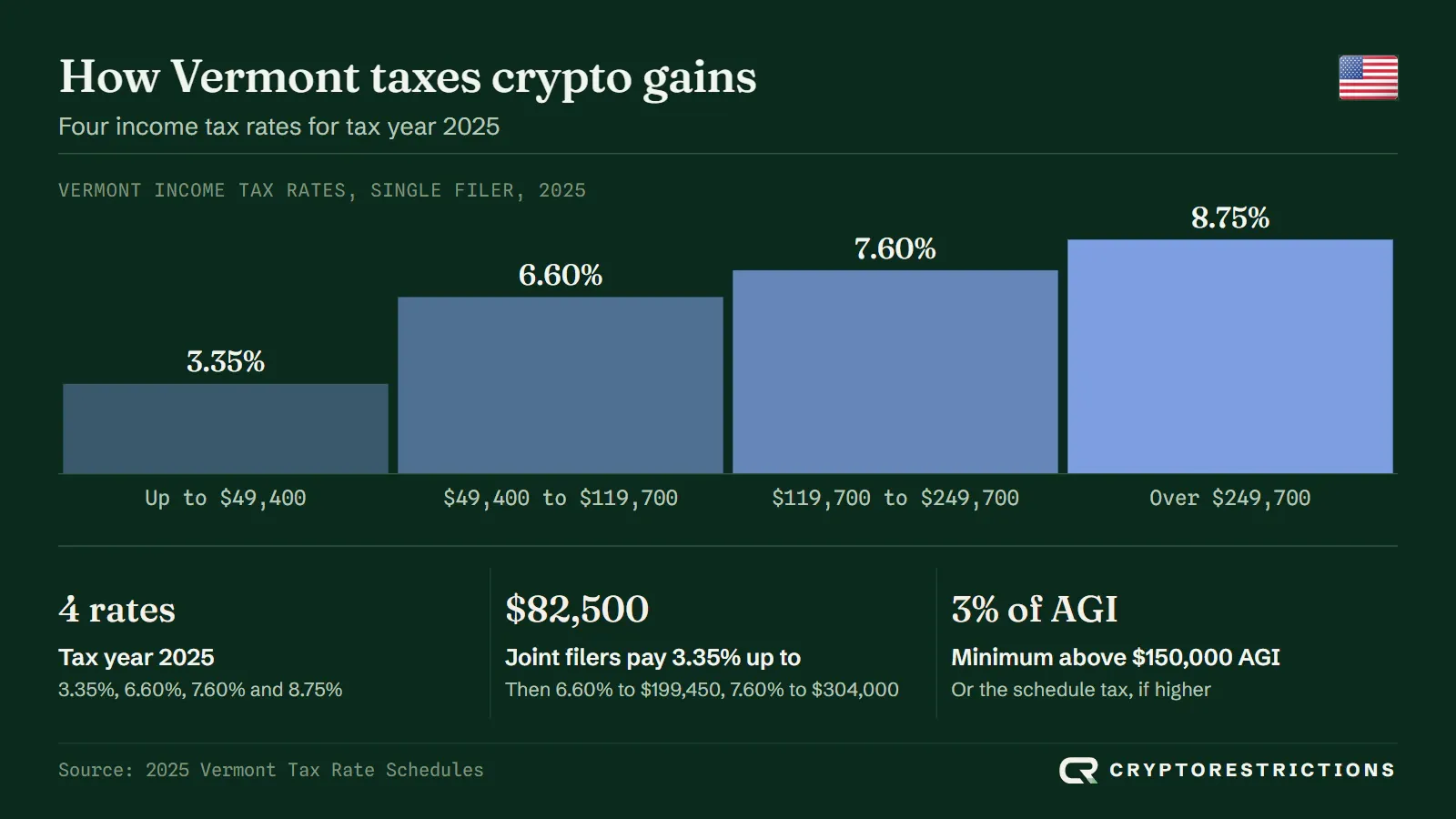
For a single filer the 2025 schedule runs 3.35% up to $49,400, 6.60% to $119,700, 7.60% to $249,700 and 8.75% above that. Joint filers pay 3.35% up to $82,500, then 6.60% to $199,450, 7.60% to $304,000 and 8.75% beyond. Above $150,000 of adjusted gross income the schedule notes that tax is the greater of the schedule amount and 3% of that income. We read these through a copy of the official schedule, because tax.vermont.gov returned an access error, and could not confirm Vermont’s capital gains exclusion for the 2025 year, so it is not covered here. Federal capital gains rules are in our United States guide.