
 United States · CA
Is crypto legal in California?
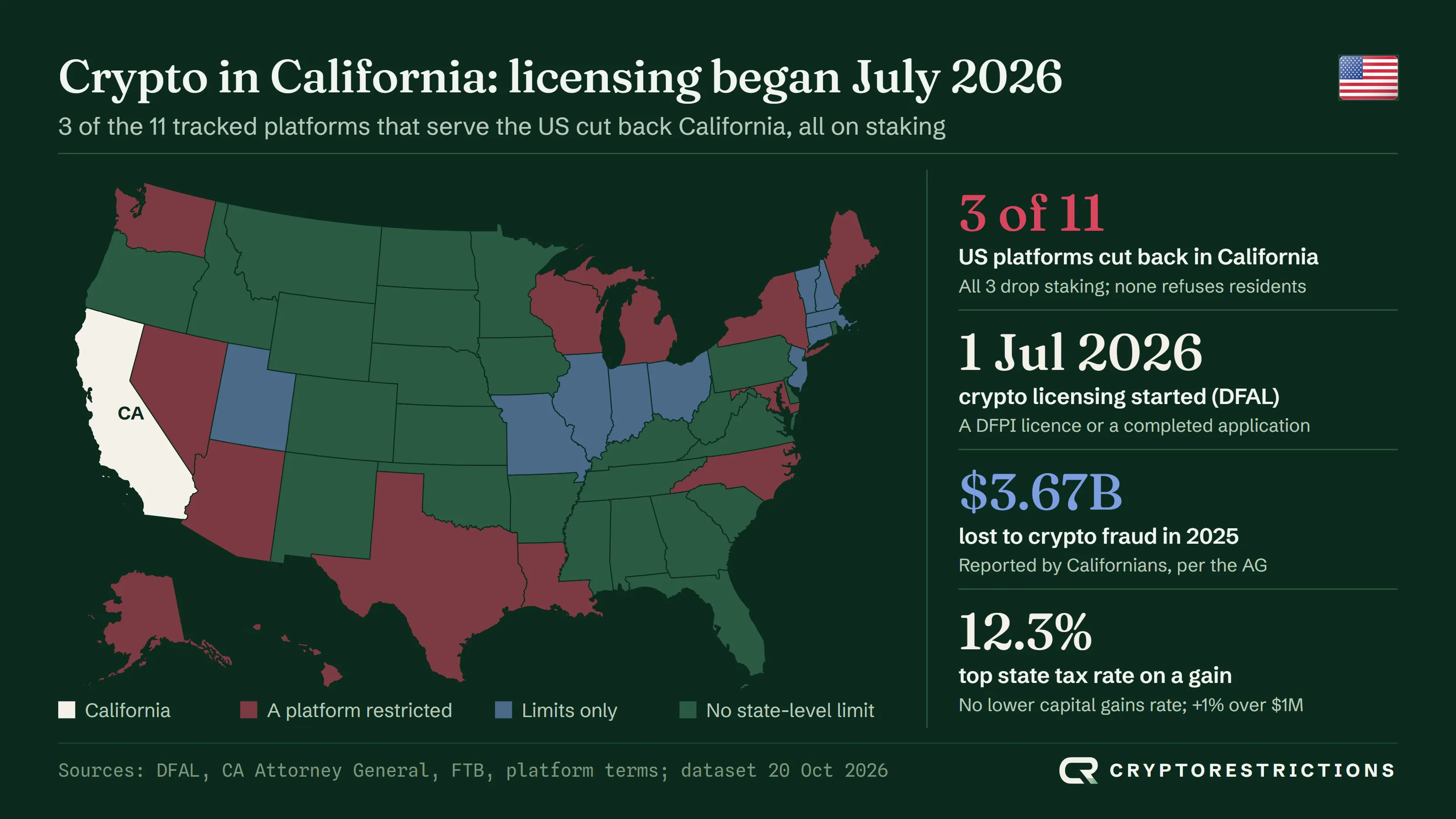
Yes. Owning and trading crypto is legal in California, but since 1 July 2026 a firm that handles crypto for Californians needs a licence from the Department of Financial Protection and Innovation (DFPI) under the Digital Financial Assets Law, or a completed application on file, or an exemption.
Governor Newsom signed the law, AB 39, on 13 October 2023, after vetoing the first licensing bill, AB 2269, a year earlier as “premature”. Licensing was set for 1 July 2025 and later moved to 1 July 2026. DFPI began taking applications through the national licensing system on 9 March 2026.
Federal rules from the SEC, CFTC, Treasury and IRS apply on top, as in every state, and offshore exchanges that refuse US users refuse Californians too. Both are covered in our United States guide.
Which crypto licences does California require?
A Digital Financial Assets Law licence from DFPI. Since 1 July 2026 a firm may keep serving Californians only if it holds one, has a completed application on file, or is exempt.
The window for new firms is shut. SB 97, signed on 30 June 2026 as an urgency statute, says only a completed application filed by 1 July lets a firm keep operating; late filers and new entrants need the licence first. It also moved the cut-off for the conditional licence offered to New York BitLicense and trust charter holders from January 2023 to January 2025. DFPI’s rules, approved on 29 June 2026, exempt most crypto activity from a separate money transmitter licence.
We do not show which exchanges hold a licence. DFPI’s list of applications under review is behind a bot check that our tools do not bypass, so no exchange’s California status can be drawn from a source we have read. We will add it when the list can be read.
Best crypto platforms for California residents
By our access score inside California, Gemini (8.4 out of 10) and Coinbase (7.9) are the most open exchanges, Kalshi (7.3) the most open prediction market and Uniswap (8.0) the most open DeFi platform.
The score rates how fully a California resident can use each platform, not its fees or safety. It is the US score with California’s own limits applied: access status (4 points), the share of the platform’s products open in the state (3), the licences we hold on file (2) and what our geo-access test saw from a US address (1). The method is on our methodology page.
Exchanges

Gemini
Best for Rewards, if you opt in
8.4/10- Access
- 3.5/4
- Products
- 1.9/3
- Licences
- 2/2
- Our test
- 1/1
Read our Gemini reportPros
- California is on its list of served states
- Asset Rewards are open to California residents
Cons
- California residents must opt in to Asset Rewards
- Gemini Derivatives excludes US persons

Coinbase
Best for The most products open in California
7.9/10- Access
- 3.5/4
- Products
- 2.4/3
- Licences
- 1/2
- Our test
- 1/1
Read our Coinbase reportPros
- Loans, in-app DEX trading and prediction markets have no California carve-out
- Publishes disclosures for California customers
Cons
- No new staking since June 2023
- Existing stakes can stay but cannot be added to

Crypto.com
Best for Spot trading in the Crypto.com App
7.5/10- Access
- 3/4
- Products
- 1.5/3
- Licences
- 2/2
- Our test
- 1/1
Read our Crypto.com reportPros
- The Crypto.com App is available in California
- CFTC-registered exchange and clearing house
Cons
- Staking is not offered in California
- Exchange liquid staking excludes California too

Kraken
Best for Spot trading outside Maine and New York
7.5/10- Access
- 3/4
- Products
- 1.5/3
- Licences
- 2/2
- Our test
- 1/1
Read our Kraken reportPros
- Serves California: only Maine and New York are refused
Cons
- No onchain staking in California
- Bitcoin staking excludes California too

Bitstamp
Best for Plain spot trading
6.6/10- Access
- 3/4
- Products
- 0.6/3
- Licences
- 2/2
- Our test
- 1/1
Read our Bitstamp reportPros
- No California carve-out in its US terms
Cons
- No derivatives, staking or lending in the US
Prediction markets

Kalshi
Best for The broadest CFTC-regulated event contracts
7.3/10- Access
- 3/4
- Products
- 2.3/3
- Licences
- 1/2
- Our test
- 1/1
Read our Kalshi reportPros
- CFTC-designated contract market
- No California agency has acted against it
Cons
- Sports contracts are blocked on the suing tribes' lands
- The Ninth Circuit held its sports contracts are gaming on tribal land

Polymarket
Best for Polymarket markets on a US exchange
6.3/10- Access
- 3/4
- Products
- 2.3/3
- Licences
- 1/2
- Our test
- 0/1
Read our Polymarket reportPros
- Polymarket US is a CFTC-designated exchange
- No California agency has acted against it
Cons
- polymarket.com itself blocks US users
- Publishes no state list
DeFi

Uniswap
Best for Swapping tokens from your own wallet
8.0/10- Access
- 4/4
- Products
- 3/3
- Licences
- 0/2
- Our test
- 1/1
Read our Uniswap reportPros
- Terms do not exclude California
Cons
- Terms add a California arbitration clause
- Leveraged products for US retail are barred

PancakeSwap
Best for BNB Chain swaps and pools
6.3/10- Access
- 3.5/4
- Products
- 1.8/3
- Licences
- 0/2
- Our test
- 1/1
Read our PancakeSwap reportPros
- Swaps, pools and staking are not excluded
Cons
- PCS Perps bars US users
- No US licence on file
Which platforms block or limit California residents?
None of the exchanges that serve the rest of the US refuses Californians. Three drop one product: Coinbase, Kraken and Crypto.com do not offer staking here.
California is a lighter case than New York, where three exchanges refuse residents outright. Here the cut is the same on every platform that makes it: staking.
Who regulates crypto in California?
DFPI licenses and supervises crypto firms, the Attorney General enforces consumer and commodity law against them, and the Legislature keeps adjusting the licensing law.
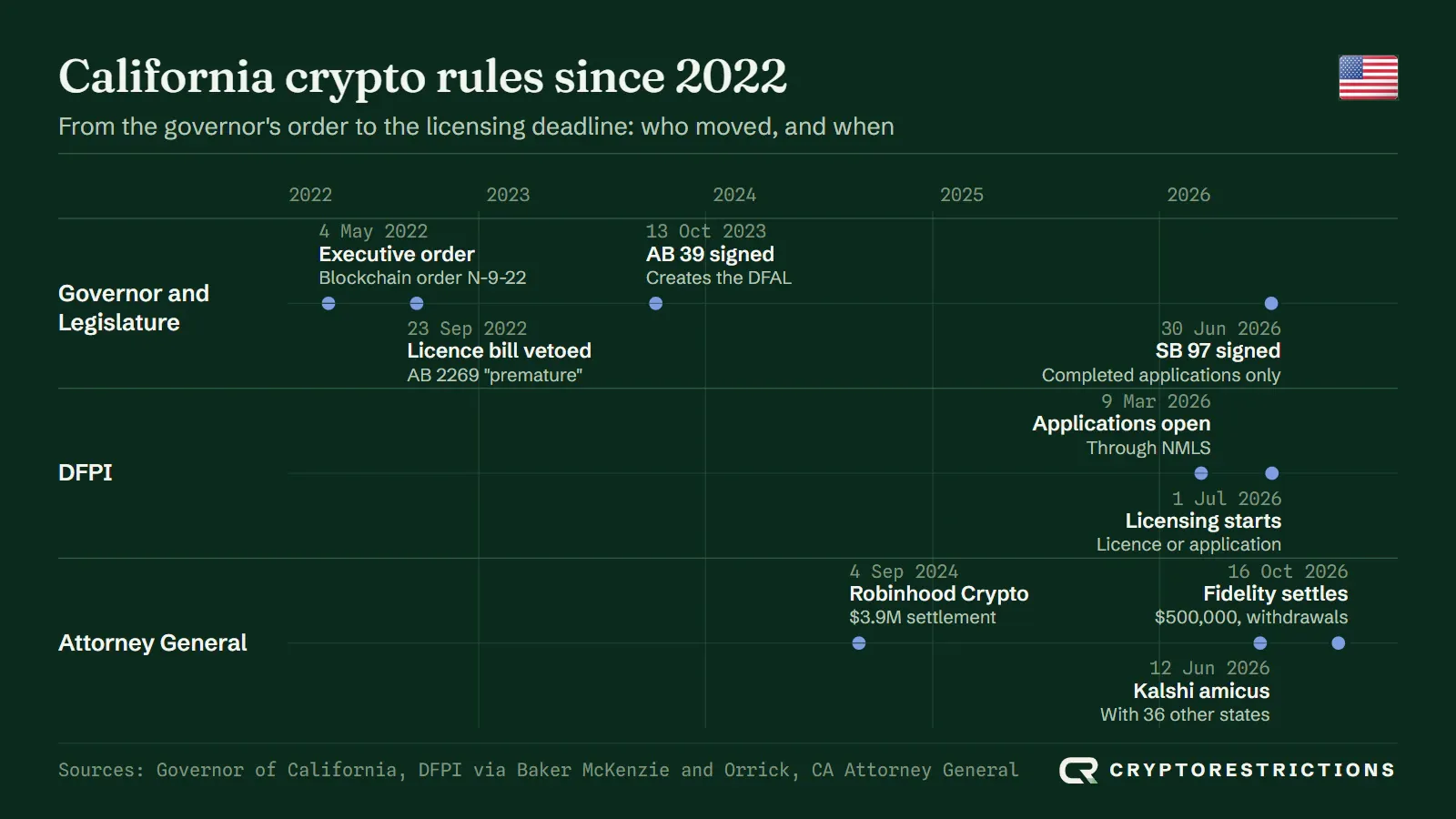
- DFPI. It runs the licensing under the Digital Financial Assets Law described above: applications opened on 9 March 2026 and licensing began on 1 July 2026. We could not read DFPI’s own pages (a bot check), so its dates come from Baker McKenzie and Orrick.
- Attorney General. Robinhood Crypto paid $3.9 million on 4 September 2024 for blocking crypto withdrawals from 2018 to 2022, and Fidelity Digital Asset Services $500,000 on 16 October 2026 over similar limits. The office also sponsored SB 1208, which lets courts return seized crypto to fraud victims. Its release says Californians reported more than $3.67 billion in crypto scam losses in 2025, the most of any state.
- Legislature. SB 822 became law on 11 October 2025: unclaimed crypto now goes to the State Controller under the Unclaimed Property Law. AB 1180, signed on 27 September 2026, lets DFPI accept licensing fees in stablecoins from 1 July 2027.
Are prediction markets legal in California?
Not on tribal land. On 16 September 2026 the Ninth Circuit held that Kalshi’s sports contracts are likely illegal gaming where tribal users trade them, though no California state agency has sued or ordered any platform to stop.
Sports betting is not legal in California, as the court notes. The fight is a tribal one under the federal Indian Gaming Regulatory Act (IGRA): Blue Lake Rancheria and Chicken Ranch Rancheria sued Kalshi, Robinhood and their affiliates in the Northern District of California (No. 3:25-cv-06162) on 22 July 2025. The district court refused an injunction in November 2025.
- 16 September 2026. The Ninth Circuit found the tribes likely to succeed: the contracts count as gaming on Indian lands because users place them from tribal territory, and federal commodities law does not displace IGRA. It sent the case back to the district court without issuing an injunction.
- 23 September 2026. Kalshi says it began geofencing the plaintiff tribes’ lands for sports contracts. In a joint statement of 14 October 2026 it calls the injunction request moot, while the tribes say a trade still went through from a reservation and want a court order.
- 8 and 21 October 2026. The appeal court issued its mandate on 8 October, and a status conference is set for 21 October.
Elsewhere in California Kalshi is still offered. The Attorney General’s only step has been to join 36 other attorneys general in an amicus brief on 12 June 2026 backing Ohio’s gambling law against Kalshi.
How is crypto taxed in California?
As ordinary income. California has no lower rate for capital gains, so a crypto gain is taxed at 1% to 12.3% in 2025 for a single filer, plus 1% on income over $1 million.
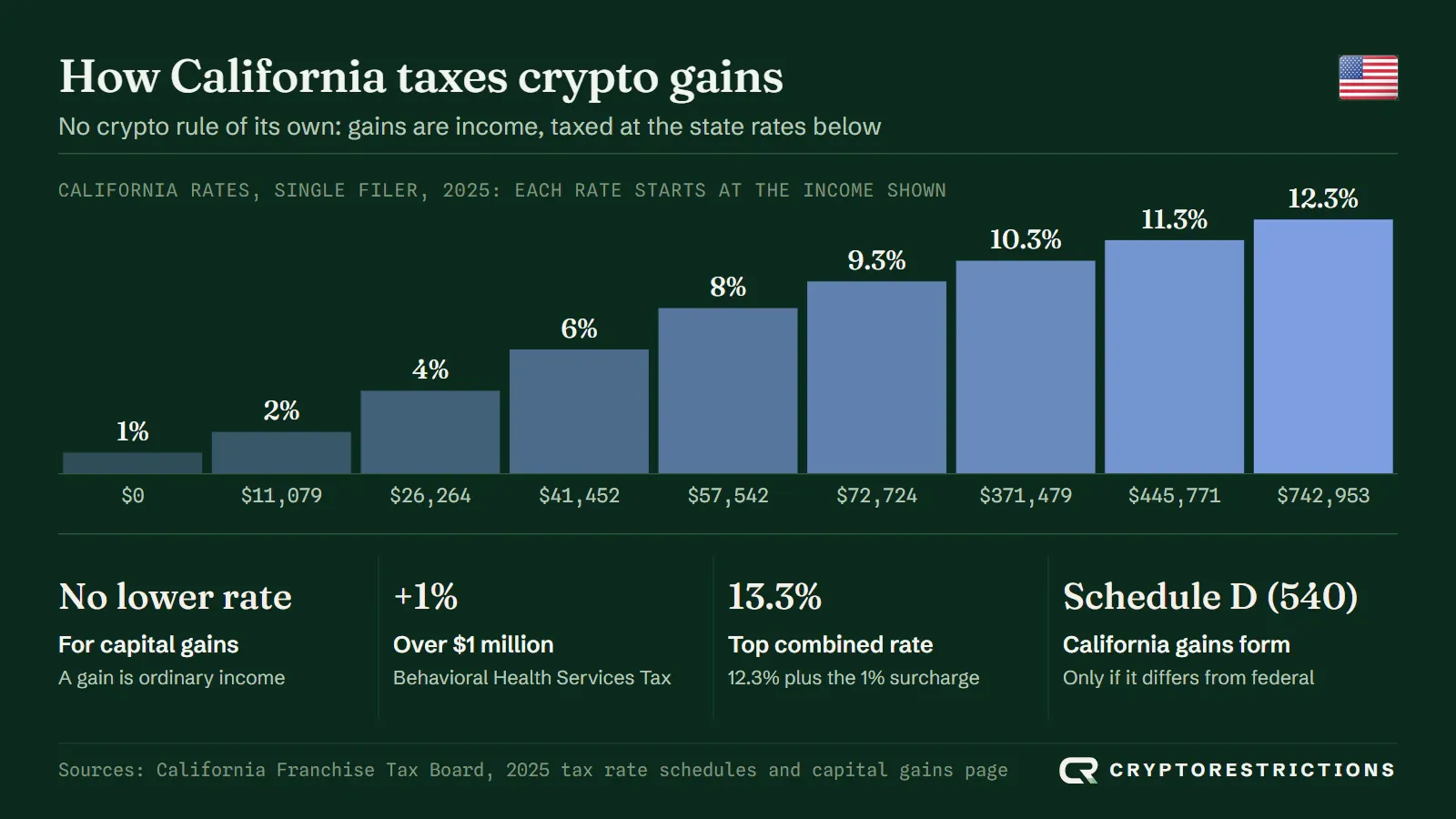
The Franchise Tax Board states it plainly on its capital gains page: “All capital gains are taxed as ordinary income.” The Board has no crypto-specific page, so the federal treatment in our United States guide is the starting point, and the California gains form, Schedule D (540), is needed only where the figures differ from federal. The bands are Schedule X of the 2025 rate schedules; the 1% surcharge, called the Behavioral Health Services Tax from 2025, brings the top combined rate to 13.3%.








