
 United States · MI
Is crypto legal in Michigan?
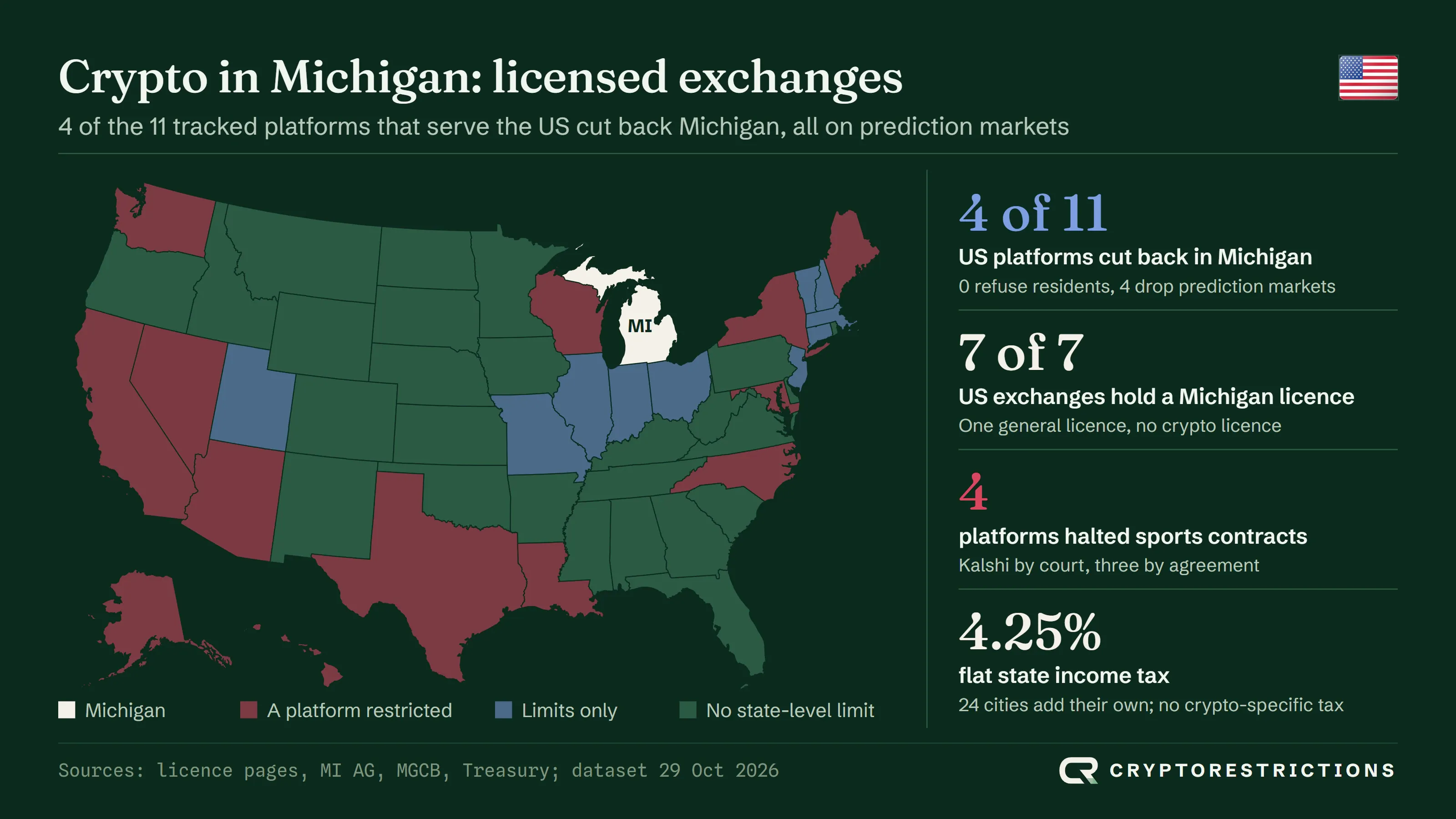
Yes. Owning and trading crypto is legal in Michigan, and the state has no crypto licence: custodial exchanges register as money transmitters with the Department of Insurance and Financial Services (DIFS).
The law is the Money Transmission Services Act, 2006 PA 250. DIFS says every entity providing money transmission services needs a licence, and that holding funds in an e-wallet counts. Neither the act nor the DIFS guidance mentions virtual currency, so licensing an exchange rests on the act’s words “monetary value”, not on a DIFS ruling. In practice all seven US exchanges we track hold a Michigan licence. In 2019 Michigan did add cryptocurrency to its penal code, the one crypto law we found signed since.
Bitcoin ATMs are the gap. The Attorney General says the machines lack oversight and regulation, and five kiosk bills sit in committee. Federal rules from the SEC, CFTC, Treasury and IRS apply as in every state, and offshore exchanges that refuse US users refuse Michigan too. Both are covered in our United States guide.
Which crypto licences does Michigan require?
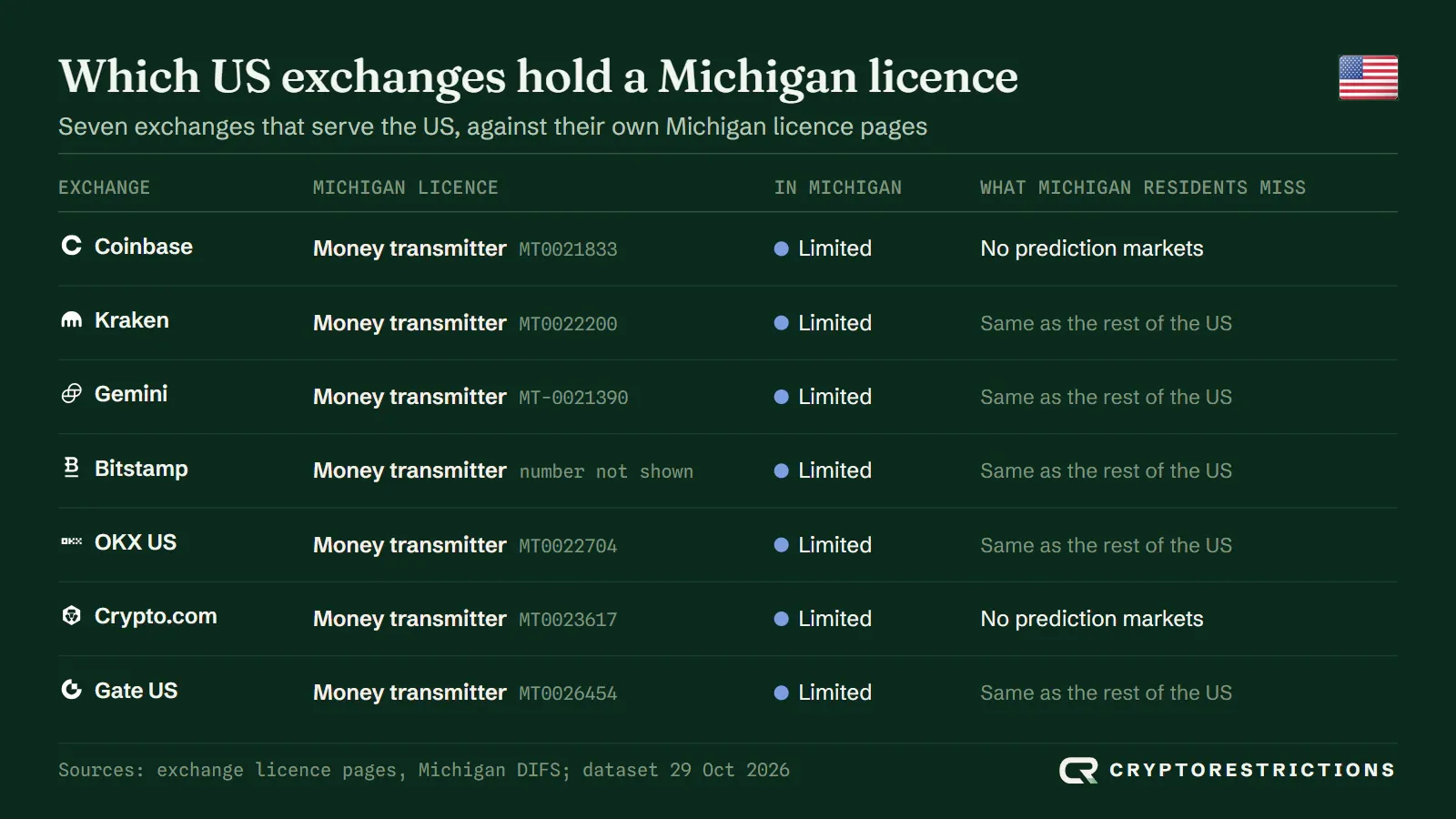
A money transmitter licence from DIFS. All seven US exchanges we track hold one: Coinbase, Kraken, Gemini, Bitstamp, OKX US, Crypto.com and Gate US.
The licence is general, not crypto-specific. DIFS applications go through NMLS, the surety bond starts at $500,000, net worth must exceed $100,000 and licences expire on 31 December each year. We could not read issue dates: the DIFS licensee locator and NMLS Consumer Access were behind bot checks, so the numbers below come from each exchange’s own licence page, and Bitstamp’s page names Michigan without a number.
A new law is close but not passed. HB 5544, which would adopt the model Money Transmission Modernization Act, passed the House 97 to 10 on 25 June 2026 and waits in a Senate committee. The session ends on 31 December 2026, so any bill not signed by then dies.
Best crypto platforms for Michigan residents
By our access score inside Michigan, Coinbase (8.5 out of 10), Gemini (8.4) and Kraken (8.3) are the most open exchanges, Kalshi (7.3) the most open prediction market and Uniswap (8.0) the most open DeFi platform.
The score rates how fully a Michigan resident can use each platform, not its fees or safety. It is the US score with Michigan’s own limits applied: access status (4 points), the share of the platform’s products open in the state (3), the licences we hold on file (2) and what our geo-access test saw from a US address (1). Platforms that refuse Michigan residents are not scored. The method is on our methodology page.
Exchanges

Coinbase
Best for The widest product range in Michigan
8.5/10- Access
- 3.5/4
- Products
- 2/3
- Licences
- 2/2
- Our test
- 1/1
Read our Coinbase reportPros
- Money transmitter licence MT0021833
- Staking, crypto-backed loans and in-app DEX trading are open here
Cons
- Prediction markets closed in Michigan
- Agreed with the Gaming Board on 7 October 2026 to stop sports contracts

Gemini
Best for Spot trading with a Michigan licence
8.4/10- Access
- 3.5/4
- Products
- 1.9/3
- Licences
- 2/2
- Our test
- 1/1
Read our Gemini reportPros
- Money transmitter licence MT-0021390
- Staking is open in Michigan; only New York is barred
Cons
- Gemini Derivatives excludes US persons
- Sued by New York over sports contracts in April 2026

Kraken
Best for Regulated futures for US residents
8.3/10- Access
- 3/4
- Products
- 2.3/3
- Licences
- 2/2
- Our test
- 1/1
Read our Kraken reportPros
- Michigan licence MT0022200, held by Payward Interactive
- Serves every state except Maine and New York
Cons
- Moving to New York or Maine ends access
- Futures run through a separate registered broker

Crypto.com
Best for A crypto app with a Michigan licence
7.5/10- Access
- 3/4
- Products
- 1.5/3
- Licences
- 2/2
- Our test
- 1/1
Read our Crypto.com reportPros
- Money transmitter licence MT0023617
- The App is offered in every state but New York
Cons
- No sports event contracts in Michigan, per a company statement in December 2025
- No derivatives for US residents on the Exchange

Bitstamp
Best for Plain spot trading
6.6/10- Access
- 3/4
- Products
- 0.6/3
- Licences
- 2/2
- Our test
- 1/1
Read our Bitstamp reportPros
- Licensed in 38 states, Michigan among them
Cons
- No derivatives, staking or lending in the US
- Does not serve Hawaii or Nevada

OKX
Best for Spot and conversions from a global brand
6.0/10- Access
- 3/4
- Products
- 1.5/3
- Licences
- 1/2
- Our test
- 0.5/1
Read our OKX reportPros
- Money transmitter licence MT0022704, held by OKX INC.
- okx.com redirects US visitors to OKX United States
Cons
- Spot and OTC conversions only: no derivatives
- Does not serve New York

Gate
Best for A wide coin list on a licensed US arm
5.1/10- Access
- 3/4
- Products
- 1.1/3
- Licences
- 1/2
- Our test
- 0/1
Read our Gate reportPros
- Money transmitter licence MT0026454
- Spot, convert and staking
Cons
- Not offered in seven jurisdictions, including Texas and Washington
- The global gate.com refused our US address
Prediction markets

Kalshi
Best for Financial and other non-sports event contracts
7.3/10- Access
- 3/4
- Products
- 2.3/3
- Licences
- 1/2
- Our test
- 1/1
Read our Kalshi reportPros
- CFTC-designated contract market and clearing house
- The Michigan injunction covers sports contracts only
Cons
- A state court order keeps its sports contracts out of Michigan
- Lost in the Sixth Circuit to Ohio and Tennessee in September 2026

Polymarket
Best for Polymarket markets on a US-regulated exchange
6.3/10- Access
- 3/4
- Products
- 2.3/3
- Licences
- 1/2
- Our test
- 0/1
Read our Polymarket reportPros
- Polymarket US (QCX LLC) is a CFTC-designated exchange
- Non-sports markets stay open in Michigan
Cons
- Agreed on 28 October 2026 to stop new sports contracts in Michigan
- Lost its federal bid to stop Michigan enforcing gaming law in June 2026
- polymarket.com itself blocks US users
DeFi

Uniswap
Best for Swapping tokens from your own wallet
8.0/10- Access
- 4/4
- Products
- 3/3
- Licences
- 0/2
- Our test
- 1/1
Read our Uniswap reportPros
- Terms do not exclude Michigan
- A New York company whose terms do not bar US users
Cons
- Leveraged products for US retail are barred

PancakeSwap
Best for BNB Chain swaps and pools
6.3/10- Access
- 3.5/4
- Products
- 1.8/3
- Licences
- 0/2
- Our test
- 1/1
Read our PancakeSwap reportPros
- Swaps, pools and staking are not excluded
Cons
- PCS Perps bars users in the United States
- No US licence on file
Which platforms block or limit Michigan residents?
None refuses Michigan outright. Four cut back prediction markets: Coinbase closed the whole product, Kalshi geofences sports contracts under a court order, Polymarket US is stopping them under an agreement and Crypto.com has no sports contracts here.
Every limit comes from the fight over sports contracts, not from crypto licensing. The Gaming Board’s cease-and-desist letters went to 33 offshore operators in October, none of them a platform we track. Robinhood, which we do not track, also agreed to stop on 9 September.
Who regulates crypto in Michigan?
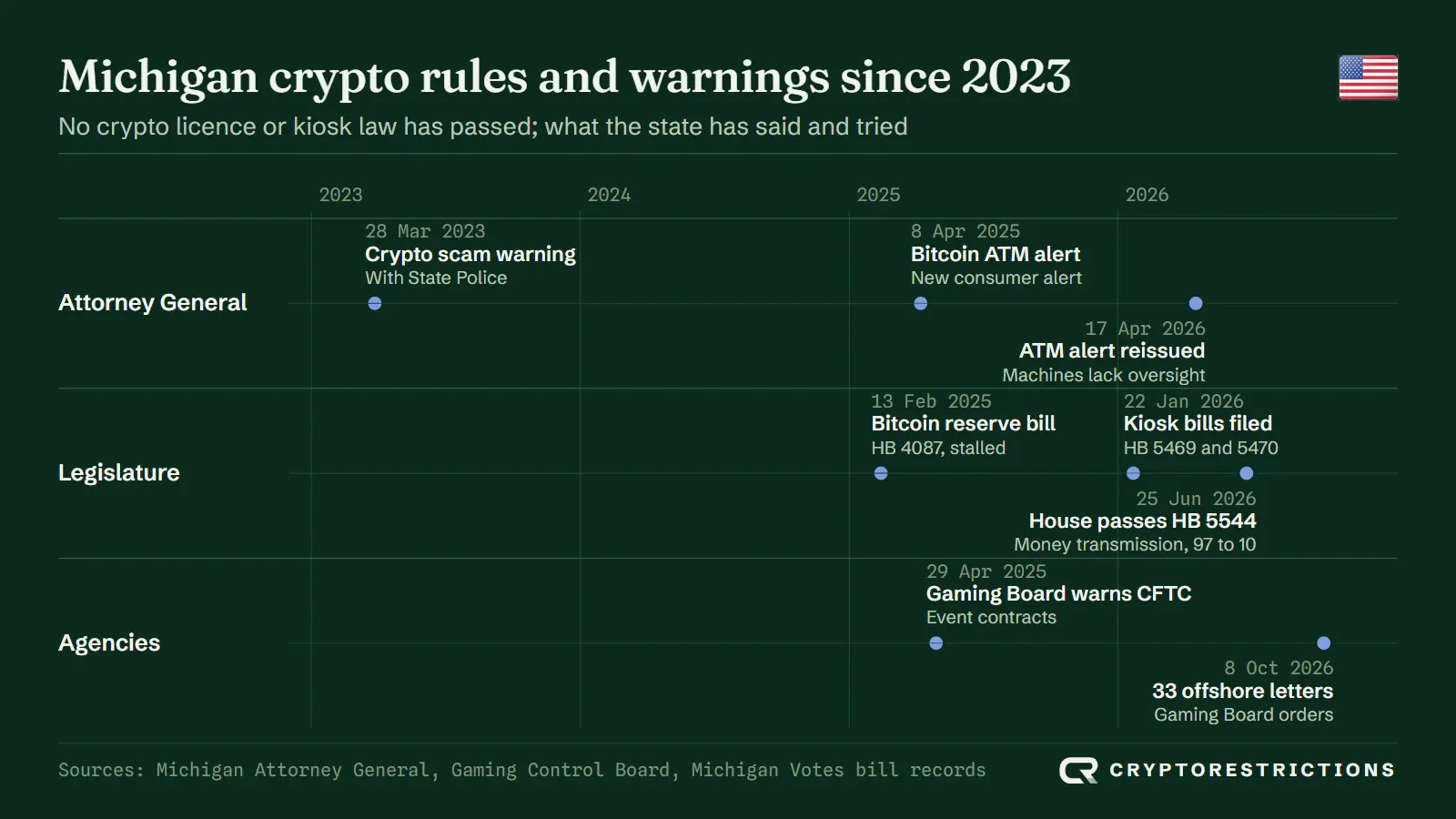
DIFS licenses the exchanges, the Attorney General warns consumers and sues over gambling, and the Gaming Control Board polices event contracts. No crypto licence or kiosk law has passed.
- DIFS. It issues the money transmitter licences and has published no guidance on virtual currency. The Money Transmission Services Act has applied since 1 January 2007, and the amended act has been in force since 28 March 2019.
- Attorney General. Dana Nessel has not sued a crypto exchange or kiosk operator. Her office has issued scam alerts, most recently on 17 April 2026, and has sued over prediction markets (next section).
- Legislature. HB 4087, a bitcoin reserve bill, was filed on 13 February 2025 and is back in committee. Five kiosk bills are pending: HB 5469 and 5470 protect consumers and put kiosk operators under the money transmission act, HB 5986 and SB 980 would ban kiosks outright, and HB 6222 would set a kiosk regulation act.
Are prediction markets legal in Michigan?
Not for sports. A Michigan court bars Kalshi’s sports contracts, and Coinbase, Robinhood and Polymarket US agreed to stop offering them, while four appeals are pending at the Sixth Circuit.
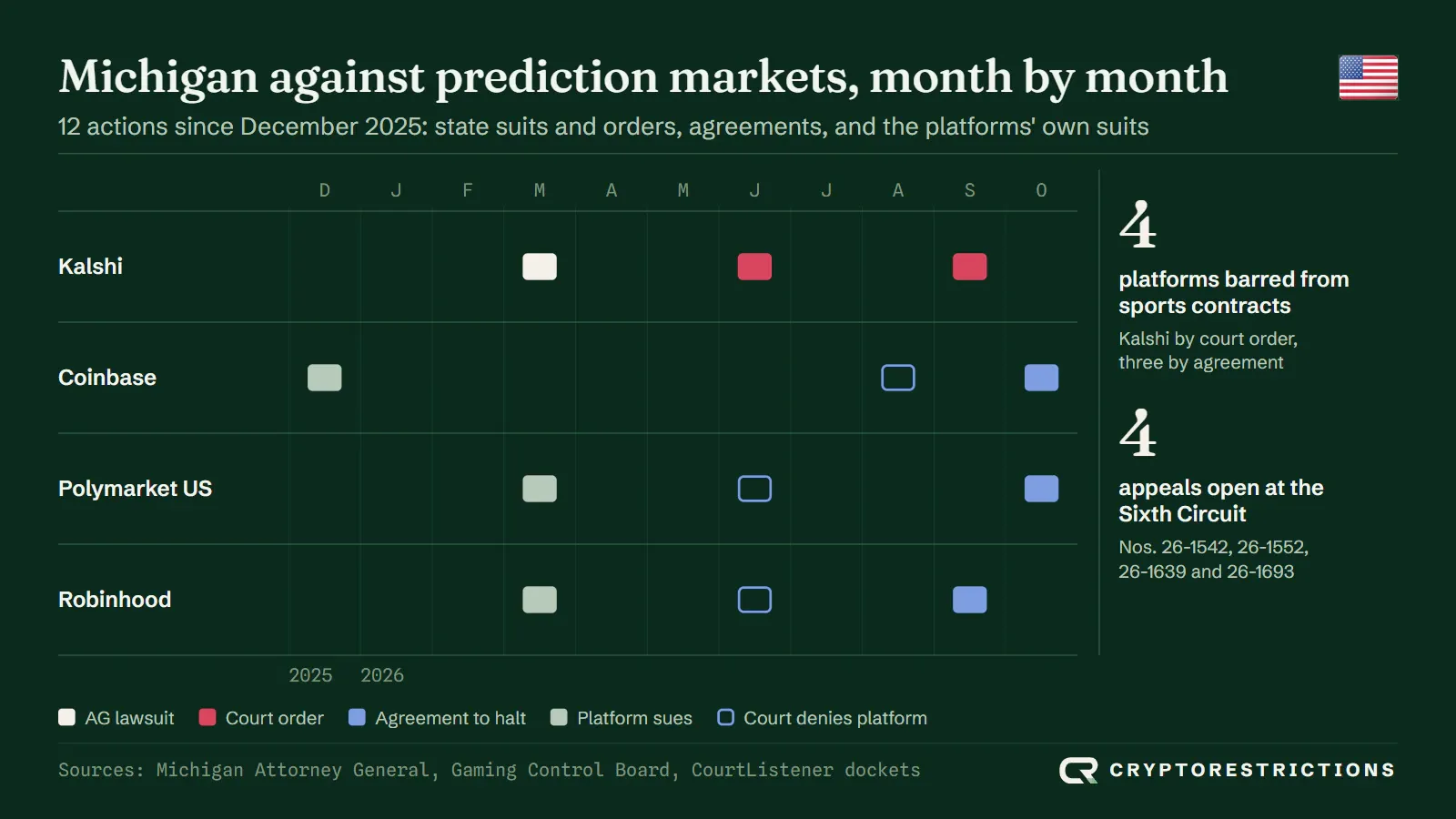
Michigan treats sports event contracts as unlicensed betting under its Lawful Sports Betting Act. The Attorney General sued Kalshi in Ingham County on 3 March 2026. Kalshi moved the case to federal court, a judge sent it back on 25 June, and on 29 June the state court issued a temporary order with a fine of $120,000 a day. The preliminary injunction of 1 September raised the fine to $500,000 a day. Kalshi’s non-sports markets stay open.
The platforms went to court first. Coinbase sued on 18 December 2025, and Polymarket US and Robinhood on 4 March 2026. A federal judge denied Polymarket and Robinhood injunctions on 17 June, and Coinbase’s followed in August. Robinhood then agreed on 9 September to stop new sports contracts, and Coinbase agreed on 7 October to stop by 10 October and close open positions. Polymarket US followed on 28 October: under a stipulation approved by the federal court it stopped new sports contracts and closes open positions by 25 November, and the state takes no enforcement action while it complies; its appeal stays pending. The Robinhood and Coinbase agreements hold until the Sixth Circuit appeals end, and Kalshi’s own appeal is No. 26-1639. The Sixth Circuit ruled against Kalshi in the Ohio and Tennessee cases on 25 September, which our United States guide covers.
The federal government has not sued Michigan, unlike ten other states, Utah the latest on 26 October 2026. In July the CFTC stepped in only to order Kalshi to fulfil its open trades after Kalshi tried to close Michigan users’ positions.
How is crypto taxed in Michigan?
The same way as federally: crypto is property, a gain is added to your income and taxed at Michigan’s flat 4.25% rate, plus 1% to 2.4% for residents of Detroit and the other cities that have an income tax.
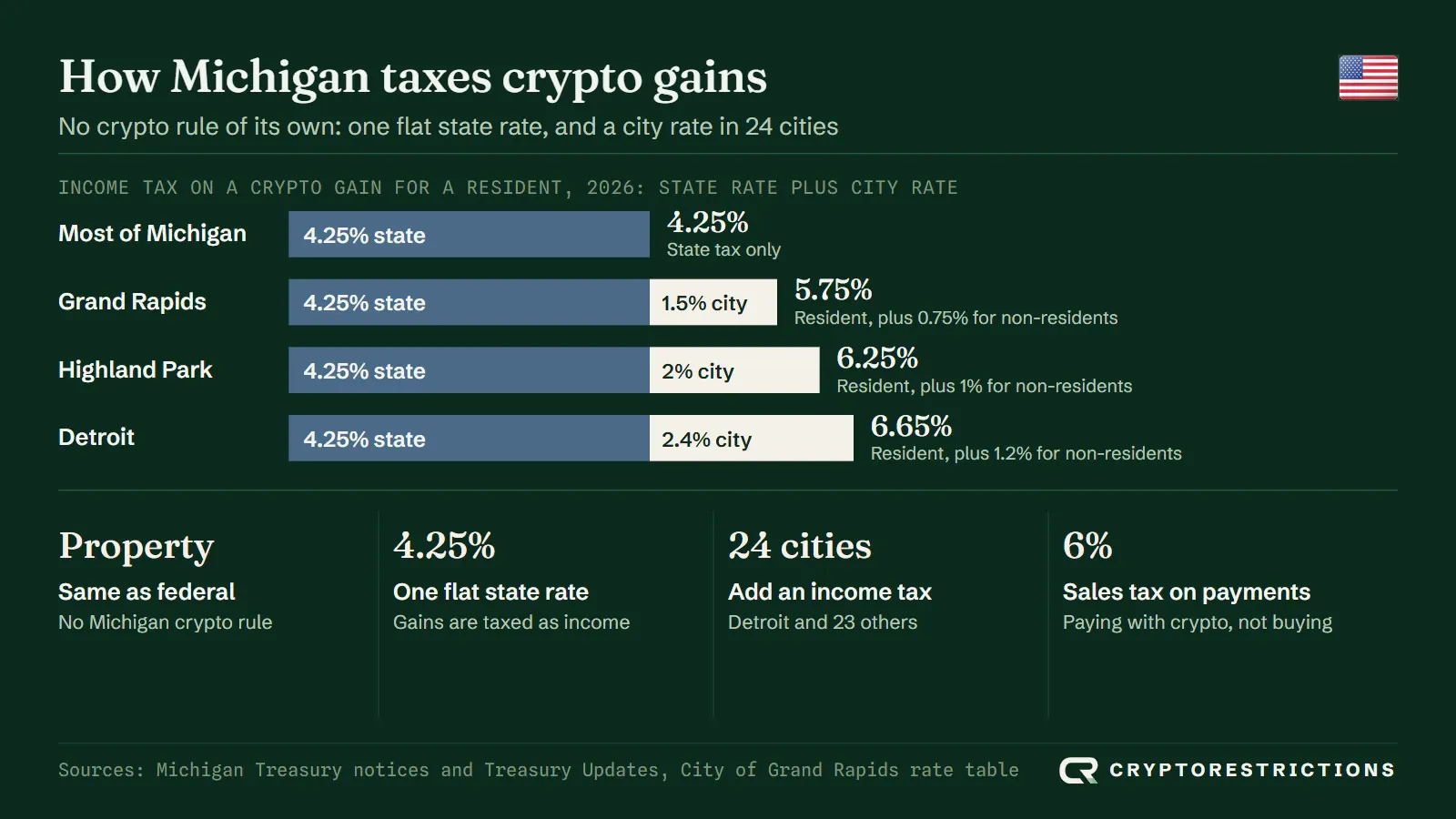
Michigan starts from federal adjusted gross income and says it has no rules or policies on digital currency that differ from the federal ones. The rate is 4.25% for the 2026 tax year, the same as 2025. For sales tax, buying crypto is not taxed, but paying for goods with it is: 6% of the dollar value at the time of sale.
Twenty-four cities add an income tax. Detroit charges residents 2.4% and non-residents 1.2%, Highland Park 2% and 1%, and Grand Rapids 1.5% and 0.75%. We did not check whether each city’s ordinance counts crypto gains. No crypto-specific Michigan tax exists, and no bill proposes one.







