
 United States · IL
Is crypto legal in Illinois?
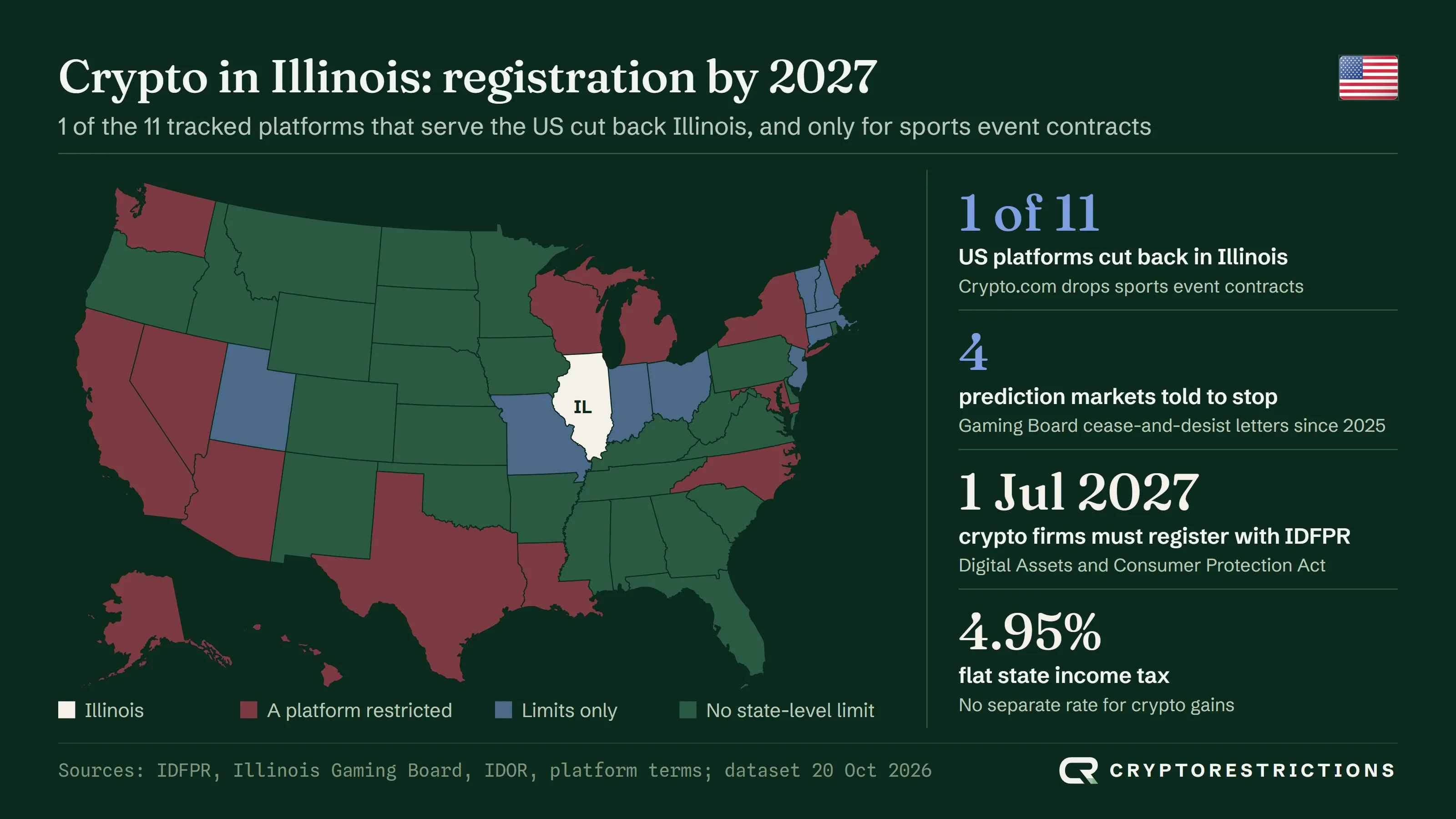
Yes. Owning and trading crypto is legal in Illinois, and the state has no crypto licence of its own yet. Its Digital Assets and Consumer Protection Act gives exchanges until 1 July 2027 to register with the Department of Financial and Professional Regulation (IDFPR).
The Act, signed on 18 August 2025, requires a firm that exchanges, transfers or stores crypto for an Illinois resident to register with IDFPR, and gives existing businesses until 1 July 2027. IDFPR says the registration provisions are not operative until 2027. A second law, the Digital Assets Kiosks Act, took effect at once: a crypto kiosk may take or pay out at most $2,500 a day from a new customer and $10,500 from an existing one, and may charge no more than the greater of $5 or 18%.
Before that, IDFPR’s 2017 guidance said that transmitting only virtual currency did not need a money transmitter licence, while an exchange holding a buyer’s dollars or a cash kiosk generally did. People who only hold crypto, and shops that accept it, need no licence.
Federal rules from the SEC, CFTC, Treasury and IRS apply on top, as in every state, and offshore exchanges that refuse US users refuse Illinois residents too. Both are covered in our United States guide.
Which crypto licences does Illinois require?
None specific to crypto until registration under the Digital Assets and Consumer Protection Act, due by 1 July 2027. The seven US exchanges we track already list an Illinois money transmitter licence.
IDFPR publishes no count of crypto licensees and sends residents to the NMLS Consumer Access lookup. Registration has not opened: the department published draft rules for the Act and for kiosks on 15 May 2026, and they were set for the legislature’s rules committee (JCAR) on 20 October 2026. Each exchange’s own licence page shows the licence it holds today.
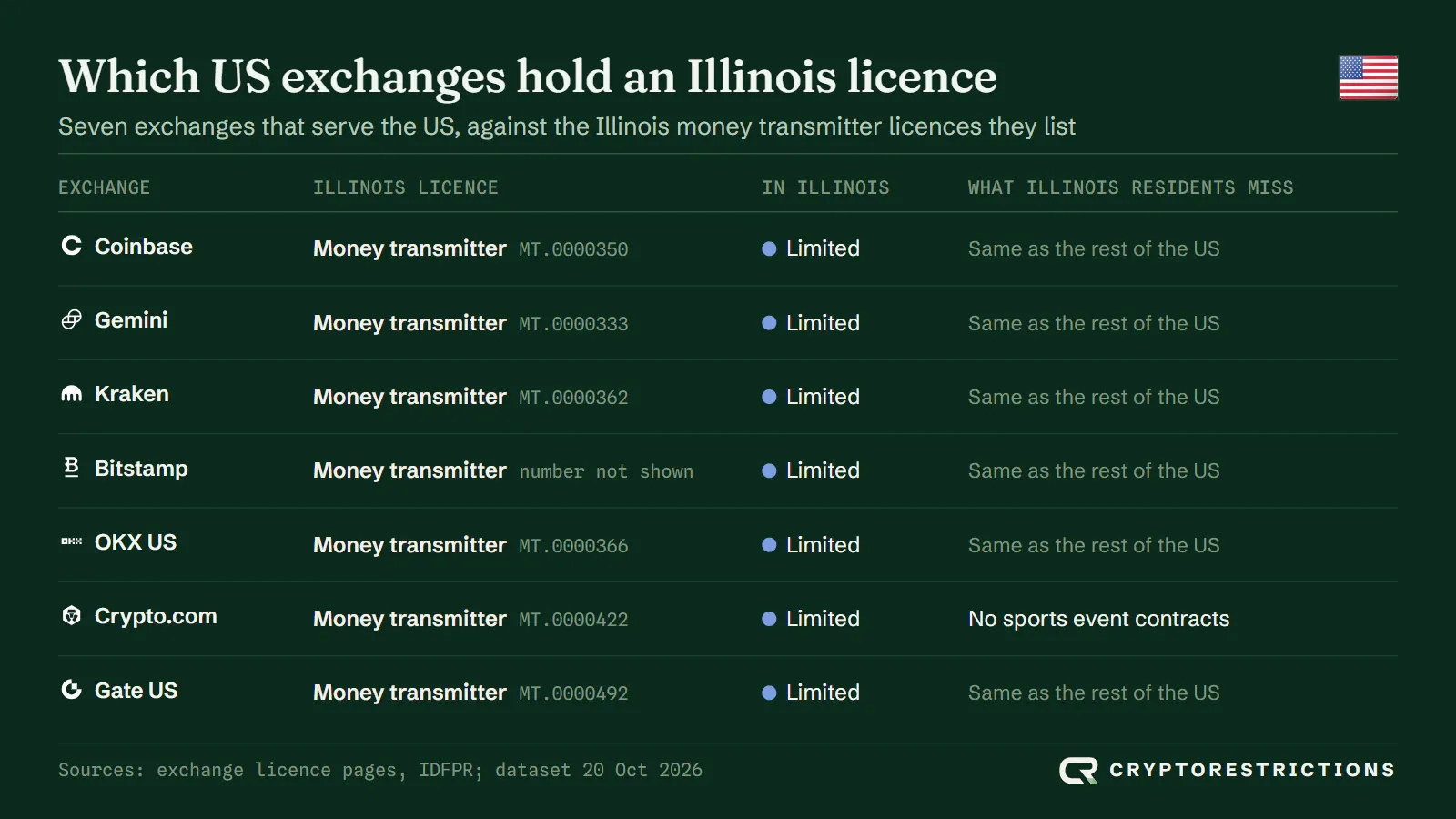
Coinbase, Gemini, Kraken, Bitstamp, OKX US, Crypto.com and Gate US all serve Illinois. Bitstamp’s page lists Illinois among its money transmitter states without giving a number. None of the seven is cut back for spot trading, staking or its card in Illinois: Coinbase closes staking only in California, Maryland, New Jersey and Wisconsin, and Kraken serves every state except Maine and New York.
Best crypto platforms for Illinois residents
By our access score inside Illinois, Gemini (8.4 out of 10), Kraken (8.3) and Coinbase (7.9) are the most open exchanges, Kalshi (7.3) the most open prediction market and Uniswap (8.0) the most open DeFi platform.
The score rates how fully an Illinois resident can use each platform, not its fees or safety. It is the US score with Illinois’s own limits applied: access status (4 points), the share of the platform’s products open in the state (3), the licences we hold on file (2) and what our geo-access test saw from a US address (1). Platforms that refuse Illinois residents are not scored. The method is on our methodology page.
Exchanges

Gemini
Best for Spot trading under a New York trust charter
8.4/10- Access
- 3.5/4
- Products
- 1.9/3
- Licences
- 2/2
- Our test
- 1/1
Read our Gemini reportPros
- Illinois money transmitter licence MT.0000333
- Spot trading listed for Illinois
Cons
- Staking needs an opt-in from Illinois residents
- Gemini Derivatives excludes US persons

Kraken
Best for Regulated futures for US residents
8.3/10- Access
- 3/4
- Products
- 2.3/3
- Licences
- 2/2
- Our test
- 1/1
Read our Kraken reportPros
- Illinois money transmitter licence MT.0000362
- Staking open: the barred states are California, Maryland, New Jersey and Wisconsin
- US futures through a CFTC-registered futures commission merchant
Cons
- Does not serve New York or Maine
- No BitLicense

Coinbase
Best for The widest product range in Illinois
7.9/10- Access
- 3.5/4
- Products
- 2.4/3
- Licences
- 1/2
- Our test
- 1/1
Read our Coinbase reportPros
- Illinois money transmitter licence MT.0000350
- Staking open in Illinois
- Crypto-backed loans open in Illinois
Cons
- Sports contracts rest on a federal injunction of 2 October 2026
- Prediction markets closed in Nevada and Michigan

Crypto.com
Best for The app and card without a state carve-out
7.5/10- Access
- 3/4
- Products
- 1.5/3
- Licences
- 2/2
- Our test
- 1/1
Read our Crypto.com reportPros
- App available in Illinois
- Separate trust company for custody
Cons
- No sports event contracts in Illinois since December 2025
- No derivatives for US residents on the Exchange

Bitstamp
Best for Plain spot trading
6.6/10- Access
- 3/4
- Products
- 0.6/3
- Licences
- 2/2
- Our test
- 1/1
Read our Bitstamp reportPros
- Lists Illinois among its money transmitter states
Cons
- No derivatives, staking or lending in the US

OKX
Best for Spot and conversions from a global brand
6.0/10- Access
- 3/4
- Products
- 1.5/3
- Licences
- 1/2
- Our test
- 0.5/1
Read our OKX reportPros
- Illinois money transmitter licence MT.0000366
- okx.com redirects US visitors to OKX United States
Cons
- Spot and OTC conversions only: no derivatives

Gate
Best for A wide coin list on a licensed US arm
5.1/10- Access
- 3/4
- Products
- 1.1/3
- Licences
- 1/2
- Our test
- 0/1
Read our Gate reportPros
- Illinois money transmitter licence MT.0000492
- Spot, convert and staking
Cons
- The global gate.com refused our US address
- No derivatives for US residents
Prediction markets

Kalshi
Best for The broadest CFTC-regulated event contracts
7.3/10- Access
- 3/4
- Products
- 2.3/3
- Licences
- 1/2
- Our test
- 1/1
Read our Kalshi reportPros
- CFTC-designated contract market and clearing house
- A federal judge barred Illinois from enforcing its sports rules against it on 2 October 2026 (reported)
Cons
- Cease-and-desist letter from the Gaming Board on 1 April 2025
- Is suing the Gaming Board over the 2026 wager law

Polymarket
Best for Polymarket markets on a US-regulated exchange
6.3/10- Access
- 3/4
- Products
- 2.3/3
- Licences
- 1/2
- Our test
- 0/1
Read our Polymarket reportPros
- Polymarket US is a CFTC-designated exchange
- Serves US residents under CFTC oversight
Cons
- Cease-and-desist letter from the Gaming Board on 27 January 2026
- Not covered by the October 2026 federal injunction
DeFi

Uniswap
Best for Swapping tokens from your own wallet
8.0/10- Access
- 4/4
- Products
- 3/3
- Licences
- 0/2
- Our test
- 1/1
Read our Uniswap reportPros
- New York company whose terms do not exclude US users
- SEC closed its investigation with no action in February 2025
Cons
- Leveraged products for US retail are barred

PancakeSwap
Best for BNB Chain swaps and pools
6.3/10- Access
- 3.5/4
- Products
- 1.8/3
- Licences
- 0/2
- Our test
- 1/1
Read our PancakeSwap reportPros
- Swaps, pools and staking are not excluded by the terms
Cons
- PCS Perps bars users in the United States
- No US licence on file
Which platforms block or limit Illinois residents?
Only one tracked platform cuts back Illinois: Crypto.com no longer offers sports event contracts there. No exchange that serves the rest of the US refuses Illinois residents.
The Illinois Gaming Board sent Crypto.com a cease-and-desist letter on 1 April 2025, calling its sports contracts unlicensed sports wagering. In December 2025 Crypto.com told the press that it had stopped offering sports event contracts in Illinois and several other states. The withdrawal rests on that company statement, since no Crypto.com page lists states for sports contracts; the app, card and spot trading are not affected.
Kalshi and Polymarket US received the same kind of letter, from the Gaming Board’s list of letters, but we found no page where either geofences Illinois, so we record no state row for them. For what the other states cut, see the United States guide.
Who regulates crypto in Illinois?
IDFPR will register crypto firms and already polices kiosks, the Gaming Board treats prediction markets as gambling, and the Department of Revenue is about to tax broker transactions. No crypto bill other than the 2025 laws has passed.
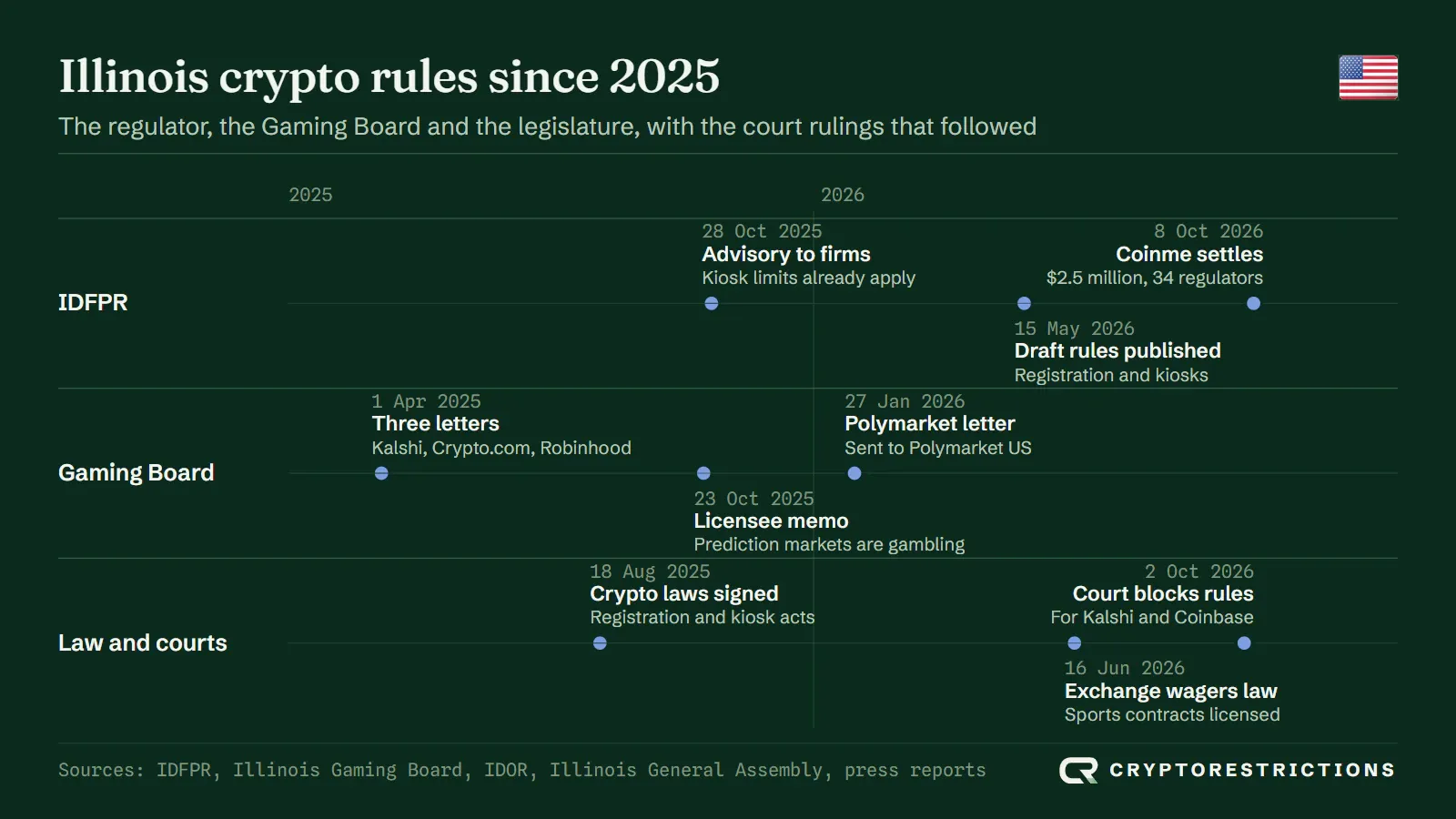
- IDFPR. After the fact sheet of March 2025, which notes the Act grew out of a 2023 House bill, IDFPR sent firms an advisory on 28 October 2025 and published draft rules on 15 May 2026. On 8 October 2026 it co-led a $2.5 million settlement with kiosk operator Coinme with 33 other regulators, under which Coinme must end its kiosk business by 1 January 2027.
- Gaming Board. Its letters of 1 April 2025 and 27 January 2026 target four prediction markets. On 23 October 2025 it told its licensees that prediction markets are gambling under Illinois law and that partnering with them could cost a licence.
- Legislature. Public Act 104-0468 of 16 June 2026, covered below, both brought sports contracts under the Sports Wagering Act and created a tax on broker transactions.
- Attorney General. We found consumer alerts about crypto scams, and no crypto lawsuit brought by the state.
Are prediction markets legal in Illinois?
Not settled. Illinois treats sports event contracts as gambling needing a licence, but a federal judge has barred the state from enforcing its rules against Kalshi and Coinbase, and the order does not cover other platforms.
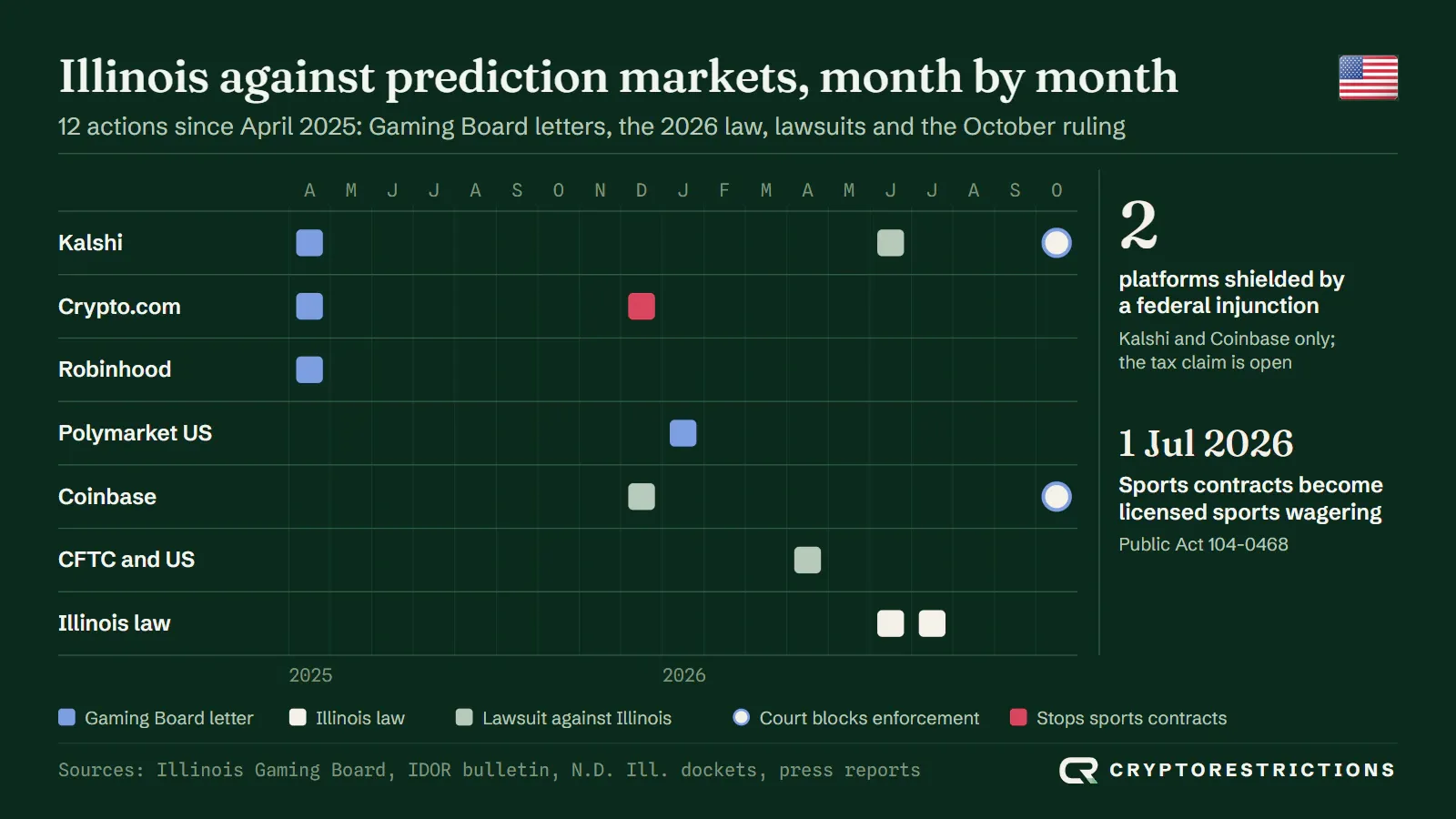
The Gaming Board began in April 2025 with letters to Kalshi, Crypto.com and Robinhood, and added Polymarket US in January 2026. Coinbase sued the state first, in December 2025, and the CFTC and the Justice Department followed in April 2026. Then Public Act 104-0468 took effect on 1 July 2026. As Kalshi’s complaint describes it, the Act adds an “exchange wager”, a contract on a sporting event traded on a prediction market, to the Sports Wagering Act, bringing licensing, an in-state location rule and age limits. Kalshi sued on 23 June 2026.
On 2 October 2026 Judge Martha Pacold granted partial injunctions, as press reports describe it, barring Illinois from enforcing its licensing and criminal rules against the contracts at issue because they are likely swaps under federal law. The challenge to the wager tax was left for more briefing. We have not read the order itself.
How is crypto taxed in Illinois?
A crypto gain is taxed through federal income at Illinois’s flat 4.95% rate. A separate 0.2% tax on broker transactions is due to start on 1 July 2027.
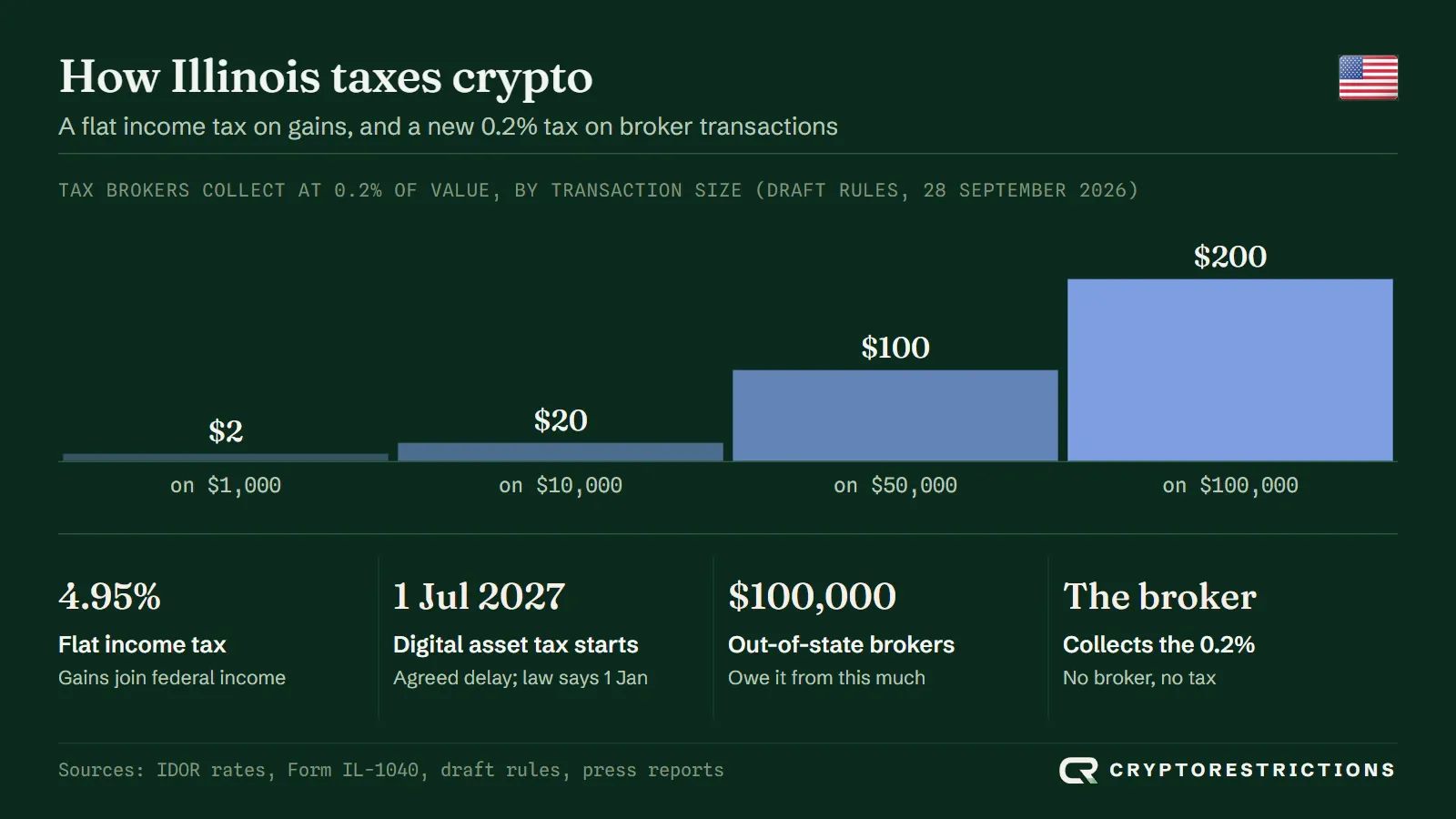
The individual rate has been 4.95% since 1 July 2017, and the 2025 Form IL-1040 starts from federal adjusted gross income, so there is no separate rate for gains.
Public Act 104-0468 also created the Digital Asset Tax. The Department of Revenue’s draft rules of 28 September 2026 put it at 0.2% of the value of crypto exchanged, transferred or stored for an Illinois customer, collected by the broker, with a first date of 1 January 2027 and comments due on 30 October 2026. They would reach out-of-state brokers once their Illinois receipts reach $100,000, and treat a paid transfer from an exchange to your own wallet as taxable, while a transfer between two private wallets with no broker is not. Decrypt reported on 1 October 2026 that the parties to an industry lawsuit agreed to delay the start to 1 July 2027; the Revenue pages did not yet mention the delay when we read them.







