
 United States · AK
Is crypto legal in Alaska?
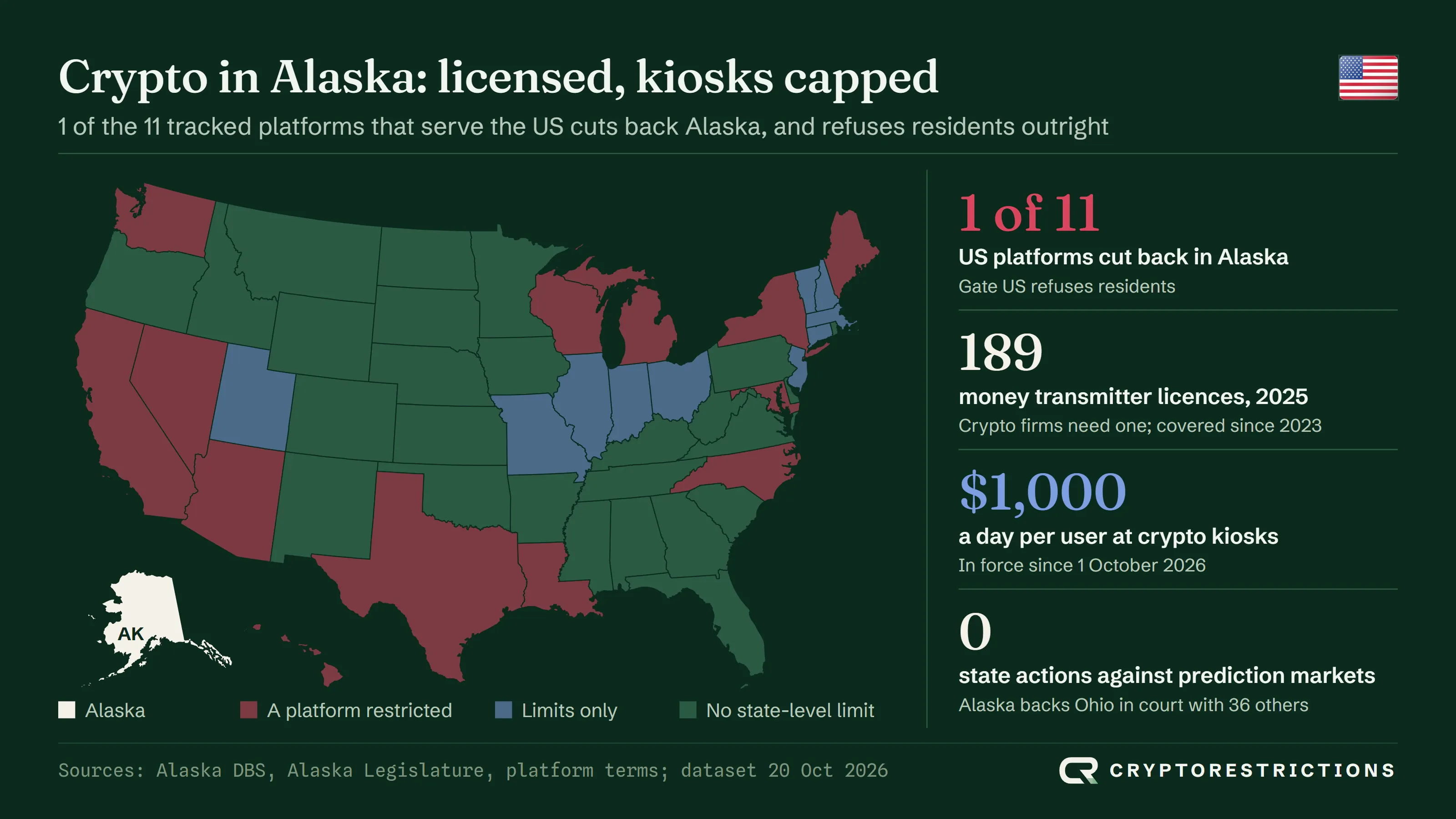
Yes. Owning and trading crypto is legal in Alaska. A firm that moves or exchanges crypto for Alaskans needs a money transmitter licence from the Division of Banking and Securities (DBS), and Alaska has no personal income tax.
Alaska has no crypto licence of its own like New York’s BitLicense. It folds crypto into its money transmission law, the Uniform Money Services Act (AS 06.55). Since 1 January 2023, rule 3 AAC 13.006 has required anyone transmitting virtual currency to, from or within Alaska to apply for a licence, and it voided the older fiat-only licensing agreements for crypto. People who only hold crypto, and shops that accept it, need no licence.
Federal rules from the SEC, CFTC, Treasury and IRS apply on top, as in every state, and offshore exchanges that refuse US users refuse Alaskans too. Both are covered in our United States guide.
Which crypto licences does Alaska require?
A money transmitter licence from DBS, with a $500,000 surety bond for crypto applicants. Four of the seven US exchanges we track list an Alaska licence number on their own pages: Coinbase, Kraken, Gemini and Crypto.com.
DBS reported 189 money transmitter and currency exchange licences in 2025, up from 113 in 2019, and crypto transmission in Alaska reached $2.29 billion that year. Its May 2025 checklist lists crypto exchange, crypto ATMs and crypto custody as licensable activities and sets the $500,000 bond for virtual currency applicants, against $25,000 for other transmitters.
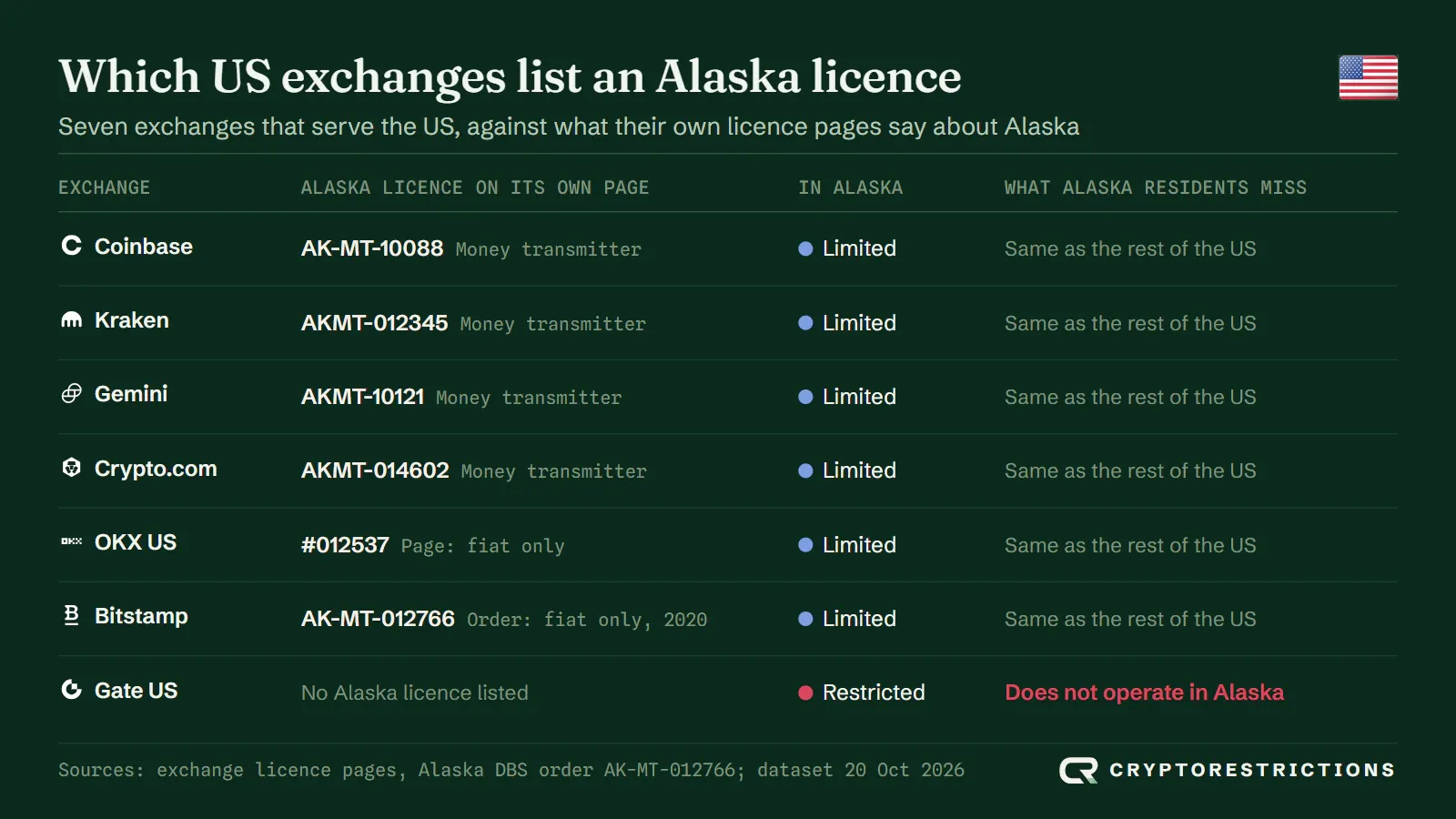
Two entries need care. OKX lists licence #012537 but adds that it “does not cover the transmission of virtual currency”, the old fiat-only wording. Bitstamp got a fiat-only licence in 2020, with the Division’s order saying it could not use it to transmit virtual currency, and we could not read its current page. Neither page says Alaska is excluded, so neither is cut back here.


A larger change is coming. SB 86 became law on 30 June 2026 without the governor’s signature. From 1 July 2027 it makes virtual currency business activity itself licensable, exempts own-account use and activity of $5,000 a year or less, and lets current licensees carry on until they renew or 1 July 2028, whichever is later.
Best crypto platforms for Alaska residents
By our access score inside Alaska, Coinbase (8.9 out of 10), Gemini (8.4) and Kraken (8.3) are the most open exchanges, Kalshi (7.3) the most open prediction market and Uniswap (8.0) the most open DeFi platform.
The score rates how fully an Alaska resident can use each platform, not its fees or safety. It is the US score with Alaska’s own limits applied: access status (4 points), the share of the platform’s products open in the state (3), the licences we hold on file (2) and what our geo-access test saw from a US address (1). Platforms that refuse Alaskans are not scored. The method is on our methodology page.
Exchanges

Coinbase
Best for The widest product range with an Alaska licence
8.9/10- Access
- 3.5/4
- Products
- 2.4/3
- Licences
- 2/2
- Our test
- 1/1
Read our Coinbase reportPros
- Alaska licence AK-MT-10088 on its own page
- No Alaska limit on staking, loans or DEX trading
Cons
- No new staking in California, Maryland, New Jersey or Wisconsin, a limit Alaska does not share
- Prediction markets closed in Nevada and Michigan

Gemini
Best for Spot trading with an Alaska licence
8.4/10- Access
- 3.5/4
- Products
- 1.9/3
- Licences
- 2/2
- Our test
- 1/1
Read our Gemini reportPros
- Alaska licence AKMT-10121 on its licences page
- Asset Rewards excludes only New York
Cons
- Gemini Derivatives excludes US persons
- Sued by New York over sports contracts

Kraken
Best for Regulated futures for US residents
8.3/10- Access
- 3/4
- Products
- 2.3/3
- Licences
- 2/2
- Our test
- 1/1
Read our Kraken reportPros
- Alaska licence AKMT-012345 on its disclosures page
- Alaska named as served for onchain staking and stock trading
Cons
- Does not serve New York or Maine
- Transfer or EUR limits in six states

Crypto.com
Best for Event contracts beside a crypto app
7.5/10- Access
- 3/4
- Products
- 1.5/3
- Licences
- 2/2
- Our test
- 1/1
Read our Crypto.com reportPros
- Alaska licence AKMT-014602
- Its US help page lists Alaska among 49 states served
Cons
- No derivatives for US residents on the Exchange
- The App is not available in New York
Prediction markets

Kalshi
Best for The broadest CFTC-regulated event contracts
7.3/10- Access
- 3/4
- Products
- 2.3/3
- Licences
- 1/2
- Our test
- 1/1
Read our Kalshi reportPros
- CFTC-designated contract market and clearing house
- No Alaska order or lawsuit against it
Cons
- Alaska backs the states fighting it in court
- Court orders geofence Nevada, Washington and Michigan

Polymarket
Best for Polymarket markets on a US-regulated exchange
6.3/10- Access
- 3/4
- Products
- 2.3/3
- Licences
- 1/2
- Our test
- 0/1
Read our Polymarket reportPros
- Polymarket US is a CFTC-designated exchange
- No Alaska order or lawsuit against it
Cons
- polymarket.com itself blocks US users
- Nevada injunction and a New York lawsuit in 2026
DeFi

Uniswap
Best for Swapping tokens from your own wallet
8.0/10- Access
- 4/4
- Products
- 3/3
- Licences
- 0/2
- Our test
- 1/1
Read our Uniswap reportPros
- Terms exclude only sanctioned jurisdictions, no states
Cons
- Leveraged products for US retail are barred

PancakeSwap
Best for BNB Chain swaps and pools
6.3/10- Access
- 3.5/4
- Products
- 1.8/3
- Licences
- 0/2
- Our test
- 1/1
Read our PancakeSwap reportPros
- Swaps, pools and staking are not excluded
Cons
- PCS Perps bars US users
- No US licence on file
Which platforms block or limit Alaska residents?
One exchange that serves the rest of the US refuses Alaskans: Gate US. We found no platform that drops a single product in Alaska.
Gate lists Alaska among the jurisdictions where it does not operate, together with Louisiana, New York, North Carolina, Texas, Washington and the US Virgin Islands. It holds no Alaska licence. The other platforms we checked name no Alaska exclusion on the pages we could read.

We could not read the full state terms of Bitstamp, Kalshi, Polymarket US or PancakeSwap, so a state limit on one of them could be missing. They carry no Alaska row until a primary page says otherwise.
Who regulates crypto in Alaska?
The Division of Banking and Securities licenses crypto firms, the Attorney General warns consumers and joins multistate cases, and the Legislature passed two crypto laws in 2026: a kiosk law now in force and a licensing rewrite that starts on 1 July 2027.
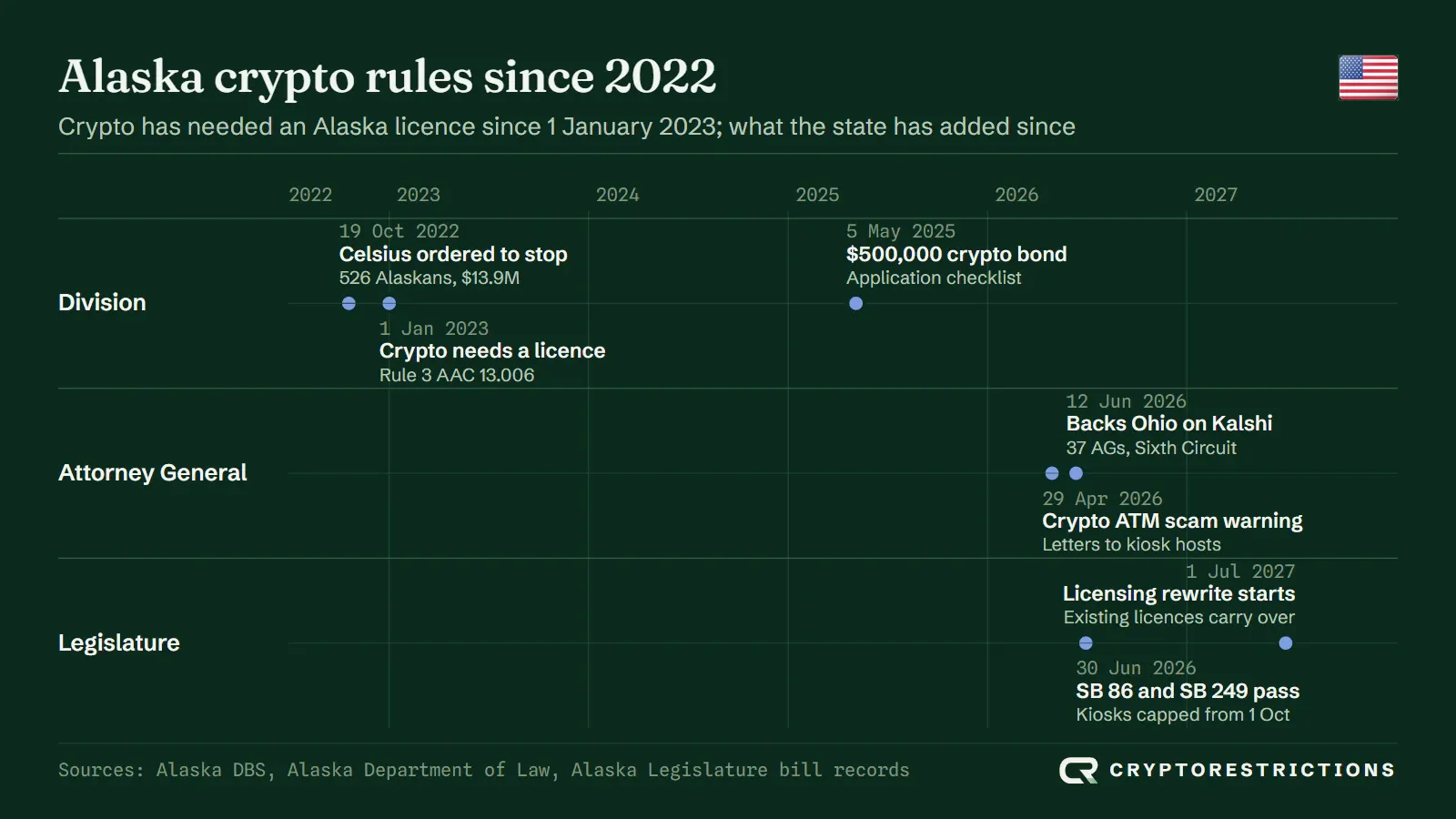
- Division of Banking and Securities. On 19 October 2022 it ordered Celsius to stop offering accounts in Alaska, citing 526 Alaskans holding $13.9 million. Tracy Reno is the director.
- Attorney General. On 29 April 2026 Stephen Cox warned Alaskans that scammers send victims to crypto ATMs and wrote to businesses that host kiosks.
- Crypto kiosks. SB 249 became law on 30 June 2026 and took effect on 1 October 2026. An operator needs a money transmission licence and the state’s approval for each kiosk, may take no more than $1,000 from a user in a day or $10,000 in 30 days, may charge no more than 10% in fees, and must refund fraud victims in full, fees included.
- Bills that did not pass. Two House kiosk bills, HB 324 and HB 354, stayed in committee. We found no bitcoin reserve bill in the 2025 and 2026 sessions.
Are prediction markets legal in Alaska?
Alaska has taken no action against a prediction market that we could find, but it has no legal sports betting either, and it sided with the states that are fighting Kalshi in court.
We found no Alaska cease-and-desist letter, lawsuit or court order naming Kalshi, Polymarket, Crypto.com, Coinbase or Robinhood. The platforms’ own pages do not exclude Alaska where we could read them. The case against them would rest on state gambling law, and Alaska licenses no commercial sports betting: HB 145 and its Senate twin SB 194, both on mobile sports wagering, stalled in committee when the session ended in May 2026. Neither mentions event contracts.
The state has still picked a side. On 12 June 2026 California’s Attorney General listed Alaska among 37 attorneys general backing Ohio’s gambling law against Kalshi at the Sixth Circuit. Alaska did not sign the 7 October 2026 Supreme Court brief in Flaherty v. KalshiEX.
How is crypto taxed in Alaska?
Alaska charges no personal income tax, so a crypto gain is taxed by the federal government only. The state has no sales tax either, but some cities and boroughs add their own.
The Tax Division says Alaska does not have an individual income tax and no state sales and use tax, though some local jurisdictions impose local sales taxes. We found no Alaska or local guidance on whether buying or selling crypto is a taxable sale, so we make no claim either way. Federal tax rules are in our United States guide.







