
 United States · TN
Is crypto legal in Tennessee?
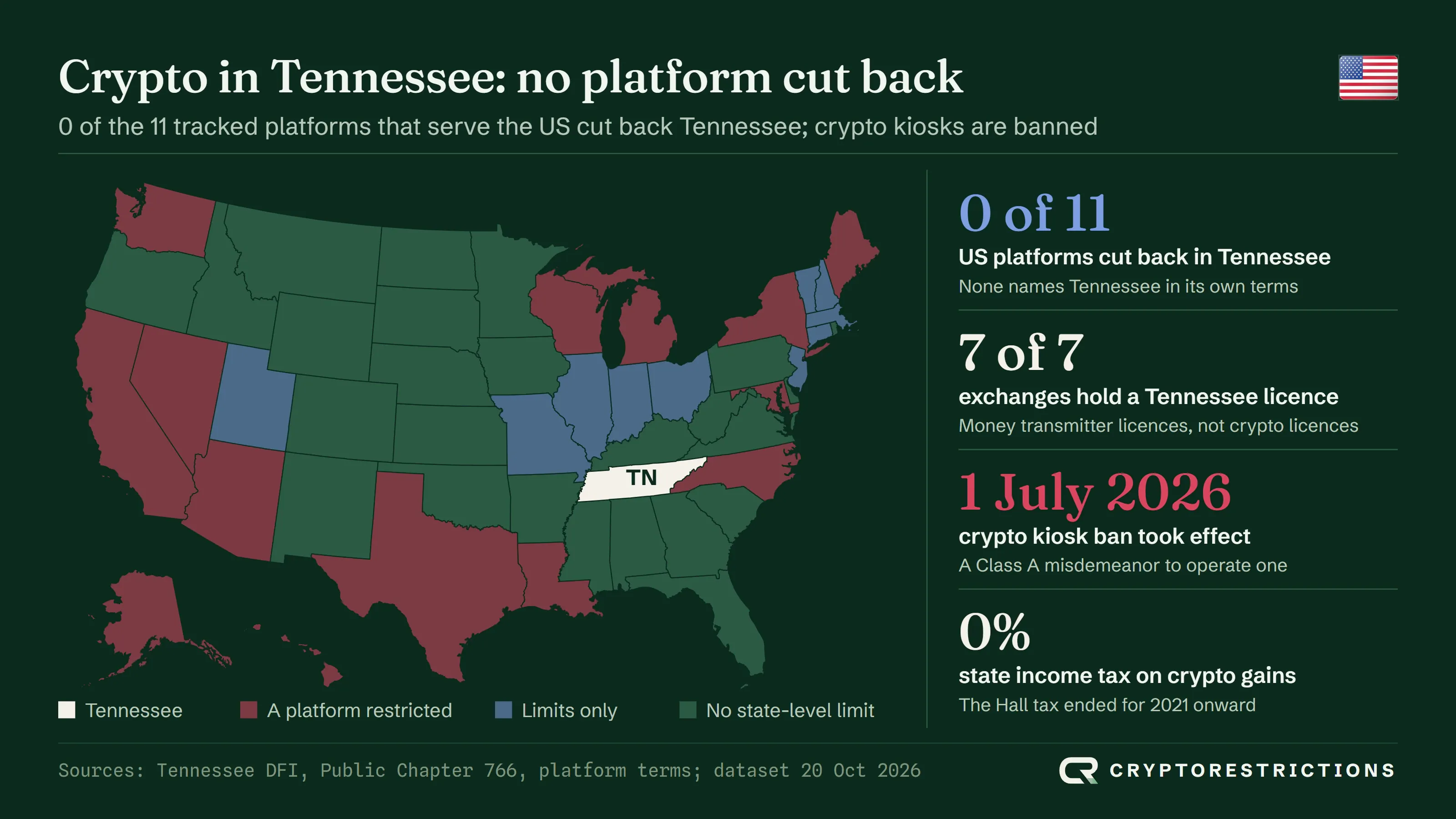
Yes. Owning and trading crypto is legal in Tennessee, and the state has no crypto licence: its financial regulator says it “does not regulate virtual currency”. Crypto kiosks are the exception, banned since 1 July 2026.
The Department of Financial Institutions states on its money transmitter page that a Tennessee money transmitter licence and its surety bond “do not cover the transmission of virtual currency”, and that a company that exchanges, administers or maintains virtual currency for sovereign currency may still face state licensing and federal regulation. Its older guidance, a memo of 16 December 2015, draws the line at dollars: swapping one coin for another, or moving a coin by itself, is not money transmission, while an exchange that holds a buyer’s dollars generally is. That memo was written under the old act. Public Chapter 115 of 2023, the Money Transmission Modernization Act, replaced it on 1 January 2024.
Tennessee taxes no crypto gains (see the tax section below). Federal rules from the SEC, CFTC, Treasury and IRS apply on top, as in every state, and offshore exchanges that refuse US users refuse Tennesseans too. Both are covered in our United States guide.
Which crypto licences does Tennessee require?
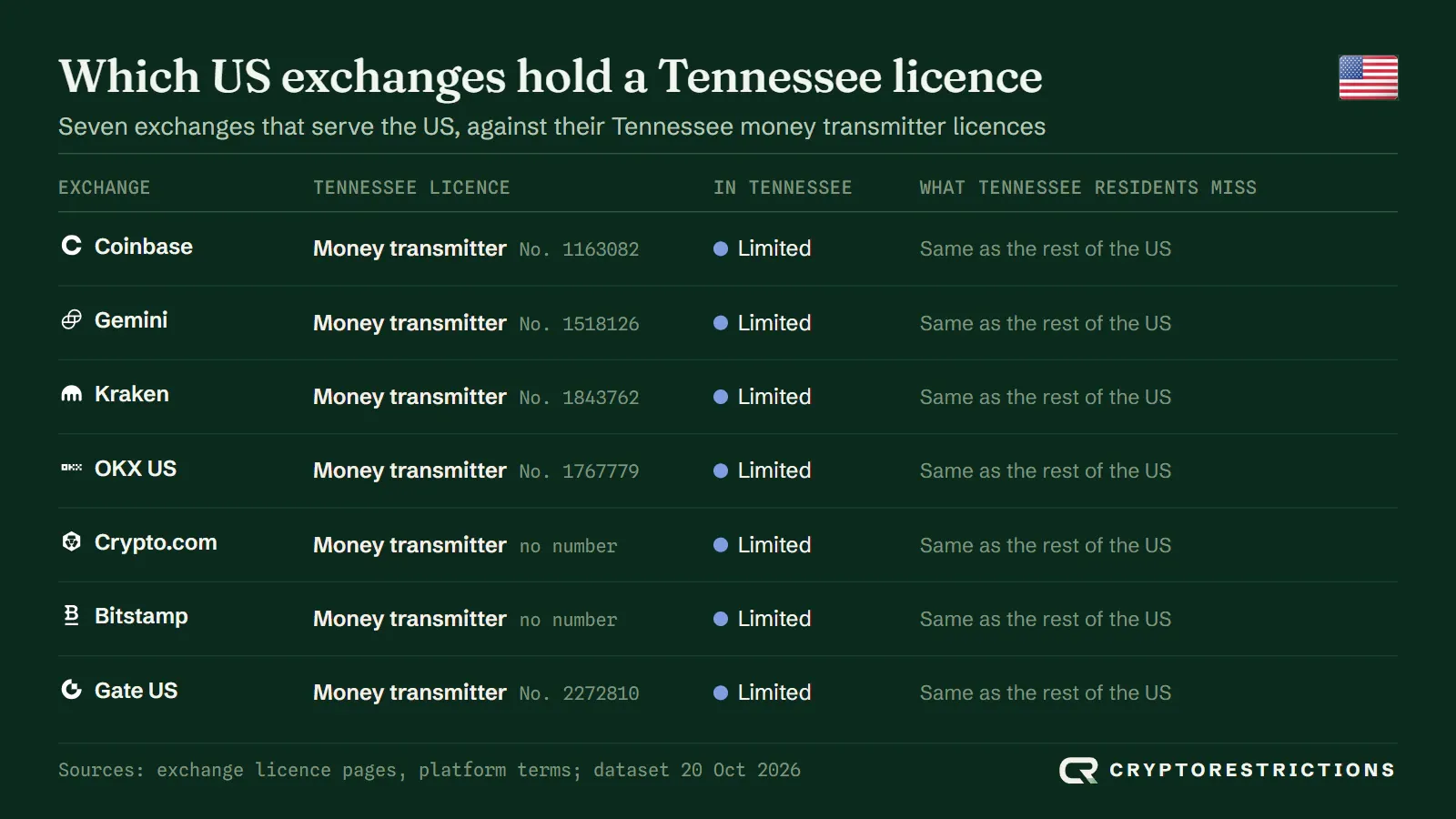
None for crypto as such. A firm that handles customers’ dollars needs a money transmitter licence from the Department of Financial Institutions, and all seven US exchanges we track show one on their own licence pages: Coinbase, Gemini, Kraken, OKX US, Crypto.com, Bitstamp and Gate US.
Tennessee has no BitLicense-style regime and no list of approved coins, and the Department publishes no licensee list: it sends the public to the NMLS Consumer Access search. Each exchange’s page repeats the Department’s caveat that the licence does not cover virtual currency, so the licence covers the dollar side only. Crypto.com and Bitstamp name Tennessee as a licensing state without a number we could read.
The Securities Division is the state’s other crypto gatekeeper. On 13 May 2022 it signed a consent order under which BlockFi Lending agreed to stop offering its interest accounts to new US clients.
Best crypto platforms for Tennessee residents
By our access score inside Tennessee, Coinbase (8.9 out of 10), Gemini (8.4) and Kraken (8.3) are the most open exchanges, Kalshi (7.3) the most open prediction market and Uniswap (8.0) the most open DeFi platform.
The score rates how fully a Tennessee resident can use each platform, not its fees or safety. It is the US score with Tennessee’s own limits applied: access status (4 points), the share of the platform’s products open in the state (3), the licences we hold on file (2) and what our geo-access test saw from a US address (1). No tracked platform has a Tennessee-specific cut, so the scores track the US ones. The method is on our methodology page.
Exchanges

Coinbase
Best for Spot trading plus staking and loans
8.9/10- Access
- 3.5/4
- Products
- 2.4/3
- Licences
- 2/2
- Our test
- 1/1
Read our Coinbase reportPros
- Tennessee money transmitter licence 1163082
- Staking is open in Tennessee: its help page excludes only CA, MD, NJ and WI
Cons
- Its prediction markets run through Kalshi, which Tennessee is contesting in court

Gemini
Best for Plain spot trading under one licence
8.4/10- Access
- 3.5/4
- Products
- 1.9/3
- Licences
- 2/2
- Our test
- 1/1
Read our Gemini reportPros
- Tennessee money transmitter licence 1518126
- Gemini lists Tennessee as available
Cons
- Fiat deposits are USD only
- Gemini Derivatives excludes US persons

Kraken
Best for A wide coin list, with EUR still open
8.3/10- Access
- 3/4
- Products
- 2.3/3
- Licences
- 2/2
- Our test
- 1/1
Read our Kraken reportPros
- Tennessee money transmitter licence 1843762
- Its EUR and bank funding exclusions name other states, not Tennessee
Cons
- Its disclosure says the Tennessee licence does not cover virtual currency
- Federal limits on US customers still apply

Crypto.com
Best for The App for spot trading
7.5/10- Access
- 3/4
- Products
- 1.5/3
- Licences
- 2/2
- Our test
- 1/1
Read our Crypto.com reportPros
- The App is available in 49 states, Tennessee included
- Staking exclusions name NY, CA, MD, NJ and WI, not Tennessee
Cons
- The Exchange does not offer US residents derivatives
- Its Tennessee licence is a scanned PDF with no number on the page

Bitstamp
Best for Plain spot trading
6.6/10- Access
- 3/4
- Products
- 0.6/3
- Licences
- 2/2
- Our test
- 1/1
Read our Bitstamp reportPros
- Lists Tennessee among its money transmitter licences
- No Tennessee carve-out in its US terms
Cons
- No staking or lending in the US
- No derivatives for US customers

OKX
Best for Spot trading under a US entity
6.0/10- Access
- 3/4
- Products
- 1.5/3
- Licences
- 1/2
- Our test
- 0.5/1
Read our OKX reportPros
- Tennessee money transmitter licence 1767779
- Its US licences page excludes only New York and the territories
Cons
- Spot and convert only, no derivatives for US customers
Prediction markets

Kalshi
Best for The broadest CFTC-regulated event contracts
7.3/10- Access
- 3/4
- Products
- 2.3/3
- Licences
- 1/2
- Our test
- 1/1
Read our Kalshi reportPros
- CFTC-designated contract market
- Its help pages do not name Tennessee as excluded
Cons
- Tennessee treats its sports contracts as unlicensed betting
- The Sixth Circuit sided with the state on 25 September 2026

Polymarket
Best for Polymarket markets on a US exchange
6.3/10- Access
- 3/4
- Products
- 2.3/3
- Licences
- 1/2
- Our test
- 0/1
Read our Polymarket reportPros
- Polymarket US is a CFTC-designated exchange
- Its terms do not name Tennessee
Cons
- polymarket.com itself blocks US users
- No state list is published, so Tennessee status rests on silence
DeFi

Uniswap
Best for Swapping tokens from your own wallet
8.0/10- Access
- 4/4
- Products
- 3/3
- Licences
- 0/2
- Our test
- 1/1
Read our Uniswap reportPros
- Terms do not exclude Tennessee
- No US state is named in its terms
Cons
- Leveraged products for US retail are barred

PancakeSwap
Best for BNB Chain swaps and pools
6.3/10- Access
- 3.5/4
- Products
- 1.8/3
- Licences
- 0/2
- Our test
- 1/1
Read our PancakeSwap reportPros
- Swaps, pools and staking are not excluded
Cons
- PCS Perps bars US users
- No US licence on file
Which platforms block or limit Tennessee residents?
None of the platforms we track. We found no tracked exchange, prediction market or DeFi protocol that names Tennessee as excluded or limited in its own terms, licence page or help centre, so Tennessee residents get the same product list as the rest of the US.
The exclusions we did find name other states. Kraken bars EUR in Texas and New Hampshire and bank funding in Texas, New York and Maine. Crypto.com bars staking in New York, California, Maryland, New Jersey and Wisconsin. Gate does not operate in Alaska, Texas, Louisiana, New York, Washington and North Carolina, and OKX excludes New York and the territories.

The one live Tennessee question is prediction markets, where the state is in court with Kalshi but no platform has changed its Tennessee access that we could confirm. It is covered below. Kiosks are a ban on machines, not on platforms: residents can still buy and trade crypto online.
Who regulates crypto in Tennessee?
The Department of Financial Institutions licenses money transmission, the Securities Division polices investment schemes and backed the kiosk ban, the Attorney General defends the state’s laws in court and sides with the industry against the SEC, and the Sports Wagering Council treats sports event contracts as betting.
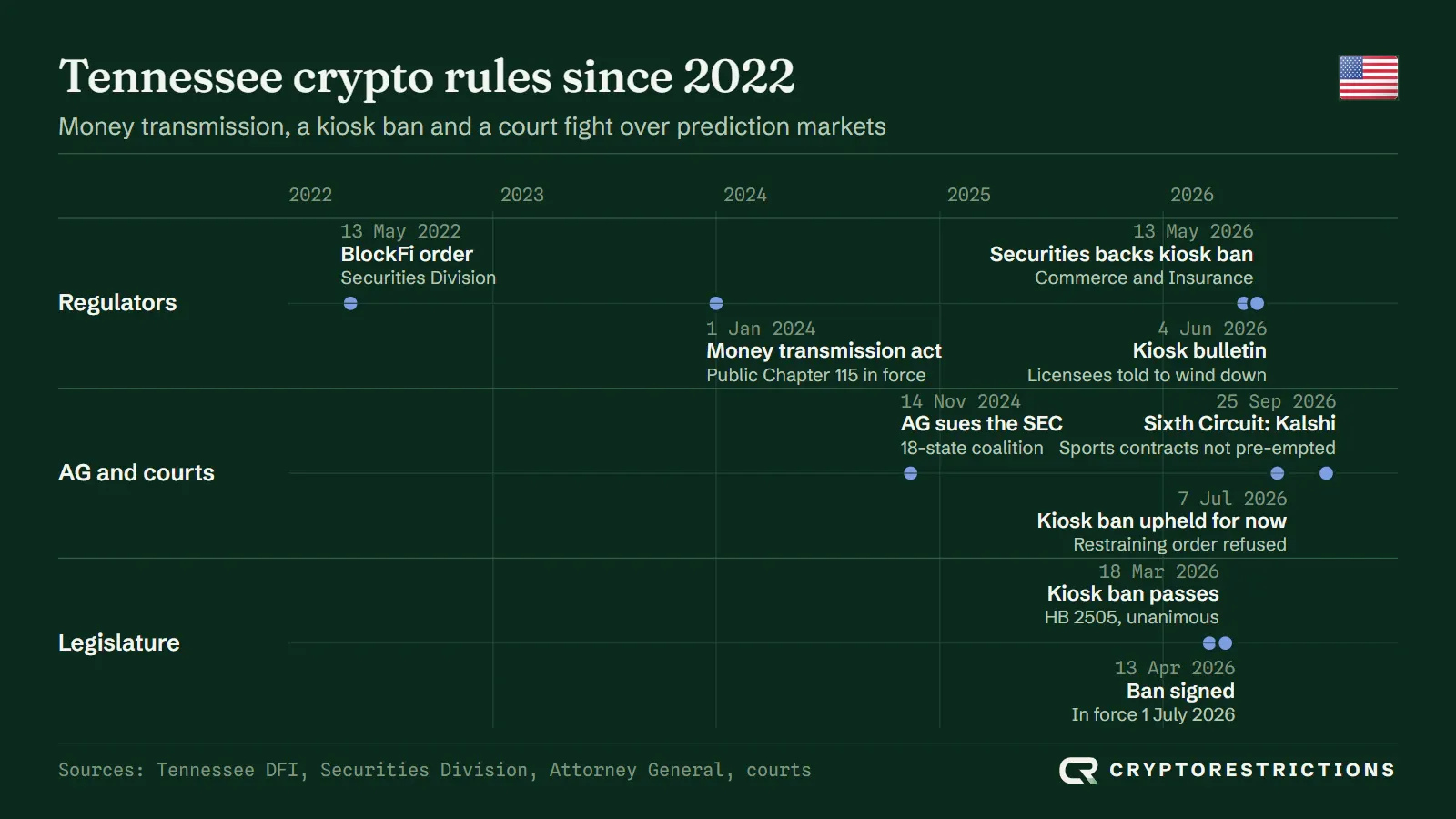
- Department of Financial Institutions. The Money Transmission Modernization Act took effect on 1 January 2024. On 4 June 2026 the Department told licensees in a bulletin that those running kiosks may face enforcement on top of the criminal penalty, and asked them to report wind-down plans by 18 June 2026.
- Securities Division. On 13 May 2026 it backed the kiosk ban and said the ban “does not prevent consumers from buying or trading cryptocurrencies”.
- Attorney General. In November 2024 Jonathan Skrmetti joined the 18-state suit against the SEC in the Eastern District of Kentucky. On 7 July 2026 a federal court refused the kiosk operator CoinFlip and another operator a restraining order against the kiosk ban; their suit continues.
- General Assembly. HB 2505 passed unanimously on 18 March 2026 and Governor Bill Lee signed it as Public Chapter 766 on 13 April 2026. From 1 July 2026 it is a Class A misdemeanor to knowingly install, permit, place or operate a virtual currency kiosk, which the act defines as an electronic terminal that exchanges virtual currency for money, bank credit or other virtual currency. Tennessee chose a ban rather than the daily limits other states set.
Are prediction markets legal in Tennessee?
Contested. Tennessee says sports event contracts are unlicensed betting, and on 25 September 2026 the Sixth Circuit agreed with the state at the injunction stage. Kalshi’s case goes back to the district court, and we could not confirm that any platform has stopped serving Tennessee.
In early 2026 the Sports Wagering Council sent Kalshi a cease-and-desist letter demanding it halt sports event contracts for Tennessee customers, on the ground that it takes bets on sporting events without a Council licence. Kalshi sued and won a temporary restraining order the same day. The Sixth Circuit’s opinion of 25 September 2026 (Nos. 26-3196 and 26-5235, decided together with an Ohio case) held that Kalshi’s sports contracts are not “swaps” under the Commodity Exchange Act and that, even if they were, the Act does not pre-empt Tennessee’s gambling laws. It vacated the Tennessee injunction and sent the case back; it ruled only on the preliminary injunction.
The Attorney General called the result a win that lifts the order blocking enforcement against Kalshi. Without a final ruling, the practical outcome for residents is not settled, so the pick lists above keep the US status for Kalshi and Polymarket. Actions in other states, and the federal side, are in our United States guide.
How is crypto taxed in Tennessee?
Tennessee taxes no crypto gains. Its Hall income tax, which reached interest and dividends only, was repealed from 2021, so we found no state tax on a gain and only federal tax applies. Sales tax is 7% plus up to 2.75% local, and companies pay franchise and excise tax.
The Revenue Department says the Hall income tax, which taxed interest and dividends only, was repealed for tax periods beginning on 1 January 2021 or later. Federal capital gains rules are in our United States guide. The general sales tax rate is 7%, with a local rate that may not exceed 2.75%. Companies, including exchanges based in the state, pay franchise tax at 0.25% of Tennessee net worth and excise tax at 6.5% of Tennessee taxable income.







