
 United States · UT
Is crypto legal in Utah?
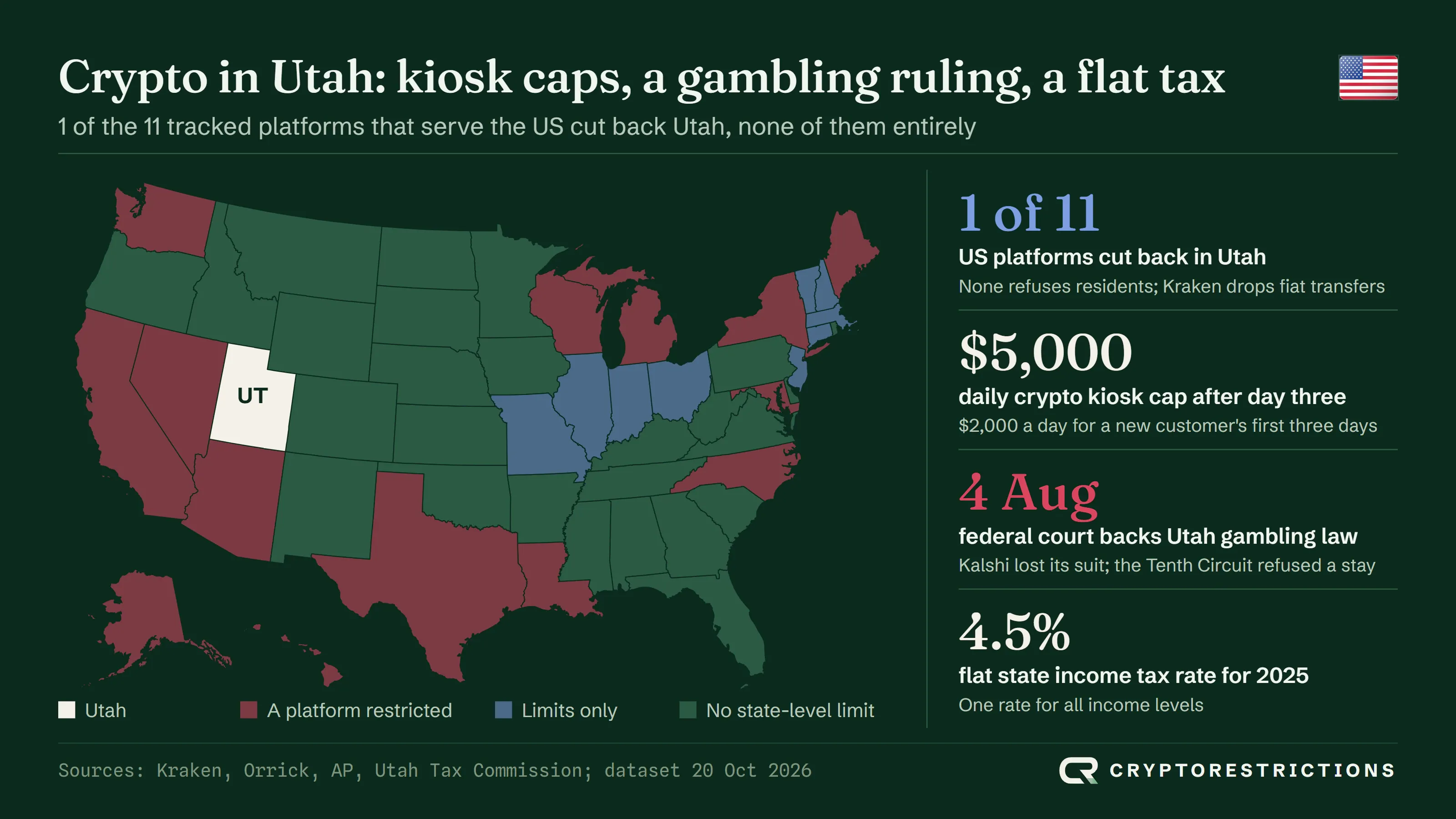
Yes. Owning and trading crypto is legal in Utah, and the state has no crypto licence of its own: a 2025 law protects holding, staking and running nodes, and only firms that handle dollars need a money transmitter licence.
HB 230, signed on 25 March 2025 and in force from 7 May 2025, bars state and local limits on accepting digital assets as payment and on holding them in self-custody. It also says a person may run a node, write blockchain software or take part in staking, and it exempts node operation, software development and swaps of one digital asset for another from the Money Transmitter Act, as long as the swap involves no legal tender or bank deposits. Earlier drafts let the state treasurer invest public funds in digital assets; the enacted text dropped that, so HB 230 did not create a state bitcoin reserve.
Federal rules from the SEC, CFTC, Treasury and IRS apply on top, as in every state, and offshore exchanges that refuse US users refuse Utahns too. Both are covered in our United States guide.
Which crypto licences does Utah require?
A money transmitter licence from the Department of Financial Institutions, for firms that handle dollars for customers. Utah has no crypto-specific licence. Of the exchanges we track, Kraken lists a Utah licence on its disclosures page.
Kraken lists a Utah money transmitter licence issued by the Department of Financial Institutions, without a licence number, on a page updated on 11 August 2026. We could not read the other exchanges’ Utah licence entries, so we list none for them rather than guess.
Crypto kiosks do have rules of their own. HB 72, signed on 25 March 2026 and in force from 6 May 2026, limits a kiosk customer to $2,000 a day for the first three days and $5,000 a day after that. Operators must print refund policies on receipts, warn that transactions are irreversible, report kiosk locations every year and tell the Division of Consumer Protection within 30 days of installing or removing a kiosk. A violation is a deceptive act under the Consumer Sales Practices Act, with administrative fines of up to $2,500 each.
Best crypto platforms for Utah residents
By our access score inside Utah, Gemini (8.4 out of 10), Kraken (8.3) and Coinbase (7.9) are the most open exchanges, Kalshi (7.3) the most open prediction market and Uniswap (8.0) the most open DeFi platform.
The score rates how fully a Utah resident can use each platform, not its fees or safety. It is the US score with Utah’s own limits applied: access status (4 points), the share of the platform’s products open in the state (3), the licences we hold on file (2) and what our geo-access test saw from a US address (1). Platforms that refuse Utahns are not scored. The method is on our methodology page.
Exchanges

Gemini
Best for Plain spot trading in dollars
8.4/10- Access
- 3.5/4
- Products
- 1.9/3
- Licences
- 2/2
- Our test
- 1/1
Read our Gemini reportPros
- Gemini says it is available in Utah, with USD funding
- Spot is open in all 50 states
Cons
- Gemini Derivatives excludes US persons

Kraken
Best for A wide coin list, funded by crypto
8.3/10- Access
- 3/4
- Products
- 2.3/3
- Licences
- 2/2
- Our test
- 1/1
Read our Kraken reportPros
- Utah money transmitter licence on its disclosures page
- US futures through Kraken Derivatives US
Cons
- No fiat transfers for Utah residents
- Fiat deposits are USD only for US residents

Coinbase
Best for Spot trading plus staking and loans
7.9/10- Access
- 3.5/4
- Products
- 2.4/3
- Licences
- 1/2
- Our test
- 1/1
Read our Coinbase reportPros
- Spot is open in every state, Utah included
- No Utah carve-out for staking or loans
Cons
- Staking is cut in four other states
- Loans are not offered in New York

Crypto.com
Best for The App for spot trading
7.5/10- Access
- 3/4
- Products
- 1.5/3
- Licences
- 2/2
- Our test
- 1/1
Read our Crypto.com reportPros
- The App is available in 49 states, Utah included
Cons
- The Exchange does not offer US residents derivatives

Bitstamp
Best for Plain spot trading
6.6/10- Access
- 3/4
- Products
- 0.6/3
- Licences
- 2/2
- Our test
- 1/1
Read our Bitstamp reportPros
- Does not bar Utah; only Hawaii and Nevada are excluded
Cons
- No staking or lending in the US
- No derivatives for US customers
Prediction markets

Kalshi
Best for The broadest CFTC-regulated event contracts
7.3/10- Access
- 3/4
- Products
- 2.3/3
- Licences
- 1/2
- Our test
- 1/1
Read our Kalshi reportPros
- CFTC-regulated US exchange
- No Utah order makes it geofence the state yet
Cons
- A federal court let Utah enforce its gambling law on 4 August 2026
- The Tenth Circuit refused Kalshi a stay on 8 September 2026

Polymarket
Best for Polymarket markets on a US exchange
6.3/10- Access
- 3/4
- Products
- 2.3/3
- Licences
- 1/2
- Our test
- 0/1
Read our Polymarket reportPros
- Polymarket US is a CFTC-designated exchange
- No Utah court order stops it
Cons
- polymarket.com itself blocks US users
DeFi

Uniswap
Best for Swapping tokens from your own wallet
8.0/10- Access
- 4/4
- Products
- 3/3
- Licences
- 0/2
- Our test
- 1/1
Read our Uniswap reportPros
- Terms do not exclude Utah
- No US state is named in its terms
Cons
- Leveraged products for US retail are barred

PancakeSwap
Best for BNB Chain swaps and pools
6.3/10- Access
- 3.5/4
- Products
- 1.8/3
- Licences
- 0/2
- Our test
- 1/1
Read our PancakeSwap reportPros
- Swaps, pools and staking are not excluded
Cons
- PCS Perps bars US users
- No US licence on file
Which platforms block or limit Utah residents?
None of the platforms we track refuses Utah residents. Kraken serves Utah with one cut: no fiat transfers.
Kraken’s licensing page lists Utah with Indiana, Louisiana and Massachusetts as states where fiat transfers are not available, while crypto transfers are blocked only in Indiana. Kraken’s separate domestic funding page, updated on 1 October 2026, names Texas, New York and Maine and does not name Utah. We follow the licensing page, which names Utah outright.
Who regulates crypto in Utah?
The Department of Financial Institutions licenses money transmission, the Division of Consumer Protection polices crypto kiosks, the Legislature has written the rules on custody and kiosks, and the Attorney General defends Utah’s gambling law in court.
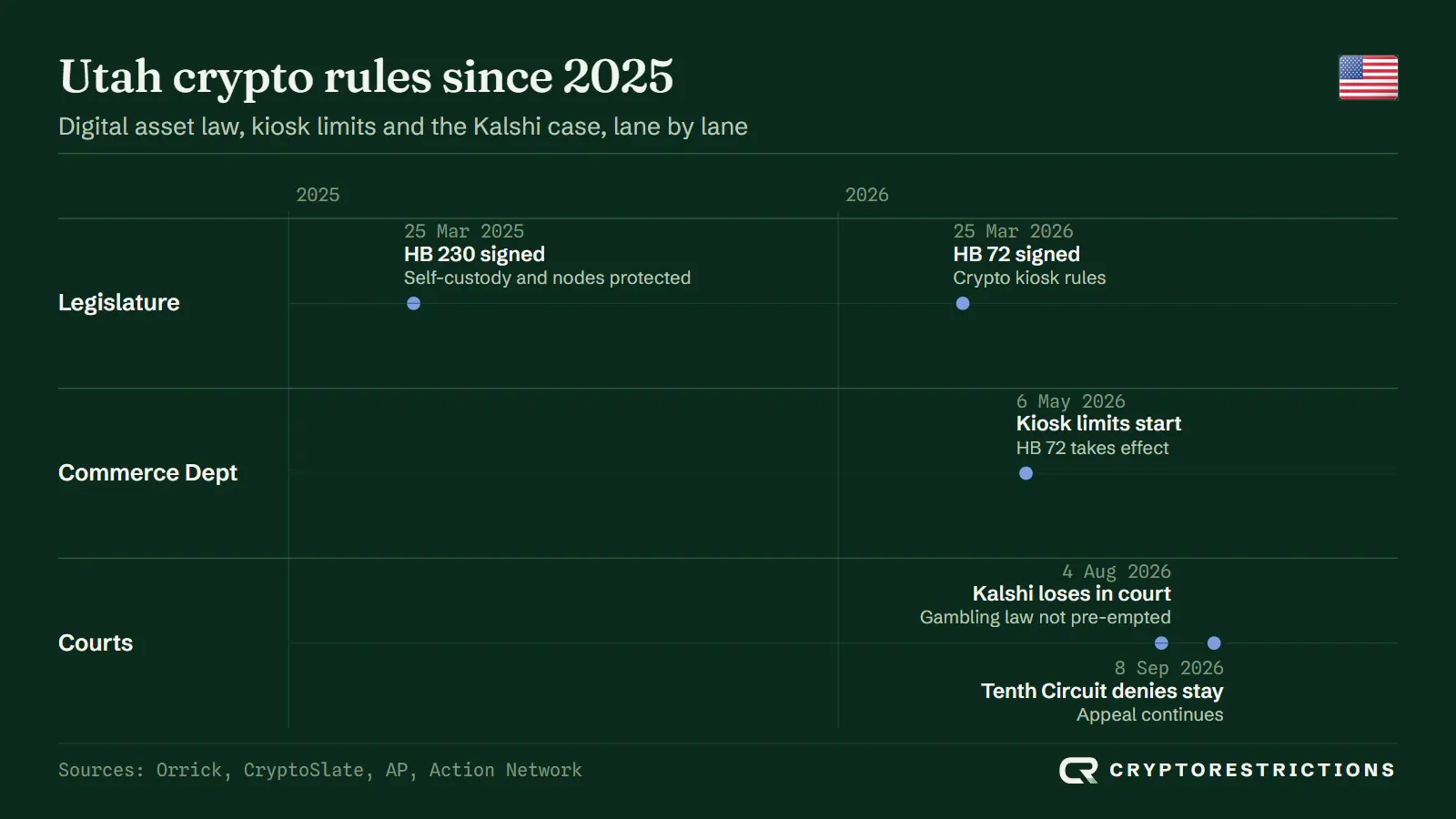
- Legislature. HB 230 in 2025 protected self-custody, nodes and staking and set limits on local rules for mining businesses that use more than one megawatt on average. HB 72 in 2026 wrote the kiosk limits above.
- Division of Consumer Protection. It receives the annual kiosk location reports and the 30-day notices, and may fine operators up to $2,500 per violation.
- Attorney General. Derek Brown’s office defended the state’s gambling law against Kalshi, then sued and charged it in October 2026, covered in the next section.
Are prediction markets legal in Utah?
Not for sports proposition bets on Kalshi, according to a federal court. A judge ruled on 4 August 2026 that federal law does not stop Utah enforcing its gambling laws, and the appeal is still running. In October 2026 the state sued Kalshi and filed criminal charges against it, but no court order yet makes Kalshi geofence the state.
- February 2026. Kalshi sued Utah, asking a federal judge to block the state’s gambling restrictions, according to the Associated Press.
- 4 August 2026. Judge Robert Shelby found that the federal law Kalshi cited does not prevent Utah from enforcing its ban on sports proposition betting. Attorney General Derek Brown said he will enforce state law but was weighing his options. At the time Utah residents could still place bets.
- 8 September 2026. The Tenth Circuit denied Kalshi an injunction while its appeal runs. The order is procedural and does not decide the preemption question.
- 20 October 2026. The Attorney General sued Kalshi, its affiliates and two Susquehanna market makers in the Third District Court, seeking to bar the contracts in Utah, restitution and damages, as the federal complaint describes it.
- 26 October 2026. The United States and the CFTC sued Utah in federal court, arguing that state gambling law is preempted for CFTC-regulated exchanges.
- 28 October 2026. The Attorney General filed criminal charges against KalshiEX and its co-founders: 13 felony counts and a misdemeanor, over 12 sports wagers an undercover agent placed in September. Our news coverage has the details.
Kalshi and Polymarket US keep their US status in Utah in our data until a state order or a platform notice says otherwise. States that have already forced a geofence are covered in our United States guide.
How is crypto taxed in Utah?
Utah taxes personal income at a single flat rate, 4.5% for 2025. The Tax Commission’s rates page applies the same rate at every income level, and Utah has no separate crypto rate.
The Utah State Tax Commission lists 4.5% from 1 January 2025 and says Utah has a single tax rate for all income levels. Its page shows no rate for 2026 yet. How a crypto gain or loss is counted is a federal question, covered in our United States guide.








