
Is crypto legal in Hong Kong?
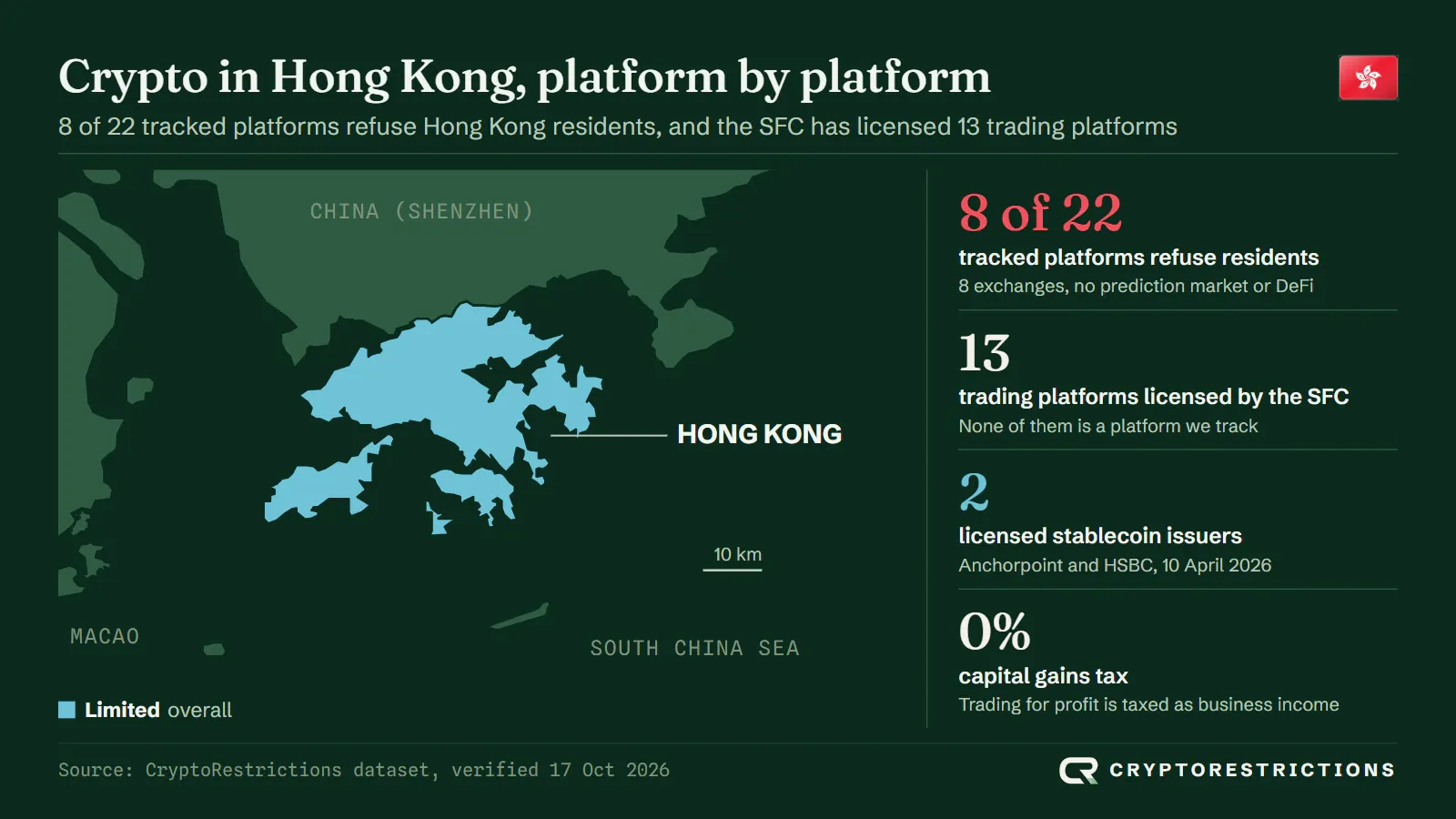
In practice yes. We found no rule that bans residents from owning or trading crypto, but the SFC tells investors to use only SFC-licensed platforms, and running an unlicensed platform for Hong Kong customers is a criminal offence.
Hong Kong is a special administrative region of China with its own financial regulators, so the rules below are Hong Kong’s, not the mainland’s. The licensing rules for trading platforms sit in the Anti-Money Laundering and Counter-Terrorist Financing Ordinance (AMLO). The SFC said in a statement updated on 28 May 2024 that every platform serving Hong Kong must be licensed or a deemed-to-be-licensed applicant, and that operating in breach of the AMLO is a criminal offence. The footer of its register of platforms urges investors to trade virtual assets only on SFC-licensed platforms.
So the law works on the platform side, not the customer side. The sections below cover who holds a licence, what licensed platforms may sell, and how profits are taxed.
Which crypto exchanges work in Hong Kong?
None of the exchanges we track holds an SFC licence. Coinbase, Kraken, Bitstamp and Bitfinex serve Hong Kong residents with no entry on the SFC lists, Binance serves them without derivatives, and Crypto.com serves them through its app only.
The SFC’s register of 16 October 2026 lists 13 licensed platforms: OSL Exchange (15 December 2020), HashKey Exchange (9 November 2022) and eleven more since October 2024, the latest being Bixin.com on 18 May 2026. None is a platform we track. The same page says deemed-to-be-licensed applicants are not formally licensed: Crypto.com (through Foris DAX HK, submitted 9 February 2024) is one, and WhaleFin is marked as having ceased business. Bybit’s second application, submitted on 6 June 2025, is on the list of applicants that the SFC says are not licensed.
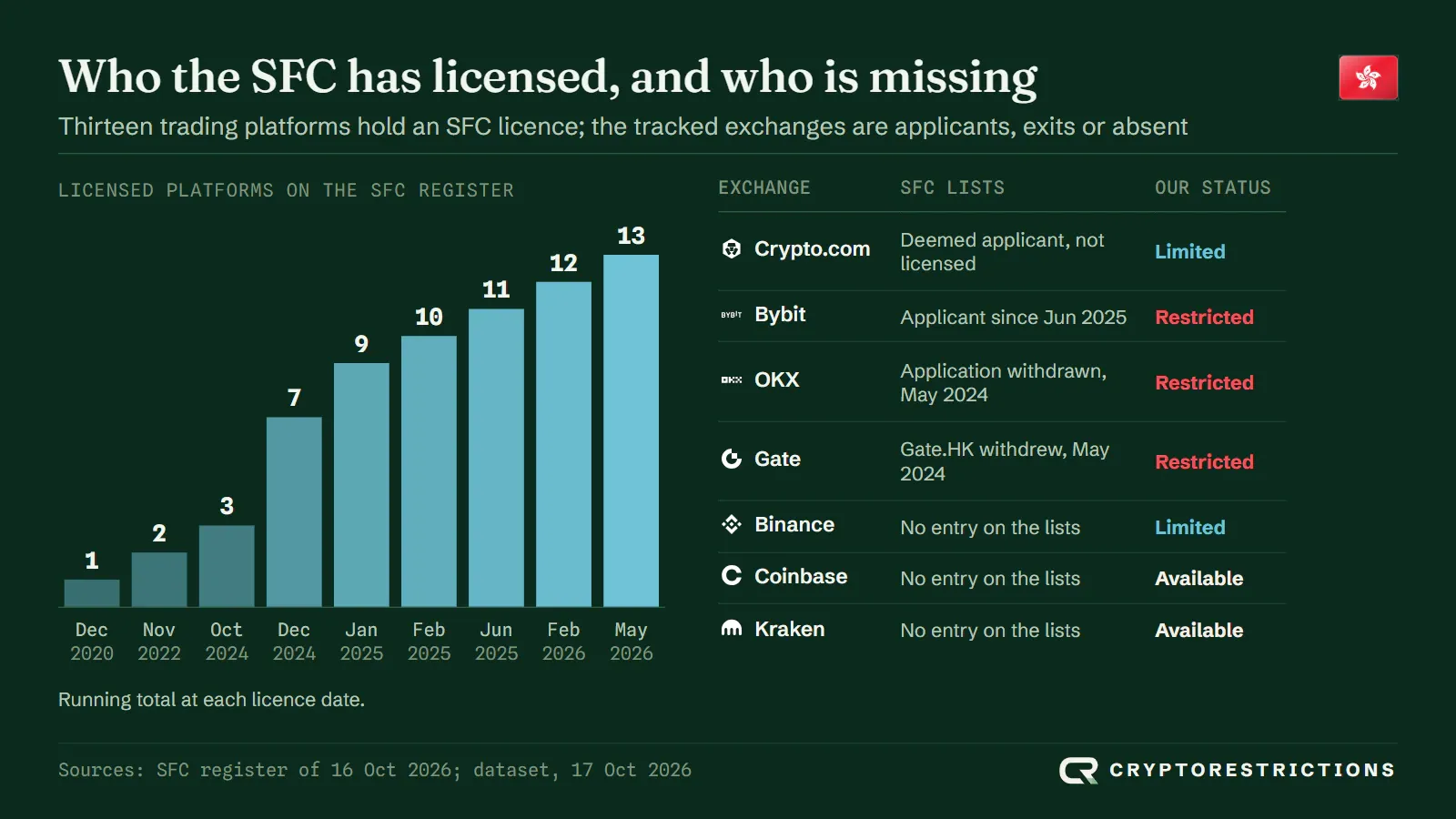
The register also records who left. It shows applications withdrawn by the OKX Hong Kong company on 24 May 2024, Gate.HK on 22 May 2024, Huobi HK on 14 May 2024 and Bybit’s first company on 31 May 2024. Matrixport HK withdrew on 12 October 2026 and has until 12 January 2027 to close its Hong Kong business.
Binance has no entry on any of the SFC’s lists, and Coinbase, Kraken, Bitstamp and Bitfinex have none either. A missing SFC entry is not a ruling that a service is allowed. Treat the label as a risk: a platform outside the licensing regime is outside the protections it is built to give.
Best crypto platforms for Hong Kong residents
By our access score, Bitfinex, Bitstamp and Kraken (8.0 out of 10 each) are the exchanges most open to Hong Kong residents, followed by Coinbase (7.5), and all six DeFi platforms we track and both prediction markets also score 8.0.
The score rates how fully a Hong Kong resident can use each platform, not its fees or safety. It is computed from our data and moves when a row changes: access status (4 points), the share of the platform’s products open here (3), the Hong Kong licences we hold on file (2) and what our geo-access test saw from a Hong Kong address (1). Platforms that refuse Hong Kong residents are not scored. The full method is on our methodology page.
Exchanges

Bitfinex
Best for Spot access without a Hong Kong company
8.0/10- Access
- 4/4
- Products
- 3/3
- Licences
- 0/2
- Our test
- 1/1
Read our Bitfinex reportPros
- Hong Kong is not a prohibited jurisdiction in its terms
Cons
- No entry on the SFC lists

Bitstamp
Best for Plain spot trading
8.0/10- Access
- 4/4
- Products
- 3/3
- Licences
- 0/2
- Our test
- 1/1
Read our Bitstamp reportPros
- No Bitstamp document excludes Hong Kong
Cons
- No entry on the SFC lists

Kraken
Best for Spot trading outside the licensing regime
8.0/10- Access
- 4/4
- Products
- 3/3
- Licences
- 0/2
- Our test
- 1/1
Read our Kraken reportPros
- Hong Kong is not on its do-not-serve list
Cons
- No entry on the SFC lists

Coinbase
Best for Spot trading with a clear sign-up path
7.5/10- Access
- 4/4
- Products
- 3/3
- Licences
- 0/2
- Our test
- 0.5/1
Read our Coinbase reportPros
- Hong Kong is a listed sign-up country in its identity verification guide
Cons
- No entry on the SFC lists
- Our test showed a notice that stocks and prediction markets are unavailable

Binance
Best for Spot trading when you need no derivatives
5.7/10- Access
- 3/4
- Products
- 1.7/3
- Licences
- 0/2
- Our test
- 1/1
Read our Binance reportPros
- Hong Kong is not on its list of prohibited countries
Cons
- Futures, options, margin and leveraged tokens closed since August 2021
- No entry on the SFC lists

Crypto.com
Best for Buying in the app
4.3/10- Access
- 3/4
- Products
- 0.8/3
- Licences
- 0/2
- Our test
- 0.5/1
Read our Crypto.com reportPros
- The app serves Hong Kong
Cons
- Exchange spot trading and derivatives exclude Hong Kong
- Its local company is only a deemed applicant, not licensed
DeFi

Aster
Best for Perpetuals and spot trading
8.0/10- Access
- 4/4
- Products
- 3/3
- Licences
- 0/2
- Our test
- 1/1
Read our Aster reportPros
- Hong Kong is not on its prohibited-jurisdictions list
Cons
- No Hong Kong licence on file

Hyperliquid
Best for Perpetuals from your own wallet
8.0/10- Access
- 4/4
- Products
- 3/3
- Licences
- 0/2
- Our test
- 1/1
Read our Hyperliquid reportPros
- Not blocked in our geo-access test
Cons
- No Hong Kong licence on file

Jupiter
Best for Solana swaps
8.0/10- Access
- 4/4
- Products
- 3/3
- Licences
- 0/2
- Our test
- 1/1
Read our Jupiter reportPros
- Hong Kong is not named in its terms
Cons
- No Hong Kong licence on file

Lighter
Best for Perpetuals on its main app
8.0/10- Access
- 4/4
- Products
- 3/3
- Licences
- 0/2
- Our test
- 1/1
Read our Lighter reportPros
- The main trading app loaded in our test
Cons
- No Hong Kong licence on file

PancakeSwap
Best for BNB Chain swaps and pools
8.0/10- Access
- 4/4
- Products
- 3/3
- Licences
- 0/2
- Our test
- 1/1
Read our PancakeSwap reportPros
- Hong Kong is not excluded by its terms
Cons
- No Hong Kong licence on file

Uniswap
Best for Swapping tokens from your own wallet
8.0/10- Access
- 4/4
- Products
- 3/3
- Licences
- 0/2
- Our test
- 1/1
Read our Uniswap reportPros
- Its terms bar only places under comprehensive US sanctions
Cons
- No Hong Kong licence on file
Prediction markets

Kalshi
Best for Event contracts, with legal risk
8.0/10- Access
- 4/4
- Products
- 3/3
- Licences
- 0/2
- Our test
- 1/1
Read our Kalshi reportPros
- Hong Kong is not on its restricted-jurisdictions list
Cons
- An SFC subsidiary says using it may constitute illegal gambling

Polymarket
Best for Event contracts, with legal risk
8.0/10- Access
- 4/4
- Products
- 3/3
- Licences
- 0/2
- Our test
- 1/1
Read our Polymarket reportPros
- Hong Kong is not on its blocked-countries list
Cons
- An SFC subsidiary says using it may constitute illegal gambling
Which platforms block Hong Kong users?
OKX, Bybit, Gemini, KuCoin, Bitget, Gate, MEXC and HTX refuse Hong Kong residents in their own terms or notices. No prediction market or DeFi platform we track does.
Three of them left around the SFC’s 2024 licensing deadline. OKX told users it was withdrawing its Hong Kong licence application on 24 May 2024 and stopped serving residents on 31 May 2024. The SFC register shows Gate.HK and Bybit’s first Hong Kong company withdrawing in the same fortnight, and both platforms now list Hong Kong as excluded in their current terms. MEXC is a different case: the SFC’s alert list names it twice, on 9 February and 15 March 2024, as an entity unlicensed in Hong Kong, and the list also holds an entity called Bitget Pro. The alert list is not a ruling on a platform’s legality elsewhere, and it names a platform only when the SFC has noticed it.


What our geo-access test saw from Hong Kong
From a Hong Kong address on 14 and 16 October 2026 we loaded all 22 platforms we track: 3 refused us, 3 showed a notice and 16 loaded with no barrier.
An open page is not permission. KuCoin, Bitget, Gate and Gemini loaded although their terms or lists exclude Hong Kong, because most platforms enforce at identity verification rather than at the page. OKX, Bybit and MEXC refused the page outright. The three notices were of different kinds: HTX said its products are not intended for users in Hong Kong, China, Crypto.com’s Exchange page pointed to the lists of excluded places, and Coinbase said stocks and prediction markets are not available. Swipe through the screenshots below; each card quotes what the page showed.
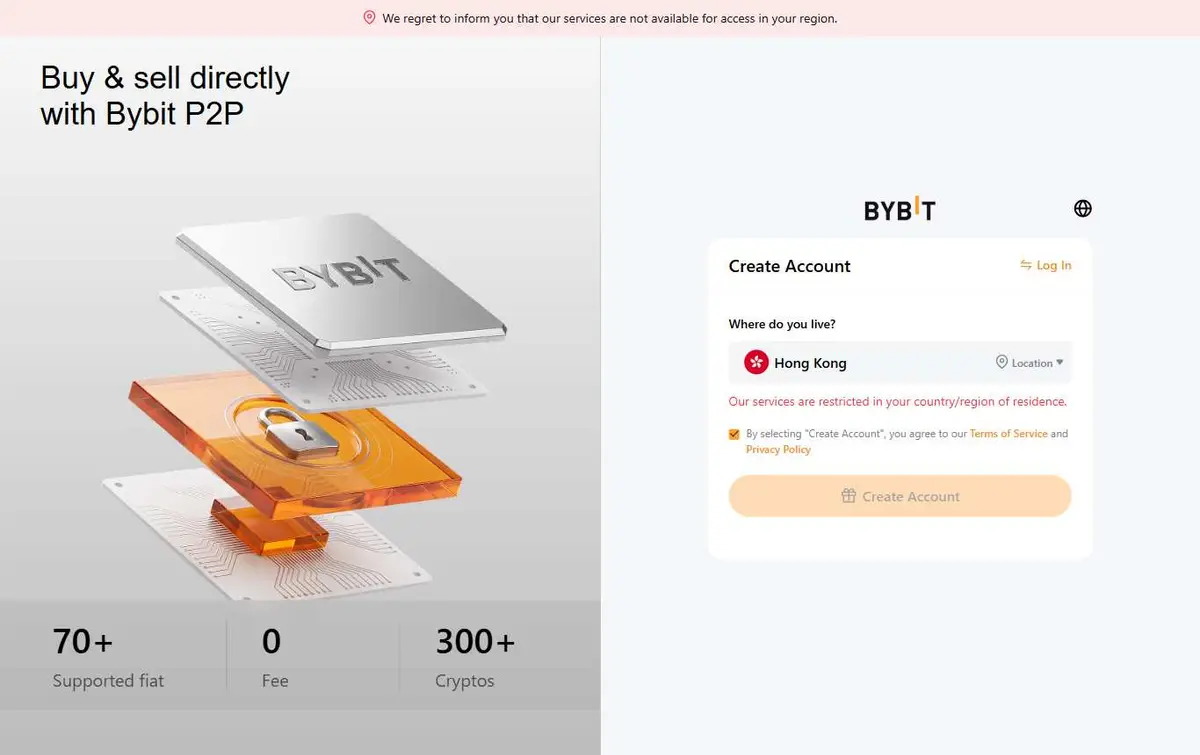
Blocked Bybit · Sign-up page
Blocked in Hong Kong, which Bybit excludes
“We regret to inform you that our services are not available for access in your region.”
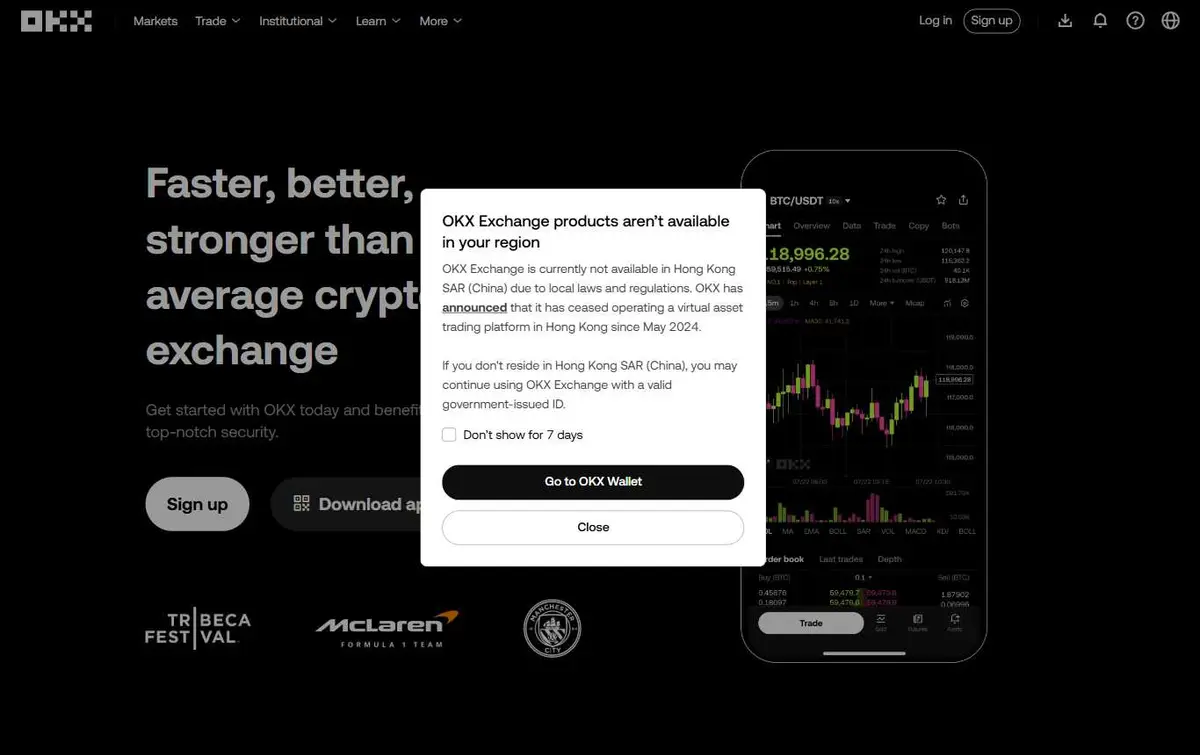
Blocked OKX · Home page
Blocked in Hong Kong, two years after OKX withdrew its licence bid
“OKX Exchange is currently not available in Hong Kong SAR (China) due to local laws and regulations.”
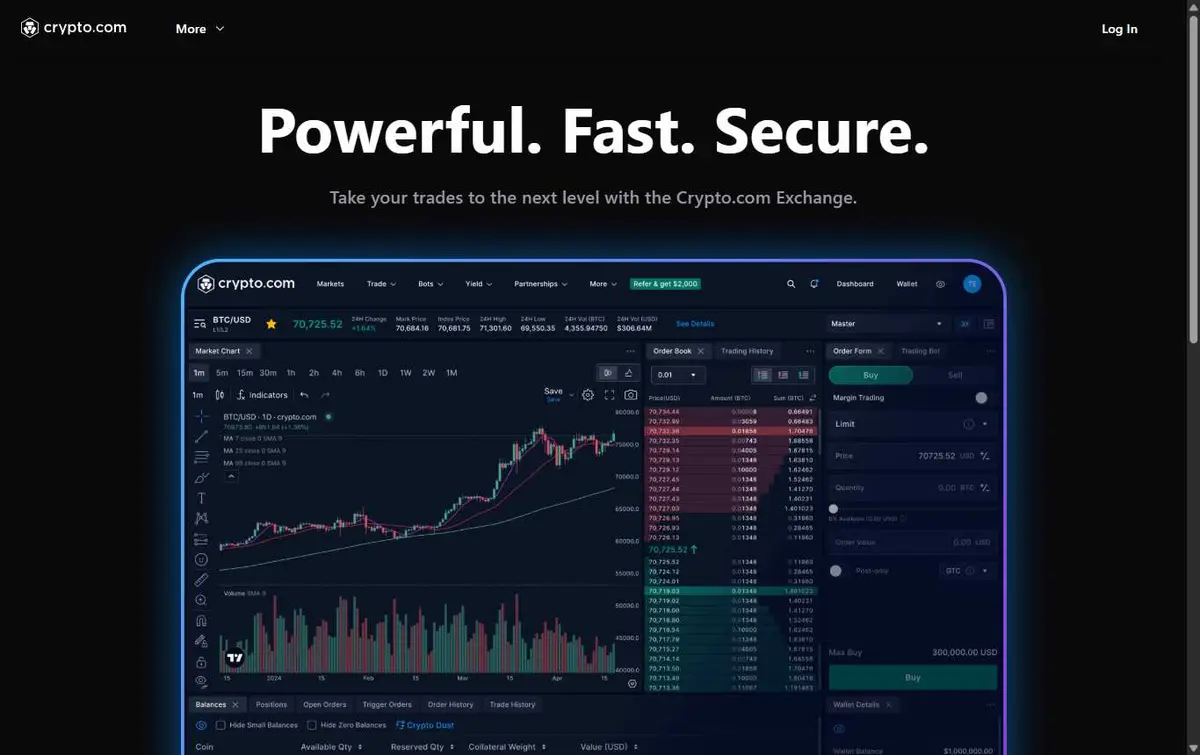
Notice shown Crypto.com · exchange
The one notice: the Exchange page in Hong Kong points to the lists that exclude it
“Please refer to the following links and ensure that you are not in any geo-restricted jurisdictions for: spot trading, derivatives trading, margin trading, on-chain staking, and lending.”
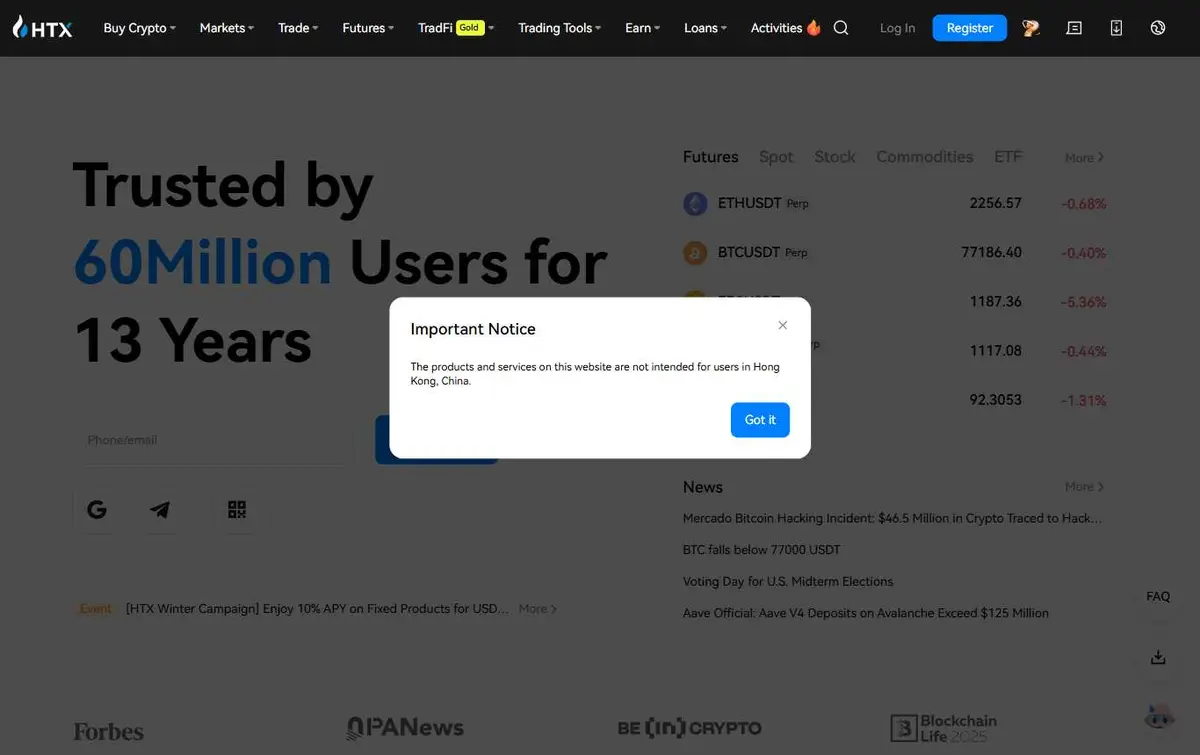
Notice shown HTX · Home page
Hong Kong gets the notice too
“The products and services on this website are not intended for users in Hong Kong, China.”
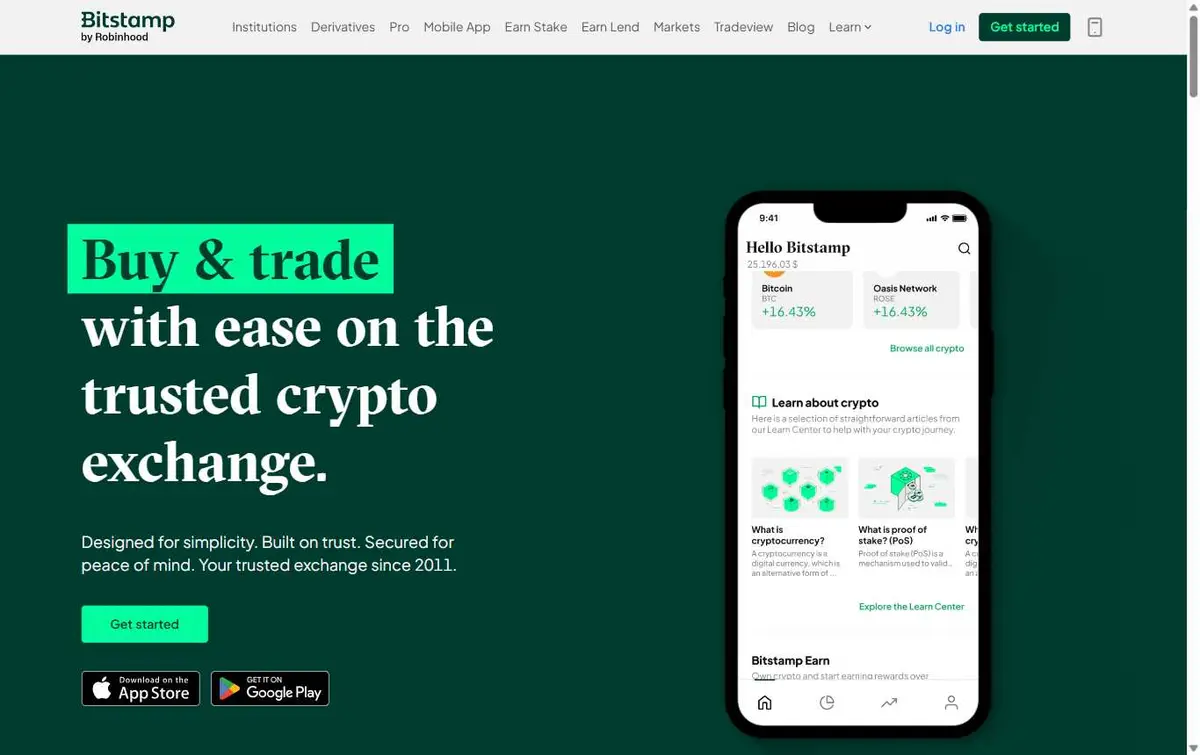
No barrier Bitstamp · Home page
Hong Kong, which leads Semrush's traffic estimate for bitstamp.net
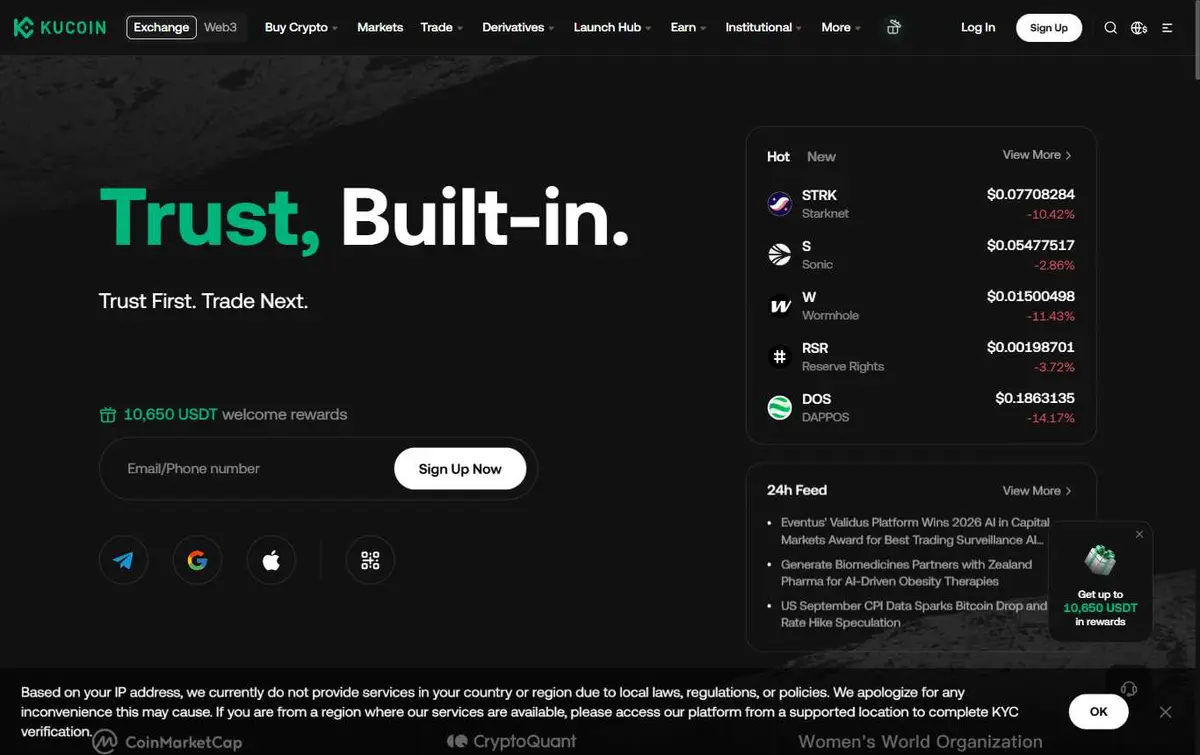
No barrier KuCoin · Home page
Hong Kong is on the list, yet the home page loads
 CRYPTORESTRICTIONS
Who regulates crypto in Hong Kong?
The SFC licenses trading platforms and sets what they may offer, the HKMA licenses stablecoin issuers, the police enforce the Gambling Ordinance, and the Inland Revenue Department (IRD) sets how tokens are taxed.
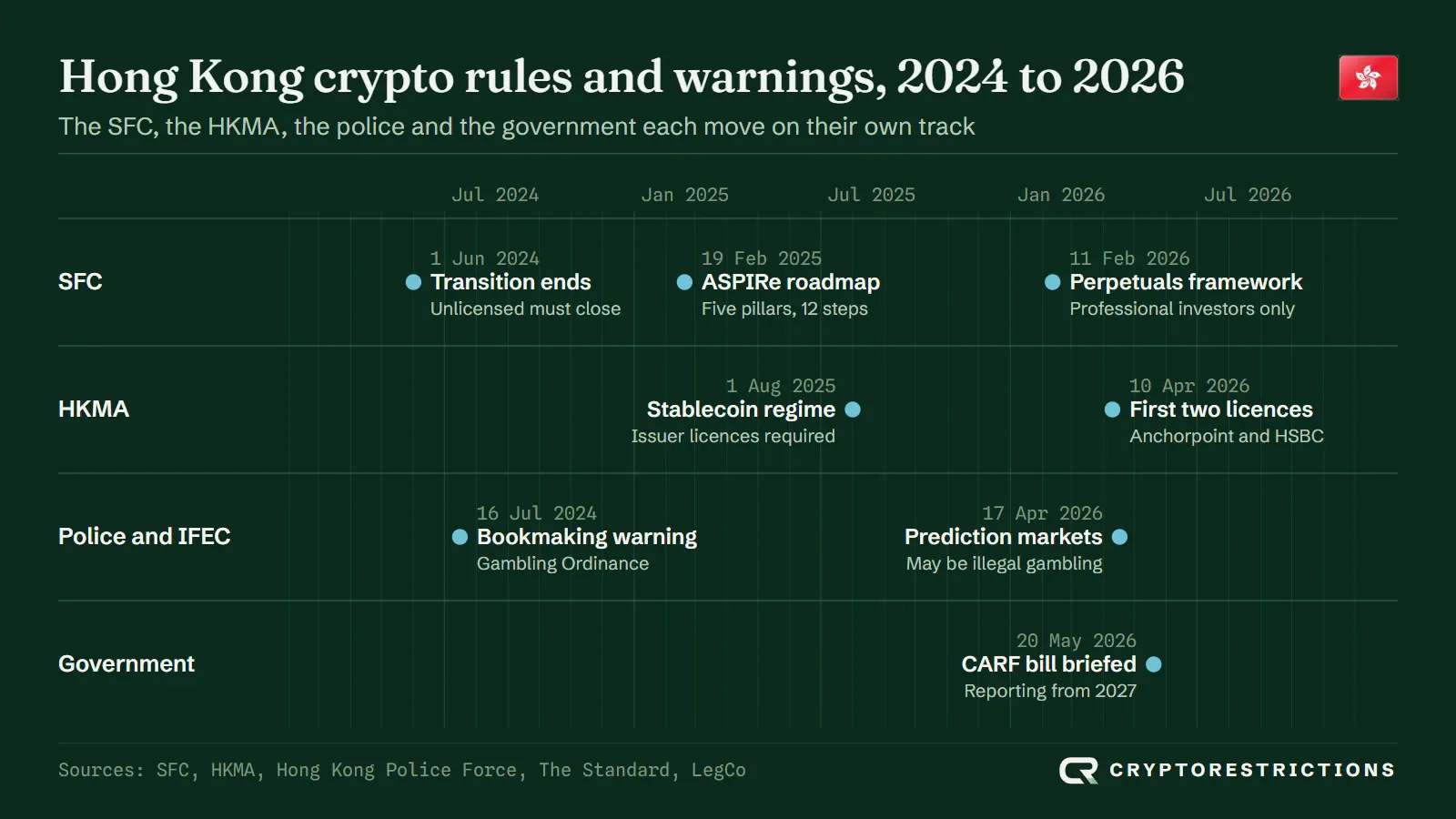
- SFC. It licenses platforms under the AMLO and keeps the register and alert list above. On 19 February 2025 it published its ASPIRe roadmap, five pillars named access, safeguards, products, infrastructure and relationships, and later SFC circulars on products and perpetual contracts cite it.
- Products circular. A circular of 3 November 2025 lets licensed platforms offer stablecoins from licensed issuers to retail investors and distribute tokenised securities, while the 12-month track record rule still applies to retail offerings of other virtual assets.
- HKMA. The regime for stablecoin issuers took effect on 1 August 2025. On 10 April 2026 it granted the first two licences, to Anchorpoint Financial Limited and The Hongkong and Shanghai Banking Corporation Limited, and said they would begin operating within months.
- Pending law. The SFC’s roadmap aimed for custody legislation by the end of 2025. A joint release concluded the government and SFC consultations on virtual asset dealer and custodian regimes and opened another on advisory and management services, with comments due on 23 January 2026. We found no sign that a bill had passed by 17 October 2026.
- Police and the IFEC. The police enforce the Gambling Ordinance; the Investor and Financial Education Council (IFEC), an SFC subsidiary, warns the public. Both are covered in the prediction markets section.
- IRD. The tax authority, covered in the tax section.
Which crypto products are limited in Hong Kong?
Derivatives are the most closed product: Binance has closed futures, options and margin to Hong Kong since August 2021, Crypto.com’s Exchange excludes Hong Kong, and the SFC says perpetual contracts on licensed platforms are for professional investors only.
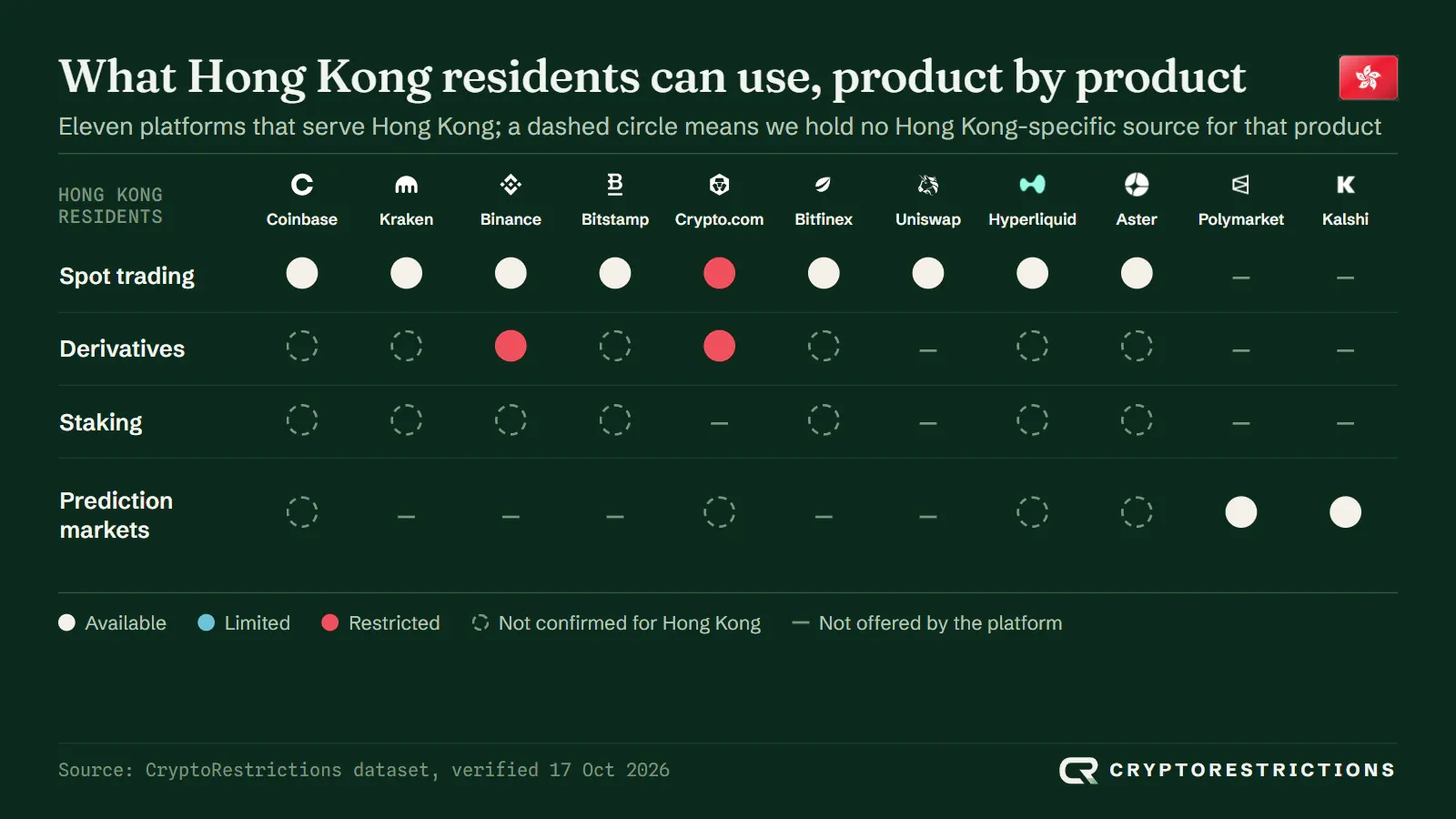
- Derivatives. Binance closed new derivatives accounts to Hong Kong users in August 2021, followed by a 90-day wind-down. The SFC’s perpetuals framework of 11 February 2026 says licensed platforms should offer perpetual contracts only to professional investors, with margin received in full before an order is accepted and no credit for margin.
- Spot trading on Crypto.com. Crypto.com lists Hong Kong on its Exchange spot and derivatives geo-restrictions (updated 7 May 2025), yet the app serves Hong Kong.
- Stablecoins and tokenised products. Licensed platforms may offer licensed-issuer stablecoins to retail investors and distribute tokenised securities under the 3 November 2025 circular. None of the platforms we track is licensed, so none uses that route.
- Staking and lending. We hold no Hong Kong source for staking or lending at any tracked platform, which is why the matrix shows them as not confirmed.
- Prediction markets. Coinbase’s page told our test that prediction markets are not available. Polymarket and Kalshi do not exclude Hong Kong in their terms.
Are prediction markets legal in Hong Kong?
Possibly not. On 17 April 2026 the SFC’s investor education arm said trading on prediction markets such as Polymarket or Kalshi in Hong Kong may constitute illegal gambling, although both platforms still serve Hong Kong.
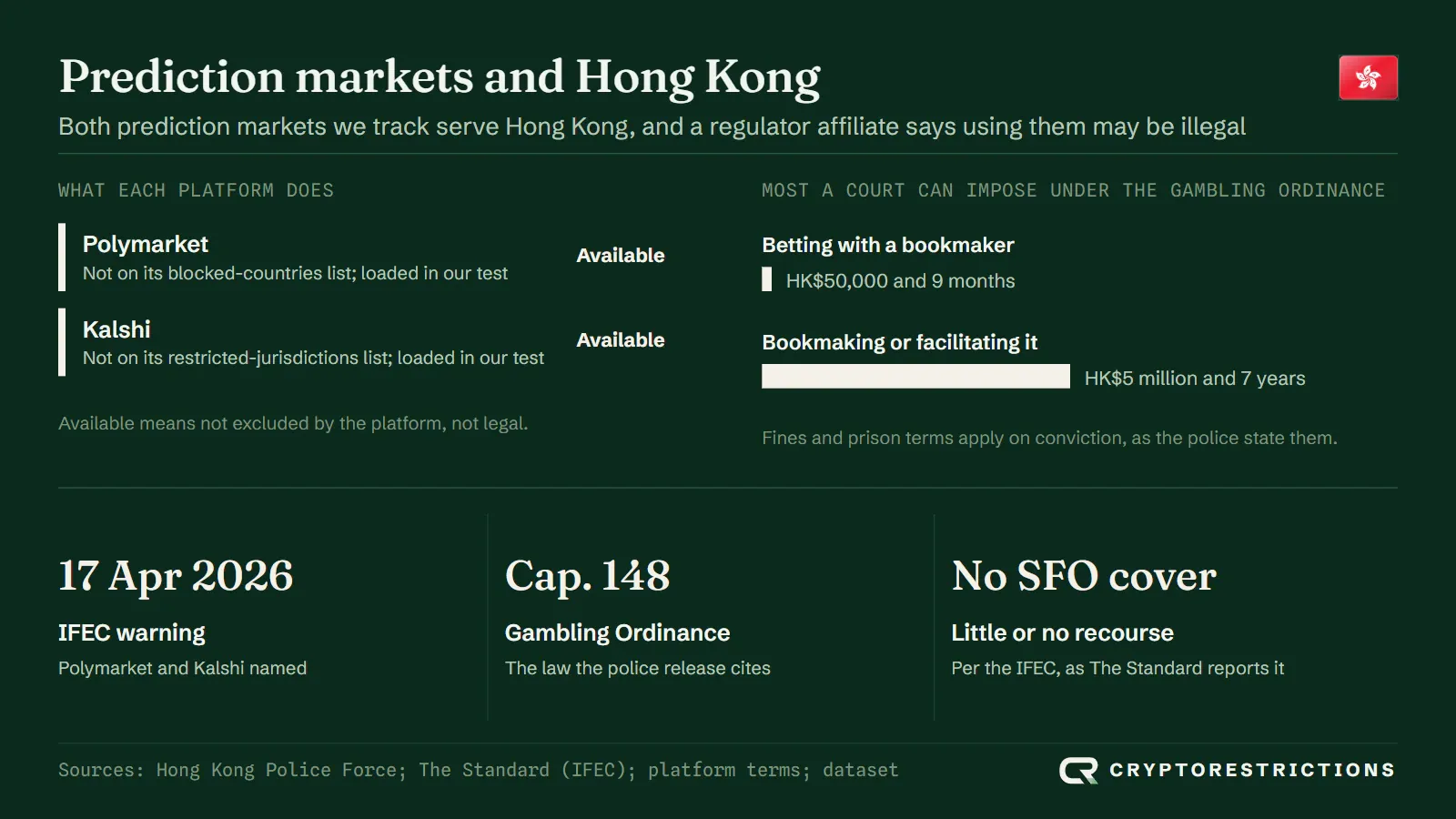
The statement came from the IFEC, as The Standard reported on 17 April 2026. It also said participants do not have the protections of the Securities and Futures Ordinance and have little or no way to seek recourse. The report names no penalty and no enforcement action, and we found neither a block of the platforms nor a case against a user.
The penalties come from a separate source. A police release of 16 July 2024 about illegal bookmaking, citing the Gambling Ordinance (Cap. 148), says betting with a bookmaker carries a maximum fine of HK$50,000 and nine months in prison on conviction, and bookmaking or facilitating it carries HK$5 million and seven years. The release does not mention prediction markets, so whether a prediction-market position counts as betting with a bookmaker is the IFEC’s open question, not a court’s ruling.
On the platform side, Polymarket and Kalshi are both recorded as available because neither lists Hong Kong as restricted and both loaded in our test. That is the platform’s position, not the law’s.
How is crypto taxed in Hong Kong?
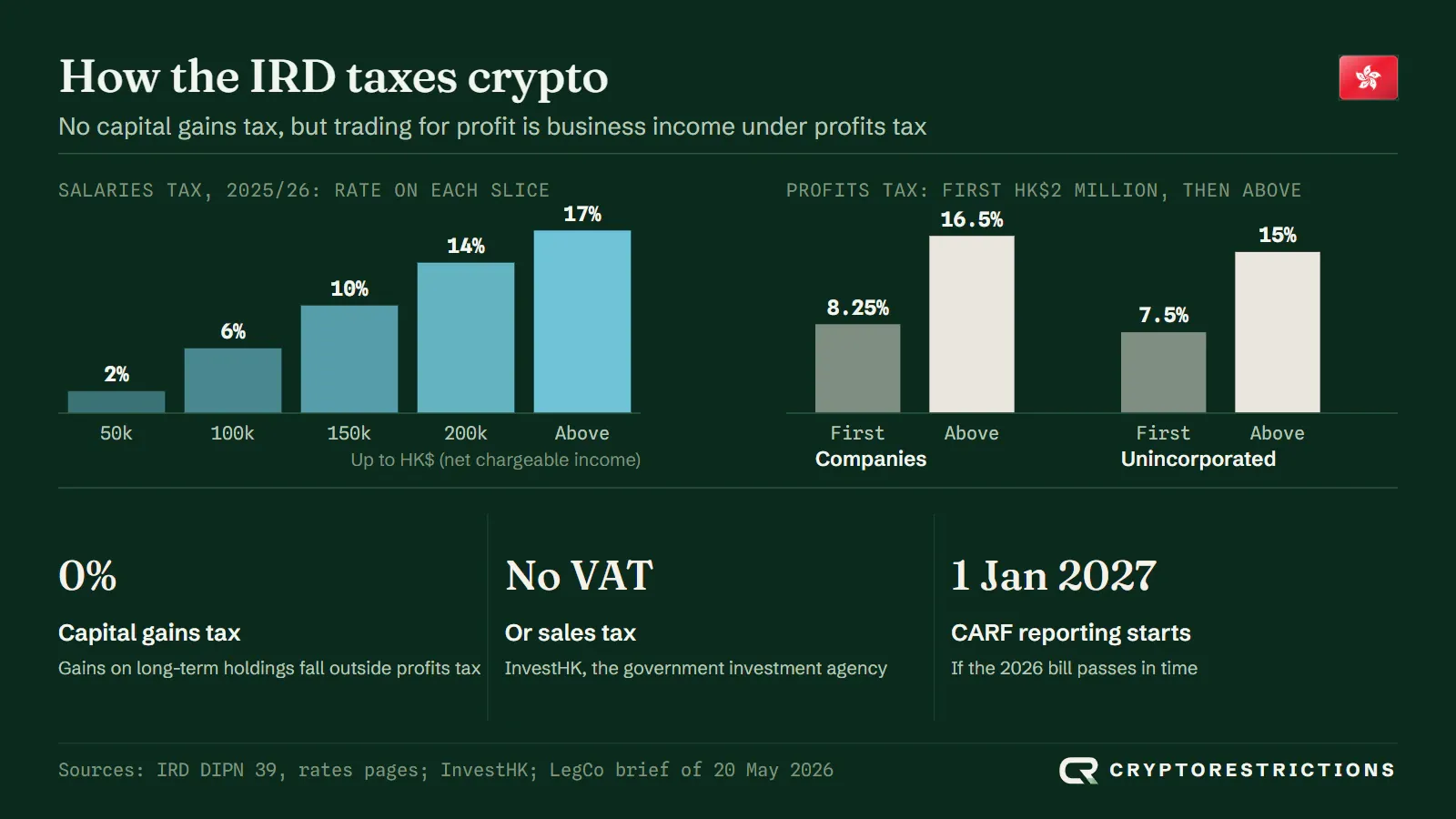
Trading crypto as a business is taxed as business profit, while the IRD says profits from crypto held as a long-term investment are not chargeable to profits tax. The government says Hong Kong has no capital gains tax.
The IRD’s guidance is DIPN 39 (Revised), dated March 2020. It says payment tokens are not legal tender in Hong Kong and that the tax treatment of a token depends on its nature and use. Trading, exchange and mining are business activities, and Hong Kong-sourced profits from them are chargeable to profits tax. Whether someone is in business is a matter of fact and degree: the IRD looks at how often they trade, how organised the activity is and whether profit is the purpose, and the intention at acquisition is always relevant. Business records must be kept. Crypto accepted as payment is recorded at its market value on the date of the transaction, and crypto paid as salary is employment income at its market value when it accrues. Airdrops and forks received in the course of a crypto business are business receipts. DIPN 39 does not cover staking, DeFi yield, lending or NFTs, so we state no IRD position on them.
The rates are on IRD pages. Profits tax is two-tiered: companies pay 8.25% on the first HK$2 million of profits and 16.5% above, and unincorporated businesses pay 7.5% and 15%. Salaries tax for 2025/26 takes 2%, 6%, 10% and 14% on successive HK$50,000 slices of net chargeable income and 17% on the rest, capped by a standard rate of 15% on the first HK$5 million of net income and 16% above. InvestHK says Hong Kong has no capital gains tax and no sales tax or VAT.
Reporting is changing. A LegCo brief of 20 May 2026 says a bill would bring the OECD Crypto-Asset Reporting Framework into force on 1 January 2027, when reporting providers with a Hong Kong link start collecting data, with the first exchange with partner jurisdictions from 2028 once the multilateral agreement is signed. The government aims to pass it by the end of 2026, and we found no sign that it had passed by 17 October 2026. Working out your own position takes four steps:


 Bahrain
 Georgia
 Qatar
 Israel
 Saudi Arabia
 Vietnam
 Pakistan
 Bangladesh
 Indonesia
 United Arab Emirates
 South Korea