


Is crypto legal in Qatar?
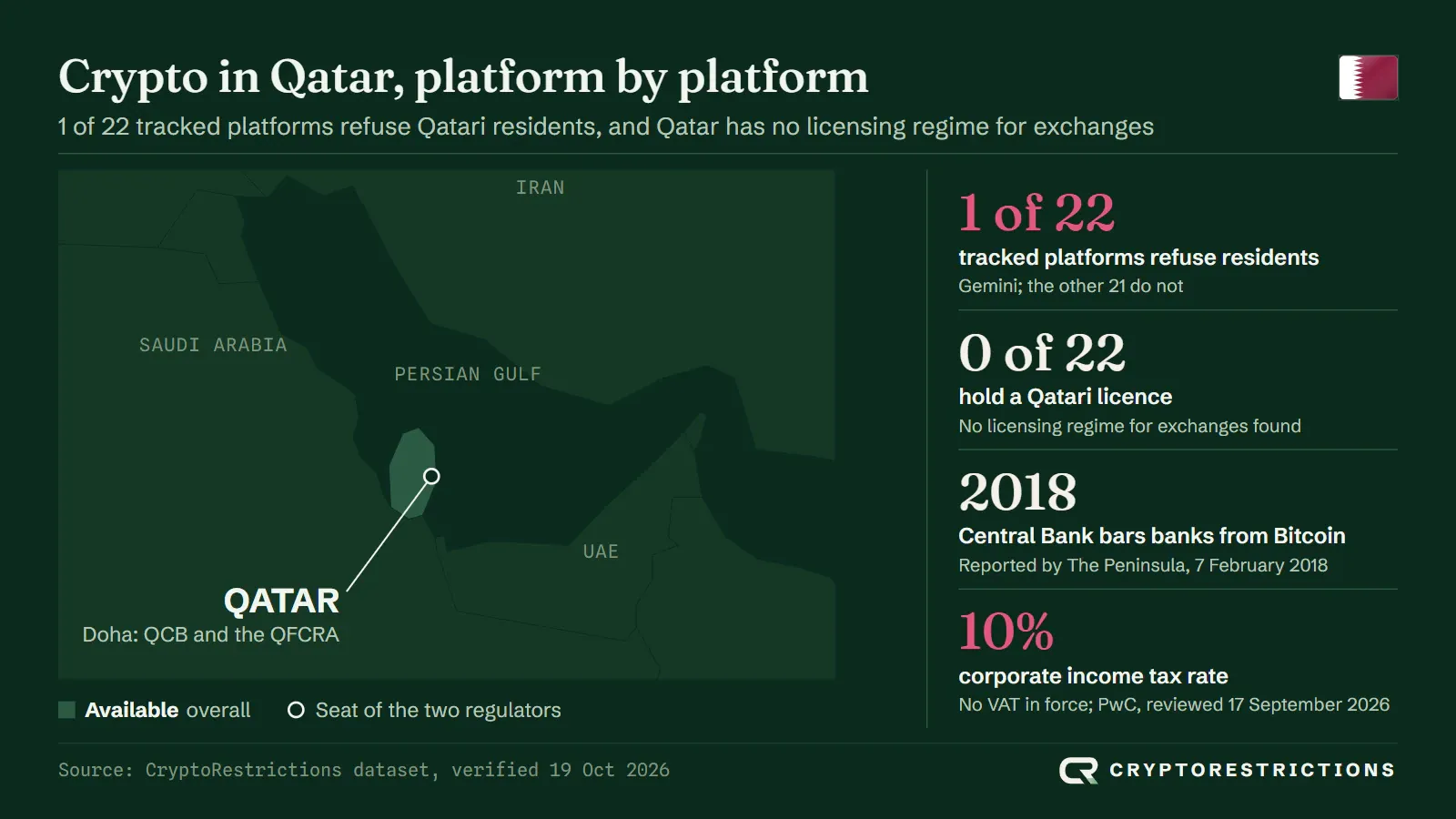
Not in practice. Qatar’s central bank has barred banks from Bitcoin since 2018 and the financial centre regulator bars crypto services, but we found no law that makes holding crypto a crime for an individual.
The Peninsula reported on 7 February 2018 that the Qatar Central Bank (QCB) told banks not to deal in Bitcoin, exchange it, open accounts for trading it or handle transfers made to buy or sell it, with penalties under the central bank’s law. That is our source for the circular because we could not find it on the QCB’s own site, and it binds banks, not their customers.
The Qatar Financial Centre (QFC) is a separate regulatory zone in Doha. Its regulator, the QFCRA, says it issued an alert on 26 December 2019, and its 2024 release confirms that the restrictions in that alert remain in place for cryptocurrencies and stablecoins. We found no QCB or QFCRA crypto statement dated 2025 or 2026 and no draft crypto law.
Which crypto exchanges work in Qatar?
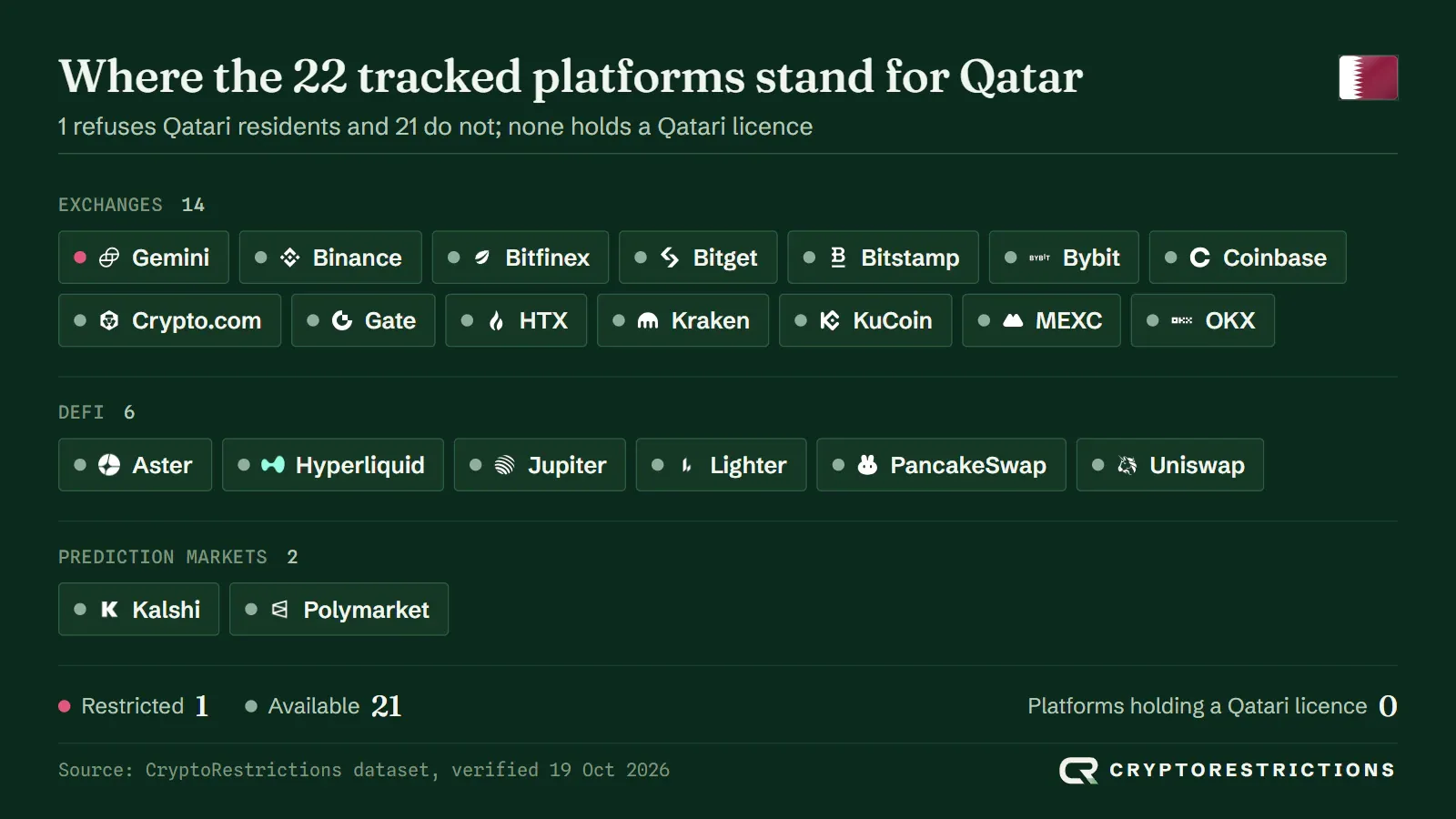
No platform we track holds a Qatari licence, because Qatar has no licensing regime for crypto exchanges that we could find. Most do not refuse Qatari residents, which is their own policy and not Qatari approval.
The QFC’s digital assets framework does not change that for exchanges. The QFCRA announced the framework on 2 September 2024 for tokenised assets and classed cryptocurrencies as excluded tokens, so a crypto exchange cannot be licensed under it. We found no register of licensed crypto firms at the QCB or the QFCRA, and no platform that has announced a Qatari entity.
Bitstamp is the one platform we could not test or check against a country list. Its Bitstamp global terms, updated 6 April 2026, carry no country list at all, so its row rests on the absence of a restriction in that document.

Best crypto platforms for Qatari residents
The score ranks every platform that is open to Qatari residents by how fully they can use it, not by fees or safety. It is computed from our data and moves when a row changes.
The score is made of access status (4 points), the share of the platform’s products open here (3), the Qatari licences we hold on file (2) and what our geo-access test saw from a Qatari address (1). Every platform here scores zero on licences, so the ranking turns on the other three parts. Platforms that refuse Qatari residents are not scored. The full method is on our methodology page.
Exchanges

Binance
Best for Widest product range
8.0/10- Access
- 4/4
- Products
- 3/3
- Licences
- 0/2
- Our test
- 1/1
Read our Binance reportPros
- Not on its prohibited-countries list
- Its home and sign-up pages loaded in our test
Cons
- No Qatari licence on file
- No Qatari rule covers its derivatives or lending

Bybit
Best for Spot and derivatives
8.0/10- Access
- 4/4
- Products
- 3/3
- Licences
- 0/2
- Our test
- 1/1
Read our Bybit reportPros
- Not on its excluded-jurisdictions list
- Its pages loaded in our test
Cons
- No Qatari licence on file

OKX
Best for Spot and derivatives with a clear list
8.0/10- Access
- 4/4
- Products
- 3/3
- Licences
- 0/2
- Our test
- 1/1
Read our OKX reportPros
- Not on its restricted-locations list, updated 8 July 2026
- Its pages loaded in our test
Cons
- No Qatari licence on file
- Its list is open-ended

Coinbase
Best for Spot and staking with a listed sign-up
7.5/10- Access
- 4/4
- Products
- 3/3
- Licences
- 0/2
- Our test
- 0.5/1
Read our Coinbase reportPros
- Qatar is a listed sign-up country in its identity guide
- Offers spot, staking and custody
Cons
- No Qatari licence on file
- Not tested from Qatar

Kraken
Best for Spot trading and staking
7.5/10- Access
- 4/4
- Products
- 3/3
- Licences
- 0/2
- Our test
- 0.5/1
Read our Kraken reportPros
- Not on its do-not-serve list
Cons
- No Qatari licence on file
- Not tested from Qatar
DeFi

Hyperliquid
Best for Perpetuals from your own wallet
8.0/10- Access
- 4/4
- Products
- 3/3
- Licences
- 0/2
- Our test
- 1/1
Read our Hyperliquid reportPros
- Its app and sign-up loaded in our test
- Not under broad sanctions
Cons
- No Qatari licence on file

Jupiter
Best for Solana swaps and staking
7.5/10- Access
- 4/4
- Products
- 3/3
- Licences
- 0/2
- Our test
- 0.5/1
Read our Jupiter reportPros
- Qatar is not in its terms
Cons
- No Qatari licence on file
- Not tested from Qatar

Uniswap
Best for Swapping tokens from your own wallet
7.5/10- Access
- 4/4
- Products
- 3/3
- Licences
- 0/2
- Our test
- 0.5/1
Read our Uniswap reportPros
- Its terms bar only places under comprehensive US sanctions
Cons
- No Qatari licence on file
- Not tested from Qatar
Prediction markets

Polymarket
Best for Event markets with no listed block
7.5/10- Access
- 4/4
- Products
- 3/3
- Licences
- 0/2
- Our test
- 0.5/1
Read our Polymarket reportPros
- Not on its blocked-countries list
Cons
- Qatari law bans gambling and we found no ruling on event contracts
- Not tested from Qatar
Which platforms block Qatar users?
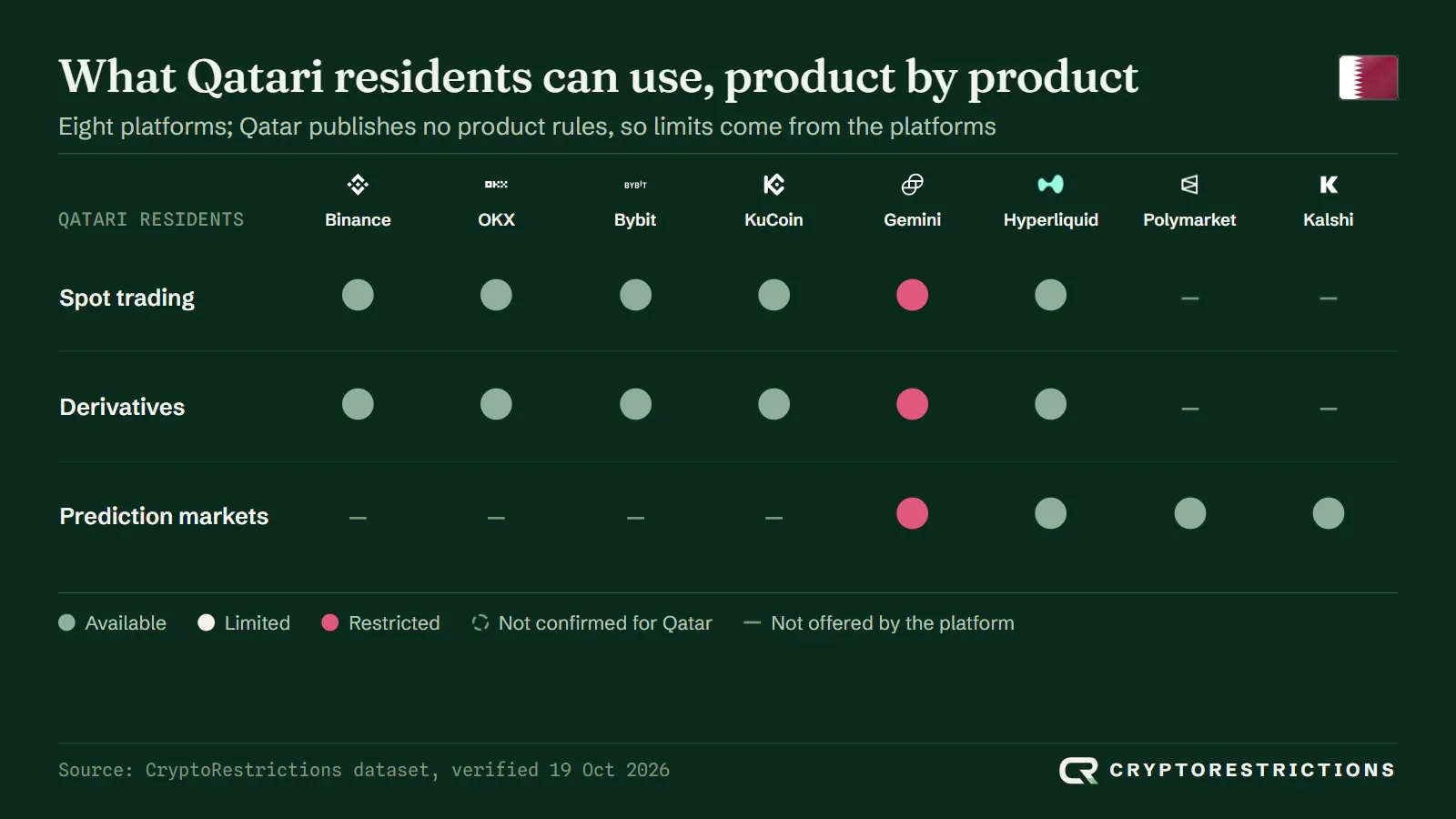
Only Gemini refuses Qatari residents. The other 21 platforms do not name Qatar on any restricted list we could read, and all 12 we tested from a Qatari address loaded.
Gemini serves a fixed list of countries, and Qatar is on neither its main list nor its derivatives list, so we record it as restricted. We found no Qatari order against any platform, so every other row follows the platform’s own documents.

What our geo-access test saw from Qatar
From a virtual Qatari address on 14 and 16 October 2026 we tested 12 of the 22 platforms we track, and all 12 loaded with no barrier and no notice.
An open page is not permission, and a virtual address tests a platform’s geo-blocking only, not a national internet block or a bank’s refusal to process a payment. We did not test the other ten platforms from Qatar. Swipe through the screenshots below to see the pages as they loaded.
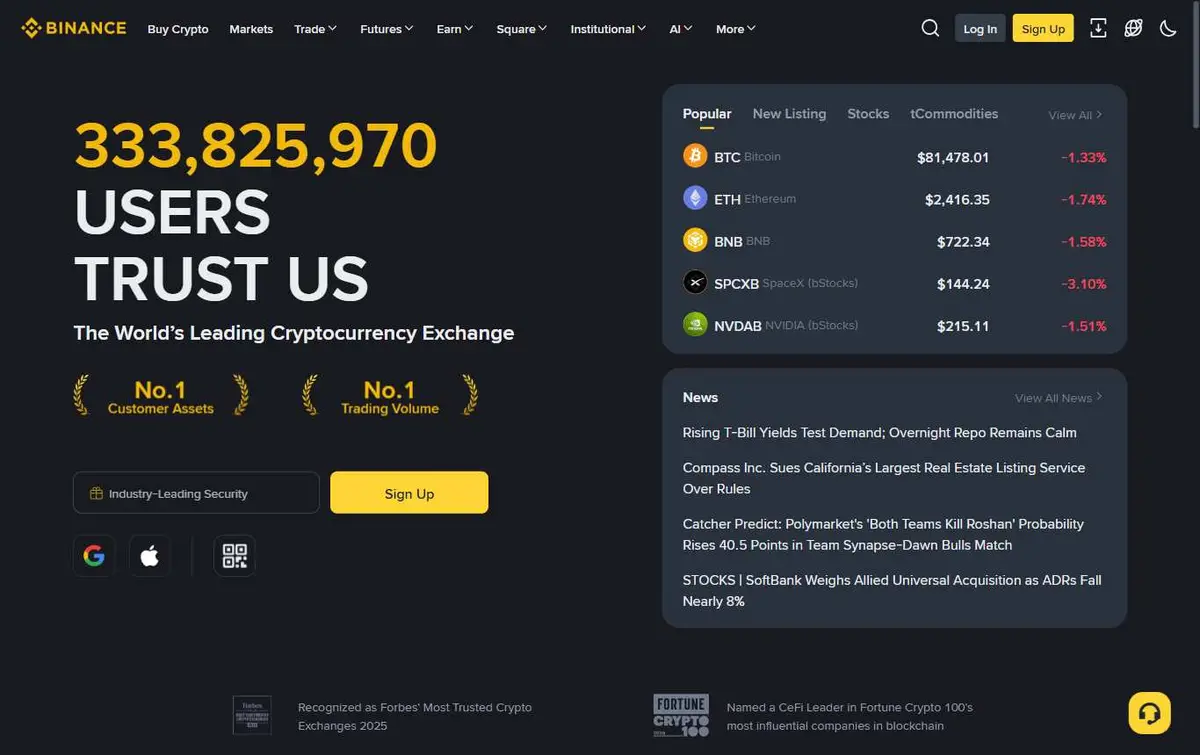
No barrier Binance · Home page
Qatar: the home page loads with no barrier
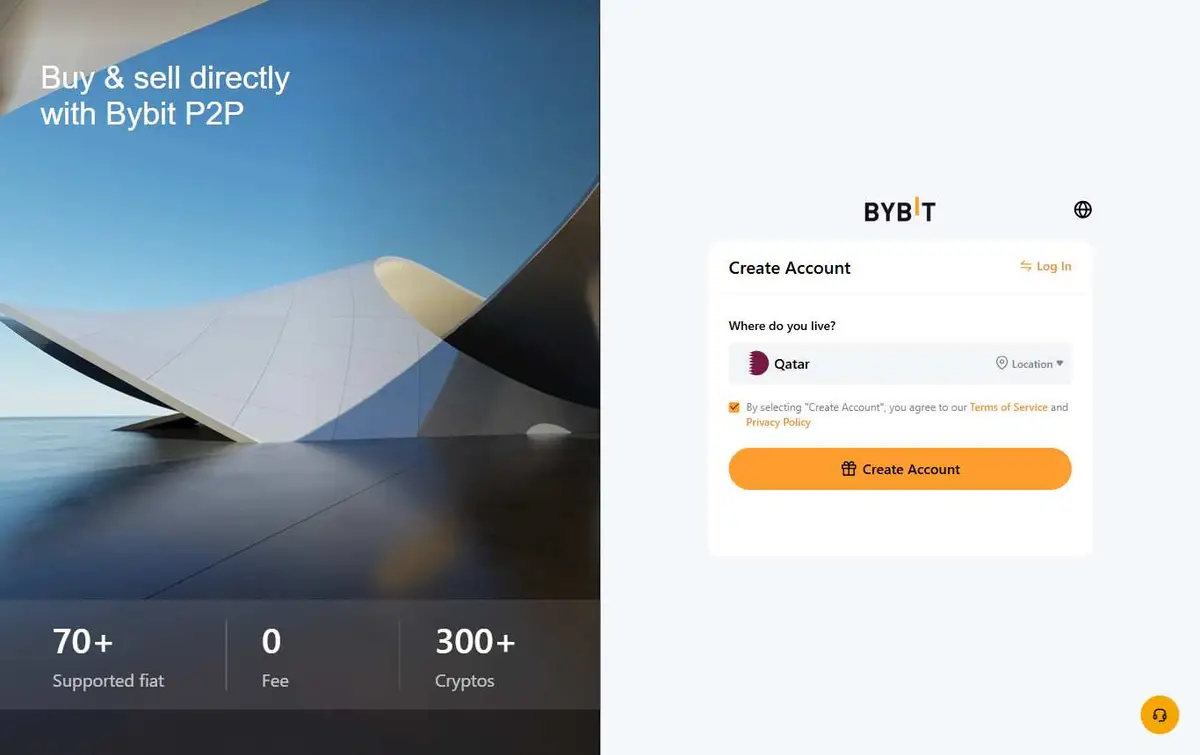
No barrier Bybit · Sign-up page
Qatar: the sign-up page loads with no barrier
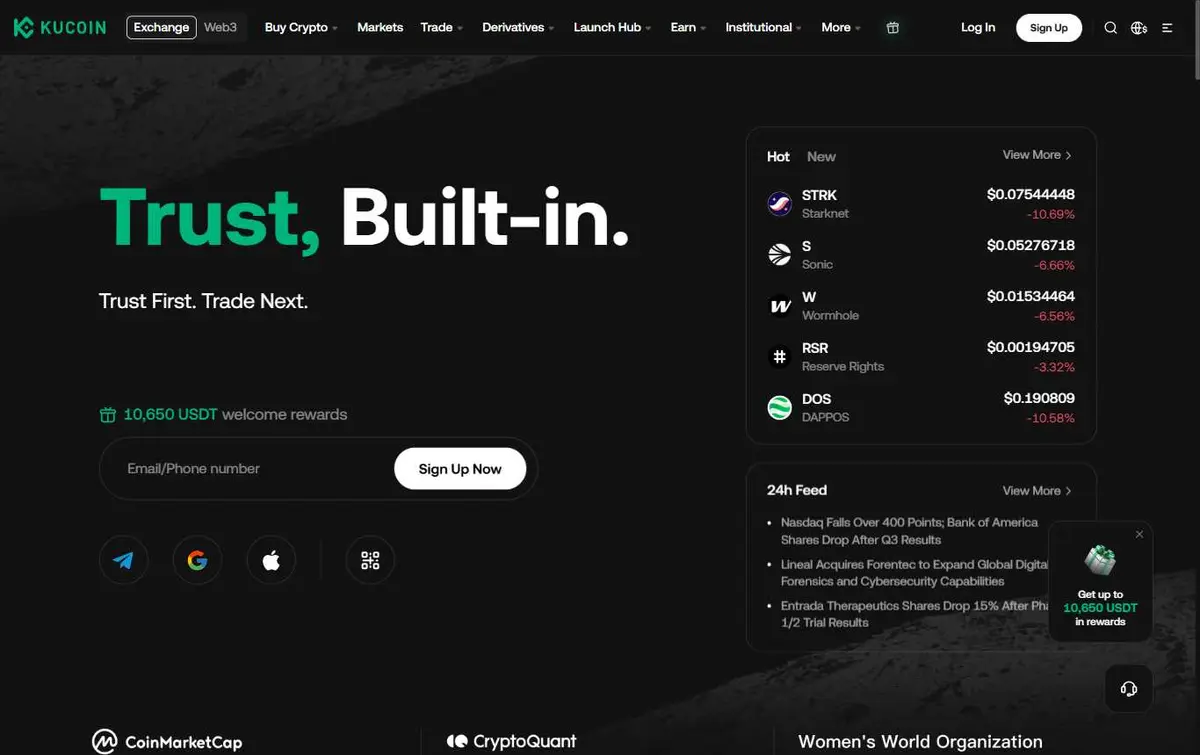
No barrier KuCoin · Home page
Qatar: the home page loads with no barrier
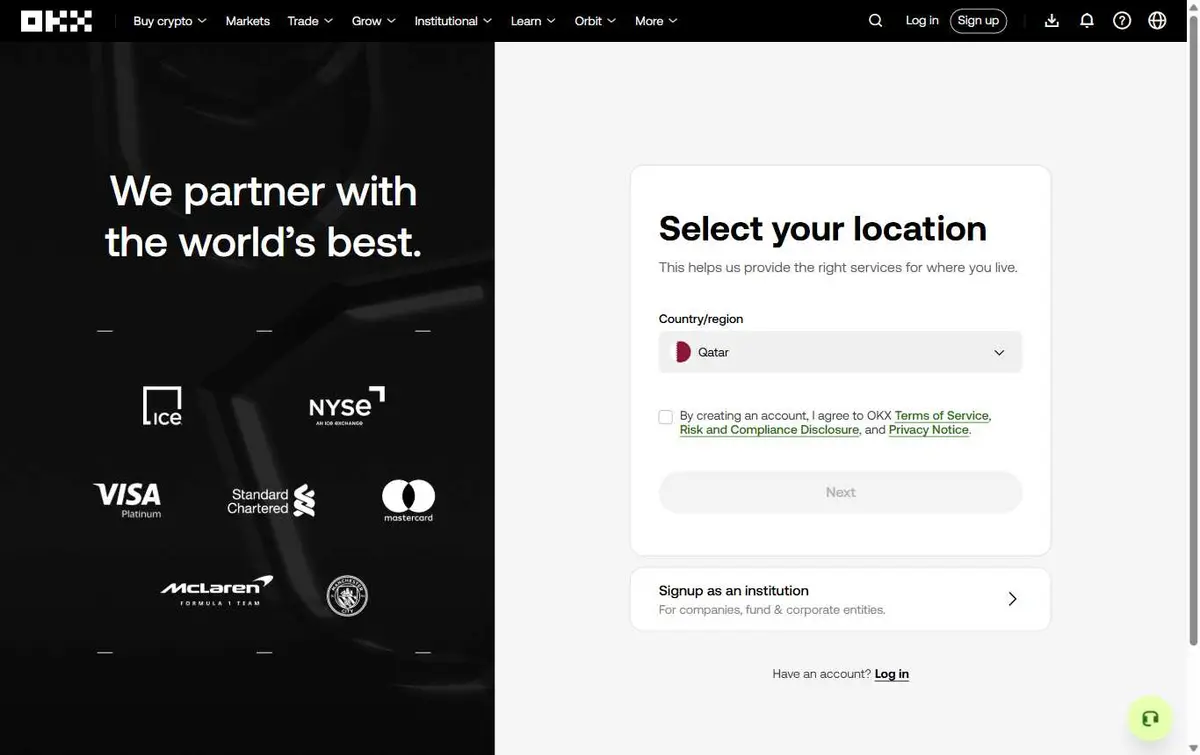
No barrier OKX · Sign-up page
Qatar: the sign-up page loads with no barrier and no local-site redirect
 CRYPTORESTRICTIONS
Who regulates crypto in Qatar?
Two bodies: the Qatar Central Bank for banks and the QFC Regulatory Authority inside the Qatar Financial Centre. Neither has licensed a crypto exchange, and we found nothing new from either on crypto since the QFC’s September 2024 framework.
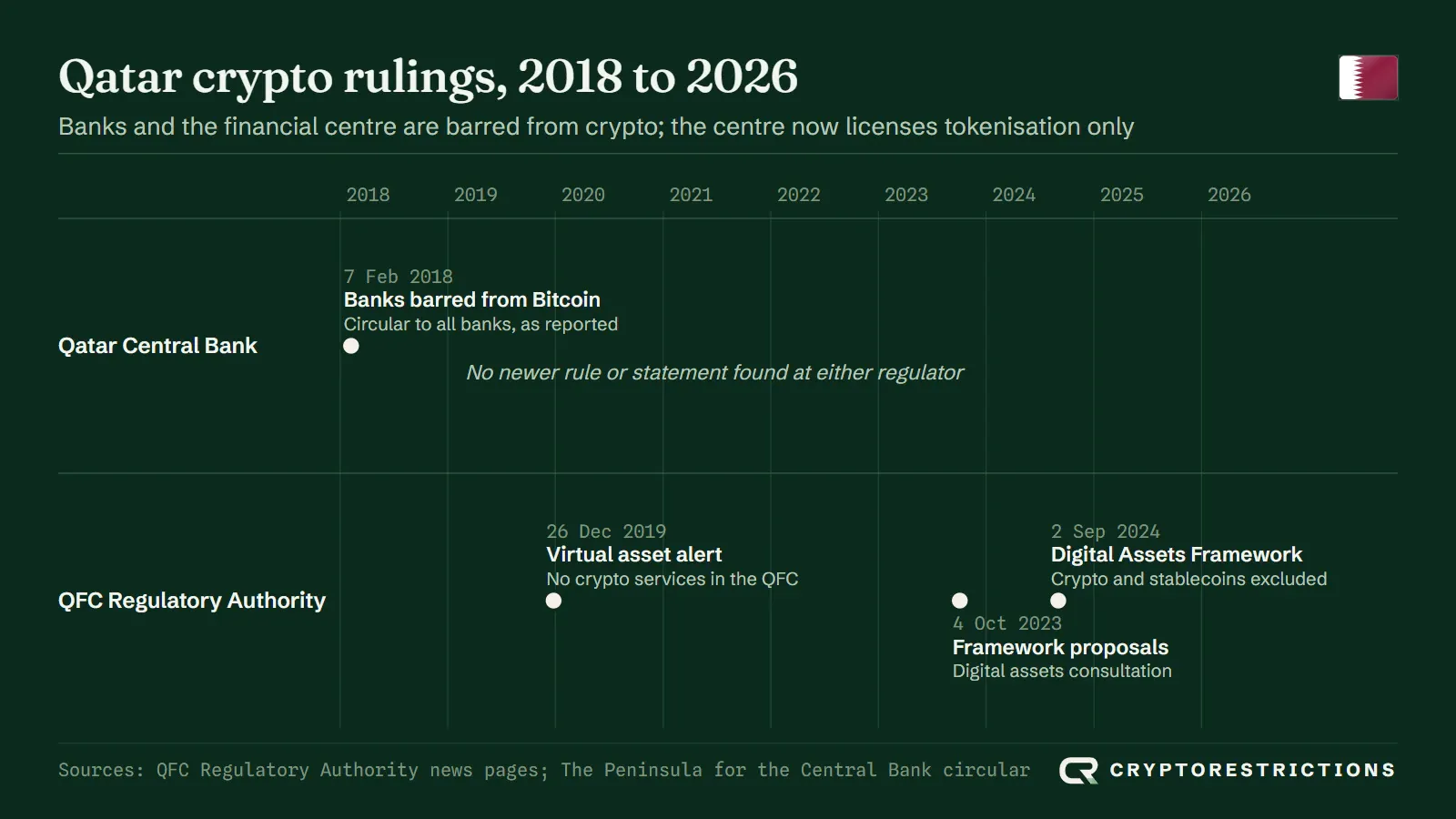
- QCB. The central bank’s 2018 circular is the only crypto instrument we could attach to it, and we have it from press, not from qcb.gov.qa. Its digital currency page covers a central bank digital currency programme run with participating banks and says nothing about crypto.
- QFCRA. The QFC’s regulator, which only covers firms inside the financial centre, told authorised firms in December 2019 that they may not provide virtual asset services or deal in virtual assets until further notice, as reported on 6 January 2020. It published proposals on 4 October 2023 and issued the Digital Assets Framework on 2 September 2024.
- Excluded tokens. In that framework, tokens that stand in for currency, such as cryptocurrencies, stablecoins and central bank digital currencies, are excluded tokens, and the 2019 restrictions still apply to them.
Which crypto products are limited in Qatar?
The limits we can document are institutional: banks may not handle Bitcoin and the QFC excludes cryptocurrencies and stablecoins from its framework. No Qatari rule names a crypto product such as derivatives or staking.
- Bank access. The 2018 circular covers accounts and transfers used to buy or sell Bitcoin, so card and bank-transfer purchases may fail even where a platform loads. We did not test payments.
- Stablecoins. The QFCRA lists stablecoins among excluded tokens, so they sit outside the financial centre’s framework.
- Tokenised assets. The Digital Assets Framework is the one route the QFC has opened, for tokenised assets rather than cryptocurrencies, and we found no list of licensed firms.
- Digital riyal. The QCB describes a wholesale central bank digital currency programme for participating banks, not a retail currency.
Are prediction markets legal in Qatar?
Almost certainly not as gambling, though no Qatari authority has ruled on event contracts. The Penal Code bans gambling, while Polymarket and Kalshi do not exclude Qatar and Gemini refuses it.
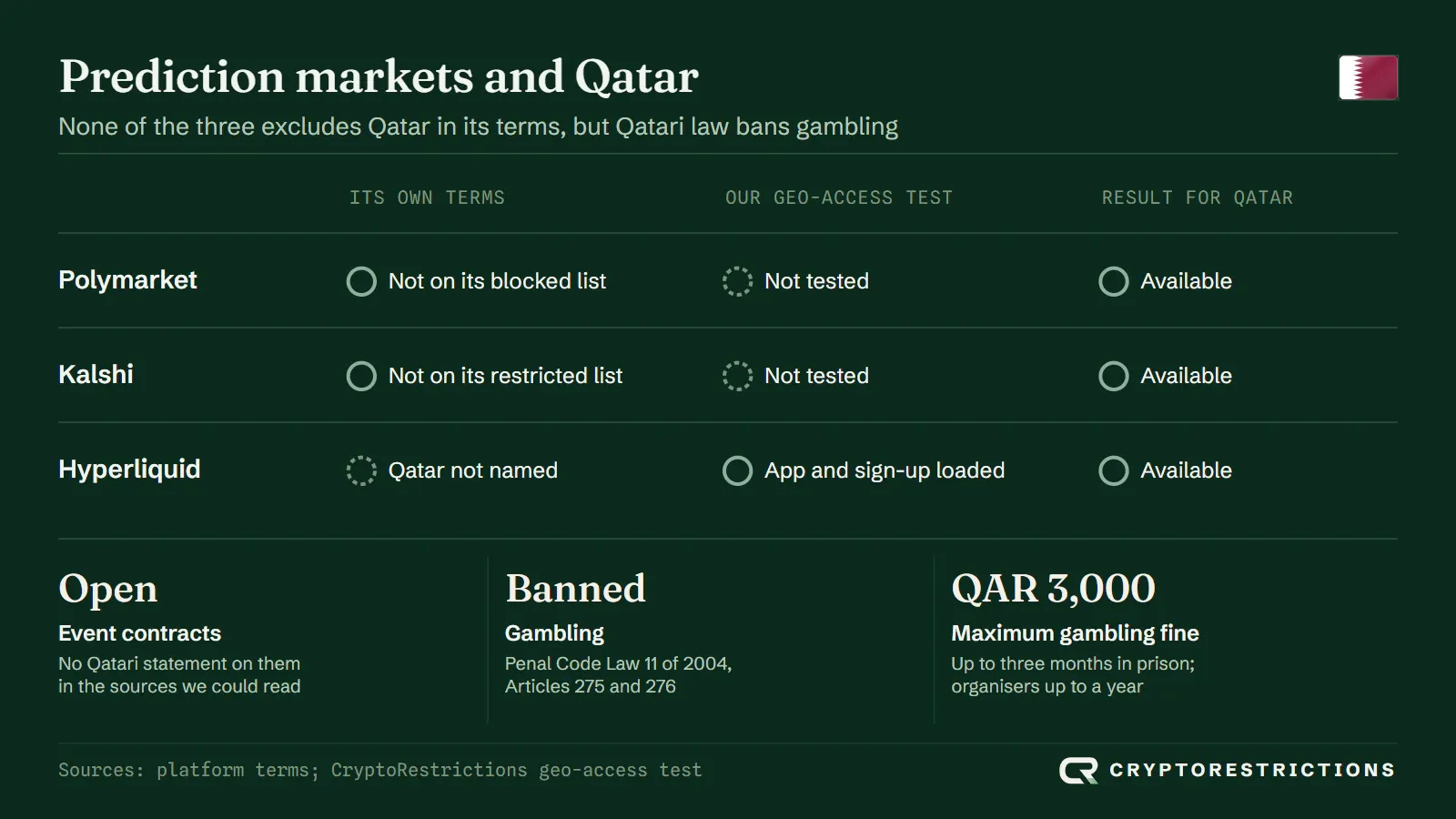
The Library of Congress reports that gambling is prohibited and that Article 275 of the Penal Code sets up to three months in prison and a fine of up to QAR 3,000, while Article 276 punishes running a gambling operation with up to a year and QAR 5,000. We found no Qatari statement on event contracts, so whether one counts as gambling is our inference. Polymarket and Kalshi do not name Qatar on their lists and we did not test either from Qatar.

How is crypto taxed in Qatar?
Qatar levies no income tax on salaries and no VAT, and the tax authority has published nothing on crypto. Companies pay a flat corporate rate, with entities wholly owned by Qataris and resident GCC nationals exempt.
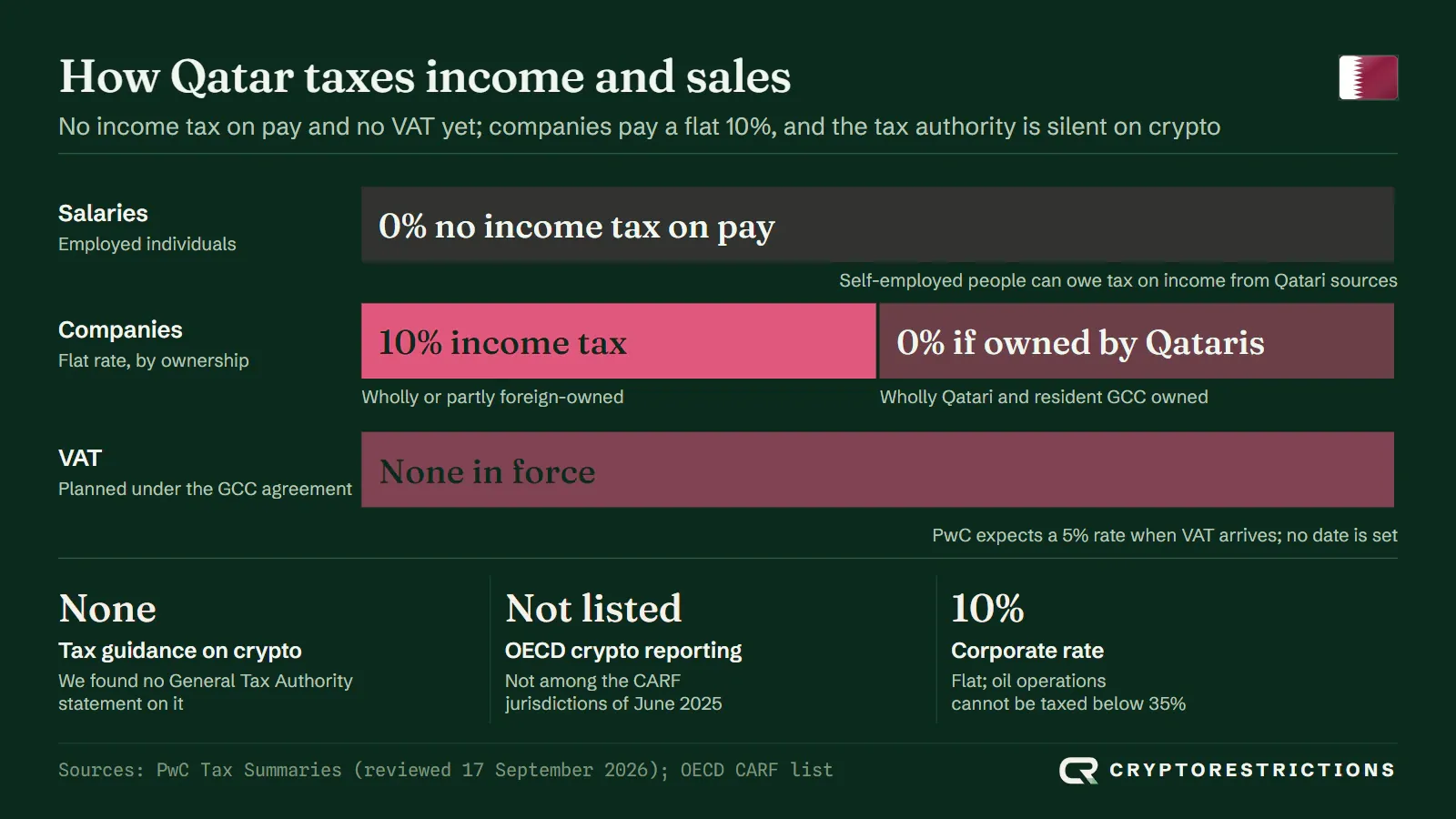
PwC’s summaries, reviewed 17 September 2026, say income tax is not imposed on employed individuals’ salaries, wages and allowances, and that a self-employed person can owe tax on income from Qatari sources. Neither page mentions crypto gains, so how an individual’s trading profit is treated is not settled by what we read, and a person who trades as a business should ask an adviser.
For companies, taxable income is generally subject to a flat 10 percent rate, paid by wholly or partly foreign-owned entities with Qatari-source income, while entities wholly owned by Qataris and resident GCC nationals currently pay none. PwC also says that Qatar currently imposes no VAT or sales tax, with a 5 percent rate expected under the GCC framework and no date given.
Qatar was not among the jurisdictions committed to the OECD’s Crypto-Asset Reporting Framework on the list of 17 June 2025. We did not check later lists, and we found no Qatari crypto reporting duty for exchanges or users.






 Bahrain
 Georgia
 Israel
 Saudi Arabia
 Vietnam
 Pakistan
 Bangladesh
 Indonesia
 United Arab Emirates
 South Korea
 Kazakhstan