
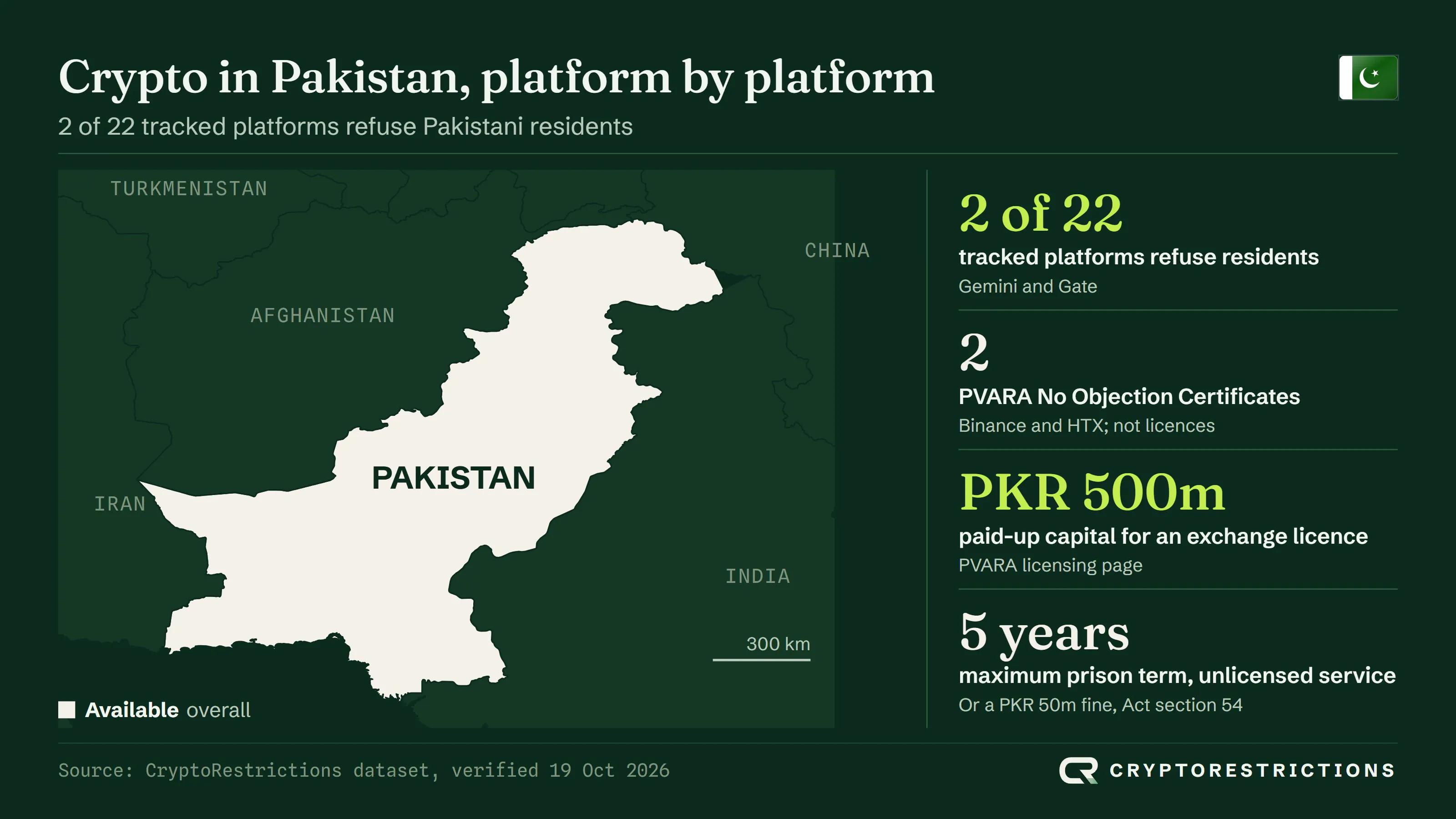
Is crypto legal in Pakistan?
Yes, as a licensed activity. The Virtual Assets Act 2026 makes the Pakistan Virtual Assets Regulatory Authority (PVARA) the licensing body, and its offences target firms that provide services without a licence, not people who hold or trade crypto.
We read the text as passed by the National Assembly. Section 54 punishes anyone who wilfully provides an unlicensed virtual asset service with up to five years in prison, a fine of up to 50 million rupees, or both, and an unlawful initial virtual asset offering with up to three years or 25 million rupees. We found no offence for an individual who buys, holds or sells crypto, but the Act is long and we did not test every clause. The text carries no assent date. Dawn reported on 15 April 2026 that a State Bank circular says “the act has been enacted”.
The Act followed the Virtual Assets Ordinance 2025, which President Zardari promulgated on 8 July 2025. Section 70 gave firms already operating six months from commencement to apply for a licence or stop. PVARA’s licensing page turns that into a date: firms operating on 5 March 2026 or earlier had to file for a No Objection Certificate (NOC) by 5 September 2026 or cease.
Banking moved the other way. A State Bank circular of 2018 barred banks from dealing in crypto. Finance Magnates reports that BPRD Circular Letter No. 10 of 2026 replaced that ban: banks may open accounts for firms that hold or seek a PVARA licence, but may not trade, invest in or hold crypto themselves. We could not open the State Bank’s own site, which returned a 403 error, so we rely on that report and on Dawn’s account of the same circular. The sections below cover who holds approval, who refuses Pakistanis, product limits, betting law and tax.
Which crypto exchanges work in Pakistan?
Most of the exchanges we track serve Pakistan, but none shows a full PVARA licence. Binance and HTX hold No Objection Certificates, which PVARA treats as the first step toward one.
PVARA’s news list carries an item dated 12 December 2025 on Binance and HTX, and The News reported the chairman, Bilal bin Saqib, calling them “not a blanket approval”. On the licensing page an NOC is valid for 3 months, extendable by up to 3, and “does not permit operating”. It lets a firm incorporate a Pakistani company and apply for a licence, which PVARA aims to decide within 90 days. The page says a public register of licensees is kept, but it links none and names no licensed firm. We found no published count of NOCs or licences, and no record of whether either exchange has since applied.
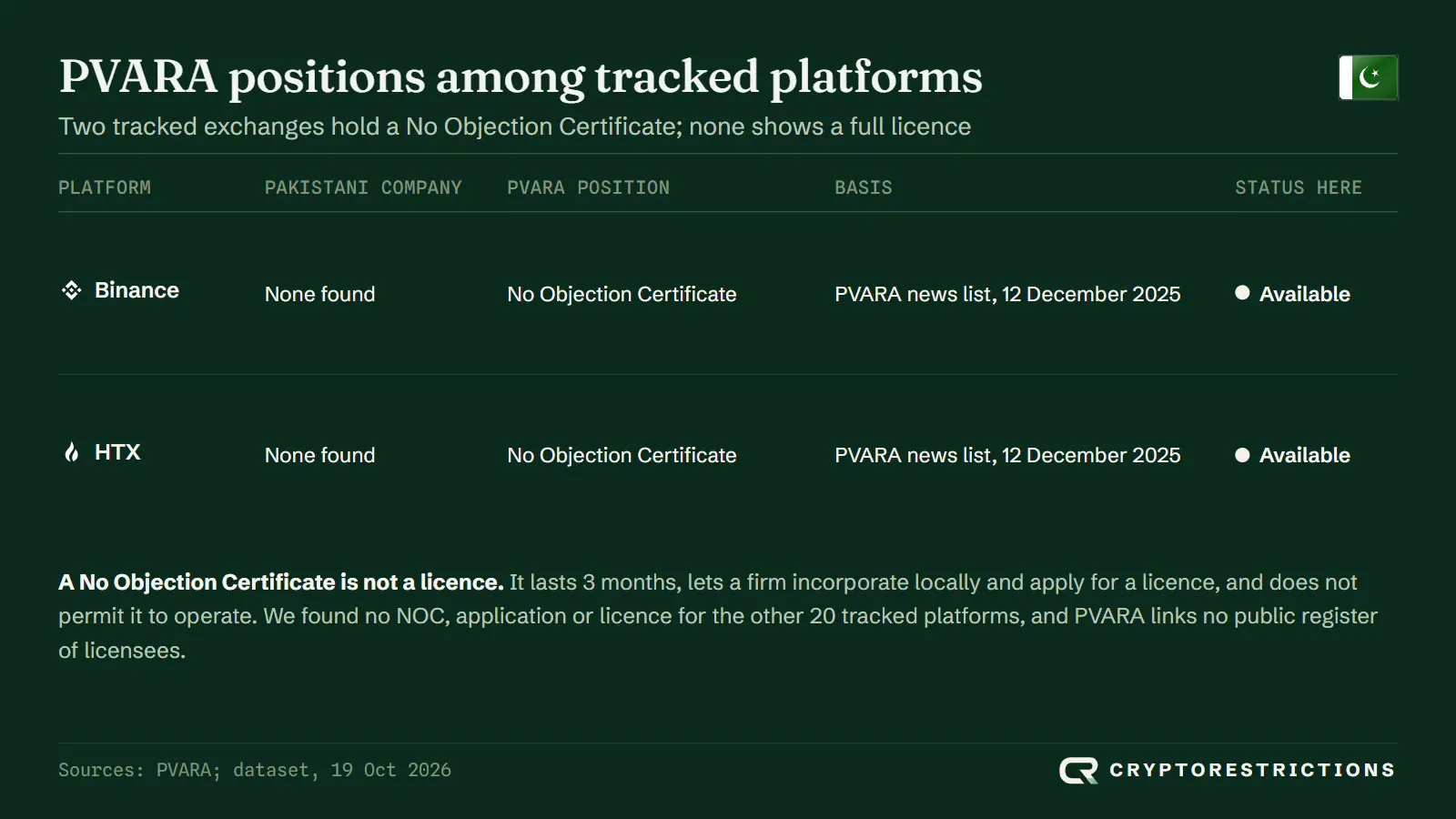
Binance and HTX are the only tracked platforms named in PVARA’s updates. HTX’s user agreement of September 2026 names the laws of Pakistan as its governing law in clause 17.10.2, which we found no explanation for in the agreement. We found no Pakistani company for either exchange, and no NOC, application or licence for any other tracked platform.
Best crypto platforms for Pakistani residents
By our access score, eight exchanges tie at 8.0 out of 10 for Pakistani residents, Binance and HTX among them. Coinbase, Kraken, Bitstamp and Crypto.com score 7.5, only because we have not tested them from Pakistan.
The score rates how fully a Pakistani resident can use each platform, not its fees or safety. It is computed from our data and moves when a row changes: access status (4 points), the share of the platform’s products open here (3), the Pakistani licences we hold on file (2) and what our geo-access test saw from a Pakistani address (1). We hold no licence row for Pakistan, because an NOC is not a licence, so every platform scores 0 on licences. Platforms that refuse Pakistani residents are not scored. The full method is on our methodology page.
Exchanges

Binance
Best for The exchange PVARA has named
8.0/10- Access
- 4/4
- Products
- 3/3
- Licences
- 0/2
- Our test
- 1/1
Read our Binance reportPros
- Holds a PVARA No Objection Certificate
- Pakistan is not on its prohibited list
Cons
- An NOC is not a licence
- No Pakistani company found

Bitfinex
Best for Spot access under global terms
8.0/10- Access
- 4/4
- Products
- 3/3
- Licences
- 0/2
- Our test
- 1/1
Read our Bitfinex reportPros
- Pakistan is not a prohibited jurisdiction in its terms
Cons
- No Pakistani licence on file

Bitget
Best for Spot and derivatives under global terms
8.0/10- Access
- 4/4
- Products
- 3/3
- Licences
- 0/2
- Our test
- 1/1
Read our Bitget reportPros
- Pakistan is not on its prohibited-countries list
Cons
- Its list covers other locations it designates later
- No Pakistani licence on file

Bybit
Best for Spot and derivatives under global terms
8.0/10- Access
- 4/4
- Products
- 3/3
- Licences
- 0/2
- Our test
- 1/1
Read our Bybit reportPros
- Pakistan is not on its excluded-jurisdictions list
Cons
- No Pakistani licence on file

HTX
Best for A second NOC holder
8.0/10- Access
- 4/4
- Products
- 3/3
- Licences
- 0/2
- Our test
- 1/1
Read our HTX reportPros
- Holds a PVARA No Objection Certificate
- Not on the restricted lists in its user agreement
Cons
- An NOC is not a licence
- No Pakistani company found

KuCoin
Best for A global exchange with broad listings
8.0/10- Access
- 4/4
- Products
- 3/3
- Licences
- 0/2
- Our test
- 1/1
Read our KuCoin reportPros
- Pakistan is not a restricted location in its terms
Cons
- Its list may change at its discretion
- No Pakistani licence on file

MEXC
Best for Spot and derivatives under global terms
8.0/10- Access
- 4/4
- Products
- 3/3
- Licences
- 0/2
- Our test
- 1/1
Read our MEXC reportPros
- Pakistan is not on its prohibited list
Cons
- Its list is non-exclusive
- No Pakistani licence on file

OKX
Best for Spot and derivatives under global terms
8.0/10- Access
- 4/4
- Products
- 3/3
- Licences
- 0/2
- Our test
- 1/1
Read our OKX reportPros
- Pakistan is not on its restricted-locations list
Cons
- No Pakistani licence on file

Bitstamp
Best for Plain spot trading
7.5/10- Access
- 4/4
- Products
- 3/3
- Licences
- 0/2
- Our test
- 0.5/1
Read our Bitstamp reportPros
- No Bitstamp document excludes Pakistan
Cons
- No Pakistani licence on file

Coinbase
Best for Spot trading with a US-listed brand
7.5/10- Access
- 4/4
- Products
- 3/3
- Licences
- 0/2
- Our test
- 0.5/1
Read our Coinbase reportPros
- Pakistan is a listed sign-up country in its identity verification guide
Cons
- No Pakistani licence on file

Crypto.com
Best for Spot trading in the app
7.5/10- Access
- 4/4
- Products
- 3/3
- Licences
- 0/2
- Our test
- 0.5/1
Read our Crypto.com reportPros
- Pakistan is not on its App geo-restriction list
Cons
- No Pakistani licence on file

Kraken
Best for Spot trading under global terms
7.5/10- Access
- 4/4
- Products
- 3/3
- Licences
- 0/2
- Our test
- 0.5/1
Read our Kraken reportPros
- Not on its do-not-serve list or its derivatives exclusions
Cons
- No Pakistani licence on file
Prediction markets

Kalshi
Best for US-regulated event contracts
7.5/10- Access
- 4/4
- Products
- 3/3
- Licences
- 0/2
- Our test
- 0.5/1
Read our Kalshi reportPros
- Pakistan is not on its restricted-jurisdictions list
Cons
- No Pakistani regulator position found

Polymarket
Best for Global event markets from a wallet
7.5/10- Access
- 4/4
- Products
- 3/3
- Licences
- 0/2
- Our test
- 0.5/1
Read our Polymarket reportPros
- Pakistan is not on its blocked-countries list
Cons
- No Pakistani regulator position found
DeFi

Aster
Best for Perpetuals and spot trading
8.0/10- Access
- 4/4
- Products
- 3/3
- Licences
- 0/2
- Our test
- 1/1
Read our Aster reportPros
- Pakistan is not on its prohibited-jurisdictions list
Cons
- Prediction trading is barred under its prediction rules

Hyperliquid
Best for Perpetuals from your own wallet
8.0/10- Access
- 4/4
- Products
- 3/3
- Licences
- 0/2
- Our test
- 1/1
Read our Hyperliquid reportPros
- Not excluded by its terms
Cons
- No Pakistani licence on file

Lighter
Best for Perpetuals on its trading app
8.0/10- Access
- 4/4
- Products
- 3/3
- Licences
- 0/2
- Our test
- 1/1
Read our Lighter reportPros
- Pakistan is not named in its terms
Cons
- No Pakistani licence on file

Jupiter
Best for Solana swaps
7.5/10- Access
- 4/4
- Products
- 3/3
- Licences
- 0/2
- Our test
- 0.5/1
Read our Jupiter reportPros
- Pakistan is not named in its terms
Cons
- No Pakistani licence on file

PancakeSwap
Best for BNB Chain swaps and pools
7.5/10- Access
- 4/4
- Products
- 3/3
- Licences
- 0/2
- Our test
- 0.5/1
Read our PancakeSwap reportPros
- Its terms bar only people and places under US sanctions
Cons
- No Pakistani licence on file

Uniswap
Best for Swapping tokens from your own wallet
7.5/10- Access
- 4/4
- Products
- 3/3
- Licences
- 0/2
- Our test
- 0.5/1
Read our Uniswap reportPros
- Its terms bar only places under comprehensive US sanctions
Cons
- No Pakistani licence on file
Which platforms block Pakistani users?
Gemini and Gate refuse Pakistani residents. Gemini does not list Pakistan among its supported countries, and Gate names Pakistan among its restricted locations.
Gemini’s areas of availability and its derivatives eligibility list leave Pakistan out, so Pakistani residents cannot open an account. Clause 2.5 of Gate’s user agreement (22 July 2026) names Pakistan among its restricted locations; the list says it is not exhaustive. Our test could not confirm Gate’s check: its sign-up page read our test address as Dubai, so the test did not reach a Pakistan-specific refusal.

We found no report that the Pakistan Telecommunication Authority has blocked a tracked exchange. Every other platform we track is open to Pakistan by its own documents. The next section covers what our test saw.
What our geo-access test saw from Pakistan
From a Pakistani address on 14 and 16 October 2026 we loaded 11 of the 12 platforms we tested with no barrier, and Gate showed a notice. We did not test the other ten tracked platforms.
The test uses virtual locations, an address registered to the country but served from elsewhere, so it sees a platform’s own geo-blocking and cannot see a block by a Pakistani internet provider. An open page is not permission, and most platforms enforce at identity verification, so a loading home page does not mean an account will pass checks. Gate’s notice named Dubai, not Pakistan. Swipe through the screenshots below; each card says what the page showed.
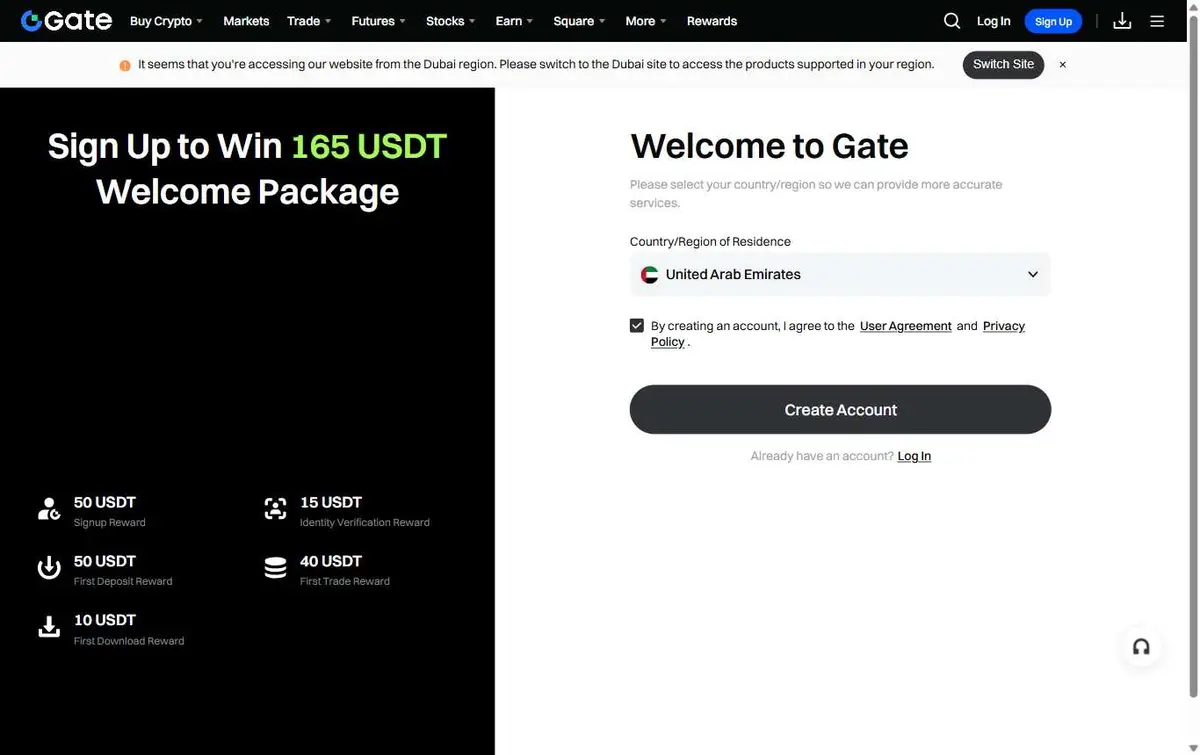
Notice shown Gate · Sign-up page
Pakistan, on Gate's list: sign-up loads with a notice that our address looks like Dubai (a virtual-location artefact)
“It seems that you're accessing our website from the Dubai region.”
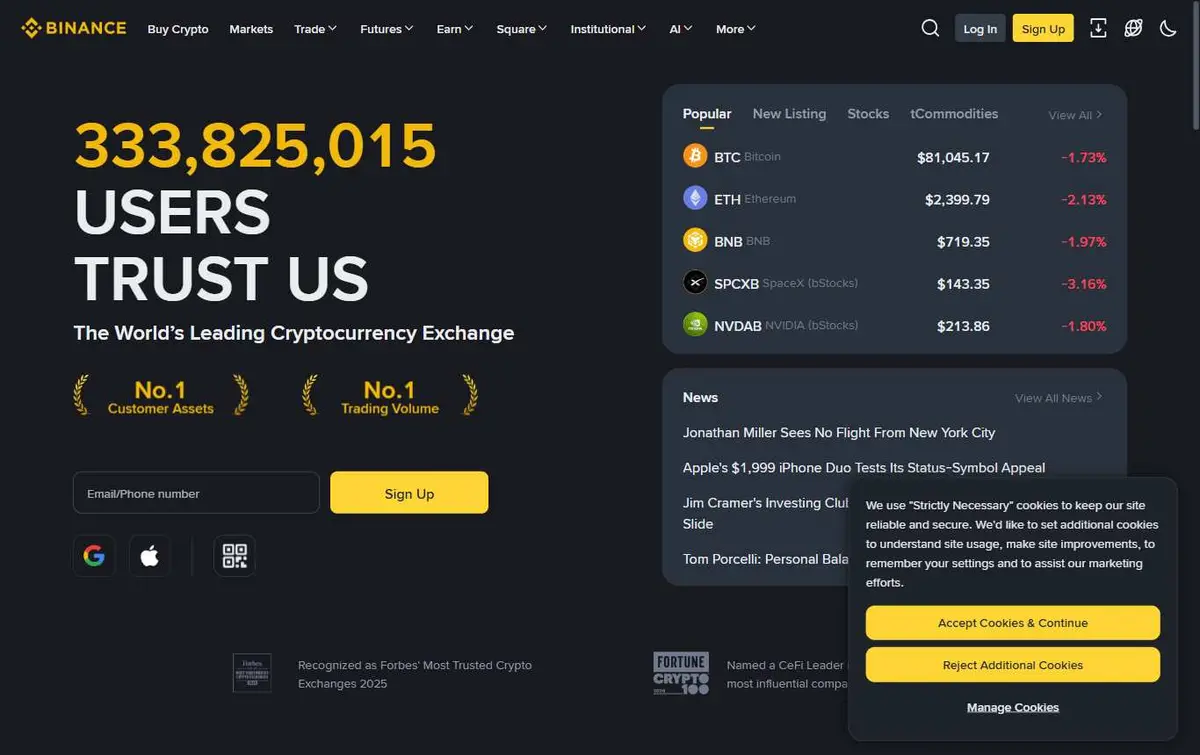
No barrier Binance · Home page
Pakistan: the global site loads with no notice
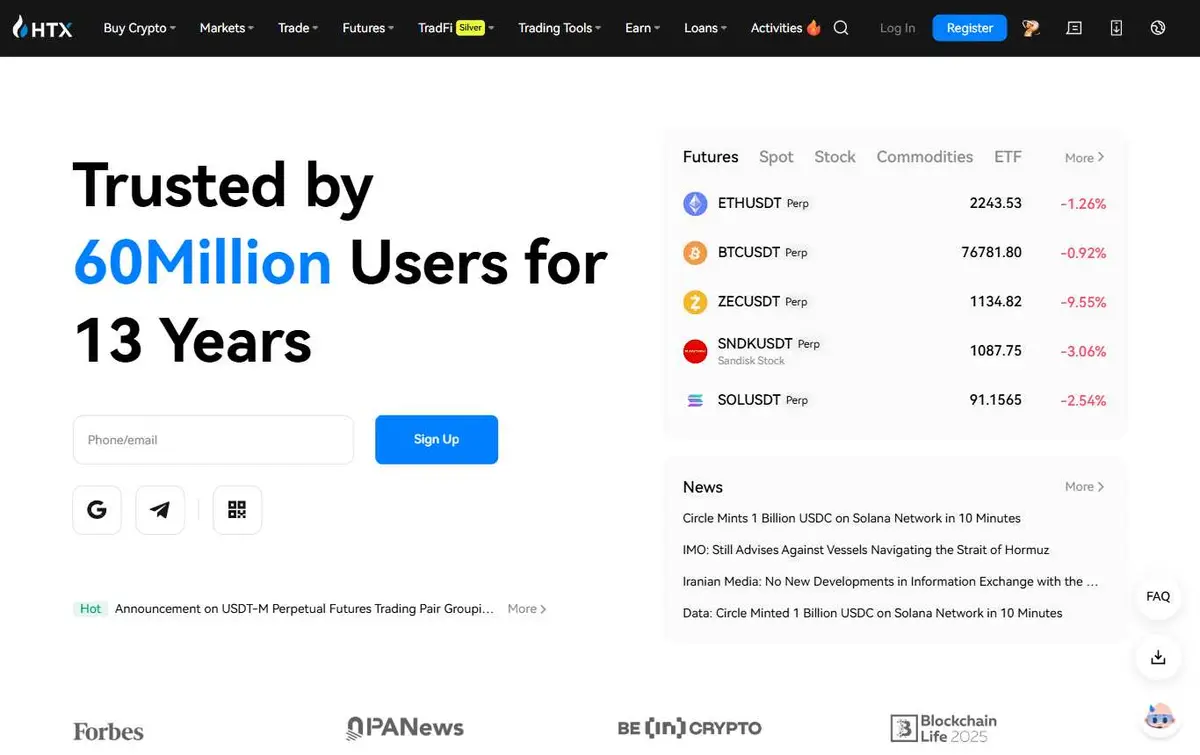
No barrier HTX · Home page
Pakistan: the home page loads with no notice
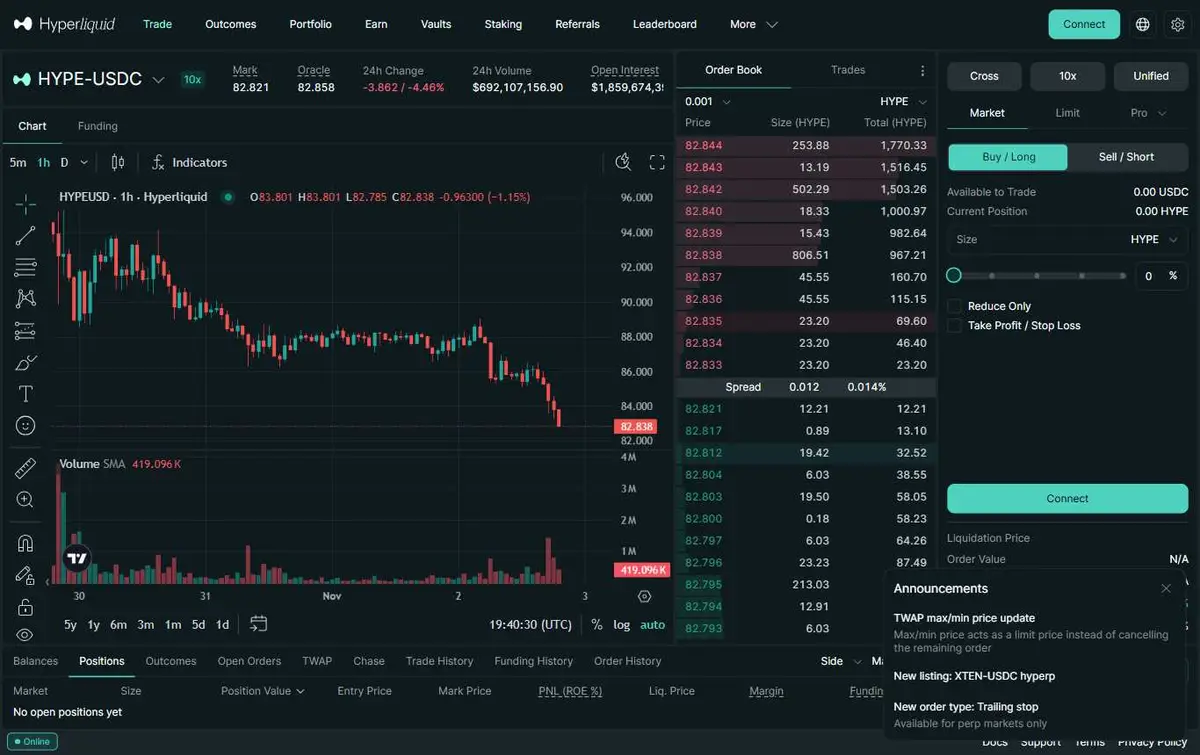
No barrierHyperliquid · Trading app
Pakistan: the trading app loads with no notice
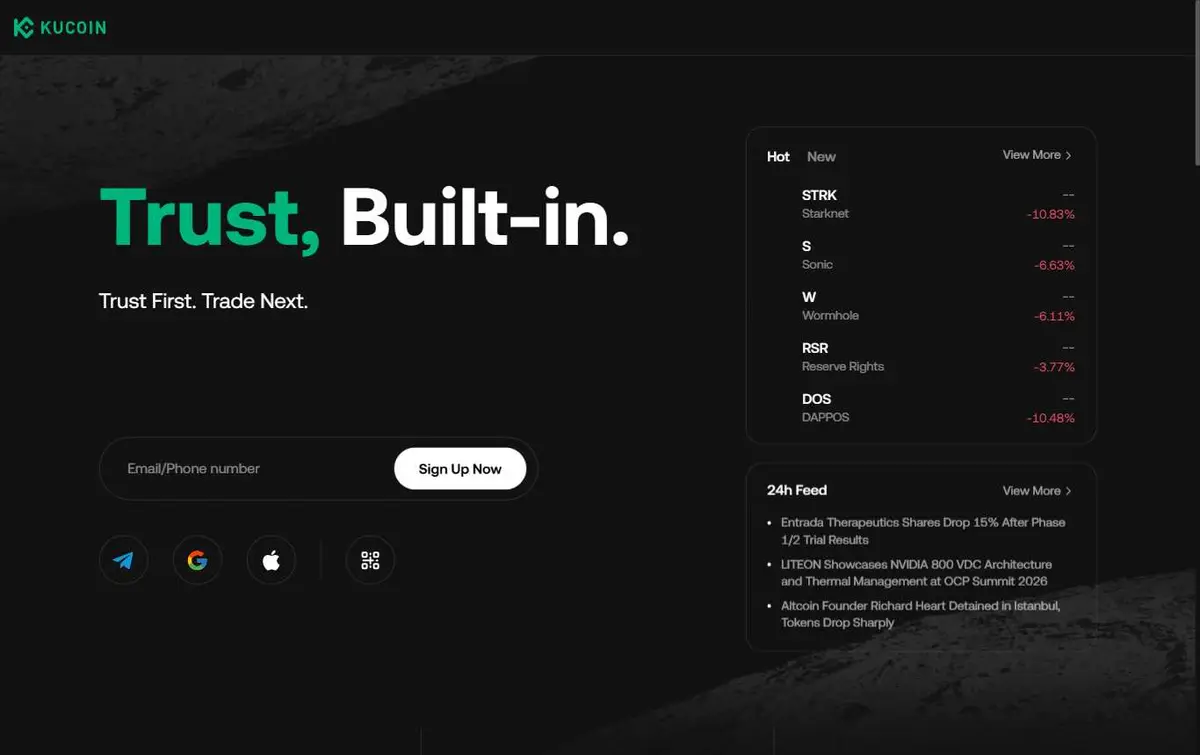
No barrier KuCoin · Home page
Pakistan: the home page loads with no notice
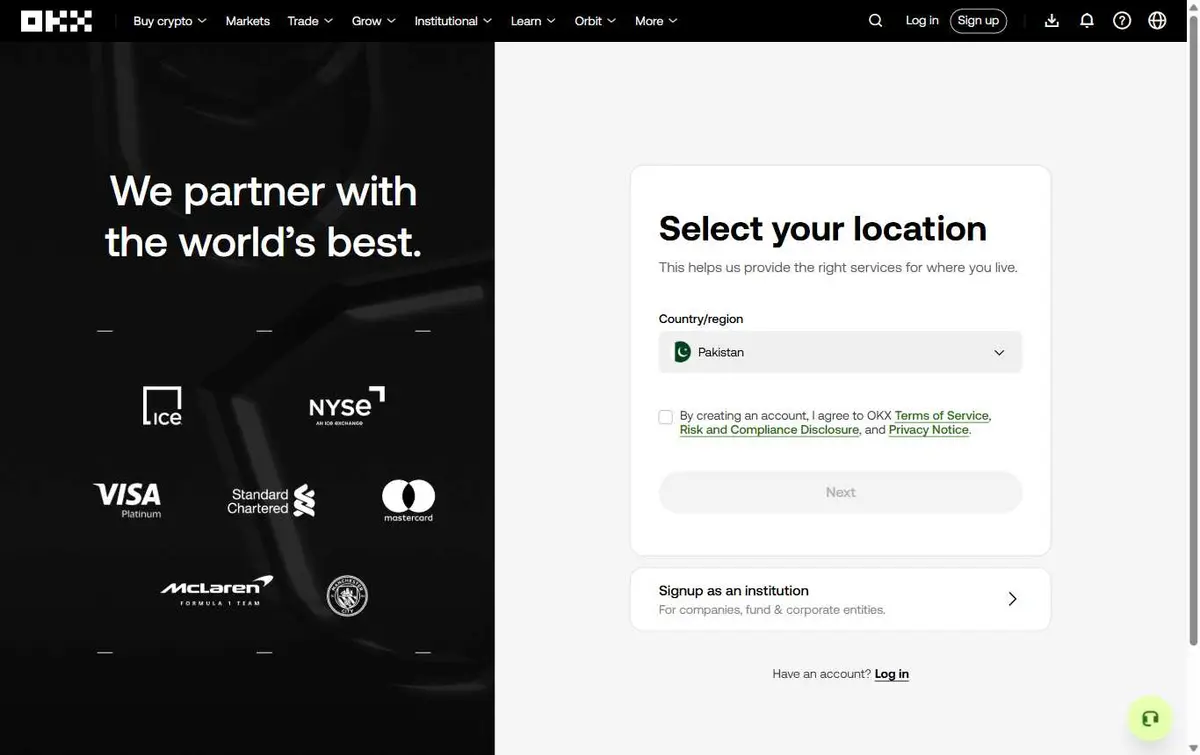
No barrier OKX · Sign-up page
Pakistan: the sign-up page loads with no barrier
 CRYPTORESTRICTIONS
Who regulates crypto in Pakistan?
PVARA licenses and supervises virtual asset firms, the State Bank decides how banks deal with them, and the Securities and Exchange Commission (SECP) sits on PVARA’s board and keeps securities outside the Act.
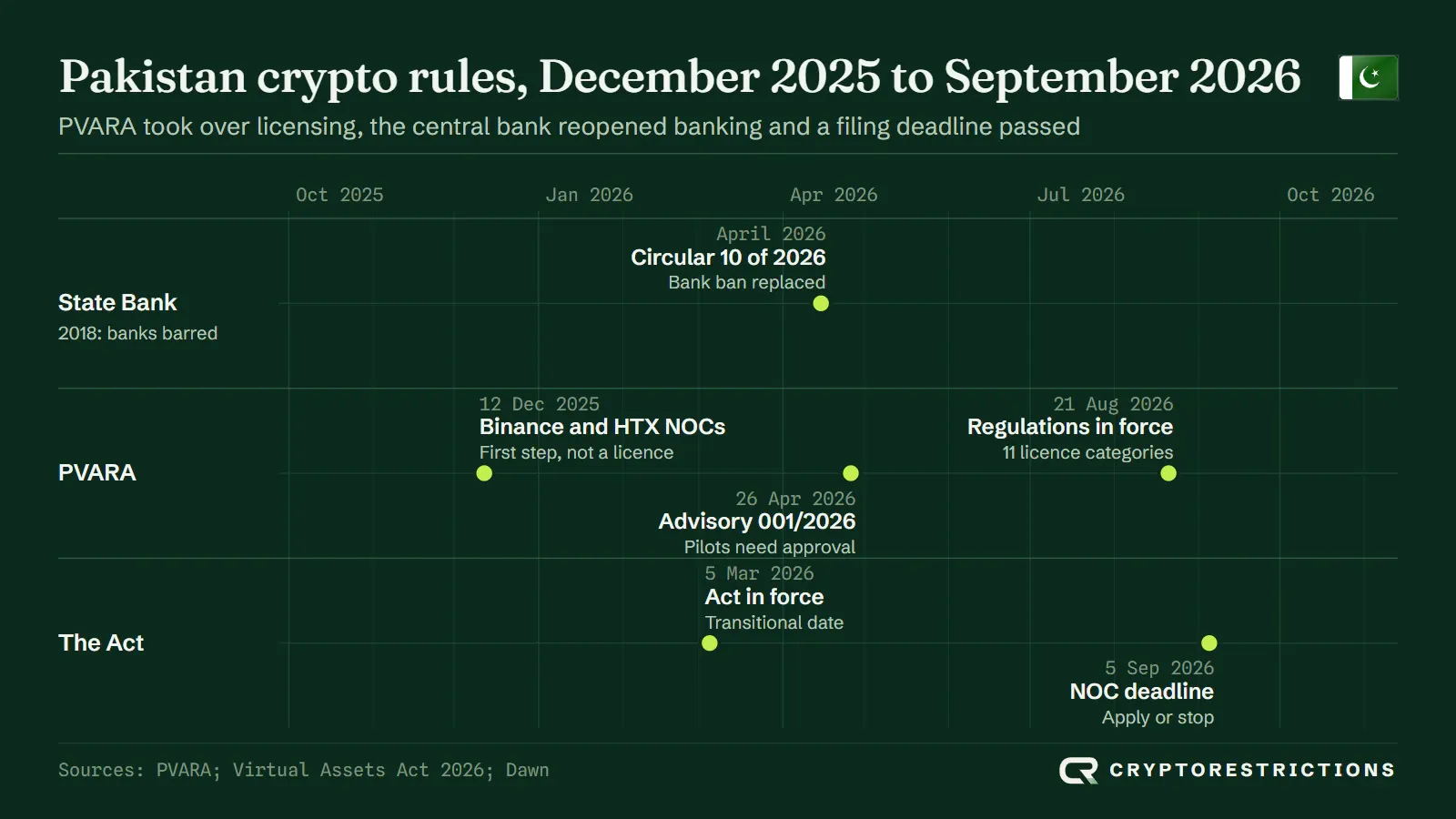
- PVARA. The statutory regulator under the Act. Its board has a chairperson appointed by the federal government, the secretaries of Finance and Law, the State Bank governor, the SECP chairperson, the chair of the National AML-CFT Authority, the chair of the Pakistan Digital Authority and two independent directors (section 7). Dawn named Bilal bin Saqib as chairman in December 2025. Its Virtual Asset Services Regulations came into force on 21 August 2026, with 11 licence categories. An advisory of 26 April 2026 says a pilot or partnership that enables virtual asset services needs PVARA’s prior authorisation, stablecoins for remittances included.
- State Bank of Pakistan. Issued the 2018 ban on bank dealings and its replacement in April 2026 (see the first section). Its governor sits on PVARA’s board.
- SECP. Section 2 of the Act keeps securities, derivatives and collective investment schemes under the State Bank and the SECP, outside the Act. The News reports that NOC holders work with the SECP to set up a local subsidiary.
- Pakistan Crypto Council. The government formed it in March 2025, per local reports that The Block cites, with Bilal Bin Saqib as chief executive and Changpeng Zhao as strategic adviser. The Block describes it as a government body that oversees blockchain and crypto initiatives.
Which crypto products are limited in Pakistan?
Banking is the tight point: banks may serve licensed firms but may not hold or trade crypto themselves. We found no ban on a product such as derivatives or peer-to-peer trading.
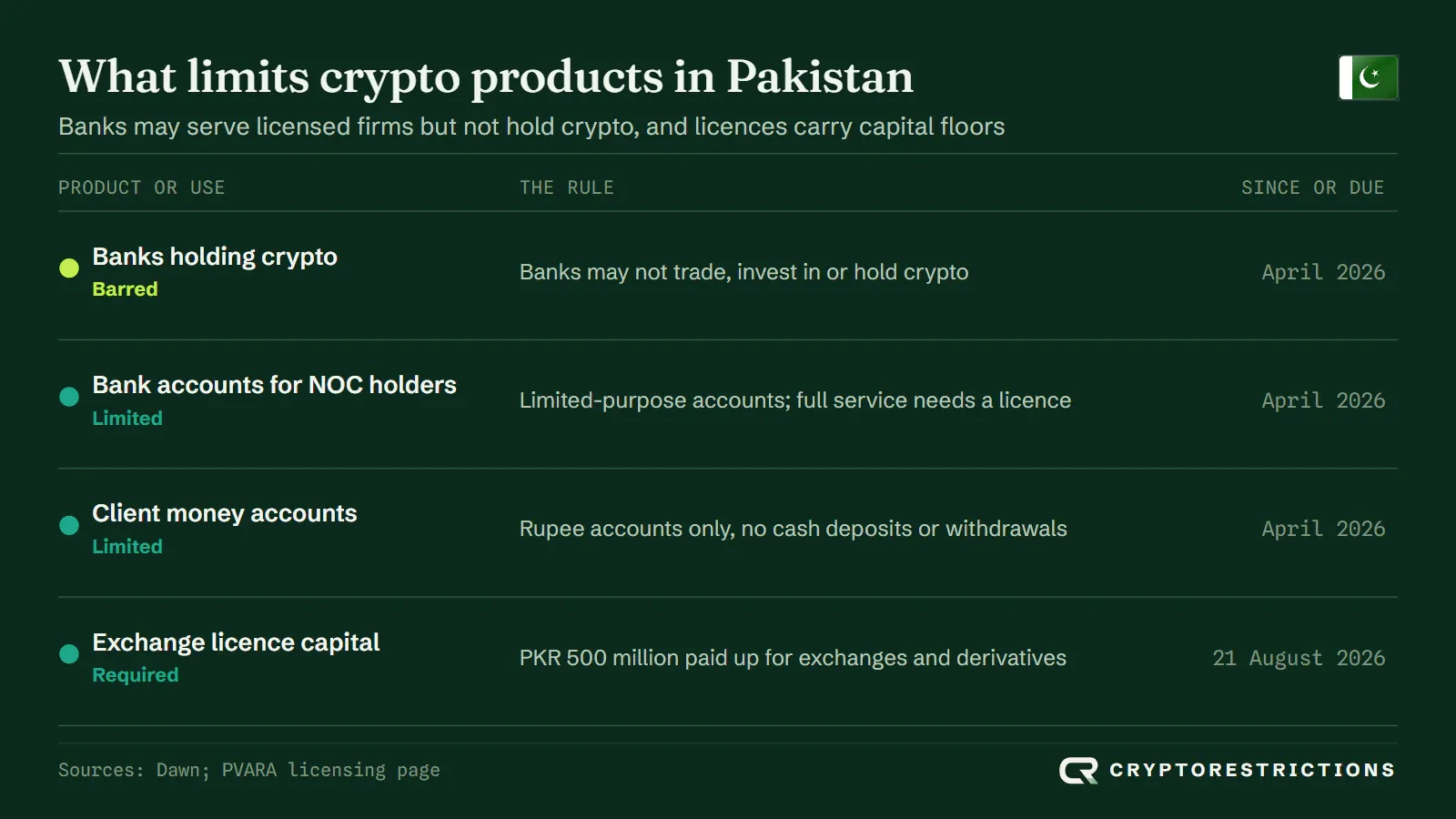
- Banks. Per Dawn, banks may open accounts for PVARA-licensed firms after checking the licence, use separate rupee client money accounts with no cash deposits or withdrawals, and may not invest in, trade or hold virtual assets with their own or customers’ funds.
- NOC holders. Dawn reports that firms with an NOC may get limited-purpose accounts to pursue their licence; fuller services need the licence itself.
- Capital. The licensing page sets minimum paid-up capital from 15 million rupees (advisory) to 500 million (exchange, lending and borrowing, derivatives, mining). Derivatives are a licence category, not a ban.
- Out of scope. Section 2 of the Act leaves out closed-loop tokens, securities, central bank digital currency and non-fungible tokens that are not used for payment or investment.
- Peer-to-peer trading. We found no State Bank or PVARA rule on it.
Are prediction markets legal in Pakistan?
The law is unsettled. The Prevention of Gambling Act 1977 defines gaming to include wagering or betting, and we found no ruling by PVARA, the Telecommunication Authority or a court on Polymarket or Kalshi, both of which are open to Pakistanis by their own lists.
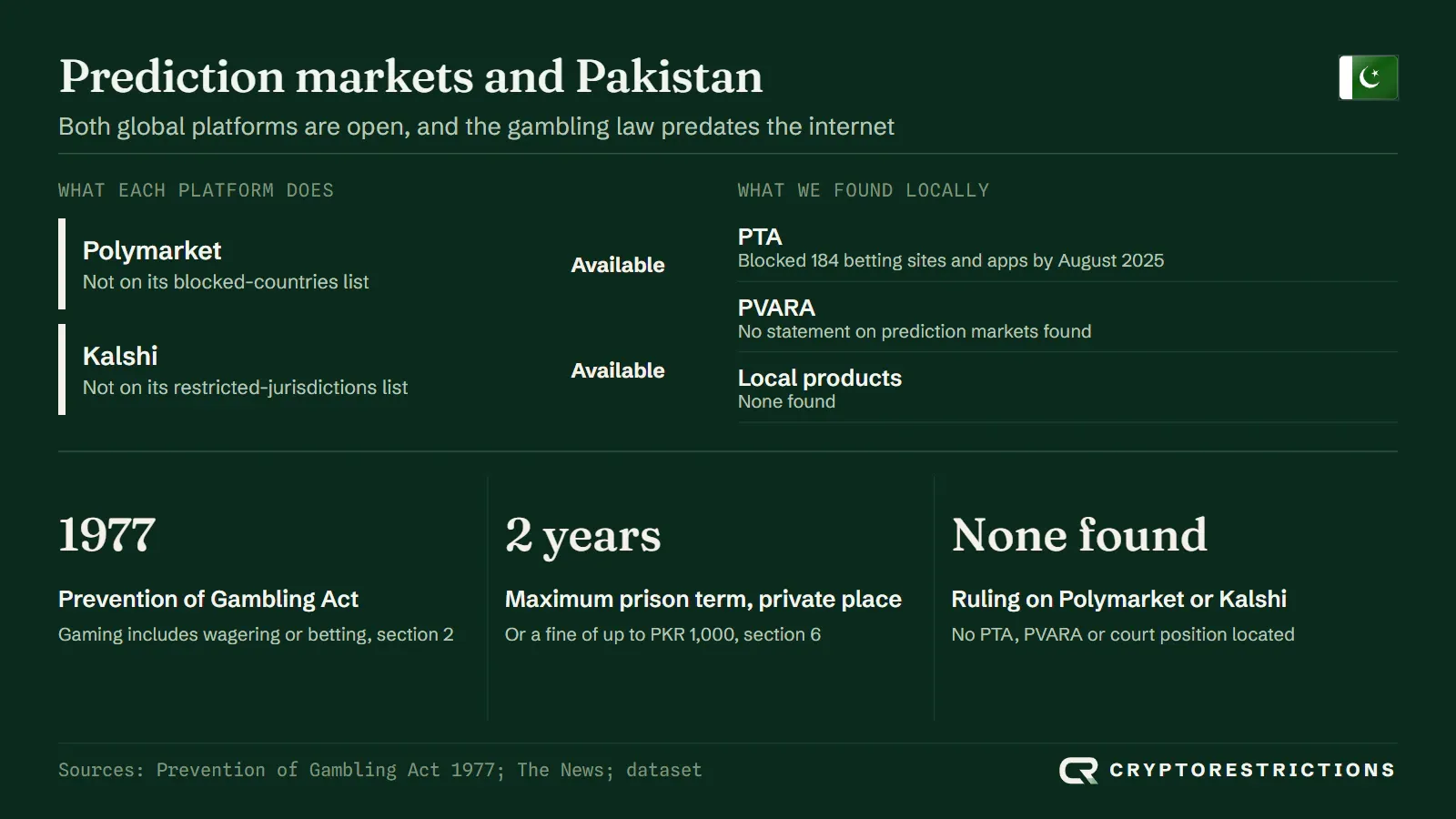
The Act extends to the whole of Pakistan. It defines “gaming” as including wagering or betting, and a common gaming-house as a place used for gaming for profit, or for gaming on figures, numbers, dates or the occurrence or non-occurrence of a natural event. Keeping one carries one month to one year in prison or a fine of 100 to 1,000 rupees; gaming in a private place carries up to two years or a fine of up to 1,000 rupees (section 6). It says nothing about online platforms or prediction markets, and we do not know how it would be applied to one.
On the online side, the Cabinet Division told the National Assembly in August 2025 that the Telecommunication Authority had blocked 184 betting and gambling websites and apps on complaints. We found no sign that Polymarket or Kalshi was among them, and no local prediction-market product. Polymarket and Kalshi list no Pakistani restriction. The Virtual Assets Act licenses derivatives but we found nothing in it on event contracts.
How is crypto taxed in Pakistan?
We found no crypto-specific tax rule. The Finance Bill 2026 text has no virtual-asset provision, though licensed firms must follow the Income Tax Ordinance 2001 and the rules of the Federal Board of Revenue (FBR).
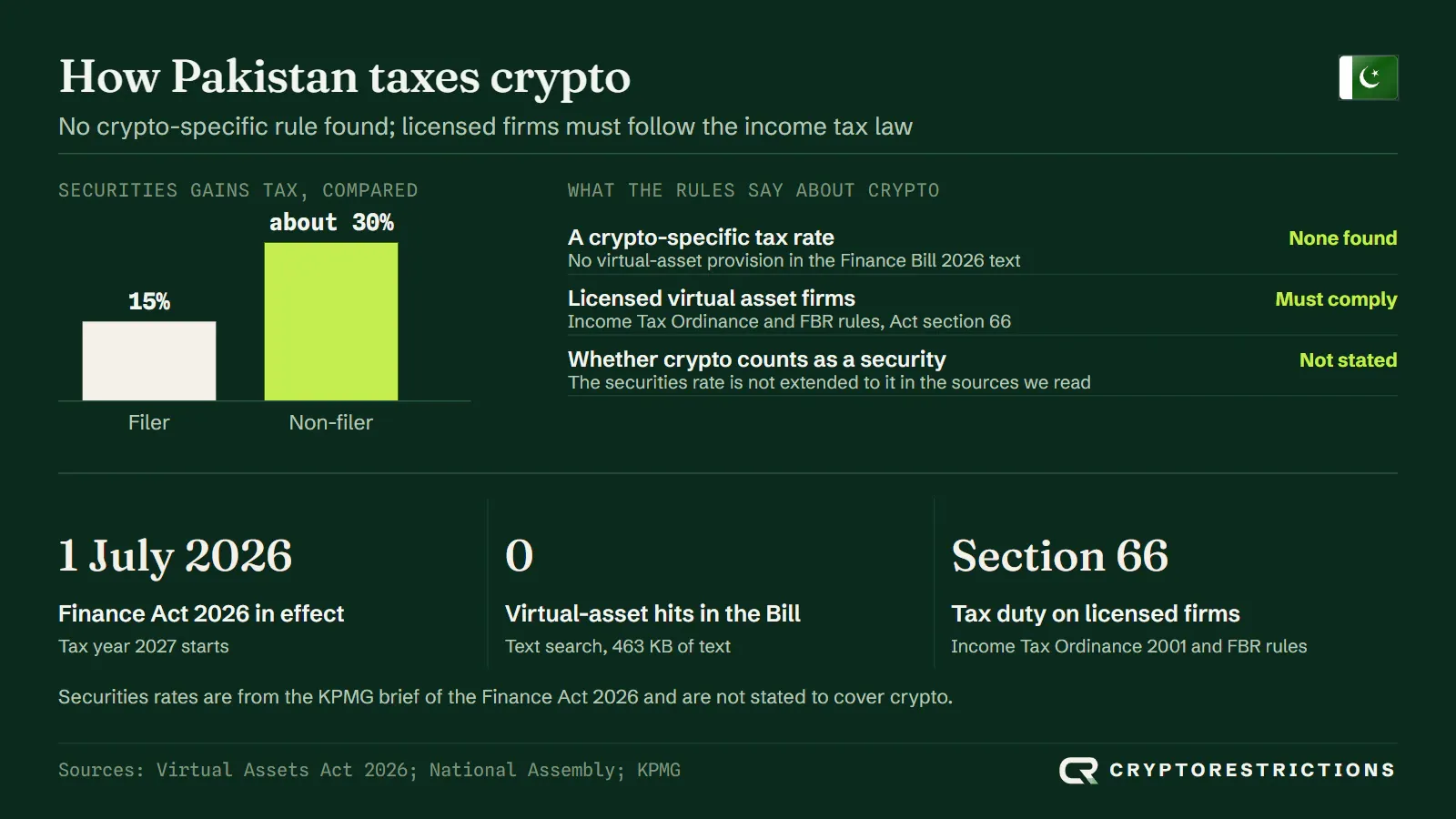
Section 66 of the Act requires every licensed firm to comply with the obligations under the Income Tax Ordinance 2001 and any FBR rules. That binds the firm, and the section sets no rate for a user’s gains. We text-searched the Finance Bill 2026 as presented in June 2026 for “virtual asset”, “crypto”, “digital asset” and “PVARA” and found none. The enacted Finance Act on the FBR site is an image scan we could not search, so the Bill and KPMG’s July 2026 brief, which lists no virtual-asset item, are our evidence. We also found no FBR guidance page on crypto.
The nearest rule is the tax on gains from securities. KPMG’s brief says that for securities acquired on or after 1 July 2024 it is 15% for people on the Active Taxpayers’ List (filers), while non-filers pay the ordinary slab rates with a 15% floor, and the Act’s removal of an exclusion doubles the rate collected from them. Pakistan’s tax year ends on 30 June, and the Act took effect on 1 July 2026. We found no source that says crypto counts as a security for this rule, so treat it as a comparison, not a rate that applies.

 Bahrain
 Georgia
 Qatar
 Israel
 Saudi Arabia
 Vietnam
 Bangladesh
 Indonesia
 United Arab Emirates
 South Korea
 Kazakhstan